America’s 1.5 million missing [B]black men is nothing short of genocide ::: theGrio

America’s 1.5 million missing [B]black men is nothing short of genocide

By   David A. Love

missing-black-men

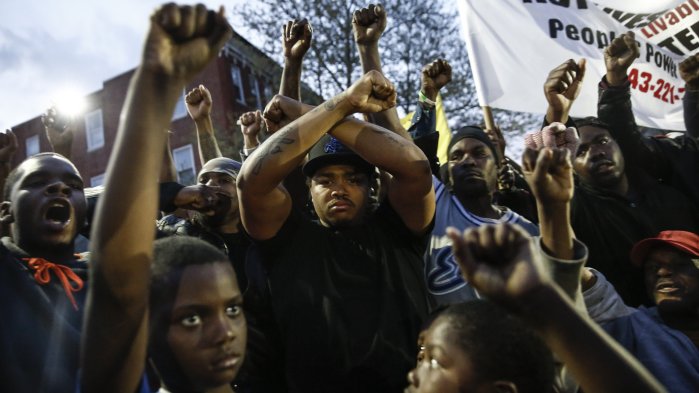
Protestors participate in a vigil for Freddie Gray down the street from the Baltimore Police Department’s Western District police station, April 21, 2015, in Baltimore, Maryland. Gray, 25, died from spinal injuries on April 19, one week after being taken into police custody. (Photo by Drew Angerer/Getty Images)

Where have all the brothers gone?

The numbers are staggering.

According to a report in The New York Times, black women between the ages of 25 and 54 outnumber black men by 1.5 million, based on an analysis of data from the 2010 U.S. Census. There were 7.046 black men of that age group not incarcerated, to 8.503 black women.

To put it another way, for every 100 black women, there are 83 black men. This is not the case in white America, where for every 100 women, there are 99 men, almost complete parity.

What that means, effectively, is that black men have disappeared. This reality lends credence to the idea that black men are an endangered species — not just symbolically or rhetorically, but based on the hard numbers.

Let’s explore this a little more. The Times estimated that more than a third of that 1.5 million gap — or 580,000 — is missing due to prison. With about 625,000 black men of prime age incarcerated and 45,000 black women also in prison, you get a discrepancy of 580,000. This is due, of course, to the staggeringly high incarceration rate of black men, which is higher than any other group, in the nation a quarter of the world’s prisoners, and the most prisoners in the world.

Putting this in perspective, in the 25-54 age range, 1 in 12 black men is in prison. However, only 1 in 60 nonblack men is in prison. Meanwhile, 1 in 200 black women and 1 in 500 nonblack women is behind bars.

Of the remaining 900,000, it was estimated that somewhere between 300,000 and 700,000 are due to mortality, early death. After all, homicide is the leading cause of death for young black men, who also die from heart disease, respiratory disease and accidents more than the rest of the nation.

The place in America with the lowest rate of black men is, believe it or not, Ferguson, Missouri, with 37.5 percent. New York is the city with the most missing black men (118,000), followed by Chicago (45,000), Philly (36,000) Detroit (21,000) and Memphis (19,000).

So what does this all mean? What struck me is that this is not a fluke, nor accidental, nor by chance. But rather, we can point to specific policies that have made black men disappear. First, I decided to look up the definition of the word genocide. The United Nations Genocide Convention defines genocide as the following:

ARTICLE II: IN THE PRESENT CONVENTION, GENOCIDE MEANS ANY OF THE FOLLOWING ACTS COMMITTED WITH INTENT TO DESTROY, IN WHOLE OR IN PART, A NATIONAL, ETHNICAL, RACIAL OR RELIGIOUS GROUP, AS SUCH:

(A) KILLING MEMBERS OF THE GROUP;
(B) CAUSING SERIOUS BODILY OR MENTAL HARM TO MEMBERS OF THE GROUP;
(C) DELIBERATELY INFLICTING ON THE GROUP CONDITIONS OF LIFE CALCULATED TO BRING ABOUT ITS PHYSICAL DESTRUCTION IN WHOLE OR IN PART;
(D) IMPOSING MEASURES INTENDED TO PREVENT BIRTHS WITHIN THE GROUP;
(E) FORCIBLY TRANSFERRING CHILDREN OF THE GROUP TO ANOTHER GROUP.

When society reinforces the notion that black men are a threat, then sets in motion laws and policies to address and ultimately eliminate that threat, is it any wonder that the brothers are missing? If the disappearing of black men is not genocide, then what should we call it?

Assessing the conditions in which black men are placed, and our historical role in society as the official national scapegoat, perennial boogeyman and monster, should we really be surprised we have disappeared? Society always believed that black men were to be fearedand loathed, devalued and disregarded. This mindset has been reinforced in the culture, in the media, and in the laws. During slavery, black men were perceived as a threat to the master’s house, criminalized based on the fear they would stage an uprising, burn down the plantation and, of course, rape the white women.

The war on drugs has been a war on black America, in which the justice system targets black men, locks them up and throws away the key. Although whites and blacks use drugs at similar rates, young men of color are racially profiled, harassed and brutalized through stop-and-frisk policies and arrested at much higher rates for drug possession. And the black incarceration rate is ten times that of whites, according to Human Rights Watch. Families and communities have been decimated by this war, and a generation lost.

From an early age, black children, and particularly black and brown boys, are dehumanized and criminalized and perceived as much older than their actual age. Funneled through a school-to-prison pipeline, many are provided an inferior education and unequal job opportunities — on purpose. And yet, in the land of 300 million guns, while the most vulnerable young black men and boys may not have access to a nourishing meal, education or job — or the ballot, for that matter — there never is a shortage of bullets for black bodies, it seems, and the black community is not a weapons manufacturer.

Further, we must not ignore the toll that racism plays on the black psyche, and on black health. As Billi Gordon, PhD wrote in Psychology Today, racism is causing a silent black genocide: “Stress acts first, and foremost, on the cardiovascular system. Hence, it is reasonable to suspect the pathophysiology of race-based stress as an antecedent to elevated heart disease in Black America.” Gordon also touched on the inherent sources of stress in the black community, including the numbers of black men in prison versus college, disintegrating support structures for black families, and the fact that the life expectancy of black men is seven years lower than anyone else.

In a land that advocates throwing away black men — in the streets, behind bars, and in the execution chamber — we now know the policy is a success, as the numbers show. The question is: how will society address this? This is not the past; this is happening now. Perhaps the idea of reparations does not sound so far-fetched.

Follow David A. Love on Twitter at @davidalove  

Visit theGrio 

OCG note:  Black when speaking of a group of people who share cultural and historical background and lineage is a Proper noun and should be spelled with a capital “B”. black is a noun which describes a color. Things journalist should know. Example:

  • A regular noun or generic noun might be that of a category of animal such as dog, cat, or horse. …
  • Individual species within the categories such as German Shepherd, Abyssinian, or Lipizzaner would be capitalized because they are proper nouns.

New Report: The Capitol of Suspensions: : Examining the Racial Exclusion of Black Males

New Report- The Capitol of Suspensions: : Examining the Racial Exclusion of Black Males in Sacramento County

Across the nation, Black males are routinely exposed to exclusionary practices that remove them from learning environments (Howard, 2008, 2013; Wood, 2017; Wood, Essien, & Blevins, 2017). These practices include over-placement in special education, in-school suspension, out-of-school suspension, and even expulsion (Losen & Skiba, 2010). Among these forms of exclusionary discipline, suspensions have been a topic of continued interest in the past several years, with numerous reports and studies demonstrating that California is home to some of the most egregious suspension patterns in the country.

As detailed in a recent report, GET OUT! Black Male Suspensions in California Public Schools, Sacramento County is ground zero for some of the highest total suspensions in the State. In fact, Sacramento county has the second highest total suspensions in California, falling only behind Los Angeles County. This rate exceeds those in other urban counties, such as San Bernardino, Riverside, Contra Costa, Alameda, and San Joaquin (Wood, Harris III, & Howard, 2018).

Prior research has demonstrated that students who are regularly suspended are being tracked into the prison industrial complex, a pattern often referred to as the school-to-prison pipeline. Thus, while some students are being socialized by schools for college-going and entering into the workforce, others are being socialized for prison. Moreover, research has also shown that those subjected to suspensions are more likely to enter into the permanent underclass and to have a reliance upon social services (Darensbourg, Perez, & Blake, 2010; Fenning & Rose, 2007; Skiba, Arredondo, & Williams, 2014). Bearing this in mind, this brief sought to highlight key facts about suspensions in Sacramento County. These facts are meant to generate conversations around issues of racial injustice and educational inequities that permeate the region’s educational institutions that fortify the economic and social health of the region.

This brief details the exposure of Black males to exclusionary discipline in Sacramento County. In particular, this report highlights the high suspensions of Black boys and young men in Sacramento County public schools. Some of the key findings include:

  • Black males are 5.4 times more likely to be suspended in Sacramento County than the statewide average.
  • Nearly 18 Black males were suspended, per day, in the county.
  • Sacramento County has four school districts in the top 20 suspension districts for Black males in the State of California.
  • Sacramento City Unified is the most egregious suspension district for Black males in the State of California.
  • Black males in early childhood education (kindergarten through third grade) are 9.9 times more likely to be suspended than their peers (statewide).
  • One third of all Black male foster youth are suspended in Sacramento County.

Full Report

Continue reading

A Note from OCG

We will now have an alt-right #SCOTUS There is little that we of goodwill can do about it now. It is too late for those who would, who could have to claim their government. We all know something is wrong – it has been for a very long time. When the horse is out of the barn, it is too late to put up a reminder sign to close the door.
#Trump and his GOP puppets are the biggest and most pressing problem, but not the only ones. We are cornered on all sides. A ruthless sheriff is in town and his deputies are everywhere. Poor people have been targeted among the unwanted. Public spaces and tax-rolled law enforcement are now weaponized to dispose of and make invisible, instill fear and isolation to “otherize” those deemed unworthy. Blatant acts of violations of fundamental human rights have become normalized forms of public policy enforcement and oversight.
Protest marches and protestations of any kind will not turn the time. While we idled in our fear of the Muslims, Al-Qaeda and Iranian powers. Wall Street and Washington’s swamp creatures were sucking the very oxygen from the air. Even your vote has been stolen and put up for sale. The GOP stands behind a corrupt and vile President because they know that their fate is controlled entirely by him – manipulation is expensive. The lifetime of emissaries can be fleeting at best.
As we enter the last era of my broadcast career, our message is profoundly fundamental:
1. Exposing wrongs is not the same as righting them.
2. What we knew as America has been forever changed. What we understood about it, remains the same.
3. Governments are not moved by shame. In this era, neither are politicians.
4.  If the House is not turned in November, there will be a seismic permanent shift in the       infrastructure of the republic. One where there is no undoing.
5.  Comrades and allies must be willing to make all kinds of serious sacrifice. If not, our children and grandchildren will be the sacrifice.
fiverr OCG_profile2
We look forward to being back with you in the Fall of 2018. Do we have what it takes to igniting the rights and dismantling the wrongs, to rescue those who don’t know they need rescuing ? I don’t know. We will see.


“Transforming Truth to Power, One Broadcast At a Time”

Students in Detroit Are Suing the State Because They Weren’t Taught to Read

Students in Detroit Are Suing the State Because They Weren’t Taught to Read

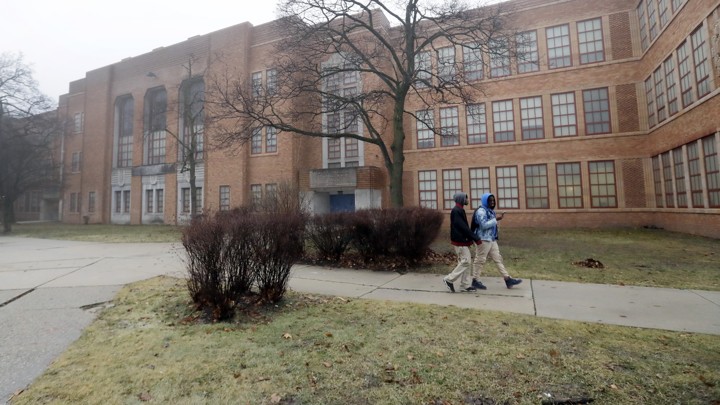
Students walk outside Detroit’s Pershing High, which isn’t one of the institutions named in the suit but was identified as one of the city’s lowest-performing schools CARLOS OSORIO / AP

What to do when a school is infested with vermin, when textbooks are outdated, when students can’t even read? Perhaps the answer is sue the government.

That’s what seven students in Detroit have done. Their class-action suit filed against the state of Michigan asserts that education is a basic right, and that they have been denied it.

 Usually, such education-equity cases wend their way through state courts, as all 50 state constitutions mandate public-education systems, while the country’s guiding document doesn’t even include the word education. But this case, Gary B. v. Snyder, was filed in federal court, and thus seeks to invoke the Constitution. And as of this week, it’s headed to the federal appeals court in Cincinnati.

The lawyers filing the suit—from the pro bono Los Angeles firm Public Counsel—contend that the students (who attend five of Detroit’s lowest-performing schools) are receiving an education so inferior and underfunded that it’s as if they’re not attending school at all. The 100-page-plus complaint alleges that the state of Michigan (which has overseen Detroit’s public schools for nearly two decades) is depriving these children—97 percent of whom are students of color—of their constitutional rights to liberty and nondiscrimination by denying them access to basic literacy. Almost all the students at these schools perform well below grade level in reading and writing, and, the suit argues, those skills are necessary to function properly in society. It’s the first case to argue that the U.S. Constitution guarantees the right to become literate (and thus to be educated) because other rights in the Constitution necessarily require the ability to read.


Continue reading

Amazon continues to profit from the sale of white-supremacist propaganda

July 6 at 6:00 AM  

The Washington Post

“Hate movements really rely on symbolism to carry their ideologies and signal their belief systems to other members of their tribe,” said Carrie Sloan, research director for the Action Center on Race & the Economy. “It’s so easy to go to Amazon and get a backpack to signal that your kid is somehow connected to neo-Nazi and white-nationalist ideology.”

Shoppers can purchase Amazon.com merchandise displaying symbols of white supremacy, such as a swastika necklace, a baby onesie with a burning cross, and a child’s backpack featuring a neo-Nazi meme, all in contradiction of the retail giant’s policy against selling products that promote hatred, according to a new report from two watchdog groups.

Amazon’s policy says that “prohibited listings” on its website include “products that promote or glorify hatred, violence, racial, sexual or religious intolerance or promote organizations with such views.” But the report, to be released Friday by the Action Center on Race & the Economy and the Partnership for Working Families, argues that Amazon is failing to adhere to its own policy by allowing the sale of dozens of products in its online store as well as its publishing and music platforms that facilitate the spread of racist ideology.

“It’s clear that Amazon is bringing in money by propping up these hate organizations and allowing them to spread these messages in a moment of rising white nationalism and violence,” said Mariah Montgomery, campaign director for the Partnership for Working Families. The Action Center on Race & the Economy and the Partnership for Working Families are national nonprofit organizations that say they are focused on advancing racial and economic justice.

Continue reading

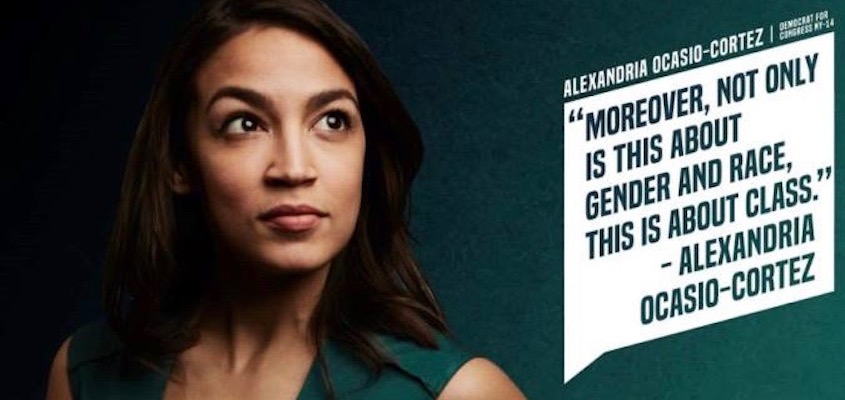
Freedom Rider: Ocasio-Cortez and the Left

Freedom Rider: Ocasio-Cortez and the Left

Margaret Kimberley, BAR editor and senior columnist

“Ocasio-Cortez deserves credit for beating a corrupt but powerful system.”

Freedom Rider: Ocasio-Cortez and the Left

Alexandria Ocasio-Cortez is a living Rorschach test for leftists. Her primary win over incumbent Joseph Crowley in a New York City congressional district is impressive on many levels. But the reaction to her victory demonstrates the sad state of affairs of left wing politics in this country.

The contradictory responses from people who are otherwise in agreement is the result of defeat after defeat and the lack of consensus on how to change the paradigm. The Democrats are the putative party of progressives but over the years they have morphed into a center right formation that differs all too little from the far right Republicans.

Regardless of motive Crowley was, as the saying goes, “phoning it in.” He had a lackluster debate performance and then didn’t show up for another. Instead he sent a former City Council Member to represent him. That level of disrespect was punished when voters went to the polls. It is true that turnout was low but such is the always the case in primary races. A win is a win and Ocasio-Cortez deserves credit for beating a corrupt but powerful system.

“The Democratic Party gas lighting which blames Jill Stein or Bernie Sanders or Vladimir Putin has been all too successful.”

Now the Democrats can’t even muster a “lesser evilism” argument after having lost state houses, Congress and, finally, the presidency. Left wing disdain for them is well deserved but there is still no agreed upon mechanism for ending their rule. In addition, the fear of being labeled a spoiler is still quite strong. The unbridled racism of the Donald Trump administration doesn’t make the debate any easier. The Democratic Party gas lighting which blames Jill Stein or Bernie Sanders or Vladimir Putin has been all too successful. The protection racket for failure has worked quite well.

Ocasio-Cortez is in the unenviable position of being dismissed by some leftists because she is a Democrat at all or lionized by others when she ought to be called to account. The Democratic Party bosses have already dismissed the significance of her win over a man who had a 10:1 fund raising advantage. That in itself is reason to give her credit. A large war chest is used not just to defeat but to scare off challengers before they can even mount a campaign. It isn’t surprising that Democratic Party leadership seek to minimize her achievement. If others follow in her footsteps the house of cards may begin to wobble.

“Ocasio-Cortez’s Peace Economy platform disappeared from her campaign website.”

Even Latino political leadership didn’t back her. Crowley’s debate stand-in was Latina and even Bronx borough president Ruben Diaz, Jr. lamented Crowley’s loss. “It’s unfortunate he had a primary,” said Diaz. “We need him in Washington D.C. Washington is about consistency and seniority.” It seems that black people aren’t the only group with a misleadership class.

But Ocasio-Cortez can’t be let off the hook either. Astute observers noticed that her Peace Economy platform disappeared from her campaign website. She blamed a volunteer-run web team and promised to “look into it.” A few days later the statement reemerged but doubters such as this columnist believe that it would never have reappeared if she hadn’t been questioned about its absence.

Ocasio-Cortez is expected to be all things to a desperate group of people. She both benefits from her connection to Bernie Sanders and is tainted by his sheep dogging for the Democrats. Yet she is rightly held up as a hopeful sign by people eager to see even a small chance of progressive politics taking hold. Alexandria Ocasio-Cortez is actually not the only issue for debate. The discredited Democratic Party and the inability of leftists to mount a successful attack against it should also be a focal point of discussion.

“Even Ocasio-Cortez falls prey to using liberal gibberish about America being a ‘force for good.’”

The Democrats have purged any semblance of progressive politics from their ranks. Democratic party attacks and Republican chicanery were used to end Cynthia McKinney’s congressional career. When Ohio lost a congressional seat after the last census it was no surprise that Dennis Kucinich ended up with the short straw. There isn’t one Democratic member of congress who consistently advances an anti-war platform. Even Ocasio-Cortez falls prey to using liberal gibberish about America being a “force for good” and demanding congressional approval for wars that should never be waged at all. But if she wins her general election in November she will be the lone member who says anything at all about the issues of war and peace.

Yet it is proper, indeed it is necessary, to call her to account when she follows Bernie Sanders and others in repeating unproven assertions that the Russian government helped Trump to victory. She can’t be held up as a progressive icon if she sounds like the imperialist democrats eager to deflect blame for their failures.

“There isn’t one Democratic member of congress who consistently advances an anti-war platform.”

In the final analysis progressives should keep Ocasio-Cortez under scrutiny lest she fall prey to big money and the pull of a partywhich wants to stamp out any and all divergence from their losing but powerful apparatus. The Democrats are openly backing former intelligence operatives and ex-military candidates to win in November. Ocasio-Cortez should be supported if only to fight against the Democrats and their ever more rightward moves.

The fight isn’t hers alone. The difficult discussions, debates and struggles must be waged by everyone. If not the leftist perpetual beat down will go on without resolution. We will be left with endless and useless argument rather than finding a way to make successful progressive politics a reality.

Margaret Kimberley’s Freedom Rider column appears weekly in BAR, and is widely reprinted elsewhere. She maintains a frequently updated blog as well at http://freedomrider.blogspot.com . Ms. Kimberley lives in New York City, and can be reached via e-Mail at Margaret.Kimberley(at)BlackAgendaReport.com.

black agenda report

Was Donald Trump’s Election Miss Ann’s Revenge? :: Amy Alexander

Miss Ann’s Revenge

With 53 percent of white women ages 45 to 64 voting for Donald Trump, was it a deliberate act meant to put blacks in their place?

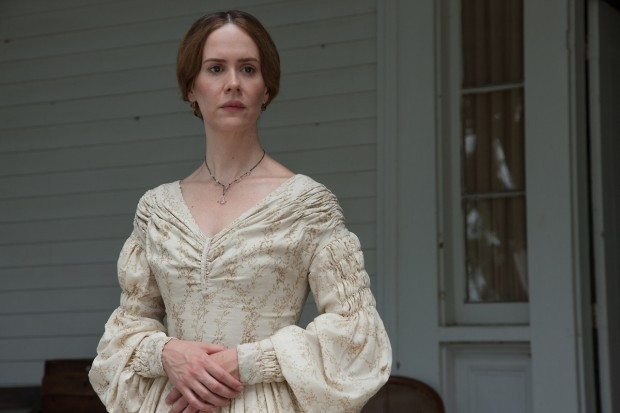
Sarah Anne Paulson as Mary Epps in the film 12 Years a Slave
Sarah Anne Paulson as Mary Epps in the film 12 Years a SlaveFOX SEARCHLIGHT

It’s time to talk about the “Miss Ann effect.”

In the wake of the stunning news that more than half of white women who voted on Nov. 8 opted for Donald Trump, I have concerns—and questions.

I’m aware that not all white women are racist. But given the significant number of white women who supported Trump, it is legitimate to at least question their motives—especially the thinking of those who are college-educated and middle-class.

Exit-polling data from CNN tells the tale:

  • Total percentage of white women who voted for Trump: 42 percent;
  • White women ages 30-44 who voted for Trump: 42 percent;
  • White women ages 45-64 who voted for Trump: 53 percent;
  • Percentage of white women with college degrees who voted for Trump: 45 percent.

Were they responding to Trump’s sickening call to “take back our country”? If so, take it back from whom, exactly? And bring it where?

For college-educated white women, especially those who are in their 30s or 40s and who have jobs; for white women who have benefited from affirmative action, you have to wonder why they felt it a good idea to support a man who is not smart and who demeans people of color, the disabled and even white women.

If you are driven by fear, we would like to know: Exactly what you are so afraid of?

I’m on the record—unironically, and without snark—as saying that many of my best friends are white women. I don’t feel obliged to spend a lot of time here outlining my bona fides on this front. But it is obvious that millions of white women whom I probably would not ever have identified as racist or even “racism-blind” betrayed me and mine by voting for Trump.

And adding to the disillusion I am now experiencing is that fact that many of the white women who helped the untested, boorish, stunningly ignorant 70-year-old white man in his mad quest to replace our nation’s first black president were stealthy if not downright deceptive about their reasons.

I’m here now to call it out.

What Drives Miss Ann? I’m Glad You Asked

In black America, the shorthand for women who harbor virulent fear and resentment of black people—however covertly it is expressed here in the 21st century—are known as “Miss Anns.” It is our not-so-secret vernacular description of white women who were the wives, sisters, daughters and mothers of slave owners in the Deep South.

This figure, and her sometimes sly, always pernicious way of expressing her fear and resentment of blacks, is a recurring theme in black American literature, because Miss Ann was with us hundreds of years before Barack Obama was born to a white woman from Kansas. Her sense of entitlement blends with incipient curiosity about blacks in general and about black men in particular, and suggests, in all probability, an attraction that she cannot readily articulate. The resulting defining character trait of Miss Ann is the unacknowledged passion that seemingly drives the anger she will inevitably express.

If you’ve ever read Zora Neale Hurston or Maya Angelou, you have seen this reference. If you viewed the Academy Award-winning film 12 Years a Slave, you have seen the “Miss Ann” type embodied in the terrific performance of Sarah Anne Paulson as Mary Epps, the wife of the owner of a plantation where the protagonist, Solomon Northup, was held.

I’ll take this moment to remind you that while creative license was taken by filmmakers, and undoubtedly by the original publishers, Northup’s story is real. The Mary Epps portrayed by Paulson, with a cataclysmic range of hate expressions from seething silence to explosive violence, is based on women that Northup dealt with during his horrific journey from freedom to slavery and back again. The invoking of their privileged status; their belief, however inchoate, that their “virtue” must be protected at all costs, and certainly at the expense of black, brown or other marginalized folks, is a key Miss Ann trait.

In the wake of the stunning news that more than half of white women who voted on Nov. 8 opted for Donald Trump, I have concerns—and questions. I’m aware that not all white women are racist. But given the significant number of white women who supported…

What likely drove many of the white female Trump voters is the same instinct that drove white women to accuse black men of all manner of imagined affronts since at least the antebellum era: a deep, innate fear and resentment of black people, particularly of black men.

The patriarchal motif looms large in attempts to answer the question of what white female supporters hope to gain by voting for Trump. It isn’t strictly a zero-sum game of reaping “gains” per se, as much as it is holding ground that some white women perceive as being theirs alone: The white women who approved of Trump as leader of the free world are betting on his ability to preserve their protected status.

Whether they acknowledge it or not, white women do enjoy a higher rung on the social and economic order in the U.S. than do black and Latino women. The perceived “halo effect” of being in close proximity to powerful white men appears to be at the least a subtext of what drove some white women to vote for Trump.

Wall-to-Wall Media Coverage of Election 2016 Didn’t See Miss Ann

I’m not qualified to make a deep dive into the history of psychosocial causal factors for why some white women apparently still harbor such virulent fear and resentment of black men. And it also must be said that by now, versions of this resentment are directed at black women. This dynamic likely did inform the decisions of millions of white women who voted for the GOP candidate Nov. 8.

That their peculiar sentiments were not explored in detail and revealed by the legions of pollsters, campaign correspondents and pundits is cold comfort. I actually take responsibility, short of feeling guilty, for having missed this possibility that as America’s first black president, and his wife and children, occupied the White House—quite literally serving as the embodiment of the United States in the eyes of the world—there were millions of Miss Anns out there quietly seething.

The “Security Moms” who helped elect George W. Bush president in 2000 and 2004 were likely reacting to at least deeply buried Miss Ann instincts. And the periodic episodes of millennial-age white women such as Lena Dunham—who pride themselves on being “woke” and yet can slip right quick into Miss Ann behavior—is an example of the powerful effect. The 2013 episode in which a white woman named Ellen Sturtz rudely interrupted remarks by first lady Michelle Obama during a Washington, D.C., fundraiser is another stark example of Miss Ann entitlement.

Now, staring into the yawning abyss of a Trump presidency, I feel acutely that I’ve been betrayed. I’ve written before about my on-again, off-again concerns about the role of deference in black-white relationships in America, how individuals and institutions and systems are still shaped by long-standing expectations that blacks must always defer to white needs and preferences. Social media warriors such as DeRay Mckesson have pushed phrases like “white privilege” and “intersectionality” onto the public debating stages, which is good and bad: There are powerful platforms now and access to megaphones to define our positions … which inevitably makes many white people uncomfortable.

I make no excuses for them; I am only pointing out that chief among those most recently made uncomfortable by social and political developments over the past few decades are white women.

I have had my own run-ins with variations of the Miss Ann effect over the years. I just never considered that any women in my sphere—in my age, occupational or education cohort—might do such a damaging thing as vote for Trump.

Now I’m compelled to look more closely at some of the women I encounter on the regular; to regard them, not with fear or even stark trepidation, necessarily, but certainly with a far more cold-eyed assessment of what might lie beneath the smiles and words of bonhomie.

The Miss Anns of 21st-century America are no longer yelling at their menfolk to lash us harder. But by voting for Trump, and approving his leadership of the most powerful government in the world, they weaponized a terrible instrument of oppression to keep us in our place.


Amy Alexander, an award-winning writer and editor in Silver Spring, Md., is the author of four nonfiction books and has contributed to The Atlantic, The Nation, the Boston Globe and NPR. Amy is an OUR COMMON GROUND Voice


Source: Was Donald Trump’s Election Miss Ann’s Revenge?

OUR COMMON GROUND with Janice Graham

Each Saturday LIVE & Call-In

10 pm ET

Join us on FACEBOOK and Learn More about us.
OCG on Facebook
Enjoy our archive of all OCG past broadcasts.

OCG on the Web: https://ourcommongroundtalk.wordpress.com/
Community Forum: http://www.ourcommonground-talk.ning.com/
Follow us on Twitter: @JaniceOCG #TalkthatMatters

Black Nationalism and Liberation | Boston Review


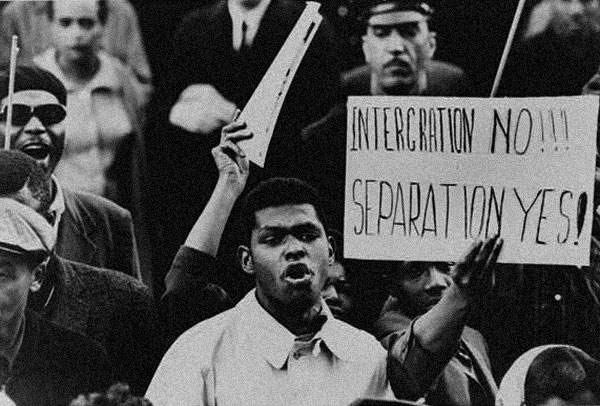
Nation of Islam counter-demonstration at NAACP rally in Harlem, 1961 / Photograph: NAACP collection, Library of Congress

In a world where Donald Trump’s presidential nomination speech has been endorsed by a former leader of the Ku Klux Klan—yet Black Lives Matter activists are accused of reverse racism for asking to not be murdered by police—what constitutes hate speech has become increasingly convoluted. In the aftermath of police killings in Dallas and Baton Rouge, gunmen Micah Johnson and Gavin Long were immediately linked by media outlets to black nationalist groups such as the Nation of Islam (NOI), New Black Panther Party, Black Riders Liberation Party, and Washitaw Nation, despite their professions to have been acting alone. Not only did these depictions draw misleading lines to organizations that do not prescribe such acts of violence, they also overshadowed both mens’ backgrounds in cultures of military violence (Johnson joined the Army Reserves immediately after high school and Long was a former Marine sergeant).

In a desperate attempt to drive home a link to black nationalism and direct attention away from these other troubling vectors, some news outlets began referring to Johnson as “Micah X” (NOI members use “X” to replace their “slave names”). In fact his middle name was simply Xavier. Even progressive groups, such as the Southern Poverty Law Center, play a legitimating role by identifying black nationalist groups as “black separatist hate groups,” leaving little room for meaningful distinctions between white supremacy and black nationalism. While groups such as the Nation of Islam have historically advocated for the separation of black communities, to assert that this position is simply the obverse of white supremacy—that is, black supremacy—overlooks the nuance of black nationalism. More importantly, it fails to account for the dramatically different relationships to power that black nationalist and white supremacist groups possess. White nationalism reinscribes and exalts the privileges of whiteness. Black nationalists council separation as an anti-racist practice and a method of empowerment in the absence of alternative avenues of power. To many black nationalists, this is the difference between life and death: the black community must either do for itself or perish.

The conflation of black and white nationalism is not new. In 1963 the New York Herald Tribune satirized what it perceived as the ironic similarities between white supremacists and black nationalists in a story entitled “Integrated Segregation.” Things “seem a trifle confused on the racial front these days. The segregationists are getting integrated and the integrationists are getting segregated,” the Tribune remarked. The article imagined a scene in which staunch segregationist George Wallace was explaining why racial segregation benefitted black Americans when “a Black Muslim popped up from behind, tapped him on the back and agreed with him.” Soon, the article predicted, the Congress for Racial Equality would “start picketing the N.A.A.C.P., while the Black Muslims set up an all-Negro chapter of the Ku Klux Klan.”

To many black nationalists, separation from whites is the difference between life and death: the black community must either do for itself or perish.

Understanding black nationalism as simply the mirror image of white supremacy, rather than an anti-racist practice, has deep roots in American political discourse. And in our current moment of colorblind “post-racialism,” when race-specific remedies such as affirmative action or reparations are derided as reverse racism—and even modest demands from Black Lives Matter for criminal justice reform are decried as anti-white—black nationalism has been once again mischaracterized using a host of long-stale tropes. We would be better served, not by simply dismissing black nationalism as the underbelly of white supremacy, but by understanding it as a tradition that is both liberative and anti-racist; one that does not mirror white supremacy, but repudiates it.

section separator

W. D. Fard, the founder of the Nation of Islam, arrived in Detroit in 1930 and told black Detroiters that they “were not Americans but Asiatics.” This was part of a holistic alternative creation story that rejected the racist underpinnings of white American nationalism. Many of Fard’s followers were former followers of Marcus Garvey, left without an organization after the decline of his Universal Negro Improvement Association (UNIA) in the late 1920s due to financial mismanagement and government infiltration. Garvey and the UNIA epitomized the goals of black nationalism, launching the most ambitious and successful Pan-Africanist vision in history. At its height, the UNIA had over 700 branches in 38 states, and its newspaper, Negro World, circulated throughout the African diaspora. Millions of black people were moved by Garvey’s message of racial pride embodied through the UNIA motto “One God! One Aim! One Destiny!” The NOI borrowed many of its black nationalist tenets from the UNIA, combining them with religious symbols, practices, and theologies drawn from the plethora of new northern, black, urban religious and racial-pride movements spawned by the Great Migration. This blending spoke to the diverse backgrounds of many early NOI members: in 1951 nineteen out of twenty-eight Muslims interviewed reported having previously been members in other movements such as black Masonry, the Israelite Movement, God’s Government on the Earth (dedicated to Liberian emigration), the Peace Movement of Ethiopia, Repatriation Movement to Liberia, and the Black Jews.

As historian Robin D. G. Kelley notes, many of these movements were influenced by a Black Zionist tradition that drew upon the narrative of the book of Exodus to imagine liberation and deliverance for black people around the world. These freedom dreams not only provided what he calls a “narrative of slavery, emancipation, and renewal,” but also a “language to critique America’s racist state since the biblical Israel represented a new beginning.” Beyond providing a framework for denouncing American racism, black nationalists addressed the racist power structures that governed their communities by creating jobs, businesses, schools, and places of worship. Racial separation was not simply about black communities’ physical relationship to white people; it was about changing the structures of power that governed those relationships through self-determination, community control, and new relationships to self and one another.

By 1959 the Nation of Islam was a burgeoning movement well known within urban black communities in the North but still largely unknown to white America. That summer, as Malcolm X traveled to Africa as a guest of Egypt’s president, Gamal Abdel Nasser, Mike Wallace (later of 60 Minutes fame) and black journalist Louis Lomax presented the NOI to white audiences for the first time. In their sensationalist documentary, The Hate That Hate Produced, NOI was compared to the American Nazi Party and the Ku Klux Klan. Members of the Nation were referred to as “black racists” and “black supremacists.” Its cautionary message to a largely white audience was that white racism would inevitably produce its black variant. As Malcolm X later recalled in his Autobiography, the show was meant to shock viewers, like when “Orson Welles frightened America with a radio program describing . . . an invasion by ‘men from Mars.’”

The Hate That Hate Produced was critical in launching the Nation of Islam into the public eye. But it also offered white viewers a language for understanding black nationalism that both intensified and allayed their fears. While racism was a plague that undermined American democracy, it was not a distinctly white characteristic. As Charlie Keil, a young white civil rights organizer at Yale during the early 1960s explained to me recently: “The Hate that Hate Produced allowed [whites] to sort of categorize the Muslims—the Nation of Islam—and treat them a certain way. . . . [It was] some way of saying that this was not an autonomous self-starting movement, but a reaction, an overreaction to a history of oppression.”

Throughout the 1960s black nationalists were castigated as “supremacists” who promoted the very racism and racial segregation that liberals were fighting against. This was stoked by white nationalists who saw calls for black racial separation as consistent with their belief in the benefits of racial segregation. As George Lincoln Rockwell, head of the American Nazi Party, told Alex Haley in a 1966 interview: “Malcolm X said the same thing I’m saying.”

Rockwell was not the only one confused about the difference between racial segregationand racial separation. In a highly-publicized Los Angeles trial in 1962 after police killed an unarmed member of the Los Angeles NOI mosque, the Los Angeles Times reported the “unusual problem in seating of spectators . . . when women members of the sect refused to accept seats alongside white persons.” The court eventually overturned this seating arrangement, and the press described this as “desegregation.” Los Angeles NAACP president Christopher Taylor joined the chorus of the aggrieved by arguing that he would be against any type of segregation, regardless of who initiated it. This decontextualized, colorblind insistence that any race demanding separation was calling for racial segregation was central to mischaracterizations of black nationalism during this period.

Malcolm X set about clarifying the Nation of Islam’s advocacy for racial separatism through dozens of debates with prominent civil rights figures on college campuses across the country in the early 1960s. He debated James Farmer at Cornell, Bayard Rustin at Howard, Louis Lomax at Yale, and the NAACP’s Walter Carrington at Harvard. Almost every debate was themed around the question: “Integration or Separation?” As Malcolm explained at Wesleyan University: “We are just as much against segregation as the most staunch integrationist.” But he added that black people did not “want to be free any more; they want integration. . . . They have confused their method with their objective.” In other words, black nationalists were not opposed to racial integration as an outcome of freedom struggles, or even as an organizing strategy, but they saw it as deeply flawed as the movement’s principal objective. More importantly, they pointed out the racist presumption of integration, which took for granted that white society and its values were more desirable. As Malcolm once sardonically asked, Who is the white man to be equal to?

More than simply critiquing integration, the Nation of Islam emphasized the importance of community control, an idea that flourished in upcoming years with the emergence of the Black Power movement. As Malcolm explained: “segregation means to regulate or control. . . . A segregated community is that forced upon inferiors by superiors. A separate community is done voluntarily by two equals.” Recognizing the pervasiveness of racial segregation, nationalists sought control over the businesses, healthcare, education, housing, and policing in their communities. Indeed, the Kerner Commission’s grim 1968 assessment that the nation was “moving toward two societies, one black, one white—separate and unequal” was something understood within black communities for decades. Amidst this backdrop, nationalists called for greater autonomy. The distinction between segregation and separation was not a semantic pivot. It was a deeper analysis of power, and an assertion of self-determination.

Over sixty years since the Supreme Court struck down the constitutionality of “separate but equal” in Brown v. Board, it would seem that calls for racial separatism are a relic of the past. But that might be too hopeful. A 2014 UCLA study revealed higher levels of school segregation in many regions than in 1968, the year the Supreme Court decreed a more proactive approach to desegregation. Schools with less than 1 percent white students are now being referred to as “apartheid schools.” And while the South is no longer governed by Jim Crow laws, cities outside the South such as Chicago and Baltimore continue to be described by demographers as “hypersegregated.”

The denial of race is a fixture of racism. Black nationalists have often exposed the “colorblind,” coded racism of liberals.

Black critiques of school integration during the 1950s and 1960s were often decried. In the words of scholar Andrew Delbanco, novelist and anthropologist Zora Neale Hurston “consigned herself to oblivion” when she responded to the Brown v. Board decision by saying that she could “see no tragedy in being too dark to be invited to a white school affair.” After James Meredith enrolled as the first black student in the University of Mississippi’s history, Malcolm X told a courtroom that anytime a man “needs [an] escort of 15,000 troops to go to a college where he will be among people whose viciousness toward him is so deadly that he needs the Army there to protect him . . . that Negro is foolish if he thinks that he is going to get an education.” Education, not integration, should be the goal, both Hurston and Malcolm agreed. As Malcolm explained, “token integration” was pointless as long as there were “a couple million Negroes in Mississippi who haven’t been allowed to go to the Kindergarten in a decent school.”

Meanwhile, integration today is often illustrated through the exceptional accomplishments of a handful of black elites, most notably President Barack Obama, rather than evidenced by a substantial redistribution of wealth or educational and housing opportunities. As Keeanga-Yamahtta Taylor demonstrates, the role of “black faces in high places” is often to obscure the common conditions facing many African Americans. Instead, black elected officials serve as interlocutors speaking to—and on behalf of—black communities. Taylor writes poignantly of the 2015 Baltimore uprising after the death of Freddie Gray: “When a Black mayor, governing a largely Black city, aids in the mobilization of a military unit led by a Black woman to suppress a Black rebellion, we are in a new period of the Black freedom struggle.” But this new period has unfortunately produced all-too-familiar outcomes for poor and working-class black people.

section separator

The long history of black nationalist leaders having official meetings with white supremacist leaders is another narrative often mobilized as proof of the essential symmetry of the two movements. In 1922 Marcus Garvey met with the Imperial Wizard of the Klan, Edward Clarke, earning him swift denunciation by the NAACP. In 1961 Malcolm X and other NOI officials secretly met with the KKK in Atlanta to negotiate a non-aggression pact surrounding the NOI’s purchase of southern farmland. The following year American Nazi leader George Lincoln Rockwell even appeared as an invited guest at the NOI’s Saviour’s Day convention in Chicago. When police in Monroe, Louisiana, illegally targeted and raided the city’s mosque with tear gas, rifles, and riot sticks, the Nation of Islam secured an interracial defense team: local black attorney James Sharpe, Jr., and Imperial Wizard of the National Knights of the Klan, James Venable. As Venable explained when taking the case, “I hate to say it but a colored man doesn’t have a chance in a courtroom in the South.”

The decision by black nationalists to meet or coordinate with white supremacists was often driven by a combination of pragmatism and a deep cynicism about the authenticity of liberals. In the case of the UNIA, Garvey negotiated an agreement with Clarke to sell stock in black businesses such as newspapers, factories, and his Black Star shipping line, which ambitiously hoped to link a global black economy in Africa, the Caribbean, and the Americas before failing due to poor business management. And although Malcolm X would later denounce the Nation of Islam’s détente with the Klan, the organization’s motivation for doing so was plainly and only to secure the right to farm in the South without danger of violent reprisal. And in the case against eight members of the NOI in Monroe, Venable successfully won an appeal for several of those convicted.

Black nationalists were also not uncritical of the white supremacists with whom they interacted, a fact often downplayed or forgotten. After his meeting with the Klan, Garvey told a crowd: “Mr. Clark [sic] did not tell me anything new; he told me what I discovered seven years ago. He told me the thing that caused me to have organized the Universal Negro Improvement Association four and a half years ago.” When Rockwell, wearing full Nazi regalia, donated twenty dollars to a collection plate at Saviour’s Day, there was a smattering of reluctant applause. Malcolm X belittled him by adding: “You got the biggest hand you ever got.” Equally, black nationalists used white supremacists to draw attention to the hypocrisy of liberals. Following his 1922 meeting, Garvey claimed that Klan members were “better friends to my race, for telling us who they are, and what they mean.” Malcolm used a similar device in his folk metaphor of the liberal “fox” and the conservative “wolf.” When comparing John F. Kennedy to George Wallace, Malcolm said: “Neither one loves you. The only difference is that the fox will eat you with a smile instead of a scowl.” He even penned a 1964 editorial entitled “Why I Am for Goldwater” in which he drew upon the same fox/wolf metaphor and cynically suggested that with Goldwater, “black people at least know what they are dealing with.”

Critics on the left who see these as misguided political strategies have marginalized black nationalists by painting them as racial conservatives, and thereby emptied black nationalists’ critiques of their incisiveness. For example, Paul Gilroy accuses Garvey of “black fascism” and C. L. R. James even compared him to Hitler. Others have taken Malcolm’s cynical support for Goldwater at face value, rather than understanding his rhetorical move to draw parallels between openly racist politicians and ostensibly liberal ones whose policies nonetheless gut the black community.

Black nationalist groups such as the UNIA and the NOI have rightly been critiqued for their deep patriarchy, homophobia, and tendency to reproduce the other trappings of empire. As historian Michelle Ann Stephens notes of Garvey, his “vision of the sovereign state figured in the black male sovereign; the desire for home at a more affective level figured in the woman of color.” Likewise, anti-Semitic comments by Nation of Islam leaders such as Louis Farrakhan have certainly buttressed comparisons between white and black nationalists. Most recently, Farrakhan stoked this fire by praising Donald Trump’s refusal to take money from Jewish donors.

But although charismatic leaders are often the voices we hear most prominently, for many rank-and-file members of the Nation of Islam and other black nationalist groups, the lived experience of racial pride, religious rebirth, and doing for oneself is a redemptive, affirming, and even lifesaving practice. Many members joined the NOI after feeling alienated in integrated, more middle-class organizations such as the NAACP. As Lindsey X told an interviewer, what the NAACP “wanted never seemed real to me. I think Negroes should create jobs for themselves rather than going begging for them.” Malcolm X’s autobiography is only the best-known narrative of religious and political redemption. In a long-running feature in the NOI’s newspaper, Muhammad Speaks, entitled “What Islam Has Done For Me,” members offered their conversion narratives and testified to the transformative practice of Islam. Robert 24X of Paterson, New Jersey, contributed: “I was a young drug addict who had spent too much time in the hells of Harlem’s East Side . . . [before] everything came into focus for me. . . . I stopped smoking, using profanity, and eating improper foods. And I’ve passed my biggest acid test—no more needles in the arm.”

Instead of positioning black nationalism as a reactionary, conservative ideology that simply apes the violence and hate of white supremacy, we might learn from its lessons today. If asked about the xenophobia and dangerous comments of conservative firebrand Donald Trump in our current election, Malcolm X might well have pivoted us back to Hillary Clinton’s questionable record on race, one which Black Lives Matter activists have pointed out includes racist dog whistles such as her comments about “super-predators” lacking empathy, her steadfast support for the devastating 1994 Crime Bill, and campaign money taken from private prison corporations. And beyond the hollow political discourse of election cycles, we must avoid the pitfalls of incessant claims of post-racialism that insist that to see race is to participate in racism. As we have witnessed with the familiar “All Lives Matter” rejoinder to “Black Lives Matter,” we are living in a time when people’s humanity is so denigrated that the mere valuation of life is taken by some whites to be a zero-sum game. The denial of race is a central fixture in the perpetuation of racism, and black nationalists have routinely called attention to the importance of racial pride while exposing the coded racism of liberals. Rather than draw facile lines between black nationalism and white supremacy, we are better served by understanding black nationalism as an anti-racist political tradition seeking to envision black American freedom and citizenship in a nation that has rarely devoted much effort toward either end.

Source: Black Nationalism and Liberation | Boston Review

The Radical Democracy of the Movement for Black Lives :: Peniel Joseph

The Radical Democracy Of The Movement For Black Lives

“Black Lives Matter has cast a strobe-light on contemporary myths of racial progress, arguing correctly that the criminal justice system represents a gateway to a panoramic system of racial and class and gender and sexuality oppression.”

The Black Lives Matter policy agenda represents one of the most important agenda setting documents collectively produced by black activists in a generation. The proposals, authored by over fifty different civil rights organizations, offers a panoramic narrative, diagnosis, and political alternatives to the intricacies of structural racism, state-sanctioned violence, and the institutional exploitation of black bodies across the nation.

A Vision For Black Lives” builds on, expands, and goes beyond policy agendas promoted by a range of civil rights and Black Power era groups, including the Black Panthers, Nation of Islam, NAACP, SNCC (the Student Non-Violent Coordinating Committee), CORE, Malcolm X’s Organization of Afro-American Unity, and Martin Luther King Jr’s SCLC. In its poignant urging of the United States to “end the war on black people,” the document is reminiscent of the “Gary Agenda,” the historic 1972 document that emanated from the National Black Political Convention in Gary, Indiana.

Gary Mayor Richard Hatcher speaks at the National Black Political Conference in Gary, Ind. (AP/Charles Kelly)

That meeting of over 8,000 black delegates from across black America’s political and ideological spectrum proved to be a watershed event, albeit one that was hamstrung by an inability to translate grassroots insurgency into tangible political power, accountability, and resources.  Gary, like the Black Power Conferences from the late 1960s and the African Liberation Day and Sixth Pan-African Congress of the 1970s, sought to modernize the black convention movements that could be traced back to the Reconstruction era, where black activists organized for political power in slavery’s aftermath.

By the early 20th century efforts like the “Niagara Movement” faltered due to a lack of resources and political infighting. For a time, Marcus Garvey’s Universal Negro Improvement Association cast a shadow large enough to encompass the complexity of black life, uniting economic strivers with revolutionary activists in developing a black agenda broad enough to attract millions of black people across several continents.

Garvey’s decline fractured aspects of black political life, but not dreams for a cohesive vision, plan, and strategy for black liberation, a cause taken up during the Depression and Second World War by a variety of groups including the Southern Negro Youth Congress, National Negro Labor Congress, The Nation of Islam, the Civil Rights Congress, and the Council of African Affairs. The NAACP’s membership reached almost a half-million by 1946, the closest it would ever come to mass membership in scale. Black political leaders pushed an agenda to the left of the New Deal creating space for the global popularity of Paul Robeson, the political resurrection of W.E.B. Du Bois, and the insider status of Mary McLeod Bethune and Ralph Bunche.


Organizers like Ella Baker in New York City and Septima Clarke in South Carolina, worked the lower frequencies of black life, working at the margins of the black quotidian: the ordinary black folk from New York to South Carolina whose dreams remained disarmingly pragmatic ones focused preserving hope and dignity.

The Black Lives Matter Movement is rooted in this wider Black Freedom Struggle, one whose two dominant branches are reflected in the Civil Rights and Black Power era. BLM activists’ successful adoption of non-violence is rooted in the civil rights era even as their unapologetic focus on structural racism, community control, and political self-determination reflects the Black Power era’s radical politics. Surprisingly, so does the movement’s focus on intersectionality. Popularly remembered as deeply masculinist, unapologetically sexist, and homophobic, the Black Power era proved to be more complicated than such simple generalizations indicate. Despite the movement’s many political and ideological blinders, black women, queer activists, and others on the margins of African American life consciously shaped an expansive Black Power politics.


The Third World Women’s Alliance articulated a vision of radical black feminism, socialism, and Black Power militancy that made it a visionary example of cutting edge social justice movements. The Combahee River Collective gave voice to radical black lesbian feminists whose politics went to the far left of the more mainstream National Black Feminist Organization. In many ways both of these organizations reflected the black radical feminist politics revealed in Toni Cade Bambara’s groundbreaking 1970 anthology, The Black Woman, an intellectual and political intervention that ushered in Black Women’s Studies and helped give attention to the works of Audre Lorde, Barbara Smith, Gloria Hull, and many others.

BLM activists have taken some of the best aspects of these two generations of the Black Radical Tradition and linked it with more recent efforts to promote reparations (especially by grassroots a organization like N’COBRA, although reparations go back to the formerly enslaved activist Callie House as the historian Mary Frances Berry teaches us); divestment from domestic and global racial exploitation which Jesse Jackson, especially in 1984, promoted as a hallmark of his presidential campaign; the pursuit of independent black political power that had been advocated in the post Gary era by a series of organizations including the National Black United Front, the National Black Independent Political Party, and the Black Radical Congress; the movement for economic justice that has been promoted by a spectrum of grassroots labor, community, church, and secular activists, including black nationalists in communities such as St. Petersburg, Florida, who famously booed candidate Obama in 2008 by chanting and holding signs, “What About the Black Community Obama?”

Black Lives Matter has cast a strobe-light on contemporary myths of racial progress, arguing correctly that the criminal justice system represents a gateway to a panoramic system of racial and class and gender and sexuality oppression. This intervention, while important, is incomplete without an acknowledgment of the way in which the rise of mass incarceration is connected to systems of racial segregation, voting rights denial, state-sanctioned violence and exploitation of black bodies, all while criminalizing and decimating the very communities that remain largely under assault even in the Age of Obama.

The Age of Ferguson, Baltimore, Milwaukee, Black Lives Matter has shattered conventional civil rights narratives, ones that begin with Rosa Parks, continue with King’s Dream, and sought to end with Barack Obama’s election. This version of history as a bedtime story, complete with heroic individual blacks, stalwart white allies, and the thanks of a grateful nation has only one glaring problem.

It’s a lie.

The Civil Rights era heroic period experienced pervasive anti-black violence that only increased during the Black Power era and its aftermath. What is now universally acknowledged as a moral and political good—complete with a multiracial cast of characters—was demonized in word and deed by the larger society, a denigration that became inscribed in a series of intricate anti-black legal, legislative, and policy challenges that have utterly decimated some of the gains of the era, especially for the black poor.

“A Movement For Black Lives” is essential precisely because it helps to expose what is at the root of our national amnesia regarding slavery and anti-black racism-white supremacy and its relationship to conceptions of citizenship, the rule of law, democracy, and justice. In its passionate repudiation of the political status quo and elevating the lives of the black community’s most vulnerable residents—the poor, young, elderly, trans, LGBT, mentally ill, incarcerated, ex-offenders—the BLM has produced a watershed document that once again illustrates why the black freedom struggle has always been on the cutting edge of movements for radical democracy: we have no choice.


Peniel Joseph is the Barbara Jordan Chair in Ethics and Political Values and director of the Center for the Study of Race and Democracy at the LBJ School of Public Affairs and Professor of History at The University of Texas. He is the award-winning author of several books, including Waiting ‘Til the Midnight Hour: A Narrative History of Black Power in America, Dark Days, Bright Nights: From Black Power to Barack Obama, and Stokely: A Life. Follow him on Twitter @PenielJoseph.

Source: The Radical Democracy of the Movement for Black Lives

Black Men In Chicago Are Taking Over Abandoned Property & Rebuilding The Neighborhood With The Youth By Creating Their Own Jobs – Ear Hustle 411

Black Men In Chicago Are Taking Over Abandoned Property & Rebuilding The Neighborhood With The Youth By Creating Their Own Jobs


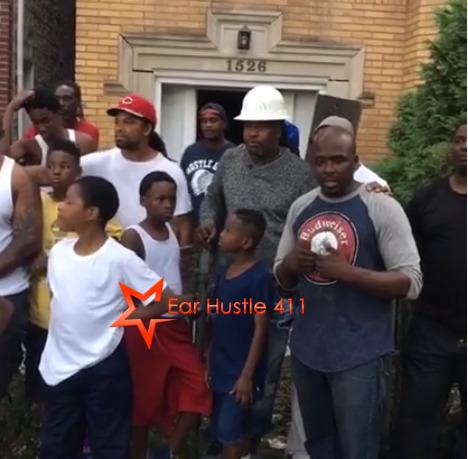
Chicago, Illinois – Black men are demanding the city help them with the resources to help rebuild the community. These men are literally in the process of taking over abandoned property and training at risk youth to help fix up the properties that the city is trying to demolish.

Many of the properties are generally in pretty decent condition as far as the frame being solid brick and these men are saying they are not going to allow the city to tear down perfectly good homes.

A lot of the homes are boarded up and abandoned due to subprime lending where the Lenders/Bankers sucked the resources out of certain communities, left them in total disarray, foreclosed on the properties and resold many of them for pennies on the dollar to Hedge Fund Investors.

This happened by way if issuing Interest only mortgages where the borrower paid only the interest and no principal and when the term was up, they were forced to pay interest plus principle which the majority was unable to do therefore losing their properties while hedge fund investors bet against the people and walked away with tons of properties.

These investors slowly take over certain areas which are considered prime real estate and move the minorities out and gentrify the neighborhoods.

The men called on Alderman Michael Scott 24th Ward, Alderman  Jason Ervin 28th Ward,  and Alderman Walter Burnett 27th Ward and all the Aldermen across the city to help them make this happen.

The group said they are going all over the city and taking over the 20,000 properties that are sitting idle waiting to be torn down.

They then said that the people in the community want the buildings demolished however they don’t realize that for every building that is demolished, property taxes goes up.

The spokesperson Mark Carter said NHS, CIC and Globe Trotters organizations were supposed to help their parents and grandparents but instead they allowed the city to demolish their homes.

The men said the Mayor and Alderman sit back and watch these children get murdered in the communities and they refuse to sit back and do nothing about it.

He said they are demanding  the resources be given to them and they can rebuild themselves.

Check out the video:


VideoPlayer

 Photo Credit:  Mark Carter- Facebook

Source: Black Men In Chicago Are Taking Over Abandoned Property & Rebuilding The Neighborhood With The Youth By Creating Their Own Jobs – Ear Hustle 411