Their eyes were indeed watching God.

Remembering the victims of the Storm of ’28 – now honored Ancestors

I have such a deep personal history around this disaster. Not forgetting the stories told to me by my Mother who was a witness; and I never forgot. After many years away, In 1991,  using my radio voice on OUR COMMON GROUND I co-founded The Sankofa Society with Janice Jennings, a local Sister Attorney and Patrice Daniels, OCG Producer to  organize the community to remember, by organizing an African-centered consecration of the burial site and raising the names of our Ancestors buried there.

ABOUT THE 1991 CONSECRATION 

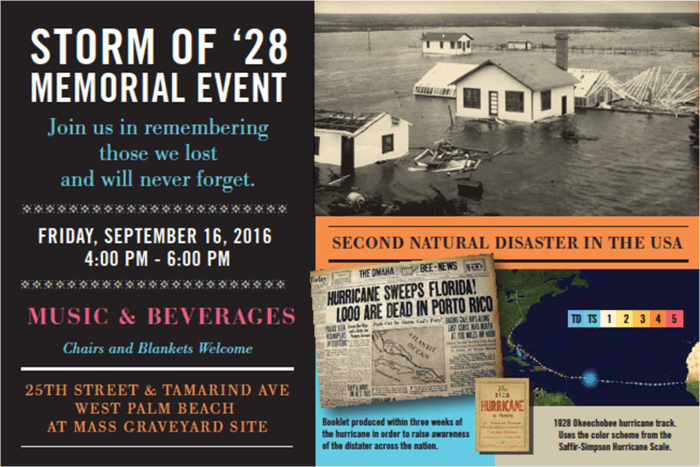
My thanks to Former WPB City Commissioner Robbie Littles, Robert Hazard, Patrice Daniels and many others who are now keeping this important history alive working to finalize the Remembrance Park. On September 16th, the community will come together for this year’s memorial.

sentinel-article


The Palm Beach Post from West Palm Beach, Florida · Page 62

Oct 21, 1991 –  Graham said she also plans to put together a housing committee that would …. Victims of 1928 hurricane in mass grave consecrated .-. … Janice Peak-Graham, Janice Jennings and Patrice Daniels were introduced as “the …

ABOUT the 2016 Memorial

storm2.png

storm1

“To them, the Storm of ’28 will forever be remembered as Black Sunday, the night when death blew down Palm Beach County’s back door.

Landfall Even before the unnamed storm, packing 150 mph winds, slammed ashore in West Palm Beach, it had killed 1,500 in the Virgin Islands, Puerto Rico and the Bahamas.

Within moments of making landfall on a Palm Beach County shoreline, its fierce winds left a trail of destruction from Pompano Beach to Jupiter. Sailboats were thrown from their moors, buildings in downtown West Palm Beach splintered and popped, choking Clematis Street with debris. The Episcopal Church on Swinton Avenue in Delray Beach was flattened, and in Boca Raton, railcars were blown off their tracks and a third of the buildings were demolished.”

woodlawn

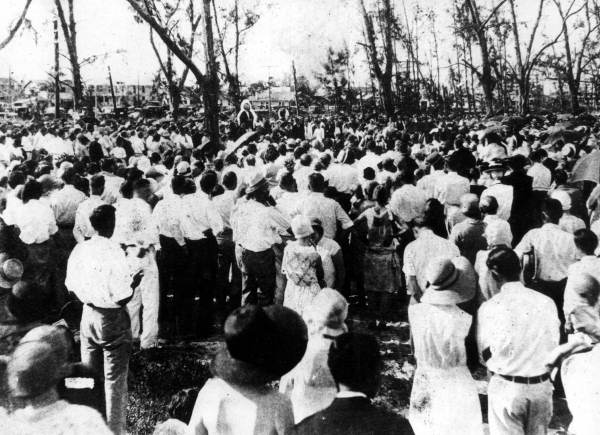
Funeral service for the Black victims of hurricane victims at Woodlawn Cemetery in West Palm Beach (1928).


coffin

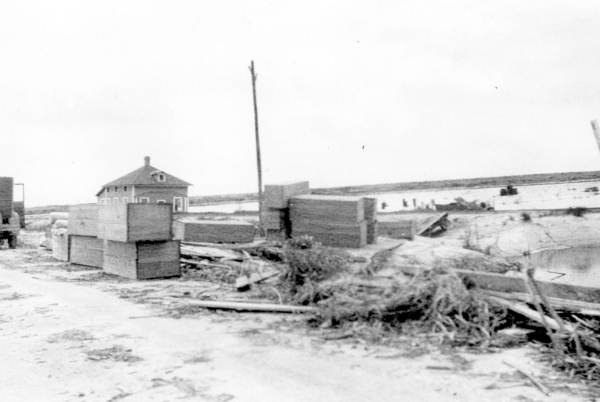
Makeshift coffins stacked alongside the road between Belle Glade and Pahokee after the Okeechobee Hurricane of 1928. Black victims were loaded onto trucks and buried in a mass grave at the corner of 25th Street and Tamarind Ave. in West Palm Beach.  The site later became the site of the WPB city sewer system.  Spewing odor across the Black community and desecrating more than 674 Black ancestors.

SEPTEMBER 16th, 1928

Okeechobee Hurricane Kills Thousands of Black Farm Workers in Florida

On September 16, 1928, a Category 4 hurricane with winds of 140 miles per hour made landfall in Palm Beach County, Florida. The hurricane destroyed a levee that protected a number of small farming communities from the waters of Lake Okeechobee. Most of the residents of these low-lying communities were black migrant farm workers. When the levee was destroyed, water from Lake Okeechobee rushed into these communities, killing thousands.

After the hurricane, black survivors were forced to recover the bodies of those killed. The officials in charge of the recovery effort ordered that food would be provided only to those who worked and some who refused to work were shot. The bodies of white storm victims were buried in coffins in local cemeteries, but local officials refused to provide coffins or proper burials for black victims.

Instead, the bodies of many black victims were stacked in piles by the side of the roads doused in fuel oil, and burned. Authorities bulldozed the bodies of 674 black victims into a mass grave in West Palm Beach. The mass grave was not marked and the site was later sold for private industrial use; it later was used as a garbage dump, a slaughterhouse, and a sewage treatment plant. The city of West Palm Beach did not purchase the land until 2000. In 2008, on the 80th anniversary of the storm, a plaque and historical marker was erected at the mass grave site.

Downtown West Palm Beach Clematis Street following the storm.

HURRICANE OF 1928 MASS BURIAL SITE

Location:Corner of 25th St. and N. Tamarind Ave.
County: Palm Beach
City: West Palm Beach, FL
Description: Early residents of Glades had to survive many harsh elements. Their goal to create a thriving farming community was often tested by storms, insects, and the lack of many comforts. In 1928 the Glades area was devastated by a powerful hurricane that threatened to destroy the entire area. Several thousand residents were killed and hundreds of homes were destroyed. Despite the death and damage, those residents that survived continued to develop the area. The Glades eventually became a major agricultural community because of their desire and vision. This memorial honors those residents who lost their lives in the 1928 hurricane.
Sponsors: CITY OF PAHOKEE AND THE FLORIDA DEPARTMENT OF STATE


Hurricane of 1928 African American Mass Grave:

West Palm Beach, Florida

[photo]
Hurricane of 1928 African American Mass Grave Site
Photo by Sherry Piland, courtesy of Florida Division of Historical Resources

The Hurricane of 1928 African American Mass Burial site is important as the burial site of approximately 674 victims, primarily African American agricultural workers, who were killed in the hurricane of 1928 that devastated South Florida–one of the worst natural disasters in American history. A major event for the African American community, it was the source for literary inspiration by noted author Zora Neale Hurston in Their Eyes Were Watching God; well known educator Mary McLeod Bethune, along with 3,000 other mourners attended the memorial service at the mass grave.

The bodies brought to West Palm Beach, Florida, were delivered to two cemeteries: 69 bodies were buried in a mass grave intended for white victims at Woodlawn Cemetery, and an additional 674 victims were buried in a mass grave intended for black victims in the City’s pauper cemetery at 25th Street and Tamarind Avenue. The mass grave was never marked. In December 2000, responding to public interest, the City of West Palm Beach reacquired the property of the burial ground from the last owner, and plans to memorialize this site in the history of the community are underway.


IMPORTANT LINKS for more Information

When the Dam Breaks…

Florida Frontiers “The Hurricane of 1928”


What Does Black Lives Matter Want?

What Does Black Lives Matter Want?

On August 1 the Movement for Black Lives (M4BL), a coalition of over sixty organizations, rolled out  “A Vision for Black Lives: Policy Demands for Black Power, Freedom & Justice,” an ambitious document described by the press as the first signs of what young black activists “really want.” It lays out six demands aimed at ending all forms of violence and injustice endured by black people; redirecting resources from prisons and the military to education, health, and safety; creating a just, democratically controlled economy; and securing black political power within a genuinely inclusive democracy. Backing the demands are forty separate proposals and thirty-four policy briefs, replete with data, context, and legislative recommendations.

But the document quickly came under attack for its statement on Palestine, which calls Israel an apartheid state and characterizes the ongoing war in Gaza and the West Bank as genocide. Dozens of publications and media outlets devoted extensive coverage to the controversy around this single aspect of the platform, including The Guardian, the Washington Post, The Times of Israel, Haaretz, and the St. Louis Post-Dispatch. Of course, M4BL is not the first to argue that Israeli policies meet the UN definitions of apartheid. (The 1965 International Convention for the Elimination of All Forms of Racial Discrimination and the 1975 International Convention on the Suppression and Punishment of the Crime of Apartheid define it as “inhuman acts committed for the purpose of establishing and maintaining domination by one racial group of persons over any other racial group of persons and systematically oppressing them.”) Nor is M4BL the first group to use the term “genocide” to describe the plight of Palestinians under occupation and settlement. The renowned Israeli historian Ilan Pappe, for example, wrote of the war on Gaza in 2014 as “incremental genocide.” That Israel’s actions in Gaza correspond with the UN definition of genocide to “destroy, in whole or in part, a national, ethnical, racial or religious group” by causing “serious bodily or mental harm” to group members is a legitimate argument to make.

The few mainstream reporters and pundits who considered the full M4BL document either reduced it to a laundry list of demands or positioned it as an alternative to the platform of the Democratic Party—or else focused on their own benighted astonishment that the movement has an agenda beyond curbing police violence. But anyone following Black Lives Matter from its inception in the killingtrayvonsaftermath of the George Zimmerman verdict should not be surprised by the document’s broad scope. Black Lives Matter founders Alicia Garza, Patrisse Cullors, and Opal Tometi are veteran organizers with a distinguished record of fighting for economic justice, immigrant rights, gender equity, and ending mass incarceration. “A Vision for Black Lives” was not a response to the U.S. presidential election, nor to unfounded criticisms of the movement as “rudderless” or merely a hashtag. It was the product of a year of collective discussion, research, collaboration, and intense debate, beginning with the Movement for Black Lives Convening in Cleveland last July, which initially brought together thirty different organizations. It was the product of some of the country’s greatest minds representing organizations such as the Black Youth Project 100, Million Hoodies, Black Alliance for Just Immigration, Dream Defenders, the Organization for Black Struggle, and Southerners on New Ground (SONG). As Marbre Stahly-Butts, a leader of the M4BL policy table explained, “We formed working groups, facilitated multiple convenings, drew on a range of expertise, and sought guidance from grassroots organizations, organizers and elders. As of today, well over sixty organizations and hundreds of people have contributed to the platform.”

The result is actually more than a platform. It is a remarkable blueprint for social transformation that ought to be read and discussed by everyone. The demands are not intended as Band-Aids to patch up the existing system but achievable goals that will produce deep structural changes and improve the lives of all Americans and much of the world. Thenjiwe McHarris, an eminent human rights activist and a principle coordinator of the M4BL policy table, put it best: “We hope that what has been created carries forward the legacy of our elders and our ancestors while imagining a world and a country profoundly different than what currently exists. For us and for those that will come after us.” The document was not drafted with the expectation that it will become the basis of a mass movement, or that it will replace the Democratic Party’s platform. Rather it is a vision statement for long-term, transformative organizing. Indeed, “A Vision for Black Lives” is less a political platform than a plan for ending structural racism, saving the planet, and transforming the entire nation—not just black lives.

If heeded, the call to “end the war on Black people” would not only reduce our vulnerability to poverty, prison, and premature death but also generate what I would call a peace dividend of billions of dollars. Demilitarizing the police, abolishing bail, decriminalizing drugs and sex work, and ending the criminalization of youth, transfolk, and gender-nonconforming people would dramatically diminish jail and prison populations, reduce police budgets, and make us safer. “A Vision for Black Lives” explicitly calls for divesting from prisons, policing, a failed war on drugs, fossil fuels, fiscal and trade policies that benefit the rich and deepen inequality, and a military budget in which two-thirds of the Pentagon’s spending goes to private contractors. The savings are to be invested in education, universal healthcare, housing, living wage jobs, “community-based drug and mental health treatment,” restorative justice, food justice, and green energy.

But the point is not simply to reinvest the peace dividend into existing social and economic structures. It is to change those structures—which is why “A Vision for Black Lives” emphasizes community control, self-determination, and “collective ownership” of certain economic institutions. It calls for community control over police and schools, participatory budgeting, the right to organize, financial and institutional support for cooperatives, and “fair development” policies based on human needs and community participation rather than market principles. Democratizing the institutions that have governed black communities for decades without accountability will go a long way toward securing a more permanent peace since it will finally end a relationship based on subjugation, subordination, and surveillance. And by insisting that such institutions be more attentive to the needs of the most marginalized and vulnerable—working people and the poor, the homeless, the formerly incarcerated, the disabled, women, and the LGBTQ community—“A Vision for Black Lives” enriches our practice of democracy.

For example, “A Vision for Black Lives” advocates not only closing tax loopholes for the rich but revising a regressive tax policy in which the poorest 20 percent of the population pays on average twice as much in taxes as the richest 1 percent. M4BL supports a massive jobs program for black workers, but the organization’s proposal includes a living wage, protection and support for unions and worker centers, and anti-discrimination clauses that protect queer and trans employees, the disabled, and the formerly incarcerated. Unlike the Democratic Party, M4BL does not subscribe to the breadwinner model of jobs as the sole source of income. It instead supports a universal basic income (UBI) that “would meet basic human needs,” eliminate poverty, and ensure “economic security for all.” This is not a new idea; some kind of guaranteed annual income has been fundamental to other industrializing nations with strong social safety nets and vibrant economies, and the National Welfare Rights Organization proposed similar legislation nearly a half century ago. The American revolutionary Thomas Paine argued in the eighteenth century for the right of citizens to draw a basic income from the levying of property tax, as Elizabeth Anderson recently reminded. Ironically, the idea of a basic income or “negative income tax” also won support from neoliberal economists Milton Friedman and Friedrich Hayek—although for very different reasons. Because eligibility does not require means testing, a UBI would effectively reduce the size of government by eliminating the bureaucratic machine of social workers and investigators who police the dispensation of entitlements such as food stamps and welfare. And by divesting from an unwieldy and unjust prison-industrial complex, there would be more than enough revenue to create good-paying jobs and provide a basic income for all.

Reducing the military is not just about resources; it is about ending war, at home and abroad. “A Vision for Black Lives” includes a devastating critique of U.S. foreign policy, including the escalation of the war on terror in Africa, machinations in Haiti, the recent coup in Honduras, ongoing support for Israel’s occupation of Palestine, and the role of war and free-trade policies in fueling the global refugee crisis. M4BL’s critique of U.S. militarism is driven by Love—not the uncritical love of flag and nation we saw exhibited at both major party conventions, but a love of global humanity. “The movement for Black lives,” one policy brief explains, “must be tied to liberation movements around the world. The Black community is a global diaspora and our political demands must reflect this global reality. As it stands funds and resources needed to realize domestic demands are currently used for wars and violence destroying communities abroad.”

Finally, a peace dividend can fund M4BL’s most controversial demand: reparations. For M4BL, reparations would take the form of massive investment in black communities harmed by past and present policies of exploitation, theft, and disinvestment; free and open access to lifetime education and student debt forgiveness; and mandated changes in the school curriculum that acknowledge the impact of slavery, colonialism, and Jim Crow in producing wealth and racial inequality. The latter is essential, since perhaps the greatest obstacle to reparations is the common narrative that American wealth is the product of individual hard work and initiative, while poverty results from misfortune, culture, bad behavior, or inadequate education. We have for too long had ample evidence that this is a lie. From generations of unfree, unpaid labor, from taxing black communities to subsidize separate but unequal institutions, from land dispossession and federal housing policies and corporate practices that conspire to keep housing values in black and brown communities significantly lower, resulting in massive loss of potential wealth—the evidence is overwhelming and incontrovertible. Structural racism is to blame for generations of inequality. Restoring some of that wealth in the form of education, housing, infrastructure, and jobs with living wages would not only begin to repair the relationship between black residents and the rest of the country, but also strengthen the economy as a whole.

To see how “A Vision for Black Lives” is also a vision for the country as a whole requires imagination. But it also requires seeing black people as fully human, as producers of wealth, sources of intellect, and as victims of crimes—whether the theft of our bodies, our labor, our children, our income, our security, or our psychological well-being. If we had the capacity to see structural racism and its consequences not as a black problem but as an American problem we have faced since colonial times, we may finally begin to hear what the Black Lives Matter movement has been saying all along: when all black lives are valued and the structures and practices that do harm to black communities are eliminated, we will change our country and possibly the world.

This article previously appeared in the Boston Review.

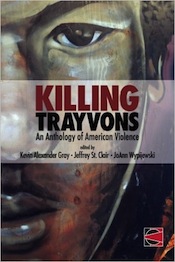
Robin D. G. Kelley, who teaches at UCLA, is the author of the remarkable biography Thelonious Monk: The Life and Times of an American Original (2009) and most recently Africa Speaks, America Answers: Modern Jazz in Revolutionary Times (2012). He is a contributor to Killing Trayvons: an Anthology of American Violence.

More articles by:

Source: What Does Black Lives Matter Want?

Discriminology – Public School Ratings, Scholarly Literature, Educational Videos & News

WASHINGTON — Black boys as young as 10 may not be viewed in the same light of childhood innocence as their white peers, but are instead more likely to be mistaken as older, be perceived as guilty and face police violence if accused of a crime, according to new research published by the American Psychological Association.

“Children in most societies are considered to be in a distinct group with characteristics such as innocence and the need for protection. Our research found that black boys can be seen as responsible for their actions at an age when white boys still benefit from the assumption that children are essentially innocent,” said author Phillip Atiba Goff, PhD, of the University of California, Los Angeles. The study was published online in APA’s Journal of Personality and Social Psychology®.

Researchers tested 176 police officers, mostly white males, average age 37, in large urban areas, to determine their levels of two distinct types of bias — prejudice and unconscious dehumanization of black people by comparing them to apes. To test for prejudice, researchers had officers complete a widely used psychological questionnaire with statements such as “It is likely that blacks will bring violence to neighborhoods when they move in.” To determine officers’ dehumanization of blacks, the researchers gave them a psychological task in which they paired blacks and whites with large cats, such as lions, or with apes. Researchers reviewed police officers’ personnel records to determine use of force while on duty and found that those who dehumanized blacks were more likely to have used force against a black child in custody than officers who did not dehumanize blacks. The study described use of force as takedown or wrist lock; kicking or punching; striking with a blunt object; using a police dog, restraints or hobbling; or using tear gas, electric shock or killing. Only dehumanization and not police officers’ prejudice against blacks — conscious or not — was linked to violent encounters with black children in custody, according to the study.

The authors noted that police officers’ unconscious dehumanization of blacks could have been the result of negative interactions with black children, rather than the cause of using force with black children. “We found evidence that overestimating age and culpability based on racial differences was linked to dehumanizing stereotypes, but future research should try to clarify the relationship between dehumanization and racial disparities in police use of force,” Goff said.

The study also involved 264 mostly white, female undergraduate students from large public U.S. universities. In one experiment, students rated the innocence of people ranging from infants to 25-year-olds who were black, white or an unidentified race. The students judged children up to 9 years old as equally innocent regardless of race, but considered black children significantly less innocent than other children in every age group beginning at age 10, the researchers found.

 The students were also shown photographs alongside descriptions of various crimes and asked to assess the age and innocence of white, black or Latino boys ages 10 to 17. The students overestimated the age of blacks by an average of 4.5 years and found them more culpable than whites or Latinos, particularly when the boys were matched with serious crimes, the study found. Researchers used questionnaires to assess the participants’ prejudice and dehumanization of blacks. They found that participants who implicitly associated blacks with apes thought the black children were older and less innocent.

In another experiment, students first viewed either a photo of an ape or a large cat and then rated black and white youngsters in terms of perceived innocence and need for protection as children. Those who looked at the ape photo gave black children lower ratings and estimated that black children were significantly older than their actual ages, particularly if the child had been accused of a felony rather than a misdemeanor.

“The evidence shows that perceptions of the essential nature of children can be affected by race, and for black children, this can mean they lose the protection afforded by assumed childhood innocence well before they become adults,” said co-author Matthew Jackson, PhD, also of UCLA. “With the average age overestimation for black boys exceeding four-and-a-half years, in some cases, black children may be viewed as adults when they are just 13 years old.”

Article: “The Essence of Innocence: Consequences of Dehumanizing Black Children,” Journal of Personality and Social Psychology, published online Feb. 24, 2014; Phillip Atiba Goff, PhD, and Matthew Christian Jackson, PhD; University of California, Los Angeles; Brooke Allison, PhD, and Lewis Di Leone, PhD, National Center for Post-Traumatic Stress Disorder, Boston; Carmen Marie Culotta, PhD, Pennsylvania State University; and Natalie Ann DiTomasso, JD, University of Pennsylvania.

Phillip Atiba Goff, PhD, can be contacted by phone at (310) 206-8614 (preferred) or by email. If Goff is unavailable, contactMatthew Christian Jackson, PhD, by phone at (814) 574-9781 or by email.

Source: Discriminology – Public School Ratings, Scholarly Literature, Educational Videos & News

Jesse Williams’ BET Awards 2016 Speech: Watch | Billboard


“Just because we’re magic doesn’t mean we’re not real. Thank you.”

Watch the full speech below:


“Let’s get a couple of things straight. The burden of the brutalized is not to comfort the bystander — that’s not our job so let’s stop with all that. If you have a critique for our resistance then you’d better have an established record, a critique of our oppression.“If you have no interest in equal rights for black people then do not make suggestions to those who do: sit down.“We’ve been floating this country on credit for centuries, and we’re done watching and waiting while this invention called whiteness uses and abuses us, burying black people out of sight and out of mind while extracting our culture, our dollars, our entertainment like oil — black gold! — ghettoizing and demeaning our creations and stealing them, gentrifying our genius and then trying us on like costumes before discarding our bodies like rinds of strange fruit.“Just because we’re magic doesn’t mean we’re not real. Thank you.”

  • Jesse Williams

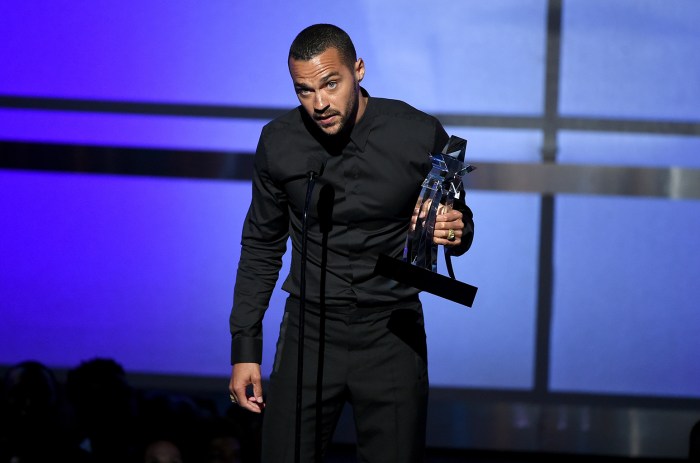
Jesse Williams accepts the Humanitarian Award onstage during the 2016 BET Awards at the Microsoft Theater on June 26, 2016 in Los Angeles.
KEVIN WINTER/BET/GETTY IMAGES FOR BET

It’s safe to say that 34-year-old Grey’s Anatomy star Jesse Williams stole the BET Awards on Sunday night with a wildly inspirational, confrontational speech that is bound to become a cornerstone of the Black Lives Matter movement. Later in the show, Samuel L. Jackson said he hadn’t heard a speech like it since the 1960s.

Williams has appeared in multiple films, but he was honored with BET’s Humanitarian Award for his activism. In October 2014, he joined protests in Ferguson, Missouri to protest the shooting of Michael Brown. He was also an actor and executive producer of Stay Woke, a documentary about the movement that premiered in May. He has written extensively on Black Lives Matter and met with President Obama earlier this year to discuss his humanitarian work.

Watch All the Prince Tributes at the 2016 BET Awards

BET CEO Debra Lee presented his award “for his continued efforts and steadfast commitment to furthering social change.”

He began by thanking BET and all involved in the video that preceded his appearance, his wife and his parents “for teaching me to focus on comprehension over career, they made sure I learned what the schools are afraid to teach us.

“This award is not for me,” he continued. “This is for the real organizers all over the country, the activist, the civil rights attorneys, the struggling parents, the families, the teachers, the students that are realizing that a system built to divide and impoverish and destroy us cannot stand if we do. It’s kinda basic mathematics: the more we learn about who we are and how we got here the more we will mobilize.

“This award is also for the black women in particular who have spent their lives nurturing everyone before themselves — we can and will do better for you.

Beyonce, Kendrick Lamar Open the 2016 BET Awards

“Now, what we’ve been doing is looking at the data and we know that police somehow manage to de-escalate, disarm and not kill white people every day. So what’s going to happen is we’re going to have equal rights and justice in our own country or we will restructure their function and ours. [Standing ovation.]

“I got more, y’all. Yesterday would have been young Tamir Rice’s 14th birthday so I don’t want to hear any more about how far we’ve come when paid public servants can pull a drive-by on a 12-year-old playing alone in a park in broad daylight, killing him on television, and then going home to make a sandwich.

“Tell Rekia Boyd how it’s so much better to live in 2012 than 1612 or 1712. Tell that to Eric Garner, Sandra Bland.

“The thing is though, all of us here are getting money, that alone isn’t going to stop this. Dedicating our lives to getting money just to give it right back to put someone’s brand on our body — when we spent centuries praying with brands on our bodies, and now we pray to get paid for brands on our bodies?

BET Awards Week: See All the Photos

“There has been no war that we have not fought and died on the front lines of. There is no job we haven’t done, there is no tax they haven’t levied against us, and we have paid all of them.

“But freedom is always conditional here. ‘You’re free!’ they keeping telling us. ‘But she would be alive if she hadn’t acted so… free.’ Now, freedom is always coming in the hereafter, but the hereafter is a hustle: We want it now.

“Let’s get a couple of things straight. The burden of the brutalized is not to comfort the bystander — that’s not our job so let’s stop with all that. If you have a critique for our resistance then you’d better have an established record, a critique of our oppression.

“If you have no interest in equal rights for black people then do not make suggestions to those who do: sit down.

“We’ve been floating this country on credit for centuries, and we’re done watching and waiting while this invention called whiteness uses and abuses us, burying black people out of sight and out of mind while extracting our culture, our dollars, our entertainment like oil — black gold! — ghettoizing and demeaning our creations and stealing them, gentrifying our genius and then trying us on like costumes before discarding our bodies like rinds of strange fruit.

“Just because we’re magic doesn’t mean we’re not real. Thank you.”

Watch the full speech  from the link below:

Source: Jesse Williams’ BET Awards 2016 Speech: Watch | Billboard

So Many Black People Locked Up it has Warped our Sense of Reality | Emerge News Online

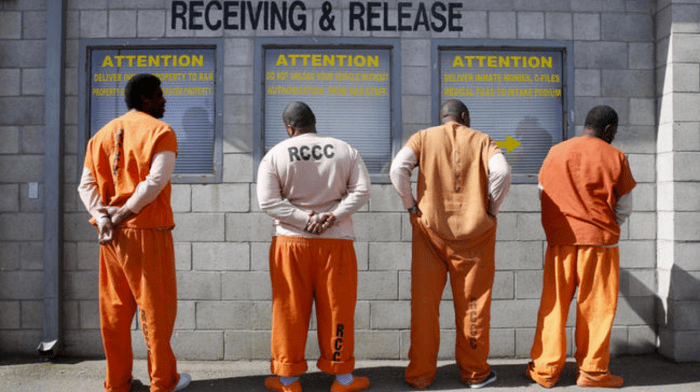
So Many Black People Locked Up it has Warped our Sense of RealityApril 23, 2016 0 45Share on Facebook Tweet on Twitter Prisoners from Sacramento County await processing after arriving at the California Department of Corrections and Rehabilitation Deuel Vocational Institution (DVI) in Tracy, Calif. (Rich Pedroncelli/Associated Press)For as long as the government has kept track, the economic statistics have shown a troubling racial gap. Black people are twice as likely as white people to be out of work and looking for a job. This fact was as true in 1954 as it is today.The most recent report puts the white unemployment rate at around 4.5 percent. The black unemployment rate? About 8.8 percent.But the economic picture for black Americans is far worse than those statistics indicate. The unemployment rate only measures people who are both living at home and actively looking for a job.The hitch: A lot of black men aren’t living at home and can’t look for jobs — because they’re behind bars. READ MORE

Source: So Many Black People Locked Up it has Warped our Sense of Reality | Emerge News Online

Angela Davis on Not Endorsing Any Presidential Candidate: “I Think We Need a New Party” | Democracy Now!

In a Women’s History Month special, we speak with author, activist and scholar Angela Davis. For more than four decades, Davis has been one of most influential activists and intellectuals in the United States. An icon of the 1970s black liberation movement, Davis’ work around issues of gender, race, class and prisons has influenced critical thought and social movements across several generations. She is a leading advocate for prison abolition, a position informed by her own experience as a fugitive on the FBI’s top 10 most wanted list more than 40 years ago. Davis talks about the “fascist appeal” of Donald Trump and explains why she is not officially endorsing any candidate in this election. “I believe in independent politics,” she says. “I still think that we need a new party, a party that is grounded in labor, a party that can speak to all of the issues around racism, sexism, homophobia, transphobia, what is happening in the world. We don’t yet have that party.”

Source: Angela Davis on Not Endorsing Any Presidential Candidate: “I Think We Need a New Party” | Democracy Now!

Top Infrastructure Official Explains How America Used Highways To Destroy Black Neighborhoods | ThinkProgress

America’s top road-builder is trying to force a reckoning over the misuse of infrastructure dollars to displace and dismantle poor-but-cohesive communities throughout the 20th century — and maybe even repair some of the damage.

t’s time for America to reckon with the role that highway projects too often play in ripping apart underprivileged communities around the country, Transportation Secretary Anthony Foxx said Wednesday at the Center for American Progress.
In the first 20 years of the federal interstate system alone, Foxx said, highway construction displaced 475,000 families and over a million Americans. Most of them were low-income people of color in urban cores. It was Foxx’s second speech in as many days about how federal infrastructure projects contribute to inequality and poverty, and how the agency wants to make up for it now.
What the Secretary is doing “appears unprecedented,” the Washington Post notes. Foxx, only the third African-American to ever hold the top federal transportation policy job, is explicitly acknowledging and condemning a history of destroying black communities and stealing wealth from their residents through intentional decisions.
Goodbye, Brooklyn
Foxx grew up in Charlotte, North Carolina, in a neighborhood that had been hewn apart by expressway projects before he was born. “I grew up living with those barriers, even though I had no idea how they came to be or what they really meant,” he said. Eventually, he became mayor of his hometown, and developed a much clearer understanding of what white leaders in the city had done to his community.
Foxx cited the case of a now-vanished Charlotte neighborhood called Brooklyn, where black families of both blue collar and professional means thrived in the early and middle 20th century. It was the favored overnight stop for jazz greats like Duke Ellington when they played the city, and home to both Charlotte’s first black high school and the first free black library in the whole South.
Poor (red) and wealthy (blue) neighborhoods in Charlotte, NC, in the early years of the interstate highway systemPoor (red) and wealthy (blue) neighborhoods in Charlotte, NC, after the interstate system was completed
Poor (red) and wealthy (blue) neighborhoods in Charlotte, NC, as the interstate highway system was just beginning and after it was completedCREDIT: DEPARTMENT OF TRANSPORTATION
“By 1912, the local paper captured the prevailing views that Brooklyn was far too valuable to be left to African-Americans,” Foxx said. “They wrote in fact that ‘Far-sighted men believe that eventually this section, because of its proximity to the center of the city, must sooner or later be utilized by the white population.’”
Redlining and “urban renewal” followed, making the community untenable for residents and newcomers alike. In a single decade, white city leaders ripped out almost 1,500 buildings in Brooklyn, displacing over a thousand black families and 200 mostly black-owned businesses.
And when Charlotte eviscerated Brooklyn, road projects served as the scalpels.
“First came Independence Boulevard, which cut a gash through the community,” the Secretary said. “Later, an inner beltway, I-277, which remains to this day,” stabbed fork-like into the neighborhood’s heart.
As the interstate system routed into and around Charlotte’s downtown over the coming decades, the city’s old identity of interlocked rich and poor neighborhoods devolved. Today, poverty clings to the freeways like a shadow.
Brooklyn’s invisible today, but it’s far from alone.
The Airport Plan That Built A Ghetto
The tool wasn’t always roads, and the decisions themselves weren’t all made way back in the mists of pre-Civil Rights Era social order.
In the early 1980s, for example, the city of St. Louis started buying out middle-class black residents of Kinloch, Missouri so that nearby Lambert International Airport could expand its runway network.
For the airlines and other businesses at Lambert, the project promised hundreds of millions of dollars in new profits by speeding up the flow of traffic through the airport. With planes spending less time idling on the tarmac, studied predicted that nearby residents would also benefit in the form of better air quality.
But for the state’s longest-standing black city, its bakeries and and drugstores and public schools, the project spelled doom. After a series of buyouts that locals say felt more like arm-twisting than a genuine personal choice to stay or sell, Kinloch’s population plunged from over 4,000 to below 300.
“I think the interesting thing about that is where they went,” Foxx said Wednesday. “Many of them, most of them, ended up moving to a town called Ferguson.”
Even for free-market types supportive of such deals, Kinloch’s story comes with a sour footnote. Business dealings elsewhere sent airline traffic through Lambert into a nosedive. It now has more capacity than it actually needs. St. Louis tore down a self-made black community and pushed its residents into civic cages like Ferguson without even capturing the new airport profits that had justified the town’s dismantling in the first place.
America can do far better at balancing needed infrastructure expansions with the interests of local communities, Foxx said. It just has to try.
Columbus, Ohio, offers a for-instance. Interstate construction left communities literally walled off from the city’s business hub for decades. But last summer, the city officially opened a grass-lined car, pedestrian, and bike bridge over I-71 that stitches the highway wound closed and reconnects people to opportunity.
Election-Year Pressure Is Key
With his department forecasting 70 million more people on the roads over the next 40 years and a 45 percent increase in total freight hauling along rails, asphalt, and flightpaths, Foxx said, “America will either be in the transportation construction business, or we will choke on our own traffic.”
Right now, federal infrastructure dollars flow to state governments, leaving control over how new projects get routed up to lawmakers in capitol domes rather than locals in community meetings. Foxx wants to push more of those decisions down to the city and county level.
“We assume states are the best decisionmakers for federal formula dollars, but maybe we should be thinking about that again,” he said. But this Congress hasn’t really been up to that kind of thoughtfulness. When lawmakers finally passed a highway funding bill late last year, dollars and cents fights crowded out any deeper re-evaluation of policy structures.
Foxx sees the election year as a key opportunity to promote ideas that will make sure Columbus-style ideas spread to the communities wounded and destroyed in the past.
“If the presidential candidates can achieve a focus on this issue at some point,” he said, “I hope there will be more conversation about what we need to do at the policy level not just at the funding level to really make an impact.”
TAGS CitiesDepartment Of TransportationEconomic JusticeInfrastructurePovertyRacismTransportation

Source: Top Infrastructure Official Explains How America Used Highways To Destroy Black Neighborhoods | ThinkProgress

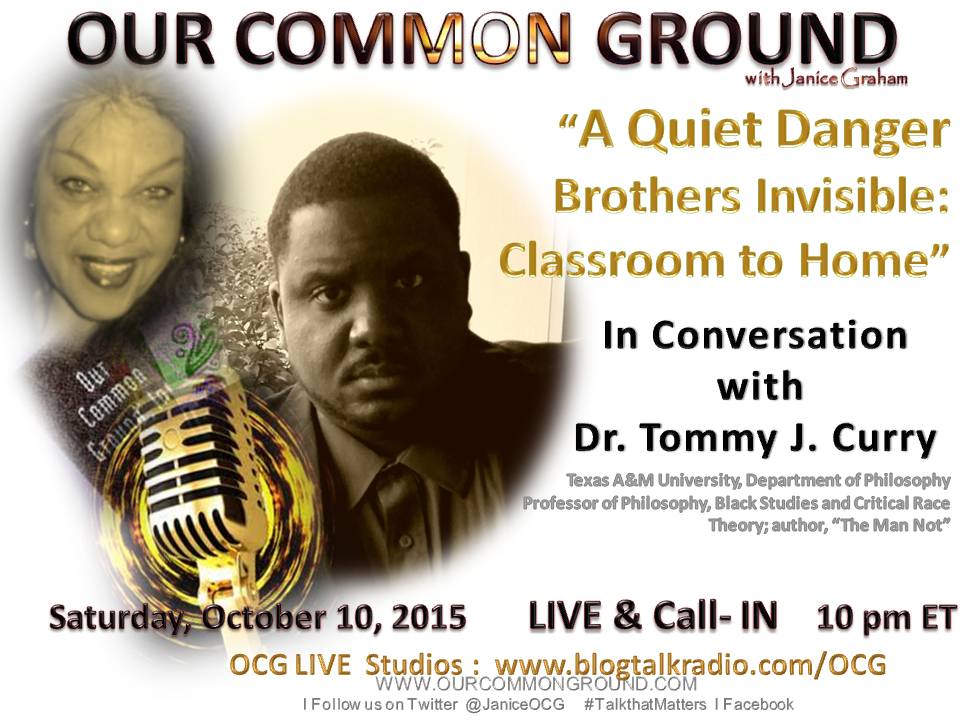
OCG This Week :: “A Quiet Danger Brothers Invisible: Classroom to Home” :: In Conversation with Dr. Tommy J. Curry

OUR COMMON GROUND
Saturday, October 10, 2015
In Conversation with Dr. Tommy J. Curry
“A Quiet Danger Brothers Invisible: Classroom to Home”

10-10 Curry“In short, although masculinity may be a part of being a man, it is not the foundation on which manhood rests.”

LISTEN LIVE and Join the OPEN Chat: http://bit.ly/1QeL6hT

http://www.blogtalkradio/OCG
Call In – Listen Line: 347-838-9852


about Dr. Tommy J. Curry
Dr. Curry is an Associate Professor of Philosophy at Texas A&M University. He is a Ray A. Rothrock Fellow 13′-16′ in the Department of Philosophy.  He is an editor of PhilPapers, Choice Magazine and a regular contributor to RacismReview.com and OUR COMMON GROUND.

Over the last several years, Dr. Curry has published over three dozen articles in prestigious venues like: The Journal of Black Studies, The Radical Philosophy Review, The Pluralist and The Transactions of the Charles S. Pierce Society. He is the editor of a forthcoming re-publication of William H. Ferris’s The African Abroad, and is currently working on several manuscripts: the first full-length publication on Derrick Bell’s political philosophy that birthed the Critical Race Theory movement entitled Illuminated in Black; a philosophical exploration of Black male death and dying entitled “The Man-Not;” and a book on Josiah Royce’s racism.

His work in social justice, applied ethics, and bioethics concerns the present interpretation of the Belmont report, and the racial/class barriers to minority access to medical innovation in health care.

He has been interviewed by Forbes.com, the Wall Street Journal,Salon.com and other popular venues for his opinions on politics, ethics, and racial justice issues.

 Episode Notes
“So we have hypothesized since 1978, that Black manhood is different than the concept of masculinity, in 1992, several studies decided to test this notion. Guess what they found:

Historically, the images of Black manhood have been unidimensional, and research has tended to focus on the inadequacies of Afro-American males’ role performance. In this preliminary analysis, we explored the cultural constructions of manhood as defined by Afro-American men at various social locations (age, occupation, income, and marital and family status). Manhood was defined in terms of the self (self-determinism and accountability, pride), family (family), the human community, and existential ideology (spirituality and humanism). It is our view that issues of self-determinism and accountability (i.e., directedness, maturity, economic viability, free will, and perseverance) are at the core of the self and of manhood and form the foundation on which family role enactment, pride, and living through one’s existential philosophy (e.g., spiritual, Afrocentric, and humanistic) are based. Interestingly, discussions of masculinity were absent from men’s definitions of manhood. Perhaps this reflects an awareness of the differences between the physical sexual man and the social man that Hare and Hare (1985) suggest is critical in Black boys’ transition into manhood. When respondents were asked to rate attributes related to masculinity (e.g., physically strong, competitive,masculine, and aggressive), they saw it as somewhat important. In short, although masculinity may be a part of being a man, it is not the foundation on which manhood rests.”      Andrea Hunter and James E. Davis-1992

On this broadcast, we begin with the recently released report by the Schotts Foundation for Public Education, “Black Lives Matter”
We recommend that you either review or read it prior to the broadcast.http://blackboysreport.org/

“It seems that America has tolerated and grown accustomed to the under-education of African American males largely because it has written this off as a “black problem.” Rather than being embraced as an American problem and challenge, our leaders in politics, business and education, have implored the Black community to do something, while washing their hands of responsibility for the failure of the public institutions that should serve them. . . .
The consequences have also been evident in the high rates of unemployment in economically depressed, socially marginalized neighborhoods, cities and towns where desperation festers and crime and violence are rampant.

The consequences have also been felt by families and communities where fatherless children fall prey to a vicious cycle of failure in part because they lack access to fathers because they are incarcerated, or don’t have the skills to obtain a job to support their family.” – Pedro A. Noguera, Professor of Education
Executive Director, Metropolitan Center
New York University – See more at: http://blackboysreport.org/national-summary/afterword-by-pedro-a-noguera/#sthash.GKiVJMsm.dpuf

You are invited to bring your thoughts about the pressing issues facing our community. SHARE please


Listen & Call In Line: 347-838-9852
Saturday, September 10, 2015 10 pm ET


BROADCASTING BOLD BRAVE & BLACK


Web: https://ourcommongroundtalk.wordpress.com/
Community Forum:
http://www.ourcommonground-talk.ning.com/
Twitter: @JaniceOCG #TalkthatMatters
Pinterest : http://www.pinterest.com/ocgmedia/boards/
Visit our Tumblr Page: http://ourcommonground.tumblr.com/
Facebook: https://www.facebook.com/OCGTALKRADIO

“Speaking Truth to Power and OURselves”

email: OCGinfo@ourcommonground.com

OCG war

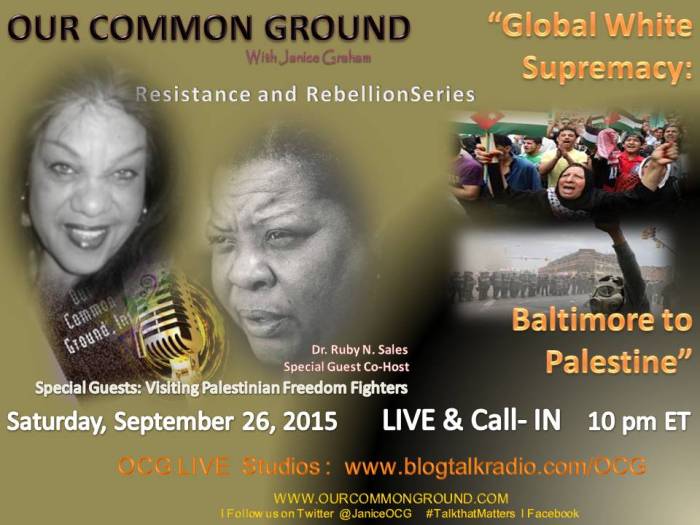
OUR COMMON GROUND This Week :: “Global White Supremacy: Baltimore to Palestine” :: LIVE

“Global White Supremacy: Baltimore to Palestine”

09-26-15 Wintess Sales

RESISTANCE and REBELLION Series

OUR COMMON GROUND with Janice Graham

Saturday, September 26, 2015            LIVE                    10 pm EDT

Our Guest Tonight:  Shardi Vardi

Dr. Ruby N. Sales, Co-Moderating
LISTEN LIVE and Join the OPEN Chat: http://bit.ly/1LS3Pfj
Call In – Listen Line: 347-838-9852

RESISTANCE and REBELLION Series

We continue our series of discussions of REBELLION AND RESISTANCE required to fight American racism and white supremacy.

Tonight on OUR COMMON GROUND, we discuss white supremacy as a system of power which is a fundamental undergird and foundation of economic, political and cultural imperialism. Part of our discussion will focus on examining the parallels of the struggle to dismantle that system with the struggles of other victims of white supremacy across the globe. Joining us will be representatives of a visiting Palestinian activist group here in the US to make its case before the UN Commission on Human Rights. We are grateful to have Dr. Ruby Sales, a featured commentator on OCG to join us and to lead this discussion, taking your calls and comments.


Sahar VardiABOUT OUR GUEST, Shardi Yardi

“The bloody cycle in which I live…is a vicious circle that is sustained by the choice of both sides to engage in violence. I refuse to take part in this choice.”

Sahar Vardi is a Jerusalem based activist. She publicly refused her military service and was imprisoned in 2008. Since then she has been active with Israeli anti-militarist groups such as New Profile and today works as the Israel Program Coordinator for the American Friends Service Committee based in Jerusalem. The focus of her work is on countering militarism in Israeli society, including challenging the Israeli military-industry complex. Sahar is also part of Boycott from Within (a group of Israelis supporting the Palestinian call for boycott) and has been active with direct action groups such as Taayush and Anarchists Against the Wall. Today much of her activism is in Jerusalem in Palestinian lead struggles against house demolitions, child arrests and discrimination of East Jerusalem.

‪#‎BlackLivesMatter: From Baltimore to Jerusalem
http://www.afsc.org/fr…/blacklivesmatter-baltimore-jerusalem

THE GLOBAL NATURE of WHITE SUPREMACY

White supremacy is a historically based, institutionally perpetuated system of exploitation and oppression of continents, nations and peoples of color by white peoples and nations of the European continent; for the purpose of maintaining and defending a system of wealth, power and privilege.

White supremacy operates through racial oppression against people of color: slavery, genocide, anti-immigration, driving while Black, etc. White supremacy maintains real power for the ruling class who control the major institutions of society.  Racism is white supremacy; white supremacy is racism. There is no other form of “functional” racism in the known universe. Therefore it is illogical purporting victims of white supremacy (racism) worldwide are capable of practicing white supremacy simultaneously. It doesn’t compute.

“Racism | White Supremacy – One or more white persons using deceit, direct violence, and/or the threat of violence to promote falsehood, non-justice, and/or incorrectness against non-white people on the basis of “color” in order to “satisfy” white people, in one or more areas of activity including economics, education, entertainment, labor, law, politics, religion, sex and/or war.”

“Everything that a Racist (White Supremacist) says, and everything that he or she does is intended to help establish, maintain, expand, and/or refine the practice of Racism (White Supremacy).”   – Neely Fuller Jr. The United Independent Compensatory Code/System/Concept a textbook/workbook for thought, speech and/or action for victims of racism (white supremacy)

The local and global power system structured and maintained by persons who classify themselves as white, whether consciously or subconsciously determined; this system consists of patterns of perception, logic, symbol formation, thought, speech, action and emotional response, as conducted simultaneously in all areas of people activity (economics, education, entertainment, labor, law, politics, religion, sex and war). The ultimate purpose of the system is to prevent white genetic annihilation on Earth – a planet in which the overwhelming majority of people are classified as non-white (black, brown, red and yellow) by white-skinned people. All of the non-white people are genetically dominant (in terms of skin coloration) compared to the genetically recessive white-skinned people.”    – Dr. Frances Cress Welsing, “The Isis Papers”

“To think of White supremacy in terms of American dynamics alone eschews the fact that much of the racism, the legacy of slavery in sheer size actually occurred outside of the United States (i.e. Brazil). Much of the colonialism globally impacts America (in terms of capitalism and trade) yet didn’t occur here. The idea that White supremacy evaporates when White people are not present or when some Whites are oppressed for other facets of identity beyond their race is simply untrue.”
“Racism Isn’t Only American. White Supremacy Isn’t Only Western.” Gradient Lair, http://www.gradientlair.com/post/63803685383/racism-and-white-supremacy-are-global

Listen & Call In Line: 347-838-9852
Saturday, September 26, 2015 10 pm ET
Join us Here: http://bit.ly/1LS3Pfj

            BROADCASTING   BOLD BRAVE & BLACK

Web     Facebook     Community Forum   Pinterest    Visit our Tumblr Page

Twitter: @JaniceOCG #TalkthatMatters

“Speaking Truth to Power and OURselves”

email: OCGinfo@ourcommonground.com

Call In – Listen Line: 347-838-9852


‘Is There a Problem?’ That Scary Brown Man And White Privilege φ GYASI ROSS

‘Is There a Problem?’ That Scary Brown Man And White Privilege

By GYASI ROSS • JAN 9, 2015
SHARE
Twitter Facebook Google+ Email
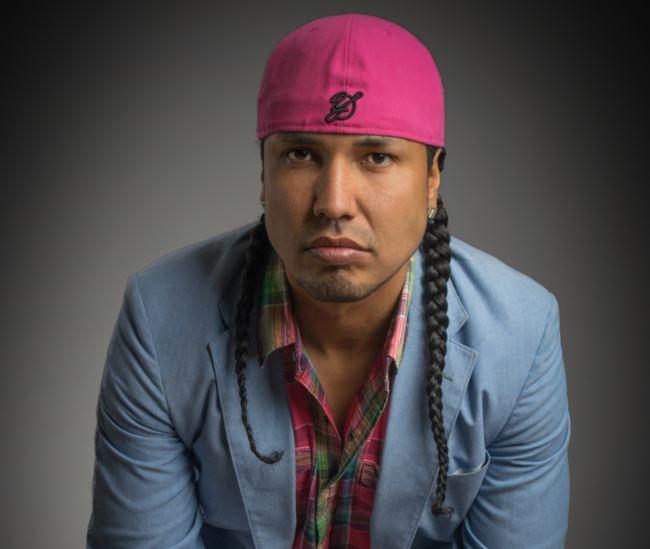
Gyasi Ross, writer and lawyer.
COURTESY GYASI ROSS

Last year, I had a big business meeting in New York and a reading for my new book, “How to Say I Love You in Indian,” at the American Indian Community House in Midtown Manhattan.

For some inexplicable reason, some television folks were interested in me doing television work. Look, I’m from the rez – we’re hunter-gatherers. If someone is willing to give me free food and an opportunity to provide for my family and me, I’m definitely going to be there. The lunch meeting was at noon. I usually fly red-eyes so I can tuck my son into bed and spend as much time with him before I leave. This time, however, I wanted to be well-prepared and rested, so I flew the night before.

First half of the flight was cool. I wore my comfortable flying clothes – camouflage sweats, camouflage sweatshirt, braids and a skullcap.

It was on Southwest, which I’ve flown a million times, simply because they sometimes have cheaper flights and, most importantly, I didn’t have to pay separately for bags. I know that I still pay for them, but it’s just not a separate charge. I appreciate that.

First leg of the flight was from Seattle to Chicago. No problem – I got off the plane for my four-hour layover (seriously) and got an all-beef dog at Chicago O’Hare.

Then the second leg of my flight. Ugh.

I had a backpack and a small duffel bag. I was in the “C” boarding group, so I knew that I was getting a middle seat. Guaranteed.

When I got on, there was a seat in the very first row – it was a middle seat. I knew I was going to get screwed on the seating, so I figured why not sit in the front of the plane? At least I’d be first to get off the plane.

In the front row was a middle-aged white couple (Sarah Jessica Parker-type middle aged, where they tried to dress like they weren’t quickly approaching AARP-status). The woman sat in the window seat and the man was in the aisle seat, holding a baby. They were being slick (like I do as well) and had a pile of stuff in the middle seat pretending it was occupied and hoping nobody would sit there.

I know the game – I’m not mad.

I asked, “Excuse me, is somebody sitting there?”

The lady responded, “Yes, I’m waiting for a friend. She’s supposed to be boarding.”

I was pretty sure she was lying. Under normal circumstances, I would have just taken the seat – this is Southwest Airlines, for God’s sake – there’s no saving seats. Southwest Airlines is PURE social Darwinism. Every person for themselves! But since I wasn’t getting a good seat anyway, and I was at the very end of the boarding group, I decided to wait.

“OK, cool,” I said. “I’ll wait here to see if your friend gets on.”

The last person boarding – another middle-aged white woman – got on. The window seat lady literally grabbed her and asked her to sit there. I’ll call that lady “The Recruit.”

I smirked and told her, “You don’t know that lady at all – ha! You lied. You realize how rude that is right?”

She responded, “That’s not rude.”

I said, “OK, well I suppose that’s just you then.” And smile at her.

The Recruit got up QUICKLY and strolled toward the back – evidently she had zero interest in this discussion and saw more fertile ground in the back of the plane.

I put my bags up above and went to sit down. The man scooted over to the middle seat, chivalrously. No problem – until there was a problem.

The wife pointed at me and said to her husband, loudly, “I don’t want him sitting there.”

I looked at her to make sure I heard her correctly. “Don’t look at me,” she said.

White privilege is the inherent suspicion that people of color – and predominately men of color – are doing something wrong. Big black men and big brown men are presumed guilty. All the time.
Damn, I couldn’t believe that. Adrenaline rushed through me. I said, “Look, you have no input into where I sit or where I look.”

I sat down and got my MP3 player ready to play some Marty Robbins. I knew the drill – I’ve been trained since I was a kid: “You’re a big brown guy – don’t be too scary. Don’t be too big. Don’t be too brown.”

We’re taught these things for our own safety and to get along.

And I was cool – but before I pressed play on my Sony MP3 player, the husband – all 5-foot-5 and probably 125 pounds told me, “You need to shut your mouth!”

WHOA!!!

For a woman to tell me something rude, that’s one thing. I’m not going to clobber a woman for a rude remark. But this guy – let’s be clear, he would never talk to me like that under any other circumstances. Ever. But he was feeling bold or threatened or insecure or something and turned what were simply words into possibly a really bad situation.

I got really close to him and said, “Look, you know this plane ride is going end at some point, right? You have to get off this plane.”

He shut up. But his wife didn’t. “You can’t sit there,” she said.

By this time, I was really mad. Not at the lady, necessarily, but that this grown man would talk to another grown man like this and expect no response. “I’m not moving anyplace so if you don’t want to sit by me, I suggest you move.”

Just then the captain came out. I was elated. Yes! I don’t like feeling like I have to run and tell anybody anything, but I also don’t want to get thrown in jail for stomping this dude into the luggage area below the plane. So I was happy to see an objective person. But unfortunately, that’s not how it went down.

The captain looked at only me. “Is there a problem?”

I said, “Well, this lady right here told me that she doesn’t want me sitting here for whatever reason and her husband tells me to shut my mo– ”

The captain interrupted me. “Well, I only hear you.”

I said, “I understand – I have a loud voice, that’s why I’m telling you what happened. Ask any of the folks sitting here –” I pointed to the people staring at us. He didn’t ask anybody anything. Instead, his focus was squarely on me.

Captain: “You need to lower your voice. Do you want to take the next flight?”

(Admittedly, I DO have a loud voice, and I WAS agitated by this time. I think that was understandable.)

Me: “No, I don’t want to – I’m telling you what happened.”

Captain: “Well I only hear you out here hollering.”

Me: “Well, I suggest that you have selective hearing.”

Captain (staring me down): “Oh, now you want to get in MY face?”

I was a bit confused because that implied that I had gotten in someone else’s face. Maybe he meant he thought I had gotten in the husband’s face?

He didn’t wait for my response. “I suggest you quiet down before you take the next flight,” he said.

I was stewing. But I knew I couldn’t take the next flight – that would not have been until the next morning, and I would have missed my important meeting. I don’t have a lot of very important meetings – I’m not a very important guy – so I didn’t want to miss one of the only ones that I’ve had.

When I got to baggage claim, a couple of younger white guys sitting behind me came up to me (one of them was from Hicksville on Long Island in New York. I laughed when he told me that – I thought he was joking): “That was bullshit. I told the captain afterward that everything happened exactly like you said.”

Made the meeting. Thankfully. Made a complaint on the Southwest Airlines website. They responded with an incredibly condescending email that said that they were sorry for my “less than pleasant” experience on the plane (it wasn’t “less than pleasant” – it was humiliating).

I couldn’t do anything or I would have been thrown off the plane or provoked into physical conflict – in the same way cops provoke men of color by staring us down and asking if we have a problem and other rhetorical questions intended only to provoke.
The email also stated, as a matter of fact, “As you know, our Pilot did not hear any other Passengers, which is why he only addressed his question to you.” (No, I have absolutely no reason to know that – I do know that he only addressed me). Also, the captain flat-out lied and said that he asked me to lower my voice twice before asking if I wanted to take another flight – not true. Finally, the email said, in ABC after-school special speak:

“We realize that sometimes it’s not what you say, but how you say it, and we apologize that you feel as if our Pilot could have used a more patient and professional tone when intervening in the exchange between you and the Customers in question.”

This is just insulting: As if my problem was with the captain’s TONE. No, it was that he didn’t ask anybody else a single question before singling me out and asking me if I wanted to take another flight, and then stood staring at me as if I were supposed to stand down from his authority (which I did, by the way, because I had to make the flight. I would have loved to have three minutes alone with that captain in a small room).

ANALYSIS:

Racism

The window seat lady clearly did not like something about the way I looked – she made up her mind before we exchanged any words. I smelled good (or as good as I could) – I showered that morning and wasn’t in any way offensive with my clothing (I wasn’t wearing a T-shirt with swear words or anything like that). Perhaps it was the camouflage – looked terrorist-ish? Maybe it was the braids or long “Native” earrings? Maybe it was the huge Native guy in braids and camouflage?

Either way, after being overwhelmingly gracious and waiting for her to find her “friend,” the lady’s first words about me (to her husband) were, “I don’t want him sitting there.” For the life of me, I cannot think what would have caused her to say something like that about me other than an inherent dislike.

Moreover, the man felt completely comfortable telling me, “You need to shut your mouth.”

I don’t think it’s possible to see a stranger as a human being and talk to them like that. They didn’t see me as a human. I was something less. I’m not overly sensitive – sometimes people are just rude. No racism, no sexism, no anything other than everyday mundane rude behavior.

This was different.

White privilege

White privilege is different than racism. I don’t THINK the Captain was racist. But he had a very bad case of white privilege. Southwest Airlines emboldened that privilege by white-washing (see what I did there?) his behavior.

White privilege is the inherent suspicion that people of color – and predominately men of color – are doing something wrong. Big black men and big brown men are presumed guilty. All the time.

At my first jury trial, the young white prosecutor came into the courtroom where I was in my suit and practicing my cross-examination. She asked, very politely, “Excuse me sir, are you waiting for your attorney?”

It’s similar to when the pundits and armchair analysts during the George Zimmerman trial assumed that Trayvon Martin, the unarmed black teenager he killed, HAD to be doing something wrong when he walked to the store. There are countless other examples.

The captain may have heard just me – that may be true. Nonetheless, it seems that in the pursuit of finding a resolution, he should have asked a question or two instead of simply cutting me off and threatening to throw me off the plane.

He had me by the balls: I couldn’t do anything or I would have been thrown off the plane or provoked into physical conflict – in the same way cops provoke men of color by staring us down and asking if we have a problem and other rhetorical questions intended only to provoke.

A huge Native guy in camouflage was arguing with a clean-cut white couple (and a white captain). Three guesses who started that one.

That’s privilege.

The white couple didn’t have to think about any of that. They didn’t have to think about appearing TOO big or TOO brown or TOO Native or anything other than simply enjoying their flight.

Look, I’m not special. This shit happens every day. Most of us are bullied into not saying anything, like I was by the captain.

“Is there a problem?” he wanted to know. But answer the question honestly, and you won’t make your flight or you might be detained. That’s privilege.

Unfortunately, my example is an EXTREMELY mild version of that privilege; I’m quite lucky that all I had to do was swallow my pride. It doesn’t even compare to other times where brown men and women are “presumed guilty,” which leads to brothers and sisters and mothers and aunts beat down, pepper sprayed and thrown in jail for choosing to answer that question honestly instead of swallowing their tongue.

I know of stories where cops literally got into men’s face – cheek to cheek, daring them to fight – trying to con them into responding.

We know EXACTLY what would happen if that big man of color gave the response that he wanted.

I couldn’t tell the captain the truth when he asked me what tens of thousands of police officers, Bureau of Indian Affairs agents, slave overseers and teachers have asked helpless and muted people of color, “Is there a problem?”

Hell, yes, there’s a problem.

This story was originally published at Indian Country Media Network on Jan. 27, 2014.

Gyasi Ross (@bigindiangyasi) is a member of the Blackfeet Nation and the Suquamish Nation. He lives on the Port Madison Indian Reservation, home of the Suquamish Nation near Seattle. Both are his Homelands and he loves being in his Homelands. He is a father to an amazing and rotten little boy, an author who writes for online and print publications and also who writes books and sometimes bad comedy. He is also a lawyer and a filmmaker. Most of all, he is a storyteller and comes from a long line of storytellers. His website: http://www.gyasi-ross.com.

The Seattle Story Project: First-person reflections published at KUOW.org. These are essays, stories told on stage, photos and zines. To submit a story – or note one you’ve seen that deserves more notice – contact Isolde Raftery at iraftery@kuow.org or 206-616-2035.