Millions of Black Voters Are Being Purged From Voter Rolls, Often Illegally: Report

Millions of Black Voters Are Being Purged From Voter Rolls, Often Illegally: Report

Residents cast their votes at a polling place on November 4, 2014, near Ferguson, Mo.       Photo: Scott Olson (Getty Images)

As the end of Barack Obama’s presidency grew closer, election officials began preparing for the next election. Instead of strengthening the security of voting machines and making voting more accessible to citizens, states did the exact opposite. But they didn’t just make it harder to vote. For hundreds of thousands of registered, eligible voters across the nation, they made it impossible.

Voter Purges (pdf), a new report by the Brennan Center, highlights the systematic purging of voters from rolls by state and local officials around the country. These are not random, isolated cases. It is a methodical effort that disproportionately affects minority voters. Even worse, no one seems to care.

In 1993, Congress passed the National Voter Registration Act (NVRA) which was an attempt to make registering to vote easier by offering driver license applicants the opportunity to register to vote. The law also prevented states from purging voters unless they met certain requirements.

But the Brennan report highlights how states have skirted the law and purged voters without punishment. And after the Supreme Court dismantled the requirements for voter pre-clearance with the Shelby v. Holder rulingstates with histories of voter discrimination no longer required federal pre-clearance before purging rolls.

Between 2014 and 2016, 16 million registered voters were removed from state rolls, 33 percent more than were moved between 2006 and 2008. For the election of 2012 and 2016, the Brennan Center estimates that two million fewer voters would have been purged if those states had to apply by the provisions of the Voting Rights Act.

Some of the egregious highlights of the report include:

  • In June 2016, the Arkansas secretary of state gave a list of 7,700 names to county clerks to be removed from the rolls because of supposed felony convictions. That list included people who had never been convicted of a felony and formerly convicted persons whose voting rights had been restored.
  • In 2013, Virginia deleted 39,000 names from its voting roster. In some counties, the mistakes on the list were as high as 17 percent.
  • A federal court halted a purge after Hurricane Katrina after justices found that one-third of the purged names came from a majority black parish in of New Orleans.
  • After the Shelby v. Holder decision, Texas purged 363,000 more voters than it did the election cycle before the case. Georgia purged 1.5 million more voters.
  • Alabama, Indiana and Maine have illegally instituted the widely ridiculed Crosscheck system (on which Charles D. Ellison previously reported on for The Root) that purges voters without federally-mandated notification.
  • In 1986, one Louisiana official remarked that a voter purge effort “could really keep the black vote down considerably.”
  • Instead of checking out inequities, Jeff Sessions’ Department of Justice has been urging states to do more purging.

Almost every type of voter purge disproportionately affects black voters and voters of color. Some states purge rolls based solely on names but non-whites are more likely to have the same names. According to the U.S. Census Bureau, 16.3 percent of Hispanic people and 13 percent of black people have one of the 10 most common surnames, compared to 4.5 percent of white people.

Black and Hispanic voters are more likely to move, often in the same jurisdiction, but voter purges based on address eliminate them from voting. Officials also use “voter caging” which intentionally sends mail to verify addresses in a format that cannot be forwarded, leading to the disenfranchisement of hundreds of thousands of eligible voters.

African Americans are also more likely to have felony convictions, and elderly and minority voters are more likely to be incapacitated, all reasons for which someone can be purged from a voter roll.

Almost every study ever done on this issue shows that in-person voter fraud is almost nonexistent. Instead, these purges are intentional efforts to restrict voting rights.

Some of the easily-implementable recommendations to rectify this travesty include:

  1. Public notifications of impending voter purges.
  2. Making purge lists available to the public, including at polling places.
  3. Accepting provisional ballots from purged voters.
  4. Universal voter registration forms and rules.
  5. Stop using failure to vote as a reason to purge voters.

All of these policies seem like they would be universally-accepted fixes for a flaw in our democracy.

But then again, not having a Russian agent for a President seems like a smart thing too. How’s that working out?

ABOUT THE AUTHOR
Michael Harriot

World-renowned wypipologist. Getter and doer of “it.” Never reneged, never will. Last real negus alive.    Posts

Sex, Race, and the Law: Considering America ‘In the Dark’ :: The Nation Mag

patty-wetterling-in-the-dark-podcast-ap-img

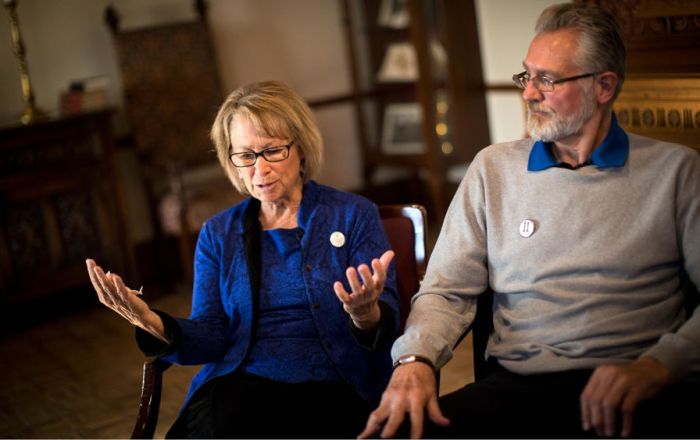
Jerry and Patty Wetterling, parents of Jason Wetterling, who was kidnapped, sexually assaulted, and killed by an Annandale man in 1989. (Star Tribune via AP / Renee Jones Schneider)

Madeleine Baran’s stunning investigative podcast grapples with our so-called “justice” system.

If Childish Gambino’s song “This is America” and Boots Riley’s film Sorry to Bother You perfectly distill the absurd comedy and violent hell of the United States circa 2018, then Madeleine Baran’s In the Dark does the same in podcast form. The audio-documentary series dropped the haunting final episode of its second season earlier this month, and, like Donald Glover’s and Riley’s works, Baran’s opus lays bare the nexus of racial anxiety, guns, criminal “justice,” and capitalism in our nation.

In the Dark is produced by APM Reports and hosted by lead reporter Baran, who helms an investigative team of a half dozen journalists who work on a single story for a year. Season 1investigated the 1989 abduction of 11-year-old Jacob Wetterling in rural Minnesota. Wetterling’s fate went unsolved for almost 27 years, during which he became the poster child for dangerous misconceptions about child kidnappings. But unlike the purveyors of many true-crime series, Baran and her team do not hype hysteria. Rather, they reveal how those in positions of power—like the local sheriff, politicians, and huckster John Walsh of America’s Most Wanted—were incompetent and exploitative of the Wetterlings. (Danny Heinrich, an early but largely unpursued suspect, confessed in 2016 as part of plea deal over child-pornography charges.)

Read More


Why White Women Keep Calling the Cops on Black People – Rolling Stone

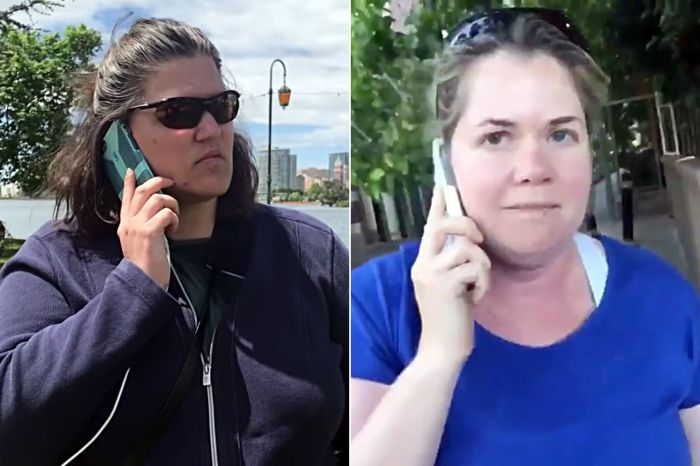
One of the most famous instances of a threatened white woman leading to a black person’s death is Carolyn Bryant. Bryant lived in Money, Mississippi, in 1955 when she accused a 14-year-old boy of following her behind the counter of the store she co-owned, grabbing her waist and bragging that he had been with white women before. Later that evening, her husband and brother-in-law found this boy, forcefully took him from his relative’s home, lynched him and threw his body in the Tallahatchie River. The men were never convicted and later confessed to the murder a year later. The boy’s name, of course, was Emmett Till, and his death galvanized the civil rights movement.

Source: Why White Women Keep Calling the Cops on Black People – Rolling Stone

New Report: The Capitol of Suspensions: : Examining the Racial Exclusion of Black Males

New Report- The Capitol of Suspensions: : Examining the Racial Exclusion of Black Males in Sacramento County

Across the nation, Black males are routinely exposed to exclusionary practices that remove them from learning environments (Howard, 2008, 2013; Wood, 2017; Wood, Essien, & Blevins, 2017). These practices include over-placement in special education, in-school suspension, out-of-school suspension, and even expulsion (Losen & Skiba, 2010). Among these forms of exclusionary discipline, suspensions have been a topic of continued interest in the past several years, with numerous reports and studies demonstrating that California is home to some of the most egregious suspension patterns in the country.

As detailed in a recent report, GET OUT! Black Male Suspensions in California Public Schools, Sacramento County is ground zero for some of the highest total suspensions in the State. In fact, Sacramento county has the second highest total suspensions in California, falling only behind Los Angeles County. This rate exceeds those in other urban counties, such as San Bernardino, Riverside, Contra Costa, Alameda, and San Joaquin (Wood, Harris III, & Howard, 2018).

Prior research has demonstrated that students who are regularly suspended are being tracked into the prison industrial complex, a pattern often referred to as the school-to-prison pipeline. Thus, while some students are being socialized by schools for college-going and entering into the workforce, others are being socialized for prison. Moreover, research has also shown that those subjected to suspensions are more likely to enter into the permanent underclass and to have a reliance upon social services (Darensbourg, Perez, & Blake, 2010; Fenning & Rose, 2007; Skiba, Arredondo, & Williams, 2014). Bearing this in mind, this brief sought to highlight key facts about suspensions in Sacramento County. These facts are meant to generate conversations around issues of racial injustice and educational inequities that permeate the region’s educational institutions that fortify the economic and social health of the region.

This brief details the exposure of Black males to exclusionary discipline in Sacramento County. In particular, this report highlights the high suspensions of Black boys and young men in Sacramento County public schools. Some of the key findings include:

  • Black males are 5.4 times more likely to be suspended in Sacramento County than the statewide average.
  • Nearly 18 Black males were suspended, per day, in the county.
  • Sacramento County has four school districts in the top 20 suspension districts for Black males in the State of California.
  • Sacramento City Unified is the most egregious suspension district for Black males in the State of California.
  • Black males in early childhood education (kindergarten through third grade) are 9.9 times more likely to be suspended than their peers (statewide).
  • One third of all Black male foster youth are suspended in Sacramento County.

Full Report

Continue reading

A Note from OCG

We will now have an alt-right #SCOTUS There is little that we of goodwill can do about it now. It is too late for those who would, who could have to claim their government. We all know something is wrong – it has been for a very long time. When the horse is out of the barn, it is too late to put up a reminder sign to close the door.
#Trump and his GOP puppets are the biggest and most pressing problem, but not the only ones. We are cornered on all sides. A ruthless sheriff is in town and his deputies are everywhere. Poor people have been targeted among the unwanted. Public spaces and tax-rolled law enforcement are now weaponized to dispose of and make invisible, instill fear and isolation to “otherize” those deemed unworthy. Blatant acts of violations of fundamental human rights have become normalized forms of public policy enforcement and oversight.
Protest marches and protestations of any kind will not turn the time. While we idled in our fear of the Muslims, Al-Qaeda and Iranian powers. Wall Street and Washington’s swamp creatures were sucking the very oxygen from the air. Even your vote has been stolen and put up for sale. The GOP stands behind a corrupt and vile President because they know that their fate is controlled entirely by him – manipulation is expensive. The lifetime of emissaries can be fleeting at best.
As we enter the last era of my broadcast career, our message is profoundly fundamental:
1. Exposing wrongs is not the same as righting them.
2. What we knew as America has been forever changed. What we understood about it, remains the same.
3. Governments are not moved by shame. In this era, neither are politicians.
4.  If the House is not turned in November, there will be a seismic permanent shift in the       infrastructure of the republic. One where there is no undoing.
5.  Comrades and allies must be willing to make all kinds of serious sacrifice. If not, our children and grandchildren will be the sacrifice.
fiverr OCG_profile2
We look forward to being back with you in the Fall of 2018. Do we have what it takes to igniting the rights and dismantling the wrongs, to rescue those who don’t know they need rescuing ? I don’t know. We will see.


“Transforming Truth to Power, One Broadcast At a Time”

Students in Detroit Are Suing the State Because They Weren’t Taught to Read

Students in Detroit Are Suing the State Because They Weren’t Taught to Read

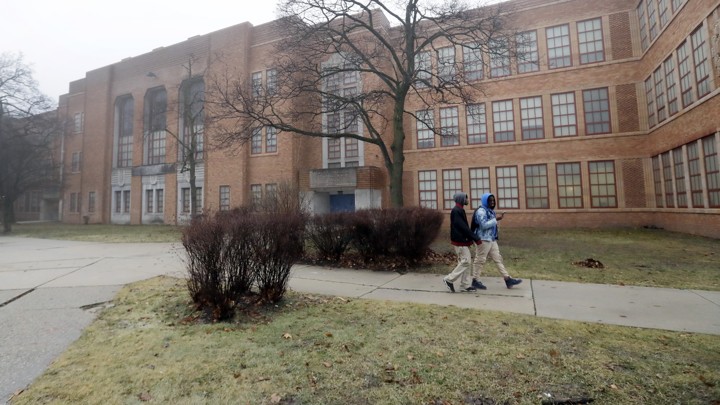
Students walk outside Detroit’s Pershing High, which isn’t one of the institutions named in the suit but was identified as one of the city’s lowest-performing schools CARLOS OSORIO / AP

What to do when a school is infested with vermin, when textbooks are outdated, when students can’t even read? Perhaps the answer is sue the government.

That’s what seven students in Detroit have done. Their class-action suit filed against the state of Michigan asserts that education is a basic right, and that they have been denied it.

 Usually, such education-equity cases wend their way through state courts, as all 50 state constitutions mandate public-education systems, while the country’s guiding document doesn’t even include the word education. But this case, Gary B. v. Snyder, was filed in federal court, and thus seeks to invoke the Constitution. And as of this week, it’s headed to the federal appeals court in Cincinnati.

The lawyers filing the suit—from the pro bono Los Angeles firm Public Counsel—contend that the students (who attend five of Detroit’s lowest-performing schools) are receiving an education so inferior and underfunded that it’s as if they’re not attending school at all. The 100-page-plus complaint alleges that the state of Michigan (which has overseen Detroit’s public schools for nearly two decades) is depriving these children—97 percent of whom are students of color—of their constitutional rights to liberty and nondiscrimination by denying them access to basic literacy. Almost all the students at these schools perform well below grade level in reading and writing, and, the suit argues, those skills are necessary to function properly in society. It’s the first case to argue that the U.S. Constitution guarantees the right to become literate (and thus to be educated) because other rights in the Constitution necessarily require the ability to read.


Continue reading

How Amazon Has Made Money Off Racism And Hate

Even seemingly innocent products on the platform, like children’s books or toys, have promoted hateful ideologies.
Although the Southern Poverty Law Center says it has alerted Amazon to sellers who sell hate group material, the company has not always been receptive to completely eliminating these sellers.

Amazon is enabling and profiting from hate groups and ideologies, according to a damning report released on Friday.

The report, “Delivering Hate: How Amazon’s Platforms Are Used to Spread White Supremacy, Anti-Semitism, and Islamophobia,” details a variety of ways that hate groups take advance of Amazon’s massive platforms and inconsistently enforced policies. Two advocacy groups ― Partnership for Working Families and Action Center on Race and the Economy ― compiled the study.


When asked about the report, Amazon referred HuffPost to its official guidelines, which prohibit the selling of “products that promote or glorify hatred, violence, racial, sexual or religious intolerance or promote organizations with such views.”

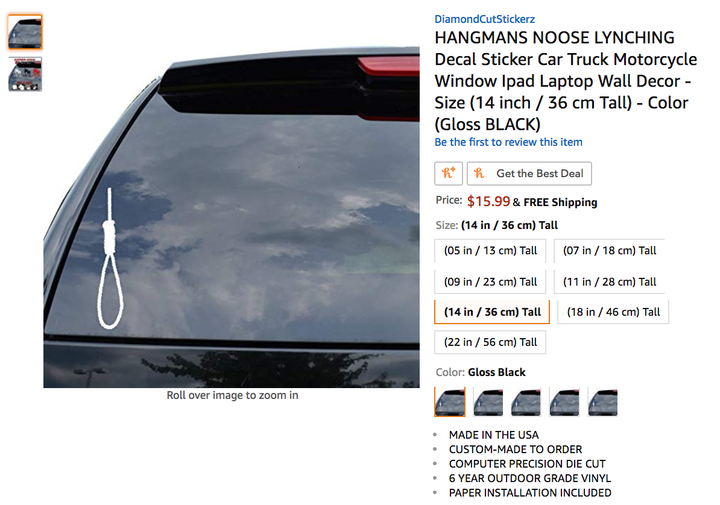
The hangman's noose is "one of the most powerful visual symbols directed against African-Americans," according to the Anti-De

But critics say that this policy often doesn’t reflect reality.

Amazon’s approximately 300 million active customers can encounter products that feature hate symbols and hateful language on Amazon Marketplace, which has allowed racist, Islamophobic, anti-LGBTQ and anti-Semitic groups to sell merchandise.

The report found items for sale that included a costume of a lynching victim, a hangman’s noose decal, Nazi memorabilia and children’s toys featuring alt-right symbol Pepe the Frog.


Continue reading

The Coming Collapse [TruthDig]

The Coming Collapse

Chris Hedges, TruthDig
Mr. Fish / Truthdig

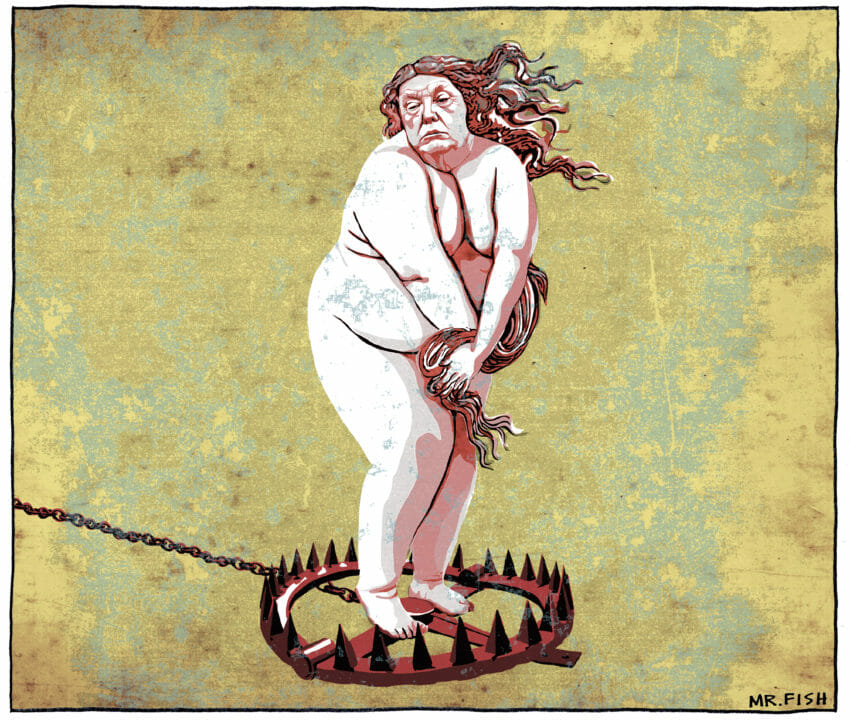
“The Trump administration did not rise, prima facie, like Venus on a half shell from the sea. Donald Trump is the result of a long process of political, cultural and social decay. He is a product of our failed democracy. The longer we perpetuate the fiction that we live in a functioning democracy, that Trump and the political mutations around him are somehow an aberrant deviation that can be vanquished in the next election, the more we will hurtle toward tyranny. The problem is not Trump. It is a political system, dominated by corporate power and the mandarins of the two major political parties, in which we don’t count. We will wrest back political control by dismantling the corporate state, and this means massive and sustained civil disobedience, like that demonstrated by teachers around the country this year. If we do not stand up we will enter a new dark age . . .

. . . “The leadership of the party, the Clintons, Nancy Pelosi, Chuck Schumer, Tom Perez, are creations of corporate America. In an open and democratic political process, one not dominated by party elites and corporate money, these people would not hold political power. They know this. They would rather implode the entire system than give up their positions of privilege. And that, I fear, is what will happen. The idea that the Democratic Party is in any way a bulwark against despotism defies the last three decades of its political activity. It is the guarantor of despotism.” . . .

READ MORE


Chris Hedges
Columnist
Chris Hedges is a Pulitzer Prize-winning journalist, New York Times best selling author, former professor at Princeton University, activist and ordained Presbyterian minister. He has written 11 books,…
Mr. Fish
Cartoonist
Mr. Fish, also known as Dwayne Booth, is a cartoonist who primarily creates for Truthdig.com and Harpers.com. Mr. Fish’s work has also appeared nationally in The Los Angeles Times, The Village Voice, Vanity…

What Did Cedric Robinson Mean by Racial Capitalism? [Boston Review]

What Did Cedric Robinson Mean by Racial Capitalism?

RACE

What Did Cedric Robinson Mean by Racial Capitalism?

ROBIN D. G. KELLEY

This essay is the introduction to Boston Review’s print issue, Race Capitalism Justice. Inspired by Cedric Robinson’s work on racial capitalism, this themed issue is a critical handbook for racial justice in the age of Trump.


“Robinson’s critique of political order and the authority of leadership anticipated the political currents in contemporary movements such as Occupy Wall Street and Black Lives Matter—movements organized horizontally rather than vertically. His monumental Black Marxism: The Making of the Black Radical Tradition (1983) takes Karl Marx to task for failing to comprehend radical movements outside of Europe. He rewrites the history of the West from ancient times to the mid-twentieth century, scrutinizing the idea that Marx’s categories of class can be universally applied outside of Europe. Instead he characterized black rebellions as expressions of what he called the “Black Radical Tradition,” movements whose objectives and aspirations confounded Western social analysis. Marxism also failed to account for the racial character of capitalism. Having written much of the book during a sabbatical year in England, Robinson encountered intellectuals who used the phrase “racial capitalism” to refer to South Africa’s economy under apartheid. He developed it from a description of a specific system to a way of understanding the general history of modern capitalism . . .

Robinson was a challenging thinker who understood that the deepest, most profound truths tend to bewilder, breaking with inherited paradigms and “common sense.” When asked to define his political commitments, he replied, “There are some realms in which names, nomination, is premature. My only loyalties are to the morally just world; and my happiest and most stunning opportunity for raising hell with corruption and deceit are with other Black people.”

Robin D. G. Kelley

Robin D. G. Kelley, Gary B. Nash Professor of American History at UCLA, is author of Africa Speaks, America Answers: Modern Jazz in Revolutionary Times and Freedom Dreams: The Black Radical Imagination.

Read More 

Black homeownership is stuck near 30-year lows

‘We haven’t made any progress’: Black homeownership is stuck near 30-year lows

July 6 at 10:48 AM 


Jani Tillery, 42, is an attorney at the Children’s Law Center in Washington who has been looking for homes since October. She’s made three offers since the end of November but lost to other bidders and she’s having a hard time finding homes in her price range of less than $200,000. (Andre Chung/for The Washington Post)

Jani Tillery thought she would be a homeowner by now.

Her parents bought a house in the Detroit suburbs in the late 1970s while living on a modest income. Her mother was a teacher. Her father worked in the automotive industry. They raised their children in the house and paid off the mortgage. They will probably live there in retirement and possibly pass the house — not only a home with rich sentimental value but also a sizable financial asset — on to their children.

Tillery, 42, hoped this would finally be the year she, too, could buy. She’s a lawyer at a nonprofit in Washington, and she recently got a promotion and raise.

Yet, she says, this part of the American Dream seems out of reach for her, as it is for many other African American workers despite notable strides in other aspects of their finances.

In many ways, African Americans have regained the ground lost during the financial crisis. Many are finding jobs and getting raises.

But the holy grail of homeownership remains elusive. Forty-three percent of blacks owned homes in 2017, according to an annual report from the Joint Center for Housing Studies of Harvard University. In contrast, 72 percent of whites did, a gap that has mostly widened during the past three decades.

“The overall frustration is, I am a working citizen. I pay my taxes. I’m doing a job to help kids,” said Tillery, whose nonprofit helps children with disabilities. “It’s better for me to own a home. I’m 42. I don’t want to continue renting.”

There aren’t many homes in the area that fall into her price range of $200,000 or less. When she sees a listing she can afford, she either loses out to a buyer who will pay more or waive contingencies or learns that the property isn’t approved for Federal Housing Administration mortgages, which she is relying on because they require lower down payments than conventional loans.

READ MORE 

Jonnelle Marte is a reporter covering personal finance. She was previously a writer for MarketWatch and the Wall Street Journal.