The Second Amendment’s Second-Class Citizens

REmembering Philando Castile

July 6, 2016, Philando Castile was murdered by a Falcon Heights cop in the passenger seat of a car, while his girlfriend and her 4 yr old daughter watched. worked in a school cafeteria for over 12 yrs where he served little kids and was beloved among his colleagues.
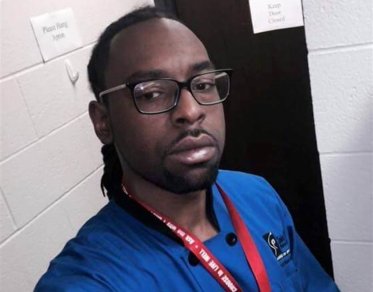
castille

The Second Amendment’s Second-Class Citizens


https://www.youtube.com/watch?time_continue=4&v=cQo-yYhExw0

On social-media, many are already asking why the Second Amendment did not protect Sterling and Castile, and why gun-rights advocates like the National Rifle Association are not speaking out on their behalf. In each case, there are complicated legal questions, and many of the details remain unclear, but it is true that gun-rights groups like the NRA and its allies have typically pushed for laws that would allow citizens broader freedom to bear arms than currently permitted. It is also the case that the interpretation of the Second Amendment has for decades been deeply intertwined with the ways the law protects—and more often fails to protect—African Americans in comparison with whites, a history that begins in earnest in the 1860s, flares up in the 1960s, and is again relevant today.

The Sterling case is the more complicated one. Sterling was a convicted felon, and thus probably was not legally permitted to have a gun. While Louisiana allows open carry of handguns for anyone legally allowed to possess one, concealed carry requires a permit, for which Sterling would have been ineligible. Sterling had allegedly been displaying the gun, which is the reason why police were called.

The crucial point is that the police couldn’t have known when they arrived on the scene whether Sterling’s gun was completely legal or not. An additional irony is that, according to Muflahi, Sterling had begun carrying the gun because he was concerned about his own safety—that is to say, for the very reasons that gun-rights advocates say citizens should be able to, and many argue should, carry guns.

The Castile case looks more straightforward, based on what’s known now. Assuming Castile’s permit was valid, he was placed in an impossible position by the officer. Unlike Sterling, who seems to have been resisting arrest (a fact that in no way justifies an extrajudicial execution by officers), Castile was attempting to comply with contradictory imperatives: first, the precautionary step of declaring the weapon to the officer; second, the officer’s request for his license and registration; and third, the officer’s command to freeze.*

Some activists contend that white men in the same situations would never have been shot. It’s an impossible counterfactual to prove, although there’s relevant circumstantial evidence, such as the fact that black men are much more likely to be shot by police than any other group. Raw Story rounds up stories of white people who pointed guns at police and were not shot. Castile’s shooting is reminiscent of a 2014 incident in which South Carolina State Trooper Sean Groubert pulled a black driver over in Columbia. Groubert asked the man, Levar Edward Jones, for his license and registration, but when the driver turned to get them, Groubert promptly shot him without warning. Groubert seems to have feared—however irrationally—for his safety when Jones reached into the car, but what was Jones supposed to do? He was complying with the officer’s instructions. (Groubert later pled guilty to assault and battery.)

The two shootings give a strong sense that the Second Amendment does not apply to black Americans in the same way it does to white Americans. Although liberals are loath to think of the right to bear arms as a civil right, it’s spelled out in the Bill of Rights. Like other civil rights, the nation and courts have interpreted it differently over time—as an individual right, and as a collective right. But however it’s been applied, African Americans have historically not enjoyed nearly the same protection as their white fellow citizens.

As Adam Winkler wrote in The Atlantic in 2011, one crucial testing ground for a personal right to bear arms came in the aftermath of the Civil War. Blacks in the South encountered a new landscape, one which they were ostensibly free but vulnerable and beset by white antagonists:

After losing the Civil War, Southern states quickly adopted the Black Codes, laws designed to reestablish white supremacy by dictating what the freedmen could and couldn’t do. One common provision barred blacks from possessing firearms. To enforce the gun ban, white men riding in posses began terrorizing black communities. In January 1866, Harper’s Weekly reported that in Mississippi, such groups had “seized every gun and pistol found in the hands of the (so called) freedmen” in parts of the state. The most infamous of these disarmament posses, of course, was the Ku Klux Klan.

In response, General Dan Sickles, who was in charge of Reconstruction in South Carolina, decreed that blacks could own guns. State officials ignored him, so Congress passed a law stating that ex-slaves possessed “full and equal benefit of all laws and proceedings concerning personal liberty … including the constitutional right to bear arms.” In the words of the Yale constitutional-law scholar Akhil Reed Amar, “Between 1775 and 1866 the poster boy of arms morphed from the Concord minuteman to the Carolina freedman.”

Black Americans again prominently asserted their right to bear arms during the 1960s. In 1964, Malcolm X was famously photographed holding a rifle as he looked out a window. The image was often misinterpreted as a statement of aggression, as though he was preparing a guerrilla assault. In fact, Malcolm was exercising his own right to own a gun for self-defense, concerned that members of the Nation of Islam—which he had recently deserted for Sunni orthodoxy—would try to kill him. (His fear was, of course, vindicated the following year, when Nation members did murder him.)

In 1967, Black Panthers began taking advantage of California laws that permitted open carry, walking the streets of Oakland armed to the teeth, citing threats of violence from white people and particularly white cops. When people were pulled over, Panthers would arrive on the scene—to ensure that justice was done, they argued, or to intimidate the cops, the cops contended. In response, Republican state Assemblyman Don Mulford introduced a bill to ban open carry. The Panthers then decided to go to the state capitol, heavily armed, to exercise their right.

As theater, it was an incredible gesture. As politics, it was a catastrophe. The sight of heavily armed black men brandishing rifles galvanized support for Mulford’s bill, which promptly passed and was signed into law by Governor Ronald Reagan. It set off a spree of gun-control laws that only began to be rolled back years later—leading to the current regime of permissive laws.

“The gun-control laws of the late 1960s, designed to restrict the use of guns by urban black leftist radicals, fueled the rise of the present-day gun-rights movement—one that, in an ironic reversal, is predominantly white, rural, and politically conservative,” Winkler wrote.

Signs of that shift are visible around the nation now. In Texas, gun owners (largely white) staged an open-carry rally on the capitol grounds in Austin in January, an echo of the Panthers’ rally in Sacramento. (Even some gun advocates looked askance at that move.) Meanwhile, the Panthers’ tactic of carrying guns and watching the police has an echo in the rapidly spreading practice of filming encounters with the police, just as happened in the Sterling and Castile shootings. Black Americans may not enjoy the full protection of the Second Amendment, but technology has offered a sort of alternative—one that may be less effective in preventing brutality in the moment, but has produced an outpouring of outrage.

One common thread through all of these cases is the constant threat of state violence against black Americans: from un-Reconstructed Southern officials; from California police; and today, from police around the country.

Gun advocates frequently argue that more guns, and more people carrying guns, produce a safer society. This, and the contrary claim that they undermine public safety, depend on statistics. But anecdotally, both Castile and Sterling represent cases in which carrying a gun not only failed to make the men safer, but in fact contributed to their deaths. The NRA has not made a public statement on either case, and a spokesman did not immediately reply to a request for comment.

In any case, the American approach to guns is, for the moment, stable. The courts, and particularly the Supreme Court, have inched toward much broader gun rights, including a suggestion of a personal right to bear arms. The death of Justice Antonin Scalia may, in the long term, produce a more liberal court, but that will require reversing years of precedents. In the meantime, spates of mass shootings and a slightly increase in violent crime have produced highly vocal calls for gun control, but there’s little reason to expect those efforts to succeed. To date, they have almost universally failed. In fact, the last few years have brought ever looser gun laws. Quick changes in gun laws, regardless of whether they’re desirable, are a remote possibility. As a result, the most relevant question right now is not whether gun laws should change, but whether existing gun laws apply equally to all Americans—and if not, why they don’t.

This article is part of our Next America: Criminal Justice project, which is supported by a grant from the John D. and Catherine T. MacArthur Foundation.

DAVID A. GRAHAM is a staff writer at The Atlantic, where he covers U.S. politics and global news.  

*This article originally stated that Castile had a legal obligation to declare his weapon to the officer. In fact, in Minnesota, holders of concealed carry permits need only declare their weapons when asked to do so by an officer. We regret the error.


The Increasing Danger of Addiction to Video Games in Children

The Increasing Danger of Addiction to Video Games in Children


It is estimated that between 5 and 8 percent of children and teens are addicted to this form of entertainment. In recent days, the World Health Organization (WHO) has categorized video game addiction as a mental health disorder, an opinion that is not shared by all experts on these games.

One of the conditions that make their use attractive for children is that they can be practiced with very few elements, unlike more traditional games. At the same time, they allow children to have an escape from the difficulties and demands of the real world.

Full Article

More articles by:

Dr. Cesar Chelala is a co-winner of the 1979 Overseas Press Club of America award for the article “Missing or Disappeared in Argentina: The Desperate Search for Thousands of Abducted Victims.”

America Being Forced to Face Conflict Between its Founding Principles and its Racist Reality  By Dr. Wilmer J. Leon, III

Oct. 16, 2017

America Being Forced to Face Conflict Between its Founding Principles and its Racist Reality 
By Dr. Wilmer J. Leon, III

charlottesvillesrobertelee

This Charlottesville statue of Confederate General Robert E. Lee remains covered in a black cloth since deadly violence by White supremacists last summer. After the defeat of the Confederacy, Lee actually called for unity.   

NEWS ANALYSIS

(TriceEdneyWire.com) – “Time catches up with kingdoms and crushes them, gets its teeth into doctrines and rends them; time reveals the foundations on which any kingdom rests, and eats at those foundations, and it destroys doctrines by proving them to be untrue.” – James Baldwin, The Fire Next Time

America, the international global hegemon, the empire – finds itself conflicted.  At the crux of this conflict is the fact that for as noble as its founding pretexts are, “…that all men are created equal, that they are endowed by their Creator with certain unalienable Rights…” the “grand experiment” of American or Jeffersonian democracy was actually founded on the myth of racism/White Supremacy.  Americans, both White and Black have been indoctrinated to believe in the false social construct of race and the false narratives that Whites – Europeans and European Americans are superior to all others in the world, Manifest Destiny and American Exceptionalism.

So, what we are seeing today play itself out with the Columbus myth, Trump, Charlottesville, DACA and the Dreamers, the Muslim ban and the NFL fiasco, etc. is America being forced to face up to the conflict between its founding principles and its racist reality. Time is catching up to these doctrines and proving them to be untrue.

The late great Dr. Francis Cress Welsing defined racism/White Supremacy as, “The local and global power system structured and maintained by persons who classify themselves as White, whether consciously or subconsciously determined. This system consists of patterns of perception, logic, symbol formation, thought, speech, action and emotional response, as conducted simultaneously in all areas of activity [economics, education, law, etc]).”

The following are two examples to support the position that the grand experiment of American or Jeffersonian democracy was founded on the myth of racism/White Supremacy.

1) The Virginia Slave Code Act I 1669, “Be it enacted…if any slave resist his master…and by the extremity of the correction should chance to die, that his death shall not be acompted felony, but the master…be acquit from molestation, since it cannot be presumed that prepense malice…should induce any man to destroy his own estate.” This is the first example that I found where we were relegated to property or what Amiri Baraka called “thingness”.

2) 13th Amendment to the Constitution – Section 1. “Neither slavery nor involuntary servitude, except as a punishment for crime whereof the party shall have been duly convicted, shall exist within the United States, or any place subject to their jurisdiction.” This led to the implementation of the convict leasing system as a replacement for slavery.  This is brilliantly documented by Douglas Blackmon in his book Slavery By Another Name.

On October 9th, Americans celebrated the traditional “Columbus Day”.  According to Steve Kurtz, from Fox News.com, “Columbus Day… is a nationally recognized holiday…It is true that the conquest of the Americas by Europeans, which starts with Columbus, was very ugly, and involved a lot of violence. But that, for better or worse, is how history worked pretty much everywhere for thousands of years. (Though it should be noted a large portion of the deaths of Native Americans was due to disease, not violence–an inevitable consequence of Old World illness in New World soil…) …The point is not to excuse the worst that happened, but to understand it. And to see that it is not the essence of Columbus, but rather part of the times. With all that, there are reasons to celebrate Columbus Day.”

Now, if that’s not Eurocentric nonsense I don’t know what is.  According to the LA Times, “Columbus’ landfall ushered in one of the greatest injustices in human history: the wholesale transfer of wealth and lands from native peoples to Europeans; the unprecedented depopulation of vast swaths of the Americas as European diseases reduced native populations by 90%…” From the Eurocentric perspective violent history is celebrated, the death, destruction, rape, slavery and other atrocities committed by Columbus are ignored and he is deified because history is written from the perspective of the victor. That’s why it’s called “his-story”.

This racist logic, this White Supremacist narrative that is clearly articulated in Kurtz’s rationale for honoring Columbus is the same narrative used by Sons and Daughters of the Confederacy, neo-Confederates and neo-Nazi’s supporting the terrorist statutes from the Civil War as paragons of virtue. In this instance it is not that the South won the Civil War. Their racism compels them to protect their whiteness, history and heritage. Their narrative tells us that the statues are supposed to help us understand context and the dynamics of what was happening at the time from their perspective.  But, like the Columbus lie, the story is told from the perspective of the oppressor, not the oppressed.  They simply want to maintain some semblance of the myth of White Supremacy.

One very simple question, how could Columbus “discover” something when the Arawak people were already there?  They are some of the indigenous peoples of the West Indies that Columbus first encountered not “discovered”. That “discovery” lie is the blindness that attends arrogance.  That’s the ignorance born out of the false narrative of White-Eurocentric supremacy.  I discovered you!  Columbus was late, real late, centuries late to the party.

Now to support this ignorance, Kurtz writes, “While there is only limited knowledge of what pre-Columbus America was like…”  Really? Try telling Dr. Ivan Van Sertima, author of They Came Before Columbus that his lifetime of work on Olmec civilization in the Americas is limited knowledge. Try telling Dr. Ben, John Henrick Clark, Chancellor Williams and the host of other Black scholars on this history that their life’s work and research is limited knowledge. Kurtz is like Columbus – just because he refuses to recognize it, it must be “limited knowledge” and research.

Kurtz wrote, “While there is plenty to criticize about Columbus…I think this movement (Indigenous People’s Day) is missing the point…History, in fact, is the story of conquest. We may not like it, but it’s our shared heritage.” No sir, that’s the Eurocentric historical perspective…not all historical perspectives begin and end with, we came, we saw, we kicked your butt. That’s the basis of the same lie being told by those who want to fly the Stars and Bars and commemorate the Confederate generals. They continuously tell us “it’s our shared heritage… The point is not to excuse the worst that happened, but to understand it.” Here’s the reality, those neo-Confederates who want to “celebrate their heritage” and “commemorate their ancestors” are celebrating treason and commemorating racists and traitors.  Where’s the honor in that?

Most of the post-Civil War statues that were erected in Virginia and Louisiana and other Southern States were not erected to commemorate Confederate Generals.  Most of the statues in question were erected as acts of intimidation to terrorize African-Americans and show unified opposition to the movement towards civil rights; not to honor dead “heroes”. In fact, Robert E. Lee opposed Confederate memorials. He wrote in 1869, “I think it wiser…not to keep open the sores of war but to follow the examples of those nations who endeavored to obliterate the marks of civil strife, to commit to oblivion the feelings engendered.” Lee eventually swore allegiance to the Union and publicly decried southern separatism, whether militant or symbolic. These neo-confederates want to honor a man who did not want to be honored.

So, what we see with the narrative of the Charlottesville race riot and Trump saying that there were good people on both sides is as Dr. Welsing clearly articulated. It is a narrative developed through and supported by patterns of perception, logic (The Lost Cause for example), symbol formation (The flying of the Stars and Bars and these statutes), thought, speech, action (glorifying Columbus w/ a holiday) and emotional response (the Charlottesville riot). It is a White Supremacist narrative that goes all the way back to the Columbus myth and a last-ditch effort by those in 2017 like Steve Kurtz who desperately try to defend the indefensible.

Dr. Wilmer Leon is the Producer/ Host of the nationally broadcast call-in talk radio program “Inside the Issues with Leon,” on SiriusXM Satellite radio channel 126. Go to http://www.wilmerleon.com or email: wjl3us@yahoo.com. www.twitter.com/drwleon and Dr. Leon’s Prescription at Facebook.com        © 2017 InfoWave Communications, LLC

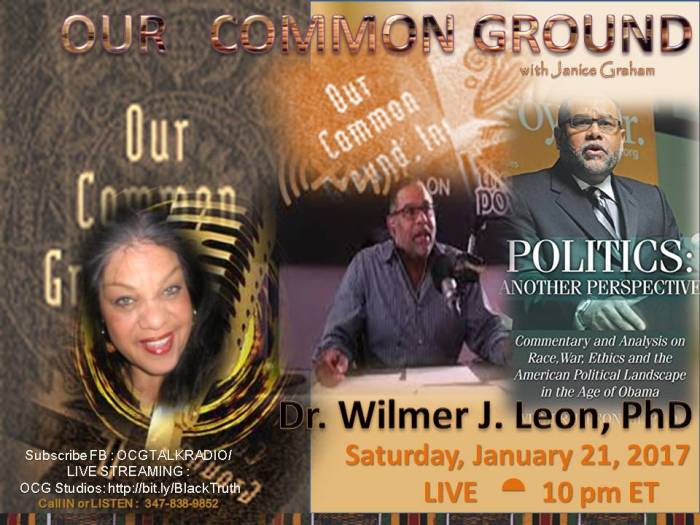
OUR COMMON GROUND with Janice Graham “Politics: Another Perspective” with Dr. Wilmer J. Leon

OUR COMMON GROUND with Janice Graham

 “Politics: Another Perspective”

Guest: Dr. Wilmer J. Leon

01-21-17-leon

 January 21, 2017 :: LIVE 10 pm EST

 Listen LIVE and Join our OPEN Chat: http://bit.ly/OCGLeon17

CALL IN and LISTEN LINE: (347) 838-9852

Political Science Professor; Host, Inside the Issues (Sirius XM); Author, Another Perspective: Analysis of Race, War, Ethics and the American Political Landscape in the Age of Obama”
, “Another Perspective: Analysis of Race, War, Ethics and the American Political Landscape in the Age of Obama” A collection of his Op Ed’s.providing cutting edge analysis of the various issues that influenced the American geopolitical landscape since 2006 and insight into the direction that the country is headed. about Dr. Leon Wilmer J. Leon III, Ph.D.
A Political Scientist whose primary areas of expertise are Black Politics, American Government, and Public Policy. For 11 years he was a Lecturer/Teaching Associate in the Political Science Department at Howard University in Washington, D.C. Currently, Dr. Leon is a nationally broadcast radio talk show host on SiriusXM Satellite radio channel 126, nationally syndicated columnist, and regular political commentator on national and international news programs. Dr. Leon earned a BS degree in Political Science from Hampton Institute, a Masters in Public Administration (MPA) from Howard University, and a Ph.D. in Political Science from Howard University. He was a contributing author to Democratic Destiny and the District of Columbia (Lexington Books, 2010). His latest book is “Politics another Perspective: Commentary and Analysis on Race, War, Ethics, and the American Political Landscape. 2016 Author House.
 “The Prescription is in the analysis”
 Dr. Leon is a regular contributor to TruthOut.org, The Root.com, Politics In Color.com, BlackStar News.com, Black Agenda Report, Black Politics on the Web, and over 200 newspapers and other web sites across the country. He can also be seen as a regular contributor and analyst on TV-One’s News On Now with Roland Martin, Press-TV and RT TV.
Dr. Leon’s Prescription
Greetings, I am still soliciting contributions for the Politics Another Perspective book tour. All contributions are greatly appreciated. The issues with the account have been resolved. To those who have contributed, thank you. Please forward this appeal to your own lists of friends. https://www.gofundme.com/politicsanotherperspective

 Saturday, Janaury 21, 2017 ll 10 pm EST

Listen LIVE Here: http://bit.ly/OCGLeon17

CALL IN and LISTEN LINE: (347) 838-9852

 BROADCASTING BOLD BRAVE & BLACK

 Join us on FACEBOOK OUR COMMON GROUND with Janice Graham

OCG on the Web: https://ourcommongroundtalk.wordpress.com/

Community Forum: http://www.ourcommonground-talk.ning.com/

Follow us on Twitter: @JaniceOCG #TalkthatMatters

stationary-logo

OUR COMMON GROUND :: Watch Night 2016

stationary-logo
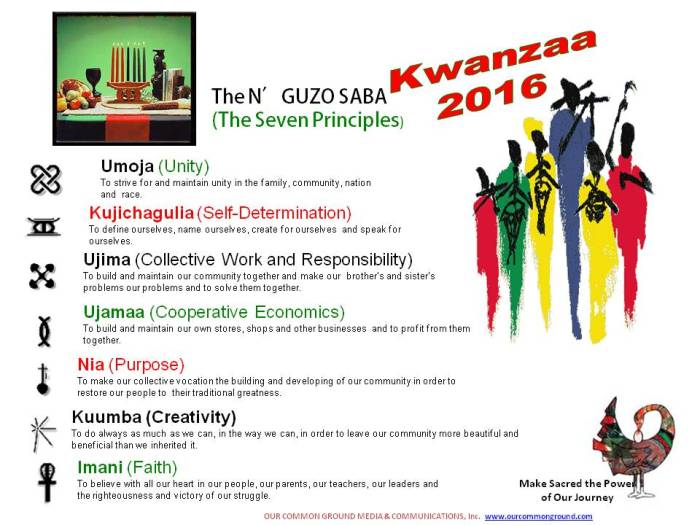
We have explored and examined the many issues, events and collective experiences of our time all through this year, 2016. As a people we have been challenged with disappointment; thunders of terror at the extra-judicial murders of our Brothers and Sisters; the continuing captured of them in enslavement camps by the millions;the covert oppression of children in schools that fail them or prepare them for imprisonment camps; and the failure of our government to makes us whole. As on this night in 1862, we search for the ‘North Star’ still. I impress my life and the spirit of this radio broadcast each week in the lessons of the N’Guzo Saba, striving to respect and honor Black Truth, our TRUTH.
Each week, we make a place, a sanctuary to say and claim that truth. In this coming year, we are faced with the gravest form of oppression and racism seen by none of us in our lives.  Make no mistake, on the bed of a fledgling fascism they will make every effort to eviscerate our belief in our historical accomplishments, ourselves as a people, what is ours and what is owed. We must stand tall in the dancing glow of our Ancestors and stand strong and tall. We must be strategically vigilant and believe in our Truth and the possibilities of our people still.
OUR COMMON GROUND will continue to provide the sanctuary that offers clarity, armament, comfort and a secure place for our voice, with respect and passion.  We are committed to serious analysis, seeking appropriate outcomes and input and answers.  I recently passed my 35th anniversary as host of OUR COMMON GROUND, there will be changes but our mission will never waver.  We are ALTERNATIVE ACTIVIST RADICAL RADIO and will continue in that tradition. WE least afford to let up in the face of what is coming.  We must careful about how we adjust our lenses in lunging into the “new struggle” era. Credible, useful, accurate and clear examination and action is more necessary than ever.  We are in a period of “post reconstruction” with the most visceral and evil forces controlling our public agency. We are a people who know how to survive.  For our children we continue thus.  As for our government, we may be unable to stop what will happen, however, we must stand on our Truth.
Throughout our history, the only thing that we have ever asked the OCG Family is do what you can (UJIMA, NIA) to help us grow and to bring more comrades to the Sanctuary.
Thank you for your support throughout the year. We return LIVE on January 7th.
Wishing for us the Victories of our Past and Abundance and Prosperity in our Future.
Janice Graham
Executive Producer, Host
OUR COMMON GROUND
kwanzaa16
watchnight
Date: December 31
Wed, 1862-12-31

*On This date in 1862 the first Watch Night Services were celebrated in Back communities in America.

The Watch Night service can be traced back to gatherings also known as “Freedom’s Eve.” On that night, Black slaves and free blacks came together in churches and private homes all across the nation awaiting news that the Emancipation Proclamation actually had become law.  At the stroke of midnight, it was January 1, 1863; all slaves in the Confederate States were declared legally free. When the news was received, there were prayers, shouts and songs of joy as many people fell to their knees and thanked God.

Blacks have gathered in churches annually on New Year’s Eve ever since, praising God for bringing us safely through another year. It’s been over a century since the first Freedom’s Eve and tradition still brings us together at this time every year to celebrate “how we got over.” This celebration takes many African American decendants of slaves into a new year with praise and worship. The service usually begins anywhere from 7 p.m. To 10 p.m. And ends at midnight with the entrance of the New Year. Some people come to church first, before going out to celebrate, for others, church is the only New Year’s Eve event.

There have been instances where clergy in mainline denominations questioned the propriety of linking religious services with a secular holiday like New Year’s Eve. However, there is a reason for the importance of New Year’s Eve services in the Black experience in America.

Reference:
The African American Desk Reference
Schomburg Center for research in Black Culture
Copyright 1999 The Stonesong Press Inc. and
The New York Public Library, John Wiley & Sons, Inc. Pub.
ISBN 0-471-23924-

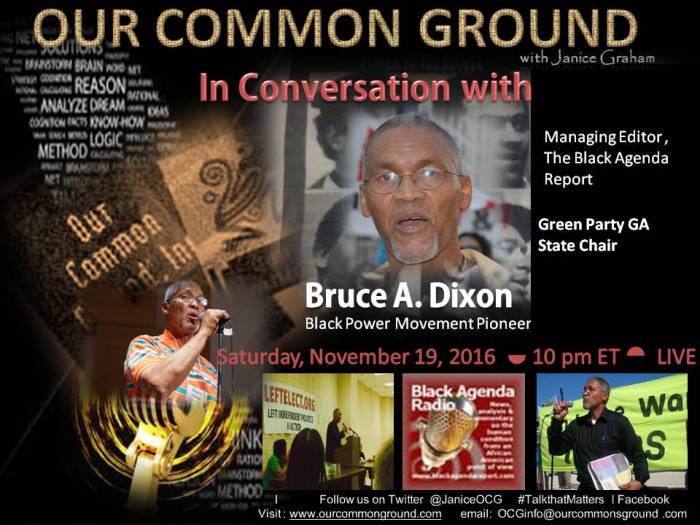
OUR COMMON GROUND with Janice Graham
      “In Conversation with Bruce A. Dixon”

11-19-16-dixon

Co-Founder and Managing Editor, The Black Agenda Report Chair, GA Green Party

November 19, 2016 <> LIVE <> 10 pm ET
                          Listen & Call In Line: 347-838-9852 
Listen LIVE/Enjoy our LIVE Chat room: http://bit.ly/OCGDixon

 BAR Managing Editor Bruce A. Dixon

“President Donald Trump? How did such a thing happen? A competent and purposeful Clinton campaign should have beaten Donald Trump. How did Hillary Clinton and one-percenter Democrats snatch defeat from the jaws of certain victory?”  MORE

Bruce A. DixonBruce Dixon is the GA State Chairman of the Green Party, Co-Founder and Managing Editor of The Black Agenda Report and journalist. Bruce was a rank and      file member of the Illinois Chapter of the BPP in 1969 and 1970. He has long been considered a voice of wisdom an encouragement in the Black left, progressive left movement in this country since the 1960s.  Tonight we talk with him about the State and Future of Black America.

             

BROADCASTING   BOLD BRAVE & BLACK

we-know-what

Join us on FACEBOOK and Learn More abut this episode

OCG on the Web: https://ourcommongroundtalk.wordpress.com/
Community Forum: http://www.ourcommonground-talk.ning.com/
Follow us on Twitter: @JaniceOCG #TalkthatMatters


Was Donald Trump’s Election Miss Ann’s Revenge? :: Amy Alexander

Miss Ann’s Revenge

With 53 percent of white women ages 45 to 64 voting for Donald Trump, was it a deliberate act meant to put blacks in their place?

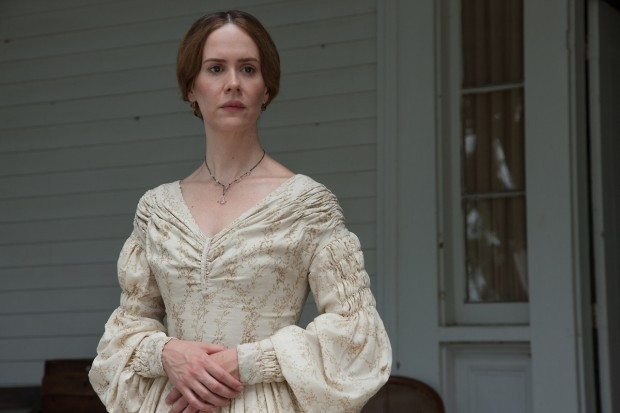
Sarah Anne Paulson as Mary Epps in the film 12 Years a Slave
Sarah Anne Paulson as Mary Epps in the film 12 Years a SlaveFOX SEARCHLIGHT

It’s time to talk about the “Miss Ann effect.”

In the wake of the stunning news that more than half of white women who voted on Nov. 8 opted for Donald Trump, I have concerns—and questions.

I’m aware that not all white women are racist. But given the significant number of white women who supported Trump, it is legitimate to at least question their motives—especially the thinking of those who are college-educated and middle-class.

Exit-polling data from CNN tells the tale:

  • Total percentage of white women who voted for Trump: 42 percent;
  • White women ages 30-44 who voted for Trump: 42 percent;
  • White women ages 45-64 who voted for Trump: 53 percent;
  • Percentage of white women with college degrees who voted for Trump: 45 percent.

Were they responding to Trump’s sickening call to “take back our country”? If so, take it back from whom, exactly? And bring it where?

For college-educated white women, especially those who are in their 30s or 40s and who have jobs; for white women who have benefited from affirmative action, you have to wonder why they felt it a good idea to support a man who is not smart and who demeans people of color, the disabled and even white women.

If you are driven by fear, we would like to know: Exactly what you are so afraid of?

I’m on the record—unironically, and without snark—as saying that many of my best friends are white women. I don’t feel obliged to spend a lot of time here outlining my bona fides on this front. But it is obvious that millions of white women whom I probably would not ever have identified as racist or even “racism-blind” betrayed me and mine by voting for Trump.

And adding to the disillusion I am now experiencing is that fact that many of the white women who helped the untested, boorish, stunningly ignorant 70-year-old white man in his mad quest to replace our nation’s first black president were stealthy if not downright deceptive about their reasons.

I’m here now to call it out.

What Drives Miss Ann? I’m Glad You Asked

In black America, the shorthand for women who harbor virulent fear and resentment of black people—however covertly it is expressed here in the 21st century—are known as “Miss Anns.” It is our not-so-secret vernacular description of white women who were the wives, sisters, daughters and mothers of slave owners in the Deep South.

This figure, and her sometimes sly, always pernicious way of expressing her fear and resentment of blacks, is a recurring theme in black American literature, because Miss Ann was with us hundreds of years before Barack Obama was born to a white woman from Kansas. Her sense of entitlement blends with incipient curiosity about blacks in general and about black men in particular, and suggests, in all probability, an attraction that she cannot readily articulate. The resulting defining character trait of Miss Ann is the unacknowledged passion that seemingly drives the anger she will inevitably express.

If you’ve ever read Zora Neale Hurston or Maya Angelou, you have seen this reference. If you viewed the Academy Award-winning film 12 Years a Slave, you have seen the “Miss Ann” type embodied in the terrific performance of Sarah Anne Paulson as Mary Epps, the wife of the owner of a plantation where the protagonist, Solomon Northup, was held.

I’ll take this moment to remind you that while creative license was taken by filmmakers, and undoubtedly by the original publishers, Northup’s story is real. The Mary Epps portrayed by Paulson, with a cataclysmic range of hate expressions from seething silence to explosive violence, is based on women that Northup dealt with during his horrific journey from freedom to slavery and back again. The invoking of their privileged status; their belief, however inchoate, that their “virtue” must be protected at all costs, and certainly at the expense of black, brown or other marginalized folks, is a key Miss Ann trait.

In the wake of the stunning news that more than half of white women who voted on Nov. 8 opted for Donald Trump, I have concerns—and questions. I’m aware that not all white women are racist. But given the significant number of white women who supported…

What likely drove many of the white female Trump voters is the same instinct that drove white women to accuse black men of all manner of imagined affronts since at least the antebellum era: a deep, innate fear and resentment of black people, particularly of black men.

The patriarchal motif looms large in attempts to answer the question of what white female supporters hope to gain by voting for Trump. It isn’t strictly a zero-sum game of reaping “gains” per se, as much as it is holding ground that some white women perceive as being theirs alone: The white women who approved of Trump as leader of the free world are betting on his ability to preserve their protected status.

Whether they acknowledge it or not, white women do enjoy a higher rung on the social and economic order in the U.S. than do black and Latino women. The perceived “halo effect” of being in close proximity to powerful white men appears to be at the least a subtext of what drove some white women to vote for Trump.

Wall-to-Wall Media Coverage of Election 2016 Didn’t See Miss Ann

I’m not qualified to make a deep dive into the history of psychosocial causal factors for why some white women apparently still harbor such virulent fear and resentment of black men. And it also must be said that by now, versions of this resentment are directed at black women. This dynamic likely did inform the decisions of millions of white women who voted for the GOP candidate Nov. 8.

That their peculiar sentiments were not explored in detail and revealed by the legions of pollsters, campaign correspondents and pundits is cold comfort. I actually take responsibility, short of feeling guilty, for having missed this possibility that as America’s first black president, and his wife and children, occupied the White House—quite literally serving as the embodiment of the United States in the eyes of the world—there were millions of Miss Anns out there quietly seething.

The “Security Moms” who helped elect George W. Bush president in 2000 and 2004 were likely reacting to at least deeply buried Miss Ann instincts. And the periodic episodes of millennial-age white women such as Lena Dunham—who pride themselves on being “woke” and yet can slip right quick into Miss Ann behavior—is an example of the powerful effect. The 2013 episode in which a white woman named Ellen Sturtz rudely interrupted remarks by first lady Michelle Obama during a Washington, D.C., fundraiser is another stark example of Miss Ann entitlement.

Now, staring into the yawning abyss of a Trump presidency, I feel acutely that I’ve been betrayed. I’ve written before about my on-again, off-again concerns about the role of deference in black-white relationships in America, how individuals and institutions and systems are still shaped by long-standing expectations that blacks must always defer to white needs and preferences. Social media warriors such as DeRay Mckesson have pushed phrases like “white privilege” and “intersectionality” onto the public debating stages, which is good and bad: There are powerful platforms now and access to megaphones to define our positions … which inevitably makes many white people uncomfortable.

I make no excuses for them; I am only pointing out that chief among those most recently made uncomfortable by social and political developments over the past few decades are white women.

I have had my own run-ins with variations of the Miss Ann effect over the years. I just never considered that any women in my sphere—in my age, occupational or education cohort—might do such a damaging thing as vote for Trump.

Now I’m compelled to look more closely at some of the women I encounter on the regular; to regard them, not with fear or even stark trepidation, necessarily, but certainly with a far more cold-eyed assessment of what might lie beneath the smiles and words of bonhomie.

The Miss Anns of 21st-century America are no longer yelling at their menfolk to lash us harder. But by voting for Trump, and approving his leadership of the most powerful government in the world, they weaponized a terrible instrument of oppression to keep us in our place.


Amy Alexander, an award-winning writer and editor in Silver Spring, Md., is the author of four nonfiction books and has contributed to The Atlantic, The Nation, the Boston Globe and NPR. Amy is an OUR COMMON GROUND Voice


Source: Was Donald Trump’s Election Miss Ann’s Revenge?

OUR COMMON GROUND with Janice Graham

Each Saturday LIVE & Call-In

10 pm ET

Join us on FACEBOOK and Learn More about us.
OCG on Facebook
Enjoy our archive of all OCG past broadcasts.

OCG on the Web: https://ourcommongroundtalk.wordpress.com/
Community Forum: http://www.ourcommonground-talk.ning.com/
Follow us on Twitter: @JaniceOCG #TalkthatMatters

“ON BEING WHITE AND OTHER LIES” James Baldwin, Essence Magazine 1984

ON BEING “WHITE” • AND OTHER LIES James Baldwin (1924-1987)

baldwinJames Baldwin was the greatest expert on white consciousness in the twentieth century United States. Born in what he described as the “southern community” of Harlem, Baldwin published six novels, including his brilliant treatment of fathers, sons, and religion in Go Tell It on the Mountain (1953), and Giovanni’s Room (1956), a work concentrating on white, gay characters. Baldwin’s early essays, collected in Notes of a Native Son (1955), Nobody Knows My Name (1961), and The Fire Next Time (1963), are works of remarkable range, lucidity, and compassion. But his scandalously underappreciated essays, generously sampled in The Price of the Ticket (1985), push Baldwin’s arguments regarding race and the meaning of America, racism, homophobia, and the “male prison,” and whiteness and the immigrant experience to unprecedented levels of insight. “On Being ‘White’ and Other Lies,” published originally in the popular African-American magazine Essence in 1984, is a dramatic reminder that “becoming American” meant learning to be white in a new way for European immigrants.

“ON BEING WHITE  AND OTHER LIES”  James Baldwin, Essence Magazine 1984

The crisis of leadership in the white community is remarkable—and terrifying—because there is, in fact, no white community. This may seem an enormous statement—and it is. I’m willing to be challenged. I’m also willing to attempt to spell it out. My frame of reference is, of course, America, or that portion of the North American continent that calls itself America. And this means I am speaking, essentially, of the European vision of the world—or more precisely; perhaps, the European vision of the universe. It is a vision as remarkable for what it pretends to include as for what it remorselessly diminishes, demolishes or leaves totally out of account.

There is, for example—at least, in principle—an Irish community: here, there, anywhere, or, more precisely, Belfast, Dublin and Boston. There is a German community: both sides of Berlin, Bavaria and Yorkville. There is an Italian community: Rome, Naples, the Bank of the Holy Ghost and Mulberry Street. And there is a Jewish community, stretching from Jerusalem to California to New York. There are English communities. There are French communities. There are Swiss consortiums. There are Poles: in Warsaw (where they would like us to be friends) and in Chicago (where because they are white we are enemies). There are, for that matter, Indian restaurants and Turkish baths. There is the underworld—the poor (to say nothing of those who intend to become rich) are always with us—but this does not describe a community It bears terrifying witness to what happened to everyone who got here, and paid the price of the ticket. The price was to become “white.”

No one was white before he/she came to America. It took generations, and a vast amount of coercion, before this became a white country. It is probable that it is the Jewish community or more accurately, perhaps, its remnants—that in America has paid the highest and most extraordinary price for becoming white. For the Jews came here from countries where they were not white, and they came here, in part, because they were not white; and incontestably in the eyes of the Black American (and not only in those eyes) American Jews have opted to become white, and this is how they operate. It was ironical to hear, for example, former Israeli prime minister Menachem Begin declare some time ago that “the Jewish people bow only to God” while knowing that the state of Israel is sustained by a blank check from Washington.

Without further pursuing the implication of this mutual act of faith, one is nevertheless aware that the Black presence, here, can scarcely hope—at least, not yet—to halt the slaughter in South Africa. And there is a reason for that. America became white—the people who, as they claim, “settled” the country became white—because of the necessity of denying the Black presence, and justifying the Black subjugation.

No community can be based on such a principle—or, in other words, no community can be established on so genocidal a lie. White men—from Norway, for example, where they were Norwegians—became white: by slaughtering the cattle, poisoning the wells, torching the houses, massacring Native Americans, raping Black women. This moral erosion has made it quite impossible for those who think of themselves as white in this country to have any moral authority at all—privately, or publicly. The multitudinous bulk of them sit, stunned, before their TV sets, swallowing garbage that they know to be garbage, and—in a profound and unconscious effort to justify this torpor that disguises a profound and bitter panic pay a vast amount of attention to athletics: even though they know that the football player (the Son of the Republic, their sons!) is merely another aspect of the money-making scheme. They are either relieved or embittered by the presence of the Black boy on the team. I do not know if they remember how long and hard they fought to keep him off it.

I know that they do not dare have any notion of the price Black people (mothers and fathers) paid and pay. They do not want to know the meaning, or face the shame, of what they compelled—out of what they took as the necessity of being white—Joe Louis or Jackie Robinson or Cassius Clay (aka Muhammad Ali) to pay I know that they, themselves, would not have liked to pay it. There has never been a labor movement in this country, the proof being the absence of a Black presence in the so-called father-to-son unions. There are, perhaps, some niggers in the window; but Blacks have no power in the labor unions. Just so does the white community, as a means of keeping itself white, elect, as they imagine, their political (!) representatives. No nation in the world, including England, is represented by so stunning a pantheon of the relentlessly mediocre.

I will not name names I will leave that to you. But this cowardice, this necessity of justifying a totally false identity and of justifying what must be called a genocidal history, has placed everyone now living into the hands of the most ignorant and powerful people the world has ever seen: And how did they get that way? By deciding that they were white. By opting for safety instead of life. By persuading themselves that a Black child’s life meant nothing compared with a white child’s life. By abandoning their children to 180 BLACK ON WHITE the things white men could buy By informing their children that Black women, Black men and Black children had no human integrity that those who call themselves white were bound to respect. And in this debasement and definition of Black people, they debased and defamed themselves. And have brought humanity to the edge of oblivion: because they think they are white. Because they think they are white, they do not dare confront the ravage and the lie of their history. Because they think they are white, they cannot allow themselves to be tormented by the suspicion that all men are brothers.

Because they think they are white, they are looking for, or bombing into existence, stable populations, cheerful natives and cheap labor. Because they think they are white, they believe, as even no child believes, in the dream of safety Because they think they are white, however vociferous they may be and however multitudinous, they are as speechless as Lot’s wife— looking backward, changed into a pillar of salt. However-1 White being, absolutely, a moral choice (for there are no white people), the crisis of leadership for those of us whose identity has been forged, or branded, as Black is nothing new. We—who were not Black before we got here either, who were defined as Black by the slave trade—have paid for the crisis of leadership in the white community for a very long time, and have resoundingly, even when we face the worst about ourselves, survived, and triumphed over it. If we had not survived and triumphed, there would not be a Black American alive. And the fact that we are still here—even in suffering, darkness, danger, endlessly defined by those who do not dare define, or even confront, themselves is the key to the crisis in white leadership.

The past informs us of various kinds of people—criminals, adventurers and saints, to say nothing, of course, of popes—but it is the Black condition, and only that, which informs us concerning white people. It is a terrible paradox, but those who believed that they could control and define Black people divested themselves of the power to control and define themselves.

497f84c1-4ea4-47ab-9098-654817c93231.jpg

OUR COMMON GROUND with Janice Graham

BROADCASTING BOLD BRAVE & BLACK

Each Saturday  LIVE& Call-In

 10 pm ET

Join us on FACEBOOK and Learn More about us.
OCG on Facebook
Enjoy our archive of all OCG past broadcasts.

OCG on the Web: https://ourcommongroundtalk.wordpress.com/
Community Forum: http://www.ourcommonground-talk.ning.com/
Follow us on Twitter: @JaniceOCG #TalkthatMatters

Presidential Election 2016: An American Tragedy – The New Yorker

OUR COMMON GROUND Returns LIVE
“Rebooting for a New Era of Struggle”
CoHosting, Dr. James L. Taylor
USF and UC Berkeley Black Studies Department Chair, Professor; Author, “Black Nationalism in the United States: From Malcolm X to Barack Obama”

Learn More About this Broadcast:
November 12, 2016 LIVE ::10 pm EST::
Join Us LIVE :: http://bit.ly/Blackreboot

Presidential Election 2016: An American Tragedy – The New Yorker

The electorate has, in its plurality, decided to live in Trump’s world.SOURCE PHOTOGRAPH BY JOE RAEDLE / GETTY

The election of Donald Trump to the Presidency is nothing less than a tragedy for the American republic, a tragedy for the Constitution, and a triumph for the forces, at home and abroad, of nativism, authoritarianism, misogyny, and racism. Trump’s shocking victory, his ascension to the Presidency, is a sickening event in the history of the United States and liberal democracy. On January 20, 2017, we will bid farewell to the first African-American President—a man of integrity, dignity, and generous spirit—and witness the inauguration of a con who did little to spurn endorsement by forces of xenophobia and white supremacy. It is impossible to react to this moment with anything less than revulsion and profound anxiety.

Source: Presidential Election 2016: An American Tragedy – The New Yorker

The Radical Democracy of the Movement for Black Lives :: Peniel Joseph

The Radical Democracy Of The Movement For Black Lives

“Black Lives Matter has cast a strobe-light on contemporary myths of racial progress, arguing correctly that the criminal justice system represents a gateway to a panoramic system of racial and class and gender and sexuality oppression.”

The Black Lives Matter policy agenda represents one of the most important agenda setting documents collectively produced by black activists in a generation. The proposals, authored by over fifty different civil rights organizations, offers a panoramic narrative, diagnosis, and political alternatives to the intricacies of structural racism, state-sanctioned violence, and the institutional exploitation of black bodies across the nation.

A Vision For Black Lives” builds on, expands, and goes beyond policy agendas promoted by a range of civil rights and Black Power era groups, including the Black Panthers, Nation of Islam, NAACP, SNCC (the Student Non-Violent Coordinating Committee), CORE, Malcolm X’s Organization of Afro-American Unity, and Martin Luther King Jr’s SCLC. In its poignant urging of the United States to “end the war on black people,” the document is reminiscent of the “Gary Agenda,” the historic 1972 document that emanated from the National Black Political Convention in Gary, Indiana.

Gary Mayor Richard Hatcher speaks at the National Black Political Conference in Gary, Ind. (AP/Charles Kelly)

That meeting of over 8,000 black delegates from across black America’s political and ideological spectrum proved to be a watershed event, albeit one that was hamstrung by an inability to translate grassroots insurgency into tangible political power, accountability, and resources.  Gary, like the Black Power Conferences from the late 1960s and the African Liberation Day and Sixth Pan-African Congress of the 1970s, sought to modernize the black convention movements that could be traced back to the Reconstruction era, where black activists organized for political power in slavery’s aftermath.

By the early 20th century efforts like the “Niagara Movement” faltered due to a lack of resources and political infighting. For a time, Marcus Garvey’s Universal Negro Improvement Association cast a shadow large enough to encompass the complexity of black life, uniting economic strivers with revolutionary activists in developing a black agenda broad enough to attract millions of black people across several continents.

Garvey’s decline fractured aspects of black political life, but not dreams for a cohesive vision, plan, and strategy for black liberation, a cause taken up during the Depression and Second World War by a variety of groups including the Southern Negro Youth Congress, National Negro Labor Congress, The Nation of Islam, the Civil Rights Congress, and the Council of African Affairs. The NAACP’s membership reached almost a half-million by 1946, the closest it would ever come to mass membership in scale. Black political leaders pushed an agenda to the left of the New Deal creating space for the global popularity of Paul Robeson, the political resurrection of W.E.B. Du Bois, and the insider status of Mary McLeod Bethune and Ralph Bunche.


Organizers like Ella Baker in New York City and Septima Clarke in South Carolina, worked the lower frequencies of black life, working at the margins of the black quotidian: the ordinary black folk from New York to South Carolina whose dreams remained disarmingly pragmatic ones focused preserving hope and dignity.

The Black Lives Matter Movement is rooted in this wider Black Freedom Struggle, one whose two dominant branches are reflected in the Civil Rights and Black Power era. BLM activists’ successful adoption of non-violence is rooted in the civil rights era even as their unapologetic focus on structural racism, community control, and political self-determination reflects the Black Power era’s radical politics. Surprisingly, so does the movement’s focus on intersectionality. Popularly remembered as deeply masculinist, unapologetically sexist, and homophobic, the Black Power era proved to be more complicated than such simple generalizations indicate. Despite the movement’s many political and ideological blinders, black women, queer activists, and others on the margins of African American life consciously shaped an expansive Black Power politics.


The Third World Women’s Alliance articulated a vision of radical black feminism, socialism, and Black Power militancy that made it a visionary example of cutting edge social justice movements. The Combahee River Collective gave voice to radical black lesbian feminists whose politics went to the far left of the more mainstream National Black Feminist Organization. In many ways both of these organizations reflected the black radical feminist politics revealed in Toni Cade Bambara’s groundbreaking 1970 anthology, The Black Woman, an intellectual and political intervention that ushered in Black Women’s Studies and helped give attention to the works of Audre Lorde, Barbara Smith, Gloria Hull, and many others.

BLM activists have taken some of the best aspects of these two generations of the Black Radical Tradition and linked it with more recent efforts to promote reparations (especially by grassroots a organization like N’COBRA, although reparations go back to the formerly enslaved activist Callie House as the historian Mary Frances Berry teaches us); divestment from domestic and global racial exploitation which Jesse Jackson, especially in 1984, promoted as a hallmark of his presidential campaign; the pursuit of independent black political power that had been advocated in the post Gary era by a series of organizations including the National Black United Front, the National Black Independent Political Party, and the Black Radical Congress; the movement for economic justice that has been promoted by a spectrum of grassroots labor, community, church, and secular activists, including black nationalists in communities such as St. Petersburg, Florida, who famously booed candidate Obama in 2008 by chanting and holding signs, “What About the Black Community Obama?”

Black Lives Matter has cast a strobe-light on contemporary myths of racial progress, arguing correctly that the criminal justice system represents a gateway to a panoramic system of racial and class and gender and sexuality oppression. This intervention, while important, is incomplete without an acknowledgment of the way in which the rise of mass incarceration is connected to systems of racial segregation, voting rights denial, state-sanctioned violence and exploitation of black bodies, all while criminalizing and decimating the very communities that remain largely under assault even in the Age of Obama.

The Age of Ferguson, Baltimore, Milwaukee, Black Lives Matter has shattered conventional civil rights narratives, ones that begin with Rosa Parks, continue with King’s Dream, and sought to end with Barack Obama’s election. This version of history as a bedtime story, complete with heroic individual blacks, stalwart white allies, and the thanks of a grateful nation has only one glaring problem.

It’s a lie.

The Civil Rights era heroic period experienced pervasive anti-black violence that only increased during the Black Power era and its aftermath. What is now universally acknowledged as a moral and political good—complete with a multiracial cast of characters—was demonized in word and deed by the larger society, a denigration that became inscribed in a series of intricate anti-black legal, legislative, and policy challenges that have utterly decimated some of the gains of the era, especially for the black poor.

“A Movement For Black Lives” is essential precisely because it helps to expose what is at the root of our national amnesia regarding slavery and anti-black racism-white supremacy and its relationship to conceptions of citizenship, the rule of law, democracy, and justice. In its passionate repudiation of the political status quo and elevating the lives of the black community’s most vulnerable residents—the poor, young, elderly, trans, LGBT, mentally ill, incarcerated, ex-offenders—the BLM has produced a watershed document that once again illustrates why the black freedom struggle has always been on the cutting edge of movements for radical democracy: we have no choice.


Peniel Joseph is the Barbara Jordan Chair in Ethics and Political Values and director of the Center for the Study of Race and Democracy at the LBJ School of Public Affairs and Professor of History at The University of Texas. He is the award-winning author of several books, including Waiting ‘Til the Midnight Hour: A Narrative History of Black Power in America, Dark Days, Bright Nights: From Black Power to Barack Obama, and Stokely: A Life. Follow him on Twitter @PenielJoseph.

Source: The Radical Democracy of the Movement for Black Lives