Freedom Rider: Ocasio-Cortez and the Left

Freedom Rider: Ocasio-Cortez and the Left

Margaret Kimberley, BAR editor and senior columnist

“Ocasio-Cortez deserves credit for beating a corrupt but powerful system.”
Freedom Rider: Ocasio-Cortez and the Left

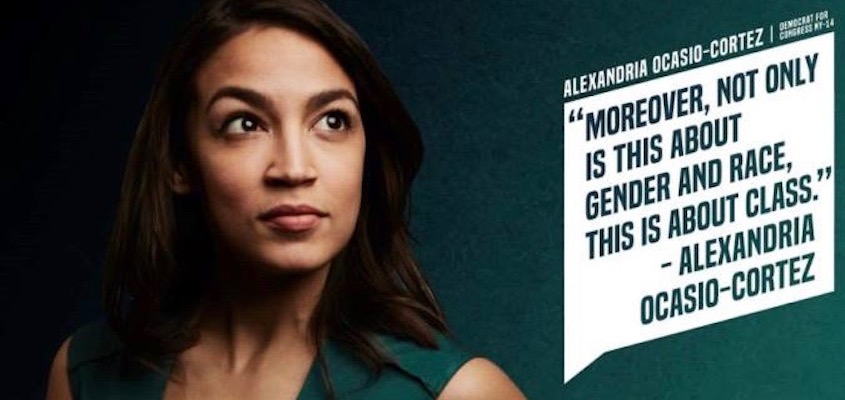
Alexandria Ocasio-Cortez is a living Rorschach test for leftists. Her primary win over incumbent Joseph Crowley in a New York City congressional district is impressive on many levels. But the reaction to her victory demonstrates the sad state of affairs of left wing politics in this country.

The contradictory responses from people who are otherwise in agreement is the result of defeat after defeat and the lack of consensus on how to change the paradigm. The Democrats are the putative party of progressives but over the years they have morphed into a center right formation that differs all too little from the far right Republicans.

Regardless of motive Crowley was, as the saying goes, “phoning it in.” He had a lackluster debate performance and then didn’t show up for another. Instead he sent a former City Council Member to represent him. That level of disrespect was punished when voters went to the polls. It is true that turnout was low but such is the always the case in primary races. A win is a win and Ocasio-Cortez deserves credit for beating a corrupt but powerful system.

“The Democratic Party gas lighting which blames Jill Stein or Bernie Sanders or Vladimir Putin has been all too successful.”

Now the Democrats can’t even muster a “lesser evilism” argument after having lost state houses, Congress and, finally, the presidency. Left wing disdain for them is well deserved but there is still no agreed upon mechanism for ending their rule. In addition, the fear of being labeled a spoiler is still quite strong. The unbridled racism of the Donald Trump administration doesn’t make the debate any easier. The Democratic Party gas lighting which blames Jill Stein or Bernie Sanders or Vladimir Putin has been all too successful. The protection racket for failure has worked quite well.

Ocasio-Cortez is in the unenviable position of being dismissed by some leftists because she is a Democrat at all or lionized by others when she ought to be called to account. The Democratic Party bosses have already dismissed the significance of her win over a man who had a 10:1 fund raising advantage. That in itself is reason to give her credit. A large war chest is used not just to defeat but to scare off challengers before they can even mount a campaign. It isn’t surprising that Democratic Party leadership seek to minimize her achievement. If others follow in her footsteps the house of cards may begin to wobble.

“Ocasio-Cortez’s Peace Economy platform disappeared from her campaign website.”

Even Latino political leadership didn’t back her. Crowley’s debate stand-in was Latina and even Bronx borough president Ruben Diaz, Jr. lamented Crowley’s loss. “It’s unfortunate he had a primary,” said Diaz. “We need him in Washington D.C. Washington is about consistency and seniority.” It seems that black people aren’t the only group with a misleadership class.

But Ocasio-Cortez can’t be let off the hook either. Astute observers noticed that her Peace Economy platform disappeared from her campaign website. She blamed a volunteer-run web team and promised to “look into it.” A few days later the statement reemerged but doubters such as this columnist believe that it would never have reappeared if she hadn’t been questioned about its absence.

Ocasio-Cortez is expected to be all things to a desperate group of people. She both benefits from her connection to Bernie Sanders and is tainted by his sheep dogging for the Democrats. Yet she is rightly held up as a hopeful sign by people eager to see even a small chance of progressive politics taking hold. Alexandria Ocasio-Cortez is actually not the only issue for debate. The discredited Democratic Party and the inability of leftists to mount a successful attack against it should also be a focal point of discussion.

“Even Ocasio-Cortez falls prey to using liberal gibberish about America being a ‘force for good.’”

The Democrats have purged any semblance of progressive politics from their ranks. Democratic party attacks and Republican chicanery were used to end Cynthia McKinney’s congressional career. When Ohio lost a congressional seat after the last census it was no surprise that Dennis Kucinich ended up with the short straw. There isn’t one Democratic member of congress who consistently advances an anti-war platform. Even Ocasio-Cortez falls prey to using liberal gibberish about America being a “force for good” and demanding congressional approval for wars that should never be waged at all. But if she wins her general election in November she will be the lone member who says anything at all about the issues of war and peace.

Yet it is proper, indeed it is necessary, to call her to account when she follows Bernie Sanders and others in repeating unproven assertions that the Russian government helped Trump to victory. She can’t be held up as a progressive icon if she sounds like the imperialist democrats eager to deflect blame for their failures.

“There isn’t one Democratic member of congress who consistently advances an anti-war platform.”

In the final analysis progressives should keep Ocasio-Cortez under scrutiny lest she fall prey to big money and the pull of a partywhich wants to stamp out any and all divergence from their losing but powerful apparatus. The Democrats are openly backing former intelligence operatives and ex-military candidates to win in November. Ocasio-Cortez should be supported if only to fight against the Democrats and their ever more rightward moves.

The fight isn’t hers alone. The difficult discussions, debates and struggles must be waged by everyone. If not the leftist perpetual beat down will go on without resolution. We will be left with endless and useless argument rather than finding a way to make successful progressive politics a reality.

Margaret Kimberley’s Freedom Rider column appears weekly in BAR, and is widely reprinted elsewhere. She maintains a frequently updated blog as well at http://freedomrider.blogspot.com . Ms. Kimberley lives in New York City, and can be reached via e-Mail at Margaret.Kimberley(at)BlackAgendaReport.com.
black agenda report

Barack Hussein Obama II, 44th President of the United States—how good must we be to gain their respect? :: Christian Fabien

Christian Fabien
January 12, 2017

12119159_183744165297349_7008125353807309659_nIf Barack Obama doesn’t represent the end of respectability politics, nothing does.

If the way that man dropped his middle name and lost all accent and did limbo—drinking in Irish pubs and eating sloppy joes and casseroles and killing Muslims and keeping the military industrial complex’s wars and not taking Billy John’s guns; toning down his own swag and terrorist fist bumps, no longer brushing off his shoulder—did nothing to make whyte America feel safe, there’s no argument to be made for appeasing the boogey men in the minds of whyte folks. There’s no PhD that can match the degree of servitude Our Shining Black Hope expressed over eight years in the face of the fears of ignorant, pre-logical, post-factual whyte folks.

The only thing that matches his kowtowing at their runaway imaginations is the utter contempt they showed by coming out of their Middle American caves to the polls two months ago. The only thing that matches the amount of way he gave them is the amount of power rich whyte men wielded to make sure that his crowning achievement would be passing the baton to the least worthy of them as if to say, “A monkey could do this job; an abject failure—more of a failure than the buffon who came before Obama can do this job.”

No, America: This replacement is not of equal or greater value. Maybe the Russian prostitutes are not a fact, but the way you’ve urinated on the legacy of Hope is all too true.

Barack Obama—President 44 of the United States of America Barack Obama—was a Good Negro. So good that some of us in the field saw him go into the House every night while the slave patrols murdered us in the streets for snuff films and left our bodies out in the street like Willie Lynch letters and we still meme’d him and loved him and wanted him to win and are praying to this day and every other of his life that he dies the natural death of a man, not that of a King on a balcony.

President Barack Obama pulled his pants up so high we couldn’t see his eyes; just his smile. He crossed his T’s and dotted his I’s and spoke the Queen’s English so well that his words smelled like tea and crumpets and tasted like Marmite. Love it or hate it, he spread his obsequiousness all over their daily bread, knowing where his was buttered.

Barack Hussein Obama II, 44th President of the United States spoke the Lie of Progress in the only way a whyte folks will hear it; in the way that says, “We will be patient and submerge our desire—our right—to be treated as men and women and human children to your comfort. We will not ask anything of you that disturbs your predilection for treating our cultures and religions like fashion accessories and glurges.”

He spoke the Lie of Progress in living rooms and in schools, at farms and on factory floors, at diners and on distant military outposts, wearing bullet-proof suits that covered the whipping scars on his back, his pants up to his eyes so that no one would see him cry.

He spoke the Great Lie to those who asked for his birth certificate, to those who asked what he did for a living and how he earned that car he was riding in and marveled at how articulate he was while telling his wife to go back to Africa to dance with simians because they were her family.

Through it all, 44—the Man, the Legend, the living history and culmination of so much Hope—smiled, rarely giving glimpse to the enervation borne of submission. In that way, he was like us, and we saw ourselves in him.

So, now what do we see? What do we see as he walks into the pages of history, retreating to the relative protection of his legacy and status and opportunity while the worst of our lifetimes is about to happen? How well-dressed and smart must we be? Is it possible to be well-dressed and smart and articulate enough to assuage the fears of whyte folk who think that Rise of the Planet of the Apes is prediction while thinking that 1984 is not?

We’re not that good.

In spite of his flaws, and because of the way he carried them, Barack Obama was twice as good as at the best of us and he got half the respect of the worst of us. He got half the respect and is being replaced by a guy who would not be the smartest man in the room were he the only man in the room.

When they believe that the top pick of the Talented Tenth is equal to a man who is one-tenth of his predecessor; that a man who sits on a gold throne in a gold tower at the bottom percentile of emotional intelligence can occupy the same seat as Barack Hussein Obama II, 44th President of the United States—how good must we be to gain their respect?

Why would we even want to?

About Christian Fabien

Christian Fabien·

Check him out on Facebook  Lives in Los Angeles, California From Port-au-Prince, Haiti · Lived in Houston, Texas

OUR COMMON GROUND :: Watch Night 2016

stationary-logo
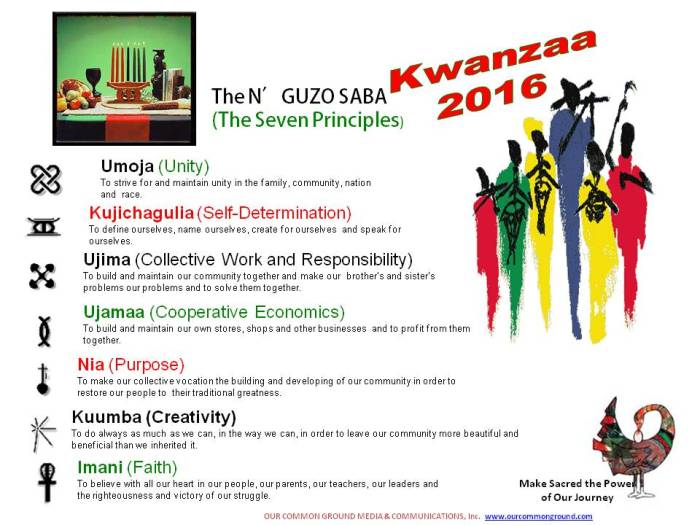
We have explored and examined the many issues, events and collective experiences of our time all through this year, 2016. As a people we have been challenged with disappointment; thunders of terror at the extra-judicial murders of our Brothers and Sisters; the continuing captured of them in enslavement camps by the millions;the covert oppression of children in schools that fail them or prepare them for imprisonment camps; and the failure of our government to makes us whole. As on this night in 1862, we search for the ‘North Star’ still. I impress my life and the spirit of this radio broadcast each week in the lessons of the N’Guzo Saba, striving to respect and honor Black Truth, our TRUTH.
Each week, we make a place, a sanctuary to say and claim that truth. In this coming year, we are faced with the gravest form of oppression and racism seen by none of us in our lives.  Make no mistake, on the bed of a fledgling fascism they will make every effort to eviscerate our belief in our historical accomplishments, ourselves as a people, what is ours and what is owed. We must stand tall in the dancing glow of our Ancestors and stand strong and tall. We must be strategically vigilant and believe in our Truth and the possibilities of our people still.
OUR COMMON GROUND will continue to provide the sanctuary that offers clarity, armament, comfort and a secure place for our voice, with respect and passion.  We are committed to serious analysis, seeking appropriate outcomes and input and answers.  I recently passed my 35th anniversary as host of OUR COMMON GROUND, there will be changes but our mission will never waver.  We are ALTERNATIVE ACTIVIST RADICAL RADIO and will continue in that tradition. WE least afford to let up in the face of what is coming.  We must careful about how we adjust our lenses in lunging into the “new struggle” era. Credible, useful, accurate and clear examination and action is more necessary than ever.  We are in a period of “post reconstruction” with the most visceral and evil forces controlling our public agency. We are a people who know how to survive.  For our children we continue thus.  As for our government, we may be unable to stop what will happen, however, we must stand on our Truth.
Throughout our history, the only thing that we have ever asked the OCG Family is do what you can (UJIMA, NIA) to help us grow and to bring more comrades to the Sanctuary.
Thank you for your support throughout the year. We return LIVE on January 7th.
Wishing for us the Victories of our Past and Abundance and Prosperity in our Future.
Janice Graham
Executive Producer, Host
OUR COMMON GROUND
kwanzaa16
watchnight
Date: December 31
Wed, 1862-12-31

*On This date in 1862 the first Watch Night Services were celebrated in Back communities in America.

The Watch Night service can be traced back to gatherings also known as “Freedom’s Eve.” On that night, Black slaves and free blacks came together in churches and private homes all across the nation awaiting news that the Emancipation Proclamation actually had become law.  At the stroke of midnight, it was January 1, 1863; all slaves in the Confederate States were declared legally free. When the news was received, there were prayers, shouts and songs of joy as many people fell to their knees and thanked God.

Blacks have gathered in churches annually on New Year’s Eve ever since, praising God for bringing us safely through another year. It’s been over a century since the first Freedom’s Eve and tradition still brings us together at this time every year to celebrate “how we got over.” This celebration takes many African American decendants of slaves into a new year with praise and worship. The service usually begins anywhere from 7 p.m. To 10 p.m. And ends at midnight with the entrance of the New Year. Some people come to church first, before going out to celebrate, for others, church is the only New Year’s Eve event.

There have been instances where clergy in mainline denominations questioned the propriety of linking religious services with a secular holiday like New Year’s Eve. However, there is a reason for the importance of New Year’s Eve services in the Black experience in America.

Reference:
The African American Desk Reference
Schomburg Center for research in Black Culture
Copyright 1999 The Stonesong Press Inc. and
The New York Public Library, John Wiley & Sons, Inc. Pub.
ISBN 0-471-23924-

“A Black Political Future” with Pascal Robert, The Thought Merchant

OUR COMMON GROUND with Janice Graham

 “A Black Political Future”

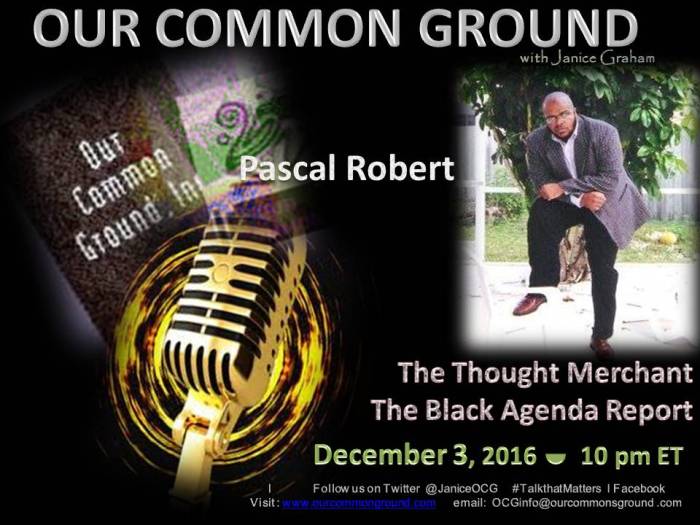
 December 3, 2016 :: LIVE ::10 pm EST

Guest: Pascal Robert The Thought Merchant Blog, Contributor, The Black Agenda Report

12-03-16-robert
LISTEN LIVE and Join Our Chat: http://bit.ly/BLKFuture
Listen or Call-In to add your voice to the discussion (347) 838-9852 Press 1 to join the discussion
 This week we discuss the political future of Black Americans in the era of a imperialist Executive and Legislative government. The critical question is not how we react to the fascism that has embedded itself but how we plan to organize our resistance and survival. There are some who say we have been here before. No,THIS is very different AND WILL be totally destructive to any viable Black empowerment strategies . They are bent on a strategy that will destroy the vulnerable infrastructure that keeps us from drowning. We talk with Pascal about preservation and building.
 Pascal  Robert (pronounced Ro-Bear like Stephan Colbert) is a Blogger who loves all things politics. SHEER political independent; unafraid to slay the most sacred cows of ideological orthodoxy from the Left, or the Right and one who enjoys global affairs and aspects of pop culture. In all ways he is a child of the Haitian Revolution.
Pascal Robert has been known for years to the online world as THOUGHT MERCHANT.
Since 2007 he has been recognized for his hard hitting, blunt unvarnished style of bringing attention to current events and global affairs, especially those affecting communities of color. Join him in these social media outlets:

Black Girls, Domestic Violence, and the Limits of Self-Defense | Black Agenda Report


Black Girls, Domestic Violence, and the Limits of Self-Defense

by Lindsey E. Jones

Recent scholarship in the history of black women and the carceral state illustrates the extent to which systems of criminal justice and law enforcement have both historically failed to protect black female victims of domestic violence and criminalized black women who rise up in their own defense.

Black Girls, Domestic Violence, and the Limits of Self-Defense

by Lindsey E. Jones

This article previously appeared in the blog of the African American Intellectual History Society.

Legal systems in this country explicitly and implicitly render black women defenseless against intra- and interracial violence.”

The case of Bresha Meadows, an African American teenage girl in Ohio, is a sad commentary on the failure of the state to protect victims of domestic violence. After a lifetime of watching him physically and psychologically abuse her mother—and of being subjected to threats and verbal abuse, along with her siblings—Bresha allegedly shot her father to death while he slept on July 28, 2016. While her mother’s family and her attorney consider her actions to have been in self-defense, the county prosecutor has charged Bresha with aggravated murder. It remains to be seen whether she will be tried as a juvenile or as an adult. At stake is the possibility that Bresha, who marked her fifteenth birthday in juvenile hall just weeks after her arrest, could spend the rest of her life in prison if convicted as an adult.

While the case is making its way through the courts and the families of Brandi Meadows (Bresha’s mother) and Jonathan Meadows (Bresha’s deceased father) share conflicting stories with news media about the latter’s personality and propensity toward violence, as well as their conflicting opinions about premeditation versus self-defense, it is important to note that this case is neither isolated nor entirely new. Recent scholarship in the history of black women and the carceral state illustrates the extent to which systems of criminal justice and law enforcement have both historically failed to protect black female victims of domestic violence and criminalized black women who rise up in their own defense.

“Survivors of intimate partner violence dramatically overrepresented among incarcerated black women.”

Historian Kali Gross, in providing historical context to the case of Marissa Alexander, argues that the state’s willingness to condemn this woman for defending herself against an abusive husband points back through centuries of American history to “the legacies of an exclusionary politics of protection whereby black women were not entitled to the law’s protection, though they could not escape its punishment.” Gross traces the ways in which “racialized, gendered notions of protection” have, from the seventeenth century on, shaped legal systems in this country that explicitly and implicitly render black women defenseless against intra- and interracial violence. She argues that this exclusionary politics of protection fuels the current mass incarceration crisis, with survivors of intimate partner violence dramatically overrepresented among incarcerated black women.1

Bresha Meadows’s case exemplifies Gross’s concept of the exclusionary politics of protection. This past May, Bresha ran away from home to the home of an aunt, Martina Latessa. Latessa, a police officer working in a domestic violence unit in Cleveland, was forced to return Bresha to her father, who had reported the girl as having been kidnapped by her aunt. Latessa reported her brother-in-law to Family Services, which resulted in an agent interviewing Brandi Meadows about the allegations of abuse—as Jonathan Meadows sat beside her. Neither law enforcement nor the state bureaucracy could protect Brandi Meadows and her children from this abuse, which she and her family assert intensified after this incident. As a result of the state’s failure to end the cycle of trauma in her family, Bresha Meadows took matters into her own hands—and was charged with aggravated murder, for which she could potentially spend the rest of her life in prison.

Gross’s essay compellingly reveals the intersections of race, gender, and class in black women’s hyper-vulnerability to domestic violence; state failure to prevent or put a stop to said violence; and the too-common outcome of black women being incarcerated for offenses resulting from attempting to defend themselves against domestic violence. However, as the case of Bresha Meadows illustrates, there is another vector of identity that often doesn’t appear in our historical analyses of black females and the carceral state: that is, age.2

“For black women in the Jim Crow South—as in antebellum times—domestic violence was constitutive of domestic labor.”

Where race, gender, and class have worked together to create the conditions discussed above, the erasure of age difference has historically created disadvantages for black girl victims of domestic violence. One prominent example recently provided by historian LaShawn Harris is that of Virginia Christian. Often referred to as the first woman to be executed by the Commonwealth of Virginia, Christian was in reality a seventeen-year-old girl when she was killed by electric chair in 1912—a fact that her advocates hoped would persuade the state to show her mercy.3

Virginia Christian belonged to a working-class black family in Hampton, Virginia, and needed to work in order to contribute to her household, including her disabled mother. From the age of thirteen, she served as a laundress for a middle-class white family named Belote in Hampton. During a dispute about missing jewelry that turned physical, Virginia killed the matriarch of the family—a crime she confessed to committing in self-defense. Harris argues that “Christian’s act of self-defense delineated working-class African American women’s impetuous ways of protecting their bodies and their often last attempts to seek and secure long-awaited personal justice—especially when legal protection seemed beyond their reach.” While there is no archival evidence that Ida Belote had laid hands upon Virginia Christian prior to this altercation, there is plenty of evidence to demonstrate that for black women in the Jim Crow South—as in antebellum times—domestic violence was constitutive of domestic labor, the racially prescribed set of occupations for black women and girls.4

Christian’s response was most immediately triggered by Belote’s accusations of theft and subsequent physical assault on March 18, 1912, but it is conceivable that she was also responding to other physical and psychological traumas accumulated over three years of working in the Belote household.

The analogy from Virginia Christian in 1912 to Bresha Meadows in 2016 is imperfect, but these cases both illustrate the extent to which the state has failed to consider age in evaluating black girls’ actions in self-defense from domestic violence. Sadly, over a century later, Bresha’s advocates find themselves making very similar demands of a system that hasn’t changed enough since Virginia’s trial, and employing very similar tactics in their pursuit of mercy for this abused adolescent girl.

“In the minds of whites, the accused, regardless of her age, was a deviant and vulgar black murderess that had to be punished for her crime.”

In the case of Virginia Christian, the Commonwealth of Virginia ignored evidence that Christian committed the crime at sixteen years of age in order to prevent her minority status from impeding its plan to execute her. Harris argues that, “in the minds of whites, the accused, regardless of her age, was a deviant and vulgar black murderess that had to be punished for her crime; essentially, Christians’ race trumped her gender and age. By denying Christian of her adolescent status, the State of Virginia sought to punish her to the full extent of the law.”5

Black and white Americans wrote letters and circulated petitions pleading with the Commonwealth to consider Christian’s youth as a factor in her crime and her punishment and to commute her sentence from execution to life in prison. In the end, neither Christian’s appeal to self-defense, nor her advocates’ appeal to adolescence, could spare her from the lethal retribution of the state.

In a throwback to the campaign to spare Virginia Christian’s life in 1912, advocates of Bresha Meadows are writing letters and circulating petitions in the hope that local prosecutors take into account her age and her status as a survivor of domestic violence as they proceed with charges against her. Because of the Supreme Court’s 2005 decision in Roper v. Simmons that it is unconstitutional to execute a person for a crime committed under eighteen years of age, the death penalty is not on the table for Bresha. However, because prosecutors could decide to try her in adult court, it is a real possibility that she could be sentenced to life in prison.

A century after Virginia Christian’s advocates passionately and strategically petitioned the Commonwealth of Virginia for life imprisonment, Bresha’s advocates argue that no adolescent should spend life in prison—especially not a girl pushed toward drastic action by a lifetime of trauma and abuse. There is thankfully still time for the prosecutors of Trumbull County to give real weight to Bresha Meadows’ traumatic life history, and to the fact that it spans fifteen short years, as they decide what action to pursue.

Lindsey E. Jones is a PhD Candidate in History of Education at the University of Virginia’s Curry School of Education and a 2016-2018 Pre-doctoral Fellow at the Carter G. Woodson Institute for African-American and African Studies at the University of Virginia. Her dissertation project, “‘Not a Place of Punishment’: the Virginia Industrial School for Colored Girls, 1915-1940,” historicizes the education and incarceration of black girls by examining Virginia’s only reformatory for delinquent African American girls. Follow her on Twitter @noumenal_woman.

NOTES:

1. Kali N. Gross, “African American Women, Mass Incarceration, and the Politics of Protection,” Journal of American History 102, no.1 (2015), 25–33.

2. For a contemporary examination of black girls, interpersonal violence, and the carceral state, see Jody Miller, Getting Played: African American Girls, Urban Inequality, and Gendered Violence (New York: NYU Press, 2008).

3. Lashawn Harris, “The ‘Commonwealth of Virginia vs. Virginia Christian’: Southern Black Women, Crime & Punishment in Progressive Era Virginia,” Journal of Social History 47, no.4 (2014), 922–42.

4. See, for instance: Tera W. Hunter, To ’Joy My Freedom: Southern Black Women’s Lives and Labors after the Civil War (Cambridge, Mass.: Harvard University Press, 1997); Thavolia Glymph, Out of the House of Bondage: The Transformation of the Plantation Household (Cambridge: Cambridge University Press, 2003); Sarah Haley, “‘Like I Was a Man’: Chain Gangs, Gender, and the Domestic Carceral Sphere in Jim Crow Georgia,” Signs 39 (Autumn 2013).

5. Harris cites “a 1910 Virginia statue prohibiting death to ‘any child under seventeen years of age who is charged with any felony, and never having been heretofore convicted in any court of a misdemeanor’” (931).

Source: Black Girls, Domestic Violence, and the Limits of Self-Defense | Black Agenda Report

Black Men In Chicago Are Taking Over Abandoned Property & Rebuilding The Neighborhood With The Youth By Creating Their Own Jobs – Ear Hustle 411

Black Men In Chicago Are Taking Over Abandoned Property & Rebuilding The Neighborhood With The Youth By Creating Their Own Jobs


Chicago, Illinois – Black men are demanding the city help them with the resources to help rebuild the community. These men are literally in the process of taking over abandoned property and training at risk youth to help fix up the properties that the city is trying to demolish.

Many of the properties are generally in pretty decent condition as far as the frame being solid brick and these men are saying they are not going to allow the city to tear down perfectly good homes.

A lot of the homes are boarded up and abandoned due to subprime lending where the Lenders/Bankers sucked the resources out of certain communities, left them in total disarray, foreclosed on the properties and resold many of them for pennies on the dollar to Hedge Fund Investors.

This happened by way if issuing Interest only mortgages where the borrower paid only the interest and no principal and when the term was up, they were forced to pay interest plus principle which the majority was unable to do therefore losing their properties while hedge fund investors bet against the people and walked away with tons of properties.

These investors slowly take over certain areas which are considered prime real estate and move the minorities out and gentrify the neighborhoods.

The men called on Alderman Michael Scott 24th Ward, Alderman  Jason Ervin 28th Ward,  and Alderman Walter Burnett 27th Ward and all the Aldermen across the city to help them make this happen.

The group said they are going all over the city and taking over the 20,000 properties that are sitting idle waiting to be torn down.

They then said that the people in the community want the buildings demolished however they don’t realize that for every building that is demolished, property taxes goes up.

The spokesperson Mark Carter said NHS, CIC and Globe Trotters organizations were supposed to help their parents and grandparents but instead they allowed the city to demolish their homes.

The men said the Mayor and Alderman sit back and watch these children get murdered in the communities and they refuse to sit back and do nothing about it.

He said they are demanding  the resources be given to them and they can rebuild themselves.

Check out the video:


VideoPlayer

 Photo Credit:  Mark Carter- Facebook

Source: Black Men In Chicago Are Taking Over Abandoned Property & Rebuilding The Neighborhood With The Youth By Creating Their Own Jobs – Ear Hustle 411

Colin Kaepernick will not be silent: He’s a black man first | theGrio

en

en San Francisco 49ers quarterback Colin Kaepernick brought light to the issue of police brutality by kneeling in protest during the national anthem, he also exposed the National Football League and America’s deep-rooted racial and economic offenses that have been brewing for decades.

Despite the thinly covered veil some in the media have conveyed about the struggles of black America, the looming issue is one that points to just how much this country has failed African-Americans.

Take MLK’s Name Out Your Mouth: An Open Letter to Clemson FB Coach Dabo Swinney

The rise of the black male sports figure and his million-dollar contract produced a safe haven, where blacks found a sense of pride and hope. Somehow an alternate reality was created in which America found comfortability at the sight of jovial black men playing and loving the sport–all while cashing in the big checks. That imagery perpetuated the deceptive notion that far less black Americans were crippled under the historical weight of a country that had, over time, legally mandated so many financial obstacles in the way of their achievement.

Nate Parker Says Colin Kaepernick’s is a Form of Resistance in the Spirit of Nat Turner

As half of the 14 million black households in America see their median net worth hover around $1,700.00 when you deduct the family car and other consumer durables, the imagery we often see in sports and entertainment–black men living lavishly–has made black America’s struggles ever more difficult to see as the real economic story. Whether we look to mass incarceration, chronic unemployment, dismal college graduation rates, or any other social indicator, it’s clear that African-Americans, and in particular black men, are not getting their fair shot at the American Dream.

Since the early 1980s and the introduction of Reaganomics, the crack cocaine epidemic and a slew of racially-biased laws, African-American men have found themselves largely living life as the underclass. Yet it is behind the decadent veil of the NFL and other sports organizations that the false narrative that the struggle for socio-economic stability had somehow subsided has been projected.

Colin Kaepernick Pledges $1 Million Donation to Causes Fighting for Equal Rights 

Thankfully, there’s data that shows otherwise.

From the incarceration numbers that show black men are sent to prison at one of the highest rates the modern world has ever seen, to unemployment rates–which in some places like Milwaukee indicate working-age black men are unemployed at rates above 50 percent–the so-called American Dream has not been good to black men by any stretch of the imagination. But inside of the NFL we could always see the million-dollar black man (albeit while destroying their bodies), happy and loving the sport of football. With Kaepernick and other athletes finally speaking up for the disenfranchised Black men who are not in their unique positions, it’s clear that many athletes are finally feeling the racial implications and failures of free markets, and now they’re speaking up about it.

Kaepernick boycotting the national anthem and other football players putting their black fists in the air, are signs of not just of protest, but of disobedience. A confrontational bucking order of things and standing up to a set of rules that has allowed the NFL–and its white billionaire owners–to thrive.

The very ethos of the NFL is a selling of diversity, opportunity, and American unity. And it’s also one of control; a place where NFL commissioner Roger Goodell would heavily punish the Ray Rices or Adrian Petersons of the world if they stepped out of line. The recent events, however, are different and have left the NFL desperately grasping for any opportunity to save itself from a branding nightmare. According to Bleacher Report, NFL executives are going as far as labeling Kaepernick a traitor they want nowhere near their team–a feeling they say mirrors that of an estimated 90 percent of other executives.

In Kaepernick’s own words, these are not unifying times, and he does not intend to act as if these injustices don’t exist. He along with others brave enough to speak out can no longer stand by and act as if we all are united during the tune of the “Star-Spangled Banner.”

“I’ll continue to sit,” Kaepernick said of his protest. “I’m going to stand with the people that are being oppressed. To me this is something that has to change and when there’s significant change and I feel like that flag represents what it’s supposed to represent in this country–is representing the way that it’s supposed to–I’ll stand.”

Those are the words of a defiant black man, and not of a NFL quarterback who led his team to a Super Bowl appearance. Kaepernick has made it loud and clear that he is a black manfirst, and that no amount of money can silence him. Now his moment of awakening is starting to catch fire, and it’s sweeping across the NFL as other players join in.

Just recently former NFL player Shannon Sharpe speaking on Fox Sports’ “Undisputed” said, “People seem to think that they can tell, ‘Shannon it’s okay, look at you, look at some of the more prominent African Americans,’ … But no, we make up a small, small portion. We’re disproportionate. We’re not the norm in black society.”

For decades, so many framed their ideas of the state of Black America on the social status of a selected few black male athletes, broadcasted on television screens globally as the new American norm. Now those very black men are standing up and saying they don’t want to play the cover up game anymore. Maybe, just maybe it will lead us to a place where finally there are no games played at all.

Antonio Moore, an attorney based in Los Angeles, is one of the producers of the Emmy-nominated documentary Freeway: Crack in the System. He has contributed pieces to the Grio, Huffington Post, and Inequality.org on the topics of race, mass incarceration and economics. Follow him on YouTube Channel Tonetalks.

Source: Colin Kaepernick will not be silent: He’s a black man first | theGrio

Their eyes were indeed watching God.

Remembering the victims of the Storm of ’28 – now honored Ancestors

I have such a deep personal history around this disaster. Not forgetting the stories told to me by my Mother who was a witness; and I never forgot. After many years away, In 1991,  using my radio voice on OUR COMMON GROUND I co-founded The Sankofa Society with Janice Jennings, a local Sister Attorney and Patrice Daniels, OCG Producer to  organize the community to remember, by organizing an African-centered consecration of the burial site and raising the names of our Ancestors buried there.

ABOUT THE 1991 CONSECRATION 

My thanks to Former WPB City Commissioner Robbie Littles, Robert Hazard, Patrice Daniels and many others who are now keeping this important history alive working to finalize the Remembrance Park. On September 16th, the community will come together for this year’s memorial.

sentinel-article


The Palm Beach Post from West Palm Beach, Florida · Page 62

Oct 21, 1991 –  Graham said she also plans to put together a housing committee that would …. Victims of 1928 hurricane in mass grave consecrated .-. … Janice Peak-Graham, Janice Jennings and Patrice Daniels were introduced as “the …

ABOUT the 2016 Memorial

storm2.png

storm1

“To them, the Storm of ’28 will forever be remembered as Black Sunday, the night when death blew down Palm Beach County’s back door.

Landfall Even before the unnamed storm, packing 150 mph winds, slammed ashore in West Palm Beach, it had killed 1,500 in the Virgin Islands, Puerto Rico and the Bahamas.

Within moments of making landfall on a Palm Beach County shoreline, its fierce winds left a trail of destruction from Pompano Beach to Jupiter. Sailboats were thrown from their moors, buildings in downtown West Palm Beach splintered and popped, choking Clematis Street with debris. The Episcopal Church on Swinton Avenue in Delray Beach was flattened, and in Boca Raton, railcars were blown off their tracks and a third of the buildings were demolished.”

woodlawn

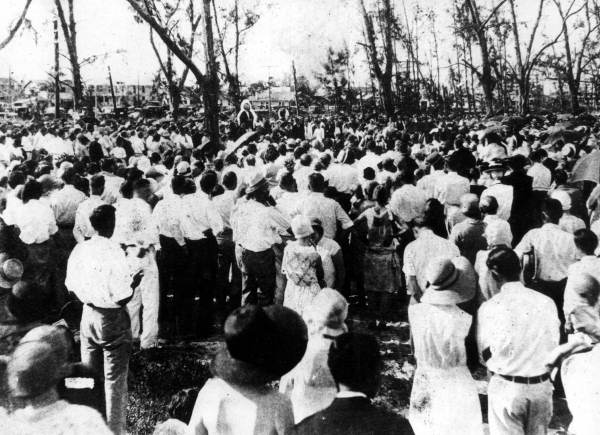
Funeral service for the Black victims of hurricane victims at Woodlawn Cemetery in West Palm Beach (1928).


coffin

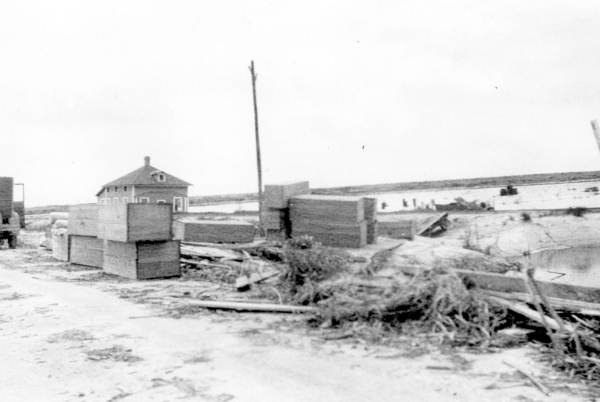
Makeshift coffins stacked alongside the road between Belle Glade and Pahokee after the Okeechobee Hurricane of 1928. Black victims were loaded onto trucks and buried in a mass grave at the corner of 25th Street and Tamarind Ave. in West Palm Beach.  The site later became the site of the WPB city sewer system.  Spewing odor across the Black community and desecrating more than 674 Black ancestors.

SEPTEMBER 16th, 1928

Okeechobee Hurricane Kills Thousands of Black Farm Workers in Florida

On September 16, 1928, a Category 4 hurricane with winds of 140 miles per hour made landfall in Palm Beach County, Florida. The hurricane destroyed a levee that protected a number of small farming communities from the waters of Lake Okeechobee. Most of the residents of these low-lying communities were black migrant farm workers. When the levee was destroyed, water from Lake Okeechobee rushed into these communities, killing thousands.

After the hurricane, black survivors were forced to recover the bodies of those killed. The officials in charge of the recovery effort ordered that food would be provided only to those who worked and some who refused to work were shot. The bodies of white storm victims were buried in coffins in local cemeteries, but local officials refused to provide coffins or proper burials for black victims.

Instead, the bodies of many black victims were stacked in piles by the side of the roads doused in fuel oil, and burned. Authorities bulldozed the bodies of 674 black victims into a mass grave in West Palm Beach. The mass grave was not marked and the site was later sold for private industrial use; it later was used as a garbage dump, a slaughterhouse, and a sewage treatment plant. The city of West Palm Beach did not purchase the land until 2000. In 2008, on the 80th anniversary of the storm, a plaque and historical marker was erected at the mass grave site.

Downtown West Palm Beach Clematis Street following the storm.

HURRICANE OF 1928 MASS BURIAL SITE

Location:Corner of 25th St. and N. Tamarind Ave.
County: Palm Beach
City: West Palm Beach, FL
Description: Early residents of Glades had to survive many harsh elements. Their goal to create a thriving farming community was often tested by storms, insects, and the lack of many comforts. In 1928 the Glades area was devastated by a powerful hurricane that threatened to destroy the entire area. Several thousand residents were killed and hundreds of homes were destroyed. Despite the death and damage, those residents that survived continued to develop the area. The Glades eventually became a major agricultural community because of their desire and vision. This memorial honors those residents who lost their lives in the 1928 hurricane.
Sponsors: CITY OF PAHOKEE AND THE FLORIDA DEPARTMENT OF STATE


Hurricane of 1928 African American Mass Grave:

West Palm Beach, Florida

[photo]
Hurricane of 1928 African American Mass Grave Site
Photo by Sherry Piland, courtesy of Florida Division of Historical Resources

The Hurricane of 1928 African American Mass Burial site is important as the burial site of approximately 674 victims, primarily African American agricultural workers, who were killed in the hurricane of 1928 that devastated South Florida–one of the worst natural disasters in American history. A major event for the African American community, it was the source for literary inspiration by noted author Zora Neale Hurston in Their Eyes Were Watching God; well known educator Mary McLeod Bethune, along with 3,000 other mourners attended the memorial service at the mass grave.

The bodies brought to West Palm Beach, Florida, were delivered to two cemeteries: 69 bodies were buried in a mass grave intended for white victims at Woodlawn Cemetery, and an additional 674 victims were buried in a mass grave intended for black victims in the City’s pauper cemetery at 25th Street and Tamarind Avenue. The mass grave was never marked. In December 2000, responding to public interest, the City of West Palm Beach reacquired the property of the burial ground from the last owner, and plans to memorialize this site in the history of the community are underway.


IMPORTANT LINKS for more Information

When the Dam Breaks…

Florida Frontiers “The Hurricane of 1928”


For Colored Girls Like Korryn Gaines And the Black Men Who Hate Us


For Colored Girls Like Korryn Gaines And The Black Men Who Hate Us

What is it to be a black woman in America. For the burden of both racism and misogyny to lay at our feet.

Korryn Gaines was no fool. In her short 23 years she was all too familiar with the carnage of black bodies. This familiarity with state sanctioned executions empowered her to raise unafraid black children. With her thick Baltimore accent she instructed her five-year-old son to record the Baltimore County police who’d pulled her over for not having registered tags on her car. That day, she was ready to die. Her life was spared, but she wouldn’t be so fortunate again.

Her Instagram shows a warrior woman who believed in her right to legally bear arms. She was uninterested in cow-towing to the very system that kills even its most “perfect” victims. Instead of “hands up, don’t shoot!” shethought “#StopKillingUs is some begging ass shit” was more appropriate. Baby girl had no desire to be pleasant or respectable.

So when Baltimore County police showed up to her apartment to serve a warrant for her arrest over misdemeanor traffic violation charges, she knew it could very well be the day she took her last breath. In her last moments she took to Instagram to record her cute, chubby cheeked five-year-old son, her asking the questions, him predicting the outcome.

“Who’s outside?”
“The police.”
“What are they trying to do?”
“They trying to kill us.”

What happened next doesn’t matter much because the result is the same. It’s always the same. Korryn is dead. The police will lie. The media will corroborate the police’s lies. The public will blame her for her death. There will be no justice. Officials will call for peace. Family members are left to raise her children. And shortly we will have all moved on to grieve the next victim of police violence. The narrative is so familiar it shows up in our dreams. The tears feel the same as the ones we wiped the last time we mourned a black person who we did not know. Only this time those tears will only be cried by black women. All black lives are not mourned equally.

Because Korryn dared to be a vocal black woman — one who may or may not have been legally armed — there is no outcry for her except from other black women. There will be no outraged celebrities. Protesters won’t flood the streets in cities across the nation. Public officials will not demand accountability for the officers who killed her. Presidential candidates will not condemn the police department for their failure to de-escalate considering a child was present. President Obama will not tell the nation Korryn could’ve been his daughter. News and cable networks won’t profit off her death by hosting Town Hall meetings. Black men will not grieve her as they have the long list of black men killed similarly. In fact, black men will adopt the language of our oppressors to blame her for her own murder.

Black men couldn’t wait to vocalize their hatred for black women. “It’s looking mighty justifiable right now” and “Korryn Gaines deserved to die” and “Basically asked for it” and “She decided to be reckless with her son and her own life” and “Korryn Gaines was an ignorant, loud mouth little girl.” Those are just a few. Tucking in their hatred is hard to do, even when two black children are left without a mother.

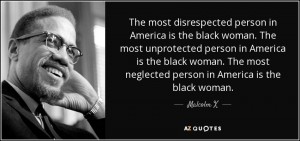
Black men's hero, Malcolm X, telling the painful truth about black women.

Black men’s hero, Malcolm X, telling the painful truth about black women.

These are the same black men who automatically don’t trust police accounts in killings where the victim is a black man, but are quick to believe Korryn was pointing a gun at the police when they entered her home. Despite her documented recordings of run-ins with the Baltimore County police, black men aren’t thinking maybe this woman was targeted. Black men are not playing detective to figure out the truth in this strange story the police tell of using the landlord’s key to enter her home. Black men are not rallying for an end to a system that sends a SWAT team to someone’s home over non-violent traffic violations. Black men are not calling foul, because even if she was armed, white suspects with guns are apprehended alive all the time. Black men are not questioning how she could hold her phone to record, hold her son and allegedly hold a shotgun in her hand all at the same time. Black men aren’t sympathetic to her developmental disability due to lead poisoning, which could’ve affected her reasoning the day she was murdered. Nope. Black men are saying she deserved to die because she was a crazy fool and a shitty mother for daring to be free.

Ain’t that peculiar?

Black men must remove the word revolutionary from their vocabulary. One minute it’s “fuck the police” and the next it’s Korryn was reckless. Black men love the iconic photo of their hero Malcolm X looking out the window of his home, shotgun in hand to protect his family, but Korryn possibly having a gun means she deserved death. They cheer on Nat Turner but who does Korryn think she is to protect her family. Black men either don’t know what revolutionary really means or think the word is reserved for them solely.

Remove it from your tongues.

It’s not just about Korryn. It’s about black womenfolk being de mules of the worldat the hands of black men. Folks called Sandra Bland sassy. Said had she not talked back she would’ve lived. No one showed up for the Rekia Boyd rally in NYC. When we talk to black men about the dangers of street harassment we are met with death and rape threats. Statistics show violence against black women is mostly at the hands of black men, but we’re shouted over for bringing that up. Then when we tell black men that we, too, are killed by police, we are told now is not the time to be divisive. You will get to us after we take care of our “kings.”

But you see, that doesn’t work for me. My liberation is not going to come after. I’m not suffering through black men’s harmful misogynoir while black women’s freedom becomes a ‘maybe we’ll get to it in the next lifetime’ non-priority. I’m not adding a “not all black men” caveat to my truths in order to coddle hurt feelings. My life is literally on the line. And my freedom can’t wait.

Either cis black men are going to center black women so we can all get free together, or my freedom fighting will be reserved for black women and black queer folks. Do what you want with that. But my freedom can’t wait. I won’t wait for you to see my humanity while I fight for yours.

While you’re denying our humanity, remember this: Putting off black women’s liberation for tomorrow is a dangerous game. Because ain’t a single liberation movement survived without us.

To Korryn and Sandra and all the black women who refuse to bow, refuse to shutup, we got you. Rest easy knowing black women said your name and refused to let them forget.

Source: For Colored Girls Like Korryn Gaines And the Black Men Who Hate Us

Political Prisoner Rev. Edward Pinkney Fears for His Life | Black Agenda Report

Political Prisoner Rev. Edward Pinkney Fears for His Life

A Black Agenda Radio commentary by executive editor Glen Ford

The Black political class is constantly congratulating itself on ancient voting rights victories in the South, yet Rev. Edward Pinkney is serving his second stretch in prison for fighting against Black disenfranchisement in Benton Harbor, Michigan. Pinkney was convicted twice by all-white juries on the flimsiest evidence, and now believes his life is in danger behind bars.

Political Prisoner Rev. Edward Pinkney Fears for His Life

A Black Agenda Radio commentary by executive editor Glen Ford

“He fears the government is out to do him harm.”

Rev. Edward Pinkney, the imprisoned community activist from the mostly Black town of Benton Harbor, Michigan, believes his life is in danger. Pinkney is serving a sentence of two and a half to ten years following his conviction by an all-white jury on the flimsiest of charges of tampering with an election recall petition. He told Kenneth Rhoades, a supporter on the outside, that he’s not afraid of the inmates, but fears the government is out to do him harm – and that they might get away with it because, in his words, “they cover everything up” at Marquette Branch Prison, located on the thinly populated and very, very white Upper Peninsula of Michigan, almost 500 miles from Benton Harbor.

Pinkney, who is 67 years old, has witnessed numerous assaults on inmates by prison guards, and has spent long stretches in isolation. For six months he was deprived of phone and visitation privileges because the authorities believed he was behind a mass inmate food protest – another bogus charge, since inmates at prisons on the Upper Peninsula have been protesting the food since before Pinkney arrived.

This is the second time that Pinkney has been railroaded to prison for trying to bring change to deeply impoverished Benton Harbor through the vote. Back in 2007, after two trials, an all-white jury from the surrounding county convicted him of tampering with a ballot petition. He was sentenced to house arrest, but was then thrown in prison for a year when he quoted Bible verses to the judge – something of a first in American legal history. Ultimately, the conviction was overturned on appeal.

Crushing Voting Rights Activism with SWAT and Prison

Rev. Pinkney’s lawyers believe his current conviction on similar bogus charges will ultimately also be reversed – but that could take years, and anything can happen to a political activist in the American prison gulag.

Mary Neal, who calls Rev. Pinkney her “online minister,” believes the people of Flint, Michigan, would have responded to the poisoning of their water sooner if Pinkney hadn’t been incarcerated at the time. The Reverend has had more experience than most other activists in dealing with state appointed emergency financial managers like the one that switched the water supply in Flint. Benton Harbor was put under state dictatorship in 2010. Governor Rick Snyder then quickly expanded the emergency financial manager regime to all of the state’s heavily Black cities, effectively disenfranchising more than half of Michigan’s Black citizens. But, Rev. Pinkney and his Black Autonomy Network Community Organization, or BANCO, pressed on, refusing to accept the loss of their local voting rights, either to the State of Michigan, or at the hands of the giant Whirlpool Corporation, which has ruled Benton Harbor like a plantationfor generations. Finally, they sent a SWAT team to arrest Rev. Pinkney at his home in April, 2014, and now he sits in cell in the American equivalent of Siberia, a 67 year old soldier in the African liberation struggle.

For Black Agenda Radio, I’m Glen Ford. On the web, go to BlackAgendaReport.com.

BAR executive editor Glen Ford can be contacted at Glen.Ford@BlackAgendaReport.com.

Source: Political Prisoner Rev. Edward Pinkney Fears for His Life | Black Agenda Report