
Baby Bonds: A Plan for Black/White Wealth Equality Conservatives Could Love?

Darrick Hamilton calls for spreading the benefits of asset-ownership to all Americans.
Darrick Hamilton calls for spreading the benefits of asset-ownership to all Americans.


Black farmers in the Mid-South region surrounding Memphis used science to uncover a multi-million scheme to put them out of business and steal their farmland, WMC News reported Tuesday.
At the Mid-South Farm and Gin Show show in March of 2017, African-American farmers believe that Stine Seed Company purposefully sold them fake seeds.

Thomas Burrell, president of the Black Farmers and Agriculturalists Association, explained how black farmers were receiving one-tenth of the yield as their white neighbors.
“Mother nature doesn’t discriminate,” Burrell said. “It doesn’t rain on white farms but not black farms. Insects don’t [only] attack black farmers’ land…why is it then that white farmers are buying Stine seed and their yield is 60, 70, 80, and 100 bushels of soybeans and black farmers who are using the exact same equipment with the exact same land, all of a sudden, your seeds are coming up 5, 6, and 7 bushels?”
The results were so stark, resulting in millions of dollars in losses, the farmers took their seeds for scientific testing by experts at Mississippi State University.
The tests revealed the black farmers had not been given the quality “certified” Stine seeds for which they had paid.
Burrell suggested a land grab was the ultimate motivation of the perpetrators.
“All we have to do is look at here: 80 years ago you had a million black farmers, today you have less than 5,000. These individuals didn’t buy 16 million acres of land, just to let is lay idle. The sons and daughters, the heirs of black farmers want to farm, just like the sons and daughters of white farmers.”
“So we have to acknowledge that racism is the motivation here,” Burrell concluded.
The farmers have filed a class-action lawsuit in United States District Court for the Western Division in Memphis.
A state legislator is also seeking an investigation into the scheme.
Tennessee Rep. G.A. Hardaway (D-Memphis) vowed state government would investigate “issues which have negatively impacted our black farmers.”
“We will explore the avenues — whether its civil, whether it’s criminal — dealing with fraud,” Rep. Hardaway vowed.
One farmer victimized, David Hall, explained why he had paid extra for high quality seeds.
“We bought nearly $90,000 worth of seed” Hall explained. “It’s been known to produce high yield, so you expect it, when you pay the money for it, to produce the high yields.”
The farmers “were effectively duped,” Burrell told WREG-TV. “It’s a double whammy for these farmers, it accelerates their demise and effectively it puts them out of business.”
“No matter much rain Mother Nature gives you, if the germination is zero the seed is impotent,” Burrell reminded.
Watch:


Black Americans born poor are much less likely to move up the income ladder than those in other racial groups, especially whites. Why? Many factors are at work, including educational inequalities, neighborhood effects, workplace discrimination, parenting, access to credit, rates of incarceration, and so on.
But gender is a big part of the story too, as detailed in a new paper from the Equality of Opportunity Project, “Race and Economic Opportunity in the United States: An Intergenerational Perspective” by Raj Chetty, Nathaniel Hendren, Maggie Jones, and Sonya Porter. As always, there is a huge amount of data and analysis in the new paper. But the big finding is that race gaps in intergenerational mobility largely reflect the poor outcomes for black men. The report is another contribution to the growing literature showing that race gaps in the intergenerational persistence of poverty are in large part the result of poor outcomes for black men.
“We conclude based on the preceding analysis that the black-white intergenerational gap in individual income is substantial for men, but quite small for women. It is important to note, however, that this finding does not imply that the black-white gap in women’s individual incomes will vanish with time. This is because black women continue to have substantially lower levels of household income than white women, both because they are less likely to be married and because black men earn less than white men.” (p. 23)
In an attempt to estimate the impact of different marriage rates, Chetty et al. calculate the intergenerational mobility rates of black and white men raised in both single parent and married families, and find little difference. As they conclude, “parental marital status has little impact on intergenerational gaps” (p. 25).
In a new paper published today, we examine the same question in a different way. (See our longer Technical Paper here, and full Results here). We confirm the stark differences in upward earnings mobility for black men compared to both black women and whites. We also confirm that black women, despite their solid earnings mobility, have very low family income mobility. We then estimate the impact of racial differences in marriage rates by simulating higher marriage rates among black women: like Chetty, we find no significant effects.
Specifically, Chetty et al. show that black men born to low-income parents are much more likely to end up with a low individual income than black women, white women, and—especially—white men. As they write:
Black and white children are born into very different economic circumstances. Almost half of black boys and girls are in households in the bottom fifth of the income distribution, compared to just over one in ten white children:
There are, then, huge race gaps in the chances of being born to or raised in a poor family—gaps that were scarcely lower among children born in the early 1980s than they were among those born in the years around 1960. But what about the chances of escaping poverty as an adult?
Using data on 4,200 black and white Americans from the NLSY97, we find that over half (54 percent) of black men born into households in the poorest fifth of the family income distribution end up, as individuals, in the poorest fifth of the earnings distribution for their respective gender, between the ages of 28 and 35, compared to the minority of white men (22 percent), white women (29 percent), and black women (34 percent).
In terms of their individual earnings, black women have similar odds of escaping poverty as white women, though both these groups lag behind the upward mobility of white men. These analyses don’t consider the income of other family members, however. What happens when we look instead at adult family income, as opposed to individual earnings? A very different picture emerges for black Americans:
Black women face a very high risk of being stuck in poverty (62 percent), surpassing even the 50 percent risk faced by black men. For whites, the odds of remaining stuck in poverty remain relatively low, for both men (28 percent) and women (33 percent), when we use a family income measure.
The headline finding here is that, among those who grew up poor, black women are the only group showing a marked difference between the risk of being in the bottom quintile of the individual earnings distribution (for each gender), and the risk of being in the bottom quintile of the family incomedistribution (for the whole age cohort). Whites do well on both counts; black men do poorly on both counts. Black women do reasonably well on the first and very poorly on the second. This result is probably driven by the fact that black women tend to create families with black men who do poorly on both counts and thus bring down the family income results for black women.
Why? Various explanations could be given. The most obvious is that, assuming marriages or cohabitation mostly occur within racial groups, black women’s family position is damaged directly or indirectly by the poor outcomes for black men. If white women end up with white men, who in terms of their earnings are more than twice as likely to escape poverty as black men, their family income will be higher. Equally, if black women are more likely than white women to end up as single, they will also record a lower family income.
We set out to model the impact of household formation by artificially equalizing the marriage rates of black women and white women. The results will of course depend not just on whether they marry, but also on whom they marry. In our simulation, we assume that the additional women who are married have a husband with the same economic characteristics as their brother (see the Technical Paper for our detailed methods). The intuition here is that most people are likely to marry someone with a broadly similar background as themselves, and siblings, by definition, have an almost identical one. The results of this equal-marriage-rate simulation are as follows:
Our results strongly echo those of the Chetty team. So what conclusions can be drawn? Chetty’s team are blunt, writing that “the key to closing income disparities for both black and white women is to close intergenerational gaps in income between black and white men.”
This is certainly one of the most important implications of both their study and our own. Breaking the cycle of intergenerational poverty for black Americans requires a transformation in the economic outcomes for black men, particularly in terms of earnings. One important point here: the relationship between earnings and marriage runs in both directions. Married men tend, other things equal, to earn more: one study of identical twins suggests that being married raises earnings by one-fourth. Married men may feel more responsibility to provide economically for their families, and especially their children. Low marriage rates may therefore have some impact on earnings.
It is also clear that the vast inequalities by race cannot be alleviated by upward mobility alone. Black girls are, relatively speaking, more likely to move out of poverty in terms of their own earnings. However, we should keep in mind the sheer number of black children being raised in low-income households in the first place. Closing the race gaps in upward mobility will require wholesale shifts in economic outcomes, perhaps above all for men’s earnings.
Scott Winship is a former Brookings Institution fellow, now at the Joint Economic Committee. His contributions to this report ended before he took his current position. The authors did not receive financial support from any firm or person for this article or from any firm or person with a financial or political interest in this article. Winship is an honorary advisor for the Foundation for Research on Equal Opportunity and the Archbridge Institute. Other than the aforementioned, the authors are currently not an officer, director, or board member of any organization with an interest in this article.

Now thirty years old, I have been incapacitated by debt for a decade. The delicate balancing act my family and I perform in order to make a payment each month has become the organizing principle of our lives. To this end, I am just one of about forty-four million borrowers in the United States who owe a total of roughly $1.4 trillion in student loan debt. This number is almost incomprehensibly high, and yet it continues to increase with no sign of stopping. Reform legislation that might help families in financial hardship has failed in Congress. A bill introduced in May 2017, the Discharge Student Loans in Bankruptcy Act, which would undo changes made to the bankruptcy code in the early 2000s, stalled in committee. Despite all evidence that student loan debt is a national crisis, the majority of the U.S. government—the only party with the power to resolve the problem—refuses to acknowledge its severity.

ON HALLOWEEN IN 2008, about six weeks after Lehman Brothers collapsed, my mother called me from Michigan to tell me that my father had lost his job in the sales department of Visteon, an auto parts supplier for Ford. Two months later, my mother lost her own job working for the city of Troy, a suburb about half an hour from Detroit. From there our lives seemed to accelerate, the terrible events compounding fast enough to elude immediate understanding. By June, my parents, unable to find any work in the state where they spent their entire lives, moved to New York, where my sister and I were both in school. A month later, the mortgage on my childhood home went into default for lack of payment.
After several months of unemployment, my mother got a job in New York City fundraising for a children’s choir. In the summer of 2010, I completed school at New York University, where I received a B.A. and an M.A. in English literature, with more than $100,000 of debt, for which my father was a cosigner. By this time, my father was still unemployed and my mother had been diagnosed with an aggressive form of breast cancer. She continued working, though her employer was clearly perturbed that she’d have to take off every Friday for chemotherapy. To compensate for the lost time, on Mondays she rode early buses into the city from the Bronx, where, after months of harrowing uncertainty, my parents had settled. She wanted to be in the office first thing.
In January 2011, Chase Bank took full possession of the house in Michigan. Our last ties were severed by an email my father received from the realtor, who had tried and failed to short sell the property, telling him “it’s safe to turn off the utilities.” In May, I got a freelance contract with a newspaper that within a year would hire me full-time—paying me, after taxes, roughly $900 every two weeks. In September 2011, my parents were approved for Chapter 7 Bankruptcy, and in October, due to a paperwork snafu, their car was repossessed in the middle of the night by creditors. Meanwhile, the payments for my debt—which had been borrowed from a variety of federal and private lenders, most prominently Citibank—totaled about $1,100 a month.
Now thirty years old, I have been incapacitated by debt for a decade. The delicate balancing act my family and I perform in order to make a payment each month has become the organizing principle of our lives. To this end, I am just one of about forty-four million borrowers in the United States who owe a total of roughly $1.4 trillion in student loan debt. This number is almost incomprehensibly high, and yet it continues to increase with no sign of stopping. Reform legislation that might help families in financial hardship has failed in Congress. A bill introduced in May 2017, the Discharge Student Loans in Bankruptcy Act, which would undo changes made to the bankruptcy code in the early 2000s, stalled in committee. Despite all evidence that student loan debt is a national crisis, the majority of the U.S. government—the only party with the power to resolve the problem—refuses to acknowledge its severity.
The delicate balancing act my family and I perform in order to make a payment each month has become the organizing principle of our lives.
My debt was the result, in equal measure, of a chain of rotten luck and a system that is an abject failure by design. My parents never lived extravagantly. In the first years of their marriage, my father drove a cab. When they had children and my father started a career in the auto industry, we became firmly middle class, never wanting for anything, even taking vacations once a year to places like Myrtle Beach or Miami. Still, there was usually just enough money to cover the bills—car leases, a mortgage, groceries. My sister and I both attended public school. How much things cost was a constant discussion. Freshman year of high school, when I lost my yearbook, which cost $40, my mother very nearly wept. College, which cost roughly $50,000 a year, was the only time that money did not seem to matter. “We’ll find a way to pay for it,” my parents said repeatedly, and if we couldn’t pay for it immediately, there was always a bank somewhere willing to give us a loan. This was true even after my parents had both lost their jobs amidst a global financial meltdown. Like many well-meaning but misguided baby boomers, neither of my parents received an elite education but they nevertheless believed that an expensive school was not a materialistic waste of money; it was the key to a better life than the one they had. They continued to put faith in this falsehood even after a previously unimaginable financial loss, and so we continued spending money that we didn’t have—money that banks kept giving to us.
I’ve spent a great deal of time in the last decade shifting the blame for my debt. Whose fault was it? My devoted parents, for encouraging me to attend a school they couldn’t afford? The banks, which should have never lent money to people who clearly couldn’t pay it back to begin with, continuously exploiting the hope of families like mine, and quick to exploit us further once that hope disappeared? Or was it my fault for not having the foresight to realize it was a mistake to spend roughly $200,000 on a school where, in order to get my degree, I kept a journal about reading Virginia Woolf? (Sample passage, which assuredly blew my mind at the time: “We are interested in facts because we are interested in myth. We are interested in myth insofar as myth constructs facts.”) The problem, I think, runs deeper than blame. The foundational myth of an entire generation of Americans was the false promise that education was priceless—that its value was above or beyond its cost. College was not a right or a privilege but an inevitability on the way to a meaningful adulthood. What an irony that the decisions I made about college when I was seventeen have derailed such a goal.
Letter to an Unknown Lender
After the dust settled on the collapse of the economy, on my family’s lives, we found ourselves in an impossible situation: we owed more each month than we could collectively pay. And so we wrote letters to Citibank’s mysterious P.O. Box address in Sioux Falls, South Dakota, begging for help, letters that I doubt ever met a human being. We grew to accept Citibank as a detestable Moloch that we feared and hated but were made to worship. The letters began to comprise a diary for my father in particular, a way to communicate a private anguish that he mostly bottled up, as if he was storing it for later. In one letter, addressed “Dear Citi,” he pleaded for a longer-term plan with lower monthly payments. He described how my mother’s mounting medical bills, as well as Chase Bank’s collection on our foreclosed home, had forced the family into bankruptcy, which provided no protection in the case of private student loans. We were not asking, in the end, for relief or forgiveness, but merely to pay them an amount we could still barely afford. “This is an appeal to Citi asking you to work with us on this loan,” he wrote to no one at all.
Finally, at the beginning of 2012, my father started writing to the office of Congressman Joseph Crowley, who represented the district in the Bronx where my parents had relocated. In one of these letters, he described watching Too Big to Fail, an HBO film about the financial crisis, which had come out several months earlier. (My parents lost every asset they had, but they still subscribed to HBO, which became more than TV for them, a symbolic relic of their former class status.) The recession was over, officially anyway, and people who had not suffered its agonies were already profiting from its memory. Recession films often took place in the gleaming offices of hedge funds and investment banks, with attractive celebrities offering sympathetic portrayals of economists and bankers—Zachary Quinto, in 2011’s Margin Call, for instance, plays a rocket scientist-turned-risk analyst with a heart of gold, a do-gooder who discovers that his employer has leveraged itself to the edge of bankruptcy. The stars of these films depicted figures who experienced little to no repercussions for their roles in leading the country into a recession, who abused the misfortune of people like my parents—unmentionables who owed more on their houses than what they had paid for them and, of course, who were rarely visited in any of these films. My father described himself and my mother to Crowley as “the poster children for this entire financial event,” by which he meant Americans who seemed to have done everything right on paper, but in doing so contributed to their own downfall. By the time he wrote to Crowley, my father was working again, but it had taken him two years to find another job for much less money. After his run of financial calamity, he knew better than to believe anything good would last. “We are in our sixties and I figure when we get to our mid-seventies life will become difficult again,” he wrote.
Crowley’s office wrote back. It was the first time in about two years that a person had responded to our correspondence with encouragement, or something like it. Kevin Casey, who worked for Crowley in Washington, helped arrange a conference call with government liaisons from Citigroup to discuss a different payment plan. The current monthly payments to Citi were for more than $800 a month, and we were trying to talk them into letting us pay the loan over a longer period, at a rate of about $400 a month. These terms were reasonable enough, but the response to this request was like an automated message brought to life: “We are precluded from a regulatory perspective from being able to do what you are asking,” each of the representatives said. What made these exchanges more ridiculous was the fact that Citibank was in the process of retreating from the student loan market by selling off my debt to Discover Financial, who would give us the same response. We were nothing to these companies but a number in a database. And they fully controlled our fates.
The Unsweetened Release
M.H. Miller is the arts editor for The New York Times Style Magazine.

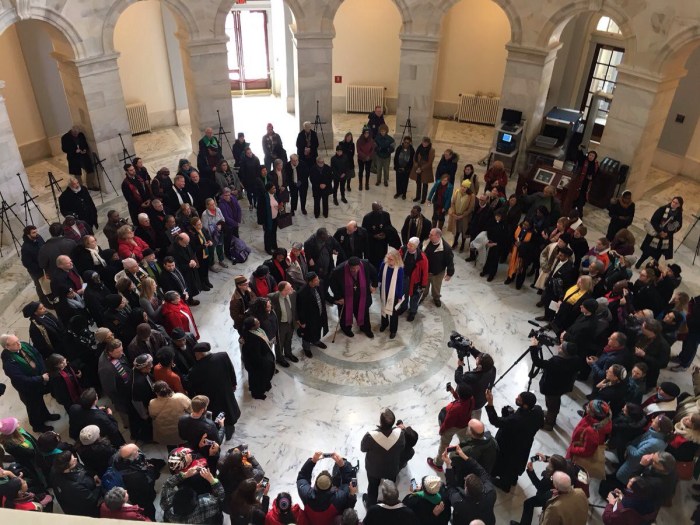 The Rev. Dr. William J. Barber, II with Muslim, Jewish, Christian, and other moral leaders at the US Capitol building on Jan. 9 2017, following a #MoralMarch and protest against the nomination of former Sen. Jeff Sessions for US Attorney General.
Gracious, eternal, and all wise God; Thou who formed what is out of nothing and called us into being to serve You — You, O Lord, who weigh every nation in the balance of Your own standards:
Today, we acknowledge how great Thou art, the marvelous mystery of Your mercy and the excellence of Your name. Because Your Holy Spirit brings all things to remembrance, breathe on us now, that we might remember how gracious You have been to this nation we call America.
As a nation, we have our faith and frailties, strengths and shortcomings, yet You have allowed grace to be shed upon us. When we have honored Your ways and when we have fallen short, You have been a merciful God. Remind us that the history of this nation is more about Your grace than about our greatness. When we are not where we should be, let us hear and follow what You said to Solomon in 2 Chronicles 7:14, “If my people, which are called by my name, shall humble themselves, and pray, and seek my face, and turn from their wicked ways; then will I hear from heaven, and will I forgive their sin, and will I heal their land.”
In our land we need healing. For a land so blessed by grace, there is too much poverty, too much sickness, too many children dying, and too much war. We need a healing. A tax bill that guts government to give a windfall to the wealthiest when income inequality is greater than it has been since the Gilded Age is more than bad policy; it is a symptom of spiritual sickness and a moral malady. We need a healing in America.
In Your word You have said that those who rule the nation must be just, and if we are to please You, we must learn to do justice, care for the fatherless, support the widow, loose the bands of wickedness, pay people what they deserve, care for the sick, the homeless, and the hungry. If we are to please You, we must hope to hear you say, “For I was hungry, and ye gave me meat: I was thirsty, and ye gave me drink; I was a stranger, and ye took me in; naked and ye clothed me; I was sick, and ye visited me; I was in prison, and ye came unto me.”
Trouble the soul of this nation as in the days of Amos so that no one is at ease in Zion. Use our prophetic words and our prophetic actions to remind those in the seats of power that they are not God. Trouble this nation with the voice of concern and the voice of compassion. Make us mindful of the thousands without paths to the pursuit of happiness.
Shake the foundations of our conscience until we cannot help but change our course. Move on us to study war no more. Cause us to live our lives to serve others. Teach us that life, liberty and the pursuit of happiness requires justice and hope and help and caring. Expand our morality beyond the narrowness of personal piety into the broadness of public policy. Give us the strength to challenge racism, poverty, unchecked militarism, and ecological devastation.
Empower us with Your Spirit that we might be a nation unto God, not unto fear; show us again that America is only here by your grace.
Show us that grace carries responsibility — that a nation under grace must lead the world, not merely police the world. A nation under grace must care, must remember her past so that she will not be arrogant in her present. A nation under grace must bring the world together and not tear it apart. A nation under grace cannot refer to people as aliens when we all were created with one blood. A nation under grace cannot leave cities decaying and flood victims barely surviving. Grace demands something better than that. So Lord, as you stirred up dry bones in the valley, stir up hope, and stir up righteousness.
Restore the Prophets and the prophetic voices to the land. Revive the spirit of Medgar, Martin, Malcolm, Corretta, Harriet, Rosa, Cinque, Douglass, Dubois, Sojourner, Jordan, Wilkins and Bethune. Call us and challenge us again. Teach even this nation that with all our power and all our resources, we will still have to stand before Your judgment one day. Give us leaders who understand that the purpose of power and influence is to help someone. Grant us a citizenry determined to be yoked together in common humanity. Let us know the only way to a more perfect union is for our laws and policies to reflect Your kind of love.
Let faith be a conviction, not a convenience. Help us, O God, to smooth out every wrinkle in the flag of our common life until we are one nation under God, with one justice system for all, with living wages for all, with quality education for all.
Finally, O Lord, we pray that the mind of the Psalmist will be ours:
Make a joyful noise unto God, all ye lands:
Sing forth the honor of his name: make his praise glorious.
Say unto God, How terrible art thou in thy works! through the greatness of thy power shall thine enemies submit themselves unto thee.
All the earth shall worship thee, and shall sing unto thee; they shall sing to thy name.
Come and see the works of God: He is terrible in His doing toward the children of men.
He turned the sea into dry land: they went through the flood on foot: there did we rejoice in Him.
He ruleth by His power for ever; His eyes behold the nations: let not the rebellious exalt themselves (Ps 66).
We thank You, O God, that Your eyes still behold the nation. We thank You that You still see injustice, You still see poverty. And because You can still see it, these things don’t have the last word. We thank You God that you still see America. You still see our leadership. You know how to bring down the high and lift up the humble. O God, we bless Your name, we lift up every voice, we declare and rejoice that You are still the God of our weary years, the God who is able to bring life out of death. Help us to know as our foreparents sang,
Time is filled with swift transition, naught of earth unmoved can stand, Build your hope on things eternal, Hold to God’s unchanging hand.
In the name of the Father who sticketh closer than a brother, watches us like a mother, the Son, and the Holy Ghost. AMEN.


*On This date in 1862 the first Watch Night Services were celebrated in Back communities in America.
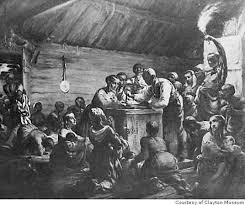
The Watch Night service can be traced back to gatherings also known as “Freedom’s Eve.” On that night, Black slaves and free blacks came together in churches and private homes all across the nation awaiting news that the Emancipation Proclamation actually had become law. At the stroke of midnight, it was January 1, 1863; all slaves in the Confederate States were declared legally free. When the news was received, there were prayers, shouts and songs of joy as many people fell to their knees and thanked God.
Blacks have gathered in churches annually on New Year’s Eve ever since, praising God for bringing us safely through another year. It’s been over a century since the first Freedom’s Eve and tradition still brings us together at this time every year to celebrate “how we got over.” This celebration takes many African American decendants of slaves into a new year with praise and worship. The service usually begins anywhere from 7 p.m. To 10 p.m. And ends at midnight with the entrance of the New Year. Some people come to church first, before going out to celebrate, for others, church is the only New Year’s Eve event.
There have been instances where clergy in mainline denominations questioned the propriety of linking religious services with a secular holiday like New Year’s Eve. However, there is a reason for the importance of New Year’s Eve services in the Black experience in America.
Reference:
The African American Desk Reference
Schomburg Center for research in Black Culture
Copyright 1999 The Stonesong Press Inc. and
The New York Public Library, John Wiley & Sons, Inc. Pub.
ISBN 0-471-23924-

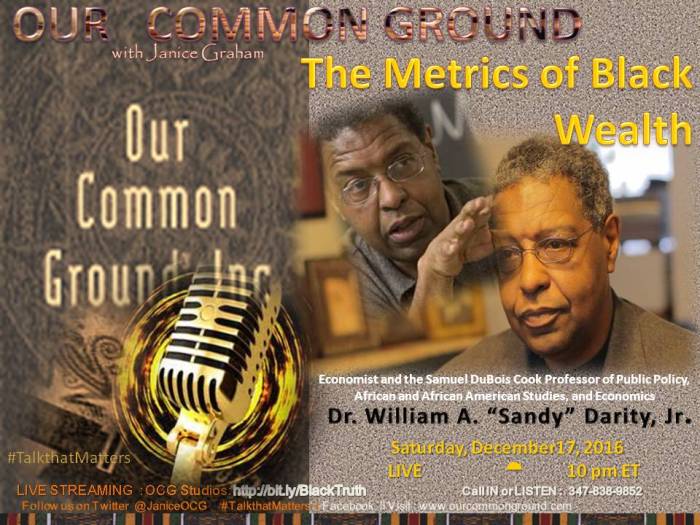
WE can’t save, educate or job income ourselves out of the economic and financial history from which our poverty springs.
Structural and historical inequality has left Blacks with fewer assets than whites. Blacks in the top 10 percent have an average wealth of only $350,000 to the $1,200,000 of whites at the same income level. Across income groups, whites average $8 of wealth for every $1 owned by Blacks and Latinos.We need to devise wholly new approaches to wealth distribution that at once honor private property and family rights, while also putting to better use collective national assets. We need inheritance law reform and new taxes on larger estates that can enable reinvestment in emerging new talent.
What are the metrics which dictate, demonstrate and evidence our collective poverty ?
 about Dr. Darity
AREAS OF EXPERTISE
He is the Samuel DuBois Cook Professor of Public Policy, African and African American Studies, and Economics and the director of the Duke Consortium on Social Equity at Duke University. He has served as chair of the Department of African and African American Studies and was the founding director of the Research Network on Racial and Ethnic Inequality at Duke.
In collaboration with Dr. Darrick Hamilton of the New School for Social Science Research, Dr. Darity formulated proposed an “interesting possible solution to address wealth disparities,” according to this Huffington Post blog. “Baby bonds” would mature in federally managed investment accounts until the beneficiary reached 18. Youth could have up to $60,000 to jumpstart their lifelong financial stability and help decrease wealth disparity in the U.S.
The The National Asset Scorecard and Communities of Color (NASCC) project is conducted by Duke University’s Research Network on Racial and Ethnic Inequality. The researchers are led by William Darity, Jr, at Duke University and Darrick Hamilton at The New School. The NASCC research team – with expertise in survey design, analysis of group differences in asset accumulation and debt burden, and general patterns of ethnic/racial group inequality, – was assembled to conduct the investigation and analyze the data generated from the study. The study is intrinsically multidisciplinary; members of the team represent the following fields: statistics, economics, sociology, political science, ethnic studies,and urban planning. NASCC published its landmark report, ” Umbrellas Don’t Make it Rain: Why Studying and Working Hard Isn’t Enough for Black Americans ” of which Dr. Darity is a co-author.
HOW DO WE BEGIN TO FIGHT THE POWER ?
Join us on FACEBOOK : https://www.facebook.com/OCGTALKRADIO/
OCG on the Web: https://ourcommongroundtalk.wordpress.com/
Community Forum: http://www.ourcommonground-talk.ning.com/
Follow us on Twitter: @JaniceOCG #TalkthatMatters


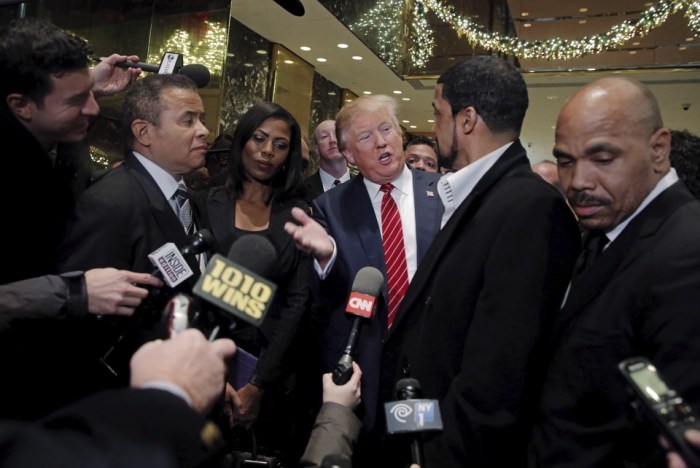
The president-elect has pledged tax reform and job creation—policies that should theoretically help poor and minority Americans. Will they?
Donald Trump talking to reporters after a meeting with black pastorsLucas Jackson / ReutersWhite Americans have about 13 times the wealth of black Americans, a Pew Research report found in 2014, the widest the gap has been since the 1980s.
(OUR COMMON GROUND Voice) William Darity, Jr., an economist and professor at Duke University, studies the intersection of inequality, wealth, and race in the U.S. I spoke with him about the recent presidential election and whether or not Donald Trump’s proposals for helping poor and middle-class Americans would extend to poor and middle-class black Americans.
The conversation below has been lightly edited for clarity.
Source: What Happens to Black Wealth Under Trump? – The Atlantic

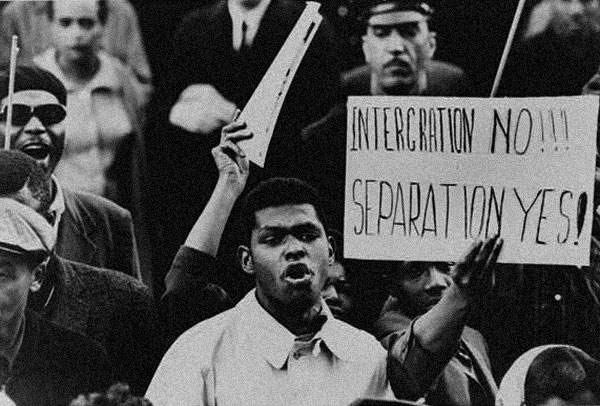
Nation of Islam counter-demonstration at NAACP rally in Harlem, 1961 / Photograph: NAACP collection, Library of Congress
In a world where Donald Trump’s presidential nomination speech has been endorsed by a former leader of the Ku Klux Klan—yet Black Lives Matter activists are accused of reverse racism for asking to not be murdered by police—what constitutes hate speech has become increasingly convoluted. In the aftermath of police killings in Dallas and Baton Rouge, gunmen Micah Johnson and Gavin Long were immediately linked by media outlets to black nationalist groups such as the Nation of Islam (NOI), New Black Panther Party, Black Riders Liberation Party, and Washitaw Nation, despite their professions to have been acting alone. Not only did these depictions draw misleading lines to organizations that do not prescribe such acts of violence, they also overshadowed both mens’ backgrounds in cultures of military violence (Johnson joined the Army Reserves immediately after high school and Long was a former Marine sergeant).
In a desperate attempt to drive home a link to black nationalism and direct attention away from these other troubling vectors, some news outlets began referring to Johnson as “Micah X” (NOI members use “X” to replace their “slave names”). In fact his middle name was simply Xavier. Even progressive groups, such as the Southern Poverty Law Center, play a legitimating role by identifying black nationalist groups as “black separatist hate groups,” leaving little room for meaningful distinctions between white supremacy and black nationalism. While groups such as the Nation of Islam have historically advocated for the separation of black communities, to assert that this position is simply the obverse of white supremacy—that is, black supremacy—overlooks the nuance of black nationalism. More importantly, it fails to account for the dramatically different relationships to power that black nationalist and white supremacist groups possess. White nationalism reinscribes and exalts the privileges of whiteness. Black nationalists council separation as an anti-racist practice and a method of empowerment in the absence of alternative avenues of power. To many black nationalists, this is the difference between life and death: the black community must either do for itself or perish.
The conflation of black and white nationalism is not new. In 1963 the New York Herald Tribune satirized what it perceived as the ironic similarities between white supremacists and black nationalists in a story entitled “Integrated Segregation.” Things “seem a trifle confused on the racial front these days. The segregationists are getting integrated and the integrationists are getting segregated,” the Tribune remarked. The article imagined a scene in which staunch segregationist George Wallace was explaining why racial segregation benefitted black Americans when “a Black Muslim popped up from behind, tapped him on the back and agreed with him.” Soon, the article predicted, the Congress for Racial Equality would “start picketing the N.A.A.C.P., while the Black Muslims set up an all-Negro chapter of the Ku Klux Klan.”
To many black nationalists, separation from whites is the difference between life and death: the black community must either do for itself or perish.
Understanding black nationalism as simply the mirror image of white supremacy, rather than an anti-racist practice, has deep roots in American political discourse. And in our current moment of colorblind “post-racialism,” when race-specific remedies such as affirmative action or reparations are derided as reverse racism—and even modest demands from Black Lives Matter for criminal justice reform are decried as anti-white—black nationalism has been once again mischaracterized using a host of long-stale tropes. We would be better served, not by simply dismissing black nationalism as the underbelly of white supremacy, but by understanding it as a tradition that is both liberative and anti-racist; one that does not mirror white supremacy, but repudiates it.

W. D. Fard, the founder of the Nation of Islam, arrived in Detroit in 1930 and told black Detroiters that they “were not Americans but Asiatics.” This was part of a holistic alternative creation story that rejected the racist underpinnings of white American nationalism. Many of Fard’s followers were former followers of Marcus Garvey, left without an organization after the decline of his Universal Negro Improvement Association (UNIA) in the late 1920s due to financial mismanagement and government infiltration. Garvey and the UNIA epitomized the goals of black nationalism, launching the most ambitious and successful Pan-Africanist vision in history. At its height, the UNIA had over 700 branches in 38 states, and its newspaper, Negro World, circulated throughout the African diaspora. Millions of black people were moved by Garvey’s message of racial pride embodied through the UNIA motto “One God! One Aim! One Destiny!” The NOI borrowed many of its black nationalist tenets from the UNIA, combining them with religious symbols, practices, and theologies drawn from the plethora of new northern, black, urban religious and racial-pride movements spawned by the Great Migration. This blending spoke to the diverse backgrounds of many early NOI members: in 1951 nineteen out of twenty-eight Muslims interviewed reported having previously been members in other movements such as black Masonry, the Israelite Movement, God’s Government on the Earth (dedicated to Liberian emigration), the Peace Movement of Ethiopia, Repatriation Movement to Liberia, and the Black Jews.
As historian Robin D. G. Kelley notes, many of these movements were influenced by a Black Zionist tradition that drew upon the narrative of the book of Exodus to imagine liberation and deliverance for black people around the world. These freedom dreams not only provided what he calls a “narrative of slavery, emancipation, and renewal,” but also a “language to critique America’s racist state since the biblical Israel represented a new beginning.” Beyond providing a framework for denouncing American racism, black nationalists addressed the racist power structures that governed their communities by creating jobs, businesses, schools, and places of worship. Racial separation was not simply about black communities’ physical relationship to white people; it was about changing the structures of power that governed those relationships through self-determination, community control, and new relationships to self and one another.
By 1959 the Nation of Islam was a burgeoning movement well known within urban black communities in the North but still largely unknown to white America. That summer, as Malcolm X traveled to Africa as a guest of Egypt’s president, Gamal Abdel Nasser, Mike Wallace (later of 60 Minutes fame) and black journalist Louis Lomax presented the NOI to white audiences for the first time. In their sensationalist documentary, The Hate That Hate Produced, NOI was compared to the American Nazi Party and the Ku Klux Klan. Members of the Nation were referred to as “black racists” and “black supremacists.” Its cautionary message to a largely white audience was that white racism would inevitably produce its black variant. As Malcolm X later recalled in his Autobiography, the show was meant to shock viewers, like when “Orson Welles frightened America with a radio program describing . . . an invasion by ‘men from Mars.’”
The Hate That Hate Produced was critical in launching the Nation of Islam into the public eye. But it also offered white viewers a language for understanding black nationalism that both intensified and allayed their fears. While racism was a plague that undermined American democracy, it was not a distinctly white characteristic. As Charlie Keil, a young white civil rights organizer at Yale during the early 1960s explained to me recently: “The Hate that Hate Produced allowed [whites] to sort of categorize the Muslims—the Nation of Islam—and treat them a certain way. . . . [It was] some way of saying that this was not an autonomous self-starting movement, but a reaction, an overreaction to a history of oppression.”
Throughout the 1960s black nationalists were castigated as “supremacists” who promoted the very racism and racial segregation that liberals were fighting against. This was stoked by white nationalists who saw calls for black racial separation as consistent with their belief in the benefits of racial segregation. As George Lincoln Rockwell, head of the American Nazi Party, told Alex Haley in a 1966 interview: “Malcolm X said the same thing I’m saying.”
Rockwell was not the only one confused about the difference between racial segregationand racial separation. In a highly-publicized Los Angeles trial in 1962 after police killed an unarmed member of the Los Angeles NOI mosque, the Los Angeles Times reported the “unusual problem in seating of spectators . . . when women members of the sect refused to accept seats alongside white persons.” The court eventually overturned this seating arrangement, and the press described this as “desegregation.” Los Angeles NAACP president Christopher Taylor joined the chorus of the aggrieved by arguing that he would be against any type of segregation, regardless of who initiated it. This decontextualized, colorblind insistence that any race demanding separation was calling for racial segregation was central to mischaracterizations of black nationalism during this period.
Malcolm X set about clarifying the Nation of Islam’s advocacy for racial separatism through dozens of debates with prominent civil rights figures on college campuses across the country in the early 1960s. He debated James Farmer at Cornell, Bayard Rustin at Howard, Louis Lomax at Yale, and the NAACP’s Walter Carrington at Harvard. Almost every debate was themed around the question: “Integration or Separation?” As Malcolm explained at Wesleyan University: “We are just as much against segregation as the most staunch integrationist.” But he added that black people did not “want to be free any more; they want integration. . . . They have confused their method with their objective.” In other words, black nationalists were not opposed to racial integration as an outcome of freedom struggles, or even as an organizing strategy, but they saw it as deeply flawed as the movement’s principal objective. More importantly, they pointed out the racist presumption of integration, which took for granted that white society and its values were more desirable. As Malcolm once sardonically asked, Who is the white man to be equal to?
More than simply critiquing integration, the Nation of Islam emphasized the importance of community control, an idea that flourished in upcoming years with the emergence of the Black Power movement. As Malcolm explained: “segregation means to regulate or control. . . . A segregated community is that forced upon inferiors by superiors. A separate community is done voluntarily by two equals.” Recognizing the pervasiveness of racial segregation, nationalists sought control over the businesses, healthcare, education, housing, and policing in their communities. Indeed, the Kerner Commission’s grim 1968 assessment that the nation was “moving toward two societies, one black, one white—separate and unequal” was something understood within black communities for decades. Amidst this backdrop, nationalists called for greater autonomy. The distinction between segregation and separation was not a semantic pivot. It was a deeper analysis of power, and an assertion of self-determination.
Over sixty years since the Supreme Court struck down the constitutionality of “separate but equal” in Brown v. Board, it would seem that calls for racial separatism are a relic of the past. But that might be too hopeful. A 2014 UCLA study revealed higher levels of school segregation in many regions than in 1968, the year the Supreme Court decreed a more proactive approach to desegregation. Schools with less than 1 percent white students are now being referred to as “apartheid schools.” And while the South is no longer governed by Jim Crow laws, cities outside the South such as Chicago and Baltimore continue to be described by demographers as “hypersegregated.”
The denial of race is a fixture of racism. Black nationalists have often exposed the “colorblind,” coded racism of liberals.
Black critiques of school integration during the 1950s and 1960s were often decried. In the words of scholar Andrew Delbanco, novelist and anthropologist Zora Neale Hurston “consigned herself to oblivion” when she responded to the Brown v. Board decision by saying that she could “see no tragedy in being too dark to be invited to a white school affair.” After James Meredith enrolled as the first black student in the University of Mississippi’s history, Malcolm X told a courtroom that anytime a man “needs [an] escort of 15,000 troops to go to a college where he will be among people whose viciousness toward him is so deadly that he needs the Army there to protect him . . . that Negro is foolish if he thinks that he is going to get an education.” Education, not integration, should be the goal, both Hurston and Malcolm agreed. As Malcolm explained, “token integration” was pointless as long as there were “a couple million Negroes in Mississippi who haven’t been allowed to go to the Kindergarten in a decent school.”
Meanwhile, integration today is often illustrated through the exceptional accomplishments of a handful of black elites, most notably President Barack Obama, rather than evidenced by a substantial redistribution of wealth or educational and housing opportunities. As Keeanga-Yamahtta Taylor demonstrates, the role of “black faces in high places” is often to obscure the common conditions facing many African Americans. Instead, black elected officials serve as interlocutors speaking to—and on behalf of—black communities. Taylor writes poignantly of the 2015 Baltimore uprising after the death of Freddie Gray: “When a Black mayor, governing a largely Black city, aids in the mobilization of a military unit led by a Black woman to suppress a Black rebellion, we are in a new period of the Black freedom struggle.” But this new period has unfortunately produced all-too-familiar outcomes for poor and working-class black people.
The long history of black nationalist leaders having official meetings with white supremacist leaders is another narrative often mobilized as proof of the essential symmetry of the two movements. In 1922 Marcus Garvey met with the Imperial Wizard of the Klan, Edward Clarke, earning him swift denunciation by the NAACP. In 1961 Malcolm X and other NOI officials secretly met with the KKK in Atlanta to negotiate a non-aggression pact surrounding the NOI’s purchase of southern farmland. The following year American Nazi leader George Lincoln Rockwell even appeared as an invited guest at the NOI’s Saviour’s Day convention in Chicago. When police in Monroe, Louisiana, illegally targeted and raided the city’s mosque with tear gas, rifles, and riot sticks, the Nation of Islam secured an interracial defense team: local black attorney James Sharpe, Jr., and Imperial Wizard of the National Knights of the Klan, James Venable. As Venable explained when taking the case, “I hate to say it but a colored man doesn’t have a chance in a courtroom in the South.”
The decision by black nationalists to meet or coordinate with white supremacists was often driven by a combination of pragmatism and a deep cynicism about the authenticity of liberals. In the case of the UNIA, Garvey negotiated an agreement with Clarke to sell stock in black businesses such as newspapers, factories, and his Black Star shipping line, which ambitiously hoped to link a global black economy in Africa, the Caribbean, and the Americas before failing due to poor business management. And although Malcolm X would later denounce the Nation of Islam’s détente with the Klan, the organization’s motivation for doing so was plainly and only to secure the right to farm in the South without danger of violent reprisal. And in the case against eight members of the NOI in Monroe, Venable successfully won an appeal for several of those convicted.
Black nationalists were also not uncritical of the white supremacists with whom they interacted, a fact often downplayed or forgotten. After his meeting with the Klan, Garvey told a crowd: “Mr. Clark [sic] did not tell me anything new; he told me what I discovered seven years ago. He told me the thing that caused me to have organized the Universal Negro Improvement Association four and a half years ago.” When Rockwell, wearing full Nazi regalia, donated twenty dollars to a collection plate at Saviour’s Day, there was a smattering of reluctant applause. Malcolm X belittled him by adding: “You got the biggest hand you ever got.” Equally, black nationalists used white supremacists to draw attention to the hypocrisy of liberals. Following his 1922 meeting, Garvey claimed that Klan members were “better friends to my race, for telling us who they are, and what they mean.” Malcolm used a similar device in his folk metaphor of the liberal “fox” and the conservative “wolf.” When comparing John F. Kennedy to George Wallace, Malcolm said: “Neither one loves you. The only difference is that the fox will eat you with a smile instead of a scowl.” He even penned a 1964 editorial entitled “Why I Am for Goldwater” in which he drew upon the same fox/wolf metaphor and cynically suggested that with Goldwater, “black people at least know what they are dealing with.”
Critics on the left who see these as misguided political strategies have marginalized black nationalists by painting them as racial conservatives, and thereby emptied black nationalists’ critiques of their incisiveness. For example, Paul Gilroy accuses Garvey of “black fascism” and C. L. R. James even compared him to Hitler. Others have taken Malcolm’s cynical support for Goldwater at face value, rather than understanding his rhetorical move to draw parallels between openly racist politicians and ostensibly liberal ones whose policies nonetheless gut the black community.
Black nationalist groups such as the UNIA and the NOI have rightly been critiqued for their deep patriarchy, homophobia, and tendency to reproduce the other trappings of empire. As historian Michelle Ann Stephens notes of Garvey, his “vision of the sovereign state figured in the black male sovereign; the desire for home at a more affective level figured in the woman of color.” Likewise, anti-Semitic comments by Nation of Islam leaders such as Louis Farrakhan have certainly buttressed comparisons between white and black nationalists. Most recently, Farrakhan stoked this fire by praising Donald Trump’s refusal to take money from Jewish donors.
But although charismatic leaders are often the voices we hear most prominently, for many rank-and-file members of the Nation of Islam and other black nationalist groups, the lived experience of racial pride, religious rebirth, and doing for oneself is a redemptive, affirming, and even lifesaving practice. Many members joined the NOI after feeling alienated in integrated, more middle-class organizations such as the NAACP. As Lindsey X told an interviewer, what the NAACP “wanted never seemed real to me. I think Negroes should create jobs for themselves rather than going begging for them.” Malcolm X’s autobiography is only the best-known narrative of religious and political redemption. In a long-running feature in the NOI’s newspaper, Muhammad Speaks, entitled “What Islam Has Done For Me,” members offered their conversion narratives and testified to the transformative practice of Islam. Robert 24X of Paterson, New Jersey, contributed: “I was a young drug addict who had spent too much time in the hells of Harlem’s East Side . . . [before] everything came into focus for me. . . . I stopped smoking, using profanity, and eating improper foods. And I’ve passed my biggest acid test—no more needles in the arm.”
Instead of positioning black nationalism as a reactionary, conservative ideology that simply apes the violence and hate of white supremacy, we might learn from its lessons today. If asked about the xenophobia and dangerous comments of conservative firebrand Donald Trump in our current election, Malcolm X might well have pivoted us back to Hillary Clinton’s questionable record on race, one which Black Lives Matter activists have pointed out includes racist dog whistles such as her comments about “super-predators” lacking empathy, her steadfast support for the devastating 1994 Crime Bill, and campaign money taken from private prison corporations. And beyond the hollow political discourse of election cycles, we must avoid the pitfalls of incessant claims of post-racialism that insist that to see race is to participate in racism. As we have witnessed with the familiar “All Lives Matter” rejoinder to “Black Lives Matter,” we are living in a time when people’s humanity is so denigrated that the mere valuation of life is taken by some whites to be a zero-sum game. The denial of race is a central fixture in the perpetuation of racism, and black nationalists have routinely called attention to the importance of racial pride while exposing the coded racism of liberals. Rather than draw facile lines between black nationalism and white supremacy, we are better served by understanding black nationalism as an anti-racist political tradition seeking to envision black American freedom and citizenship in a nation that has rarely devoted much effort toward either end.
Source: Black Nationalism and Liberation | Boston Review


 OCG
OCG 