The Permanent Crisis of Housing | Jacobin

This essay is adapted from the introduction of In Defense of Housing: The Politics of Crisis, out now from Verso.

The symptoms of housing crisis are everywhere in evidence today. Households are being squeezed by the cost of living. Homelessness is on the rise. Evictions and foreclosures are commonplace. Segregation and poverty, along with displacement and unaffordability, have become the hallmarks of today’s cities. Urban and suburban neighborhoods are being transformed by speculative development, shaped by decisions made in boardrooms half a world away. Small towns and older industrial cities are struggling to survive.

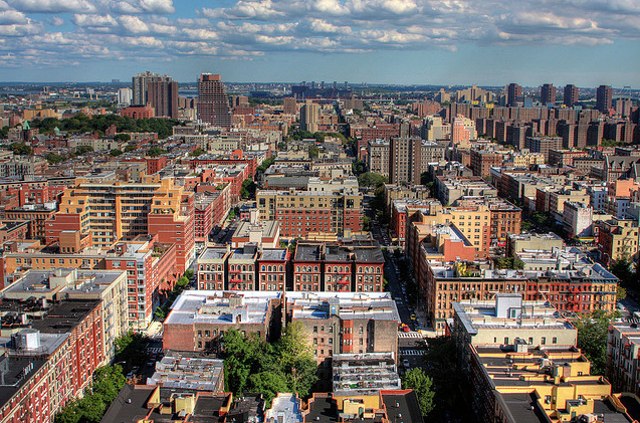
In America, the housing crisis is especially acute in New York City. The city has more homeless residents now than at any time since the Great Depression. More than half of all households cannot afford the rent. Displacement, gentrification, and eviction are rampant. Two pillars of New York’s distinctive housing system — public housing and rent regulation — are both under threat.

But housing problems are not unique to New York. Shelter poverty is a problem throughout the United States. According to the standard measures of affordability, there is no US state where a full-time minimum-wage worker can afford to rent or own a one-bedroom dwelling.

Nationwide, nearly half of all renting households spend anunsustainable amount of their income on rent, a figure that is only expected to rise. This is not only a big-city issue. Around 30 percent of rural households cannot afford their housing, including nearly half of all rural renters.

In fact, the housing crisis is global in scope. London, Shanghai, São Paulo, Mumbai, Lagos, indeed nearly every major city faces its own residential struggles. Land grabs, forced evictions, expulsions, and displacement are rampant. According to the United Nations, the homeless population across the planet may be anywhere between one hundred million and one billion people, depending on how homelessness is defined.

It has been estimated that globally there are currently 330 million households — more than a billion people — that are unable to find a decent or affordable home. Some research suggests that in recent decades, residential displacement due to development, extraction, and construction has occurred on a scale that rivals displacement caused by disasters and armed conflicts. In China and India alone in the past fifty years, an estimated one hundred million people have been displaced by development projects.

And yet if there is broad recognition of the existence of a housing crisis, there is no deep understanding of why it occurs, much less what to do about it. The dominant view today is that if the housing system is broken, it is a temporary crisis that can be resolved through targeted, isolated measures. In mainstream debates, housing tends to be understood in narrow terms.

The provision of adequate housing is seen as a technical problem and technocratic means are sought to solve it: better construction technology, smarter physical planning, new techniques for management, more homeownership, different zoning laws, and fewer land use regulations. Housing is seen as the domain of experts like developers, architects, or economists. Certainly, technical improvements in the housing system are possible, and some are much needed. But the crisis is deeper than that.

We see housing in a wider perspective: as a political-economic problem. The residential is political — which is to say that the shape of the housing system is always the outcome of struggles between different groups and classes. Housing necessarily raises questions about state action and the broader economic system. But the ways in which social antagonisms shape housing are too often obscured.

Housing is under attack today. It is caught within a number of simultaneous social conflicts. Most immediately, there is a conflict between housing as lived, social space and housing as an instrument for profit-making — a conflict between housing as home and as real estate. More broadly, housing is the subject of contestation between different ideologies, economic interests, and political projects. More broadly still, the housing crisis stems from the inequalities and antagonisms of class society.

Reposing the Housing Question

The classic statement on the political-economic aspects of housing was written by Friedrich Engels in 1872. At the time, few disputed the fact that housing conditions for the industrial proletariat were unbearable. What Engels called “the housing question” was the question of why working-class housing appeared in the condition as it did, and what should be done about it.

Engels was generally pessimistic about the prospects for housing struggles per se. Criticizing bourgeois attempts at housing reform, he argued that housing problems should be understood as some of “the numerous, smaller, secondary evils which result from the present-day capitalist mode of production.”

He concluded, “As long as the capitalist mode of production continues to exist, it is folly to hope for an isolated solution to the housing question or of any other social question affecting the fate of the workers.” For Engels, housing struggles were derivative of class struggle. Housing problems, then, could only be addressed through social revolution.

We take from Engels the idea that the housing question is embedded within the structures of class society. Posing the housing question today means uncovering the connections between societal power and the residential experience. It means asking who and what housing is for, who controls it, who it empowers, who it oppresses. It means questioning the function of housing within globalized neoliberal capitalism.

However, residential struggles today are not simply derivative of other conflicts. Housing movements are significant political actors in their own right. The housing question may not be resolvable under capitalism. But the shape of the housing system can be acted upon, modified, and changed.

The social theorist Henri Lefebvre helps us understand the political role of housing and the potential for changing it. In his 1968 book The Right to the City, Lefebvre argued that industrial insurrection was not the only force for social transformation. An “urban strategy” for revolutionizing society was possible.

Given changes to the nature of work and of urban development, the industrial proletariat was no longer the only agent of revolutionary change, or even the predominant one. Lefebvre claimed that there was a new political subject: the city dweller. More generally, Lefebvre invokes the politics of “the inhabitant,” a category that includes any worker, in the broadest sense, seen from the perspective of everyday social and residential life.

Lefebvre is vague about what exactly the inhabitant as a political subject will accomplish with the urban revolution. But he does point to a different way of inhabiting. He imagines a future where social needs would not be subordinated to economic necessity, where disalienated dwelling space would be universally available, where both equality and difference would be the basic principles of social and political life.

Whether or not anything like Lefebvre’s urban revolution is on the horizon, we can use his ideas to understand a basic point: the politics of housing involve a bigger set of actors and interests than is recognized either by mainstream debates or by conventional political-economic analyses such as that offered by Engels.

In the orthodox account, the only conflicts that matter are those surrounding exploitation and value. But the ruling class also needs to solidify its rule, and preserving the ability to exploit is only one aspect of this. There are also political, social, and ideological imperatives that significantly affect residential conditions.

In the financialized global economy — which was only beginning to emerge when Lefebvre was writing — real estate has come to have new prominence in relation to industrial capital. Housing and urban development today are not secondary phenomena. Rather, they are becoming some of the main processes driving contemporary global capitalism.

If Lefebvre is right, housing is becoming an ever more important site for the reproduction of the system — a change that might open new strategic possibilities for housing movements to achieve social change.

Whose Crisis?

Critics, reformers, and activists have invoked the term “housing crisis” for more than a hundred years. The phrase once again became pervasive after the global economic meltdown of 2008. But we need to be careful with this usage of the concept of crisis.

The idea of crisis implies that inadequate or unaffordable housing is abnormal, a temporary departure from a well- functioning standard. But for working-class and poor communities, housing crisis is the norm. Insufficient housing has been the mark of dominated groups throughout history. Engels made exactly this point:

The so-called housing shortage, which plays such a great role in the press nowadays, does not consist in the fact that the working class generally lives in bad, overcrowded or unhealthy dwellings. This shortage is not something peculiar to the present; it is not even one of the sufferings peculiar to the modern proletariat in contradistinction to all earlier oppressed classes. On the contrary, all oppressed classes in all periods suffered more or less uniformly from it.

For the oppressed, housing is always in crisis. The reappearance of the term “housing crisis” in headlines represents the experiences of middle-class homeowners and investors, who faced unexpected residential instability following the 2008 financial implosion.

The idea of a housing crisis is politically loaded. Though the concept of crisis has a long history in critical theory and radical practice, it can be deployed for other purposes. In the United States, the discourse of housing crisis is often used to condemn state “interference” in housing markets. In the United Kingdom, the crisis frame is invoked in support of granting new legal powers to developers in order to override local planning guidelines.

Discrete moments when housing crises become acute tend to be interpreted away as exceptions to a fundamentally sound system. But this is an ideological distortion. The experience of crisis in the residential sphere reflects and amplifies the broader tendencies towards insecurity in capitalist societies. Housing crisis is a predictable, consistent outcome of a basic characteristic of capitalist spatial development: housing is not produced and distributed for the purposes of dwelling for all; it is produced and distributed as a commodity to enrich the few. Housing crisis is not a result of the system breaking down but of the system working as it is intended.

We should reject ideological versions of the concept of housing crisis. But the term is still useful. For those compelled to dwell in oppressive and alienating conditions, housing crisis is not empty rhetoric; it is daily reality. To millions of households, “crisis” describes precisely the chaos, fear, and disempowerment that they experience. The state of their housing is critical indeed.

Our objective, then, is not to argue for the resolution of some temporary crisis and return to the status quo. We use the concept of crisis to highlight the ways that the contemporary housing system is unsustainable by its very nature. We point to the crisis tendencies in housing under contemporary capitalism, in order to draw attention to the urgent but systemic character of these problems.

In Defense of Housing

We do not seek to defend the housing system as it currently stands, which is in many ways indefensible. What needs defending is the use of housing as home, not as real estate. We are interested in the defense of housing as a resource that should be available to all.

Housing means many things to different groups. It is home for its residents and the site of social reproduction. It is the largest economic burden for many, and for others a source of wealth, status, profit, or control. It means work for those who construct, manage, and maintain it; speculative profit for those buying and selling it; and income for those financing it. It is a source of tax revenue and a subject of tax expenditures for the state, and a key component of the structure and functioning of cities.

Our concern is squarely with those who reside in and use housing — the people for whom home provides use values rather than exchange value. From the perspective of those who inhabit it, housing unlocks a whole range of social, cultural, and political goods. It is a universal necessity of life, in some ways an extension of the human body. Without it, participation in most of social, political, and economic life is impossible.

Housing is more than shelter; it can provide personal safety and ontological security. While the domestic environment can be the site of oppression and injustice, it also has the potential to serve as a confirmation of one’s agency, cultural identity, individuality, and creative powers.

The built form of housing has always been seen as a tangible, visual reflection of the organization of society. It reveals the existing class structure and power relationships. But it has also long been a vehicle for imagining alternative social orders. Every emancipatory movement must deal with the housing question in one form or another. This capacity to spur the political imagination is part of housing’s social value as well.

Housing is the precondition both for work and for leisure. Controlling one’s housing is a way to control one’s labor as well as one’s free time, which is why struggles over housing are always, in part, struggles over autonomy. More than any other item of consumption, housing structures the way that individuals interact with others, with communities, and with wider collectives. Where and how one lives decisively shapes the treatment one receives by the state and can facilitate relations with other citizens and with social movements.

No other modern commodity is as important for organizing citizenship, work, identities, solidarities, and politics.

It is this side of housing — its lived, universally necessary, social dimension, and its identity as home — that needs defending. Our challenge as analysts, as residents, and as participants in housing struggles is to understand the causes and consequences of the multidimensional attack on housing. Our goal is to provide a critical understanding of the political-economic nature of housing, such that we may develop a greater sense of the actions needed to address housing’s crises today and in the future.

Preview the new issue of Jacobin and get a discounted subscription today.

Source: The Permanent Crisis of Housing | Jacobin

The Radical Democracy of the Movement for Black Lives :: Peniel Joseph

The Radical Democracy Of The Movement For Black Lives

“Black Lives Matter has cast a strobe-light on contemporary myths of racial progress, arguing correctly that the criminal justice system represents a gateway to a panoramic system of racial and class and gender and sexuality oppression.”

The Black Lives Matter policy agenda represents one of the most important agenda setting documents collectively produced by black activists in a generation. The proposals, authored by over fifty different civil rights organizations, offers a panoramic narrative, diagnosis, and political alternatives to the intricacies of structural racism, state-sanctioned violence, and the institutional exploitation of black bodies across the nation.

A Vision For Black Lives” builds on, expands, and goes beyond policy agendas promoted by a range of civil rights and Black Power era groups, including the Black Panthers, Nation of Islam, NAACP, SNCC (the Student Non-Violent Coordinating Committee), CORE, Malcolm X’s Organization of Afro-American Unity, and Martin Luther King Jr’s SCLC. In its poignant urging of the United States to “end the war on black people,” the document is reminiscent of the “Gary Agenda,” the historic 1972 document that emanated from the National Black Political Convention in Gary, Indiana.

Gary Mayor Richard Hatcher speaks at the National Black Political Conference in Gary, Ind. (AP/Charles Kelly)

That meeting of over 8,000 black delegates from across black America’s political and ideological spectrum proved to be a watershed event, albeit one that was hamstrung by an inability to translate grassroots insurgency into tangible political power, accountability, and resources.  Gary, like the Black Power Conferences from the late 1960s and the African Liberation Day and Sixth Pan-African Congress of the 1970s, sought to modernize the black convention movements that could be traced back to the Reconstruction era, where black activists organized for political power in slavery’s aftermath.

By the early 20th century efforts like the “Niagara Movement” faltered due to a lack of resources and political infighting. For a time, Marcus Garvey’s Universal Negro Improvement Association cast a shadow large enough to encompass the complexity of black life, uniting economic strivers with revolutionary activists in developing a black agenda broad enough to attract millions of black people across several continents.

Garvey’s decline fractured aspects of black political life, but not dreams for a cohesive vision, plan, and strategy for black liberation, a cause taken up during the Depression and Second World War by a variety of groups including the Southern Negro Youth Congress, National Negro Labor Congress, The Nation of Islam, the Civil Rights Congress, and the Council of African Affairs. The NAACP’s membership reached almost a half-million by 1946, the closest it would ever come to mass membership in scale. Black political leaders pushed an agenda to the left of the New Deal creating space for the global popularity of Paul Robeson, the political resurrection of W.E.B. Du Bois, and the insider status of Mary McLeod Bethune and Ralph Bunche.


Organizers like Ella Baker in New York City and Septima Clarke in South Carolina, worked the lower frequencies of black life, working at the margins of the black quotidian: the ordinary black folk from New York to South Carolina whose dreams remained disarmingly pragmatic ones focused preserving hope and dignity.

The Black Lives Matter Movement is rooted in this wider Black Freedom Struggle, one whose two dominant branches are reflected in the Civil Rights and Black Power era. BLM activists’ successful adoption of non-violence is rooted in the civil rights era even as their unapologetic focus on structural racism, community control, and political self-determination reflects the Black Power era’s radical politics. Surprisingly, so does the movement’s focus on intersectionality. Popularly remembered as deeply masculinist, unapologetically sexist, and homophobic, the Black Power era proved to be more complicated than such simple generalizations indicate. Despite the movement’s many political and ideological blinders, black women, queer activists, and others on the margins of African American life consciously shaped an expansive Black Power politics.


The Third World Women’s Alliance articulated a vision of radical black feminism, socialism, and Black Power militancy that made it a visionary example of cutting edge social justice movements. The Combahee River Collective gave voice to radical black lesbian feminists whose politics went to the far left of the more mainstream National Black Feminist Organization. In many ways both of these organizations reflected the black radical feminist politics revealed in Toni Cade Bambara’s groundbreaking 1970 anthology, The Black Woman, an intellectual and political intervention that ushered in Black Women’s Studies and helped give attention to the works of Audre Lorde, Barbara Smith, Gloria Hull, and many others.

BLM activists have taken some of the best aspects of these two generations of the Black Radical Tradition and linked it with more recent efforts to promote reparations (especially by grassroots a organization like N’COBRA, although reparations go back to the formerly enslaved activist Callie House as the historian Mary Frances Berry teaches us); divestment from domestic and global racial exploitation which Jesse Jackson, especially in 1984, promoted as a hallmark of his presidential campaign; the pursuit of independent black political power that had been advocated in the post Gary era by a series of organizations including the National Black United Front, the National Black Independent Political Party, and the Black Radical Congress; the movement for economic justice that has been promoted by a spectrum of grassroots labor, community, church, and secular activists, including black nationalists in communities such as St. Petersburg, Florida, who famously booed candidate Obama in 2008 by chanting and holding signs, “What About the Black Community Obama?”

Black Lives Matter has cast a strobe-light on contemporary myths of racial progress, arguing correctly that the criminal justice system represents a gateway to a panoramic system of racial and class and gender and sexuality oppression. This intervention, while important, is incomplete without an acknowledgment of the way in which the rise of mass incarceration is connected to systems of racial segregation, voting rights denial, state-sanctioned violence and exploitation of black bodies, all while criminalizing and decimating the very communities that remain largely under assault even in the Age of Obama.

The Age of Ferguson, Baltimore, Milwaukee, Black Lives Matter has shattered conventional civil rights narratives, ones that begin with Rosa Parks, continue with King’s Dream, and sought to end with Barack Obama’s election. This version of history as a bedtime story, complete with heroic individual blacks, stalwart white allies, and the thanks of a grateful nation has only one glaring problem.

It’s a lie.

The Civil Rights era heroic period experienced pervasive anti-black violence that only increased during the Black Power era and its aftermath. What is now universally acknowledged as a moral and political good—complete with a multiracial cast of characters—was demonized in word and deed by the larger society, a denigration that became inscribed in a series of intricate anti-black legal, legislative, and policy challenges that have utterly decimated some of the gains of the era, especially for the black poor.

“A Movement For Black Lives” is essential precisely because it helps to expose what is at the root of our national amnesia regarding slavery and anti-black racism-white supremacy and its relationship to conceptions of citizenship, the rule of law, democracy, and justice. In its passionate repudiation of the political status quo and elevating the lives of the black community’s most vulnerable residents—the poor, young, elderly, trans, LGBT, mentally ill, incarcerated, ex-offenders—the BLM has produced a watershed document that once again illustrates why the black freedom struggle has always been on the cutting edge of movements for radical democracy: we have no choice.


Peniel Joseph is the Barbara Jordan Chair in Ethics and Political Values and director of the Center for the Study of Race and Democracy at the LBJ School of Public Affairs and Professor of History at The University of Texas. He is the award-winning author of several books, including Waiting ‘Til the Midnight Hour: A Narrative History of Black Power in America, Dark Days, Bright Nights: From Black Power to Barack Obama, and Stokely: A Life. Follow him on Twitter @PenielJoseph.

Source: The Radical Democracy of the Movement for Black Lives

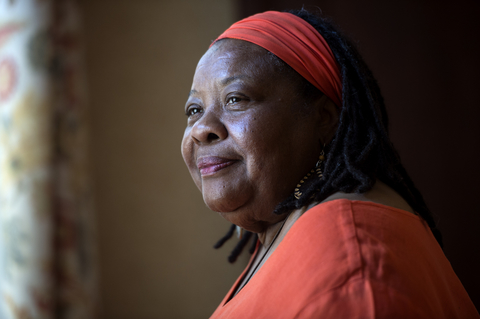
Ruby Sales — Where Does It Hurt? | On Being

RUBY SALES —Where Does It Hurt?

Where does it hurt? That’s a question the civil rights icon Ruby Sales learned to ask during the days of that movement. It’s a question we scarcely know how to ask in public life now, but it gets at human dynamics that we are living and reckoning with. At a convening of 20 theologians seeking to re-imagine the public good of theology for this century, Ruby Sales unsettles some of what we think we know about the force of religion in civil rights history, and names a “spiritual crisis of white America” as a calling of this time.

[OCG NOTE: Dr. Ruby Sales is a frequent contributor and commentator of OUR COMMON GROUND.  In addition to being an OUR COMMON GROUND Voice, she is an OCG Witness from the Bridge. Our visits with Dr. Sales can be found in our archives.   Please do check out a couple of  most important discussions that we had with her in our 2016 Season, “Hands Off Our Children: 300 Strong” Report from Field with Dr. Ruby Sales on 04/16; and, STOP THE WAR ON OUR CHILDREN™ • MARCH 18, 2016. We are proud of our association with Dr. Sales, our friendship and support from her and the Spirit House Project. Ruby Sales is a national treasure. ]

 GUESTS
RUBY SALES is the founder and director of the Spirit House Project. She is one of 50 African Americans to be spotlighted in the new Smithsonian National Museum of African American History and Culture in Washington, D.C.

“WHERE DOES IT HURT?”: A NATIONAL INQUIRYAnger, name-calling, and division seem to be deepening in American and global life. They are public faces of human pain and fear. But they are not the whole story of our time. As part of The Civil Conversations Project, we’re launching a national inquiry, “Where Does It Hurt?” Please join with us and take part in a new conversation in our radio and digital spaces.

Source: Ruby Sales — Where Does It Hurt? | On Being

Policing and the Violence of White Being: An Interview with Dylan Rodríguez – The Black Scholar

Policing and the Violence of White Being: An Interview with Dylan RodríguezSeptember 12, 2016The following interview was conducted by Casey Goonan, an editor with True Leap Press. It originally appeared on the True Leap Press blog. Casey Goonan: The US white-supremacist state operates today through a different set of discourses and cultural structures than in previous epochs. Your work interrogates such shifts at a level of depth and nuance that is of particular importance for emergent struggles against racist state violence. “Multiculturalist white supremacy,” “post-racial liberal optimism,” “white academic raciality”—such terms are utilized throughout your work to interrogate a myriad of theoretical and historical conundrums that define the post-Civil Rights era, particularly in regards to racial violence and subjectivity. Can you, in very broad strokes, lay out what you are trying to accomplish with these interventions in the discourses, practices, and forms of embodiment that so violently delimit the possibilities for radical social change in the United States?

Dylan Rodríguez: The aftermath of American apartheid’s formal abolition has been overwhelmed by a grand national-cultural vindication of “Civil Rights” as the vessel of fully actualized gendered-racial citizenship. This fraud has, in various ways, facilitated rather than interrupted the full, horrific exercise of a domestic war-waging regime. For the sake of momentary simplicity, we can think about it along these lines: the half-century narrative of Civil Rights victory rests on an always-fragile but persistent common sense—the idea that national political culture (“America”) and the spirit of law and statecraft (let’s call this “The Dream”) endorse formal racial equality. Bound by this narrative-political context, the racist state’s mechanics shift and multiply to rearticulate a condition of normalized racist violence that is condoned or even applauded by the institutionalized regimes of Civil Rights. (It is not difficult to see how the NAACP, JACL, LULAC, Lambda, NOW, Urban League and other like-minded organizations condone or applaud domestic racial war, so long as it is directed at the correct targets: gang members, drug dealers, “violent criminals,” terrorists, etc.). In other words, the contemporary crisis of racist state violence is not reducible to “police brutality” and homicidal policing, or even the structuring asymmetries of incarceration: it is also a primary derivative of the Civil Rights regime.

Source: Policing and the Violence of White Being: An Interview with Dylan Rodríguez – The Black Scholar

Discriminology – Public School Ratings, Scholarly Literature, Educational Videos & News

WASHINGTON — Black boys as young as 10 may not be viewed in the same light of childhood innocence as their white peers, but are instead more likely to be mistaken as older, be perceived as guilty and face police violence if accused of a crime, according to new research published by the American Psychological Association.

“Children in most societies are considered to be in a distinct group with characteristics such as innocence and the need for protection. Our research found that black boys can be seen as responsible for their actions at an age when white boys still benefit from the assumption that children are essentially innocent,” said author Phillip Atiba Goff, PhD, of the University of California, Los Angeles. The study was published online in APA’s Journal of Personality and Social Psychology®.

Researchers tested 176 police officers, mostly white males, average age 37, in large urban areas, to determine their levels of two distinct types of bias — prejudice and unconscious dehumanization of black people by comparing them to apes. To test for prejudice, researchers had officers complete a widely used psychological questionnaire with statements such as “It is likely that blacks will bring violence to neighborhoods when they move in.” To determine officers’ dehumanization of blacks, the researchers gave them a psychological task in which they paired blacks and whites with large cats, such as lions, or with apes. Researchers reviewed police officers’ personnel records to determine use of force while on duty and found that those who dehumanized blacks were more likely to have used force against a black child in custody than officers who did not dehumanize blacks. The study described use of force as takedown or wrist lock; kicking or punching; striking with a blunt object; using a police dog, restraints or hobbling; or using tear gas, electric shock or killing. Only dehumanization and not police officers’ prejudice against blacks — conscious or not — was linked to violent encounters with black children in custody, according to the study.

The authors noted that police officers’ unconscious dehumanization of blacks could have been the result of negative interactions with black children, rather than the cause of using force with black children. “We found evidence that overestimating age and culpability based on racial differences was linked to dehumanizing stereotypes, but future research should try to clarify the relationship between dehumanization and racial disparities in police use of force,” Goff said.

The study also involved 264 mostly white, female undergraduate students from large public U.S. universities. In one experiment, students rated the innocence of people ranging from infants to 25-year-olds who were black, white or an unidentified race. The students judged children up to 9 years old as equally innocent regardless of race, but considered black children significantly less innocent than other children in every age group beginning at age 10, the researchers found.

 The students were also shown photographs alongside descriptions of various crimes and asked to assess the age and innocence of white, black or Latino boys ages 10 to 17. The students overestimated the age of blacks by an average of 4.5 years and found them more culpable than whites or Latinos, particularly when the boys were matched with serious crimes, the study found. Researchers used questionnaires to assess the participants’ prejudice and dehumanization of blacks. They found that participants who implicitly associated blacks with apes thought the black children were older and less innocent.

In another experiment, students first viewed either a photo of an ape or a large cat and then rated black and white youngsters in terms of perceived innocence and need for protection as children. Those who looked at the ape photo gave black children lower ratings and estimated that black children were significantly older than their actual ages, particularly if the child had been accused of a felony rather than a misdemeanor.

“The evidence shows that perceptions of the essential nature of children can be affected by race, and for black children, this can mean they lose the protection afforded by assumed childhood innocence well before they become adults,” said co-author Matthew Jackson, PhD, also of UCLA. “With the average age overestimation for black boys exceeding four-and-a-half years, in some cases, black children may be viewed as adults when they are just 13 years old.”

Article: “The Essence of Innocence: Consequences of Dehumanizing Black Children,” Journal of Personality and Social Psychology, published online Feb. 24, 2014; Phillip Atiba Goff, PhD, and Matthew Christian Jackson, PhD; University of California, Los Angeles; Brooke Allison, PhD, and Lewis Di Leone, PhD, National Center for Post-Traumatic Stress Disorder, Boston; Carmen Marie Culotta, PhD, Pennsylvania State University; and Natalie Ann DiTomasso, JD, University of Pennsylvania.

Phillip Atiba Goff, PhD, can be contacted by phone at (310) 206-8614 (preferred) or by email. If Goff is unavailable, contactMatthew Christian Jackson, PhD, by phone at (814) 574-9781 or by email.

Source: Discriminology – Public School Ratings, Scholarly Literature, Educational Videos & News

These 7 Cities Expose Exactly What Gentrification Is Doing to America


These 7 Cities Expose Exactly What Gentrification Is Doing to America

Source: These 7 Cities Expose Exactly What Gentrification Is Doing to America

Is It Time For Federal Anti-Gentrification Zones In NYC?: Gothamist

Some of these concepts are familiar. An early-1990s federal preservation program called the Low-Income Housing Preservation and Resident Homeownership Act (LIHPRHA) provided federal funding to nonprofit organizations and tenant groups to purchase their buildings, before Congress defunded it in 1998. In Washington DC, building owners are required to give their tenants the right of first refusal.

But while advocates, academics and attorneys were pleasantly surprised to see a pitch for anti-gentrification policy at the federal level, several worried that the cost of the GMZ program would be staggering—especially for a federal government so historically stingy when it comes to affordable housing.

“With LIHPRHA they had to layer all kinds of subsidies to make it actually affordable,” John Krinsky, a professor of political science at City College, told us. “It was more feasible in situations where there wasn’t yet rampant gentrification, because those properties aren’t as valuable yet.”

Even East New York, still less gentrified than neighboring Crown Heights, recently saw its property values triple. “Think about a tenant coop that is competing for a property with, like, Blackstone Group,” Krinsky speculated.

“It’s hard to see how the Republican Congress is going to pass any of these,” added Legal Aid Society housing attorney Judith Goldiner. “Truthfully, it’s just so hard to get them to do anything.” She suggested that if the federal government were willing to make a huge investment in affordable housing, the money might be better spent on fully funding Section 8, coupled with stronger rent laws at the state level and the right to an attorney in housing court.

She also questioned Espaillat’s relocation tax proposal. “Once people are displaced it’s really hard to find them,” she said. “And they’re probably going to be paying more somewhere else. That’s not the goal.”

Governmental loans, like the HUD-funded mortgages Espaillat is suggesting, tend to have expiration dates. What might happen to cooperative tenants if and when these federal subsidies run dry?

“When you have these HUD-backed loans, the object is how do you keep them from [expiring] after a certain amount of time,” Krinsky said, suggesting that Espaillat consider the Community Land Trust (CLT) model—which can protect a building from any future for-profit sale—as an additional protection. (Espaillat says he’s open to the concept.)

But even with the protections of a CLT, some advocates in Espaillat’s Harlem are skeptical of the sustainability of the proposed coops.

Maria Lizardo, director of the Northern Manhattan Improvement Corporation (NMIC), has supported numerous low-income coops in Harlem. “It only works when you are able to provide the tenants with a lot of assistance,” she said. “Everything from the workshops about what to expect… to doing the monthly overview of the budget and maintenance increases.”

“These ideas are great, but not without ongoing support,” added NMIC legal services head Rodrigo Sanchez. “It’s something that needs to be seen as an ongoing 10, 20, 30-year plan. Whether I think the government will commit to the dollars and cents is another question.”

Source: Is It Time For Federal Anti-Gentrification Zones In NYC?: Gothamist

Poverty Has Same Effect On The Brain As Constantly Pulling All Nighters | ThinkProgress

One of the study’s authors, Harvard economist Sandhil Mullainathan, told the Washington Post, “Poverty is the equivalent of pulling an all-nighter. Picture yourself after an all-nighter. Being poor is like that every day.”

Poverty Has Same Effect On The Brain As Constantly Pulling All Nighters

AUG 30, 2013 8:54 AM

The mental strain of living in poverty and thinking constantly about tight finances can drop a person’s IQ by as much as 13 percent, or about the equivalent of losing a night of sleep, according to a new study. It consumes so much mental energy that there is often little room to think about anything else, which leaves low-income people more susceptible to bad decisions.

One of the study’s authors, Harvard economist Sandhil Mullainathan, told the Washington Post, “Poverty is the equivalent of pulling an all-nighter. Picture yourself after an all-nighter. Being poor is like that every day.”

The researchers came to this conclusion after conducting two separate experiments. The first gave low- and moderate-income shoppers at a mall in New Jersey a number of tests that measure IQ and impulse control, but half of the participants were first given a question about finances: what they would do if they needed to make $1,500 worth of repairs on their car, putting financial concerns at the forefront of their minds. They found that it reduced cognitive performance among the poor participants but not those who are well-off.

The second experiment looked at the cognitive functions of farmers in India before the harvest, when they are poor, and after the harvest, when they have much more money. The same farmer performs lower on cognitive ability before than he does after — which researchers say “cannot be explained by differences in time available, nutrition, or work effort” nor by stress. Instead, it appears to be poverty reducing their mental capacity.

A past study came to a similar conclusion: It found that scarcity can sap mental capacity and lead to short-term decision-making over long-term considerations.

Poverty has other negative impacts. The chronic stress of growing up in poverty has been found toimpair children’s brains, particularly in working memory. A study of veterans found that poverty is a bigger risk factor for mental illness than being exposed to warfare. The mental stress of being poor is also a major reason for why low-income people tend to have negative health outcomes like high blood pressure and cholesterol or elevated rates of obesity and diabetes.

Poverty takes its toll on health in a number of other critical ways: It prevents people from buying healthy food, makes people more likely to smoke, means they are more likely to live in areas with poor air quality, and can cause health problems that begin in the womb.


Source: Poverty Has Same Effect On The Brain As Constantly Pulling All Nighters | ThinkProgress

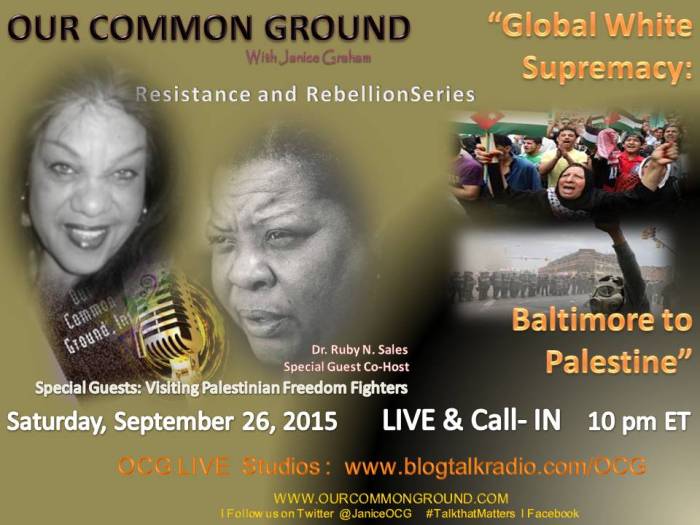
OUR COMMON GROUND This Week :: “Global White Supremacy: Baltimore to Palestine” :: LIVE

“Global White Supremacy: Baltimore to Palestine”

09-26-15 Wintess Sales

RESISTANCE and REBELLION Series

OUR COMMON GROUND with Janice Graham

Saturday, September 26, 2015            LIVE                    10 pm EDT

Our Guest Tonight:  Shardi Vardi

Dr. Ruby N. Sales, Co-Moderating
LISTEN LIVE and Join the OPEN Chat: http://bit.ly/1LS3Pfj
Call In – Listen Line: 347-838-9852

RESISTANCE and REBELLION Series

We continue our series of discussions of REBELLION AND RESISTANCE required to fight American racism and white supremacy.

Tonight on OUR COMMON GROUND, we discuss white supremacy as a system of power which is a fundamental undergird and foundation of economic, political and cultural imperialism. Part of our discussion will focus on examining the parallels of the struggle to dismantle that system with the struggles of other victims of white supremacy across the globe. Joining us will be representatives of a visiting Palestinian activist group here in the US to make its case before the UN Commission on Human Rights. We are grateful to have Dr. Ruby Sales, a featured commentator on OCG to join us and to lead this discussion, taking your calls and comments.


Sahar VardiABOUT OUR GUEST, Shardi Yardi

“The bloody cycle in which I live…is a vicious circle that is sustained by the choice of both sides to engage in violence. I refuse to take part in this choice.”

Sahar Vardi is a Jerusalem based activist. She publicly refused her military service and was imprisoned in 2008. Since then she has been active with Israeli anti-militarist groups such as New Profile and today works as the Israel Program Coordinator for the American Friends Service Committee based in Jerusalem. The focus of her work is on countering militarism in Israeli society, including challenging the Israeli military-industry complex. Sahar is also part of Boycott from Within (a group of Israelis supporting the Palestinian call for boycott) and has been active with direct action groups such as Taayush and Anarchists Against the Wall. Today much of her activism is in Jerusalem in Palestinian lead struggles against house demolitions, child arrests and discrimination of East Jerusalem.

‪#‎BlackLivesMatter: From Baltimore to Jerusalem
http://www.afsc.org/fr…/blacklivesmatter-baltimore-jerusalem

THE GLOBAL NATURE of WHITE SUPREMACY

White supremacy is a historically based, institutionally perpetuated system of exploitation and oppression of continents, nations and peoples of color by white peoples and nations of the European continent; for the purpose of maintaining and defending a system of wealth, power and privilege.

White supremacy operates through racial oppression against people of color: slavery, genocide, anti-immigration, driving while Black, etc. White supremacy maintains real power for the ruling class who control the major institutions of society.  Racism is white supremacy; white supremacy is racism. There is no other form of “functional” racism in the known universe. Therefore it is illogical purporting victims of white supremacy (racism) worldwide are capable of practicing white supremacy simultaneously. It doesn’t compute.

“Racism | White Supremacy – One or more white persons using deceit, direct violence, and/or the threat of violence to promote falsehood, non-justice, and/or incorrectness against non-white people on the basis of “color” in order to “satisfy” white people, in one or more areas of activity including economics, education, entertainment, labor, law, politics, religion, sex and/or war.”

“Everything that a Racist (White Supremacist) says, and everything that he or she does is intended to help establish, maintain, expand, and/or refine the practice of Racism (White Supremacy).”   – Neely Fuller Jr. The United Independent Compensatory Code/System/Concept a textbook/workbook for thought, speech and/or action for victims of racism (white supremacy)

The local and global power system structured and maintained by persons who classify themselves as white, whether consciously or subconsciously determined; this system consists of patterns of perception, logic, symbol formation, thought, speech, action and emotional response, as conducted simultaneously in all areas of people activity (economics, education, entertainment, labor, law, politics, religion, sex and war). The ultimate purpose of the system is to prevent white genetic annihilation on Earth – a planet in which the overwhelming majority of people are classified as non-white (black, brown, red and yellow) by white-skinned people. All of the non-white people are genetically dominant (in terms of skin coloration) compared to the genetically recessive white-skinned people.”    – Dr. Frances Cress Welsing, “The Isis Papers”

“To think of White supremacy in terms of American dynamics alone eschews the fact that much of the racism, the legacy of slavery in sheer size actually occurred outside of the United States (i.e. Brazil). Much of the colonialism globally impacts America (in terms of capitalism and trade) yet didn’t occur here. The idea that White supremacy evaporates when White people are not present or when some Whites are oppressed for other facets of identity beyond their race is simply untrue.”
“Racism Isn’t Only American. White Supremacy Isn’t Only Western.” Gradient Lair, http://www.gradientlair.com/post/63803685383/racism-and-white-supremacy-are-global

Listen & Call In Line: 347-838-9852
Saturday, September 26, 2015 10 pm ET
Join us Here: http://bit.ly/1LS3Pfj

            BROADCASTING   BOLD BRAVE & BLACK

Web     Facebook     Community Forum   Pinterest    Visit our Tumblr Page

Twitter: @JaniceOCG #TalkthatMatters

“Speaking Truth to Power and OURselves”

email: OCGinfo@ourcommonground.com

Call In – Listen Line: 347-838-9852


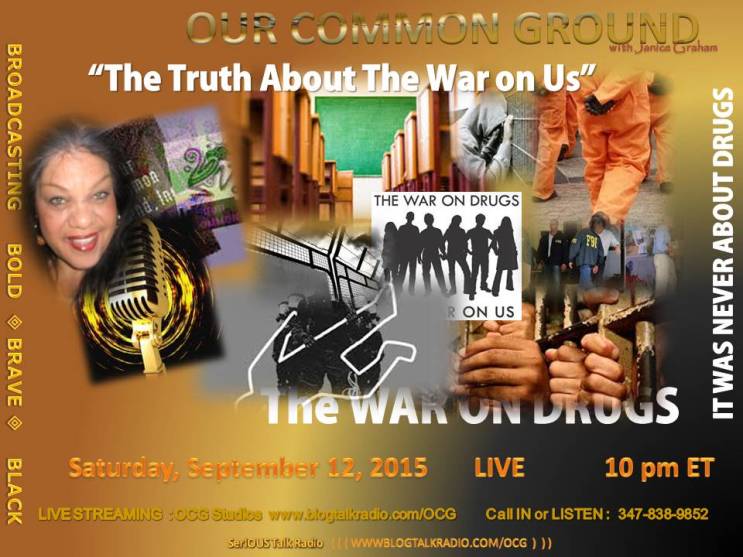
This Week on OUR COMMON GROUND φ “40 Years, $1 Trillion, 45 Million Arrests Later: “The Truth About the War Against Us” φ LIVE

OUR COMMON GROUND with Janice Graham

“The Truth About the War Against Us”
09-12-15 War on Drugs4
40 Years, $1 Trillion, 45 Million Arrests – the war still rages against our community. IT WAS NEVER ABOUT DRUGS

 Saturday, September 12, 2015

10 pm EDT
LISTEN LIVE and Join the OPEN Chat

LISTEN LIVE HERE

Learn more and join us on Facebook
Call In – Listen Line: 347-838-9852

This week on OUR COMMON GROUND, we review and examine the truth about the policies and intent of the “War on Drugs”. We need to talk about the money making behind the politics; how the drug war can be considered slow Nazi policy on the poor and the racial profiling used. We look at these destructive and failed policy and manipulation in its historical context and destructive outcomes. We will present audio clips for our discussion which will assist us in understanding just how much the “War on Drugs” was really never about drugs.

For sheer government absurdity, the War on Drugs is hard to beat. After three decades of increasingly punitive policies, illicit drugs are more easily available, drug potencies are greater, drug killings are more common, and drug barons are richer than ever. The War on Drugs costs Washington more than the Commerce, Interior, and State departments combined – and it’s the one budget item whose growth is never questioned. A strangled court system, exploding prisons, and wasted lives push the cost beyond measure. What began as a flourish of campaign rhetoric in 1968 has grown into a monster. And while nobody claims that the War on Drugs is a success, nobody suggests an alternative. Because to do so, as Surgeon General Joycelyn Elders learned, is political suicide.

As a community we need to understand how Drug War fever has been escalated; who has benefited along the way; and how the mounting price in dollars, lives, and liberties has been willfully ignored. Where are the policy maker offices where each new stage was planned and executed? What happened in the streets where policies have produced bloody warfare. This is a tale of the nation run amok – in a way the American people are not yet ready to confront. Are you?

You are invited to bring your thoughts about the pressing issues facing our community. Come listen and learn. SHARE please.

OUR COMMON GROUND where friends come to confer with allies.

Listen & Call In Line: 347-838-9852
Saturday, September 12, 2015 10 pm ET
Join the LIVE Broadcast Here

 http://bit.ly/1KIQv2q

            BROADCASTING   BOLD BRAVE & BLACK

Web     Facebook     Community Forum   Pinterest    Visit our Tumblr Page

Twitter: @JaniceOCG #TalkthatMatters

“Speaking Truth to Power and OURselves” 

email: OCGinfo@ourcommonground.com

Call In – Listen Line: 347-838-9852