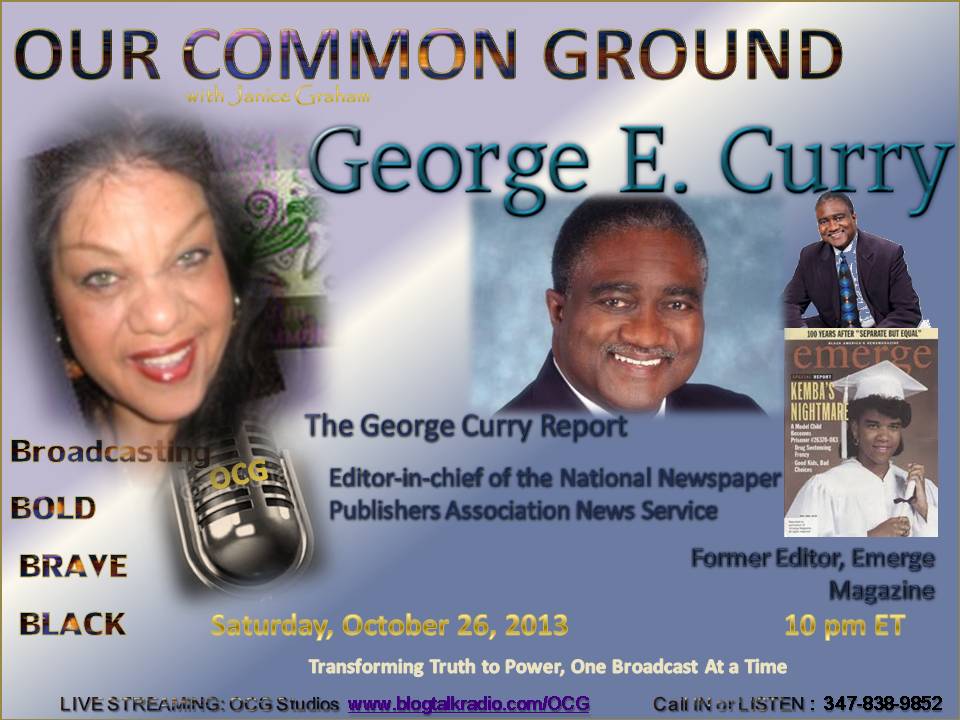
“Transforming Truth to Power, One Broadcast At a Time”
“In Conversation with George Curry”
October 26, 2013 10 pm ET LIVE and Call -IN
About our Guest George Curry
George E. Curry is the editor-in-chief of the National Newspaper Publishers Association News Service. The former editor-in-chief of Emerge magazine, Curry also writes a weekly syndicated column for NNPA, a federation of more than 200 African American newspapers.
Curry, who served as editor-in-chief of the NNPA News Service from 2001 until 2007, returned to lead the news service for a second time on April 2, 2012. His work at the NNPA has ranged from being inside the Supreme Court to hear oral arguments in the University of Michigan affirmative action cases to traveling to Doha, Qatar, to report on America’s war with Iraq.
As editor-in-chief of Emerge, Curry led the magazine to win more than 40 national journalism awards. He is most proud of his four-year campaign to win the release of Kemba Smith, a 22-year-old woman who was given a mandatory sentence of 24 1/2 years in prison for her minor role in a drug ring. In May 1996, Emerge published a cover story titled “Kemba’s Nightmare.” President Clinton pardoned Smith in December 2000, marking the end of her nightmare.
Curry is the author of Jake Gaither: America’s Most Famous Black Coach and editor of The Affirmative Action Debate and The Best of Emerge Magazine. He was editor of the National Urban League’s 2006 State of Black America report.
His work in journalism has taken him to Egypt, England, France, Italy, China, Germany, Malaysia, Thailand, Cuba, Brazil, Ghana, Senegal, Nigeria, the Ivory Coast, Mexico, Canada, and Austria. In August 2012, he was part of the official US delegation and a presenter at the US-Brazil seminar on educational equity in Brasilia, Brazil.
George Curry is a member of the National Speakers Association and the International Federation for Professional Speakers. His speeches have been televised on C-SPAN and reprinted in Vital Speeches of the Day magazine. In his presentations, he addresses such topics as diversity, current events, education, and the media.
One student editor fired, another suspended following protests at Grambling State Univ.
20 Oct 2013
By Tracie Powell
UPDATING
The online editor was fired and the opinions page editor is under a two-week suspension at Grambling State University’s student newspaper, The Gramblinite, following growing tensions there between students and administrators.
David Lankster Sr. said he’s been fired after tweeting statements from anonymous sources and photos of dilapidated facilities (here and here) using the newspaper’s Twitter account, and he accused the school’s Director of Public Relations and Communications, former journalist Will Sutton, of attempting to censor student journalists.
“I was behind it. I was the only one on the ground hearing from the students and players,” said Lankster, the former sports editor who has worked at the paper since 2009. “Sutton was trying to mute our voice because we were tweeting the real news, the truth about what was going on.”
allDigitocracy reached out to Sutton on Sunday; he referred questions to the newspaper’s adviser who did not immediately respond to emails.
Tensions that have been simmering for weeks came to a head last week when Grambling football players walked out of a meeting with college president Frank Pogue; and they refused to play in a scheduled game over the weekend, taking a forfeit. Students are upset about crumbling buildings and a lack of teachers among other things, they said. There’s even mold in a section of the newsroom, Lankster said. Doors to the area are kept locked and students are told not to enter the area, he added.
While Lankster was fired, his colleague Kimberly Monroe was informed she was being suspended for two weeks. Monroe, the editor of the newspaper’s opinion section, said she was asked by the newspaper’s adviser to remove parts of a column submitted by Grambling’s student government president, including the president’s email address that he asked students to use to report problems on campus.
“I refused and then I left,” said Monroe, a graduate student who said she has worked at the paper for two years. Monroe said she later attended a student rally where she spoke with local and national media about crumbling buildings and the student-teacher ratio. The next day Monroe said the newspaper’s adviser, Wanda Peters, asked what role she played at the rally. Monroe responded that she was there as a concerned student. “That’s when (Peters) told me that she didn’t know what she would do with me, but something would have to be done,” Monroe said.
Monroe can be seen in this Associated Press photo and is identified as the organizer of the Oct. 17th rally. She told allDigitocracy that she did help gather students, but had no idea members of the football team would attend. Having players present at the gathering on Thursday turned it into a media event that she did not expect, Monroe said.
Monroe was notified by email on Friday afternoon that she would be suspended from her job at The Gramblinite due to “unprofessional behavior.” An excerpt from the letter below states:
As a member of The Gramblinite, you should not have become involved in a public rally, as you did yesterday. I know Mass Communication was not your undergraduate major so you missed the classroom instruction regarding conflict of interest. But the Code of Ethics that you must read and sign each semester as part of your Gramblinite application outlines certain behaviors that are expected of you. Item No. 4 of the Code reads:
“We report the news without regard for our own interests, mindful of the need to disclose potential conflicts. We avoid involvement in campus events, politics, demonstrations and social causes that would cause a conflict of interest, or the appearance of such conflict.”
The letter is copied to Dr. Edward Welch, interim chief of the school’s department of mass communication, Dr. Janet Guyden, dean of the college’s graduate school and Dr. Connie Walton, provost and vice president of academic affairs. Peters, the adviser, did not immediately respond to emails asking for comment on the disciplinary actions against the student journalists, but she did include in the letter that Monroe contributes “much to The Gramblinite and it would be a blow to lose your participation.”
Monroe said she does not agree with the suspension. ”I’m a student first,” Monroe said in a telephone interview, “a student who works for a student newspaper.” Monroe added that she did not sign a code of ethics at the start of the current semester.
Lankster, the online editor, said he began tweeting developments and student frustrations with administrators around Oct. 17. He does not recall how many tweets he posted, but said some of them have been deleted by school officials, but not before they had caught Sutton’s attention. Sutton, a former president of the National Association of Black Journalists, did not answer specific questions, but earlier he tweeted these admonishments to Grambling’s student journalists:
For the past several years, I have spent virtually all my working hours writing about or speaking about the immorality, cruelty, racism and insanity of our nation’s latest caste system: mass incarceration. On this Facebook page I have written and posted about little else. But as I pause today to reflect on the meaning and significance of the 50th anniversary of the March on Washington, I realize that my focus has been too narrow.
Five years after the March, Dr. King was speaking out against the Vietnam War, condemning America’s militarism and imperialism – famously stating that our nation was the “greatest purveyor of violence in the world.” He saw the connections between the wars we wage abroad and the utter indifference we have for poor people and people of color at home. He saw the necessity of openly critiquing an economic system that will fund war and will reward greed, hand over fist, but will not pay workers a living wage. Five years after the March on Washington, Dr. King was ignoring all those who told him to just stay in his lane, just stick to talking about civil rights.
Yet here I am decades later, staying in my lane. I have not been speaking publicly about the relationship between drones abroad and the War on Drugs at home. I have not been talking about the connections between the corrupt capitalism that bails out Wall Street bankers, moves jobs overseas and forecloses on homes with zeal, all while private prisons yield high returns and expand operations into a new market: caging immigrants. I have not been connecting the dots between the NSA spying on millions of Americans, the labeling of mosques as “terrorist organizations” and the spy programs of the 1960s and ‘70s – specifically the FBI and COINTELPRO programs that placed civil rights advocates under constant surveillance, infiltrated civil rights organizations and assassinated racial justice leaders.
I have been staying in my lane. But no more. In my view, the most important lesson we can learn from Dr. King is not what he said at the March on Washington, but what he said and did after. In the years that followed, he did not play politics to see what crumbs a fundamentally corrupt system might toss to the beggars of justice. Instead he connected the dots and committed himself to building a movement that would shake the foundations of our economic and social order, so that the dream he preached in 1963 might one day be a reality for all. He said that nothing less than “a radical restructuring of society” could possibly ensure justice and dignity for all. He was right.
I am still committed to building a movement to end mass incarceration, but I will not do it with blinders on. If all we do is end mass incarceration, this movement will not have gone nearly far enough. A new system of racial and social control will be born again, all because we did not do what King demanded we do: connect the dots between poverty, racism, militarism and materialism. I’m getting out of my lane. I hope you’re already out of yours.
This statement was posted by Michelle Alexander to her Facebook page on Aug. 28, 2013.
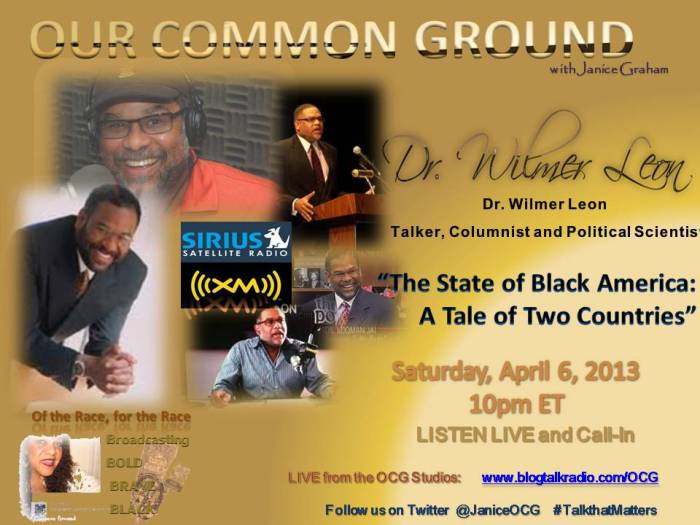
“The State of Black America: A Tale of Two Countries”
Tonight’s Guest: Dr. Wilmer Leon
“The State of Black America: A Tale of Two Countries”
Tonight’s Guest: Dr. Wilmer Leon
Dr. Leon comes to OCG once again to weigh in on the issues which face Black America, the politics of our problems and the light of solutions available.
Wilmer J. Leon III, Ph.D. is a Political Scientist whose primary areas of expertise are Black Politics, American Government, and Public Policy. He is a Teaching Associate in the Political Science Department at Howard University in Washington, D.C., a nationally syndicated broadcast radio talk show host, columnist, commentator, political consultant, TV host, lecturer, and much sought after motivational speaker.
Dr. Leon earned a BS degree in Political Science from Hampton Institute, a Masters in Public Administration (MPA) from Howard University, and a Ph.D. in Political Science from Howard University.
A serious void exists in the public discourse relating to the issues that directly and/or disproportionately impact the global village in which we live. Dr. Leon’s lectures and writings focus on issues such as the media’s coverage of national and international issues, the criminal industrial complex, environmental racism, school vouchers, health care, crime policy, economic globalization, American domestic and foreign policy from as much of a non- biased and academically accurate perspective as possible. Dr. Leon’s perspective and lectures are grounded in the history of the African American community and the tradition of African American scholarship.
Dr. Leon is host/producer of the nationally broadcast call in talk radio program Inside The Issues With Dr. Wilmer Leon on XM/Sirius satellite radio channel 169 “Urban View” and the host of Epilogue, a political book discussion program on Press TV. He hosts discussion on Facebook as Dr. Leon Prescriptions.
Dr. Leon was a regular guest on CNN’s Lou Dobbs Tonight and is a contributing columnist to The Grio.com, The Black Agenda Report, The Maynard Institute.com, TruthOut.org, PoliticsInColor.com and Black Star News.
(The Root) — Professor Cornel West has struck again. The always outspoken Obama critic recently said in an interview with Democracy Now: “I think that it’s morally obscene and spiritually profane to spend $6 billion on an election, $2 billion on a presidential election, and not have any serious discussion — poverty; trade unions being pushed against the wall, dealing with stagnating and declining wages when profits are still up and the 1 percent are doing very well; no talk about drones dropping bombs on innocent people … I mean, I’m glad there was not a right-wing takeover, but we end up with a Republican, a Rockefeller Republican in blackface, with Barack Obama, so that our struggle with regard to poverty intensifies.”
Putting aside the substance in West’s comments, since there are certainly valid and substantive policy critiques to be made of the Obama administration, it is completely unnecessary for him to attack the president in such a racialized and offensive manner. Any good points he made are lost.
This isn’t the first time that the Princeton and Union Theological Seminary professor has attacked the president as a person instead of sticking to policy. West has previously called the president a “black mascot of Wall Street oligarchs and a black puppet of corporate plutocrats.” West and his partner Tavis Smiley (they have a public-radio show together, Smiley & West), also an outspoken Obama critic, have failed, time and again, to keep their critiques focused on policy when commenting on the shortcomings of the Obama administration.
High-profile black intellectuals who dared to support the president in public are not immune from the wrath of West and Smiley, either. The Rev. Al Sharpton, Melissa Harris-Perry and Michael Eric Dyson are “for sale” for access to Obama, according to West. This an interesting choice of words, considering Smiley’s history with corporate sponsors including Wells Fargo and Exxon Mobil.
Perhaps, with a second Obama win, West and Smiley feel their influence diminishing within the black community, which supported the re-election of President Obama with even higher turnout than in 2008 in key states, despite criticism. President Obama has been elected and re-elected, and the old guard of black political thought is becoming more and more marginalized as a result. No longer does a black politician need to be ordained by Smiley orgrace the stage of his (now-canceled) State of the Black Union speech-a-thon to be considered a contender for high office.
There are legitimate critiques of the president and serious issues to tackle during his second term. The challenge for Obama critics is to point out areas that absolutely need to be addressed — high black unemployment and, yes, poverty — without attacking the president as a man. With pride continuing to cloud their critiques of President Obama, West and Smiley have failed to do this time and again. It seems that they are facing a future in the black-intellectual wilderness over the next four years.
Let’s hope that during Obama’s next term, we can all work together to push the president and his administration to make big changes (or at least use his bully pulpit to talk about big changes, since the balance of power in Congress is unchanged) that will benefit the lives of the millions who voted for him. Offering constructive criticism and applying public pressure that is intended to assist the president rather than undermine him is a much more effective strategy going forward. Maybe more high-profile black thinkers will take note.
Zerlina Maxwell is a political analyst and contributing writer for Ebony.com, theGrio.com and Feministing.com. She writes about national politics, candidates and specific policy and culture issues, including domestic violence, sexual assault, victim blaming and gender inequality. Follow her on Twitter.
Students at a Morehouse College commencement (Getty); prisoners at the Avon Park Correctional Facility (Getty)
(The Root) — What does the line “There are more black men in jail than in college” have in common with the Jheri curl? Answer: They were invented by white men (Jheri Redding and Vincent Schiraldi, respectively) and adopted enthusiastically by black people, and they left a nasty stain on the shoulders of millions of black men.
It’s been more than 20 years since the Jheri curl faded away into infamy, and I’m proud to say that even in the 1980s, I never sported a curl. Unfortunately, I can’t say the same about the line “There are more black men in jail than in college.”
About six years ago I wrote, “In 2000, the Justice Policy Institute (JPI) found evidence that more black men are in prison than in college,” in my first “Breaking Barriers” (pdf) report. At the time, I did not question the veracity of this statement. The statement fit well among other stats that I used to establish the need for more solution-focused research on black male achievement.
I was in good company. The same year, at a 2007 NAACP forum, then-presidential candidate Barack Obama said, “We have more work to do when more young black men languish in prison than attend colleges and universities across America.”
Both President Obama and I brought our own unique style to the line. I was deferential and academic, while President Obama was passionate and eloquent. In contrast, many people, like Charles Barkley, are reckless and aloof when they use the line. Recently he told Bob Costas, “You know, we as black people always, we don’t have respect for one another. You know, we’ve got more black men in prison than we do in college, and crime in our neighborhoods is running rampant.” In full context, Barkley was using the line to justify the need for armed defense against black men.
However, just as a Jheri curl would be wrong no matter how you dressed it up today, the line “There are more black men in jail than in college” is wrong no matter how you contextualize, qualify or articulate it.
Today there are approximately 600,000 more black men in college than in jail, and the best research evidence suggests that the line was never true to begin with. In this two-part entry in Show Me the Numbers, the Journal of Negro Education’s monthly series for The Root, I examine the dubious origins, widespread use and harmful effects of what is arguably the most frequently quoted statistic about black men in the United States.
Black academics don’t have a “special obligation” to speak to broader social and political issues. What we have witnessed over the last few decades is the increasing professionalization of this particular class of persons – where the object of their scholarly interests range across a number of subjects that aren’t reducible to questions of race. These individuals stand alongside those who work explicitly on racial matters, but their work doesn’t necessarily reach beyond the confines of a specialized academic community. The political significance of their ideas has been weakened or worse, banished to the shadows, and we’re left, as my grandmother would say, “bumping our gums.”
Too many have given up the work of thinking carefully about black America. We have become cheerleaders for President Obama or self-serving pundits.
However, the role of the black intellectual raises a different question. I do believe that intellectuals generally ought to aspire to be the moral conscience of their societies: that what we write, say and do should reflect intelligent efforts to provide a critical account of who we take ourselves to be as a nation. Black intellectuals take up this task in the context of black communities and the ever-shifting regime of race that undermines democratic possibility in this country. (And remember that the folks who do this kind of labor do not have to work in universities or colleges.)
That’s what they ought to do. Instead, today we are experiencing a “new nadir.” Too many black intellectuals have given up the hard work of thinking carefully in public about the crisis facing black America. We have either become cheerleaders for President Obama or self-serving pundits. Our celebration of his singular achievement and our crazed desire for access have made many of us “born-again patriots.”
All too often what stands in for the black intellectual these days are folks who can spin a phrase and offer a soundbite. The idea of the intellectual who reads widely and deeply and who critically engages the complexity of our times has been supplanted by the fast-talking “black Ph.D. pundit” who strives to be on CNN, Fox or MSNBC. This same pundit has found new career opportunities within universities and colleges by thinking about black people in ways that conform to the current liberal consensus about racial matters.
The combination turns out to be a deadly one. I am reminded of what the sociologist C. Wright Mills wrote in 1948: “The two together, for the liberal ideology, as now used by intellectuals, acts as a device whereby he can take advantage of the new career chances but retain the illusion that his soul remains his own.” Put another way, too many black intellectuals have sold their souls “for a mess of pottage,” while the misery in black America deepens. And there is a tragic story to tell about how we arrived at this point.
Even given this state of affairs, I remain hopeful. Those of us committed to the work of thinking carefully in public with others must model the value of seriousness amid the white noise of our current media landscape. This involves using various social networks to push critical conversations and thinking among our fellows; it entails recommitting ourselves to build reading and writing communities that cultivate the habits of public intellectual work; it means bringing our skills to bear on the problems of our day through interpretations that single out our failings and point the way forward to what needs to be done to, as James Baldwin wrote, “achieve our country.”
Most of the work of academics goes unnoticed. A few of us gain public attention, but most often we are just the best-looking, most articulate thought synthesizers of our age.
STEPHON ALEXANDER, PHYSICS AND ASTRONOMY, DARTMOUTH
As a tenured faculty member, I feel an obligation to recruit and mentor black and other minority group members, as well as to shape institutional support.
KHALIL MUHAMMAD, SCHOMBURG CENTER, NEW YORK PUBLIC LIBRARY
The incarceration and sustained poverty of black and brown young men are a product, in part, of the off-campus activities of conservative black intellectuals.
INTRODUCTION
Associated PressW.E.B. Du Bois, a leading black intellectual of an earlier generation.
Two decades ago, The Atlantic Monthly chronicledthe rise of black academics, including Cornel West, Henry Louis Gates Jr. and Patricia Williams, who had vigorously taken on the role of public intellectuals, stirring debate on issues of importance to African-Americans. Today, more African-Americans hold more positions at colleges, not always involving subjects that have particular relevance to black people.
Do these academics still have a special obligation to address the nation’s social and racial issues? Are there particular challenges or opportunities faced by intellectuals who talk to the public about social issues?
Josef Sorett, an assistant professor of religion and African-American studies at Columbia University, organized this discussion.
My 9-year old daughter came home this week raving about her class and their discussion of Martin Luther King, Jr.
She declared that she loved learning about his life and that she was thankful to him because without King, no change would have been possible in America on the question of race. I am a historian of African-American history specializing in social movements, so I quickly moved to correct her. Of course change would have happened, even if King had never lived! I described to her other leaders. I reminded her that movements don’t function because of just one great man. I told her that King was not a perfect person, and that even he had come short of meeting all his goals. In the end, I even resorted to reminding her that I wrote a book on a movement that took place 35 years before King was even born.
Clearly my daughter didn’t care. She insisted that her school would not be integrated, and that her whole world would not have been the same without King’s leadership.
After thinking about it for a while, I realized that most people feel the same way about King that my daughter does. King has become the single greatest icon of the civil rights movement—his words are studied, his great marches are remembered, his name marks our boulevards; his shadow, now literally cast in stone, looms large on our national consciousness. He has become the benchmark for great leadership, so much so that nearly every leader that has emerged after him is compared to him, and found wanting.
As an icon, King is often thought of as flawless, so that we rarely reflect on his failures as a movement leader. Our collective memory of King only touches on the high points. The images we remember are the moments of his greatest triumphs as a leader: the 1955-56 Montgomery Bus Boycott, the 1963 March on Washington, the Birmingham Campaign that same year, and the 1965 march from Selma to Montgomery. Each of these efforts resulted in positive change, clear victories in the courts or in the halls of Congress.
We tend not to remember the moments when King faltered or searched for the right direction. We don’t recall the indecision about what to do next after the success of the Montgomery Bus Boycott; the challenge of the 1966 Chicago Freedom Movement campaign, or his unfulfilled Poor People’s Campaign — cut short by his tragic assassination in 1968. These moments are forgotten when King is not remembered in his broader context.
Dr. Jahi Issa, until March 2012, worked as an Assistant Professor of History & Africana Studies at Delaware State University (DSU) in Dover. When a group of students assembled in protest of DSU President Dr. Harry Williams after the state auditor criticized the university’s business practices and for the decreasing percentage of black students at the historically black university, police arrested Issa and escorted him away until he dropped to the ground and requested an ambulance. After being seen at the hospital and later released, DSU police charged him with disorderly conduct, resisting arrest, offensive touching of a law enforcement officer, and inciting a riot.
Issa was born and reared in St. Louis, Mo. and was awarded his PhD in history from Howard University. His forthcoming monograph examines the Universal Negro Improvement Association in Louisiana and its contribution to African nationalism. He is currently banned from the DSU campus and is facing a prosecution that could put him behind bars for
more than two years. The incident has fueled concerns that Professor Issa’s arrest and the pending charges represent an act of repression and retaliation for his outspokenness and the EEOC and other complaints he has filed while he was on the faculty at DSU, and not because of any actual crimes he committed. The situation is depressing and he is in need of support in this difficult time.
We ask, what is the crime ? Is there no freedom of speech for a progressive Black educator in this HBC ? We remember the on-slaught of firings in HBCUs in the 1960s as many began to publish the early works of student involvement in the infancy of the Black Power movement. Among them, Dr. Nathan Hare who was fired from Howard University.
At the heart of this bizarre response to Dr. Issa’s attendance to the student rally is an essay which he wrote and was published at Black Agenda Report.
How Black Colleges Are Turning White – The Ethnic Cleansing Of African Americans in the Age of Obama
How Black Colleges Are Turning White and Keeping Their Historically Black Colleges and Universities Status: The Ethnic Cleansing Of African Americans in the Age of Obama (Part 1 of 3 )
By Jahi Issa, Ph.D.
For more than 100 years, HBCU’s have served as a model for educating a plethora of African American leadership around the country. Although the mission statements of most HBCUs do not state this fact, HBCUs grew out of the social disorder and aftermath of the American Civil War—a period which constitutionally brought millions of formerly enslaved Africans into citizenry in the United States. Similar to colleges and universities that were created for groups such as Catholics, Jews and for immigrant groups, HBCUs were created in reaction to de facto marginalization created by a European American hostile society. Because of the efforts of the Civil Right Movement, HBCU’s were finally recognized as important institutions and were giving special status for Federal funding. However, over the past few decades, HBCUs have been targeted as being too “Black” and many states are progressively trying to eliminate African Americans from these institutions that have served as a buffer zone for the Black middle class. Some HBCUs have and are going through hostile takeovers in order to turn them into White education facilities and thereby permanently eliminating the African American middle class.
African American Perform Better at HBCUs
Although over the years many have argued that HBCUs are redundant and irrelevant in today’s “post racial world,” the fact remains that these intuitions of higher learning, according to the National Science Foundation, graduate more than 33% of all African Americans earning Bachelor’s and doctoral degrees, almost double that compared to African Americans attending predominately White schools . Furthermore, according to the Washington Post, the “post racial” world that many hoped for with the election of President Barack Obama may just be an illusion. Relying on a recent report from the Pew Research Center’s Social & Demographic Trends, the Washington Post noted that the typical White household in 2009 had 20 times more wealth ($113,149) than the typical Black household ($5,677). Moreover, another report that was conducted by Brandeis University in May of 2010 and concluded that African American will never reach wealth parity with that of White Americans. Both reports note that African Americans with college degrees stand a better chance at edging out a decent life in the United States than those without degrees.
According to a 1977 study that was conducted under the leadership of Dr. Mary Francis Berry, in her capacity as the former Secretary of Education in the Carter Administration, primary reasons why HBCUs tended to be better equipped to prepare students for real world experience was because they offered:
“credible models for aspiring Blacks…
“psycho-socially congenial settings in which blacks can develop”
“insurance against a potentially declining interest in the education of black folk”
Furthermore, the report posits that the ultimate purpose of the HBCU is to “represent the formal structures which nurture and stress racial ideology, pride and worth for Blacks. Consequently, they are what every racial and ethnic group is entitled to have—a political, social and intellectual haven.” The report mentioned above was recently vindicated in a study that was published in January of 2011. Three economists concluded that African Americans who attend HBCUs tend to perform better in the work force than African Americans who attend predominately White universities and colleges.
The 1965 Higher Education Act and Title III: Federal Funding For African-Americans in Higher Education
One cannot discuss today’s relevancy of HBCU’s without mentioning the Higher Education Act of 1965. The Higher Education Act was signed into law by President Lyndon B. Johnson as part of his Great Society program that sought “to strengthen the educational resources of our colleges and universities and to provide financial assistance for students in postsecondary and higher education.” Before the law was signed by President Johnson, the Chairman of the House Committee on Education, an African-American Harlem Congressman named Adam Clayton Powell made an amendment that defined HBCUs as “…any historically black college or university that was established prior to 1964, whose principal mission was, and is, the education of black Americans.” The amendments also legalized the federal funding of HBCUs through the Higher Education Act of 1965 Title III program. Title III is the federal governing body which sets the standard for providing funding for HBCUs. Over the years Title III had provided billions of dollars to support African-American undergraduate, graduate programs, increasing African American participation in math and science, real estate acquisitions and strengthen HBCU’ endowments to name a few. In all, Title III has helped African American universities to not only increase their numbers in accredited degree programs across the country; it has also allowed many HBCUs to have a tremendous economic impact in the communities that they serve.
Economic Impact of HBCUs and the Origins of a New Era Rifted in Corruption
In 2005 the National Center for Education Statistics (NCES), an office within the U.S. Department of Education, published a report that documented the economic impact of HBCUs. Primarily, this study was introduced by President George W. Bush and continued by President Barack Obama administration which sought to include the participation of private sector (corporations) into the governing bodies of HBCUs. The study found that more than 100 HBCUs had in 2001 an economic impact of almost 11 billion dollars in the communities that they served. For instance, schools such as Howard University total economic impact in the Washington D.C. metropolitan area was more than 600 million dollars. For smaller schools such as Delaware State University, their total economic impact was more than 150 million dollars. It must be noted that the economic impacts also made a national impression. Again, according to the National Science Foundation, HBCUs bestowed nearly 25% of all bachelor degrees earned by African Americans in 2001. In the areas of agriculture, biology, mathematics and the physical sciences, HBCUs accounted for more than 40 percent of all bachelor degrees earned by African-Americans. With this stated, it is easy to see why corporations would want a piece of the pie. Furthermore, if one is to evaluate the current lack of transparency on Wall Street, it is easy to see that Wall Street’s collaboration with today’s HBCUs could represent the end of African American higher education as we know it.
The Second Corporate takeover Black Higher Education
Although President Barack Obama HBCU Executive Order 13532 “encourages private investment in HBCUs,” however, research proves that corporate partnerships is not new to HBCUs, nor are their historic input solely motivated by financial gains. Not long after the end of reconstruction, Northern White capitalists sought extreme ways in which they could control the ebb and flow of African American education. This was done to curtail the rapid development of African American educational institutions immediately after the Civil War. For instance, from 1865-1880 federal agents documented that there were thousands of African American schools operating throughout the South independent of White control. When northern White benevolent groups finally reach the South with mythical-preconceived notions that they were coming to “civilize” former wretched enslaved Africans, they were astonished to see that Africans Americans had already had established their own schools systems fully equipped with African American teachers. These schools’ full missions were self-determination and political control over the regions of the South in which they were the majority.
The high level of African American political education created a problem for the nation after the Compromise of 1877. Since African Americans were no longer allowed to exercise political autonomy in the South, strategies were devised on the federal level to control the nature of their education. The federal government along with the corporate conglomerates in the North believed that the only way that they could ensure the continual flow of cheap labor in the South was to train African Americans in a way that they would not advocate for political control of their communities. Furthermore, there was another important issue at play—that was African American competition with Whites for high skilled jobs. The solution was a new type of training for Southern African Americans was called industrial education. This type of schooling served the purpose of supervising and training African American to be subservient to White interest. Schools such as Hampton, Tuskegee and Delaware State were devised as the alternative to the African American independent schools that advocated self-determination after the Civil War. The corporate-handpicked spokesman for this new type of schooling was none other than Booker T. Washington. One must remember that Washington’s entrance exam into Hampton University was sweeping the floor. The ultimate goal of Hampton was to control the emerging Black leadership of the Jim Crow South, and train African Americans in the corporate labor needs of the new South. The financial backing of Hampton University and what would later be Tuskegee was provided by White Northern corporations and philanthropy. This corporate-industrial style form of education continued to dominate Southern higher educational institutions long after the death of Booker T. Washington in 1915.
The White House Initiative on HBCUs Encourages Corporate Collaboration?
The current encroachment of private corporate input into the affairs of African American higher education could and will be disastrous. It would mean that African Americans will be forced back into the Jim Crow Era. A deliberate attempt to curtail educational advancements that was gained by the Civil Rights and Black Power era seems to be the main motivation. The White House Advisor on HBCUs, John Wilson, Jr., stated in April of 2010 HBCUs “must not be seen as plaintiffs in the struggle for civil rights….” Dr. Wilson, a graduate of Morehouse College, tends to forget that it was struggle for Civil Rights that literally allows him to serve President Barack Obama. The White House Initiative on HBCUs came into existence because of the “plaintiff” of the past. Furthermore, Mr. Wilson’s statement implies that African American should abandon their pursuit for full rights and self-interest. Taking a lead from Dr. Wilson’s statements, A Wall Street Journal editor named Jason L. Liley wrote an editorial stating that HBCU’s were a dismal failure and that “Mr. Obama ought to use the federal government’s leverage” to bring these schools under Wall Street’s control. He went further by stating that HBCUs should all become private and model themselves after the University of Phoenix. One month after Liley’s editorial, a conservative from the Wall Street funded American Enterprise Institute also imputed on Wall Street’s quest to control Black education. He ended his article in the Chronicle of Higher Education by stating that HBCUs “should accordingly be encouraged to enroll more non-black students.” The author mentioned nothing about White universities increasing African American enrollment. He also stated that “some HBCUs, notably two in West Virginia (Bluefield State and West Virginia State University), are in fact no longer predominantly black” but are still receiving special (HBCU) federal funding. Five months after the Chronicle of Higher Education essay appeared, the White House Advisor on HBCUs, John Wilson, Jr. was invited as the keynote speaker to the Thurgood Marshall College Fund. The title of his speech “Historically Black Colleges and Universities and the Albatross of Undignified Publicity” conveyed that HBCU are historically cursed when it comes to publicity in White dominated media outlets. Moreover, the central thesis of his speech, although impressively constructed, was that HBCUs should jump on the corporate bandwagon by accepting funds from good corporate Samaritans such as Bill Gates and Warren Buffett.
Black Colleges Turning White or White Cultural Hegemony: The Signs of the Future
Although the Higher Education Act of 1965 clearly states that an HBCU is a school “whose principal mission was, and is, the education of black Americans,” economist and scholar at American Enterprise Institute, Richard Vedder, reminds us that there is a trend being shaped were as HBCUs who formally had an African American majority student and faculty body, and now have White majority populations, still receive federal funding geared for African Americans. These two schools are Bluefield State College and West Virginia State University. According to a May 19, 2000 CNN report, White enrollment at HBCUs is on the rise. Other schools such as Kentucky State University, Elizabeth City State University and Delaware State University are only a few schools that have a growing White and non-African American student and faculty population. Furthermore, according to an August 17, 2011 Wall Street Journal article called “Recruiters at Black Colleges Break From Tradition,” HBCUs such as Tennessee State University, Delaware State University and Paul Quinn College are cited as no longer focusing exclusively on recruiting African Americans. The author of the article points out that Tennessee State University’s Black enrollment has reduced to around 70 %, while Paul Quinn College Black enrollment has been predicted to fall from 94% to 85% for the Fall 2011 academic year.
Many have asked the question if White enrollment at HBCUs represent a decrease in African American enrollment at the same schools. The year that CNN published its story, Bluefield College African American faculty had dwindled to less than one percent from previous decades. The African American student enrollment had also decreased to less than ten percent. Nonetheless, research shows that when African American faculty at HBCUs is a majority, African American students tend to enroll at a higher percentage and they tend to be more productive in the work place once they graduate. There seems to be a direct correlation between African American student enrollment and that of its faculty. In other words, if the African American faculty enrollment at HBCU’s is low, African American students tend not to attend HBCU’s. When this occurs, is an HBCU still a HBCU? In other words, can you have a HBCU without Black students and faculty? This is exactly the issue that American Enterprise Institute scholar Richard Vedder was raising in his essay in the Chronicle of Higher Learning. Why are HBCUs that are no longer Black in students or faculty population receiving federal monies geared toward African Americans? The federal government seems to believe that this trend represents the future for HBCUs.
Jahi Issa, Ph.D Assistant Professor of History and Africana Studies at Delaware State University and Former Northeastern North Carolina Grass Root Coordinator for President Barack Obama’s 2008 Presidential Campaign.

 BROADCASTING




 Associated PressW.E.B. Du Bois, a leading black intellectual of an earlier generation.


 OCG
OCG 