“The Flames of Liberation: Rebellion and Resistance” ll September 5, 2015 with Ruby N. Sales

Activist and Organizer, Ruby N. Sales

  “The Flames of Liberation: Rebellion and Resistance”

Saturday, September 5, 2015    Φ     LIVE  10 pm EDT

 “Transforming Truth to Power, One Broadcast At a Time” 

           OUR COMMON GROUND  Session II 2015 SEASON 

     33rd BROADCAST SEASON 

                               We open our 2nd Session of the 2015 Season continuing to examine the depth of structural and institutionalized racism, the impact of white supremacy and the concept of #BlackLivesMatter as a clarion call and the its promise as a movement.  As always we ask, “What is your End Game?”                      We invite you to join us and be part of the response to THE STATE OF EMERGENCY.


Guest Moderator, Ruby N. Sales, Founder & Director, The Spirit House Project


To help us kick off this session we have asked Rev. Ruby N. Sales to join us a co-moderator on the critical questions and issues that challenge, trembling like a swelling tsunami beneath the ocean. A seasoned veteran of the civil and human rights campaigns of our time and a fierce and clear visionary of Black Power, we believe that she is most appropriate to help us press out an authentic narrative on these issues.

Institutionalized Racism is the concept and practice of white supremacy. It is the practice of discrimination and oppression based on skin color, physical characteristics, continent of origin and culture. It has its origins as a justification for slavery and the conquest of the Americas. From the beginning, slavery in the United States was tied to the development and growth of capitalism. Founded on the sale and ownership of human beings on the basis of their physical characteristics and color, its purpose was the exploitation of unpaid labor for super profits. As chattels, Africans were hunted like animals, transported to the “New World,” and then sold on the auction block like beasts of burden. In like manner Native American Indians were exterminated on a massive scale.

Moral and intellectual rationales were invented and continue to justify this kidnapping, sale, enslavement and genocide against human beings. As an ideology, racism provided the moral and intellectual underpinnings of slavery, the westward expansion of colonialism and the seizure of half of Mexico. Thus the purpose of this doctrine was, and still is, to put forward ideas and theories founded on the myth that Black people and other people of color are inherently inferior.

Almost 130 years after the Emancipation Proclamation, the legacy of slavery remains. It is embedded in and influences every aspect of social, economic and political life. Institutionalized racism is the combined economic, political, social, cultural, legal, ideological and other structures that exist to maintain the system of inequality. #RaceMatters

Institutionalized racism has economic, social, political, ideological and cultural forms, and denies equality, justice and dignity to all people of color.  There are new problems because of the systemic nature of crisis. Our discussions should examine what adjustments must be made in these new efforts to eradicate our place in this society. We rebel and resist the effort to force us into the margins, to make us invisible and to remove us to prison for profit camps.

Our discussions must explore and examine how to elevate our voices in the fight against police brutality, housing discrimination, immigrant rights, and the dismantlement of public education to mention a few issues. At OUR COMMON GROUND provide “a place for our unfiltered voices”.  With the brightest, most loyal and insightful Black activists, community organizers and servants, scholars, researchers, journalists and social scientists we raise, clarify and illuminate the racist dimension of these issues, show how their roots lie in the system of capitalism and its new stage of crisis, and come up with concrete ideas to launch new initiatives and support existing ones.

As a set of institutions, racism is infused in the very foundations of our society and is inseparable from the economic foundations of U.S. capitalist society. The “new domestic military policing” is implemented to intimidate and destroy racially homogenous communities and put into place a ‘superexploitation’ of racial oppression that ensures our silence and to fill prisons serves to create and make real the essence of white supremacy.  We are living in an increasingly surreal special system of oppression and racism perpetrated by a narrative dictated outside of our community. None of this is new; the struggle to liberate ourselves has been before us since our time on these shores. One of our most effective weapons is to ensure that we work from an authentic narrative and that its formulation comes from our Truth. OUR COMMON GROUND for more than 33 years has focused its broadcast mission on ensuring that the Black Truth illuminates and informs our struggle.  #BlackTruthMatters #BlackVoiceMatters

   BROADCASTING   

   BOLD      BRAVE       BLACK 

           OUR COMMON GROUND with Janice Graham

                                 “Speaking Truth to Power and Ourselves” 

                                email: OCGinfo@ourcommonground.com

           LISTEN LIVE and Join the OPEN Chat:  http://www.blogtalkradio.com/OCG

                             Call In – Listen Line: 347-838-9852

Community Forum ll   Twitter: @JaniceOCG  #TalkthatMatters   ll    Pinterest   ll  Visit our Tumblr Page   Facebook

A Clear and Simple Reason Why Blacks Shun the Republican Party

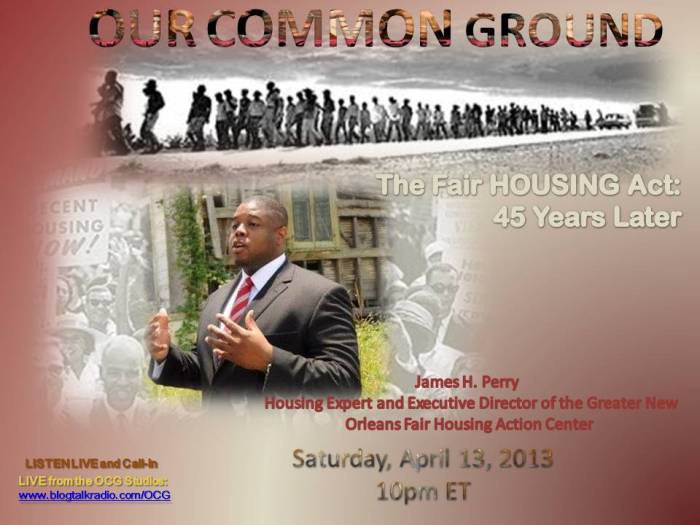
“45 Years Later: The Fair Housing Act” with James Perry – April 13, 2013 – 10 pm ET LIVE

OUR COMMON GROUND with Janice Graham

“45 Years Later: The Fair Housing Act”

 Guest: James H. Perry

Executive Director of the Greater New Orleans Fair Housing Action Center (GNOFHAC)

04-13 Perry2

April 13, 2013 10pm ET 

LIVE and CALL-In

about JAMES H. PERRY

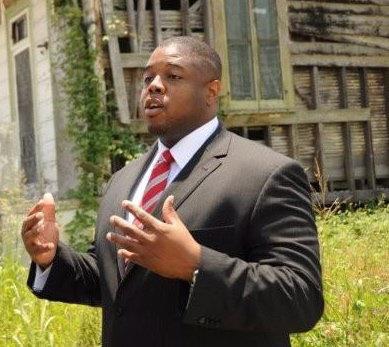
Jim PerryJames Perry is the Executive Director of the Greater New Orleans Fair Housing Action Center (GNOFHAC). Perry is a housing expert. He founded the Gulf Coast Fair Housing Center in Mississippi when he was 26 years old. He led the Greater New Orleans Fair Housing Action Center through two of America’s greatest disasters-Hurricanes Katrina and Rita. Under Perry’s leadership, the Center favorably settled an historic class action lawsuit resulting in compensation of more than $500 million for Katrina victims. Perry has testified before congress eight times and was a candidate in the 2010 New Orleans Mayoral election.

Perry serves on the Board of Directors of the National Fair Housing Alliance, the National Low Income Housing Coalition, the Gulf Coast Fair Housing Center and chairs the Louisiana Housing Alliance Board of Directors. He holds a Bachelors in political science from the University of New Orleans and a Juris Doctorate from the Loyola University School of Law.

The Greater New Orleans Fair Housing Action Center is a private, non-profit civil rights organization established in the summer of 1995 to eradicate housing discrimination throughout the greater New Orleans area.

America’s poor and middle-class are mired in the fall out of a crumbling economic foundation. Housing discrimination in new forms contribute to the fall out causing massive homelessness, including children, veterans and elderly. A new and vicious kind of resilience to compassionate themes in our politics, lends a hand to this threat. Foreclosures which rise out of predatory lending and greed, plague the well-being of the Black and Brown working class. Housing discrimination has a new and more virulent strain. Join us tonight to take a look with James Perry.

OUR COMMON GROUND with Janice Graham

“Speaking Truth to Power and Ourselves”

BROADCASTING BRAVE BOLD BLACK

Community Forum: http://www.ourcommonground-talk.ning.com/
Twitter: @JaniceOCG #TalkthatMatters
Web: http://www.wordpress.ourcommongroundtalk.com/

OUR COMMON GROUND with Janice Graham l “The State of Black America: A Tale of Two Countries” l Guest: Dr. Wilmer Leon l April 6, 2013

OUR COMMON GROUND with Janice Graham

April 6, 2013       10 pm ET  LIVE

“The State of Black America: A Tale of Two Countries”

Tonight’s Guest: Dr. Wilmer Leon


04-06 Wiler2 Leon


“The State of Black America: A Tale of Two Countries”

Tonight’s Guest: Dr. Wilmer Leon

Dr. Leon comes to OCG once again to weigh in on the issues which face Black America, the politics of our problems and the light of solutions available.

Wilmer J. Leon III, Ph.D. is a Political Scientist whose primary areas of expertise are Black Politics, American Government, and Public Policy. He is a Teaching Associate in the Political Science Department at Howard University in Washington, D.C., a nationally syndicated broadcast radio talk show host, columnist, commentator, political consultant, TV host, lecturer, and much sought after motivational speaker.

Dr. Leon earned a BS degree in Political Science from Hampton Institute, a Masters in Public Administration (MPA) from Howard University, and a Ph.D. in Political Science from Howard University.

A serious void exists in the public discourse relating to the issues that directly and/or disproportionately impact the global village in which we live. Dr. Leon’s lectures and writings focus on issues such as the media’s coverage of national and international issues, the criminal industrial complex, environmental racism, school vouchers, health care, crime policy, economic globalization, American domestic and foreign policy from as much of a non- biased and academically accurate perspective as possible. Dr. Leon’s perspective and lectures are grounded in the history of the African American community and the tradition of African American scholarship.

Dr. Leon is host/producer of the nationally broadcast call in talk radio program Inside The Issues With Dr. Wilmer Leon on XM/Sirius satellite radio channel 169 “Urban View” and the host of Epilogue, a political book discussion program on Press TV. He hosts discussion on Facebook as Dr. Leon Prescriptions.

Dr. Leon was a regular guest on CNN’s Lou Dobbs Tonight and is a contributing columnist to The Grio.com, The Black Agenda Report, The Maynard Institute.com, TruthOut.org, PoliticsInColor.com and Black Star News.

OUR COMMON GROUND with Janice Graham

“Speaking Truth to Power and Ourselves”

BROADCASTING     BRAVE     BOLD BLACK

LISTEN LIVE 

Join the discussion in our Open Chat during the broadcast.

 On the Web

Follow us on Twitter    @JaniceOCG      #TalkthatMatters

Like US on Facebook

LIVE: OCG Meetinghouse: http://www.blogtalkradio.com/OCG
For More Information: http://www.ourcommongroundtalk.wordpress.com/


Economic Mobility For African Americans May Be A Myth l Pew Report Finding

Economic Mobility For African Americans May Be A Myth, Pew Report Shows

The Huffington Post  |  By  Posted: 07/17/2012

Economic Mobility

The fine line between the American Dream and the African-American Dream is becoming more distinct, according to a recent report by the Pew Charitable Trusts, a nonprofit research organization.

The survey of economic mobility across generations compared the income and wealth of Americans with that of their parents at the same age, and it offered a promising outlook for most Americans — 84 percent to be exact — who were shown to have higher incomes than their parents, when adjusted for inflation.

African Americans, however, haven’t had the same success, with just 23 percent of blacks raised in the middle class surpassing their parents’ family wealth, compared to 56 percent of whites.

The study’s project manager, Erin Currier, said the results aren’t far off from what a simliar 2008 survey found. “With this newest update to the data, we can see that not much has changed with a few more years of data added in,” Currier told The Huffington Post. “Specifically, African Americans are much more likely than whites to be stuck at the bottom of the income ladder over a generation, and also at the bottom of the wealth ladder,” she said. They’re also more likely to fall from the middle.

Currier and her team analyzed income data over five years from the University of Michigan’s Panel Study of Income Dynamics (PSID), a nationally representative sample of more than 18,000 individuals living in 5,000 families in the United States. During the years they chose — 1967, ’68, ’69, ’70 and ’71 for the parents; 2000, ’02, ’04, ’06 and ’08 for their kids — both groups were at a common age (in their early to mid 40s) and at similar positions of marriage, income parity and post-secondary education, Currier said.

“It is the case that African-American families manage to get to the middle class and they have some sense of economic security, but their ability to pass that on to their kids is not as high as the white families,” she said.

And while this particular study didn’t delve into specific reasons for this gap, Currier pointed to previous research showing the impact neighborhood poverty has had on maintaining wealth disparities over time. “Two thirds of African-American children born between 1985 and 2000 are being raised in high poverty neighborhoods,” compared to just six percent of white children, Currier noted, proportions that haven’t shifted much over the last 30 years. “It isn’t the case that two thirds of African-American families are poor, but a lot of even middle-class African-American families are living in high poverty neighborhoods and research shows that, that environment in childhood increases a person’s chance of downward mobility by 52 percent,” she added.

A study published in May by the National Bureau of Economic Research may have hinted at one of the barriers to moving out of those poverty-stricken neighborhoods, revealing that black and Hispanic homebuyers pay as much as 3 percent more for their homes, regardless of their income, wealth or credit profiles.

Pew research has also examined the roles that marital status andincarceration have played in the black-white economic mobility gap in recent years. Meanwhile, others have looked at the roles of higher education and even differences by region. (Those with a college degree and those who live in the Northeast U.S. have a higher chance of moving up, researchers say.)

Since 2006, Currier and her team have set out to examine the health and status of the American Dream, which she says is more than a cliche, but rather a part of our national fabric based on the notion that your children can do better than you did.

“Our research shows a pretty mixed view of the degree to which that’s true,” she said. “On one hand, there has been significant economic growth over the last generation, [wealth that] has been broadly, equally shared. But at the same time, we see some lack of movement on the ladder as a whole.” So even though Gen Xers may have greater incomes than their parents did within a certain income bracket, they may not make enough to move to the next bracket up, Currier explained.

That finding contradicts what is said to be the crux of the American Dream, that all Americans have equality of opportunity regardless of their economic status at birth.

“A defining factor of the American dream is that a person’s family background or income has no bearing on where he or she ends up, but the study shows otherwise,” Currier said in an interview with the Poughkeepsie Journal.

The American Case Against a Black Middle Class l TA-NEHISI COATES l The Atlantic

The American Case Against a Black Middle Class

 JAN 22 2013 

I went on a Twitter rant yesterday because I’d finished Isabel Wilkerson’s phenomenal The Warmth Of Other Suns. The book is a narrative history of the Great Migration through the eyes of actual migrants. Several points stick out for me.

1) The Great Migration was not an influx of illiterate, bedraggled, lazy have-nots. Wilkerson marshalls a wealth of social science data showing that the migrants were generally better educated than their Northern brethren, more likely to stay married, and more likely to stay employed. In fact, in some cases, black migrants were better educated than their Northern white neighbors.
2) In this sense, the migrants to Northern cities resembled immigrant classes to whom black people in these same cities are often unfavorably compared to. There’s a quote in Wilkerson’s book which I can’t find where a supervisor basically says that blacks are the favored workers because they will work hard at the worst jobs for relatively little money. You would have thought the guy was talking about Hispanic farm-hands today.
3) The black migrants were not immigrants. They were citizens of this country who did not enjoy its full protection. Unlike other immigrant classes, blacks were never able to cash in on their hard work and middle-class values. For all of their work-ethic, education-valuing, and long-term marriages, they received the worst wages in the worst jobs, were limited to the worst housing, and stuffed in the worst schools.
4) What becomes clear by the end of Wilkerson’s book is that America’s response to the Great Migration was to enact a one-sided social contract. America says to its citizens, “Play by the rules, and you will enjoy the right to compete.” The black migrants did play by the rules, but they did not enjoy the right to compete. Black people have been repeatedly been victimized by the half-assed social contract. It goes back, at least, to Reconstruction.
5) The half-assed social contract continues to this very day with policies under the present administration, like the bail-out of banks that left the homeowners whom the banks conned underwater. The results of the housing crisis for black people have been devastating. The response is to hector these people about playing video games and watching too much television. Or to tell them they’ve have “an achievement gap.” It is sickening, dishonest, and morally repugnant.
6) America does not really want a black middle class. Some of the most bracing portions of Wilkerson’s book involve the vicious attacks on black ambition. When a black family in Chicago saves up enough to move out of the crowded slums into Cicero, the neighborhood riots. The father had saved for years for a piano for his kids. The people of Cicero tossed the piano out the window, looted his home, torched his apartment and then torched his building. In the South, when black people attempted to leave to earn better wages, they were often forcibly detained, and thus kept in slavery as late as the 1950s.
On a policy level, there is a persistent strain wherein efforts to aid The People are engineered in such a way wherein they help black people a lot less. It is utterly painful to read about the New Deal being left in the hands of Southern governments which were hostile to black people, and then to today see a significant chunk of health care, again, left in the hands of Southern governments which are hostile to black people.  At this point, such efforts no longer require open bigotry. They are simply built into the system.
7) “That the Negro American has survived at all, is extraordinary.” That is from the Moynihan report, which neo-liberals are fond of touting, while ignoring the report’s lengthy policy recommendations.
8) Get the book. Read it now. Today is too late.

 – Ta-Nehisi Coates is a senior editor at The Atlantic, where he writes about culture, politics, and social issues for TheAtlantic.com and the magazine. He is the author of the memoir The Beautiful StruggleMore


The Façade of the American Dream l Press TV Documentary l Parts 1-4

Documentary

The Façade of the American Dream

Published on Jan 15, 2013

 A cross section of people discuss the fraud of the American dream and how systemic racism keeps millions of people down while offering others hope and opportunity. Executive producer Dr. Randy Short, M.div. and senior director Marzieh Hashemi’s film gives voice to those who believe That African Americans are far from achieving the American Dream in health, education, welfare, and justice.

The documentary features commentary from a number of OUR COMMON GROUND Voices, Dr. Vernellia Randall, Dr. Wilmer Leon, Rev. Graylan Haigler, Dr. Mary Scott, Dr. Charles Norman, Dr. Joseph Richardson, Glen Ford, Atty. Efia Nwangaza, and  Dr. Mary Neal.

WE STILL AIN’T FREE :THE FAÇADE OF THE AMERICAN DREAM

Part 1: This is Why We Have the Blues

Part 2: From School House to Jail House

Part 3: Lack of Wealth, Lack of Health

Part 4: You Aren’t Free

If you like this series, try sharing  your feedback, and encourage PRESSTV to produce documentaries that tell the truth about the African Diaspora and its legacy.

It depicts how the US removed Africans from their country of origin, worked them to death as slaves and today, in schools, is brainwashing them to make believe they are inferior in many aspects.

 The Façade of the American Dream Part 1

This is Why We Have the Blues

 The Façade of the American Dream Part 2

From School House to Jail House

The Façade of the American Dream Part 3

Lack of Wealth, Lack of Health

 The Façade of the American Dream Part 4

You Aren’t Free

ABOUT PRESS TV
PRESS TV produces more than 350 episodes of documentaries annually. PRESS TV documentaries, produced in many countries in the four corners of the world, try to reveal the truth with a different outlook to people around the world. Through these documentaries, PRESS TV presents a different point of view on current world affairs compared with the mainstream media.

The Documentary Department of PRESS TV is interested in selling the broadcasting rights of its documentaries to other television networks, websites, companies, distributors, independent buyers etc.

Check out the “Online Catalogue” to select your favorite film by clicking here!

You can watch Press TV by visiting the following websites:

Press TV watch live services (Worldwide)

OHTV Box (internet Set-top box) (Worldwide)

Livestation (internet platform. Supports PC MAC, Linux and all tablet PCs and smartphones)

Windows Mobile app

Press TV Mobile Page

OUR COMMON GROUND 2013 Season Begins February 2, 2013


2013 Season


OUR COMMON GROUND BEGINS THE 2013 BROADCAST SEASON’

SATURDAY, February 2, 2013   10 pm ET


SPEAKING TRUTH

 The 2013 SEASON

SATURDAY   February 2, 2013    10 pm ET


PhotoFunia-a349


saturdays

We hope that you will join us as we kick off our 2013 Season of LIVE Broadcast. This season, we focus on poverty, hunger, homelessness, prison and prisoners and mental health in Black America. Advancing our VOICE and our WILL. Building solutions in the context of respect for our people’s HISTORY and HOPE. Constructing the path for new law, new public policy and reparations in an on-going dialogue transforming our thinking and our living. It’s what we do on OUR COMMON GROUND.


OUR COMMON GROUND premiering the 2013 Season of LIVE Broadcasts February 2, 2013 – 10 pm ET

Live and Call-In

Broadcasting BRAVE BOLD and BLACK

Celebrating its 28th Year of Broadcast Excellence

Continuing the Legacy of bringing to our audiences the best of informed analysis, discourse, ideas, solutions to the pressing issues of Struggle of Black People.

OCG Meeting House Studios

“Where Friends come to Meet with Comrades”

America’s Real Criminal Element: Lead

America’s Real Criminal Element: Lead

New research finds Pb is the hidden villain behind violent crime, lower IQs, and even the ADHD epidemic. And fixing the problem is a lot cheaper than doing nothing.

—By 

from Mother Jones   | January/February 2013 Issue

  • lead and crimeIllustration: Gérard DuBois

WHEN RUDY GIULIANI RAN FOR MAYOR of New York City in 1993, he campaigned on a platform of bringing down crime and making the city safe again. It was a comfortable position for a former federal prosecutor with a tough-guy image, but it was more than mere posturing. Since 1960, rape rates had nearly quadrupled, murder had quintupled, and robbery had grown fourteenfold. New Yorkers felt like they lived in a city under siege.


Throughout the campaign, Giuliani embraced a theory of crime fighting called “broken windows,” popularized a decade earlier by James Q. Wilson and George L. Kelling in an influential article in The Atlantic. “If a window in a building is broken and is left unrepaired,” they observed, “all the rest of the windows will soon be broken.” So too, tolerance of small crimes would create a vicious cycle ending with entire neighborhoods turning into war zones. But if you cracked down on small crimes, bigger crimes would drop as well. 

Giuliani won the election, and he made good on his crime-fighting promises by selecting Boston police chief Bill Bratton as the NYPD’s new commissioner. Bratton had made his reputation as head of the New York City Transit Police, where he aggressively applied broken-windows policing to turnstile jumpers and vagrants in subway stations. With Giuliani’s eager support, he began applying the same lessons to the entire city, going after panhandlers, drunks, drug pushers, and the city’s hated squeegee men. And more: He decentralized police operations and gave precinct commanders more control, keeping them accountable with a pioneering system called CompStat that tracked crime hot spots in real time.

The results were dramatic. In 1996, the New York Times reported that crime had plunged for the third straight year, the sharpest drop since the end of Prohibition. Since 1993, rape rates had dropped 17 percent, assault 27 percent, robbery 42 percent, and murder an astonishing 49 percent. Giuliani was on his way to becoming America’s Mayor and Bratton was on the cover of Time. It was a remarkable public policy victory.

But even more remarkable is what happened next. Shortly after Bratton’s star turn, political scientist John DiIulio warned that the echo of the baby boom would soon produce a demographic bulge of millions of young males that he famously dubbed “juvenile super-predators.” Other criminologists nodded along. But even though the demographic bulge came right on schedule, crime continued to drop. And drop. And drop. By 2010, violent crime rates in New York City had plunged 75 percent from their peak in the early ’90s.

All in all, it seemed to be a story with a happy ending, a triumph for Wilson and Kelling’s theory and Giuliani and Bratton’s practice. And yet, doubts remained. For one thing, violent crime actually peaked in New York City in 1990, four years before the Giuliani-Bratton era. By the time they took office, it had already dropped 12 percent.

THE PB EFFECT

What happens when you expose a generation of kids to high lead levels? Crime and teen pregnancy data two decades later tell a startling story.

Second, and far more puzzling, it’s not just New York that has seen a big drop in crime. In city after city, violent crime peaked in the early ’90s and then began a steady and spectacular decline. Washington, DC, didn’t have either Giuliani or Bratton, but its violent crime rate has dropped 58 percent since its peak. Dallas’ has fallen 70 percent. Newark: 74 percent. Los Angeles: 78 percent.

There must be more going on here than just a change in policing tactics in one city. But what?
THERE ARE, IT TURNS OUT, plenty of theories. When I started research for this story, I worked my way through a pair of thick criminology tomes. One chapter regaled me with the “exciting possibility” that it’s mostly a matter of economics: Crime goes down when the economy is booming and goes up when it’s in a slump. Unfortunately, the theory doesn’t seem to hold water—for example, crime rates have continued to drop recently despite our prolonged downturn.

Another chapter suggested that crime drops in big cities were mostly a reflection of the crack epidemic of the ’80s finally burning itself out. A trio of authors identified three major “drug eras” in New York City, the first dominated by heroin, which produced limited violence, and the second by crack, which generated spectacular levels of it. In the early ’90s, these researchers proposed, the children of CrackGen switched to marijuana, choosing a less violent and more law-abiding lifestyle. As they did, crime rates in New York and other cities went down.

Another chapter told a story of demographics: As the number of young men increases, so does crime. Unfortunately for this theory, the number of young men increased during the ’90s, but crime dropped anyway.

There were chapters in my tomes on the effect of prison expansion. On guns and gun control. On family. On race. On parole and probation. On the raw number of police officers. It seemed as if everyone had a pet theory. In 1999, economist Steven Levitt, later famous as the coauthor of Freakonomics, teamed up with John Donohue to suggest that crime dropped because of Roe v. Wade; legalized abortion, they argued, led to fewer unwanted babies, which meant fewer maladjusted and violent young men two decades later.

But there’s a problem common to all of these theories: It’s hard to tease out actual proof. Maybe the end of the crack epidemic contributed to a decline in inner-city crime, but then again, maybe it was really the effect of increased incarceration, more cops on the beat, broken-windows policing, and a rise in abortion rates 20 years earlier. After all, they all happened at the same time.

To address this problem, the field of econometrics gives researchers an enormous toolbox of sophisticated statistical techniques. But, notes statistician and conservative commentator Jim Manzi in his recent book Uncontrolled, econometrics consistently fails to explain most of the variation in crime rates. After reviewing 122 known field tests, Manzi found that only 20 percent demonstrated positive results for specific crime-fighting strategies, and none of those positive results were replicated in follow-up studies.

DID LEAD MAKE YOU DUMBER?

Even low levels have a significant effect.

So we’re back to square one. More prisons might help control crime, more cops might help, and better policing might help. But the evidence is thin for any of these as the main cause. What are we missing?

Experts often suggest that crime resembles an epidemic. But what kind? Karl Smith, a professor of public economics and government at the University of North Carolina-Chapel Hill, has a good rule of thumb for categorizing epidemics: If it spreads along lines of communication, he says, the cause is information. Think Bieber Fever. If it travels along major transportation routes, the cause is microbial. Think influenza. If it spreads out like a fan, the cause is an insect. Think malaria. But if it’s everywhere, all at once—as both the rise of crime in the ’60s and ’70s and the fall of crime in the ’90s seemed to be—the cause is a molecule.

A molecule? That sounds crazy. What molecule could be responsible for a steep and sudden decline in violent crime?

Well, here’s one possibility: Pb(CH2CH3)4.
IN 1994, RICK NEVIN WAS A CONSULTANT working for the US Department of Housing and Urban Development on the costs and benefits of removing lead paint from old houses. This has been a topic of intense study because of the growing body of research linking lead exposure in small children with a whole raft of complications later in life, including lower IQ, hyperactivity, behavioral problems, and learning disabilities.

But as Nevin was working on that assignment, his client suggested they might be missing something. A recent study had suggested a link between childhood lead exposure and juvenile delinquency later on. Maybe reducing lead exposure had an effect on violent crime too?

That tip took Nevin in a different direction. The biggest source of lead in the postwar era, it turns out, wasn’t paint. It was leaded gasoline. And if you chart the rise and fall of atmospheric lead caused by the rise and fall of leaded gasoline consumption, you get a pretty simple upside-down U: Lead emissions from tailpipes rose steadily from the early ’40s through the early ’70s, nearly quadrupling over that period. Then, as unleaded gasoline began to replace leaded gasoline, emissions plummeted.

Gasoline lead may explain as much as 90 percent of the rise and fall of violent crime over the past half century.

Intriguingly, violent crime rates followed the same upside-down U pattern. The only thing different was the time period: Crime rates rose dramatically in the ’60s through the ’80s, and then began dropping steadily starting in the early ’90s. The two curves looked eerily identical, but were offset by about 20 years.

So Nevin dove in further, digging up detailed data on lead emissions and crime rates to see if the similarity of the curves was as good as it seemed. It turned out to be even better: In a 2000 paper (PDF) he concluded that if you add a lag time of 23 years, lead emissions from automobiles explain 90 percent of the variation in violent crime in America. Toddlers who ingested high levels of lead in the ’40s and ’50s really were more likely to become violent criminals in the ’60s, ’70s, and ’80s.

And with that we have our molecule: tetraethyl lead, the gasoline additive invented by General Motors in the 1920s to prevent knocking and pinging in high-performance engines. As auto sales boomed after World War II, and drivers in powerful new cars increasingly asked service station attendants to “fill ‘er up with ethyl,” they were unwittingly creating a crime wave two decades later.

It was an exciting conjecture, and it prompted an immediate wave of…nothing. Nevin’s paper was almost completely ignored, and in one sense it’s easy to see why—Nevin is an economist, not a criminologist, and his paper was published in Environmental Research, not a journal with a big readership in the criminology community. What’s more, a single correlation between two curves isn’t all that impressive, econometrically speaking. Sales of vinyl LPs rose in the postwar period too, and then declined in the ’80s and ’90s. Lots of things follow a pattern like that. So no matter how good the fit, if you only have a single correlation it might just be a coincidence. You need to do something more to establish causality.

As it turns out, however, a few hundred miles north someone was doing just that. In the late ’90s, Jessica Wolpaw Reyes was a graduate student at Harvard casting around for a dissertation topic that eventually became a study she published in 2007 as a public health policy professor at Amherst. “I learned about lead because I was pregnant and living in old housing in Harvard Square,” she told me, and after attending a talk where futureFreakonomics star Levitt outlined his abortion/crime theory, she started thinking about lead and crime. Although the association seemed plausible, she wanted to find out whether increased lead exposure caused increases in crime. But how?

In states where consumption of leaded gasoline declined slowly, crime declined slowly. Where it declined quickly, crime declined quickly.

The answer, it turned out, involved “several months of cold calling” to find lead emissions data at the state level. During the ’70s and ’80s, the introduction of the catalytic converter, combined with increasingly stringent Environmental Protection Agency rules, steadily reduced the amount of leaded gasoline used in America, but Reyes discovered that this reduction wasn’t uniform. In fact, use of leaded gasoline varied widely among states, and this gave Reyes the opening she needed. If childhood lead exposure really did produce criminal behavior in adults, you’d expect that in states where consumption of leaded gasoline declined slowly, crime would decline slowly too. Conversely, in states where it declined quickly, crime would decline quickly. And that’s exactly what she found.

Meanwhile, Nevin had kept busy as well, and in 2007 he published a new paper looking atcrime trends around the world (PDF). This way, he could make sure the close match he’d found between the lead curve and the crime curve wasn’t just a coincidence. Sure, maybe the real culprit in the United States was something else happening at the exact same time, but what are the odds of that same something happening at several different times in several different countries?

Nevin collected lead data and crime data for Australia and found a close match. Ditto for Canada. And Great Britain and Finland and France and Italy and New Zealand and West Germany. Every time, the two curves fit each other astonishingly well. When I spoke to Nevin about this, I asked him if he had ever found a country that didn’t fit the theory. “No,” he replied. “Not one.”

Just this year, Tulane University researcher Howard Mielke published a paper with demographer Sammy Zahran on the correlation of lead and crime at the city level. They studied six US cities that had both good crime data and good lead data going back to the ’50s, and they found a good fit in every single one. In fact, Mielke has even studied lead concentrations at the neighborhood level in New Orleans and shared his maps with the local police. “When they overlay them with crime maps,” he told me, “they realize they match up.”

LOCATION, LOCATION, LOCATION

In New Orleans, lead levels can vary dramatically from one neighborhood to the next—and the poorest neighborhoods tend to be the worst hit.

Maps by Karen Minot

Put all this together and you have an astonishing body of evidence. We now have studies at the international level, the national level, the state level, the city level, and even the individual level. Groups of children have been followed from the womb to adulthood, and higher childhood blood lead levels are consistently associated with higher adult arrest rates for violent crimes. All of these studies tell the same story: Gasoline lead is responsible for a good share of the rise and fall of violent crime over the past half century.

When differences of atmospheric lead density between big and small cities largely went away, so did the difference in murder rates.

Like many good theories, the gasoline lead hypothesis helps explain some things we might not have realized even needed explaining. For example, murder rates have always been higher in big cities than in towns and small cities. We’re so used to this that it seems unsurprising, but Nevin points out that it might actually have a surprising explanation—because big cities have lots of cars in a small area, they also had high densities of atmospheric lead during the postwar era. But as lead levels in gasoline decreased, the differences between big and small cities largely went away. And guess what? The difference in murder rates went away too. Today, homicide rates are similar in cities of all sizes. It may be that violent crime isn’t an inevitable consequence of being a big city after all.

The gasoline lead story has another virtue too: It’s the only hypothesis that persuasively explains both the rise of crime in the ’60s and ’70s and its fall beginning in the ’90s. Two other theories—the baby boom demographic bulge and the drug explosion of the ’60s—at least have the potential to explain both, but neither one fully fits the known data. Only gasoline lead, with its dramatic rise and fall following World War II, can explain the equally dramatic rise and fall in violent crime.

Page 1 of 2Next

No Sting: Feds Won’t Go Undercover to Prove Housing Discrimination

No Sting: Feds Won’t Go Undercover to Prove Housing Discrimination

Claire Rembis, 33, holds her daughter Cora, 1, at their rental home in Warren, Mich., on Dec. 19, 2012. The family moved there after facing what the Department of Housing and Urban Development contends was illegal discrimination. (Jeffrey Sauger for ProPublica)

by Nikole Hannah-Jones
ProPublica, Dec. 20, 2012, 4:29 p.m.

The four-bedroom house advertised on Craigslist sounded like just what Claire Rembis and her husband had been looking for. It sat on two verdant acres with plenty of room for their seven home-schooled children to run and play. And the $850 monthly rent was much cheaper than the prices for other homes they’d looked at.

Rembis loaded her family into their Dodge van and drove the 80 miles from Dearborn to Hudson, Mich. After the landlord’s brother showed them the property, they called the landlord and told her they “loved it.”

Have you experienced discrimination under the Fair Housing Act?Share your story with us.

Three days later, Rembis got a call from the landlord saying she was dropping by to see how the family lived. It seemed strange, but Rembis really wanted the house, so she agreed. The landlord looked around, noted how tidy Rembis kept her home, and then asked to meet her children.

“I notice you are a woman of color,” the landlord said. “Are you concerned about living in that area?” Hudson is about 96 percent white, according to the U.S. Census. Rembis is biracial; her husband is white.

When Rembis replied she expected she and her children would have no problems, the landlord clarified her question. “No, no, no, not your children,” Rembis recalled her saying. “They are so beautiful, they are so fair.”

The landlord told Rembis she’d get back to her. A few days later Rembis received an email saying the family could not rent the house because there were issues with their credit and they had too many small children.

By then, Rembis had already contacted the Fair Housing Center of Metropolitan Detroit, a non-profit group. The center arranged for black and white testers to ask to rent the house.

Four years later, Rembis still gets emotional when she talks about what the testers found. “This part is really hard,” she said, her voice breaking. “This part is really hard. The black family and the white family had the same income, the same credit history, and the black family had the least number of kids. They wouldn’t even let them see the house. They wouldn’t return their phone calls.”

The white family, the testing showed, was called back immediately and invited to see the house.


The Rembis family applied to rent this 3,000-square-foot house in Hudson, Mich., but was denied, according to HUD, because Claire Rembis is part black. (medinaacademy.com)The Rembis family applied to rent this 3,000-square-foot house in Hudson, Mich., but was denied, according to HUD, because Claire Rembis is part black. (medinaacademy.com)

What happened to the Rembis family isn’t an isolated instance of a landlord flouting the 1968 Fair Housing Act. It’s a rare case of the U.S. Department of Housing and Urban Development actually investigating and filing formal charges. Today, federal authorities filed a complaint against the owners of the property and proposed to settle the case with a $12,500 fine to be paid to the Rembis family, according to a Justice Department official. The proposed settlement also calls for Paula and David French to undergo training in following the fair housing law. Attempts to reach the Frenchs’ attorney were unsuccessful. 

Few civil rights laws are more routinely defied than the ban on housing discrimination.

HUD studies have found that African Americans and Latinos are discriminated against in one of every five home-buying encounters and one in every four attempts to rent an apartment.

Only a scant few of these incidents ever come to the attention of authorities.

In 2010, HUD and the National Fair Housing Alliance, reported that HUD, state, local and private groups received about 29,000 complaints from people alleging discrimination for a wide variety of reasons — including race, familial status, disability and national origin. About two-thirds were handled by private attorneys and non-profits which settled cases and, in some instances, filed civil law suits.

The remaining 10,000 went to state, local and federal agencies which together filed only 700 formal charges of discrimination in 2010. That year HUD found reasonable cause to believe discrimination based on race or national origin occurred in just 11 cases. The Department of Justice filed 29 cases — the lowest number since 2003.

The pervasive, unaddressed discrimination in the housing market has far-reaching effects. It is a significant factor in maintaining a segregated America four decades afterCongress passed landmark legislation intended to integrate the nation’s communities. It means that African Americans and Latinos who can afford to move to better neighborhoods are systematically blocked from doing so. They and their families are thus deprived of opportunities — from access to grocery stores with fresh vegetables to adequate health care to top-flight schools.

The negligible number of housing discrimination cases arises largely from fundamental choices by federal agencies.

Instead of actively searching for landlords and agents who discriminate, federal officials open investigations only after complaints are filed. But most victims have no idea they’ve been discriminated against, which means they never demand an inquiry.

Experts say undercover testing is the most effective way to catch landlords and real estate agents who conceal their intentions behind smiling faces and seemingly open, friendly attitudes.

Indeed, the handful of people who, like Rembis, realize what happened and are upset enough to pursue complaints find it difficult to prove their cases without evidence gathered through such testing.

Yet the federal government almost never uses this technique. HUD, the chief enforcement agency of the Fair Housing Act, runs no testing program of its own. Instead, it outsources the work to a patchwork of about 100 small, poorly funded private fair housing groupssuch as the Fair Housing Center of Metropolitan Detroit.

Nearly all focus on verifying individual complaints rather than systematically seeking out serial discriminators.

Civil rights advocates say it’s no surprise that the current policies have had little impact on breaking apart the nation’s segregated neighborhoods.

“It has been impossible to desegregate communities on a case-by-case basis,” said Leslie Proll, director of the NAACP Legal Defense Fund’s Washington, D.C., office. “It’s as if we were trying to desegregate schools student by student. Nobody would think that would be an appropriate remedy.”


Claire Rembis, who home schools her nine children, leads them in an arts project as her husband Willie, 44, looks on from in front of the refrigerator. (Jeffrey Sauger for ProPublica)Claire Rembis, who home schools her nine children, leads them in an arts project as her husband Willie, 44, looks on from in front of the refrigerator. (Jeffrey Sauger for ProPublica)

HUD officials declined to be interviewed for this story. But a HUD spokesman released a statement saying the agency avoids conducting its own tests for racial bias so it can remain “neutral” when it receives complaints. 

“For many years, HUD has held the position that it should not conduct a national testing program itself to make certain that it conducts neutral and impartial investigations of complaints under the Fair Housing Act,” the statement said.

“Conducting its own testing program (on which complaints might be based) would compromise that objectivity…If HUD conducted its own testing, and then investigated cases based on that testing, HUD would be accused of losing that required neutrality.”

That view seems out of step with the law, according to advocates and many legal experts. When Congress amended the act in 1988, it gave HUD the authority to initiate housing investigations on its own and to file what the law describes as “Secretary Initiated Complaints.”

“Testing doesn’t assume facts; it is done to find out what the facts are. It is nothing more or less than an investigation,” said Elizabeth Julian, a former HUD assistant secretary who is now president of a non-profit fair housing group called the Inclusive Communities Project. HUD’s statement, she said, doesn’t explain “why they don’t do systemic testing that would lead to secretary initiated complaints.”

Fred Freiberg founded a national testing program at the Justice Department in 1991 to ferret out cases of discrimination. HUD’s position, he said, “is absurd.”

“So what they are saying is the Department of Justice is compromising its objectivity because it runs a testing program and brings cases based on that testing?” he asked. “Is an investigation of a drug dealer at an elementary school compromised when an agent goes undercover?”

The Short Arm of the Law

The Fair Housing Act was the last piece of landmark civil rights legislation in the 1960s. Passed in the tumultuous days after the assassination of the Rev. Martin Luther King Jr., the long-stalled measure was intended to address the root causes of riots that had set aflame more than 100 cities. It called on the federal government to do everything possible to “affirmatively further” fair housing, and it outlawed discrimination in the sale and rental of homes and apartments.

The law was the first civil rights legislation to address practices commonplace in both the North and South.

Earlier bills, including the Civil Rights Act of 1964 and the Voting Rights Act of 1965, succeeded in ending Jim Crow-discrimination in polling places, buses, hotels, restaurants and employment.

But the Fair Housing Act, intended to strike at the heart of what the 1968 Kerner Commission called two disparate nations, one black and one white, has produced astoundingly limited results.

“It is the third leg of the civil rights movement,” said Brian Gilmore, director of Michigan State University’s Housing Clinic. “This is the one that has been the complete failure.”

The original draft of the bill gave HUD broad new powers, including the authority to hold hearings, impose fines, and order property owners to change their behavior. But to win support from Northern lawmakers who feared legislation that dealt with racial issues so close to home, its sponsors gutted the enforcement provisions. The law that ultimately passed was, as Massachusetts Sen. Edward Kennedy later put it, “a toothless tiger.”

The agency could not initiate investigations and could only respond to complaints. It could not impose fines or even bar violators from continuing illegal practices. All HUD was permitted to do was organize meetings in which the parties would attempt to voluntarily resolve their differences.


Belle Rembis, 6, paints a Christmas present for a family member in Texas. (Jeffrey Sauger for ProPublica)Belle Rembis, 6, paints a Christmas present for a family member in Texas. (Jeffrey Sauger for ProPublica)

When landlords or real estate agents denied the charges, HUD had no choice but to close cases and inform those involved of their right to file a private lawsuit. But hardly anyone went to court partly because the law limited damages to $1,000 and did not provide for attorney’s fees. 

Just a few years after the law went into effect, Patricia Roberts Harris, HUD secretary under President Jimmy Carter, called filing complaints a “useless task.”

The law did give the Justice Department authority to prosecute cases in which investigators could establish large-scale “patterns and practice” of discriminatory behavior. But the agency assigned fewer than two dozen attorneys to enforce all the nation’s civil rights laws, not just the Fair Housing Act, and brought few housing cases.

Former Senator (and later Vice President) Walter Mondale, a Minnesota Democrat who co-authored the act, said in a recent interview that he and others had intended to address the law’s weaknesses in subsequent Congresses. But the nation’s willingness to address racial inequality quickly dissipated.

Republican Richard Nixon won the 1968 presidential election, relying in part on a“Southern strategy” that built a coalition of formerly Democratic Southerners and white Northern suburbanites with promises to roll back integration efforts. The Congresses elected in the years that followed had little appetite to revisit the housing law.

The result, Mondale said, was a law with a “ragged history” that did not accomplish its fundamental goals. The Fair Housing Act was “intended to change discrimination and patterns of racial separation,” he said. “It wasn’t designed to duck it; it was designed to deal with it.”

One arm of government did aggressively search for housing discrimination: the Department of Defense. The military had long played a leading role in the fight for integration, beginning with President Harry Truman’s 1948 Executive Order banning segregation in the armed forces. Military officials launched the nation’s first national testing program shortly after the housing act passed, when it started sending white soldiers to test whether landlords were discriminating against black soldiers seeking off-base housing.

The commercial consequences were potentially ruinous. When the Defense Department found a landlord was discriminating, it banned all military personnel — on pain of court martial — from signing a lease with that person.

In the civilian world, non-profit fair housing groups operating on shoestring budgets struggled to fill that role. They sent out testers to investigate claims and help victims bring civil suits. Often, they sued under the recently passed Fair Housing Act and the 1866 Civil Rights Act. The 1866 Act, along with granting black Americans the full rights of citizenship, barred racial discrimination and, unlike the Fair Housing Act, did not limit damages.

The non-profit groups scored some notable successes, revealing discriminatory practices in real estate, insurance and lending. Still, without the weight of the federal government, the impact was limited. Federal studies conducted in the 1970s and 1980s show the rate of discrimination remained steady. Housing patterns stayed as segregated as before the housing act passed.

In 1988, President Ronald Reagan responded to mounting criticism of his civil rights record by helping push through the Fair Housing Amendments Act. Signing the bill, Reagan declared that “discrimination is particularly tragic when it means a family is refused housing near good schools, a good job, or simply in a better neighborhood to raise children.”

The bill, he said, repaired a significant “defect”: Lack of enforcement. For the first time, it gave HUD authority to initiate systemic investigations of housing bias. Officials could haul landlords and real estate agents before administrative law judges who had the power to fine them up $50,000. It also lifted the $1,000 cap on civil damages and expanded the authority of the U.S. Department of Justice to initiate cases.

The U.S. Department of Justice swiftly took advantage of its new powers. In 1991, two years after the law went into effect, the department recruited Freiberg to launch its national testing program.

Freiberg sent investigators to dozens of cities with suspect racial patterns, leading to about 70 lawsuits against property owners in cities from Newark to Miami to Rapid City, S.D.

Freiberg left the Justice Department in 1999, and since then the department has brought an average of fewer than two cases a year. It is unclear exactly why the cases have declined as the DOJ did not respond to repeated requests for interviews.

HUD never created a testing program. Instead, officials continued to wait for people to file complaints.

Would-be Broadway Stars Reveal Discrimination


Willie Rembis talks on the phone while holding his daughter Cora. (Jeffrey Sauger for ProPublica)Willie Rembis talks on the phone while holding his daughter Cora. (Jeffrey Sauger for ProPublica)

In the two decades it took for Congress to give HUD real authority to punish discrimination, America had changed. The overt racism of the ’60s, in which landlords often told black Americans they had no apartments for their kind, had given way to subtler forms of bias. 

“If you think about the old-fashioned discrimination as the door being slammed in somebody’s face, today you have to talk about a revolving door, where people are politely and courteously escorted in and out and ultimately away from the desired housing,” said Freiberg, now the executive director of the Fair Housing Justice Center, a non-profit enforcement group in New York City.

The best way to detect such practices today, experts and housing officials say, is to send actors of different races posing as renters and homebuyers.

But HUD opted to fund non-profits around the country to perform such tests and bring the majority of lawsuits involving housing discrimination. More than two decades later, these groups, which on average have just five staff members, process 65 percent of the nation’s fair housing complaints and account for nearly all of the fair housing testing conducted in the United States.

The Obama administration has significantly increased the money to fund these groups’ enforcement work. Still, HUD devotes far less than one one-thousandth of its budget to this effort. Out of its $43 billion in funding last year, the agency spent just $25 million on these contracts, and that sum is divided among 98 groups. The most any organization received last year was $325,000. The money covers staffing, legal expenses, complaint intake and investigation. Relatively little is spent on testing.

Meanwhile, large swaths of the country are not subject to any discrimination testing. No private fair housing groups operate in Kansas, Colorado, New Mexico, Arkansas, Wyoming or South Carolina. In other parts of the country, such as Louisiana, just one housing group covers an entire state.

Officials at non-profit groups say most of the testing that is done is in response to complaints. Tight resources mean they do not work to bring to light previously unknown individuals or companies that systematically discriminate, but rather to build a case on behalf of people who say they were victimized and who want to file a case.

Freiberg said that approach is unlikely to detect the larger patterns of discrimination or catch serial, systemic perpetrators. At his organization, Freiberg begins his inquiries with sophisticated mapping software that identifies enclaves in New York City where the racial patterns of housing conflict with area demographics and income.

When he identifies a suspect neighborhood in what is the nation’s third most segregated city, Freiberg sends in teams of professional actors to work as testers.

Adrienne, an actor and director, joined the testing program in 2005. She didn’t expect the gig to last because she doubted they’d find much discrimination.

The 45-year-old black woman grew up on a Brooklyn block that, she said, evoked the multi-cultural ideals of Sesame Street. Her two best childhood friends were Jewish and Puerto Rican.

Freiberg agreed to allow Adrienne to describe her experiences as a tester as long as her full name was not published. She said her work has forever changed her view of a city she once viewed as a melting pot, and she remains particularly haunted by a case she investigated three years ago.

Freiberg had tapped Adrienne to test in an area of Queens he wanted to target because it was just 3 percent black. The borough, however, was 17 percent black and the entire city 27 percent black. Armed with a recording device, Adrienne headed to a leafy block in Astoria to ask about a renting an apartment in a well-maintained 72-unit building.

“Hi, my name is, Adrienne,” she told the super, offering her hand. “How are you?” he said, introducing himself as Louie.

Adrienne asked if any apartments were available. She needed something, she said, by the first of the month. In the recording, Louie Dodaj seemed regretful as he explained that the only open apartment had just been rented. He politely answered each of Adrienne’s questions, took her number and promised to call when something opened up.


Claire and Willie Rembis and their nine children live in close quarters in their rented home in Warren, Mich. (Jeffrey Sauger for ProPublica)Claire and Willie Rembis and their nine children live in close quarters in their rented home in Warren, Mich. (Jeffrey Sauger for ProPublica)

Adrienne remembers feeling certain that Dodaj was sincerely trying to help her, that he “would have totally put me in that apartment if he’d had one.” Less than 20 minutes later, a white actor asked Dodaj about renting an apartment. “Want to take a look?” he asked. 

Though the apartment had sat vacant for more than a month, it was the third time Louie had been caught on tape turning black testers away while just a few moments later welcoming white ones with similar backgrounds, credit and income.

With evidence from Adrienne and others, the Fair Housing Justice Center sued the property owner, Broadway Crescent Realty, for housing discrimination. In November 2011, the non-profit settled the case for $341,000 and the company’s promise to submit to monitoring and set up new procedures to insure that its 30 properties comply with the Fair Housing Act.

A representative at Broadway Crescent Realty said the company would not comment on the case. Dodaj’s attorney also declined to comment, and attempts to reach Dodaj were unsuccessful. The company and Dodaj denied wrongdoing in the settlement documents.

Adrienne said she’s disheartened by the experience of being politely denied housing again and again and can’t understand why the federal government is not doing more to root out a problem that seems so pervasive.

“I can’t change the color of my skin. I can’t change your opinion about that,” she said. “Someone has to have a way of finding out in order to help me fight it, because there wouldn’t have been a way for me to know on my own. That’s why it keeps happening, because there is no consequence.”

Over the past several years, Freiberg’s organization has brought cases in neighborhoods across New York City. It settled a suit with a Bronx apartment building and its real estate agent for steering away black buyers. It brought a case against a Brooklyn landlord who could not prove he had ever rented to an African American in 40 years. The center also reached a settlement in Brooklyn with a real estate company that had refused to serve black renters.

Testing was the crucial element in each of these cases, Freiberg said. It provided indisputable, tape-recorded evidence that housing professionals were turning away Adrienne and others of color while offering the same properties to white home seekers.

“I Would Forever Be in Court”

Most Americans who think they’ve experienced housing discrimination do nothing, according to research, because they doubt they can prove their cases or they lack faith that the federal government will enforce the law. A 2006 HUD study found that just one percent of the black Americans who believed they had faced housing discrimination filed a complaint.

Folayemi Agbede ended up among the 99 percent. As a junior at Northwestern University in 2007, she recalled, she was apartment hunting in a largely white neighborhood in nearby Chicago when she ran into a couple who said they’d just vacated an apartment. They told her the landlord had asked them to help recruit a new tenant. But when Agbede called the landlord’s office from the couple’s living room, a woman answering the phone tersely told her the unit was gone. No, she was told, she could not speak directly to the landlord.

Agbede remembers hanging up, sure that her race had cost her a place to live and burning with humiliation.

Here she was, she explained, educated, middle class, capable of paying the rent, but she couldn’t even get a foot in the door — literally.

Agbede considered filing a complaint but did not. Instead, she did what most people do when they have a tight deadline to find a place to live. She moved on.

“How can I indicate that I think someone lied to me on the phone, that I believe this person knew I was black, and they’ll take it seriously enough to investigate and invest their resources?” said Agbede, now a graduate student at American University in Washington, D.C. “I was quite hurt, but I swallowed it.”

When Agbede moved there to earn her master’s degree, she chose to live in a mostly black neighborhood.


Willie Rembis watches his daughter Cinderella, 4, dance in the living room of their rental home in Warren, Mich. (Jeffrey Sauger for ProPublica)Willie Rembis watches his daughter Cinderella, 4, dance in the living room of their rental home in Warren, Mich. (Jeffrey Sauger for ProPublica)

Jesus Padilla reacted similarly after being turned away from a new subdivision being built in a small community nestled in Central California’s wine country. He’d seen the homes advertised in a local newspaper and was attracted to the good schools, golf course and ample parks and trails. 

But when he went to the sales office, he recalled, the saleswoman told him the builder had run out of money and canceled plans to build additional homes. No homes were available, she said. Not now, and not in the future.

“I just felt kind of cold, so I left,” he said. “It wasn’t, ‘Gee, I am sorry, we ran out of money.’ It was, ‘Get lost.’ I was feeling angry, but I thought, ‘If you don’t want my business, screw you.'”

Padilla, who was born in Mexico City and came to the U.S. when he was seven, said he had worked ceaselessly to speak English without an accent. A clinical psychologist, he said he could easily afford the mortgage. None of that mattered, he recalled, and it stung.

Over the coming months and years, Padilla, now 56, said he continued to see advertisements for the subdivision and watched as the construction continued apace. By then he’d bought another house, and though he thought about filing a complaint, he doubted it would make a difference.

“It’s a law that is extremely difficult to enforce because it is difficult to prove,” he said. “They might say maybe the lady didn’t like me because I was ugly. Filing a complaint really doesn’t matter.”

We invited readers who believed they’d experienced housing discrimination to tell us their stories. Several said they did not file complaints partly because discrimination is so commonplace. “If I reported every instance of discrimination I faced I would forever be in court or working with some third party,” wrote one reader. “I feel as though I have to pick and choose my battles.”

Opposition From Landlords

Agbede and Padilla were right to think they’d get little help from HUD. Even the people who file complaints can’t expect HUD to conduct or commission the testing often needed to prove their cases.

HUD’s own data shows that non-profits investigate just one-tenth of the cases brought to HUD and to local and state civil rights agencies. But these non-profits account for 85 percent of these agencies’ cases that include testing evidence. A 2012 HUD budget report said the “enforcement work and testing” by the groups “significantly strengthen complaints filed” and that cases assembled and brought to HUD by the non-profits are seven times more likely to result in a discrimination finding than complaints victims file directly with HUD and other government agencies.

Records show that government civil rights agencies dismiss far more claims than they settle or prosecute, typically for lack of evidence. Freiberg compares the government agencies’ reluctance to test to a law enforcement agency refusing to use fingerprints or DNA analysis.

“Testing takes away the doubt of what is happening,” explained Shanna Smith, president of the National Fair Housing Alliance. “If you come to me and file a complaint, it is your word against the landlord’s. The testing introduces objective fact finders, and it either verifies what you told me as a complainant or it dismisses it.”

LaDonna Burns, an intake analyst at Freiberg’s Fair Housing Justice Center, said some people have resorted to trying to perform their own stings. They’ve sent white friends to confirm whether an apartment has really been taken, or they’ve made their own scratchy recordings of discriminatory comments.

Rep. Al Green, a Texas Democrat, has been trying to address the government’s lax enforcement of the housing law for five years. “I understand what invidious discrimination looks like, what it smells like. I understand how it hurts people, how it hurt families,” Green said in an interview.

In 2007, Green introduced the Housing Fairness Act which would require HUD to invest $20 million in a national program of systemic testing and discrimination research and would provide another $22 million to non-profit enforcement groups.

“In this, the greatest country in the world, is it something we can curtail? We have the tools to do it,” Green said. “The question boils down to: Do we have the will to do it?”


The Rembis family rents an 1100-square-foot, run-down bungalow in Warren, Mich., after being denied a much larger home in Hudson, Mich. (Jeffrey Sauger for ProPublica)The Rembis family rents an 1100-square-foot, run-down bungalow in Warren, Mich., after being denied a much larger home in Hudson, Mich. (Jeffrey Sauger for ProPublica)

The answer so far is no. 

The bill, which Green reintroduced in 2009 and in 2011, has failed to make it out of the House Financial Services Committee. He said he’ll introduce it again in the coming session.

HUD favors Green’s bill, with John Trasvina, HUD assistant secretary for fair housing, calling testing “an indispensable part of fair housing enforcement.”

But many landlords and realtors oppose it. The National Multi Housing Council and National Apartment Association, industry groups representing landlords, sent a representative to testify against the bill in 2010. “I am sure it will come as no surprise that the apartment industry does not exactly embrace additional testing as the best means to combat housing discrimination,” Jeanne Delgado, a vice president at the Multi Housing Council, told a hearing of the subcommittee on Housing and Community Opportunity.

“There seems to be an underlying assumption that fair housing testing equals effective enforcement,” Delgado testified. “Increasing the number of tests just to increase the number of complaints is short-sighted and misses the goals of reducing discrimination.”

Calling testing programs outdated and unfair, she said the key to reducing housing bias is better education programs. The council declined interview requests.

Freiberg said HUD does not have to wait on Congress and could launch its own testing program by reallocating money from its existing budget. But Julian, the former HUD assistant secretary, said opposition to testing is a political reality and predicted Congress would block any HUD budget that included funds to carry out testing directly or commission more of a substantial amount of new testing.

As for Claire Rembis, she believes that without testing, HUD would have doubted her story. “There would have been. ‘Was she or wasn’t she, did she or didn’t she?'” she said.

Even though she is among the lucky few who proved their case to HUD, the discrimination scarred her. “I didn’t think it could happen to me. I figured we’re in Michigan, we are not in the South, and I am a human being,” Rembis said. “I would think you knowing who I am would be more important than who I look like.”

She has lived in white communities all of her life and said she never thought much about her race. But when her family last moved, she said she stayed home and let her husband house-hunt alone so that landlords wouldn’t get the chance to see her or her children.

The 3,000-square-foot Hudson home was remodeled and spacious with a sprawling wooded lawn. The Rembis family ended up in a run-down, 1,100-square-foot Warren, Mich., bungalow with peeling linoleum, squeezed between two other homes on narrow lot.

Tell us your story: We discovered the stories of Folayemi Agbede and Jesus Padilla by inviting readers to share their experiences around housing discrimination. Help us continue our investigation into fair housing by telling us about yours.