Black Teachers Matter | Mother Jones

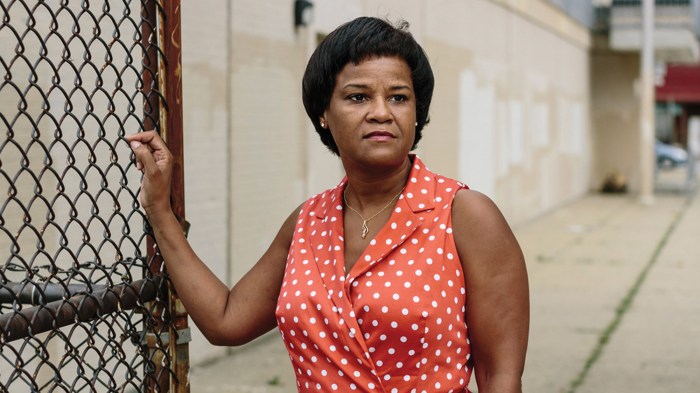
One spring morning this year, Darlene Lomax was driving to her father’s house in northwest Philadelphia. She took a right onto Germantown Avenue, one of the city’s oldest streets, and pulled up to Germantown High School, a stately brick-and-stone building. Empty whiskey bottles and candy cartons were piled around the benches in the school’s front yard. Posters of the mascot, a green and white bear, had browned and curled. In what was once the teachers’ parking lot, spindly weeds shot up through the concrete. Across the street, above the front door of the also-shuttered Robert Fulton Elementary School, a banner read, “Welcome, President Barack Obama, October 10, 2010.”

It had been almost three years since the Philadelphia school district closed Germantown High, and 35 years since Lomax was a student there. But the sight of the dead building, stretching over an entire city block, still pained her. She looked at her old classroom windows, tinted in greasy brown dust, and thought about Dr. Grabert, the philosophy teacher who pushed her to think critically and consider becoming the first in her family to go to college. She thought of Ms. Stoeckle, the English teacher, whose red-pen corrections and encouraging comments convinced her to enroll in a program for gifted students. Lomax remembers the predominantly black school—she had only one white and one Asian American classmate—as a rigorous place, with college preparatory honors courses and arts and sports programs. Ten years after taking Ms. Stoeckle’s class, Lomax had dropped by Germantown High to tell her that she was planning to become a teacher herself.
A historic Georgian Revival building, Germantown High opened its doors in 1915 as a vocational training ground for the industrial era, with the children of blue-collar European immigrants populating its classrooms. In the late 1950s, the district added a wing to provide capacity for the growing population of a rapidly integrating neighborhood.

By 1972, Lomax’s father, a factory worker, had saved up enough to move his family of eight from a two-bedroom apartment in one of the poorest parts of Philadelphia into a four-bedroom brick house in Germantown. Each month, Darlene and her younger sister would walk 15 blocks to the mortgage company’s gray stucco building, climb up to the second floor, and press a big envelope with money orders into the receptionist’s hand. The new house had a dining room and a living room, sparkling glass doorknobs, French doors that opened into a large sunroom, an herb garden, and a backyard with soft grass and big trees. Darlene and her father planted tomatoes and made salads with the sweet, juicy fruit every Friday, all summer long.

To the Lomax children, the fenceless backyard was ripe for exploration, and it funneled them right to the yards of their neighbors. One yard belonged to two sisters who worked as special-education teachers—the first black people Darlene had met who had college degrees. As Lomax got to know these sisters, she began to think that perhaps her philosophy teacher was right: She, too, could go to college and someday buy a house of her own with glass doorknobs and a garden. She graduated from Rosemont College in 1985, and after a stint as a social worker, she enrolled at Temple University and got her teaching credential.

In Philadelphia, the number of black teachers fell 18.5 percent between 2001 and 2012. In Chicago, it dropped 40 percent.

On February 19, 2013, Lomax was in the weekly faculty leadership meeting at Fairhill Elementary, a 126-year-old school in a historic Puerto Rican neighborhood of Philadelphia where she served as principal. A counselor was giving his report, but Lomax couldn’t hear what he said. She just stared at her computer screen, frozen, as she read a letter from the school superintendent. She read it again and again to make sure she understood what it said.

Then, slowly, she turned to Robert Harris, Fairhill’s special-education teacher for 20 years, and his wife, the counselor and gym teacher. “They are closing our school,” she said quietly. They all broke down weeping. Then they walked to the front of the building in silence and unlocked the doors to open the school for the day.

Five miles away, as Germantown High School prepared for its 100th anniversary, its principal was digesting the same letter. In all, 24 Philadelphia schools would be closed that year. These days, when Lomax visits her father in the house with the glass doorknobs, she drives by four shuttered school buildings, each with a “Property Available for Sale” sign.

Back when Lomax was a student in Philadelphia in the 1970s, local, state, and federal governments poured extra resources into these racially isolated schools—grand, elegant buildings that might look like palaces or city halls—to compensate for a long history of segregation. And they invested in the staff inside those schools, pushing to expand the teaching workforce and bring in more black and Latino teachers with roots in the community. Teaching was an essential path into the middle class, especially for African American women; it was also a nexus of organizing. During the civil rights movement, black educators were leaders in fighting for increased opportunity, including more equitable school funding and a greater voice for communities in running schools and districts.

But today, as buildings like Germantown High stand shuttered, these changes are slowly being rolled back. In Philadelphia and across the country, scores of schools have been closed, radically restructured, or replaced by charter schools. And in the process, the face of the teaching workforce has changed. In one of the most far-reaching consequences of the past decade’s wave of education reform, the nation has lost tens of thousands of experienced black teachers and principals.

According to the Albert Shanker Institute, which is funded in part by the American Federation of Teachers, the number of black educators has declined sharply in some of the largest urban school districts in the nation. In Philadelphia, the number of black teachers declined by 18.5 percent between 2001 and 2012. In Chicago, the black teacher population dropped by nearly 40 percent. And in New Orleans, there was a 62 percent drop in the number of black teachers.

Percentage Change in Teacher Population by Race and Ethnicity, 2002-2012
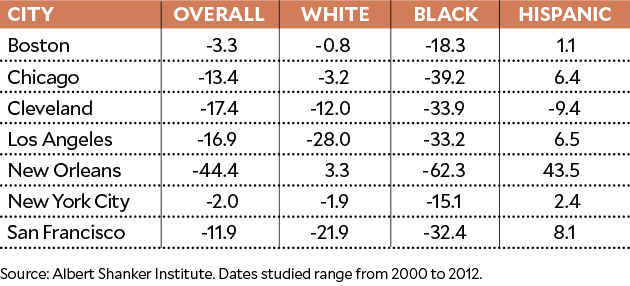
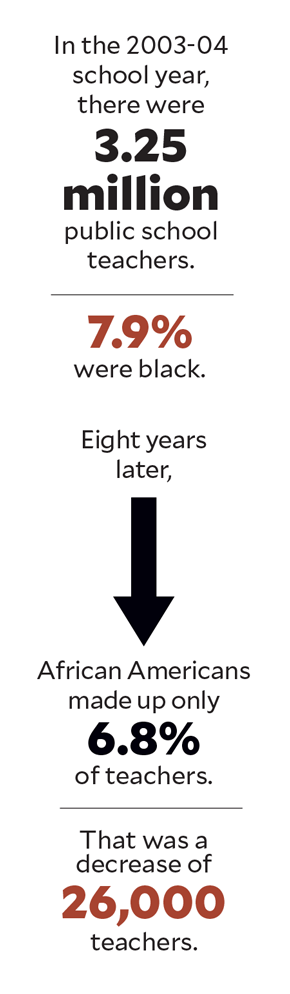
Many of these departures came as part of mass layoffs and closings in schools with low test scores, a policy promoted with federal and state dollars since 2002. In Chicago, 49 out of about 500 schools were closed in 2013, and in Washington, DC, 38 out of 111 schools have been shuttered since 2008. And since 2002, 140 out of roughly 1,800 New York City schools have closed. In each of the nine cities the Albert Shanker Institute studied, a higher percentage of black teachers were laid off or quit than Latino or white educators. Nationwide, according to the federal Department of Education, African Americans made up 6.8 percent of the teaching workforce in the 2011-12 school year, down from 8.3 percent in 1990. (Nearly 83 percent of the teaching workforce in 2011 was white, down slightly from 1990.)

In all, that means 26,000 African American teachers have disappeared from the nation’s public schools—even as the overall teaching workforce has increased by 134,000. Countless black principals, coaches, cafeteria workers, nurses, and counselors have also been displaced—all in the name of raising achievement among black students. While white Americans are slowly waking up to the issue of police harassment and violence in black communities, many are unaware of the quiet but broad damage the loss of African American educators inflicts on the same communities.

“You have to expel him,” said the teacher who marched into Darlene Lomax’s office, a small, windowless room in the back of Fairhill Elementary, one morning in 2011. She set a red Swiss Army knife on the dark brown linoleum desk, next to the pictures of Lomax’s children. The teacher had taken the knife from a fifth grader who was showing it to a classmate. “I never want to see him in my class again,” the teacher, who is white, told Lomax.

Soon afterward, Lomax sat down with the 12-year-old. He told her that on his way to school, an older and more popular boy had shown him the knife and chosen him to carry it for a few days. Lomax had known the student, who was African American, for two years. She knew he struggled academically and socially, that he yearned for ways to raise his status among peers.

After talking to the parents, Lomax decided that the boy, who hadn’t had any previous discipline problems, wasn’t a threat. She suspended him and filed a report with the district. The teacher, as Lomax recalls it, argued that the district’s code of conduct required expulsion for any student who brought a weapon to school, but Lomax told her, “We have to judge each case on its merits. My judgment and common sense tells me these rules don’t apply in this case.” She added, “This child made a mistake, but he deserves a second chance.”

Within the next two years, the student turned out to be one of the higher-achieving kids in the school.
It’s well documented that black students are disciplined and punished in school at a disproportionate rate. In a 2015 study, Adam Wright, a researcher at the University of California-Santa Barbara, identified a key factor in that disparity: White teachers are much more likely than black teachers to find behavior problems with black students. (This difference did not show up when teachers evaluated white or Latino students.) Wright estimated that if schools doubled the number of black teachers, the black-white suspension disparity would be cut in half.

Other research points in the same direction. A 2008 study by the London School of Economics found that white teachers graded black and Latino students more harshly for the same performance, accounting for as much as 22 percent of the achievement gap between white students and students of color. Earlier this year, Johns Hopkins researchers found that black teachers are much more likely than white teachers to think a black student will graduate from high school or get a college degree—especially if the kid is a black boy. A 2016 Vanderbilt study showed that black students are about half as likely as white students to be put on “gifted” tracks, even when they have comparable test scores—but the disparity was erased when black students were evaluated by black teachers.

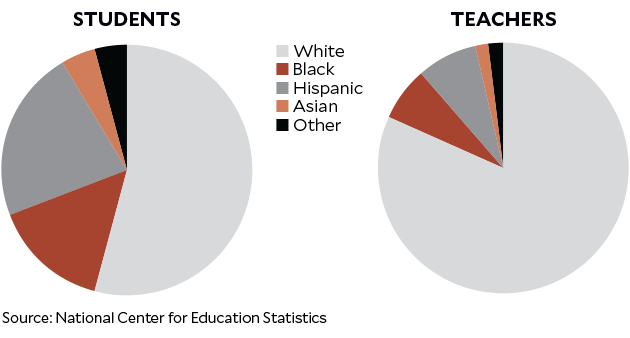
Yet, though 16 percent of America’s students are black, only 7 percent of teachers are. And even at the schools where black and Latino students are concentrated—71 percent of these students attend high-poverty, mostly urban schools—only 15 percent of teachers are black and 16 percent are Latino.

Like Darlene Lomax, Gloria Ladson-Billings grew up in Philadelphia. In the ’60s, she was a teacher there, and later a district coach working with new or struggling teachers. During that time, she remembers coming across many veteran educators who were successfully teaching kids of all backgrounds. By the early ’90s, Ladson-Billings had become an education researcher at Santa Clara University, at a time of growing concern in the field about how schools were failing children of color, especially African Americans. Ladson-Billings decided to document the teaching practices she’d seen—many of which were not in the standard education canon. She asked black parents in Philadelphia to identify teachers they considered most effective with their children and then spent two years observing those teachers in the classroom. She wrote about it in a book, The Dreamkeepers: Successful Teachers of African American Children.

Ladson-Billings noticed that instead of mentally sorting kids into “teachable” or “problem student” categories, as researchers have found many teachers do, these educators set a high bar for all students and then helped individual kids to meet it. And instead of a one-size-fits-all approach, they used different techniques with kids of varying skills and interests.

The successful teachers Ladson-Billings studied also created bonds that resemble family. That was what Lomax did when she first became an assistant principal: She invited parents, teachers, and students to come to school on a Friday evening with sleeping bags and blow-up mattresses. Teachers and parents set up a movie room in the library. Parents brought a potluck dinner, and kids, mothers, grandmothers, aunts, cousins, and teachers chatted into the wee hours. Lomax’s mother and two daughters spent the night too. “People just got to know each other better, and the overall climate of the school changed,” Lomax recalls.
Researchers like Ladson-Billings argue that teachers are more effective when they get to know their students’ backgrounds, including cultural rules for engagement and different ways of expressing knowledge. For example, instead of pushing children to stop using African American vernacular, they might encourage students to translate their favorite hip-hop lyrics into formal English—treating them as bilingual rather than as poor speakers.

Another habit of successful teachers, Ladson-Billings observed, was giving students agency and authority. When Lomax became a principal, she created “administration jobs” for students: They worked as counselors, nurses, teaching assistants, and security guards, and they used credits they earned to bid on computers, bicycles, and skateboards that Lomax would purchase with her own funds and donations. Students worked alongside the staff and advised Lomax and her colleagues on how to improve everything from lunch hour to after-school activities. The program helped build better relationships between students and staff, and it even reduced suspensions.

A focus on inclusion must go beyond classroom changes, Ladson-Billings argues, to school staffing (so students don’t see a workforce where, for example, teachers and administrators are mostly white and custodians and cafeteria workers are mostly black) and student opportunities—so that advanced classrooms aren’t dominated by white and Asian American students while remedial classes are filled with black and Latino kids. Ultimately, researchers have found, for schools to raise achievement, they have to push back against damaging racial prejudices in every aspect of what they do. Personal humiliation and discrimination are daily realities for most black students, they point out, but teachers can counteract this with inclusion, knowledge, and skills that help kids persevere.

Many of the historically segregated schools that successfully educated black students long before the civil rights era were focused on countering racial stereotypes and instilling pride, according to Theresa Perry, a professor of Africana studies and education at Simmons College. This crucial function was rolled back during desegregation, Perry writes, when researchers estimate thatnearly 40,000 black teachers and principals (close to half the African American teaching force) lost their jobs. This happened even though they often had more credentials and teaching experience than white educators, according to new research from Jim Crow’s Pink Slip, a forthcoming book by Leslie Fenwick, dean emerita of Howard University’s School of Education. In the South, in particular, the consolidation of black and white schools typically meant that white school boards and superintendents had more control than black principals over individual schools’ staffing.

Lomax knows from experience how just one teacher can encourage a student to use her voice and overcome challenges. After Lomax graduated from Germantown High in 1981, she enrolled at Rosemont College, a small liberal-arts school outside Philadelphia. Of roughly 600 students, fewer than 10 were black. All the professors were white.

During her first week at Rosemont, Lomax recalls, she was standing in line in the cafeteria when she overheard a white girl say to her friend, “I didn’t know they allowed niggers in here.”

“Who are they talking about like that?” Lomax thought to herself as she looked around. “I never heard racial epithets living in Germantown, and it took me a minute to realize: They are talking about me.”

Weeks later, one of her English professors asked her, “Where did you learn to write so well?” The professor added that black students didn’t usually know how to write research papers.

The person who helped Lomax persevere was another English professor she turned to, crying, one day after an insulting comment in the classroom. “What would you like to see changed?” the teacher said. Lomax replied that she wanted to recruit more black students and professors, and perhaps launch a black student union. The teacher, who was white, helped Lomax write a proposal that Lomax delivered to the dean herself. The number of black students at Rosemont increased over time, and Lomax told me the experience left her committed to becoming a teacher and helping make schools more inclusive.

It was a little before 10 a.m. on November 17, 1967, when about 200 students walked out of Germantown High, wearing the school’s green and white colors along with gold Black Power buttons, and started marching down Germantown Avenue. A few miles up the street they met up with other marchers, and by noon the crowd had swelled to more than 3,500 students and teachers from a dozen high schools, all marching toward the Board of Education building.

By then, the student body of Germantown High—once home to mostly white immigrant students—had become more than two-thirds black. Migration from the South had increased Philadelphia’s black population from 5 percent in 1910 to 34 percent in 1970. Many black families, like Lomax’s, had moved to Germantown and neighboring Mount Airy, the city’s only two integrated neighborhoods. Yet most teachers at Germantown were white, as were all the district administrators, and dropout rates were three times higher for black students than for whites.

Schools like Germantown High, historian Matthew J. Countryman writes in his book on the civil rights struggle in Philadelphia, Up South, offered a unique space for organizing because they blurred the class lines in the black community. “Corner kids,” nerds, cheerleaders, civil rights advocates, and black teachers came together to push for political power and economic opportunity.

When the student protesters reached the towering art deco Board of Education building, Superintendent Mark Shedd—a strong advocate of integration who had enrolled his own white children in majority-black schools in Germantown—invited a delegation of them into a room overlooking the crowd below. They presented their demands: black-studies classes, more black teachers and principals, a bigger voice for black parents in school governance, recognition of black student unions, and no more police officers in schools. After hours of negotiations, a student opened the window to yell to the marchers that the district had agreed to 24 of their 25 demands.

Following the march, the number of black teachers in Philadelphia’s public schools slowly increased. Gloria Ladson-Billings came home to Philadelphia the next year, after the district sent a recruiter to her college in an effort to attract more black teachers with community roots. She was first placed in a predominantly white school where, she recalls, some white parents told the principal they would not tolerate black teachers for their kids. The principal refused to transfer the kids—taking a stand that, Ladson-Billings recalls, was still controversial at the time.

Shedd created the first black-studies department in the district, called for black-history classes in all high schools (an order that wasn’t implemented until 2005), and hired black district administrators. It was a heady time, Ladson-Billings recalls, when teachers were treated as intellectuals rather than testing proctors following a script. “That environment doesn’t exist anymore,” she reflected.
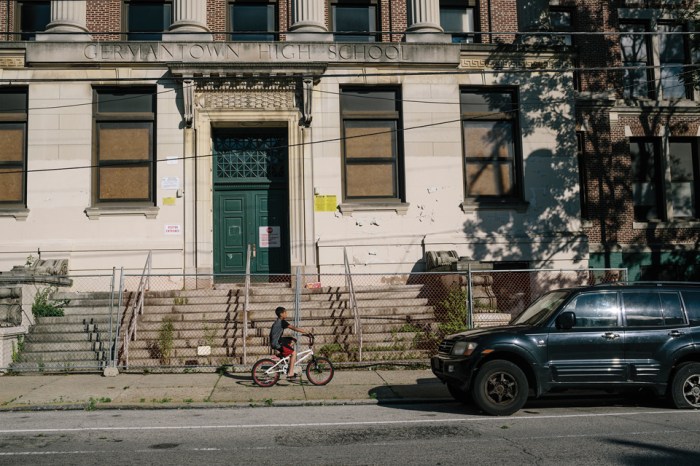
Germantown High School closed in 2013. Lexey Swall/Grain Images

Like many black educators, Ladson-Billings viewed teaching as a way to help her community. But the profession also served as a critical avenue into the middle class. In the ’50s, about half of all college-educated African Americans went into teaching—one of the few fields open to black professionals, especially women. And through the second half of the 20th century, public-sector jobs in education, social work, transportation, and the Postal Service formed the backbone of the black middle class. As Mary Pattillo, a professor of African American studies at Northwestern University, explains, affirmative action was applied most vigorously in the public sector, and to this day public jobs remain the single most important source of employment for black workers. (Not coinci­dentally, black workers have the highest percentage of union membership of any group.) The public sector employs a higher proportion of black workers in higher-paying jobs. And when public-sector jobs are shifted to the private sector, they typically result in longer, irregular hours and more unstable pay, reducing the assets of the black community, Pattillo explained.

Access to these middle-class jobs has a big ripple effect in black communities, Pattillo documents in her book Black Picket Fences, because African American professionals are more likely than other groups to also support family members and friends in poverty. One study in the ’90s found that black middle-class women reported a greater sense of responsibility for people outside their nuclear families than white middle-class women did. Black middle-class families are much more likely than white families to live near poor black families, and they are often key to supporting community institutions. And, research shows, black teachers contribute to communities in myriad crucial but less visible ways—as role models of college-educated professionals, resources for parents on how to navigate the school system and demand improvements from local politicians, and mentors for neighborhood kids long after the school day ends.

As Ladson-Billings left Philadelphia once more to pursue her Ph.D. at Stanford University in the early 1980s, the political winds were changing. Ronald Reagan had been elected president, and one of his first education policy initiatives was to commission a report on K-12 schools. Titled “A Nation at Risk: The Imperative for Educational Reform,” it documented a growing unease with public schools among the business community and blamed lagging student performance for America’s troubles in the global market. The report called for more data-driven teacher evaluations and an emphasis on standardized testing—postulating (though with scant evidence) that test scores in reading and math would predict workplace performance.

The ideas set forth in “A Nation at Risk” would prove deeply influential, inspiring reform efforts all the way to the 2001 No Child Left Behind Act, President Barack Obama’s Race to the Top initiative, and the Common Core guidelines now being rolled out. The policies influenced by the report—including mass layoffs in schools that fail to raise their scores fast enough—have had a disproportionate impact on large urban districts like Philadelphia where most black teachers work. These reforms also laid the groundwork for the explosion in charter schools, which have attracted a less diverse teaching corps in some large urban districts (though nationwide, charters employ more African American teachers than traditional schools).

And while this wave of reformers has emphasized reducing the “achievement gap” between white students and those of color, it did not push as hard for integration and equitable funding. As a result, urban school administrators found themselves increasingly chasing scarce state and federal dollars tied to standardized test scores. In 2014, the Center for American Progress found that students in urban elementary schools spent 75 percent more time on average taking district-mandated tests than their suburban counterparts did—in large part because the stakes for their schools were so high. Multiple-choice questions became a major part of the daily curriculum.
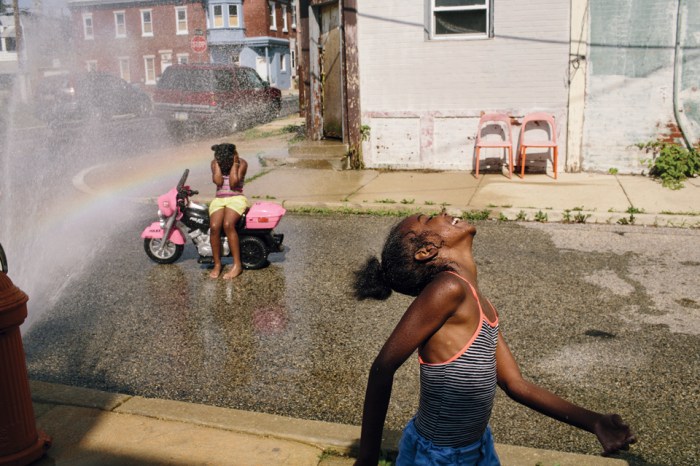
Children play near the shuttered Gen. John F. Reynolds School in Philadelphia. Lexey Swall/Grain Images

With public sentiment increasingly critical of schools and teachers, many states rolled back education funding. In 1992, Pennsylvania began to decrease its share of district funding in Philadelphia, ultimately prompting David Hornbeck, then the city’s superintendent of schools, to file a lawsuit arguing that the state had discriminated against students of color. The state’s Republican-controlled Legislature responded in 2001 by authorizing a state takeover of the Philadelphia schools and barring the city’s teachers from striking. Hornbeck resigned—because, he told NPR in 2013, lawmakers falsely assumed that the budget crisis was a result of waste and inefficiency, not chronic underfunding and segregation.

The state created a five-member School Reform Commission—three members were appointed by the governor and two by the mayor—to fix the schools. In 2010, Republican Tom Corbett became governor, bringing with him a political network full of private-sector reform advocates. He cut the state education budget by another $860 million, and the following year Philadelphia lost $105 million more in state funding, plus $200 million in federal dollars.

By the 2013-14 school year, the Philadelphia district had 3,885 fewer staff members—teachers, nurses, aides—than it had two years before.

To solve the budget crisis, the School Reform Commission hired the Boston Consulting Group, a private consultancy that advised the district to close 64 schools, continue expanding charters, and gut the central office. The group’s $2.6 million consulting fee was paid with private donations, including more than half from charter and voucher advocates.

By the 2013-14 school year, the Philadelphia district had 3,885 fewer staffmembers—teachers, nurses, counselors, secretaries, and aides—than it had at the end of 2011, a decrease of 16 percent. About 1,486 of these departed employees were teachers, and close to a quarter of them were black. Germantown High and Fairhill had to cut art, music, and physical education classes, and full-time nurses. Fairhill lost a nurse who had worked in the community for 20 years. “She was so important to our middle school students, going through a lot of physical and emotional changes, or some dealing with sexual abuse or parents’ drug addiction, all kinds of pain,” Lomax told me. “And she was just extraordinary in knowing when to intervene beyond her job duty.”

A few months before Germantown High’s closure, two seniors decided to make a video documenting the reactions of students and staff. They pointed their camera at Ismael Jimenez, who taught black history and lived in Germantown with his wife and children. In middle school, Jimenez had briefly attended a mostly white school in the suburbs, but after several racially charged incidents his parents moved him back to Philadelphia schools. He’d become a teacher, he said, to help black kids feel more at home in school. Jimenez was in the process of buying a house in Germantown and told me he had hoped to teach and live in the neighborhood for the rest of his life.

“How do you feel about the closing of Germantown?” a student asked.

“I think the closing of Germantown is a reflection of the overall destruction of public education that is occurring all over our nation in almost every inner city—from Detroit to Atlanta to Chicago to New Orleans,” Jimenez said before pausing to hold back tears.

The students turned off the camera and then turned it on again.

“The closing will affect the feeling of the community with such a large, empty building in the middle of the neighborhood,” Jimenez continued. “Parents might send their child to a charter school that may not produce better results, but on image, it looks better. And the parent says, ‘It doesn’t matter that kids around my way don’t have a local public school to go to as long as my child is okay.’ That individualism is destroying this community—and all communities—that once was the very foundation of what we needed to get by.”
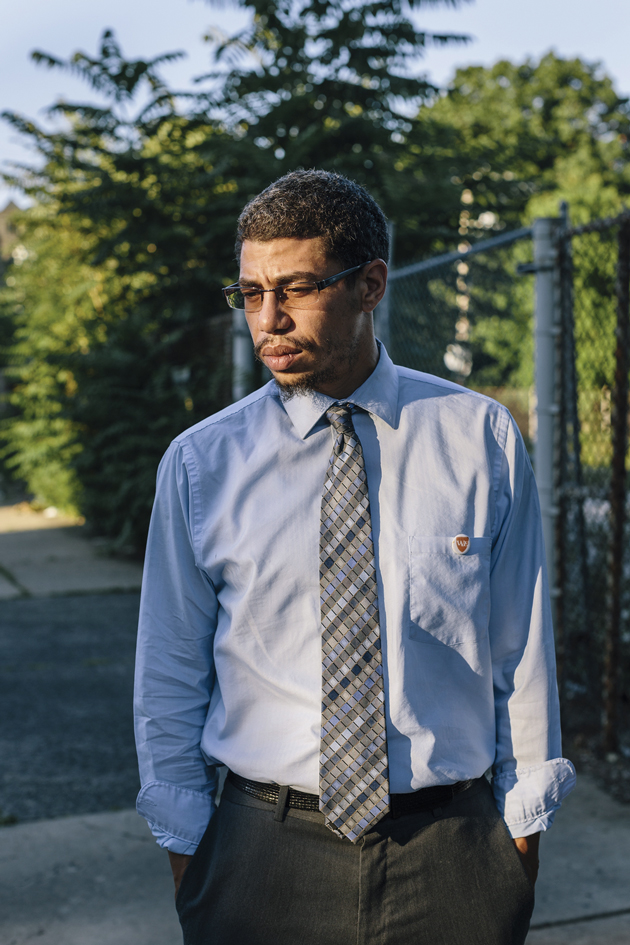
History teacher Ismael Jimenez was in the process of buying a house near Germantown High when it closed. He says he hoped to spend his life and career in the neighborhood. Lexey Swall/Grain Images

“There are so many layers to this pattern of destruction,” Robin Roberts, the parent of three children in Philadelphia’s public schools and a physical therapist for the district, told me. “Germantown is such a tight-knit, established community. There is old blood. Collected history. Gorgeous brownstones. And you rip that school out, leaving a huge open lot. No security. It’s dead energy, and it invites people and events that you have no control over. Property values of folks living there go down. When a community has a vibrant, living, interactive school, property values increase. Houses look better. All of these closures—it’s erasure of history of these established communities.”

For reform proponents like Philadelphia Superintendent William Hite, restructuring was the only possible way to close a $304 million budget hole decades in the making. And he wasn’t alone: Superintendents across the country have faced similar budget holes, exacerbated by the recession of 2008 and 2009. Between 2010 and 2015, federal aid to high-poverty schools shrank by11 percent. And in 2014, 31 states were still giving out less education funding per student than they had the year before the recession.

The Philadelphia School District spends less per student—$12,570 in all—than most of its big-city peers in the country, including Detroit, Baltimore, and Milwaukee. And until this year, Pennsylvania was one of three states that didn’t have a “weighted” formula to send extra funding for students who live in poverty, struggle in school, or are learning English. Meanwhile, child poverty rates in Philadelphia are some of the highest in the nation.

Hite is part of a cadre of superintendents in large urban districts—including Antwan Wilson in Oakland, California, and former Los Angeles schools chief John Deasy—who have been trained in an academy financed by the philanthropist Eli Broad, whose foundation in 2009 issued a handbook on how to “rightsize” school districts. Like other Broad-trained superintendents, Hite has closed traditional schools and expanded charters. “We are making these changes because we believe they will result in a system that better serves all students, families and stakeholders,” Hite wrote in his email to Lomax and other principals announcing the school closures.

“Closing schools is always hard, but we are making those decisions because there are no children in those schools,” Hite told me. “You can’t operate buildings that are designed for students when there are no students there. Given our fiscal challenges, we had to do everything within our control to ensure that we were impacting classrooms the least. You can’t operate an infrastructure designed for 200,000 students when you only have 137,000 students.” (In Philadelphia, the number of kids in traditional schools has shrunk by 50,000 since 2003, while enrollment in charters has gone up by 40,000.)

A former teacher and principal, Hite, who is black, grew up in Richmond, Virginia, and went to a school much like Germantown High. Such schools did enough to prepare students to make a living back in the ’70s, when manufacturing jobs were plentiful, Hite told Philadelphia magazine earlier this year. “Reading, writing and arithmetic—you may not have needed more than that to sweep floors in a tobacco warehouse. And it would pay you $18 an hour…Now those jobs aren’t available.”

In Hite’s view, the new economy requires schools that are much more rigorous, but the government doesn’t want to fund them. The answer, he and other reformers have argued, is a “portfolio model”: a menu of publicly and privately run schools, including charters that can attract private funding and are unconstrained by district and teachers’ union rules.

This is not an uncommon view: Even [ OUR COMMON GROUND  Voice] Derrick Bell, the legendary former NAACP lawyer who handled hundreds of desegregation cases in the ’60s, described charters as a promising alternative in his 2004 book, Silent Covenants: Brown v. Board of Education and the Unfulfilled Hopes for Racial Reform. Bell came across many nominally integrated districts where black and Latino students attended the same schools as whites but were placed into separate and less challenging classes. He viewed charter schools as one remedy for that, in addition to a continued push for integration and more equitable funding. Many black educators such as Geoffrey Canada, the founder of the Harlem Children’s Zone, opened charter schools as a way to break free from the constraints of the traditional school system.

But the way this push played out in Philadelphia and many other large urban districts wasn’t quite as these advocates had envisioned. First, when the state of Pennsylvania took over Philadelphia’s schools in 2002, it embarked on what was then the nation’s biggest experiment in private management of public schools: It contracted out 46 schools with low test scores to seven private for-profit and nonprofit organizations. Four years later, when this venture had failed to produce better results, the state ended the experiment and doubled down on the expansion of charter schools instead. Last year, 35 percent of kids in the city went to charter schools.

The growth of charters, though, put even more stress on the strained district budget. In Philadelphia, 30 percent of all charter students now come from outside the district, and while per-student public money follows them, the city has extra costs (such as transportation) that aren’t offset. Meanwhile, costs in traditional schools—building expenses, salaries for teachers and principals—don’t go away when a student leaves for a charter school. In all, the Boston Consulting Group estimated that each new student in a charter school creates as much as $7,000 in additional costs for the district.
But the challenges are more than financial. A growing number of educators argue that charters can’t replace what traditional schools provided, including a teaching corps with the experience and community connections to help students from every background. For one thing, charters tend to attract the students most equipped to succeed: One study found that students with severe needs—those who have been in foster care or involved with the juvenile justice system, or whose families are on welfare—are concentrated in traditional public schools in Philadelphia. Traditional schools also educate 10 percent more students living in poverty, 4 percent more English learners, and 2 percent more students with special needs. Some charter schools have even been found to practice “skimming”—illegally screening out potentially challenging students, including those with special needs, according to a 2013 Reuters investigation.

Hite argues that the concentration of students with special needs and those living in deep poverty requires schools to reorient what they do, adding that the savings from closing buildings helps the district do that. “Next year, for the first time all of our schools will have at least one counselor, no matter the size,” he told me. “They will have a school nurse. And we will be making a $440 million investment into neighborhood community schools with an attempt to address [poverty] factors.”

But many black parents and teachers in Philadelphia and elsewhere remain concerned that these changes don’t reverse the broader trend of underfunding at a time of growing need. And the increasing role of state government, and of the companies and foundations that have promoted private management and charter schools, represents to them an erosion of the civil rights movement’s gains in political power for black communities.
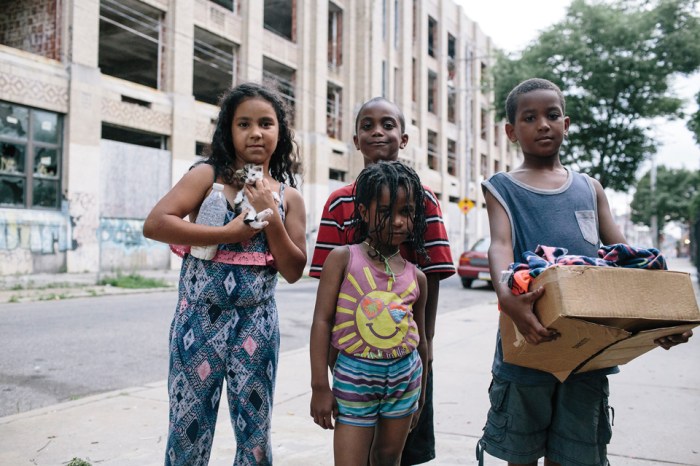
Fairhill Elementary, near Germantown Avenue, was one of the 24 schools that Philadelphia closed in 2013. Lexey Swall/Grain Images

“The current language of educational reform emphasizes racial ‘achievement gaps’ and ‘underperforming schools’ but also tends to approach education as if history had never happened,” author Jelani Cobb wrote in The New Yorker when the historic Jamaica High School in Queens, where he had been a student, was closed in 2014. Looking back at an era when busing students across neighborhood boundaries was the primary tool for integration, he noted, “Both busing and school closure recognize the educational obstacles that concentrated poverty creates. But busing recognized a combination of unjust history and policy as complicit in educational failure. In the ideology of school closure, though, the lines of responsibility—of blame, really—run inward. It’s not society that has failed, in this perspective. It’s the schools.”

Or, as Ladson-Billings writes in her book about successful teachers, “The way a problem is defined frames the universe of possible public actions.” When the problem of racial disparities in education is defined primarily in quantitative data like test scores, other factors—cultural pride, confidence, the presence of intellectual authority figures like teachers and principals in the community, the ecosystem of economically integrated neighborhoods, and access to political power—are often overlooked.

“Church used to be the center of the black community,” Roberts, the physical therapist in Philadelphia, told me, “but now as less people go to churches, school is the only remaining hub where the people in poor communities self-organize.

“We don’t want a Walmart to be the only place where we can come together. We want a public space that is run by the community.”

In May 2015, nearly 800 students, parents, and teachers came to a reunion in front of the shuttered Fairhill school building. Lomax was there—by then she had a job as a principal in another Philadelphia school, which had no administrators except for her and a secretary, and no full-time counselors or nurses or art, music, or physical education programs. Lomax spent an hour each morning filling in as a nurse, dispensing medications to dozens of students. She also doubled as a counselor and took care of administrative tasks that had been handled by assistant principals in her previous jobs. Meanwhile, more of her students were living in deep poverty. And even though she often worked late into the night, Lomax felt increasingly hopeless about her chances of succeeding in the new school.

During her 25 years in the district, Lomax felt that she’d earned the trust of her colleagues and developed relationships to get things done. But in recent years it had felt to her as if, even as her experience and skill grew, her power to control what happened in her work diminished. If test scores didn’t go up fast enough, her school closed or she was transferred to another one. After Fairhill, Lomax said, she was placed in a different school each year, with fewer and fewer resources to do the job. Eventually, she decided to leave—seven years before her official retirement date, even though that meant that her income and pension were cut by more than 50 percent. At 53, Lomax is now living off her savings and not certain if she will ever return to teaching.

“When I read that letter about Fairhill closing, I felt like someone shot me,” Lomax told me. “It’s very hard to explain just how much emotional energy it takes to improve a school. After six years of hard work together, I really felt like we were finally on the cusp of something great: Students were engaged, parents were volunteering more, teachers’ hearts were into it, and then it was shut down. I never want to go through something like this again.”

After Germantown High closed, Ismael Jimenez was unemployed for three months and then took a job in a local Afrocentric charter school. “The curriculum was very scripted, and I had to be more of a disciplinarian,” Jimenez told me. “I like to structure my classrooms around a dialogue.” The pay was lower and the hours were longer. He quit after six weeks, when he got an offer from another school.

Jimenez now drives across town to predominantly Latino Kensington High, a commute that leads him past shuttered Germantown High. Student projects and posters from the old school cover the walls in his new classroom. At Kensington, many more students live in deep poverty and have special needs, he told me. When the kids with the strongest financial or family resources leave for private or charter schools, he said, it becomes harder to teach.

Between 2001 and 2012, the share of black teachers in the district steadily declined—from 34 percent to 26 percent—and fewer new black teachers were hired, according to the Shanker Institute report. The institute also found that teachers who left the district were more senior than those who stayed. And while experience doesn’t guarantee success, research indicates that veteran teachers are more effective than rookies and key for coaching the next generation of educators.

Superintendent Hite told me his office has been focused on recruiting teachers of color since his arrival in 2012. Last year, 25 percent of teachers in Philadelphia public schools were black­—well above the national average, Hite points out.

Data compiled by Richard Ingersoll, a professor of education and sociology at the University of Pennsylvania, indicates that across the country, the turnover rate for white teachers has been relatively stable at 15 percent since the 2008-09 academic year. But the departure rate for black teachers has been increasing, from 19 percent in 2008 to 22 percent in 2013—a higher turnover rate than in any other demographic.

The biggest factors teachers of color cite for leaving, Ingersoll says, are micromanagement and lack of autonomy in the classroom. Policymakers often emphasize recruitment as a way to solve teacher shortages, he told me, but retention is a much bigger issue. From 1987 to 2011, the share of teachers of color grew from 12 percent nationwide to 17 percent (though the share of black teachers has decreased in recent years). But during the same period, turnover increased among all teachers of color. This revolving door makes it hard for students to form bonds, and for administrators to solve teacher shortages. At the beginning of the 2003-04 school year, about 47,600 educators of color entered teaching; the following year, 20 percent more—about 56,000—had left teaching. “We are pouring water into a bucket with holes in the bottom,” Ingersoll says.

“There is this myth out there that black teachers leave because of our kids,” Peggy Savage, an award-winning science and math teacher with 35 years of experience in Philadelphia schools, told me. “No, it’s the adults and the lack of voice and respect that push black teachers out. Before the School Reform Commission took over, I remember having conversations with our superintendent. We felt heard. Now, all we do is testify, but no one listens.”

“At every turn they are being told that they can’t do what they know in their spirit and heart and soul is the right thing to do.”

José Luis Vilson is a veteran math teacher in New York and the author of a book about his experience called This Is Not a Test: A New Narrative on Race, Class, and Education. “I would venture to say that the stereotype of the ‘failing’ teacher often conjures up black teachers who stick by the union rules,” Vilson says. “Whenever reformers go into communities of color, they often seek images of failure, and if a black teacher has been in this underserved ‘failing’ school for a few decades, they are viewed as a part of the problem.”

Chris Emdin, [ OUR COMMON GROUND  Voice]  an associate professor of education at Columbia University and the author of For White Folks Who Teach in the Hood…and the Rest of Y’all Too, told me that many black educators leave because they are forced to become the kind of teachers they resented when they went to urban schools. “They want to teach in urban spaces because they want to undo that damage that they’ve experienced,” Emdin, a former teacher, told me. “They say, ‘I hated school. I want to teach math, English, science in an engaging way.’ And the minute you try to be more creative, the principal says, ‘Nope. You gotta do more test prep. You gotta follow the curriculum.’ At every turn they are being told that they can’t do what they know in their spirit and heart and soul is the right thing to do. It’s causing teachers to leave, students to fail, and it’s making these schools factories of dysfunction.”

After leaving the school system, Lomax had to give up her apartment, about 30 miles from her father’s house, with its own glass doorknobs and small garden, and move into a cheaper place in New Jersey. Her daughter had to switch from a state university to a community college because Lomax could no longer afford to pay her tuition. “Our savings and assets are dwindling,” she told me earlier this year. “It will seriously impact our opportunities to provide for the next generation.”

Her daughter, she said, had been interested in becoming a special-education teacher. “She is a natural,” Lomax said. “But she won’t do it anymore after she saw what happened to me. She works at a nursing home now.”

KRISTINA RIZGA

Kristina Rizga is a senior reporter at Mother Jones. You can reach her at krizga@motherjones.com. Rizga covers education, focusing primarily on how school reforms affect students and teachers in the classrooms, and how policies create or reduce racial disparities in schools. She is the author ofMission High (Nation Books, 2015).

Mother Jones is a nonprofit, and stories like this are made possible by readers like you. or to help fund independent journalism.

Source: Black Teachers Matter | Mother Jones

Jesse Williams’ BET Awards 2016 Speech: Watch | Billboard


“Just because we’re magic doesn’t mean we’re not real. Thank you.”

Watch the full speech below:


“Let’s get a couple of things straight. The burden of the brutalized is not to comfort the bystander — that’s not our job so let’s stop with all that. If you have a critique for our resistance then you’d better have an established record, a critique of our oppression.“If you have no interest in equal rights for black people then do not make suggestions to those who do: sit down.“We’ve been floating this country on credit for centuries, and we’re done watching and waiting while this invention called whiteness uses and abuses us, burying black people out of sight and out of mind while extracting our culture, our dollars, our entertainment like oil — black gold! — ghettoizing and demeaning our creations and stealing them, gentrifying our genius and then trying us on like costumes before discarding our bodies like rinds of strange fruit.“Just because we’re magic doesn’t mean we’re not real. Thank you.”

  • Jesse Williams

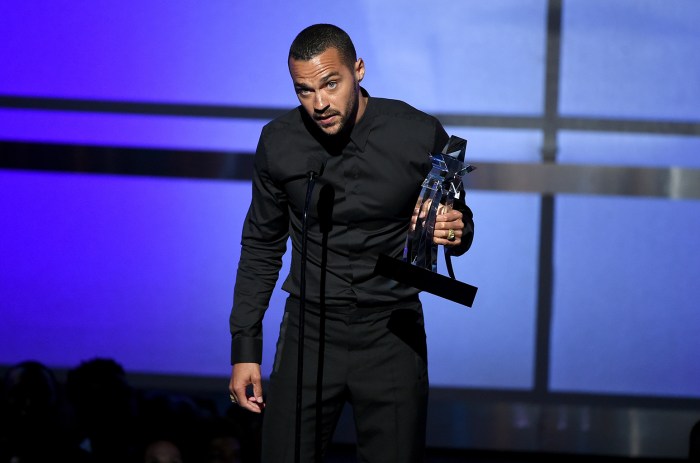
Jesse Williams accepts the Humanitarian Award onstage during the 2016 BET Awards at the Microsoft Theater on June 26, 2016 in Los Angeles.
KEVIN WINTER/BET/GETTY IMAGES FOR BET

It’s safe to say that 34-year-old Grey’s Anatomy star Jesse Williams stole the BET Awards on Sunday night with a wildly inspirational, confrontational speech that is bound to become a cornerstone of the Black Lives Matter movement. Later in the show, Samuel L. Jackson said he hadn’t heard a speech like it since the 1960s.

Williams has appeared in multiple films, but he was honored with BET’s Humanitarian Award for his activism. In October 2014, he joined protests in Ferguson, Missouri to protest the shooting of Michael Brown. He was also an actor and executive producer of Stay Woke, a documentary about the movement that premiered in May. He has written extensively on Black Lives Matter and met with President Obama earlier this year to discuss his humanitarian work.

Watch All the Prince Tributes at the 2016 BET Awards

BET CEO Debra Lee presented his award “for his continued efforts and steadfast commitment to furthering social change.”

He began by thanking BET and all involved in the video that preceded his appearance, his wife and his parents “for teaching me to focus on comprehension over career, they made sure I learned what the schools are afraid to teach us.

“This award is not for me,” he continued. “This is for the real organizers all over the country, the activist, the civil rights attorneys, the struggling parents, the families, the teachers, the students that are realizing that a system built to divide and impoverish and destroy us cannot stand if we do. It’s kinda basic mathematics: the more we learn about who we are and how we got here the more we will mobilize.

“This award is also for the black women in particular who have spent their lives nurturing everyone before themselves — we can and will do better for you.

Beyonce, Kendrick Lamar Open the 2016 BET Awards

“Now, what we’ve been doing is looking at the data and we know that police somehow manage to de-escalate, disarm and not kill white people every day. So what’s going to happen is we’re going to have equal rights and justice in our own country or we will restructure their function and ours. [Standing ovation.]

“I got more, y’all. Yesterday would have been young Tamir Rice’s 14th birthday so I don’t want to hear any more about how far we’ve come when paid public servants can pull a drive-by on a 12-year-old playing alone in a park in broad daylight, killing him on television, and then going home to make a sandwich.

“Tell Rekia Boyd how it’s so much better to live in 2012 than 1612 or 1712. Tell that to Eric Garner, Sandra Bland.

“The thing is though, all of us here are getting money, that alone isn’t going to stop this. Dedicating our lives to getting money just to give it right back to put someone’s brand on our body — when we spent centuries praying with brands on our bodies, and now we pray to get paid for brands on our bodies?

BET Awards Week: See All the Photos

“There has been no war that we have not fought and died on the front lines of. There is no job we haven’t done, there is no tax they haven’t levied against us, and we have paid all of them.

“But freedom is always conditional here. ‘You’re free!’ they keeping telling us. ‘But she would be alive if she hadn’t acted so… free.’ Now, freedom is always coming in the hereafter, but the hereafter is a hustle: We want it now.

“Let’s get a couple of things straight. The burden of the brutalized is not to comfort the bystander — that’s not our job so let’s stop with all that. If you have a critique for our resistance then you’d better have an established record, a critique of our oppression.

“If you have no interest in equal rights for black people then do not make suggestions to those who do: sit down.

“We’ve been floating this country on credit for centuries, and we’re done watching and waiting while this invention called whiteness uses and abuses us, burying black people out of sight and out of mind while extracting our culture, our dollars, our entertainment like oil — black gold! — ghettoizing and demeaning our creations and stealing them, gentrifying our genius and then trying us on like costumes before discarding our bodies like rinds of strange fruit.

“Just because we’re magic doesn’t mean we’re not real. Thank you.”

Watch the full speech  from the link below:

Source: Jesse Williams’ BET Awards 2016 Speech: Watch | Billboard

Angela Davis Talks Black Liberation, History and the Contemporary Vision – News & Views – EBONY

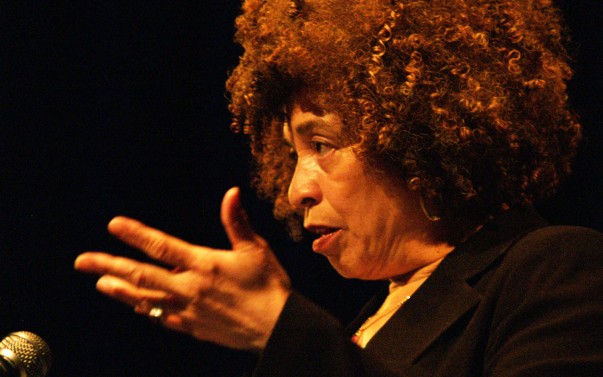
Angela Davis Talks Black Liberation, History and the Contemporary Vision[INTERVIEW] The iconic freedom struggle leader speaks with EBONY.com about Black human rights activism stretching back decades and her recently released book observing global movementsBY SHERYL HUGGINS SALOMON, FEBRUARY 17, 2016COMMENTSAngela Davis speaking at Myer Horowitz Theatre of the University of Alberta. Nick Wiebe/Wikimedia CommonsFifty years after the founding of the Black Panther Party for Self Defense, the agenda and style of the legendary Black revolutionary organization remains relevant in today’s public discourse. An end to “police brutality and the murder of Black people,” central to the Black Lives Matter movement, was laid out in the Black Panthers’ 10-Point Platform five decades ago. Both acclaim and condemnation erupted when their iconic black berets made an appearance recently in Beyoncé’s half-time show performance during the Super Bowl.It’s telling that America is still grappling with many of the same racial inequities and injustices that it did 50 years ago – and that Black pride remains a controversial topic. Not so to renowned scholar, activist and feminist icon and close associate of the Black Panthers Angela Y. Davis.“If one looks at the 10-point program of the Black Panther Party, one sees that the very same issues that were raised in the aftermath of slavery are at the center of a program that was formulated in 1966,” said Davis, now a professor emeritus at University of California, Santa Cruz. “In 2008 when Barack Obama was elected, those issues had not been sufficiently addressed, certainly not yet solved, so therefore the election of one person to political office was not going to automatically reverse a history of a racist inspired economic oppression, which isn’t to say that it wasn’t important that we elected Barack Obama, but those struggles continue.”While in Spain last week advocating for the release of imprisoned Basque separatist politician Arnaldo Otegi, Davis took a few moments with EBONY.com to discuss contemporary issues like Black Lives Matter, the 2016 U.S. presidential election, and details from her latest book, Freedom is a Constant Struggle: Ferguson, Palestine, and the Foundations of a Movement (Haymarket Books, 2016), edited by human rights activist Frank Barat.“I’ve been involved in the Palestine Solidarity movement for a very long time,” explained Davis. “When the Ferguson uprising happened a year and a half ago activists on the ground in occupied Palestine were the first to tweet support and advice to protesters in Ferguson. Out of that has come a very interesting, a very rich development of connections across the ocean. A delegation from Palestine visited Ferguson. Black Lives Matter and Ferguson activists, [as well as members of] Dream Defenders, Black Youth Project 100 made a trip to Palestine over about a year ago to express their solidarity.”  Related Articles CONNECTING PALESTINE AND POLICE VIOLENCE SIDRA SMITH ON ANGELA DAVIS DOC DIRECTOR TALKS ANGELA DAVIS DOCUMENTARYMore highlights of what Davis said are in the Q&A below.EBONY.COM: What’s the message of your new book?Angela Davis: I am particularly interested in [having] activists associated with the Black freedom movement to realize that our struggles never would have achieved this universality that they have achieved without solidarity that has come from Africa, Asia, Latin America, Europe and Australia. Our struggles are global, therefore, it is important for us to incorporate this global vision into our on the ground battles against police crimes and the prison industrial complex. Since I was very young I have been involved in organizations— the Communist Party, the Black Panther Party— that have had this global perspective.EBONY.COM: As you note in your book, events in Ferguson after the police shooting of Michael Brown exposed the militarization of police forces. Where is this push toward militarization headed and how can it be stopped?Davis: If one looks at the history of policing, especially over the last 15 years in the aftermath of 9/11, one can see the emphasis on the shifting of resources from the military to the police. This actually has a much longer history if one looks at the way in which the Vietnam War resulted in an impact on local police. The S.W.A.T. squads emerged as a result of using techniques and technology that were used by the Green Berets in the Vietnam War. The Los Angeles Police Department was the first to use such tactics against the Black Panther Party. We have also seen the emergence of privatized policing corporations. In the book, I refer to G4S (Group 4 Security), which is a private security corporation that has spread policing and prisons all over the world. It’s important not only to look at the ways in which these moments of inflicting terror have been taken up by police departments, but it’s also essential to look at the economic dimension by such processes. G4S, of course, is the thir

Source: Angela Davis Talks Black Liberation, History and the Contemporary Vision – News & Views – EBONY

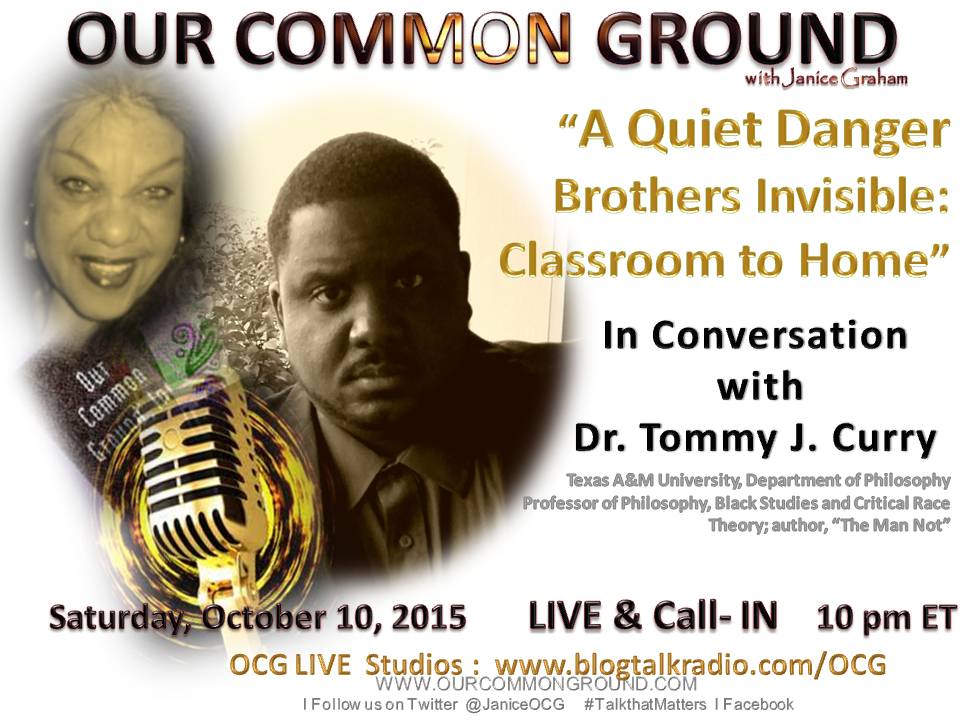
OCG This Week :: “A Quiet Danger Brothers Invisible: Classroom to Home” :: In Conversation with Dr. Tommy J. Curry

OUR COMMON GROUND
Saturday, October 10, 2015
In Conversation with Dr. Tommy J. Curry
“A Quiet Danger Brothers Invisible: Classroom to Home”

10-10 Curry“In short, although masculinity may be a part of being a man, it is not the foundation on which manhood rests.”

LISTEN LIVE and Join the OPEN Chat: http://bit.ly/1QeL6hT

http://www.blogtalkradio/OCG
Call In – Listen Line: 347-838-9852


about Dr. Tommy J. Curry
Dr. Curry is an Associate Professor of Philosophy at Texas A&M University. He is a Ray A. Rothrock Fellow 13′-16′ in the Department of Philosophy.  He is an editor of PhilPapers, Choice Magazine and a regular contributor to RacismReview.com and OUR COMMON GROUND.

Over the last several years, Dr. Curry has published over three dozen articles in prestigious venues like: The Journal of Black Studies, The Radical Philosophy Review, The Pluralist and The Transactions of the Charles S. Pierce Society. He is the editor of a forthcoming re-publication of William H. Ferris’s The African Abroad, and is currently working on several manuscripts: the first full-length publication on Derrick Bell’s political philosophy that birthed the Critical Race Theory movement entitled Illuminated in Black; a philosophical exploration of Black male death and dying entitled “The Man-Not;” and a book on Josiah Royce’s racism.

His work in social justice, applied ethics, and bioethics concerns the present interpretation of the Belmont report, and the racial/class barriers to minority access to medical innovation in health care.

He has been interviewed by Forbes.com, the Wall Street Journal,Salon.com and other popular venues for his opinions on politics, ethics, and racial justice issues.

 Episode Notes
“So we have hypothesized since 1978, that Black manhood is different than the concept of masculinity, in 1992, several studies decided to test this notion. Guess what they found:

Historically, the images of Black manhood have been unidimensional, and research has tended to focus on the inadequacies of Afro-American males’ role performance. In this preliminary analysis, we explored the cultural constructions of manhood as defined by Afro-American men at various social locations (age, occupation, income, and marital and family status). Manhood was defined in terms of the self (self-determinism and accountability, pride), family (family), the human community, and existential ideology (spirituality and humanism). It is our view that issues of self-determinism and accountability (i.e., directedness, maturity, economic viability, free will, and perseverance) are at the core of the self and of manhood and form the foundation on which family role enactment, pride, and living through one’s existential philosophy (e.g., spiritual, Afrocentric, and humanistic) are based. Interestingly, discussions of masculinity were absent from men’s definitions of manhood. Perhaps this reflects an awareness of the differences between the physical sexual man and the social man that Hare and Hare (1985) suggest is critical in Black boys’ transition into manhood. When respondents were asked to rate attributes related to masculinity (e.g., physically strong, competitive,masculine, and aggressive), they saw it as somewhat important. In short, although masculinity may be a part of being a man, it is not the foundation on which manhood rests.”      Andrea Hunter and James E. Davis-1992

On this broadcast, we begin with the recently released report by the Schotts Foundation for Public Education, “Black Lives Matter”
We recommend that you either review or read it prior to the broadcast.http://blackboysreport.org/

“It seems that America has tolerated and grown accustomed to the under-education of African American males largely because it has written this off as a “black problem.” Rather than being embraced as an American problem and challenge, our leaders in politics, business and education, have implored the Black community to do something, while washing their hands of responsibility for the failure of the public institutions that should serve them. . . .
The consequences have also been evident in the high rates of unemployment in economically depressed, socially marginalized neighborhoods, cities and towns where desperation festers and crime and violence are rampant.

The consequences have also been felt by families and communities where fatherless children fall prey to a vicious cycle of failure in part because they lack access to fathers because they are incarcerated, or don’t have the skills to obtain a job to support their family.” – Pedro A. Noguera, Professor of Education
Executive Director, Metropolitan Center
New York University – See more at: http://blackboysreport.org/national-summary/afterword-by-pedro-a-noguera/#sthash.GKiVJMsm.dpuf

You are invited to bring your thoughts about the pressing issues facing our community. SHARE please


Listen & Call In Line: 347-838-9852
Saturday, September 10, 2015 10 pm ET


BROADCASTING BOLD BRAVE & BLACK


Web: https://ourcommongroundtalk.wordpress.com/
Community Forum:
http://www.ourcommonground-talk.ning.com/
Twitter: @JaniceOCG #TalkthatMatters
Pinterest : http://www.pinterest.com/ocgmedia/boards/
Visit our Tumblr Page: http://ourcommonground.tumblr.com/
Facebook: https://www.facebook.com/OCGTALKRADIO

“Speaking Truth to Power and OURselves”

email: OCGinfo@ourcommonground.com

OCG war

Who are Black Americans? A Primer for Educators φ Ivory A. Toldson, Editor in Chief, The Journal of Negro Education

wegeonocideWho are Black Americans? A Primer for Educators

By: Ivory A. Toldson 

Persons of Black African ancestry live as citizens, foreign nationals, and indigenous populations on every continent as a result of immigration, colonialism and slave trading. Today, most Black people in the Americas are the progeny of victims of the transatlantic slave trade. From 1619 to 1863, millions of Africans were involuntarily relocated from various regions of West Africa to newly established European colonies in the Americas. Many different African ethnic groups, including the Congo, Yoruba, Wolof, and Ibo, were casualties of the transatlantic slave trade. The Black American population is the aggregate of these groups, consolidated into one race, bound by a common struggle against racial oppression and distinguished by cultural dualism.

Importantly, the historic legacy of Black people in the Western Hemisphere is not limited to slavery. The Olmec heads found along the Mexican Gulf Coast is evidence of African colonies in the Americas centuries before Columbus arrived in the Caribbean. Black people were also responsible for establishing the world’s first free Black republic, and only the second independent nation in the Western Hemisphere, with the Haitian Revolution. In the United States, almost 500,000 African Americans were free prior to the Civil War and were immensely instrumental in shaping U.S. policy throughout abolition and beyond. Post-Civil War, African Americans influenced U.S. arts, agriculture, foods, textile, language, and invented technological necessities such as the traffic light and elevators, and parts necessary to build the automobile and personal computer. All of these contributions were necessary for the U.S. to become a world power by the 20th Century.

Racism and oppression are forces that have shaped the experiences and development of Black people worldwide. Although European colonialists initially enslaved Black people because of their agricultural expertise and genetic resistance to diseases, they used racist propaganda to justify their inhumane practices. During periods of slavery and the “Scramble for Africa,” European institutions used pseudoscience and religion (e.g. the Hamitic myth) to dehumanize Black people. The vestiges of racism and oppression survived centuries after propaganda campaigns ended and influence all human interactions today.

Today, racism is perpetuated most profoundly through the educational system. Black students are taught to revere historians, such as Columbus, who nearly committed genocide against the native population of the Dominican Republic; and Woodrow Wilson who openly praised the Ku Klux Klan. Although many of these facts are not well known and purposefully disguised in history texts, children often leave traditional elementary and secondary education with the sense that aside from a few isolated figures (e.g. Martin Luther King and Harriet Tubman) Black people had a relatively small role in the development of modern nations.

Survey data often indicate that African Americans have the highest incidence and mortality of any given mental or physical disorder, are more deeply impacted by social ills, and generally have the lowest economic standing. While some of the data are accurately presented, rationales are usually baseless and findings typically lack a sociohistorical context. In addition, studies on African Americans unfairly draw social comparisons to the social groups that historically benefited from their oppression.

Historical distortions accompanying dismal statistics have resulted in many educators and counselors perpetually using a deficit model when working with Black students. The deficit model focuses on problems, without exploring sociohistorical factors or institutional procedures. Persons of Black African ancestry have a distinguished history, are immeasurably resilient, and have developed sophisticated coping mechanisms throughout centuries of oppression. Appreciating and celebrating a Black people’s legacy, contextualizing problems, and building on strengths instead of focusing on deficits are universally appreciated counseling strategies, which merit greater prudence when working with Black children.

IVORY TOLDSON  is the Deputy Director of  White House Initiative on Historically Black Colleges; Universities; Associate Professor at Howard University and Editor in Chief of The Journal of Negro Education

The Lies We Tell Black Boys and the Truth They Deserve to Hear φ CHRISTOPHER “FLOOD THE DRUMMER®” NORRIS

The Lies We Tell Black Boys and the Truth They Deserve to Hear

black boys-AfroDad-flickr

We need to stop teaching our black boys how to survive in a world not designed for them, and instead show them how to design a world that will allow them to thrive as individuals.

I never realized how hard it was to get people to view black men and boys as assets until I asked them to actually do it. In countless conversation I’ve had with peers about black male achievement—from philanthropy to politics, to the environment and education—the question has always been: “how do we help black boys achieve?” and not: “how do we leverage the value and agency of black men and boys who are already achieving to inspire others and transform the spaces they live, work and play?”

In my opinion, the reason the latter doesn’t gets asked as often as it should is because most people believe that black men and boys are problems that need to be solved; a disease that needs to be cured. Decision and media makers pretend the answer is as easy as getting the “thugs” to pull up their pants and not tattoo their faces.

Well-intentioned teachers and mentors often express that if black boys wear suits, ties, and carry books instead of bullets, that the probability of being accepted by, and achieving in, the “real world” will increase dramatically. Parents of black boys—just wanting them to come home in one piece—indoctrinate them religiously with the “do’s and don’ts of being black in public.”

And all the while, during of all these lectures, the black boys who we want to grow into proud black men are slowly but surely feeling humanity slip right out of their finger tips. With a skewed perception of their self-worth, chances are those black boys grow into insecure black men who feel the need to measure their accomplishments and assets to their white-counterparts, ultimately seeking validation outside their race before accepting what makes them unique.

What we should be telling black boys, and more importantly, what they deserve to hear is that the “real-world” is f*cked up and is filled with sick people who will hate them regardless of whether or not they are wearing a hoodie or a Brooks Brothers suit. They need to hear that the problem is the world and not them; that they exist to improve the world, not succumb to its bullsh*t. Black boys deserve to know that their elders will fight for their right to walk or run down a street of their choosing—regardless of their clothing—without the fear of being intimidated by a police officer who doesn’t view them as a human being.

We need to stop teaching our black boys how to survive in a world not designed for them, and instead show them how to design a world that will allow them to thrive as individuals. We need stop preaching respectability politics and tell our black boys what they deserve to hear, which is the sky is not the limit, it’s the starting point.

CLICK HERE to pledge to see the good in black men and share their stories so that others may do the same. 

– See more at: http://goodmenproject.com/featured-content/the-lies-we-tell-black-boys-and-the-truth-they-deserve-to-hear-cnorris/#sthash.XZqFn3xn.1C2M93Pi.dpuf


Thanks for reading. Until next time, I’m Flood the Drummer® & I’m Drumming for JUSTICE!™ DOWNLOAD NOW: The Black His-Story Book: A Collection of Narratives from Black Male Mentors, presented in part by GoodMenProject.com.  – See more at: http://goodmenproject.com/featured-content/the-lies-we-tell-black-boys-and-the-truth-they-deserve-to-hear-cnorris/#sthash.XZqFn3xn.1C2M93Pi.dpuf

Talking about white Privilege is not Profound, its just for profit. φ Dr. Tommy J. Curry

curryvoicesTalking about white Privilege is not Profound, its just for profit.

By: Dr. Tommy J. Curry

There is a growing economy for discussions about white privilege in this country that are employing Black and brown intellectuals and whites who profess anti-racism, to be the missionaries that save white souls. white privilege, or the idea that white individuals are born with unearned benefits and advantages, over others has been making its way through out the public media as well as the classroom. On the face of it, this seems like a radical conversation. Black, brown and some white people calling out white liberals and conservatives for their racism, and starting “real” conversations about race that air on MsNBC,CNN and even the Huffington Post. But conversations about white privilege are not really conversations about race, and certainly not about racism—its a business—WHERE BLACKS MARKET THEMSELVES AS RACIAL THERAPISTS.

See the first discussions of white privilege like W.E.B. DuBois’s Black Reconstruction (1935) or George Lipsitz’s The Possessive Investment in whiteness, or even Cheryl Harris’s “whiteness as property,” came from the radical Black intellectual tradition (race-crits, Black nationalists, Pan-Africanists) that did not believe that whites would simply donate their power and act against their global racial interests to be good people IN THE EYES OF BLACKS, people they owned and still imprison. DuBois, and Lipsitz understood there is an antipathy and power in being against Blacks. Like George Jackson said, regarding the ILLUSION many Black academics have in romanticizing their ability to solve racism, “the white race, the economic elites of America, are not going to let themselves be educated out of existence. But today, you sound radical, progressive and insightful by MARKETING YOURSELF as a therapist for whites, and know nothing about the actual conditions, structures, and ills that concretely affect the lives of Blacks. You can even talk about white privilege and not even know the names of the Black thinkers, the literature, the context, or the history the term comes from, and get acclaim for only citing white celebrities like Peggy McIntosh or Tim Wise.

It’s not genius to say in an oppressive society there are benefits being in the superior class instead of the inferior class. That’s true in any hierarchy, being on the top is better than being on the bottom, but the speaker of white privilege gets to pretend that America is not oppressive, they love America, they just want whites to surrender their privilege so we can be equal. See the revolutionary doesn’t have white friends: the government killed MLK, Assata is called a terrorist, Derrick Bell is erased from a field he started, because they spoke about the actual racial and economic tyranny of corporations, governments, the military and the white public, but the for profit revolutionary wants to be commodified by whites…that Black friend that feels like they cured the racist white, while that same white person gets to point to these very relationships as proof they are healed and show to other whites they are the “white ally.”

Conversations about white privilege are simply moral appeals to the conscience of whites who have shown themselves to be committed to racism and social inequity IN THE IDLE HOPE THAT THEY change their mind. The implication of talking about privilege suffers from a childlike naiveity, it suggests that simply exposing racism and the privilege of whiteness to the white mind motivates whites to no longer act in their own self interest. See like the liberal utopia born out of integration, there is an unjustifiable assumption that telling whites about their social position means they are willing to surrender their power to appease a pop culture account of oppression. Think about the dishonesty of this approach. Black people, oppressed people, know there is a fundamental difference between being oppressed/Black and not oppressed, a citizen, white. We call for “national conversations on race,” where these public intellectuals get credit for starting conversations that amount to little more than allowing white America the opportunity to deny the actual realities Black America suffer from. And regardless of the outcome they come out LOOKING LIKE PROPHETS. This issue is white supremacy, and anti-Black death…trying discussing that…and see if your oppressor recognizes you then.

I remember at a recent APA I sat next to a feminist of color trying to get her white male student who couldn’t get a job in the white figures he studied and wrote a book on, and never studied race, racism, or Black philosophy, a job. This professor felt comfortable telling him if you start talking about white privilege, where she claimed the field was going, he could land a race job easily. Think about this. So all the Black, Brown, and Indigenous scholars who study the raw histories of oppression and resistance lose out because they don’t want to give white liberals and conservatives a guilt trip. This is a powerful example of how as an academic discussion white privilege distracts the oppressed, and empowers the oppressor class to be employed in discussing systems they have no real interest in dismantling.

Dr. Tommy J. Curry, The Nationist

9-14-13 Curry4


Race-Blind Admissions Are Affirmative Action for Whites

Race-Blind Admissions Are Affirmative Action for Whites

EDMUND ZAGORIN

APRIL 21, 2014

In 1994, University of Michigan rejected Jennifer Gratz, setting in motion the overturning of state’s affirmative-action policy. Now, she’s challenging a black student who’s protesting her own rejection.

Brooke Kimbrough always dreamed of becoming a University of Michigan Wolverine. Her score on the ACT—a college-readiness test—dwarfs the scores of most of her classmates. Earlier this month, she was part of a winning team at the National Urban League Debate Championship in Washington, D.C. Last week, she became a powerful symbol for exactly how Michigan’s race-blind college admissions policies have failed.

In December, the University of Michigan informed Kimbrough that her application for admission had been wait-listed. Two months later, she received the letter that she had not been accepted. But instead of conceding defeat, Kimbrough decided to fight. Today she hopes that her story will highlight how Michigan’s current approach to race in admissions fails exceptional students of color. Black students comprise just 4.6 percent of the 2012 freshman class; in 2008, the number was 6.8 percent.

Over the course of this year, I had the honor of working with University Preparatory Academy debate coach Sharon Hopkins, who guided Kimbrough and her partner, Rayvon Dean, to victory. Shortly after her team won the debate championship, I spoke with Kimbrough about her protest of the University of Michigan’s admission policy.

“This isn’t about me,” Kimbrough said. “That’s not why I’m doing this. The real problem is when students are denied and don’t speak up, don’t question the system that failed them.” To that end, Kimbrough has joined with the Coalition to Defend Affirmative Action, Integration, and Immigrant Rights and Fight for Equality By Any Means Necessary (BAMN) to advocate for the rights of black students in admissions and on campus.

Nearly 15 years ago, Jennifer Gratz, a white high-school senior, was denied admission to the University of Michigan. Rather than keeping quiet, she also fought. Gratz began by mounting a coordinated legal and media battle to challenge her rejection. In 2003, the Supreme Court ruled in her favor, and its decision in Gratz v. Bollinger ended the university’s system of preferential admission based on race. Encouraged by this victory, Gratz and other opponents of affirmative action went on to champion a statewide ballot initiative that completely banned any use of race as a criteria for admissions at Michigan’s public universities.

At the University of Michigan, the years following the high court’s decision have seen a precipitous drop in the number of African-American students. For Kimbrough, who uses discussions of racial privilege and cultural politics in her debate competitions, her rejection from Michigan became an opportunity to highlight a concrete instance of colorblind discrimination.

While both Gratz and Kimbrough fought their decisions, Jennifer Gratz bristles at comparisons. “I fought for all applicants to be treated equally—as individuals, without regard to race,” Gratz said in a comment on the Detroit News website. “This woman is standing up for group rights and asking for preferential treatment based on race while others are discriminated against, she wants unequal treatment. Ms. Kimbrough is fighting because she wasn’t accepted; I fought because of discrimination in the admissions process, a major difference.”

What critics of affirmative action like Gratz don’t talk about, and what they aredeeply invested in keeping hidden, is the racial violence and culture of white aggression that intensifies and pervades campus life for students of color when affirmative action policies are taken away. This dirty secret was blown apart earlier this year when University of Michigan’s Black Student Union decided that they’d had enough, launching the viral Twitter campaign known as #BBUM (Being Black at U-M). Stories ranged from hurtful micro-aggressions to racial slurs to threats of physical violence. Overall #BBUM highlighted the dysphoria of a campus population of color whose number is in steep decline.

But so incensed is Gratz, 37, that she has challenged Kimbrough, 17, to a public debate on the issue of affirmative action, according to the Detroit Free Press. In an apparent attempt to appear gracious, Gratz, citing her potential opponent’s youth and inexperience, offered to allow Kimbrough to include a BAMN representative on her side of the debate.

The attitude expressed by Gratz betrays a seemingly willful obliviousness to the fact that no group experiences more affirmative action than white people. Michigan’s formal pro-white affirmative action policy, colloquially known as “legacy preference,” puts the children of alumni ahead of other applicants. It unquestionably favors the white and the wealthy, at the expense of the poor and the black. Outside of the U.S., legacy admissions mostly went the way of feudalism. But at many U.S. universities, and especially at Michigan, legacy admissions amount to an eternal parade of white pride.

Why does legacy preference work this way? Because it reinforces the demographic power of previous generations of whites that benefited from dozens of explicitly segregationist federal and state institutions. Those institutions, from the New Deal to the G.I. Bill, helped whites out of Depression-era poverty while explicitly disadvantaging blacks, locking whole communities into cycles of violence and misery. “When I think about the fact that my grandmother’s grandmother was a slave baby—like, literally owned as property—and then I hear people talk about how whites don’t experience affirmative action from legacy, it’s so frustrating,” Kimbrough said. “People want to put that behind them. They’d prefer not to think about it. The thing is that black people can’t put that history behind us because we live it every day.”

And legacy doesn’t even scratch the surface of the biggest instrument of racial discrimination in so-called “race-blind” university admissions: standardized testing.Most scholars of education policy agree that the ACT testing process, like the SAT, favors wealthy white students from suburban environments at the expense of students who are poor black and urban. This favoritism is often deemed a “necessary evil” of education policy, done in the service of meritocratic apples-to-apples comparisons of students’ analytical skills. There are many reasons for performance disparities, from cultural assumptions of the test writers to unequal access to prep materials and tutors.

“We don’t have time to prep for the ACT the way some students do,” Kimbrough explains. “I come from a single-parent household. We worry about keeping the lights on and food on the table. Even though I want to go to college, people have to understand that the ACT isn’t a priority. Michigan talks about ‘holistic’ admissions. I wonder what’s so holistic about it.” Standardized testing is literally the example given in sociological texts to define the term “institutional racism”.

It must be nice to live in the world of Jennifer Gratz. It is a world in which America somehow happened without colonialism or slavery, where we are born into bodies in which race is invisible (which is how the concept of race generally functions for members of the white majority). In Gratz’s worldview, disparities in wealth and access to public goods have no bearing on the measure of that mystical quotient of “ability”.

“Public universities are supposed to represent us,” says Kimbrough. “Blacks and Latinos are 14 percent of the population, and yet our public universities can’t represent us. We pay taxes for that university to stand as tall as it does. It’s sad.”

The American Prospect

OUR COMMON GROUND Kwanzaa 2013 -14

KWANZAA

Kwanzaa (kwahn-ZAH) is an annual cultural observance, which is recognized by Black people from December 26 thru January 1, each year:

  • Kwanzaa is non-political.
  • Kwanzaa is non-religious.
  • Kwanzaa is not related to Christmas.*

* Annual Kwanzaa observances begin on December 26th, each year] 

2013 Kwanzaa banner

This year’s OUR COMMON GROUND KWANZAA message comes from our Brother, Friend and Comrade,OUR COMMON GROUND Voice, Dr. Ron Daniels.

The Nguzo Saba contains the core concepts and values of Kawaida and the foundation for Kwanzaa.  In a recent article, First Call for State of the Black World Conference III, I suggested that a spiritual and cultural revival is essential to combat and overcome the devastating State of Emergency afflicting the “dark ghettos” in Black America.  As we begin the celebration of Kwanzaa, it might be useful to restate the N’guzo Saba and discuss its relevance to healing our families and communities in a time of crisis.  So, I offer these reflections.

Dr. Ron Daniels, Founder and Director, IBW 21

Ron Daniels

The first Principle in the Nguzo Saba is Umoja/Unity. That Africans in America should be unified or act in concert to confront the State of Emergency should be self evident.  However, achieving Black unity can be challenging and illusive. In the name of pursuing the interests of Black people, what we have in the Black community is a myriad of leaders and organizations that all too often compete rather than cooperate with each other.  Moreover, various leaders and organizations have different ideologies and strategies for achieving full freedom/liberation. There is also a “class divide” between the more affluent sisters and brothers who have benefited from the “movement” and moved up in the world and the dispossessed left behind in abandoned and devastated “dark ghettos,” the “hood.”  Overcoming disunity  requires a conscious effort to create “united front” structures which bring people together despite their differences in philosophy and approach.  Dr. Karenga has advocated “operational unity” as a concept to enable leaders and organizations with differing philosophies and approaches to work together.  Operational unity means focusing on issues and areas where there is agreement among organizations and leaders rather than disagreement.  Dr. Karenga calls this “unity without uniformity.” With so many problems/issues affecting the Black community, the goal of operational unity is to have leaders and organizations collaborate/act collectively around specific issues, projects and initiatives they agree on.

Unity in the Black community requires bridging the class divide.  Brothers and sisters who have seized on a pathway to the middle and upper class paved by the blood and sacrifice of heroes and sheroes of the Black freedom struggle have an obligation to spiritually and/or physically return to “Tobacco Road,” the urban inner-city neighborhoods of this country, to give back, to reinvest their time, talent and resources to reconstruct/revive the “dark ghettos” from which they escaped.

 The second Principle is Kujichagulia/Self-Determination.  There has been much talk about a “post-racial society” in the aftermath of the election of Barack Obama as America’s first African American president. And, there have always been some within the race who wanted to escape the “burden” of their Blackness.  The State of Emergency in Black America clearly suggests that “race still matters” as a determinant of one’s life chances in this country. Dr. Karenga has said that to chart a course toward full freedom, a theory/ideology of liberation must provide an “identity, purpose and direction.” I believe that if we are to permanently rise above the crises plaguing our families and communities, we must name and claim our identity, proudly embrace ourselves and be resolutely committed to being “of the race and for the race.”  As descendants from the African motherland, “we are an African people.” And, part of our mission in life should be to unapologetically work for the advancement of people of African descent in the U.S. and the Pan African world.  This does not mean disrespecting, disregarding or disdaining other racial/ethnic groups; it simply means “charity begins at home and spreads abroad,” and “love thy neighbor as thyself.”  We cannot, must not abandon the race, especially our sisters and brothers in the “hood,” in an ill conceived effort to become absorbed in a “colorblind” or “post racial society.”  We have a right to define who we are and determine our own destiny as people!

 The third Principle is Ujima/Collective Work and Responsibility.  As noted earlier, the Doctrine of Kawaida as conceived by Dr. Karenga is grounded in the traditional worldview and way of life of African people. As such it emphasizes “we, us and our” in terms of the values that are important to building and sustaining wholesome families and communities.  This is diametrically opposed to the “me, myself and I” values of “individualism” and “competition” stressed as central to the “cherished” American/western way of life.  The concept of the “collective” is frowned upon in America as “socialist” or communist.” And yet, the idea of extended families working together for a common purpose within communities with a sense of mutual obligation and responsibility is deeply ingrained in African societies – and our own experience as Africans in America, particularly in the South.  We certainly will not permit class or status to divide us if we see ourselves as one people committed to promoting the common good of the race. This is a clear example of the need to retain the values/principles of our forebears as opposed to adopting a value orientation which has proven to be destructive to Black families and communities.

 The fourth Principle is Ujamaa/Cooperative Economics.  This principle is closely linked to Ujima in that it encourages people of African descent to share resources and engage in joint efforts to build and sustain an economic foundation for our families and communities. Cooperatives, credit unions, investment clubs and community development corporations are examples of economic structures based on pooling and sharing resources for the common good.  Ujamaa does not preclude for-profit corporations or individual entrepreneurship. But, the value/principle of Ujamaa dictates that entrepreneurs and businesses explore ways of collaborating/cooperating, exchanging ideas and pooling resources where appropriate to enhance the collective economic empowerment of the Black community. This is what Dr. Claud Anderson has promoted through the concept of Powernomics and George Fraser through Power Networking.  In the spirit of Booker T. Washington, Marcus Garvey, W.E.B. Du Bois and the Honorable Elijah Muhammad, it is imperative that people of African descent persistently work to build an economic infrastructure to undergird our social and political institutions.

 The fifth Principle is Nia/Purpose. When we survey the incredible fratricide/carnage occurring in Black communities, largely committed by young Black males, one has the feeling that it may be because many of our young people lack a sense of purpose and meaning in their lives.  And, this may be related to a lack of collective purpose in the Black community as a whole. Gone are the days of the civil rights/human rights and Black Power movements when there was a pervasive spirit of purpose in the air. There was a dynamic movement and a feeling that Black people were on the move! In the face of a daunting State of Emergency, we urgently need to restore a sense of purpose in Black America. And, that purpose should be a commitment to reclaim and rebuild our communities, a fervent determination that America’s desolate dark ghettos will become new communities that are bright beacons of hope and possibility. The collective conviction/purpose and the struggle required to rebuild our communities will be contagious; it will capture the hearts and minds of our youth/young people by restoring a sense of mission to their lives as part of a people fighting to liberate themselves from an oppressive value system and society.

The Sixth Principle is Kuumba/Creativity.  People of African descent gave the world its first multi-genius in the person of Imhotep, the Egyptian physician, architect and engineer who mastered the science of building in stone that led to the erection of the pyramids as one of the greatest wonders of the world! One might say that creativity is in our DNA.  Africans from the Caribbean took old barrels and transformed them into “steel drums” that produce amazing music.  Those of us who came up on the “rough side of the mountain” in America (most of us) bear witness to the fact that our mothers and fathers were masters of “making something out of nothing.”  They had to in order to survive.  Overcoming the State of Emergency to rebuild our families and communities is a formidable undertaking.  It will not be easy, but we should act with the absolute confidence that we possess the creativity, the knowledge, skill and will to meet the challenge.

 The Seventh and final Principle is Imani/Faith.  Given the obstacles our forebears faced, they had to have an abiding faith that survival was possible, that beyond the brutality, hardships, suffering and sacrifice of the moment, “joy would come in the morning,” that someday, a generation that sprang from their loins – sons, daughters, grandchildren, great grandchildren, great, great grandchildren … would be able to proclaim “free at last.” For millions it was the belief that “we’ve come this far by faith, leaning on the Lord.” For others it was a spiritual force deep down inside that could be tapped to carry forth for another day and another day … the faith that a better day was coming for the sons and daughters of Africa in America. In this current crisis, we too must have faith, a belief that enables us to scale heights, not normally possible, because we believe and act on our beliefs. Similar to the Principle of Kuumba/Creativity, we must have faith that there are no odds too great for a people to overcome if we act with Umoja/Unity, Kujichagulia/Self-Determination, Ujima/Collective Work and Responsibility, Ujamaa/Cooperative Economics, Nia/Purpose, Kuumba/Creativity, and Imani/Faith.  “Deep in my heart, I do believe, we shall overcome some day!”

– See more at: http://ibw21.org/vantage-point/the-nguzo-saba-and-kwanzaa-in-a-time-of-crisis/#sthash.gap6irva.dpuf

2014-3Kwanzaa

The Traumatic Return of Michael Moses Ward

The Traumatic Return of Michael Moses Ward
My wife and I will go see Let the Fire Burn this evening, the only time theaters in or near Ann Arbor are scheduled to show this acclaimed documentary about the disputatious back-to-Nature group, MOVE. Oddly, although I am very interested in seeing the film, directed by George Washington University professor Jason Osder, because it occurred just prior to this film’s limited national release and because the reviewers mention it only parenthetically, I am just as curious about the September 20th death of one of the film’s central figures, Michael Moses Ward, a truck driver and part-time barber who survived of the massive fire of May 13, 1985 that ignited when a bomb was dropped by the Philadelphia police on the roof of MOVE’s row house.  While the autopsy performed on his body has not yet been released, I can’t shake the feeling that the 41 year old man’s death was another tragic result of the 40 year battle between MOVE and my native city.   At the very least, the unhappy irony that Ward, who was taught as a child that modern technology and life were physically and spiritually pernicious, died on vacation aboard the Carnival Dream, a cruise ship that is a floating signifier of lavish modern excess, is indisputable.
Christened “Birdie Africa” as a toddler soon after his mother joined MOVE, Ward was separated from the group permanently when the world he knew was destroyed.  After enduring hours of sustained terror as tear gas, 10,000 rounds of ammunition, a small pond’s quantity of water, bomb blasts, and the threatening pronouncements of a police commissioner claiming to represent America, the dazed, ravenous 13 year old Birdie was burned severely as he escaped the group’s blazing home.  He then nearly drowned in a large puddle of water that had been discharged from fire hoses whose emissions failed to dislodge either the group or its rooftop bunker.  (At dusk, the police and fire commissioners decided against using these hoses to extinguish the fire while it was eminently manageable, hoping it would destroy the bunker that afforded MOVE a tactical advantage over the heavily armed police force.  This horrendous mistake, along with the menacing presence of police whom the home’s residents had every reason to distrust, helped to cause the deaths of eleven MOVE members, including Birdie’s mother, and the destruction of sixty one houses owned by black working class neighbors whose rights the city was endeavoring to protest against MOVE’s escalating acts of verbal and physical harassment.)
After Birdie’s escape – and despite the terror he experienced during the siege as well as the deaths of his mother and other people whom he loved, he insisted he was grateful that the fire had freed him from MOVE’s tyranny – he pursued a mainstream American life as Michael Moses Ward, a life that included bicycles, television, video games, football, marriage, parenthood, divorce, military service, and, in his last days, a family vacation aboard the ornate technological marvel, the Carnival Dream.  Still, his traumatic past intervened with regularity: nightmares of being trapped in a house engulfed by flames; scars imprinted upon his flesh that no surgery could wholly erase; an abiding fear that he would be harmed by or forced to rejoin MOVE; memories of abuse so distressing that he refused to detail its precise nature except to his father, whose earlier efforts to liberate him ended when members of the group threatened to kill Birdie if he persisted; and, judging from widely distributed photographs of his somber visage, painfully uncomfortable interviews with local and national media that sought his input for stories marking major anniversaries of the bombing.

My distress at the news of his passing is heightened, perhaps, by my regret for deciding against discussing Ward in the brief examination of MOVE that appears inPhiladelphia Freedoms, a new book that explores traumatic black American experiences in the post-civil rights era. Curious to consider what I might have written, I reread newspaper articles and books on MOVE, along with digesting from the first time the Special Investigation Commission’s Report on the bombing.  Despite my thorough investigation, I’m still unsure that examining the child survivor would have proven a better choice than discussing, as I did, the still-traumatized city’s first black mayor, W. Wilson Goode, who, on the 25th anniversary of the bombing, assumes responsibility for the highly destructive raid while absolving himself of responsibility in the same breath.
In the Report’s Foreword, its chair, William H. Brown III, insists that “the process of the work of the Commission and its involvement with the public was absolutely necessary if Philadelphians are to work through their collective pain of May 13th.  It is necessary if our community is to heal the scars that remain from the tragedy that occurred on Osage Avenue” (272).  Brown’s concern with communal healing is echoed in an addendum where, in the section entitled “The Blood of Children,” Commission member Charles Bowser argues that “at the heart of this tragedy is the indelible stain made by the blood of innocent children,” a stain that “also marks the lives of every person who accepted a role in their death from the highest office to the Osage asphalt street.”  The city officials whom Bowser criticizes include Goode, its police and fire commissioners, and its head of Health and Human Services (who was a third cousin of mine), all of whom displayed “a wanton and callous disregard for the lives and the safety of the children” affiliated with MOVE.
Taken together, these acts of atonement implore us to recommit ourselves to fulfilling civil responsibilities by attempting to: 1), make sense of the MOVE bombing, an unparalleled example of the sometimes-destructive clash between our ideals and our sometimes-irrepressible human frailties; 2), attend to its traumatic effects on survivors such as Ward and millions of others; and 3), approach local and national tragedies in general in a manner that ultimately enhances our efforts – in the nation’s First City and elsewhere – to achieve the American ideal of e pluribus Unum.   The pain Ward suffered and the obstacles he sought to overcome obligate us to consider the entirety of his life along with the circumstances of his death.
By all accounts, Let the Fire Burn compels its viewers to look closely at the complex causes of the MOVE bombing.  Unfortunately, however, in his published comments about Ward’s death, Osder speaks only about his role as a survivor of the MOVE siege. “In a strange way,” Osder claims, this death “has reminded us of the nature of the event itself: it’s tragic that he died young, but it serves as a reminder of the other five children that didn’t even live to age 41.”  I feel strongly that we owe it to the young man who suffered through outrages not of his own making to assess his life in broader terms than the filmmaker does in assessing the possible meanings of Ward’s death.  But no matter how strong my compunction to do so, the best I can muster is a list of what are, for me, provocative questions for which I have no confirmable answers.
How difficult was it for the former Birdie, while in the midst of working to remake his life, to rehash aspects of his troubled life and to offer psychological progress reports on each occasion reporters deemed important?   Had he fully embraced all aspects of modernity, a condition that John Africa taught his followers was evil and wholly destructive?  How anguished might he have been as he vacationed on the Carnival Dream, knowing that, because of the acclaim earned by Osder’s documentary, upon his return to suburban Philadelphia, he would be asked to undergo yet another round of public scrutiny of the damage that had been done to him and of the current state of his wounds?   Could he have appeared, as his father describes, to have “put the past behind him,” to be “doing well” and “very joyful” as he swam “with the dolphins” during a family vacation on the Carnival Dream, a floating symbol of modern excess, yet remained inescapably within the throes of childhood trauma?  How disconcerting might it have been for him to know that the videotaped testimony of his former self and identity, the 13 year old Birdie Africa who, according to a film reviewer for The Nation, “seems more like a shy 6-year-old in the deposition, answering the gently coaxing interrogator so guilelessly that you adopt his viewpoint as the simple truth,”was used as a crucial narrative device in Let the Fire Burn?  How fearful might he have been if and when he learned that, in this documentary, “the people, places and things on-screen seem uncommonly immediate,” that no significant effort was made by the filmmaker “to distance the images, which come before you with the air of something irreducible, as if they were not representations of the past but solid pieces of it”?
Even as he admits to being baffled about how his “extremely fit” son, a “41-year old man with the body of a 17-year old” who “worked out every day and was very particular about what he put in his body,” had died on the final day of their vacation, Andino Ward expresses profound gratitude for having had the privilege of nurturing the son to whom MOVE had denied him access.  His equally grateful son spent the last 27 years of his life recreating himself as someone whose identity was no longer subsumed by MOVE, efforts which, like all attempts to overcome trauma, seemed daunting, halting, and likely not wholly successful.  (It is impossible to read of the fastidiousness of Ward’s diet and exercise regime without surmising that they were healthy responses to the perverse extremes of MOVE practices.)  As he insisted during the Commission hearings and in newspaper interviews, though he continued to have terrible nightmares about his past victimization and found it difficult to trust people, he was committed, with his father’s help, to overcoming both his life with MOVE and a day of unimaginable terror when Philadelphia used what its mayor acknowledged was “any means necessary” to evict the city’s most disruptive residents.
It takes roughly 6 weeks for toxicology reports to be completed, so we still do not know the general condition of Ward’s internal organs and the precise cause of his death.  However, the other survivor of the Philadelphia fire, the still-active spokesperson, Ramona Africa, is sure that he died because he’d been separated from MOVE and was immersed in the corrupt modern world against which the group’s leader had warned his followers: “if he was still with MOVE and hadn’t been snatched from MOVE, he would not have drowned on no cruise ship. We don’t go on cruise ships. It just shows you how protective MOVE’s belief is. John Africa taught us that it is dangerous to be out in a body of water like that.”
Unlike Ramona Africa, I cannot pretend to know why the young man she knew as Birdie died. (Given what I’ve learned of MOVE’s violent treatment of members who rejected or expressed serious doubts about its teachings, however, I am skeptical of her claim that MOVE would have been “protective” of Ward had he been left alone with its embittered members either as a child “snatched” away by Philadelphia authorities or as a thoroughly modern adult.)  I suspect, however, that on the eve of his return to Philadelphia, his presence on the Carnival Dream felt disharmonious with “MOVE belief” he imbibed until he was on the eve of adolescence that, like the benefits of careful diet and strenuous daily exercise, continued to shape aspects of his being.  Unlike Osder, I feel strongly that, in his death, we must honor his efforts to transcend his MOVE origins and his status as a (perhaps guilt-filled) child survivor.  I want – and, in a not fully rational way, need – Ward’s post-MOVE life, his hard-fought battles for normalcy and psychic peace, his triumphs, large and small, and his painfully inevitable setbacks, to matter.
Saved from drowning by a white policeman who refused to see the malnourished boy as a terroristic combatant, nurtured back to health by a father who encouraged him to rename himself, Ward made choices as an adult – to join the military to defend values that John Africa et al despised; to drive products along the East Coast, perhaps as a curative to a claustrophobic childhood existence; to cut others’ hair to keep it from forming into dreadlocks that MOVE members believed properly symbolized their antagonistically natural lifestyle; and to exalt publicly in the fact, because of the otherwise lethal fire, he “got out” – that fly boldly in the face of the precepts of the group that, long before the siege, he wanted desperately to escape.  I doubt, however, that he ever completely threw off the effects of his childhood existence in that long-incinerated MOVE home in which he had been trapped both by his putative family and, finally, by representatives of the city of Philadelphia.
Our sporadic attempts to revisit moments of collective trauma that might otherwise be misunderstood or unremembered kept pulling Ward figuratively back into a burning house of horrors.  We need newspaper articles, Action News reports, and widescreen spectacles to link our present circumstances to the nightmarish pain that Ward recalled too clearly.  But, unlike the rest of us, Ward desperately needed to block those fiery images, to silence blood-curdling screams we could only imagine – to overcome that fateful day – in order to live a productive life.  The edification, morality, and civil responsibility of the rest of us require that we have access in perpetuity to images of him escaping the Osage Avenue inferno.  No matter what the autopsy concludes, because our collective needs and Ward’s needs diverged so dramatically, I suspect that, aboard the Carnival Dream, his return to Philadelphia, to his starring role as Birdie Africa, might have seemed unbearable.
***

Michael Awkward, Gayl A. Jones Professor of Afro-American Literature and Culture at the University of Michigan, is the author, most recently, of Burying Don Imus: Anatomy of a Scapegoat and Soul Covers: Rhythm and Blues Remakes and the Struggle for Artistic Identity. Professor Awkward’s latest book, Philadelphia Freedoms: Black American Trauma, Memory, and Culture after King, was published by Temple University Press in October.