America’s willful ignorance about Black lives – The Boston Globe

EDITORIAL

America’s willful ignorance about Black lives

This could be a watershed moment for the threats that Black Americans face, but only if political leaders and citizens refuse to accept anything less than real reform.
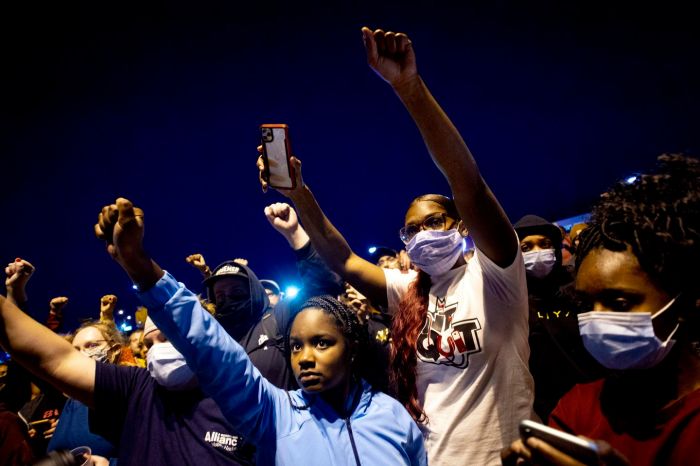
People march at a peaceful protest seeking justice for George Floyd in Flint Township, Michigan.
People march at a peaceful protest seeking justice for George Floyd in Flint Township, Michigan.JAKE MAY | MLIVE.COM/ASSOCIATED PRESS

“The reason that Black people are in the streets,” the acclaimed American writer James Baldwin said in 1968, “has to do with the lives they are forced to lead in this country. And they are forced to lead these lives by the indifference and the apathy and a certain kind of ignorance, a very willful ignorance, on the part of their co-citizens.” A half century later, Baldwin’s wrenching words reverberate in an America where thousands of protesters across dozens of cities have taken to the streets over the past three days despite a deadly pandemic. The country they are objecting to is one where a police officer kneels on the neck of a Black man until he dies, knowing it is all being caught on camera; the country where, after a Black jogger in a white neighborhood is shot to death in broad daylight, the killers go weeks without facing charges; the country where police officers can shoot a young Black woman eight times in her own apartment after entering unannounced with a warrant for someone who did not live there.

In this America, the president tweets out dog whistles to white supremacists and threatens protesters with violence. Never mind that the same president encouraged protests just a few weeks ago that culminated in the storming of the Michigan Capitol by armed white vigilantes.
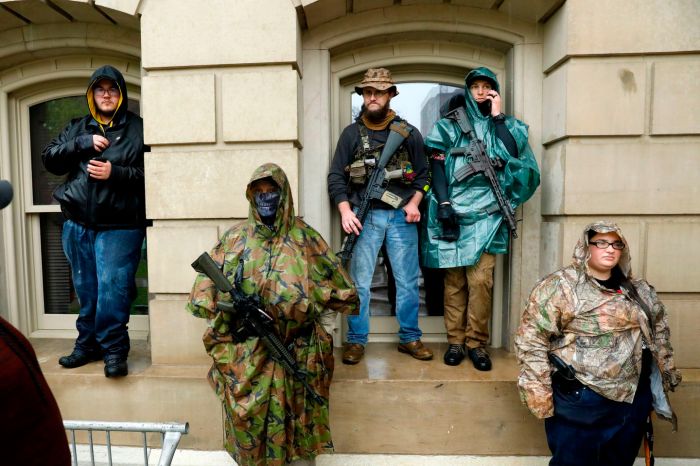
Armed demonstrators in Lansing, Michigan, protest the coronavirus pandemic stay-at-home orders on May 14.
Armed demonstrators in Lansing, Michigan, protest the coronavirus pandemic stay-at-home orders on May 14.JEFF KOWALSKY/AFP VIA GETTY IMAGES

“Everybody knows, no matter what they do not know, that they wouldn’t like to be a Black man in this country,” Baldwin said in 1968. The ills he spoke of remain; some have even worsened. Stark income and wealth gaps persist along racial lines, failing schools and paltry social services put a giant foot on the scale against Black youth, biased judges and juries disproportionately imprison Black men, and the severe health disparities suffered by Black Americans now include a higher death rate from COVID-19. But the most poignant picture of racial injustice in America is repainted in blood whenever a police officer, armed and sanctioned by the state and wearing the uniform of the law, kills a Black citizen with impunity. With the video of the death of George Floyd under the knee of white Minneapolis police Officer Derek Chauvin, Black Americans once again relive a brutal nightmare that dates back to the country’s founding. Their lives are deemed dispensable, even and sometimes especially by those whose job it is to enforce the law.

And on Tuesday, the day after the incident, it took civil unrest in the streets to spur his arrest and murder charges on Friday. The three officers who helped him during the arrest, who either held George Floyd down or stood by as he said he could not breathe and cried out for his mother, have not faced charges. The camera footage shows a group of officers who acted as if they knew they would not be punished.

It is a form of Baldwin’s “willful ignorance” that the country’s politicians, policy makers, prosecutors, and police departments have not done more to prevent and punish acts of violence against Black people on the part of police and it is a form of willful ignorance that more citizens are not outraged. Piecemeal reforms to diversify police forces, train officers to de-escalate conflict, and require body cameras have fallen abysmally short in protecting Black people from errant law enforcement officers. Derek Chauvin had nearly 20 complaints and two letters of reprimand filed against him and had opened fire on two people before he knelt on the neck of George Floyd. Across the country, there is still too little accountability for police, including here in Boston, where the city has stopped releasing stop-and-frisk data.

It is striking that chiefs of police around the nation quickly condemned the incident that led to George Floyd’s death in Minneapolis. But over the past few days, what has followed such political statements are violent confrontations between police and protesters and between police and journalists in many cities. Law enforcement officers have driven vehicles through crowds, tear-gassed protesters, and opened fire with rubber bullets on journalists. For the people on the streets who are exploiting the unrest and endangering others, arrests are justified. But numerous accounts point to acts of disproportionate police violence in response to peaceful protests.

That more and more Americans are refusing to accept the violence against Black Americans presents political leaders and law enforcement agencies around the nation with an imperative to act. State and federal lawmakers must use this moment to enact bolder policy reforms than those to date to reduce sentencing disparities, raise juvenile justice ages to keep young people out of the prison system, reform civil service laws that make it hard to hold cops accountable for wrongdoing, and strengthen civilian police-oversight boards. Police departments across the nation should press for the authority to remove officers who have any history of racial violence or aggression toward citizens; police chiefs should show that they have zero tolerance for such acts. They must send a loud and clear message that the era of sanctioned police violence against Black citizens is over.

With so many Americans moved by the death of Floyd and the callousness of Chauvin, this could be the country’s watershed moment for finally addressing police violence and racial injustice. But even after the fires stop burning, Americans of all races must be unwilling to accept the loss of Black lives.

Editorials represent the views of the Boston Globe Editorial Board. Follow us on Twitter at @GlobeOpinion.

Source: America’s willful ignorance about Black lives – The Boston Globe

Research Shows Entire Black Communities Suffer Trauma After Police Shootings – Yes! Magazine

Police killings of unarmed African Americans have created a mental health crisis of enormous proportions.

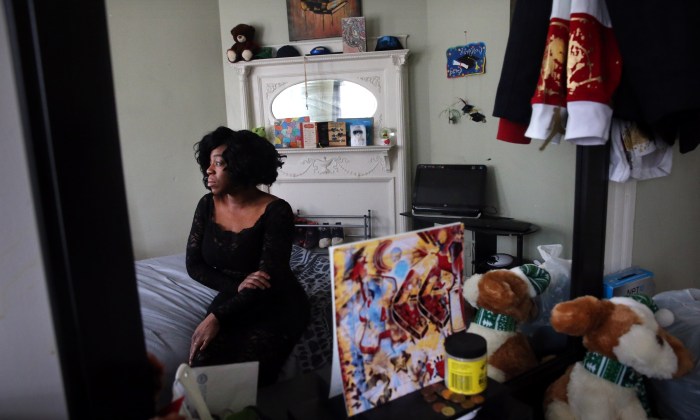
Following several nationally publicized police killings of unarmed Black Americans in the United States, Eva L., a fitness instructor who identifies as Black, started to experience what she describes as “immense paranoia.” She would often call in sick, because she feared risking an encounter with police upon leaving her house. She also started to second-guess her and her husband’s decision to have children. “Seeing Black bodies murdered and physical/emotional violence online and on the news” was a trauma she could no longer bear, Eva says. “I was terrified of bringing a child into the world we live in and experience as Black people. I thought not having kids was a truer sign of love than risk them being harmed by this world.”

Click here for more in this series.

A recent study sponsored by the University of Pennsylvania—released just before the anniversaries of the deaths of Eric Garner (2014), Michael Brown (2014), John Crawford (2014), and Philando Castile (2016)—found that there could be millions like Eva, for whom these killings have been a mental health trigger. Research included data from the Mapping Police Violence Project database for police killings between 2013 and 2016 and information from the Behavioral Risk Factor Surveillance System of over 103,000 Black Americans. The results indicate that police killings of unarmed Black Americans are having a population-level impact on the mental health of Black Americans.

According to researchers, the incidents may contribute to 1.7 additional poor mental health days per person every year, or 55 million more poor mental health days every year among Black Americans across the United States. That means the mental health burden for African Americans caused by police killings of unarmed Black victims is nearly as great as the mental health burden associated with diabetes. African Americans have some of the highest rates of the disease, which contributes annually to 75 million days of poor mental health among them.

African Americans make up 13 percent of the U.S. population but they accounted for 26 percent of people fatally shot by police in 2015 and 2016. While the death of a loved one can be tragic for the family and community of any police-shooting victim regardless of race, the study reveals that there is a deeper trauma for African Americans, related to the victim or not. Eva started seeing a therapist who diagnosed her as having generalized anxiety and post-traumatic stress disorder. It’s been two years now, and she admits that her progress toward healing has been slow, yet steady. Jacob Bor, co-author of the study and assistant professor at the Boston University School of Public Health, says the responses in his social circle to police killings of unarmed Black victims is what interested him in conducting this study. Bor noticed that White people were able to comprehend “the injustice on an intellectual level but did not experience the same level of trauma.”

The study findings confirmed Bor’s personal observations. The research team did not observe spillover mental health effects in White respondents from police killings. It should also be noted that among respondents of either race, there were no spillover effects for police killings of unarmed White people or killings of armed Black people. The research is essential in considering our own personal experiences, says Bor, adding that the findings speak to the overall “value of different people’s lives.” This society “has a long history of state-sanctioned violence” toward racially marginalized groups, he says. The mental health sector is only now researching the impact of police brutality, a concern that has affected African Americans for decades. “Clinicians can go through medical school without [gaining] any experience in treating the effects of racism,” Bor says. Studies like his, he adds, can help to create long overdue critical mainstream discussions about the effects of racism on mental health, such as, “How do we in public health, society, and among the clinical and mental health services support people when these incidents occur?” and “Can a profession dominated by White providers effectively treat the emotional struggles of ‘living while Black’ in this country?” According to Bor, these discussions are needed to implement change. “Among many White Americans, there is an empathy gap … and a failure to believe when people of color say ‘this hurts me,’” he says.

“Mental health is the ultimate intersectional concern.”

Adding to the deficiency of culturally competent therapists, poverty and other formidable socio-economic challenges—also stemming from structural racism—remain steadfast barriers to African Americans accessing mental health care, according to the American Psychological Association. New York City’s first lady, Chirlane McCray, has also become a passionate advocate for what she describes as a movement for “culturally competent mental health care.” “When you talk about people of color, who are obviously facing discrimination and legacy of racism and poverty in huge numbers, you are talking about something that is really tough to overcome,” McCray says. Inadequate care undermines benefits from policies and resources designed to mitigate the burdens of systemic oppression. “Mental illness along with substance abuse disorders are hardship multipliers,” she says. Struggling unsupported with “mental illness can make everything that much harder.” For example, holding on to affordable housing, staying enrolled in college, and even surviving encounters with law enforcement can be extremely more difficult for those suffering from mental illness or trauma, McCray says. In fact, the most recent annual numbers from the Washington Post’s database of fatal police-shooting victims indicate that “nearly 1 in 4 of those shot was described as experiencing some form of mental distress at the time of the encounter with police.” “Mental health is the ultimate intersectional concern,” McCray says. “It is reflected in all of our policies … education, housing, school, relationships.” In 2015, she and her spouse, Mayor Bill de Blasio, launched Thrive NYC, a $850 million mental health program that incorporates 54 initiatives. Among the program’s several core objectives is the aim to address the stigma around mental illness and increase access to treatment across the city. McCray believes that ThriveNYC’s community focused approach is one of several necessary steps toward reaching historically underserved groups. “Culturally competent care to me is all about trust,” McCray says. “It improves early identification, accessibility, and outcomes.” Also, she says, “People have to be seen.” From her advocacy experience she has observed that “people have to feel that they can turn to someone that they trust.” Connecting people with the appropriate resources, however, means surmounting many challenges. “There is great deal of work to be done to eliminate the stigma,” McCray says. There is also the matter of affordability and infrastructure. “We’ve never had a well-coordinated mental health system in our country—ever. People who have the money find ways to manage.” She says she wants to fight for everyone to get the resources they need to cope. Eva recognizes that her path to healing has taken a significant amount of work and support beyond the means of many African Americans. “Access to therapy is a privilege,” she says. “I know that most people can’t afford weekly sessions at $150-plus.” Yet, she adds, “[going through therapy] is the only reason why I’m OK planning for kids at 32.”


TASHA WILLIAMS writes about economics and technology.
CONNECT:  Twitter

Source: Research Shows Entire Black Communities Suffer Trauma After Police Shootings – Yes! Magazine

Opinion | My Mother’s Death Will Have Everything and Nothing to Do With Covid-19 – The New York Times

My Mother Is Busy Getting Ready to Die

No insurance. 64 years old. Alone, along with all the other black people at the bottom of the pandemic.

By 

Dr. Manigault-Bryant is an associate professor of Africana studies at Williams College.

My mother is dying a painful death, and it has everything and nothing to do with Covid-19.

In a piece for The Atlantic detailing the ways in which the coronavirus seems to be hitting black people the hardest, Ibram X. Kendi wrote: “Sometimes racial data tell us something we don’t know. Other times we need racial data to confirm something we already seem to know.” My mother is a living example of what we already know about race, class and suffering.

She is not in an elder-care facility, nor a hospital. She has not been, and most likely will not be, tested for the virus or receive a diagnosis of having it.

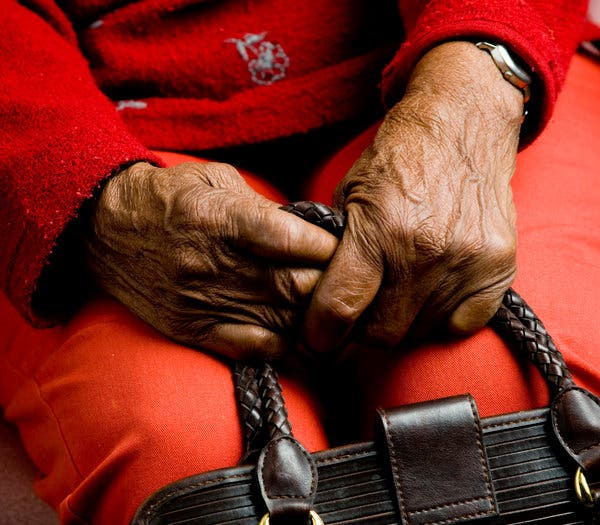
Still, hers is the body of all the black people at the bottom of the pandemic. No insurance, though not for lack of trying. Medicaid applications denied for reasons we don’t understand. Inconsistent care at a local public clinic meant hard-to-come-by appointments and checkups only at moments deemed most critical. It wasn’t enough.

Now, she’s dying from end-stage liver disease and kidney failure, diagnosed too late to save her. This has nothing to do with Covid-19.

She is not even that old (64, and thus Medicare ineligible), but FaceTime tells no lies, and she is wasting away before us. What’s worse, even as I’m exactly four hours and three minutes away — geographically closer than I’ve been in over a decade — I can’t be near her, touch her, cook for her, kiss her or tell her all of the things that I don’t yet know I need to say. This has everything to do with Covid-19.
On the occasion she’s strong enough to answer the phone, holding the phone for FaceTime proves too much. Calls come too late, even as time is too short. The grandchildren who live close by cannot get close to her — the idea of transmitting anything to her, as she’s so obviously immune-compromised, is terrifying. The underlying conditions would amplify an already-certain death. This has everything to do with Covid-19.

My brother, who lives exactly six minutes and 24 seconds away from Mommy, risks seeing her because someone needs to make sure she’s still breathing. That check-in is thus essential. He scrubs himself clean after work with all manner of chemicals — he’s a waste management truck driver, an essential employee. This is an effort to protect her. He’s close to her. This is an effort to protect us. This has everything to do with Covid-19.

He tries to get her to eat something other than her single meal of applesauce and Vienna sausages. This has nothing to do with Covid-19.

It’s officially power-of-attorney and health-proxy time. Getting my mother to the lawyer — a four-minute drive — is a thing. My brother and I spend hours strategizing transportation. The errand feels like it takes an eternity. This has everything to do with Covid-19.

Like so many, countless others, my family and I are going to be left with the unsettling weight of her death. My mother is going to die soon, and it will most likely be alone. I am afraid. I am one of many grieving, forever-changed faces. No repast. No low-country songs sung graveside. No sending up our timber for her. We cannot grieve properly. Lots of regret. This has everything to do with Covid-19.

When the pandemic is over, we still won’t know how to deal with this. We’re not ready for this kind of grief. Death is so utter, so absolute, yet so much right now is uncertain. My mother is dying a painful death, and it has everything and nothing to do with Covid-19.

LeRhonda S. Manigault-Bryant (@DoctorRMB) is associate professor of Africana studies at Williams College and the author of “Talking to the Dead: Religion, Music, and Lived Memory Among Gullah/Geechee Women.”


America’s Racial Contract Is Showing – The Atlantic

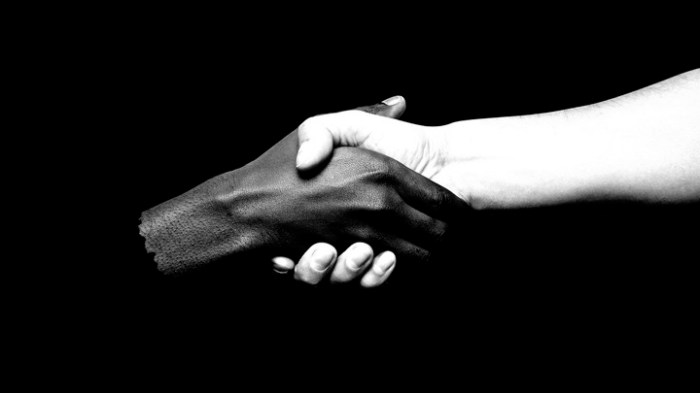
An illustration of two hands—one black, and one white—shaking.The local prosecutor, George E. Barnhill, concluded that no crime had been committed. Arbery had tried to wrest a shotgun from Travis McMichael before being shot, Barnhill wrote in a letter to the police chief. The two men who had seen a stranger running, and decided to pick up their firearms and chase him, had therefore acted in self-defense when they confronted and shot him, Barnhill concluded. On Tuesday, as video of the shooting emerged on social media, a different Georgia prosecutor announced that the case would be put to a grand jury; the two men were arrested and charged with murder yesterday evening after video of the incident sparked national outrage across the political spectrum.

But Barnhill’s leniency is selective—as The Appeal’s Josie Duffy Rice notes, Barnhill attempted to prosecute Olivia Pearson, a black woman, for helping another black voter use an electronic voting machine. A crime does not occur when white men stalk and kill a black stranger. A crime does occur when black people vote.The underlying assumptions of white innocence and black guilt are all part of what the philosopher Charles Mills calls the “racial contract.” If the social contract is the implicit agreement among members of a society to follow the rules—for example, acting lawfully, adhering to the results of elections, and contesting the agreed-upon rules by nonviolent means—then the racial contract is a codicil rendered in invisible ink, one stating that the rules as written do not apply to nonwhite people in the same way. The Declaration of Independence states that all men are created equal; the racial contract limits this to white men with property. The law says murder is illegal; the racial contract says it’s fine for white people to chase and murder black people if they have decided that those black people scare them. “The terms of the Racial Contract,” Mills wrote, “mean that nonwhite subpersonhood is enshrined simultaneously with white personhood.”

The racial contract is not partisan—it guides staunch conservatives and sensitive liberals alike—but it works most effectively when it remains imperceptible to its beneficiaries. As long as it is invisible, members of society can proceed as though the provisions of the social contract apply equally to everyone. But when an injustice pushes the racial contract into the open, it forces people to choose whether to embrace, contest, or deny its existence. Video evidence of unjustified shootings of black people is so jarring in part because it exposes the terms of the racial contract so vividly. But as the process in the Arbery case shows, the racial contract most often operates unnoticed, relying on Americans to have an implicit understanding of who is bound by the rules, and who is exempt from them.

The implied terms of the racial contract are visible everywhere for those willing to see them. A 12-year-old with a toy gun is a dangerous threat who must be met with lethal force; armed militias drawing beads on federal agents are heroes of liberty. Struggling white farmers in Iowa taking billions in federal assistance are hardworking Americans down on their luck; struggling single parents in cities using food stamps are welfare queens. Black Americans struggling in the cocaine epidemic are a “bio-underclass” created by a pathological culture; white Americans struggling with opioid addiction are a national tragedy. Poor European immigrants who flocked to an America with virtually no immigration restrictions came “the right way”; poor Central American immigrants evading a baroque and unforgiving system are gang members and terrorists.

Donald Trump’s 2016 election campaign, with its vows to enforce state violence against Mexican immigrants, Muslims, and black Americans, was built on a promise to enforce terms of the racial contract that Barack Obama had ostensibly neglected, or violated by his presence. Trump’s administration, in carrying out an explicitly discriminatory agenda that valorizes crueltywar crimes, and the entrenchment of white political power, represents a revitalized commitment to the racial contract.

But the pandemic has introduced a new clause to the racial contract. The lives of disproportionately black and brown workers are being sacrificed to fuel the engine of a faltering economy, by a president who disdains them. This is the COVID contract.

As the first cases of the coronavirus were diagnosed in the United States, in late January and early February, the Trump administration and Fox News were eager to play down the risk it posed. But those early cases, tied to international travel, ensnared many members of the global elite: American celebritiesworld leaders, and those with close ties to Trump himself. By March 16, the president had reversed course, declaring a national emergency and asking Americans to avoid social gatherings.

The purpose of the restrictions was to flatten the curve of infections, to keep the spread of the virus from overwhelming the nation’s medical infrastructure, and to allow the federal government time to build a system of testing and tracing that could contain the outbreak. Although testing capacity is improving, the president has very publicly resisted investing the necessary resources, because testing would reveal more infections; in his words, “by doing all of this testing, we make ourselves look bad.”

Over the weeks that followed the declaration of an emergency, the pandemic worsened and the death toll mounted. Yet by mid-April, conservative broadcasters were decrying the restrictions, small bands of armed protesters were descending on state capitols, and the president was pressing to lift the constraints.

As Matt Gertz writes, some of these premature celebrations may have been an overreaction to the changes in the prominent coronavirus model designed by the Institute for Health Metrics and Evaluation at the University of Washington, which had recently revised its estimates down to about 60,000 deaths by August. But even as the mounting death toll proved that estimate wildly optimistic, the chorus of right-wing elites demanding that the economy reopen grew louder. By April 16, the day the first anti-lockdown protests began, deaths had more than doubled, to more than 30,000.That more and more Americans were dying was less important than who was dying.

The disease is now “infecting people who cannot afford to miss work or telecommute—grocery store employees, delivery drivers and construction workers,” The Washington Post reported. Air travel has largely shut down, and many of the new clusters are in nursing homes, jails and prisons, and factories tied to essential industries. Containing the outbreak was no longer a question of social responsibility, but of personal responsibility. From the White House podium, Surgeon General Jerome Adams told “communities of color” that “we need you to step up and help stop the spread.”

Public-health restrictions designed to contain the outbreak were deemed absurd. They seemed, in Carlson’s words, “mindless and authoritarian,” a “weird kind of arbitrary fascism.” To restrict the freedom of white Americans, just because nonwhite Americans are dying, is an egregious violation of the racial contract. The wealthy luminaries of conservative media have sought to couch their opposition to restrictions as advocacy on behalf of workers, but polling shows that those most vulnerable to both the disease and economic catastrophe want the outbreak contained before they return to work.

Although the full picture remains unclear, researchers have found that disproportionately black counties “account for more than half of coronavirus cases and nearly 60 percent of deaths.”* The disproportionate burden that black and Latino Americans are bearing is in part a direct result of their overrepresentation in professions where they risk exposure, and of a racial gap in wealth and income that has left them more vulnerable to being laid off. Black and Latino workers are overrepresented among the essential, the unemployed, and the dead.

This tangled dynamic played out on Tuesday, during oral arguments over Wisconsin Governor Tony Evers’s statewide stay-at-home order before the state Supreme Court, held remotely. Chief Justice Patience Roggensack was listening to Wisconsin Assistant Attorney General Colin Roth defend the order.
 

“When you see a virus like this one that does not respect county boundaries, this started out predominantly in Madison and Milwaukee; then we just had this outbreak in Brown County very recently in the meatpacking plants,” Roth explained. “The cases in Brown County in a span of two weeks surged over tenfold, from 60 to almost 800—”

“Due to the meatpacking, though, that’s where Brown County got the flare,” Roggensack interrupted to clarify. “It wasn’t just the regular folks in Brown County.”

Perhaps Roggensack did not mean that the largely Latino workers in Brown County’s meatpacking plants—who have told reporters that they have been forced to work in proximity with one another, often without masks or hand sanitizer, and without being notified that their colleagues are infected—are not “regular folks” like the other residents of the state. Perhaps she merely meant that their line of work puts them at greater risk, and so the outbreaks in the meatpacking plants, seen as essential to the nation’s food supply, are not rationally related to the governor’s stay-at-home order, from which they would be exempt.

Yet either way, Roggensack was drawing a line between “regular folks” and the workers who keep them fed, mobile, safe, and connected. And America’s leaders have treated those workers as largely expendable, praising their valor while disregarding their safety.

“There were no masks. There was no distancing inside the plant, only [in the] break room. We worked really close to each other,” Raquel Sanchez Alvarado, a worker with American Foods, a Wisconsin meatpacking company, told local reporters in mid-April. “People are scared that they will be fired and that they will not find a job at another company if they express their concerns.”

In Colorado, hundreds of workers in meatpacking plants have contracted the coronavirus. In South Dakota, where a Smithfield plant became the site of an outbreak infecting more than 700 workers, a spokesperson told BuzzFeed News that the issue was their “large immigrant population.” On Tuesday, when Iowa reported that thousands of workers at meat-processing plants had become infected, Governor Kim Reynolds was bragging in The Washington Post about how well her approach to the coronavirus had worked.

“We can’t keep our country closed down for years,” Trump said Wednesday. But that was no one’s plan. The plan was to buy time to take the necessary steps to open the country safely. But the Trump administration did not do that, because it did not consider the lives of the people dying worth the effort or money required to save them.

The economic devastation wrought by the pandemic, and the Trump administration’s failure to prepare for it even as it crippled the world’s richest nations, cannot be overstated. Tens of millions of Americans are unemployed. Tens of thousands line up outside food banks and food pantries each week to obtain sustenance they cannot pay for. Businesses across the country are struggling and failing. The economy cannot be held in stasis indefinitely—the longer it is, the more people will suffer.

Yet the only tension between stopping the virus and reviving the economy is one the Trump administration and its propaganda apparatus have invented. Economists are in near-unanimous agreement that the safest path requires building the capacity to contain the virus before reopening the economy—precisely because new waves of deaths will drive Americans back into self-imposed isolation, destroying the consumer spending that powers economic growth. The federal government can afford the necessary health infrastructure and financial aid; it already shelled out hundreds of billions of dollars in tax cuts to wealthy Americans. But the people in charge do not consider doing so to be worthwhile—Republicans have already dismissed aid to struggling state governments that laid off a million workers this month alone as a “blue-state bailout,” while pushing for more tax cuts for the rich.

“The people of our country are warriors,” Trump told reporters Tuesday. “I’m not saying anything is perfect, and will some people be affected? Yes. Will some people be affected badly? Yes. But we have to get our country open and we have to get it open soon.”

The frame of war allows the president to call for the collective sacrifice of laborers without taking the measures necessary to ensure their safety, while the upper classes remain secure at home. But the workers who signed up to harvest food, deliver packages, stack groceries, drive trains and buses, and care for the sick did not sign up for war, and the unwillingness of America’s political leadership to protect them is a policy decision, not an inevitability. Trump is acting in accordance with the terms of the racial contract, which values the lives of those most likely to be affected less than the inconveniences necessary to preserve them. The president’s language of wartime unity is a veil draped over a federal response that offers little more than contempt for those whose lives are at risk. To this administration, they are simply fuel to keep the glorious Trump economy burning.


The president’s cavalier attitude is at least in part a reflection of his fear that the economic downturn caused by the coronavirus will doom his political fortunes in November. But what connects the rise of the anti-lockdown protests, the president’s dismissal of the carnage predicted by his own administration, and the eagerness of governors all over the country to reopen the economy before developing the capacity to do so safely is the sense that those they consider “regular folks” will be fine.Many of them will be. People like Ahmaud Arbery, whose lives are depreciated by the terms of the racial contract, will not.


Related Podcast

Listen to Adam Serwer talk about this story on Social DistanceThe Atlantic’s podcast about life in the pandemic:

Subscribe to Social Distance on Apple Podcasts or Spotify (How to Listen)


*Correction: An earlier version of this piece misdescribed a study showing disproportionately black counties were responsible for more than half of coronavirus cases in the United States by describing those counties as “majority black.”

ADAM SERWER is a staff writer at The Atlantic, where he covers politics.

Source: America’s Racial Contract Is Showing – The Atlantic

“Black Economic Inequality: #RACEMatters” May 9, 2020

This Week on OUR COMMON GROUND

May 09, 20202

Guest: Dr. Touré F. Reed, Professor of History and Author of “Toward Freedom: The Case Against Race Reductionism”

10 PM EDT – Live & Call-In  Listen or Call – In (347) 838-9852
Tune In Here: http://bit.ly/OCGTruthTalk  

5-09 Reed Banner

Dr. Touré F. Reed earned his BA in American Studies from Hampshire College (Amherst, MA), and his PhD in History from Columbia University (New York, NY). He is a fourth generation African American educator and third generation professor. Having spent his formative years in South West Atlanta, GA and New Haven, CT, Dr. Reed’s research interests center on race, class, and inequality.
Specifically, Professor Reed’s research focuses on the impact of race and class ideologies on African American civil rights politics and US public policy from the Progressive Era through the Presidency of Barack Obama.

Dr. Reed is the author of Not Alms But Opportunity: The Urban League and the Politics of Racial Uplift, 1910-1950, (UNC Chapel Hill Press, 2008) and the recently published Toward Freedom: The Case Against Race Reductionism (Verso Books, 2020). He is also co-author of Renewing Black Intellectual History: The Ideological and Material Foundations of Black American Thought (Paradigm Publishers, 2009).
His articles have appeared in the Journal of American Ethnic History, LABOR, nonsite.org, Catalyst, Blackagendareport.comCommondreams.org, Jacobin, the New Republic, and the Nation.

Dr. Reed has received numerous grants and fellowships including the prestigious Kluge Postdoctoral Fellowship at the Library of Congress in support of a book in progress titled New Deal Civil Rights: Class Politics and the Quest for Racial Equality, 1933-1948.

ABOUT the Book

“Toward Freedom: The Case Against Race Reductionism”

Examines the fate of poor and working-class African Americans-who are unquestionably represented among neoliberalism’s victims-is inextricably linked to that of other poor and working-class Americans

Reed contends that the road to a more just society for African Americans and everyone else is obstructed, in part, by a discourse that equates entrepreneurialism with freedom and independence. This, ultimately, insists on divorcing race and class. In the age of runaway inequality and Black Lives Matter, there is an emerging consensus that our society has failed to redress racial disparities. The culprit, however, is not the sway of a metaphysical racism or the modern survival of a primordial tribalism. Instead, it can be traced to far more comprehensible forces, such as the contradictions in access to New Deal era welfare programs, the blinders imposed by the Cold War, and Ronald Reagan’s neoliberal assault on the half-century long Keynesian consensus.

Freedom Is Ours, We Just Have to Keep Fighting For It

One of the most common refrains when a democracy collapses into an autocracy is that no one could have seen it coming.

The motivation behind this myth is the absolution of the powerful. After all, what cannot be predicted cannot be prevented, and therefore the failure of officials to safeguard our freedoms should be forgiven. This is the story we hear as Donald Trump approaches a possible second term and the U.S. plunges into unprecedented turmoil.

The premise, of course, is a lie.

Freedom is about what it means to be human, and to be recognized and treated by others as such.

What “No one saw it coming” tells you is who the powerful consider to be “no one.” “No one” are the multitude of marginalized Americans who warned in 2016 that their rights had always been on the line and would be even more so now. “No one” are the people who knew that a future American autocracy was possible because their ancestors had been subject to past ones: slavery, Jim Crow, internment camps, and other forms of legal subjugation that were destroyed only through decades of defiant demands for their eradication.

Freedom was always a moving target. So are Americans under Donald Trump.

Trump is not the cause of the American crisis, but its culmination. The fragility of rights that members of marginalized groups have always experienced has been widened to encompass the country as a whole. In the 21st century, political, economic and technological freedom were all radically curtailed. Americans signed away their rights unwittingly and unwillingly – through the Patriot Act, which expanded government surveillance in the wake of 9/11, through social media companies turned surveillance monopolies, through the deference to corporations that is a survival mechanism in an economy structured on precarity.

The loss of legal rights over the past 20 years – voting rights chief among them – has been accompanied by a culture of fear that is as effective in derailing democracy as any decree. What does it mean to have freedom of speech when your words are data-mined and shot back at you as targeted propaganda? What is freedom of assembly when your every movement is recorded and reproduced online, when human lives are reduced to hashtags?

There are few worse feelings than being watched but never seen.

Trump exemplifies this era of exploitation. The reality TV president sees citizens not as human beings, but as disposable background players in a show starring himself. The U.S. media — an industry both exclusionary and desperate after decades of financial turmoil — has long proven an easy mark for the Trump team. Complex catastrophes are no match for the easy media lure of personality politics. The framework of spectacle to which Americans have always been drawn — soap operas and pro wrestling, talk shows and tabloids – is Trump’s native vernacular. To some degree, this was always our national political language, but there is a soullessness today that feels new. Whatever entertaining quality politics once possessed is gone, replaced by a culture of profound dehumanization that endangers the American experiment.

What Does Freedom Mean?
Protesters demonstrate in Freedom Plaza against family detentions and to demand the end of criminalizing efforts of asylum seekers on June 28, 2018.

WIN MCNAMEEGETTY IMAGES

Freedom is never just about rights or laws. Freedom is about what it means to be human, and to be recognized and treated by others as such.

That yearning — to simply be and have that be enough, to not have to prove your innate worth time and time again to a dubious arbiter — is at the heart of every struggle for human rights.

At a time when the world seems to be closing in on us, whether through apocalyptic change disasters, like the wildfires in Australia, or surveillance apps that monitor our every move, the dehumanizing quality of the Trump era — like separating migrant families and housing them in unsanitary border camps — is particularly gutting. With dehumanization comes disposability — a cheapening of the cherished, a commodification of every casualty.

There is a litany of horrifying images from the Trump era, but the worst may be a grinning Donald and Melania Trump holding a baby orphaned in the El Paso mass shooting like it was a trophy, giving the world a thumbs up after the baby’s parents were gunned down. What future does that child face? What present, so devoid of empathy and teeming with violence, made that moment possible?

Along with “No one could have seen it coming” lies also the idea that “The Founders never predicted this” in the archive of excuses for democracy’s demise. But the Founders absolutely predicted this — if not the legal architecture, then the moral forfeiture, which they often framed in terms of suicide.

“Remember, democracy never lasts long,” John Adams wrote in 1814. “It soon wastes, exhausts, and murders itself. There never was a democracy yet that did not commit suicide.”

In 1838, Abraham Lincoln expressed similar thoughts on what would ultimately destroy America: “At what point then is the approach of danger to be expected? I answer. If it ever reach us it must spring up amongst us; it cannot come from abroad. If destruction be our lot we must ourselves be its author and finisher.”

Each warned that America was its own worst enemy. Many also believe we are our own best hope.

We are the wild cards we are waiting for.

The problems Americans face are so innumerable that they overwhelm. As a nation, we are indeed weary. Still, there are concrete actions people can take to slow the entrenchment of autocracy: voting, protesting, and creating or supporting independent organizations that combat corporate or state control are a few suggestions. But all of this requires maintaining presence of mind in a political environment designed to annihilate it. The greatest threat of the Trump era is the loss of what makes us human – our empathy, our individuality, our imagination.

The antithesis to freedom isn’t subjugation but surrender.

Oppressive governments can control what they take from you, but not your willingness to fight for it. They can never fully know you, and the unpredictability of human nature means no outcome is an inevitability, even in an aspiring autocracy. We are the wild cards we are waiting for.

Freedom of thought is a freedom that can never truly be taken, but you must guard it nonetheless. In an era of rampant dehumanization, it is more important than ever not to surrender in advance.


Sarah Kendzior is a writer, scholar, and author of the best-selling book, The View From Flyover Country, and the upcoming book Hiding in Plain Sight. Kendzior is also the host of Gaslit Nation, a weekly podcast which covers corruption in the Trump administration and the rise of authoritarianism around the world. Follow her on Twitter @SarahKendzior.

Source: Freedom Is Ours, We Just Have to Keep Fighting For It

How Wealthy Towns Keep People With Housing Vouchers Out — ProPublica

This article was produced in partnership with The Connecticut Mirror, which is a member of the ProPublica Local Reporting Network.

ProPublica is a nonprofit newsroom that investigates abuses of power. Sign up to receive our biggest stories as soon as they’re published.

HARTFORD, Conn. — On a sweltering Saturday afternoon last June, Crystal Carter took a deep breath as she walked toward the red “for rent” sign.

Shaded by tall oak trees, the three-story duplex looked cozy. The first floor siding was painted yellow, with white railings leading to the front door. The windows appeared new, the lawn freshly cut.

Although the property was in Barry Square, on the edge of a struggling area in southern Hartford, the family outside buoyed Carter’s spirits. Four children giggled in a recliner in the front yard, singing along to the radio while their father packed a moving truck. Across the street were Trinity College’s dignified brick pillars, the entry to the elite school’s 100-acre campus.

Carter tried to tamp down her excitement, but this looked like the kind of place the 48-year-old single mother so desperately wanted for her five kids: no mouse traps, no chipped paint trying to camouflage mold.

He put down a crate and offered her a tour of the first-floor, four-bedroom unit. Inside, she marveled at the modern kitchen, finished hardwood floors and large closets.

“This is a lot of space. When are you putting this on the market?” she asked.

“It’s ready, if you want to do the application,” he told her. Rent was $1,500 a month.

Carter paused.

“I’ll be paying with a Section 8 voucher,” she said.

“Yeah,” the man shot back. “I don’t do Section 8.”

Officially called Housing Choice Vouchers, Section 8 rent subsidies were supposed to help low-income people find decent housing outside poor communities. But, for the better part of a year, Carter had found the opposite. This was easily the 50th place she had toured since her landlord sold her last apartment and evicted her. Nearly all of them were in poor areas. They had holes in the wall, uncovered electrical outlets, even roaches and mice. When she hit upon something clean, she learned not to ask too many questions. She complimented the landlord, talked about her children and emphasized that she didn’t smoke. None of it seemed to matter, though, once she uttered two words: Section 8.

Now, as Carter showed herself out of the first-floor rental, she felt panic welling within. “There really are no doors open for people that have a voucher,” she said afterward. “It makes you feel ashamed to even have one.” Typically, vouchers come with a time limit to find housing, and Carter had already won three extensions. She wasn’t sure she’d get another.

She had just 40 days left to find a place to live.

As the federal government retreated from building new public housing in the 1970s, it envisioned Section 8 vouchers as a more efficient way of subsidizing housing for the poor in the private market. They now constitute the largest rental assistance program in the country, providing almost $23 billion in aid each year to 2.2 million households. Local housing authorities administer the program with an annual budget from Washington and are given wide latitude on how many vouchers they hand out and how much each is worth. The bulk of the vouchers are reserved for families who make 30% or less of an area’s median income. That is $30,300 or less for a family of four in Hartford.

For years, researchers and policymakers have lamented the program’s failure to achieve one of its key goals: giving families a chance at living in safer communities with better schools. Low-income people across the country struggle to use their vouchers outside of high-poverty neighborhoods.

In Connecticut, the problem is especially acute. An analysis of federal voucher data by The Connecticut Mirror and ProPublica found that 55% of the state’s nearly 35,000 voucher holders live in neighborhoods with concentrated poverty. That’s higher than the national average of 49% and the rates in 43 other states.

The segregation results, at least in part, from exclusionary zoning requirements that local officials have long used to block or limit affordable housing in prosperous areas. As the Mirror and ProPublica reported in November, state authorities have done little to challenge those practices, instead steering taxpayer money to build more subsidized developments in struggling communities.

Dozens of voucher holders in Connecticut say this concentration has left them with few housing options. Local housing authorities often provide a blue booklet of Section 8-friendly properties, but many of the ones listed are complexes that have a reputation for being rundown and are in struggling communities or have long waitlists. Many recipients call it the “Black Book” because “you are going to the dark side, for real. The apartments in that black book are nasty and disgusting,” said Janieka Lewis, a Hartford resident whose home is infested with mice.

Josh Serrano also lives in one of the state’s poorest neighborhoods. After landing a voucher in 2018, he tried to find a place in the middle-class town of West Hartford, where his son lives part time with his mother. He also looked in nearby Manchester and Simsbury. At each stop, the rent was higher than his voucher’s value or the landlord wouldn’t take a voucher.

“There is an invisible wall surrounding Hartford for those of us who are poor and particularly have black or brown skin like myself,” he said. “No community wanted me and my son.”

Nearly 80% of the state’s voucher holders are black or Hispanic and half have children. Their average income is $17,200 a year and the average amount they pay in rent out of pocket is $413 a month.

The federal government has taken a mostly hands-off approach to ensuring the Section 8 program is working as it was originally intended. The U.S. Department of Housing and Urban Development typically leaves it up to each housing authority to determine how much a voucher is worth, which essentially determines the type of neighborhood a voucher holder can afford. And when HUD assesses the work of housing authorities — to decide whether to increase federal oversight — only a tiny fraction is based on whether local officials are “expanding housing opportunities … outside areas of poverty or minority concentration.” (And even at that, nearly all housing authorities receive full credit.)

Moreover, federal law does not make it illegal for a landlord to turn down a prospective tenant if they plan to pay with a voucher, so HUD does not investigate complaints of landlords who won’t accept Section 8 vouchers.

Connecticut goes further. It is one of 14 states where it’s illegal to deny someone housing because they plan to use a Section 8 voucher. And the state allocated more than $820,000 in the last fiscal year to help pay for 10 investigators to look into complaints of all types of housing discrimination and provide legal assistance. “There has been an effort to try to change” housing segregation, said Seila Mosquera-Bruno, the commissioner of the Connecticut Department of Housing.

But those efforts have done little to prevent landlords from continuing to reject voucher holders. The groups charged with investigating housing complaints say they lack the resources to be proactive and believe they are only seeing a fraction of what’s really going on.

“Housing providers keep coming up with ways to rent to who they want to rent and find ways around housing discrimination laws,” said Erin Kemple, executive director of the Connecticut Fair Housing Center, which investigates complaints. “There is a lot more discrimination going on than what we are investigating.”

In 2018, fewer than 75 complaints were made that accused the landlord or owner of refusing to accept a voucher or some other legal source of income, such as Social Security. The Connecticut Fair Housing Center said that figure isn’t low because discrimination is scarce but rather because prospective tenants are fearful that complaining could hurt them and know that it will do nothing to help them with their immediate needs; investigations can take longer than the time they have to find a house with their vouchers.

“In order to make it a real priority and address the real effects of discrimination in society, the government should dedicate more resources to ferreting it out,” said Greg Kirschner, the group’s legal director.


A Hartford native, Carter reluctantly moved back to her hometown in 2011 to escape an abusive relationship. She had delayed relocating, she said, because she worried she’d be taking her children from a quiet neighborhood in Florida to a “war zone” in Connecticut.

“They not from the streets. Their heart is trying to be goofy-cool,” she said of her three sons, now 10, 17 and 18, and two daughters, ages 13 and 14. “They don’t have that fight in them. I do.” (Worried about her children’s privacy, Carter asked that they not be named in this story.)

More: Source: How Wealthy Towns Keep People With Housing Vouchers Out — ProPublica

The Sober Clarity of the Impeachment Witnesses | The New Yorker


Impeachment is a grave business, and the risks are manifest. But no democracy can overlook evidence of abuse of power, bribery, and obstruction in the hope that an election will set things right.

These hearings and a potential Senate trial will never get to the full range of Donald Trump’s corruptions, be they on Fifth Avenue or Pennsylvania Avenue, in Istanbul, Moscow, or Riyadh. But the focus of Congress is on this particular and outrageous abuse of the public trust, and for now that must suffice.

Long before Alexander Hamilton became an icon of the Broadway stage, he glimpsed the harrowing qualities of a man like Donald Trump. He did not like what he saw. As his definitive biographer, Ron Chernow, makes clear, Hamilton was an advocate of strong executive power, yet he also envisaged the rise of a demagogue who would put liberty and the rule of law at risk, and place his own interests before those of the country. Writing to George Washington, in 1792, Hamilton seemed to anticipate our current moment and the con on the golden escalator:

When a man unprincipled in private life desperate in his fortune, bold in his temper, possessed of considerable talents . . . is seen to mount the hobby horse of popularity—to join in the cry of danger to liberty—to take every opportunity of embarrassing the General Government & bringing it under suspicion—to flatter and fall in with all the non sense of the zealots of the day—It may justly be suspected that his object is to throw things into confusion that he may “ride the storm and direct the whirlwind.”

Hamilton also paid close attention to the crimes and misdemeanors that such a scoundrel might commit, and how the country could protect itself from them. He wrote two Federalist essays about impeachment, and, as Chernow noted recently in the Washington Post, he would “certainly have endorsed” the current inquiry in the House. Only willful resistance to fact can obscure the reality that Trump, with the help of his lawyer Rudy Giuliani and various others, tried to extort a vulnerable ally in order to gain an advantage in the 2020 election campaign. The White House finally released three hundred and ninety-­one million dollars in defense funds to Ukraine on September 11th—not owing to a fit of moral reconsideration but, it would appear, because two days earlier the House had launched its inquiry into allegations that Trump had tried to press Ukraine into investigating a political opponent. Given the abundance of documentary evidence, testimony from high-ranking public officials, and self-incriminating public statements by Trump, Hamilton would have seconded the sentiments expressed by Adam Schiff, the chair of the House Intelligence Committee, who gavelled open the public hearings on impeachment on Wednesday, saying:

If we find that the President of the United States abused his power and invited foreign interference in our elections  . . . must we simply get over it? Is this what Americans should now expect from their President? If this is not impeachable conduct, what is?

The first day of the hearings was notable for the sobriety, clarity, and unshakable dignity of the witnesses. William B. Taylor, Jr., a decorated Vietnam War veteran and the top U.S. diplomat in Ukraine, and Deputy Assistant Secretary of State George Kent, who oversees Eastern European and Eurasian affairs, provided, as they had earlier in closed hearings, detailed testimony that the President of the United States sought to pressure the beleaguered President of Ukraine to sully the reputation of a Democratic rival, Joe Biden, in exchange for a meeting at the Oval Office and the release of the defense funds.

According to Taylor, Gordon Sondland, the U.S. Ambassador to the European Union, spoke with Trump by cell phone from a restaurant in Kiev; the President’s emphasis was single-minded. After finishing the call, Sondland told one of Taylor’s aides that “Trump cares more about the investigation of Biden” than about the fate of Ukraine. The date was July 26th––the day after Trump issued his now infamous demand that the Ukrainian President do him a “favor.”

Taylor and Kent were impassive, formal witnesses, but they were direct about their sense of dismay. Essential questions emerged from the stories they told: How could a President engage in such brazen self-dealing? How could he play games with the security needs of a state that had been invaded by Russia, first in Crimea and then in the Donbass? “To withhold that assistance for no good reason other than help with a political campaign made no sense,” Taylor said. “It was counterproductive to all of what we had been trying to do. It was illogical. It could not be explained. It was crazy.”

The President dismissed the hearings as a “hoax.” He insisted that he was “too busy to watch,” although he retweeted more than a dozen video clips, articles, and commentaries in his putative defense. Conservative media outlets, from Fox News to Breitbart, declared the hearings “boring” and hoped their audience, the Trump base, would remain unmoved. Republican members of the Intelligence Committee, led by Jim Jordan, of Ohio, and Devin Nunes, of California, made every attempt to confound voters with misdirection and conspiracy theories. Nunes warned obscurely of the prospect of “nude ­pictures of Trump.” The Republicans ­complained that Taylor and Kent didn’t even know the President—their testimony was so “secondhand”—and yet these same legislators are in no rush to have the White House lift its block on witnesses with distinctly firsthand access—including Giuliani and the acting chief of staff, Mick Mulvaney.

As Hamilton, Madison, Adams, . . . more

Source: The Sober Clarity of the Impeachment Witnesses | The New Yorker

Overdue reparations is the key to closing the racial wealth gap II Dr. William “Sandy”Darity

Overdue reparations is the key to closing the racial wealth gap

Dr. William Darity‘s congressional testimony lays a path to fix historic inequity that produces unequal outcomes for blacks

Dr. Willliam “Sandy” Darity, Samuel DuBois Cook Center on Social Equity at Duke University.

The case for black reparations must be anchored on three phases of grievous injustice inflicted upon enslaved blacks and their descendants. First is the atrocity of slavery itself.

The case for black reparations must be anchored on three phases of grievous injustice inflicted upon enslaved blacks and their descendants. First is the atrocity of slavery itself. Second are the atrocities exercised during the nearly century-long period of legal segregation in the U.S. (the “Jim Crow” era). Third are the legacy effects of slavery and Jim Crow, compounded by ongoing racism manifest in persistent health disparities, labor market discrimination, mass incarceration, police executions of unarmed blacks (de facto lynchings), black voter suppression, and the general deprivation of equal well-being with all Americans. Therefore, it is a misnomer to refer to “slavery reparations,” since black reparations must encompass the harms imposed throughout American history to the present moment — both slavery and post-slavery, both Jim Crow and post-Jim Crow — on black descendants of American slavery. It is precisely that unique community that should be the recipients of reparations: black American descendants of persons enslaved in the U.S.

Second are the atrocities exercised during the nearly century-long period of legal segregation in the U.S. (the “Jim Crow” era).

In a 2003 article written with Dania Frank Francis, and, more recently, in work written with Kirsten Mullen, we have proposed two criteria for eligibility for black reparations. First, an individual must demonstrate that they have at least one ancestor who was enslaved in the U.S. Second, an individual must demonstrate that for at least 10 years prior to the onset of the reparations program or the formation of the study commission, whichever comes first, they self-identified as black, Negro or African-American. The first criterion will require genealogical documentation — but absolutely no phenotype, ideology or DNA tests. The second criterion will require presentation of a suitable state or federal legal document that the person declared themselves to be black.

iStockphoto.

… it is a misnomer to refer to “slavery reparations,” since black reparations must encompass the harms imposed throughout American history to the present moment

I also recommend, like the Commission on Wartime Relocation and Internment of Civilians, the commission on reparations proposals commission should be appointed exclusively by the Congress. The commission appointees should be experts in American history, Constitutional law, economics (including stratification economics), political science and sociology. These appointees must have expert knowledge on the history of slavery and Jim Crow, employment discrimination, wealth inequality, health disparities, unequal educational opportunities, criminal justice and mass incarceration, media, political participation and exclusion, and housing inequities. The commission also should include appointees with detailed knowledge about the design and administration of prior reparations programs as guidelines for structuring a comprehensive reparations program for native black Americans.

Where do we go from here?

What would it take to bridge the black-white wealth gap?
A Q & A with Duke University economist William ‘Sandy’ Darity, who has some radical—yet doable—ideas
mlk50.com
Reparations well-intentioned, but insufficient for the debt owed
City of Memphis gives $50,000 each to the 14 living black sanitation workers from the 1968 strike
mlk50.com
The Loebs : Exploited black labor and inherited white wealth
Penny-pinching Loeb ancestors kept wages flat for 25 years as black laundresses did “miserable” work
mlk50.com

Source: Overdue reparations is the key to closing the racial wealth gap