OUR COMMON GROUND with Janice Graham l “The State of Black America: A Tale of Two Countries” l Guest: Dr. Wilmer Leon l April 6, 2013

OUR COMMON GROUND with Janice Graham

April 6, 2013       10 pm ET  LIVE

“The State of Black America: A Tale of Two Countries”

Tonight’s Guest: Dr. Wilmer Leon
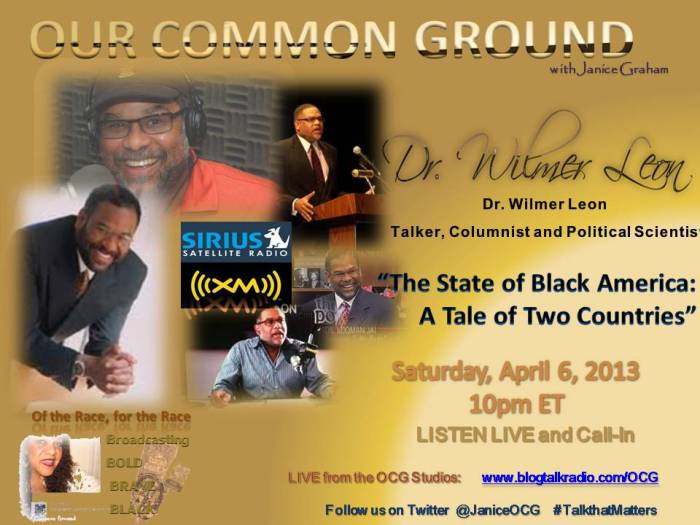
 

04-06 Wiler2 Leon


“The State of Black America: A Tale of Two Countries”

Tonight’s Guest: Dr. Wilmer Leon

Dr. Leon comes to OCG once again to weigh in on the issues which face Black America, the politics of our problems and the light of solutions available.

Wilmer J. Leon III, Ph.D. is a Political Scientist whose primary areas of expertise are Black Politics, American Government, and Public Policy. He is a Teaching Associate in the Political Science Department at Howard University in Washington, D.C., a nationally syndicated broadcast radio talk show host, columnist, commentator, political consultant, TV host, lecturer, and much sought after motivational speaker.

Dr. Leon earned a BS degree in Political Science from Hampton Institute, a Masters in Public Administration (MPA) from Howard University, and a Ph.D. in Political Science from Howard University.

A serious void exists in the public discourse relating to the issues that directly and/or disproportionately impact the global village in which we live. Dr. Leon’s lectures and writings focus on issues such as the media’s coverage of national and international issues, the criminal industrial complex, environmental racism, school vouchers, health care, crime policy, economic globalization, American domestic and foreign policy from as much of a non- biased and academically accurate perspective as possible. Dr. Leon’s perspective and lectures are grounded in the history of the African American community and the tradition of African American scholarship.

Dr. Leon is host/producer of the nationally broadcast call in talk radio program Inside The Issues With Dr. Wilmer Leon on XM/Sirius satellite radio channel 169 “Urban View” and the host of Epilogue, a political book discussion program on Press TV. He hosts discussion on Facebook as Dr. Leon Prescriptions.

Dr. Leon was a regular guest on CNN’s Lou Dobbs Tonight and is a contributing columnist to The Grio.com, The Black Agenda Report, The Maynard Institute.com, TruthOut.org, PoliticsInColor.com and Black Star News.

OUR COMMON GROUND with Janice Graham

“Speaking Truth to Power and Ourselves”

BROADCASTING     BRAVE     BOLD BLACK

LISTEN LIVE 

Join the discussion in our Open Chat during the broadcast.

 On the Web

Follow us on Twitter    @JaniceOCG      #TalkthatMatters

Like US on Facebook

LIVE: OCG Meetinghouse: http://www.blogtalkradio.com/OCG
For More Information: http://www.ourcommongroundtalk.wordpress.com/


Economic Mobility For African Americans May Be A Myth l Pew Report Finding

Economic Mobility For African Americans May Be A Myth, Pew Report Shows

The Huffington Post  |  By  Posted: 07/17/2012

Economic Mobility

The fine line between the American Dream and the African-American Dream is becoming more distinct, according to a recent report by the Pew Charitable Trusts, a nonprofit research organization.

The survey of economic mobility across generations compared the income and wealth of Americans with that of their parents at the same age, and it offered a promising outlook for most Americans — 84 percent to be exact — who were shown to have higher incomes than their parents, when adjusted for inflation.

African Americans, however, haven’t had the same success, with just 23 percent of blacks raised in the middle class surpassing their parents’ family wealth, compared to 56 percent of whites.

The study’s project manager, Erin Currier, said the results aren’t far off from what a simliar 2008 survey found. “With this newest update to the data, we can see that not much has changed with a few more years of data added in,” Currier told The Huffington Post. “Specifically, African Americans are much more likely than whites to be stuck at the bottom of the income ladder over a generation, and also at the bottom of the wealth ladder,” she said. They’re also more likely to fall from the middle.

Currier and her team analyzed income data over five years from the University of Michigan’s Panel Study of Income Dynamics (PSID), a nationally representative sample of more than 18,000 individuals living in 5,000 families in the United States. During the years they chose — 1967, ’68, ’69, ’70 and ’71 for the parents; 2000, ’02, ’04, ’06 and ’08 for their kids — both groups were at a common age (in their early to mid 40s) and at similar positions of marriage, income parity and post-secondary education, Currier said.

“It is the case that African-American families manage to get to the middle class and they have some sense of economic security, but their ability to pass that on to their kids is not as high as the white families,” she said.

And while this particular study didn’t delve into specific reasons for this gap, Currier pointed to previous research showing the impact neighborhood poverty has had on maintaining wealth disparities over time. “Two thirds of African-American children born between 1985 and 2000 are being raised in high poverty neighborhoods,” compared to just six percent of white children, Currier noted, proportions that haven’t shifted much over the last 30 years. “It isn’t the case that two thirds of African-American families are poor, but a lot of even middle-class African-American families are living in high poverty neighborhoods and research shows that, that environment in childhood increases a person’s chance of downward mobility by 52 percent,” she added.

A study published in May by the National Bureau of Economic Research may have hinted at one of the barriers to moving out of those poverty-stricken neighborhoods, revealing that black and Hispanic homebuyers pay as much as 3 percent more for their homes, regardless of their income, wealth or credit profiles.

Pew research has also examined the roles that marital status andincarceration have played in the black-white economic mobility gap in recent years. Meanwhile, others have looked at the roles of higher education and even differences by region. (Those with a college degree and those who live in the Northeast U.S. have a higher chance of moving up, researchers say.)

Since 2006, Currier and her team have set out to examine the health and status of the American Dream, which she says is more than a cliche, but rather a part of our national fabric based on the notion that your children can do better than you did.

“Our research shows a pretty mixed view of the degree to which that’s true,” she said. “On one hand, there has been significant economic growth over the last generation, [wealth that] has been broadly, equally shared. But at the same time, we see some lack of movement on the ladder as a whole.” So even though Gen Xers may have greater incomes than their parents did within a certain income bracket, they may not make enough to move to the next bracket up, Currier explained.

That finding contradicts what is said to be the crux of the American Dream, that all Americans have equality of opportunity regardless of their economic status at birth.

“A defining factor of the American dream is that a person’s family background or income has no bearing on where he or she ends up, but the study shows otherwise,” Currier said in an interview with the Poughkeepsie Journal.

Did Cornel West Go Too Far — Again? l Zerlina Maxwell

Did Cornel West Go Too Far — Again?

After his “blackface” quip, maybe he’ll learn to make his critiques more constructive and less offensive.

By: Zerlina Maxwell | Posted: November 14, 2012 

Cornel West (Karen Bleier/AFP)

(The Root) — Professor Cornel West has struck again. The always outspoken Obama critic recently said in an interview with Democracy Now: “I think that it’s morally obscene and spiritually profane to spend $6 billion on an election, $2 billion on a presidential election, and not have any serious discussion — poverty; trade unions being pushed against the wall, dealing with stagnating and declining wages when profits are still up and the 1 percent are doing very well; no talk about drones dropping bombs on innocent people … I mean, I’m glad there was not a right-wing takeover, but we end up with a Republican, a Rockefeller Republican in blackface, with Barack Obama, so that our struggle with regard to poverty intensifies.”

Putting aside the substance in West’s comments, since there are certainly valid and substantive policy critiques to be made of the Obama administration, it is completely unnecessary for him to attack the president in such a racialized and offensive manner. Any good points he made are lost.

This isn’t the first time that the Princeton and Union Theological Seminary professor has attacked the president as a person instead of sticking to policy. West has previously called the president a “black mascot of Wall Street oligarchs and a black puppet of corporate plutocrats.” West and his partner Tavis Smiley (they have a public-radio show together, Smiley & West), also an outspoken Obama critic, have failed, time and again, to keep their critiques focused on policy when commenting on the shortcomings of the Obama administration.

High-profile black intellectuals who dared to support the president in public are not immune from the wrath of West and Smiley, either. The Rev. Al Sharpton, Melissa Harris-Perry and Michael Eric Dyson are “for sale” for access to Obama, according to West. This an interesting choice of words, considering Smiley’s history with corporate sponsors including Wells Fargo and Exxon Mobil.

Perhaps, with a second Obama win, West and Smiley feel their influence diminishing within the black community, which supported the re-election of President Obama with even higher turnout than in 2008 in key states, despite criticism. President Obama has been elected and re-elected, and the old guard of black political thought is becoming more and more marginalized as a result. No longer does a black politician need to be ordained by Smiley orgrace the stage of his (now-canceled) State of the Black Union speech-a-thon to be considered a contender for high office.

There are legitimate critiques of the president and serious issues to tackle during his second term. The challenge for Obama critics is to point out areas that absolutely need to be addressed — high black unemployment and, yes, poverty — without attacking the president as a man. With pride continuing to cloud their critiques of President Obama, West and Smiley have failed to do this time and again. It seems that they are facing a future in the black-intellectual wilderness over the next four years.

Let’s hope that during Obama’s next term, we can all work together to push the president and his administration to make big changes (or at least use his bully pulpit to talk about big changes, since the balance of power in Congress is unchanged) that will benefit the lives of the millions who voted for him. Offering constructive criticism and applying public pressure that is intended to assist the president rather than undermine him is a much more effective strategy going forward. Maybe more high-profile black thinkers will take note.

Zerlina Maxwell is a political analyst and contributing writer for Ebony.com, theGrio.com and Feministing.com. She writes about national politics, candidates and specific policy and culture issues, including domestic violence, sexual assault, victim blaming and gender inequality. Follow her on Twitter.


More Black Men in Jail Than in College? Wrong l Ivory A. Toldson, Ph.D

More Black Men in Jail Than in College? Wrong

Show Me the Numbers: A 13-year-old report using questionable data gave rise to an enduring myth.

Students at a Morehouse College commencement (Getty); prisoners at the Avon Park Correctional Facility (Getty)

(The Root) — What does the line “There are more black men in jail than in college” have in common with the Jheri curl? Answer: They were invented by white men (Jheri Redding and Vincent Schiraldi, respectively) and adopted enthusiastically by black people, and they left a nasty stain on the shoulders of millions of black men.

It’s been more than 20 years since the Jheri curl faded away into infamy, and I’m proud to say that even in the 1980s, I never sported a curl. Unfortunately, I can’t say the same about the line “There are more black men in jail than in college.”

About six years ago I wrote, “In 2000, the Justice Policy Institute (JPI) found evidence that more black men are in prison than in college,” in my first “Breaking Barriers” (pdf) report. At the time, I did not question the veracity of this statement. The statement fit well among other stats that I used to establish the need for more solution-focused research on black male achievement.

I was in good company. The same year, at a 2007 NAACP forum, then-presidential candidate Barack Obama said, “We have more work to do when more young black men languish in prison than attend colleges and universities across America.”

However, just as a Jheri curl would be wrong no matter how you dressed it up today, the line “There are more black men in jail than in college” is wrong no matter how you contextualize, qualify or articulate it.

Today there are approximately 600,000 more black men in college than in jail, and the best research evidence suggests that the line was never true to begin with. In this two-part entry in Show Me the Numbers, the Journal of Negro Education’s monthly series for The Root, I examine the dubious origins, widespread use and harmful effects of what is arguably the most frequently quoted statistic about black men in the United States.

Continue Reading

Will Globalization Destroy Black America? l THE BLACK STAR PROJECT

Will Globalization Destroy Black America?

Will Globalization Destroy Black America?

The lack of response to globalization by Black America is frightening and troubling. While much of the world has adapted to the new-world economy and new-world standards of existence, most of Black America is still operating much the same way it did in the 1950s and 1960s. But now, throughout Black communities in America, there is a whisper campaign by Black people who don’t know each other and Black people who live in different parts of the country, saying to each other, “We are in trouble!” We know it and the rest of the world knows it! Black America, as we know it, is in danger of not surviving globalization.

In the 21st century, there are only two kinds of people. Not Black or White, or rich or poor, or foreign or national. The two kinds of people in the world today are those who are educated and those who are not. Although education has become the new currency of exchange in the 21st century, the old American educational paradigm stopped working decades ago for Black Americans. Simply sending Black children to American schools without a clear purpose or goal has contributed to the demise of the Black community. Black America watched formerly third-world countries catapult over America to become educational super powers while America rested on its old, stale educational laurels and fell way behind much of the world in educational performance. And because Black America unthinkingly depended on the American education system to educate its children, we have fallen way behind.

The horrific educational, social, health, economic and criminal justice indicators in much of Black America predict a meltdown of gargantuan proportions in the near future for the Black community. But still, the thing that is most remarkable and unbelievable is the lack of response by Black Americans to this impending doom! Without numerous positive changes, practical well-thought-out ideas, massive mobilization and immediate action, the fate of many Black Americans is sealed. We will not be able to prosper in the cities of America or possibly in any city in the world where the new currency for existence is access to global information, higher-order critical thinking and advanced technological skills. There used to be a time when it was better to be poor in America than rich in other countries. Now it might be better to be poor in some other countries than to be poor in America.

Black people in America must immediately disengage from the diversions of mind-deadening entertainment, useless sports, hyper-sexuality, excessive social celebrations, pointless conversations and debates, meaningless media and the civil rights issue de jour approach to managing our problems. We must focus on the most important issue in our communities — making education the highest priority. We must create a culture of literacy and learning that replaces intellectual apathy and resistance to educational progress. Somehow, we must re-inspire our children to want to learn and to love to learn. But having educated children is not enough. We must have educated families and educated communities. Every Black man, woman and child must become part of this new community of learners.

Black America must take education out of the schools and universities and root it in our homes, our workplaces, our communities, our churches and even in our streets and prisons. The purpose of education as defined by the Equipped for the Future initiative, a federally sponsored effort to develop a framework for accountability in adult education, is to help people actualize their roles in society as parent/family members, citizen/community members and workers in the economy. If the education system that serves us is not meeting these objectives, it is a disservice to our children and our communities.

The ability of a people to survive in changing times is not magic, nor is it by chance. Success depends on people being able to change to survive in a new environment! And new environments demand new skills for survival. Equipped for the Future tells us that without certain basic skills, survival will be extremely difficult for Black people, or any people, in the 21st century. These essential skills are the ability to read with understanding; convey ideas in writing; speak so that others can understand; observe critically; listen actively; solve problems and make decisions appropriately; plan and put those plans into action effectively; use math to solve problems and to communicate; cooperate with others; guide others; advocate and influence; resolve conflict and negotiate; take responsibility for life-long learning; learn through research; reflect and evaluate; and use information and communication technology. These are the skills necessary to survive in the 21st century.

The solution to the issue of Black America’s poor response to globalization is to 1) Deconstruct value systems that have caused Black people to arrive at the precipice of non-existence; 2) Construct value systems that will rebuild the Black family as a purveyor of positive values, cultures, mores and education, and re-establish the Black family as the primary and most important social unit of our culture and society; 3) Embrace education as the highest value in the Black community; 4) Effectively manage the negative cultural influences that hugely impact the thinking and actions of Black boys; and 5) Understand that for the rest of existence, change is a required part of the living process. The faster Black America is able to put this plan into action, adopt these new principles and manage change, the more likely we will survive.

Today, many Black people seem to be having “cosmic flashbacks” to our time in slavery, which was the first crude effort at globalization that helped to set the stage for today’s globalization. For years, Black America was buffered from modern globalization by political boundaries and economic barriers. Now globalization has come to our country, our cities, our communities, onto our blocks and into our homes, schools and workplaces. Globalization has happened, whether Black America is ready for it or not. We still have time to make the necessary changes that will guarantee that Black people will survive into the 21st century and that we will thrive in this global economy. But there is not much time. With globalization, Black America has entered into the “Educate or Die” era. In this era, there are only two questions worth answering: “Will we change? Can we survive?” How we emerge from this era is up to us.

Phillip Jackson, Executive Director
The Black Star Project
3473 South King Drive, Box 464
Chicago, Illinois 60616
773.285.9600 or email at blackstar1000@ameritech.net


EXCELLENCE IN EDUCATION

He Simply Doesn’t Care About People Like You: The Real Reason that the President of Emory’s Comments on Slavery and the 3/5th’s Clause Really Hurts (Some of You)

MONDAY, FEBRUARY 18, 2013

He Simply Doesn’t Care About People Like You: The Real Reason that the President of Emory’s Comments on Slavery and the 3/5th’s Clause Really Hurts (Some of You)


We have not had a “real talk” moment in quite some time.James Wagner, the President of Emory University’s suggestion, that the 3/5th’s compromise was noble, necessary, and an example of good governance to be admired is an appropriate moment to share some uncomfortable truths.

Wagner’s comments have attracted a good amount of attention. For many, it is shocking that an accomplished man of letters would so unapologetically “white wash” the history of slavery in the United States.

Yes, those of us who are are students of American history should be offended by a flattening of the historical record, and a very sympathetic view of the nobility of white elites to count black slaves as less than a full person in the service of maintaining an ignoble institution.

I get all of those sentiments.

Here is the painful reality that many of those in the out-group, the less than privileged, the Other, the marginalized, and the like have not yet figured out: James Wagner does not care about you. His comments on slavery were not a personal dig, stab, or barb. Black folks, our legacy, personhood, and the like are quite simply not choices on the decision tree which is used to teach lessons about politics, social life, history, the present, future, or the past by men like him.

You/we/us are footnotes and outliers.

People of color–and likely women, gays and lesbians, the “disabled”, and other folks who are not “normal” by the narrow definitions of hetero normative, able bodied, Whiteness–are also non-factors in the worlds of the truly race and class privileged in American society.

You/we/us spend much energy on these matters; They spend little to none at all.

I know that hurts. Privilege has, well for lack of a better turn of phrase, its own privileges.

It is best to accept such facts if you are to wage battle effectively on their terrain.

I will double down. The real damage done by colorblind and institutional racism in the post civil rights era is that seemingly race neutral decisions about policy and related matters are done with a calculi which ignores how said decisions will impact the life chances of people of color.

Here, the White Supremacists, the caricatures who make convenient bogeymen and women, are easy targets.

Why? Because they actually think about black and brown people a great deal. Moreover, those who are classic bigots are oddly obsessed with non-whites. There is a certain deep intimacy that comes with racism. It is love, fascination, and hate all rolled up into one ball.

The movers and shakers, the shot callers who have the ability to impact policy in ways that hurt the Other, do not usually care one iota about the latter. The privileged are not bad people, per se. The Other is simply not on their radar. For this reason, the elite–the top tier of the in-group–are so dangerous precisely because of an ability to sleep well at night because said agents can tell themselves that they are race neutral and good people, despite how their decision-making hurts those not in their circle.

Trust me, James Wagner is legitimately surprised by the reaction to his comments. In his eyes, he made a self-evident and obvious observation about American history. The apology is necessary for reasons of realpolitik and peace.

In all probability, Wagner has no idea what the fuss is about. Nor, does he really care. Why should he?

If you want to start playing that 3d Star Trek chess on these matters of race, politics, and justice in the Age Obama, it is essential that you start thinking about the agents who do the work of impersonal and institutional racism (as well as other types of social inequalities), not as demons or villains, but as self-interested actors who care little about people not like them.

Again, they are not “bad people.” They simply do not care about about people like you. The privileged classes are possessed of narcissism. The disadvantaged are also possessed of narcissism too, as they think that the world cares one bit about them. Sadly, it does not.

Remember, institutional racism is not personal. It is only business. If you accept that premise, then you can learn how to adapt, achieve, and overcome it. If you take institutional and impersonal racism personally, well then, you will just be beaten down and defeated every time.

I know that hurts. Someone had to say it.

Follow the Blog of OUR COMMON GROUND Voice, Chauncey DeVega “We are Respectable Negroes”
11-10 chaunceydevega


Do Black Intellectuals Need to Talk About Race? l Room for Debate @ NYT

Room for Debate Home

UPDATED FEBRUARY 4, 2013 8:33 PM

Do Black Intellectuals Need to Talk About Race?

Black Intellectuals Have Sold Their Souls

Eddie S. Glaude Jr.

Eddie S. Glaude Jr. is the William S. Tod Professor of Religion and African-American Studies in the department of religion at Princeton University and the chairman of the Center for African-American Studies.

FEBRUARY 4, 2013

 Black academics don’t have a “special obligation” to speak to broader social and political issues. What we have witnessed over the last few decades is the increasing professionalization of this particular class of persons – where the object of their scholarly interests range across a number of subjects that aren’t reducible to questions of race. These individuals stand alongside those who work explicitly on racial matters, but their work doesn’t necessarily reach beyond the confines of a specialized academic community. The political significance of their ideas has been weakened or worse, banished to the shadows, and we’re left, as my grandmother would say, “bumping our gums.”


Too many have given up the work of thinking carefully about black America. We have become cheerleaders for President Obama or self-serving pundits.

However, the role of the black intellectual raises a different question. I do believe that intellectuals generally ought to aspire to be the moral conscience of their societies: that what we write, say and do should reflect intelligent efforts to provide a critical account of who we take ourselves to be as a nation. Black intellectuals take up this task in the context of black communities and the ever-shifting regime of race that undermines democratic possibility in this country. (And remember that the folks who do this kind of labor do not have to work in universities or colleges.)

That’s what they ought to do. Instead, today we are experiencing a “new nadir.” Too many black intellectuals have given up the hard work of thinking carefully in public about the crisis facing black America. We have either become cheerleaders for President Obama or self-serving pundits. Our celebration of his singular achievement and our crazed desire for access have made many of us “born-again patriots.”

All too often what stands in for the black intellectual these days are folks who can spin a phrase and offer a soundbite. The idea of the intellectual who reads widely and deeply and who critically engages the complexity of our times has been supplanted by the fast-talking “black Ph.D. pundit” who strives to be on CNN, Fox or MSNBC. This same pundit has found new career opportunities within universities and colleges by thinking about black people in ways that conform to the current liberal consensus about racial matters.

The combination turns out to be a deadly one. I am reminded of what the sociologist C. Wright Mills wrote in 1948: “The two together, for the liberal ideology, as now used by intellectuals, acts as a device whereby he can take advantage of the new career chances but retain the illusion that his soul remains his own.” Put another way, too many black intellectuals have sold their souls “for a mess of pottage,” while the misery in black America deepens. And there is a tragic story to tell about how we arrived at this point.

Even given this state of affairs, I remain hopeful. Those of us committed to the work of thinking carefully in public with others must model the value of seriousness amid the white noise of our current media landscape. This involves using various social networks to push critical conversations and thinking among our fellows; it entails recommitting ourselves to build reading and writing communities that cultivate the habits of public intellectual work; it means bringing our skills to bear on the problems of our day through interpretations that single out our failings and point the way forward to what needs to be done to, as James Baldwin wrote, “achieve our country.”

Room for Debate NYT


Do Black Intellectuals Need to Talk About Race?

DEBATERS

Eddie S. Glaude Jr.

Black Intellectuals Have Sold Their Souls

EDDIE S. GLAUDE JR., RELIGION, PRINCETON

Too many have given up the work of thinking carefully about black America. We have become cheerleaders for President Obama or self-serving pundits.

Melissa Harris-Perry

The Few, the Famous

MELISSA HARRIS-PERRY, POLITICAL SCIENCE, TULANE

Most of the work of academics goes unnoticed. A few of us gain public attention, but most often we are just the best-looking, most articulate thought synthesizers of our age.

Carl Hart

Keep to Your Expertise

CARL HART, PSYCHOLOGY, COLUMBIA

Not every black academic is an expert on race. Qualified intellectuals of any race should raise their voices about social and racial issues.

Stephon Alexander

A Responsibility to the Next Generation

STEPHON ALEXANDER, PHYSICS AND ASTRONOMY, DARTMOUTH

As a tenured faculty member, I feel an obligation to recruit and mentor black and other minority group members, as well as to shape institutional support.

Khalil Muhammad

Many Voices’ Many Agendas

KHALIL MUHAMMAD, SCHOMBURG CENTER, NEW YORK PUBLIC LIBRARY

The incarceration and sustained poverty of black and brown young men are a product, in part, of the off-campus activities of conservative black intellectuals.

INTRODUCTION

W.E.B. Du Bois, the sociologist and civil rights activist, in 1949.Associated PressW.E.B. Du Bois, a leading black intellectual of an earlier generation.
Two decades ago, The Atlantic Monthly chronicledthe rise of black academics, including Cornel West, Henry Louis Gates Jr. and Patricia Williams, who had vigorously taken on the role of public intellectuals, stirring debate on issues of importance to African-Americans. Today, more African-Americans hold more positions at colleges, not always involving subjects that have particular relevance to black people.

Do these academics still have a special obligation to address the nation’s social and racial issues? Are there particular challenges or opportunities faced by intellectuals who talk to the public about social issues?

Josef Sorett, an assistant professor of religion and African-American studies at Columbia University, organized this discussion.

READ THE DISCUSSION »

OUR COMMON GROUND Opens 2013 Season with Political-Cultural-Social Commentator Playthell Benjamin

OUR COMMON GROUND with Janice Graham

2013 Season Opening

season 2013opening2

 Playthell Benjamin

February 2, 2013 10pm ET

LIVE and Call In

2013 Season Opening

Listen LIVE


GUEST: Playthell Benjamin, Author, Commentator, Scholar and Broadcaster

Commentaries on The Times

“Praising Saints, Celebrating Heroes, Unmasking Charlatans, Defending the Defenseless and Chastising Scoundrel

“He characterized Tavis Smiley and Dr. Cornel West as misdirected and Marvin X of Oakland, a recovering left coast crack head and shameless sophist with an alter-ego bearing the curious name of “Plato Negro;” a pompous wag who confuses mindless mumbo jumbo with profound wisdom, alas I have been dragged back into an ethnic kerfuffle of the sort they love to wallow in but I eschew.” He writes about all the great issues of our time, and he is interested in the whole world. From the issues of SandyHook to Syria, the White House and the UN, there is no argument that Playthell Benjamin is a learned scholar and street smart analyst.”


About Playthell Benjamin

Playthell George Benjamin is the producer of “Commentaries On the Times” which he writes and delivers on WBAI radio in New York City. He is a producer with The Midnight Ravers, a long running show exploring the world of art and politics which has won several radio awards for excellence in programming. He is an award winning journalist who has been nominated for the Pulitzer Prize in two different categories: Explanatory Journalism, Village Voice 1988, and Distinguished Commentary, New York Daily News 1995. As part of the production team for The Midnight Ravers, Mr. Benjamin won a 2011 award for excellence in radio programming, given for The Curtis Mayfield Special.

playthell benjaminIn addition to major political current events, he has extensively written about the differences in political approach within the Black community on issues related to the Obama presidency, administration policies and achievement. Playthell has been an OUR COMMON GROUND Voice since the late 1980s and we welcome his voice back to our microphone. Our discussion will focus on issues related to Obama administration achievements, the inter-community discourse on Obama, and class struggle in America. His provocative, well-informed commentary is hard-hitting and sure to invite serious consideration of our positions and direction.

He characterized Tavis Smiley and Dr. Cornel West as misdirected and Marvin X of Oakland, a recovering left coast crack head and shameless sophist with an alter-ego bearing the curious name of “Plato Negro;” a pompous wag who confuses mindless mumbo jumbo with profound wisdom, alas I have been dragged back into an ethnic kerfuffle of the sort they love to wallow in but I eschew.” He writes about all the great issues of our time, and he is interested in the whole world. From the issues of SandyHook to Syria, the White House and the UN, there is no argument that Playthell Benjamin is a learned scholar and street smart analyst.

He writes that he has spent “a half century chronicling the triumphs and studying the problems of the black world. Indeed I was a co-founder of the first free standing, degree granting, Black Studies Department in history – the W.E.B. DuBois Department of Afro-American Studies at the University of Mass, Amherst. I also spent quite a few years as an activist trying to solve those problems, beginning with the explosion of the black student movement in the south during the spring of 1960. Since then my life story would make a spectacular read even by the standards of a romance novel.”

Playthell has won several prizes ranging from The Unity Award presented by the School of communications at Lincoln University in Missouri for distinguished commentary on race relations; the Griot Prize for excellence in covering a story requiring an exploration of African American history and culture: “Who is Listening to Louis Farrakhan?” It was awarded by the New York chapter of the Association of Black Journalist in December 1989. In 1991 Mr. Benjamin won the NYABJ Magazine Awards for Feature Stories, and in 1996 he won the first Annual Tom Forcade Award “for honesty and accuracy in drug reporting” awarded by High Times magazine for his columns on drug use and abuse in the New York Daily News.
From 1991 – 1996 Playthell was a regular contributor to the Guardian Observer of London, where he wrote on politics, culture and sports. He also wrote for the Sunday Times of London, particularly in the prestigious magazine, The Culture, which addresses cultural matters high and low. In the London Guardian he wrote feature stories ranging from the television coverage of the Los Angeles race riot sparked by the Rodney King incident, to the courtroom genius of the great First Amendment Lawyer Martin Garbus, as well as the O.J. Simpson Trial, The Mike Tyson Rape Case, The Inauguration of Bill Clinton, Concerts at Lincoln Center, and the Sista Souljah vs. Bill Clinton incident. Mr. Clinton’s saxophone playing was also subjected to serious critical evaluation in an essay titled “He may be the Leader of the Western World…But will he ever be President of the Saxophone? For The Sunday Times he wrote about the Youth Jazz festivals convened by the peerless jazz vocalist Betty Carter, Michael Douglass’ movie on the desperation of displaced white workers, Gangsta Rap, Jazz, etc.

PhotoFunia-a349

OUR COMMON GROUND with Janice Graham

“Speaking Truth to Power and Ourselves”

BROADCASTING BRAVE BOLD BLACK

Community Forum: http://www.ourcommonground-talk.ning.com/
Twitter: @JaniceOCG #TalkthatMatters
Web: http://www.wordpress.ourcommongroundtalk.com/

Resistance and Accountability in the Academy l Sr. Faculty at UPenn Challenges President

graduation2

Guest Column | Guess who’s (not) coming to dinner

President Gutmann fails at increasing administration diversity

By SENIOR FACULTY OF AFRICANA STUDIES · January 30, 2013, 12:32 am

Every institution has traditions that celebrate diversity on campus and the University of Pennsylvania is no exception.

Penn President Amy Gutmann invites faculty of color to a dinner at her house each year. Last year’s dinner was a memorable one. With the term for the dean of the School of Arts and Sciences soon ending and the newly appointed provost on hand, President Gutmann was asked during a heated exchange why she has never appointed a person of color to the position of dean during her long tenure at Penn.

Her response was that she would not just bring in someone who is not qualified, a comment implying that none of the people in the room were qualified to serve in these positions, even though many of them serve in administrative capacities in departments and centers. In her closing remarks, President Gutmann reiterated her dedication to diversity within Penn’s administration, admitting that “a show beats a tell.”

President Gutmann’s “show” came on Jan. 17, when she announced the appointment of the new dean of the School of Arts and Sciences. Yes, a show beats a tell every time, and once again, she has shown that her commitment to diversity does not include her own administration. When presented with yet another opportunity to increase diversity at the highest levels of the University, she failed to do so after nine years at the helm.

Not only has President Gutmann failed to show leadership in diversifying the highest levels of University administration, those individuals appointed by President Gutmann have often modeled her example and made similarly nondiverse appointments of vice provosts, associate deans and other high-ranking administrative staff.

Don’t take our word — walk into the Provost’s office or many of the deans’ offices at Penn. Like begets like, and in this instance, the absence of clear leadership and real results seems to have trickled down to those who report to her. The president’s most recent dean appointment is simply one more example of failure to act in a manner that is consistent with diversity claims and a recently enacted university-wide diversity plan.

Still, President Gutmann persists in speaking and writing about diversity, touting it on Penn’s website and elsewhere as the leading tenet of her presidency.

To her credit, there has been progress on creating a more diverse undergraduate student body. But the continuing failure of any changes in her own leadership team raises questions either about her ability to lead or about her commitment on this particular issue, or both.

Whatever the reason, the sad truth is that her stated vision for a more diverse administration and faculty at the University has yet to be matched by actions taken by her and those she has appointed.

So consider this an early RSVP. As senior faculty of color at Penn, we will not attend any “faculty of color” dinner this year. In the afterglow of the Dr. Martin Luther King Jr. holiday weekend and the second inauguration of our country’s first African-American president, we can no longer mask our disappointment, stifle our outrage or pretend not to notice the incongruity between internal actions and public words of commitment to diversity at the institution that we serve.

If President Obama can be queried about the diversity of his administration, as well he should be, then certainly the same applies to the president of the University of Pennsylvania.

The annual “diversity dinner” is indicative of cosmetic — not substantive — progress on diversity that we believe President Gutmann must address. Our decision not to attend this year’s dinner — and to share that decision with the Penn community — is not a petty one, nor is it one we’ve made lightly. Rather, it is based on a long overdue decision to forgo these meaningless gestures toward progress on diversity.

Only when issues of diversity are substantively engaged at the highest levels of our administration, not simply promoted as social events, will real change occur at Penn.

It is long past time to turn rhetoric into reality, planning into action and commitment into leadership. We stand ready to actively engage in that process. Until then, dinner can wait.

Camille Charles, Barbara Savage, Mary Frances Berry, Vivian Gadsden, Kenneth Shropshire and Tukufu Zuberi are all senior faculty in
. They can be reached at ccharles@pop.upenn.edu.

LAST UPDATED JANUARY 30, 2013, 12:32 AM


Celebrating the ‘complete’ Martin Luther King Jr.; unfinished work and all l Dr. Blair L.M. Kelley

Celebrating the ‘complete’ Martin Luther King Jr.; unfinished work and all

by Blair L. M. Kelley

Blair L. M. Kelley is an associate professor at North Carolina State University. Follow her on Twitter at @ProfBLMKelley

My 9-year old daughter came home this week raving about her class and their discussion of Martin Luther King, Jr.

She declared that she loved learning about his life and that she was thankful to him because without King, no change would have been possible in America on the question of race. I am a historian of African-American history specializing in social movements, so I quickly moved to correct her. Of course change would have happened, even if King had never lived! I described to her other leaders. I reminded her that movements don’t function because of just one great man. I told her that King was not a perfect person, and that even he had come short of meeting all his goals. In the end, I even resorted to reminding her that I wrote a book on a movement that took place 35 years before King was even born.

Clearly my daughter didn’t care. She insisted that her school would not be integrated, and that her whole world would not have been the same without King’s leadership.

After thinking about it for a while, I realized that most people feel the same way about King that my daughter does. King has become the single greatest icon of the civil rights movement—his words are studied, his great marches are remembered, his name marks our boulevards; his shadow, now literally cast in stone, looms large on our national consciousness. He has become the benchmark for great leadership, so much so that nearly every leader that has emerged after him is compared to him, and found wanting.

As an icon, King is often thought of as flawless, so that we rarely reflect on his failures as a movement leader. Our collective memory of King only touches on the high points. The images we remember are the moments of his greatest triumphs as a leader: the 1955-56 Montgomery Bus Boycott, the 1963 March on Washington, the Birmingham Campaign that same year, and the 1965 march from Selma to Montgomery. Each of these efforts resulted in positive change, clear victories in the courts or in the halls of Congress.

We tend not to remember the moments when King faltered or searched for the right direction. We don’t recall the indecision about what to do next after the success of the Montgomery Bus Boycott; the challenge of the 1966 Chicago Freedom Movement campaign, or his unfulfilled Poor People’s Campaign — cut short by his tragic assassination in 1968. These moments are forgotten when King is not remembered in his broader context.