Segregation Now … – The Atlantic

Segregation Now …

Sixty years after Brown v. Board of Education, the schools in Tuscaloosa, Alabama, show how separate and unequal education is coming back.


APRIL 16, 2014

Nikole Hannah-Jones/ProPublica

Photographs by Maisie Crow


Enough James Dent could watch Central High School’s homecoming parade from the porch of his faded-white bungalow, it had been years since he’d bothered. But last fall, Dent’s oldest granddaughter, D’Leisha, was vying for homecoming queen, and he knew she’d be poking up through the sunroof of her mother’s car, hand cupped in a beauty-pageant wave, looking for him.

So, at about 4:30 in the afternoon on October 18, Dent, age 64, made his way off the porch and to the curb along Martin Luther King Jr. Boulevard in the West End of Tuscaloosa, Alabama. Soon he could hear the first rumblings of the band.

There was a time, little more than a decade ago, when the Central High School homecoming parade brought out the city. The parade started in the former state capital’s lively downtown and seemed to go on for miles. The horns of one of the state’s largest marching bands, some 150 members strong, would bounce off the antebellum mansions along the streets. Revelers—young and old, black and white, old money and no money—crowded the sidewalks to watch the elaborate floats and cheer a football team feared across the region.

Central was not just a renowned local high school. It was one of the South’s signature integration success stories. In 1979, a federal judge had ordered the merger of the city’s two largely segregated high schools into one. The move was clumsy and unpopular, but its consequences were profound. Within a few years, Central emerged as a powerhouse that snatched up National Merit Scholarships and math-competition victories just as readily as it won trophies in football, track, golf. James Dent’s daughter Melissa graduated from Central in 1988, during its heyday, and went on to become the first in her family to graduate from college.

But on that sunlit day last October, as Dent searched for Melissa’s daughter in the procession coming into view, he saw little to remind him of that era. More caravan than parade, Central’s homecoming pageant consisted of a wobbly group of about 30 band members, some marching children from the nearby elementary schools, and a dozen or so cars with handwritten signs attached to their sides. The route began in the predominantly black West End and ended a few blocks later, just short of the railroad tracks that divide that community from the rest of the city.

The reason for the decline of Central’s homecoming parade is no secret. In 2000, another federal judge released Tuscaloosa City Schools from the court-ordered desegregation mandate that had governed it for a single generation. Central had successfully achieved integration, the district had argued—it could be trusted to manage that success going forward.

Freed from court oversight, Tuscaloosa’s schools have seemed to move backwards in time. The citywide integrated high school is gone, replaced by three smaller schools. Central retains the name of the old powerhouse, but nothing more. A struggling school serving the city’s poorest part of town, it is 99 percent black. D’Leisha, an honors student since middle school, has only marginal college prospects. Predominantly white neighborhoods adjacent to Central have been gerrymandered into the attendance zones of other, whiter schools.

New Prinicipal

via Segregation Now … – The Atlantic.

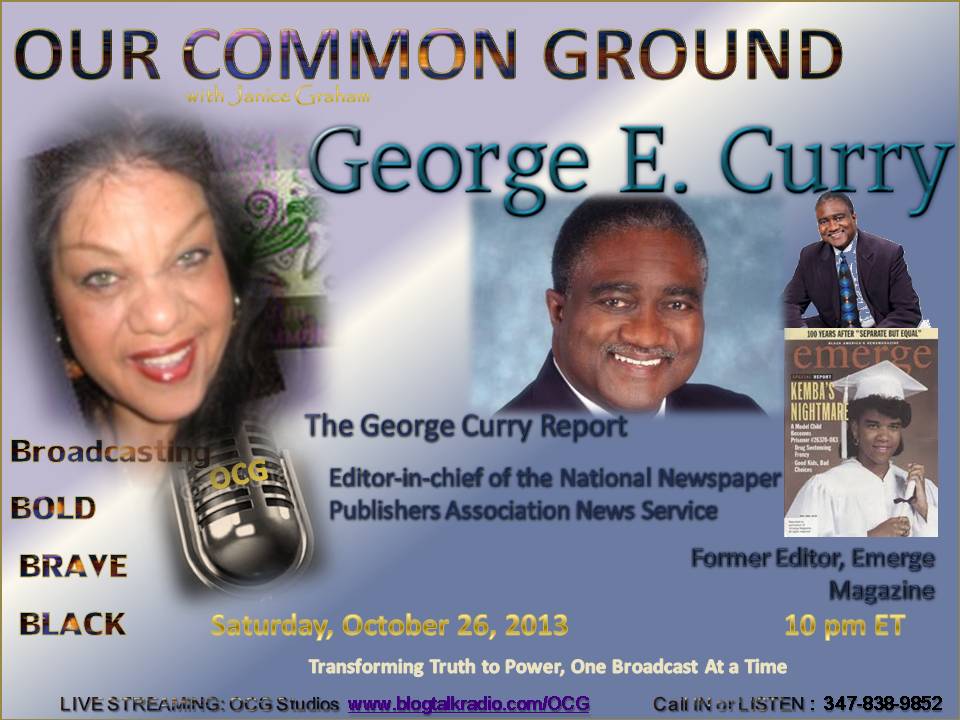
OUR COMMON GROUND “In Conversation with George Curry”

OUR COMMON GROUND with Janice Graham

“Transforming Truth to Power, One Broadcast At a Time”

“In Conversation with George Curry”

October 26, 2013 
10 pm ET                                     LIVE and Call -IN

10-26-13 Curry

About our Guest George Curry

George E. Curry is the editor-in-chief of the National Newspaper Publishers Association News Service. The former editor-in-chief of Emerge magazine, Curry also writes a weekly syndicated column for NNPA, a federation of more than 200 African American newspapers.

Curry, who served as editor-in-chief of the NNPA News Service from 2001 until 2007, returned to lead the news service for a second time on April 2, 2012. His work at the NNPA has ranged from being inside the Supreme Court to hear oral arguments in the University of Michigan affirmative action cases to traveling to Doha, Qatar, to report on America’s war with Iraq.
As editor-in-chief of Emerge, Curry led the magazine to win more than 40 national journalism awards. He is most proud of his four-year campaign to win the release of Kemba Smith, a 22-year-old woman who was given a mandatory sentence of 24 1/2 years in prison for her minor role in a drug ring. In May 1996, Emerge published a cover story titled “Kemba’s Nightmare.” President Clinton pardoned Smith in December 2000, marking the end of her nightmare.

Curry is the author of Jake Gaither: America’s Most Famous Black Coach and editor of The Affirmative Action Debate and The Best of Emerge Magazine. He was editor of the National Urban League’s 2006 State of Black America report.

His work in journalism has taken him to Egypt, England, France, Italy, China, Germany, Malaysia, Thailand, Cuba, Brazil, Ghana, Senegal, Nigeria, the Ivory Coast, Mexico, Canada, and Austria. In August 2012, he was part of the official US delegation and a presenter at the US-Brazil seminar on educational equity in Brasilia, Brazil.
George Curry is a member of the National Speakers Association and the International Federation for Professional Speakers. His speeches have been televised on C-SPAN and reprinted in Vital Speeches of the Day magazine. In his presentations, he addresses such topics as diversity, current events, education, and the media.

Ikard comingBROADCASTING 
BOLD BRAVE BLACK

OUR COMMON GROUND with Janice Graham

“Speaking Truth to Power and Ourselves” 

email: OCGinfo@ourcommonground.com

LISTEN LIVE and Join the OPEN Chat: http://www.blogtalkradio.com/OCG
Community Forum:http://www.ourcommonground-talk.ning.com/
Twitter: @JaniceOCG #TalkthatMatters
Web: http://www.ourcommonground.com/
OCG Blog: http://www.ourcommongroundtalk.wordpress.com/
Pinterest : http://www.pinterest.com/ocgmedia/boards/
Visit our Tumblr Page: http://ourcommonground.tumblr.com/
Facebook: https://www.facebook.com/OCGTALKRADIO

One student editor fired, another suspended following protests at Grambling State Univ.

One student editor fired, another suspended following protests at Grambling State Univ.

20 Oct 2013

By Tracie Powell

UPDATING

The online editor was fired and the opinions page editor is under a two-week suspension at Grambling State University’s student newspaper, The Gramblinite, following growing tensions there between students and administrators.

David Lankster Sr. said he’s been fired after tweeting statements from anonymous sources and photos of dilapidated facilities (here and here) using the newspaper’s Twitter account, and he accused the school’s Director of Public Relations and Communications, former journalist Will Sutton, of attempting to censor student journalists.

“I was behind it. I was the only one on the ground hearing from the students and players,” said Lankster, the former sports editor who has worked at the paper since 2009. “Sutton was trying to mute our voice because we were tweeting the real news, the truth about what was going on.”

allDigitocracy reached out to Sutton on Sunday; he referred questions to the newspaper’s adviser who did not immediately respond to emails.

Tensions that have been simmering for weeks came to a head last week when Grambling football players walked out of a meeting with college president Frank Pogue; and they refused to play in a scheduled game over the weekend, taking a forfeit. Students are upset about crumbling buildings and a lack of teachers among other things, they said. There’s even mold in a section of the newsroom, Lankster said. Doors to the area are kept locked and students are told not to enter the area, he added.

While Lankster was fired, his colleague Kimberly Monroe was informed she was being suspended for two weeks. Monroe, the editor of the newspaper’s opinion section, said she was asked by the newspaper’s adviser to remove parts of a column submitted by Grambling’s student government president, including the president’s email address that he asked students to use to report problems on campus.

Kimberly Monroe“I refused and then I left,” said Monroe, a graduate student who said she has worked at the paper for two years. Monroe said she later attended a student rally where she spoke with local and national media about crumbling buildings and the student-teacher ratio. The next day Monroe said the newspaper’s adviser, Wanda Peters, asked what role she played at the rally. Monroe responded that she was there as a concerned student. “That’s when (Peters) told me that she didn’t know what she would do with me, but something would have to be done,” Monroe said.

Monroe can be seen in this Associated Press photo and is identified as the organizer of the Oct. 17th rally. She told allDigitocracy that she did help gather students, but had no idea members of the football team would attend. Having players present at the gathering on Thursday turned it into a media event that she did not expect, Monroe said.

Monroe was notified by email on Friday afternoon that she would be suspended from her job at The Gramblinite due to “unprofessional behavior.” An excerpt from the letter below states:

As a member of The Gramblinite, you should not have become involved in a public rally, as you did yesterday.  I know Mass Communication was not your undergraduate major so you missed the classroom instruction regarding conflict of interest.  But the Code of Ethics that you must read and sign each semester as part of your Gramblinite application outlines certain behaviors that are expected of you. Item No. 4 of the Code reads:

“We report the news without regard for our own interests, mindful of the need to disclose potential conflicts. We avoid involvement in campus events, politics, demonstrations and social causes that would cause a conflict of interest, or the appearance of such conflict.”

The letter is copied to Dr. Edward Welch, interim chief of the school’s department of mass communication, Dr. Janet Guyden, dean of the college’s graduate school and Dr. Connie Walton, provost and vice president of academic affairs. Peters, the adviser, did not immediately respond to emails asking for comment on the disciplinary actions against the student journalists, but she did include in the letter that Monroe contributes “much to The Gramblinite and it would be a blow to lose your participation.”

Monroe said she does not agree with the suspension. ”I’m a student first,” Monroe said in a telephone interview, “a student who works for a student newspaper.” Monroe added that she did not sign a code of ethics at the start of the current semester.

Lankster, the online editor, said he began tweeting developments and student frustrations with administrators around Oct. 17. He does not recall how many tweets he posted, but said some of them have been deleted by school officials, but not before they had caught Sutton’s attention. Sutton, a former president of the National Association of Black Journalists, did not answer specific questions, but earlier he tweeted these admonishments to Grambling’s student journalists:

This Week on OUR COMMON GROUND “The Killing of Radical Black Media”

OUR COMMON GROUND with Janice

Graham


October 12, 2013    LIVE


“The Killing of Radical Black Media”

Our Guest: Author, Researcher, Dr. Jeffrey B. Perry

Co-Author: “The Radicalization of Ray Richardson: Suspicion Still Surrounds Death of Black Activist TV Producer”

Must Read

“He was responsible to black people… so they had to get rid of him.”

In January, 1971, the young producer of Boston public television’s groundbreaking program Say Brother, was found dead in a Mexican resort, along with his fiancé. Ray Richardson was the grandson of Harlem’s radical Hubert Harrison.

The Story of Ray Richardson, Black public discourse pioneer and how “SAY Brother”, a TV show shaped contemporary Black media.

“Say Brother first aired on July 18, 1968,”  . . . it “helped set a standard of excellence for black television shows, with the issues it brought to the public, the artists it featured, and the education it provided for the white community.” It was “the era of Black Power, Black Pride, and the thrust for political power — an era when hairstyles and modes of dress proclaimed ‘Black is Beautiful’ and even the show’s title sent a message.” – “Say Brother’ was a commonplace greeting in those days. It was a signal, a sign of recognition that blacks were connected to one another emotionally and by common experience.” Ray Richardson was its founder, defender and producer.”

“. . . Ray Richardson’s death ( January, 1971 reported as drowning with girl friend in Acapulco, Mexico while vacationing) came in the period that included the December 4, 1969, murder of Black Panther activists Fred Hampton and Mark Clark by Chicago police; the 1970 CIA-involvement in the kidnapping (and subsequent death) of a Chilean general, Rene Schneider; the March 11, 1971, death in Nigeria of National Urban League Executive Director Whitney Young (by drowning according to a U.S. coroner, by brain hemorrhage according to a Lagos coroner) after he came out against the Vietnam War; the August 21, 1971,murder by prison guards of Black Panther George Jackson; and the September 11, 1973, death of Salvatore Allende during the CIA-driven coup in which armed forces and police overthrew the socialist government in Chile. It was also a period in which COINTELPRO, the FBI’s counterintelligence program, targeted Black radicals and activists and the Black Panther Party; the National Security Agency and its Minaret Program monitored and targeted Black and anti-war activists (particularly while abroad); and the Nixon administration sought to control Public Television and support its aims through its funding policies and removal of personnel it perceived as hostile.”

“. . . A great deal was also at stake regarding Black programming in the WGBH vs. Say Brother struggle. Charles Richardson points out that “WGBH was the flagship of the PBS network” and that, as he “understood it from Ray, it’s activities were “run out of the paranoid Nixon White House.” In addition, “the FBI under Hoover was monitoring all things Black.” In this way “Black public affairs shows, ostensibly introduced to feed the community’s appetite for information and news about local community goings on, were also the government’s way of monitoring thought, and, by the placement of their own operatives in positions of power and control (as directors/producers) they had the means to control thought by controlling the programming.” Neither Nixon, nor Hoover, nor WGBH management and its most powerful supporters wanted a show that truly gave voice to the Black community, particularly a show that included Black radical criticism of societal conditions.”

Excerpts from “The Radicalization of Ray Richardson: Suspicion Still Surrounds Death of Black Activist TV Producer”

“The Radicalization of Ray Richardson: Suspicion Still Surrounds Death of Black Activist TV Producer”

 Published in “The Black Agenda Report”     October 8, 2013

Read the full article here: http://bit.ly/1amm76U

by Jeffrey B. Perry and Charles V. Richardson In January, 1971, the young producer of Boston public television’s groundbreaking program Say Brother, was found dead in a Mexican resort, along with his fiancé. Ray Richardson was the grandson of Harlem radical Hubert Harrison.

Jeffrey B. Perry is an independent working class scholar whose work focuses on the role of white supremacy as a retardant to progressive social change and on centrality of struggle against white supremacy to progressive social change efforts. He is the editor of A Hubert Harrison Reader (Wesleyan University Press, 2001) and author of Hubert Harrison: The Voice of Harlem Radicalism, 1883-1918 (Columbia University Press, 2008). Most recently he wrote the introduction and back matter for the new expanded edition of Theodore W. Allen’s “classic” The Invention of the White Race (2 vols. 1994, 1997; Verso Books, 2012).

Charles V. Richardson is the brother or Ray Richardson and grandson and heir of Hubert Harrison. For many years he helped to oversee, and then to place, the Hubert H. Harrison Papers at Columbia University’s Rare Book and Manuscript Library. He works in the media field.


OUR COMMON GROUND with Janice Graham

 email: OCGinfo@ourcommonground.com

LISTEN LIVE and Join the OPEN Chat:  http://www.blogtalkradio.com/OCG

Community Forum:http://www.ourcommonground-talk.ning.com/

Twitter: @JaniceOCG  #TalkthatMatters

Webhttp://www.ourcommonground.com/

OCG Blog:  http://www.ourcommongroundtalk.wordpress.com

Pinterest : http://www.pinterest.com/ocgmedia/boards/

Visit our Tumblr Pagehttp://ourcommonground.tumblr.com/

Facebookhttps://www.facebook.com/OCGTALKRADIO

Shutdown jeopardizes nutrition program for poor

FRIDAY, OCT 4, 2013 09:22 AM EDT

Shutdown jeopardizes nutrition program for poor


“What’s going to happen to my baby?” asked one mother, as she fed her son formula bought with a WIC voucher

BY 


Shutdown jeopardizes nutrition program for poor
(Credit: AP)

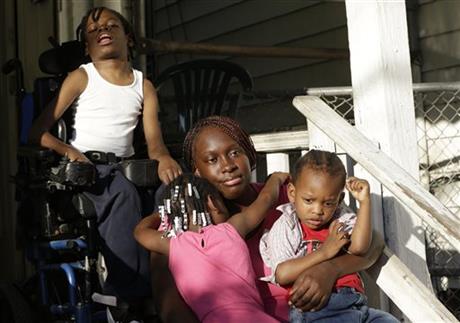
ALLENTOWN, Pa. (AP) — Jacob Quick is a fat and happy 4-month-old with a big and expensive appetite. Like millions of other poor women, Jacob’s mother relies on the federal Women, Infants and Children program to pay for infant formula — aid that is now jeopardized by the government shutdown.

Pennsylvania and other states say they can operate WIC at least through the end of October, easing fears among officials that it would run out of money within days. But advocates and others worry what will happen if the shutdown drags on beyond that.

“What’s going to happen to my baby?” asked Jacob’s mother, Cierra Schoeneberger, as she fed him a bottle of formula bought with her WIC voucher. “Am I going to have to feed him regular milk, or am I going to have to scrounge up the little bit of change I do have for formula or even baby food?”

WIC serves nearly 9 million mothers and young children, providing what advocates say is vital nutrition that poor families might otherwise be unable to afford.

Schoenberger, for example, said her son goes through about $40 worth of formula a week. “It’s like a car payment,” said the unemployed mother of three.

The Special Supplemental Nutrition Program for Women, Infants and Children — better known as WIC — supplies low-income women with checks or debit cards that can be used for infant formula and cereal, fruits and vegetables, dairy items and other healthy food. WIC also provides breast-feeding support and nutrition classes. Poor women with children under 5 are eligible.

Just before the shutdown, the U.S. Department of Agriculture had warned that states would run out of WIC cash after a “week or so.” Now the agency says WIC should be able to provide benefits through late October, with states using $100 million in federal contingency money released Wednesday and $280 million in unspent funds from the last budget year.

If the aid dries up, desperate moms will probably dilute their babies’ formula with water to make it last longer, or simply give them water or milk, said the Rev. Douglas A. Greenaway, head of the National WIC Association, an advocacy group. Pediatricians say children under 1 shouldn’t drink cow’s milk because they can develop iron deficiency anemia.

“These mothers have trust and confidence in this program, and that trust and confidence has been shaken by Congress,” Greenaway said. “This is just unconscionable.”


Danyelle Brents, 22, a single mother of three, receives about $200 a month in vouchers for food and formula for her two children and baby. She is being hit doubly hard by the shutdown: She is a contract worker for the Federal Aviation Administration who catalogs records for aircraft certification, and is furloughed. Now, with her baby going through 10 cans of formula a month, she might lose key help with her grocery bill.

“That’s a lot of money, $15 a can,” she said. “Now that I’m out of work, WIC is how I support my family. … I’m scared at this point to go buy anything extra.”

Groups that fight hunger say they are also concerned about the confusion that needy mothers may be feeling. Though most WIC offices are open, many mothers mistakenly assumed that benefits were cut off.

Advocates are also worried that there will be a cumulative effect as other, smaller government feeding programs run out of money.

Adding to the uncertainty: While USDA has said that food stamps are guaranteed to continue through October, it is unclear what will happen after that.

In Pennsylvania, whose $208 million WIC program supports 250,000 women and children, all local WIC offices remain open and benefits are being dispensed as usual. The state Health Department said it has $25.5 million on hand to continue operating the program through October. Ohio said it has enough money to last through the second week of November.

“Ohio WIC is open for business!” proclaimed the headline on a state website.

Utah’s WIC program, though, immediately closed its doors Tuesday in the wake of the government shutdown, meaning that families who hadn’t already received their October vouchers were out of luck and new applications couldn’t be processed. The state got $2.5 million in USDA funding on Thursday, and WIC offices throughout the state planned to reopen by noon Friday.

Charitable groups were already filling the void. A Facebook group called “The People’s WIC — Utah” was launched hours after WIC offices closed, matching up families in need with those able to donate formula and other food.

In Layton, about 25 miles north of Salt Lake City, a donation drive was planned for Saturday, with organizers asking for fresh fruits and vegetables, unopened baby formula and other necessities.

Food banks, meanwhile, are bracing for a surge in requests for help if WIC runs out of money.

Linda Zimmerman, executive director of Neighbors In Need, which runs 11 food banks in Massachusetts, said her organization already provides a lot of baby formula to its clients, most of whom get WIC aid as well.

“I think they’re truly nervous,” Zimmerman said. “We’re going to have to be doing a lot of work to make sure we can keep up with need for infant formula.”

In some places, grocery stores refused to honor WIC vouchers, assuming they wouldn’t get paid. Terry Bryce, director of Oklahoma’s WIC program, said WIC officials called and emailed grocers to assure them the program is still funded.

In New Jersey, Patricia Jones said she is worried about losing her WIC assistance.

“You’re affecting families that haven’t done anything to you,” said Jones, a 34-year-old mother of five. Because of the shutdown, she was turned away from the Social Security Administration office in Newark when she tried to get printouts of her children’s Social Security numbers to renew her welfare and WIC benefits.

___

Associated Press Writers Mary Clare Jalonick in Washington, Samantha Henry in Newark, N.J., Tim Talley in Oklahoma City, Bridget Murphy in Boston and Dan Sewell in Cincinnati contributed to this report.

Charter Schools Are a Colossal Mistake. Here’s Why

Diane Ravitch: Charter Schools Are a Colossal Mistake. Here’s Why


The campaign to “reform” schools by giving public money to private corporations is a distraction from our system’s real problems: poverty and racial segregation.

Photo Credit: michaeljung via shutterstock.com

October 2, 2013  |

Los Angeles has more charter schools than any other school district in the nation, and it’s a very bad idea.

Billionaires like privately managed schools. Parents are lured with glittering promises of getting their kids a sure ticket to college. Politicians want to appear to be champions of “school reform” with charters.

But charters will not end the poverty at the root of low academic performance or transform our nation’s schools into a high-performing system. The world’s top-performing systems – Finland and Korea, for example – do not have charter schools. They have strong public school programs with well-prepared, experienced teachers and administrators. Charters and that other faux reform, vouchers, transform schooling into a consumer good, in which choice is the highest value.

The original purpose of charters, when they first opened in 1990 (and when I was a charter proponent), was to collaborate with public schools, not to compete with them or undermine them. They were supposed to recruit the weakest students, the dropouts, and identify methods to help public schools do a better job with those who had lost interest in schooling. This should be their goal now as well.

Instead, the charter industry is aggressive and entrepreneurial. Charters want high test scores, so many purposely enroll minimal numbers of English-language learners and students with disabilities. Some push out students who threaten their test averages. Last year, the federal General Accountability Office issued a report chastising charters for avoiding students with disabilities, and the ACLU is suing charters in New Orleans for that reason.

Because they are loosely regulated, charter schools are often neither accountable nor transparent. In 2013, the founders of an L.A. charter with 1,200 students were convicted of misappropriating more than $200,000 in public funds. In Oakland, an audit at the highest-performing charter schools in the state found that $3.8 million may have been misused when the founder hired his other businesses to do work for his charters.

Charter schools are “public” when it is time to claim public funding, but they have claimed in federal court and before the National Labor Relations Board to be private corporations when their employees seek the protection of state labor laws.

In Los Altos, a group of wealthy people opened a boutique charter school for their own children. Parents are asked to donate $5,000 per child each year. Local public school parents consider the charter to be an elite private school, albeit one primarily funded with public dollars.

Of course there are honorable, well-run charter schools that provide an excellent education. This newspaper’s editorial board cites independent research that shows students in L.A. charters do better than they would in L.A. Unified schools. But many other studies show that charters in general are no more successful at the task of educating children than public schools if they enroll the same kinds of students.

As large as the gulf can be between charter cheerleading and charter reality, it doesn’t represent the greatest danger of these schools. They have become the leading edge of a long-cherished ideological crusade by the far right to turn education into a consumer choice rather than a civic obligation.

Abandoning public schools for a free-market system eviscerates our basic obligation to support them whether our own children are in public schools, private schools or religious schools, and even if we have no children at all.

The campaign to “reform” schools by turning public money over to private corporations is a great distraction from our system’s real problems: Academic performance is low where poverty and racial segregation are high. Sadly, the U.S. leads other advanced nations of the world in the proportion of children living in poverty. And income inequality in our nation is larger than at any point in the last century.

white out – from Gone agape.

Gone Agape.

white out.

http://goneagape.tumblr.com/post/55996194687/white-out

I haven’t had much to say about the trial of Trayvon Martin (yes he was the one on trial) because like many of you— this shit was emotionally destructive. What you may not know is me and Trayvon are from the same neighborhood. Literally. That I went to the elementary school and middle school that fed into Rachel Jeantel’s highschool of the same name. My brother went to Rachel’s high school, as did most of my friends growing up.
Had I not suffered from extreme anxiety that arose anytime I made a mistake, I would have gone to the same high school as Trayvon. The day I was to audition for their vocal program, I didn’t bring background music and after being chastised by the white woman organizing the auditions, I decided not to audition at all and lied to my mom about my rejection. I regret that.

So when I say this shit hits home, I mean it. It hit 197th Terrace in Miami Gardens, Florida. This hit home and it sucks. Because I know very well what comes out of North Dade and what died with Trayvon that night was a whole hell of a lot of potential and no conviction of George Zimmerman will allow us to see what Trayvon could have been.
But as much as this entire fiasco is about racism— it’s also about privilege. Privilege white people refuse to acknowledge and Black people can’t seem to communicate enough. No doubt that the privilege with roots in racism played a role in the trial… but, it’s not enough to say, things would be different if the races were reversed. People never want to deal in the what ifs… and no one seems to want to touch racism with a 10 foot pole. Though the acts are no doubt racist at the root, I rather be effective than right- so I need to acknowledge these things in a way people can digest.

White privilege is being able to live your life as a white man for all intents and purposes and become Hispanic when denying you are racist. That same privilege allows you to not know the difference between race and ethnicity. Privilege involves always getting the benefit of the doubt… because you are trusted.

No matter how ridiculous it might sound that you disobey an order by an emergency professional, and shoot someone to death for nothing really. Privilege is like that. Privilege is about the right to be an individual. That no matter how heinous crimes are that white people are accused of, no one looked at George Zimmerman and thought of Dahmer, or Bundy, or Gacy. No one diagnosed his anger issues, his insecurity, or overzealous nature as something indicative of a propensity to commit violence again. But when you’re Black, you are everyone else. Because, violent and mischievous Black teenagers exist, it was okay for Zimmerman to assume Trayvon was one. And because we don’t ever exist as individuals, then Trayvon becomes at fault for his own murder. Black children can’t make mistakes, white adults can.

Whenever there is an instance of one account versus another, the account of a White person is always more true. It’s the reason that I pull out my whitest voice possible when making any customer service transaction over the phone. When you’re white, you are you— when you’re Black you’re all of us, and all of us, are bad Black thugs. I don’t even like the premise that Trayvon could have gone to college and been a “good nigga.” Don’t show me a picture of another teenager with baggy pants and then with a graduation cap 10 years later… because, Trayvon wasn’t wronged because he could have been a college graduate and traded in his hoodie for a bowtie. Trayvon was wronged because he was here. We are wronged not just because we aren’t afforded individuality, we are wronged because someone believes they can determine the value, or lack thereof, of Black lives.

Privilege is when there is outrage about a white terrorist who makes the cover of Rolling Stone after killing white people in a horrific display of inhumanity. But awkward white boys with backpacks across the world will continue boarding planes, going hiking, being publicly intoxicated, and playing violent video games without so much as a nod in their direction. They will go to school without being tracked, and they will drive cars freely without being stopped. Privilege on privilege is when people are outraged he made the cover and not at the article that promises to tell us how a “popular, promising student was failed by his family, fell into radical Islam, and became a monster.”
No one is troubled by the suggestion that the Boston Marathon bomber was failed by his family and became a monster and Trayvon was supported by his family and born one. Privilege is telling Black people these things are not related in a world where everything is. Privilege is failing to understand the very real physical and psychological damage privilege and racial microaggressions cause. Since I have gotten a new car, I’ve been pulled over three times- more than in almost 10 years of driving. Privilege is when seeing the police is a sign of relief and not one of anxiety.

This discussion about racism will never be valuable if the subject matter and those discussing it are always the oppressed. It will never be valuable if we keep saying people who do racist shit are not racist because they are nice people. The cop who stopped me for “rolling through a stop sign” was a fucking racist. Why? Because he wanted to know where I was going, how long I owned my car, and asked to see my license and registration even though by his own admission, “everyone who comes to that sign always does the same thing.” And maybe he volunteers at his church or takes care of his sick mother and I’m supposed to believe he can’t be racist because he’s a nice person. Well, like people we love are addicts, or thieves or liars— we can love racists.  And while we pity him, it is me who has PTSD from being followed in the dark, humiliated, scared, and even as a civil rights attorney well aware that I was stopped for DWB in a nice car, I had to be non threatening and apologetic for a stop that I know was complete bullshit because I wanted to make it out alive.

And anyone whose privilege won’t allow them to recognize that fact, I suggest they ask Trayvon Martin how the decision to defend or be offended is so often a life or death one. I have no doubt Zimmerman spent his life relishing in microaggressions that were dismissed as non racist, and of people being too sensitive or obsessed with being politically correct. But the reality is, many microaggressions make for one big ass MACROaggression and a whole helluva lot of Trayvons. The running theme is, they are not like us, they are dangerous and they are all the same. So long as I have a Black friend, I can’t possibly have ever caused harm to another Black person. And if engaged in a fist fight with a black person, I must use a gun because the pure brute strength of the Black African makes any object in the universe a weapon. We can be armed with fresh air so it’s best to suffocate us all if given the chance.

And suffocate us they do, bit by bit. While we march for Trayvon and pack theaters to watch Fruitvale, I encourage everyone to call out these microaggressions and deconstruct the myth of Black inhumanity. We are human when we are born, not because we go to college, or because we wear bow ties. We are worthy because we are here.

 http://goneagape.tumblr.com/post/55996194687/white-out

About

gone agape is a blog that is centered around understanding the world with love as a compass. to go agape is to BE love. agape (uh-gop-ay) is the most divine, unconditional, self-sacrificing, active, volitional and thoughtful love.

to go apape is also to be open, and to find freedom in being honest about who you are. we may not always like what we find, but we must love it. and sometimes that means repairing the most broken parts of us. every post is a chance to challenge everything we have been taught, and unlearn when necessary. you don’t always have to agree, but you do have to be open to the process.

Agape Always.

“Indescribably insane”: A public school system from hell ” – Salon

MONDAY, AUG 19, 2013 07:01 PM EDT

“Indescribably insane”: A public school system from hell


Pennsylvania’s right-wing governor drains public schools of basic funds — and the sickening details will shock you

BY 


Pennsylvania Gov. Tom Corbett(Credit: Associated Press)

Want to see a public school system in its death throes? Look no further than Philadelphia. There, the school district is facing end times, with teachers, parents and students staring into the abyss created by a state intent on destroying public education.

On Thursday the city of Philadelphia announced that it would be borrowing $50 million to give the district, just so it can open schools as planned on Sept. 9, after Superintendent William Hite threatened to keep the doors closed without a cash infusion. The schools may open without counselors, administrative staff, noon aids, nurses, librarians or even pens and paper, but hey, kids will have a place to go and sit.

The $50 million fix is just the latest band-aid for a district that is beginning to resemble a rotting bike tube, covered in old patches applied to keep it functioning just a little while longer. At some point, the entire system fails.

Things have gotten so bad that at least one school has asked parents to chip in $613 per student just so they can open with adequate services, which, if it becomes the norm, effectively defeats the purpose of equitable public education, and is entirely unreasonable to expect from the city’s poorer neighborhoods.

The needs of children are secondary, however, to a right-wing governor in Tom Corbett who remains fixated on breaking the district in order to crush the teachers union and divert money to unproven experiments like vouchers and privately run charters. If the city’s children are left uneducated and impoverished among the smoldering wreckage of a broken school system, so be it.

To be clear, the schools are in crisis because the Commonwealth of Pennsylvania refuses to fund them adequately. The state Constitution mandates that the Legislature “provide for the maintenance and support of a thorough and efficient system of public education,” but that language appears to be considered some kind of sick joke at the state capital in Harrisburg.

It’s worth noting that the state itself runs the Philadelphia School District after a 2001 takeover. The state is also responsible for catastrophic budget cuts two years ago that crippled the district’s finances. And in a diabolical example of circular logic, the state argues that the red ink it imposed, and shoddy management it oversees, are proof that the district can’t manage its finances or its mission and therefore shouldn’t  get more money.

Make no mistake, on the aggregate the district does not perform well. Only slightly more than 60 percent of students graduate from high school, with less than 60 percent proficient in reading and math. But put that in the context where 80 percent of students come from disadvantaged backgrounds while administrators struggle to cobble together enough cash to even open doors, let alone provide a safe, rich and comprehensive educational experience.

Particularly noxious lawmakers are fond of spouting the ridiculous notion that money can’t help struggling schools, as if more and better-trained staff, better equipment and diverse programming wouldn’t make a difference in kids’ educations and their lives.

The timing of this meltdown is unfortunate, as if there were ever a good time for the euthanasia of public schooling. According to the 2010 census, Philadelphia grew in population for the first time in 60 years, changing direction from decades of decline. Most of that growth came from immigrants who will rely on public schools — or not, as the case may be. Another area of growth was in young families, who will face a choice, once they have school-age children, to stay in the city or flee to superior suburban schools as previous generations have done.

Nearly the entire burden to keep the district afloat has fallen to the city, which raised property taxes each of the two previous years specifically to funnel extra money that the schools weren’t getting from the state. This is in one of the poorest and most highly taxed cities in the nation.

The floundering district is both a symptom and cause of the city’s predicament, creating a vicious cycle of people who can afford to bail moving to the suburbs, leaving a crippled tax base, with the result being less money to fix the schools and ever-higher taxes imposed on those who stay.

Unlike the city, the state could come up with the necessary cash without excessively burdening its finances. Pennsylvania has the lowest severance tax of any state drilling for Marcellus shale gas, with plenty of room for an increase. The state had a modest surplus at the end of the last budget year. The governor has no trouble coming up with money to build new prisons, which will serve as future homes for all too many children of Philadelphia who are being failed and tossed aside by adult leadership, if you can call it that.

The pattern has become clear: defund the schools, precipitate a crisis and use that as an excuse to further attack the schools, pushing them closer and closer to a point of no return. The $50 million to open the schools this year is just the latest and most immediate example of three years of brinkmanship.

The district was hit with a double whammy in 2011, when stimulus funds that it had idiotically been using for operating expenses dried up, and incoming Gov. Tom Corbett took office eager to prove his reactionary bona fides by enacting massive budget cuts to public education to the tune of $1 billion statewide, disproportionately hitting Philadelphia. The result was an absurd $629 million shortfall, which was filled by a mix of cuts and city tax hikes.

Last year, the district took out a $300 million bond to patch another big deficit, the very definition of a band-aid fix as it only added to what is now $280 million in annual debt payments.

This round of budget hysteria kicked off in May when the superintendent announced that the district was another $304 million in the hole for the upcoming school year and requested extra funding from the city and state as well as givebacks from the teachers union to fill the gap.

To prepare, he laid off nearly 4,000 teachers and staff members, and closed 24 schools, after the district had shut eight the year before. Empty buildings and mass layoffs — the perfect image of 21st century education.

The city and state came up with a Rube Goldberg device of funding worth about $140 million, composed of repurposed federal funds, better city tax collections, borrowing against future city taxes and a whopping $2 million thrown in by the state beyond what it had already committed.

Most of even that inadequate amount hasn’t arrived yet as the state sits on $45 million in federal money it refuses to disperse until the teachers agree to enormous salary cuts and rollback of other benefits and city officials bicker among themselves on how to deliver the money they promised.

It’s still unclear what, if anything, will be kicked in by the teachers, who already make disproportionately less money than their suburban counterparts while teaching in much more challenging environments. Their contracts expire at the end of the month.

Leering over the whole mess is the controversial charter school movement, which siphons $675 million from district schools. The charter experiment has been a mixed bag, with some performing well, others proving mere vehicles for graft and corruption. Critics see them as a way to divert public money into politically connected private hands, and even more important, a way to break the teachers union because they aren’t bound by district collective bargaining rules.

It’s not hard to see the same forces at work here as those taking apart public sector unions in Wisconsin and trying to confiscate Detroit city employees’ pensions in Michigan. Indeed, the district leadership met Thursday to unilaterally suspend the school code to get around teacher seniority and automatic raise rules as they use the $50 million to rehire some of the employees laid off earlier this year.

Teachers are understandably displeased at being blamed for a problem the state has caused. “It is Commonwealth of Pennsylvania’s obligation to fully fund public education. Yet the budget office seems to be employing any and every means to avoid living up to this responsibility,” Philadelphia Teachers Federation president Jerry Jordan said in a statement. “Chronic lack of resources has brought this crisis to our schools, not work rule provisions in collective bargaining agreements.”

“The trunk of my car is now filled with a carton of paper, pens, lined paper, and copybooks I have bought for my students this September,” district teacher Christine MacArthur wrote in an editorial to the Philadelphia Inquirer. “Now we are also to pay for the mistakes of our employers?”

Parents and students are trying to push back, but may ultimately have little traction. Thousands of students led by the Philadelphia Student Union walked out last spring to protest the doomsday budget, to no avail. Now, with the stark projections of May becoming reality in August, members are canvassing the streets to rally support. “I’m just doing it for my school because it’s the right thing to do,” one student told a local television station. “We are going to need counselors. Without counselors, it’s going to be hard to get into college.” The group is considering boycotting school entirely if the district doesn’t get the money it needs.

“It’s indescribably insane,” says Helen Gym of the advocacy group Parents United for Public Schools, who has three children in the public school system. “It’s unbelievable that it’s come to this.” The group put out a statement Thursday reemphasizing that $50 million was far from enough to have effective schools.

“I don’t send my child to go to a shell of a building, I send my child to get an education,” Gym says. “They can’t do that with $50 million.”

The district got its $50 million, though, and will get more in dribbles and drips. That will barely, not really, suffice for inadequate schooling this year. Next year, stay tuned for a repeat. Barring an unforeseen economic renaissance in the city or thorough overhaul of the state executive and legislative branches, the district is poised for year after year of one crisis after another.

Parents and teachers are all too aware of what’s happening. “Tom Corbett, the weakest governor in the United States, is trying to stake his claim on completely dismantling and starving one of the nation’s largest school districts into dysfunction and collapse,” says Gym.

The nails aren’t all in the coffin yet, but they are being pounded deeper every year by a state that has turned its back on, if is not openly hostile to, the idea of free and equitable education for all.

“It’s an absolute atrocious mockery of anything related to public leadership,” Gym says. “To not have a stable public school system is more devastating to Philadelphia than anything that has happened before.”

Aaron Kase is a freelance writer and a reporter for Lawyers.com. Follow him on Twitter at@Aaron_Kase.MORE AARON KASE.

Detroit and America’s Racial “Exceptionalism” | Black Agenda Report

 Detroit and America’s Racial “Exceptionalism” | Black Agenda Report.

A Black Agenda Radio commentary by executive editor Glen ford

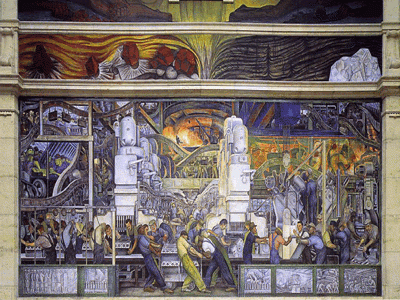
The picture is of Diego Rivera’s mural Detroit Industry, 1932-33, Detroit Institute of Arts.

Corporate solutions can justifiably be substituted for democracy, when it comes to Blacks.”

The great American dissolution of electoral democracy is playing out in Detroit, where last Monday the state-appointed Emergency Financial Manager explained to a crowd at Wayne State University how he would compassionately go about the business of breaking their city into buyable and sellable parts. The people and their elected representatives would have no say in the ultimate result.

The corporate media, and white folks in general, view the process as an inevitability – a kind of crude justice – not because they have rejected the principle of self-government, but because Detroit is overwhelmingly Black, and Blacks have always been the exception to the American rule. In fact, all of the Black population centers of Michigan have been divested of the right to govern themselves.

There has been no national outpouring of solidarity with Michigan’s Blacks over the loss of their citizenship rights, which can only mean that there exists an effective white consensus that African Americans are not fully deserving of those rights. Uncontrolled concentrations of Blacks are seen as pathological, by definition.

The same race-based exception was made to public education, for Blacks. In New Jersey and localities across the country, public schools in largely Black areas have for decades been under state control, denying Black parents any effective voice in their children’s education. By and large, white suburbanites supported the state in making Blacks an exception to the general American rule on local control over education. It is a right Blacks are not thought to be qualified to exercise.

Blacks were an exception to the Constitution.”

The same racial exception to the rule led to massive privatization of inner city education, through wholesale imposition of charter schools and private school vouchers. When education secretary Arne Duncan declared that Hurricane Katrina was the best thing that ever happened to public schools in New Orleans because it allowed most of the city’s schools to be converted to charters, there was no national condemnation of his remarks – since it is accepted that Blacks cannot run their own school systems. They are the great exceptions to the American rule. Corporate solutions can justifiably be substituted for democracy, when it comes to Blacks.

The problems of drugs and crime were framed as Black phenomena, requiring a more flexible interpretation of civil liberties and the creation of a vast police state. Just as the Founding Fathers actually intended, Blacks were an exception to the Constitution.

Blacks, and their alleged “pathologies,” were considered the nexus of poverty and social disintegration in America. Therefore, the social safety net was kept at the absolute minimum.

And now, all these exceptions that have been made for Blacks, are to become models for America as a whole, in the age of austerity, corporatized education, undemocratic governance, and the National Security State. In places like Detroit and New Orleans, America has been busily creating the pilot programs for the rule of the rich, by systematically undermining social democracy for Blacks.

The great exception, is becoming the rule.

For Black Agenda Radio, I’m Glen Ford. On the web, go to BlackAgendaReport.com.

BAR executive editor Glen Ford can be contacted at Glen.Ford@BlackAgendaReport.com.


Why the United States Is Destroying Its Education System l Chris Hedges

Why the United States Is Destroying Its Education System

April 1, 2013

Photo illustration by PZS based on an image byLin Pernille Photography

By Chris Hedges

A nation that destroys its systems of education, degrades its public information, guts its public libraries and turns its airwaves into vehicles for cheap, mindless amusement becomes deaf, dumb and blind. It prizes test scores above critical thinking and literacy. It celebrates rote vocational training and the singular, amoral skill of making money. It churns out stunted human products, lacking the capacity and vocabulary to challenge the assumptions and structures of the corporate state. It funnels them into a caste system of drones and systems managers. It transforms a democratic state into a feudal system of corporate masters and serfs.

Teachers, their unions under attack, are becoming as replaceable as minimum-wage employees at Burger King. We spurn real teachers—those with the capacity to inspire children to think, those who help the young discover their gifts and potential—and replace them with instructors who teach to narrow, standardized tests. These instructors obey. They teach children to obey. And that is the point. The No Child Left Behind program, modeled on the “Texas Miracle,” is a fraud. It worked no better than our deregulated financial system. But when you shut out debate these dead ideas are self-perpetuating.

Passing bubble tests celebrates and rewards a peculiar form of analytical intelligence. This kind of intelligence is prized by money managers and corporations. They don’t want employees to ask uncomfortable questions or examine existing structures and assumptions. They want them to serve the system. These tests produce men and women who are just literate and numerate enough to perform basic functions and service jobs. The tests elevate those with the financial means to prepare for them. They reward those who obey the rules, memorize the formulas and pay deference to authority. Rebels, artists, independent thinkers, eccentrics and iconoclasts—those who march to the beat of their own drum—are weeded out.

“Imagine,” said a public school teacher in New York City, who asked that I not use his name, “going to work each day knowing a great deal of what you are doing is fraudulent, knowing in no way are you preparing your students for life in an ever more brutal world, knowing that if you don’t continue along your scripted test prep course and indeed get better at it you will be out of a job. Up until very recently, the principal of a school was something like the conductor of an orchestra: a person who had deep experience and knowledge of the part and place of every member and every instrument. In the past 10 years we’ve had the emergence of both [Mayor] Mike Bloomberg’s Leadership Academy and Eli Broad’s Superintendents Academy, both created exclusively to produce instant principals and superintendents who model themselves after CEOs. How is this kind of thing even legal? How are such ‘academies’ accredited? What quality of leader needs a ‘leadership academy’? What kind of society would allow such people to run their children’s schools? The high-stakes tests may be worthless as pedagogy but they are a brilliant mechanism for undermining the school systems, instilling fear and creating a rationale for corporate takeover. There is something grotesque about the fact the education reform is being led not by educators but by financers and speculators and billionaires.”

Teachers, under assault from every direction, are fleeing the profession. Even before the “reform” blitzkrieg we were losing half of all teachers within five years after they started work—and these were people who spent years in school and many thousands of dollars to become teachers. How does the country expect to retain dignified, trained professionals under the hostility of current conditions? I suspect that the hedge fund managers behind our charter schools system—whose primary concern is certainly not with education—are delighted to replace real teachers with nonunionized, poorly trained instructors. To truly teach is to instill the values and knowledge which promote the common good and protect a society from the folly of historical amnesia. The utilitarian, corporate ideology embraced by the system of standardized tests and leadership academies has no time for the nuances and moral ambiguities inherent in a liberal arts education. Corporatism is about the cult of the self. It is about personal enrichment and profit as the sole aim of human existence. And those who do not conform are pushed aside.

“It is extremely dispiriting to realize that you are in effect lying to these kids by insinuating that this diet of corporate reading programs and standardized tests are preparing them for anything,” said this teacher, who feared he would suffer reprisals from school administrators if they knew he was speaking out. “It is even more dispiriting to know that your livelihood depends increasingly on maintaining this lie. You have to ask yourself why are hedge fund managers suddenly so interested in the education of the urban poor? The main purpose of the testing craze is not to grade the students but to grade the teacher.”

“I cannot say for certain—not with the certainty of a Bill Gates or a Mike Bloomberg who pontificate with utter certainty over a field in which they know absolutely nothing—but more and more I suspect that a major goal of the reform campaign is to make the work of a teacher so degrading and insulting that the dignified and the truly educated teachers will simply leave while they still retain a modicum of self-respect,” he added. “In less than a decade we been stripped of autonomy and are increasingly micromanaged. Students have been given the power to fire us by failing their tests. Teachers have been likened to pigs at a trough and blamed for the economic collapse of the United States. In New York, principals have been given every incentive, both financial and in terms of control, to replace experienced teachers with 22-year-old untenured rookies. They cost less. They know nothing. They are malleable and they are vulnerable to termination.”

1     NEXT PAGE >>>

The World As It Is: 


Dispatches on the Myth of Human Progress

A collection of Truthdig Columns
by Chris Hedges

Keep up with Chris Hedges’ latest columns, interviews, tour dates and more at www.truthdig.com/chris_hedges.

TAGS: