If Barack Obama doesn’t represent the end of respectability politics, nothing does.
If the way that man dropped his middle name and lost all accent and did limbo—drinking in Irish pubs and eating sloppy joes and casseroles and killing Muslims and keeping the military industrial complex’s wars and not taking Billy John’s guns; toning down his own swag and terrorist fist bumps, no longer brushing off his shoulder—did nothing to make whyte America feel safe, there’s no argument to be made for appeasing the boogey men in the minds of whyte folks. There’s no PhD that can match the degree of servitude Our Shining Black Hope expressed over eight years in the face of the fears of ignorant, pre-logical, post-factual whyte folks.
The only thing that matches his kowtowing at their runaway imaginations is the utter contempt they showed by coming out of their Middle American caves to the polls two months ago. The only thing that matches the amount of way he gave them is the amount of power rich whyte men wielded to make sure that his crowning achievement would be passing the baton to the least worthy of them as if to say, “A monkey could do this job; an abject failure—more of a failure than the buffon who came before Obama can do this job.”
No, America: This replacement is not of equal or greater value. Maybe the Russian prostitutes are not a fact, but the way you’ve urinated on the legacy of Hope is all too true.
Barack Obama—President 44 of the United States of America Barack Obama—was a Good Negro. So good that some of us in the field saw him go into the House every night while the slave patrols murdered us in the streets for snuff films and left our bodies out in the street like Willie Lynch letters and we still meme’d him and loved him and wanted him to win and are praying to this day and every other of his life that he dies the natural death of a man, not that of a King on a balcony.
President Barack Obama pulled his pants up so high we couldn’t see his eyes; just his smile. He crossed his T’s and dotted his I’s and spoke the Queen’s English so well that his words smelled like tea and crumpets and tasted like Marmite. Love it or hate it, he spread his obsequiousness all over their daily bread, knowing where his was buttered.
Barack Hussein Obama II, 44th President of the United States spoke the Lie of Progress in the only way a whyte folks will hear it; in the way that says, “We will be patient and submerge our desire—our right—to be treated as men and women and human children to your comfort. We will not ask anything of you that disturbs your predilection for treating our cultures and religions like fashion accessories and glurges.”
He spoke the Lie of Progress in living rooms and in schools, at farms and on factory floors, at diners and on distant military outposts, wearing bullet-proof suits that covered the whipping scars on his back, his pants up to his eyes so that no one would see him cry.
He spoke the Great Lie to those who asked for his birth certificate, to those who asked what he did for a living and how he earned that car he was riding in and marveled at how articulate he was while telling his wife to go back to Africa to dance with simians because they were her family.
Through it all, 44—the Man, the Legend, the living history and culmination of so much Hope—smiled, rarely giving glimpse to the enervation borne of submission. In that way, he was like us, and we saw ourselves in him.
So, now what do we see? What do we see as he walks into the pages of history, retreating to the relative protection of his legacy and status and opportunity while the worst of our lifetimes is about to happen? How well-dressed and smart must we be? Is it possible to be well-dressed and smart and articulate enough to assuage the fears of whyte folk who think that Rise of the Planet of the Apes is prediction while thinking that 1984 is not?
We’re not that good.
In spite of his flaws, and because of the way he carried them, Barack Obama was twice as good as at the best of us and he got half the respect of the worst of us. He got half the respect and is being replaced by a guy who would not be the smartest man in the room were he the only man in the room.
When they believe that the top pick of the Talented Tenth is equal to a man who is one-tenth of his predecessor; that a man who sits on a gold throne in a gold tower at the bottom percentile of emotional intelligence can occupy the same seat as Barack Hussein Obama II, 44th President of the United States—how good must we be to gain their respect?
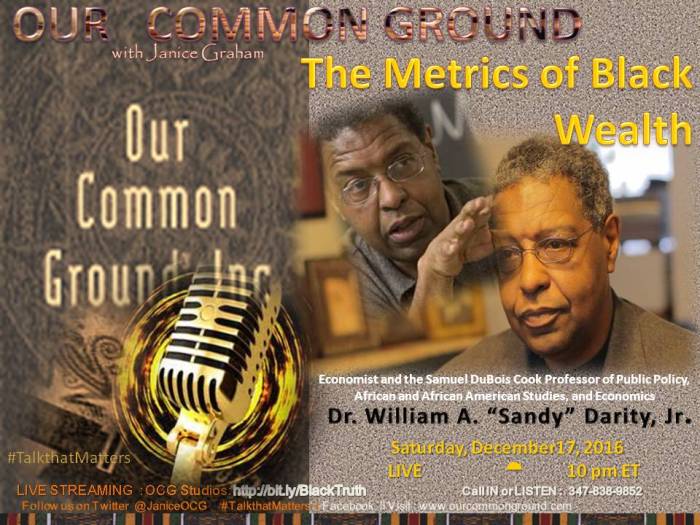
OUR COMMON GROUND with Janice Graham “The Metrics of Black Wealth” Guest: Dr. William A. (“Sandy”) Darity, Jr., Ph.D.
December 17, 2016 :: LIVE :: 10 pm EST
Listen LIVE and join the Chat: http://bit.ly/OCGDarity
Call In and LISTEN LINE: (347) 838-9852
WE can’t save, educate or job income ourselves out of the economic and financial history from which our poverty springs.
Structural and historical inequality has left Blacks with fewer assets than whites. Blacks in the top 10 percent have an average wealth of only $350,000 to the $1,200,000 of whites at the same income level. Across income groups, whites average $8 of wealth for every $1 owned by Blacks and Latinos.We need to devise wholly new approaches to wealth distribution that at once honor private property and family rights, while also putting to better use collective national assets. We need inheritance law reform and new taxes on larger estates that can enable reinvestment in emerging new talent.
What are the metrics which dictate, demonstrate and evidence our collective poverty ?
about Dr. Darity
Samuel DuBois Cook Professor of Public Policy
Professor in the Sanford School of Public Policy
Professor of African and African American Studies
Professor of Economics
Affiliate of the Duke Initiative for Science & Society
Affiliate of the Center for Child and Family Policy
AREAS OF EXPERTISE
Educational Policy
Educational Inequality
Segregation in Education
InequalityStratification
Economics
Student Achievement
Race
Racial Discrimination
Racial Identity
Wealth-United StatesIncome
InequalityEDUCATION
Ph.D., Massachusetts Institute of Technology (1978)
B.A., Brown University (1974)
He is the Samuel DuBois Cook Professor of Public Policy, African and African American Studies, and Economics and the director of the Duke Consortium on Social Equity at Duke University. He has served as chair of the Department of African and African American Studies and was the founding director of the Research Network on Racial and Ethnic Inequality at Duke.
In collaboration with Dr. Darrick Hamilton of the New School for Social Science Research, Dr. Darity formulated proposed an “interesting possible solution to address wealth disparities,” according to this Huffington Post blog. “Baby bonds” would mature in federally managed investment accounts until the beneficiary reached 18. Youth could have up to $60,000 to jumpstart their lifelong financial stability and help decrease wealth disparity in the U.S.
The The National Asset Scorecard and Communities of Color (NASCC) project is conducted by Duke University’s Research Network on Racial and Ethnic Inequality. The researchers are led by William Darity, Jr, at Duke University and Darrick Hamilton at The New School. The NASCC research team – with expertise in survey design, analysis of group differences in asset accumulation and debt burden, and general patterns of ethnic/racial group inequality, – was assembled to conduct the investigation and analyze the data generated from the study. The study is intrinsically multidisciplinary; members of the team represent the following fields: statistics, economics, sociology, political science, ethnic studies,and urban planning. NASCC published its landmark report, ” Umbrellas Don’t Make it Rain: Why Studying and Working Hard Isn’t Enough for Black Americans ” of which Dr. Darity is a co-author.
“1) A social cognition theory proposed by Stanford University Psychologist Albert Bandura that views people as self-organizing, proactive, self-reflective and self-regulating as times change. An agentic perspective states that we are not merely reactive organisms shaped by environmental forces or driven by inner impulses.
2) The capacity for human beings to make choices in the world. HUMAN AGENCY
We see the world as agents of change. We believe that we have choice over our actions and we strive to enable others to make informed, responsible decisions.”
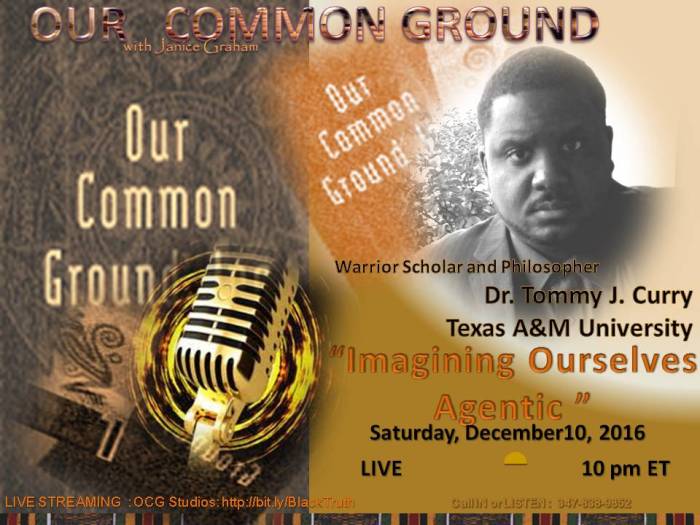
Recently, Dr. Curry wrote in his persistent advocacy of Black males in America, “The reoccuring structure of Black males coping with their rape is to accept its impossibility and imagine themselves as agentic. We need psychologists and social workers in these communities willing to treat these boys as victims , and theorists willing to engage female perpetrated rape beyond the idea of sexual initiation.” In the context of all of us as victims of racial attack, we ask whether any of us can imagine ourselves as agentic and if such a preposition may be impeded by inherent fallacies. Dr. Curry always brings opportunities FOR “transformative discourse”. He will be joining us once again on OUR COMMON GROUND with Janice Graham.
about Dr. Tommy J. Curry
Dr. Curry is an Associate Professor of Philosophy at Texas A&M University. He is a Ray A. Rothrock Fellow 13′-16′ in the Department of Philosophy.
He is an editor of PhilPapers, Choice Magazine and a regular contributor to RacismReview.com and OUR COMMON GROUND. He is Critical Race Theorist, Anti-Colonialist, Applied Ethicist and Black philosopher.
His work in social justice, applied ethics, and bioethics concerns the present interpretation of the Belmont report, and the racial/class barriers to minority access to medical innovation in health care. He has been interviewed by Forbes.com, the Wall Street Journal, Salon.com and other popular venues for his opinions on politics, ethics, and racial justice issues.
His upcoming book in Black Studies and Black Manhood Studies | “The Man-Not” can be Pre-Ordered now on Amazon.com.
Black Girls, Domestic Violence, and the Limits of Self-Defense
Submitted by Lindsey E. Jones on Tue, 09/20/2016 – 17:42
by Lindsey E. Jones
Recent scholarship in the history of black women and the carceral state illustrates the extent to which systems of criminal justice and law enforcement have both historically failed to protect black female victims of domestic violence and criminalized black women who rise up in their own defense.
Black Girls, Domestic Violence, and the Limits of Self-Defense
“Legal systems in this country explicitly and implicitly render black women defenseless against intra- and interracial violence.”
The case of Bresha Meadows, an African American teenage girl in Ohio, is a sad commentary on the failure of the state to protect victims of domestic violence. After a lifetime of watching him physically and psychologically abuse her mother—and of being subjected to threats and verbal abuse, along with her siblings—Bresha allegedly shot her father to death while he slept on July 28, 2016. While her mother’s family and her attorney consider her actions to have been in self-defense, the county prosecutor has charged Bresha with aggravated murder. It remains to be seen whether she will be tried as a juvenile or as an adult. At stake is the possibility that Bresha, who marked her fifteenth birthday in juvenile hall just weeks after her arrest, could spend the rest of her life in prison if convicted as an adult.
While the case is making its way through the courts and the families of Brandi Meadows (Bresha’s mother) and Jonathan Meadows (Bresha’s deceased father) share conflicting stories with news media about the latter’s personality and propensity toward violence, as well as their conflicting opinions about premeditation versus self-defense, it is important to note that this case is neither isolated nor entirely new. Recent scholarship in the history of black women and the carceral state illustrates the extent to which systems of criminal justice and law enforcement have both historically failed to protect black female victims of domestic violence and criminalized black women who rise up in their own defense.
“Survivors of intimate partner violence dramatically overrepresented among incarcerated black women.”
Historian Kali Gross, in providing historical context to the case of Marissa Alexander, argues that the state’s willingness to condemn this woman for defending herself against an abusive husband points back through centuries of American history to “the legacies of an exclusionary politics of protection whereby black women were not entitled to the law’s protection, though they could not escape its punishment.” Gross traces the ways in which “racialized, gendered notions of protection” have, from the seventeenth century on, shaped legal systems in this country that explicitly and implicitly render black women defenseless against intra- and interracial violence. She argues that this exclusionary politics of protection fuels the current mass incarceration crisis, with survivors of intimate partner violence dramatically overrepresented among incarcerated black women.1
Bresha Meadows’s case exemplifies Gross’s concept of the exclusionary politics of protection. This past May, Bresha ran away from home to the home of an aunt, Martina Latessa. Latessa, a police officer working in a domestic violence unit in Cleveland, was forced to return Bresha to her father, who had reported the girl as having been kidnapped by her aunt. Latessa reported her brother-in-law to Family Services, which resulted in an agent interviewing Brandi Meadows about the allegations of abuse—as Jonathan Meadows sat beside her. Neither law enforcement nor the state bureaucracy could protect Brandi Meadows and her children from this abuse, which she and her family assert intensified after this incident. As a result of the state’s failure to end the cycle of trauma in her family, Bresha Meadows took matters into her own hands—and was charged with aggravated murder, for which she could potentially spend the rest of her life in prison.
Gross’s essay compellingly reveals the intersections of race, gender, and class in black women’s hyper-vulnerability to domestic violence; state failure to prevent or put a stop to said violence; and the too-common outcome of black women being incarcerated for offenses resulting from attempting to defend themselves against domestic violence. However, as the case of Bresha Meadows illustrates, there is another vector of identity that often doesn’t appear in our historical analyses of black females and the carceral state: that is, age.2
“For black women in the Jim Crow South—as in antebellum times—domestic violence was constitutive of domestic labor.”
Where race, gender, and class have worked together to create the conditions discussed above, the erasure of age difference has historically created disadvantages for black girl victims of domestic violence. One prominent example recently provided by historian LaShawn Harris is that of Virginia Christian. Often referred to as the first woman to be executed by the Commonwealth of Virginia, Christian was in reality a seventeen-year-old girl when she was killed by electric chair in 1912—a fact that her advocates hoped would persuade the state to show her mercy.3
Virginia Christian belonged to a working-class black family in Hampton, Virginia, and needed to work in order to contribute to her household, including her disabled mother. From the age of thirteen, she served as a laundress for a middle-class white family named Belote in Hampton. During a dispute about missing jewelry that turned physical, Virginia killed the matriarch of the family—a crime she confessed to committing in self-defense. Harris argues that “Christian’s act of self-defense delineated working-class African American women’s impetuous ways of protecting their bodies and their often last attempts to seek and secure long-awaited personal justice—especially when legal protection seemed beyond their reach.” While there is no archival evidence that Ida Belote had laid hands upon Virginia Christian prior to this altercation, there is plenty of evidence to demonstrate that for black women in the Jim Crow South—as in antebellum times—domestic violence was constitutive of domestic labor, the racially prescribed set of occupations for black women and girls.4
Christian’s response was most immediately triggered by Belote’s accusations of theft and subsequent physical assault on March 18, 1912, but it is conceivable that she was also responding to other physical and psychological traumas accumulated over three years of working in the Belote household.
The analogy from Virginia Christian in 1912 to Bresha Meadows in 2016 is imperfect, but these cases both illustrate the extent to which the state has failed to consider age in evaluating black girls’ actions in self-defense from domestic violence. Sadly, over a century later, Bresha’s advocates find themselves making very similar demands of a system that hasn’t changed enough since Virginia’s trial, and employing very similar tactics in their pursuit of mercy for this abused adolescent girl.
“In the minds of whites, the accused, regardless of her age, was a deviant and vulgar black murderess that had to be punished for her crime.”
In the case of Virginia Christian, the Commonwealth of Virginia ignored evidence that Christian committed the crime at sixteen years of age in order to prevent her minority status from impeding its plan to execute her. Harris argues that, “in the minds of whites, the accused, regardless of her age, was a deviant and vulgar black murderess that had to be punished for her crime; essentially, Christians’ race trumped her gender and age. By denying Christian of her adolescent status, the State of Virginia sought to punish her to the full extent of the law.”5
Black and white Americans wrote letters and circulated petitions pleading with the Commonwealth to consider Christian’s youth as a factor in her crime and her punishment and to commute her sentence from execution to life in prison. In the end, neither Christian’s appeal to self-defense, nor her advocates’ appeal to adolescence, could spare her from the lethal retribution of the state.
In a throwback to the campaign to spare Virginia Christian’s life in 1912, advocates of Bresha Meadows are writing letters and circulating petitions in the hope that local prosecutors take into account her age and her status as a survivor of domestic violence as they proceed with charges against her. Because of the Supreme Court’s 2005 decision in Roper v. Simmons that it is unconstitutional to execute a person for a crime committed under eighteen years of age, the death penalty is not on the table for Bresha. However, because prosecutors could decide to try her in adult court, it is a real possibility that she could be sentenced to life in prison.
A century after Virginia Christian’s advocates passionately and strategically petitioned the Commonwealth of Virginia for life imprisonment, Bresha’s advocates argue that no adolescent should spend life in prison—especially not a girl pushed toward drastic action by a lifetime of trauma and abuse. There is thankfully still time for the prosecutors of Trumbull County to give real weight to Bresha Meadows’ traumatic life history, and to the fact that it spans fifteen short years, as they decide what action to pursue.
Lindsey E. Jones is a PhD Candidate in History of Education at the University of Virginia’s Curry School of Education and a 2016-2018 Pre-doctoral Fellow at the Carter G. Woodson Institute for African-American and African Studies at the University of Virginia. Her dissertation project, “‘Not a Place of Punishment’: the Virginia Industrial School for Colored Girls, 1915-1940,” historicizes the education and incarceration of black girls by examining Virginia’s only reformatory for delinquent African American girls. Follow her on Twitter @noumenal_woman.
NOTES:
1. Kali N. Gross, “African American Women, Mass Incarceration, and the Politics of Protection,” Journal of American History 102, no.1 (2015), 25–33.
2. For a contemporary examination of black girls, interpersonal violence, and the carceral state, see Jody Miller, Getting Played: African American Girls, Urban Inequality, and Gendered Violence (New York: NYU Press, 2008).
3. Lashawn Harris, “The ‘Commonwealth of Virginia vs. Virginia Christian’: Southern Black Women, Crime & Punishment in Progressive Era Virginia,” Journal of Social History 47, no.4 (2014), 922–42.
4. See, for instance: Tera W. Hunter, To ’Joy My Freedom: Southern Black Women’s Lives and Labors after the Civil War (Cambridge, Mass.: Harvard University Press, 1997); Thavolia Glymph, Out of the House of Bondage: The Transformation of the Plantation Household (Cambridge: Cambridge University Press, 2003); Sarah Haley, “‘Like I Was a Man’: Chain Gangs, Gender, and the Domestic Carceral Sphere in Jim Crow Georgia,” Signs 39 (Autumn 2013).
5. Harris cites “a 1910 Virginia statue prohibiting death to ‘any child under seventeen years of age who is charged with any felony, and never having been heretofore convicted in any court of a misdemeanor’” (931).
“Black Lives Matter has cast a strobe-light on contemporary myths of racial progress, arguing correctly that the criminal justice system represents a gateway to a panoramic system of racial and class and gender and sexuality oppression.”
The Black Lives Matter policy agenda represents one of the most important agenda setting documents collectively produced by black activists in a generation. The proposals, authored by over fifty different civil rights organizations, offers a panoramic narrative, diagnosis, and political alternatives to the intricacies of structural racism, state-sanctioned violence, and the institutional exploitation of black bodies across the nation.
“A Vision For Black Lives” builds on, expands, and goes beyond policy agendas promoted by a range of civil rights and Black Power era groups, including the Black Panthers, Nation of Islam, NAACP, SNCC (the Student Non-Violent Coordinating Committee), CORE, Malcolm X’s Organization of Afro-American Unity, and Martin Luther King Jr’s SCLC. In its poignant urging of the United States to “end the war on black people,” the document is reminiscent of the “Gary Agenda,” the historic 1972 document that emanated from the National Black Political Convention in Gary, Indiana.
Gary Mayor Richard Hatcher speaks at the National Black Political Conference in Gary, Ind. (AP/Charles Kelly)
That meeting of over 8,000 black delegates from across black America’s political and ideological spectrum proved to be a watershed event, albeit one that was hamstrung by an inability to translate grassroots insurgency into tangible political power, accountability, and resources. Gary, like the Black Power Conferences from the late 1960s and the African Liberation Day and Sixth Pan-African Congress of the 1970s, sought to modernize the black convention movements that could be traced back to the Reconstruction era, where black activists organized for political power in slavery’s aftermath.
By the early 20th century efforts like the “Niagara Movement” faltered due to a lack of resources and political infighting. For a time, Marcus Garvey’s Universal Negro Improvement Association cast a shadow large enough to encompass the complexity of black life, uniting economic strivers with revolutionary activists in developing a black agenda broad enough to attract millions of black people across several continents.
Garvey’s decline fractured aspects of black political life, but not dreams for a cohesive vision, plan, and strategy for black liberation, a cause taken up during the Depression and Second World War by a variety of groups including the Southern Negro Youth Congress, National Negro Labor Congress, The Nation of Islam, the Civil Rights Congress, and the Council of African Affairs. The NAACP’s membership reached almost a half-million by 1946, the closest it would ever come to mass membership in scale. Black political leaders pushed an agenda to the left of the New Deal creating space for the global popularity of Paul Robeson, the political resurrection of W.E.B. Du Bois, and the insider status of Mary McLeod Bethune and Ralph Bunche.
Organizers like Ella Baker in New York City and Septima Clarke in South Carolina, worked the lower frequencies of black life, working at the margins of the black quotidian: the ordinary black folk from New York to South Carolina whose dreams remained disarmingly pragmatic ones focused preserving hope and dignity.
The Black Lives Matter Movement is rooted in this wider Black Freedom Struggle, one whose two dominant branches are reflected in the Civil Rights and Black Power era. BLM activists’ successful adoption of non-violence is rooted in the civil rights era even as their unapologetic focus on structural racism, community control, and political self-determination reflects the Black Power era’s radical politics. Surprisingly, so does the movement’s focus on intersectionality. Popularly remembered as deeply masculinist, unapologetically sexist, and homophobic, the Black Power era proved to be more complicated than such simple generalizations indicate. Despite the movement’s many political and ideological blinders, black women, queer activists, and others on the margins of African American life consciously shaped an expansive Black Power politics.
The Third World Women’s Alliance articulated a vision of radical black feminism, socialism, and Black Power militancy that made it a visionary example of cutting edge social justice movements. The Combahee River Collective gave voice to radical black lesbian feminists whose politics went to the far left of the more mainstream National Black Feminist Organization. In many ways both of these organizations reflected the black radical feminist politics revealed in Toni Cade Bambara’s groundbreaking 1970 anthology, The Black Woman, an intellectual and political intervention that ushered in Black Women’s Studies and helped give attention to the works of Audre Lorde, Barbara Smith, Gloria Hull, and many others.
BLM activists have taken some of the best aspects of these two generations of the Black Radical Tradition and linked it with more recent efforts to promote reparations (especially by grassroots a organization like N’COBRA, although reparations go back to the formerly enslaved activist Callie House as the historian Mary Frances Berry teaches us); divestment from domestic and global racial exploitation which Jesse Jackson, especially in 1984, promoted as a hallmark of his presidential campaign; the pursuit of independent black political power that had been advocated in the post Gary era by a series of organizations including the National Black United Front, the National Black Independent Political Party, and the Black Radical Congress; the movement for economic justice that has been promoted by a spectrum of grassroots labor, community, church, and secular activists, including black nationalists in communities such as St. Petersburg, Florida, who famously booed candidate Obama in 2008 by chanting and holding signs, “What About the Black Community Obama?”
Black Lives Matter has cast a strobe-light on contemporary myths of racial progress, arguing correctly that the criminal justice system represents a gateway to a panoramic system of racial and class and gender and sexuality oppression. This intervention, while important, is incomplete without an acknowledgment of the way in which the rise of mass incarceration is connected to systems of racial segregation, voting rights denial, state-sanctioned violence and exploitation of black bodies, all while criminalizing and decimating the very communities that remain largely under assault even in the Age of Obama.
The Age of Ferguson, Baltimore, Milwaukee, Black Lives Matter has shattered conventional civil rights narratives, ones that begin with Rosa Parks, continue with King’s Dream, and sought to end with Barack Obama’s election. This version of history as a bedtime story, complete with heroic individual blacks, stalwart white allies, and the thanks of a grateful nation has only one glaring problem.
It’s a lie.
The Civil Rights era heroic period experienced pervasive anti-black violence that only increased during the Black Power era and its aftermath. What is now universally acknowledged as a moral and political good—complete with a multiracial cast of characters—was demonized in word and deed by the larger society, a denigration that became inscribed in a series of intricate anti-black legal, legislative, and policy challenges that have utterly decimated some of the gains of the era, especially for the black poor.
“A Movement For Black Lives” is essential precisely because it helps to expose what is at the root of our national amnesia regarding slavery and anti-black racism-white supremacy and its relationship to conceptions of citizenship, the rule of law, democracy, and justice. In its passionate repudiation of the political status quo and elevating the lives of the black community’s most vulnerable residents—the poor, young, elderly, trans, LGBT, mentally ill, incarcerated, ex-offenders—the BLM has produced a watershed document that once again illustrates why the black freedom struggle has always been on the cutting edge of movements for radical democracy: we have no choice.
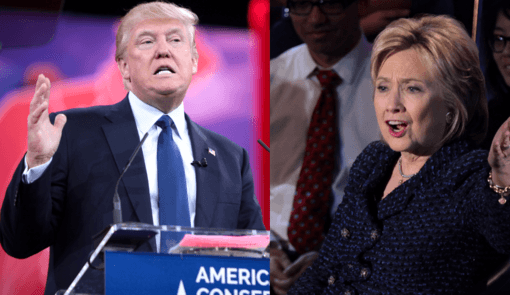
Photograph by Krassotkin (derivative), Gage Skidmore (Donald Trump), Gage Skidmore (Hillary Clinton), distributed under a CC-BY 2.0 license.
The horror of a Clinton v. Trump election is making everybody who pays attention a little crazy. Not paying attention isn’t easy – not with everybody hooked into social (actually anti-social) media and with“ news” and commentary coming from every direction.The hypocrisy is breathtaking.In the midst of it all, the American propaganda system, the one that supposedly doesn’t exist, has gone berserk — targeting RT America (formerly Russia Today).
Anyone who relies on The New York Times or The Washington Post or NPR or, worse, CNN or MSNBC, to find out what’s shaking – or rather what the guardians of the status quo want people to think is shaking (and “fit to print”) — and who also has access to RT America on satellite TV or a handful of cable stations, or who goes to the trouble of watching it over the internet, will know what I mean.RT America is a better source for news and commentary than America’s finest by many orders of magnitude. It is less biased too.The Russian government funds it, but this doesn’t make its output propaganda – not unless anything funded by governments is propaganda by definition. RT America is more like the BBC or CBC than, say, Radio Free Europe.
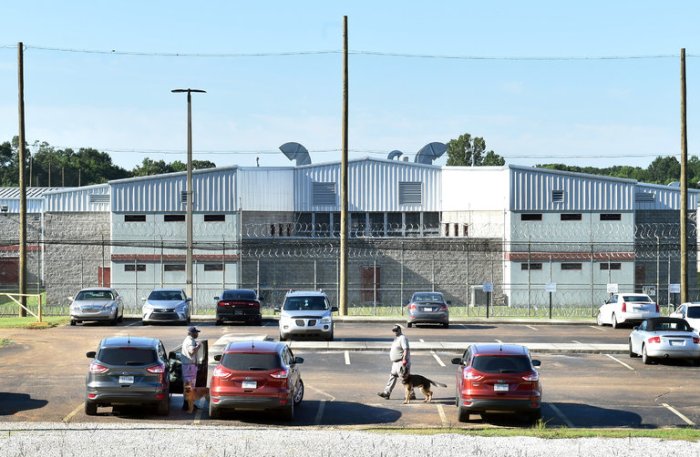
The Walnut Grove facility that had been operating since 2012 under a federal consent decree for violating prisoners’ constitutional rights was the scene of two major riots in 2014.
This jail is likely 90 percent black men. Privately Run Mississippi Prison, Called a Scene of Horror, ““The sexual misconduct we found was among the worst that we have seen in any facility anywhere in the nation,” the report said.
Some of the guards, the report said, were themselves members of the gangs, including at least one prison supervisor who let prisoners out of their cells to assault unsuspecting rivals.
Organized gladiator-style fights between prisoners and encouraged by guards were also a frequent occurrence, with guards betting on the outcomes, according to the report.” FB comment from Antonio Moore
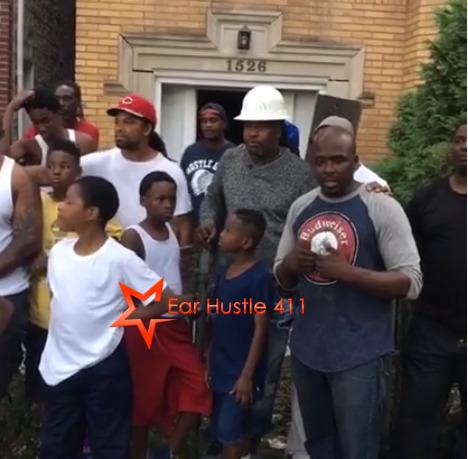
Chicago, Illinois – Black men are demanding the city help them with the resources to help rebuild the community. These men are literally in the process of taking over abandoned property and training at risk youth to help fix up the properties that the city is trying to demolish.
Many of the properties are generally in pretty decent condition as far as the frame being solid brick and these men are saying they are not going to allow the city to tear down perfectly good homes.
A lot of the homes are boarded up and abandoned due to subprime lending where the Lenders/Bankers sucked the resources out of certain communities, left them in total disarray, foreclosed on the properties and resold many of them for pennies on the dollar to Hedge Fund Investors.
This happened by way if issuing Interest only mortgages where the borrower paid only the interest and no principal and when the term was up, they were forced to pay interest plus principle which the majority was unable to do therefore losing their properties while hedge fund investors bet against the people and walked away with tons of properties.
These investors slowly take over certain areas which are considered prime real estate and move the minorities out and gentrify the neighborhoods.
The men called on Alderman Michael Scott 24th Ward, Alderman Jason Ervin 28th Ward, and Alderman Walter Burnett 27th Ward and all the Aldermen across the city to help them make this happen.
The group said they are going all over the city and taking over the 20,000 properties that are sitting idle waiting to be torn down.
They then said that the people in the community want the buildings demolished however they don’t realize that for every building that is demolished, property taxes goes up.
The spokesperson Mark Carter said NHS, CIC and Globe Trotters organizations were supposed to help their parents and grandparents but instead they allowed the city to demolish their homes.
The men said the Mayor and Alderman sit back and watch these children get murdered in the communities and they refuse to sit back and do nothing about it.
He said they are demanding the resources be given to them and they can rebuild themselves.
Policing and the Violence of White Being: An Interview with Dylan RodríguezSeptember 12, 2016The following interview was conducted by Casey Goonan, an editor with True Leap Press. It originally appeared on the True Leap Press blog. Casey Goonan: The US white-supremacist state operates today through a different set of discourses and cultural structures than in previous epochs. Your work interrogates such shifts at a level of depth and nuance that is of particular importance for emergent struggles against racist state violence. “Multiculturalist white supremacy,” “post-racial liberal optimism,” “white academic raciality”—such terms are utilized throughout your work to interrogate a myriad of theoretical and historical conundrums that define the post-Civil Rights era, particularly in regards to racial violence and subjectivity. Can you, in very broad strokes, lay out what you are trying to accomplish with these interventions in the discourses, practices, and forms of embodiment that so violently delimit the possibilities for radical social change in the United States?
Dylan Rodríguez: The aftermath of American apartheid’s formal abolition has been overwhelmed by a grand national-cultural vindication of “Civil Rights” as the vessel of fully actualized gendered-racial citizenship. This fraud has, in various ways, facilitated rather than interrupted the full, horrific exercise of a domestic war-waging regime. For the sake of momentary simplicity, we can think about it along these lines: the half-century narrative of Civil Rights victory rests on an always-fragile but persistent common sense—the idea that national political culture (“America”) and the spirit of law and statecraft (let’s call this “The Dream”) endorse formal racial equality. Bound by this narrative-political context, the racist state’s mechanics shift and multiply to rearticulate a condition of normalized racist violence that is condoned or even applauded by the institutionalized regimes of Civil Rights. (It is not difficult to see how the NAACP, JACL, LULAC, Lambda, NOW, Urban League and other like-minded organizations condone or applaud domestic racial war, so long as it is directed at the correct targets: gang members, drug dealers, “violent criminals,” terrorists, etc.). In other words, the contemporary crisis of racist state violence is not reducible to “police brutality” and homicidal policing, or even the structuring asymmetries of incarceration: it is also a primary derivative of the Civil Rights regime.
Twenty-five years ago, the term “gentrification” was largely unfamiliar to the average American. Today, you can’t talk about cities, race, rent or overpriced coffee without bringing it up. It’s a hard phenomenon to measure, yet most agree its harbingers include the rapid influx of young, well-to-do white people into once low-income neighborhoods, often in the inner city, usually populated by people of color.
The rest is history. Said people show up, the area is flooded with resources, property value rises and many former residents are forced to move out. We’ve seen such patterns before, where poor people are literally moved around, in and out of their homes, at the behest of the wealthy. It’s typically called “colonialism.” And that’s not an inaccurate comparison.
This dynamic came to a head last week when a group of Dropbox employees in San Francisco’s notoriously gentrifying Mission District tried to kick a group of local kids off a soccer field they had reserved:
The subtext was clear: We’re here now, we make the rules.
This outcome was uncharacteristically positive, in the short term. A petition and City Hall rally followed, after which the San Francisco Recreation and Park Department ruled that “adult permits” would no longer be issued for the Mission Playground soccer field, according to Latino Rebels.
Most gentrified neighborhoods aren’t so lucky. Change is ruthless and unapologetic. Once an area becomes unaffordable for its low-income residents, it tends to stay that way, and the “storied history,” “selective nostalgia” and “carefully sprinkled grit” that define this particular iteration of “urban life,” in the words of Al Jazeera columnist Sarah Kendzior, become the lens through which America’s cities are increasingly viewed.
Neighborhoods, then, are not just homes, but opportunities for profit and redevelopment. And the renewal fantasy that defines them hides an often racist history of deliberate and concentrated impoverishment, one that’s inevitably copied wherever poor residents are forced to move next — usually the isolated suburbs they were barred from occupying in the first place.
It’s a pattern as old as America itself — and it’s not going away any time soon. To illustrate, here are seven cities that have been radically altered by gentrification in the 21st century, as defined by the percentage of urban homes that went from the bottom half of home price distribution to the top half. Data was compiled by the Federal Reserve Bank of Cleveland, and calculates for the period between 2000 and 2007.
1. Boston: 61%
The unexpected gentrification capital of America is a city that’s more than 50% white.
As yuppies and tech professionals take over the former Irish-Catholic stronghold of South Boston, or “Southie,” the neighborhood’s once-notorious reputation as an organized crime hub has given way to a bitter nostalgia (ironically espoused by the gentrifiers themselves) for the edge and toughness personified by the Whitey Bulger era, according to the New Republic.
But make no mistake: Southie’s prototypical residents are as irritated by “SoBo” as the people who made SoBo claim to be irritated by SoBo.
“The yuppies have invaded. It’s totally overrun by yuppies,” resident William O’Brien told theHuffington Post.
Plumber Scott Clark said, simply, “It’s not my neighborhood anymore.”
2. Seattle: 55%
A small act of civic defiance occurred in Capitol Hill this February. A pair of masked individuals blocked a Microsoft employee bus on its way to the office, brandishing a sign that read “Gentrification stops here.” The move came in response to a pattern that’s defined the city for years, according to the Seattle Times: With a home price turnaround rate of 55%, the Pacific Northwestern metropolis was the second most drastically gentrified city in the U.S. between 2000 and 2007.
Neighborhoods from Ballard in the north to Delridge in the south have seen dramatic shifts of late. Law professor and longtime Seattle resident Henry W. McGee Jr. specifically articulates the fate of the Central District, once home to Seattle’s small black population, where in 2000 the number of white residents surpassed the number of black residents for the first time in 30 years.
“What is clear is that thousands of African-Americans have been displaced from the city’s oldest identifiably African-American community,” he writes.
The reasons are multipronged, but the fact that black applicants in Seattle are 2.56 times more likely to be denied a conventional mortgage loan than whites, in addition to being more likely to pay higher rates, isn’t helping.
3. New York City: 46%
Perhaps no city more thoroughly dominates modern conversations around gentrification than New York. Whether it’s Spike Lee bemoaning the sudden influx of resources into neighborhoods like Harlem, Bedford-Stuyvesant and Crown Heights since white people moved in, or new Fort Greene residents complaining about homeless people being mean to their dogs in the local park, gentrification stories ranging from bad to awful abound. Today, New York City is the most expensive metropolitan area in the U.S.
4. San Francisco: 42%
Even aside from the Mission Playground incident, San Francisco consistently makes headlines for tensions fanned by gentrification.
The recent tech industry explosion has drawn unprecedented numbers of IT workers to the Bay Area, with the fallout encapsulated by stories like the recent protests designed to stop Google Buses, private vehicles used to transport Google employees, from using municipal bus stops on their daily routes.
It’s hard to quantify how drastically this transportation practice could alter the local status quo, but critics claim it pollutes the environment and makes the road more dangerous for the city’s cycling community, according to SFGate. Regardless, San Francisco’s housing economy has shifted drastically. In the seven years between 2000 and 2007, houses in the bottom half of home prices switched to the upper bracket at a staggering 42% rate.
5. Washington, D.C.: 35%
Recent conversations around gentrification in D.C. have taken a familiar turn, with some arguing that it has, in fact, been a good thing for the region’s original residents. NPR claims that gentrification not only doesn’t increase the likelihood that lower-income occupants will move out of a neighborhood, but that those who do stay reap benefits, ranging from “new parks” and “safer streets” to higher credit scores.
Of course, it stands to reason that those who can afford to stick around as an area gentrifies are richly rewarded. But even if this were the case across the board, we should be concerned that the most dependable way to ensure economic and infrastructural investment in struggling, low-income and, most importantly, black neighborhoods (such as Anacostia, Deanwood and Columbia Heights) is to have white people with money move into them.
6. Atlanta: 31%
Gentrification in Atlanta has caused the respective rise and fall of the city’s white and black populations for the first time since the 1920s, according to the New York Times. Brookings Institution demographer William Frey said, “There could be a time in the not-too-distant future when the black population is below half of the city population, if this trend continues.” (Atlanta is currently 54% black.)
The irony, according to Bloomberg, is that white conservative Georgia voters outside the city have consistently opposed measures to revitalize this now-gentrifying civic core, most notably by blocking plans to expand the city’s public transportation system. But some wonder whether projects like the Beltline, a new rail network and green space currently under construction, are themselves actually just draws for, or even byproducts of, gentrification.
7. Chicago: 28%
The racial dynamics of gentrification are perhaps no better illustrated than in Chicago. In a tellingarticle, NPR’s Gene Demby reported that the size of a Windy City neighborhood’s black population — as exemplified in areas like Englewood, Austin and Roseland, all more than 85%black — directly correlates with the speed at which it gentrifies.
His source is a study by Harvard researchers Robert Sampson and Jackelyn Hwang. Sampson refers to this phenomenon as “‘white avoidance’ — [gentrifiers are] not moving into neighborhoods where there are lots of black people.”
“In Chicago,” he said, “the [neighborhoods] that are gentrifying are the ones where there was a white working class, or Latinos, but not many blacks.”
This is especially interesting when you look at how this pattern plays out in other cities. Williamsburg and Greenpoint, viewed as the hotspots for gentrification in Brooklyn, New York, supports Sampson’s point. Both had large Polish-American and Latino populations before the influx of gentrifiers, but very few blacks. Similar claims can be made about Boston and Seattle, the top two (and statistically whitest) cities on this list, while historically black neighborhoods like Harlem and Bedford-Stuyvesant are “outliers,” according to the report.
Of course, this doesn’t change the fact that, due to policies like redlining and government-sanctioned housing discrimination, the people most likely to be affected by rising home prices in urban cores are black or brown. It just means that gentrifiers may tend to gravitate toward poor white neighborhoods first. It’s hard to say whether people should be happy or extremely offended by this.
The takeaway: And so it goes, the constant geographical shuffling of low-income people at the behest of those with money.
Many cities have undergone such radical shifts in recent years as to be nearly unrecognizable. There are more to come: The New York Times recently calculated gentrification rates by determining which cities have seen the biggest influx of recent college graduates between 2000 and 2012. Places like Houston (50% uptick), Nashville (48%), Denver (47%), Austin, Texas (44%), and Portland, Oregon (37%), top the list, with D.C. (36%), Buffalo, New York (34%), and Baltimore (32%) not far behind.
It’s a phenomenon that hides within it all the racial and class tensions that define American history. If only all people could share in its spoils, and do so without relying on influxes of wealth and white people.

 If Barack Obama doesn’t represent the end of respectability politics, nothing does.
 about Dr. Darity
 about Dr. Tommy J. Curry










 OCG
OCG 