So Many Black People Locked Up it has Warped our Sense of RealityApril 23, 2016 0 45Share on Facebook Tweet on Twitter Prisoners from Sacramento County await processing after arriving at the California Department of Corrections and Rehabilitation Deuel Vocational Institution (DVI) in Tracy, Calif. (Rich Pedroncelli/Associated Press)For as long as the government has kept track, the economic statistics have shown a troubling racial gap. Black people are twice as likely as white people to be out of work and looking for a job. This fact was as true in 1954 as it is today.The most recent report puts the white unemployment rate at around 4.5 percent. The black unemployment rate? About 8.8 percent.But the economic picture for black Americans is far worse than those statistics indicate. The unemployment rate only measures people who are both living at home and actively looking for a job.The hitch: A lot of black men aren’t living at home and can’t look for jobs — because they’re behind bars. READ MORE
Pull up your pants. Straighten your hair. Stop using the n-word.
Black Americans have long been told that there is a “right” way to act in order to secure racial equality and individual promotion in the United States. Often, these recommendations are made by other black Americans attempting to mute certain cultural aesthetics in order to make white Americans feel comfortable in their presence. I recently attended a lecture where a middle-aged black American man explained that he yearned for the days when black men “had grace.” He posted a picture of black men circa 1940 in Tuskegee, Alabama, standing in a cotton field wearing pressed white shirts and suspenders.
As journalist Aurin Squire explains, black respectability presumes that “systematic oppression can be overcome if we’re clean, mild, moderate, and economically successful.” Yet in a time when black men are nine times more likely to be shot and killed by the police and people still protest those who point out police brutality, policing the appearance of black Americans is, at best, beside the point.
But the issue isn’t just that respectability is irrelevant. New evidence suggests that the beliefs that inform respectability politics are bad for black Americans’ health.
According to the Journal of Behavioral Medicine, attributing success to personal characteristics instead of biased structural systems may negatively impact black Americans’ health. Nao Hagiwara and her colleagues at Virginia Commonwealth University explored whether the “just world” belief—the belief that the world is a just place where people get what they deserve—would influence the relationship between perceived discrimination and health consequences for 130 black adults.
The psychologists found that participants who both strongly believed that the world was a just place and reported experiencing high levels of discrimination were more likely than other blacks to suffer from chronic illnesses and increased blood pressure. Why? Because respectability politics tells black Americans that what is happening to them in this country is our fault. In other words, we’re to blame for the 9.5% unemployment rate among black Americans, the police who fatally shoot unarmed black men, and the teachers who expect less academic success from black students. If we just pulled our pants up a little higher and turned our music down, the systematic discrimination that informs nearly every sector of American life would disappear. If the world is just, then the injustice we experience in it is on us.
This thought is literally making people sick.
Health care and mental health practitioners should work to educate themselves on the current status of racial issues in the United States. And they should encourage their black patients to reframe how they look at their experiences. An understanding of individual accountability must be supplemented with a more contextual assessment of negative events. This reframing could alleviate the stress that’s associated with the belief that our behavior determines all of our experiences–even in a deeply racist and unjust society.
By seriously considering the social systems and racist encounters experienced by black Americans, health practitioners may help their patients better assess their experiences and select tailored methods for health improvement. Those charged with caring for black lives should be among the first acknowledge that they matter.
You can follow Veronica Womack on Twitter at @vwomackphd. This piece was originally published in New America’s digital magazine, The New America Weekly. We welcome your comments at ideas@qz.com.
‘Is There a Problem?’ That Scary Brown Man And White Privilege
By GYASI ROSS • JAN 9, 2015
SHARE
Twitter Facebook Google+ Email
Gyasi Ross, writer and lawyer.
COURTESY GYASI ROSS
Last year, I had a big business meeting in New York and a reading for my new book, “How to Say I Love You in Indian,” at the American Indian Community House in Midtown Manhattan.
For some inexplicable reason, some television folks were interested in me doing television work. Look, I’m from the rez – we’re hunter-gatherers. If someone is willing to give me free food and an opportunity to provide for my family and me, I’m definitely going to be there. The lunch meeting was at noon. I usually fly red-eyes so I can tuck my son into bed and spend as much time with him before I leave. This time, however, I wanted to be well-prepared and rested, so I flew the night before.
First half of the flight was cool. I wore my comfortable flying clothes – camouflage sweats, camouflage sweatshirt, braids and a skullcap.
It was on Southwest, which I’ve flown a million times, simply because they sometimes have cheaper flights and, most importantly, I didn’t have to pay separately for bags. I know that I still pay for them, but it’s just not a separate charge. I appreciate that.
First leg of the flight was from Seattle to Chicago. No problem – I got off the plane for my four-hour layover (seriously) and got an all-beef dog at Chicago O’Hare.
Then the second leg of my flight. Ugh.
I had a backpack and a small duffel bag. I was in the “C” boarding group, so I knew that I was getting a middle seat. Guaranteed.
When I got on, there was a seat in the very first row – it was a middle seat. I knew I was going to get screwed on the seating, so I figured why not sit in the front of the plane? At least I’d be first to get off the plane.
In the front row was a middle-aged white couple (Sarah Jessica Parker-type middle aged, where they tried to dress like they weren’t quickly approaching AARP-status). The woman sat in the window seat and the man was in the aisle seat, holding a baby. They were being slick (like I do as well) and had a pile of stuff in the middle seat pretending it was occupied and hoping nobody would sit there.
I know the game – I’m not mad.
I asked, “Excuse me, is somebody sitting there?”
The lady responded, “Yes, I’m waiting for a friend. She’s supposed to be boarding.”
I was pretty sure she was lying. Under normal circumstances, I would have just taken the seat – this is Southwest Airlines, for God’s sake – there’s no saving seats. Southwest Airlines is PURE social Darwinism. Every person for themselves! But since I wasn’t getting a good seat anyway, and I was at the very end of the boarding group, I decided to wait.
“OK, cool,” I said. “I’ll wait here to see if your friend gets on.”
The last person boarding – another middle-aged white woman – got on. The window seat lady literally grabbed her and asked her to sit there. I’ll call that lady “The Recruit.”
I smirked and told her, “You don’t know that lady at all – ha! You lied. You realize how rude that is right?”
She responded, “That’s not rude.”
I said, “OK, well I suppose that’s just you then.” And smile at her.
The Recruit got up QUICKLY and strolled toward the back – evidently she had zero interest in this discussion and saw more fertile ground in the back of the plane.
I put my bags up above and went to sit down. The man scooted over to the middle seat, chivalrously. No problem – until there was a problem.
The wife pointed at me and said to her husband, loudly, “I don’t want him sitting there.”
I looked at her to make sure I heard her correctly. “Don’t look at me,” she said.
White privilege is the inherent suspicion that people of color – and predominately men of color – are doing something wrong. Big black men and big brown men are presumed guilty. All the time.
Damn, I couldn’t believe that. Adrenaline rushed through me. I said, “Look, you have no input into where I sit or where I look.”
I sat down and got my MP3 player ready to play some Marty Robbins. I knew the drill – I’ve been trained since I was a kid: “You’re a big brown guy – don’t be too scary. Don’t be too big. Don’t be too brown.”
We’re taught these things for our own safety and to get along.
And I was cool – but before I pressed play on my Sony MP3 player, the husband – all 5-foot-5 and probably 125 pounds told me, “You need to shut your mouth!”
WHOA!!!
For a woman to tell me something rude, that’s one thing. I’m not going to clobber a woman for a rude remark. But this guy – let’s be clear, he would never talk to me like that under any other circumstances. Ever. But he was feeling bold or threatened or insecure or something and turned what were simply words into possibly a really bad situation.
I got really close to him and said, “Look, you know this plane ride is going end at some point, right? You have to get off this plane.”
He shut up. But his wife didn’t. “You can’t sit there,” she said.
By this time, I was really mad. Not at the lady, necessarily, but that this grown man would talk to another grown man like this and expect no response. “I’m not moving anyplace so if you don’t want to sit by me, I suggest you move.”
Just then the captain came out. I was elated. Yes! I don’t like feeling like I have to run and tell anybody anything, but I also don’t want to get thrown in jail for stomping this dude into the luggage area below the plane. So I was happy to see an objective person. But unfortunately, that’s not how it went down.
The captain looked at only me. “Is there a problem?”
I said, “Well, this lady right here told me that she doesn’t want me sitting here for whatever reason and her husband tells me to shut my mo– ”
The captain interrupted me. “Well, I only hear you.”
I said, “I understand – I have a loud voice, that’s why I’m telling you what happened. Ask any of the folks sitting here –” I pointed to the people staring at us. He didn’t ask anybody anything. Instead, his focus was squarely on me.
Captain: “You need to lower your voice. Do you want to take the next flight?”
(Admittedly, I DO have a loud voice, and I WAS agitated by this time. I think that was understandable.)
Me: “No, I don’t want to – I’m telling you what happened.”
Captain: “Well I only hear you out here hollering.”
Me: “Well, I suggest that you have selective hearing.”
Captain (staring me down): “Oh, now you want to get in MY face?”
I was a bit confused because that implied that I had gotten in someone else’s face. Maybe he meant he thought I had gotten in the husband’s face?
He didn’t wait for my response. “I suggest you quiet down before you take the next flight,” he said.
I was stewing. But I knew I couldn’t take the next flight – that would not have been until the next morning, and I would have missed my important meeting. I don’t have a lot of very important meetings – I’m not a very important guy – so I didn’t want to miss one of the only ones that I’ve had.
When I got to baggage claim, a couple of younger white guys sitting behind me came up to me (one of them was from Hicksville on Long Island in New York. I laughed when he told me that – I thought he was joking): “That was bullshit. I told the captain afterward that everything happened exactly like you said.”
Made the meeting. Thankfully. Made a complaint on the Southwest Airlines website. They responded with an incredibly condescending email that said that they were sorry for my “less than pleasant” experience on the plane (it wasn’t “less than pleasant” – it was humiliating).
I couldn’t do anything or I would have been thrown off the plane or provoked into physical conflict – in the same way cops provoke men of color by staring us down and asking if we have a problem and other rhetorical questions intended only to provoke.
The email also stated, as a matter of fact, “As you know, our Pilot did not hear any other Passengers, which is why he only addressed his question to you.” (No, I have absolutely no reason to know that – I do know that he only addressed me). Also, the captain flat-out lied and said that he asked me to lower my voice twice before asking if I wanted to take another flight – not true. Finally, the email said, in ABC after-school special speak:
“We realize that sometimes it’s not what you say, but how you say it, and we apologize that you feel as if our Pilot could have used a more patient and professional tone when intervening in the exchange between you and the Customers in question.”
This is just insulting: As if my problem was with the captain’s TONE. No, it was that he didn’t ask anybody else a single question before singling me out and asking me if I wanted to take another flight, and then stood staring at me as if I were supposed to stand down from his authority (which I did, by the way, because I had to make the flight. I would have loved to have three minutes alone with that captain in a small room).
ANALYSIS:
Racism
The window seat lady clearly did not like something about the way I looked – she made up her mind before we exchanged any words. I smelled good (or as good as I could) – I showered that morning and wasn’t in any way offensive with my clothing (I wasn’t wearing a T-shirt with swear words or anything like that). Perhaps it was the camouflage – looked terrorist-ish? Maybe it was the braids or long “Native” earrings? Maybe it was the huge Native guy in braids and camouflage?
Either way, after being overwhelmingly gracious and waiting for her to find her “friend,” the lady’s first words about me (to her husband) were, “I don’t want him sitting there.” For the life of me, I cannot think what would have caused her to say something like that about me other than an inherent dislike.
Moreover, the man felt completely comfortable telling me, “You need to shut your mouth.”
I don’t think it’s possible to see a stranger as a human being and talk to them like that. They didn’t see me as a human. I was something less. I’m not overly sensitive – sometimes people are just rude. No racism, no sexism, no anything other than everyday mundane rude behavior.
This was different.
White privilege
White privilege is different than racism. I don’t THINK the Captain was racist. But he had a very bad case of white privilege. Southwest Airlines emboldened that privilege by white-washing (see what I did there?) his behavior.
White privilege is the inherent suspicion that people of color – and predominately men of color – are doing something wrong. Big black men and big brown men are presumed guilty. All the time.
At my first jury trial, the young white prosecutor came into the courtroom where I was in my suit and practicing my cross-examination. She asked, very politely, “Excuse me sir, are you waiting for your attorney?”
It’s similar to when the pundits and armchair analysts during the George Zimmerman trial assumed that Trayvon Martin, the unarmed black teenager he killed, HAD to be doing something wrong when he walked to the store. There are countless other examples.
The captain may have heard just me – that may be true. Nonetheless, it seems that in the pursuit of finding a resolution, he should have asked a question or two instead of simply cutting me off and threatening to throw me off the plane.
He had me by the balls: I couldn’t do anything or I would have been thrown off the plane or provoked into physical conflict – in the same way cops provoke men of color by staring us down and asking if we have a problem and other rhetorical questions intended only to provoke.
A huge Native guy in camouflage was arguing with a clean-cut white couple (and a white captain). Three guesses who started that one.
That’s privilege.
The white couple didn’t have to think about any of that. They didn’t have to think about appearing TOO big or TOO brown or TOO Native or anything other than simply enjoying their flight.
Look, I’m not special. This shit happens every day. Most of us are bullied into not saying anything, like I was by the captain.
“Is there a problem?” he wanted to know. But answer the question honestly, and you won’t make your flight or you might be detained. That’s privilege.
Unfortunately, my example is an EXTREMELY mild version of that privilege; I’m quite lucky that all I had to do was swallow my pride. It doesn’t even compare to other times where brown men and women are “presumed guilty,” which leads to brothers and sisters and mothers and aunts beat down, pepper sprayed and thrown in jail for choosing to answer that question honestly instead of swallowing their tongue.
I know of stories where cops literally got into men’s face – cheek to cheek, daring them to fight – trying to con them into responding.
We know EXACTLY what would happen if that big man of color gave the response that he wanted.
I couldn’t tell the captain the truth when he asked me what tens of thousands of police officers, Bureau of Indian Affairs agents, slave overseers and teachers have asked helpless and muted people of color, “Is there a problem?”
Hell, yes, there’s a problem.
This story was originally published at Indian Country Media Network on Jan. 27, 2014.
Gyasi Ross (@bigindiangyasi) is a member of the Blackfeet Nation and the Suquamish Nation. He lives on the Port Madison Indian Reservation, home of the Suquamish Nation near Seattle. Both are his Homelands and he loves being in his Homelands. He is a father to an amazing and rotten little boy, an author who writes for online and print publications and also who writes books and sometimes bad comedy. He is also a lawyer and a filmmaker. Most of all, he is a storyteller and comes from a long line of storytellers. His website: http://www.gyasi-ross.com.
The Seattle Story Project: First-person reflections published at KUOW.org. These are essays, stories told on stage, photos and zines. To submit a story – or note one you’ve seen that deserves more notice – contact Isolde Raftery at iraftery@kuow.org or 206-616-2035.
Persons of Black African ancestry live as citizens, foreign nationals, and indigenous populations on every continent as a result of immigration, colonialism and slave trading. Today, most Black people in the Americas are the progeny of victims of the transatlantic slave trade. From 1619 to 1863, millions of Africans were involuntarily relocated from various regions of West Africa to newly established European colonies in the Americas. Many different African ethnic groups, including the Congo, Yoruba, Wolof, and Ibo, were casualties of the transatlantic slave trade. The Black American population is the aggregate of these groups, consolidated into one race, bound by a common struggle against racial oppression and distinguished by cultural dualism.
Importantly, the historic legacy of Black people in the Western Hemisphere is not limited to slavery. The Olmec heads found along the Mexican Gulf Coast is evidence of African colonies in the Americas centuries before Columbus arrived in the Caribbean. Black people were also responsible for establishing the world’s first free Black republic, and only the second independent nation in the Western Hemisphere, with the Haitian Revolution. In the United States, almost 500,000 African Americans were free prior to the Civil War and were immensely instrumental in shaping U.S. policy throughout abolition and beyond. Post-Civil War, African Americans influenced U.S. arts, agriculture, foods, textile, language, and invented technological necessities such as the traffic light and elevators, and parts necessary to build the automobile and personal computer. All of these contributions were necessary for the U.S. to become a world power by the 20th Century.
Racism and oppression are forces that have shaped the experiences and development of Black people worldwide. Although European colonialists initially enslaved Black people because of their agricultural expertise and genetic resistance to diseases, they used racist propaganda to justify their inhumane practices. During periods of slavery and the “Scramble for Africa,” European institutions used pseudoscience and religion (e.g. the Hamitic myth) to dehumanize Black people. The vestiges of racism and oppression survived centuries after propaganda campaigns ended and influence all human interactions today.
Today, racism is perpetuated most profoundly through the educational system. Black students are taught to revere historians, such as Columbus, who nearly committed genocide against the native population of the Dominican Republic; and Woodrow Wilson who openly praised the Ku Klux Klan. Although many of these facts are not well known and purposefully disguised in history texts, children often leave traditional elementary and secondary education with the sense that aside from a few isolated figures (e.g. Martin Luther King and Harriet Tubman) Black people had a relatively small role in the development of modern nations.
Survey data often indicate that African Americans have the highest incidence and mortality of any given mental or physical disorder, are more deeply impacted by social ills, and generally have the lowest economic standing. While some of the data are accurately presented, rationales are usually baseless and findings typically lack a sociohistorical context. In addition, studies on African Americans unfairly draw social comparisons to the social groups that historically benefited from their oppression.
Historical distortions accompanying dismal statistics have resulted in many educators and counselors perpetually using a deficit model when working with Black students. The deficit model focuses on problems, without exploring sociohistorical factors or institutional procedures. Persons of Black African ancestry have a distinguished history, are immeasurably resilient, and have developed sophisticated coping mechanisms throughout centuries of oppression. Appreciating and celebrating a Black people’s legacy, contextualizing problems, and building on strengths instead of focusing on deficits are universally appreciated counseling strategies, which merit greater prudence when working with Black children.
IVORY TOLDSON is the Deputy Director of White House Initiative on Historically Black Colleges; Universities; Associate Professor at Howard University and Editor in Chief of The Journal of Negro Education
Two hundred fifty years of slavery. Ninety years of Jim Crow. Sixty years of separate but equal. Thirty-five years of racist housing policy. Until we reckon with our compounding moral debts, America will never be whole.
And if thy brother, a Hebrew man, or a Hebrew woman, be sold unto thee, and serve thee six years; then in the seventh year thou shalt let him go free from thee. And when thou sendest him out free from thee, thou shalt not let him go away empty: thou shalt furnish him liberally out of thy flock, and out of thy floor, and out of thy winepress: of that wherewith the LORD thy God hath blessed thee thou shalt give unto him. And thou shalt remember that thou wast a bondman in the land of Egypt, and the LORD thy God redeemed thee: therefore I command thee this thing today.— Deuteronomy 15: 12–15
Besides the crime which consists in violating the law, and varying from the right rule of reason, whereby a man so far becomes degenerate, and declares himself to quit the principles of human nature, and to be a noxious creature, there iscommonly injury done to some person or other, and some other man receives damage by his transgression: in which case he who hath received any damage, has, besides the right of punishment common to him with other men, a particular right to seek reparation.
— John Locke, “Second Treatise”
By our unpaid labor and suffering, we have earned the right to the soil, many times over and over, and now we are determined to have it.
— Anonymous, 1861
I. “So That’s Just One Of My Losses”
Clyde Ross was born in 1923, the seventh of 13 children, near Clarksdale, Mississippi, the home of the blues. Ross’s parents owned and farmed a 40-acre tract of land, flush with cows, hogs, and mules. Ross’s mother would drive to Clarksdale to do her shopping in a horse and buggy, in which she invested all the pride one might place in a Cadillac. The family owned another horse, with a red coat, which they gave to Clyde. The Ross family wanted for little, save that which all black families in the Deep South then desperately desired—the protection of the law.
Clyde Ross, photographed in November 2013 in his home in the North Lawndale neighborhood of Chicago, where he has lived for more than 50 years. When he first tried to get a legitimate mortgage, he was denied; mortgages were effectively not available to black people. (Carlos Javier Ortiz)
In the 1920s, Jim Crow Mississippi was, in all facets of society, a kleptocracy. The majority of the people in the state were perpetually robbed of the vote—a hijacking engineered through the trickery of the poll tax and the muscle of the lynch mob. Between 1882 and 1968, more black people were lynched in Mississippi than in any other state. “You and I know what’s the best way to keep the nigger from voting,” blustered Theodore Bilbo, a Mississippi senator and a proud Klansman. “You do it the night before the election.”
The state’s regime partnered robbery of the franchise with robbery of the purse. Many of Mississippi’s black farmers lived in debt peonage, under the sway of cotton kings who were at once their landlords, their employers, and their primary merchants. Tools and necessities were advanced against the return on the crop, which was determined by the employer. When farmers were deemed to be in debt—and they often were—the negative balance was then carried over to the next season. A man or woman who protested this arrangement did so at the risk of grave injury or death. Refusing to work meant arrest under vagrancy laws and forced labor under the state’s penal system.
Well into the 20th century, black people spoke of their flight from Mississippi in much the same manner as their runagate ancestors had. In her 2010 book, The Warmth of Other Suns, Isabel Wilkerson tells the story of Eddie Earvin, a spinach picker who fled Mississippi in 1963, after being made to work at gunpoint. “You didn’t talk about it or tell nobody,” Earvin said. “You had to sneak away.”
When Clyde Ross was still a child, Mississippi authorities claimed his father owed $3,000 in back taxes. The elder Ross could not read. He did not have a lawyer. He did not know anyone at the local courthouse. He could not expect the police to be impartial. Effectively, the Ross family had no way to contest the claim and no protection under the law. The authorities seized the land. They seized the buggy. They took the cows, hogs, and mules. And so for the upkeep of separate but equal, the entire Ross family was reduced to sharecropping.
This was hardly unusual. In 2001, the Associated Press published a three-part investigation into the theft of black-owned land stretching back to the antebellum period. The series documented some 406 victims and 24,000 acres of land valued at tens of millions of dollars. The land was taken through means ranging from legal chicanery to terrorism. “Some of the land taken from black families has become a country club in Virginia,” the AP reported, as well as “oil fields in Mississippi” and “a baseball spring training facility in Florida.”
Clyde Ross was a smart child. His teacher thought he should attend a more challenging school. There was very little support for educating black people in Mississippi. But Julius Rosenwald, a part owner of Sears, Roebuck, had begun an ambitious effort to build schools for black children throughout the South. Ross’s teacher believed he should attend the local Rosenwald school. It was too far for Ross to walk and get back in time to work in the fields. Local white children had a school bus. Clyde Ross did not, and thus lost the chance to better his education.
Then, when Ross was 10 years old, a group of white men demanded his only childhood possession—the horse with the red coat. “You can’t have this horse. We want it,” one of the white men said. They gave Ross’s father $17.
“I did everything for that horse,” Ross told me. “Everything. And they took him. Put him on the racetrack. I never did know what happened to him after that, but I know they didn’t bring him back. So that’s just one of my losses.”
Sharecropper boys in 1936 (Carly Mydans/Library of Congress)
The losses mounted. As sharecroppers, the Ross family saw their wages treated as the landlord’s slush fund. Landowners were supposed to split the profits from the cotton fields with sharecroppers. But bales would often disappear during the count, or the split might be altered on a whim. If cotton was selling for 50 cents a pound, the Ross family might get 15 cents, or only five. One year Ross’s mother promised to buy him a $7 suit for a summer program at their church. She ordered the suit by mail. But that year Ross’s family was paid only five cents a pound for cotton. The mailman arrived with the suit. The Rosses could not pay. The suit was sent back. Clyde Ross did not go to the church program.
It was in these early years that Ross began to understand himself as an American—he did not live under the blind decree of justice, but under the heel of a regime that elevated armed robbery to a governing principle. He thought about fighting. “Just be quiet,” his father told him. “Because they’ll come and kill us all.”
Clyde Ross grew. He was drafted into the Army. The draft officials offered him an exemption if he stayed home and worked. He preferred to take his chances with war. He was stationed in California. He found that he could go into stores without being bothered. He could walk the streets without being harassed. He could go into a restaurant and receive service.
Ross was shipped off to Guam. He fought in World War II to save the world from tyranny. But when he returned to Clarksdale, he found that tyranny had followed him home. This was 1947, eight years before Mississippi lynched Emmett Till and tossed his broken body into the Tallahatchie River. The Great Migration, a mass exodus of 6 million African Americans that spanned most of the 20th century, was now in its second wave. The black pilgrims did not journey north simply seeking better wages and work, or bright lights and big adventures. They were fleeing the acquisitive warlords of the South. They were seeking the protection of the law.
Clyde Ross was among them. He came to Chicago in 1947 and took a job as a taster at Campbell’s Soup. He made a stable wage. He married. He had children. His paycheck was his own. No Klansmen stripped him of the vote. When he walked down the street, he did not have to move because a white man was walking past. He did not have to take off his hat or avert his gaze. His journey from peonage to full citizenship seemed near-complete. Only one item was missing—a home, that final badge of entry into the sacred order of the American middle class of the Eisenhower years.
In 1961, Ross and his wife bought a house in North Lawndale, a bustling community on Chicago’s West Side. North Lawndale had long been a predominantly Jewish neighborhood, but a handful of middle-class African Americans had lived there starting in the ’40s. The community was anchored by the sprawling Sears, Roebuck headquarters. North Lawndale’s Jewish People’s Institute actively encouraged blacks to move into the neighborhood, seeking to make it a “pilot community for interracial living.” In the battle for integration then being fought around the country, North Lawndale seemed to offer promising terrain. But out in the tall grass, highwaymen, nefarious as any Clarksdale kleptocrat, were lying in wait.
Three months after Clyde Ross moved into his house, the boiler blew out. This would normally be a homeowner’s responsibility, but in fact, Ross was not really a homeowner. His payments were made to the seller, not the bank. And Ross had not signed a normal mortgage. He’d bought “on contract”: a predatory agreement that combined all the responsibilities of homeownership with all the disadvantages of renting—while offering the benefits of neither. Ross had bought his house for $27,500. The seller, not the previous homeowner but a new kind of middleman, had bought it for only $12,000 six months before selling it to Ross. In a contract sale, the seller kept the deed until the contract was paid in full—and, unlike with a normal mortgage, Ross would acquire no equity in the meantime. If he missed a single payment, he would immediately forfeit his $1,000 down payment, all his monthly payments, and the property itself.
The men who peddled contracts in North Lawndale would sell homes at inflated prices and then evict families who could not pay—taking their down payment and their monthly installments as profit. Then they’d bring in another black family, rinse, and repeat. “He loads them up with payments they can’t meet,” an office secretary told The Chicago Daily Newsof her boss, the speculator Lou Fushanis, in 1963. “Then he takes the property away from them. He’s sold some of the buildings three or four times.”
Ross had tried to get a legitimate mortgage in another neighborhood, but was told by a loan officer that there was no financing available. The truth was that there was no financing for people like Clyde Ross. From the 1930s through the 1960s, black people across the country were largely cut out of the legitimate home-mortgage market through means both legal and extralegal. Chicago whites employed every measure, from “restrictive covenants” to bombings, to keep their neighborhoods segregated.
Their efforts were buttressed by the federal government. In 1934, Congress created the Federal Housing Administration. The FHA insured private mortgages, causing a drop in interest rates and a decline in the size of the down payment required to buy a house. But an insured mortgage was not a possibility for Clyde Ross. The FHA had adopted a system of maps that rated neighborhoods according to their perceived stability. On the maps, green areas, rated “A,” indicated “in demand” neighborhoods that, as one appraiser put it, lacked “a single foreigner or Negro.” These neighborhoods were considered excellent prospects for insurance. Neighborhoods where black people lived were rated “D” and were usually considered ineligible for FHA backing. They were colored in red. Neither the percentage of black people living there nor their social class mattered. Black people were viewed as a contagion. Redlining went beyond FHA-backed loans and spread to the entire mortgage industry, which was already rife with racism, excluding black people from most legitimate means of obtaining a mortgage.
Explore Redlining in Chicago
A 1939 Home Owners’ Loan Corporation “Residential Security Map” of Chicago shows discrimination against low-income and minority neighborhoods. The residents of the areas marked in red (representing “hazardous” real-estate markets) were denied FHA-backed mortgages. (Map development by Frankie Dintino)
“A government offering such bounty to builders and lenders could have required compliance with a nondiscrimination policy,” Charles Abrams, the urban-studies expert who helped create the New York City Housing Authority, wrote in 1955. “Instead, the FHA adopted a racial policy that could well have been culled from the Nuremberg laws.”
The devastating effects are cogently outlined by Melvin L. Oliver and Thomas M. Shapiro in their 1995 book, Black Wealth/White Wealth:
Locked out of the greatest mass-based opportunity for wealth accumulation in American history, African Americans who desired and were able to afford home ownership found themselves consigned to central-city communities where their investments were affected by the “self-fulfilling prophecies” of the FHA appraisers: cut off from sources of new investment[,] their homes and communities deteriorated and lost value in comparison to those homes and communities that FHA appraisers deemed desirable.
In Chicago and across the country, whites looking to achieve the American dream could rely on a legitimate credit system backed by the government. Blacks were herded into the sights of unscrupulous lenders who took them for money and for sport. “It was like people who like to go out and shoot lions in Africa. It was the same thrill,” a housing attorney told the historian Beryl Satter in her 2009 book, Family Properties. “The thrill of the chase and the kill.”
The kill was profitable. At the time of his death, Lou Fushanis owned more than 600 properties, many of them in North Lawndale, and his estate was estimated to be worth $3 million. He’d made much of this money by exploiting the frustrated hopes of black migrants like Clyde Ross. During this period, according to one estimate, 85 percent of all black home buyers who bought in Chicago bought on contract. “If anybody who is well established in this business in Chicago doesn’t earn $100,000 a year,” a contract seller told The Saturday Evening Post in 1962, “he is loafing.”
Contract sellers became rich. North Lawndale became a ghetto.
Clyde Ross still lives there. He still owns his home. He is 91, and the emblems of survival are all around him—awards for service in his community, pictures of his children in cap and gown. But when I asked him about his home in North Lawndale, I heard only anarchy.
“We were ashamed. We did not want anyone to know that we were that ignorant,” Ross told me. He was sitting at his dining-room table. His glasses were as thick as his Clarksdale drawl. “I’d come out of Mississippi where there was one mess, and come up here and got in another mess. So how dumb am I? I didn’t want anyone to know how dumb I was.
“When I found myself caught up in it, I said, ‘How? I just left this mess. I just left no laws. And no regard. And then I come here and get cheated wide open.’ I would probably want to do some harm to some people, you know, if I had been violent like some of us. I thought, ‘Man, I got caught up in this stuff. I can’t even take care of my kids.’ I didn’t have enough for my kids. You could fall through the cracks easy fighting these white people. And no law.”
But fight Clyde Ross did. In 1968 he joined the newly formed Contract Buyers League—a collection of black homeowners on Chicago’s South and West Sides, all of whom had been locked into the same system of predation. There was Howell Collins, whose contract called for him to pay $25,500 for a house that a speculator had bought for $14,500. There was Ruth Wells, who’d managed to pay out half her contract, expecting a mortgage, only to suddenly see an insurance bill materialize out of thin air—a requirement the seller had added without Wells’s knowledge. Contract sellers used every tool at their disposal to pilfer from their clients. They scared white residents into selling low. They lied about properties’ compliance with building codes, then left the buyer responsible when city inspectors arrived. They presented themselves as real-estate brokers, when in fact they were the owners. They guided their clients to lawyers who were in on the scheme.
The Contract Buyers League fought back. Members—who would eventually number more than 500—went out to the posh suburbs where the speculators lived and embarrassed them by knocking on their neighbors’ doors and informing them of the details of the contract-lending trade. They refused to pay their installments, instead holding monthly payments in an escrow account. Then they brought a suit against the contract sellers, accusing them of buying properties and reselling in such a manner “to reap from members of the Negro race large and unjust profits.”
WATCH VIDEOThe story of Clyde Ross and the Contract Buyers League
In return for the “deprivations of their rights and privileges under the Thirteenth and Fourteenth Amendments,” the league demanded “prayers for relief”—payback of all moneys paid on contracts and all moneys paid for structural improvement of properties, at 6 percent interest minus a “fair, non-discriminatory” rental price for time of occupation. Moreover, the league asked the court to adjudge that the defendants had “acted willfully and maliciously and that malice is the gist of this action.”
Ross and the Contract Buyers League were no longer appealing to the government simply for equality. They were no longer fleeing in hopes of a better deal elsewhere. They were charging society with a crime against their community. They wanted the crime publicly ruled as such. They wanted the crime’s executors declared to be offensive to society. And they wanted restitution for the great injury brought upon them by said offenders. In 1968, Clyde Ross and the Contract Buyers League were no longer simply seeking the protection of the law. They were seeking reparations.
II. “A Difference of Kind, Not Degree”
According to the most-recent statistics, North Lawndale is now on the wrong end of virtually every socioeconomic indicator. In 1930 its population was 112,000. Today it is 36,000. The halcyon talk of “interracial living” is dead. The neighborhood is 92 percent black. Its homicide rate is 45 per 100,000—triple the rate of the city as a whole. The infant-mortality rate is 14 per 1,000—more than twice the national average. Forty-three percent of the people in North Lawndale live below the poverty line—double Chicago’s overall rate. Forty-five percent of all households are on food stamps—nearly three times the rate of the city at large. Sears, Roebuck left the neighborhood in 1987, taking 1,800 jobs with it. Kids in North Lawndale need not be confused about their prospects: Cook County’s Juvenile Temporary Detention Center sits directly adjacent to the neighborhood.
North Lawndale is an extreme portrait of the trends that ail black Chicago. Such is the magnitude of these ailments that it can be said that blacks and whites do not inhabit the same city. The average per capita income of Chicago’s white neighborhoods is almost three times that of its black neighborhoods. When the Harvard sociologist Robert J. Sampson examined incarceration rates in Chicago in his 2012 book, Great American City, he found that a black neighborhood with one of the highest incarceration rates (West Garfield Park) had a rate more than 40 times as high as the white neighborhood with the highest rate (Clearing). “This is a staggering differential, even for community-level comparisons,” Sampson writes. “A difference of kind, not degree.”
Interactive Census Map
Explore race, unemployment, and vacancy rates over seven decades in Chicago. (Map design and development by Frankie Dintino)
In other words, Chicago’s impoverished black neighborhoods—characterized by high unemployment and households headed by single parents—are not simply poor; they are “ecologically distinct.” This “is not simply the same thing as low economic status,” writes Sampson. “In this pattern Chicago is not alone.”
The lives of black Americans are better than they were half a century ago. The humiliation of Whites Only signs are gone. Rates of black poverty have decreased. Black teen-pregnancy rates are at record lows—and the gap between black and white teen-pregnancy rates has shrunk significantly. But such progress rests on a shaky foundation, and fault lines are everywhere. The income gap between black and white households is roughly the same today as it was in 1970. Patrick Sharkey, a sociologist at New York University, studied children born from 1955 through 1970 and found that 4 percent of whites and 62 percent of blacks across America had been raised in poor neighborhoods. A generation later, the same study showed, virtually nothing had changed. And whereas whites born into affluent neighborhoods tended to remain in affluent neighborhoods, blacks tended to fall out of them.
This is not surprising. Black families, regardless of income, are significantly less wealthy than white families. The Pew Research Center estimates that white households are worth roughly 20 times as much as black households, and that whereas only 15 percent of whites have zero or negative wealth, more than a third of blacks do. Effectively, the black family in America is working without a safety net. When financial calamity strikes—a medical emergency, divorce, job loss—the fall is precipitous.
And just as black families of all incomes remain handicapped by a lack of wealth, so too do they remain handicapped by their restricted choice of neighborhood. Black people with upper-middle-class incomes do not generally live in upper-middle-class neighborhoods. Sharkey’s research shows that black families making $100,000 typically live in the kinds of neighborhoods inhabited by white families making $30,000. “Blacks and whites inhabit such different neighborhoods,” Sharkey writes, “that it is not possible to compare the economic outcomes of black and white children.”
The implications are chilling. As a rule, poor black people do not work their way out of the ghetto—and those who do often face the horror of watching their children and grandchildren tumble back.
Even seeming evidence of progress withers under harsh light. In 2012, the Manhattan Institute cheerily noted that segregation had declined since the 1960s. And yet African Americans still remained—by far—the most segregated ethnic group in the country.
With segregation, with the isolation of the injured and the robbed, comes the concentration of disadvantage. An unsegregated America might see poverty, and all its effects, spread across the country with no particular bias toward skin color. Instead, the concentration of poverty has been paired with a concentration of melanin. The resulting conflagration has been devastating.
One thread of thinking in the African American community holds that these depressing numbers partially stem from cultural pathologies that can be altered through individual grit and exceptionally good behavior. (In 2011, Philadelphia Mayor Michael Nutter, responding to violence among young black males, put the blame on the family: “Too many men making too many babies they don’t want to take care of, and then we end up dealing with your children.” Nutter turned to those presumably fatherless babies: “Pull your pants up and buy a belt, because no one wants to see your underwear or the crack of your butt.”) The thread is as old as black politics itself. It is also wrong. The kind of trenchant racism to which black people have persistently been subjected can never be defeated by making its victims more respectable. The essence of American racism is disrespect. And in the wake of the grim numbers, we see the grim inheritance.
The Contract Buyers League’s suit brought by Clyde Ross and his allies took direct aim at this inheritance. The suit was rooted in Chicago’s long history of segregation, which had created two housing markets—one legitimate and backed by the government, the other lawless and patrolled by predators. The suit dragged on until 1976, when the league lost a jury trial. Securing the equal protection of the law proved hard; securing reparations proved impossible. If there were any doubts about the mood of the jury, the foreman removed them by saying, when asked about the verdict, that he hoped it would help end “the mess Earl Warren made with Brown v. Board of Education and all that nonsense.”
The Supreme Court seems to share that sentiment. The past two decades have witnessed a rollback of the progressive legislation of the 1960s. Liberals have found themselves on the defensive. In 2008, when Barack Obama was a candidate for president, he was asked whether his daughters—Malia and Sasha—should benefit from affirmative action. He answered in the negative.
The exchange rested upon an erroneous comparison of the average American white family and the exceptional first family. In the contest of upward mobility, Barack and Michelle Obama have won. But they’ve won by being twice as good—and enduring twice as much. Malia and Sasha Obama enjoy privileges beyond the average white child’s dreams. But that comparison is incomplete. The more telling question is how they compare with Jenna and Barbara Bush—the products of many generations of privilege, not just one. Whatever the Obama children achieve, it will be evidence of their family’s singular perseverance, not of broad equality.
III. “We Inherit Our Ample Patrimony”
In 1783, the freedwoman Belinda Royall petitioned the commonwealth of Massachusetts for reparations. Belinda had been born in modern-day Ghana. She was kidnapped as a child and sold into slavery. She endured the Middle Passage and 50 years of enslavement at the hands of Isaac Royall and his son. But the junior Royall, a British loyalist, fled the country during the Revolution. Belinda, now free after half a century of labor, beseeched the nascent Massachusetts legislature:
The face of your Petitioner, is now marked with the furrows of time, and her frame bending under the oppression of years, while she, by the Laws of the Land, is denied the employment of one morsel of that immense wealth, apart whereof hath been accumilated by her own industry, and the whole augmented by her servitude.
WHEREFORE, casting herself at your feet if your honours, as to a body of men, formed for the extirpation of vassalage, for the reward of Virtue, and the just return of honest industry—she prays, that such allowance may be made her out of the Estate of Colonel Royall, as will prevent her, and her more infirm daughter, from misery in the greatest extreme, and scatter comfort over the short and downward path of their lives.
Belinda Royall was granted a pension of 15 pounds and 12 shillings, to be paid out of the estate of Isaac Royall—one of the earliest successful attempts to petition for reparations. At the time, black people in America had endured more than 150 years of enslavement, and the idea that they might be owed something in return was, if not the national consensus, at least not outrageous.
Click the image above to view the full document.
“A heavy account lies against us as a civil society for oppressions committed against people who did not injure us,” wrote the Quaker John Woolman in 1769, “and that if the particular case of many individuals were fairly stated, it would appear that there was considerable due to them.”
As the historian Roy E. Finkenbine has documented, at the dawn of this country, black reparations were actively considered and often effected. Quakers in New York, New England, and Baltimore went so far as to make “membership contingent upon compensating one’s former slaves.” In 1782, the Quaker Robert Pleasants emancipated his 78 slaves, granted them 350 acres, and later built a school on their property and provided for their education. “The doing of this justice to the injured Africans,” wrote Pleasants, “would be an acceptable offering to him who ‘Rules in the kingdom of men.’ ”
Click the image above to view the full document.
Edward Coles, a protégé of Thomas Jefferson who became a slaveholder through inheritance, took many of his slaves north and granted them a plot of land in Illinois. John Randolph, a cousin of Jefferson’s, willed that all his slaves be emancipated upon his death, and that all those older than 40 be given 10 acres of land. “I give and bequeath to all my slaves their freedom,” Randolph wrote, “heartily regretting that I have been the owner of one.”
In his book Forever Free, Eric Foner recounts the story of a disgruntled planter reprimanding a freedman loafing on the job:
Planter: “You lazy nigger, I am losing a whole day’s labor by you.”
Freedman: “Massa, how many days’ labor have I lost by you?”
In the 20th century, the cause of reparations was taken up by a diverse cast that included the Confederate veteran Walter R. Vaughan, who believed that reparations would be a stimulus for the South; the black activist Callie House; black-nationalist leaders like “Queen Mother” Audley Moore; and the civil-rights activist James Forman. The movement coalesced in 1987 under an umbrella organization called the National Coalition of Blacks for Reparations in America (N’COBRA). The NAACP endorsed reparations in 1993. Charles J. Ogletree Jr., a professor at Harvard Law School, has pursued reparations claims in court.
But while the people advocating reparations have changed over time, the response from the country has remained virtually the same. “They have been taught to labor,” the Chicago Tribune editorialized in 1891. “They have been taught Christian civilization, and to speak the noble English language instead of some African gibberish. The account is square with the ex‑slaves.”
Not exactly. Having been enslaved for 250 years, black people were not left to their own devices. They were terrorized. In the Deep South, a second slavery ruled. In the North, legislatures, mayors, civic associations, banks, and citizens all colluded to pin black people into ghettos, where they were overcrowded, overcharged, and undereducated. Businesses discriminated against them, awarding them the worst jobs and the worst wages. Police brutalized them in the streets. And the notion that black lives, black bodies, and black wealth were rightful targets remained deeply rooted in the broader society. Now we have half-stepped away from our long centuries of despoilment, promising, “Never again.” But still we are haunted. It is as though we have run up a credit-card bill and, having pledged to charge no more, remain befuddled that the balance does not disappear. The effects of that balance, interest accruing daily, are all around us.
Broach the topic of reparations today and a barrage of questions inevitably follows: Who will be paid? How much will they be paid? Who will pay? But if the practicalities, not the justice, of reparations are the true sticking point, there has for some time been the beginnings of a solution. For the past 25 years, Congressman John Conyers Jr., who represents the Detroit area, has marked every session of Congress by introducing a bill calling for a congressional study of slavery and its lingering effects as well as recommendations for “appropriate remedies.”
A country curious about how reparations might actually work has an easy solution in Conyers’s bill, now called HR 40, the Commission to Study Reparation Proposals for African Americans Act. We would support this bill, submit the question to study, and then assess the possible solutions. But we are not interested.
“It’s because it’s black folks making the claim,” Nkechi Taifa, who helped found N’COBRA, says. “People who talk about reparations are considered left lunatics. But all we are talking about is studying [reparations]. As John Conyers has said, we study everything. We study the water, the air. We can’t even study the issue? This bill does not authorize one red cent to anyone.”
That HR 40 has never—under either Democrats or Republicans—made it to the House floor suggests our concerns are rooted not in the impracticality of reparations but in something more existential. If we conclude that the conditions in North Lawndale and black America are not inexplicable but are instead precisely what you’d expect of a community that for centuries has lived in America’s crosshairs, then what are we to make of the world’s oldest democracy?
One cannot escape the question by hand-waving at the past, disavowing the acts of one’s ancestors, nor by citing a recent date of ancestral immigration. The last slaveholder has been dead for a very long time. The last soldier to endure Valley Forge has been dead much longer. To proudly claim the veteran and disown the slaveholder is patriotism à la carte. A nation outlives its generations. We were not there when Washington crossed the Delaware, but Emanuel Gottlieb Leutze’s rendering has meaning to us. We were not there when Woodrow Wilson took us into World War I, but we are still paying out the pensions. If Thomas Jefferson’s genius matters, then so does his taking of Sally Hemings’s body. If George Washington crossing the Delaware matters, so must his ruthless pursuit of the runagate Oney Judge.
In 1909, President William Howard Taft told the country that “intelligent” white southerners were ready to see blacks as “useful members of the community.” A week later Joseph Gordon, a black man, was lynched outside Greenwood, Mississippi. The high point of the lynching era has passed. But the memories of those robbed of their lives still live on in the lingering effects. Indeed, in America there is a strange and powerful belief that if you stab a black person 10 times, the bleeding stops and the healing begins the moment the assailant drops the knife. We believe white dominance to be a fact of the inert past, a delinquent debt that can be made to disappear if only we don’t look.
There has always been another way. “It is in vain to alledge, that our ancestors brought them hither, and not we,” Yale President Timothy Dwight said in 1810.
We inherit our ample patrimony with all its incumbrances; and are bound to pay the debts of our ancestors. This debt, particularly, we are bound to discharge: and, when the righteous Judge of the Universe comes to reckon with his servants, he will rigidly exact the payment at our hands. To give them liberty, and stop here, is to entail upon them a curse.
IV. “The Ills That Slavery Frees Us From”
America begins in black plunder and white democracy, two features that are not contradictory but complementary. “The men who came together to found the independent United States, dedicated to freedom and equality, either held slaves or were willing to join hands with those who did,” the historian Edmund S. Morgan wrote. “None of them felt entirely comfortable about the fact, but neither did they feel responsible for it. Most of them had inherited both their slaves and their attachment to freedom from an earlier generation, and they knew the two were not unconnected.”
Slaves in South Carolina prepare cotton for the gin in 1862. (Timothy H. O’Sullivan/Library of Congress)
When enslaved Africans, plundered of their bodies, plundered of their families, and plundered of their labor, were brought to the colony of Virginia in 1619, they did not initially endure the naked racism that would engulf their progeny. Some of them were freed. Some of them intermarried. Still others escaped with the white indentured servants who had suffered as they had. Some even rebelled together, allying under Nathaniel Bacon to torch Jamestown in 1676.
One hundred years later, the idea of slaves and poor whites joining forces would shock the senses, but in the early days of the English colonies, the two groups had much in common. English visitors to Virginia found that its masters “abuse their servantes with intollerable oppression and hard usage.” White servants were flogged, tricked into serving beyond their contracts, and traded in much the same manner as slaves.
This “hard usage” originated in a simple fact of the New World—land was boundless but cheap labor was limited. As life spans increased in the colony, the Virginia planters found in the enslaved Africans an even more efficient source of cheap labor. Whereas indentured servants were still legal subjects of the English crown and thus entitled to certain protections, African slaves entered the colonies as aliens. Exempted from the protections of the crown, they became early America’s indispensable working class—fit for maximum exploitation, capable of only minimal resistance.
For the next 250 years, American law worked to reduce black people to a class of untouchables and raise all white men to the level of citizens. In 1650, Virginia mandated that “all persons except Negroes” were to carry arms. In 1664, Maryland mandated that any Englishwoman who married a slave must live as a slave of her husband’s master. In 1705, the Virginia assembly passed a law allowing for the dismemberment of unruly slaves—but forbidding masters from whipping “a Christian white servant naked, without an order from a justice of the peace.” In that same law, the colony mandated that “all horses, cattle, and hogs, now belonging, or that hereafter shall belong to any slave” be seized and sold off by the local church, the profits used to support “the poor of the said parish.” At that time, there would have still been people alive who could remember blacks and whites joining to burn down Jamestown only 29 years before. But at the beginning of the 18th century, two primary classes were enshrined in America.
“The two great divisions of society are not the rich and poor, but white and black,” John C. Calhoun, South Carolina’s senior senator, declared on the Senate floor in 1848. “And all the former, the poor as well as the rich, belong to the upper class, and are respected and treated as equals.”
In 1860, the majority of people living in South Carolina and Mississippi, almost half of those living in Georgia, and about one-third of all Southerners were on the wrong side of Calhoun’s line. The state with the largest number of enslaved Americans was Virginia, where in certain counties some 70 percent of all people labored in chains. Nearly one-fourth of all white Southerners owned slaves, and upon their backs the economic basis of America—and much of the Atlantic world—was erected. In the seven cotton states, one-third of all white income was derived from slavery. By 1840, cotton produced by slave labor constituted 59 percent of the country’s exports. The web of this slave society extended north to the looms of New England, and across the Atlantic to Great Britain, where it powered a great economic transformation and altered the trajectory of world history. “Whoever says Industrial Revolution,” wrote the historian Eric J. Hobsbawm, “says cotton.”
In this artistic rendering by Henry Louis Stephens, a well-known illustrator of the era, a family is in the process of being separated at a slave auction. (Library of Congress)
The wealth accorded America by slavery was not just in what the slaves pulled from the land but in the slaves themselves. “In 1860, slaves as an asset were worth more than all of America’s manufacturing, all of the railroads, all of the productive capacity of the United States put together,” the Yale historian David W. Blight has noted. “Slaves were the single largest, by far, financial asset of property in the entire American economy.” The sale of these slaves—“in whose bodies that money congealed,” writes Walter Johnson, a Harvard historian—generated even more ancillary wealth. Loans were taken out for purchase, to be repaid with interest. Insurance policies were drafted against the untimely death of a slave and the loss of potential profits. Slave sales were taxed and notarized. The vending of the black body and the sundering of the black family became an economy unto themselves, estimated to have brought in tens of millions of dollars to antebellum America. In 1860 there were more millionaires per capita in the Mississippi Valley than anywhere else in the country.
Beneath the cold numbers lay lives divided. “I had a constant dread that Mrs. Moore, her mistress, would be in want of money and sell my dear wife,” a freedman wrote, reflecting on his time in slavery. “We constantly dreaded a final separation. Our affection for each was very strong, and this made us always apprehensive of a cruel parting.”
Forced partings were common in the antebellum South. A slave in some parts of the region stood a 30 percent chance of being sold in his or her lifetime. Twenty-five percent of interstate trades destroyed a first marriage and half of them destroyed a nuclear family.
When the wife and children of Henry Brown, a slave in Richmond, Virginia, were to be sold away, Brown searched for a white master who might buy his wife and children to keep the family together. He failed:
The next day, I stationed myself by the side of the road, along which the slaves, amounting to three hundred and fifty, were to pass. The purchaser of my wife was a Methodist minister, who was about starting for North Carolina. Pretty soon five waggon-loads of little children passed, and looking at the foremost one, what should I see but a little child, pointing its tiny hand towards me, exclaiming, “There’s my father; I knew he would come and bid me good-bye.” It was my eldest child! Soon the gang approached in which my wife was chained. I looked, and beheld her familiar face; but O, reader, that glance of agony! may God spare me ever again enduring the excruciating horror of that moment! She passed, and came near to where I stood. I seized hold of her hand, intending to bid her farewell; but words failed me; the gift of utterance had fled, and I remained speechless. I followed her for some distance, with her hand grasped in mine, as if to save her from her fate, but I could not speak, and I was obliged to turn away in silence.
In a time when telecommunications were primitive and blacks lacked freedom of movement, the parting of black families was a kind of murder. Here we find the roots of American wealth and democracy—in the for-profit destruction of the most important asset available to any people, the family. The destruction was not incidental to America’s rise; it facilitated that rise. By erecting a slave society, America created the economic foundation for its great experiment in democracy. The labor strife that seeded Bacon’s rebellion was suppressed. America’s indispensable working class existed as property beyond the realm of politics, leaving white Americans free to trumpet their love of freedom and democratic values. Assessing antebellum democracy in Virginia, a visitor from England observed that the state’s natives “can profess an unbounded love of liberty and of democracy in consequence of the mass of the people, who in other countries might become mobs, being there nearly altogether composed of their own Negro slaves.”
V. The Quiet Plunder
The consequences of 250 years of enslavement, of war upon black families and black people, were profound. Like homeownership today, slave ownership was aspirational, attracting not just those who owned slaves but those who wished to. Much as homeowners today might discuss the addition of a patio or the painting of a living room, slaveholders traded tips on the best methods for breeding workers, exacting labor, and doling out punishment. Just as a homeowner today might subscribe to a magazine like This Old House, slaveholders had journals such as De Bow’s Review, which recommended the best practices for wringing profits from slaves. By the dawn of the Civil War, the enslavement of black America was thought to be so foundational to the country that those who sought to end it were branded heretics worthy of death. Imagine what would happen if a president today came out in favor of taking all American homes from their owners: the reaction might well be violent.
Click the image above to view the full document.
“This country was formed for thewhite, not for the black man,” John Wilkes Booth wrote, before killing Abraham Lincoln. “And looking upon African slavery from the same standpoint held by those noble framers of our Constitution, I for one have ever considered it one of the greatest blessings (both for themselves and us) that God ever bestowed upon a favored nation.”
In the aftermath of the Civil War, Radical Republicans attempted to reconstruct the country upon something resembling universal equality—but they were beaten back by a campaign of “Redemption,” led by White Liners, Red Shirts, and Klansmen bent on upholding a society “formed for the white, not for the black man.” A wave of terrorism roiled the South. In his massive historyReconstruction, Eric Foner recounts incidents of black people being attacked for not removing their hats; for refusing to hand over a whiskey flask; for disobeying church procedures; for “using insolent language”; for disputing labor contracts; for refusing to be “tied like a slave.” Sometimes the attacks were intended simply to “thin out the niggers a little.”
Terrorism carried the day. Federal troops withdrew from the South in 1877. The dream of Reconstruction died. For the next century, political violence was visited upon blacks wantonly, with special treatment meted out toward black people of ambition. Black schools and churches were burned to the ground. Black voters and the political candidates who attempted to rally them were intimidated, and some were murdered. At the end of World War I, black veterans returning to their homes were assaulted for daring to wear the American uniform. The demobilization of soldiers after the war, which put white and black veterans into competition for scarce jobs, produced the Red Summer of 1919: a succession of racist pogroms against dozens of cities ranging from Longview, Texas, to Chicago to Washington, D.C. Organized white violence against blacks continued into the 1920s—in 1921 a white mob leveled Tulsa’s “Black Wall Street,” and in 1923 another one razed the black town of Rosewood, Florida—and virtually no one was punished.
A postcard dated August 3, 1920, depicts the aftermath of a lynching in Center, Texas, near the Louisiana border. According to the text on the other side, the victim was a 16-year-old boy.
The work of mobs was a rabid and violent rendition of prejudices that extended even into the upper reaches of American government. The New Deal is today remembered as a model for what progressive government should do—cast a broad social safety net that protects the poor and the afflicted while building the middle class. When progressives wish to express their disappointment with Barack Obama, they point to the accomplishments of Franklin Roosevelt. But these progressives rarely note that Roosevelt’s New Deal, much like the democracy that produced it, rested on the foundation of Jim Crow.
“The Jim Crow South,” writes Ira Katznelson, a history and political-science professor at Columbia, “was the one collaborator America’s democracy could not do without.” The marks of that collaboration are all over the New Deal. The omnibus programs passed under the Social Security Act in 1935 were crafted in such a way as to protect the southern way of life. Old-age insurance (Social Security proper) and unemployment insurance excluded farmworkers and domestics—jobs heavily occupied by blacks. When President Roosevelt signed Social Security into law in 1935, 65 percent of African Americans nationally and between 70 and 80 percent in the South were ineligible. The NAACP protested, calling the new American safety net “a sieve with holes just big enough for the majority of Negroes to fall through.”
The oft-celebrated G.I. Bill similarly failed black Americans, by mirroring the broader country’s insistence on a racist housing policy. Though ostensibly color-blind, Title III of the bill, which aimed to give veterans access to low-interest home loans, left black veterans to tangle with white officials at their local Veterans Administration as well as with the same banks that had, for years, refused to grant mortgages to blacks. The historian Kathleen J. Frydl observes in her 2009 book, The GI Bill, that so many blacks were disqualified from receiving Title III benefits “that it is more accurate simply to say that blacks could not use this particular title.”
In Cold War America, homeownership was seen as a means of instilling patriotism, and as a civilizing and anti-radical force. “No man who owns his own house and lot can be a Communist,” claimed William Levitt, who pioneered the modern suburb with the development of the various Levittowns, his famous planned communities. “He has too much to do.”
But the Levittowns were, with Levitt’s willing acquiescence, segregated throughout their early years. Daisy and Bill Myers, the first black family to move into Levittown, Pennsylvania, were greeted with protests and a burning cross. A neighbor who opposed the family said that Bill Myers was “probably a nice guy, but every time I look at him I see $2,000 drop off the value of my house.”
The neighbor had good reason to be afraid. Bill and Daisy Myers were from the other side of John C. Calhoun’s dual society. If they moved next door, housing policy almost guaranteed that their neighbors’ property values would decline.
In August 1957, state police pull teenagers out of a car during a demonstration against Bill and Daisy Myers, the first African Americans to move into Levittown, Pennsyvlania. (AP Photo/Bill Ingraham)
Whereas shortly before the New Deal, a typical mortgage required a large down payment and full repayment within about 10 years, the creation of the Home Owners’ Loan Corporation in 1933 and then the Federal Housing Administration the following year allowed banks to offer loans requiring no more than 10 percent down, amortized over 20 to 30 years. “Without federal intervention in the housing market, massive suburbanization would have been impossible,” writes Thomas J. Sugrue, a historian at the University of Pennsylvania. “In 1930, only 30 percent of Americans owned their own homes; by 1960, more than 60 percent were home owners. Home ownership became an emblem of American citizenship.”
That emblem was not to be awarded to blacks. The American real-estate industry believed segregation to be a moral principle. As late as 1950, the National Association of Real Estate Boards’ code of ethics warned that “a Realtor should never be instrumental in introducing into a neighborhood … any race or nationality, or any individuals whose presence will clearly be detrimental to property values.” A 1943 brochure specified that such potential undesirables might include madams, bootleggers, gangsters—and “a colored man of means who was giving his children a college education and thought they were entitled to live among whites.”
The federal government concurred. It was the Home Owners’ Loan Corporation, not a private trade association, that pioneered the practice of redlining, selectively granting loans and insisting that any property it insured be covered by a restrictive covenant—a clause in the deed forbidding the sale of the property to anyone other than whites. Millions of dollars flowed from tax coffers into segregated white neighborhoods.
“For perhaps the first time, the federal government embraced the discriminatory attitudes of the marketplace,” the historian Kenneth T. Jackson wrote in his 1985 book, Crabgrass Frontier, a history of suburbanization. “Previously, prejudices were personalized and individualized; FHA exhorted segregation and enshrined it as public policy. Whole areas of cities were declared ineligible for loan guarantees.” Redlining was not officially outlawed until 1968, by the Fair Housing Act. By then the damage was done—and reports of redlining by banks have continued.
Ta-Nehisi Coates is a national correspondent at The Atlantic, where he writes about culture, politics, and social issues. He is the author of the memoir The Beautiful Struggle.
Diversity in the Workplace Help or Hinder Teamwork?
By Evan Apfelbaum
Andrey_Popov/Shutterstock.com
Companies promote diversity in the workplace as a moral imperative with “bottom line benefits.” But research on the value of diversity is mixed. Some studies have found diverse teams—meaning workgroups comprised of employees of different races, genders, and backgrounds—promote creativity, nurture critical thinking, and tend to make better, more thoughtful decisions because they consider a wider range of perspectives. Other studies indicate diverse teams fuel interpersonal conflicts, reduce cohesion, and slow the pace of learning.
The trouble with past research is it assumes only diverse settings are capable of changing how people behave, form impressions, and make decisions. The research has created a convention in which homogeneous groups are considered a “control condition.” Think, for instance, about how we talk about topics related to diversity—we ask whether diversity influences perception, decision-making, and performance. When we digest results, we focus on whether diversity helped or hurt, strengthened or weakened, increased or decreased a given outcome. On the other hand, we view the homogeneous condition as a baseline: a reference point from which we can understand how diversity has changed behavior or what type of response is “normal.”
Homogeneity, however, is not a baseline. My colleagues, Katherine Phillips at Columbia Business School and Jennifer Richeson at Northwestern University, and I recently sampled 240 research articles on group diversity. We found that while the vast majority of research pays no heed to the effects of homogeneity, it may play a profound—and at times negative—role in shaping group behavior. Studies show, for instance, that homogeneous groups tend to make oversimplified judgments that can result in over-confident, even objectively inaccurate, decisions.
Take, for instance, one study that involved giving case information—potential clues to solve a murder mystery—to individuals assigned to either a homogeneous or diverse group. In diverse groups, people’s confidence about their group’s performance corresponded with how well their group actually performed. That is, diverse groups that identified the correct murder suspect reported higher levels of confidence than diverse groups who did not. People in homogeneous groups, on the other hand, tended to report high levels of confidence irrespective of how their group performed. In other words: homogeneous groups were further, not closer, than diverse groups to an objective index of accuracy.
In a different study, participants were randomly assigned to all-white or racially diverse juries and asked to deliberate over the same trial. Results revealed that the all-white juries made more factually inaccurate statements and considered a narrower range of information when discussing a trial than did racially diverse juries.
Why may homogeneous groups be more prone to make less accurate decisions, but feel more confident about them?
One reason may be that homogeneity leads people to assume that other peoples’ behavior is more predictable than it actually is. People in homogeneous groups assume that because others look like them, they are like them in terms of having similar perspectives, knowledge, and values. This assumption of like-mindedness feels comfortable. We feel good when we think we’re around people like us. It happens in the school cafeteria, at cocktail parties, and also in hiring situations.
But that sense of comfort comes at a cost. It creates blind spots in our judgments and decision-making. People in homogeneous groups seem to underestimate the potential for seemingly similar others to have substantively different perspectives, which can lead them to make oversimplified, perhaps even objectively inaccurate, decisions. It’s as though homogeneous groups operate on cruise control. Without people who look different, there’s no “social prompt” to snap team members out of their comfort zone and remind people there may be a different way of looking at an issue. Everyone goes on blithely presuming that all others are all thinking the same thing.
It’s worth noting that the effects associated with homogeneity—lack of accuracy in processing information and an absence of objectivity in making decisions— hark back to one of the most widely-popularized phenomenon in the psychology of groups: groupthink. Groupthink scenarios traditionally are characterized as ones in which a group’s consensus-seeking tendencies detract from the quality or morality of their decisions. There is a distinct possibility that homogeneity plays an underappreciated role in producing some effects typically ascribed to groupthink.
My point isn’t that diversity has no effects on behavior. Of course it does. But homogeneity does, too. Much more work remains to be done, but it may be that the strongest business case to be made for diversity in the workplace has less to do with what diversity adds, and more to do with what homogeneity takes away.
Reprinted with permission from Quartz. The original story can be found here.
Marissa Alexander, the Florida woman who was sentenced to 20 years for firing a warning shot to ward off her abusive husband, was granted no bail Wednesday afternoon in a Jacksonville courtroom. The mother of three will most likely not get to spend Thanksgiving or Christmas with her children, as the ‘deciding judge’ opted to make no decision and set another hearing for January 15, 2012 – pending of course, that he does, or does not, change his mind.In 2010, just days after giving birth, Marissa Alexander fired a warning shot in self-defense to keep her abusive husband, Rico Gray, from attacking her. In his deposition, Gray who has a history of abusing Alexander, admitted it, stated he intended to hurt her had she not fired the warning shot, and said she did the right thing. He also said Alexander did not aim he gun at him. Gray then changed his story once the case went to trial. He walked out a free man – Marissa Alexander, the battered wife, received 20 years. The Florida Stand Your Ground Law did not work for Alexander because she fired a warning shot. Had she shot and killed Rico Gray that day, she would have most likely served no time at all.
My source who was in the courtroom today, reported new evidence has been brought forth – a text message of Rico Gray asking Marissa to come over for sex while there was an order of protection. Rico Gray claims Marissa should not be let out on bond because he is afraid of Marissa; he fears/feared for his life. Does asking her for sex sound like someone who feared for his life?
“I was in a rage. I called her a whore and bitch and . . . I told her, you know, I used to always tell her that, if I can’t have you, nobody going to have you. It was not the first time of ever saying it to her.”~ Rico Gray in his deposition on November 22, 2010.
Again, does this sound like a man fearing for his life?Marissa Alexander’s case has been highly publicized from the start, and the Free Marissa Now campaign has grown throughout social media. The case was catapulted into even more national spotlight, following the George Zimmerman case. In July 2013, Zimmerman was set free after killing teenager, Trayvon Martin, even though Zimmerman was the aggressor. Ironically, the same state attorney that failed to successfully prosecute George Zimmerman, is the same attorney that sent Marissa Alexander to prison. State Attorney Angela Corey ‘twisted the knife’ by refusing to drop Alexander’s case,even after it was overturned in September.
Unless something changes, it doesn’t look as though Marissa Alexander and her three children will be having happy holidays, as she awaits a new bail hearing, and then a whole new trial in March 2014. Supposedly the next trial will be different. This time, Florida courts say the burden of proof will be placed upon them rather than Marissa Alexander. Isn’t that how it’s supposed to work, Florida?
Chris Hedges, whose book “Death of the Liberal Class” (Perseus) came out the day of this presentation, is also the best-selling author of “War is a Force That Gives Us Meaning.” Hedges, whose column is published Mondays on Truthdig, spent nearly two decades as a foreign correspondent in Central America, the Middle East, Africa and the Balkans. He has reported from more than 50 countries and has worked for The Christian Science Monitor, National Public Radio, The Dallas Morning News and The New York Times, for which he was a foreign correspondent for 15 years. Produced by The Sanctuary for Independent Media in Troy NY, this event was co-sponsored by Bethlehem Neighbors for Peace.
Chris Hedges, whose column is published Mondays on Truthdig, has written twelve books, including the New York Times best seller “Days of Destruction, Days of Revolt” (2012), which he co-authored with the cartoonist Joe Sacco. Some of his other books include “Death of the Liberal Class” (2010), “Empire of Illusion: The End of Literacy and the Triumph of Spectacle” (2009), “I Don’t Believe in Atheists” (2008) and the best selling “American Fascists: The Christian Right and the War on America” (2008). His book “War Is a Force That Gives Us Meaning” (2003) was a finalist for the National Book Critics Circle Award for Nonfiction. In 2011, Nation Books published a collection of Hedges’ Truthdig columns called “The World As It Is: Dispatches on the Myth of Human Progress.”
Hedges previously spent nearly two decades as a foreign correspondent in Central America, the Middle East, Africa and the Balkans. He has reported from more than 50 countries and has worked for The Christian Science Monitor, National Public Radio, The Dallas Morning News and The New York Times, for which he was a foreign correspondent for 15 years.
Hedges was part of the team of reporters at The New York Times awarded a Pulitzer Prize in 2002 for the paper’s coverage of global terrorism. He also received the Amnesty International Global Award for Human Rights Journalism in 2002. The Los Angeles Press Club honored Hedges’ original columns in Truthdig by naming the author the Online Journalist of the Year in 2009 and again in 2011. The LAPC also granted him the Best Online Column award in 2010 for his Truthdig essay “One Day We’ll All Be Terrorists”.
Hedges is a senior fellow at The Nation Institute in New York City. He has taught at Columbia University, New York University, Princeton University and The University of Toronto. He currently teaches prisoners at a maximum-security prison in New Jersey.
Hedges began his career reporting on the Falkland War from Argentina for National Public Radio. He went on to cover the war in El Salvador and Nicaragua for five years, first for The Christian Science Monitor and National Public Radio and later The Dallas Morning News. Following six years in Latin America, he took time off to study Arabic and then went to Jerusalem and later Cairo. He spent seven years in the Middle East, most of them as the bureau chief there for The New York Times. He left the Middle East in 1995 for Sarajevo to cover the war in Bosnia and later reported the war in Kosovo. Afterward, he joined the Times’ investigative team and was based in Paris to cover al-Qaida. He left the Times after being issued a formal reprimand for denouncing the Bush administration’s invasion of Iraq.
Hedges holds a B.A. in English literature from Colgate University and a Master of Divinity degree from Harvard University. He was awarded an honorary doctorate from Starr King School for the Ministry in Berkeley, Calif. Hedges speaks Arabic, French and Spanish and studied classics, including ancient Greek and Latin, at Harvard. In addition to writing a weekly original column for Truthdig, he has written for Harper’s Magazine, Le Monde, The New Statesman, The New York Review of Books, Adbusters, Granta, Foreign Affairs and other publications. He lives in Princeton, New Jersey and is married to the Canadian actress Eunice Wong with whom he has two children. He also has two children from a previous marriage.
ALLENTOWN, Pa. (AP) — Jacob Quick is a fat and happy 4-month-old with a big and expensive appetite. Like millions of other poor women, Jacob’s mother relies on the federal Women, Infants and Children program to pay for infant formula — aid that is now jeopardized by the government shutdown.
Pennsylvania and other states say they can operate WIC at least through the end of October, easing fears among officials that it would run out of money within days. But advocates and others worry what will happen if the shutdown drags on beyond that.
“What’s going to happen to my baby?” asked Jacob’s mother, Cierra Schoeneberger, as she fed him a bottle of formula bought with her WIC voucher. “Am I going to have to feed him regular milk, or am I going to have to scrounge up the little bit of change I do have for formula or even baby food?”
WIC serves nearly 9 million mothers and young children, providing what advocates say is vital nutrition that poor families might otherwise be unable to afford.
Schoenberger, for example, said her son goes through about $40 worth of formula a week. “It’s like a car payment,” said the unemployed mother of three.
The Special Supplemental Nutrition Program for Women, Infants and Children — better known as WIC — supplies low-income women with checks or debit cards that can be used for infant formula and cereal, fruits and vegetables, dairy items and other healthy food. WIC also provides breast-feeding support and nutrition classes. Poor women with children under 5 are eligible.
Just before the shutdown, the U.S. Department of Agriculture had warned that states would run out of WIC cash after a “week or so.” Now the agency says WIC should be able to provide benefits through late October, with states using $100 million in federal contingency money released Wednesday and $280 million in unspent funds from the last budget year.
If the aid dries up, desperate moms will probably dilute their babies’ formula with water to make it last longer, or simply give them water or milk, said the Rev. Douglas A. Greenaway, head of the National WIC Association, an advocacy group. Pediatricians say children under 1 shouldn’t drink cow’s milk because they can develop iron deficiency anemia.
“These mothers have trust and confidence in this program, and that trust and confidence has been shaken by Congress,” Greenaway said. “This is just unconscionable.”
Danyelle Brents, 22, a single mother of three, receives about $200 a month in vouchers for food and formula for her two children and baby. She is being hit doubly hard by the shutdown: She is a contract worker for the Federal Aviation Administration who catalogs records for aircraft certification, and is furloughed. Now, with her baby going through 10 cans of formula a month, she might lose key help with her grocery bill.
“That’s a lot of money, $15 a can,” she said. “Now that I’m out of work, WIC is how I support my family. … I’m scared at this point to go buy anything extra.”
Groups that fight hunger say they are also concerned about the confusion that needy mothers may be feeling. Though most WIC offices are open, many mothers mistakenly assumed that benefits were cut off.
Advocates are also worried that there will be a cumulative effect as other, smaller government feeding programs run out of money.
Adding to the uncertainty: While USDA has said that food stamps are guaranteed to continue through October, it is unclear what will happen after that.
In Pennsylvania, whose $208 million WIC program supports 250,000 women and children, all local WIC offices remain open and benefits are being dispensed as usual. The state Health Department said it has $25.5 million on hand to continue operating the program through October. Ohio said it has enough money to last through the second week of November.
“Ohio WIC is open for business!” proclaimed the headline on a state website.
Utah’s WIC program, though, immediately closed its doors Tuesday in the wake of the government shutdown, meaning that families who hadn’t already received their October vouchers were out of luck and new applications couldn’t be processed. The state got $2.5 million in USDA funding on Thursday, and WIC offices throughout the state planned to reopen by noon Friday.
Charitable groups were already filling the void. A Facebook group called “The People’s WIC — Utah” was launched hours after WIC offices closed, matching up families in need with those able to donate formula and other food.
In Layton, about 25 miles north of Salt Lake City, a donation drive was planned for Saturday, with organizers asking for fresh fruits and vegetables, unopened baby formula and other necessities.
Food banks, meanwhile, are bracing for a surge in requests for help if WIC runs out of money.
Linda Zimmerman, executive director of Neighbors In Need, which runs 11 food banks in Massachusetts, said her organization already provides a lot of baby formula to its clients, most of whom get WIC aid as well.
“I think they’re truly nervous,” Zimmerman said. “We’re going to have to be doing a lot of work to make sure we can keep up with need for infant formula.”
In some places, grocery stores refused to honor WIC vouchers, assuming they wouldn’t get paid. Terry Bryce, director of Oklahoma’s WIC program, said WIC officials called and emailed grocers to assure them the program is still funded.
In New Jersey, Patricia Jones said she is worried about losing her WIC assistance.
“You’re affecting families that haven’t done anything to you,” said Jones, a 34-year-old mother of five. Because of the shutdown, she was turned away from the Social Security Administration office in Newark when she tried to get printouts of her children’s Social Security numbers to renew her welfare and WIC benefits.
___
Associated Press Writers Mary Clare Jalonick in Washington, Samantha Henry in Newark, N.J., Tim Talley in Oklahoma City, Bridget Murphy in Boston and Dan Sewell in Cincinnati contributed to this report.
Marissa Alexander was sentenced to 20 years in prison for firing what she termed a warning shot at her abusive husband, and not allowed to use the stand your ground defense.
Members of the Florida Cabinet said Tuesday it’s too soon to consider a pardon for Marissa Alexander, a Jacksonville woman who was sentenced to 20 years in prison after firing a shot into a wall during a domestic dispute.
But an appeals court will decide whether Alexander should have been able to use a “stand your ground” defense to fight the charge.
Alexander, a 32-year-old mother of three, was sentenced last year under Florida’s “10-20-Life” mandatory-minimum law. (She was prosecuted by State Attorney Angela Corey, whom Gov. Rick Scott picked to prosecute the Gorge Zimmerman case. Corey offered Alexander a three-year prison sentence in a plea bargain, which Alexander turned down. The prosecution’s version of events is posted here.)
Alexander argued that the “stand your ground” self-defense law should apply, but a judge ruled against her because she ran to the garage for her gun and returned with it instead of escaping. A jury later found her guilty — in 12 minutes — of aggravated assault with a deadly weapon.
According to filings at the 1st District of Appeal in Tallahassee, Alexander’s attorneys contend that the trial court erred in denying Alexander’s pretrial motion for immunity based on “stand your ground.” They wrote that due to the history of domestic violence in the relationship with her husband, Rico Gray, Alexander had reason to fear bodily harm and had no duty to retreat.
They also argued that the trial court’s instruction to the jury “erroneously shifted the burden of proof, requiring that Alexander prove beyond a reasonable doubt that she was in danger of imminent harm in order to invoke self-defense,” according to the motion filed last November.
Alexander’s case drew enormous attention when she was sentenced in May 2012. It returned to the spotlight last month, when a Sanford jury acquitted George Zimmerman of second-degree murder in the death of Trayvon Martin.
Zimmerman did not use a “stand your ground” defense, but the case has sparked widespread debate about the law. Approved in 2005, the law says a person who is not doing anything illegal and gets attacked “has no duty to retreat and has the right to stand his or her ground and meet force with force, including deadly force if he or she reasonably believes it is necessary to do so to prevent death or great bodily harm to himself or herself.”
Alexander’s case also has become part of a sit-in at the state Capitol, where a group called the Dream Defenders has occupied Gov. Rick Scott’s waiting area, demanding a special legislative session on the “stand your ground” law. Tuesday marked the third week of the sit-in.
Members of the Dream Defenders have followed Alexander’s case, and their political director, Ciara Taylor of Jacksonville, was in court when Alexander was sentenced.
One good thing to come out of the verdict, Taylor said Tuesday, is the need to explore cases like Alexander’s — “cases involving the black-and-white … disparity within using ‘stand your ground.’ ” She also said it’s important “to talk about domestic violence against women in this country.”
On Monday, state Sen. Dwight Bullard, D-Miami, wrote to Scott and the Cabinet, asking them to pardon Alexander when they next sit as the clemency board. Bullard noted that Alexander had reason to fear because her husband had battered her in the past.
Scott and Cabinet members could take up Bullard’s call for a pardon for Alexander on Sept. 25, when the clemency board meets. But on Tuesday, they were noncommittal. A spokeswoman for Attorney General Pam Bondi said that because Bondi’s office is representing the prosecution in Alexander’s criminal appeal, “it would not be appropriate to discuss clemency-related matters until the court has made a determination regarding the disposition of the criminal appeal.”
The appeal is also based on what Alexander’s attorneys argue are two additional errors by the trial court: denying her the right to consult her attorney during the single overnight recess of her two-day trial, and giving the standard jury instruction on the use of force.
“The instruction given effectively negated Alexander’s sole defense — that is, self-defense — by erroneously stating that an injury to the victim was a prerequisite to successfully invoking self-defense,” the motion said.
“She had every right to be afraid and every right to defend herself,” said Rita Smith, executive director of the National Coalition Against Domestic Violence. “It is often the case that when a battered woman fights back and protects herself, the full force of the law comes down on her.”


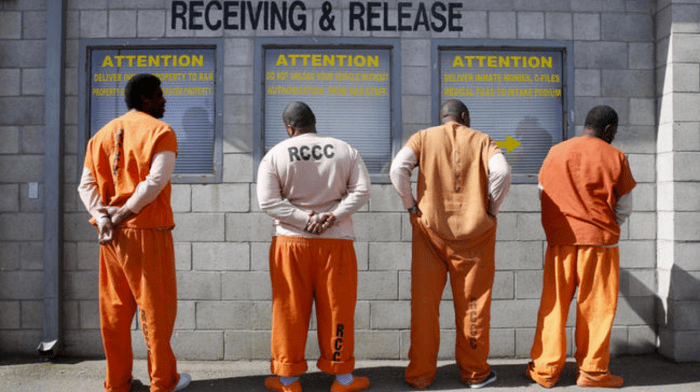 So Many Black People Locked Up it has Warped our Sense of RealityApril 23, 2016 0 45Share on Facebook Tweet on Twitter Prisoners from Sacramento County await processing after arriving at the California Department of Corrections and Rehabilitation Deuel Vocational Institution (DVI) in Tracy, Calif. (Rich Pedroncelli/Associated Press)For as long as the government has kept track, the economic statistics have shown a troubling racial gap. Black people are twice as likely as white people to be out of work and looking for a job. This fact was as true in 1954 as it is today.The most recent report puts the white unemployment rate at around 4.5 percent. The black unemployment rate? About 8.8 percent.But the economic picture for black Americans is far worse than those statistics indicate. The unemployment rate only measures people who are both living at home and actively looking for a job.The hitch: A lot of black men aren’t living at home and can’t look for jobs — because they’re behind bars. READ MORE


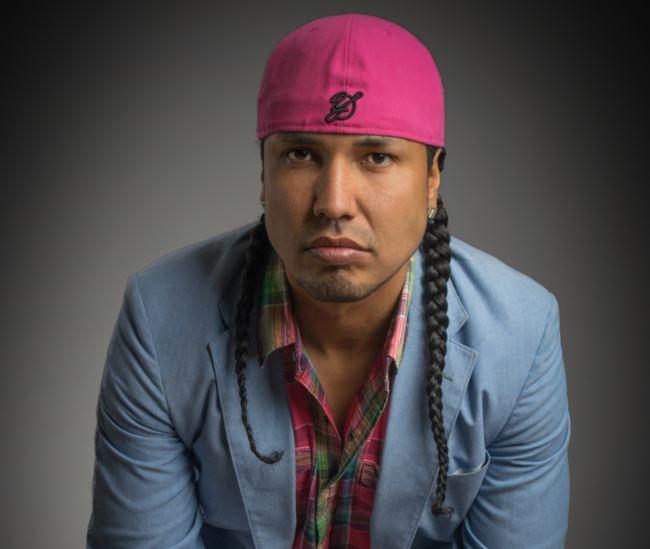

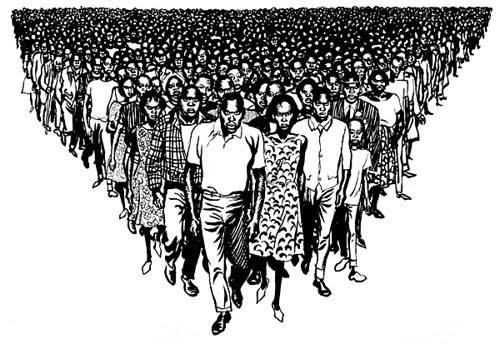

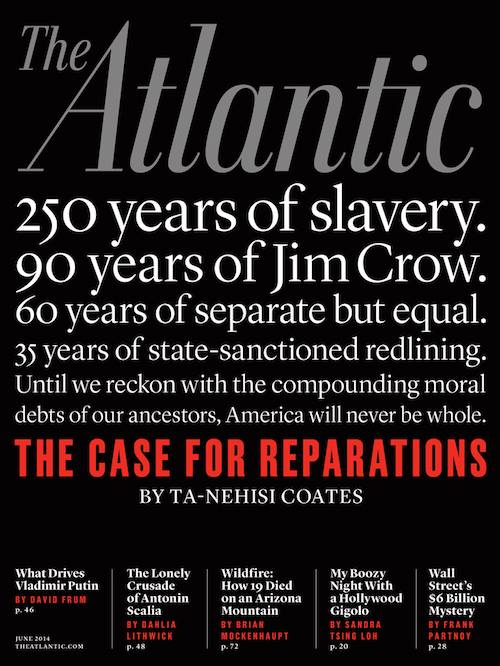


 Andrey_Popov/Shutterstock.com




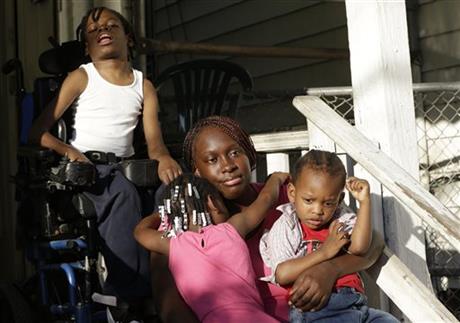


 OCG
OCG 