Obama Offered “The Tranquilizing Drug of Gradualism” – Dr. Wilmer Leon

 In His March on Washington Speech, Obama Offered “The Tranquilizing Drug of Gradualism”

Dr. Wilmer Leon

 By Dr. Wilmer J. Leon, III

weopwepospwp

“We have also come to this hallowed spot to remind America of the fierce urgency of Now. This is no time to engage in the luxury of cooling off or to take the tranquilizing drug of gradualism. Now is the time to make real the promises of democracy.” Rev. Dr. Martin Luther King, Jr. August 28, 1963

During the 50th anniversary of the March on Washington for Jobs and Freedom there was a lot of discussion about the “then” vs. “now”.  Has the “Dream” been realized?  Are we in a post-racial America? How did the 50th anniversary March compare to the first?

The answer to the first question is an emphatic “NO”. As I have written and lectured on a number of occasions, to refer to Dr. King’s message as a dream misses the point of the speech. Over the years Dr. King’s revolutionary message has been hijacked, compromised and relegated to being that of just a dreamer, not the lucid and radical ideas of a man seeking solutions to how a people can overcome oppression and racism. To cast King in the light of a dreamer allows people to be convinced that substantive change resulting from clear vision and direct action is not necessary.

Are we in a post-racial America? No, and that’s a ridiculous question.  I havewritten to this point as well. America cannot be close to being post racial when a candidate for president has to run a deracialized campaign in order to make the masses comfortable with the obvious aesthetic. This is not a post-racial America when the unemployment rate in the African American community is more than double the national average and the wealth accumulation of the average European American family is 20 times that of the average African American family.

How did the 50th anniversary March compare to the first? Comparisons are natural due to the fact that the two marches were convened to address many of the same issues. The fact that 50 years later, speakers still addressed issues such as unemployment, jobs, civil liberties, education, health care, support for social programs and protection against police brutality made for easy yet unfortunate comparisons. It is understandable that people will try to make qualitative and quantitative assessments between similar events.

While there might be some obvious and natural similarities between the two marches they are also quite different. Their political contexts are very different.

Leading up to the 1963 March, civil rights organizations such as CORE, SNCC, SCLC and the NAACP were engaged in non-v*****t direct action.  There was a three pronged strategy to bring pressure upon the executive branch and other branches of government to recognize and protect the civil rights of Negros of the day.  This pressure was being applied in the streets (sit-ins, boycotts, and marches), the courts (Brown v. Board of Education, etc.) and the legislature (civil rights laws, voting, and public accommodations). It was the struggle of a people to be included into the social, economic and legal mainstream of America.

Due to the constant pressure that the Civil Rights Movement brought to bear upon the government which culminated with the 63’ March, President Kennedy reluctantly came to support what would become the 1964 Civil Rights Act. Torn between the moral reality of the Movement and practical Southern electoral politics, Kennedy in June of 63’gave a nationally televised address where he stated, “A great change is at hand, and our task, our obligation, is to make that revolution, that change, peaceful and constructive for all.” He then asked Congress to enact a civil rights bill that would remove race from consideration “in American life or law.”

After Kennedy’s assassination, President Johnson would support and sign the 1964 Civil Rights Act, along with the 1965 Voting Rights Act, and the Fair Housing Act. In seizing the initiative, Johnson stated, “…rarely in any time does an issue lay bare the secret heart of America itself. The issue of equal rights for American Negroes is such an issue. And should we defeat every enemy, should we double our wealth and conquer the stars, and still be unequal to this issue, then we will have failed as a people and as a nation… Wednesday I will send to Congress a law designed to eliminate illegal barriers to the right to vote.”

It is important to understand what both Kennedy and Johnson said and did to bring about substantive change in American society. Today, due to complacency and the fallacy that those who dare criticize the president should turn in their “Black Card”, there has been virtually no pressure on the current administration to work with the Congressional Black Caucus to propose and fight for targeted legislation that addresses the interests of the African American community.

As a result of orchestrated efforts by of some in the extremist wing of the Republican Party and the complacency of the Black electorate after the election of President Obama, many of the civil rights gained from the movement and culminating in the 1963 March (affirmative action, voting rights, and protections against police brutality) have been eviscerated.  The focus of the struggle has shifted away from inclusion into mainstream America to futile efforts to hang onto the gains that were hard fought and won in the 1960’s.

The 2013 March on Washington was a wonderful commemoration and tribute to the past, but it failed to articulate a legislative agenda and plan to pressure the Obama administration and Congress to address disparities in mass incarceration, home foreclosure, unemployment or education.

In 1963 President Kennedy stayed in the White House, choosing to watch the March on television. He was afraid that the March would turn into a riot. In 2013 President Obama was the keynote speaker. Many see this as progress.

During his speech President Obama applauded the struggles and successes of the past and with soaring rhetoric talked about the promise of tomorrow. He did not propose any substantive legislative initiatives to address the suffering of today and ask those in attendance to go back to their homes and hamlets and work with him to defeat legislative gridlock.

He offered the “tranquilizing drug of gradualism”.

Dr. Wilmer Leon, an OUR COMMON GROUND Voice, is the Producer/ Host of the Sirisu/XM Satellite radio channel 110 call-in talk radio program “Inside the Issues with Wilmer Leon” Go to www.wilmerleon.com or email:wjl3us@yahoo.comwww.twitter.com/drwleon and Dr. Leon’s Prescription at Facebook.com

© 2013 InfoWave Communications, LLC

04-06 Wiler Leon

Debt Inc. – The American Scam Economy -ProPublica

The 182 Percent Loan: How Installment Lenders Put Borrowers in a World of Hurt

by Paul Kiel, ProPublica, May 13

Many people know the dangers of payday loans. But “installment loans” also have sky-high rates and work by getting borrowers — usually poor — to renew over and over. We take you inside one of the biggest installment lenders, billion-dollar World Finance. More »


http://www.propublica.org/series/debt-inc

via Debt Inc. – ProPublica.

Detroit and America’s Racial “Exceptionalism” | Black Agenda Report

 Detroit and America’s Racial “Exceptionalism” | Black Agenda Report.

A Black Agenda Radio commentary by executive editor Glen ford

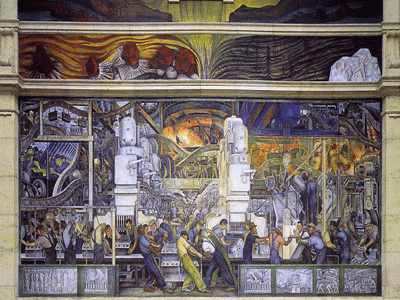
The picture is of Diego Rivera’s mural Detroit Industry, 1932-33, Detroit Institute of Arts.

Corporate solutions can justifiably be substituted for democracy, when it comes to Blacks.”

The great American dissolution of electoral democracy is playing out in Detroit, where last Monday the state-appointed Emergency Financial Manager explained to a crowd at Wayne State University how he would compassionately go about the business of breaking their city into buyable and sellable parts. The people and their elected representatives would have no say in the ultimate result.

The corporate media, and white folks in general, view the process as an inevitability – a kind of crude justice – not because they have rejected the principle of self-government, but because Detroit is overwhelmingly Black, and Blacks have always been the exception to the American rule. In fact, all of the Black population centers of Michigan have been divested of the right to govern themselves.

There has been no national outpouring of solidarity with Michigan’s Blacks over the loss of their citizenship rights, which can only mean that there exists an effective white consensus that African Americans are not fully deserving of those rights. Uncontrolled concentrations of Blacks are seen as pathological, by definition.

The same race-based exception was made to public education, for Blacks. In New Jersey and localities across the country, public schools in largely Black areas have for decades been under state control, denying Black parents any effective voice in their children’s education. By and large, white suburbanites supported the state in making Blacks an exception to the general American rule on local control over education. It is a right Blacks are not thought to be qualified to exercise.

Blacks were an exception to the Constitution.”

The same racial exception to the rule led to massive privatization of inner city education, through wholesale imposition of charter schools and private school vouchers. When education secretary Arne Duncan declared that Hurricane Katrina was the best thing that ever happened to public schools in New Orleans because it allowed most of the city’s schools to be converted to charters, there was no national condemnation of his remarks – since it is accepted that Blacks cannot run their own school systems. They are the great exceptions to the American rule. Corporate solutions can justifiably be substituted for democracy, when it comes to Blacks.

The problems of drugs and crime were framed as Black phenomena, requiring a more flexible interpretation of civil liberties and the creation of a vast police state. Just as the Founding Fathers actually intended, Blacks were an exception to the Constitution.

Blacks, and their alleged “pathologies,” were considered the nexus of poverty and social disintegration in America. Therefore, the social safety net was kept at the absolute minimum.

And now, all these exceptions that have been made for Blacks, are to become models for America as a whole, in the age of austerity, corporatized education, undemocratic governance, and the National Security State. In places like Detroit and New Orleans, America has been busily creating the pilot programs for the rule of the rich, by systematically undermining social democracy for Blacks.

The great exception, is becoming the rule.

For Black Agenda Radio, I’m Glen Ford. On the web, go to BlackAgendaReport.com.

BAR executive editor Glen Ford can be contacted at Glen.Ford@BlackAgendaReport.com.


OUR COMMON GROUND with Janice Graham l “The State of Black America: A Tale of Two Countries” l Guest: Dr. Wilmer Leon l April 6, 2013

OUR COMMON GROUND with Janice Graham

April 6, 2013       10 pm ET  LIVE

“The State of Black America: A Tale of Two Countries”

Tonight’s Guest: Dr. Wilmer Leon


04-06 Wiler2 Leon


“The State of Black America: A Tale of Two Countries”

Tonight’s Guest: Dr. Wilmer Leon

Dr. Leon comes to OCG once again to weigh in on the issues which face Black America, the politics of our problems and the light of solutions available.

Wilmer J. Leon III, Ph.D. is a Political Scientist whose primary areas of expertise are Black Politics, American Government, and Public Policy. He is a Teaching Associate in the Political Science Department at Howard University in Washington, D.C., a nationally syndicated broadcast radio talk show host, columnist, commentator, political consultant, TV host, lecturer, and much sought after motivational speaker.

Dr. Leon earned a BS degree in Political Science from Hampton Institute, a Masters in Public Administration (MPA) from Howard University, and a Ph.D. in Political Science from Howard University.

A serious void exists in the public discourse relating to the issues that directly and/or disproportionately impact the global village in which we live. Dr. Leon’s lectures and writings focus on issues such as the media’s coverage of national and international issues, the criminal industrial complex, environmental racism, school vouchers, health care, crime policy, economic globalization, American domestic and foreign policy from as much of a non- biased and academically accurate perspective as possible. Dr. Leon’s perspective and lectures are grounded in the history of the African American community and the tradition of African American scholarship.

Dr. Leon is host/producer of the nationally broadcast call in talk radio program Inside The Issues With Dr. Wilmer Leon on XM/Sirius satellite radio channel 169 “Urban View” and the host of Epilogue, a political book discussion program on Press TV. He hosts discussion on Facebook as Dr. Leon Prescriptions.

Dr. Leon was a regular guest on CNN’s Lou Dobbs Tonight and is a contributing columnist to The Grio.com, The Black Agenda Report, The Maynard Institute.com, TruthOut.org, PoliticsInColor.com and Black Star News.

OUR COMMON GROUND with Janice Graham

“Speaking Truth to Power and Ourselves”

BROADCASTING     BRAVE     BOLD BLACK

LISTEN LIVE 

Join the discussion in our Open Chat during the broadcast.

 On the Web

Follow us on Twitter    @JaniceOCG      #TalkthatMatters

Like US on Facebook

LIVE: OCG Meetinghouse: http://www.blogtalkradio.com/OCG
For More Information: http://www.ourcommongroundtalk.wordpress.com/


Witness On the Bridge l In Conversation with Ruby N. Sales l March 23, 2013 l OUR COMMON GROUND

OUR COMMON GROUND with Janice Graham

WITNESSES FROM THE BRIDGE Series


03-09 RubySales2

In Conversation with Ruby N. Sales


Civil Rights and Liberation Activist – Community Activist and OrganizerCommunity Education and Development Leader

 Human Rights Activist

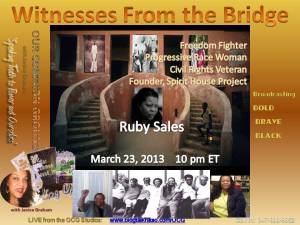
March 23, 2013       10pm ET

LIVE and CALL-In

“WITNESSES FROM THE BRIDGE”
“They came to Change a Nation and Lift Up A People”
The Women of the Black Power Movement

about RUBY N. SALES

FREEDOM and JUSTICE WARRIOR

sales
Ruby Nell Sales is a highly-trained, experienced, and deeply-committed social activist, scholar, administrator, manager, public theologian, and educator in the areas of Civil, Gender, and other Human Rights. She is an excellent public speaker, with a proven track record in conflict resolution and consensus building. Ms. Sales has preached around the country on race, class, gender, and reconciliation, and she has done ground-breaking work on community and nonviolence formation. Ms. Sales also serves as a national convener of the Every Church A Peace Church Movement.

Along with other SNCC workers, Sales joined young people from Fort Deposit, Alabama who organized a demonstration to protest the actions of the local White grocery-store owners who cheated their parents. The group was arrested and held in jail and then suddenly released. Jonathan Daniels, a White seminarian and freedom worker from Episcopal Divinity School in Cambridge, Massachusetts was assassinated as he pulled Sales out of the line of fire when they attempted to enter Cash Grocery Store to buy sodas for other freedom workers who were released from jail. Tom Coleman also shot and deeply wounded Father Richard Morrisroe, a priest from Chicago. Despite threats of violence, Sales was determined to attend the trial of Daniels’ murderer, Tom Coleman, and to testify on behalf of her slain colleague.

As a social activist, Sales has served on many committees to further the work of reconciliation, education, and awareness. She has served on the Steering Committee for International Women’s Day, Washington, D.C.; the James Porter Colloquium Committee, Howard University, Washington, D.C.; the Coordinating Committee, People’s Coalition, Washington, D.C.; the President’s Committee On Race, University of Maryland; and the Coalition on Violence Against Women, Amnesty International, Washington, D.C. She was a founding member of Sage Magazine: A Scholarly Journal on Black Women. Sales received a Certificate of Gratitude for her work on Eyes on the Prize. Additionally, she was featured in Broken Ground: A Film on Race Relations in the South, by Broken Ground Productions. From 1991-1994, Sales founded and directed the national nonprofit organization Women of All Colors, dedicated to improving the overall quality of life for women, their families, and the communities in which they live. Women of All Colors organized a week-long SisterSpeak that brought more than 80 Black women together to set a national agenda.

In 2000, Dan Rather spotlighted Sales on his “American Dream” Segment. In 1999, Selma, Alabama gave Sales the key to the city to honor her contributions there. In 2007, Sales moved to Columbus, Georgia, where she organized: a southern summit on racism; a national write-in campaign to save Albany State from being merged into a White college; a grassroots and media campaign to shed light on the death of seventeen year old, Billye Jo Johnson, who allegedly killed himself on a dark road in Lucedale, Mississippi when a deputy stopped him for speeding; Long Train Running Towards Justice, which celebrated the work of Black teachers during segregation and explored the ways that the Black school culture has been destroyed by White officials under the guise of desegregation; and a meeting with students at Savannah State to assist them in organizing and mobilizing a move by officials to merge Savannah State with a White college.

03-09 RubySalesIn 2009, the History Makers named her a History Maker for her contributions to civic affairs. The Veterans of Hope Project selected her to be a part of its video series. Her video “Standing Against the Wind” has been shown at colleges around the nation.

Sales serves as the founder and director of the SpiritHouse Project. SpiritHouse Project is a national organization that uses the arts, research, education, action, and spirituality to bring diverse peoples together to work for racial, economic, and social justice, as well as for spiritual maturity.

about SPIRITHOUSE Project

SpiritHouse Project houses The Jonathan Daniels and Samuel Young Institute for Racial Justice, which (1) supports and prepares a new generation of peace and justice workers who want to discern a call to social justice and nonviolence; (2) strengthens their courage, hope, resolve, and reason to do this work; (3) prepares them to play leading roles in public policy debates about issues such as poverty, prison industrial complex, militarism, the shrinking budget for human needs, voting rights, privacy and judicial issues, and neo-conservatism; and (4) helps grassroots communities meet their urgent need for trained and committed volunteers or staff. Throughout her career, Sales has mentored young people and provided support and venues for an intergenerational community of developing and seasoned social justice performing and creative artists. Sales has a deep commitment to providing the education, practical experiences, and frame of references to contest racism and add their voices to a public conversation on the many streams of oppression that emerge from it.

SpiritHouse also houses SisterAll Programs that bring Black women together in assemblies, classrooms, and performance spaces to renew our historical roles as a community of activists, spiritual guides, and leaders who stand and work on the front lines for racial, economic, and human rights using the tools of nonviolence and participatory democracy. SisterAll One was a community-building project that called together black female scholars, activists, artists, students, workers, practitioners, and lay and ordained spiritual leaders between the ages of 18 and 35, alongside older Black women who have been long distance runners for justice.

Ruby Sales’ Spirit House Project interns will share what they have learned in their work tracking the different points of connection within the Prison Industrial Complex and Criminal Justice Reform.

Spirit House is located at 1884 Ponce De Leon Avenue NE #1, Atlanta, GA 30307

Join us in the conversation with one of our most powerful, prolific and important figures in contemporary Black History.

LIVE: OCG Meetinghouse: http://www.blogtalkradio.com/OCG

For More Information: http://www.ourcommongroundtalk.wordpress.com/

OUR COMMON GROUND with Janice Graham

“Speaking Truth to Power and Ourselves

“BROADCASTING BRAVE BOLD BLACK

Community Forum: http://www.ourcommonground-talk.ning.com/

Twitter: @JaniceOCG #TalkthatMatters                   Web: http://www.wordpress.ourcommongroundtalk.com/

More Black Men in Jail Than in College? Wrong l Ivory A. Toldson, Ph.D

More Black Men in Jail Than in College? Wrong

Show Me the Numbers: A 13-year-old report using questionable data gave rise to an enduring myth.

Students at a Morehouse College commencement (Getty); prisoners at the Avon Park Correctional Facility (Getty)

(The Root) — What does the line “There are more black men in jail than in college” have in common with the Jheri curl? Answer: They were invented by white men (Jheri Redding and Vincent Schiraldi, respectively) and adopted enthusiastically by black people, and they left a nasty stain on the shoulders of millions of black men.

It’s been more than 20 years since the Jheri curl faded away into infamy, and I’m proud to say that even in the 1980s, I never sported a curl. Unfortunately, I can’t say the same about the line “There are more black men in jail than in college.”

About six years ago I wrote, “In 2000, the Justice Policy Institute (JPI) found evidence that more black men are in prison than in college,” in my first “Breaking Barriers” (pdf) report. At the time, I did not question the veracity of this statement. The statement fit well among other stats that I used to establish the need for more solution-focused research on black male achievement.

I was in good company. The same year, at a 2007 NAACP forum, then-presidential candidate Barack Obama said, “We have more work to do when more young black men languish in prison than attend colleges and universities across America.”

However, just as a Jheri curl would be wrong no matter how you dressed it up today, the line “There are more black men in jail than in college” is wrong no matter how you contextualize, qualify or articulate it.

Today there are approximately 600,000 more black men in college than in jail, and the best research evidence suggests that the line was never true to begin with. In this two-part entry in Show Me the Numbers, the Journal of Negro Education’s monthly series for The Root, I examine the dubious origins, widespread use and harmful effects of what is arguably the most frequently quoted statistic about black men in the United States.

Continue Reading

The Execution of Christopher Dorner l Counterpunch

FEBRUARY 13, 2013


The State of the Union Amidst the Ashes of Extrajudicial Death

The Execution of Christopher Dorner

by GEORGE CICCARIELLO-MAHER and MIKE KING

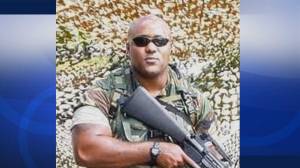
If the murder of Oscar Grant on an Oakland transit platform marked the dawn of the Obama era, the cold-blooded murder of former Naval reservist and Los Angeles Police officer Christopher Dorner might just mark the end of whatever optimistic hope people can muster in his administration. Whether an innocent young man just trying to get home, shot in the back after being racially profiled and slurred, or a man driven to his breaking point after being fired from a similar police force that operates according to its own warped morality and overarching objectives, the state of the union is a powder keg whose wick has gotten shorter due to decades of looking the other way.

Just minutes before Barack Obama began his state of the union address, San Bernardino County Sheriffs, knowing full well what they were doing, burned Christopher Dorner to death. From police brutality and racism to political unaccountability, from lack of economic opportunities to the extrajudicial murder of anyone deemed an enemy of the state, Dorner’s life and death offers us a much clearer picture of the state of this union than last night’s speech or media commentary.

In the years between the murder of Oscar Grant and Dorner’s last stand, March of 2009 to be specific, we were among those observing the case of Lovelle Mixon in Oakland, a parolee who decided he was not going to return to prison, opening fire on police at a traffic stop, killing two. Police went in to execute Mixon, not expecting that he would be holding an SKS. Two more cops died as a result. The logic of Dorner’s desperation, and the chain of events that led to his ultimate death, parallels Mixon’s; proud men without hope, cornered, deciding to go out fighting.

Neither man was a self-understood revolutionary and it would be inaccurate (or perhaps too accurate a reflection of the dearth of revolutionary activity in contemporary society) to try and declare otherwise. However, the material conditions that produced Dorner, as with Mixon, are not uncommon. The meaning and the effects of their actions speak volumes about the depth of racialization, criminalization and hopelessness in Obama’s supposed “post-racial” America.

dornergunLAPD Endgame: Street Justice on a Snow-Capped Mountain

The scene could not be more surreal: the remains of a cabin south of Big Bear still smoldering, the President delivered his State of the Union Address. To be fair, they had yet to confirm that the person they were incinerating in a cabin near Big Bear actually was Dorner. Earlier in the day, San Bernardino County Sheriffs received a call reporting a stolen vehicle driven by someone matching a description of Dorner. If the experience of the past five days is any indication, this narrowed it down to Black men, Asian women, and skinny white men.  The $1 million dollar reward offered for information leading to Dorner’s capture or death, also offered a measurable rubric for the value of the lives of police officers, as traditionally rewards in homicide cases are closer to $20,000.    

In the gathering of hurried interviews some interesting truths from the public made it into the TV news. An MSNBC reporter asked a witness: “Where you worried when you learned that Christopher Dorner was so close to your house?” But the witness responded “Actually, I was just afraid of the cops.” Given the unrestrained violence unleashed in recent days by the LAPD, this sentiment is perhaps unsurprising, but demonstrating a degree of hubris matched only by an utter absence of ironic intent, LAPD chief Charlie Beck said, evidently with a straight face, “To be targeted because of what you are… that is absolutely terrifying.” To which many nationwide responded with an audible guffaw: welcome to the club.

An interview with the man who was allegedly carjacked by Dorner said that, while police had told the man not to tell the whole story, he reported that Dorner had simply said “I don’t want to hurt, take your dog and go.” When sheriff’s deputies found thevehicle yesterday, the driver allegedly retreated into a cabin, at one point re-emerging amid the smoke of a diversionary device to exchange more than 100 rounds of fire with deputies. Two police were injured, with one later dying. Police quickly established a large perimeter, closing highways around Seven Oaks, south of Big Bear up to twenty miles away.

Establishing the perimeter also seemed to mean keeping the media at an arm’s length. While press helicopters had been providing live shots of the cabin in which Dorner was allegedly holed-up, the SBSD quickly requested that media withdraw to roadblocks miles away and that news choppers cease to transmit live video for fear of providing strategic information to Dorner himself. The San Bernardino Sheriff’s Department requested that media outlets and individuals cease and desist from even tweeting about the manhunt and shootout.

Even more astonishing than the request was the immediate compliance: press outlets abruptly ceased to tweet about the developing story, and duly retreating to the roadblocks, abandoned their task of reporting the news and waited for it to be fed to them. To paraphrase but one of many incredulous observers, we speak of press blackouts in China, but all the police had to do here was ask nicely and the press complied without batting an eyelash.

With a voluntary media blackout in effect, the Twittersphere, punctuated with a plethora of indignant and sharply worded refusals to comply with the police, became one of the only sources of developing news. What we know about what happened thereafter owes almost entirely to those who scoured the web for scanner feeds from the San Bernardino Sheriff’s Department and intently followed the story these feeds told.

“The Burn Plan”

Shortly after 4pm Pacific Standard Time, the cabin was engulfed in flames, with CNN helicopters broadcasting plumes of black smoke from a distance of five miles. A single gunshot is reported from within the house. A narrative quickly emerged among the mainstream media, which we should recall was conspicuously absent from the scene, that police agencies had only deployed tear gas, and that perhaps Dorner himself had set the fire. Soon, what seems to be a cache of ammunition is exploding sporadically.

But for those of us listening to the San Bernardino Sheriff’s Department radio frequency, there was little question what had occurred. Nearly a half hour prior, officers had referred to “going ahead with the plan with the burner,” with another adding that the plan was to “back the Bear down and deploy the burner through the turret.” (Live audio during the preceding shootout seems to confirm this intention). Soon, the message was straightforward and expected: “Seven burners have deployed and we have a fire.” No surprised tones, no suggestion that the fire be extinguished.

In fact, there was the exact opposite: a female voice on the scanner repeatedly asks if the fire crews should be allowed to approach, and is told that it’s not time yet, that we need to wait until all four corners are engulfed, then that we need to wait until the roof collapses. At one particularly repulsive point, those on the scene realize that the house has a basement, and an authoritative male voice indicates that the fire crew would not be called until the fire had “burned through the basement.” They were going to let him die.

References to the 1993 massacre at Waco, Texas, the murderous 1985 bombing of the MOVE Organization in Philadelphia were immediate, and will serve as opposing frames for Dorner’s death in the days and weeks to come.

A murder? An assassination? A lynching? An execution.

State of the Union: Flammable

This is a day of a million possible metaphors, but central among these should be the image of the burning house. In an effort to distinguish what he called the “house negro” from the “field negro,” Malcolm X had once observed that the two responded differently when the master’s house caught fire: “But that field negro, remember, they were in the majority, and they hated their master. When the house caught on fire, he didn’t try to put it out, that field negro prayed for a wind.” While the metaphor may seem a strange one, given the fiery death of a man some have compared to a runaway slave. But as many Americans choose to gaze, mesmerized, at the glowing embers of the Dorner saga rather than watching the State of the Union, it’s worth wondering: whose house is really on fire? And who is praying for wind?

The eclipsing of the State of the Union, with some networks airing a split screen of the President’s speech alongside images from Southern California, or omitting pre- and post- speech coverage to report on Dorner’s likely death (a speech given in the context of ongoing war and occupation, unending recession and social crisis and a heated debate about, well, gun control) speaks volumes about our society, the conditions which produced Dorner and has helped produced a surge in mass killings generally. Persistent racist policies couched in the language of security, and failed imperial ventures with war tactics re-imported into American policing, are routinely covered over by the trite conflicts of celebrities, whether they be Kardashians or Congressmen.

Dorner was not just a product of a racist police department, he also no doubt adored his ‘fifteen minutes,’ stealing time from the President he nevertheless supported during the biggest planned speech of the year. Although Dorner’s actions were not driven by a radical consciousness, they are ‘as American as cherry pie’ in an apolitical vacuum that (at least on the surface) resembles Oliver Stone’s Natural Born Killers far more than the political contexts of the 1960s.

As Obama was taking to the lectern, police agencies were insisting that they had not set the fire that killed Christopher Dorner, and the compliant media were parroting this clearly implausible message. As members of Congress stood and sat on cue to rapturously applaud the Commander-in-Chief, more than 14,000 people have liked just one of the Facebook pages in support of Dorner, some because they know what racist policing is like, some because ours is a time of resisting injustice by any means, and some simply for the joy of backing an outlaw to the grisly end.

Dorner was not a radical, but his short war was not simply the story of broken man or of individualistic vengeance. The issues of brutality and racism perpetually covered up by a corrupt police department created the insurgent Dorner and resonated with many people who endure the reality of urban policing on a daily basis. The sympathy and the support Dorner received is a clear indicator of the very real and deep structural inequalities that helped forge the path of Dorner’s life and his fiery death. The great radical historian Mike Davis concluded a recent articleon Dorner with a peculiar question: “Does anyone cheer Dorner?” What is peculiar is that, for better or worse, there’s no denying that the answer is “yes.”

There’s no telling what sort of a fire they could start tomorrow.

George Ciccariello-Maher is assistant professor of political science at Drexel University. He is the author of We Created Chávez: A People’s History of the Venezuelan Revolution and can be reached at gjcm(at)drexel.edu.

Mike King is a Ph.D candidate in sociology at UC Santa Cruz, and can be reached at mikeking0101(at)gmail.com. Both study policing and counterinsurgency.

 From CounterPunch

THE OTHER FACE OF GUN VIOLENCE: KEEPING GUNS FROM HIGH-RISK INDIVIDUALS l Jamye Wooten, Kinetics LIVE

Suicide-Gun-Violence

THE OTHER FACE OF GUN VIOLENCE: KEEPING GUNS FROM HIGH-RISK INDIVIDUALS

By Jamye Wooten | NEWS & VIEWS

 “The staggering toll of gun violence—which claims 31,000 U.S. lives each year—is an urgent public health issue that demands an effective evidence-based policy response.”– The Case for Gun Policy Reform in America

There’s a world of difference between truth and facts. Facts can obscure the truth.”– Maya Angelou

There has been a lot of attention given to gun violence, since the day Adam Lanza armed himself with hundreds of bullets and took the lives of 20 children and six adults at Sandy Hook Elementary in Newtown, Connecticut. This tragic story has gotten the attention of corporate media, the nation, and even a President who hails from one of the deadliest cities in the country. “We won’t be able to stop every violent act, but if there is even one thing that we can do to prevent any of these events, we have a deep obligation, all of us, to try,” stated President Obama.

English: New York Mayor, Michael R. Bloomberg.New York Mayor, Michael R. Bloomberg.

New York City Mayor Michael Bloomberg, co-founder of Mayors Against Illegal Guns, also joined the chorus launching  Demand a Plan, a celebrity backed PSA campaign to reform gun laws.

Mayor Bloomberg has been supportive of the controversial, “Stop and Frisk” program of the NYPD that has resulted in over 4 million stops and street interrogations of mostly Black and Latinos in New York City since 2002. According to New York Civil Liberties Union (NYCLU) guns are found in less than 0.2 percent of stops, prompting concerns over racial profiling.

Gun Policy Summit

The staggering toll of gun violence—which claims 31,000 U.S. lives each year—is an urgent public health issue that demands an effective evidence-based policy response.

The staggering toll of gun violence—which claims 31,000 U.S. lives each year—is an urgent public health issue that demands an effective evidence-based policy response.

Last month, I attended a two-day Gun Policy Summit hosted by Mayor Bloomberg and the John Hopkins University School for Public Health. I was interested in hearing what sort of gun policy recommendations would be proposed and their potential impact on the Black community.

According to the research there are over 31,000 incidents of gun violence each year in the United States, but while homicides often make the headlines, there is a less known fact when dealing with issues of gun violence.

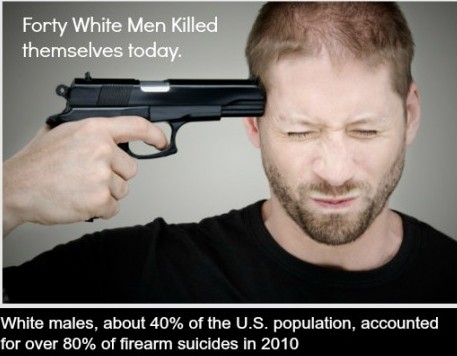
Out of the 31,000 lives lost due to gun violence, every year 19,000 or almost 2 out of every 3 are suicides. White males accounted for over 80% of gun related suicides in 2010. And according to the American Foundation for Suicide Prevention, yearly medical costs associated with suicide, is nearly $100 million and 90% of people who die by suicide have a diagnosable and treatable psychiatric disorder at the time of their death.

Every night we watch Black men on the nightly news who have been involved in gun violence. Gun violence in urban America is a serious issue and Black youth are disproportionately victims of it. When addressing the high rates of homicide in the African-American community, Dr. Linda Frisman told the audience at John Hopkins “that being African-American and Hispanic are really proxies for social and economic disadvantage.” This is something that most Blacks understand. Addressing gun violence in urban America will not be solved with more police and school resource officers as President Obama has recommended or by adding additional security cameras to our schools that stream live to patrol cars and police precincts. If we are serious about reducing gun violence, we must address the social and economic disparities in communities of color. Strong economically secure communities that provide family sustaining wages, affordable housing, culturally relevant and enriching education that equips children with skills to succeed in the 21st century, and love will make schools and neighborhoods safe for our children. Successful faith and community-based programs should be rewarded with additional funds with less money being poured into Police departments that normally respond punitively when dealing with our children.

Another forty white men have killed themselves tonight

I begin to think, what if each night the local nightly news began by stating, “Another forty white men have killed themselves tonight?”

There are studies for every social pathology in the Black community, and policy responses crafted by “experts,” that are often punitive and never seem to be systemic. But for some reason, you can’t find much research on white males and why they are killing themselves at an alarming rate, or why there is a fascination with weapons. What if we began to take the same data and create policy around it? What would it look like? Would it stigmatize white males? Would we have to dispatch mental health professionals to workplaces every time they were laid off? Would we need to send the Bureau of Alcohol, Tobacco, Firearms and Explosives (ATF) to their homes to search and remove their guns? How safe would White women and children feel when their husbands and fathers were laid off? Would white men be considered a High-Risk group for firearm ownership? Or would there be a stop and frisk policy implemented for White men over the age of 50?

In October of 2012, leading experts from the Johns Hopkins Bloomberg School of Public Health produced a report entitled, “The Case for Gun Policy Reform in America.” Many of the policy recommendations from the expert reports concentrated on Firearms Prohibitions for High-Risk Persons. Though suicide is the leading cause of death by firearms, with White males accounting for over 80%, they were not mentioned in the high risk category.

Well, who are the High Risk groups that should be prohibited from owning firearms? Under the section entitled, Why Firearms Prohibitions for High-Risk Persons Should be Broadened the categories include Criminals, Substance Abusers (Illegal Substances) and Youth Under Age 21.

Criminal Prohibitions

We believe the evidence above justifies an extension of firearm prohibitions for persons with a history of criminal behavior to include persons convicted of all misdemeanor crimes of violence, as well as individuals who have committed felony crimes as a juvenile.”

Substance Abusers

The number of drug abusers prohibited from possessing firearms might be increased significantly by revamping these regulations to, for example, expand the period following a drug conviction for which a person is prohibited from possessing firearms.”

Youth Under Age 21

Restrictions on youths’ ability to purchase and possess firearms should be broadened. Although federal law and most state law allows youth 18 to 20 years of age to legally possess a handgun, youth of these ages have some of the highest rates of homicide offending.”

These policy recommendations are about narrowing access to who can legally own a firearm, by identifying the most high-risk persons. The criminal prohibitions and substance abusers recommendations would narrow the number of Black people who have access to guns. Not because Blacks use illegal substances at higher rates than Whites. According to the NAACP, “5 times as many Whites are using drugs as Blacks, yet the Black population, especially men are sent to prison for drug offenses at 10 times the rate of Whites.”  The NAACP Criminal Justice Fact Sheets states that “in 2002, despite that fact that more than 2/3 of crack cocaine users in the U.S. are white or Hispanic, blacks constituted more than 80% of people sentences under federal crack cocaine laws.”

It is also important to remember, as Dr. Matthew Miller pointed out, the vast majority guns that kill are handguns and legally owned.

United Nations Conference on the Arms Trade Treaty

Internationally the United Nations appears to be pursuing the same policies. In March of this year they will convene the United Nations Conference on the Arms Trade Treaty (ATT). The conference is designed to tighten import, export and transfer of conventional arms. The UN states that ATT “will not aim to ban any weapon.” And why would they? White men control the most deadly arsenals of weapons of mass destruction in the world. Instead, the conference wants to make sure weapons don’t fall “into the hands of terrorists, drug traffickers, and criminal cartels.”

Drug traffickers and Criminal cartels? I think you already know who the target groups are. This sounds very familiar to the language in the Hopkins report. Identify high-risk populations, mostly communities of color and limit their access to acquiring weapons while leaving out the highest risk group, White men. No group has manufactured, proliferated or used more weapons of mass destruction than White males, yet they conveniently label communities of color as “terrorists” or “high risk.”

They will beat their swords into plowshares and their spears into pruning hooks. Nation will not take up sword against nation, nor will they train for war anymore. – Isaiah 2:4

I pray for the day when we will beat our swords into plowshares and study war no more. But until then, we must make an honest effort to make sound gun policy. We must make sure that the War-on-Guns does not unfairly target people of color in the same way the War-on-Drugs have devastated our community.

READ MORE on Kinetics LIVE

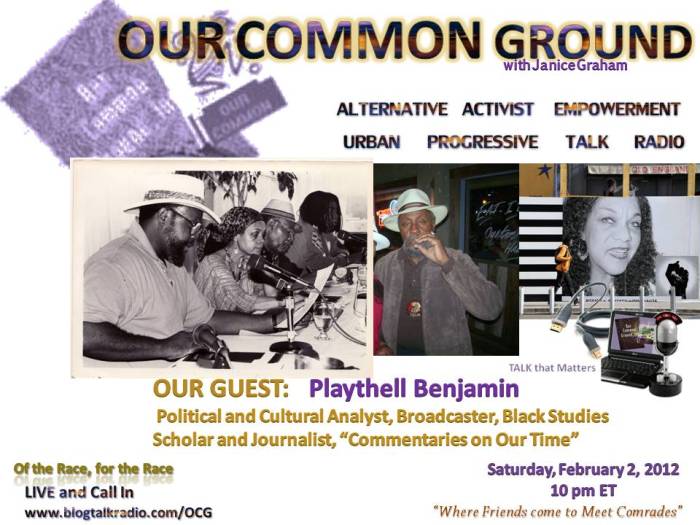
OUR COMMON GROUND Opens 2013 Season with Political-Cultural-Social Commentator Playthell Benjamin

OUR COMMON GROUND with Janice Graham

2013 Season Opening

season 2013opening2

 Playthell Benjamin

February 2, 2013 10pm ET

LIVE and Call In

2013 Season Opening

Listen LIVE


GUEST: Playthell Benjamin, Author, Commentator, Scholar and Broadcaster

Commentaries on The Times

“Praising Saints, Celebrating Heroes, Unmasking Charlatans, Defending the Defenseless and Chastising Scoundrel

“He characterized Tavis Smiley and Dr. Cornel West as misdirected and Marvin X of Oakland, a recovering left coast crack head and shameless sophist with an alter-ego bearing the curious name of “Plato Negro;” a pompous wag who confuses mindless mumbo jumbo with profound wisdom, alas I have been dragged back into an ethnic kerfuffle of the sort they love to wallow in but I eschew.” He writes about all the great issues of our time, and he is interested in the whole world. From the issues of SandyHook to Syria, the White House and the UN, there is no argument that Playthell Benjamin is a learned scholar and street smart analyst.”


About Playthell Benjamin

Playthell George Benjamin is the producer of “Commentaries On the Times” which he writes and delivers on WBAI radio in New York City. He is a producer with The Midnight Ravers, a long running show exploring the world of art and politics which has won several radio awards for excellence in programming. He is an award winning journalist who has been nominated for the Pulitzer Prize in two different categories: Explanatory Journalism, Village Voice 1988, and Distinguished Commentary, New York Daily News 1995. As part of the production team for The Midnight Ravers, Mr. Benjamin won a 2011 award for excellence in radio programming, given for The Curtis Mayfield Special.

playthell benjaminIn addition to major political current events, he has extensively written about the differences in political approach within the Black community on issues related to the Obama presidency, administration policies and achievement. Playthell has been an OUR COMMON GROUND Voice since the late 1980s and we welcome his voice back to our microphone. Our discussion will focus on issues related to Obama administration achievements, the inter-community discourse on Obama, and class struggle in America. His provocative, well-informed commentary is hard-hitting and sure to invite serious consideration of our positions and direction.

He characterized Tavis Smiley and Dr. Cornel West as misdirected and Marvin X of Oakland, a recovering left coast crack head and shameless sophist with an alter-ego bearing the curious name of “Plato Negro;” a pompous wag who confuses mindless mumbo jumbo with profound wisdom, alas I have been dragged back into an ethnic kerfuffle of the sort they love to wallow in but I eschew.” He writes about all the great issues of our time, and he is interested in the whole world. From the issues of SandyHook to Syria, the White House and the UN, there is no argument that Playthell Benjamin is a learned scholar and street smart analyst.

He writes that he has spent “a half century chronicling the triumphs and studying the problems of the black world. Indeed I was a co-founder of the first free standing, degree granting, Black Studies Department in history – the W.E.B. DuBois Department of Afro-American Studies at the University of Mass, Amherst. I also spent quite a few years as an activist trying to solve those problems, beginning with the explosion of the black student movement in the south during the spring of 1960. Since then my life story would make a spectacular read even by the standards of a romance novel.”

Playthell has won several prizes ranging from The Unity Award presented by the School of communications at Lincoln University in Missouri for distinguished commentary on race relations; the Griot Prize for excellence in covering a story requiring an exploration of African American history and culture: “Who is Listening to Louis Farrakhan?” It was awarded by the New York chapter of the Association of Black Journalist in December 1989. In 1991 Mr. Benjamin won the NYABJ Magazine Awards for Feature Stories, and in 1996 he won the first Annual Tom Forcade Award “for honesty and accuracy in drug reporting” awarded by High Times magazine for his columns on drug use and abuse in the New York Daily News.
From 1991 – 1996 Playthell was a regular contributor to the Guardian Observer of London, where he wrote on politics, culture and sports. He also wrote for the Sunday Times of London, particularly in the prestigious magazine, The Culture, which addresses cultural matters high and low. In the London Guardian he wrote feature stories ranging from the television coverage of the Los Angeles race riot sparked by the Rodney King incident, to the courtroom genius of the great First Amendment Lawyer Martin Garbus, as well as the O.J. Simpson Trial, The Mike Tyson Rape Case, The Inauguration of Bill Clinton, Concerts at Lincoln Center, and the Sista Souljah vs. Bill Clinton incident. Mr. Clinton’s saxophone playing was also subjected to serious critical evaluation in an essay titled “He may be the Leader of the Western World…But will he ever be President of the Saxophone? For The Sunday Times he wrote about the Youth Jazz festivals convened by the peerless jazz vocalist Betty Carter, Michael Douglass’ movie on the desperation of displaced white workers, Gangsta Rap, Jazz, etc.

PhotoFunia-a349

OUR COMMON GROUND with Janice Graham

“Speaking Truth to Power and Ourselves”

BROADCASTING BRAVE BOLD BLACK

Community Forum: http://www.ourcommonground-talk.ning.com/
Twitter: @JaniceOCG #TalkthatMatters
Web: http://www.wordpress.ourcommongroundtalk.com/

How Racism, Global Economics, and the New Jim Crow Fuel Black America’s Crippling Jobs Crisis

What We Don’t Talk About When We Talk About Jobs

Posted: 07/05/11

 How Racism, Global Economics, and the New Jim Crow Fuel Black America’s Crippling Jobs Crisis

Andy Kroll, Staff writer, Mother Jones magazine

Tomdispatch.com 

Like the country it governs, Washington is a city of extremes. In a car, you can zip in bare moments from northwest District of Columbia, its streets lined with million-dollar homes and palatial embassies, its inhabitants sporting one of the nation’s lowest jobless rates, to Anacostia, a mostly forgotten neighborhood in southeastern D.C. with one of the highest unemployment rates anywhere in America. Or, if you happen to be jobless, upset about it, and living in that neighborhood, on a crisp morning in March you could have joined an angry band of protesters marching on the nearby 11th Street Bridge.

They weren’t looking for trouble. They were looking for work.

Those protesters, most of them black, chanted and hoisted signs that read “D.C. JOBS FOR D.C. RESIDENTS” and “JOBS OR ELSE.” The target of their outrage: contractors hired to replace the very bridge under their feet, a $300 million project that will be one of the largest in District history. The problem: few D.C. citizens, which means few African Americans, had so far been hired. “It’s deplorable,”insisted civil rights attorney Donald Temple, “that… you can find men from West Virginia to work in D.C. You can find men from Maryland to work in D.C. And you can find men from Virginia to work in D.C. But you can’t find men and women in D.C. to work in D.C.”

The 11th Street Bridge arches over the slow-flowing Anacostia River, connecting the poverty-stricken, largely black Anacostia neighborhood with the rest of the District. By foot the distance is small; in opportunity and wealth, it couldn’t be larger. At one end of the bridge the economy is booming even amid a halting recovery and jobs crisis. At the other end, hard times, always present, are worse than ever.

Live in Washington long enough and you’ll hear someone mention “east of the river. That’s D.C.’s version of “the other side of the tracks,” the place friends warn against visiting late at night or on your own. It’s home to District Wards 7 and 8, neighborhoods with a long, rich history. Once known as Uniontown, Anacostia was one of the District’s first suburbs; Frederick Douglass, nicknamed the “Sage of Anacostia,” once lived there, as did the poet Ezra Pound and singer Marvin Gaye. Today the area’s unemployment rate is officially nearly 20%. District-wide, it’s 9.8%, a figure that drops as low as 3.6% in the whiter, more affluent northwestern suburbs.

D.C.’s divide is America’s writ large. Nationwide, the unemployment rate for black workers at 16.2% is almost double the 9.1% rate for the rest of the population. And it’s twice the 8% white jobless rate.

The size of those numbers can, in part, be chalked up to the current jobs crisis in which black workers are being decimated. According to Duke University public policy expert William Darity, that means blacks are “the last to be hired in a good economy, and when there’s a downturn, they’re the first to be released.”

That may account for the soaring numbers of unemployed African Americans, but not the yawning chasm between the black and white employment rates, which is no artifact of the present moment. It’s a problem that spans generations, goes remarkably unnoticed, and condemns millions of black Americans to a life of scraping by. That unerring, unchanging gap between white and black employment figures goes back at least 60 years. It should be a scandal, but whether on Capitol Hill or in the media it gets remarkably little attention. Ever.

The 60-Year Scandal

The unemployment lines run through history like a pair of train tracks. Since the 1940s, the jobless rate for blacks in America has held remarkably, if grimly, steady at twice the rate for whites. The question of why has vexed and divided economists, historians, and sociologists for nearly as long.

For years the sharpest minds in academia pointed to upheaval in the American economy as the culprit. In his 1996 book When Work Disappears, the sociologist William Julius Wilson depicted the forces of globalization, a slumping manufacturing sector, and suburban flight at work in Chicago as the drivers of growing joblessness and poverty in America’s inner cities and among its black residents.

He pictured the process this way: as corporations outsourced jobs to China and India, American manufacturing began its slow fade, shedding jobs often held by black workers. What jobs remained were moved to sprawling offices and factories in outlying suburbs reachable only by freeway. Those jobs proved inaccessible to the mass of black workers who remained in the inner cities and relied on public transportation to get to work.

Time and research have, however, eaten away at the significance of Wilson’s work. The hollowing-out of America’s cities and the decline of domestic manufacturing no doubt played a part in black unemployment, but then chronic black joblessness existed long before the upheaval Wilson described. Even when employment in the manufacturing sector was at its height, black workers were still twice as likely to be out of work as their white counterparts.

Another commonly cited culprit for the tenaciousness of African-American unemployment has been education. Whites, so the argument goes, are generally better educated than blacks, and so more likely to land a job at a time when a college degree is ever more significant when it comes to jobs and higher earnings. In 2009, President Obama told reporters that education was the key to narrowing racial gaps in the US. “If we close the achievement gap, then a big chunk of economic inequality in this society is diminished,” he said.

Educational levels have, in fact, steadily climbed over the past 60 years for African Americans. In 1940, less than 1% of black men and less 2% of black women earned college degrees; jump to 2000, and the figures are 10% for black men and 15% for black women. Moreover, increased education has helped to narrow wage inequality between employed whites and blacks. What it hasn’t done is close the unemployment gap.

Algernon Austin, an economist for the Economic Policy Institute in Washington, D.C., crunched data from the Bureau of Labor Statistics and found that blacks with the same level of education as whites have consistently lower employment levels. It doesn’t matter whether you compare high-school dropouts or workers with graduate degrees, whites are still more likely to have a job than blacks. Degrees be damned.

Academics have thrown plenty of other explanations at the problem: declining wages, the embrace of crime as a way of life, increased competition with immigrants.  None of them have stuck. How could they? In recent decades, the wage gap has narrowed, crime rates have plummeted, and there’s scant evidence to suggest immigrants are stealing jobs that would otherwise be filled by African Americans.

Indeed, many top researchers in this field, including several I interviewed, are left scratching their heads when trying to explain why that staggering jobless gap between blacks and white won’t budge. “I don’t know if there’s anybody out there who can tell you why that ratio stays at two to one,” Darity says. “It’s a statistical regularity that we don’t have an explanation for.”

Behind Bars, the Invisible Unemployed

So what keeps blacks from cutting into those employment figures? Among the theories, one that deserves special attention points to the high incarceration rate among blacks — and especially black men.

In 2009, 7.2 million Americans — or 3.1% of all adults — were under the jurisdiction of the U.S. corrections system, including 1.6 million Americans incarcerated in a state or federal prison. Of that population, nearly 40% percent were black, even though blacks make up only 13% percent of the American population. Blacks were six times as likely to be in prison as whites, and three times as likely as Hispanics. For some perspective, consider what author of The New Jim Crow Michelle Alexanderwrote last year: “There are more African Americans under correctional control today — in prison or jail, on probation or parole — than were enslaved in 1850, a decade before the Civil War began.”

Incarceration amounts to a double whammy when it comes to African-American unemployment. Rarely mentioned in the usual drumbeat of media reports on jobs is the fact that the Labor Department doesn’t include prison populations in its official unemployment statistics. This automatically shrinks the pool of blacks capable of working and in the process lowers the black jobless rate.

In the mid-1990s, academics Bruce Western and Becky Pettit discovered that the American prison population lowered the jobless rate for black men by five percentage points, and for young black men by eight percentage points. (Of course, this applies to whites, Asians, and Hispanics as well, but the figures are particularly striking given the overrepresentation of blacks in the prison population.)

Even that vast incarcerated population pales, however, in comparison to the number of ex-cons who have rejoined the world beyond the prison walls. In 2008, there were 12 million to 14 million ex-offenders in the U.S. old enough to work, according to the Center for Economic and Policy Research (CEPR). So many ex-cons represent a serious drag on our economy, according to CEPR, sucking from it $57 billion to $65 billion in output.

Of course, such research tells us how much, not why — as in, why are ex-cons so much more likely to be out of work? For an answer, it’s necessary to turn to an eye-opening and, in some circles, controversial field of study that may offer the best explanation for the 60-year scandal of black unemployment.

Twice as Hard, Half as Far

In 2001, a pair of black men and a pair of white men went hunting for work in Milwaukee, Wisconsin. Each was 23 years old, a local college student, bright and articulate. They looked alike and dressed alike, had identical educational backgrounds and remarkably similar past work experience. From June to December, they combed the Sunday classified pages in the Milwaukee Journal Sentinel and searched a state-run job site called “Jobnet,” applying for the same entry-level jobs as waiters, delivery-truck drivers, cooks, and cashiers. There was one obvious difference in each pair: one man was a former criminal and the other was not.

If this sounds like an experiment, that’s because it was. Watching the explosive growth of the criminal justice system, fueled largely by ill-conceived “tough on crime” policies, sociologist Devah Pager took a novel approach to how prison affected ever growing numbers of Americans after they’d done their time — a process all but ignored by politicians and the judicial system.

So Pager sent those two young black men and two young white men out into the world to apply for perfectly real jobs. Then she recorded who got callbacks and who didn’t. She soon discovered that a criminal history caused a massive drop-off in employer responses — not entirely surprising. But when Pager started separating out black applicants from white ones, she stumbled across the real news in her study, a discovery that shook our understanding of racial inequality and jobs to the core.

Pager’s white applicant without a criminal record had a 34% callback rate. That promptly sunk to 17% for her white applicant with a criminal record. The figures for black applicants were 14% and 5%. And yes, you read that right: in Pager’s experiment, white job applicants with a criminal history got more callbacks than black applicants without one. “I expected to find an effect with a criminal record and some with race,” Pager says. “I certainly was not expecting that result, and it was quite a surprise.”

Pager ran a larger version of this experiment in New York City in 2004, sending teams of young, educated, and identically credentialed men out into the Big Apple’s sprawling market for entry-level jobs — once again, with one applicant posing as an ex-con, the other with a clean record. (As she did in Milwaukee, Pager had the teams alternate who posed as the ex-con.) The results? Again Pager’s African-American applicants received fewer callbacks and job offers than the whites. The disparity was particularly striking for ex-criminals: a drop off of 9 percentage points for whites, but 15 percentage points for blacks. “Employers already reluctant to hire blacks,” Pager wrote, “appear particularly wary of blacks with known criminal histories.”

Other research has supported her findings. A 2001-2002 field experiment by academics from the University of Chicago and the Massachusetts Institute of Technology, for example, uncovered a sizeable gap in employer callbacks for job applicants with white-sounding names (Emily and Greg) versus black-sounding names (Lakisha and Jamal). They also found that the benefits of a better resume were 30% greater for whites than blacks.

These findings proved a powerful antidote to the growing notion, mostly in conservative circles, that discrimination was an illusion and racism long eradicated. In The Content of Our Character (1991),Shelby Steele argued that racial discrimination no longer held black men or women back from the jobs they wanted; the problem was in their heads. Dinesh D’Souza, a first-generation immigrant of Indian descent, published The End of Racism in 1995, similarly claiming racial discrimination had little to do with the plight of black America.

Not so, insist Pager, Darity, Harvard’s Bruce Western, and other academics using real data with an unavoidable message: racism is alive and well. It leads to endemic, deeply embedded patterns of discrimination whose harmful impact has barely changed in 60 years. And it cannot be ignored. As the old African-American adage puts it, “You’ve got to work twice as hard to get half as far as a black person in white America.”

Is There a Solution for Black America?

Tracing black unemployment in America since World War II, there are two moments when, briefly, the gap between black and white joblessness narrowed ever so slightly — in the 1940s and again in the late 1960s and early 1970s. For example in 1970, unemployment was at 5.8% for blacks and 3.3% for whites, a sizeable gap but significantly better than what followed in the Reagan era. Those are moments worth revisiting, if only to understand what began to go right.

According to University of Chicago professors William Sites and Virginia Parks, those periods were marked by a flurry of civil rights and anti-discrimination activity on the federal level. A series of actions ranging from the creation of the Fair Employment Practice Committee in 1941 to the passage of the Civil Rights Act of 1964 (which mandated the Equal Employment Opportunity Commission), the Voting Rights Act of 1965, and the Equal Employment Opportunity Act of 1972, write Sites and Parks, had “dramatic impacts on employment discrimination.”

But those gains of the 1970s were soon wiped out. The thinning of union membership and the dwindling power of organized labor didn’t help either, after decades of pressure on employers to end discrimination against workers of color.

Today, in terrible times, with the possibility of social legislation off the table in Washington, the question remains: What, if anything, can be done to close the jobless gap between blacks and whites? When I asked Devah Pager, she called this the “million-dollar question.” This form of discrimination, she pointed out, is especially difficult to deal with. As she noted in 2005, many employers who discriminate don’t even realize they’re doing so; they’re just going with “gut feelings.” “It’s not that these employers have decided that they are not going to hire workers from a particular group,” Pager told me.

What won’t work is relying on discrimination watchdogs to crack down more often. The way federal anti-discrimination law works, it’s up to the person who was discriminated against to raise an alarm. As Duke’s William Darity points out, that’s a near impossibility for a job applicant who must convincingly read the mind of a person he or she doesn’t know. Worse than that, the applicant who wants to lodge charges of discrimination also has to prove that the discrimination was intentional, which, as Pager’s experiments make clear, is no small feat. Under the circumstances, as Darity told me, perhaps no one should be surprised to discover that blacks “grossly underreport their exposure to discrimination and whites grossly overreport it.”

Of course, fixing a problem first requires acknowledging it — something the nation has yet to do, says the Economic Policy Institute’s Algernon Austin. To put blacks back to work, lawmakers should invest federal money directly in job creation, especially for black workers. Other avenues for putting people back to work, like a payroll tax credit won’t do the trick. “We’ve spent billions in trying to build jobs overseas” in war zones, Austin told me. “But if we invested that money here in our cities, we wouldn’t have this racial gap.”

But how likely is that at a moment when, in a Washington gripped by paralysis, any discussion of spending in Washington begins and ends at how much to cut? The painful reality of permanent crisis for black workers is here to stay. That’s how it seems to blacks in D.C., especially those who live east of the river. In April, another group of protesters took to the 11th Street Bridge to demand more D.C. hires, and the following month, the group D.C. Jobs or Else took their complaints to City Hall. But progress is slow. “We’re being pushed out economically,” said William Alston El, a 63-year-old unemployed resident who grew up in D.C. “They say it’s not racism, but the name of the game is they have the money. You can’t live [in] a place if you can’t pay the rent.”


Andy Kroll

, Staff writer, Mother Jones magazine

Andy Kroll is a reporter in the D.C. bureau of Mother Jones magazine, and an associate editor at TomDispatch. He’s appeared on MSNBC, Al Jazeera English, Current TV, and Democracy Now! to discuss the economy and its ills.