THE OTHER FACE OF GUN VIOLENCE: KEEPING GUNS FROM HIGH-RISK INDIVIDUALS l Jamye Wooten, Kinetics LIVE

Suicide-Gun-Violence

THE OTHER FACE OF GUN VIOLENCE: KEEPING GUNS FROM HIGH-RISK INDIVIDUALS

By Jamye Wooten | NEWS & VIEWS

 “The staggering toll of gun violence—which claims 31,000 U.S. lives each year—is an urgent public health issue that demands an effective evidence-based policy response.”– The Case for Gun Policy Reform in America

There’s a world of difference between truth and facts. Facts can obscure the truth.”– Maya Angelou

There has been a lot of attention given to gun violence, since the day Adam Lanza armed himself with hundreds of bullets and took the lives of 20 children and six adults at Sandy Hook Elementary in Newtown, Connecticut. This tragic story has gotten the attention of corporate media, the nation, and even a President who hails from one of the deadliest cities in the country. “We won’t be able to stop every violent act, but if there is even one thing that we can do to prevent any of these events, we have a deep obligation, all of us, to try,” stated President Obama.

English: New York Mayor, Michael R. Bloomberg.New York Mayor, Michael R. Bloomberg.

New York City Mayor Michael Bloomberg, co-founder of Mayors Against Illegal Guns, also joined the chorus launching  Demand a Plan, a celebrity backed PSA campaign to reform gun laws.

Mayor Bloomberg has been supportive of the controversial, “Stop and Frisk” program of the NYPD that has resulted in over 4 million stops and street interrogations of mostly Black and Latinos in New York City since 2002. According to New York Civil Liberties Union (NYCLU) guns are found in less than 0.2 percent of stops, prompting concerns over racial profiling.

Gun Policy Summit

The staggering toll of gun violence—which claims 31,000 U.S. lives each year—is an urgent public health issue that demands an effective evidence-based policy response.

The staggering toll of gun violence—which claims 31,000 U.S. lives each year—is an urgent public health issue that demands an effective evidence-based policy response.

Last month, I attended a two-day Gun Policy Summit hosted by Mayor Bloomberg and the John Hopkins University School for Public Health. I was interested in hearing what sort of gun policy recommendations would be proposed and their potential impact on the Black community.

According to the research there are over 31,000 incidents of gun violence each year in the United States, but while homicides often make the headlines, there is a less known fact when dealing with issues of gun violence.

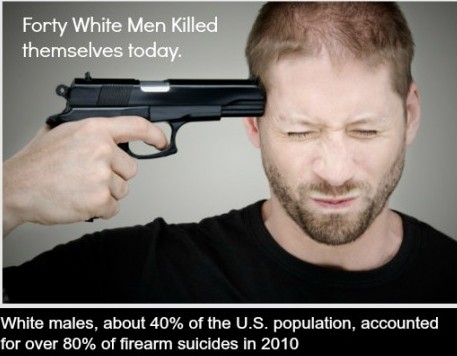
Out of the 31,000 lives lost due to gun violence, every year 19,000 or almost 2 out of every 3 are suicides. White males accounted for over 80% of gun related suicides in 2010. And according to the American Foundation for Suicide Prevention, yearly medical costs associated with suicide, is nearly $100 million and 90% of people who die by suicide have a diagnosable and treatable psychiatric disorder at the time of their death.

Every night we watch Black men on the nightly news who have been involved in gun violence. Gun violence in urban America is a serious issue and Black youth are disproportionately victims of it. When addressing the high rates of homicide in the African-American community, Dr. Linda Frisman told the audience at John Hopkins “that being African-American and Hispanic are really proxies for social and economic disadvantage.” This is something that most Blacks understand. Addressing gun violence in urban America will not be solved with more police and school resource officers as President Obama has recommended or by adding additional security cameras to our schools that stream live to patrol cars and police precincts. If we are serious about reducing gun violence, we must address the social and economic disparities in communities of color. Strong economically secure communities that provide family sustaining wages, affordable housing, culturally relevant and enriching education that equips children with skills to succeed in the 21st century, and love will make schools and neighborhoods safe for our children. Successful faith and community-based programs should be rewarded with additional funds with less money being poured into Police departments that normally respond punitively when dealing with our children.

Another forty white men have killed themselves tonight

I begin to think, what if each night the local nightly news began by stating, “Another forty white men have killed themselves tonight?”

There are studies for every social pathology in the Black community, and policy responses crafted by “experts,” that are often punitive and never seem to be systemic. But for some reason, you can’t find much research on white males and why they are killing themselves at an alarming rate, or why there is a fascination with weapons. What if we began to take the same data and create policy around it? What would it look like? Would it stigmatize white males? Would we have to dispatch mental health professionals to workplaces every time they were laid off? Would we need to send the Bureau of Alcohol, Tobacco, Firearms and Explosives (ATF) to their homes to search and remove their guns? How safe would White women and children feel when their husbands and fathers were laid off? Would white men be considered a High-Risk group for firearm ownership? Or would there be a stop and frisk policy implemented for White men over the age of 50?

In October of 2012, leading experts from the Johns Hopkins Bloomberg School of Public Health produced a report entitled, “The Case for Gun Policy Reform in America.” Many of the policy recommendations from the expert reports concentrated on Firearms Prohibitions for High-Risk Persons. Though suicide is the leading cause of death by firearms, with White males accounting for over 80%, they were not mentioned in the high risk category.

Well, who are the High Risk groups that should be prohibited from owning firearms? Under the section entitled, Why Firearms Prohibitions for High-Risk Persons Should be Broadened the categories include Criminals, Substance Abusers (Illegal Substances) and Youth Under Age 21.

Criminal Prohibitions

We believe the evidence above justifies an extension of firearm prohibitions for persons with a history of criminal behavior to include persons convicted of all misdemeanor crimes of violence, as well as individuals who have committed felony crimes as a juvenile.”

Substance Abusers

The number of drug abusers prohibited from possessing firearms might be increased significantly by revamping these regulations to, for example, expand the period following a drug conviction for which a person is prohibited from possessing firearms.”

Youth Under Age 21

Restrictions on youths’ ability to purchase and possess firearms should be broadened. Although federal law and most state law allows youth 18 to 20 years of age to legally possess a handgun, youth of these ages have some of the highest rates of homicide offending.”

These policy recommendations are about narrowing access to who can legally own a firearm, by identifying the most high-risk persons. The criminal prohibitions and substance abusers recommendations would narrow the number of Black people who have access to guns. Not because Blacks use illegal substances at higher rates than Whites. According to the NAACP, “5 times as many Whites are using drugs as Blacks, yet the Black population, especially men are sent to prison for drug offenses at 10 times the rate of Whites.”  The NAACP Criminal Justice Fact Sheets states that “in 2002, despite that fact that more than 2/3 of crack cocaine users in the U.S. are white or Hispanic, blacks constituted more than 80% of people sentences under federal crack cocaine laws.”

It is also important to remember, as Dr. Matthew Miller pointed out, the vast majority guns that kill are handguns and legally owned.

United Nations Conference on the Arms Trade Treaty

Internationally the United Nations appears to be pursuing the same policies. In March of this year they will convene the United Nations Conference on the Arms Trade Treaty (ATT). The conference is designed to tighten import, export and transfer of conventional arms. The UN states that ATT “will not aim to ban any weapon.” And why would they? White men control the most deadly arsenals of weapons of mass destruction in the world. Instead, the conference wants to make sure weapons don’t fall “into the hands of terrorists, drug traffickers, and criminal cartels.”

Drug traffickers and Criminal cartels? I think you already know who the target groups are. This sounds very familiar to the language in the Hopkins report. Identify high-risk populations, mostly communities of color and limit their access to acquiring weapons while leaving out the highest risk group, White men. No group has manufactured, proliferated or used more weapons of mass destruction than White males, yet they conveniently label communities of color as “terrorists” or “high risk.”

They will beat their swords into plowshares and their spears into pruning hooks. Nation will not take up sword against nation, nor will they train for war anymore. – Isaiah 2:4

I pray for the day when we will beat our swords into plowshares and study war no more. But until then, we must make an honest effort to make sound gun policy. We must make sure that the War-on-Guns does not unfairly target people of color in the same way the War-on-Drugs have devastated our community.

READ MORE on Kinetics LIVE

A Massacre in Newtown, CT l Commentary

December 14, 2012

THE NEWTOWN SHOOTING: KINDERGARTENERS AND COURAGE

Posted by 
sandy-hook-kids.jpg

[Updated]
“I heard something like someone was kicking on a door,” a little boy, a student at Sandy Hook Elementary School, near Newtown, Connecticut, told a reporter for NBC. He said that bullets were “whizzing by” him in the hallway, but “a teacher pulled me into her room” before one hit him. “The gym teachers told us to go in the corner and we huddled,” another said. “We were in the gym and I heard really loud bangs,’’ a third boy, a nine-year-old, told the Times. “And we heard yelling, and we heard gunshots. We heard lots of gunshots…. We had to go into the closet in the gym. Then someone came and told us to run down the hallway.” The children ran, some with their eyes closed, and made it out.


By then, twenty of the children who had arrived at school that morning were dead, along with six grownups—that is a preliminary count—and the shooter, a twenty-year-old man named Adam Lanza, whose mother was among the adult victims. (Earlier reports had named his older brother, Ryan.) “The majority of those who died today were children, beautiful little kids between the ages of five and ten years old,” President Obama said in a press conference. And then he began to cry.

This is one of the worst school shootings in the history of a country that has had plenty of them. The images from Newtown are hard to shake: the children comforting each other, the parents for whom comfort now must feel useless; the seventeen-year-old who lived near enough to hear the shots and came running, looking for his nine-year-old sister. A teacher leading a line of students, many of them crying but each, with the orderliness of the very young, with hands on the shoulder of the child ahead. Other children had been told to find a buddy before making a break for it, and did. They were brave. The contrast here is not only between the civility of the children and the cruelty of the shooter, but between what was asked of them at this moment and how little the public and elected officials ask of themselves when it comes to doing something about gun violence. (One of the first questions was not just what kind of gun Lanza had but how many.) How do we find ourselves asking kindergarteners to be more courageous in the face of a gunman than politicians are in the face of the gun lobby?

Here is the difference guns make: A man comes to kill his mother. He shoots her and goes to the school where she works and, on his way down the hall, turns his weapon on some of her colleagues. He finds a room filled with kindergarteners; she is their teacher, they are all about five years old. He pulls the trigger and keeps shooting until the children are dead, too. Then he shoots himself.

In what sort of state of rage and nothingness do you have to be to take even one of those steps? Adam Lanza moved from one to another for reasons we will be sorting out for a long time, maybe forever. His mother is dead, and by the time the shooting stopped, so was he. The impulse and the guilt appear to be his alone. But a gun, with the momentum of shot after shot, the continuity of a round of bullets, gives such crimes more force. (As I noted in a post on the Jovan Belcher case, ninety-two per cent of domestic-violence murder-suicides involve guns.) Guns extend the reach of violence, and, with our national silence on senseless gun laws, so do we. Guns make it easier for a killer. They make it impossibly hard for parents who arrive, dazed and pleading, at the firehouse in Connecticut where the surviving schoolchildren were taken, and don’t find the one they were looking for there.

Photograph by Shannon Hicks/Newton Bee/AP.

See our full coverage of the Newtown shooting.

Read more: http://www.newyorker.com/online/blogs/closeread/2012/12/the-newtown-shooting-kindergarteners-and-courage.html#ixzz2F8dmAVPB


December 14, 2012

AMERICA’S SHAME: WORDS AND TEARS AREN’T ENOUGH

Posted by 
Newtown-shooting-Americas-gun-shame.jpg

Having flown into Manchester from J.F.K. on Friday morning, I was driving through my home town of Leeds listening to the radio. “We’re getting reports of another mass shooting at a school in the United States,” the announcer on BBC Radio 4 said, “this one at an elementary school in Connecticut.” By the time I reached my destination, a holiday charity event at Leeds Irish Center, the big television screen above the bar, which is usually dedicated to sports, was showing live pictures and footage from Newtown: buildings and vehicles cordoned off with yellow plastic tape, burly police officers sporting submachine guns, teary parents leading away some of the young survivors.

At that stage, the number of the victims and the name of the shooter hadn’t been established, but it was clear that something terrible had transpired. A few of the revellers near the bar were avidly watching the story develop. Others glanced at it occasionally, shaking their heads. Most people were ignoring the screen, talking to their friends, and drinking their beer—an attitude that wasn’t as heartless as it might seem. From three thousand five hundred miles away, the narrative emerging from Newtown seemed all too familiar. A lone nut arms himself like Rambo, drives to a locale packed with innocents, and savagely takes out his resentments on the world. In July, the location was a movie theatre in Aurora, Colorado. A few weeks later, it was a Sikh temple near Milwaukee. Now it was an elementary school in leafy Connecticut. Just another American horror movie.

For me, of course, it was something much closer to home. My holiday spirit having dissipated, I called my wife in Brooklyn and talked about what we should tell our two young daughters, both of whom attend local schools. Then I drove back to my mother’s house and turned on the BBC News channel, which was covering the shooting as if it had taken place in Glasgow or Grimsby. Other countries, the U.K. included, have experienced school massacres of this nature. In March, 1996, a former Scout troop leader called Thomas Hamilton entered a primary school in Dunblane, Scotland, and shot to death sixteen pupils before killing himself. But nowhere have mass shootings been as prevalent as the United States, and nowhere has the policy reaction been so pathetic.

As the coverage continued, the true scale of what had taken place—including the apparent execution of an entire kindergarten class—became clear. But did it really make much of a difference to the underlying narrative? At various points in recent years, the American gun plague has struck down college students, high-school students, department-store shoppers, moviegoers, and religious worshippers. Unstopped, it was sure at some point to claim the lives of kindergarten and grade-school students.

Deprived of much truly revealing footage from the scene, the BBC dug up some eyewitnesses, local residents, psychologists, criminologists, and an academic from Yeshiva University whom it billed as an expert on school massacres. (In what other country can you make a professional specialty of the mass shootings of children?) The presenters dutifully brought up many of the pertinent questions about gun control and school security, not that they, or anybody else here, was really expecting to get any persuasive answers. After watching so many of these terrible events from afar, a lot of Britons and other foreigners, including many who greatly admire the United States, have given up even trying to figure out why it doesn’t do more to prevent them.

In fact, things have gone in the other direction. The U.S.’s addiction to gun violence and its capacity to generate these acts of astonishing selfishness, cruelty, and nihilism is sometimes seen as an immutable national trait—something as American as baseball and fast food. From this perspective, producing crazed shooters like Adam Lanza is just one of those things that American does better than any other nation, the criminal equivalent of churning out New York comedians and Silicon Valley billionaires.

This thinking is wrong, of course. All societies have deeply troubled and alienated young men, some of whom end up violently lashing out at the world. But in most other advanced countries, such as the United Kingdom, which banned handguns after what happened at Dunblane, these misfits don’t have easy access to guns and the gun culture that glorifies them. During recent years, politicians of both parties, President Obama included, have been far too reticent about spelling out this elemental truth. In the immediate aftermath of the massacre at the cinema in Aurora, President Obama refused even to talk about the gun laws, preferring to keep the focus on the victims.

On Friday, it looked for a time as if the White House was going to give another pitiful response, especially when Obama’s press secretary Jay Carney, at his regular morning briefing, said that this wasn’t the day for a discussion of gun control. President Obama recognized the magnitude of the occasion and grasped that something more was needed. In his emotional statement, which the BBC ran live and then showed repeatedly, Obama artfully expressed the nation’s grief and horror and also called for “meaningful action to prevent more tragedies like this, regardless of the politics.”

They were only words, of course—words and tears. If we really want to persuade people overseas, people such as ones I grew up with, that what happened today was an aberration—a desecration of American values rather than a twisted display of them—more, much more, will be needed: a willingness to face down the N.R.A. and introduce proper gun control. Until such a display of national resolve materializes, the massacres will occur at intermittent intervals, the toll of needless deaths will climb, and our overseas friends will continue to shake their heads, saying, “It’s America, you know. That sort of thing happens there.”

Photograph by Jessica Hill/AP.

See our full coverage of the Newtown shooting.

Read more: http://www.newyorker.com/online/blogs/johncassidy/2012/12/after-the-newtown-shooting-americas-gun-shame.html#ixzz2F8dzUoJb