The Zimmerman Verdict and Race: A Brief Criminological Assessment I The Hampton Institute


“The problem with society is that it fails to include the perspective of those who are in opposition with the way in which the justice system operates. When one simplifies this conflict of perspectives it becomes clear that this split is predominantly based on race, although some may also implicate class. Sadly, this conflict reflects that the majority of the country uncritically accepts the theory that justice is fair and colorblind in spite of what social science research has historically shown. Meanwhile, those who fall prey to this machinery of injustice are blamed for their victimization as the system is constantly legitimated each time someone is convicted because most people refuse to believe the system can be unfair.”

via The Zimmerman Verdict and Race: A Brief Criminological Assessment I The Hampton Institute.

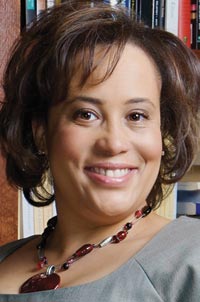
This is what a feminist professor looks like – Minnesota Women’s Press – St. Paul, MN

This is what a feminist professor looks like

“I look forward to a time when Black women will have the freedom to wear what they want to wear, speak how they want to speak and still be taken seriously.”

— Duchess Harris

This is what a feminist professor looks like - Minnesota Women's Press - St. Paul, MN

by Duchess Harris

(OUR COMMON GROUND Voice)

I have taught Women’s Gender and Sexuality Studies since 1994, and one recurring comment from white students is that I don’t “look” like a feminist. I find it amusing. I pretend to be confused and politely ask, “What does a feminist look like?” Their response is usually, “Less feminine.”

This is a teachable moment.

When I was an undergraduate at the University of Pennsylvania between 1987 and 1991, I was mentored by Professor Evelyn Brooks Higginbotham. She was finishing her groundbreaking book “Righteous Discontent,” in which she argues that the politics of respectability enabled Black women to counter racist images and structures. She stated that this aesthetic of respectability should not be misconstrued as mindless mimicry of white behavior or a “front” without substance or content. Instead, the politics of respectability assumed a fluid and shifting continuum of African American resistance.

Fast forward to 2013. The reality is that when you think of a college professor, you probably do not see the image of my face. My insistence on professional dress (i.e., skirts, heels and ironed shirts) is not a subscription to patriarchy; I want to be recognized and respected. Informality, for a Black woman, can be professionally harmful.

There are currently 176,485 tenured full professors at the nation’s public and private research universities – 72 percent white men, 17 percent white women, 8 percent men of color (Black, Hispanic and Native American combined) and 2 percent women of color – combined.

In a racist society, white people hold the power of the “gaze,” and people of color are subject to interpretation.

I wear what I wear because I take myself seriously and I expect you to, also. I don’t have the privilege to “dress down.” When white women do this, they are read as earthy, edgy and intellectual. When Black women dress down, we are read as “The Help.”

I share this because my white female students feel entitled to judge my cisgender, herteronormative, feminine aesthetic; not understanding that many Blacks are proud that I don’t wear a uniform. I find that the Black service people at Macalester are glad to see a dressed up Black woman on the faculty.

Once again there is a historical context for this. In “Living In, Living Out,” Elizabeth Clark-Lewis narrates the personal experiences of 81 Black women who worked for wealthy white families. These women describe how they encountered – but never accepted – the master-servant relationship, and they recount their struggles to change their status from “live in” servants to daily paid workers who “lived out.” One of their biggest acts of resistance was to do the cleaning in their own clothes, not a uniform, and leave.

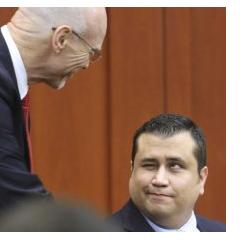
I am writing this essay in the midst of the George Zimmerman trial. I have been traumatized by the treatment of Rachel Jeantel, a friend of Trayvon Martin. The best analysis I have read of why many people could not hear her was because of what they saw.

Regina N. Bradley writes, “Jeantel’s … inability to conform to expected cultural and aural scripts of Black womanhood within the confines of the courtroom – the epitome of a hyper-respectable space – destabilizes not only racial paradigms of Black (southern) respectability but Americanized expectations of Black women’s scripts of respectability.”

I was not ashamed by her inability to conform; I was disappointed that in 2013 she isn’t read as “respectable.” I look forward to a time when Black women will have the freedom to wear what they want to wear, speak how they want to speak and still be taken seriously.

But until then I will dress up for Rachel and all the other Black women who do not have the privilege of being heard.

Duchess Harris, J.D., Ph.D., is a professor of American Studies at Macalester College. Read a selection of her published works at works.bepress.com/duchess_harris/.

via This is what a feminist professor looks like – Minnesota Women’s Press – St. Paul, MN.

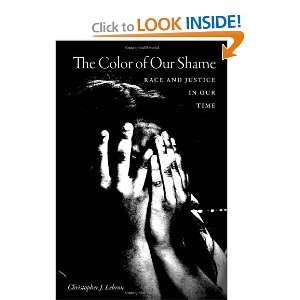
Book Recommendation: The Color of Our Shame: Race and Justice in Our Time (9780199936342): Christopher J. Lebron: Books


Christopher J. Lebron

Publication Date: September 9, 2013

For many Americans, the election of Barack Obama as the country’s first black president signaled that we had become a post-racial nation – some even suggested that race was no longer worth discussing. Of course, the evidence tells a very different story. And while social scientists are fully engaged in examining the facts of race, normative political thought has failed to grapple with race as an interesting moral case or as a focus in the expansive theory of social justice. Political thought’s under participation in the debate over the status of blacks in American society raises serious concerns since the main academic task of political theory is to adjudicate discrepancies between the demands of ideal justice and social realities.

Christopher J. Lebron contends that it is the duty of political thought to address the moral problems that attend racial inequality and to make those problems salient to a democratic polity. Thus, in The Color of Our Shame, he asks two major questions. First, given the success of the Civil Rights Act and the sharp decline in overt racist norms, how can we explain the persistence of systemic racial inequality? Second, once we have settled on an explanation, what might political philosophy have to offer in terms of a solution?

In order to answer these questions Lebron suggests that we reconceive of racial inequality as a condition that marks the normative status of black citizens in the eyes of the nation. He argues that our collective response to racial inequality ought to be shame. While we reject race as a reason for marginalizing blacks on the basis of liberal democratic ideals, we fail to live up to those ideals – a situation that Lebron sees as a failure of national character. Drawing on a wide array of resources including liberal theory, virtue ethics, history, and popular culture, Lebron proposes a move toward a “perfectionist politics” that would compel a higher level of racially relevant moral excellence from individuals and institutions and enable America to meet the democratic ideals that it has set for itself.

via Amazon.com: The Color of Our Shame: Race and Justice in Our Time (9780199936342): Christopher J. Lebron: Books.

Detroit and America’s Racial “Exceptionalism” | Black Agenda Report

 Detroit and America’s Racial “Exceptionalism” | Black Agenda Report.

A Black Agenda Radio commentary by executive editor Glen ford

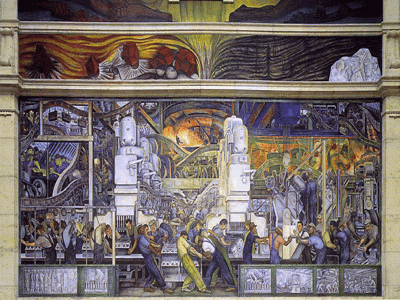
The picture is of Diego Rivera’s mural Detroit Industry, 1932-33, Detroit Institute of Arts.

Corporate solutions can justifiably be substituted for democracy, when it comes to Blacks.”

The great American dissolution of electoral democracy is playing out in Detroit, where last Monday the state-appointed Emergency Financial Manager explained to a crowd at Wayne State University how he would compassionately go about the business of breaking their city into buyable and sellable parts. The people and their elected representatives would have no say in the ultimate result.

The corporate media, and white folks in general, view the process as an inevitability – a kind of crude justice – not because they have rejected the principle of self-government, but because Detroit is overwhelmingly Black, and Blacks have always been the exception to the American rule. In fact, all of the Black population centers of Michigan have been divested of the right to govern themselves.

There has been no national outpouring of solidarity with Michigan’s Blacks over the loss of their citizenship rights, which can only mean that there exists an effective white consensus that African Americans are not fully deserving of those rights. Uncontrolled concentrations of Blacks are seen as pathological, by definition.

The same race-based exception was made to public education, for Blacks. In New Jersey and localities across the country, public schools in largely Black areas have for decades been under state control, denying Black parents any effective voice in their children’s education. By and large, white suburbanites supported the state in making Blacks an exception to the general American rule on local control over education. It is a right Blacks are not thought to be qualified to exercise.

Blacks were an exception to the Constitution.”

The same racial exception to the rule led to massive privatization of inner city education, through wholesale imposition of charter schools and private school vouchers. When education secretary Arne Duncan declared that Hurricane Katrina was the best thing that ever happened to public schools in New Orleans because it allowed most of the city’s schools to be converted to charters, there was no national condemnation of his remarks – since it is accepted that Blacks cannot run their own school systems. They are the great exceptions to the American rule. Corporate solutions can justifiably be substituted for democracy, when it comes to Blacks.

The problems of drugs and crime were framed as Black phenomena, requiring a more flexible interpretation of civil liberties and the creation of a vast police state. Just as the Founding Fathers actually intended, Blacks were an exception to the Constitution.

Blacks, and their alleged “pathologies,” were considered the nexus of poverty and social disintegration in America. Therefore, the social safety net was kept at the absolute minimum.

And now, all these exceptions that have been made for Blacks, are to become models for America as a whole, in the age of austerity, corporatized education, undemocratic governance, and the National Security State. In places like Detroit and New Orleans, America has been busily creating the pilot programs for the rule of the rich, by systematically undermining social democracy for Blacks.

The great exception, is becoming the rule.

For Black Agenda Radio, I’m Glen Ford. On the web, go to BlackAgendaReport.com.

BAR executive editor Glen Ford can be contacted at Glen.Ford@BlackAgendaReport.com.


The Boston Bombing: A Reader l Rhetoric Race and Religion

 The Boston Bombing: A Reader

On April 15, 2013 around 3:00pm EST, two explosions rocked participants and onlookers at the Boston Marathon. We here at Rhetoric Race and Religion are collecting posts that focus on this horrific event. If you have one to share or would like to write one for our blog, please email us at rhetoricraceandreligion@gmail.com

1. The Boston Marathon: All My Tears, All My Love
2. Erik Rush, Conservative Columnist, Makes Muslim Joke After Boston Marathon Explosions
3. Prayers for Boston & for an End to Racist Backlash
4. A Prayer for Boston
5. Boston Bombing Is a Tragedy, But Let’s Not Rush to Blame Muslims or People of Arabic Descent
6. God Weeps Over Boston Through Us
7. Responding to Boston With Holy Anger
8. Prayers for Boston and for an End to Racist Backlash
9. Terrorism and Privilege: Understanding the Power of Whiteness
10. Tea Party Nation Blames Boston Bombing On Obama, ‘Radical Islam’
11. THE SAUDI MARATHON MAN
12. Let’s hope the Boston Marathon bomber is a white American
13.Boston Marathon Editorial Cartoons
14.False comfort of the ‘T’ word: Patience in the aftermath of Boston
15.On gun control, courage in short supply
16. The Boston bombing produces familiar and revealing reactions
17. Separate, Unequal and More Violent
18.Remarks by the President at Interfaith Service in Boston, MA 
19. On Boston bombing, media are wrong – again
20. Jon Stewart Slams Media for Boston Bombing Stories
21. “On Boston & Violence: An Intimate Relationship” 
22. Boston Bombing Suspects’ Muslim Identity Provides Few Clues To Motivation For Bombing
23. The Boston Bombing Suspects Were Reared by Both Chechnya and America
24. Family’ Group Co-Opts Tragedy To Oppose ‘Sexual Liberalism’
25. Robert Robb: Reflections on the Boston Bombing
26. Why Should I Care That No One’s Reading Dzhokhar Tsarnaev His Miranda Rights? 
27. The Media and the ‘Dark-Skinned’ Men from Chechnya
28. Race, Religion and the Boston Marathon Bombing
29. Boston bombing: How Indian student Sunil Tripathi was wrongly identified as suspect
30. Religious Responses to Boston Bombing
31. Race, Religion and Terrorism in the Wake Of Boston
32. Who Bombed the Boston Marathon?
33. Is Boston Like Columbine?
34. Let’s Not Normalize This Thing Called ‘Terrorism’: A Conversation With Sohail Daulatzai
35. Dzhokhar Tsarnaev charged with using ‘weapon of mass destruction’
36. Why is Boston ‘terrorism’ but not Aurora, Sandy Hook, Tucson and Columbine?
37. Are the Tsarnaev brothers white?
38. Boston Bombing Aftermath: If It’s Not About Islam or Foreign Policy, Then What?
39. A Love of Hip-Hop Doesn’t Make a Terrorist
40. The Boston Bombing: Should Cameras Now Be Everywhere?
41. Boston Bombing Shocker: Naturalized Citizens Identify with Home Countries!
42. Hey, White Liberals: A Word On The Boston Bombings, The Suffering Of White Children, And The Erosion of Empathy
43. Why the faith of the Boston Marathon bombing suspects doesn’t matter, but yours does

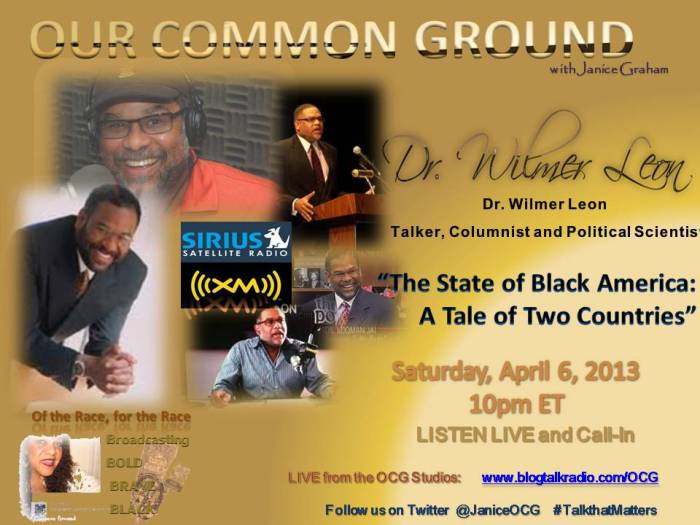
OUR COMMON GROUND with Janice Graham l “The State of Black America: A Tale of Two Countries” l Guest: Dr. Wilmer Leon l April 6, 2013

OUR COMMON GROUND with Janice Graham

April 6, 2013       10 pm ET  LIVE

“The State of Black America: A Tale of Two Countries”

Tonight’s Guest: Dr. Wilmer Leon


04-06 Wiler2 Leon


“The State of Black America: A Tale of Two Countries”

Tonight’s Guest: Dr. Wilmer Leon

Dr. Leon comes to OCG once again to weigh in on the issues which face Black America, the politics of our problems and the light of solutions available.

Wilmer J. Leon III, Ph.D. is a Political Scientist whose primary areas of expertise are Black Politics, American Government, and Public Policy. He is a Teaching Associate in the Political Science Department at Howard University in Washington, D.C., a nationally syndicated broadcast radio talk show host, columnist, commentator, political consultant, TV host, lecturer, and much sought after motivational speaker.

Dr. Leon earned a BS degree in Political Science from Hampton Institute, a Masters in Public Administration (MPA) from Howard University, and a Ph.D. in Political Science from Howard University.

A serious void exists in the public discourse relating to the issues that directly and/or disproportionately impact the global village in which we live. Dr. Leon’s lectures and writings focus on issues such as the media’s coverage of national and international issues, the criminal industrial complex, environmental racism, school vouchers, health care, crime policy, economic globalization, American domestic and foreign policy from as much of a non- biased and academically accurate perspective as possible. Dr. Leon’s perspective and lectures are grounded in the history of the African American community and the tradition of African American scholarship.

Dr. Leon is host/producer of the nationally broadcast call in talk radio program Inside The Issues With Dr. Wilmer Leon on XM/Sirius satellite radio channel 169 “Urban View” and the host of Epilogue, a political book discussion program on Press TV. He hosts discussion on Facebook as Dr. Leon Prescriptions.

Dr. Leon was a regular guest on CNN’s Lou Dobbs Tonight and is a contributing columnist to The Grio.com, The Black Agenda Report, The Maynard Institute.com, TruthOut.org, PoliticsInColor.com and Black Star News.

OUR COMMON GROUND with Janice Graham

“Speaking Truth to Power and Ourselves”

BROADCASTING     BRAVE     BOLD BLACK

LISTEN LIVE 

Join the discussion in our Open Chat during the broadcast.

 On the Web

Follow us on Twitter    @JaniceOCG      #TalkthatMatters

Like US on Facebook

LIVE: OCG Meetinghouse: http://www.blogtalkradio.com/OCG
For More Information: http://www.ourcommongroundtalk.wordpress.com/


Chinua Achebe, African Literary Titan, Dies at 82 : The iroko has fallen.

Chinua Achebe, African Literary Titan, Dies at 82

 The iroko has fallen.

Craig Ruttle/Associated Press

Chinua Achebe, a Nigerian-born novelist and poet, at home on the campus of Bard College in Annandale-on-Hudson, New York, in 2008.

By JONATHAN KANDELL

From the NYT

Published: March 22, 2013

Chinua Achebe, the Nigerian writer who was one of Africa’s most widely read novelists and one of the continent’s towering men of letters, has died after a brief illness, his publisher and agent said in London on Friday. He was 82.

Few details were immediately available.

Besides novels, Mr. Achebe’s works included powerful essays and poignant short stories and poems rooted in the countryside and cities of his native Nigeria, before and after independence from British colonial rule. His most memorable fictional characters were buffeted and bewildered by the conflicting pulls of traditional African culture and invasive Western values.

For inspiration, Mr. Achebe drew on his own family history as part of the Ibo nation of southeastern Nigeria, a people victimized by the racism of British colonial administrators and then by the brutality of military dictators from other Nigerian ethnic groups.

Mr. Achebe burst onto the world literary scene with the publication in 1958 of his first novel, “Things Fall Apart,” which sold millions of copies and was translated into 45 different languages.

Set in the Ibo countryside in the late 19th century, the novel tells the story of Okonkwo, who rises from poverty to become an affluent farmer and village leader. But with the advent of British colonial rule and cultural values, Okonkwo’s life is thrown into turmoil. In the end, unable to adapt to the new status quo, he explodes in frustration, killing an African in the employ of the British and then committing suicide.

The novel, which is also compelling for its descriptions of traditional Ibo society and rituals, went on to become a classic of world literature and was often listed as required reading in university courses in Europe and the United States.

But when it was first published, “Things Fall Apart” did not receive unanimous acclaim. Some British critics thought it idealized pre-colonial African culture at the expense of the former empire.

“An offended and highly critical English reviewer in a London Sunday paper titled her piece cleverly, I must admit Hurray to Mere Anarchy!” wrote Mr. Achebe in “Home and Exile,” a collection of autobiographical essays that appeared in 2000. A few other novels by Mr. Achebe early in his career were occasionally criticized by reviewers as being stronger on ideology than on narrative interest.

But over the years, Mr. Achebe’s stature grew until he was considered a literary and political beacon.

“In all Achebe’s writing there is an intense moral energy,” observed Kwame Anthony Appiah, professor of Afro-American studies and philosophy at Princeton, in a commentary written in 2000. “He speaks about the task of the writer in language that captures the sense of threat and loss that must have faced many Africans as empire invaded and disrupted their lives.”

In a 1998 New York Times book review, the novelist Nadine Gordimer hailed Mr. Achebe as “a novelist who makes you laugh and then catch your breath in horror — a writer who has no illusions but is not disillusioned.”

Mr. Achebe’s political thinking evolved from blaming colonial rule for Africa’s woes to frank criticism of African rulers and of citizens who tolerated their corruption and violence.

Forced abroad by Nigeria’s bloody civil war in the 1960s and then by military dictatorship in the 1980s and 1990s, Mr. Achebe had lived for many years in the United States, where he was a university professor. But he continued to believe that writers and storytellers ultimately held more power than army strongmen.

“Only the story can continue beyond the war and the warrior,” an old soothsayer observes in Mr. Achebe’s 1988 novel, “Anthills of the Savannah.” “It is the story that saves our progeny from blundering like blind beggars into the spikes of the cactus fence. The story is our escort; without it, we are blind.”

Above from the NYT

MORE INFORMATION ABOUT THIS GREAT AUTHOR AND SCHOLAR

A KING HAS TRANSITIONED…LAST NIGHT IN BOSTON, MASS.

The iroko has fallen.

A Great One has passed over today.

“Things Fall Apart” tells two intertwining stories, both centering on Okonkwo, a “strong man” of an Ibo village in Nigeria. The first, a powerful fable of the immemorial conflict between the individual and society, traces Okonkwo’s fall from grace with the tribal world. The second, as modern as the first is ancient, concerns the clash of cultures and the destruction of Okonkwo’s world with the arrival of aggressive European missionaries. These perfectly harmonized twin dramas are informed by an awareness capable of encompassing at once the life of nature, human history, and the mysterious compulsions of the soul.”

Chinua Achebe (Nov 16, 1930-Mar 22, 2013).

HAVE YOU READ FROM HIS BOOKS! ONE IS “WHEN THINGS FALL APART” Comfort&Courage.

Chinua Achebe Biography

Today in History: We mourn the death of literary great and activist Prof Chinua Achebe, 82. He died in the United States where he was said to have suffered from an undisclosed ailment. He died last night in a hospital in Boston, Massachusetts, United States.
A source close to the family said the professor had been ill for a while and was hospitalized in a hospital in Boston.

Until his death, the renowned author of Things Fall Apart was the David and Marianna Fisher University Professor and Professor of Africana Studies at Brown. The University described him as “known the world over for having played a seminal role in the founding and development of African literature.”

“Achebe’s global significance lies not only in his talent and recognition as a writer, but also as a critical thinker and essayist who has written extensively on questions of the role of culture in Africa and the social and political significance of aesthetics and analysis of the postcolonial state in Africa,” Brown University writes of the literary icon.

Mr. Achebe was the author of Things Fall Apart, published in 1958, and considered the most widely read book in modern African Literature. The book sold over 12 million copies and has been translated to over 50 languages worldwide. Many of his other novels, including Arrow of God, No Longer at Ease, Anthills of the Savannah, and A man of the People, were equally influential as well.

Prof Achebe was born in Ogidi, Anambra State, on November 16, 1930 and attended St Philips’ Central School at the age of six. He moved away from his family to Nekede, four kilometres from Owerri, the capital of Imo State, at the age of 12 and registered at the Central School there. He attended Government College Umuahia for his secondary school education. He was a pioneer student of the University College, now University of Ibadan in 1948. He was first admitted to study medicine but changed to English, history and theology after his first year.
While studying at Ibadan, Mr. Achebe began to become critical of European literature about Africa. He eventually wrote his final papers in the University in 1953 and emerged with a second-class degree.

Prof Achebe taught for a while after graduation before joining the Nigeria Broadcasting Service in 1954 in Lagos. While in Lagos with the Broadcasting Service, Mr. Achebe met Christie Okoli, who later became his wife; they got married in 1961. The couple had four children. He also played a major role during the Nigeria Civil War where he joined the Biafran Government as an ambassador.

Mr. Achebe was a consistent critic of various military dictators that ruled Nigeria and was a loud voice in denouncing the failure of governance in the country. Twice, he rejected offers by the Nigerian government to grant him a national honor, citing the deplorable political situations in the country, particularly in his home state of Anambra, as reason…

This is a great loss to not only the literary world, but to humanity! His legacy will live on in his work. May he ‘ascend’ in peace! 

Here’s he is on CNN’s African Voices

African voices tv program on CNN interviewed Nigerian writer Chinua Achebe

Black men increasingly hard to find in medical schools


PROFESSION

Black men increasingly hard to find in medical schools

A dwindling share of students pursuing physician careers are African-American men. Experts warn that the trend could exacerbate racial health disparities and doctor shortages.

By KEVIN B. O’REILLY, amednews staff. Posted Feb. 25, 2013.

As a medical student, Frank A. Clark, MD, was one of the few African-American men in his class. It wasn’t that he saw black men being rejected from medical school. The bigger problem was that he didn’t see many on track to get there at all.

“Even during my collegiate career, I was a biology major with a minor in chemistry, and I didn’t see many other African-American males on the premed route,” says Dr. Clark, now a psychiatry resident at Palmetto Richland Memorial Hospital in Columbia, S.C.

Black men are notable in that their numbers are lagging even as other minorities and women are continuing a long-term trend of gaining greater representation among medical school applicants and students, according to the most recent Assn. of American Medical Colleges report on medical education diversity.

The report said 2.5% of medical school applicants were black men in 2011, a drop from 2.6% in 2002. That compares with 9% and 11% increases in the share of Asian and Hispanic male applicants, respectively, during the same period. A 10% greater share of matriculating students were Asian men in 2011 than in 2002, and Hispanic men made up a 24% larger proportion of new medical students. The share of white male applicants and matriculants was stable.

10% of U.S. men 30 and older are black, but less than 3% of practicing doctors are black men.

Growth in the number of African-American women applying for — and attending — medical school has been comparatively weak as well, with their representation, as a percentage of all applicants and graduates, also in decline. However, their numbers are still enough to create, as they have for some time, the biggest gender gap among all racial or ethnic groups.

Twice as many African-American women as men applied to medical school, and black women accounted for nearly two-thirds of black students who were accepted and eventually matriculated. That disparity translates into graduation rates, with 63% of new black MDs in 2011 being women.

By comparison, the non-Hispanic white gender gap in favor of men is 55%-45%, and while most other racial and ethnic groups skew female, they don’t come near the African-American gender gap. Overall, according to AAMC, the male-female gap in applicants and matriculants in 2011 was 53%-47% favoring men, a near-historic low ratio that has held steady for the past few years.

The AAMC report said the “persistent” problem of black male underrepresentation among medical school applicants speaks to a need for medical schools, which have stepped up minority recruitment efforts in recent years to try to get their student bodies to reflect the American population, “to institute plans and initiatives aimed at strengthening the pipeline.” Efforts include attempts to interest more black male youth in medicine and hiring more faculty members “from racially and ethnically underrepresented groups.”

“We have a major, major problem in this country,” said Marc Nivet, EdD, the AAMC’s chief diversity officer. “There is just simply an enormous amount of indisputable evidence that we’re not intervening as effectively as we’d like as a society to increase the talent pool of African-Americans who are capable of taking advantage of the science curricula available up and down the pipeline.”

Despite a 3% rise in the total number of male African-American medical school graduates during the last decade, the proportion of new doctors who were black men fell from 2.6% in 2002 to 2.4% in 2011. African-Americans account for 13% of the U.S. population, but only 6% of 2011 matriculants were black, as are just 4% of practicing doctors. And while the Census Bureau reports that 10% of U.S. men 30 and older are African-American, less than 3% of practicing doctors are black men, according to American Medical Association data.

Multiple repercussions

The underrepresentation of black men in medicine is problematic for multiple reasons, experts say.

The shortage could worsen access to care in low-income communities, because black medical students are likelier than any other group to have a firm commitment to practicing in underserved areas, with 55% saying they plan to do so. Meanwhile, several studies have found that patients who are treated by physicians with whom they share racial or gender characteristics report greater satisfaction with their care and higher rates of medication compliance.

63% of new black MDs in 2011 were women.

With the U.S. Census Bureau projecting that nonwhites will account for a majority of the American population by 2050, a sputtering pipeline of black male doctors could worsen the physician supply problem. The AAMC projects that by 2025, the country will be short by 130,000 doctors of all racial and ethnic backgrounds.

“This has huge implications,” said Rahn K. Bailey, MD, president of the National Medical Assn., which promotes the interests of African-American physicians and patients.

“Society does better with balance all the way around,” he said. “And we don’t have balance if we have disproportionately twice as many females as males applying to enter the profession, or twice as many from California as from New York, or twice as many people who want to go into surgery as into pediatrics. We need everybody. We need all hands on deck.”

Disparities begin early

The gap seen among African-American men in medicine does not start when students apply to medical school. About 3% of college graduates are black men, and women account for nearly two-thirds of black students to earn bachelor’s degrees. Nearly three-quarters of African-Americans majoring in biology or biomedical sciences are women, according to 2009 U.S. Dept. of Education data.

Nationally, 52% of male African-Americans earn high school diplomas, compared with 58% of male Hispanics and 78% of male non-Hispanic whites, said a September 2012 report published by the nonprofit Schott Foundation for Public Education. For every black male physician, there are about 50 African-American men incarcerated at the federal, state or local levels, according to 2009 U.S. Justice Dept. data.

Twice as many African-American women as men apply to medical school.

Reaching male African-Americans at younger ages is critical, experts say. Twelve medical and dental schools now take part in the six-week, tuition-free Summer Medical and Dental Education Program, administered by the AAMC and the American Dental Education Assn. The program, launched in 1989, each year offers intensive preparation for dental or medical school, clinical experiences, and academic enrichment in math and science to about 1,000 college freshman and sophomores who are from underrepresented minority groups or low-income families.

Some medical schools are working to encourage math and science among elementary and secondary school students. The Duke University School of Medicine in Durham, N.C., works with the local public schools as early as the third grade, offering field trips to Duke health care facilities. Starting in the fifth grade, 25 students from underrepresented minority groups or low-income families are selected from each participating school to join Duke’s BOOST program, which offers extra math and science instruction, overnight field trips and summer workshops. The outreach effort continues with high school students, said Brenda Armstrong, MD, dean of admissions at Duke’s medical school. The school had more black graduates in 2011 — 20 total, 14 women — than all but four other medical schools.

“A lot of this has to do with giving [male African-Americans] the academic tools to work with at an early stage, and you have to reinforce those successes and keep them in the system,” said Dr. Armstrong, a professor of pediatrics.

Affirmative action’s future in doubt

Experts’ concern about the diminishing share of black men entering medicine is accentuated by uncertainty about the future of affirmative action. A case before the U.S. Supreme Court, Fisher v. University of Texas at Austin, could produce a ruling this year that restricts how publicly funded medical schools factor race, ethnicity and gender into admissions decisions. The AMA joined in a friend-of-the-court brief urging the Supreme Court to uphold the ability to use race as one part of the admissions process.

The AMA also co-founded the Commission to End Health Care Disparities in 2004 with the National Medical Assn. The commission studies gaps in care and convenes expert panels to provide practice and policy recommendations. In 2002, the AMA launched the Doctors Back to School program, which sends black, Hispanic and other physicians to visit schools to encourage minority students’ interest in medicine.

Dr. Clark, the Columbia, S.C., psychiatry resident, has taken part in the back-to-school program and also made other trips to talk with area elementary and high school students. Role models are key to encouraging more male African-Americans to pursue math, science and medicine, said Dr. Clark, a member of the AMA Minority Affairs Section’s governing council.

“As physicians, we have an obligation to not only serve our community in terms of providing good patient care, but also to be mentors, to reach out to those people who look up to us,” he said. “People do look up to us. We may not be Michael Jordan or Kobe Bryant. We may not have won championships, but we still have a role in the community to play, and a role that’s vital to the community.”

BACK TO TOP


 ADDITIONAL INFORMATION:

The last decade reshaped medical school diversity

The proportion of African-American men in medical schools has fallen since 2002, while a rising share of medical students come from Asian and Hispanic backgrounds.

Group 2002 applicants (%) 2011 applicants (%) 2002 matriculants (%) 2011 matriculants (%)
White men 10,483 (31.2%) 13,506 (30.8%) 5,355 (32.5%) 6,252 (32.5%)
White women 8,974 (26.7%) 10,451 (23.8%) 4,619 (28.0%) 4,808 (25.0%)
Asian men 2,965 (8.8%) 4,645 (10.6%) 1,474 (8.9%) 1,968 (10.2%)
Asian women 2,984 (8.9%) 4,296 (9.8%) 1,556 (9.4%) 1,891 (9.8%)
Hispanic men 1,167 (3.5%) 1,655 (3.8%) 549 (3.3%) 790 (4.1%)
Hispanic women 1,274 (3.8%) 1,804 (4.1%) 581 (3.5%) 843 (4.4%)
Black men 874 (2.6%) 1,107 (2.5%) 391 (2.4%) 445 (2.3%)
Black women 1,738 (5.2%) 2,108 (4.8%) 735 (4.5%) 737 (3.8%)
Total 33,625 43,919 16,488 19,230

Note: Individuals who did not mark a race or ethnicity, or who identified as multiracial, foreigners, Native Americans, Alaskans, Hawaiians or other Pacific Islanders are not included in this chart.

Source: “Diversity in Medical Education: Facts & Figures 2012,” Assn. of American Medical Colleges, November 2012; “Minorities in Medical Education: Facts & Figures 2005,” AAMC

BACK TO TOP


WEBLINK

“The Urgency of Now: The Schott 50 State Report on Public Education and Black Males,” Schott Foundation for Public Education, September 2012 (blackboysreport.org/urgency-of-now.pdf)

“Adherence to Cardiovascular Disease Medications: Does Patient-Provider Race/Ethnicity and Language Concordance Matter?,” Journal of General Internal Medicine, November 2010 (www.ncbi.nlm.nih.gov/pubmed/20571929)

“Diversity in Medical Education: Facts & Figures 2012,” Assn. of American Medical Colleges, November 2012, and earlier years (www.aamc.org/initiatives/diversity/179816/facts_and_figures.html)

BACK TO TOP


Copyright 2013 American Medical Association. All rights reserved.

Did Cornel West Go Too Far — Again? l Zerlina Maxwell

Did Cornel West Go Too Far — Again?

After his “blackface” quip, maybe he’ll learn to make his critiques more constructive and less offensive.

By: Zerlina Maxwell | Posted: November 14, 2012 

Cornel West (Karen Bleier/AFP)

(The Root) — Professor Cornel West has struck again. The always outspoken Obama critic recently said in an interview with Democracy Now: “I think that it’s morally obscene and spiritually profane to spend $6 billion on an election, $2 billion on a presidential election, and not have any serious discussion — poverty; trade unions being pushed against the wall, dealing with stagnating and declining wages when profits are still up and the 1 percent are doing very well; no talk about drones dropping bombs on innocent people … I mean, I’m glad there was not a right-wing takeover, but we end up with a Republican, a Rockefeller Republican in blackface, with Barack Obama, so that our struggle with regard to poverty intensifies.”

Putting aside the substance in West’s comments, since there are certainly valid and substantive policy critiques to be made of the Obama administration, it is completely unnecessary for him to attack the president in such a racialized and offensive manner. Any good points he made are lost.

This isn’t the first time that the Princeton and Union Theological Seminary professor has attacked the president as a person instead of sticking to policy. West has previously called the president a “black mascot of Wall Street oligarchs and a black puppet of corporate plutocrats.” West and his partner Tavis Smiley (they have a public-radio show together, Smiley & West), also an outspoken Obama critic, have failed, time and again, to keep their critiques focused on policy when commenting on the shortcomings of the Obama administration.

High-profile black intellectuals who dared to support the president in public are not immune from the wrath of West and Smiley, either. The Rev. Al Sharpton, Melissa Harris-Perry and Michael Eric Dyson are “for sale” for access to Obama, according to West. This an interesting choice of words, considering Smiley’s history with corporate sponsors including Wells Fargo and Exxon Mobil.

Perhaps, with a second Obama win, West and Smiley feel their influence diminishing within the black community, which supported the re-election of President Obama with even higher turnout than in 2008 in key states, despite criticism. President Obama has been elected and re-elected, and the old guard of black political thought is becoming more and more marginalized as a result. No longer does a black politician need to be ordained by Smiley orgrace the stage of his (now-canceled) State of the Black Union speech-a-thon to be considered a contender for high office.

There are legitimate critiques of the president and serious issues to tackle during his second term. The challenge for Obama critics is to point out areas that absolutely need to be addressed — high black unemployment and, yes, poverty — without attacking the president as a man. With pride continuing to cloud their critiques of President Obama, West and Smiley have failed to do this time and again. It seems that they are facing a future in the black-intellectual wilderness over the next four years.

Let’s hope that during Obama’s next term, we can all work together to push the president and his administration to make big changes (or at least use his bully pulpit to talk about big changes, since the balance of power in Congress is unchanged) that will benefit the lives of the millions who voted for him. Offering constructive criticism and applying public pressure that is intended to assist the president rather than undermine him is a much more effective strategy going forward. Maybe more high-profile black thinkers will take note.

Zerlina Maxwell is a political analyst and contributing writer for Ebony.com, theGrio.com and Feministing.com. She writes about national politics, candidates and specific policy and culture issues, including domestic violence, sexual assault, victim blaming and gender inequality. Follow her on Twitter.


More Black Men in Jail Than in College? Wrong l Ivory A. Toldson, Ph.D

More Black Men in Jail Than in College? Wrong

Show Me the Numbers: A 13-year-old report using questionable data gave rise to an enduring myth.

Students at a Morehouse College commencement (Getty); prisoners at the Avon Park Correctional Facility (Getty)

(The Root) — What does the line “There are more black men in jail than in college” have in common with the Jheri curl? Answer: They were invented by white men (Jheri Redding and Vincent Schiraldi, respectively) and adopted enthusiastically by black people, and they left a nasty stain on the shoulders of millions of black men.

It’s been more than 20 years since the Jheri curl faded away into infamy, and I’m proud to say that even in the 1980s, I never sported a curl. Unfortunately, I can’t say the same about the line “There are more black men in jail than in college.”

About six years ago I wrote, “In 2000, the Justice Policy Institute (JPI) found evidence that more black men are in prison than in college,” in my first “Breaking Barriers” (pdf) report. At the time, I did not question the veracity of this statement. The statement fit well among other stats that I used to establish the need for more solution-focused research on black male achievement.

I was in good company. The same year, at a 2007 NAACP forum, then-presidential candidate Barack Obama said, “We have more work to do when more young black men languish in prison than attend colleges and universities across America.”

However, just as a Jheri curl would be wrong no matter how you dressed it up today, the line “There are more black men in jail than in college” is wrong no matter how you contextualize, qualify or articulate it.

Today there are approximately 600,000 more black men in college than in jail, and the best research evidence suggests that the line was never true to begin with. In this two-part entry in Show Me the Numbers, the Journal of Negro Education’s monthly series for The Root, I examine the dubious origins, widespread use and harmful effects of what is arguably the most frequently quoted statistic about black men in the United States.

Continue Reading