In Conversation with Dr. Gerald Horne l Commentaries On the Times Radio l Thursday, February 21, 2013

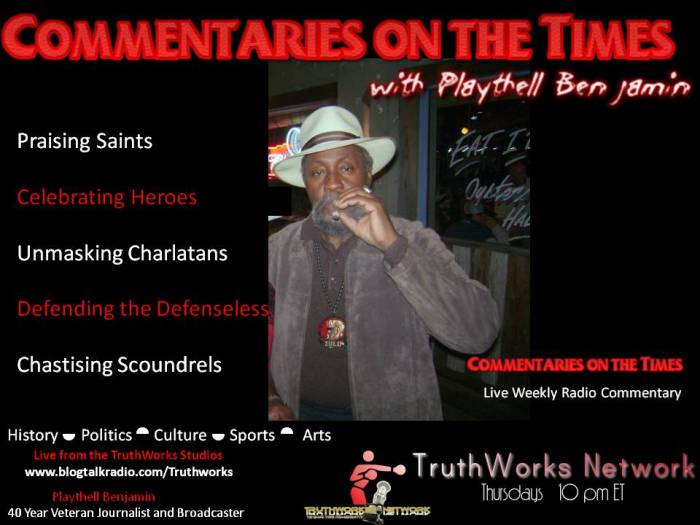
“Commentaries On the Times Radio” with Playthell Benjamin
 

Commentaries gen 6

In Conversation with Dr. Gerald Horne John J. and Rebecca Moores Chair of History and African American Studies at the University of Houston


Gerald Horne is an African American historian who currently holds the John J. and Rebecca Moores Chair of History and African American Studies at the University of Houston. He received his PhD from Columbia University and a J.D. from theUniversity of California, Berkeley. He is a frequent contributor to Political Affairs magazine.

He is a prolific author, Horne has published on W. E. B. Du Bois and has written books on a wide range of neglected but by no means marginal or minor episodes of world history. He specializes in illuminating previously obscure or misrepresented struggles of humanity for social justice, in particular communist struggles and struggles against imperialism, colonialism, fascism and racism. Individuals whose lives his work has highlighted in their historical contexts have included the blacklisted Hollywood screenwriter John Howard LawsonFerdinand Smith (Jamaican-born communist, sailor, labor leader), the perplexing Lawrence Dennis, an African-American fascist and racist who passed for white, and the feminist, anti-colonialist, internationalist intellectual Shirley Graham DuBois whose own career was overshadowed by that of her famous husband. While many of Horne’s books use a celebrated, intriguing or politically engaged individual as a prism to inspect the historical forces of their times, Horne has also produced broad canvas chronicles of infrequently examined periods and aspects of the history of white supremacy and imperialism such as the post-civil war involvement of the US ruling class—newly dispossessed of human chattels—with slavery in Brazil, which was not legally abolished until 1888, or the attempts by Japanese imperialists in the mid-20th century to appear as the leaders of a global war against white supremacy, thus allies and instruments of liberation for people of color oppressed by Anglo-American Empire.

Manning Marable said, “Gerald Horne is one of the most gifted and insightful historians on racial matters of his generation.”
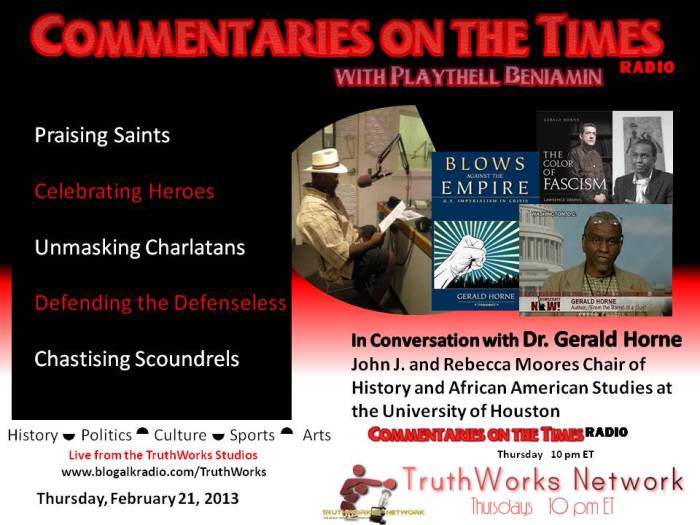
 

02-21 2nd amend Commentaries2

PREMIERING Thursday, February 21, 2013 10 pm ET LIVE  Joins TruthWorks Network

TruthWorks welcomes Playthell Benjamin with “Commentaries On the Times Radio” to our exciting Black Voice Collaborative line up.

This weekly program features the best of the writings of Playthell Benjamin with commentary from his renowned virtual magazine, “Commentaries On the Times”http://commentariesonthetimes.wordpress.com/.

The program will broadcast Thursday, 10 pm ET. “Commentaries On the Times“, a compilation of many years of essays, commentary and analysis of world and domestic issues. They include commentary with carefully researched historical background of the issues of day, including Black history, art, music and current events and people.

Benjamin brings a scope of 40 years of outstanding journalism and broadcasting to TruthWorks. As a former pioneer in the development of Black Studies programs and pundit broadcasting, he comes to a microphone with tremendous knowledge, insight and passion. Of his products, he labels his wordsmith products as, “Praising Saints, Celebrating Heroes, Unmasking Charlatans, Defending the Defenseless and Chastising Scoundrels”. We expect that his show will be no less.

With a lively wit to compliment a broadly learned mind, Playthell is a great guest on television or radio and has shared the mike with some of the biggest host in television, including Geraldo Rivera and Bill Mahr, which can be soon viewed on You Tube. At Present he is completing two books :Quantum shift: Commentaries on the Obama Phenomenon and Jazz at Lincoln Center: Magic Moments In the House Of Swing, a collaboration with the renowned photographer Frank Stewart. Playthell has held a professorship in History/Afro-American Studies at the University of Massachusetts and recently held an adjunct professorship in journalism at Long Island University.

His essays on music criticism have appeared in a wide variety of publications and his interest range from classical music to Jazz to Latin and Hip hop. He writes program notes for Jazz at Lincoln center concerts and is an accomplished Latin percussionist who can be viewed playing with the group Zon Del Barrio on You Tube.

A regular reader of ”Commentaries On the Times” recently commented on one of his essays, “READ the top notch researched work that Brother Playthell George Benjamin is providing for Us. It doesn’t get any better and knowledge is a beautiful thing to share with your family and friends! Several hundred articles await your READING COMPREHENSION and you get what I consider a full PHD worth of knowledge nuggets. Go get that information and become the intelligent person you’ve always wanted to be amongst your crew of friends. Speak with intelligence and knowledge to support your points of view. In spoken and written dialogue, The FACTS tell who you are and as my grandmother used to say, “All Things in Life Change, but Not The TRUTH!” Let’s tell Our Story! I salute YOU Brother Playthell George Benjamin for “Enlightening Us All With Your Knowledge” in so many fields of Interest”.
playthellABOUT PLAYTHELL BENJAMIN

Playthell George Benjamin is the producer of “Commentaries On the Times”, which he writes and delivers on WBAI radio in New York City, and a producer with The Midnight Ravers, a long running show exploring the world of art and politics which has won several radio awards for excellence in programming. He is an award winning journalist who has been nominated for the Pulitzer Prize in two different categories: Explanatory Journalism, Village Voice 1988, and Distinguished Commentary, New York Daily News1995. As part of the production team for The Midnight Ravers, Mr. Benjamin won a 2011 award for excellence in radio programming, given for The Curtis Mayfield Special.

Playthell has won several prizes ranging from The Unity Award presented by the School of communications at Lincoln University in Missouri for distinguished commentary on race relations; the Griot Prize for excellence in covering a story requiring an exploration of African American history and culture: “Who is Listening to LouisFarrakhan?” It was awarded by the New York chapter of the Association of Black Journalist in December 1989. In 1991 Mr. Benjamin won the NYABJ Magazine Awards for Feature Stories,and in 1996 he won the first Annual Tom Forcade Award “for honesty and accuracy in drug reporting” awarded by High Times magazine for his columns on drug use and abuse in the New York Daily News.

His book, “Witnessing the Motion of History” is expected to publish in the Summer of 2013. His e-magazine covering analysis, commentary and presentation of issues and events is available here: http://commentariesonthetimes.wordpress.com/

On Christopher Doner, the former LAPD officer, he recently wrote,

A REAL LIFE DJANGO? As I write a black gunman is terrorizing the Los Angeles Police Department, wreaking murder and mayhem upon the cops and their loved ones. Judging from comments online a growing number of people are beginning to see him as a real life Django Unchained! The broadcast media has been treating him like the crazy white boys who are going off all over the place – the macho paranoids like Dirty Dick Popolovsky in Pittsburgh, or pootbutt nerds suffering from pant worm and need a gun to feel like a man. But Christopher Dosner is neither one. When I saw his military record and the fact that he was once a member of the LAPD, I decided to do some investigation, beginning with reading his “Manifesto,” then reading a variety of materials on him. It was a revelation. I think it is a representative anecdote on the state of racism, corruption and brutality in contemporary police community relations in the great American cities. Here is my take on the man and what motivated his murderous mission. See: More Dangerous than Django! And he’s All the Way Live!!!!

As a former pioneer in the development of Black Studies programs and pundit broadcasting, he comes to a microphone with tremendous knowledge, insight and passion. Of his essays and commentaries, he labels these tremendously illuminating wordsmith products as, –

“Praising Saints, Celebrating Heroes, Unmasking Charlatans, Defending the Defenseless and Chastising Scoundrels”.
. . . Commentaries on the Times Radio will be no less.

Commentaries On The Times Radio with Playthell Benjamin
TruthWorks Network
Premiering Thursday, February 21, 2013 10 pm ET

Like us on Facebook https://www.facebook.com/CommentariesOnTheTimesRadio
On the Web/Program Notes http://www.commentariesonthetimeradio.wordpress.com/

Do Black Intellectuals Need to Talk About Race? l Room for Debate @ NYT

Room for Debate Home

UPDATED FEBRUARY 4, 2013 8:33 PM

Do Black Intellectuals Need to Talk About Race?

Black Intellectuals Have Sold Their Souls

Eddie S. Glaude Jr.

Eddie S. Glaude Jr. is the William S. Tod Professor of Religion and African-American Studies in the department of religion at Princeton University and the chairman of the Center for African-American Studies.

FEBRUARY 4, 2013

 Black academics don’t have a “special obligation” to speak to broader social and political issues. What we have witnessed over the last few decades is the increasing professionalization of this particular class of persons – where the object of their scholarly interests range across a number of subjects that aren’t reducible to questions of race. These individuals stand alongside those who work explicitly on racial matters, but their work doesn’t necessarily reach beyond the confines of a specialized academic community. The political significance of their ideas has been weakened or worse, banished to the shadows, and we’re left, as my grandmother would say, “bumping our gums.”


Too many have given up the work of thinking carefully about black America. We have become cheerleaders for President Obama or self-serving pundits.

However, the role of the black intellectual raises a different question. I do believe that intellectuals generally ought to aspire to be the moral conscience of their societies: that what we write, say and do should reflect intelligent efforts to provide a critical account of who we take ourselves to be as a nation. Black intellectuals take up this task in the context of black communities and the ever-shifting regime of race that undermines democratic possibility in this country. (And remember that the folks who do this kind of labor do not have to work in universities or colleges.)

That’s what they ought to do. Instead, today we are experiencing a “new nadir.” Too many black intellectuals have given up the hard work of thinking carefully in public about the crisis facing black America. We have either become cheerleaders for President Obama or self-serving pundits. Our celebration of his singular achievement and our crazed desire for access have made many of us “born-again patriots.”

All too often what stands in for the black intellectual these days are folks who can spin a phrase and offer a soundbite. The idea of the intellectual who reads widely and deeply and who critically engages the complexity of our times has been supplanted by the fast-talking “black Ph.D. pundit” who strives to be on CNN, Fox or MSNBC. This same pundit has found new career opportunities within universities and colleges by thinking about black people in ways that conform to the current liberal consensus about racial matters.

The combination turns out to be a deadly one. I am reminded of what the sociologist C. Wright Mills wrote in 1948: “The two together, for the liberal ideology, as now used by intellectuals, acts as a device whereby he can take advantage of the new career chances but retain the illusion that his soul remains his own.” Put another way, too many black intellectuals have sold their souls “for a mess of pottage,” while the misery in black America deepens. And there is a tragic story to tell about how we arrived at this point.

Even given this state of affairs, I remain hopeful. Those of us committed to the work of thinking carefully in public with others must model the value of seriousness amid the white noise of our current media landscape. This involves using various social networks to push critical conversations and thinking among our fellows; it entails recommitting ourselves to build reading and writing communities that cultivate the habits of public intellectual work; it means bringing our skills to bear on the problems of our day through interpretations that single out our failings and point the way forward to what needs to be done to, as James Baldwin wrote, “achieve our country.”

Room for Debate NYT


Do Black Intellectuals Need to Talk About Race?

DEBATERS

Eddie S. Glaude Jr.

Black Intellectuals Have Sold Their Souls

EDDIE S. GLAUDE JR., RELIGION, PRINCETON

Too many have given up the work of thinking carefully about black America. We have become cheerleaders for President Obama or self-serving pundits.

Melissa Harris-Perry

The Few, the Famous

MELISSA HARRIS-PERRY, POLITICAL SCIENCE, TULANE

Most of the work of academics goes unnoticed. A few of us gain public attention, but most often we are just the best-looking, most articulate thought synthesizers of our age.

Carl Hart

Keep to Your Expertise

CARL HART, PSYCHOLOGY, COLUMBIA

Not every black academic is an expert on race. Qualified intellectuals of any race should raise their voices about social and racial issues.

Stephon Alexander

A Responsibility to the Next Generation

STEPHON ALEXANDER, PHYSICS AND ASTRONOMY, DARTMOUTH

As a tenured faculty member, I feel an obligation to recruit and mentor black and other minority group members, as well as to shape institutional support.

Khalil Muhammad

Many Voices’ Many Agendas

KHALIL MUHAMMAD, SCHOMBURG CENTER, NEW YORK PUBLIC LIBRARY

The incarceration and sustained poverty of black and brown young men are a product, in part, of the off-campus activities of conservative black intellectuals.

INTRODUCTION

W.E.B. Du Bois, the sociologist and civil rights activist, in 1949.Associated PressW.E.B. Du Bois, a leading black intellectual of an earlier generation.
Two decades ago, The Atlantic Monthly chronicledthe rise of black academics, including Cornel West, Henry Louis Gates Jr. and Patricia Williams, who had vigorously taken on the role of public intellectuals, stirring debate on issues of importance to African-Americans. Today, more African-Americans hold more positions at colleges, not always involving subjects that have particular relevance to black people.

Do these academics still have a special obligation to address the nation’s social and racial issues? Are there particular challenges or opportunities faced by intellectuals who talk to the public about social issues?

Josef Sorett, an assistant professor of religion and African-American studies at Columbia University, organized this discussion.

READ THE DISCUSSION »

BLACK HISTORY MONTH 2013: “At the Crossroads of Freedom and Equality: The Emancipation Proclamation and the March on Washington”

black history

BLACK HISTORY MONTH 2013 Theme

“At the Crossroads of Freedom and Equality: The Emancipation Proclamation and the March on Washington”

When Carter G. Woodson established Negro History week in 1926, he realized the importance of providing a theme to focus the attention of the public. The intention has never been to dictate or limit the exploration of the Black experience, but to bring to the public’s attention important developments that merit emphasis.

For those interested in the study of identity and ideology, anexploration of ASALH’s Black History themes is itself instructive. Over the years, the themes reflect changes in how people of African descent in the United States have viewed themselves, the influence of social movements on racial ideologies, and the aspirations of the black community.

The changes notwithstanding, the list reveals an overarching continuity in ASALH–our dedication to exploring historical issues of importance to people of African descent and race relations in America.

Woodson_Carter_G

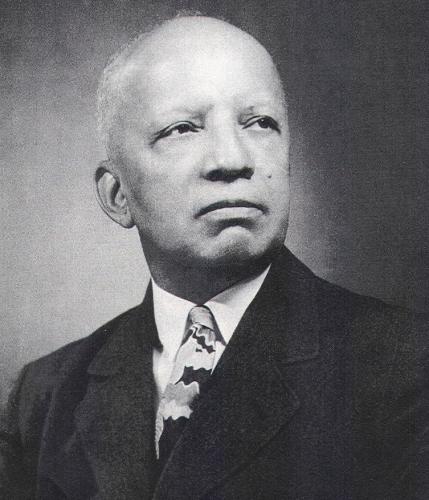
Dr. Carter G. Woodson,  Researcher Honored as the “Father of Black History Week”

The story of Black History Month begins in Chicago during the
late summer of 1915.
 An alumnus of the University of Chicago with
many friends in the city, Carter G. Woodson traveled from
Washington, D.C. to participate in a national celebration of the fiftieth
anniversary of emancipation sponsored by the state of Illinois.
Thousands of African Americans traveled from across the country to
see exhibits highlighting the progress their people had made since the
destruction of slavery.  Awarded a doctorate in Harvard three years
earlier, Woodson joined the other exhibitors with a black history display.
Despite being held at the Coliseum, the site of the 1912 Republican
convention, an overflow crowd of six to twelve thousand waited
outside for their turn to view the exhibits. Inspired by the three-week
celebration, Woodson decided to form an organization to promote the
scientific study of black life and history before leaving town.  On
September 9th, Woodson met at the Wabash YMCA with A. L. Jackson
and three others and formed the Association for the Study of Negro
Life and History (ASNLH).
He hoped that others would popularize the findings that he and other black intellectuals would publish in The Journal of Negro History, which he established in 1916.  As early as 1920, Woodson urged black civic organizations to promote the achievements that researchers were uncovering.  A graduate member of Omega Psi Phi, he urged his fraternity brothers to take up the work. In 1924, they responded with the creation of Negro History and Literature Week, which they renamed Negro Achievement Week.  Their outreach was significant, but Woodson desired greater impact.  As he told an audience of Hampton Institute students, “We are going back to that beautiful history and it is going to inspire us to greater achievements.”  In 1925, he decided that the Association had to shoulder the responsibility.  Going forward it would both create and popularize knowledge about the black past. He sent out a press release announcing Negro History Week in February, 1926.Woodson chose February for reasons of tradition and reform.  It is commonly said that Woodson selected February to encompass the birthdays of two great Americans who played a prominent role in shaping black history, namely Abraham Lincoln and Frederick Douglass, whose birthdays are the 12th and the 14th, respectively.  More importantly, he chose them for reasons of tradition.  Since Lincoln’s assassination in 1865, the black community, along with other Republicans, had been celebrating the fallen President’s birthday.  And since the late 1890s, black communities across the country had been celebrating Douglass’.  Well aware of the pre-existing celebrations, Woodson built Negro History Week around traditional days of commemorating the black past.  He was asking the public to extend their study of black history, not to create a new tradition.  In doing so, he increased his chances for success.Yet Woodson was up to something more than building on tradition. Without saying so, he aimed to reform it from the study of two great men to a great race.  Though he admired both men, Woodson had never been fond of the celebrations held in their honor. He railed against the “ignorant spellbinders” who addressed large, convivial gatherings and displayed their lack of knowledge about the men and their contributions to history.  More importantly, Woodson believed that history was made by the people, not simply or primarily by great men.  He envisioned the study and celebration of the Negro as a race, not simply as the producers of a great man. And Lincoln, however great, had not freed the slaves—the Union Army, including hundreds of thousands of black soldiers and sailors, had done that. Rather than focusing on two men, the black community, he believed, should focus on the countless black men and women who had contributed to the advance of human civilization.From the beginning, Woodson was overwhelmed by the response to his call.  Negro History Week appeared across the country in schools and before the public.  The 1920s was the decade of the New Negro, a name given to the Post-War I generation because of its rising racial pride and consciousness.  Urbanization and industrialization had brought over a million African Americans from the rural South into big cities of the nation.  The expanding black middle class became participants in and consumers of black literature and culture.  Black history clubs sprang up, teachers demanded materials to instruct their pupils, and progressive whites stepped and endorsed the efforts.

Woodson and the Association scrambled to meet the demand.  They set a theme for the annual celebration, and provided study materials—pictures, lessons for teachers, plays for historical performances, and posters of important dates and people.  Provisioned with a steady flow of knowledge, high schools in progressive communities formed Negro History Clubs.  To serve the desire of history buffs to participate in the re-education of black folks and the nation, ASNLH formed branches that stretched from coast to coast.  In 1937, at the urging of Mary McLeod Bethune, Woodson established the Negro History Bulletin, which focused on the annual theme. As black populations grew, mayors issued Negro History Week proclamations, and in cities like Syracuse progressive whites joined Negro History Week with National Brotherhood Week.  Continued Here

Learn More

dubois

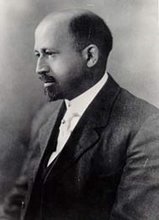
Dr. W.E. B. Dubois

The year 2013 marks two important anniversaries in the history of African Americans and the United States. On January 1, 1863, the Emancipation Proclamation set the United States on the path of ending slavery. A wartime measure issued by President Abraham Lincoln, the proclamation freed relatively few slaves, but it fueled the fire of the enslaved to strike for their freedom. In many respects, Lincoln’s declaration simply acknowledged the epidemic of black self-emancipation –spread by black freedom crusaders like Harriet Tubman – that already had commenced beyond his control. Those in bondage increasingly streamed into the camps of the Union Army, reclaiming and asserting self-determination. The result, abolitionist Fredrick Douglass predicted, was that the war for the Union became a war against slavery. The actions of both Lincoln and the slaves made clear that the Civil War was in deed, as well as in theory, a struggle between the forces of slavery and emancipation. The full-scale dismantlement of the “peculiar institution” of human bondage had begun. In 1963, a century later, America once again stood at the crossroads. Nine years earlier, the U.S. Supreme Court had outlawed racial segregation in public schools, but the nation had not yet committed itself to equality of citizenship. Segregation and innumerable other forms of discrimination made second‐class citizenship the extra‐constitutional status of non‐whites.Another American president caught in the gale of racial change, John F. Kennedy, temporized over the legal and moral issue of his time. Like Lincoln before him, national concerns, and the growing momentum of black mass mobilization efforts, overrode his personal ambivalence toward demands for black civil rights. On August 28, 1963, hundreds of thousands of Americans, blacks and whites, Jews and gentiles, Protestants and Catholics, marched to the memorial of Abraham Lincoln, the author of the Emancipation Proclamation, in the continuing pursuit of equality of citizenship and self-determination. It was on this occasion that Martin Luther King, Jr. delivered his celebrated “I Have a Dream” speech. Just as the Emancipation Proclamation had recognized the coming end of slavery, the March on Washington for Jobs and Freedom announced that the days of legal segregation in the United States were numbered. Marking the sesquicentennial of the Emancipation Proclamation and the 50th anniversary of the March on Washington, the Association for the Study of African American Life and History invites papers, panels, and roundtables on these and related topics of black emancipation, freedom, justice and equality, and the movements that have sought to achieve these goals. Submissions may focus on the historical periods tied to the 2013 theme, their precursors and successors, and other past and contemporary moments across the
breadth of African American history.

This copy may be republished electronically with the following acknowledgement and link by the Association for the Study of African American Life and History at http://www.asalh.org.


Visit our Honoring Our Past Pages

Resistance and Accountability in the Academy l Sr. Faculty at UPenn Challenges President

graduation2

Guest Column | Guess who’s (not) coming to dinner

President Gutmann fails at increasing administration diversity

By SENIOR FACULTY OF AFRICANA STUDIES · January 30, 2013, 12:32 am

Every institution has traditions that celebrate diversity on campus and the University of Pennsylvania is no exception.

Penn President Amy Gutmann invites faculty of color to a dinner at her house each year. Last year’s dinner was a memorable one. With the term for the dean of the School of Arts and Sciences soon ending and the newly appointed provost on hand, President Gutmann was asked during a heated exchange why she has never appointed a person of color to the position of dean during her long tenure at Penn.

Her response was that she would not just bring in someone who is not qualified, a comment implying that none of the people in the room were qualified to serve in these positions, even though many of them serve in administrative capacities in departments and centers. In her closing remarks, President Gutmann reiterated her dedication to diversity within Penn’s administration, admitting that “a show beats a tell.”

President Gutmann’s “show” came on Jan. 17, when she announced the appointment of the new dean of the School of Arts and Sciences. Yes, a show beats a tell every time, and once again, she has shown that her commitment to diversity does not include her own administration. When presented with yet another opportunity to increase diversity at the highest levels of the University, she failed to do so after nine years at the helm.

Not only has President Gutmann failed to show leadership in diversifying the highest levels of University administration, those individuals appointed by President Gutmann have often modeled her example and made similarly nondiverse appointments of vice provosts, associate deans and other high-ranking administrative staff.

Don’t take our word — walk into the Provost’s office or many of the deans’ offices at Penn. Like begets like, and in this instance, the absence of clear leadership and real results seems to have trickled down to those who report to her. The president’s most recent dean appointment is simply one more example of failure to act in a manner that is consistent with diversity claims and a recently enacted university-wide diversity plan.

Still, President Gutmann persists in speaking and writing about diversity, touting it on Penn’s website and elsewhere as the leading tenet of her presidency.

To her credit, there has been progress on creating a more diverse undergraduate student body. But the continuing failure of any changes in her own leadership team raises questions either about her ability to lead or about her commitment on this particular issue, or both.

Whatever the reason, the sad truth is that her stated vision for a more diverse administration and faculty at the University has yet to be matched by actions taken by her and those she has appointed.

So consider this an early RSVP. As senior faculty of color at Penn, we will not attend any “faculty of color” dinner this year. In the afterglow of the Dr. Martin Luther King Jr. holiday weekend and the second inauguration of our country’s first African-American president, we can no longer mask our disappointment, stifle our outrage or pretend not to notice the incongruity between internal actions and public words of commitment to diversity at the institution that we serve.

If President Obama can be queried about the diversity of his administration, as well he should be, then certainly the same applies to the president of the University of Pennsylvania.

The annual “diversity dinner” is indicative of cosmetic — not substantive — progress on diversity that we believe President Gutmann must address. Our decision not to attend this year’s dinner — and to share that decision with the Penn community — is not a petty one, nor is it one we’ve made lightly. Rather, it is based on a long overdue decision to forgo these meaningless gestures toward progress on diversity.

Only when issues of diversity are substantively engaged at the highest levels of our administration, not simply promoted as social events, will real change occur at Penn.

It is long past time to turn rhetoric into reality, planning into action and commitment into leadership. We stand ready to actively engage in that process. Until then, dinner can wait.

Camille Charles, Barbara Savage, Mary Frances Berry, Vivian Gadsden, Kenneth Shropshire and Tukufu Zuberi are all senior faculty in
. They can be reached at ccharles@pop.upenn.edu.

LAST UPDATED JANUARY 30, 2013, 12:32 AM


‘Post-racial’? No: with a black president, all issues are racialized l Professor Anthea Butler

‘Post-racial’? No: with a black president, all issues are racialized

Anthea Butler

12:05 pm on 01/21/2013
File Photo: In this handout from the The White House, U.S. President Barack Obama bends over so the son of a White House staff member can pat his head during a visit to the Oval Office May 8, 2009 in Washington, DC.  (Photo by Pete Souza/The White House via Getty Images, File)File Photo: In this handout from the The White House, U.S. President Barack Obama bends over so the son of a White House staff member can pat his head during a visit to the Oval Office May 8, 2009 in Washington, DC. (Photo by Pete Souza/The White House via Getty Images, File)

The inauguration of President Obama on Martin Luther King Jr. day is a powerful symbol of the progress in race relations in America. Symbols, however, do not have universal meaning. Since the 2008 election of Barack Obama, the nation has had to contend with two competing narratives: one, the election of the nation’s first African-American president meant America was now post-racial. The second narrative was that the election of Barack Obama meant that “America” was in peril, and that a Socialist Kenyan became president again through nefarious means. Which narrative will prevail in President Obama’s second term?  It depends on how race is confronted in the president’s second term, not only by the president, but by concerned Americans.

Since the presidential election of 2008, race relations in this country have deteriorated with the rumors that the president is a crypto Muslim, a Kenyan or any of the myriad of names (Obozo, Obummer) that have been given to him by conservative talk show pundits and detractors. Consistent calls for the president’s birth certificate during his first term, and other racial epithets and slurs from many sources including Sarah Palin, Donald Trump, and Rush Limbaugh seeped into portions of the country’s psyche, angering many people of color and galvanizing disenfranchised whites into polarized political camps. These racialized slurs against the president, fueled by conservative radio, television, and print media, have turned into a cottage industry of T-shirts, buttons and posters sold online and at Tea Party and other political rallies. Those who have promoted this racism are also quick to say that they are not “racists,” further compounding the issue.

All of this racial animus tumbled into the 2012 election campaign, leaving the Romney/Ryan ticket to win 59% of white voters in the 2012 election. That was 20 points more than the Obama/Biden ticket.  Despite this, the president won by a large margin, and with a broad coalition of support from all ethnic groups. With the president’s win, the racial animus has continued, threatening to engulf his second term as well.

There is no better time than the anniversary of Martin Luther King’s Jr. birthday for the president to address the legacy of race and racism in the United States.  Most Americans remember one important line from the “I have a Dream Speech”:  “I have a dream that my four little children will one day live in a nation where they will not be judged by the color of their skin, but by the content of their character.” The quote of King is lifted out of a critical speech highlighting the problems of the civil rights movement. Now it is used to validate America’s so-called post-racial society. The reality is, the last four years have been anything but “post racial.”

At the beginning of President Obama’s second term, it is important that the boil of racism festering during the last four years be lanced. How? By the president’s acknowledging the tensions in this country that are being currently racialized: gun control, health care, and immigration.  While the president’s race speech back in 2008 was a necessity on the campaign trail, perhaps the inauguration speech or his State of the Union address could acknowledge these tensions, explaining how they they subvert or distort our attempts to deal with the problems themselves.

How we as a nation work through our racial issues is important as we draw closer to the 50th anniversary of the Civil Rights Act of 1964. America’s history in race relations has always been fraught, and it is time to revisit the legacy of the civil rights movement once more. The issues of race are not simply black and white, but now encompass a changing demographic in a nation of immigrants. If the president ignores the clamor, the poison will continue to seep, destroying “our more perfect union.” Now is the time to address the festering survival of racism, before divisions in our nation grow any deeper. We will become “post racial” not byceasing to talk about race, but by talking more: pulling the ugliness out of the codes and subtexts where it lurks, and confronting it directly.

Anthea Butler is Associate Professor of Religious Studies and Africana Studies at the University of Pennsylvania.


Straight, no chaser

Anthea Butler is Associate Professor of Religious Studies and Africana Studies at the University of Pennsylvania and Graduate Chair of Religious Studies. She holds a Ph.D from Vanderibilt University in Religion, a Masters in Religion from Vanderbilt, and a Masters in Theology from Fuller Theological Seminary. A historian of American and African American Religion, Professor Butler’s research and writing spans Religion and Politics, Religion and Gender, African American Religion, Sexuality, and Religion and Popular culture.

Professor Butler’s forthcoming book The Gospel According to Sarah on The New Press, explores the exploring the role of religion in Sarah Palin’s political action, and Palin’s influence on the Republican Party. Her first book, Women in the Church of God in Christ: Making A Sanctified World on The University of North Carolina Press is the first full-length academic book focused on The Women’s Department of the Church of God in Christ (COGIC). The book is an engaging look at African American women’s lives and civic engagement, highlighting how the of African American women’s social uplift in the church is rooted not only in respectability, but in strict religious beliefs.

A regular guest on the Melissa Harris Perry Show on MSNBC and a sought after media commentator, Professor Butler also provides commentary on contemporary politics, religion and social issues at Religion Dispatches, and her own blog, “You Might Think So” She also served as a consultant to PBS series God in America, and the American Experience on Aimee Semple McPherson.

Professor Butler’s future research projects include a book on African American Women education and missions work in the 19th and 20th century, and the sexual abuse cases in the American Catholic Church.


Books

cogic

The Church of God in Christ (COGIC), an African American Pentecostal denomination founded in 1896, has become the largest Pentecostal denomination in the United States today. In this first major study of the church, Anthea Butler examines the religious and social lives of the women in the COGIC Women’s Department […]

Read More >>

palinBook

The Gospel According to Sarah is a fascinating new look at a little-understood but crucial side of Sarah Palin: her Pentecostal roots. Anthea Butler’s analysis trains the keen eye of a noted religion scholar on religious and political currents that have been widely caricatured but, until now, poorly understood.

[…]

Read More >>


Celebrating the ‘complete’ Martin Luther King Jr.; unfinished work and all l Dr. Blair L.M. Kelley

Celebrating the ‘complete’ Martin Luther King Jr.; unfinished work and all

by Blair L. M. Kelley

Blair L. M. Kelley is an associate professor at North Carolina State University. Follow her on Twitter at @ProfBLMKelley

My 9-year old daughter came home this week raving about her class and their discussion of Martin Luther King, Jr.

She declared that she loved learning about his life and that she was thankful to him because without King, no change would have been possible in America on the question of race. I am a historian of African-American history specializing in social movements, so I quickly moved to correct her. Of course change would have happened, even if King had never lived! I described to her other leaders. I reminded her that movements don’t function because of just one great man. I told her that King was not a perfect person, and that even he had come short of meeting all his goals. In the end, I even resorted to reminding her that I wrote a book on a movement that took place 35 years before King was even born.

Clearly my daughter didn’t care. She insisted that her school would not be integrated, and that her whole world would not have been the same without King’s leadership.

After thinking about it for a while, I realized that most people feel the same way about King that my daughter does. King has become the single greatest icon of the civil rights movement—his words are studied, his great marches are remembered, his name marks our boulevards; his shadow, now literally cast in stone, looms large on our national consciousness. He has become the benchmark for great leadership, so much so that nearly every leader that has emerged after him is compared to him, and found wanting.

As an icon, King is often thought of as flawless, so that we rarely reflect on his failures as a movement leader. Our collective memory of King only touches on the high points. The images we remember are the moments of his greatest triumphs as a leader: the 1955-56 Montgomery Bus Boycott, the 1963 March on Washington, the Birmingham Campaign that same year, and the 1965 march from Selma to Montgomery. Each of these efforts resulted in positive change, clear victories in the courts or in the halls of Congress.

We tend not to remember the moments when King faltered or searched for the right direction. We don’t recall the indecision about what to do next after the success of the Montgomery Bus Boycott; the challenge of the 1966 Chicago Freedom Movement campaign, or his unfulfilled Poor People’s Campaign — cut short by his tragic assassination in 1968. These moments are forgotten when King is not remembered in his broader context.

The Case of Dr. Jahi Issa l RACE, HIGHER EDUCATION AND HBCUs -Update

09-01-12 Issa

Revision of October 26, 2012 publication
See Updates below

RACE, HIGHER EDUCATION AND HBCUs

 Dr. Jahi Issa, until March 2012, worked as an Assistant Professor of History & Africana Studies at Delaware State University (DSU) in Dover. When a group of students assembled in protest of DSU President Dr. Harry Williams after the state auditor criticized the university’s business practices and for the decreasing percentage of black students at the historically black university, police arrested Issa and escorted him away until he dropped to the ground and requested an ambulance. After being seen at the hospital and later released, DSU police charged him with disorderly conduct, resisting arrest, offensive touching of a law enforcement officer, and inciting a riot.

Issa was born and reared in St. Louis, Mo. and was awarded his PhD in history from Howard University. His forthcoming monograph examines the Universal Negro Improvement Association in Louisiana and its contribution to African nationalism. He is currently banned from the DSU campus and is facing a prosecution that could put him behind bars for
more than two years. The incident has fueled concerns that Professor Issa’s arrest and the pending charges represent an act of repression and retaliation for his outspokenness and the EEOC and other complaints he has filed while he was on the faculty at DSU, and not because of any actual crimes he committed. The situation is depressing and he is in need of support in this difficult time.

We ask, what is the crime ?  Is there no freedom of speech for a progressive Black educator in this HBC ? We remember the on-slaught of firings in HBCUs in the 1960s as many began to publish the early works of student involvement in the infancy of the Black Power movement.  Among them, Dr. Nathan Hare who was fired from Howard University.


Listen to the OUR COMMON GROUND

interview with Dr. Jahi Issa

09-01-12 Issa

YouTube video of the Rally and his arrest

“How Black Colleges are Turning White” in the Black Agenda Report
http://www.blackagendareport.com/content/ethnic-cleansing-historica…


Dr. Issa’s Legal Defend Fund. Consider donating and circulating the site address.  http://www.hbcuinstitute.org/

His response to the White House Advisor on HBCUs in the Chronicle ofHigher Education

  http://www.chronicle.com/article/No-Need-to-Overhaul-Americas/129565/

Visit HBCU Institute to lean More and to support Dr. Issa
www.hbcuinstitute.org

Commentary on the Case of Dr. Jahi Issa


At the heart of this bizarre response to Dr. Issa’s attendance to the student rally is an essay which he wrote and was published at Black Agenda Report.

How Black Colleges Are Turning White – The Ethnic Cleansing Of African Americans in the Age of Obama

“How Black Colleges are Turning White” in the Black Agenda Report
http://www.blackagendareport.com/content/ethnic-cleansing-historica…

How Black Colleges Are Turning White and Keeping Their Historically Black Colleges and Universities Status: The Ethnic Cleansing Of African Americans in the Age of Obama (Part 1 of 3 )
By Jahi Issa, Ph.D.

For more than 100 years, HBCU’s have served as a model for educating a plethora of African American leadership around the country. Although the mission statements of most HBCUs do not state this fact, HBCUs grew out of the social disorder and aftermath of the American Civil War—a period which constitutionally brought millions of formerly enslaved Africans into citizenry in the United States. Similar to colleges and universities that were created for groups such as Catholics, Jews and for immigrant groups, HBCUs were created in reaction to de facto marginalization created by a European American hostile society. Because of the efforts of the Civil Right Movement, HBCU’s were finally recognized as important institutions and were giving special status for Federal funding. However, over the past few decades, HBCUs have been targeted as being too “Black” and many states are progressively trying to eliminate African Americans from these institutions that have served as a buffer zone for the Black middle class. Some HBCUs have and are going through hostile takeovers in order to turn them into White education facilities and thereby permanently eliminating the African American middle class.

African American Perform Better at HBCUs
Although over the years many have argued that HBCUs are redundant and irrelevant in today’s “post racial world,” the fact remains that these intuitions of higher learning, according to the National Science Foundation, graduate more than 33% of all African Americans earning Bachelor’s and doctoral degrees, almost double that compared to African Americans attending predominately White schools . Furthermore, according to the Washington Post, the “post racial” world that many hoped for with the election of President Barack Obama may just be an illusion. Relying on a recent report from the Pew Research Center’s Social & Demographic Trends, the Washington Post noted that the typical White household in 2009 had 20 times more wealth ($113,149) than the typical Black household ($5,677). Moreover, another report that was conducted by Brandeis University in May of 2010 and concluded that African American will never reach wealth parity with that of White Americans. Both reports note that African Americans with college degrees stand a better chance at edging out a decent life in the United States than those without degrees.

According to a 1977 study that was conducted under the leadership of Dr. Mary Francis Berry, in her capacity as the former Secretary of Education in the Carter Administration, primary reasons why HBCUs tended to be better equipped to prepare students for real world experience was because they offered:

  • “credible models for aspiring Blacks…
  • “psycho-socially congenial settings in which blacks can develop”
  • “insurance against a potentially declining interest in the education of black folk”

Furthermore, the report posits that the ultimate purpose of the HBCU is to “represent the formal structures which nurture and stress racial ideology, pride and worth for Blacks. Consequently, they are what every racial and ethnic group is entitled to have—a political, social and intellectual haven.” The report mentioned above was recently vindicated in a study that was published in January of 2011. Three economists concluded that African Americans who attend HBCUs tend to perform better in the work force than African Americans who attend predominately White universities and colleges.

The 1965 Higher Education Act and Title III: Federal Funding For African-Americans in Higher Education
One cannot discuss today’s relevancy of HBCU’s without mentioning the Higher Education Act of 1965. The Higher Education Act was signed into law by President Lyndon B. Johnson as part of his Great Society program that sought “to strengthen the educational resources of our colleges and universities and to provide financial assistance for students in postsecondary and higher education.” Before the law was signed by President Johnson, the Chairman of the House Committee on Education, an African-American Harlem Congressman named Adam Clayton Powell made an amendment that defined HBCUs as “…any historically black college or university that was established prior to 1964, whose principal mission was, and is, the education of black Americans.” The amendments also legalized the federal funding of HBCUs through the Higher Education Act of 1965 Title III program. Title III is the federal governing body which sets the standard for providing funding for HBCUs. Over the years Title III had provided billions of dollars to support African-American undergraduate, graduate programs, increasing African American participation in math and science, real estate acquisitions and strengthen HBCU’ endowments to name a few. In all, Title III has helped African American universities to not only increase their numbers in accredited degree programs across the country; it has also allowed many HBCUs to have a tremendous economic impact in the communities that they serve.

Economic Impact of HBCUs and the Origins of a New Era Rifted in Corruption
In 2005 the National Center for Education Statistics (NCES), an office within the U.S. Department of Education, published a report that documented the economic impact of HBCUs. Primarily, this study was introduced by President George W. Bush and continued by President Barack Obama administration which sought to include the participation of private sector (corporations) into the governing bodies of HBCUs. The study found that more than 100 HBCUs had in 2001 an economic impact of almost 11 billion dollars in the communities that they served. For instance, schools such as Howard University total economic impact in the Washington D.C. metropolitan area was more than 600 million dollars. For smaller schools such as Delaware State University, their total economic impact was more than 150 million dollars. It must be noted that the economic impacts also made a national impression. Again, according to the National Science Foundation, HBCUs bestowed nearly 25% of all bachelor degrees earned by African Americans in 2001. In the areas of agriculture, biology, mathematics and the physical sciences, HBCUs accounted for more than 40 percent of all bachelor degrees earned by African-Americans. With this stated, it is easy to see why corporations would want a piece of the pie. Furthermore, if one is to evaluate the current lack of transparency on Wall Street, it is easy to see that Wall Street’s collaboration with today’s HBCUs could represent the end of African American higher education as we know it.

The Second Corporate takeover Black Higher Education

Although President Barack Obama HBCU Executive Order 13532 “encourages private investment in HBCUs,” however, research proves that corporate partnerships is not new to HBCUs, nor are their historic input solely motivated by financial gains. Not long after the end of reconstruction, Northern White capitalists sought extreme ways in which they could control the ebb and flow of African American education. This was done to curtail the rapid development of African American educational institutions immediately after the Civil War. For instance, from 1865-1880 federal agents documented that there were thousands of African American schools operating throughout the South independent of White control. When northern White benevolent groups finally reach the South with mythical-preconceived notions that they were coming to “civilize” former wretched enslaved Africans, they were astonished to see that Africans Americans had already had established their own schools systems fully equipped with African American teachers. These schools’ full missions were self-determination and political control over the regions of the South in which they were the majority.

The high level of African American political education created a problem for the nation after the Compromise of 1877. Since African Americans were no longer allowed to exercise political autonomy in the South, strategies were devised on the federal level to control the nature of their education. The federal government along with the corporate conglomerates in the North believed that the only way that they could ensure the continual flow of cheap labor in the South was to train African Americans in a way that they would not advocate for political control of their communities. Furthermore, there was another important issue at play—that was African American competition with Whites for high skilled jobs. The solution was a new type of training for Southern African Americans was called industrial education. This type of schooling served the purpose of supervising and training African American to be subservient to White interest. Schools such as Hampton, Tuskegee and Delaware State were devised as the alternative to the African American independent schools that advocated self-determination after the Civil War. The corporate-handpicked spokesman for this new type of schooling was none other than Booker T. Washington. One must remember that Washington’s entrance exam into Hampton University was sweeping the floor. The ultimate goal of Hampton was to control the emerging Black leadership of the Jim Crow South, and train African Americans in the corporate labor needs of the new South. The financial backing of Hampton University and what would later be Tuskegee was provided by White Northern corporations and philanthropy. This corporate-industrial style form of education continued to dominate Southern higher educational institutions long after the death of Booker T. Washington in 1915.

The White House Initiative on HBCUs Encourages Corporate Collaboration? 
The current encroachment of private corporate input into the affairs of African American higher education could and will be disastrous. It would mean that African Americans will be forced back into the Jim Crow Era. A deliberate attempt to curtail educational advancements that was gained by the Civil Rights and Black Power era seems to be the main motivation. The White House Advisor on HBCUs, John Wilson, Jr., stated in April of 2010 HBCUs “must not be seen as plaintiffs in the struggle for civil rights….” Dr. Wilson, a graduate of Morehouse College, tends to forget that it was struggle for Civil Rights that literally allows him to serve President Barack Obama. The White House Initiative on HBCUs came into existence because of the “plaintiff” of the past. Furthermore, Mr. Wilson’s statement implies that African American should abandon their pursuit for full rights and self-interest. Taking a lead from Dr. Wilson’s statements, A Wall Street Journal editor named Jason L. Liley wrote an editorial stating that HBCU’s were a dismal failure and that “Mr. Obama ought to use the federal government’s leverage” to bring these schools under Wall Street’s control. He went further by stating that HBCUs should all become private and model themselves after the University of Phoenix. One month after Liley’s editorial, a conservative from the Wall Street funded American Enterprise Institute also imputed on Wall Street’s quest to control Black education. He ended his article in the Chronicle of Higher Education by stating that HBCUs “should accordingly be encouraged to enroll more non-black students.” The author mentioned nothing about White universities increasing African American enrollment. He also stated that “some HBCUs, notably two in West Virginia (Bluefield State and West Virginia State University), are in fact no longer predominantly black” but are still receiving special (HBCU) federal funding. Five months after the Chronicle of Higher Education essay appeared, the White House Advisor on HBCUs, John Wilson, Jr. was invited as the keynote speaker to the Thurgood Marshall College Fund. The title of his speech “Historically Black Colleges and Universities and the Albatross of Undignified Publicity” conveyed that HBCU are historically cursed when it comes to publicity in White dominated media outlets. Moreover, the central thesis of his speech, although impressively constructed, was that HBCUs should jump on the corporate bandwagon by accepting funds from good corporate Samaritans such as Bill Gates and Warren Buffett.

Black Colleges Turning White or White Cultural Hegemony: The Signs of the Future 
Although the Higher Education Act of 1965 clearly states that an HBCU is a school “whose principal mission was, and is, the education of black Americans,” economist and scholar at American Enterprise Institute, Richard Vedder, reminds us that there is a trend being shaped were as HBCUs who formally had an African American majority student and faculty body, and now have White majority populations, still receive federal funding geared for African Americans. These two schools are Bluefield State College and West Virginia State University. According to a May 19, 2000 CNN report, White enrollment at HBCUs is on the rise. Other schools such as Kentucky State University, Elizabeth City State University and Delaware State University are only a few schools that have a growing White and non-African American student and faculty population. Furthermore, according to an August 17, 2011 Wall Street Journal article called “Recruiters at Black Colleges Break From Tradition,” HBCUs such as Tennessee State University, Delaware State University and Paul Quinn College are cited as no longer focusing exclusively on recruiting African Americans. The author of the article points out that Tennessee State University’s Black enrollment has reduced to around 70 %, while Paul Quinn College Black enrollment has been predicted to fall from 94% to 85% for the Fall 2011 academic year.

Many have asked the question if White enrollment at HBCUs represent a decrease in African American enrollment at the same schools. The year that CNN published its story, Bluefield College African American faculty had dwindled to less than one percent from previous decades. The African American student enrollment had also decreased to less than ten percent. Nonetheless, research shows that when African American faculty at HBCUs is a majority, African American students tend to enroll at a higher percentage and they tend to be more productive in the work place once they graduate. There seems to be a direct correlation between African American student enrollment and that of its faculty. In other words, if the African American faculty enrollment at HBCU’s is low, African American students tend not to attend HBCU’s. When this occurs, is an HBCU still a HBCU? In other words, can you have a HBCU without Black students and faculty? This is exactly the issue that American Enterprise Institute scholar Richard Vedder was raising in his essay in the Chronicle of Higher Learning. Why are HBCUs that are no longer Black in students or faculty population receiving federal monies geared toward African Americans? The federal government seems to believe that this trend represents the future for HBCUs.

Jahi Issa, Ph.D Assistant Professor of History and Africana Studies at Delaware State University and Former Northeastern North Carolina Grass Root Coordinator for President Barack Obama’s 2008 Presidential Campaign. 

Dr. Issa’s Legal Defend Fund. Consider donating and circulating the site address.  http://www.hbcuinstitute.org/

“How Black Colleges are Turning White” in the Black Agenda Report

http://www.blackagendareport.com/content/ethnic-cleansing-historica…

His response to the White House Advisor on HBCUs in the Chronicle ofHigher Education    http://www.chronicle.com/article/No-Need-to-Overhaul-Americas/129565/

Learn more about  the and how you can support Dr. Issa

HBCU Institute
www.hbcuinstitute.org


UPDATE:  

The Petition for Justice for Dr. Issa

OP-ED on BlackStar News

Rally to Support Dr. Issa on January 15, 2013. Commentary and participant comments begin around 2:52 in the video.

Relevant to this case

Protest to force investigate Lynchings in DE

2012 whites in Delaware Lynching Black Men Louisiana-styled Cover-ups in Delaware


Extraordinary Scholar and Author, Dr. Tony Martin Now an Ancestor l February 21, 1942 ~ January 17, 2013

Dr. Tony Martin Now an Ancestor


Professor Tony Martin dies at 70

Trinicenter.com Reporters
January 17, 2013


Professor Martin has written, compiled or edited 14 books including Caribbean History: From Pre-Colonial Origins to the Present (2012) published by Pearson Education; Amy Ashwood Garvey: Pan-Africanist, Feminist and Mrs. Marcus Garvey No. 1, Or, A Tale of Two Amies (2007), Literary Garveyism: Garvey, Black Arts and the Harlem Renaissance (1983), and the classic study of the Garvey Movement, Race First: the Ideological and Organizational Struggles of Marcus Garvey and the Universal Negro Improvement Association (1976).
Dr. Tony Martin, former Professor Emeritus at Wellesley College, has passed over tonight, January 17th 2013 in Trinidad & Tobago at West Shore Medical Hospital. Trinidadian-born Dr. Martin taught at the University of Michigan-Flint, the Cipriani Labour College (Trinidad), and St. Mary’s College (Trinidad). He has been a visiting professor at the University of Minnesota, Brandeis University, Brown University, and The Colorado College and also spent a year as an honorary research fellow at the University of the West Indies, Trinidad.

His work on Marcus Garvey was featured on the curricula of many African studies programmes around the world and he was a well-known lecturer in many countries.

Share your views here…


Dr. Tony Martin is Emeritus Professor of Africana Studies at Wellesley College, Massachusetts, where he taught from 1973 to 2007. Now an Ancestor

Dr. Tony Martin is Emeritus Professor of Africana Studies at Wellesley College, Massachusetts, where he taught  from 1973 to 2007. Prior to coming to Wellesley, he taught at the University of Michigan-Flint, the Cipriani Labour College (Trinidad), and St. Mary’s College (Trinidad). He has been a visiting professor at the University of Minnesota, Brandeis University, Brown University, and The Colorado College. He also spent a year as an honorary research fellow at the University of the West Indies, Trinidad.

Professor Martin has authored, compiled or edited 14 books. His most recent isCaribbean History: From Pre-Colonial Origins to the Present (2012) published by Pearson Education. Earlier works include  Amy Ashwood Garvey: Pan-Africanist, Feminist and Mrs. Marcus Garvey No. 1, Or, A Tale of Two Amies (2007), Literary Garveyism: Garvey, Black Arts and the Harlem Renaissance (1983), and the classic study of the Garvey Movement, Race First: the Ideological and Organizational Struggles of Marcus Garvey and the Universal Negro Improvement Association (1976).

Martin qualified as a barrister-at-law at the Honourable Society of Gray’s Inn (London) in 1965, did a B.Sc. honours degree in economics at the University of Hull (England), and the M.A. and Ph.D. in history at Michigan State University.

Martin’s articles and reviews have appeared in such journals as the Journal of Negro History; Journal of African American History; American Historical Review; African Studies Review; Washington Post Book World; Journal of Caribbean History; Journal of American History; Black Books Bulletin; Jamaica Journal; Comparative Studies of South Asia, Africa and the Middle East; and many others.

His writings can be found in several reference works and encyclopedias, including the UNESCO General History of the Caribbean; the Oxford Dictionary of National BiographyAmerican National Biography; the Encyclopedia of African American Business History; International Encyclopedia of the Social Sciences; and Encyclopedia of the Harlem Renaissance. He has received numerous academic and community awards, including a grant from the American Philosophical Society. He has reviewed articles and programs for scholarly journals, the National Endowment for the Humanities, and the Austrian Science Fund. His biographical listings can be found in Who’s Who in America; Who’s Who in the World; Who’s Who Among America’s Teachers; Personalities Caribbean; Who’s Who Among African Americans; and elsewhere. He has been a reviewer and consultant for publishers and has served as an expert witness for Congressional hearings.

Martin is well known as a lecturer in many countries. He has spoken to university and general audiences all over the United States, Canada, the Caribbean, and England, as well as in Africa, Australia, Bermuda, and South America. In 1990 he delivered the annual DuBois/Padmore/Nkrumah Pan-African lectures in Ghana. In 2004 he was one of the principal speakers at the First Conference of Intellectuals of Africa and the Diaspora, which was sponsored by the African Union in Senegal.

Learn more about Dr. Tony Martin at his Official Website

Dr. Martin became an OUR COMMON GROUND Voice in 1989. His voice is deep and important. We are proud of his association and support of our programming. We expect that he will be an ancestral guide to our mission.

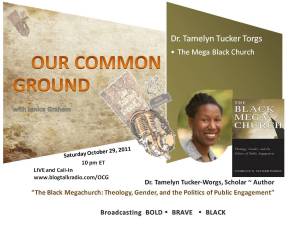
Dr. Tamelyn Tucker-Worgs Winner of the National Conference of Black Political Scientists’sW.E.B. DuBois Distinguished Book Award

Congratulations to Author, Researcher and OUR COMMON GROUND Voice Dr. Tamelyn Tucker-Worgs

Winner of the National Conference of Black Political Scientists’sW.E.B. DuBois Distinguished Book Award.

ABOUT THE AUTHOR

Tamelyn Tucker-Worgs specializes in American Politics, Race and Politics, African American Religion, Public Policy, Gender and Politics, and Urban Politics.

Her work is interdisciplinary and her courses include the Politics of the Black Church, Black Theology, African American Politics, and Women and Politics.

Her current research focuses on the black megachurch phenomenon and faith-based community development. Her publications focus on the black church and politics, megachurch-based community development and black women’s contemporary political activism.

 An explosion of flourishing black megachurches has changed the landscape of American religious life. Boasting memberships into the tens of thousands and meeting within both adorned walls and refurbished warehouse buildings, these contemporary fruits of the Civil Rights Movement hold many of the resources necessary to address America’s contemporary social disparities. After studying nearly 150 black megachurches, Tamelyn N. Tucker-Worgs asks, How are these church communities engaging the public sphere? And, why are their approaches so varied?

The Black Megachurch sets aside the broad assumptions usually applied to the study of black churches and analyzes the three factors most necessary for social engagement- theological orientation, organization of community development initiatives, and genderbased spheres of labor and leadership. In doing so, Tucker-Worgs underscores the myriad ways in which black megachurches have responded to the changing social climate and concludes that while some have lived up to their potential, others have a long way to go.

Endorsements

A timely analysis of a much discussed but rarely understood phenomenon. Finally, we have a book on religion and black politics that begins to provide some rigorous insight into the black megachurch movement. The Black Megachurch will be an important resource for years to come.”

-FREDRICK C. HARRIS, Professor of Political Science and Director for the Institute in African-American Studies,
Columbia University

“Tucker-Worgs advances a progressive framework for evaluating the impact of black megachurches while providing one of the most comprehensive profiles of these churches available to date.”

-R. DREW SMITH, Director, Center for the Church and the Black Experience, Garrett-Evangelical Theological Seminary

“The Black Megachurch is the best empirical study of black megachurches and politics. Covering 149 churches, Tucker-Worgs astutely shows their wide variety and relates their theological orientation to the types of public engagement they undertake.

-LAWRENCE MAMIYA, Professor of Religion and Africana Studies on the Mattie M. Paschall Davis and Norman H. Davis Chair, Vassar College

From Kinetics Live.com

http://kineticslive.com/2013/01/new-book-examines-black-megachurches-and-their-impact-on-black-public-life/

Media Contact

For press inquiries, speaking engagements or to schedule an interview with Tamelyn Tucker-Worgs, please contact:

Jamye Wooten
Kinetics Communications
(443)415-7974
jamye@kineticslive.com


Listen to our interview with Dr. Tucker-Torgs

10-29 torgs

A Death in the Family l Remembering Dr. John Hope Franklin on his birthday

A Death in the Family

by Kevin Alexander Gray
MARCH 30, 2009
Obits Magazine
From the moment word broke of John Hope Franklin’s passing, we started calling around, spreading the word as if a family member had just died.  Our griot had crossed over.  In West African societies, the griot kept and told the oral history of the village or tribe, and so helped the people know who they were. That was Franklin’s service to us.

John Hope FranklinFriends and family called him John Hope.  The rest of us called him Dr. Franklin. Generations of black activists, scholars, historians, politicians and those who appreciate history revere Dr. Franklin.  In the homes of most educated (or conscious) blacks you’ll find three standard items – the Bible, a picture of Martin Luther King, and a copy of Dr. Franklin’s seminal work, From Slavery to Freedom: A History of African-Americans.

Anyone who takes an African American history course in high school or college is usually required to have Franklin’s book.  Certainly there are whites who have a copy or have read some of his work.  But I’d be willing to bet that a significant number of black students who bought the book in college still have it.  I’ve had mine since the ’70s.

Rev. Jesse L. Jackson Sr. called Franklin, “the preeminent voice and witness for America’s sojourn from slavery to freedom.”  He’s right, but doesn’t go far enough: Dr. Franklin was (and still is) our preeminent teacher.  Even today, his work reaches and affects millions.  For blacks, his work forms the the base of our knowledge of who we are.  That’s no small thing.

To me, Franklin was just as significant — if not more so — than Rosa Parks.  First of all, she and many others were educated or historically informed by Franklin’s work.  Second, he chronicled Parks’ deed (and many others) in the context of a broader struggle and a connected history for the rest of us.

He insisted that our story is greater than one person’s refusing to give up a seat on a bus to a white person.  He showed us that the struggle for rights didn’t happen just in Montgomery or Selma or Birmingham; it galvanized everyday folks across the country. Franklin often spoke of the “cult of personality” that diminished the contributions of so many people whose names we don’t celebrate. His job was to tell the whole story.

Because of Franklin, we know that the movement for change didn’t spring up when Martin Luther King appeared on the scene.  It started before Crispus Attucks and Cinque.  Franklin knew we’d need to know that.

The week before Franklin passed, a young actress tragically lost her life in a skiing accident.  In the days that followed countless stories recounted her life, and Broadway dimmed its lights in her honor.  On the day Franklin died, I was struck by the obligatory notice his death was given, particularly in the electronic media.

I’m not claiming his passing didn’t get national notice, although the Obama White House did little to mark the significance of the moment.  Most of the news reports gave Franklin his due in the allotted 2-5 minutes.  And for those really interested, of course, Franklin’s biography is widely available. I’m also not trying to diminish the pain felt by the actress’s family or the appropriateness of her tributes. She was 45 and he was 94. Yet the differing coverage of the two deaths proves the importance of Franklin’s work.  He told the stories that were told nowhere else.

John Hope Franklin, MarchingOne article I ran across on Franklin said: “He is perhaps best known to the public for his work on President Clinton’s 1997 task force on race. But his reputation as a scholar was made in 1947” and that From Slavery to Freedom was “still considered the definitive account of the black experience in America.”

Think about it: to cast working with Bill Clinton above writing “the definitive account of the black experience in America.”  It’s such small actions – not intended as slights perhaps – that place the black experience in the shadow of our relationship to whites.  What went unmentioned was that Franklin supported reparations over empty apologies, much to the establishment’s consternation.

As the adage goes, “History is written by the winners.”   Before From Slavery to Freedom, blacks were an appendage in the history book of “the winners,” cast all too often as “the losers.”  Black struggle, progress and lives were invisible until whites wanted to see them.  And even when the story of blacks were told by a white, too often it contained what whites thought blacks felt.

Franklin showed blacks to be winners, with their own history of fighting to overcome second-class status and the pain, struggle and glory that went with it.  In his work, our people told their own stories.

The nation owes a huge debt to John Hope Franklin.  Rest in peace, honored griot.


Obits Magazine  Homepage image by Simmie Cox

Kevin Alexander Gray is a civil rights activist and author based in Columbia, S.C. He is a former president of the state ACLU. He managed Reverend Jesse Jackson’s presidential campaign in South Carolina in 1988, and is the author of Waiting for Lightning to Strike: The Fundamentals of Black Politics and the forthcoming The Decline of Black Politics: From Malcolm X to Barack Obama. He is an OUR COMMON GROUND Voice. Read more of Gray on his blog, The New Liberator.  

Dr. John Hope Franklin transcended on March 25, 2009. He would have celebrated his