Angela Davis Talks Black Liberation, History and the Contemporary Vision – News & Views – EBONY

Angela Davis Talks Black Liberation, History and the Contemporary Vision[INTERVIEW] The iconic freedom struggle leader speaks with EBONY.com about Black human rights activism stretching back decades and her recently released book observing global movementsBY SHERYL HUGGINS SALOMON, FEBRUARY 17, 2016COMMENTSAngela Davis speaking at Myer Horowitz Theatre of the University of Alberta. Nick Wiebe/Wikimedia CommonsFifty years after the founding of the Black Panther Party for Self Defense, the agenda and style of the legendary Black revolutionary organization remains relevant in today’s public discourse. An end to “police brutality and the murder of Black people,” central to the Black Lives Matter movement, was laid out in the Black Panthers’ 10-Point Platform five decades ago. Both acclaim and condemnation erupted when their iconic black berets made an appearance recently in Beyoncé’s half-time show performance during the Super Bowl.It’s telling that America is still grappling with many of the same racial inequities and injustices that it did 50 years ago – and that Black pride remains a controversial topic. Not so to renowned scholar, activist and feminist icon and close associate of the Black Panthers Angela Y. Davis.“If one looks at the 10-point program of the Black Panther Party, one sees that the very same issues that were raised in the aftermath of slavery are at the center of a program that was formulated in 1966,” said Davis, now a professor emeritus at University of California, Santa Cruz. “In 2008 when Barack Obama was elected, those issues had not been sufficiently addressed, certainly not yet solved, so therefore the election of one person to political office was not going to automatically reverse a history of a racist inspired economic oppression, which isn’t to say that it wasn’t important that we elected Barack Obama, but those struggles continue.”While in Spain last week advocating for the release of imprisoned Basque separatist politician Arnaldo Otegi, Davis took a few moments with EBONY.com to discuss contemporary issues like Black Lives Matter, the 2016 U.S. presidential election, and details from her latest book, Freedom is a Constant Struggle: Ferguson, Palestine, and the Foundations of a Movement (Haymarket Books, 2016), edited by human rights activist Frank Barat.“I’ve been involved in the Palestine Solidarity movement for a very long time,” explained Davis. “When the Ferguson uprising happened a year and a half ago activists on the ground in occupied Palestine were the first to tweet support and advice to protesters in Ferguson. Out of that has come a very interesting, a very rich development of connections across the ocean. A delegation from Palestine visited Ferguson. Black Lives Matter and Ferguson activists, [as well as members of] Dream Defenders, Black Youth Project 100 made a trip to Palestine over about a year ago to express their solidarity.”  Related Articles CONNECTING PALESTINE AND POLICE VIOLENCE SIDRA SMITH ON ANGELA DAVIS DOC DIRECTOR TALKS ANGELA DAVIS DOCUMENTARYMore highlights of what Davis said are in the Q&A below.EBONY.COM: What’s the message of your new book?Angela Davis: I am particularly interested in [having] activists associated with the Black freedom movement to realize that our struggles never would have achieved this universality that they have achieved without solidarity that has come from Africa, Asia, Latin America, Europe and Australia. Our struggles are global, therefore, it is important for us to incorporate this global vision into our on the ground battles against police crimes and the prison industrial complex. Since I was very young I have been involved in organizations— the Communist Party, the Black Panther Party— that have had this global perspective.EBONY.COM: As you note in your book, events in Ferguson after the police shooting of Michael Brown exposed the militarization of police forces. Where is this push toward militarization headed and how can it be stopped?Davis: If one looks at the history of policing, especially over the last 15 years in the aftermath of 9/11, one can see the emphasis on the shifting of resources from the military to the police. This actually has a much longer history if one looks at the way in which the Vietnam War resulted in an impact on local police. The S.W.A.T. squads emerged as a result of using techniques and technology that were used by the Green Berets in the Vietnam War. The Los Angeles Police Department was the first to use such tactics against the Black Panther Party. We have also seen the emergence of privatized policing corporations. In the book, I refer to G4S (Group 4 Security), which is a private security corporation that has spread policing and prisons all over the world. It’s important not only to look at the ways in which these moments of inflicting terror have been taken up by police departments, but it’s also essential to look at the economic dimension by such processes. G4S, of course, is the thir

Source: Angela Davis Talks Black Liberation, History and the Contemporary Vision – News & Views – EBONY

“The Flames of Liberation: Rebellion and Resistance” ll September 5, 2015 with Ruby N. Sales

Activist and Organizer, Ruby N. Sales

  “The Flames of Liberation: Rebellion and Resistance”

Saturday, September 5, 2015    Φ     LIVE  10 pm EDT

 “Transforming Truth to Power, One Broadcast At a Time” 

           OUR COMMON GROUND  Session II 2015 SEASON 

     33rd BROADCAST SEASON 

                               We open our 2nd Session of the 2015 Season continuing to examine the depth of structural and institutionalized racism, the impact of white supremacy and the concept of #BlackLivesMatter as a clarion call and the its promise as a movement.  As always we ask, “What is your End Game?”                      We invite you to join us and be part of the response to THE STATE OF EMERGENCY.


Guest Moderator, Ruby N. Sales, Founder & Director, The Spirit House Project


To help us kick off this session we have asked Rev. Ruby N. Sales to join us a co-moderator on the critical questions and issues that challenge, trembling like a swelling tsunami beneath the ocean. A seasoned veteran of the civil and human rights campaigns of our time and a fierce and clear visionary of Black Power, we believe that she is most appropriate to help us press out an authentic narrative on these issues.

Institutionalized Racism is the concept and practice of white supremacy. It is the practice of discrimination and oppression based on skin color, physical characteristics, continent of origin and culture. It has its origins as a justification for slavery and the conquest of the Americas. From the beginning, slavery in the United States was tied to the development and growth of capitalism. Founded on the sale and ownership of human beings on the basis of their physical characteristics and color, its purpose was the exploitation of unpaid labor for super profits. As chattels, Africans were hunted like animals, transported to the “New World,” and then sold on the auction block like beasts of burden. In like manner Native American Indians were exterminated on a massive scale.

Moral and intellectual rationales were invented and continue to justify this kidnapping, sale, enslavement and genocide against human beings. As an ideology, racism provided the moral and intellectual underpinnings of slavery, the westward expansion of colonialism and the seizure of half of Mexico. Thus the purpose of this doctrine was, and still is, to put forward ideas and theories founded on the myth that Black people and other people of color are inherently inferior.

Almost 130 years after the Emancipation Proclamation, the legacy of slavery remains. It is embedded in and influences every aspect of social, economic and political life. Institutionalized racism is the combined economic, political, social, cultural, legal, ideological and other structures that exist to maintain the system of inequality. #RaceMatters

Institutionalized racism has economic, social, political, ideological and cultural forms, and denies equality, justice and dignity to all people of color.  There are new problems because of the systemic nature of crisis. Our discussions should examine what adjustments must be made in these new efforts to eradicate our place in this society. We rebel and resist the effort to force us into the margins, to make us invisible and to remove us to prison for profit camps.

Our discussions must explore and examine how to elevate our voices in the fight against police brutality, housing discrimination, immigrant rights, and the dismantlement of public education to mention a few issues. At OUR COMMON GROUND provide “a place for our unfiltered voices”.  With the brightest, most loyal and insightful Black activists, community organizers and servants, scholars, researchers, journalists and social scientists we raise, clarify and illuminate the racist dimension of these issues, show how their roots lie in the system of capitalism and its new stage of crisis, and come up with concrete ideas to launch new initiatives and support existing ones.

As a set of institutions, racism is infused in the very foundations of our society and is inseparable from the economic foundations of U.S. capitalist society. The “new domestic military policing” is implemented to intimidate and destroy racially homogenous communities and put into place a ‘superexploitation’ of racial oppression that ensures our silence and to fill prisons serves to create and make real the essence of white supremacy.  We are living in an increasingly surreal special system of oppression and racism perpetrated by a narrative dictated outside of our community. None of this is new; the struggle to liberate ourselves has been before us since our time on these shores. One of our most effective weapons is to ensure that we work from an authentic narrative and that its formulation comes from our Truth. OUR COMMON GROUND for more than 33 years has focused its broadcast mission on ensuring that the Black Truth illuminates and informs our struggle.  #BlackTruthMatters #BlackVoiceMatters

   BROADCASTING   

   BOLD      BRAVE       BLACK 

           OUR COMMON GROUND with Janice Graham

                                 “Speaking Truth to Power and Ourselves” 

                                email: OCGinfo@ourcommonground.com

           LISTEN LIVE and Join the OPEN Chat:  http://www.blogtalkradio.com/OCG

                             Call In – Listen Line: 347-838-9852

Community Forum ll   Twitter: @JaniceOCG  #TalkthatMatters   ll    Pinterest   ll  Visit our Tumblr Page   Facebook

‘Police are Heroes’: The Cultural Mythologies that Enable Police Brutality Against Black and Brown Americans φ Chauncey Devega

‘Police are Heroes’: The Cultural Mythologies that Enable Police Brutality Against Black and Brown Americans φ

The deaths of NYPD officers Rafael Ramos and Wenjian Liu, gunned down by a mentally unstable man who later committed suicide, have been accompanied by public rituals of mourning. Unfortunately, many public figures are also villifying those who demand accountabilty for police brutality.
In a sign of how debased American cultural values have become (especially on the Right), a plea for human dignity, civil rights and an end to police brutality against people of color can be twisted and warped into some type of provocation to violence against the police. The millions of Americans who want police to act in a professional and responsible manner by not abusing those they are ostensibly “sworn to protect” are not endorsing premeditated violence against police. Rather, those Americans of conscience who are standing up against police brutality believe that the dignity and safety of all people are paramount virtues.
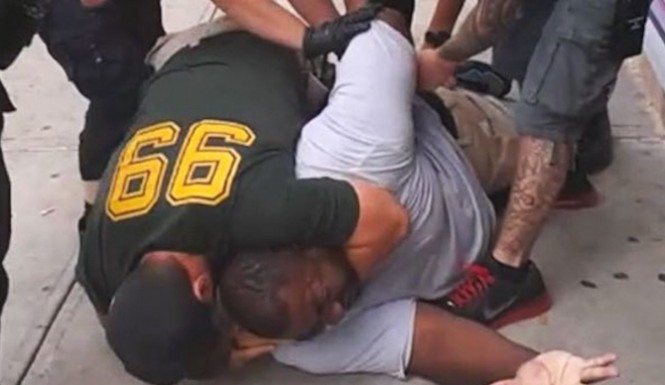
While it may be a challenging truth for some, as I wrote here, the lives of Rafael Ramos and Wenjian Liu are no more valuable or sacred than the lives of Eric Garner, Tamir Rice, Michael Brown, John Crawford, or any other human being. Human rights are universal. The lives of police are no more valuable or special than those of any other citizen. Failing to embrace this fact leads to a type of creeping fascism or authoritarianism by legitimizing police thuggery and abuse of the public.
While the public rituals that accompany the loss of a police officer are by definition designed to hide and obfuscate complex realities through the use of powerful symbols and rhetoric, the basic truth remains that police as a social institution and group are not victims. Rather, in the United States the police are a protected class of people. They are the day-to-day face of the State—and its power to visit violence upon the American people. Police are enforcers of the law; in many ways they are positioned above and outside it.
The examples of this Orwellian abuse of power are many.

The Supreme Court recently ruled in Hein v. North Carolina that even when a police officer stops a person without proper cause such an act is not a violation of the Constitution’s protections against unreasonable search and seizure.
And in those rare instances when police are faced with indictments by the courts for their illegal, hostile and heinous acts against the American people they are rarely, if ever, indicted.
Police departments also do not report the actual numbers of people they kill in the United States each year. Victims of police violence are “disappeared” by a bureaucratic trick where “justified” killings by police officers are thrown down the memory hole.
The criminal justice system monitors itself. There can be no true accountability. This is not an accident or aberration of the system. No, it is the carceral and punishing State working exactly as designed and intended by American elites.
The United States was founded as a white (and male) supremacist society. Centuries later, the country remains organized around the maintenance and protection of white privilege. These hierarchies of race deem that the ability and power of the police to violate the basic human and Constitutional rights of a given person of color in the United States are outsized and exaggerated.
Here, police abuse against non-whites (and the poor, more generally) within the context of a racist criminal justice system (what Michelle Alexander has called the New Jim Crow) is the norm, a quotidian reality that hides behind cold statistics that detail how black teens are 21 times more likely to be killed by the police than their white peers, or how a black person’s life is taken at least once every 28 hours by a law enforcement officer.
The panoply of ways black and brown people have been killed by the police, and the explanations offered for their deaths, could form the basis of an absurdist or dark satire. Black people have been killed by cops for sleeping in cars, because wallets, key chains and cell phones look like guns when held by African Americans; for holding toys, committing the Jim Crow-era crime of “bumptious walking,” playing in the park, dressing up like a favorite anime character, or selling loose cigarettes outside a corner bodega.
Except for pathological white racists, and those other white folks who share such sentiments and feelings even while they mask their bigotry with the claim that they don’t “see” race, there is no humor to be found in this necropolis of black people, many of them unarmed, who have been killed by the police in this bloody 2014 or in the decades and centuries that preceded it.
Because the police are a protected class, an artifice of myths has been erected around them, myths that take the form of unstated assumptions that are circulated throughout American culture and are rarely questioned or critically interrogated. This cultural and rhetorical shield takes many forms; it is a narrative and type of conventional wisdom that Americans learn in childhood, is recited by politicians and religious leaders, and endlessly reinforced by the mass media.
Police violence is justified and explained away by the following tropes.
Police work is a dangerous job. While being a police officer may involve some level of risk, it is largely mitigated by training and equipment. On the macro level, in the United Statespolice work is not included in the top 10 most dangerous professions. Sanitation workers, truck drivers, forestry workers, and professional fisherman are far more likely to be killed or injured on the job than police.
While the mass media and police unions are invested in projecting an image of police work as highly dangerous, thrilling, and adrenaline-filled, the number-one cause of death for police officers are vehicular accidents.
Police have a difficult job that involves making split-second decisions. As research on implicit bias, racism and police use of force has demonstrated, cops are much more likely to make “split-second decisions” to kill black men. Yet, somehow the perils and fears that loom over police and their decision-making processes are suspended and lessened when they interact with white people.
Cliven Bundy and his armed group of marauders did not face a “split-second” decision by the police to shoot them. White men walking around neighborhoods with guns displayed in plain sight are not preemptively killed by the police. White men who have actually shot at firefighters and police are somehow miraculously taken into custody unharmed and alive. White teenagers who bring arsenals of guns and knives to their high schools are arrested and given bail.
Police selectively make split-second decisions about who to shoot and kill in America. Blackness is a trigger for violence; whiteness and white skin privilege are signals to deescalate.
Police are heroes. Heroism involves a selfless act by a person who is not trained for such duty, or who cannot be reasonably expected to act in such a manner. Police have chosen their profession. They are trained and equipped for the task. Police officers are also well compensated both on the job and in retirement. They also benefit and receive support from a huge and powerful social apparatus that is designed to protect them from the consequences of their actions.
A given police officer may have a moment of bravery or courage. By themselves, neither of those deeds rises to the level of heroism.
The police who killed Eric Garner, Tamir Rice, Michael Brown, and who participate in a system that harasses and targets people of color for unjust punishment and harassment are most certainly not heroes in the best and most authentic sense of the word.
Instead of holding police (and others who are empowered by the state to kill) to a higher standard, America’s civil religion deifies police and simultaneously lowers their bar of accountability to one far below that of the average person—in all, what is a perverse paradox.
The blind worship of the police exists in the same flat and empty right-wing political imagination as litmus tests for patriotism that consist of questioning if a given politician wears an American flag pen on his lapel.
Such rituals socialize the American people into the twin habits of banal and unreflective thinking which legitimizes a narrowing of the public discourse. Basic questions about justice are made verboten; they are not to be mentioned or discussed in polite company.
Rafael Ramos and Wenjian Liu are dead. Eric Garner, and many other unarmed black and brown people are also dead—killed by the police under highly questionable circumstances. Demands that police treat all Americans with respect, and in accordance with their human rights, is not a zero sum game.
Police lives matter because they are human beings. The lives of the victims of police brutality and violence matter because they too are human beings. This simple calculus makes for a safer and more just society for all people.

devega2WHO IS CHAUNCEY DEVEGA?

I am the editor and founder of We Are Respectable Negroes, as well as the host of the podcast known as “The Chauncey DeVega Show”.

I am also a race man in progress, Black pragmatist, ghetto nerd, cultural critic and essayist. I have been a guest on the BBC, Ring of Fire Radio, Ed Schultz, Make it Plain, Joshua Holland’s Alternet Radio Hour, the Thom Hartmann radio show, the Burt Cohen show, and Our Common Ground.  My writing has been featured by Salon, Alternet, The New York Daily News, and the Daily Kos.  My work has also been referenced by MSNBC, as well as online magazines and publications such as The Atlantic, Slate, The Week, The New Republic, Buzzfeed, The Daily Beast, The Washington Times, The Nation, and The Chronicle of Higher Education.

Judge me by my enemies. Fox News, Rush Limbaugh, Sean Hannity, Juan Williams, Herman Cain, Alex Jones, World Net Daily, Twitchy, the Free Republic, NewsBusters, the Media Research Council, Project 21, and Weasel Zippers have made it known that they do not like me very much

Activist Ruby Sales on Liberation and God’s Will

03-09 RubySales2


Dear Sisters and Brothers,

I want to respond to a question that was posed: where we go from here when far too many Black people are in the theological and Christological grip of white right wing Christians. Chip Berlet, author and political, analyst calls this group the theocrats. He tells us, “Theocrats support a form of government where the actions of leaders are seen as sanctioned by God-where the leaders claim that they are carrying out God’s will.” This is a very dangerous claim that gives divine meaning and sanction to their actions no matter how racist, sexist, militaristic or homophobic. Moreover, this brand of Christofacism is designed to shut down critique by creating one legitimate Christian voice. Without a doubt for theocrats, the legitimate Christian voice is white, and more than likely a heterosexual male.

Berlet goes on to tell us that theocrats promote a brand of Christianity that proclaims, “People are basically sinful and must be restrained by harsh punitive laws. Social problems are caused by satanic conspiracies aided and abetted by liberals, homosexuals, feminists and secular humanists. These forces must be exposed and neutralized. “They see themselves in a holy war against the forces of evil and conspirators who are determined to destroy the divine destiny of the white American Empire. However, they do not see all white men as standard bearers for the Empire. Nor do they mean people of color when they use the term American Empire.
As we move forward in this reflection, it is critical that we make a distinction between Empire Christianity and Liberation Christianity. Empire Christianity beats in the veins and hearts of theocrats and their Reconstructionist allies. It is essential to realize that conservatism stands in direct opposition to the mission of Jesus which is a radical call to “turn the society upside down” and create a just society.

Liberation Christianity begins with the assertion that God is on the side of the oppressed rather than the side of the Empire. This is the good news of the radical Jew Jesus who challenged the Roman Empire. Jesus made clear the radical nature of his mission: (1) to bring sight to the blind, i.e. to bring a new consciousness that freed his community and others from the false consciousness of identifying with the goals of the Roman Empire; (2) to feed the hungry, i.e. a systemic redistribution of resources that is not charity, but systemic economic justice; and (3) to set the prisoners free, i.e., a recognition that the Empire uses law and order as tools of oppression and domination.

This message of liberation galvanized the Southern Freedom Movement in the United States, South African liberation movement, and liberation movements around the world. It is a dynamic message that changes the status quo and rearranges our relationship with God and others. It is a justice message of non violence. It is a message that reminds us that we are not entrapped by history. We have the collective power to free ourselves from the bonds of a tyrannical state. It reminds us that we have the power to make a new history and a new world. The view of our collective power challenges the notion that history begins and ends with the Empire.
For the Tea Party members and their allies God is the keeper of the status quo. Theirs is a cynical status quo view of God that allows them to be “on the wrong side of history and issues” without taking moral responsibility for their actions. Their God talk also obscures the nature of their radical wrongs by hiding behind liberation and freedom sounding language that they stole from the Southern Freedom Movement and other popular struggles for justice.

The Empire religion espoused by the Tea Party and their white Christian conservative allies and their misled colored allies is headed by a white supremacist patriarchal upper class God who stood on the side of enslavement and the genocide of native peoples throughout the globe, including North and South America. Their God issued a direct order to destroy the Iraqi people and their culture. In their eyes, Iraq is a pagan Babylonian culture that worships a false God. They root their religion in an over and against paradigm that tears down the world and relationships, gobble up resources and relationship. Although they claim to stand for law and order, they operate from a theology of chaos where God summons them that to tears down the world rather than build it up.
Like their forefathers, right wing and conservative militaristic, white supremacist, and homophobic Christians believe that God is on their side and gives them the theological authority to build an oppressive white supremacist patriarchal world. They misuse scripture to justify this, and they hide their intentions behind self-centered and pious God talk that under girds and propels exclusion and domination whether it is about the inferiority of women, black people or lesbians and gays.

Nor is their Jesus the Jesus who wept over the oppression and suffering of his people. Nor is there Jesus the Jesus who came from a colonized community where the Roman Empire used violent measures to stifle unrest and resistance. Or the Jesus who was executed by the Roman Empire for proclaiming that God and not the Empire owns the world or the people in it. This Jesus who acted in history for those people whom the Empire minimized moved generations of enslaved Black people to assert, in the face of an Empire that said they were property without any civil or spiritual rights, “I have a right to the tree of life.”
What Black Christian conservatives must understand is that the God of the Empire can never be our God. Nor can their Jesus be our Jesus. Nor can their Empire Theology or Christology be ours. The Empire Jesus is their emissary and the messenger of war and oppression. For them, Jesus is not as the Black old folk understood, a poor little shepherd boy, outcast and belonging to a people whose backs were “up against the wall.”
The next step is to unveil the lies of White Christian Conservatives so that Black folk understand that these lesbian and gay hating folk come out the same tradition of the people who broke and battered Emmett Till’s fourteen-year-old body and threw it into the Tallahatchie River. Their teachings birthed and fermented the hatred that poisoned the minds and spirits of the killers of Samuel Younge and Jonathan Daniels. Their God can never be our God. Nor can their theology or Christology be ours. They are inheritors of a Biblical tradition that believed that Black oppression was ordained by God because of a curse where God proclaims, “Canaan shall be the lowest of slaves to his brothers.”

We must unveil their hypocrisy and slight of theological hands by remembering that these right wing conservatives barred Martin Luther King, Jr. and other southern freedom workers from the doors of white churches even as they proclaimed their connection with God. They stand today in the doorways of Christian academies and universities like Bob Jones University. In these spaces Christian conservatives still see Blacks as inferior and the bearers of a theological taint that places us on the lowest rung of humanity.

Our job is to have these conversations that help Black Christian conservatives remember so that we as a community do not fall prey to demagoguery. For those of us who remember, we are called upon to stir within Black Christian conservatives the reminder we serve a God that brought us out of the tyranny of enslavement and southern apartheid. This same God enabled Black southern sharecroppers and their allies during the Southern Freedom Movement to bring down southern apartheid, one of the most powerful governments in history, without firing a shot.
There is a great spiritual and social danger of not remembering this God and what God has been with us and for us. When we forget we allow other people to reconstruct God in their own image and to make us believe that their God of hate and injustice is our God. When we bow down to their God, we bow down at the altar of the Empire and men who believe that they are God and the overseers of creation.
Finally, it is important to remember that our ancestors, these magnificent and ordinary people had a vision of God that broke with the enslavers’ view of God. Their view of God moved them to a theology of agape that enabled them to say in the midst of enslavement: “I love everybody, I love everybody, and you can’t make me hate you in my heart; you can’t make me hate you in my heart.”

© All rights reserved. The SpiritHouseProject

Follow Ruby Sales on Facebook

Visit the SpiritHouse Project Website

Paris, #BlackLivesMatter, the Cultural Violence, and the White Western State

Paris, #BlackLivesMatter, the Cultural Violence, and the White Western State

January 8, 2015

By

By: Malik Nashad Sharpe

Today, I mourn with French society, especially the families who have lost their loved ones to violence during yesterday’s attack at Charlie Hebdo. I also stand in solidarity with all of the Brown people in France, who, because of media fear-mongering, and Islamist-blame-gaming, will be further excluded from French society by State-condoned racism.

I’m not French, but one doesn’t need to be in order to see how deeply racism runs throughout French, and Western, societies. The ruthless murders of cartoonists– cultural producers who were questionably using their art to dispel (or perpetuate?) racism to an already discriminatory public in the name of free speech–and the counter-attacks against everyday Muslims, who would prefer this incident not be blamed on their entire, diverse, multi-faceted community, provides us with another opportunity to think through solutions to violence issued on behalf of the State and those retaliating to such violence in the form of extremism.

paris1France, like every Western country, ruthlessly excludes Brown/Black people by using discourses of exceptionalism to dispel claims of State-perpetuated racism in order to protect racist hatred under the guise of free speech. Take a look at the Parisian suburbs, Clichy-sous-Bois and Seine-Saint-Denis. Look back at France’s imperialist occupation of Algeria, or the French parliament, and one can easily tease out how obviously anti-Black/Brown French culture has been and become.

But France is not alone, anti-blackness runs deep throughout the West, most particularly among White people who have enslaved Brown/Blacks, have deprived us, murdered us, appropriated our cultures and claimed them as their own, lynched us, isolated us, and tortured us, in the name of the State.

charllieI do not condone the killings of any sentient being, and, yet, the same people trending the popular, #JeSuisCharlie hashtag are the same people trending #KillAllMuslims. The same people who are throwing grenades at French mosques in counter-attacks are the same people who believed Charlie Hebdo wasn’t racist, but satirical. In fact, what we really need to question is why satirizing non-White cultures is seen as harmless, especially when Black and Brown people of these particular cultures have been murdered time-and-time again in the name of the State because of the maintenance of anti-Black, White racial supremacist ideologies.

However, what troubles me the most is the fact that the same activists who have been protesting police violence against people of color, especially here in the United States, are the same people who are shamelessly posting sympathies with Charlie Hebdo.

garnerLet me be frank. Islamophobia runs deeply within Western culture. The same activists who are screaming Eric Garner’s last words “I can’t breathe” throughout all of the world’s metropoles should be the same people taking a stand against the rampant Islamophobic now proliferating via media. State-sanctioned cultural violence against Brown Muslims in France, is connected to the State-sanctioned violence exacted upon Black bodies in the United States.

Let us not forget that when Michael Brown was murdered in the streets of St Louis, when Tamir Rice was murdered in front of a park in Cleveland, when Aiyana Jones was murdered while asleep in her bed in Detroit, that across the ocean, Bouna Traoré and Zyed Benna were murdered after being chased by Parisian police into an electrical substation where they were ultimately electrocuted to death.

Let us not forget that Western culture does not believe that the murders of Black/Brown people are worthy enough to be considered national tragedies.

Let us not forget that Charlie Hebdo cartooned racist caricatures of deprived Brown cultures in the name of free speech.

Let us not forget that no one became Christianphobic when White KKK members and other White racial supremacists burned crosses and murdered Black people throughout the United States in the name of Christianity.

Let us not forget the cowardice of Western media as they’ve attempted to focus on Black on Black crime or the recent, tragic, murders of NYPD officers by one Black man as a way of reminding Black and Brown people that we are capable of killing, too.

Media outlets are guilty of igniting the already fiery racial hatred that has been ablaze and guilty of forgetting to fully narrate the ways racial supremacy harms all of us. White people can bomb NAACP offices in Colorado or Mosques in France, and the United Kingdom, and not even get close to the same coverage as did the stories of the two police officers murdered in Brooklyn or that of the cartoonists murdered in Paris.

Let us not forget the pregnant Muslim woman who was attacked for wearing a Niqab in the Parisian suburb of Argenteuil. She not only suffered from anti-Islamic taunts by her attackers, but also had her veil ripped, hair cut off, and most depressingly of all, her soon-to-be born baby murdered via miscarriage.

Let us not forget the White couple who caricatured Eric Garner’s death on ABC Live but did not receive any backlash from Western media.

Let us not forget the Turkish Muslims in Germany fearing for their lives, as Neo-Nazi’s paraded through the streets of German cities, while being excluded from the folds of German society.

Let us not forget that Islamophobia is not just about religion, but more particularly about race, and that even though Charlie Hebdo caricatured France’s White right-wing sensibilities, White people are the only one’s who benefit from racism.

Let us not forget that racism kills, too.

_______________________

MalikMalik Nashad Sharpe is a queer experimental choreography, poet, writer, and radical thinker from New York, who  is now based in Chicagoland. His choreographic works have been showcased in London, Tokyo, and in Williamstown, MA, and his poetry has been published with New Bourgeois. He graduated from Williams College with a BA in Experimental Dance and Live Art, and also studied radical performance theory, choreography, and contemporary dance at the Trinity Laban Conservatoire for Music and Dance in London, UK. His artistic work can defined specifically as a form of politics, using the organization of time, space, bodies, and words to formulate radical commentary and resistance.


FOLLOW THE FEMINIST WIRE

SUBSCRIBE TO TFW VIA EMAIL

#SupportKelliMurray: Stop the Bullying of the Baltimore Co. FOP Lodge | LBS Baltimore

#SupportKelliMurray: Stop the Bullying of the Baltimore Co. FOP Lodge | LBS Baltimore.

Kelli Murray is currently an employee of the Baltimore County Government who works as a dispatcher. She is a wife and mother.  After the non-indictment of Daniel Pantaleo in New York City (the officer who killed Eric Garner), she posted a Facebook status that expressed her fear of her children interacting with law enforcement.  This is a fear that has been expressed by many people in light of the increased coverage of issues of police brutality.  She went out of her way to express that she appreciates the job that good police officers do, but that in light of the current events her fears persist.  This was the text of her actual post:


“UPDATE: 12/29: Since this article has been published, Kelli has been continued to be bullied online and in the media. She will likely have to move and find new employment. Kelli is a wife and mother of six who needs support. Please click here to donate to her family and support them during this time.  Kelli has also released a video public statement about her comments (at the bottom of this article).

Unfortunately most people who are talking about racism in the mainstream political discourse are not sufficiently literate in the dynamics of racism to properly apply it to the events that have dominated the mainstream news media.  Racism is about the power that white dominated and controlled institutions have over the livelihood of Black people and other people of color.  In the context of police brutality what we are seeing is racism as it exist in our society.

Racism does not exist in a form that requires ill intent of a white person against Black people.  We are not seeing evil white people conspiring to kill young Black people.  What we are seeing is police officers operationalizing their feelings of Black criminality and worthlessness that our society has been saturated with.  They are acting on impulses that all of us are socialized to have.  Black criminality and worthlessness are notions that have been with us since America’s inception.  From the 3/5’s compromise, to the system of Jim Crow, American civil society has been structured on popular narratives that justify our dehumanization.  It’s latest iteration has been embodied in the war on drugs that has decimated Black communities.”


“

“Instead of society admitting that there is a deep seeded problem of racism in our country beyond the rudimentary discourse of unfair treatment, our conversation about police brutality has been muddled.  Admitting that law enforcement (like all of the major institutions of society) is an institutions that perpetuates institutional racism doesn’t mean that you are anti-cop.  All it means is that you acknowledge that the criminalization of Black people has caused law enforcement officials to engage in behaviors that dehumanized Black people.  And if you are serious about effectively serving the people that you are designated to protect then you would take the time to take seriously the ways that internalized racism effects how you interact with Black people.”

KineticsLive.com | When and Where I Grieve‏

When and Where I Grieve

By Yolanda Pierce, Ph.D.,

The tears started while I was sitting in a Barnes and Noble bookstore and they refused to stop. I gathered my laptop and purse, hurried back to the car, and sat quietly – expecting the flow to cease. But it would not. Tears were in my eyes on the way back home and tears stayed with me throughout the day. I wept while folding the laundry and while trying to decide what to cook for dinner. There is a moment when you grieve that you can no longer make tears – instead, your silent cries are felt in the pit of your stomach or in the wordless moans that escape your mouth.

It is difficult to put into words what triggered this particular moment of grief. All I can explain is that the weight of being black in a world that hates black existence came rushing forward and I could no longer contain my anger, rage, or grief in a series of polite conversations and academic panels. I could no longer form the right words to describe how it feels to wake up in a world where a police officer can brutally assault and rape black women, violate the terms of his bail, and yet again be released from jail a second time since the courts have determined that he poses “no significant threat” while he awaits trial. I no longer had the means for polite discourse when trying to describe how police leaving the dead body of a murdered teen uncovered on the street for over four hours paralleled the worse of the American tradition for lynching. I did not have the right language to express my horror at the multiple deaths of black women whose only “crime” had been to say no to sexual advances. I had no language in response to the horrors of racism and misogyny that greeted me each morning.

Our culture privileges words and texts. If you want to be taken seriously and considered intelligent and rational, you are asked to respond to horrific events with sustained textual or oral analysis. I had been doing my best…writing, when I was asked to write, and speaking and preaching, when asked to do so. I’ve lectured and written on the historical, theological, racial, and societal implications of several recent events. But while sitting in Barnes and Nobles, my words failed because my words were no longer adequate. Living with terror requires more than just words. Dealing with the realities of the terrorized black body in America requires my entire soul…and my soul wept. The horrors had simply surpassed the ability of my pen to write and so my tears took up where my pen left off.

On that particular morning, my tears were triggered by a rendition of “There is Room at the Cross,” playing on my headphones. I thought about all the various meanings of the cross for Christians: a place of atonement and redemption; a place of suffering and shame; a place of lynching and execution; even a place of promise and resurrection. But on that particular morning, the cross represented a place where I was encouraged to grieve. Whatever the cross means in a person’s own theology, we know that the family of Jesus and his disciples grieved the death of one whom they loved. We know that tears were shed at the death of a beloved child, a cherished teacher, a dear friend, and a valued leader whose entire existence confounded Roman authority. The cross is a place where there is always more room for the grieving.

The foot of the cross is a place where I can grieve for all the deaths and for all the people that are “ungrievable.” And so I grieve for the women whose claims of rape aren’t taken seriously because they are sex workers. I grieve for those whose only crime is walking while black or driving while black. I grieve for the mothers and fathers burying their children much too soon. I grieve for women who stay home rather than face street harassment. I grieve for those triggered by the sight of blue lights in their rearview windows. I grieve for parents who have to teach racial life lessons while their children are still toddlers. I grieve for black women whose murdered bodies barely rate a mention during the evening’s news. And I grieve for those who do not have a community to support them while they grieve.

At the foot of the cross, or at the site of any of these lynchings, state executions, murders, or injustices, there must be a place to allow the tears to flow and the moans to escape. There must be a place – beyond words or sermons or essays – which allows the body to grieve. Before we can heal the land, repair the breach, or right the wrongs, our souls are crying for a moment to mourn. The grief is both personal and collective as we grieve for our own losses and for the losses of others.  But when and where I grieve, my heart, body, and soul insist that this space, this moment, and this loss must be acknowledged. I grieve because it matters. I grieve because even when my voice is silenced, my tears will tell their own story.

Dr. Yolanda Pierce is the Elmer G. Homrighausen Associate Professor of African American Religion and Literature at Princeton Theological Seminary, and Liaison with the Princeton University Center for African American Studies. She blogs @ Reflections of an Afro-Christian Scholar 


KineticsLive.com | When and Where I Grieve‏.

FELLOW AMERICANS, DON’T LET OUR IGNORANCE DESTROY US  Φ The Wattree Chronicle

Marissa Alexander Facing 60 Years in Prison for Firing a Warning Shot in Self Defense | The Nation

Marissa Alexander Now Faces 60 Years in Prison for Firing a Warning Shot in Self Defense | The Nation.

Florida State Attorney Angela Corey will seek to triple Marissa Alexander’s original prison sentence from twenty to sixty years, effectively a life sentence for the 33-year-old woman, when her case is retried this July, The Florida Times-Union reports.

Alexander was convicted on three charges of aggravated assault in 2012 for firing warning shots in the direction of Rico Gray, her estranged husband, and his two children. No one was hurt. Alexander’s attorneys argued that she had the right to self-defense after Gray physically assaulted and threatned to kill her the day of the shooting. In a deposition, Gray confessed to a history of abusing women, including Alexander.

In September of 2013 a District Appeals court threw out the conviction on grounds that Circuit Judge James Daniel erroneously placed the burden on Alexander to prove she acted in self-defense, when she only had to meet a “reasonable doubt concerning self-defense.”

Judge Daniel originally slapped Alexander with three twenty-year prison sentences, but ordered that they be served concurrently. If Alexander is convicted a second time in July, State Attorney Angela Corey will seek consecutive sentences, adding up to sixty years in prison.

Florida’s 10-20-Life law imposes a mandatory minimum of twenty years in prison for anyone who fires a gun while committing a felony. Angela Corey’s prosecution team says it is following a court ruling that multiple convictions for related charges under 10-20-Life should carry consecutive sentences.

The advocacy group Free Marissa Now released a statement calling Corey’s move a “stunning abuse of power.” Members of the group say Corey is pressing for a longer sentence to thwart attention from accusations of prosecutorial misconduct, as well as recent failures in high-profile trials. Corey failed to secure murder convictions for George Zimmerman and Michael Dunn, two men who fatally shot black teenagers.

“Remember that when Marissa Alexander fired her warning shot to save her own life, she caused no injuries. Now she’s facing the very real possibility of spending the rest of her life in prison for that act of self-defense,” said advocate Sumayya Fire in the statement. “That should send a chill down the back of every person in this country who believes that women who are attacked have the right to defend themselves.”

From Prostitute to Professor: The 7 Lessons of Maya Angelou’s Messy Life φ Yolanda Young

From Prostitute to Professor: The 7 Lessons of Maya Angelou’s Messy Life

Yolanda Young

Yolanda Young Become a fan

Yolanda Young is the author of On Our Way To Beautiful founder of http://www.onbeingablacklawyer.com.

Posted: 06/12/2014
MAYA ANGELOU

The death of Dr. Maya Angelou provided us the opportunity to once again delight in her memoirs, which chronicle the eclectic, bohemian first half of her life. Yet, we know from her writings that such praise was often withheld as she pursued her dreams of being a dancer and poet while raising a young child as a single mother. How many times must she have been urged to settle down and give up her artistic and cultural pursuits, which time and time again left her broke and broken? While we now refer to Angelou as a renaissance woman, until she published I Know Why The Caged Bird Sings in her 40s, her life resembled what is referred to in ghetto parlance as a hot mess.

This messiness is what we all fear. It is why rather than pursue our dreams, we settle into the lives expected of us. Cubicles and cul-de-sacs become the things of our imagination. Only happiness and satisfaction studies suggest they are not enough. A GALLUP Poll last year found that only 30 percent of U.S. workers are passionate about their work. The majority (52 percent) are unhappy with their jobs and put little energy into their work while another 18 percent actually hate their jobs and actively work to undermine coworkers. We sacrifice our dreams only to find ourselves restless, bored and frustrated in midlife having realized what Angelou told us all along; “making a living is not the same thing as making a life.” Worse still, we recognize the irony in discovering after layoffs, financial setbacks and divorce that the “mess” is unavoidable.

These unmet expectations and realization that youthful aspirations have been abandoned are suspected as the cause of feelings of discouragement and depression among those in midlife. The British think tank NatCen Social Research found that studies show that people between 35 and 55 suffer a dip in well-being. A separate study that analyzed data from “nationally representative” surveys in Australia, Britain and Germany found that the bell curve in well-being dips to its lowest point around the ages of 40 to 42.

Even those who choose to pursue unconventional dreams don’t escape these feelings, especially if such pursuits have come at the expense of nearly everything else. I abandoned life as a lawyer in favor of one as a writer, activist and entrepreneur. Now having entered midlife without any of our culture’s success markers — husband, children, two-car garage — I have had to answer, both to myself and to others, the question of whether the path I’ve chosen was a wise one. Reflecting on Angelou’s has helped me find the answers.

1. Be uniquely you.

Angelou described herself in I Know Why the Caged Bird Sings as “a too-big Negro girl, with nappy black hair, broad feet and a space between her teeth that would hold a number-two pencil.” She knew such a girl would’ve perished trying to conform to mainstream conventions. “If you’re always trying to be normal, you will never know how amazing you can be.” Instead of fretting over not being a swan, Angelou reinvented herself as a rare bird. As many biographers have noted, she won’t be remembered for her poems or plays, but for her memoirs and for being Maya Angelou. The key to discerning one’s authenticity is quite simple: “Listen to yourself and in that quietude you might hear the voice of God.”

2. When it comes to failure, be courageous.

Angelou was a marvelous failure. Her most noteworthy stage performance, playing the seamstress in the two-woman play Mary Todd Lincoln, earned her a Tony nomination but closed on opening night. The rolling stone never stuck to one thing for long. She moved from coast to coast, continent to continent, sometimes making poor childcare decisions, one of which resulted in her son’s brief abduction. She didn’t have a stable home or steady job until she was in her 50s, an age at which many are preparing for retirement. She divorced several times but would would never confirm the exact number, “for fear of sounding frivolous.” Aware of all her failings, Angelou was brave enough to look at herself. “We have to confront ourselves. Do we like what we see in the mirror? And, according to our light, according to our understanding, according to our courage, we will have to say yea or nay — and rise!”

3. Know who your friends are.

One would be hard-pressed to identify a significant black figure Angelou didn’t know. She danced with Amiri Baraka. Billie Holiday visited her home and explained the meaning of Strange Fruit to her young son. While a calypso dancer she worked with Alvin Ailey. James Baldwin gave her the introductions that would lead to the publication of her first memoir. These were people she deeply cared for, but in anEssence interview, she had this to say of friendship.

There’s a marked difference between acquaintances and friends. Most people really don’t become friends. They become deep and serious acquaintances. But in a friendship you get to know the spirit of another person, and your values coincide. Friends may disagree, but not about serious matters. A friend will stand for you when you are no longer able… Years ago one of the slick White women’s magazines asked if they could photograph me with my closest friends for an issue they were doing on friends. The editor wanted me to bring Oprah. I have 30 years on Oprah. She calls me her friend, her mother, all that. I am very close to her in a motherly way. So I told [the magazine], ‘I have three dear friends — Dolly McPherson, Jessica ‘Decca’ Mitford and M.J. Hewitt — they are sisters to me.’

4. Believe you can do anything.

For Angelou, inexperience was never a reason not to take on an interesting job. Angelou’s only criterion was seemingly that a new occupation share little to no similarities with her previous one. At sixteen, she became San Francisco’s first African-American streetcar conductor and later passed herself off as an experienced Creole chef. She held jobs dancing in a nightclub, stripping paint from old cars, and singing Calypso. She knew nothing about being a journalist when she accepted a position as an editor for The Arab Observer,” an English-language magazine. She said of the experience,

I stayed at the Arab Observer for over a year and gradually my ignorance receded. I learned from Abdul Hassan how to write an opinionated article with such subtlety that the reader would think the opinion his own…I received a raise from Dr. Nagati, the respect of my fellow workers and a few compliments from strangers…

She made her television debut as Kunte Kinte’s grandmother in the acclaimed television adaptation of Alex Haley’s Roots. And in the one-time high school dropout who never attended college became the Reynolds professor of American studies at Wake Forest University in North Carolina.

5. Forgive others and yourself.

In addition to enduring the injustices that came along with being poor, black and female in the South, Angelou was also raped as a child and beaten as a young woman. In a May 9th interview at her home she told Armstrong Williams, “I’ve learned that forgiving is one of the greatest gifts that I can give myself…And as soon as I do I feel lighter, brighter and better.”

In Gather Together in My Name, Angelou shares one of her lowest periods when she served as a pimp for two lesbian prostitutes and sometimes worked as a prostitute herself. In one interview, she said of the experience.

If you happen to fall into that sort of experience, what you have to do is forgive yourself. If you’re in the very gutter, see where you are and admit it. As soon as you admit it, you can be like the prodigal son, the prodigal daughter. Get up and go home — wherever home is. Get up and go to a safe place, someplace where your spirit is not kicked and brutalized and your body not misused and abused. Get up. But you can’t get up unless you see where you are and admit it.

6. Persevere.

In A Song Flung Up to Heaven, Angelou tells of her midlife crisis which was accompanied by great sorrow. Returning to the States after the end of a romance in Africa, Angelou became a Civil Rights activist only to be witness to the Movement’s greatest tragedies. She was working with Malcolm X to establish his foundation when he was assassinated New York City. Three years later she was working as the northern coordinator for Dr. Martin Luther King Jr. when he was gunned down in Memphis on Angelou’s 40th birthday. For a time, Angelou withdrew from society unable to deal with the tragedy, but eventually she harnessed her grief and regrets to write her seminal work, I Know Why The Caged Bird Sings. From then on, she would rise at dawn and set out for the motel room where she would write. Her only companions were a Bible, a dictionary, a thesaurus, a stack of legal pads, and a bottle of sherry. Having written her way out of the worst time in her life, she credited it with her survival. “All my work is meant to say, ‘You may encounter many defeats, but you must not be defeated…Nothing will work unless you do.”

7. Change.

Angelou was a master of reinvention. She didn’t settle on a name until after her first marriage, claiming her childhood nickname and a twist on her first husband’s last name. For Angelou, change was essential. Perhaps more so when one decides nothing can be done at all. “If you don’t like something, change it. If you can’t change it, change your attitude.”


Yolanda Young Headshot

Follow @yolandayoungesq

Follow Yolanda Young on Twitter: www.twitter.com/yolandayoungesq