The Coming Collapse [TruthDig]

The Coming Collapse

Chris Hedges, TruthDig
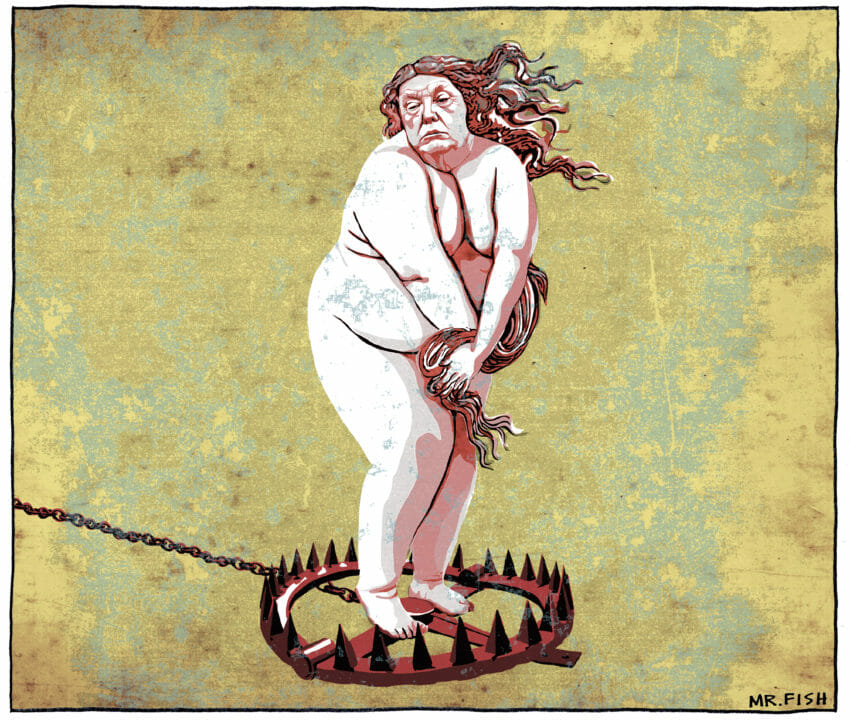
Mr. Fish / Truthdig

“The Trump administration did not rise, prima facie, like Venus on a half shell from the sea. Donald Trump is the result of a long process of political, cultural and social decay. He is a product of our failed democracy. The longer we perpetuate the fiction that we live in a functioning democracy, that Trump and the political mutations around him are somehow an aberrant deviation that can be vanquished in the next election, the more we will hurtle toward tyranny. The problem is not Trump. It is a political system, dominated by corporate power and the mandarins of the two major political parties, in which we don’t count. We will wrest back political control by dismantling the corporate state, and this means massive and sustained civil disobedience, like that demonstrated by teachers around the country this year. If we do not stand up we will enter a new dark age . . .

. . . “The leadership of the party, the Clintons, Nancy Pelosi, Chuck Schumer, Tom Perez, are creations of corporate America. In an open and democratic political process, one not dominated by party elites and corporate money, these people would not hold political power. They know this. They would rather implode the entire system than give up their positions of privilege. And that, I fear, is what will happen. The idea that the Democratic Party is in any way a bulwark against despotism defies the last three decades of its political activity. It is the guarantor of despotism.” . . .

READ MORE


Chris Hedges
Columnist
Chris Hedges is a Pulitzer Prize-winning journalist, New York Times best selling author, former professor at Princeton University, activist and ordained Presbyterian minister. He has written 11 books,…
Mr. Fish
Cartoonist
Mr. Fish, also known as Dwayne Booth, is a cartoonist who primarily creates for Truthdig.com and Harpers.com. Mr. Fish’s work has also appeared nationally in The Los Angeles Times, The Village Voice, Vanity…

What Did Cedric Robinson Mean by Racial Capitalism? [Boston Review]

What Did Cedric Robinson Mean by Racial Capitalism?

RACE

What Did Cedric Robinson Mean by Racial Capitalism?

ROBIN D. G. KELLEY

This essay is the introduction to Boston Review’s print issue, Race Capitalism Justice. Inspired by Cedric Robinson’s work on racial capitalism, this themed issue is a critical handbook for racial justice in the age of Trump.


“Robinson’s critique of political order and the authority of leadership anticipated the political currents in contemporary movements such as Occupy Wall Street and Black Lives Matter—movements organized horizontally rather than vertically. His monumental Black Marxism: The Making of the Black Radical Tradition (1983) takes Karl Marx to task for failing to comprehend radical movements outside of Europe. He rewrites the history of the West from ancient times to the mid-twentieth century, scrutinizing the idea that Marx’s categories of class can be universally applied outside of Europe. Instead he characterized black rebellions as expressions of what he called the “Black Radical Tradition,” movements whose objectives and aspirations confounded Western social analysis. Marxism also failed to account for the racial character of capitalism. Having written much of the book during a sabbatical year in England, Robinson encountered intellectuals who used the phrase “racial capitalism” to refer to South Africa’s economy under apartheid. He developed it from a description of a specific system to a way of understanding the general history of modern capitalism . . .

Robinson was a challenging thinker who understood that the deepest, most profound truths tend to bewilder, breaking with inherited paradigms and “common sense.” When asked to define his political commitments, he replied, “There are some realms in which names, nomination, is premature. My only loyalties are to the morally just world; and my happiest and most stunning opportunity for raising hell with corruption and deceit are with other Black people.”

Robin D. G. Kelley

Robin D. G. Kelley, Gary B. Nash Professor of American History at UCLA, is author of Africa Speaks, America Answers: Modern Jazz in Revolutionary Times and Freedom Dreams: The Black Radical Imagination.

Read More 

Scott Pruitt Wasn’t Corrupt Enough for Trumpistan

If you’re going to act like a local warlord, you’ve got to go big. Petty corruption is harder to excuse than bold piratical plundering.

Source: Scott Pruitt Wasn’t Corrupt Enough for Trumpistan

Trump’s Ever More Powerful Weapons Against Journalism

President Donald Trump greets military families at the White House for the Fourth of July. (Alex Brandon / AP)
Jacob Sugarman

Shortly after five staffers at the Capital Gazette were gunned down in their Annapolis, Md., office, President Donald Trump refused a request from the city’s mayor, Gavin Buckley, to lower American flags on federal property to half-staff. The White House eventually reversed its decision, but the episode underscores the contempt that this administration holds for the press.

Last month, after spending the better part of two years railing against purveyors of “fake news,” the president called the media the “enemy of the American people.” Now the Department of Homeland Security is reportedly compiling a database of journalists, editors, correspondents and bloggers to identify the leading voices in their respective fields.

According to an April 5 report in Bloomberg Government, DHS was searching for a contractor to help it monitor more than 290,000 global news sources in over 100 languages, including Arabic, Chinese and Russian, all of which will be translated to English in real time. These outlets would include newspapers and magazines, television and radio, podcasts and social media.

“The DHS request says the selected vendor will set up an online ‘media influence database’ giving users the ability to browse based on location, beat, and type of influence,” Bloomberg’s Cary O’Reilly reveals. The database would include, “[f]or each influencer found, present contact details and any other information that could be relevant, including publications this influencer writes for, and an overview of the previous coverage published by the media influencer.”

If the project sounds like a First Amendment violation waiting to happen, that’s because it is. While DHS insists that the database will “protect and enhance the resilience of the nation’s physical and cyberinfrastructure,” perhaps against foreign interference in future elections, the potential for censorship and other abuses of power is virtually limitless.“Unfortunately, increasing government encroachment on the freedom of the press is the sinister backdrop to all of this,” writes Forbes’ Michelle Fabio. “Freedom House, which has monitored the status of the press for nearly 40 years, recently concluded that global media freedom has reached its lowest level in the past 13 years.”

The independent watchdog blames “crackdowns on independent media in authoritarian countries like Russia and China,” but it also cites “new threats to journalists and media outlets in major democracies”—Trump chief among them.

If the project sounds like a First Amendment violation waiting to happen, that’s because it is. While DHS insists that the database will “protect and enhance the resilience of the nation’s physical and cyberinfrastructure,” perhaps against foreign interference in future elections, the potential for censorship and other abuses of power is virtually limitless.

“Unfortunately, increasing government encroachment on the freedom of the press is the sinister backdrop to all of this,” writes Forbes’ Michelle Fabio. “Freedom House, which has monitored the status of the press for nearly 40 years, recently concluded that global media freedom has reached its lowest level in the past 13 years.”

The independent watchdog blames “crackdowns on independent media in authoritarian countries like Russia and China,” but it also cites “new threats to journalists and media outlets in major democracies”—Trump chief among them.

“No U.S. president in recent memory has shown greater contempt for the press than Trump in his first months in office,” reads Freedom House’s 2017 report. “He has repeatedly ridiculed reporters. … Such comments suggest a hostility toward the fundamental principles and purposes of press freedom, especially the news media’s role in holding governments to account for their words and actions—as opposed to the government holding the media to account.”

Barack Obama’s eight years in office were marked by an overt hostility toward leakers and whistleblowers; Leonard Downie’s report for the Committee to Protect Journalists in 2013 called the White House’s treatment of the press “the most aggressive I’ve seen since the Nixon administration, when I was one of the editors involved in the Washington Post’s investigation of Watergate.”

The DHS’ latest venture reveals where disdain for journalists can lead, and the extent to which it can be weaponized.

Jacob Sugarman
Jacob Sugarman is a graduate of the Arthur L. Carter Institute of Journalism whose writing has appeared in Salon, AlterNet and Tablet, among other…

MORE


Black homeownership is stuck near 30-year lows

‘We haven’t made any progress’: Black homeownership is stuck near 30-year lows

July 6 at 10:48 AM 


Jani Tillery, 42, is an attorney at the Children’s Law Center in Washington who has been looking for homes since October. She’s made three offers since the end of November but lost to other bidders and she’s having a hard time finding homes in her price range of less than $200,000. (Andre Chung/for The Washington Post)

Jani Tillery thought she would be a homeowner by now.

Her parents bought a house in the Detroit suburbs in the late 1970s while living on a modest income. Her mother was a teacher. Her father worked in the automotive industry. They raised their children in the house and paid off the mortgage. They will probably live there in retirement and possibly pass the house — not only a home with rich sentimental value but also a sizable financial asset — on to their children.

Tillery, 42, hoped this would finally be the year she, too, could buy. She’s a lawyer at a nonprofit in Washington, and she recently got a promotion and raise.

Yet, she says, this part of the American Dream seems out of reach for her, as it is for many other African American workers despite notable strides in other aspects of their finances.

In many ways, African Americans have regained the ground lost during the financial crisis. Many are finding jobs and getting raises.

But the holy grail of homeownership remains elusive. Forty-three percent of blacks owned homes in 2017, according to an annual report from the Joint Center for Housing Studies of Harvard University. In contrast, 72 percent of whites did, a gap that has mostly widened during the past three decades.

“The overall frustration is, I am a working citizen. I pay my taxes. I’m doing a job to help kids,” said Tillery, whose nonprofit helps children with disabilities. “It’s better for me to own a home. I’m 42. I don’t want to continue renting.”

There aren’t many homes in the area that fall into her price range of $200,000 or less. When she sees a listing she can afford, she either loses out to a buyer who will pay more or waive contingencies or learns that the property isn’t approved for Federal Housing Administration mortgages, which she is relying on because they require lower down payments than conventional loans.

READ MORE 

Jonnelle Marte is a reporter covering personal finance. She was previously a writer for MarketWatch and the Wall Street Journal. 

The Financial Elite’s War Against the US Economy

The only feature of this Amerikkan truth that has changed it that the attacks are vicious, vile, open and under the cover of law.

OUR COMMON GROUND's avatarOCG

Published on Monday, December 31, 2012 by Naked Capitalism

The Financial Elite’s War Against the US Economy

Today’s economic warfare is not the kind waged a century ago between labor and its industrial employers. Finance has moved to capture the economy at large, industry and mining, public infrastructure (via privatization) and now even the educational system. (At over $1 trillion, U.S. student loan debt came to exceed credit-card debt in 2012.) The weapon in this financial warfare is no larger military force. The tactic is to load economies (governments, companies and families) with debt, siphon off their income as debt service and then foreclose when debtors lack the means to pay. Indebting government gives creditors a lever to pry away land, public infrastructure and other property in the public domain. Indebting companies enables creditors to seize employee pension savings. And indebting labor means that it no longer…

View original post 1,330 more words

Been Down So Long It Looks Like Debt to Me

Now thirty years old, I have been incapacitated by debt for a decade. The delicate balancing act my family and I perform in order to make a payment each month has become the organizing principle of our lives. To this end, I am just one of about forty-four million borrowers in the United States who owe a total of roughly $1.4 trillion in student loan debt. This number is almost incomprehensibly high, and yet it continues to increase with no sign of stopping. Reform legislation that might help families in financial hardship has failed in Congress. A bill introduced in May 2017, the Discharge Student Loans in Bankruptcy Act, which would undo changes made to the bankruptcy code in the early 2000s, stalled in committee. Despite all evidence that student loan debt is a national crisis, the majority of the U.S. government—the only party with the power to resolve the problem—refuses to acknowledge its severity.

Been Down So Long It Looks Like Debt to Me

An American family’s struggle for student loan redemption

M.H. Miller No. 40

ON HALLOWEEN IN 2008, about six weeks after Lehman Brothers collapsed, my mother called me from Michigan to tell me that my father had lost his job in the sales department of Visteon, an auto parts supplier for Ford. Two months later, my mother lost her own job working for the city of Troy, a suburb about half an hour from Detroit. From there our lives seemed to accelerate, the terrible events compounding fast enough to elude immediate understanding. By June, my parents, unable to find any work in the state where they spent their entire lives, moved to New York, where my sister and I were both in school. A month later, the mortgage on my childhood home went into default for lack of payment.

After several months of unemployment, my mother got a job in New York City fundraising for a children’s choir. In the summer of 2010, I completed school at New York University, where I received a B.A. and an M.A. in English literature, with more than $100,000 of debt, for which my father was a cosigner. By this time, my father was still unemployed and my mother had been diagnosed with an aggressive form of breast cancer. She continued working, though her employer was clearly perturbed that she’d have to take off every Friday for chemotherapy. To compensate for the lost time, on Mondays she rode early buses into the city from the Bronx, where, after months of harrowing uncertainty, my parents had settled. She wanted to be in the office first thing.

In January 2011, Chase Bank took full possession of the house in Michigan. Our last ties were severed by an email my father received from the realtor, who had tried and failed to short sell the property, telling him “it’s safe to turn off the utilities.” In May, I got a freelance contract with a newspaper that within a year would hire me full-time—paying me, after taxes, roughly $900 every two weeks. In September 2011, my parents were approved for Chapter 7 Bankruptcy, and in October, due to a paperwork snafu, their car was repossessed in the middle of the night by creditors. Meanwhile, the payments for my debt—which had been borrowed from a variety of federal and private lenders, most prominently Citibank—totaled about $1,100 a month.

Now thirty years old, I have been incapacitated by debt for a decade. The delicate balancing act my family and I perform in order to make a payment each month has become the organizing principle of our lives. To this end, I am just one of about forty-four million borrowers in the United States who owe a total of roughly $1.4 trillion in student loan debt. This number is almost incomprehensibly high, and yet it continues to increase with no sign of stopping. Reform legislation that might help families in financial hardship has failed in Congress. A bill introduced in May 2017, the Discharge Student Loans in Bankruptcy Act, which would undo changes made to the bankruptcy code in the early 2000s, stalled in committee. Despite all evidence that student loan debt is a national crisis, the majority of the U.S. government—the only party with the power to resolve the problem—refuses to acknowledge its severity.

The delicate balancing act my family and I perform in order to make a payment each month has become the organizing principle of our lives.

My debt was the result, in equal measure, of a chain of rotten luck and a system that is an abject failure by design. My parents never lived extravagantly. In the first years of their marriage, my father drove a cab. When they had children and my father started a career in the auto industry, we became firmly middle class, never wanting for anything, even taking vacations once a year to places like Myrtle Beach or Miami. Still, there was usually just enough money to cover the bills—car leases, a mortgage, groceries. My sister and I both attended public school. How much things cost was a constant discussion. Freshman year of high school, when I lost my yearbook, which cost $40, my mother very nearly wept. College, which cost roughly $50,000 a year, was the only time that money did not seem to matter. “We’ll find a way to pay for it,” my parents said repeatedly, and if we couldn’t pay for it immediately, there was always a bank somewhere willing to give us a loan. This was true even after my parents had both lost their jobs amidst a global financial meltdown. Like many well-meaning but misguided baby boomers, neither of my parents received an elite education but they nevertheless believed that an expensive school was not a materialistic waste of money; it was the key to a better life than the one they had. They continued to put faith in this falsehood even after a previously unimaginable financial loss, and so we continued spending money that we didn’t have—money that banks kept giving to us.

I’ve spent a great deal of time in the last decade shifting the blame for my debt. Whose fault was it? My devoted parents, for encouraging me to attend a school they couldn’t afford? The banks, which should have never lent money to people who clearly couldn’t pay it back to begin with, continuously exploiting the hope of families like mine, and quick to exploit us further once that hope disappeared? Or was it my fault for not having the foresight to realize it was a mistake to spend roughly $200,000 on a school where, in order to get my degree, I kept a journal about reading Virginia Woolf? (Sample passage, which assuredly blew my mind at the time: “We are interested in facts because we are interested in myth. We are interested in myth insofar as myth constructs facts.”) The problem, I think, runs deeper than blame. The foundational myth of an entire generation of Americans was the false promise that education was priceless—that its value was above or beyond its cost. College was not a right or a privilege but an inevitability on the way to a meaningful adulthood. What an irony that the decisions I made about college when I was seventeen have derailed such a goal.

Letter to an Unknown Lender

After the dust settled on the collapse of the economy, on my family’s lives, we found ourselves in an impossible situation: we owed more each month than we could collectively pay. And so we wrote letters to Citibank’s mysterious P.O. Box address in Sioux Falls, South Dakota, begging for help, letters that I doubt ever met a human being. We grew to accept Citibank as a detestable Moloch that we feared and hated but were made to worship. The letters began to comprise a diary for my father in particular, a way to communicate a private anguish that he mostly bottled up, as if he was storing it for later. In one letter, addressed “Dear Citi,” he pleaded for a longer-term plan with lower monthly payments. He described how my mother’s mounting medical bills, as well as Chase Bank’s collection on our foreclosed home, had forced the family into bankruptcy, which provided no protection in the case of private student loans. We were not asking, in the end, for relief or forgiveness, but merely to pay them an amount we could still barely afford. “This is an appeal to Citi asking you to work with us on this loan,” he wrote to no one at all.

Finally, at the beginning of 2012, my father started writing to the office of Congressman Joseph Crowley, who represented the district in the Bronx where my parents had relocated. In one of these letters, he described watching Too Big to Fail, an HBO film about the financial crisis, which had come out several months earlier. (My parents lost every asset they had, but they still subscribed to HBO, which became more than TV for them, a symbolic relic of their former class status.) The recession was over, officially anyway, and people who had not suffered its agonies were already profiting from its memory. Recession films often took place in the gleaming offices of hedge funds and investment banks, with attractive celebrities offering sympathetic portrayals of economists and bankers—Zachary Quinto, in 2011’s Margin Call, for instance, plays a rocket scientist-turned-risk analyst with a heart of gold, a do-gooder who discovers that his employer has leveraged itself to the edge of bankruptcy. The stars of these films depicted figures who experienced little to no repercussions for their roles in leading the country into a recession, who abused the misfortune of people like my parents—unmentionables who owed more on their houses than what they had paid for them and, of course, who were rarely visited in any of these films. My father described himself and my mother to Crowley as “the poster children for this entire financial event,” by which he meant Americans who seemed to have done everything right on paper, but in doing so contributed to their own downfall. By the time he wrote to Crowley, my father was working again, but it had taken him two years to find another job for much less money. After his run of financial calamity, he knew better than to believe anything good would last. “We are in our sixties and I figure when we get to our mid-seventies life will become difficult again,” he wrote.

Crowley’s office wrote back. It was the first time in about two years that a person had responded to our correspondence with encouragement, or something like it. Kevin Casey, who worked for Crowley in Washington, helped arrange a conference call with government liaisons from Citigroup to discuss a different payment plan. The current monthly payments to Citi were for more than $800 a month, and we were trying to talk them into letting us pay the loan over a longer period, at a rate of about $400 a month. These terms were reasonable enough, but the response to this request was like an automated message brought to life: “We are precluded from a regulatory perspective from being able to do what you are asking,” each of the representatives said. What made these exchanges more ridiculous was the fact that Citibank was in the process of retreating from the student loan market by selling off my debt to Discover Financial, who would give us the same response. We were nothing to these companies but a number in a database. And they fully controlled our fates.

The Unsweetened Release

M.H. Miller is the arts editor for The New York Times Style Magazine.

READ MORE


The Second Amendment’s Second-Class Citizens

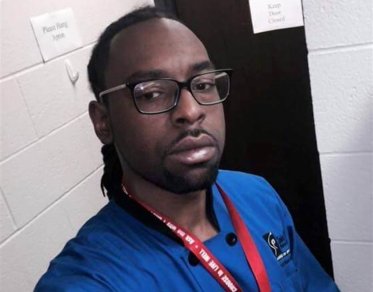
REmembering Philando Castile

July 6, 2016, Philando Castile was murdered by a Falcon Heights cop in the passenger seat of a car, while his girlfriend and her 4 yr old daughter watched. worked in a school cafeteria for over 12 yrs where he served little kids and was beloved among his colleagues.

castille

The Second Amendment’s Second-Class Citizens


https://www.youtube.com/watch?time_continue=4&v=cQo-yYhExw0

On social-media, many are already asking why the Second Amendment did not protect Sterling and Castile, and why gun-rights advocates like the National Rifle Association are not speaking out on their behalf. In each case, there are complicated legal questions, and many of the details remain unclear, but it is true that gun-rights groups like the NRA and its allies have typically pushed for laws that would allow citizens broader freedom to bear arms than currently permitted. It is also the case that the interpretation of the Second Amendment has for decades been deeply intertwined with the ways the law protects—and more often fails to protect—African Americans in comparison with whites, a history that begins in earnest in the 1860s, flares up in the 1960s, and is again relevant today.

The Sterling case is the more complicated one. Sterling was a convicted felon, and thus probably was not legally permitted to have a gun. While Louisiana allows open carry of handguns for anyone legally allowed to possess one, concealed carry requires a permit, for which Sterling would have been ineligible. Sterling had allegedly been displaying the gun, which is the reason why police were called.

The crucial point is that the police couldn’t have known when they arrived on the scene whether Sterling’s gun was completely legal or not. An additional irony is that, according to Muflahi, Sterling had begun carrying the gun because he was concerned about his own safety—that is to say, for the very reasons that gun-rights advocates say citizens should be able to, and many argue should, carry guns.

The Castile case looks more straightforward, based on what’s known now. Assuming Castile’s permit was valid, he was placed in an impossible position by the officer. Unlike Sterling, who seems to have been resisting arrest (a fact that in no way justifies an extrajudicial execution by officers), Castile was attempting to comply with contradictory imperatives: first, the precautionary step of declaring the weapon to the officer; second, the officer’s request for his license and registration; and third, the officer’s command to freeze.*

Some activists contend that white men in the same situations would never have been shot. It’s an impossible counterfactual to prove, although there’s relevant circumstantial evidence, such as the fact that black men are much more likely to be shot by police than any other group. Raw Story rounds up stories of white people who pointed guns at police and were not shot. Castile’s shooting is reminiscent of a 2014 incident in which South Carolina State Trooper Sean Groubert pulled a black driver over in Columbia. Groubert asked the man, Levar Edward Jones, for his license and registration, but when the driver turned to get them, Groubert promptly shot him without warning. Groubert seems to have feared—however irrationally—for his safety when Jones reached into the car, but what was Jones supposed to do? He was complying with the officer’s instructions. (Groubert later pled guilty to assault and battery.)

The two shootings give a strong sense that the Second Amendment does not apply to black Americans in the same way it does to white Americans. Although liberals are loath to think of the right to bear arms as a civil right, it’s spelled out in the Bill of Rights. Like other civil rights, the nation and courts have interpreted it differently over time—as an individual right, and as a collective right. But however it’s been applied, African Americans have historically not enjoyed nearly the same protection as their white fellow citizens.

As Adam Winkler wrote in The Atlantic in 2011, one crucial testing ground for a personal right to bear arms came in the aftermath of the Civil War. Blacks in the South encountered a new landscape, one which they were ostensibly free but vulnerable and beset by white antagonists:

After losing the Civil War, Southern states quickly adopted the Black Codes, laws designed to reestablish white supremacy by dictating what the freedmen could and couldn’t do. One common provision barred blacks from possessing firearms. To enforce the gun ban, white men riding in posses began terrorizing black communities. In January 1866, Harper’s Weekly reported that in Mississippi, such groups had “seized every gun and pistol found in the hands of the (so called) freedmen” in parts of the state. The most infamous of these disarmament posses, of course, was the Ku Klux Klan.

In response, General Dan Sickles, who was in charge of Reconstruction in South Carolina, decreed that blacks could own guns. State officials ignored him, so Congress passed a law stating that ex-slaves possessed “full and equal benefit of all laws and proceedings concerning personal liberty … including the constitutional right to bear arms.” In the words of the Yale constitutional-law scholar Akhil Reed Amar, “Between 1775 and 1866 the poster boy of arms morphed from the Concord minuteman to the Carolina freedman.”

Black Americans again prominently asserted their right to bear arms during the 1960s. In 1964, Malcolm X was famously photographed holding a rifle as he looked out a window. The image was often misinterpreted as a statement of aggression, as though he was preparing a guerrilla assault. In fact, Malcolm was exercising his own right to own a gun for self-defense, concerned that members of the Nation of Islam—which he had recently deserted for Sunni orthodoxy—would try to kill him. (His fear was, of course, vindicated the following year, when Nation members did murder him.)

In 1967, Black Panthers began taking advantage of California laws that permitted open carry, walking the streets of Oakland armed to the teeth, citing threats of violence from white people and particularly white cops. When people were pulled over, Panthers would arrive on the scene—to ensure that justice was done, they argued, or to intimidate the cops, the cops contended. In response, Republican state Assemblyman Don Mulford introduced a bill to ban open carry. The Panthers then decided to go to the state capitol, heavily armed, to exercise their right.

As theater, it was an incredible gesture. As politics, it was a catastrophe. The sight of heavily armed black men brandishing rifles galvanized support for Mulford’s bill, which promptly passed and was signed into law by Governor Ronald Reagan. It set off a spree of gun-control laws that only began to be rolled back years later—leading to the current regime of permissive laws.

“The gun-control laws of the late 1960s, designed to restrict the use of guns by urban black leftist radicals, fueled the rise of the present-day gun-rights movement—one that, in an ironic reversal, is predominantly white, rural, and politically conservative,” Winkler wrote.

Signs of that shift are visible around the nation now. In Texas, gun owners (largely white) staged an open-carry rally on the capitol grounds in Austin in January, an echo of the Panthers’ rally in Sacramento. (Even some gun advocates looked askance at that move.) Meanwhile, the Panthers’ tactic of carrying guns and watching the police has an echo in the rapidly spreading practice of filming encounters with the police, just as happened in the Sterling and Castile shootings. Black Americans may not enjoy the full protection of the Second Amendment, but technology has offered a sort of alternative—one that may be less effective in preventing brutality in the moment, but has produced an outpouring of outrage.

One common thread through all of these cases is the constant threat of state violence against black Americans: from un-Reconstructed Southern officials; from California police; and today, from police around the country.

Gun advocates frequently argue that more guns, and more people carrying guns, produce a safer society. This, and the contrary claim that they undermine public safety, depend on statistics. But anecdotally, both Castile and Sterling represent cases in which carrying a gun not only failed to make the men safer, but in fact contributed to their deaths. The NRA has not made a public statement on either case, and a spokesman did not immediately reply to a request for comment.

In any case, the American approach to guns is, for the moment, stable. The courts, and particularly the Supreme Court, have inched toward much broader gun rights, including a suggestion of a personal right to bear arms. The death of Justice Antonin Scalia may, in the long term, produce a more liberal court, but that will require reversing years of precedents. In the meantime, spates of mass shootings and a slightly increase in violent crime have produced highly vocal calls for gun control, but there’s little reason to expect those efforts to succeed. To date, they have almost universally failed. In fact, the last few years have brought ever looser gun laws. Quick changes in gun laws, regardless of whether they’re desirable, are a remote possibility. As a result, the most relevant question right now is not whether gun laws should change, but whether existing gun laws apply equally to all Americans—and if not, why they don’t.

This article is part of our Next America: Criminal Justice project, which is supported by a grant from the John D. and Catherine T. MacArthur Foundation.

DAVID A. GRAHAM is a staff writer at The Atlantic, where he covers U.S. politics and global news.  

*This article originally stated that Castile had a legal obligation to declare his weapon to the officer. In fact, in Minnesota, holders of concealed carry permits need only declare their weapons when asked to do so by an officer. We regret the error.


Amazon continues to profit from the sale of white-supremacist propaganda

July 6 at 6:00 AM  

The Washington Post

“Hate movements really rely on symbolism to carry their ideologies and signal their belief systems to other members of their tribe,” said Carrie Sloan, research director for the Action Center on Race & the Economy. “It’s so easy to go to Amazon and get a backpack to signal that your kid is somehow connected to neo-Nazi and white-nationalist ideology.”

Shoppers can purchase Amazon.com merchandise displaying symbols of white supremacy, such as a swastika necklace, a baby onesie with a burning cross, and a child’s backpack featuring a neo-Nazi meme, all in contradiction of the retail giant’s policy against selling products that promote hatred, according to a new report from two watchdog groups.

Amazon’s policy says that “prohibited listings” on its website include “products that promote or glorify hatred, violence, racial, sexual or religious intolerance or promote organizations with such views.” But the report, to be released Friday by the Action Center on Race & the Economy and the Partnership for Working Families, argues that Amazon is failing to adhere to its own policy by allowing the sale of dozens of products in its online store as well as its publishing and music platforms that facilitate the spread of racist ideology.

“It’s clear that Amazon is bringing in money by propping up these hate organizations and allowing them to spread these messages in a moment of rising white nationalism and violence,” said Mariah Montgomery, campaign director for the Partnership for Working Families. The Action Center on Race & the Economy and the Partnership for Working Families are national nonprofit organizations that say they are focused on advancing racial and economic justice.

Continue reading

Trump Will Use SCOTUS Pick To Unravel The Mueller Investigation

Ari Melber Warns That Trump Will Use SCOTUS Pick To Unravel The Mueller Investigation

Tonight, there are activists calling for payback and exploring plans to shut down the Senate or somehow the whole government to try to give McConnell, the McConnell treatment. So we may be entering unchartered territory with the highest stakes decision of the Trump era that will outlast the trump era. Because this becomes actuarial at a certain point. A young replacement for Kennedy could rule for two or three or even four decades, raising fundamental questions about where we go from here. And I say all that, that’s all the legal substance, before you even consider the extra fact that Donald Trump will be picking a jurist who could ultimately rule on whether Trump, a president who came under criminal investigation earlier than any other president in history, whether Trump must turn over evidence or ultimately give testimony in Bob Mueller’s Russia probe.

“Hours after Justice Anthony Kennedy announced that he would be retiring at the end of next month, Ari Melber dropped a chilling warning about what Trump’s goal will be when he is choosing a replacement judge.

As the MSNBC host noted, the Supreme Court could soon make key decisions regarding Robert Mueller’s special counsel investigation into Russia, especially relating to the president.

Trump will likely pick a nominee that would tip the court in his direction and get him off scot-free.”

Check it out at PoliticsUSA.com