Black Nationalism and Liberation | Boston Review


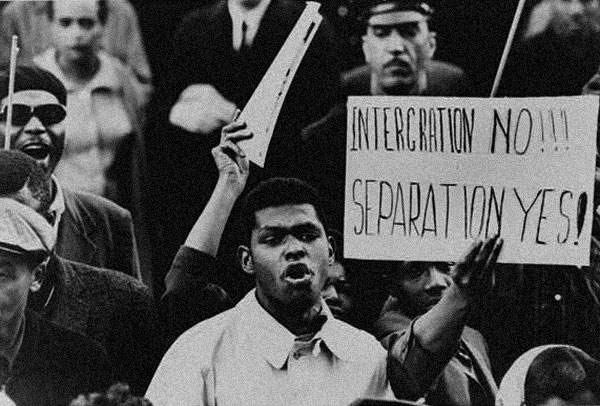
Nation of Islam counter-demonstration at NAACP rally in Harlem, 1961 / Photograph: NAACP collection, Library of Congress

In a world where Donald Trump’s presidential nomination speech has been endorsed by a former leader of the Ku Klux Klan—yet Black Lives Matter activists are accused of reverse racism for asking to not be murdered by police—what constitutes hate speech has become increasingly convoluted. In the aftermath of police killings in Dallas and Baton Rouge, gunmen Micah Johnson and Gavin Long were immediately linked by media outlets to black nationalist groups such as the Nation of Islam (NOI), New Black Panther Party, Black Riders Liberation Party, and Washitaw Nation, despite their professions to have been acting alone. Not only did these depictions draw misleading lines to organizations that do not prescribe such acts of violence, they also overshadowed both mens’ backgrounds in cultures of military violence (Johnson joined the Army Reserves immediately after high school and Long was a former Marine sergeant).

In a desperate attempt to drive home a link to black nationalism and direct attention away from these other troubling vectors, some news outlets began referring to Johnson as “Micah X” (NOI members use “X” to replace their “slave names”). In fact his middle name was simply Xavier. Even progressive groups, such as the Southern Poverty Law Center, play a legitimating role by identifying black nationalist groups as “black separatist hate groups,” leaving little room for meaningful distinctions between white supremacy and black nationalism. While groups such as the Nation of Islam have historically advocated for the separation of black communities, to assert that this position is simply the obverse of white supremacy—that is, black supremacy—overlooks the nuance of black nationalism. More importantly, it fails to account for the dramatically different relationships to power that black nationalist and white supremacist groups possess. White nationalism reinscribes and exalts the privileges of whiteness. Black nationalists council separation as an anti-racist practice and a method of empowerment in the absence of alternative avenues of power. To many black nationalists, this is the difference between life and death: the black community must either do for itself or perish.

The conflation of black and white nationalism is not new. In 1963 the New York Herald Tribune satirized what it perceived as the ironic similarities between white supremacists and black nationalists in a story entitled “Integrated Segregation.” Things “seem a trifle confused on the racial front these days. The segregationists are getting integrated and the integrationists are getting segregated,” the Tribune remarked. The article imagined a scene in which staunch segregationist George Wallace was explaining why racial segregation benefitted black Americans when “a Black Muslim popped up from behind, tapped him on the back and agreed with him.” Soon, the article predicted, the Congress for Racial Equality would “start picketing the N.A.A.C.P., while the Black Muslims set up an all-Negro chapter of the Ku Klux Klan.”

To many black nationalists, separation from whites is the difference between life and death: the black community must either do for itself or perish.

Understanding black nationalism as simply the mirror image of white supremacy, rather than an anti-racist practice, has deep roots in American political discourse. And in our current moment of colorblind “post-racialism,” when race-specific remedies such as affirmative action or reparations are derided as reverse racism—and even modest demands from Black Lives Matter for criminal justice reform are decried as anti-white—black nationalism has been once again mischaracterized using a host of long-stale tropes. We would be better served, not by simply dismissing black nationalism as the underbelly of white supremacy, but by understanding it as a tradition that is both liberative and anti-racist; one that does not mirror white supremacy, but repudiates it.

section separator

W. D. Fard, the founder of the Nation of Islam, arrived in Detroit in 1930 and told black Detroiters that they “were not Americans but Asiatics.” This was part of a holistic alternative creation story that rejected the racist underpinnings of white American nationalism. Many of Fard’s followers were former followers of Marcus Garvey, left without an organization after the decline of his Universal Negro Improvement Association (UNIA) in the late 1920s due to financial mismanagement and government infiltration. Garvey and the UNIA epitomized the goals of black nationalism, launching the most ambitious and successful Pan-Africanist vision in history. At its height, the UNIA had over 700 branches in 38 states, and its newspaper, Negro World, circulated throughout the African diaspora. Millions of black people were moved by Garvey’s message of racial pride embodied through the UNIA motto “One God! One Aim! One Destiny!” The NOI borrowed many of its black nationalist tenets from the UNIA, combining them with religious symbols, practices, and theologies drawn from the plethora of new northern, black, urban religious and racial-pride movements spawned by the Great Migration. This blending spoke to the diverse backgrounds of many early NOI members: in 1951 nineteen out of twenty-eight Muslims interviewed reported having previously been members in other movements such as black Masonry, the Israelite Movement, God’s Government on the Earth (dedicated to Liberian emigration), the Peace Movement of Ethiopia, Repatriation Movement to Liberia, and the Black Jews.

As historian Robin D. G. Kelley notes, many of these movements were influenced by a Black Zionist tradition that drew upon the narrative of the book of Exodus to imagine liberation and deliverance for black people around the world. These freedom dreams not only provided what he calls a “narrative of slavery, emancipation, and renewal,” but also a “language to critique America’s racist state since the biblical Israel represented a new beginning.” Beyond providing a framework for denouncing American racism, black nationalists addressed the racist power structures that governed their communities by creating jobs, businesses, schools, and places of worship. Racial separation was not simply about black communities’ physical relationship to white people; it was about changing the structures of power that governed those relationships through self-determination, community control, and new relationships to self and one another.

By 1959 the Nation of Islam was a burgeoning movement well known within urban black communities in the North but still largely unknown to white America. That summer, as Malcolm X traveled to Africa as a guest of Egypt’s president, Gamal Abdel Nasser, Mike Wallace (later of 60 Minutes fame) and black journalist Louis Lomax presented the NOI to white audiences for the first time. In their sensationalist documentary, The Hate That Hate Produced, NOI was compared to the American Nazi Party and the Ku Klux Klan. Members of the Nation were referred to as “black racists” and “black supremacists.” Its cautionary message to a largely white audience was that white racism would inevitably produce its black variant. As Malcolm X later recalled in his Autobiography, the show was meant to shock viewers, like when “Orson Welles frightened America with a radio program describing . . . an invasion by ‘men from Mars.’”

The Hate That Hate Produced was critical in launching the Nation of Islam into the public eye. But it also offered white viewers a language for understanding black nationalism that both intensified and allayed their fears. While racism was a plague that undermined American democracy, it was not a distinctly white characteristic. As Charlie Keil, a young white civil rights organizer at Yale during the early 1960s explained to me recently: “The Hate that Hate Produced allowed [whites] to sort of categorize the Muslims—the Nation of Islam—and treat them a certain way. . . . [It was] some way of saying that this was not an autonomous self-starting movement, but a reaction, an overreaction to a history of oppression.”

Throughout the 1960s black nationalists were castigated as “supremacists” who promoted the very racism and racial segregation that liberals were fighting against. This was stoked by white nationalists who saw calls for black racial separation as consistent with their belief in the benefits of racial segregation. As George Lincoln Rockwell, head of the American Nazi Party, told Alex Haley in a 1966 interview: “Malcolm X said the same thing I’m saying.”

Rockwell was not the only one confused about the difference between racial segregationand racial separation. In a highly-publicized Los Angeles trial in 1962 after police killed an unarmed member of the Los Angeles NOI mosque, the Los Angeles Times reported the “unusual problem in seating of spectators . . . when women members of the sect refused to accept seats alongside white persons.” The court eventually overturned this seating arrangement, and the press described this as “desegregation.” Los Angeles NAACP president Christopher Taylor joined the chorus of the aggrieved by arguing that he would be against any type of segregation, regardless of who initiated it. This decontextualized, colorblind insistence that any race demanding separation was calling for racial segregation was central to mischaracterizations of black nationalism during this period.

Malcolm X set about clarifying the Nation of Islam’s advocacy for racial separatism through dozens of debates with prominent civil rights figures on college campuses across the country in the early 1960s. He debated James Farmer at Cornell, Bayard Rustin at Howard, Louis Lomax at Yale, and the NAACP’s Walter Carrington at Harvard. Almost every debate was themed around the question: “Integration or Separation?” As Malcolm explained at Wesleyan University: “We are just as much against segregation as the most staunch integrationist.” But he added that black people did not “want to be free any more; they want integration. . . . They have confused their method with their objective.” In other words, black nationalists were not opposed to racial integration as an outcome of freedom struggles, or even as an organizing strategy, but they saw it as deeply flawed as the movement’s principal objective. More importantly, they pointed out the racist presumption of integration, which took for granted that white society and its values were more desirable. As Malcolm once sardonically asked, Who is the white man to be equal to?

More than simply critiquing integration, the Nation of Islam emphasized the importance of community control, an idea that flourished in upcoming years with the emergence of the Black Power movement. As Malcolm explained: “segregation means to regulate or control. . . . A segregated community is that forced upon inferiors by superiors. A separate community is done voluntarily by two equals.” Recognizing the pervasiveness of racial segregation, nationalists sought control over the businesses, healthcare, education, housing, and policing in their communities. Indeed, the Kerner Commission’s grim 1968 assessment that the nation was “moving toward two societies, one black, one white—separate and unequal” was something understood within black communities for decades. Amidst this backdrop, nationalists called for greater autonomy. The distinction between segregation and separation was not a semantic pivot. It was a deeper analysis of power, and an assertion of self-determination.

Over sixty years since the Supreme Court struck down the constitutionality of “separate but equal” in Brown v. Board, it would seem that calls for racial separatism are a relic of the past. But that might be too hopeful. A 2014 UCLA study revealed higher levels of school segregation in many regions than in 1968, the year the Supreme Court decreed a more proactive approach to desegregation. Schools with less than 1 percent white students are now being referred to as “apartheid schools.” And while the South is no longer governed by Jim Crow laws, cities outside the South such as Chicago and Baltimore continue to be described by demographers as “hypersegregated.”

The denial of race is a fixture of racism. Black nationalists have often exposed the “colorblind,” coded racism of liberals.

Black critiques of school integration during the 1950s and 1960s were often decried. In the words of scholar Andrew Delbanco, novelist and anthropologist Zora Neale Hurston “consigned herself to oblivion” when she responded to the Brown v. Board decision by saying that she could “see no tragedy in being too dark to be invited to a white school affair.” After James Meredith enrolled as the first black student in the University of Mississippi’s history, Malcolm X told a courtroom that anytime a man “needs [an] escort of 15,000 troops to go to a college where he will be among people whose viciousness toward him is so deadly that he needs the Army there to protect him . . . that Negro is foolish if he thinks that he is going to get an education.” Education, not integration, should be the goal, both Hurston and Malcolm agreed. As Malcolm explained, “token integration” was pointless as long as there were “a couple million Negroes in Mississippi who haven’t been allowed to go to the Kindergarten in a decent school.”

Meanwhile, integration today is often illustrated through the exceptional accomplishments of a handful of black elites, most notably President Barack Obama, rather than evidenced by a substantial redistribution of wealth or educational and housing opportunities. As Keeanga-Yamahtta Taylor demonstrates, the role of “black faces in high places” is often to obscure the common conditions facing many African Americans. Instead, black elected officials serve as interlocutors speaking to—and on behalf of—black communities. Taylor writes poignantly of the 2015 Baltimore uprising after the death of Freddie Gray: “When a Black mayor, governing a largely Black city, aids in the mobilization of a military unit led by a Black woman to suppress a Black rebellion, we are in a new period of the Black freedom struggle.” But this new period has unfortunately produced all-too-familiar outcomes for poor and working-class black people.

section separator

The long history of black nationalist leaders having official meetings with white supremacist leaders is another narrative often mobilized as proof of the essential symmetry of the two movements. In 1922 Marcus Garvey met with the Imperial Wizard of the Klan, Edward Clarke, earning him swift denunciation by the NAACP. In 1961 Malcolm X and other NOI officials secretly met with the KKK in Atlanta to negotiate a non-aggression pact surrounding the NOI’s purchase of southern farmland. The following year American Nazi leader George Lincoln Rockwell even appeared as an invited guest at the NOI’s Saviour’s Day convention in Chicago. When police in Monroe, Louisiana, illegally targeted and raided the city’s mosque with tear gas, rifles, and riot sticks, the Nation of Islam secured an interracial defense team: local black attorney James Sharpe, Jr., and Imperial Wizard of the National Knights of the Klan, James Venable. As Venable explained when taking the case, “I hate to say it but a colored man doesn’t have a chance in a courtroom in the South.”

The decision by black nationalists to meet or coordinate with white supremacists was often driven by a combination of pragmatism and a deep cynicism about the authenticity of liberals. In the case of the UNIA, Garvey negotiated an agreement with Clarke to sell stock in black businesses such as newspapers, factories, and his Black Star shipping line, which ambitiously hoped to link a global black economy in Africa, the Caribbean, and the Americas before failing due to poor business management. And although Malcolm X would later denounce the Nation of Islam’s détente with the Klan, the organization’s motivation for doing so was plainly and only to secure the right to farm in the South without danger of violent reprisal. And in the case against eight members of the NOI in Monroe, Venable successfully won an appeal for several of those convicted.

Black nationalists were also not uncritical of the white supremacists with whom they interacted, a fact often downplayed or forgotten. After his meeting with the Klan, Garvey told a crowd: “Mr. Clark [sic] did not tell me anything new; he told me what I discovered seven years ago. He told me the thing that caused me to have organized the Universal Negro Improvement Association four and a half years ago.” When Rockwell, wearing full Nazi regalia, donated twenty dollars to a collection plate at Saviour’s Day, there was a smattering of reluctant applause. Malcolm X belittled him by adding: “You got the biggest hand you ever got.” Equally, black nationalists used white supremacists to draw attention to the hypocrisy of liberals. Following his 1922 meeting, Garvey claimed that Klan members were “better friends to my race, for telling us who they are, and what they mean.” Malcolm used a similar device in his folk metaphor of the liberal “fox” and the conservative “wolf.” When comparing John F. Kennedy to George Wallace, Malcolm said: “Neither one loves you. The only difference is that the fox will eat you with a smile instead of a scowl.” He even penned a 1964 editorial entitled “Why I Am for Goldwater” in which he drew upon the same fox/wolf metaphor and cynically suggested that with Goldwater, “black people at least know what they are dealing with.”

Critics on the left who see these as misguided political strategies have marginalized black nationalists by painting them as racial conservatives, and thereby emptied black nationalists’ critiques of their incisiveness. For example, Paul Gilroy accuses Garvey of “black fascism” and C. L. R. James even compared him to Hitler. Others have taken Malcolm’s cynical support for Goldwater at face value, rather than understanding his rhetorical move to draw parallels between openly racist politicians and ostensibly liberal ones whose policies nonetheless gut the black community.

Black nationalist groups such as the UNIA and the NOI have rightly been critiqued for their deep patriarchy, homophobia, and tendency to reproduce the other trappings of empire. As historian Michelle Ann Stephens notes of Garvey, his “vision of the sovereign state figured in the black male sovereign; the desire for home at a more affective level figured in the woman of color.” Likewise, anti-Semitic comments by Nation of Islam leaders such as Louis Farrakhan have certainly buttressed comparisons between white and black nationalists. Most recently, Farrakhan stoked this fire by praising Donald Trump’s refusal to take money from Jewish donors.

But although charismatic leaders are often the voices we hear most prominently, for many rank-and-file members of the Nation of Islam and other black nationalist groups, the lived experience of racial pride, religious rebirth, and doing for oneself is a redemptive, affirming, and even lifesaving practice. Many members joined the NOI after feeling alienated in integrated, more middle-class organizations such as the NAACP. As Lindsey X told an interviewer, what the NAACP “wanted never seemed real to me. I think Negroes should create jobs for themselves rather than going begging for them.” Malcolm X’s autobiography is only the best-known narrative of religious and political redemption. In a long-running feature in the NOI’s newspaper, Muhammad Speaks, entitled “What Islam Has Done For Me,” members offered their conversion narratives and testified to the transformative practice of Islam. Robert 24X of Paterson, New Jersey, contributed: “I was a young drug addict who had spent too much time in the hells of Harlem’s East Side . . . [before] everything came into focus for me. . . . I stopped smoking, using profanity, and eating improper foods. And I’ve passed my biggest acid test—no more needles in the arm.”

Instead of positioning black nationalism as a reactionary, conservative ideology that simply apes the violence and hate of white supremacy, we might learn from its lessons today. If asked about the xenophobia and dangerous comments of conservative firebrand Donald Trump in our current election, Malcolm X might well have pivoted us back to Hillary Clinton’s questionable record on race, one which Black Lives Matter activists have pointed out includes racist dog whistles such as her comments about “super-predators” lacking empathy, her steadfast support for the devastating 1994 Crime Bill, and campaign money taken from private prison corporations. And beyond the hollow political discourse of election cycles, we must avoid the pitfalls of incessant claims of post-racialism that insist that to see race is to participate in racism. As we have witnessed with the familiar “All Lives Matter” rejoinder to “Black Lives Matter,” we are living in a time when people’s humanity is so denigrated that the mere valuation of life is taken by some whites to be a zero-sum game. The denial of race is a central fixture in the perpetuation of racism, and black nationalists have routinely called attention to the importance of racial pride while exposing the coded racism of liberals. Rather than draw facile lines between black nationalism and white supremacy, we are better served by understanding black nationalism as an anti-racist political tradition seeking to envision black American freedom and citizenship in a nation that has rarely devoted much effort toward either end.

Source: Black Nationalism and Liberation | Boston Review

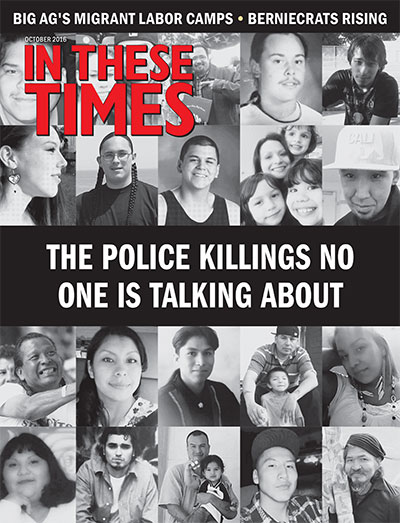
If You Thought Obama Was Giving Less Military Gear to Local Police Departments, You Were Wrong :: In These Times

If You Thought Obama Was Giving Less Military Gear to Local Police Departments, You Were Wrong

Despite President Obama’s much-touted 2015 executive order, an In These Timesinvestigation reveals evidence that police departments are still receiving as much military hardware from the Pentagon as ever.


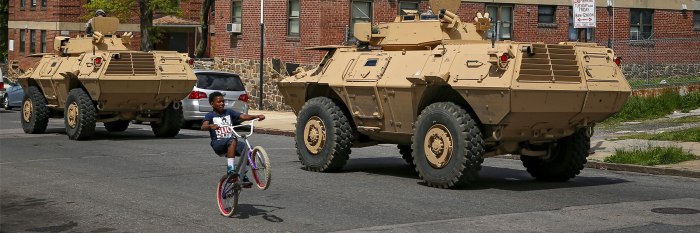
WHEN PROTESTORS TOOK TO THE STREETS OF FERGUSON, MO., IN 2014 in response to the police killing of 18-year-old Michael Brown, they also turned the nation’s attention to a related issue: the growing militarization of local law enforcement. Images of suburban police threatening demonstrators with armored vehicles and assault rifles prompted changes to the controversial 1033 program, through which the Department of Defense (DOD) transfers surplus military equipment to police departments nationwide.

President Obama’s May 2015 announcement that he would freeze giveaways of certain gear drew outrage from law enforcement groups such as the National Association of Police Organizations (NAPO), which later charged that the banned equipment was “essential in protecting communities against violent criminals and terrorists.” After shooters targeted and killed uniformed police officers in Dallas and Baton Rouge in July, NAPO and other groups doubled down on criticisms that the administration was putting officers’ lives at risk. On July 21, Reuters reported that, following a meeting with police groups, Obama had agreed to revisit the ban.

But an In These Times investigation provides evidence that, in practice, the president’s much-ballyhooed reforms to the 1033 program have done little to stem the flow of battlefield gear to cops.

In fact, the total value of equipment distributed through the program actually increased in the year following the ban, according to figures provided to In These Times by Michelle McCaskill, media relations chief for the DOD’s Defense Logistics Agency (DLA), which oversees the shipments.

So far in fiscal year 2016, (Oct. 1, 2015 – September 13), the DLA has transferred $494 million worth of gear to local police departments, In These Times learned from McCaskill.

That far exceeds the $418 million of equipment sent to police in FY 2015 (Oct. 1, 2014 – Sept. 30, 2015). According to an analysis published in May by the transparency organization Open the Books, 2015 was already a peak year for such shipments within the past decade, exceeded only by 2014’s $787 million. Since 2006, more than $2.2 billion of hardware has found its way into the hands of police, according to the report.

Many police accountability advocates warned from the outset that last year’s reforms were too limited in scope. Of seven items on the list of prohibited equipment, only one had actually been given to police departments in recent years, noted a May 2015 article in the Guardian. While the Obama administration placed additional requirements on the transfer of certain aircraft, armored vehicles and riot gear considered especially intimidating to civilians, hundreds of pieces of such equipment are still finding their way into the hands of local police. So far this year, for example, cops have acquired more than 80 mine-resistant ambush protected vehicles (MRAPs)—15-ton vehicles that were originally designed to withstand roadside bombs in war zones.

A SECOND LIFE FOR LETHAL WEAPONRY

The 1033 program, which refers to a section of the 1997 National Defense Authorization Act that created it, is a popular way for cash-strapped local law enforcement agencies to get gear on the cheap. Police departments typically are responsible only for the costs of shipping and maintaining the equipment.

Advocates also say the 1033 program allows underutilized Pentagon inventory to find a second life. “Since the American taxpayers have paid for this equipment already, does it not make more sense to share this equipment with local law enforcement agencies, as opposed to asking for the taxpayers to buy the same equipment twice?” asks Jim Franklin, executive director of the Minnesota Sheriffs’ Association, in an email to In These Times.

ACLU Minnesota legal director Teresa Nelson says that she is sensitive to the needs of law enforcement. “Nobody wants the police to be unsafe,” she says. “At the same time … when you have police in armored vehicles that look like tanks, you really change the dynamic between the police and the communities they serve.”

In January 2015, Obama responded to growing criticism of the program in the wake of Ferguson by issuing Executive Order 13688, which created a federal interagency group to investigate police militarization and come up with recommendations. As a result of this investigation, police were prohibited from receiving certain equipment, including bayonets, tracked armored vehicles, firearms and ammunition of .50‐caliber or higher, grenade launchers, camouflage uniforms and weaponized aircraft.

Critics said the reforms were superficial. Last year, an NPR analysis of 10 years of DLA data showed that of all the aircraft given to local police through the 1033 program, none were weaponized. The investigation further revealed that nearly 87 percent of the hundreds of armored vehicles being used at the time by local police ran on wheels, not tracks. Peter Kraska, a professor at Eastern Kentucky University’s School of Social Justice Studies and one of the leading researchers of police militarization, told the Guardian that the new rules were nothing more than a “publicity stunt.”

The ongoing transfer of armored vehicles, such as MRAPs, epitomizes these criticisms. Since the vehicles run on wheels, they aren’t on the new list of banned transfers. Nevertheless, their heft and design for use in warfare illustrates what critics see as the increasingly blurry line between police and military.

According to the DLA, police departments have received 708 MRAPs through the 1033 program since 2011, when the drawdown of troops in Iraq and Afghanistan first created a large reserve of unused equipment. At press time, 84 police departments had received the armored vehicles this year. More than 100 others have been approved and are awaiting delivery, according to DLA records obtained by In These Times through a Freedom of Information Act request.

As part of the Obama administration’s reforms, law enforcement agencies receiving “controlled” items, such as MRAPs, must demonstrate that they plan to train officers on proper use. But training materials used by various California police departments, obtained by the website MuckRock in June, show that instructional time for MRAPs ranges from 20 hours to as little as 15 minutes.

COMING TO A TOWN NEAR YOU?

Previously, only large urban police departments would have had the resources to justify acquiring the armored vehicles, which can cost upwards of $1 million. In 2014, Bill Johnson, executive director of NAPO, told USA Today that the 1033 program allows smaller police forces to play catch-up: “It’s their turn to get some of this equipment.”

That may explain why the 1033 program is particularly popular in states with significant rural populations such as Minnesota, where 74 of 87 county sheriffs have received surplus military equipment since 2005—mostly assault rifles and armored vehicles.

Jason Dingman, sheriff of sparsely populated Stevens County, Minn., told In These Times that an MRAP arrived this summer with only 56 miles on it. Virtually brand-new, the armored vehicle will just need a paint job and a fresh battery before being ready for use by West Central SWAT—a multi-agency task force that carries out tactical operations along the South Dakota border, but is called to the scene just six to eight times per year. “If we’re just executing a search warrant then we won’t bring [the MRAP] out,” Dingman says.
“But if the bad guy starts shooting at us then it’s a different situation and we can call out the MRAP to give our officers more protection.”

The DLA’s data show that police agencies receiving MRAPs in 2016 included those serving such tiny municipalities as Fallon, Nev. (pop. 8,458), and Westwego, La. (pop. 8,542). Even the police force in rural Pigeon Forge, Tenn. (pop. 6,171), found the need for an MRAP—perhaps to more effectively repel potential terrorist attacks on Dollywood, the town’s Dolly Parton-themed amusement park.

While police contend that equipment such as MRAPs are used defensively, renewed concerns arise whenever protests are met with a show of force. Following the police killing of Alton Sterling in Baton Rouge in July, a local reporter videotaped an armored vehicle pushing up against a crowd of protestors.

John Lindsay-Poland, who has researched the topic for the anti-militarism group American Friends Service Committee, thinks that the 1033 program fosters a “warrior mentality” that can further corrode police-community relations. “If we do not want our police to be at war in our communities,” he tellsIn These Times, “then we shouldn’t equip them with war-fighting equipment.”

Investigative stories like this are only possibly because of the support of readers like you. If you want to see more hard-hitting journalism, make a tax-deductible donation to support In These Times.


From the November 2016 Issue

SETH KERSHNER is a writer and researcher whose work has appeared in outlets such as Rethinking Schools, Sojourners, and Boulder Weekly. He is the co-author (with Scott Harding) of Counter-Recruitment and the Campaign to Demilitarize Public Schools (Palgrave Macmillan, 2015).

Source: If You Thought Obama Was Giving Less Military Gear to Local Police Departments, You Were Wrong

Policing and the Violence of White Being: An Interview with Dylan Rodríguez – The Black Scholar

Policing and the Violence of White Being: An Interview with Dylan RodríguezSeptember 12, 2016The following interview was conducted by Casey Goonan, an editor with True Leap Press. It originally appeared on the True Leap Press blog. Casey Goonan: The US white-supremacist state operates today through a different set of discourses and cultural structures than in previous epochs. Your work interrogates such shifts at a level of depth and nuance that is of particular importance for emergent struggles against racist state violence. “Multiculturalist white supremacy,” “post-racial liberal optimism,” “white academic raciality”—such terms are utilized throughout your work to interrogate a myriad of theoretical and historical conundrums that define the post-Civil Rights era, particularly in regards to racial violence and subjectivity. Can you, in very broad strokes, lay out what you are trying to accomplish with these interventions in the discourses, practices, and forms of embodiment that so violently delimit the possibilities for radical social change in the United States?

Dylan Rodríguez: The aftermath of American apartheid’s formal abolition has been overwhelmed by a grand national-cultural vindication of “Civil Rights” as the vessel of fully actualized gendered-racial citizenship. This fraud has, in various ways, facilitated rather than interrupted the full, horrific exercise of a domestic war-waging regime. For the sake of momentary simplicity, we can think about it along these lines: the half-century narrative of Civil Rights victory rests on an always-fragile but persistent common sense—the idea that national political culture (“America”) and the spirit of law and statecraft (let’s call this “The Dream”) endorse formal racial equality. Bound by this narrative-political context, the racist state’s mechanics shift and multiply to rearticulate a condition of normalized racist violence that is condoned or even applauded by the institutionalized regimes of Civil Rights. (It is not difficult to see how the NAACP, JACL, LULAC, Lambda, NOW, Urban League and other like-minded organizations condone or applaud domestic racial war, so long as it is directed at the correct targets: gang members, drug dealers, “violent criminals,” terrorists, etc.). In other words, the contemporary crisis of racist state violence is not reducible to “police brutality” and homicidal policing, or even the structuring asymmetries of incarceration: it is also a primary derivative of the Civil Rights regime.

Source: Policing and the Violence of White Being: An Interview with Dylan Rodríguez – The Black Scholar

For Colored Girls Like Korryn Gaines And the Black Men Who Hate Us


For Colored Girls Like Korryn Gaines And The Black Men Who Hate Us

What is it to be a black woman in America. For the burden of both racism and misogyny to lay at our feet.

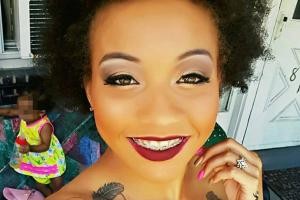
Korryn Gaines was no fool. In her short 23 years she was all too familiar with the carnage of black bodies. This familiarity with state sanctioned executions empowered her to raise unafraid black children. With her thick Baltimore accent she instructed her five-year-old son to record the Baltimore County police who’d pulled her over for not having registered tags on her car. That day, she was ready to die. Her life was spared, but she wouldn’t be so fortunate again.

Her Instagram shows a warrior woman who believed in her right to legally bear arms. She was uninterested in cow-towing to the very system that kills even its most “perfect” victims. Instead of “hands up, don’t shoot!” shethought “#StopKillingUs is some begging ass shit” was more appropriate. Baby girl had no desire to be pleasant or respectable.

So when Baltimore County police showed up to her apartment to serve a warrant for her arrest over misdemeanor traffic violation charges, she knew it could very well be the day she took her last breath. In her last moments she took to Instagram to record her cute, chubby cheeked five-year-old son, her asking the questions, him predicting the outcome.

“Who’s outside?”
“The police.”
“What are they trying to do?”
“They trying to kill us.”

What happened next doesn’t matter much because the result is the same. It’s always the same. Korryn is dead. The police will lie. The media will corroborate the police’s lies. The public will blame her for her death. There will be no justice. Officials will call for peace. Family members are left to raise her children. And shortly we will have all moved on to grieve the next victim of police violence. The narrative is so familiar it shows up in our dreams. The tears feel the same as the ones we wiped the last time we mourned a black person who we did not know. Only this time those tears will only be cried by black women. All black lives are not mourned equally.

Because Korryn dared to be a vocal black woman — one who may or may not have been legally armed — there is no outcry for her except from other black women. There will be no outraged celebrities. Protesters won’t flood the streets in cities across the nation. Public officials will not demand accountability for the officers who killed her. Presidential candidates will not condemn the police department for their failure to de-escalate considering a child was present. President Obama will not tell the nation Korryn could’ve been his daughter. News and cable networks won’t profit off her death by hosting Town Hall meetings. Black men will not grieve her as they have the long list of black men killed similarly. In fact, black men will adopt the language of our oppressors to blame her for her own murder.

Black men couldn’t wait to vocalize their hatred for black women. “It’s looking mighty justifiable right now” and “Korryn Gaines deserved to die” and “Basically asked for it” and “She decided to be reckless with her son and her own life” and “Korryn Gaines was an ignorant, loud mouth little girl.” Those are just a few. Tucking in their hatred is hard to do, even when two black children are left without a mother.

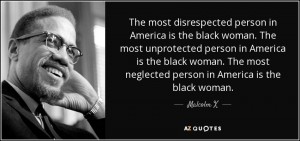
Black men's hero, Malcolm X, telling the painful truth about black women.

Black men’s hero, Malcolm X, telling the painful truth about black women.

These are the same black men who automatically don’t trust police accounts in killings where the victim is a black man, but are quick to believe Korryn was pointing a gun at the police when they entered her home. Despite her documented recordings of run-ins with the Baltimore County police, black men aren’t thinking maybe this woman was targeted. Black men are not playing detective to figure out the truth in this strange story the police tell of using the landlord’s key to enter her home. Black men are not rallying for an end to a system that sends a SWAT team to someone’s home over non-violent traffic violations. Black men are not calling foul, because even if she was armed, white suspects with guns are apprehended alive all the time. Black men are not questioning how she could hold her phone to record, hold her son and allegedly hold a shotgun in her hand all at the same time. Black men aren’t sympathetic to her developmental disability due to lead poisoning, which could’ve affected her reasoning the day she was murdered. Nope. Black men are saying she deserved to die because she was a crazy fool and a shitty mother for daring to be free.

Ain’t that peculiar?

Black men must remove the word revolutionary from their vocabulary. One minute it’s “fuck the police” and the next it’s Korryn was reckless. Black men love the iconic photo of their hero Malcolm X looking out the window of his home, shotgun in hand to protect his family, but Korryn possibly having a gun means she deserved death. They cheer on Nat Turner but who does Korryn think she is to protect her family. Black men either don’t know what revolutionary really means or think the word is reserved for them solely.

Remove it from your tongues.

It’s not just about Korryn. It’s about black womenfolk being de mules of the worldat the hands of black men. Folks called Sandra Bland sassy. Said had she not talked back she would’ve lived. No one showed up for the Rekia Boyd rally in NYC. When we talk to black men about the dangers of street harassment we are met with death and rape threats. Statistics show violence against black women is mostly at the hands of black men, but we’re shouted over for bringing that up. Then when we tell black men that we, too, are killed by police, we are told now is not the time to be divisive. You will get to us after we take care of our “kings.”

But you see, that doesn’t work for me. My liberation is not going to come after. I’m not suffering through black men’s harmful misogynoir while black women’s freedom becomes a ‘maybe we’ll get to it in the next lifetime’ non-priority. I’m not adding a “not all black men” caveat to my truths in order to coddle hurt feelings. My life is literally on the line. And my freedom can’t wait.

Either cis black men are going to center black women so we can all get free together, or my freedom fighting will be reserved for black women and black queer folks. Do what you want with that. But my freedom can’t wait. I won’t wait for you to see my humanity while I fight for yours.

While you’re denying our humanity, remember this: Putting off black women’s liberation for tomorrow is a dangerous game. Because ain’t a single liberation movement survived without us.

To Korryn and Sandra and all the black women who refuse to bow, refuse to shutup, we got you. Rest easy knowing black women said your name and refused to let them forget.

Source: For Colored Girls Like Korryn Gaines And the Black Men Who Hate Us

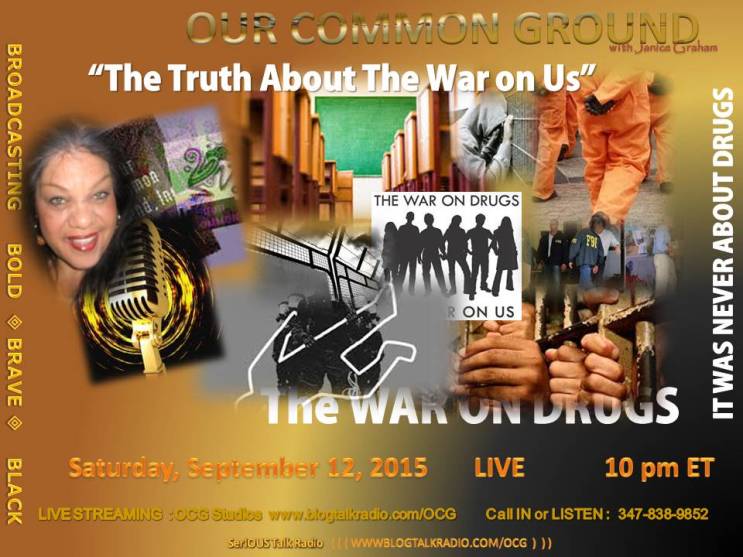
This Week on OUR COMMON GROUND φ “40 Years, $1 Trillion, 45 Million Arrests Later: “The Truth About the War Against Us” φ LIVE

OUR COMMON GROUND with Janice Graham

“The Truth About the War Against Us”
09-12-15 War on Drugs4
40 Years, $1 Trillion, 45 Million Arrests – the war still rages against our community. IT WAS NEVER ABOUT DRUGS

 Saturday, September 12, 2015

10 pm EDT
LISTEN LIVE and Join the OPEN Chat

LISTEN LIVE HERE

Learn more and join us on Facebook
Call In – Listen Line: 347-838-9852

This week on OUR COMMON GROUND, we review and examine the truth about the policies and intent of the “War on Drugs”. We need to talk about the money making behind the politics; how the drug war can be considered slow Nazi policy on the poor and the racial profiling used. We look at these destructive and failed policy and manipulation in its historical context and destructive outcomes. We will present audio clips for our discussion which will assist us in understanding just how much the “War on Drugs” was really never about drugs.

For sheer government absurdity, the War on Drugs is hard to beat. After three decades of increasingly punitive policies, illicit drugs are more easily available, drug potencies are greater, drug killings are more common, and drug barons are richer than ever. The War on Drugs costs Washington more than the Commerce, Interior, and State departments combined – and it’s the one budget item whose growth is never questioned. A strangled court system, exploding prisons, and wasted lives push the cost beyond measure. What began as a flourish of campaign rhetoric in 1968 has grown into a monster. And while nobody claims that the War on Drugs is a success, nobody suggests an alternative. Because to do so, as Surgeon General Joycelyn Elders learned, is political suicide.

As a community we need to understand how Drug War fever has been escalated; who has benefited along the way; and how the mounting price in dollars, lives, and liberties has been willfully ignored. Where are the policy maker offices where each new stage was planned and executed? What happened in the streets where policies have produced bloody warfare. This is a tale of the nation run amok – in a way the American people are not yet ready to confront. Are you?

You are invited to bring your thoughts about the pressing issues facing our community. Come listen and learn. SHARE please.

OUR COMMON GROUND where friends come to confer with allies.

Listen & Call In Line: 347-838-9852
Saturday, September 12, 2015 10 pm ET
Join the LIVE Broadcast Here

 http://bit.ly/1KIQv2q

            BROADCASTING   BOLD BRAVE & BLACK

Web     Facebook     Community Forum   Pinterest    Visit our Tumblr Page

Twitter: @JaniceOCG #TalkthatMatters

“Speaking Truth to Power and OURselves” 

email: OCGinfo@ourcommonground.com

Call In – Listen Line: 347-838-9852


“The Flames of Liberation: Rebellion and Resistance” ll September 5, 2015 with Ruby N. Sales

Activist and Organizer, Ruby N. Sales

  “The Flames of Liberation: Rebellion and Resistance”

Saturday, September 5, 2015    Φ     LIVE  10 pm EDT

 “Transforming Truth to Power, One Broadcast At a Time” 

           OUR COMMON GROUND  Session II 2015 SEASON 

     33rd BROADCAST SEASON 

                               We open our 2nd Session of the 2015 Season continuing to examine the depth of structural and institutionalized racism, the impact of white supremacy and the concept of #BlackLivesMatter as a clarion call and the its promise as a movement.  As always we ask, “What is your End Game?”                      We invite you to join us and be part of the response to THE STATE OF EMERGENCY.


Guest Moderator, Ruby N. Sales, Founder & Director, The Spirit House Project


To help us kick off this session we have asked Rev. Ruby N. Sales to join us a co-moderator on the critical questions and issues that challenge, trembling like a swelling tsunami beneath the ocean. A seasoned veteran of the civil and human rights campaigns of our time and a fierce and clear visionary of Black Power, we believe that she is most appropriate to help us press out an authentic narrative on these issues.

Institutionalized Racism is the concept and practice of white supremacy. It is the practice of discrimination and oppression based on skin color, physical characteristics, continent of origin and culture. It has its origins as a justification for slavery and the conquest of the Americas. From the beginning, slavery in the United States was tied to the development and growth of capitalism. Founded on the sale and ownership of human beings on the basis of their physical characteristics and color, its purpose was the exploitation of unpaid labor for super profits. As chattels, Africans were hunted like animals, transported to the “New World,” and then sold on the auction block like beasts of burden. In like manner Native American Indians were exterminated on a massive scale.

Moral and intellectual rationales were invented and continue to justify this kidnapping, sale, enslavement and genocide against human beings. As an ideology, racism provided the moral and intellectual underpinnings of slavery, the westward expansion of colonialism and the seizure of half of Mexico. Thus the purpose of this doctrine was, and still is, to put forward ideas and theories founded on the myth that Black people and other people of color are inherently inferior.

Almost 130 years after the Emancipation Proclamation, the legacy of slavery remains. It is embedded in and influences every aspect of social, economic and political life. Institutionalized racism is the combined economic, political, social, cultural, legal, ideological and other structures that exist to maintain the system of inequality. #RaceMatters

Institutionalized racism has economic, social, political, ideological and cultural forms, and denies equality, justice and dignity to all people of color.  There are new problems because of the systemic nature of crisis. Our discussions should examine what adjustments must be made in these new efforts to eradicate our place in this society. We rebel and resist the effort to force us into the margins, to make us invisible and to remove us to prison for profit camps.

Our discussions must explore and examine how to elevate our voices in the fight against police brutality, housing discrimination, immigrant rights, and the dismantlement of public education to mention a few issues. At OUR COMMON GROUND provide “a place for our unfiltered voices”.  With the brightest, most loyal and insightful Black activists, community organizers and servants, scholars, researchers, journalists and social scientists we raise, clarify and illuminate the racist dimension of these issues, show how their roots lie in the system of capitalism and its new stage of crisis, and come up with concrete ideas to launch new initiatives and support existing ones.

As a set of institutions, racism is infused in the very foundations of our society and is inseparable from the economic foundations of U.S. capitalist society. The “new domestic military policing” is implemented to intimidate and destroy racially homogenous communities and put into place a ‘superexploitation’ of racial oppression that ensures our silence and to fill prisons serves to create and make real the essence of white supremacy.  We are living in an increasingly surreal special system of oppression and racism perpetrated by a narrative dictated outside of our community. None of this is new; the struggle to liberate ourselves has been before us since our time on these shores. One of our most effective weapons is to ensure that we work from an authentic narrative and that its formulation comes from our Truth. OUR COMMON GROUND for more than 33 years has focused its broadcast mission on ensuring that the Black Truth illuminates and informs our struggle.  #BlackTruthMatters #BlackVoiceMatters

   BROADCASTING   

   BOLD      BRAVE       BLACK 

           OUR COMMON GROUND with Janice Graham

                                 “Speaking Truth to Power and Ourselves” 

                                email: OCGinfo@ourcommonground.com

           LISTEN LIVE and Join the OPEN Chat:  http://www.blogtalkradio.com/OCG

                             Call In – Listen Line: 347-838-9852

Community Forum ll   Twitter: @JaniceOCG  #TalkthatMatters   ll    Pinterest   ll  Visit our Tumblr Page   Facebook