North Carolina’s shocking history of sterilization

North Carolina’s shocking history of sterilization

Forced sterilization was the law in 32 U.S. states, and actually inspired the Nazis. We’re just learning the truth

North Carolina's shocking history of sterilization(Credit: Provided by Willis Lynch)
Adapted from “For the Public Good” from The New New South

People generally have two reactions when they hear about American eugenics programs for the first time: the first is shock, and the second is distancing. How could those people have done that to them?

Most have heard of the program in Nazi Germany, in which more than 400,000 people considered unworthy of life — those with hereditary illnesses, but also the dissident, the idle, the homosexual, and the weak — were targeted for forced sterilization beginning in the 1930s. Few realize that the some of the inspiration for Germany’s eugenics program, and even the language for the Nuremberg racial hygiene laws, which among other restrictions banned sexual intercourse between Jewish and non-Jewish Germans, came from eugenicists who had been practicing for years in the United States. Some 60,000 American citizens were sterilized, often under coercion or without consent.

Returning from my first visit with Willis Lynch, I met my in-laws, in town from Northern Virginia, for dinner in Durham, N.C. Lynch was sterilized at age 14 on the recommendation of North Carolina’s Eugenics Board, which determined that he was unfit to father children. When I told them about all he had been through, they were outraged. They had never heard of forced sterilizations taking place in the United States, but blamed their ignorance on where they grew up. “I’m from the North,” said my mother-in-law, who had assumed that Lynch, now 80, is black (he is white). “We didn’t have things like that there.”

I went home and looked it up. Pennsylvania, her home state, never passed a eugenics law, but managed to sterilize 270 people anyway, and also to perform the first known eugenics-motivated castration, in 1889. The first state to enact a eugenics-based sterilization law was Indiana, in 1907; it was followed two years later by Washington and California. Eventually 32 states would pass such legislation. Internationally, the list of countries with a history of forced sterilization includes Canada, Czechoslovakia and the Czech Republic, Denmark, Japan, Iceland, India, Finland, Estonia, China, Peru, Russia, Sweden, Switzerland, and Uzbekistan.

Though North Carolina did not sterilize the greatest number of people (that distinction belongs to California, where 20,000 were sterilized), the state’s Eugenics Board was notorious for its aggressiveness. While many states confined their sterilization programs to institutions, North Carolina allowed social workers to make recommendations based on observations of “unwholesome” home environments or poor school performance. The state’s program was also one of the longest lasting, increasing its number of sterilizations while others were winding down. Between 1929 and 1974, more than 7,600 North Carolinians were sterilized. Like Willis Lynch, many of the victims were children, and consent was provided by relatives or guardians who feared the loss of welfare benefits or other consequences if they refused.

Over more than a decade, sterilization victims waited for North Carolina to make things right. Lynch, for his part, testified at state hearings, gave interviews to newspapers and magazines, and talked regularly by phone with other victims. For years, not much materialized: an apology from Democratic Gov. Mike Easley, expressions of regret and sympathy from his successor, Beverly Perdue, also a Democrat.

Then in 2012, something remarkable happened: A Perdue-appointed task force that had been listening to testimonies from Lynch and others like him for almost two years recommended a package of compensation for the victims of eugenics, and the state’s Republican-led and oft-divided House of Representatives supported the measure in a bipartisan effort. The plan included equal monetary payments to victims, access to mental health resources, and a program of public recognition and education that would ensure that no one would ever forget what happened to them. It began to look like North Carolina would be the first in the nation to address the legacy of eugenics, and victims imagined what they might do with the restitution: pay bills, fix up their homes, visit distant relatives.

The members of the task force were united in their recommendation, but the journey to a proposal that satisfied the victims had not been easy. They’d listened to many hours of painful testimony from sterilized men and women and their families, and had reviewed thousands of pages of supporting documents: medical records, reports from the Eugenics Board, propaganda in favor of eugenics-based sterilization. They’d looked at the faulty science behind eugenics, as well as North Carolina’s unequal targeting of poor, vulnerable, and minority citizens. They’d considered actuarial data to estimate the number of living victims, and calculated the potential total cost of compensation. Though they acknowledged that no amount of money can pay for the harm done by compulsory sterilization, they did, in fact, put a number on the line: $50,000 for each living victim, $50 million total.

But some wondered: Can you put a price on reproductive ability? And is it appropriate, in a time of austerity, to make such large monetary payments, especially when it won’t right the wrongs? Should today’s taxpayers be responsible for something that happened decades ago? Though the effort to include the task force’s recommendations in the House budget had been bipartisan, the measure faced more dissent from the G.O.P.-controlled Senate: The state can’t afford to pay for something that won’t fix any problems, and it was a long time ago, anyway. It wasn’t us.

It is human nature to distance oneself from what now seems cruel, violent, reprehensible. We tell ourselves that we would not have done that, that our country is better than that now. But that same distance — I am not like that, I am better — is what motivated the first eugenicists and their followers.

Like Willis Lynch, Francis Galton was born into a family of seven children, though more than 90 years earlier and thousands of miles away. The circumstances of his early childhood in England were quite different: His father was a wealthy banker, his mother the daughter of physician Erasmus Darwin, making Francis Galton a cousin to the father of the theory of evolution. The Galton family also included a number of prominent gunsmiths, iron mongers, athletes, and Quakers.

Under the tutelage of a doting older sister, Galton showed exceptional intellectual promise even before he was school-aged. He knew his capital letters by 12 months, could read at 2-and-a-half, and could sign his own name by 3. The day before he turned 5, Galton boasted in a letter to his sister: “I am four years old and can read any English book. I can say all the Latin Substantives and Adjectives and active verbs besides 52 lines of Latin poetry. I can cast up any sum in addition and multiply by 2, 3, 4, 5, 6, 7, 8, 10. I can also say the pence table. I read French a little and I know the Clock.” When he finally entered school, he was surprised and disappointed that his classmates did not share his enthusiasm or facility for reciting the “Iliad” or Walter Scott’s “Marmion.” He was sent to a French boarding school at age 8, and at 16, left secondary school to study medicine (a pursuit he later abandoned).

As an adult, Galton had a varied and peripatetic career. He traveled to Africa for anthropological work, discovered the anticyclone, created the first weather map, pioneered the first system of fingerprinting, and developed a “Beauty-map” of the British Isles that compared the relative attractiveness of women. (London had the most beautiful women, according to his research, Aberdeen the ugliest.) He is best known, however, as the father of modern eugenics, an area of study partially inspired by cousin Charles Darwin’s work. Less than a month after the publication of “On the Origin of Species,” Galton wrote, in an admiring letter to his cousin: “I have laid it down in the full enjoyment of a feeling that one rarely experiences after boyish days, of having been initiated into an entirely new province of knowledge, which, nevertheless, connects itself with other things in a thousand ways.” Galton was interested in the potential implications of Darwin’s work on heredity and evolution: Could these principles be used, through selective breeding, to enhance the human gene pool? Likely influenced by the achievements of his own illustrious family, Galton believed that talent and ability are transferred genetically rather than by environment. To Galton’s mind, his particular aptitude for geography, language, and the sciences came not so much from his education and privilege as from his eminent forebears.

Improving human societies through selective breeding was not a new idea, even in the 1800s. In ancient Greece, deformed babies were killed at birth, unwanted ones abandoned to the elements. Spartan elders inspected every newborn for potential contribution to the state — weak babies were dropped into a chasm — and the strongest men and women were encouraged to procreate (including outside of marriage). In the “Republic,” Plato argued that “the best of either sex should be united with the best as often as possible, and the inferior with the inferior as seldom as possible.” The goal was the collective good. If only the strongest and smartest reproduced, then their offspring would, over time, benefit everyone through their industry, bravery, creativity, and strength.

But the term eugenics was not coined until 1883, when Galton published his fifth book, “Inquiries into Human Faculty and Development.” In it, he combined the Greek word eu, meaning good, with the suffix -genes, meaning born, and defined eugenics as “the study of all agencies under human control which can improve or impair the racial quality of future generations.” He identified both positive eugenics (encouraging the breeding of the best) as well as negative eugenics (discouraging and even preventing the unfit from procreation), though he found the former more practical and socially palatable. Arguing that religion and custom had always strongly influenced breeding and marriage, Galton proposed that eugenics, with its ultimate goal of improving human societies, could be introduced to the general public as a new and compelling religion.

With his amateur background in anthropology, Galton classified humans along a line of “Mediocrity,” or average talents. Those above average, especially the most talented, should be encouraged to procreate within their classes, early and often. Those below average, especially the lowest-ranking, should be encouraged to abstain or, at the very least, refrain from tainting the bloodlines of their superiors. He had only a few vague suggestions about how this could be accomplished: intelligent and well-born women should be encouraged to marry at 21 or 22, promising couples provided with inexpensive housing, social inferiors encouraged to regard celibacy as noble self-sacrifice, and habitual criminals segregated, monitored, and denied the opportunity to produce offspring. “What nature does blindly, slowly, and ruthlessly, man may do providently, quickly, and kindly,” he asserted. His vision was Utopian; the English race, after a few generations, would be “less foolish, less excitable, and politically more provident.” Men of special ability, like himself and his cousin, would be less rare, and would be able to contribute more than their fair share to the general population.

Galton soon realized a problem with positive eugenics: Eminence generally appeared later in life, often after the opportunity to marry and produce children. To address this problem, he established London’s Anthropometric Laboratory, the world’s first mental testing center, which sought not only to provide individuals with information about their own abilities, but also to serve as a collection of data for Galton and other scientists. These early tests, offered for three pence each to subjects ranging in age from 5 to 80, were unlike the written test Willis Lynch would take, years later, though their goal was the same: determination of ability or potential. Galton’s tests involved a variety of largely physical measurements: grip strength, head size, tactile sensitivity, breathing capacity, and visual and auditory acuity. His Anthropometric Laboratory collected data on more than 9,000 people, and although there is little evidence that they found much use in the information cards they received, his studies of the data eventually produced the statistical concepts of standard deviation and percentile ranking.

Negative eugenics — preventing those deemed unfit from reproducing — was considerably more challenging, at least as envisioned by Galton. It was not reasonable to expect most people to live a celibate life simply for the betterment of the gene pool, and monitoring ex-cons and other undesirables  was equally daunting. Though the British Eugenics Education Society, founded in 1907, campaigned for sterilization and marriage restrictions for mentally ill citizens, negative eugenics remained mostly the subject of political debate in Britain, and legislation enforcing sterilization of the unfit was never passed. Galton died in 1911 without seeing his “new religion” realized. Despite the genetic promise of his intellectual gifts, he also died childless.

**

The American eugenics movement is often characterized as a progressive folly for its faith in science and its big-government intrusiveness, but the truth is somewhat more complicated. The American Eugenics Society counted among its members some of the country’s most influential Progressive Era businesspeople, philanthropists, and activists, including J.P. Morgan Jr., Mary Duke Biddle, and Margaret Sanger, but the group of scientists and eugenicists who founded it also included well-known racists and anti-Semites. Early outreach efforts often included a mix of public health education and racist, anti-immigration messages.

The Fitter Families for Future Firesides competitions, sponsored by the Eugenics Society starting in 1924, provided one way of reaching out to rural white Americans. Held in state fairs across the country, the contests originated as Better Babies competitions and exhibitions that were meant to educate the public about infant health and mortality. Fitter Families contests, with the goals of collecting data on hereditary traits and spreading the message of eugenics to a wider population, invited entire families to submit to screenings for health, character, and intelligence. Those scoring highest received awards and medals bearing the inscription, “Yea, I have a goodly heritage” and had their photographs taken for the local papers. Following an examination, a family might listen to a Galtonesque lecture on the importance of mating the best with the best; browse an exhibit about comparative literacy rates of foreign, African-American, and native-born white Americans; or read about the social costs of incarcerating the mentally deficient.

At the 1926 Sesqui-Centennial International Exposition in Philadelphia, a poster equipped with flashing lights informed fairgoers that “every 48 seconds someone is born in America who will never grow up beyond the mental age of 8” and that “crime costs America $100,000 every second.” The poster also claimed that  “few normal persons go to jail.” The message received by the “Fittest Families?” You are carrying the burden of the least fit, who should not be having so many children. In one way or another, you will pay for the children of undesirable parents: to feed and clothe them when their parents cannot, to care for them in institutions, and later, to imprison them.

Outside of state fairs and exhibitions, this fear of social dependency had already primed the culture for an embrace of negative eugenics. Large-scale asylums for the homeless and mentally ill, built in the late 19th and early 20th centuries, raised fears that increasing numbers of handicapped citizens were a drain on public resources. The country’s first major immigration law, the Immigration Act of 1882, specifically prohibited entry by any “lunatic, idiot, or any person unable to take care of himself or herself without becoming a public charge.” American eugenicists believed, as Galton did, that people could be bred, like livestock, for desirable traits. Those with undesirable traits, which included everything from alcoholism to criminal recidivism to poverty, could be sterilized.

Indiana passed the first law allowing eugenics-based sterilization in 1907. Thirty-one other states would follow. After constitutional challenges, many employed language and structure from the Model Eugenical Sterilization Law written by Harry Laughlin, one of the founders of the American Eugenics Society. (Laughlin’s law later became the model for Nazi Germany’s Law for the Prevention of Hereditarily Diseased Offspring, and he would receive an honorary degree from the University of Heidelberg for his support of “the science of racial cleansing.”)

Laughlin proposed a position of state eugenicist, whose function was “to protect the state against the procreation of persons socially inadequate from degenerate or defective physical, physiological or psychological inheritance.” He defined a socially inadequate person as one who, in comparison with “normal” persons, fails to maintain himself as a useful member of the state, and he set out the socially inadequate classes: the feeble-minded, the insane, the criminalistic, the epileptic, the inebriate, the diseased, the blind, the deaf, the deformed, the crippled, and the dependent (including “orphans, ne’er-do-wells, the homeless, tramps and paupers”). Twenty years later, Virginia’s Sterilization Act, patterned after Laughlin’s, was found constitutional by the U.S. Supreme Court in the Buck v. Bell case, in which Chief Justice Oliver Wendell Holmes famously wrote, about the family of 19-year-old Carrie Buck, “three generations of imbeciles are enough.”

North Carolina’s first sterilization law was recorded in 1919, but sterilizations did not begin until 1929, after the passage of Buck v. Bell, when one vasectomy, one castration, and one ovariectomy were performed (the state’s law was unusual in allowing castrations for “therapeutic treatment”). In 1933, the law was declared unconstitutional by the state’s Supreme Court on the basis of a deficient appeals process, and a second law was passed that year, ostensibly providing for due process for the individuals recommended for surgery. Sterilizations could be petitioned by the superintendent of public welfare, the heads of prisons or other institutions housing potential patients, or their next of kin or legal guardians. Despite the ability of individuals to appeal such recommendations, the statute was broad, allowing the Eugenics Board to overrule objections and authorize sterilizations in the best interest of the individual, for the public good, or if the individual was suspected to produce children with “a tendency to serious physical, mental or nervous disease or deficiency.”

By July 1935, the state had sterilized 223 men and women, most of them residents of state-run institutions. Though it would take another decade for public opinion to begin turning away from eugenics, “Eugenical Sterilization in North Carolina,” a report published by the state that year, envisioned a public that still needed convincing. The report argued, among other things, that sterilization was protection that benefitted both society and the sterilized individual:

There is no discovery vitally affecting the life, happiness and well being of the human race in the last quarter of a century about which intelligent people know so little, as modern sterilization. The operation is simple, it removes no organ or tissue of the body. It has no effect on the patient except to prevent parenthood. Under conservative laws, sanely and diplomatically administered, as they have been in California, these discoveries developed by the medical profession now offer to these classes the greatest relief possible and the greatest protection to the defenseless child of the future. It offers one, humane, practical protection against threatened race degeneracy.

Adapted from “For the Public Good” by Belle Boggs. Copyright 2013 The New New South. All rights reserved.


Belle Boggs is the author of the story collection “Mattaponi Queen,” which won the Bakeless Prize and the Library of Virginia Award.

By Comparing Obamacare to Slavery, Dr. Ben Carson Has Become a Jim Crow Caricature

By Comparing Obamacare to Slavery, Dr. Ben Carson Has Become a Jim Crow Caricature

  opewopewoepw

Dr. Ben Carson “Jumps Jim Crow”

By  Dr. Wilmer J. Leon, III

“You know Obamacare is really I think the worst thing that has happened in this nation since slavery…it is slavery in a way, because it is making all of us subservient to the government, and it was never about health care. It was about control.”                                                                                                                         Dr. Ben Carson October 11, 2013

Dr. Ben Carson is a world renowned American neurosurgeon. He is a brilliant physician with an incredibly compelling and motivational story. Born into poverty in Detroit in 1951 and raised by a single mother with a third-grade education, Carson became the first surgeon to separate conjoined twins and the youngest to head a surgical department. His focus, work ethic and commitment to excellence should be emulated by as many as possible.

Over the past year Dr. Carson has emerged on the political scene as a spokesperson for conservative interests.  Most recently he addressed the 2013 Values Voter Summit in Washington, D.C., making the remarks referenced above.

“Obamacare” or more accurately the Affordable Care Act (ACA) is the worst thing in this nation since slavery?  Really?  I understand political diatribes and hyperbole but the worst thing in America since slavery?  How can reducing the number of uninsured Americans through an expansion of Medicaid and the creation of new health insurance exchange marketplaces be worse than slavery?

The 13th Amendment abolished slavery in America except as punishment for a crime in 1865. Since then, African Americans have been lynched, had their farms confiscated, been denied the right to vote and have had limited or no access to public and private facilities. For an African American of Dr. Carson’s intellect and stature to publically make such assertions is historically inaccurate, irresponsible and promotes many of the racist stereotypes that are being used to garner support to overturn the law.

Does Dr. Carson really believe that the ACA is worse than the Tuskegee syphilis experiment of 1932?  This infamous clinical study was conducted by the U.S. Public Health Service on 399 African American men from 1932 to 1972 to trace the natural progression of untreated syphilis.  These human “laboratory animals” thought they were receiving free health care from the U.S. government.  By the end of the experiment, 28 of the men had died directly of syphilis, 100 were d**d of related complications, 40 of their wives had been infected and 19 of their children had been born with congenital syphilis.

Would Dr. Carson have us believe that the ACA is worse than the government sanctioned, racially motivated attack on the Greenwood district of TulsaOklahoma in 1921?  The Greenwood district of Tulsa, also know as Black Wall Street, was the wealthiest African American community in America. During a 16 hour period from May 31 and June 1, 1921 whites rioted, attacked the community and b****d it to the ground based upon the rumor that an African American shoeshiner named d**k Roland touched a white female elevator operator named Sarah Page.

An estimated 10,000 African American residents were left homeless and 35 city blocks composed of 1,256 residences were destroyed by fire. The official d***h count by the Oklahoma Department of Vital Statistics was 39, but other estimates of African American fatalities have been up to about 300.

From 1920 – 1970 the state of North Carolina forcibly sterilized more than 7,600 women.  Most of these women were poor and African American.  This eugenics program began as a means to control the birth rates of poor white woman and quickly expanded as an attack on African American woman. Woman were being sterilized like cats and dogs are spayed and neutered. Dr. Carson wants us to believe that the ACA is worse than this?

As Carson is being promoted in conservative political circles as an informed spokesman on the talk circuit he has quickly become a political minstrel show.  He’s jumping Jim Crow. Jump Jim Crow is a song and dance that was performed in blackface by a white comedian named Thomas Dartmouth around 1830, the early minstrel era of American entertainment.  It made a mockery of African Americans; lampooning them as dim-witted, lazy, and buffoonish.  The expression to Jump Jim Crow came to mean “to act like a stereotyped stage caricature of a black person” usually by a white person.

Dr. Carson has once again put his black face on political ideology that is contrary to the interests of the African American community and validates denigrating stereotypes perpetuated by its enemies. Earlier this year Carson told a CPAC audience that “Nobody is starving on the streets (of America). We have always taken care of them. We have churches which actually are much better mechanisms for taking care of the poor because they are right there with them. This is one of the reasons we give tax breaks to churches…”

He is lending his voice and using his personal narrative to validate the conservative “blame the poor” political agenda and undermine the social safety net in America.

. The argument is that the Carson’s of the world have overachieved in spite of the odds; therefore, the inability of the poor (stereotypically the “Black poor”) in America to rise into the middle class or beyond is due to personal failure, lack of drive, initiative, and dependence upon the government. Carson made it; why can’t they?

The ACA is far from perfect.  The flaws in the legislation will be flushed out and addressed over time or it will die a natural d***h.  How the Obama administration allowed the government web site to go live without beta testing, anticipating the problems and without immediate fixes for them is at least irresponsible.  These issues should not invalidate the reality that providing access to health care coverage for more Americans is a good thing.

As a physician Dr. Ben Carson should know better.  If he has problems with the ACA he should present his issues using accurate data and facts; not baseless political ideology and foolish hyperbole.

Dr Carson’s stature in the medical community makes his comments even more reckless. Even reasonable but uninformed people might try to find truth in his words. He is allowing the reputation that he has earned based upon his stellar professional accomplishments, focus, work ethic, and commitment to excellence as a surgeon to be used as a front by white ultra-conservatives. He is attempting to undermine greater access to health care and other social programs; the social safety net that is needed now more than ever before.

He’s a pitiful one-man minstrel show.  He’s Jumpin’ Jim Crow.

Dr. Wilmer Leon, an OUR COMMON GROUND Voice,  is the Producer/ Host of the Sirisu/XM Satellite radio channel 110 call-in talk radio program “Inside the Issues with Wilmer Leon” Go to www.wilmerleon.com or email:wjl3us@yahoo.comwww.twitter.com/drwleon and Dr. Leon’s Prescription at Facebook.com  © 2013 InfoWave Communications, LLC

‘Boys Have Deep Emotional Lives’

‘Boys Have Deep Emotional Lives’


How parents, teachers, and schools can better understand young men: a conversation with Rosalind Wiseman about her new book, Masterminds and Wingmen.
SEP 04 2013

The Atlantic

Jim Young/Reuters

Before Rosalind Wiseman’s 2002 book Queen Bees and Wannabes was published, her agent asked if she would talk to a woman named Tina Fey. Wiseman, a new mother, “had no idea who she was,” but after a short conversation agreed to sell Fey the film rights to her book, which dissected the complex social world of teenage girls. Two years later, Mean Girls hit theaters, an entertaining and spot-on illustration of the capacity of high school girls to inflict emotional pain on each other. With the success of the film, Wiseman became known as an expert on children, giving lectures to parents and educators on bullying, parenting, and ethical leadership around the world.

Her latest book, Masterminds and Wingmen: Helping Our Boys Cope with Schoolyard Power, Locker-Room Tests, Girlfriends, and the New Rules of Boy World tackles Boy World. With two sons of her own, Wiseman began to notice ways that adults would ignore or reinforce stereotypes about teenage boys’ social world. Her new book was written with the help of more than 200 teenage boys who vetted her information and contributed their own experiences. (The Guide: Managing Douchebags, Recruiting Wingmen, and Attracting Who You Want is her companion manual, written specifically for the boys). I spoke with Wiseman about the best way for parents and teachers to communicate with boys, what the biggest myths are about popular boys, and why all boys are so often misunderstood.


After the popularity of Mean Girls, a lot of attention has gone toward the dynamics of Girl World. Why is Boy World less understood?

We have a very hard time seeing the signs of how and when boys want to talk to us. We also have a hard time–even though we think we don’t–acknowledging that boys have deep emotional lives. We believe that because we can’t see it, it’s not there.

How do parents and teachers perpetuate the negative aspects of Boy World?

In so many different ways, we box boys in. We’re not aware of it. Boys say it’s good to have a female friend–if something bad happens with a girl, or if you break up with your girlfriend, it’s much easier to talk to a girl about it than even your closest male friends. I just talked to a high school boy about how important it is to have girls that are friends. He broke up with his girlfriend, was overwhelmed, and realized it was a terrible mistake. His heart was broken and he didn’t know what to do. He was a football player and wanted to talk to his closest friends, but he said that they just wanted to talk about hooking up. They didn’t talk about their relationship problems. So he made evening plans to go to dinner with a very close female friend. As he walked out the door, his mother barraged him with questions about it. She assumed he wanted to hook up with this other girl. She thought he didn’t care about his girlfriend, that he wants a hookup.

So his mom reinforced the stereotype about guys just going after sex.

Right. Even his own mother doesn’t realize that her son needs a strong relationship with a girl–and that he’s going out with this girl to bare his soul, to get relationship advice. We are allowing these stereotypes to shape the way we look at boys and their relationships with other people.

Fathers can also contribute to a macho culture.

The thing that really disturbs me is that there are so many wonderful dads, who want the best for their sons, who aren’t having conversations with their sons about healthy relationships or acknowledging that they will fall in love. Falling in love in high school is a huge adrenaline rush–it’s got intense highs and lows. Your heart can break, you can be betrayed. It’s horrible, and you don’t know what to do, or you wonder if you’ll ever have a girlfriend. These are things that all boys struggle with, but even really good dads don’t have conversations that acknowledge that experience.

And then there are a lot of other fathers whose relationship advice is limited to this type of scenario (told to me by the boys themselves):  A very attractive 18-year-old woman walks by and the dad nudges his son and says, “Go get that.”

Great young men want to have rich emotional lives, but everywhere they turn, people are forcing them to live the stereotype of being a sexist, not-caring, emotionally disengaged, superficial guy. It’s amazing because we turn around and get angry with them when they go over the line, without acknowledging what we do as adults that stifles and silences and shuts boys up from being emotionally engaged people.

What about schools? What role do they play in all this?

It’s such an enormous question. But enough to say that much of how our educational system is structured–from the way boys are taught academics, to the lack of training we give teachers to be ethical competent authority figures who not only know their subject matter but are engaging educators, to the way the minority of boys who do abuse power so often regularly get away or are disciplined in a way that only shows how powerless the adults are to truly hold them accountable, all too often schools are the place boys learn that the overall culture they will grow up in restricts their creativity and makes it as difficult as possible to come into their masculinity in healthy ways.

What are the rules that govern Boy World and how are they different from Girl World?

The similarity is that verbal power is held high in both groups. If you can put someone down really fast or defend yourself verbally, that’s a commodity, a real value. What boys do is they’re much ruder about it. They do it more directly.

You talk about how boys are often at a loss when they’re faced with highly verbal girls.

They pretend they don’t mind it. They learn from an early age that whatever is going on around them isn’t a problem. After years of convincing themselves that everything’s fine, it’s really difficult for them to recognize when things are not fine, when things are over the line. It goes right from young boys unable to say, “What’s happening is not fine” to boys at a party seeing a girl who’s drunk with four guys around her, and the boys conditioned to not acknowledge the potential danger that’s in front of them. They don’t see what they need to do to stop it until it’s too late. If we’re constantly dismissing or ridiculing their right to have emotional lives, why would they want to do it? At a certain point they shut down.

interviewed Donna Freitas for The Atlantic earlier this year, and she says that in campus hookup culture “our most at-risk population seems to be young men”–specifically because they aren’t encouraged to communicate their feelings about relationships.

I completely agree.

But while it’s important to have conversations with boys about their relationships, you think it’s a bit misguided for adults to sit boys down to talk about their feelings. So what’s the best way to get them to open up?

This is where people jump down my back, saying, “Oh, you want boys to sit in a circle and talk about their feelings?” Anybody who works with boys knows that’s a stupid way to spend your time. Crickets chirp, it’s horrible. Instead, it’s about role modeling healthy relationships with whoever you’re in intimate relationships with. We are so hypocritical in the way we live versus what we say to boys. We lack credibility. The most important thing is to have arguments well. To treat people with dignity when you’re angry with them. And not trying to control people when you’re angry. Boys are extremely sensitive to that. They know which people in their lives use power and dominance to control people when they’re angry. The best that you can hope for is that the boy experiences that and thinks, “I’m not going to be like that.” It’s like the anti-mentor.

You write about a hypothetical scenario where a mother is chauffeuring a group of boys who begin to tease each other. One of them refers to another guy as “retarded.” What’s your advice for parents in this situation?

Boys tease and use put-downs as an important part of their social glue. It’s not always negative–if you take it away, they have very few ways to interact with each other. So it’s about differentiating. It’s totally fine for boys to tease, to give each other crap, but it’s not okay for them to use particular words to get someone to shut up. “Gay,” “faggot,” and “pussy” are the shorthand ways to do this. It’s the way to marginalize someone. Even with advances in gay rights, it’s still the way they do it.

So this just happened: I was driving a group of 10-year-old boys who started using these words. I had to practice what I preach–I turned and said, “You are not going to use those words to put people down.” They got crazy uncomfortable, my son didn’t like it. I asked, “Are we good?” It took 15 seconds and we went back to listening to the radio.

Boys often hear these jokes and know they’re wrong but don’t know how to stand up to their friends.

It’s not a fight that they can fight. It’s too difficult for them. The power imbalance is so strong, so intense in that moment. The boy eventually needs to learn how to do that, but most adults can’t even do it. How many times have adults been to a party where someone says some racist or sexist joke and no one says anything? So to expect a 10-year-old to do it is a little much.

You write from the perspective of a mother and your book includes advice specific to mothers and fathers. What advice do you have for single-parent households?

There are a lot of different types of parents today. It’s a complex issue. I’ve seen parents who are married but the mother or father is so undermined by the spouse that it’s so much worse. To have a single parent who lays down the rules and expectations is way better than to have a parent who is undermined by the other parent. I’m not saying that being a single parent is easy. But we don’t credit how dysfunctional married relationships sometimes are.

What are the most critical challenges parents and teachers face now as opposed to 10 or 20 years ago?

It’s easy to be overwhelmed with the technology that boys are interacting with all the time. I totally understand that. But I think the conversations we should be having with boys are the same: Conflict is inevitable, you’re going to need to speak your truth when it’s really uncomfortable, you’re going to see somebody abuse power. Reacting to someone who grabs your tricycle when you’re five is different from when you’re at a party and have to speak out against your friend who’s about to rape a drunk girl–but those are the moments. Those are the moments when who you are as a man counts.

Can you debunk any myths about popular boys?

We have stereotypes that the highest social status boys are having the most sex. And that they’re having a particular kind of hookup–that they don’t have heartbreak and only have random hookups, that they use girls. And that’s not the case. Nor is it the case that lower social-status boys are sitting there hoping a girl hooks up with them. Adults make assumptions that, for example, the theater people are geeky, and they’re not getting it on. In my experience, that’s 100 percent not the case. Those people are very active, shall we say.

I brought this up with a male friend in his 30s, who completely disagreed. He still says the popular guys got all the girls.

No, they don’t. Ask him if the guy in high school who played his acoustic guitar got any hookups. Really, the theater and band people are spending all their time together. It’s a tight-knit group. Some of them will be good friends and some of them will hook up. The athletes, on the other hand, are spending much less time together. When the football team goes to an away game four hours away on the bus, that’s a single-sex activity. When the band goes, it’s co-ed.

As a mother of two boys, what have been your biggest surprises?

There’s something every day. Here’s one from this morning. My boys love to play hard-to-get with me. When I say “Come here and kiss me before you go to school!” my 10-year-old will run away to his bike, as fast as he can, laughing the whole time. For me, in that moment, I wonder: Why can’t I just have a kid who wants to kiss me goodbye? But I have to realize that from the boys’ perspective, that was the bonding. The bonding wasn’t the kiss; it was “I’m going to run away from Mommy.”

So we need to be more attuned to the ways they express themselves?

Exactly.

This conversation was edited for length and clarity.

HOPE REESE is a freelance writer and editor based in Louisville, Kentucky. Her website ishopereese.com.

Aaron Alexis was someone’s son: Our brothers are crying out and nobody’s listening

Aaron Alexis was someone’s son: Our brothers are crying out and nobody’s listening

Opinion

by Terrie Williams and Dawn M. Porter | September 19, 2013 at 12:02 PM

Bishops Gerald Seabrooks, right, and Willie Billips stand in front of the home of Cathleen Alexis, mother of Washington Navy Yard gunman Aaron Alexis, who made a statement at her home in New York's Brooklyn borough on Wednesday, Sept. 18, 2013. The bishops are part of a Brooklyn Clergy-NYPD Task Force. Cathleen Alexis said that she does not know why her son did what he did and she will never be able to ask him. Aaron Alexis opened fire Monday, killing 12 people, before he was killed in a shootout with police. (AP Photo/Seth Wenig)

Bishops Gerald Seabrooks, right, and Willie Billips stand in front of the home of Cathleen Alexis, mother of Washington Navy Yard gunman Aaron Alexis, who made a statement at her home in New York’s Brooklyn borough on Wednesday, Sept. 18, 2013. The bishops are part of a Brooklyn Clergy-NYPD Task Force. Cathleen Alexis said that she does not know why her son did what he did and she will never be able to ask him. Aaron Alexis opened fire Monday, killing 12 people, before he was killed in a shootout with police. (AP Photo/Seth Wenig)

Renowned educator and author Geoffrey Canada put it this way:

There was a time when we were little that we could tell our mother about the pain, but then our mother, like lots of women raising boys, began to worry that we would be soft, that we wouldn’t grow up to be men, that we had to toughen up.  It was rough out there and she couldn’t protect us.  She knew one of the first things used to taunt boys is to say, ‘oh, you’re a mama’s boy.’ ‘go tell your mother.’ So after a while, we began to say “oh I can’t tell mommy anything,” and we stopped telling.  Once we stopped telling her, it was easier not to tell anybody anything.

With this, the beginning of the pain and suffering, the mask, and the slow death, began.

In an environment where we teach our black son’s to be strong and self-sufficient, we often forget to teach them how to ask for help.  And in an era where stigma continues to shackle African-Americans with mental health issues, we see the tragic aftermath in our homes, our neighborhoods, in our communities and in our world.

In the African-American community, the perception of weakness is an overwhelming fear that has plagued our existence since slavery.  We had to be strong to survive and that message has been passed down from generation to generation.

Don’t get me wrong, this is not necessarily a black thing it’s an “every living animal thing…”  Darwin’s theory of natural selection tells us this.  But in the black community it takes on greater meaning, because we know as African-Americans, we have to be twice as strong, twice as fast and twice as smart to even get noticed, so showing any sign of perceived weakness can result in our demise.  This was the world that Aaron Alexis was likely raised in.  In the beginning of the pain and suffering, the mask and the slow death begins.

Regardless of the issue, there is an unwillingness to ask for or seek help, and there is an unwillingness  for others to get involved.  As with many recent tragic stories, Lee Thompson YoungDon Cornelius, and others, we see the effects of a society that has been paralyzed by mental health issues and the unwillingness to ask for help or get involved.

Aaron Alexis is just another example of how our society [the system] is failing our black men.  We don’t know much about the “Navy Yard Suspect.”  We really don’t know who he was…only what the media wants us to know.  But Aaron Alexis was someone’s son…we know this because his mother has spoken out about her sorrow for this tragedy.  But did he have any friends who may have noticed a change in his behavior?  Was there not a system in place to see the kinks in his armor as his mask began to falter.  “Our brothers are crying out…nobody’s listening…” as Ken Braswell, founder of Fathers, Inc. has passionately declared.

We do know that he had two incidents that involved the police.  In 2004, he was reportedly arrested for “malicious mischief” and in again in 2010 for “discharging a firearm into the ceiling of his apartment.”  Although the first incident is truly unclear, the second seemingly should have raised some serious red flags.  Are we too busy with our own lives to see those around us falling apart or are we too scared to get involved?  Or is it simply, we just don’t know what to do or how to help so we stand by feeling helpless and do nothing.

Aaron Alexis was a man who served his country in the Navy Reserves from 2007 to 2011 and was honorably discharged.   As a service member, we do not know what he endured or what challenges he may have faced or feared.  All we do know is that he reportedly “held it together at work,” but seemed to fall apart in the evenings—as many of us do.

According to news reports, just weeks before the shooting, he called the police.  He expressed paranoid thoughts of people following him and complained of hearing “voices speaking to him through the wall, flooring and ceiling.”  Although there could be a number of reasons for someone experiencing paranoia and auditory hallucinations, there is a definite indication for assessment and intervention.

Unfortunately, with limited resources, on all fronts, police departments, emergency psychiatric facilities and veterans administration systems, people often fall through the cracks.

One agency may make a call and assume the other will get the message and do what is necessary. In a perfect world, Mr. Alexis would have been sent for an evaluation, likely hospitalized and engaged in medication management to address the overt symptoms while trying to sort out the underlying cause for the behavior.  Again, we are dealing with a flawed system and we are continually seeing the fallout from this.

The tragedy is not only in the lives lost on September 16th, but in the reality that with all of the rhetoric and power plays in our government, we still can’t find a solution to this problem.  It makes you wonder if this complacency is due to a lack of understanding or just plain old apathy.

When will we address the way we are raising our young black men?  When will we take time to talk to our friends and neighbors?  When will we stop being scared and get involved?  When will we become the village it takes to raise a child?  Can we stop saying when and start saying now.

Can we stop spending hours on Facebook and Twitter and start talking to with our children, our neighbors and strangers who are “friends” we just haven’t met yet? Can we stop burying ourselves in our work and start talking with our spouses and our coworkers ? Can we start getting to know the people around us?

We challenge you to get involved. Get to know someone…really know someone. Many times we are complacent with the people we know…we may politely ask if they are OK, but we really don’t want to know the answer, and subconsciously give off the vibe that we really don’t want to hear it.  If you really want to do something, stand up and be present.  Don’t let this life pass you by — be present in your life and in the life of someone else who you care about. Show them you care by asking — really asking.  Get involved.  You may need just take a break and disconnect from this new technologically advanced social media thing that is leaving people emotionally disconnected from others and get involved. If you really care, you will take the time and effort to truly to get know someone. People know if you really care or if you are just being polite.

Who knows? If someone would have really taken the time to get to know Aaron Alexis or countless others, who knows what lives might have been spared.

Today is the day that we must make a difference.  We must raise our collective voices—if you see something, say something–do something.  Edmund Burke tells us, “All that is required for the triumph of evil [or pain] is that good men remain silent and do nothing.”  Every single day, most of walk past one another without a nod, a word, or a smile that says “you matter.”  There are way too many who don’t even know how to smile or genuinely return one—because society has made them feel, in every way, they do not matter.

If you don’t know where to start, be inspired by one promising moment a few months ago.  Antoinette Tuff, an Atlanta school staff member, with love, humanity and God in her spirit, calmed and talked to a young man whom she described as a “hurting soul” who was planning to “shoot up” the school.  She took the time and made the difference, and in this instance, countless lives were saved.

“We must do the very thing we think we cannot do.”

Dare to make a difference!


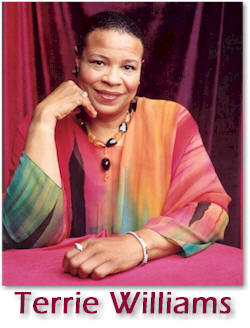
Terrie Williams, an OUR COMMON GROUND Voice, is author of Black Pain: It Just Looks Like We are Not Hurting and Dawn M. Porter is a MD Board Certified Child, Adolescent and Adult Psychiatrist

Terrie Williams

Terrie Williams

Recovery Work: Black Women and Emotional Health

Wednesday, September 4, 2013

Recovery Work: Black Women and Emotional Health

by Liz A.

I had a recent encounter with her, you know, that sister who is needy as hell. I was hoping she didn’t see me and with a quick right turn down the other hallway, I would be able to dodge her. But just my luck, before I could attempt my matrix type move, she spotted me.
DAMN.

Me: Hey sis…
Her: Hey girl, I’ve been calling you. Did you get my texts? My voice messages?
Me: Yes girl, I got them. I just have been extremely busy and haven’t had the opportunity to respond to them yet.

Yes, I am aware that she has been calling me. And yes, I did receive all of her texts and voice messages. But as an acquaintance, her incessant calling and texting made me uncomfortable. And after much thought I made a conscious decision not to return her calls and to distance myself from her. My decision to distance myself was not out of malice or ill will but as an act of self-care. Especially after unsuccessful attempts to playfully hint to her, using gestures such as “ girl, stop calling me a million times a day” or “sis, you don’t have to call me, I will call you,” that she needed to calm down with the contact. It was also intended to serve as a non-verbal cue, with the hope that, for someone who admittedly had difficulty with preserving friendships, she would take the time to recognize and examine her relationship patterns.

I mean what else could I have done? We weren’t close enough for me to tell her straight out that she didn’t have any friends because she was needy. And that her incessant contact was suffocating and entrapping and that contrary to her belief that it communicated her interest in pursuing a friendship, it actually displayed itself as neurotic and obsessive behavior that made people distance themselves from her. No, I couldn’t tell her this but I did hope someone who cared about her would; that way, it wouldn’t hurt so much.

Because as a woman in recovery, who herself was confronted about being needy, knowing that the person cared about me, helped to absorb some of the impact of that painful truth.

My need arose from the death of my mother when I was fourteen. After being abandoned by our relatives, my brothers and I were left to raise ourselves. During this phase of my journey, I was emotionally neglected, deprived of affection and suffered from issues of abandonment and rejection. In a desperate attempt to seek out love, as an only girl with limited female guidance, I sought out women under the guise of mentorship for nurture, affection and mothering, often forcing my emotional needs onto them. This resulted in several toxic and unhealthy relationships with women.

Overtime, I learned that my need came from a place of deep pain and wounded-ness. And according to my truth telling therapist, “as long as I come from that place of wounded-ness, I would never be in a healthy relationship.” So out of an act of ‘radical self love’ and out of a desire to be as whole as possible, I made a commitment to do the necessary work in order to heal, which involved taking ownership of my emotional health.

Just like that sister must do…

And when she does, she will realize that it’s deeper than her inability to develop friendships and that her neediness is but the language of her wounded-ness.


Reposted from “For Harriet” 

For Harriet is an online community for women of African ancestry. We encourage women, through storytelling and journalism, to engage in candid, revelatory dialogue about the beauty and complexity of Black womanhood.Learn more.

Liz A. is a woman on a journey of becoming. She is a “warrior poet”, an avid journal-ler and an independent writer. Liz identifies as a Womanist with Black Feminist tendencies and is currently a social worker in training. So far, Liz has written for the Feminist Wire and is a columnist for the ForHarriet blog. Liz is currently working on her untitled memoir.

At the Very Least, Your Days of Eating Pacific Ocean Fish Are Over

At the Very Least, Your Days of Eating Pacific Ocean Fish Are Over


Radiation

Opinion by Gary Stamper

The heart-breaking news from Fukushima just keeps getting worse…a LOT worse…it is, quite simply, an out-of-control flow of death and destruction. TEPCO is finally admitting that radiation has been leaking to the Pacific Ocean all along. and it’s NOT over….

I find myself moving between the emotions of sorrow and anger.

It now appears that anywhere from 300 to possibly over 450 tons of contaminated water that contains radioactive iodone, cesium, and strontium-89 and 90, is flooding into the Pacific Ocean from the Fukushima Daichi site everyday. To give you an idea of how bad that actually is, Japanese experts estimate Fukushima’s fallout at 20-30 times as high as as the Hiroshima and Nagasaki nuclear bombings in 1945

There’s a lot you’re not being told. Oh, the information is out there, but you have to dig pretty deep to find it, and you won’t find it on the corporate-owned evening news.

  • An MSNBC article in April of 2012 reported that seals and polar bears were found to have “external maladies” that consisted of fur loss and open sores, obvious signs of radiation burns from the Fukushima meltdown, despite the conclusions of the article.
  • Fukushima radiation appears to be causing an epidemic of dead and starving Sea Lions in California and the FDA has refused to test for radiation
  • Since the summer of 2011, U.S. scientists have observed several dozen living and dead Pacific Ocean marine mammals with a strangely similar condition of skin sores and hair loss. These animals may be suffering from ‘beta burns,’ which are caused by significant external exposure to ‘beta emitters’ such as radiostrontiums, which were released in copious quantities to the Pacific Ocean at Fukushima Daiichi in 2011
  • .Almost a third more US West Coast newborns may face thyroid problems after Fukushima nuclear disaster
  • Contaminated water from Fukushima reactors could double radioactivity levels of US coastal waters in 5 years — “We were surprised at how quickly the tracer spread”

Radiation

IS THE PACIFIC OCEAN FOOD CHAIN DOOMED? – May 2013 – Incredibly worrisome levels of cesium, including short-lived radioactive cesium-134, have been found near Hawaii in the LOWEST part of the marine food chain: plankton. Levels up the food chain, i.e. fish, whales, seals, due to bioaccumulation, MUST be magnitudes higher in contamination now or soon – stop eating Pacific wild seafood now – Researchers find high cesium in some Pacific plankton

SEAFOOD LOVERS ACROSS THE WORLD – The ‘levels’ of radiation in the seafood you are eating now and in the future certainly contain Fukushima radiation but will be considered ‘safe’ by government scientists. Let’s boil it down quickly: Scientists say the only safe level of radiation is zero. YET, governments set ‘limits’ for radiation in food well above zero. These limits actually increase every decade or so. If you love nuclear power and nuclear weapons complexes, then you should accept these limits as well as the fact that a fraction of our cancer epidemic is blamed on nuclear emissions. If you don’t want people (or yourself) to die of cancer to preserve nuclear power and nuclear weapons, then you should heed the scientific consensus conclusion that the safe level of radiation is zero becquerels of anything. Unless you are a nuclear nut, please protect your own health and regulate your genetic stability for the sake of your children, grandchildren, etc…by NOT EATING SEAFOOD OR CONSUMING ANYTHING MADE IN THE SEA. Learn more about food safety.

KEYPOINTS ABOUT FISH CONTAMINATION

  • Bluefin tuna will grow in radioactivity over years with each migration back to West Pacific; older caught fish will be hotter
  • Media is neglecting March (2012) lab study find that North Pacific albacore ‘tuna fish’ has same Fukushima cesium contaminant
  • All Pacific migratory fish are probably Fukushima contaminated – why isn’t this all over Twitter?
  • Alaska Halibut also found with same Fuku-cesium contaminant – but did not migrate to Japan’s waters. How did cesium-134 get into Alaska halibut?
  • Bluefin tuna in 2012 study aren’t all equally radioactive; sample #8 contained 50% higher cesium concentrations than the average of the 15 samples
  • Bluefin scientists did a most non-stellar job. They cherrypicked isotopes for dose comparison.
  • FDA is telling media and consumers it is ‘testing fish.’ It is testing imports and not testing U.S.-caught wild seafood (billions of pounds caught annually in U.S.) More
  • Cesium-134 is marker for strontium-90 – causes bone cancer and immune-disorders; babies are ‘sponges’ for calcium and strontium
  • Levels in bluefin tuna are similar to record food concentrations in 1960s
  • ECRR (Busby) predicts ’61,600,000 deaths from cancer’ (and 3.5 million baby deaths) ‘from the nuclear project since 1945,’ mostly the 1960s.
  • Bulk of 1960s exposure was internal, largely from ingested FOOD made radioactive from hydrogen bomb test fallout.
  • FDA saying levels are safe is a lie. FDA says its intervention levels will kill people. Downplays risk as ‘small’ compared to our ~40-50% cancer rate. But much of that rate is prolonged fallout effects from 1960s.
  • Baseline levels of manmade-radionuclides in Pacific seafood pre-Fukushima caused some genetic defects and cancers in world population
  • FDA uses faulty dose calculations that lowball rate of cancer carnage by several magnitudes. Genetic harm from cesium’s gamma rays ignored in dose models
  • Alvarez asks would a 1950′s NPR ‘trivialize’ ‘impacts of open-air hydrogen bomb testing?’ You bet. Our government and media is herding us into rail-cars destined for another radioactive holocaust.

Hawaii Is Hot

Hawaii is Hot with Radiation


Chemo Checklist – Things To Bring With You During Chemo by the Lymphoma Club

trust your struggleChemo Checklist – Things To Bring With You During Chemo by the Lymphoma Club

July 9, 2011 at 9:56am

This checklist and tips was created to help those undergoing chemo with ideas and suggestions on things to bring during chemo day including tips on how to prepare for chemo day.


Suggested items to bring with you during chemo (Put small items in a tote bag or back-pack and other items leave in car ):


1.     An advocate, family or friend to hold your hand and be there for you

2.     Portable notebook/laptop to help pass the time

3.     iPad/iPod or Kindle

4.     Portable DVD player – favorite movies

5.     Favorite music

6.     Books/Magazines – pen/pencils

7.     A small notebook to take notes

8.     A list of all your current medications

9.     Extra cotton t-shirt or change of shirt – preferably v-neck for women (for port access)

10.   Sweater/layers and sweats (be comfortable)

11.   Bottled water (very important to stay well hydrated)

12.   Sugarless candy (good to suck on before the heparin or chemo)

13.   An insulated lunch bag with snacks – important to eat a light meal  before chemo

14.   Travel size pillow (for comfort)

15.   Travel size blanket (cancer center may be cold)

16.   Soft toothbrush and travel size toothpaste

17.   Alcohol free mouth wash like Biotene (check with doctor or nurse)

18.   Alcohol-free sanitizers or towelettes

19.   Kleenix/tissue

20.   Paper Towels

21.   Chapstick

22.   Lotion

23.   Popsicles or ice cubes (to prevent mouth sores)

24.   A plastic bag for laundry or in case of nausea

25.   Small bucket to keep in car (in case of nausea emergency)

26.   A cooler for food and snacks, include extra for caregiver

27.   Small first aid kit

28.   A cooler to keep in car with cold water (optional)

29.   Pictures of favorite destinations, family and friends to keep you focused and motivated

30.   Anything inspirational to you

31.   Your doctor’s phone number or possibly nurse (obtain after-hours phone number too)


Chemo Tips and Suggestions


1.    Stay well hydrated

2.    Rest when tired

3.    Track and report side effects to doctor

4.    Reduce stress (as much as possible)

5.    Dress comfortable (loose, comfortable clothing)

6.    Stock up on items you need

7.    Eat a light, fiber meal before treatment

8.    Ask questions about the drug and what it’s for

9.    Have a supportive person nearby

10.  Allow for fatigue and recovery

11.  Keep a list of all medications and be sure doctor has a copy

12.  Have somebody check up on you after treatment. Know the warning signs of adverse chemical reactions.

13.  Buy a digital thermomater

14.  Never take supplements, vitamins, herbs or related WITHOUT checking with your oncologist/doctor, as it may interfere with treatment.


Other Suggestions:

Visit the dentist before you start chemo to ensure your teeth and gums are healthy


By the Lymphoma Club at FB


Black men increasingly hard to find in medical schools


PROFESSION

Black men increasingly hard to find in medical schools

A dwindling share of students pursuing physician careers are African-American men. Experts warn that the trend could exacerbate racial health disparities and doctor shortages.

By KEVIN B. O’REILLY, amednews staff. Posted Feb. 25, 2013.

As a medical student, Frank A. Clark, MD, was one of the few African-American men in his class. It wasn’t that he saw black men being rejected from medical school. The bigger problem was that he didn’t see many on track to get there at all.

“Even during my collegiate career, I was a biology major with a minor in chemistry, and I didn’t see many other African-American males on the premed route,” says Dr. Clark, now a psychiatry resident at Palmetto Richland Memorial Hospital in Columbia, S.C.

Black men are notable in that their numbers are lagging even as other minorities and women are continuing a long-term trend of gaining greater representation among medical school applicants and students, according to the most recent Assn. of American Medical Colleges report on medical education diversity.

The report said 2.5% of medical school applicants were black men in 2011, a drop from 2.6% in 2002. That compares with 9% and 11% increases in the share of Asian and Hispanic male applicants, respectively, during the same period. A 10% greater share of matriculating students were Asian men in 2011 than in 2002, and Hispanic men made up a 24% larger proportion of new medical students. The share of white male applicants and matriculants was stable.

10% of U.S. men 30 and older are black, but less than 3% of practicing doctors are black men.

Growth in the number of African-American women applying for — and attending — medical school has been comparatively weak as well, with their representation, as a percentage of all applicants and graduates, also in decline. However, their numbers are still enough to create, as they have for some time, the biggest gender gap among all racial or ethnic groups.

Twice as many African-American women as men applied to medical school, and black women accounted for nearly two-thirds of black students who were accepted and eventually matriculated. That disparity translates into graduation rates, with 63% of new black MDs in 2011 being women.

By comparison, the non-Hispanic white gender gap in favor of men is 55%-45%, and while most other racial and ethnic groups skew female, they don’t come near the African-American gender gap. Overall, according to AAMC, the male-female gap in applicants and matriculants in 2011 was 53%-47% favoring men, a near-historic low ratio that has held steady for the past few years.

The AAMC report said the “persistent” problem of black male underrepresentation among medical school applicants speaks to a need for medical schools, which have stepped up minority recruitment efforts in recent years to try to get their student bodies to reflect the American population, “to institute plans and initiatives aimed at strengthening the pipeline.” Efforts include attempts to interest more black male youth in medicine and hiring more faculty members “from racially and ethnically underrepresented groups.”

“We have a major, major problem in this country,” said Marc Nivet, EdD, the AAMC’s chief diversity officer. “There is just simply an enormous amount of indisputable evidence that we’re not intervening as effectively as we’d like as a society to increase the talent pool of African-Americans who are capable of taking advantage of the science curricula available up and down the pipeline.”

Despite a 3% rise in the total number of male African-American medical school graduates during the last decade, the proportion of new doctors who were black men fell from 2.6% in 2002 to 2.4% in 2011. African-Americans account for 13% of the U.S. population, but only 6% of 2011 matriculants were black, as are just 4% of practicing doctors. And while the Census Bureau reports that 10% of U.S. men 30 and older are African-American, less than 3% of practicing doctors are black men, according to American Medical Association data.

Multiple repercussions

The underrepresentation of black men in medicine is problematic for multiple reasons, experts say.

The shortage could worsen access to care in low-income communities, because black medical students are likelier than any other group to have a firm commitment to practicing in underserved areas, with 55% saying they plan to do so. Meanwhile, several studies have found that patients who are treated by physicians with whom they share racial or gender characteristics report greater satisfaction with their care and higher rates of medication compliance.

63% of new black MDs in 2011 were women.

With the U.S. Census Bureau projecting that nonwhites will account for a majority of the American population by 2050, a sputtering pipeline of black male doctors could worsen the physician supply problem. The AAMC projects that by 2025, the country will be short by 130,000 doctors of all racial and ethnic backgrounds.

“This has huge implications,” said Rahn K. Bailey, MD, president of the National Medical Assn., which promotes the interests of African-American physicians and patients.

“Society does better with balance all the way around,” he said. “And we don’t have balance if we have disproportionately twice as many females as males applying to enter the profession, or twice as many from California as from New York, or twice as many people who want to go into surgery as into pediatrics. We need everybody. We need all hands on deck.”

Disparities begin early

The gap seen among African-American men in medicine does not start when students apply to medical school. About 3% of college graduates are black men, and women account for nearly two-thirds of black students to earn bachelor’s degrees. Nearly three-quarters of African-Americans majoring in biology or biomedical sciences are women, according to 2009 U.S. Dept. of Education data.

Nationally, 52% of male African-Americans earn high school diplomas, compared with 58% of male Hispanics and 78% of male non-Hispanic whites, said a September 2012 report published by the nonprofit Schott Foundation for Public Education. For every black male physician, there are about 50 African-American men incarcerated at the federal, state or local levels, according to 2009 U.S. Justice Dept. data.

Twice as many African-American women as men apply to medical school.

Reaching male African-Americans at younger ages is critical, experts say. Twelve medical and dental schools now take part in the six-week, tuition-free Summer Medical and Dental Education Program, administered by the AAMC and the American Dental Education Assn. The program, launched in 1989, each year offers intensive preparation for dental or medical school, clinical experiences, and academic enrichment in math and science to about 1,000 college freshman and sophomores who are from underrepresented minority groups or low-income families.

Some medical schools are working to encourage math and science among elementary and secondary school students. The Duke University School of Medicine in Durham, N.C., works with the local public schools as early as the third grade, offering field trips to Duke health care facilities. Starting in the fifth grade, 25 students from underrepresented minority groups or low-income families are selected from each participating school to join Duke’s BOOST program, which offers extra math and science instruction, overnight field trips and summer workshops. The outreach effort continues with high school students, said Brenda Armstrong, MD, dean of admissions at Duke’s medical school. The school had more black graduates in 2011 — 20 total, 14 women — than all but four other medical schools.

“A lot of this has to do with giving [male African-Americans] the academic tools to work with at an early stage, and you have to reinforce those successes and keep them in the system,” said Dr. Armstrong, a professor of pediatrics.

Affirmative action’s future in doubt

Experts’ concern about the diminishing share of black men entering medicine is accentuated by uncertainty about the future of affirmative action. A case before the U.S. Supreme Court, Fisher v. University of Texas at Austin, could produce a ruling this year that restricts how publicly funded medical schools factor race, ethnicity and gender into admissions decisions. The AMA joined in a friend-of-the-court brief urging the Supreme Court to uphold the ability to use race as one part of the admissions process.

The AMA also co-founded the Commission to End Health Care Disparities in 2004 with the National Medical Assn. The commission studies gaps in care and convenes expert panels to provide practice and policy recommendations. In 2002, the AMA launched the Doctors Back to School program, which sends black, Hispanic and other physicians to visit schools to encourage minority students’ interest in medicine.

Dr. Clark, the Columbia, S.C., psychiatry resident, has taken part in the back-to-school program and also made other trips to talk with area elementary and high school students. Role models are key to encouraging more male African-Americans to pursue math, science and medicine, said Dr. Clark, a member of the AMA Minority Affairs Section’s governing council.

“As physicians, we have an obligation to not only serve our community in terms of providing good patient care, but also to be mentors, to reach out to those people who look up to us,” he said. “People do look up to us. We may not be Michael Jordan or Kobe Bryant. We may not have won championships, but we still have a role in the community to play, and a role that’s vital to the community.”

BACK TO TOP


 ADDITIONAL INFORMATION:

The last decade reshaped medical school diversity

The proportion of African-American men in medical schools has fallen since 2002, while a rising share of medical students come from Asian and Hispanic backgrounds.

Group 2002 applicants (%) 2011 applicants (%) 2002 matriculants (%) 2011 matriculants (%)
White men 10,483 (31.2%) 13,506 (30.8%) 5,355 (32.5%) 6,252 (32.5%)
White women 8,974 (26.7%) 10,451 (23.8%) 4,619 (28.0%) 4,808 (25.0%)
Asian men 2,965 (8.8%) 4,645 (10.6%) 1,474 (8.9%) 1,968 (10.2%)
Asian women 2,984 (8.9%) 4,296 (9.8%) 1,556 (9.4%) 1,891 (9.8%)
Hispanic men 1,167 (3.5%) 1,655 (3.8%) 549 (3.3%) 790 (4.1%)
Hispanic women 1,274 (3.8%) 1,804 (4.1%) 581 (3.5%) 843 (4.4%)
Black men 874 (2.6%) 1,107 (2.5%) 391 (2.4%) 445 (2.3%)
Black women 1,738 (5.2%) 2,108 (4.8%) 735 (4.5%) 737 (3.8%)
Total 33,625 43,919 16,488 19,230

Note: Individuals who did not mark a race or ethnicity, or who identified as multiracial, foreigners, Native Americans, Alaskans, Hawaiians or other Pacific Islanders are not included in this chart.

Source: “Diversity in Medical Education: Facts & Figures 2012,” Assn. of American Medical Colleges, November 2012; “Minorities in Medical Education: Facts & Figures 2005,” AAMC

BACK TO TOP


WEBLINK

“The Urgency of Now: The Schott 50 State Report on Public Education and Black Males,” Schott Foundation for Public Education, September 2012 (blackboysreport.org/urgency-of-now.pdf)

“Adherence to Cardiovascular Disease Medications: Does Patient-Provider Race/Ethnicity and Language Concordance Matter?,” Journal of General Internal Medicine, November 2010 (www.ncbi.nlm.nih.gov/pubmed/20571929)

“Diversity in Medical Education: Facts & Figures 2012,” Assn. of American Medical Colleges, November 2012, and earlier years (www.aamc.org/initiatives/diversity/179816/facts_and_figures.html)

BACK TO TOP


Copyright 2013 American Medical Association. All rights reserved.

Economic Mobility For African Americans May Be A Myth l Pew Report Finding

Economic Mobility For African Americans May Be A Myth, Pew Report Shows

The Huffington Post  |  By  Posted: 07/17/2012

Economic Mobility

The fine line between the American Dream and the African-American Dream is becoming more distinct, according to a recent report by the Pew Charitable Trusts, a nonprofit research organization.

The survey of economic mobility across generations compared the income and wealth of Americans with that of their parents at the same age, and it offered a promising outlook for most Americans — 84 percent to be exact — who were shown to have higher incomes than their parents, when adjusted for inflation.

African Americans, however, haven’t had the same success, with just 23 percent of blacks raised in the middle class surpassing their parents’ family wealth, compared to 56 percent of whites.

The study’s project manager, Erin Currier, said the results aren’t far off from what a simliar 2008 survey found. “With this newest update to the data, we can see that not much has changed with a few more years of data added in,” Currier told The Huffington Post. “Specifically, African Americans are much more likely than whites to be stuck at the bottom of the income ladder over a generation, and also at the bottom of the wealth ladder,” she said. They’re also more likely to fall from the middle.

Currier and her team analyzed income data over five years from the University of Michigan’s Panel Study of Income Dynamics (PSID), a nationally representative sample of more than 18,000 individuals living in 5,000 families in the United States. During the years they chose — 1967, ’68, ’69, ’70 and ’71 for the parents; 2000, ’02, ’04, ’06 and ’08 for their kids — both groups were at a common age (in their early to mid 40s) and at similar positions of marriage, income parity and post-secondary education, Currier said.

“It is the case that African-American families manage to get to the middle class and they have some sense of economic security, but their ability to pass that on to their kids is not as high as the white families,” she said.

And while this particular study didn’t delve into specific reasons for this gap, Currier pointed to previous research showing the impact neighborhood poverty has had on maintaining wealth disparities over time. “Two thirds of African-American children born between 1985 and 2000 are being raised in high poverty neighborhoods,” compared to just six percent of white children, Currier noted, proportions that haven’t shifted much over the last 30 years. “It isn’t the case that two thirds of African-American families are poor, but a lot of even middle-class African-American families are living in high poverty neighborhoods and research shows that, that environment in childhood increases a person’s chance of downward mobility by 52 percent,” she added.

A study published in May by the National Bureau of Economic Research may have hinted at one of the barriers to moving out of those poverty-stricken neighborhoods, revealing that black and Hispanic homebuyers pay as much as 3 percent more for their homes, regardless of their income, wealth or credit profiles.

Pew research has also examined the roles that marital status andincarceration have played in the black-white economic mobility gap in recent years. Meanwhile, others have looked at the roles of higher education and even differences by region. (Those with a college degree and those who live in the Northeast U.S. have a higher chance of moving up, researchers say.)

Since 2006, Currier and her team have set out to examine the health and status of the American Dream, which she says is more than a cliche, but rather a part of our national fabric based on the notion that your children can do better than you did.

“Our research shows a pretty mixed view of the degree to which that’s true,” she said. “On one hand, there has been significant economic growth over the last generation, [wealth that] has been broadly, equally shared. But at the same time, we see some lack of movement on the ladder as a whole.” So even though Gen Xers may have greater incomes than their parents did within a certain income bracket, they may not make enough to move to the next bracket up, Currier explained.

That finding contradicts what is said to be the crux of the American Dream, that all Americans have equality of opportunity regardless of their economic status at birth.

“A defining factor of the American dream is that a person’s family background or income has no bearing on where he or she ends up, but the study shows otherwise,” Currier said in an interview with the Poughkeepsie Journal.

More Black Men in Jail Than in College? Wrong l Ivory A. Toldson, Ph.D

More Black Men in Jail Than in College? Wrong

Show Me the Numbers: A 13-year-old report using questionable data gave rise to an enduring myth.

Students at a Morehouse College commencement (Getty); prisoners at the Avon Park Correctional Facility (Getty)

(The Root) — What does the line “There are more black men in jail than in college” have in common with the Jheri curl? Answer: They were invented by white men (Jheri Redding and Vincent Schiraldi, respectively) and adopted enthusiastically by black people, and they left a nasty stain on the shoulders of millions of black men.

It’s been more than 20 years since the Jheri curl faded away into infamy, and I’m proud to say that even in the 1980s, I never sported a curl. Unfortunately, I can’t say the same about the line “There are more black men in jail than in college.”

About six years ago I wrote, “In 2000, the Justice Policy Institute (JPI) found evidence that more black men are in prison than in college,” in my first “Breaking Barriers” (pdf) report. At the time, I did not question the veracity of this statement. The statement fit well among other stats that I used to establish the need for more solution-focused research on black male achievement.

I was in good company. The same year, at a 2007 NAACP forum, then-presidential candidate Barack Obama said, “We have more work to do when more young black men languish in prison than attend colleges and universities across America.”

However, just as a Jheri curl would be wrong no matter how you dressed it up today, the line “There are more black men in jail than in college” is wrong no matter how you contextualize, qualify or articulate it.

Today there are approximately 600,000 more black men in college than in jail, and the best research evidence suggests that the line was never true to begin with. In this two-part entry in Show Me the Numbers, the Journal of Negro Education’s monthly series for The Root, I examine the dubious origins, widespread use and harmful effects of what is arguably the most frequently quoted statistic about black men in the United States.

Continue Reading