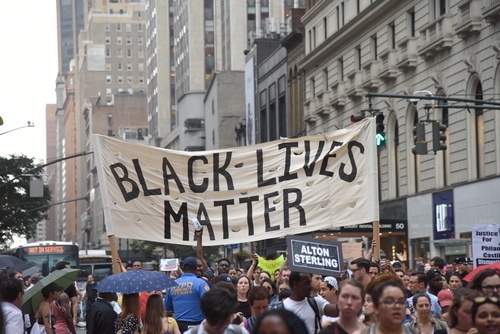
What Does Black Lives Matter Want?

What Does Black Lives Matter Want?

On August 1 the Movement for Black Lives (M4BL), a coalition of over sixty organizations, rolled out  “A Vision for Black Lives: Policy Demands for Black Power, Freedom & Justice,” an ambitious document described by the press as the first signs of what young black activists “really want.” It lays out six demands aimed at ending all forms of violence and injustice endured by black people; redirecting resources from prisons and the military to education, health, and safety; creating a just, democratically controlled economy; and securing black political power within a genuinely inclusive democracy. Backing the demands are forty separate proposals and thirty-four policy briefs, replete with data, context, and legislative recommendations.

But the document quickly came under attack for its statement on Palestine, which calls Israel an apartheid state and characterizes the ongoing war in Gaza and the West Bank as genocide. Dozens of publications and media outlets devoted extensive coverage to the controversy around this single aspect of the platform, including The Guardian, the Washington Post, The Times of Israel, Haaretz, and the St. Louis Post-Dispatch. Of course, M4BL is not the first to argue that Israeli policies meet the UN definitions of apartheid. (The 1965 International Convention for the Elimination of All Forms of Racial Discrimination and the 1975 International Convention on the Suppression and Punishment of the Crime of Apartheid define it as “inhuman acts committed for the purpose of establishing and maintaining domination by one racial group of persons over any other racial group of persons and systematically oppressing them.”) Nor is M4BL the first group to use the term “genocide” to describe the plight of Palestinians under occupation and settlement. The renowned Israeli historian Ilan Pappe, for example, wrote of the war on Gaza in 2014 as “incremental genocide.” That Israel’s actions in Gaza correspond with the UN definition of genocide to “destroy, in whole or in part, a national, ethnical, racial or religious group” by causing “serious bodily or mental harm” to group members is a legitimate argument to make.

The few mainstream reporters and pundits who considered the full M4BL document either reduced it to a laundry list of demands or positioned it as an alternative to the platform of the Democratic Party—or else focused on their own benighted astonishment that the movement has an agenda beyond curbing police violence. But anyone following Black Lives Matter from its inception in the killingtrayvonsaftermath of the George Zimmerman verdict should not be surprised by the document’s broad scope. Black Lives Matter founders Alicia Garza, Patrisse Cullors, and Opal Tometi are veteran organizers with a distinguished record of fighting for economic justice, immigrant rights, gender equity, and ending mass incarceration. “A Vision for Black Lives” was not a response to the U.S. presidential election, nor to unfounded criticisms of the movement as “rudderless” or merely a hashtag. It was the product of a year of collective discussion, research, collaboration, and intense debate, beginning with the Movement for Black Lives Convening in Cleveland last July, which initially brought together thirty different organizations. It was the product of some of the country’s greatest minds representing organizations such as the Black Youth Project 100, Million Hoodies, Black Alliance for Just Immigration, Dream Defenders, the Organization for Black Struggle, and Southerners on New Ground (SONG). As Marbre Stahly-Butts, a leader of the M4BL policy table explained, “We formed working groups, facilitated multiple convenings, drew on a range of expertise, and sought guidance from grassroots organizations, organizers and elders. As of today, well over sixty organizations and hundreds of people have contributed to the platform.”
The result is actually more than a platform. It is a remarkable blueprint for social transformation that ought to be read and discussed by everyone. The demands are not intended as Band-Aids to patch up the existing system but achievable goals that will produce deep structural changes and improve the lives of all Americans and much of the world. Thenjiwe McHarris, an eminent human rights activist and a principle coordinator of the M4BL policy table, put it best: “We hope that what has been created carries forward the legacy of our elders and our ancestors while imagining a world and a country profoundly different than what currently exists. For us and for those that will come after us.” The document was not drafted with the expectation that it will become the basis of a mass movement, or that it will replace the Democratic Party’s platform. Rather it is a vision statement for long-term, transformative organizing. Indeed, “A Vision for Black Lives” is less a political platform than a plan for ending structural racism, saving the planet, and transforming the entire nation—not just black lives.

If heeded, the call to “end the war on Black people” would not only reduce our vulnerability to poverty, prison, and premature death but also generate what I would call a peace dividend of billions of dollars. Demilitarizing the police, abolishing bail, decriminalizing drugs and sex work, and ending the criminalization of youth, transfolk, and gender-nonconforming people would dramatically diminish jail and prison populations, reduce police budgets, and make us safer. “A Vision for Black Lives” explicitly calls for divesting from prisons, policing, a failed war on drugs, fossil fuels, fiscal and trade policies that benefit the rich and deepen inequality, and a military budget in which two-thirds of the Pentagon’s spending goes to private contractors. The savings are to be invested in education, universal healthcare, housing, living wage jobs, “community-based drug and mental health treatment,” restorative justice, food justice, and green energy.

But the point is not simply to reinvest the peace dividend into existing social and economic structures. It is to change those structures—which is why “A Vision for Black Lives” emphasizes community control, self-determination, and “collective ownership” of certain economic institutions. It calls for community control over police and schools, participatory budgeting, the right to organize, financial and institutional support for cooperatives, and “fair development” policies based on human needs and community participation rather than market principles. Democratizing the institutions that have governed black communities for decades without accountability will go a long way toward securing a more permanent peace since it will finally end a relationship based on subjugation, subordination, and surveillance. And by insisting that such institutions be more attentive to the needs of the most marginalized and vulnerable—working people and the poor, the homeless, the formerly incarcerated, the disabled, women, and the LGBTQ community—“A Vision for Black Lives” enriches our practice of democracy.

For example, “A Vision for Black Lives” advocates not only closing tax loopholes for the rich but revising a regressive tax policy in which the poorest 20 percent of the population pays on average twice as much in taxes as the richest 1 percent. M4BL supports a massive jobs program for black workers, but the organization’s proposal includes a living wage, protection and support for unions and worker centers, and anti-discrimination clauses that protect queer and trans employees, the disabled, and the formerly incarcerated. Unlike the Democratic Party, M4BL does not subscribe to the breadwinner model of jobs as the sole source of income. It instead supports a universal basic income (UBI) that “would meet basic human needs,” eliminate poverty, and ensure “economic security for all.” This is not a new idea; some kind of guaranteed annual income has been fundamental to other industrializing nations with strong social safety nets and vibrant economies, and the National Welfare Rights Organization proposed similar legislation nearly a half century ago. The American revolutionary Thomas Paine argued in the eighteenth century for the right of citizens to draw a basic income from the levying of property tax, as Elizabeth Anderson recently reminded. Ironically, the idea of a basic income or “negative income tax” also won support from neoliberal economists Milton Friedman and Friedrich Hayek—although for very different reasons. Because eligibility does not require means testing, a UBI would effectively reduce the size of government by eliminating the bureaucratic machine of social workers and investigators who police the dispensation of entitlements such as food stamps and welfare. And by divesting from an unwieldy and unjust prison-industrial complex, there would be more than enough revenue to create good-paying jobs and provide a basic income for all.

Reducing the military is not just about resources; it is about ending war, at home and abroad. “A Vision for Black Lives” includes a devastating critique of U.S. foreign policy, including the escalation of the war on terror in Africa, machinations in Haiti, the recent coup in Honduras, ongoing support for Israel’s occupation of Palestine, and the role of war and free-trade policies in fueling the global refugee crisis. M4BL’s critique of U.S. militarism is driven by Love—not the uncritical love of flag and nation we saw exhibited at both major party conventions, but a love of global humanity. “The movement for Black lives,” one policy brief explains, “must be tied to liberation movements around the world. The Black community is a global diaspora and our political demands must reflect this global reality. As it stands funds and resources needed to realize domestic demands are currently used for wars and violence destroying communities abroad.”

Finally, a peace dividend can fund M4BL’s most controversial demand: reparations. For M4BL, reparations would take the form of massive investment in black communities harmed by past and present policies of exploitation, theft, and disinvestment; free and open access to lifetime education and student debt forgiveness; and mandated changes in the school curriculum that acknowledge the impact of slavery, colonialism, and Jim Crow in producing wealth and racial inequality. The latter is essential, since perhaps the greatest obstacle to reparations is the common narrative that American wealth is the product of individual hard work and initiative, while poverty results from misfortune, culture, bad behavior, or inadequate education. We have for too long had ample evidence that this is a lie. From generations of unfree, unpaid labor, from taxing black communities to subsidize separate but unequal institutions, from land dispossession and federal housing policies and corporate practices that conspire to keep housing values in black and brown communities significantly lower, resulting in massive loss of potential wealth—the evidence is overwhelming and incontrovertible. Structural racism is to blame for generations of inequality. Restoring some of that wealth in the form of education, housing, infrastructure, and jobs with living wages would not only begin to repair the relationship between black residents and the rest of the country, but also strengthen the economy as a whole.

To see how “A Vision for Black Lives” is also a vision for the country as a whole requires imagination. But it also requires seeing black people as fully human, as producers of wealth, sources of intellect, and as victims of crimes—whether the theft of our bodies, our labor, our children, our income, our security, or our psychological well-being. If we had the capacity to see structural racism and its consequences not as a black problem but as an American problem we have faced since colonial times, we may finally begin to hear what the Black Lives Matter movement has been saying all along: when all black lives are valued and the structures and practices that do harm to black communities are eliminated, we will change our country and possibly the world.

This article previously appeared in the Boston Review.

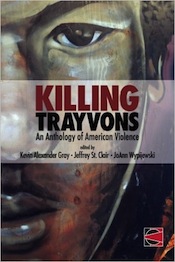
Robin D. G. Kelley, who teaches at UCLA, is the author of the remarkable biography Thelonious Monk: The Life and Times of an American Original (2009) and most recently Africa Speaks, America Answers: Modern Jazz in Revolutionary Times (2012). He is a contributor to Killing Trayvons: an Anthology of American Violence.

More articles by:

Source: What Does Black Lives Matter Want?

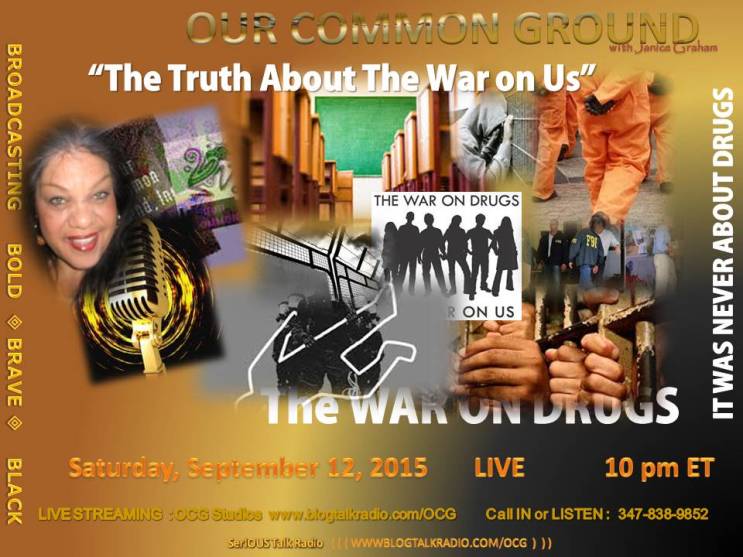
This Week on OUR COMMON GROUND φ “40 Years, $1 Trillion, 45 Million Arrests Later: “The Truth About the War Against Us” φ LIVE

OUR COMMON GROUND with Janice Graham

“The Truth About the War Against Us”
09-12-15 War on Drugs4
40 Years, $1 Trillion, 45 Million Arrests – the war still rages against our community. IT WAS NEVER ABOUT DRUGS

 Saturday, September 12, 2015

10 pm EDT
LISTEN LIVE and Join the OPEN Chat

LISTEN LIVE HERE

Learn more and join us on Facebook
Call In – Listen Line: 347-838-9852

This week on OUR COMMON GROUND, we review and examine the truth about the policies and intent of the “War on Drugs”. We need to talk about the money making behind the politics; how the drug war can be considered slow Nazi policy on the poor and the racial profiling used. We look at these destructive and failed policy and manipulation in its historical context and destructive outcomes. We will present audio clips for our discussion which will assist us in understanding just how much the “War on Drugs” was really never about drugs.

For sheer government absurdity, the War on Drugs is hard to beat. After three decades of increasingly punitive policies, illicit drugs are more easily available, drug potencies are greater, drug killings are more common, and drug barons are richer than ever. The War on Drugs costs Washington more than the Commerce, Interior, and State departments combined – and it’s the one budget item whose growth is never questioned. A strangled court system, exploding prisons, and wasted lives push the cost beyond measure. What began as a flourish of campaign rhetoric in 1968 has grown into a monster. And while nobody claims that the War on Drugs is a success, nobody suggests an alternative. Because to do so, as Surgeon General Joycelyn Elders learned, is political suicide.

As a community we need to understand how Drug War fever has been escalated; who has benefited along the way; and how the mounting price in dollars, lives, and liberties has been willfully ignored. Where are the policy maker offices where each new stage was planned and executed? What happened in the streets where policies have produced bloody warfare. This is a tale of the nation run amok – in a way the American people are not yet ready to confront. Are you?

You are invited to bring your thoughts about the pressing issues facing our community. Come listen and learn. SHARE please.

OUR COMMON GROUND where friends come to confer with allies.

Listen & Call In Line: 347-838-9852
Saturday, September 12, 2015 10 pm ET
Join the LIVE Broadcast Here

 http://bit.ly/1KIQv2q

            BROADCASTING   BOLD BRAVE & BLACK

Web     Facebook     Community Forum   Pinterest    Visit our Tumblr Page

Twitter: @JaniceOCG #TalkthatMatters

“Speaking Truth to Power and OURselves” 

email: OCGinfo@ourcommonground.com

Call In – Listen Line: 347-838-9852


Teaching Peace in Violence-Torn Regions of Africa φ Carmen del Rosario, Anti-violence Educator and Activist φ LIVE 10 pm ET 3-29-14

OUR COMMON GROUND with Janice Graham

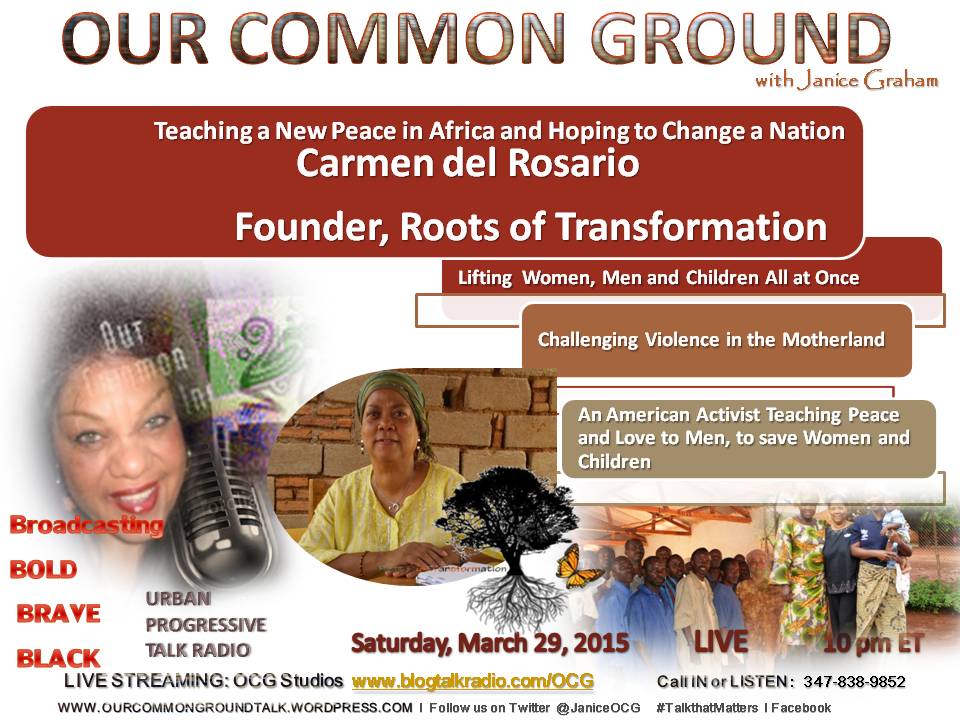
Teaching a New Peace in Africa and Hoping to Change a Nation

Guest:   Anti-Violence EducatorActivist Carmen del Rosario
Founder, Roots of Transformation


03-29 Carmen

Saturday, March 29, 2014 10 pm ET

LISTEN LIVE and Join the OPEN Chat

Web location:  http://www.blogtalkradio.com/OCG
Call In – Listen Line: 347-838-9852

“When I dare to be powerful– to use my strength in service of my vision, then it becomes less and less important whether I am afraid” – Audre Lorde

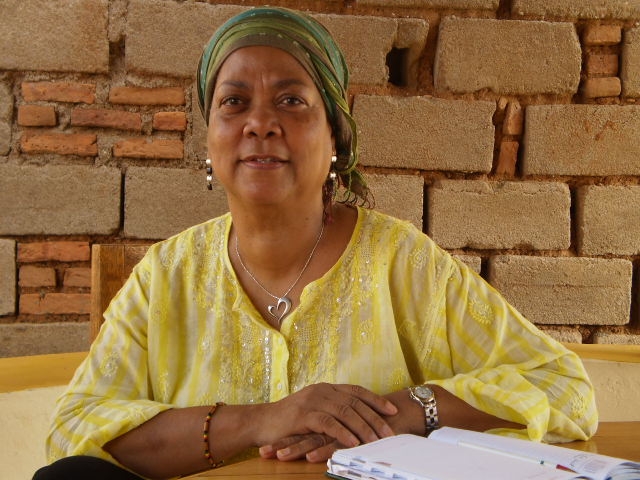
OLYMPUS DIGITAL CAMERAAbout Carmen del Rosario

Carmen is a highly driven and motivated, partnership, and programme management professional with over 20 years of professional experience working in the field of violence against women and children with government and development organizations, community networks and institutions in the US, El Salvador, Rwanda, Burundi, Dominican Republic, Tanzania, Congo (RDC) and Liberia

Ms. Carmen Del Rosario served as the Director of the Boston Public Health Commission’s Domestic Violence Program for 10 years. Del Rosario was a pioneer in developing strategies to engage boys and men in positive ways to prevent violence and to promote healthy relationships. In the year 2000, under her leadership, de Domestic Violence Program received funding from the CDC to develop , implement and evaluate a five years demonstration project working with men as fathers.

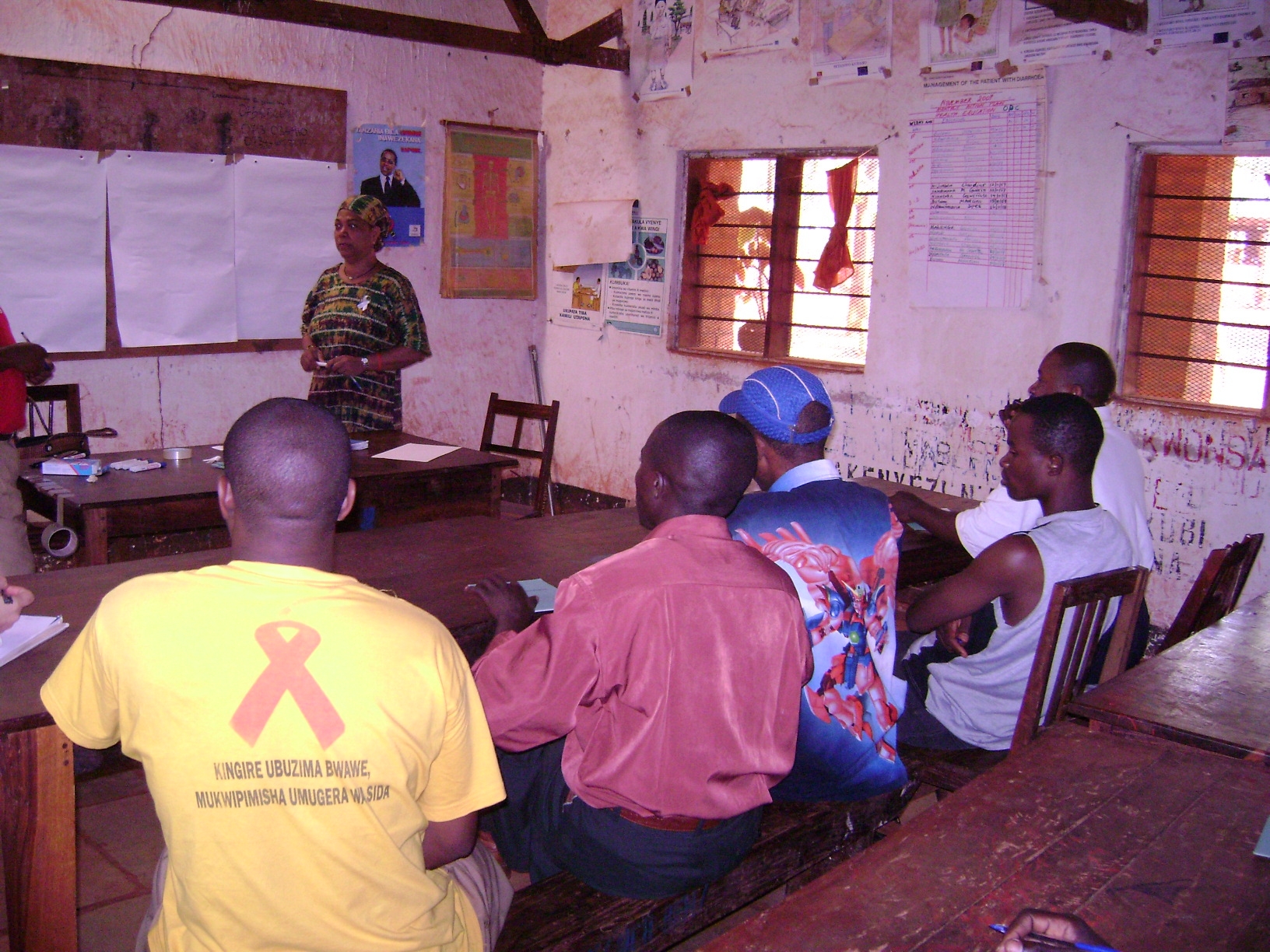
Over the past eight years Carmen has been working in East Africa, (Tanzania) Central Africa (Eastern Congo) and West Africa (Liberia), developing, coordinating and implementing programs to respond to survivors of Gender Based Violence (GBV), Women’s Empowerment Program as well as prevention initiatives with men from different background; these include, refugees’ men, religious leaders, traditional leaders, the police, and the UN peacekeepers. Carmen has developed intervention and prevention programs providing technical support to capacity development of the implementing partners in partnership with government, UNHCR, WFP, UNICEF and INGO.

ABOUT ROOTS of TRANSFORMATION

Roots of Transformation, is a non-government grassroots organization working toward the prevention of VAWC by catalyzing changes in communities and by supporting organizational sustainability. The organization works to prevent violence by addressing its roots causes, such as traditional gender roles, and the imbalance of power between women and men.

 Mission

DSC00577Roots of Transformation is committed to equipping people with the knowledge, wisdom and tools needed to make decisions that will positively impact their futures, the future of their family and their nation.

BROADCASTING BOLD BRAVE BLACK

OUR COMMON GROUND with Janice Graham

“Speaking Truth to Power and Ourselves”

email: OCGinfo@ourcommonground.com

Call In – Listen Line: 347-838-9852

“Speaking Truth to Power and Ourselves” 

email: OCGinfo@ourcommonground.com

LISTEN LIVE and Join the OPEN Chat

Call In – Listen Line: 347-838-9852

Community Forum

Twitter: @JaniceOCG #TalkthatMatters

Web   –  OCG Blog  –  OCG Pinterest   – Visit our OUR COMMON GROUND Tumblr Page

Facebook

“Speaking Truth to Power and Our selves” 

email: OCGinfo@ourcommonground.com

LISTEN LIVE and Join the OPEN Chathttp://www.blogtalkradio.com/OCG
Call In – Listen Line: 347-838-9852

Marissa Alexander seeks “Stand Your Ground” immunity,… | www.wokv.com

Marissa Alexander seeks “Stand Your Ground” immunity, sentencing changes


Marissa Alexander
Action News
Marissa Alexander

By Stephanie Brown

Jacksonville, FL —

We first told you earlier this week that Marissa Alexander’s attorney intended seek another “Stand Your Ground” immunity hearing ahead of her trial- and we’ve now obtained the documents backing that up.

More than 1200 pages were filed today in support of five separate motions. One would seek a pre-trial immunity hearing under “Stand Your Ground”. Two deal with the sentence Alexander could face if convicted. Two more deal with interactions between Alexander and Rico Gray.

Alexander was initially convicted of shooting a gun in the presence of Gray and two children and was sentenced to 20 years in prison. That conviction was overturned because of how the jury instructions were phrased. Alexander claims she fired a warning shot, fearing that Gray meant to harm her.

Stand Your Ground

Alexander sought SYG immunity ahead of her initial trial, but was denied. The motion now filed argues that neither the initial denial or the appeals court decision not to “reweigh” the case prevent Alexander from seeking this immunity again.

“This Court is able on remand to consider anew legal issues decided as part of the original proceeding, and the use of that discretion is especially vital where failure to do so would result in manifest injustice,” the motion reads.

The attorney, Bruce Zimet, says there has been “critical” new evidence since the initial SYG hearing and that the initial hearing itself included evidentiary problems. Zimet says the ruling in the SYG hearing was made largely on the testimony of Gray’s two sons, and he says one has since recanted and the other admitted to lying about a “prior altercation” between Gray and another woman, which Zimet believes woduld have established a pattern of Gray as abusive toward women.  He additionally argues that expert testimony on Alexander’s state of mind when she pulled the trigger was not previously introduced.

Zimet further says the initial SYG hearing was argued under the wrong statute.  He says the section used includes more stringent rules that require someone to have been attacked before returning with force of their own.

“By contrast, § 776.012—which applies to an individual in her home, as is the case here—eliminates any duty to retreat and allows deadly force if a person reasonably believes that such force is necessary to prevent imminent death, great bodily harm, or a forcible felony,” the motion says.

10-20-Life

A second motion claims sentencing Alexander to a mandatory minimum 20 years in prison is cruel and unusual punishment because it is “grossly disproportionate” to any offense Alexander is accused of committing.

Zimet argues the Florida legislature, who established 10-20-Life, never intended to have it applied to “battered women attempting to defend themselves”. In fact, Zimet cites current efforts at the state level to specifically exempt “warning shots” from such consequences, as proof that the statute was improperly applied.

While Zimet argues that Alexander should not face conviction at all, he says if she is found guilty, the sentence is out of proportion. He says most other states have a mandatory minimum nowhere near what Florida law outlines.

Consecutive vs. concurrent sentencing

The State Attorney’s Office tells WOKV that Florida statute requires Alexander to serve concurrent sentences if convicted, meaning she would face a minimum 60 years in prison for the total three counts of aggravated assault with a deadly weapon.

This motion is condition on the ruling over 10-20-Life. Zimet says if the court does not rule mandatory minimum sentencing should not apply here, than it should rule sentences should at least not run consecutive- a total sentence Zimet argues would be unconstitutional in two ways.

First, Zimet argues the State is not allowed to pursue a steeper sentence on appeal unless there is new evidence introduced to warrant it. Zimet says the State did not object to concurrent sentences on the initial trial, so consecutive sentencing now would be an unconstitutional increase.

Second, the motion states the 60 year sentence in itself would be unconstitutional.

“A sentence of such enormous length is grossly disproportionate to any offense Alexander may have committed by firing a single, upward warning shot to protect herself against an enraged husband with a history of abuse who only minutes before had violently assaulted her,” the motion says.

Rico Gray, Sr. prior actions

The fourth motion filed is notice of Zimet’s intent to introduce past actions by Gray as part of Alexander’s affirmative defense that she feared for her life.

“At Alexander’s first trial, the jury heard a he-said/she-said about the events of August 1, 2010,” the motion says.

There was as discrepancy between those sides on whether the argument was verbal or physical, who the aggressor was, if there was an imminent threat, whether Alexander could leave the scene and more.

“What the jury did not hear—and what Alexander is now entitled to introduce—is specific evidence of Gray’s prior similar attacks on women, his repeated lies to law enforcement to avoid prosecution, and his implicit and explicit threats of violence against and coercion of witnesses, including his own children, to falsely accuse his female victims of attacking him,” the motion says.

Zimet says there is evidence Gray attacked Alexander as well as other women, which makes it hard to believe he is a victim. While Alexander introduced evidence of prior violent acts against her by Gray in the initial trial, Zimet says they plan to offer further evidence of violent acts by Gray against other women as well, and repeated attempts to obstruct justice- including a threat to kill Alexander and cover it up.

Subsequent “incident” with Rico Gray

While out on bail for the initial charges, which happened in August 2010, Alexander communicated on several occasions with Gray. In December 2010, Alexander was charged with Domestic Battery stemming from a fight with Gray. Gray claims that he refused to let Alexander spend the night after she dropped off their daughter, and she became angry and punched him, leaving marks on his face. Alexander claims Gray was the one who was angry and violent because she refused to spend the night, but police did not notice any physical marks on her.

In the first trial, the defense sought to preclude any evidence of this incident, but was denied. Zimet has filed a new motion asking the court to reconsider that motion to preclude.

Zimet says the fact that Alexander had contact with Gray cannot rebut her claim to self-defense. He says the charge deals with Alexander’s state of mind and fear of harm the moment she fired the gun, so only evidence dealing with that moment should be presented to a jury.

“The December 30 incident is not probative of Alexander’s state of mind nearly five months earlier, before she and Gray went to marital counseling, before Gray’s profuse apologies and proclamations of love, and before Alexander learned that her daughter Rihanna’s insurance was set to expire at the end of 2010 unless Alexander obtained Gray’s signature on Rihanna’s birth certificate,” the motion says.

Zimet further says the incident is “excessively prejudicial”, which hampers the interest of justice.

The State’s response

The State Attorney’s Office has issued a statement reading, in part, that they are reviewing these most recent motions.

“The State Attorney’s Office is committed to seeking justice for our two child victims and their father,” the statement says.

It further reads that they will make a response to these motions at the appropriate time.

Alexander’s retrial has been scheduled for July.


Marissa Alexander seeks “Stand Your Ground” immunity,… | www.wokv.com.

Update: Marissa Alexander Is Given No Bail Today – New Evidence Comes To Court

WED NOV 13, 2013

Updated: Marissa Alexander Is Given No Bail Today – New Evidence Comes To Court

by Leslie SalzilloFollow

in SOLIDARITY mARISSAMarissa Alexander, the Florida woman who was sentenced to 20 years for firing a warning shot to ward off her abusive husband, was granted no bail Wednesday afternoon in a Jacksonville courtroom. The mother of three will most likely not get to spend Thanksgiving or Christmas with her children, as the ‘deciding judge’ opted to make no decision and set another hearing for January 15, 2012 – pending of course, that he does, or does not, change his mind.In 2010, just days after giving birth, Marissa Alexander fired a warning shot in self-defense to keep her abusive husband, Rico Gray, from attacking her. In his deposition, Gray who has a history of abusing Alexander, admitted it, stated he intended to hurt her had she not fired the warning shot, and said she did the right thing. He also said Alexander did not aim he gun at him. Gray then changed his story once the case went to trial. He walked out a free man – Marissa Alexander, the battered wife, received 20 years. The Florida Stand Your Ground Law did not work for Alexander because she fired a warning shot. Had she shot and killed Rico Gray that day, she would have most likely served no time at all.

My source who was in the courtroom today, reported new evidence has been brought forth – a text message of Rico Gray asking Marissa to come over for sex while there was an order of protection. Rico Gray claims Marissa should not be let out on bond because he is afraid of Marissa; he fears/feared for his life. Does asking her for sex sound like someone who feared for his life?

“I was in a rage. I called her a whore and bitch and . . . I told her, you know, I used to always tell her that, if I can’t have you, nobody going to have you. It was not the first time of ever saying it to her.”~ Rico Gray in his deposition on November 22, 2010.

Again, does this sound like a man fearing for his life?Marissa Alexander’s case has been highly publicized from the start, and the Free Marissa Now campaign has grown throughout social media. The case was catapulted into even more national spotlight, following the George Zimmerman case. In July 2013, Zimmerman was set free after killing teenager, Trayvon Martin, even though Zimmerman was the aggressor. Ironically, the same state attorney that failed to successfully prosecute George Zimmerman, is the same attorney that sent Marissa Alexander to prison. State Attorney Angela Corey ‘twisted the knife’ by refusing to drop Alexander’s case,even after it was overturned in September.

Unless something changes, it doesn’t look as though Marissa Alexander and her three children will be having happy holidays, as she awaits a new bail hearing, and then a whole new trial in March 2014. Supposedly the next trial will be different. This time, Florida courts say the burden of proof will be placed upon them rather than Marissa Alexander. Isn’t that how it’s supposed to work, Florida?

If you’re in an abusive relationship, or know someone who may be, there is help: Call: 800-799-SAFE/National Domestic Violence Hotline or Call: 800-656-HOPE/RAINN (Rape,Abuse, & Incest National Network) 

Domestic Violence: When Love Becomes Hurtful

domestiv v

Domestic Violence: When Love Becomes Hurtful

By: Rev. Arlington Pryor, M.Div. 

The Statistics on Domestic Violence Are Shocking

Domestic violence occurs in an estimated 4 million intimate relationships each year in the United States. We are now recognizing and dealing with the urgency and severity of domestic violence in cities from coast to coast. The statistics reveal that domestic violence is one of the most important public health problems in our country and it is time that we all address this issue. Consider the following findings:

  • The Surgeon General of the United States reports that domestic violence causes more injury to adult women than cancers, heart attacks, or strokes.
  • FBI statistics point out that a woman is battered every 15-18 seconds in the United States.
  • More than three million children witness domestic violence, and more than four million women are battered to death by their husbands or boyfriends each year.
  • Approximately one third of female murder victims in the United States are killed by their husband or boyfriend.

What Is Domestic Violence?

Domestic violence, partner abuse, and battering refer to the physical, emotional, sexual, and psychological abuse, performed by one person against another. The abuser and the victim are involved in or have had an intimate or romantic relationship.

Who Are The Victims?

Domestic violence, including battering, happens in all socioeconomic levels, to urban or rural women, young or old, with child and childless, single, married, divorced – and within all religious, racial, ethnic groups, and geographic locations. Councils On Family Violence has designated domestic violence battering as an “Unreported Epidemic.” It is important to note, that women initiate and carry out physical assaults on their partners as often as men do, according to a 1993 study by Straus and Gelles. However, when it comes to serious physical abuse, women are still overwhelmingly on the receiving end.

The Impact Of Domestic Violence On Women:

More women are injured through domestic violence than by rape, muggings, and car accidents combined. Many pregnant women have been and may be victims of domestic violence abuse. Forced sex or marital rape is the leading type of sexual assault. Yet marital rape or forced sex maybe the most underreported and least legally punished crime of partner abuse because many victims are reluctant to report and file charges against the abuser, for various reasons. The Justice Department’s 1994 National Crime Victimization Survey (NCVS) found that only about half of the women who suffered domestic violence between 1987 and 1991 reported the abuse to law enforcement authorities.

Domestic Violence and African Americans

African Americans, including African American Women suffer deadly violence from family members at rates decidedly higher than for other racial groups in the United States. However, it is observed that research concerning family violence among African Americans is inadequate.

Factors such as the breakdown of families, unemployment and underemployment, poor schools, inadequate vocational skills and training, bad housing, the influence and use of drugs, and the density of liquor stores in the inner city contribute to the problem of domestic violence. All of these ingredients may compound and coalesce into a strong undercurrent of frustration that can lead to domestic violence.

A Painful Dilemma

Many Black women may find it harder to leave a battering relationship than White women. The reasons for this are unclear, but some possible explanations include the following: (1) African American women have fewer options in their search for a marital partner than do White women; (2) African American women on average, have a lower income level than that of most White women; (3) Black women are reluctant to call the police because they see the racial injustice in the criminal justice system; (4) community support systems including women’s shelters and other service programs may be less available to them and they may view the shelter system movement as something mainly to benefit White women. Unfortunately, many Black women resort to “homicide” as an answer to the violence and battering they encounter.

What You Can Do If You (Or A Friend) Suffers Domestic Violence

  • Domestic violence is a Federal crime. Call 911 immediately. This will activate the criminal justice system in regards to your domestic violence abuse and injurious claims. Experts say that women are beaten about five times before they ever dial 911.


  • Try to give police all available information and make certain that the police listen and write down your statements and their observations, and direct quotes of what your abuser said while attacking you.


  • Never refuse medical evaluations and medical services! Never clean up the house or location after a domestic violence attack, so that critical evidence of harm or injury is not removed. Keep a Polaroid or some type of camera and film on hand to photograph your injuries and any damage to property, etc. Remember, “a picture is worth a thousand words,” and is a good sign of evidence.


  • Call domestic violence resource agencies in your community or call the National Domestic Violence hot line at (800) 799-SAFE (7233). This hotline was initiated in 1996 with cooperation from the Justice Department. Through this hotline, a woman anywhere in the United States can be connected to resources to help her get away from her violent abuser.

Consider Obtaining A Protective Order Against Your Abuser

A protective order can be issued by civil and criminal courts against anyone who is a threat to your safety. The 1994 Federal Violence Act against women specifies that protective orders are recognized and enforced from state to state and includes Indian Tribal Reservations. Call the various domestic violence organizations and agencies for information and advice about a protective order.

How Can We As A Community More Effectively Address This Problem?

We must all work together to fight against domestic violence. Churches, corporations, hospitals, and individuals in general must be vigilant about increasing the awareness that domestic violence is a major problem facing our communities. Churches should present sermons, workshops and provide information about domestic violence and sexual violence including rape, child incest and child molestation, and conjugal battery.

Churches should also keep a file of references of therapists who work with victims of domestic and sexual violence and of medical, law enforcement, social services, and other resources that offer help and support. The Church needs to be open and forthright about the reality of domestic and sexual violence and not be silent on these subjects.

Additionally, hospitals and health care providers must be more vigilant in screening for domestic violence. The American Medical Association (AMA) advises doctors and nurses to routinely observe and screen patients in the emergency rooms for signs of domestic violence, and report their findings to proper authorities.

Empowerment Points

  • Domestic and sexual violence is a vicious malady that the African American community must confront, reduce, and eliminate from our lives.


  • The ancient Chinese proverb says that a journey of a thousand miles begins with the first step.


  • You are taking the first step by being informed and aware that domestic violence is a hard reality and no laughing matter for Black women.

References:

Hot Line

African American Domestic Violence Fact Sheet

Web Sites:


Books


  • Maria Hong, “Family Abuse, A National Epidemic”, Springfield, NJ: Enslow Publishers, Inc., 1997


  • Cynthia L. Mather, “How Long Does It Hurt?”  San Francisco, CA: Jossey-Bass Publishers, 1994


  • Susan Murphy-Milano, “Defending Our Lives”, New York: An Anchor Book, published by Doubleday, 1996


  • A.E. Sadler, book editor, “Family Violence”, San Diego, CA: Greenhaven Press, Inc., 1996


  • Jan Berliner-Statman, “The Battered Woman’s Survival Guide”, Dallas, TX: Taylor Publishing Company, 1995


  • Karin L. Swisher, book editor, “Domestic Violence”, San Diego, CA: Greenhaven Press, Inc., 1996


  • Karin L. Swisher and Carol Wekesser, book editors, “Violence Against Women”, San Diego, CA: Greenhaven Press, Inc., 1994

– See more at: http://www.blackwomenshealth.com/blog/domestic-violence-when-love-becomes-hurtful/#sthash.cOIlEzLB.dpuf

Women’s lives don’t matter: The lesson of Marissa Alexander

TUESDAY, OCT 1, 2013

Women’s lives don’t matter: The lesson of Marissa Alexander

Laws fail to effectively stop violent men or protect us — that’s why we have to stand up for ourselves

BY 

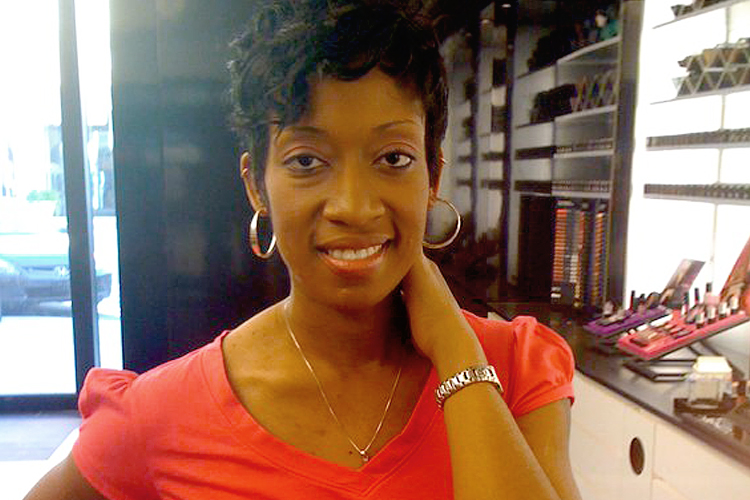
Women's lives don't matter: The lesson of Marissa AlexanderMarissa Alexander (Credit: AP/Lincoln B. Alexander)

I am passionate about domestic violence, because I am a childhood survivor of domestic violence. I know all too well the ways in which men like my father, many of whom are themselves subjugated on the basis of race and class, use home spaces to assert dominance and control that they are not able to wield in the larger world.

I know intimately the terror of being under surveillance in one’s own home, of the prerogative that many men assert to control the comings and goings of their partners and children, often through the threat of violence and force. I have seen how difficult it is to stand your ground, when society is structured to give men economic and political control over private, domestic space. I know what the journey to survivor status looked like for my mother, and the way that my father’s violence demoralized him and ruined our relationship.

I think of the women survivors of gun violence that I personally know (and of the gun violence that snuffed out my father’s life at the age of 33, as he ironically tried to prevent another woman and her children from becoming the victims of domestic violence at the hands of another man).

I think of two high school classmates, a white girl named Mary Dee and a black girl named Jackie, both killed by fatal gunshots in murder-suicide scenarios involving their partners. I think of a class of first-year, college-age African-American women (18 and 19 year olds) that I taught several years ago, in which fully one-quarter of them admitted to having been in violent relationships in high school.

I think about all the stories that are almost too terrifying to remember and much too personal to confess.

Last week, a judge ordered a new trial for Marissa Alexander, a 33-year-old African-American woman from Florida currently serving a mandatory 20-year sentence for firing a warning shot into the wall to scare off her violent and abusive husband.

The new trial order comes just in time for our annual October commemoration of Domestic Violence Awareness Month, and it calls attention to startling new statistics released from the Violence Policy Center. In 2011, 1,707 women were murdered by men in single victim, single offender incidents. In 94 percent of these cases, these women were murdered by men they knew, and in 51 percent of the cases, they were murdered by guns. Sixty-one percent of these victims were wives or intimate acquaintances of their killers. This means that intimate partner relationships constitute one of the most significant contexts through which women experience violence within our culture.

The disproportionate amounts of violence toward black women, who are 2.5 times more likely to be killed by an intimate partner than their white female counterparts, were significant enough to warrant their own section of the report. In 2011, 470 black women were killed in single victim/single offender homicides. In cases where the relationship could be determined, 94 percent of black women knew their killers.

That number is entirely consistent across racial categories, because most violent crime is intraracial. On the one hand, that fact would seem to highlight the erroneous nature of designations like “black-on-black” crime, an incendiary term use to pathologize black people, while failing to acknowledge that among white people most crime is “white-on-white” crime.

Beyond the racially problematic dimensions of these kinds of demographic designations, there is the problem of gender. Black women are never the subject of either community or national discussions about “black-on-black” crime, which is largely focused on stopping the epidemic of homicidal violence among young black men. The invisibilization of black women from discourses about victims of violence makes it hard to actually see black women as victims.

In Marissa Alexander’s case, she inadvertently encountered her husband, a man against whom she had a restraining order, when she went to their home to retrieve her clothes unaware that he would be there. When he showed up, she felt threatened, went to her car to retrieve her gun, and then fired a shot into the wall in order to scare him away. Perhaps, this is why the judge also ruled that Alexander cannot use a “stand your ground” defense in her own trial.

The failure of the law to protect Marissa Alexander from her husband, who has admitted under oath to treating her violently, placed her in a difficult set of circumstances. There is no reason that she should be serving 20 years in prison for defending herself against a violent attacker. Yet, she was sentenced through a combination of overzealous prosecuting, by the same Florida district attorney, Angela Corey, who had to be convinced through national protests and marches to prosecute Trayvon Martin’s killer, and extremely punitive mandatory minimum sentencing laws that require some crimes in which a gun is used to carry a 20-year sentence.

Yet again, Angela Corey, and the Florida justice system in general, seem to have a hard time distinguishing victims from perpetrators.

In an ironic twist, Shellie Zimmerman, wife of acquitted killer George Zimmerman, has also had trouble finding any protection on the basis of Florida’s domestic violence laws.  In early September, Shellie Zimmerman called 911 to report that George Zimmerman was brandishing a gun at her and her father, as she attempted to remove her belongings from their home after filing for divorce. Mrs. Zimmerman never saw the actual weapon, but instead observed her husband using threatening body language, while gesturing toward his waistband. She concluded that he had a gun, and since he is legally entitled to carry his gun after being acquitted of Trayvon Martin’s murder, that seems like a credible conclusion on her part. To date, no charges have been filed against George Zimmerman, even though this is not his first run-in with the law on charges of domestic violence.

Fifty-one percent of female homicide victims are killed with guns. In a world where women’s lives matter, robust gun control would be non-negotiable. But in a world where women’s lives don’t matter, Marissa Alexander doesn’t have any ground on which to stand, nor a fighting chance at freedom.

Lest folks convince themselves that these kinds of occurrences are anomalous, I would encourage you to spend some time this month talking to the women you know about the violence they have experienced at the hands of men in their own lives.

Marissa Alexander stood up for herself. She did not retreat. She refused any longer to take her husband’s shit. Unaided by laws that can effectively stop violent men in their tracks, all women survivors reach a point where they refuse to take it anymore. Even as we work to transform our culture of misogynistic violence into a world safe for women to inhabit, we must stand with and for those women who are standing up for themselves.

Brittney CooperBrittney Cooper is a contributing writer at Salon. Follow her on Twitter at@professorcrunk.

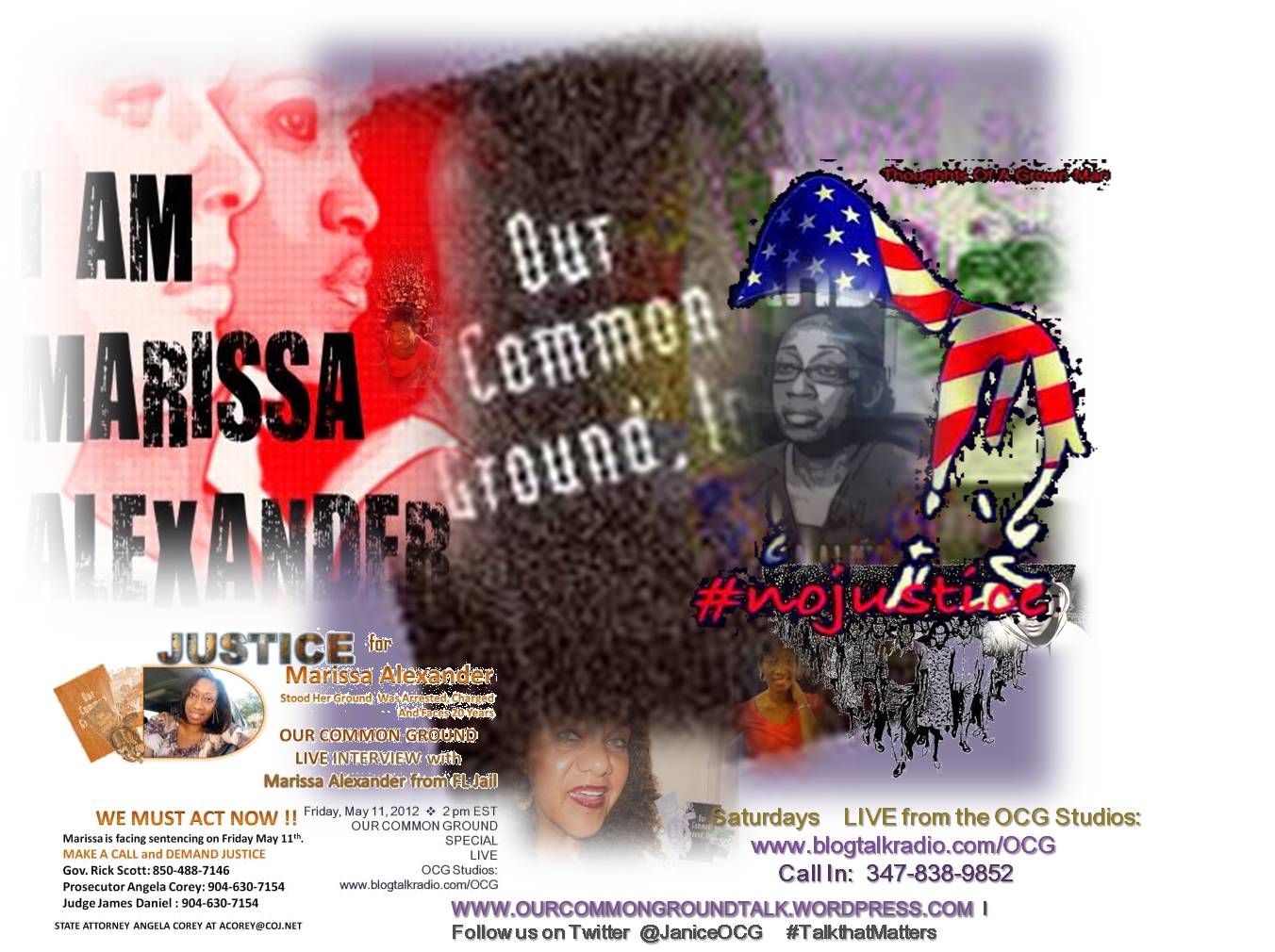
LISTEN LIVE TO OUR LIVE INTERVIEW WITH Ms. Alexander hours following her sentencing.

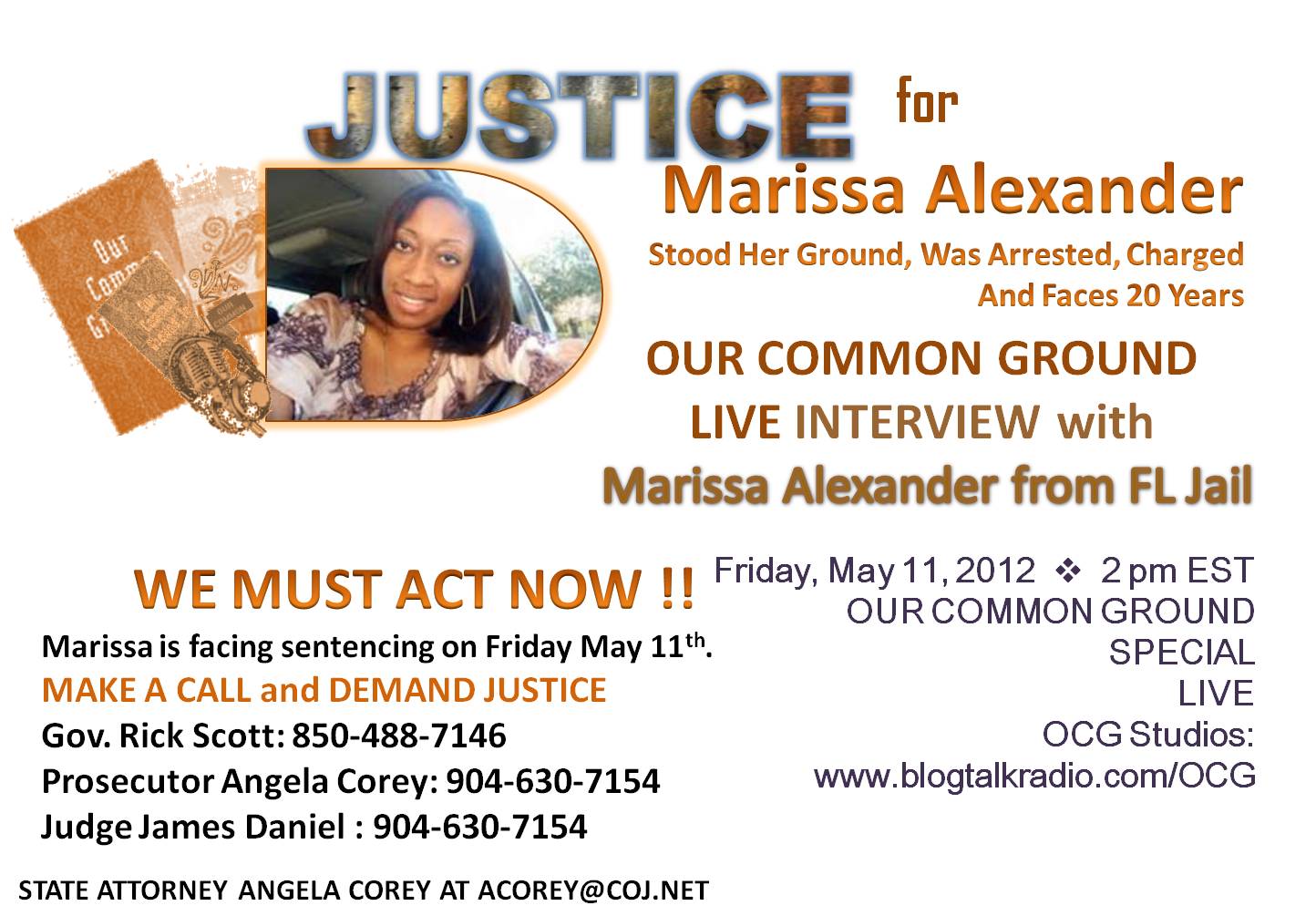
5-12 aCTION aLERT

Michelle Alexander: I can no longer just stay in my lane

Michelle Alexander: I can no longer just stay in my lane

September 3, 2013

by Michelle Alexander

For the past several years, I have spent virtually all my working hours writing about or speaking about the immorality, cruelty, racism and insanity of our nation’s latest caste system: mass incarceration. On this Facebook page I have written and posted about little else. But as I pause today to reflect on the meaning and significance of the 50th anniversary of the March on Washington, I realize that my focus has been too narrow.

Michelle Alexander graphic, webFive years after the March, Dr. King was speaking out against the Vietnam War, condemning America’s militarism and imperialism – famously stating that our nation was the “greatest purveyor of violence in the world.” He saw the connections between the wars we wage abroad and the utter indifference we have for poor people and people of color at home. He saw the necessity of openly critiquing an economic system that will fund war and will reward greed, hand over fist, but will not pay workers a living wage. Five years after the March on Washington, Dr. King was ignoring all those who told him to just stay in his lane, just stick to talking about civil rights.

Yet here I am decades later, staying in my lane. I have not been speaking publicly about the relationship between drones abroad and the War on Drugs at home. I have not been talking about the connections between the corrupt capitalism that bails out Wall Street bankers, moves jobs overseas and forecloses on homes with zeal, all while private prisons yield high returns and expand operations into a new market: caging immigrants. I have not been connecting the dots between the NSA spying on millions of Americans, the labeling of mosques as “terrorist organizations” and the spy programs of the 1960s and ‘70s – specifically the FBI and COINTELPRO programs that placed civil rights advocates under constant surveillance, infiltrated civil rights organizations and assassinated racial justice leaders.

I have been staying in my lane. But no more. In my view, the most important lesson we can learn from Dr. King is not what he said at the March on Washington, but what he said and did after. In the years that followed, he did not play politics to see what crumbs a fundamentally corrupt system might toss to the beggars of justice. Instead he connected the dots and committed himself to building a movement that would shake the foundations of our economic and social order, so that the dream he preached in 1963 might one day be a reality for all. He said that nothing less than “a radical restructuring of society” could possibly ensure justice and dignity for all. He was right.

I am still committed to building a movement to end mass incarceration, but I will not do it with blinders on. If all we do is end mass incarceration, this movement will not have gone nearly far enough. A new system of racial and social control will be born again, all because we did not do what King demanded we do: connect the dots between poverty, racism, militarism and materialism. I’m getting out of my lane. I hope you’re already out of yours.

This statement was posted by Michelle Alexander to her Facebook page on Aug. 28, 2013.

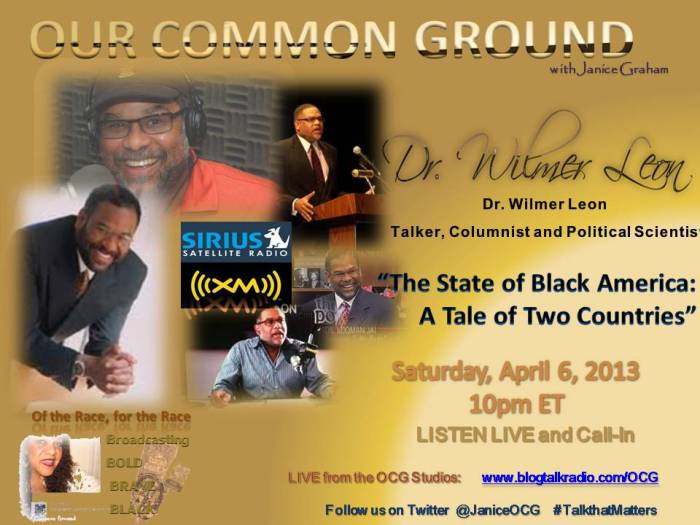
OUR COMMON GROUND with Janice Graham l “The State of Black America: A Tale of Two Countries” l Guest: Dr. Wilmer Leon l April 6, 2013

OUR COMMON GROUND with Janice Graham

April 6, 2013       10 pm ET  LIVE

“The State of Black America: A Tale of Two Countries”

Tonight’s Guest: Dr. Wilmer Leon


04-06 Wiler2 Leon


“The State of Black America: A Tale of Two Countries”

Tonight’s Guest: Dr. Wilmer Leon

Dr. Leon comes to OCG once again to weigh in on the issues which face Black America, the politics of our problems and the light of solutions available.

Wilmer J. Leon III, Ph.D. is a Political Scientist whose primary areas of expertise are Black Politics, American Government, and Public Policy. He is a Teaching Associate in the Political Science Department at Howard University in Washington, D.C., a nationally syndicated broadcast radio talk show host, columnist, commentator, political consultant, TV host, lecturer, and much sought after motivational speaker.

Dr. Leon earned a BS degree in Political Science from Hampton Institute, a Masters in Public Administration (MPA) from Howard University, and a Ph.D. in Political Science from Howard University.

A serious void exists in the public discourse relating to the issues that directly and/or disproportionately impact the global village in which we live. Dr. Leon’s lectures and writings focus on issues such as the media’s coverage of national and international issues, the criminal industrial complex, environmental racism, school vouchers, health care, crime policy, economic globalization, American domestic and foreign policy from as much of a non- biased and academically accurate perspective as possible. Dr. Leon’s perspective and lectures are grounded in the history of the African American community and the tradition of African American scholarship.

Dr. Leon is host/producer of the nationally broadcast call in talk radio program Inside The Issues With Dr. Wilmer Leon on XM/Sirius satellite radio channel 169 “Urban View” and the host of Epilogue, a political book discussion program on Press TV. He hosts discussion on Facebook as Dr. Leon Prescriptions.

Dr. Leon was a regular guest on CNN’s Lou Dobbs Tonight and is a contributing columnist to The Grio.com, The Black Agenda Report, The Maynard Institute.com, TruthOut.org, PoliticsInColor.com and Black Star News.

OUR COMMON GROUND with Janice Graham

“Speaking Truth to Power and Ourselves”

BROADCASTING     BRAVE     BOLD BLACK

LISTEN LIVE 

Join the discussion in our Open Chat during the broadcast.

 On the Web

Follow us on Twitter    @JaniceOCG      #TalkthatMatters

Like US on Facebook

LIVE: OCG Meetinghouse: http://www.blogtalkradio.com/OCG
For More Information: http://www.ourcommongroundtalk.wordpress.com/


More Black Men in Jail Than in College? Wrong l Ivory A. Toldson, Ph.D

More Black Men in Jail Than in College? Wrong

Show Me the Numbers: A 13-year-old report using questionable data gave rise to an enduring myth.

Students at a Morehouse College commencement (Getty); prisoners at the Avon Park Correctional Facility (Getty)

(The Root) — What does the line “There are more black men in jail than in college” have in common with the Jheri curl? Answer: They were invented by white men (Jheri Redding and Vincent Schiraldi, respectively) and adopted enthusiastically by black people, and they left a nasty stain on the shoulders of millions of black men.

It’s been more than 20 years since the Jheri curl faded away into infamy, and I’m proud to say that even in the 1980s, I never sported a curl. Unfortunately, I can’t say the same about the line “There are more black men in jail than in college.”

About six years ago I wrote, “In 2000, the Justice Policy Institute (JPI) found evidence that more black men are in prison than in college,” in my first “Breaking Barriers” (pdf) report. At the time, I did not question the veracity of this statement. The statement fit well among other stats that I used to establish the need for more solution-focused research on black male achievement.

I was in good company. The same year, at a 2007 NAACP forum, then-presidential candidate Barack Obama said, “We have more work to do when more young black men languish in prison than attend colleges and universities across America.”

However, just as a Jheri curl would be wrong no matter how you dressed it up today, the line “There are more black men in jail than in college” is wrong no matter how you contextualize, qualify or articulate it.

Today there are approximately 600,000 more black men in college than in jail, and the best research evidence suggests that the line was never true to begin with. In this two-part entry in Show Me the Numbers, the Journal of Negro Education’s monthly series for The Root, I examine the dubious origins, widespread use and harmful effects of what is arguably the most frequently quoted statistic about black men in the United States.

Continue Reading