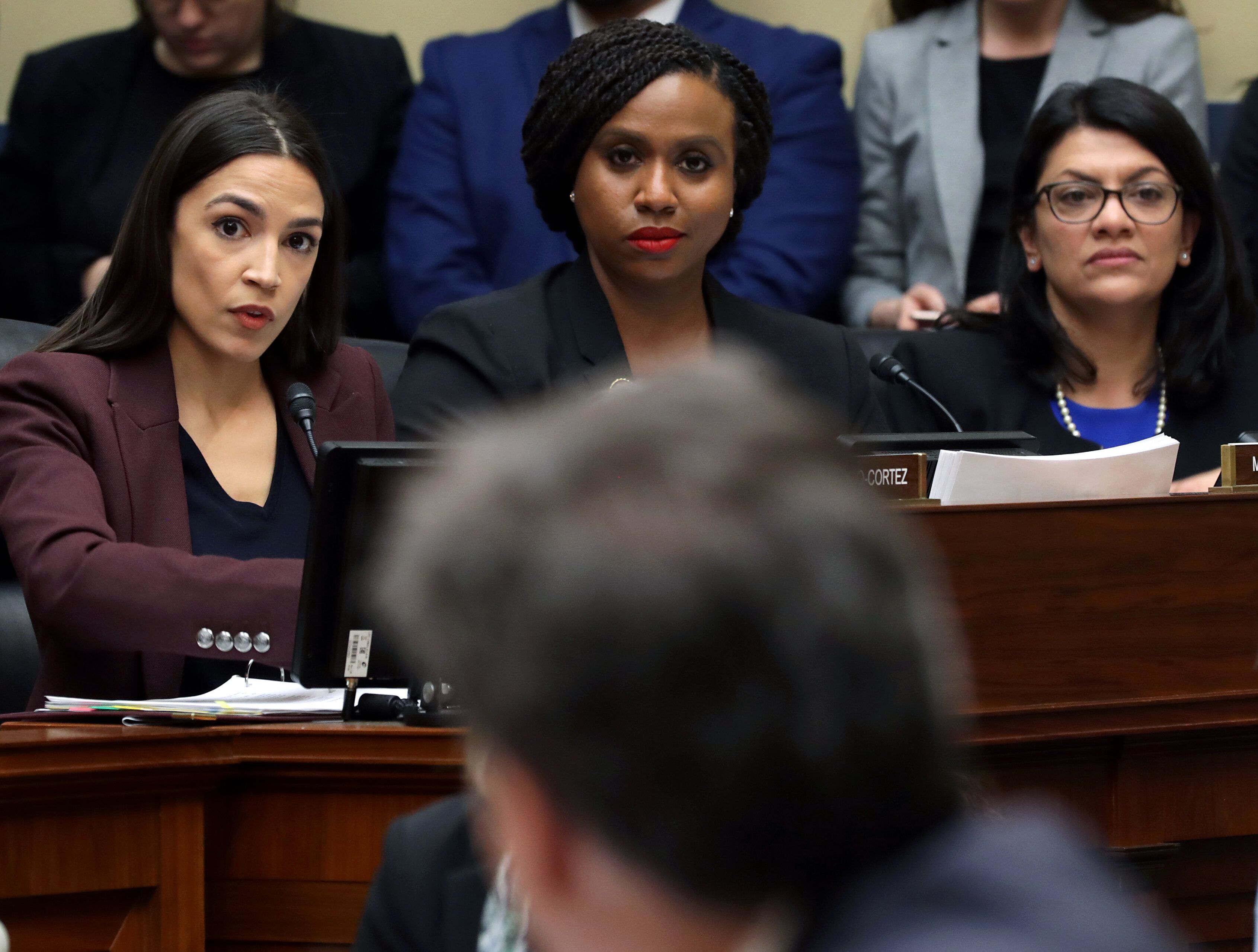
“Trump’s attacks on these four courageous, committed, knowledgeable and defiant congresswomen of color, not only reflect his commitment to views, policies and practices that are racist, anti-people of color; xenophobic, anti-immigrant and those different; sexist, anti-women; and opportunistic, ever self-promoting and peacocking.
These attacks also reflect his reactionary politics and conception of America. It is a politics of White supremacy; predatory capitalism at home and abroad; warmongering; privatization of public wealth and space; and peddling a personalized patriotism based on his astonishing ignorance, multiple insecurities and vulgar interests.We must constantly expose, criticize and condemn the monster side of America we call Trump and his supporters and enablers, but we must not over focus on him and under focus on the rising movement to actively resist him in Congress, as represented by the initiatives of the courageous four and also in our various communities across the country. To make this mistake would be like over focusing on a devast[at]ing fire and the havoc it is wreaking and under focusing on the response and responders needed to control and extinguish it.
Audacious and defiant, these four progressive congresswomen resist and reject Trump’s attempt to impose his deformed and dishonest reactionary conception of patriotism and politics. Indeed, they cannot morally and will not politically accept Trump’s packaged and constantly peddled racist patriotic politics of vicious and varied forms of oppression: apartheid walls here and abroad; corruption and coercion; the savaging of immigrants and the abuse and separation of children from their families; anti-labor and anti-union policies; preference for the rich at the expense and injury of the poor; racial and religious restrictions and preferences; denial of climate change; and his obsessive and infantile attempt to rival and erase everything considered an Obama achievement.
What does it feel like when every move you make is policed?
“HuffPost asked black readers to share their stories of being subjected to racial profiling and discrimination. They described moments when someone called the police on them for no apparent reason aside from their race. They recalled scenarios of cops stopping and searching them because their skin color made them look “suspicious.” They also said how maddening it is to live with the constant anxiety of possibly having their presence — and innocence — questioned.”
“Thus, in that moment, I was unsure whether the student was directing a hateful message toward me or if he merely lacked decorum and was oblivious to how his hat might be interpreted by his black law professor. I presumed it was the former. As the student sat there directly in front of me, his shiny red MAGA hat was like a siren spewing derogatory racial obscenities at me for the duration of the one hour and fifteen-minute class.Being a law professor, I understand the complexities of academic freedom and free speech. I respect students’ rights to freely express their political beliefs and values within the framework of the law. Yet, at the same time, law schools are inherently institutions of professional training. Just as faculty and staff are required to maintain professional formalities to aid the training and matriculation of their students, it seems only logical that students, too, should maintain similar businesslike etiquette.But when students fail to live up to such professional expectations, what are the professors’ options? Although my position is at a private university, I understood that my lack of tenure, precarious status as a VAP and the hue of my skin meant that I would be fighting an uphill battle should I have asked the student to remove his distracting red hat during class. Surely, there must be protocol when African-American professors—whose presence is scarce in most law schools—find their authority defiantly undermined by an insensitive student.As my blood boiled inwardly, outwardly I remained calm. In an effort to assuage the perceived tension, I jokingly told the student, “I like your hat,” when he raised his hand to participate in class discussion. Without missing a beat, the student mockingly grinned from ear to ear and said, “Thank you.”
“I finally got up my nerve to ask a stranger directly about white privilege as I was sitting next to him at the gate. He had initiated our conversation, because he was frustrated about yet another delay. We shared that frustration together. Eventually he asked what I did, and I told him that I write and teach. “Where do you teach?” he asked. “Yale,” I answered. He told me his son wanted to go there but hadn’t been accepted during the early-application process. “It’s tough when you can’t play the diversity card,” he added.Was he thinking out loud? Were the words just slipping out before he could catch them? Was this the innocence of white privilege? Was he yanking my chain? Was he snapping the white-privilege flag in my face? Should I have asked him why he had the expectation that his son should be admitted early, without delay, without pause, without waiting? Should I have asked how he knew a person of color “took” his son’s seat and not another white son of one of these many white men sitting around us?I was perhaps holding my breath. I decided to just breathe.”
Blackness is being born under a mountain of racial debt.
“As Saidiya Hartman writes, “Debt ensured submission; it insinuated that servitude was not yet over and that the travails of freedom were the price to be paid by emancipation.” Hence enslaved black people were forced to “self-purchase” their own freedom, for they could not even claim a property right in themselves. Is it any wonder that, as Hartmann describes, the enslaved used “stealing away” to describe not only the act of running away, but also in reference to a wide range of everyday activities:
Stealing away involved unlicensed movement, collective assembly, and an abrogation of the terms of subjection in acts as simple as sneaking off to laugh and talk with friends or making nocturnal visits to visit loved ones . . . These nighttime visits to lovers and family were a way of redressing the natal alienation or enforced “kinlessness” of the enslaved.”
“The scholarship surrounding male rape in war and genocides is new and perplexing for many scholars. Whereas previous scholarship simply assumed that women were rape victims and men were the perpetrators, the discovery of male victims of rape has forced many researchers to rethink the politicized nature of older paradigms. Misra for example has argued that “most of the contemporary scholarship on sexual violence in armed conflicts is not only biased towards the female gender but is heavily influenced by a feminist monopolization of that space that has sought to describe such violence as binary in nature: it is only perpetrated again the female gender by male members of the society.” This binary division of violence renders male victims of sexual violence and rape conceptually invisible. Researchers and scholars are simply unable to interpret males, even men subjugated within genocide and war, as victims because the encountering of the male rape victim in real-life conflicts with the pre-determined view of men as perpetrators of rape in theory. Misra continues, “Thanks to this biased interpretation where the feminist concern is primarily to highlight the victimization of women by men, male sufferers have simply become ‘absent victims’ in such gender analyses of conflict dynamics. Therefore, it would not be incorrect to suggest that there is a conceptual and definitional confusion over gender-based violence.” Marysia Zalewki’s “Provocations in Debates about Sexual Violence against Men” takes a similar view of how male victims of rape and sexual violence are theorized. She writes:
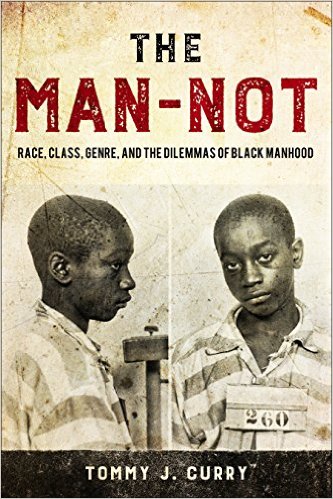
Tommy J. Curry’s provocative book The Man-Not is a justification for Black Male Studies. He posits that we should conceptualize the Black male as a victim, oppressed by his sex. The Man-Not, therefore,is a corrective of sorts, offering a concept of Black males that could challenge the existing accounts of Black men and boys desiring the power of white men who oppress them that has been proliferated throughout academic research across disciplines. Curry argues that Black men struggle with death and suicide, as well as abuse and rape, and their genred existence deserves study and theorization. This book offers intellectual, historical, sociological, and psychological evidence that the analysis of patriarchy offered by mainstream feminism (including Black feminism) does not yet fully understand the role that homoeroticism, sexual violence, and vulnerability play in the deaths and lives of Black males. Curry challenges how we think of and perceive the conditions that actually affect all Black males.
it can be argued that the putative innocence of feminist scholarship, traditionally presented as an emancipatory justice project, works to conceptually conceal not only women’s proclivities to violence, including sexual violence, but also to conceal the ‘truth’ of male victimhood. The veracity of all of these claims might easily be challenged (or confirmed), yet there is surely something about the gendered focus on women and all her epistemological, ethical, ontological scaffolding that might go some way in explaining why there has been so little attention to sexual violence against men, at least until very recently.
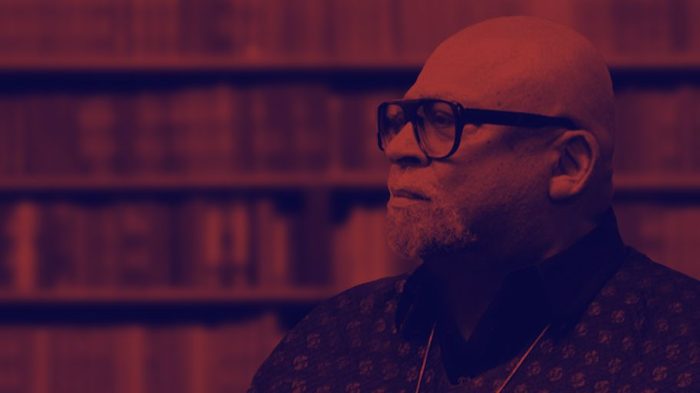
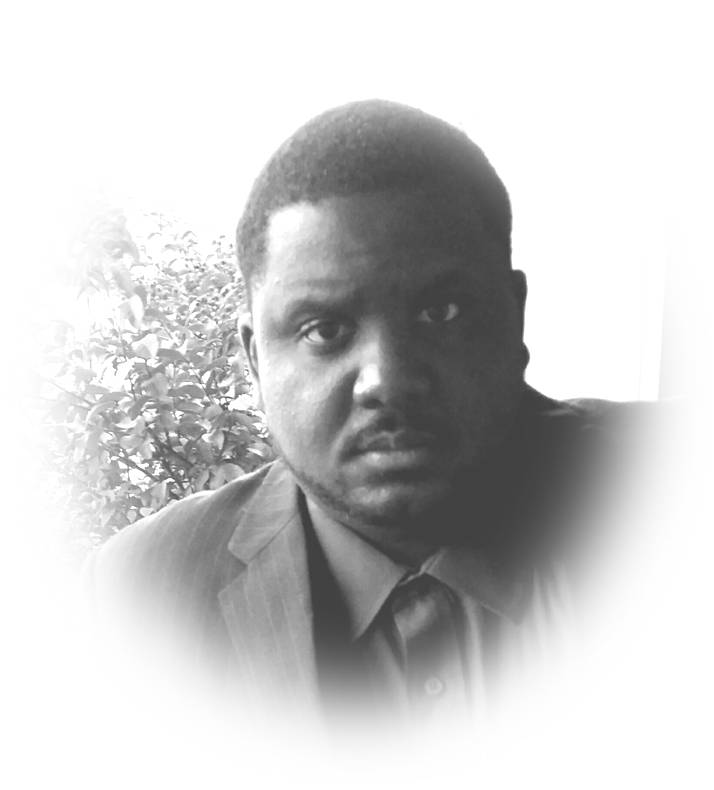
Dr. Tommy J. Curry Chair of Africana Philosophy & Black Male Studies @ University of Edinburgh. 2018 American Book Award. Editor of Black Male Studies Series on Temple Univ Press.
How we come to understand victimization, specifically what kind of violence creates victims, is of the utmost importance in our interpretation of Jewish male victims and their suffering. Jewish male rape cannot be truly understood if it is thought to be exceptional or a lesser form of violence endlessly compared to death. These young men and boys understood themselves—as males—being raped. Said differently, Jewish men are not simply analogous of female sexual experience. Scholars cannot hear the stories and accounts of Jewish males and imagine them to be females to understand how they could suffer rape. Inevitably one is drawn back to their socialized idea of a rape victim who is often a girl or woman. In doing so the researcher asks: “How do women or girls who are raped react?” This is not the proper question to ask in the listening to or reading of Jewish male survivor stories. Jewish men and boys suffered within their male body. They utilized their male bodies to attain food, clothes, and protection. These young accepted the violence of rape and the excruciating pain of anal penetration to escape death themselves or to help spare the lives of their friends.”
About Dr. Tommy J. Curry
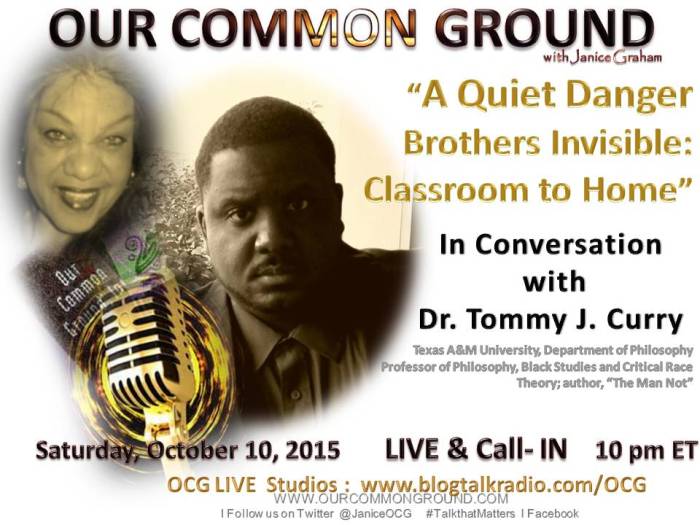
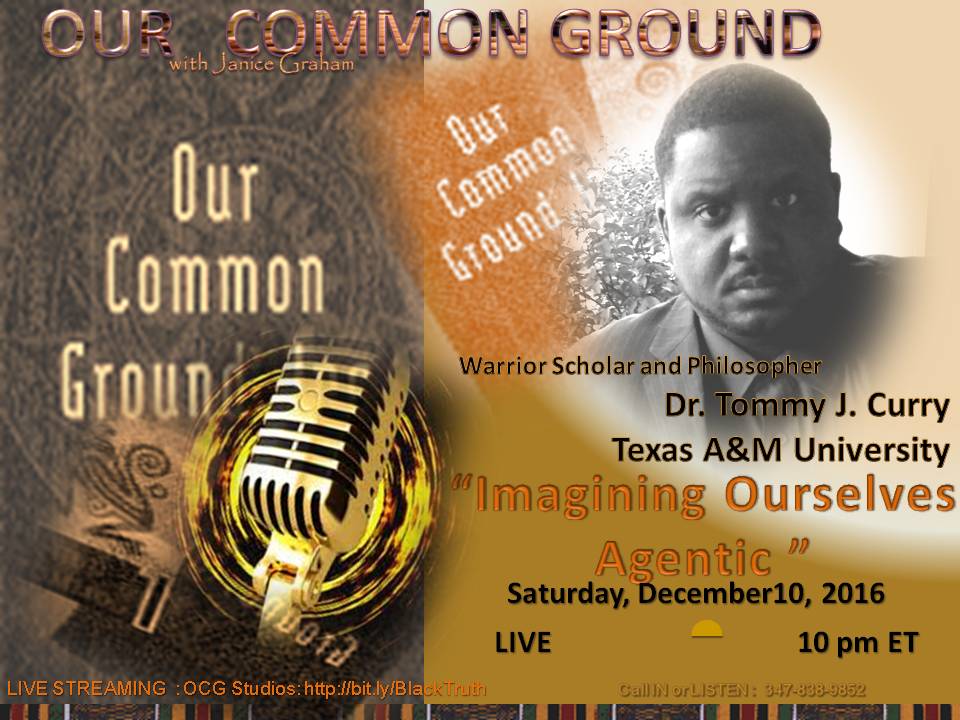
Dr. Curry has been an OUR COMMON GROUND Voice and OCG Incolocotur since 2013.
Tommy J. Curry is an Black-American author and professor of Philosophy. He currently holds a Personal Chair in Africana Philosophy and Black Male Studies at the University of Edinburgh. In 2018, he won an American Book Award for The Man-Not: Race, Class, Genre, and the Dilemmas of Black Manhood. He has been an OUR COMMON GROUND Voice and OCG Incolocotur since 2013.
He is arguably one of the nation’s most prolific philosophers of race, whose research focuses on the Black male experience— is leaving the United States to become the Chair of Africana Philosophy and Black Male Studies at the University of Edinburgh.
Curry, 39, who currently holds a full, tenured professorship in the Department of Philosophy at Texas A&M University is an expert on Critical Race Theory, Africana Philosophy, Black Male Studies and Social Political Thought and was recognized by Diverse as a 2018 Emerging Scholar.
“The political climate in the United States has made the study of racism a dangerous option for Black scholars,” said Curry, in an interview with Diverse. “Identifying the violence of White supremacy has now become equated to anti-Whiteness. In Europe, there is an effort to understand the Black experience, particularly the Black male experience.”
In announcing Curry’s appointment, Dr. Holly Branigan, head of the School of Philosophy, Psychology and Language Sciences at the University of Edinburgh said that the hiring of Curry amounted to a real game changer for the institution founded in 1582.
“Below you will find a very powerful letter written to Harriet by Douglas in 1868.
Dear Harriet:
I am glad to know that the story of your eventful life has been written by a kind lady, and that the same is soon to be published. You ask for what you do not need when you call upon me for a word of commendation. I need such words from you far more than you can need them from me, especially where your superior labors and devotion to the cause of the lately enslaved of our land are known as I know them. The difference between us is very marked. Most that I have done and suffered in the service of our cause has been in public, and I have received much encouragement at every step of the way.
You, on the other hand, have labored in a private way. I have wrought in the day – you in the night. I have had the applause of the crowd and the satisfaction that comes of being approved by the multitude, while the most that you have done has been witnessed by a few trembling, scarred, and foot-sore bondmen and women, whom you have led out of the house of bondage, and whose heartfelt, “God bless you,” has been your only reward. The midnight sky and the silent stars have been the witnesses of your devotion to freedom and of your heroism. Excepting John Brown – of sacred memory – I know of no one who has willingly encountered more perils and hardships to serve our enslaved people than you have.
Much that you have done would seem improbable to those who do not know you as I know you. It is to me a great pleasure and a great privilege to bear testimony for your character and your works, and to say to those to whom you may come, that I regard you in every way truthful and trustworthy.Your friend,Frederick Douglass.
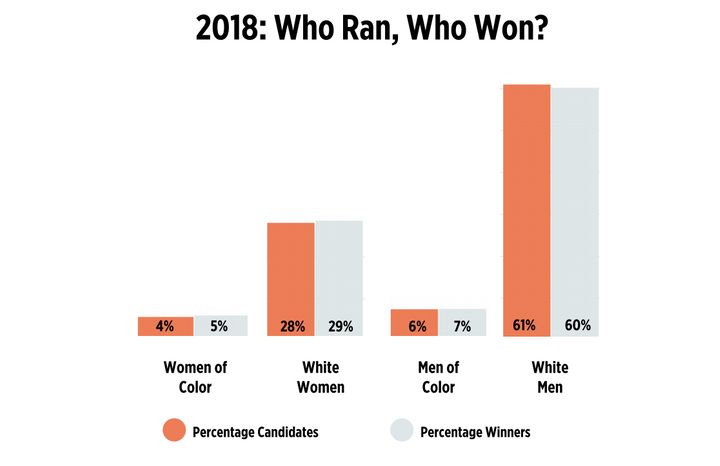
“Specifically, women of color were 4% of 2018 candidates and 5% of winners; white women were 28% of candidates and 29% of winners; men of color were 6% of candidates and 7% of winners; and white men were 61% of candidates and 60% of winners. “There’s a common assumption that white men are the more electable candidates ― but our research found the opposite,” Brenda Choresi Carter, director of the Reflective Democracy Campaign, said on a press call. “We found women of color, white women and men of color win at essentially the same rate. There’s only one group that loses slightly more ― and that’s white men.”
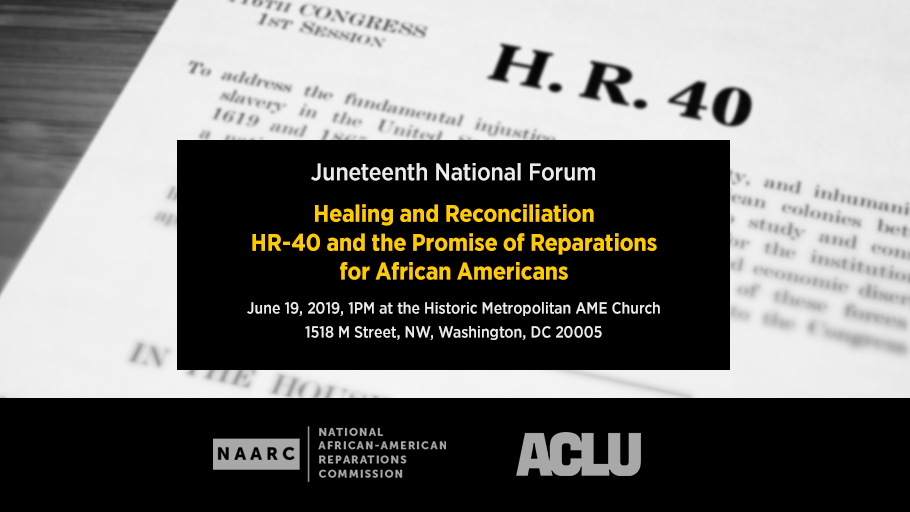
Juneteenth National Forum: HR-40 and the Promise of Reparations for African Americans
Press Play: Live-stream will begin here at 1PM EST, Wednesday June 19, 2019Healing and Reconciliation: HR-40 and the Promise of Reparations for African AmericansWednesday, June 19, 2019 (Juneteenth), 10 AM the House Judiciary Committee’s Subcommittee on the Constitution will convene a hearing on HR 40.Following this historic hearing, the National African American Reparations Commission (NAARC) and the American Civil Liberties Union (ACLU) will hold a national forum, 1 PM at the Historical Metropolitan AME Church, 1518 M Street, NW, Washington, DC 20005. This event is free and open to the public. Doors Open at 12:30 PM. If you are not able to join us in Washington DC, join us here online during the livestream (above).Panelists and speakers to include Rev. Dr. William Lamar, Jeffery Robinson, Dr. Ron Daniels, Congresswoman Sheila Jackson Lee, Danny Glover, Professor Sir Hilary Beckles, Dr. Julianne Malveaux, Kamm Howard, Atty. Nkechi Taifa, Dr. Iva Carruthers, Nana Dr. Patricia Newton, Katrina Browne and others – See program
“The role of black public officials within the contexts of cities like Washington, D.C., Detroit, New Orleans, and elsewhere was anything but subordinate. Subordinate to whom? Moody misses the very powerful role that these black elites played, and continue to play in formal party politics and local economic growth regimes, in legitimating neoliberalization and, at times, insulating such forces from criticism even when they embark on policy decisions that will have negative social consequences for black constituencies. More troubling, Moody diminishes the role that various black constituencies, neighborhood groups, landlords, business owners, clergy, educators, and activists, not simply political elites, played in shaping the carceral expansion. The sense of different subject positions among blacks, which cannot be reduced simply to the “petty bourgeoisie” and the “long struggle for black freedom” as Moody does, is totally lost. Moody refers to the demands of working-class blacks for more police protection and tougher crime policy, but in a manner that returns quickly to the victim narrative, disconnecting their conscious actions as citizens from their unintended consequence, mass incarceration. ”













 OCG
OCG 