
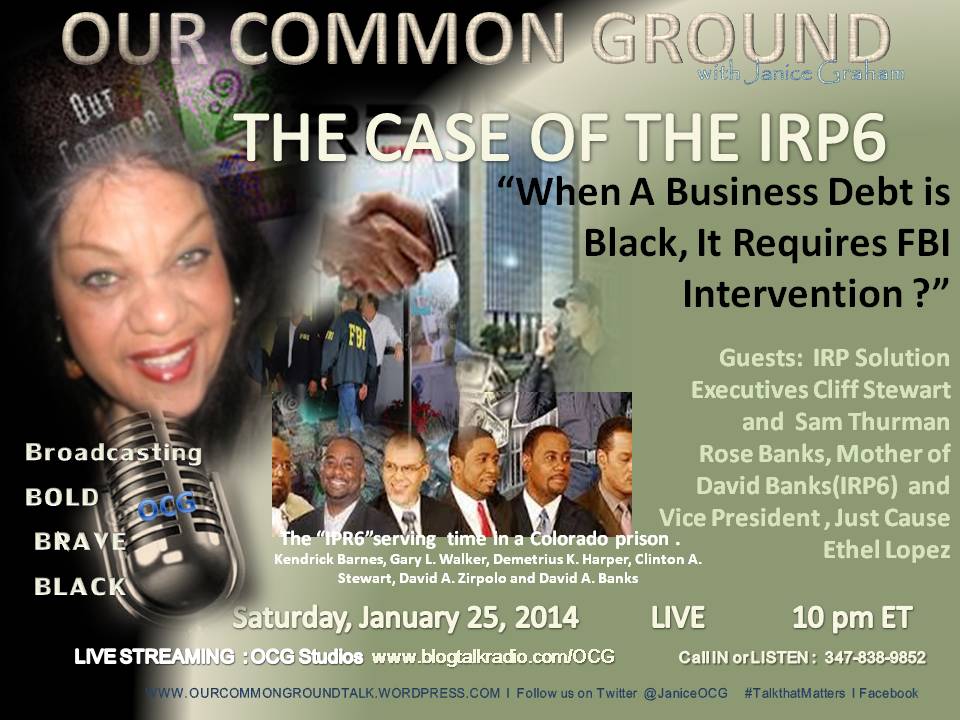
“The Case of IRP6”IRP Solutions CorporationHow a business dream became a nightmare
|
Visit OUR COMMON GROUND with Janice Graham at: http://ourcommonground-talk.ning.com/
“The Case of IRP6”IRP Solutions CorporationHow a business dream became a nightmare
|
Visit OUR COMMON GROUND with Janice Graham at: http://ourcommonground-talk.ning.com/

“Transforming Truth to Power, One Broadcast At a Time”
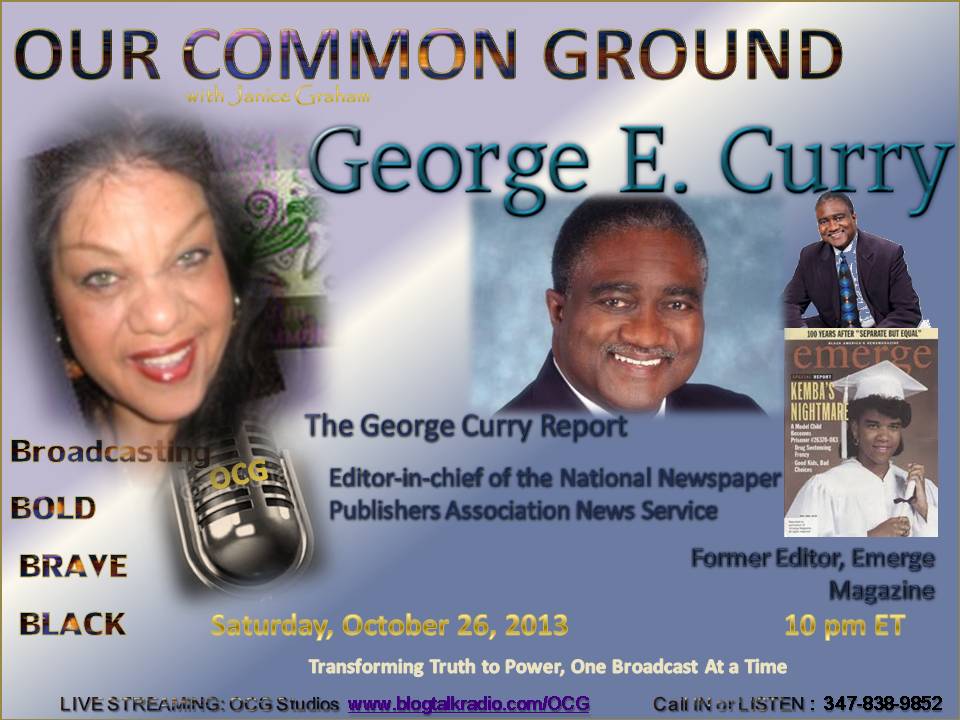
George E. Curry is the editor-in-chief of the National Newspaper Publishers Association News Service. The former editor-in-chief of Emerge magazine, Curry also writes a weekly syndicated column for NNPA, a federation of more than 200 African American newspapers.
Curry, who served as editor-in-chief of the NNPA News Service from 2001 until 2007, returned to lead the news service for a second time on April 2, 2012. His work at the NNPA has ranged from being inside the Supreme Court to hear oral arguments in the University of Michigan affirmative action cases to traveling to Doha, Qatar, to report on America’s war with Iraq.
As editor-in-chief of Emerge, Curry led the magazine to win more than 40 national journalism awards. He is most proud of his four-year campaign to win the release of Kemba Smith, a 22-year-old woman who was given a mandatory sentence of 24 1/2 years in prison for her minor role in a drug ring. In May 1996, Emerge published a cover story titled “Kemba’s Nightmare.” President Clinton pardoned Smith in December 2000, marking the end of her nightmare.
Curry is the author of Jake Gaither: America’s Most Famous Black Coach and editor of The Affirmative Action Debate and The Best of Emerge Magazine. He was editor of the National Urban League’s 2006 State of Black America report.
His work in journalism has taken him to Egypt, England, France, Italy, China, Germany, Malaysia, Thailand, Cuba, Brazil, Ghana, Senegal, Nigeria, the Ivory Coast, Mexico, Canada, and Austria. In August 2012, he was part of the official US delegation and a presenter at the US-Brazil seminar on educational equity in Brasilia, Brazil.
George Curry is a member of the National Speakers Association and the International Federation for Professional Speakers. His speeches have been televised on C-SPAN and reprinted in Vital Speeches of the Day magazine. In his presentations, he addresses such topics as diversity, current events, education, and the media.
 BROADCASTING
BOLD BRAVE BLACK
OUR COMMON GROUND with Janice Graham
“Speaking Truth to Power and Ourselves”
email: OCGinfo@ourcommonground.com
LISTEN LIVE and Join the OPEN Chat: http://www.blogtalkradio.com/OCG
Community Forum:http://www.ourcommonground-talk.ning.com/
Twitter: @JaniceOCG #TalkthatMatters
Web: http://www.ourcommonground.com/
OCG Blog: http://www.ourcommongroundtalk.wordpress.com/
Pinterest : http://www.pinterest.com/ocgmedia/boards/
Visit our Tumblr Page: http://ourcommonground.tumblr.com/
Facebook: https://www.facebook.com/OCGTALKRADIO

Co-Author: “The Radicalization of Ray Richardson: Suspicion Still Surrounds Death of Black Activist TV Producer”

“He was responsible to black people… so they had to get rid of him.”
In January, 1971, the young producer of Boston public television’s groundbreaking program Say Brother, was found dead in a Mexican resort, along with his fiancé. Ray Richardson was the grandson of Harlem’s radical Hubert Harrison.
The Story of Ray Richardson, Black public discourse pioneer and how “SAY Brother”, a TV show shaped contemporary Black media.
 “Say Brother first aired on July 18, 1968,” . . . it “helped set a standard of excellence for black television shows, with the issues it brought to the public, the artists it featured, and the education it provided for the white community.” It was “the era of Black Power, Black Pride, and the thrust for political power — an era when hairstyles and modes of dress proclaimed ‘Black is Beautiful’ and even the show’s title sent a message.” – “Say Brother’ was a commonplace greeting in those days. It was a signal, a sign of recognition that blacks were connected to one another emotionally and by common experience.” Ray Richardson was its founder, defender and producer.”

“. . . Ray Richardson’s death ( January, 1971 reported as drowning with girl friend in Acapulco, Mexico while vacationing) came in the period that included the December 4, 1969, murder of Black Panther activists Fred Hampton and Mark Clark by Chicago police; the 1970 CIA-involvement in the kidnapping (and subsequent death) of a Chilean general, Rene Schneider; the March 11, 1971, death in Nigeria of National Urban League Executive Director Whitney Young (by drowning according to a U.S. coroner, by brain hemorrhage according to a Lagos coroner) after he came out against the Vietnam War; the August 21, 1971,murder by prison guards of Black Panther George Jackson; and the September 11, 1973, death of Salvatore Allende during the CIA-driven coup in which armed forces and police overthrew the socialist government in Chile. It was also a period in which COINTELPRO, the FBI’s counterintelligence program, targeted Black radicals and activists and the Black Panther Party; the National Security Agency and its Minaret Program monitored and targeted Black and anti-war activists (particularly while abroad); and the Nixon administration sought to control Public Television and support its aims through its funding policies and removal of personnel it perceived as hostile.”
“. . . A great deal was also at stake regarding Black programming in the WGBH vs. Say Brother struggle. Charles Richardson points out that “WGBH was the flagship of the PBS network” and that, as he “understood it from Ray, it’s activities were “run out of the paranoid Nixon White House.” In addition, “the FBI under Hoover was monitoring all things Black.” In this way “Black public affairs shows, ostensibly introduced to feed the community’s appetite for information and news about local community goings on, were also the government’s way of monitoring thought, and, by the placement of their own operatives in positions of power and control (as directors/producers) they had the means to control thought by controlling the programming.” Neither Nixon, nor Hoover, nor WGBH management and its most powerful supporters wanted a show that truly gave voice to the Black community, particularly a show that included Black radical criticism of societal conditions.”
Excerpts from “The Radicalization of Ray Richardson: Suspicion Still Surrounds Death of Black Activist TV Producer”
Published in “The Black Agenda Report” October 8, 2013
Read the full article here: http://bit.ly/1amm76U
by Jeffrey B. Perry and Charles V. Richardson In January, 1971, the young producer of Boston public television’s groundbreaking program Say Brother, was found dead in a Mexican resort, along with his fiancé. Ray Richardson was the grandson of Harlem radical Hubert Harrison.
 Jeffrey B. Perry is an independent working class scholar whose work focuses on the role of white supremacy as a retardant to progressive social change and on centrality of struggle against white supremacy to progressive social change efforts. He is the editor of A Hubert Harrison Reader (Wesleyan University Press, 2001) and author of Hubert Harrison: The Voice of Harlem Radicalism, 1883-1918 (Columbia University Press, 2008). Most recently he wrote the introduction and back matter for the new expanded edition of Theodore W. Allen’s “classic” The Invention of the White Race (2 vols. 1994, 1997; Verso Books, 2012).
Charles V. Richardson is the brother or Ray Richardson and grandson and heir of Hubert Harrison. For many years he helped to oversee, and then to place, the Hubert H. Harrison Papers at Columbia University’s Rare Book and Manuscript Library. He works in the media field.
OUR COMMON GROUND with Janice Graham
email: OCGinfo@ourcommonground.com
LISTEN LIVE and Join the OPEN Chat: http://www.blogtalkradio.com/OCG
Community Forum:http://www.ourcommonground-talk.ning.com/
Twitter: @JaniceOCG #TalkthatMatters
Web: http://www.ourcommonground.com/
OCG Blog: http://www.ourcommongroundtalk.wordpress.com
Pinterest : http://www.pinterest.com/ocgmedia/boards/
Visit our Tumblr Page: http://ourcommonground.tumblr.com/
Facebook: https://www.facebook.com/OCGTALKRADIO


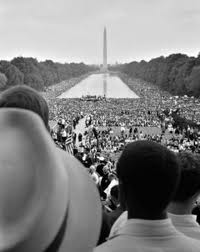
– “Even when pressed by the demands of inner truth, men do not easily assume the task of opposing their government’s policy, especially in time of war. Nor does the human spirit move without great difficulty against all the apathy of conformist thought within one’s own bosom and in the surrounding world. Moreover, when the issues at hand seem as perplexing as they often do in the case of this dreadful conflict, we are always on the verge of being mesmerized by uncertainty. But we must move on.” Rev. Dr. Martin Luther King, Jr. April 4, 1967
As America commemorates the 50th anniversary of the historic March on Washington for Jobs and Freedom I am compelled to ask the following question, would Dr. King be invited to speak at upcoming events to commemorate the March?
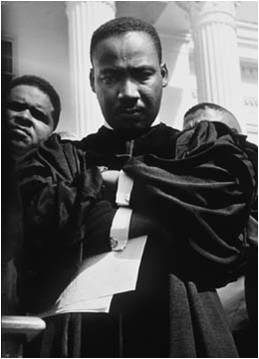 If you get past the marketed “Dream” reference in the “I Have a Dream” speech you will understand that it was an indictment of America. If you read “Beyond Vietnam: A Time to Break Silence” or Dr. King’s last book Where Do We Go From Here, Chaos or Community?; you can rest assured that today Dr. King would be in opposition to America’s backing of the assignation of Muammar Gaddafi, drone attacks, indefinite detention at Guantanamo, NSA wiretapping, mass incarceration, and the Obama administration’s failure to speak forcefully about poverty in America. From that premise one can only conclude that if Dr. King were alive today, those within the African American community who are engaged in stifling honest, fact-based, critical analysis of the administration’s policies would not allow Dr. King on the dais. Reason being, Dr. King committed his life to a morally based sense of justice and humanity not actions taken from a sense of political expediency or realpolitik.
On August 28, 1963 Dr. King stated, “Five score years ago, a great American, in whose symbolic shadow we stand today, signed the Emancipation Proclamation…One hundred years later, the colored American lives on a lonely island of poverty in the midst of a vast ocean of material prosperity.” Today according to the Bureau of Labor Statistics, the national unemployment rate stands at 7.6% and 15% in the African American community. Today, “in the midst of a vast ocean of material prosperity,” according to Bread For the World, “14.5 percent of U.S. households—nearly 49 million Americans, including 16.2 million children—struggle to put food on the table” and “more than one in five children is at risk of hunger. Among African-Americans and Latinos, nearly one in three children is at risk of hunger.”
President Obama has claimed to be a champion of the middle class but rarely speaks to the plight of the poor in America. Dr. King would not stand idly by and allow this to go unchallenged. As America spends billions of dollars on its drone program, children continue to go hungry. In his 1967 speech Beyond Vietnam: A Time to Break Silence Dr. King stated, “A few years ago…It seemed as if there was a real promise of hope for the poor, both black and white, through the poverty program…Then came the buildup in Vietnam, and I watched this program broken and eviscerated as if it were some idle political plaything on a society gone mad on war. And I knew that America would never invest the necessary funds or energies in rehabilitation of its poor so long as adventures like Vietnam continued to draw men and skills and money like some demonic, destructive suction tube.” If you replace Vietnam with Afghanistan and the War on Terror I believe Dr. King would be engaged in the same analysis and saying the same things today.
Dr. King said that the people of Vietnam must see, “Americans as strange liberators…they languish under our bombs and consider us, not their fellow Vietnamese, the real enemy…What do the peasants think as we ally ourselves with the landlords and as we refuse to put any action into our many words concerning land reform? What do they think as we test out our latest weapons on them…?” Today, Dr. King would be asking the same questions about America’s actions in Libya, Afghanistan, Pakistan, Egypt, and the continued US support for the Zionist government in Israel as it continues to build settlements on Palestinian land in violation of international law.
 Let’s be very clear, I have used actions of the Obama administration to highlight many of the contradictions that we face and to demonstrate how the man we now revere, the icon that will be lauded at the 50th anniversary of the March on Washington would not be invited to speak in today’s political context. That’s the symptom of a greater problem.
To gain great insight into the real problem you have to examine the work of Edward Bernays and the rise of the propaganda industry in the 1920’s. “[The] American business community was also very impressed with the propaganda effort (created by Bernays). They had a problem at that time. The country was becoming formally more democratic. A lot more people were able to vote and that sort of thing. The country was becoming wealthier and more people could participate and a lot of new immigrants were coming in, and so on. So what do you do? It’s going to be harder to run things as a private club. Therefore, obviously, you have to control what people think. There had been public relation specialists but there was never a public relations industry.” History as a Weapon – Noam Chomsky – 1997.
The business community as Chomsky discussed or the corptocracy in today’s parlance uses propaganda to co-opt the American political landscape and has contributed to the decline of the American political left. The politics and policies of the Obama administration are examples of that decline, not responsible for it. th
At the 50th anniversary of the March on Washington pay very close attention to what is said and even closer attention to what is not (August 27, 2013 is the 50th commemoration of the passing of W.E.B. DuBois).
Understanding the moral basis of Dr. King’s analysis, he would be standing today for the very things he stood for then. He would be critical of the current administration, and as such, great efforts would be made to shut him out of the national debate since many in the African American community see honest, fact based, criticism of Obama administration policy as antithetical to the interests of the African American community. The prophet is never welcome in his own village.
Dr. King’s “Dream” was significant because of its juxtaposition against the reality of the Negros nightmare but Bernaysian propaganda keeps the focus on the “Dream”.
 Dr. Wilmer Leon is the Producer/ Host of the Sirisu/XM Satellite radio channel 110 call-in talk radio program “Inside the Issues with Leon” Go to www.wilmerleon.com or email:wjl3us@yahoo.com. www.twitter.com/drwleon and Dr. Leon’s Prescription at Facebook.com He is an OUR COMMON GROUND Voice, joining us as Guest and Co-Host.
© 2013 InfoWave Communications, LLC
– See more at: http://www.wilmerleon.com/

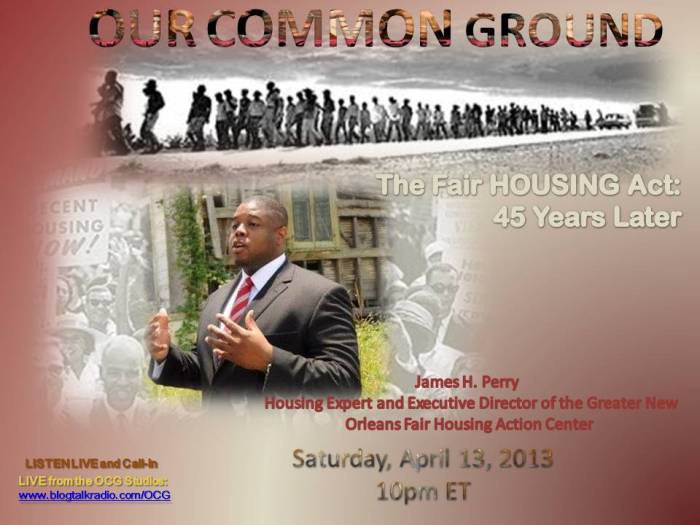
about JAMES H. PERRY
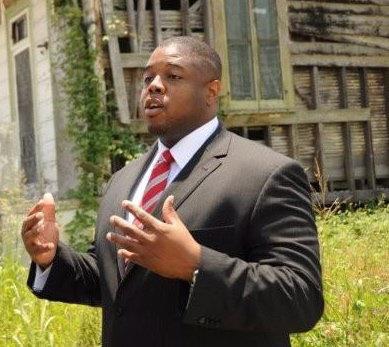 James Perry is the Executive Director of the Greater New Orleans Fair Housing Action Center (GNOFHAC). Perry is a housing expert. He founded the Gulf Coast Fair Housing Center in Mississippi when he was 26 years old. He led the Greater New Orleans Fair Housing Action Center through two of America’s greatest disasters-Hurricanes Katrina and Rita. Under Perry’s leadership, the Center favorably settled an historic class action lawsuit resulting in compensation of more than $500 million for Katrina victims. Perry has testified before congress eight times and was a candidate in the 2010 New Orleans Mayoral election.
Perry serves on the Board of Directors of the National Fair Housing Alliance, the National Low Income Housing Coalition, the Gulf Coast Fair Housing Center and chairs the Louisiana Housing Alliance Board of Directors. He holds a Bachelors in political science from the University of New Orleans and a Juris Doctorate from the Loyola University School of Law.
The Greater New Orleans Fair Housing Action Center is a private, non-profit civil rights organization established in the summer of 1995 to eradicate housing discrimination throughout the greater New Orleans area.
America’s poor and middle-class are mired in the fall out of a crumbling economic foundation. Housing discrimination in new forms contribute to the fall out causing massive homelessness, including children, veterans and elderly. A new and vicious kind of resilience to compassionate themes in our politics, lends a hand to this threat. Foreclosures which rise out of predatory lending and greed, plague the well-being of the Black and Brown working class. Housing discrimination has a new and more virulent strain. Join us tonight to take a look with James Perry.
OUR COMMON GROUND with Janice Graham
“Speaking Truth to Power and Ourselves”
BROADCASTING BRAVE BOLD BLACK
Community Forum: http://www.ourcommonground-talk.ning.com/
Twitter: @JaniceOCG #TalkthatMatters
Web: http://www.wordpress.ourcommongroundtalk.com/


by Dr. Wilmer J. Leon III
Austerity, perpetually high unemployment and other aspects of the New Domestic Order are creating a new “precariat” – a class condemned to permanent precariousness and insecurity.
Connecting the Dots to a Frightening Future
by Dr. Wilmer J. Leon III
“They are saddled with debt from school loans, working two and three jobs at subsistence wages with no health care, no pension, and no sense of permanency or security.”
Post Racial America, New Normal, Austerity, and The Precariat Class.
These concepts, when discussed individually, make for interesting dialogue. Moreover, when assessed in a larger context, these same concepts should become a cause for concern.
Right after Senator Obama became President there were many discussions and articles written about a Post Racial America. Had we evolved into an America devoid of racial preference, discrimination, and prejudice?During the 2008 presidential campaign The New York Times published an article by Matt Bai entitled Is Obama the End of Black Politics? The premise of the article was that in 2008, 60 years after Strom Thurmond left the Democratic Party over the issue of integrating the armed forces and 45 years after Dr. King’s “I Have a Dream Speech” the Democratic party was poised to deliver its nomination for the nation’s highest office to an African-American. Bai’s article asked if Obama’s nomination somehow signaled the end of Black politics?
The answer to Matt Bai’s question is; of course not. America cannot be closer to being post racial when a candidate for president has to run a deracialized campaign in order to make the masses comfortable with the obvious aesthetic. We are not in a post-racial America when the unemployment rate in the African American community is more than double the national average and the wealth accumulation of the average European American family is 20 times that of the average African American family. The dangerous subtext to that question is that it ignores the struggle for justice and equality that African Americans still face. It also reinforces the conservative view that the government should no longer enact and enforce legislation guaranteeing the rights of minorities.
“We are not in a post-racial America when the unemployment rate in the African American community is more than double the national average.”
As the American economy has remained stagnate with 1.3 percent growth, the national unemployment number has stayed close to 8%, 17% in the African American community. Close to 5.4 million people have dropped out of the workforce and now analysts and commentators have started talking about a “New Normal.” Americans are supposed to get used to dismal rates of growth and high unemployment while the stock market soars and American corporations sit on record cash balances. According to CNBC, corporate “cash balances have swelled 14 percent and are on track toward $1.5 trillion for the Standard & Poor’s 500, according to JPMorgan. Both levels would be historic highs.”
These record amounts of cash being stockpiled by corporations are not “trickling down” to the working and middle-classes. The “job creators” are not creating jobs. According to Pimco Investment founder Bill Gross. “It’s time to recognize that things have changed and that they will continue to change for the next—yes, the next 10 years and maybe even the next 20 years.” This is the “new normal” and it’s not good.
The solution being proposed by conservatives and subtly endorsed by President Obama to address the financial crisis is “austerity.” Austerity is the policy of deficit-cutting by lowering spending via a reduction in the amount of benefits and services provided by the government. Instead of focusing on what to save, they are debating what to cut.
“The ‘job creators’ are not creating jobs.”
In challenging times such as these the government should be investing in the economy not cutting back.Reductions in government spending tend to increase unemployment which increases demands on social programs or “safety-net” programs. Increased unemployment also reduces tax revenue. As with the Great Depression, short-term government spending, financed by deficits may be required to support economic growth when consumers and businesses are unwilling or unable to do so.
When you start to connect the dots between, New Normal and Austerity, you see a new picture. There is a new class of existence being created in this country. Professor Guy Standing calls this new class the “precariat”. “Millions of workers, mainly young and educated are being habituated to a life of unstable labor and uncertainty, a precarious existence…The precariat is wanted by multinationals and many corporations”…because their precarious existence makes them easy to exploit. They are saddled with debt from school loans, working two and three jobs at subsistence wages with no health care, no pension, and no sense of permanency or security.
As the African American community continues to be plagued by disproportionate rates of unemployment, poverty, hunger, wealth disparities, incarceration rates and other social ills the development of a precariat class will prove to be catastrophic. African Americans and many others would continue as Dr. King said in 1963, to live “…on a lonely island of poverty in the midst of a vast ocean of material prosperity…languishing in the corners of American society and find(ing) (themselves) an exile in (their) own land.”
“The development of a precariat class will prove to be catastrophic.”
If the underclass, working class and precariat become dissatisfied with their existence what will they do? Will there be an uprising from the masses? What would the government do? How would the government protect its interests and repel the domestic uprising?
When you assess the implications of a Post Racial America, the New Normal, Austerity and The Precariat Class in a larger context, you begin to see a different America than the one being portrayed in mainstream media. When you connect these dots with a government that is engaging in warrantless wiretapping, calling for the ability to indefinitely detain American citizens, stop and frisk laws, and an American Attorney General who states that the president has the authority to assassinate American citizens any place in the world without judicial review, you get a very frightening picture. The picture reflects a battle between democracy and fascism and the battle for democracy should begin now.
Dr. Wilmer Leon is the Producer/ Host of the nationally broadcast call-in talk radio program “Inside the Issues with Wilmer Leon,” and a Teaching Associate in the Department of Political Science at Howard University in Washington, D.C. Go to www.wilmerleon.com or email: wjl3us@yahoo.com.www.twitter.com/drwleon, and Dr. Leon’s Prescription at Facbook.com.
© 2013 InfoWave Communications, LLC

April 6, 2013 10 pm ET LIVE

“The State of Black America: A Tale of Two Countries”
Tonight’s Guest: Dr. Wilmer Leon
Dr. Leon comes to OCG once again to weigh in on the issues which face Black America, the politics of our problems and the light of solutions available.
Wilmer J. Leon III, Ph.D. is a Political Scientist whose primary areas of expertise are Black Politics, American Government, and Public Policy. He is a Teaching Associate in the Political Science Department at Howard University in Washington, D.C., a nationally syndicated broadcast radio talk show host, columnist, commentator, political consultant, TV host, lecturer, and much sought after motivational speaker.
 Dr. Leon earned a BS degree in Political Science from Hampton Institute, a Masters in Public Administration (MPA) from Howard University, and a Ph.D. in Political Science from Howard University.
A serious void exists in the public discourse relating to the issues that directly and/or disproportionately impact the global village in which we live. Dr. Leon’s lectures and writings focus on issues such as the media’s coverage of national and international issues, the criminal industrial complex, environmental racism, school vouchers, health care, crime policy, economic globalization, American domestic and foreign policy from as much of a non- biased and academically accurate perspective as possible. Dr. Leon’s perspective and lectures are grounded in the history of the African American community and the tradition of African American scholarship.
Dr. Leon is host/producer of the nationally broadcast call in talk radio program Inside The Issues With Dr. Wilmer Leon on XM/Sirius satellite radio channel 169 “Urban View” and the host of Epilogue, a political book discussion program on Press TV. He hosts discussion on Facebook as Dr. Leon Prescriptions.
Dr. Leon was a regular guest on CNN’s Lou Dobbs Tonight and is a contributing columnist to The Grio.com, The Black Agenda Report, The Maynard Institute.com, TruthOut.org, PoliticsInColor.com and Black Star News.

“Speaking Truth to Power and Ourselves”
BROADCASTING BRAVE BOLD BLACK
Join the discussion in our Open Chat during the broadcast.
LIVE: OCG Meetinghouse: http://www.blogtalkradio.com/OCG
For More Information: http://www.ourcommongroundtalk.wordpress.com/


“Living Legendz” is documentary that highlights the lives of Abiodun Oyewole, Dr. Leonard Jeffries and Jamal Joseph and their contributions to their community and culture.
“Living Legendz” The documentary series explores the lives of African and Latino American icons. So much of Black and Latino history has been lost or not documented leaving others to tell our stories.
The filmmaker, Nicholle La Vann, says, ” It is my responsibility to be that keeper of our history and provide a platform where their lives and accomplishments can be heard.”
La Vann is a an award winning filmmaker with a Master of Fine Arts from the City University of New York in Media Arts Production. As an artist of visual culture, Nicholle is interested in the intersection between the digital environment and media social issues. As a video artist, she focuses on the impact of injustice and youth development while integrating related factors such as poverty. Nicholle’s interest continues to be in the area of facilitating dialogues between people. Which mean challenging existing assumptions as well as searching for new ways of addressing current issues. La Vann continues to give back through teaching documentary workshops in New York City and Toronto and screenings that provide feedback discussions with audiences.
She is a warrior storyteller with a modern day weapon. Recording the best of our aspirations in the 21st Century.
She notes that, “Too much emphasis has been put on our appearance and not enough on our mindset. It is my goal to inspire audiences of all races with a special interest on my own. The amount of knowledge that children learn in school is not always accurate nor true, depending on where the source comes from.”

Living Legendz is a sponsored project of Fractured Atlas, a non-profit arts service organization. Contributions for the purposes of Living Legendz must be made payable to Fractured Atlas and are tax-deductible to the extent permitted by law.
Your contributions in support of this project are appreciated.
http://www.indiegogo.com/projects/living-legendz
about Filmdress Filmz
Filmstress Filmz is a creative multimedia production company specializing in social marketing. We work with an array of agencies, corporations and non-profit organizations, and government agencies to build and educate cause marketing campaigns through a wide range of video productions. Our work includes Public Service Announcements (PSAs), documentary shorts, music videos and internet streaming video. Our projects address social issues rarely heard in mainstream media. We offer broadcast quality media for television, community screenings, fundraisers, presentations, conferences, film festivals and workshops.
Join us in this conversation with Filmmater, Nicholle La Van about this important recording of our history and storyteller, a contemporary warrior in Black History.

LIVE: OCG Meetinghouse: http://www.blogtalkradio.com/OCG
For More Information: http://www.ourcommongroundtalk.wordpress.com
DOWNLOAD OUR APP Here
http://7f3186db-1b59-417d-989e-5feaed15b224.conduitapps.com/#

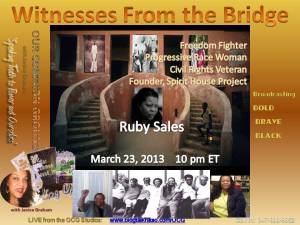
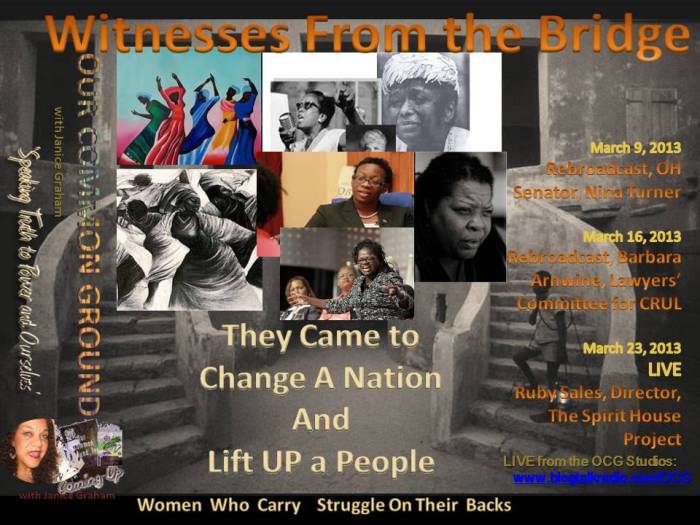
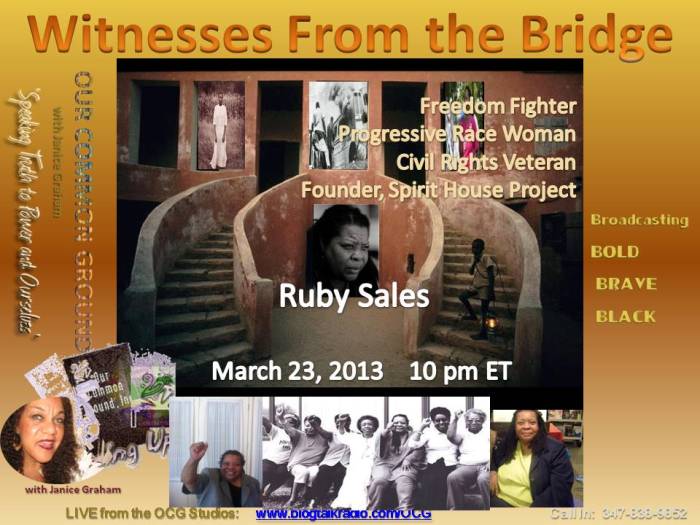
WITNESSES FROM THE BRIDGE Series
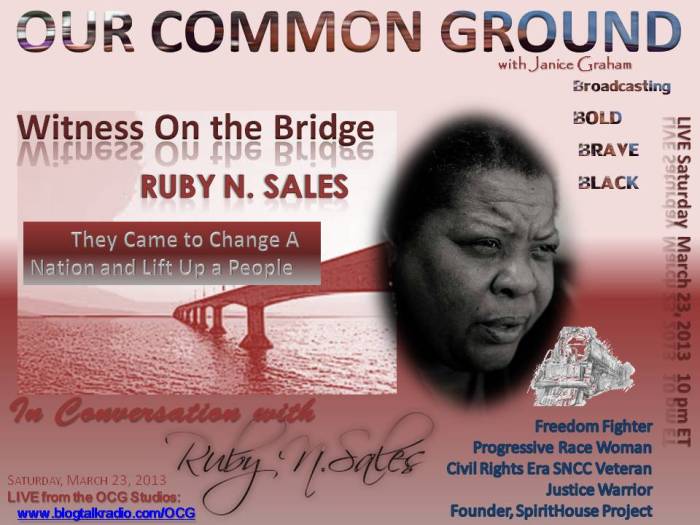
“WITNESSES FROM THE BRIDGE”
“They came to Change a Nation and Lift Up A People”
The Women of the Black Power Movement
Ruby Nell Sales is a highly-trained, experienced, and deeply-committed social activist, scholar, administrator, manager, public theologian, and educator in the areas of Civil, Gender, and other Human Rights. She is an excellent public speaker, with a proven track record in conflict resolution and consensus building. Ms. Sales has preached around the country on race, class, gender, and reconciliation, and she has done ground-breaking work on community and nonviolence formation. Ms. Sales also serves as a national convener of the Every Church A Peace Church Movement.
Along with other SNCC workers, Sales joined young people from Fort Deposit, Alabama who organized a demonstration to protest the actions of the local White grocery-store owners who cheated their parents. The group was arrested and held in jail and then suddenly released. Jonathan Daniels, a White seminarian and freedom worker from Episcopal Divinity School in Cambridge, Massachusetts was assassinated as he pulled Sales out of the line of fire when they attempted to enter Cash Grocery Store to buy sodas for other freedom workers who were released from jail. Tom Coleman also shot and deeply wounded Father Richard Morrisroe, a priest from Chicago. Despite threats of violence, Sales was determined to attend the trial of Daniels’ murderer, Tom Coleman, and to testify on behalf of her slain colleague.
As a social activist, Sales has served on many committees to further the work of reconciliation, education, and awareness. She has served on the Steering Committee for International Women’s Day, Washington, D.C.; the James Porter Colloquium Committee, Howard University, Washington, D.C.; the Coordinating Committee, People’s Coalition, Washington, D.C.; the President’s Committee On Race, University of Maryland; and the Coalition on Violence Against Women, Amnesty International, Washington, D.C. She was a founding member of Sage Magazine: A Scholarly Journal on Black Women. Sales received a Certificate of Gratitude for her work on Eyes on the Prize. Additionally, she was featured in Broken Ground: A Film on Race Relations in the South, by Broken Ground Productions. From 1991-1994, Sales founded and directed the national nonprofit organization Women of All Colors, dedicated to improving the overall quality of life for women, their families, and the communities in which they live. Women of All Colors organized a week-long SisterSpeak that brought more than 80 Black women together to set a national agenda.
In 2000, Dan Rather spotlighted Sales on his “American Dream” Segment. In 1999, Selma, Alabama gave Sales the key to the city to honor her contributions there. In 2007, Sales moved to Columbus, Georgia, where she organized: a southern summit on racism; a national write-in campaign to save Albany State from being merged into a White college; a grassroots and media campaign to shed light on the death of seventeen year old, Billye Jo Johnson, who allegedly killed himself on a dark road in Lucedale, Mississippi when a deputy stopped him for speeding; Long Train Running Towards Justice, which celebrated the work of Black teachers during segregation and explored the ways that the Black school culture has been destroyed by White officials under the guise of desegregation; and a meeting with students at Savannah State to assist them in organizing and mobilizing a move by officials to merge Savannah State with a White college.
 In 2009, the History Makers named her a History Maker for her contributions to civic affairs. The Veterans of Hope Project selected her to be a part of its video series. Her video “Standing Against the Wind” has been shown at colleges around the nation.
Sales serves as the founder and director of the SpiritHouse Project. SpiritHouse Project is a national organization that uses the arts, research, education, action, and spirituality to bring diverse peoples together to work for racial, economic, and social justice, as well as for spiritual maturity.
about SPIRITHOUSE Project
SpiritHouse Project houses The Jonathan Daniels and Samuel Young Institute for Racial Justice, which (1) supports and prepares a new generation of peace and justice workers who want to discern a call to social justice and nonviolence; (2) strengthens their courage, hope, resolve, and reason to do this work; (3) prepares them to play leading roles in public policy debates about issues such as poverty, prison industrial complex, militarism, the shrinking budget for human needs, voting rights, privacy and judicial issues, and neo-conservatism; and (4) helps grassroots communities meet their urgent need for trained and committed volunteers or staff. Throughout her career, Sales has mentored young people and provided support and venues for an intergenerational community of developing and seasoned social justice performing and creative artists. Sales has a deep commitment to providing the education, practical experiences, and frame of references to contest racism and add their voices to a public conversation on the many streams of oppression that emerge from it.
SpiritHouse also houses SisterAll Programs that bring Black women together in assemblies, classrooms, and performance spaces to renew our historical roles as a community of activists, spiritual guides, and leaders who stand and work on the front lines for racial, economic, and human rights using the tools of nonviolence and participatory democracy. SisterAll One was a community-building project that called together black female scholars, activists, artists, students, workers, practitioners, and lay and ordained spiritual leaders between the ages of 18 and 35, alongside older Black women who have been long distance runners for justice.
Ruby Sales’ Spirit House Project interns will share what they have learned in their work tracking the different points of connection within the Prison Industrial Complex and Criminal Justice Reform.
Spirit House is located at 1884 Ponce De Leon Avenue NE #1, Atlanta, GA 30307
Join us in the conversation with one of our most powerful, prolific and important figures in contemporary Black History.
LIVE: OCG Meetinghouse: http://www.blogtalkradio.com/OCG
For More Information: http://www.ourcommongroundtalk.wordpress.com/
Community Forum: http://www.ourcommonground-talk.ning.com/
Twitter: @JaniceOCG #TalkthatMatters Web: http://www.wordpress.ourcommongroundtalk.com/




 OCG
OCG 