From Prostitute to Professor: The 7 Lessons of Maya Angelou’s Messy Life φ Yolanda Young

From Prostitute to Professor: The 7 Lessons of Maya Angelou’s Messy Life

Yolanda Young

Yolanda Young Become a fan

Yolanda Young is the author of On Our Way To Beautiful founder of http://www.onbeingablacklawyer.com.

Posted: 06/12/2014
MAYA ANGELOU

The death of Dr. Maya Angelou provided us the opportunity to once again delight in her memoirs, which chronicle the eclectic, bohemian first half of her life. Yet, we know from her writings that such praise was often withheld as she pursued her dreams of being a dancer and poet while raising a young child as a single mother. How many times must she have been urged to settle down and give up her artistic and cultural pursuits, which time and time again left her broke and broken? While we now refer to Angelou as a renaissance woman, until she published I Know Why The Caged Bird Sings in her 40s, her life resembled what is referred to in ghetto parlance as a hot mess.

This messiness is what we all fear. It is why rather than pursue our dreams, we settle into the lives expected of us. Cubicles and cul-de-sacs become the things of our imagination. Only happiness and satisfaction studies suggest they are not enough. A GALLUP Poll last year found that only 30 percent of U.S. workers are passionate about their work. The majority (52 percent) are unhappy with their jobs and put little energy into their work while another 18 percent actually hate their jobs and actively work to undermine coworkers. We sacrifice our dreams only to find ourselves restless, bored and frustrated in midlife having realized what Angelou told us all along; “making a living is not the same thing as making a life.” Worse still, we recognize the irony in discovering after layoffs, financial setbacks and divorce that the “mess” is unavoidable.

These unmet expectations and realization that youthful aspirations have been abandoned are suspected as the cause of feelings of discouragement and depression among those in midlife. The British think tank NatCen Social Research found that studies show that people between 35 and 55 suffer a dip in well-being. A separate study that analyzed data from “nationally representative” surveys in Australia, Britain and Germany found that the bell curve in well-being dips to its lowest point around the ages of 40 to 42.

Even those who choose to pursue unconventional dreams don’t escape these feelings, especially if such pursuits have come at the expense of nearly everything else. I abandoned life as a lawyer in favor of one as a writer, activist and entrepreneur. Now having entered midlife without any of our culture’s success markers — husband, children, two-car garage — I have had to answer, both to myself and to others, the question of whether the path I’ve chosen was a wise one. Reflecting on Angelou’s has helped me find the answers.

1. Be uniquely you.

Angelou described herself in I Know Why the Caged Bird Sings as “a too-big Negro girl, with nappy black hair, broad feet and a space between her teeth that would hold a number-two pencil.” She knew such a girl would’ve perished trying to conform to mainstream conventions. “If you’re always trying to be normal, you will never know how amazing you can be.” Instead of fretting over not being a swan, Angelou reinvented herself as a rare bird. As many biographers have noted, she won’t be remembered for her poems or plays, but for her memoirs and for being Maya Angelou. The key to discerning one’s authenticity is quite simple: “Listen to yourself and in that quietude you might hear the voice of God.”

2. When it comes to failure, be courageous.

Angelou was a marvelous failure. Her most noteworthy stage performance, playing the seamstress in the two-woman play Mary Todd Lincoln, earned her a Tony nomination but closed on opening night. The rolling stone never stuck to one thing for long. She moved from coast to coast, continent to continent, sometimes making poor childcare decisions, one of which resulted in her son’s brief abduction. She didn’t have a stable home or steady job until she was in her 50s, an age at which many are preparing for retirement. She divorced several times but would would never confirm the exact number, “for fear of sounding frivolous.” Aware of all her failings, Angelou was brave enough to look at herself. “We have to confront ourselves. Do we like what we see in the mirror? And, according to our light, according to our understanding, according to our courage, we will have to say yea or nay — and rise!”

3. Know who your friends are.

One would be hard-pressed to identify a significant black figure Angelou didn’t know. She danced with Amiri Baraka. Billie Holiday visited her home and explained the meaning of Strange Fruit to her young son. While a calypso dancer she worked with Alvin Ailey. James Baldwin gave her the introductions that would lead to the publication of her first memoir. These were people she deeply cared for, but in anEssence interview, she had this to say of friendship.

There’s a marked difference between acquaintances and friends. Most people really don’t become friends. They become deep and serious acquaintances. But in a friendship you get to know the spirit of another person, and your values coincide. Friends may disagree, but not about serious matters. A friend will stand for you when you are no longer able… Years ago one of the slick White women’s magazines asked if they could photograph me with my closest friends for an issue they were doing on friends. The editor wanted me to bring Oprah. I have 30 years on Oprah. She calls me her friend, her mother, all that. I am very close to her in a motherly way. So I told [the magazine], ‘I have three dear friends — Dolly McPherson, Jessica ‘Decca’ Mitford and M.J. Hewitt — they are sisters to me.’

4. Believe you can do anything.

For Angelou, inexperience was never a reason not to take on an interesting job. Angelou’s only criterion was seemingly that a new occupation share little to no similarities with her previous one. At sixteen, she became San Francisco’s first African-American streetcar conductor and later passed herself off as an experienced Creole chef. She held jobs dancing in a nightclub, stripping paint from old cars, and singing Calypso. She knew nothing about being a journalist when she accepted a position as an editor for The Arab Observer,” an English-language magazine. She said of the experience,

I stayed at the Arab Observer for over a year and gradually my ignorance receded. I learned from Abdul Hassan how to write an opinionated article with such subtlety that the reader would think the opinion his own…I received a raise from Dr. Nagati, the respect of my fellow workers and a few compliments from strangers…

She made her television debut as Kunte Kinte’s grandmother in the acclaimed television adaptation of Alex Haley’s Roots. And in the one-time high school dropout who never attended college became the Reynolds professor of American studies at Wake Forest University in North Carolina.

5. Forgive others and yourself.

In addition to enduring the injustices that came along with being poor, black and female in the South, Angelou was also raped as a child and beaten as a young woman. In a May 9th interview at her home she told Armstrong Williams, “I’ve learned that forgiving is one of the greatest gifts that I can give myself…And as soon as I do I feel lighter, brighter and better.”

In Gather Together in My Name, Angelou shares one of her lowest periods when she served as a pimp for two lesbian prostitutes and sometimes worked as a prostitute herself. In one interview, she said of the experience.

If you happen to fall into that sort of experience, what you have to do is forgive yourself. If you’re in the very gutter, see where you are and admit it. As soon as you admit it, you can be like the prodigal son, the prodigal daughter. Get up and go home — wherever home is. Get up and go to a safe place, someplace where your spirit is not kicked and brutalized and your body not misused and abused. Get up. But you can’t get up unless you see where you are and admit it.

6. Persevere.

In A Song Flung Up to Heaven, Angelou tells of her midlife crisis which was accompanied by great sorrow. Returning to the States after the end of a romance in Africa, Angelou became a Civil Rights activist only to be witness to the Movement’s greatest tragedies. She was working with Malcolm X to establish his foundation when he was assassinated New York City. Three years later she was working as the northern coordinator for Dr. Martin Luther King Jr. when he was gunned down in Memphis on Angelou’s 40th birthday. For a time, Angelou withdrew from society unable to deal with the tragedy, but eventually she harnessed her grief and regrets to write her seminal work, I Know Why The Caged Bird Sings. From then on, she would rise at dawn and set out for the motel room where she would write. Her only companions were a Bible, a dictionary, a thesaurus, a stack of legal pads, and a bottle of sherry. Having written her way out of the worst time in her life, she credited it with her survival. “All my work is meant to say, ‘You may encounter many defeats, but you must not be defeated…Nothing will work unless you do.”

7. Change.

Angelou was a master of reinvention. She didn’t settle on a name until after her first marriage, claiming her childhood nickname and a twist on her first husband’s last name. For Angelou, change was essential. Perhaps more so when one decides nothing can be done at all. “If you don’t like something, change it. If you can’t change it, change your attitude.”


Yolanda Young Headshot

Follow @yolandayoungesq

Follow Yolanda Young on Twitter: www.twitter.com/yolandayoungesq


America’s Moral Debt To African Americans l Smithsonian.com

America’s Moral Debt To African Americans

SLAVERY
 As a historian, I know slavery has left a deep scar on America. The reasons are many. I have found wisdom in the words of Cornelius Holmes, a former slave, interviewed in 1939, a man who saw brutality and separation of families. Holmes shared the dreams and melodies before freedom and then witnessed the reality of freedom.

One reason for my current retrospection is the fine essay by Ta-Nehisi Coates in the June issue of the Atlantic arguing that reparations are deserved and long overdue. He has gathered an amazing array of facts about racism, economics, violence and the role of the U.S. government, implicit and explicit. With pinpoint clarity, Coates has focused a scholarly light that shines into all the dark corners of this shameful chapter in our history.

Read the whole story at Smithsonian.com

Print Article


OCG Reparations Page

Freedom Note from OUR COMMON GROUND φ Chronicling OUR History φ “Witness On the Bridge”, Dr. Joyce A. Ladner

Freedom Note from OUR COMMON GROUND

Elder voices

I am within the year to become an Elder. While it surprises and mystifies me, it does not the rest of the world. This is what becomes of so many privileged experiences and soul shattering moments. To become from all that I have seen, done and been. To recall the wisdom and embrace of men and women, big and tall. I might be very surprised, but I am very prepared. I thank the many people who have mentored me, nurtured and nourished me on this journey. They have been diligent in guiding me on the path of this story, inspiring me to measure the successes and use the failures. My legacy is not about the fancy education or powerful jobs, but recalling the lines etched into the hands of those who guided me and bringing their spirits into a new form that is worthy. Capturing the spirit of our people’s hopes and aspirations. This is why it has been so important to me to capture their voices, and in doing so I retain our wisdom, our truths and our history born of both our suffering and our victory for all times.

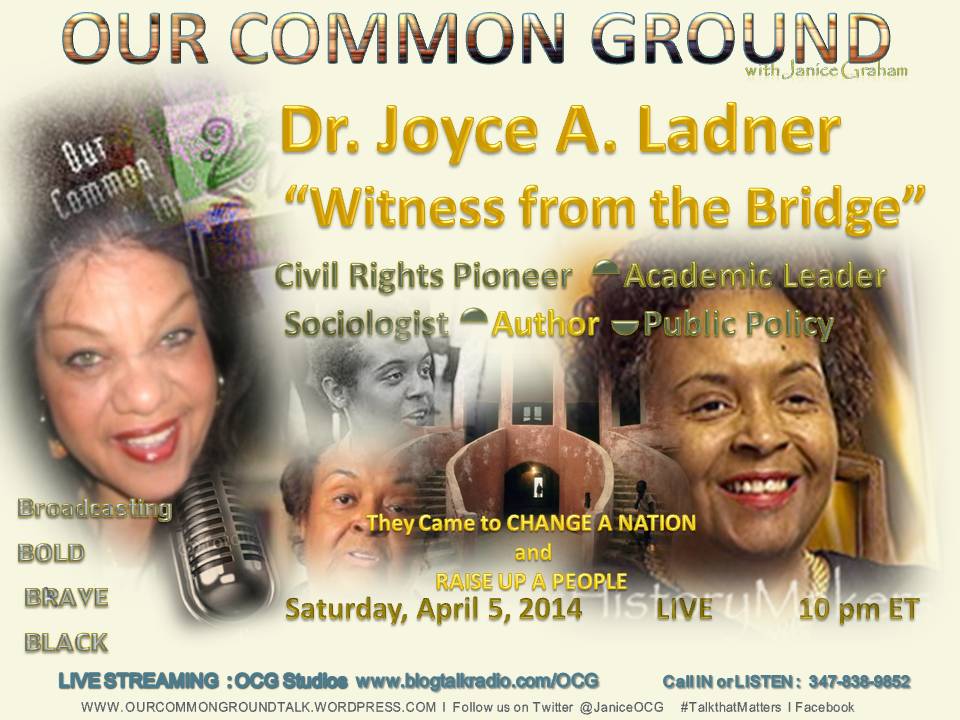
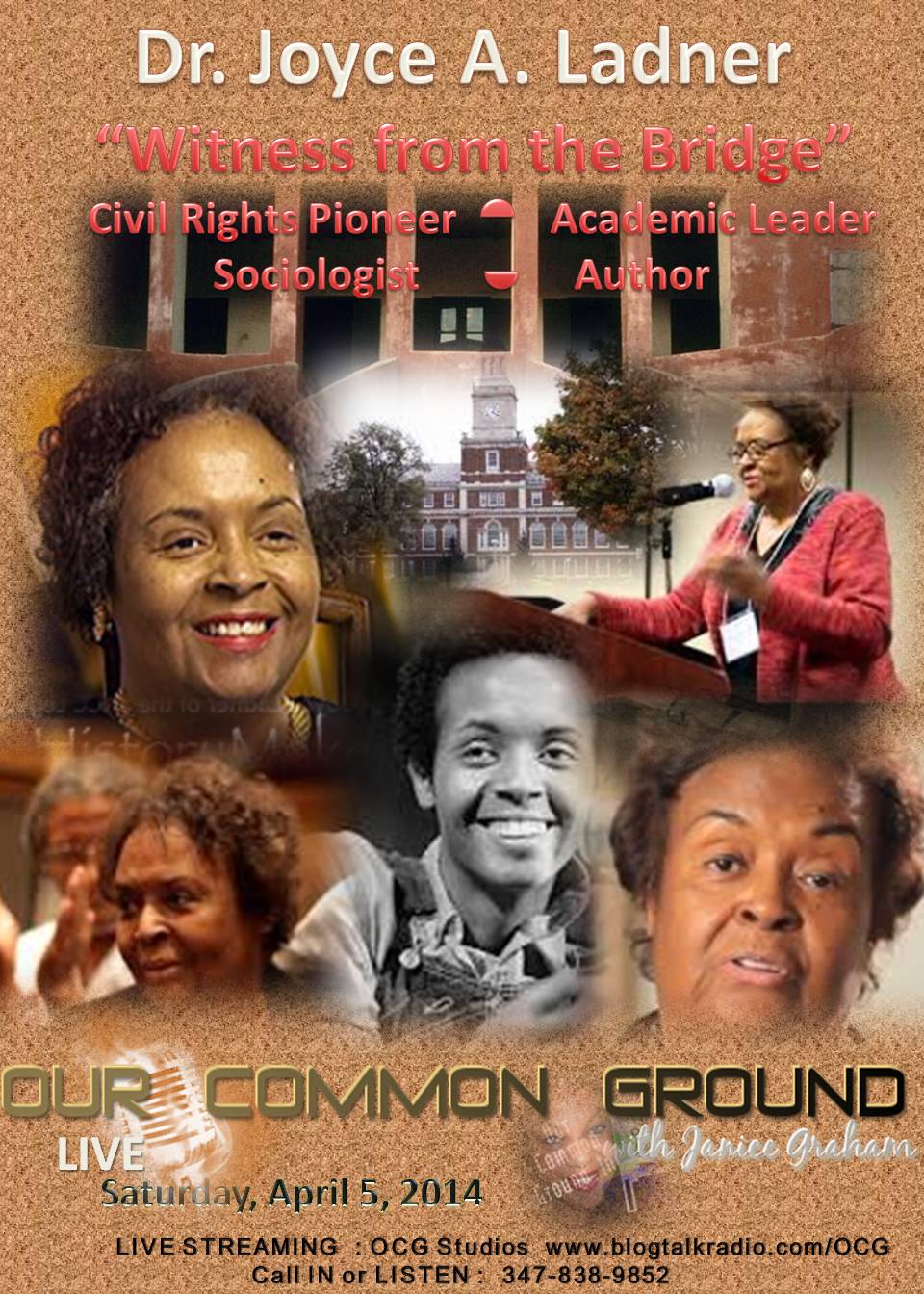
We hope you will join us tonight as we honor another “Witness From the Bridge”, Dr, Joyce A. Ladner as we enter our life and courage onto OUR COMMON GROUND.

LIVE   10 pm ET      April 5, 2015


03-29 Ladner4


OUR COMMON GROUND
Witness From the Bridge
Dr. Joyce A. Ladner
Sociologist – Academic and Education Leader
Civil Rights Pioneer Activist

April 5, 2014 LIVE 10 pm ET
LISTEN LIVE and Join the OPEN Chat: http://www.blogtalkradio.com/OCG
Call In – Listen Line: 347-838-9852

Sociologist Joyce Ladner was born in Battles, Mississippi, on October 12, 1943. She attended Tougaloo College in Tougaloo, Mississippi, where she earned her B.A. in sociology in 1964 and went on to Washington University in St. Louis, Missouri, to earn a Ph.D. in 1968.

At school, she also became involved in the civil rights movement. After earning her Ph.D., Ladner went on to teach at colleges in Illinois; Washington, D.C.; Connecticut; and Tanzania.

03-29 Ladner3In 1970 she conducted postdoctoral work as a research associate at the University of Dar es Salaam in Tanzania. In Tanzania she completed research on “The Roles of Tanzanian Women in Community Development.” Active within the SNCC organization as field secretary, Ladner was a witness to the racial conflict, violence, and the institutionalization of segregation. She has written numerous reports on children’s issues and has often been consulted for her expertise. Her work spans the roles of sociology professor, university president, presidential appointee, and a national public policy analyst. A prolific scholar, she has committed her life to improving the areas of diversity, multicultural education, higher education, urban issues, public policy, family and gender challenges, and child welfare.

Ladner published her first book in 1971, Tomorrow’s Tomorrow: The Black Woman, a study of poor black adolescent girls from St. Louis. In 1973, Ladner joined the faculty of Hunter College at the City University of New York.

Leaving Hunter College for Howard University in Washington, D.C., Ladner served as vice president for academic affairs from 1990 to 1994 and as interim president of Howard University from 1994 to 1995. When she became interim president of Howard in 1994, she was the first woman to hold the position at the university. She retired to Florida in 2003.

In 1995, President Bill Clinton appointed her to the District of Columbia Financial Control Board, where she oversees the finances and budgetary restructuring of the public school system.

She is also a former senior fellow in the Governmental Studies Program at the Brookings Institution, a Washington, D.C. think tank and research organization. She has spoken nationwide about the importance of improving education for public school students. She has appeared on nationally syndicated radio and television programs as well.

She has received many honors and awards, including distinguished alumna and Hall of Famer of Tougaloo College, distinguished alumna of Washington University, Most Inspiring Teacher Award in 1986 and the Outstanding Achievement Award in 1991 from the Howard University School of Social Work. In 1996. Dr. Ladner was named Washingtonian of the Year by Washingtonian magazine

Ladner is active in a number of civic and professional organizations. She is a member of the Council on Foreign Relations, The American Sociological Association, the Washington Urban League, the Washington Women’s Forum and the Coalition of 100 Black Women. In 1997, she was named Washingtonian of the Year by Washingtonian for her work in education.

Dr. Joyce A. Ladner, author of The Death of White Sociology: Essays on Race and Culture, published by Black Classic Press, has written numerous books on education, urban issues, public policy and transracial adoption.

She has been an activist, author and civil servant. She is a Mississippi native who earned her bachelor.s in sociology in 1964 from Tougaloo College. She earned a doctorate in sociology in 1968 from Washington University in St. Louis, Missouri.

She and her sister, Dorie, organized and went to jail for their roles in demonstrations on behalf of the Student Nonviolent Coordinating Committee for which Joyce Ladner served as field secretary.

Her career has included work at various universities and institutions: Southern Illinois University, assistant professor and curriculum specialist, 1968-69; affiliated with Wesleyan University, 1969-70; University of Dar es Salaam, Dar es Salaam, Tanzania, research associate, 1970-71; Hunter College of the City University of New York, sociology faculty, 1976-81; Howard University, professor of sociology, 1981-98, vice president of academic affairs, 1990-94, interim president, 1994-95; Brookings Institution, senior fellow, government studies, 1977.

When she became interim president of Howard in 1994, she was the first woman to hold the position at the university. She retired to Florida in 2003.

She has received many honors and awards, including distinguished alumna and Hall of Famer of Tougaloo College, distinguished alumna of Washington University, Most Inspiring Teacher Award in 1986 and the Outstanding Achievement Award in 1991 from the Howard University School of Social Work. In 1996. Dr. Ladner was named Washingtonian of the Year by Washingtonian magazine.

Dr. Joyce A. Ladner, is the author of The Death of White Sociology: Essays on Race and Culture, published by Black Classic Press and Launching Our Black Children for Success: A Guide for Parents of Kids from Three to Eighteen by Joyce A. Ladner and Theresa Foy DiGeronimo. She has written numerous books on education, urban issues, public policy and transracial adoption. Her other books include, authored or edited, Tomorrow’s Tomorrow: The Black Woman, The Ties That Bind: Timeless Values For African American Families, Mixed Families: Adopting Across Racial Boundaries and The New Urban Leaders. And,these must reads:


Ladner, Joyce. Tomorrow’s Tomorrow: The Black Woman. Garden City, New York: Doubleday, 1971.
—. Mixed Families: Adopting Across Racial Boundaries. Garden City, New York: Doubleday, 1977.
—. The New Urban Leaders. Washington, D.C.: Brookings Institution Press, 2001.

BROADCASTING BOLD BRAVE BLACK

OUR COMMON GROUND with Janice Graham

“Speaking Truth to Power and Ourselves”

email: OCGinfo@ourcommonground.com

LISTEN LIVE and Join the OPEN Chat: http://www.blogtalkradio.com/OCG
Call In – Listen Line: 347-838-9852

Freedom Note from OUR COMMON GROUND Φ April 3, 2014

ocgmainlogoHistory is sneaking up on us. That is what Rachel Maddow is telling us tonight. From Co-Intel Pro, to NSA, to Wall Street Banking scams, to all the truths we know, those especially that we were not supposed to know as citizens, has it made much difference ? That Fred Hampton was murdered in his bed or our history glimmers with thousands of Black landowners who have been burned out of their homes, businesses and land; or that a brutal slavery system was the economic embelishment foundation of this nation’s economy as it built to become a super-power. These truths have not been enough in our knowing. It informs what a knowing is and teaches us that “knowing” and repeating the truth does not have any authentic power. We are baiting into believing that knowing the truth, having the knowing is something. Something useful that builds our lives, invigorates our intelligence and changes us in some way. It does not. What is does is levitates us to a place and while there we seek and keep following the golden glitter, looking to the morphing disappearance of worthy dreams. In a whisper, we do not question “our knowing”. So they lied . . . how is that different now from then ? :sigh:

Φ

5 Reasons Why The Black Community Is Still Enslaved To White People >>Urban Intellectuals

5 Reasons Why The Black Community Is Still Enslaved To White People

by  | Jan 17, 2014 | Opinions |

5 Reasons Why The Black Community Is Still Enslaved To White People


You might not want to hear this, but it is time for the black community to have a dose of cold reality. We are in a position today where we don’t control our own destiny and are effectively still slaves to white people. Hopefully, this article we can open the dialog and minds to get out of this situation before it is too late.

This opinion isn’t about bashing white people or telling you to hate them. It is about pointing out our behaviors and things we are allowing to continue to happen to us 150 years after the Emancipation Proclamation. We have lawyers, politicians, doctors, PhDs, business owners and so called intelligent people in the black community. We have many material things in our lives and “freedoms”, but in many ways are in a worse position than we were 100 years ago. Isn’t it time to recognize and admit it is time to do something different as a community?

slavery photo

With that said, let’s dive into the reasons we still haven’t gotten from under the thumb of our captors and still have a long uphill battle to fight. Despite some of us having the markings of success, we still have a long way to go as a people.

The White Educational System And View Of The World Dominates The Black Community

Because the black community doesn’t control their educational system, our children will forever see the world through the perspective of white eyes. This is what is meant when people say one has black skin, but white eyes. The individual looks like a member of the black community, but thinks like a member of the white community. Meaning, they see everything as sacred that comes from the white community and negates thoughts, sciences, businesses and everything else that comes from their own people.

During the indoctrination years, I mean formal education, the black community is being conditioned to love, honor and respect white history, people and where they come from on the planet. Blacks know everything about white people, but only take one month, February, to learn anything about the black community. And if you are awakened, then you know these are controlled lessons that only emphasis what you are learning the other 11 months of the year.

Black People Are Infatuated By White Culture & Europe

This is a by product of the reason above, the educational system. Why wouldn’t you love, honor and respect white or Western culture when you have been formally indoctrinated into the system? It only makes sense. It becomes what you are familiar with and identify with at the same time.

On the other hand, if you are all in on Western culture, then you must be ignoring your own culture, history and people. Sure, you don’t mean for this to be the outcome, but it is nevertheless unless you are blessed enough to have someone in your life to help the scales fall from your eyes.

However, most in the black community are not so fortunate. We end up living a life dreaming of visiting Europe to see and experience the history we endear growing up first hand. The black community is infatuate with white culture, people and Europe.

Nothing Is Validated In The Black Community Until It Is Approved By Whites

Building on the education and the infatuation the black community has with white people, you know nothing is given the stamp of approval until someone white gives it the thumbs up. It hurts my heart to say this in public, but it is true and you know it.

breaking the chainsValidation comes to businesses, athletes, students, children, our intelligence, medicine, inventions, political policies, and everything else the black community can dream up when someone from the white community says it is good. This is a hangover from slavery as discussed by Dr. Na’im Akbar in his epic book “Breaking the Chains of Psychological Slavery”. We need white validation.

Blacks Embrace White Jesus And Their Religion

I know I’m going to lose a few of you from the this point forward. However, I don’t care. This is very important. Dr. John Henrik Clarke talks about if you take a man’s identity out of his God, then he will always see himself as inferior because he will identify the other with the deity, blessed people and not himself. This is exactly what happen to the black community and we bought it hook line and sinker.

For hundreds of thousands of years, we have controlled our visions of God, the Universe and our spirituality. Post slavery, we do not control this image and continue to struggle from turning over this basic human right.

Blacks Spend All Their Money With Whites Continuing To Make Them Rich At The Expense Of Themselves

It makes me sick that we are economically foolish enough to spend our $1 trillion dollars in annual spending power almost exclusively with white businesses. We have no concept of how important it is to spread our money around our community a few times before allowing it to leave. In fact, we are the only community in the country that does this and because of our Mis-Education, Carter G. Woodson’s book reference. What is worst is we don’t even understand the error in this practice, nor care to learn.  At this rate, we will definitely forever be slaves to white people.

Obviously, the black community is no longer in physical chains, but to the awakened mind it is clear the psychological chains still exist. We turn over all power and assets back to the white community without resistance and need to make a serious change in our behavior and beliefs.

What Are Your Thoughts and What Reasons Are Missing From the List Above?

OUR COMMON GROUND Kwanzaa 2013 -14

KWANZAA

Kwanzaa (kwahn-ZAH) is an annual cultural observance, which is recognized by Black people from December 26 thru January 1, each year:

  • Kwanzaa is non-political.
  • Kwanzaa is non-religious.
  • Kwanzaa is not related to Christmas.*

* Annual Kwanzaa observances begin on December 26th, each year] 

2013 Kwanzaa banner

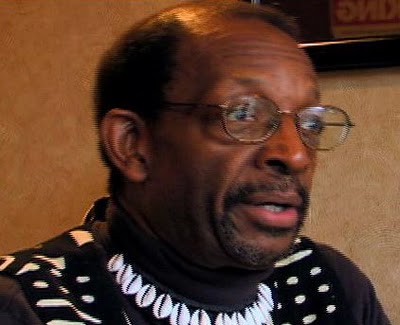
This year’s OUR COMMON GROUND KWANZAA message comes from our Brother, Friend and Comrade,OUR COMMON GROUND Voice, Dr. Ron Daniels.

The Nguzo Saba contains the core concepts and values of Kawaida and the foundation for Kwanzaa.  In a recent article, First Call for State of the Black World Conference III, I suggested that a spiritual and cultural revival is essential to combat and overcome the devastating State of Emergency afflicting the “dark ghettos” in Black America.  As we begin the celebration of Kwanzaa, it might be useful to restate the N’guzo Saba and discuss its relevance to healing our families and communities in a time of crisis.  So, I offer these reflections.

Dr. Ron Daniels, Founder and Director, IBW 21

Ron Daniels

The first Principle in the Nguzo Saba is Umoja/Unity. That Africans in America should be unified or act in concert to confront the State of Emergency should be self evident.  However, achieving Black unity can be challenging and illusive. In the name of pursuing the interests of Black people, what we have in the Black community is a myriad of leaders and organizations that all too often compete rather than cooperate with each other.  Moreover, various leaders and organizations have different ideologies and strategies for achieving full freedom/liberation. There is also a “class divide” between the more affluent sisters and brothers who have benefited from the “movement” and moved up in the world and the dispossessed left behind in abandoned and devastated “dark ghettos,” the “hood.”  Overcoming disunity  requires a conscious effort to create “united front” structures which bring people together despite their differences in philosophy and approach.  Dr. Karenga has advocated “operational unity” as a concept to enable leaders and organizations with differing philosophies and approaches to work together.  Operational unity means focusing on issues and areas where there is agreement among organizations and leaders rather than disagreement.  Dr. Karenga calls this “unity without uniformity.” With so many problems/issues affecting the Black community, the goal of operational unity is to have leaders and organizations collaborate/act collectively around specific issues, projects and initiatives they agree on.

Unity in the Black community requires bridging the class divide.  Brothers and sisters who have seized on a pathway to the middle and upper class paved by the blood and sacrifice of heroes and sheroes of the Black freedom struggle have an obligation to spiritually and/or physically return to “Tobacco Road,” the urban inner-city neighborhoods of this country, to give back, to reinvest their time, talent and resources to reconstruct/revive the “dark ghettos” from which they escaped.

 The second Principle is Kujichagulia/Self-Determination.  There has been much talk about a “post-racial society” in the aftermath of the election of Barack Obama as America’s first African American president. And, there have always been some within the race who wanted to escape the “burden” of their Blackness.  The State of Emergency in Black America clearly suggests that “race still matters” as a determinant of one’s life chances in this country. Dr. Karenga has said that to chart a course toward full freedom, a theory/ideology of liberation must provide an “identity, purpose and direction.” I believe that if we are to permanently rise above the crises plaguing our families and communities, we must name and claim our identity, proudly embrace ourselves and be resolutely committed to being “of the race and for the race.”  As descendants from the African motherland, “we are an African people.” And, part of our mission in life should be to unapologetically work for the advancement of people of African descent in the U.S. and the Pan African world.  This does not mean disrespecting, disregarding or disdaining other racial/ethnic groups; it simply means “charity begins at home and spreads abroad,” and “love thy neighbor as thyself.”  We cannot, must not abandon the race, especially our sisters and brothers in the “hood,” in an ill conceived effort to become absorbed in a “colorblind” or “post racial society.”  We have a right to define who we are and determine our own destiny as people!

 The third Principle is Ujima/Collective Work and Responsibility.  As noted earlier, the Doctrine of Kawaida as conceived by Dr. Karenga is grounded in the traditional worldview and way of life of African people. As such it emphasizes “we, us and our” in terms of the values that are important to building and sustaining wholesome families and communities.  This is diametrically opposed to the “me, myself and I” values of “individualism” and “competition” stressed as central to the “cherished” American/western way of life.  The concept of the “collective” is frowned upon in America as “socialist” or communist.” And yet, the idea of extended families working together for a common purpose within communities with a sense of mutual obligation and responsibility is deeply ingrained in African societies – and our own experience as Africans in America, particularly in the South.  We certainly will not permit class or status to divide us if we see ourselves as one people committed to promoting the common good of the race. This is a clear example of the need to retain the values/principles of our forebears as opposed to adopting a value orientation which has proven to be destructive to Black families and communities.

 The fourth Principle is Ujamaa/Cooperative Economics.  This principle is closely linked to Ujima in that it encourages people of African descent to share resources and engage in joint efforts to build and sustain an economic foundation for our families and communities. Cooperatives, credit unions, investment clubs and community development corporations are examples of economic structures based on pooling and sharing resources for the common good.  Ujamaa does not preclude for-profit corporations or individual entrepreneurship. But, the value/principle of Ujamaa dictates that entrepreneurs and businesses explore ways of collaborating/cooperating, exchanging ideas and pooling resources where appropriate to enhance the collective economic empowerment of the Black community. This is what Dr. Claud Anderson has promoted through the concept of Powernomics and George Fraser through Power Networking.  In the spirit of Booker T. Washington, Marcus Garvey, W.E.B. Du Bois and the Honorable Elijah Muhammad, it is imperative that people of African descent persistently work to build an economic infrastructure to undergird our social and political institutions.

 The fifth Principle is Nia/Purpose. When we survey the incredible fratricide/carnage occurring in Black communities, largely committed by young Black males, one has the feeling that it may be because many of our young people lack a sense of purpose and meaning in their lives.  And, this may be related to a lack of collective purpose in the Black community as a whole. Gone are the days of the civil rights/human rights and Black Power movements when there was a pervasive spirit of purpose in the air. There was a dynamic movement and a feeling that Black people were on the move! In the face of a daunting State of Emergency, we urgently need to restore a sense of purpose in Black America. And, that purpose should be a commitment to reclaim and rebuild our communities, a fervent determination that America’s desolate dark ghettos will become new communities that are bright beacons of hope and possibility. The collective conviction/purpose and the struggle required to rebuild our communities will be contagious; it will capture the hearts and minds of our youth/young people by restoring a sense of mission to their lives as part of a people fighting to liberate themselves from an oppressive value system and society.

The Sixth Principle is Kuumba/Creativity.  People of African descent gave the world its first multi-genius in the person of Imhotep, the Egyptian physician, architect and engineer who mastered the science of building in stone that led to the erection of the pyramids as one of the greatest wonders of the world! One might say that creativity is in our DNA.  Africans from the Caribbean took old barrels and transformed them into “steel drums” that produce amazing music.  Those of us who came up on the “rough side of the mountain” in America (most of us) bear witness to the fact that our mothers and fathers were masters of “making something out of nothing.”  They had to in order to survive.  Overcoming the State of Emergency to rebuild our families and communities is a formidable undertaking.  It will not be easy, but we should act with the absolute confidence that we possess the creativity, the knowledge, skill and will to meet the challenge.

 The Seventh and final Principle is Imani/Faith.  Given the obstacles our forebears faced, they had to have an abiding faith that survival was possible, that beyond the brutality, hardships, suffering and sacrifice of the moment, “joy would come in the morning,” that someday, a generation that sprang from their loins – sons, daughters, grandchildren, great grandchildren, great, great grandchildren … would be able to proclaim “free at last.” For millions it was the belief that “we’ve come this far by faith, leaning on the Lord.” For others it was a spiritual force deep down inside that could be tapped to carry forth for another day and another day … the faith that a better day was coming for the sons and daughters of Africa in America. In this current crisis, we too must have faith, a belief that enables us to scale heights, not normally possible, because we believe and act on our beliefs. Similar to the Principle of Kuumba/Creativity, we must have faith that there are no odds too great for a people to overcome if we act with Umoja/Unity, Kujichagulia/Self-Determination, Ujima/Collective Work and Responsibility, Ujamaa/Cooperative Economics, Nia/Purpose, Kuumba/Creativity, and Imani/Faith.  “Deep in my heart, I do believe, we shall overcome some day!”

– See more at: http://ibw21.org/vantage-point/the-nguzo-saba-and-kwanzaa-in-a-time-of-crisis/#sthash.gap6irva.dpuf

2014-3Kwanzaa

State Funeral for our Beloved President Nelson Mandela

Nelson Mandela State Funeral Update: Statement By Minister Chabane On Behalf Of The Inter-Ministerial Committee For The State Funeral

8 December 2013

nelson-tribute-bg
 

Fellow South Africans,

Ladies and gentlemen of the media,

Welcome to this latest update on the preparations for the State Funeral for our beloved President.

We are pleased to have with us:

  • The Minister of International Relations and Cooperation, Ms Maite Nkoana-Mashabane;
  • The Minister of Transport, Ms Dipuo Peters;
  • The Executive Mayor of the City of Joburg, Mr Parks Tau,
  • and representatives of the City of Tshwane.

These leaders are here to provide closer details of some of the logistics in and around the two cities, as well as South Africa’s hosting of the large number of international dignitaries who have begun to arrive.

We will in this briefing provide more information on some of the arrangements on which we reported yesterday.

But we do again want to start by thanking people around the country and the world for their warm and generous responses in the wake of the passing of our beloved President Nelson Rolihlahla Mandela.

These demonstrations of love and affection will go a long way to entrenching our memories of Madiba and in shaping the way we live and work with one another as human beings in this country and beyond.

What we have seen over the past few days reflects the true spirit of South Africa as a place where people of all backgrounds are working together to create a non-racial, non-sexist, prosperous society. These efforts are creating the hope that we will achieve even greater things than we have during the first 20 Years of Freedom.

I now want to turn to the update on the programme over the next few hours and days.

1. DAY OF PRAYER AND REFLECTION: TODAY, SUNDAY, DECEMBER 8 2013

Government has been heartened by the positive response of various communities of faith and other civil society formations to President Jacob Zuma’s call for today to be observed as a day of prayer and reflection.

We are aware that a large number of events are being held in South Africa and abroad today, giving people an opportunity to come together in fellowship and reflection.

We hope these events will bring comfort and healing to congregants and participants, and that it will inspire all of humanity to ensure that Madiba’s values live on in our hearts and in our actions.

As these events take place, government agencies will be hard at work making preparations for the rest of the week’s official programme.

2. INTERNATIONAL ARRIVALS

From today we will see the arrival of a large contingent of Heads of State and Government and a broad range of eminent persons, including royalty.

The fact that international leaders are making their way to South Africa at such short notice, reflects the special place President Mandela holds in the hearts of people around the globe.

We are touched by the fact that many countries have declared periods of mourning, ordered that flags be flown at half-mast and draped or lit landmarks in the colours of the South African flag. We truly appreciate these gestures.

We appreciate the willingness showed by a broad range of eminent persons to come to South Africa to join us personally at this time of mourning, reflection and celebration of Nelson Mandela’s life and legacy.

To date, 13 African states have confirmed attendance, in addition to 15 from outside the continent.

International and regional organisations from the United Nations and European Commission to the African Union, for example, have also confirmed attendance.

Eleven (11) Eminent Persons will also be in South Africa during this period.
From the United States, President and Mrs Obama will be accompanied by three former Presidents – Carter, Bush (George W), Clinton and their spouses, and 26 Congressmen.

The Brazilian President, Ms Dilma Rousseff, will be accompanied by four former Heads of State: Presidents Sarney, Melo, Cardoso and Lula da Silva.

We expect more confirmations, and we wish to reiterate that our international guests are most welcome as they join us at this difficult time.

3. OFFICIAL MEMORIAL SERVICE: FNB STADIUM, JOHANNESBURG

The Official Memorial Service at FNB Stadium, Johannesburg, on Tuesday, December 10. The event will begin formally at 11am. Gates will open at 6am.

This is an international event that will be attended by members of the public alongside national and international leaders.

The President of the Republic of South Africa will address the official memorial service.

The programme will also include tributes by Heads of State from the various regions of the globe, the continent and representatives of international and regional organisations. Eminent persons will also address the gathering.

As we invite people to participate in this event, we must make the additional point that the body of President Mandela will not be in position at the Official Memorial Service. President Mandela will lie in state at the Union Buildings only from Wednesday, December 11 to 13 December 2013.

Our advice is that people outside Gauteng come together in their own provinces to ensure that this is a truly nationwide event, and that people take advantage of the fact that all key events are being broadcast live.

Provincial and local authorities have been requested to arrange transport for mourners from various parts of the country to FNB Stadium and the overflow venues at Ellis Park Stadium, Orlando Stadium and Dobsonville Stadium.

Big screens will be installed at the overflow venues to allow members of the public to follow proceedings at FNB Stadium in the company of compatriots.

While these venues offer extensive seating, people must accept that at some stage this capacity will be filled and police and other authorities will turn people away.

We call on people to cooperate and demonstrate patience and dignity if they were to be turned away.

Government is doing all it can to allow as many people as possible to be part of these official events, but there are limits to how many people we can reasonably accommodate.

Members of the public who want to attend the National Memorial Service at FNB or other stadiums must plan their trips carefully, leave early and use public transport. No cars will be allowed in the vicinity of FNB Stadium.

ROAD CLOSURES, PUBLIC TRANSPORT AND PARK AND RIDE

  • There will be road closures around FNB Stadium and no cars will be allowed at the stadium. Some of the road closures have already been listed on various government websites, including http://www.mandela.gov.za.
  • There will also be road closures on Tuesday morning around Orlando, Ellis Park and Dobsonville stadiums.
  • Mourners to FNB Stadium can travel by Metrorail from all major stations in Gauteng.
  • They will also be able to travel by Gautrain to Park Station and transfer to Metrorail to FNB Stadium.
  • People will also be able to walk from the surrounding areas to the stadium, and
  • A special Rea Vaya service will also be in operation.
  • The City of Joburg has a number of Park and Ride sites for FNB Stadium, Ellis Park and Orlando Stadium. Members of the public must watch the media, visit websites and follow broadcast media for details.

The City of Joburg has also established Mourning Sites at various locations but the City will provide more details in its own briefing here shortly.

4. PUBLIC VIEWING AREAS FOR REGIONAL MEMORIAL EVENTS AROUND THE COUNTRY

We must emphasise that also on Tuesday, provincial authorities will be hosting various events around the country where people are invited to come together to view the national event at FNB Stadium on big screens.

These public viewing areas, which are normally activated during national events such as the State of the Nation Address, will be similar to the “fan parks” that were in place during the 2010 FIFA World Cup.

Around 90 big screens will be set up by Government Communications (GCIS) and partners in all provinces.

We expect this number will increase as provincial plans are consolidated later this afternoon.

Some of the big screens will be live from Tuesday 10 December to Monday 16 December, which is Day of Reconciliation.

On the Day of Reconciliation, we will unveil a statue of President Mandela at the Union Buildings and observe the 100th anniversary of the Union Buildings as the seat of government.

Throughout this period, people will also be able to express their emotions and reflections in books of condolence that have been posted at various government offices around the country and our diplomatic missions abroad.

Details of the sites where books of condolence have been opened have been posted on the government memorial website, http://www.mandela.gov.za.

Details of the public viewing areas for Tuesday’s provincial events will be posted on government websites and social media later today, Sunday.

5. LYING IN STATE: WEDNESDAY TO FRIDAY, DECEMBER 11 TO 13, 2013

The procession will leave 1 Military Hospital at 7am daily and President Mandela’s body will be on view from 8am.

On Wednesday December 11, the Mandela family and VVIPs will view the body from 10am.

Members of the public will file past the body from 12h00 to 17h30.

On Thursday and Friday December 12 and 13, the public will have access to casket from 8am to 5.30pm.

We also appeal to people to work with the various agencies of government who will manage this route so that this daily event will be dignified and secure.

Two sites in Pretoria will be used as points from which mourners will be shuttled to the Union Buildings and back. No other access will be possible. Mourners are also advised that cellphones will need to be off and out of sight as mourners file past the body.

Government reiterates its appeal for members of the public to line the memorial route each morning to form a public guard of honour. The public guard of honour will not apply in the evening.

STATE FUNERAL, QUNU

More information will be released in the coming days about arrangements for the laying to rest of President Mandela at Qunu in the Eastern Cape.

However, it is worth noting that South African Airways will operate a special air transport service to ferry mourners who will attend the funeral of world icon and former president Nelson Mandela in the Eastern Cape.

This special service – for which travellers will pay – will cater for mourners who will attend the funeral and the service will also be available on the return leg of their travel.

The special service does not replace and will not disrupt SAA’s existing daily operations to the Eastern Cape – except that airspace will be restricted around Mthatha.

Information about the readiness of the Airports Company of South Africa to manage passengers and aircraft during this period has been compiled into a factsheet. This factsheet is available on the official government memorial website, http://www.mandela.gov.za.


Marissa Alexander Released Home on House Arrest

Fla. Woman Sentenced to 20 Yrs. for Firing Warning Shot—RELEASED

Marissa Alexander Freed While Awaiting Trial

by Associated Press

Click on the photo to view additional Photos.

Marissa Alexander before going to prison (left), and during her prison term (right). (Courtesy Photo)

 AFRO Black History Archives

Check out related stories, research genealogies, or peruse all that our archives have to offer.

Click Here to get started! 

JACKSONVILLE, Fla. (AP) — The Florida woman awaiting a new trial in a controversial “stand your ground” case is free on bond.

First Coast News (http://fcnews.tv/18q19sa) reports that Marissa Alexander was released from jail Wednesday. According to the Duval County Clerk of Court, she must remain under house arrest and electronic monitoring while awaiting trial.

In 2012, Alexander was sentenced to a mandatory 20-year prison sentence for firing what she insisted was a warning shot during a fight with her husband. She tried to invoke Florida’s “stand your ground” law but the judge threw out her self-defense claim, noting that she could have run out of the house to escape her husband but instead got the gun and went back inside

An appeals court ruled in September that the judge in the case gave improper jury instructions, and a new trial has been set for next year.

Alexander’s supporters, including the NAACP and advocates for victims of domestic violence, have compared the case to the trial of George Zimmerman, who recently was acquitted in the fatal shooting of Trayvon Martin. Both cases have brought into question the state’s “stand your ground” law, which generally allows people to use deadly force if they feel threatened.

Alexander, who had never been arrested before, has said she fired a bullet at a wall in 2010 to scare off her husband when she felt he was threatening her. No one was hurt, but the judge in the case said he was bound by state law to sentence her to 20 years in prison after she was convicted of aggravated assault with a deadly weapon.

Alexander had rejected a plea deal that would have resulted in a three-year prison sentence and chose to go to trial. A jury deliberated 12 minutes before convicting her.

Alexander was also charged with domestic battery four months after the shooting in another assault on her husband. She pleaded no contest and was sentenced to time served.

State Attorney Angela Corey, who oversaw the prosecution of George Zimmerman in the shooting death of Trayvon Martin, has stood by the handling of Alexander’s case. Corey said she believes that Alexander aimed the gun at the man and his two sons, and that the bullet she fired could have ricocheted and hit any of them.

Click for related articles:

“Woman Sentenced to 20 Years for Firing Warning Shot Receives New Trial”

“Blacks Who Stand Their Ground Often Imprisoned”

“Unbelievable: Fla. ‘Stand Your Ground’ Defense Rejected for Mother Only Firing “Warning Shot””

“Stand Your Ground Law Bites Blacks in the Butt”

Woman Sentenced For Firing Alleged ‘Warning Shot’ At Her Husband Gets Released

11/28/13 03:21 PM ET EST AP

woman warning shot released

JACKSONVILLE, Fla. (AP) — The Jacksonville woman awaiting a new trial in a controversial “stand your ground” case is free on bond.

First Coast News (http://fcnews.tv/18q19sa) reports that Marissa Alexander was released from jail Wednesday. According to the Duval County Clerk of Court, she must remain under house arrest while awaiting trial.

In 2012, Alexander was sentenced to a mandatory 20-year prison sentence for firing what she insisted was a warning shot during a fight with her husband. She tried to invoke Florida’s “stand your ground” law, but the judge threw out her self-defense claim.

An appeals court ruled in September that the judge in the case gave improper jury instructions.

Alexander says she fired a bullet at a wall in 2010 to scare off her husband when she felt he was threatening her.


Freedom Note: “Twice As Good” for what?

“Twice as Good”

If you are a Black person over the age of 55, being told that in order to be successful, over and over again that you have to be “twice as good” was a mantra that came from parents, church, school. You inherently understood this message.  It lived with you most of the time in study and other endeavors, as you entered a new world brought on my the civil rights movement. In many ways, the message translated into “twice as good and twice as right”. Overachievement and a lifetime of seeking perfection. Never letting up, always winning.  Always running as hard as you can to beat the odds and avoid failure.

The mantra popped up in a recent episode of the ABC series, “Scandal” in a scene with Olivia Pope, the main character who is a “political crisis fixer” and her Father, Rowan, a powerful Washington insider. In this scene, he reiterates what we were all told, you have to be “twice as good to get half of what they have”. We were told this, even when our parents had no idea of what the really had. They did know, however, how far they were willing to go to keep it for themselves and from us.

I watched it with great interest, seeing yet again the damage that we inflict on our children in our quest to prove that being Black deserves respect, and that we are worthy. In the quest to prepare our children, foster their survival, prepare them for the duality and inequities, and on-slaughter . . . just what are we to do as parents?

The “brown-eyes” parents in the Jane Elliott exercises have no idea the corner in which Black parents have to paint their children to meet the challenges of race discrimination and the realities of an endless battle against white privilege in order to win.

For many Blacks, the “twice as good” worked.  I wonder often at what price ?

2013 Black History Note l From Footnote to Fame in Civil Rights History

From Footnote to Fame in Civil Rights History

By BROOKS BARNES

Published: November 25, 2009

On that supercharged day in 1955, when Rosa Parks refused to give up her bus seat to a white passenger in Montgomery, Ala., she rode her way into history books, credited with helping to ignite the civil rights movement.

Nicole Bengiveno/The New York Times (left), The Montgomery Advertiser, via Melanie Kroupa Books/Farrar, Straus & Giroux

Claudette Colvin in a portrait taken in November (left) and as a child around 1953.

Nicole Bengiveno/The New York Times

Claudette Colvin’s historic stand preceded that of Rosa Parks.

Michael Appleton for The New York Times

Phillip Hoose, with Claudette Colvin, accepting a National Book Award last week for “Claudette Colvin: Twice Toward Justice.”

The Montgomery Advertiser, via Melanie Kroupa Books/Farrar, Straus & Giroux


But there was another woman, named Claudette Colvin, who refused to be treated like a substandard citizen on one of those Montgomery buses — and she did it nine months before Mrs. Parks. The Rev. Dr. Martin Luther King Jr. made his political debut fighting her arrest. Moreover, she was the star witness in the legal case that eventually forced bus desegregation.

Yet instead of being celebrated, Ms. Colvin has lived unheralded in the Bronx for decades, initially cast off by black leaders who feared she was not the right face for their battle, according to a new book that has plucked her from obscurity.

Last week Phillip Hoose won the National Book Award for Young People’s Literature for “Claudette Colvin: Twice Toward Justice,” published by Farrar, Straus & Giroux. The honor sent the little-selling title shooting up 500 spots on Amazon.com’s sales list and immediately thrust Ms. Colvin, 70, back into the cultural conversation.

“Young people think Rosa Parks just sat down on a bus and ended segregation, but that wasn’t the case at all,” Ms. Colvin said in an animated interview at a diner near her apartment in the Parkchester section of the Bronx. “Maybe by telling my story — something I was afraid to do for a long time — kids will have a better understanding about what the civil rights movement was about.”

Ms. Colvin made her stand on March 2, 1955, and Mrs. Parks made hers on Dec. 1 that same year. Somehow, as Mrs. Parks became one of Time Magazine’s 100 most important people of the 20th century, and streets and schools were named after her, Ms. Colvin managed to let go of any bitterness. After Ms. Colvin was arrested, Mrs. Parks, a seasoned N.A.A.C.P. official, sometimes let her spend the night at her apartment. Ms. Colvin remembers her as a reserved but kindly woman who fixed her snacks of peanut butter on Ritz crackers.

“My mother told me to be quiet about what I did,” Ms. Colvin recalled. “She told me: ‘Let Rosa be the one. White people aren’t going to bother Rosa — her skin is lighter than yours and they like her.’ ”

Ms. Colvin said she came to terms with her “raw feelings” a long time ago. “I know in my heart that she was the right person,” she said of Mrs. Parks.

Ms. Colvin was riding the bus home from school when the driver demanded that she give up her seat for a middle-age white woman, even though three other seats in the row were empty, one beside Ms. Colvin and two across the aisle.

“If she sat down in the same row as me, it meant I was as good as her,” Ms. Colvin said.

Two police officers, one of them kicking her, dragged her backward off the bus and handcuffed her, according to the book. On the way to the police station, they took turns trying to guess her bra size.

At the time, the arrest was big news. Black leaders, among them Dr. King, jumped at the opportunity to use her case to fight segregation laws in court. “Negro Girl Found Guilty of Segregation Violation” was the headline in The Alabama Journal. The article said that Ms. Colvin, “a bespectacled, studious looking high school student,” accepted the ruling “with the same cool aloofness she had maintained” during the hearing.

As chronicled by Mr. Hoose, more than 100 letters of support arrived for Ms. Colvin — sent in care of Mrs. Rosa Parks, secretary of the Montgomery branch of the N.A.A.C.P.

But Ms. Colvin was ultimately passed over.

“They worried they couldn’t win with her,” Mr. Hoose said in an interview from his home in Portland, Me. “Words like ‘mouthy,’ ‘emotional’ and ‘feisty’ were used to describe her.”

Mrs. Parks, on the other hand, was considered “stolid, calm, unflappable,” he said. The final straw: Ms. Colvin became pregnant by a married man.

A second Montgomery teenager, Mary Louise Smith, was also arrested for refusing to give up her bus seat — after Ms. Colvin’s arrest but before Ms. Parks’s — and she was also deemed an unsuitable symbol for the movement partly because of rumors that her father had an alcohol problem.

Although Ms. Colvin quickly left Montgomery, she returned during the peak of the bus boycott that Mrs. Parks had subsequently sparked, and testified in federal court in Browder v. Gayle, the landmark case that effectively ended bus segregation.

“It’s an important reminder that crucial change is often ignited by very plain, unremarkable people who then disappear,” said David J. Garrow, a Pulitzer Prize-winning biographer of Dr. King.

Even Mrs. Parks was forgotten for the better part of 20 years, only re-emerging as a world-famous figure in the early 1970s after magazine articles and attention in several children’s books.

Ms. Colvin, who relies on a cane to steady herself, retired in 2004 after 35 years as a nurse’s aide at a Manhattan nursing home. She contributed to her own obscurity: after settling in New York, she never talked about how her arrest helped prompt the famous bus boycott.

“She continued to heed her mother’s advice, and worried that drawing attention to herself would result in the loss of her job. “I wasn’t going to take that chance,” she said.

So she settled into living an average life. She never married. The son she had in Montgomery died at age 37; a second son is an accountant in Atlanta. She watches television — “Who Wants to Be a Millionaire” is a favorite — and is a regular at the diner.

Ms. Colvin said she reads two newspapers every day to keep up on current events, chatting about recent Nobel Prize winners. She likes Chris Rock and Alicia KeysAretha Franklincould stand to lose a few pounds, but she wore a good hat to President Obama’sinauguration. Don’t get Ms. Colvin started on Sarah Palin.

She has fond memories of Dr. King. “He was just an average-looking fellow — it’s not like he was Kobe Bryant or anything,” she said, fluttering her eyelashes. “But when he opened his mouth he was like Charlton Heston playing Moses.”

Mr. Hoose said he stumbled across Ms. Colvin’s story while researching a previous book, “We Were There, Too! Young People in U.S. History.” Several sources told him to investigate what had almost become an urban myth: that a teenager had beaten Mrs. Parks to the punch in Montgomery.

He eventually tracked down Ms. Colvin, who has an unlisted telephone number. She refused to talk to Mr. Hoose for almost four years.

Mr. Hoose won over his reluctant subject over a long lunch at the diner. It was clear, he said, that she yearned to have her story told despite protests to the contrary. “It was easy to find the rebel girl inside of her,” he said.

One of her first questions: “Can you get it into schools?”

This article has been revised to reflect the following correction:

Correction: December 4, 2009
An article on Nov. 26 about Claudette Colvin, who protested segregation on theMontgomery, Ala., buses nine months before Rosa Parks did and is the subject of a book for young people that won a National Book Award last month, referred imprecisely to Mrs. Parks’s protest. While the boycott that followed her arrest for refusing to give up her seat to a white passenger was planned by civil rights leaders who were waiting for the right case, her protest itself on Dec. 1, 1955, was not “carefully planned.”

More Articles in Books »A version of this article appeared in print on November 26, 2009, on page A1 of the New York edition.

Visit our Honoring Our Past Pages