Trump’s Man on the Inside at the IRS | DCReport.org


Charles Rettig is Running the Tax Agency for One Reason Only—To Keep His Boss’s Returns Locked Up

“Unless they are too brazen or clumsy, very rich tax cheats with very good lawyers get to deal with their tax offenses behind closed doors.  As a criminal tax defense lawyer once told me, “I get paid to save people from indictments for their tax crimes by settling cases before their names go into the public record.”


Source: Trump’s Man on the Inside at the IRS | DCReport.org

The Cult of Trump

JOHN PAVLOVITZStuff That Needs To Be Said


Source: The Cult of Trump

Racism Knocking at the Door: the Use of Criminal Background Checks in Rental Housing – Race, Racism and the Law

Racism Knocking at the Door: the Use of Criminal Background Checks in Rental Housing

In 2016, after decades of appearing to encourage local public housing providers to adopt harsh policies barring applicants with criminal records, the Office of General Counsel for the United States Department of Housing and Urban Development (“HUD”) issued guidance instructing public and private housing providers to take in to account the potentially disparate effects of such policies on racial minorities (the “HUD Guidance”). Recognizing that African Americans and Latinos are “arrested, convicted and incarcerated at rates disproportionate to their share of the general population,” HUD advised that any policy that “restricts access to housing on the basis of criminal history” may have an unlawful disparate impact based on race.


Source: Racism Knocking at the Door: the Use of Criminal Background Checks in Rental Housing – Race, Racism and the Law

Ilhan Omar, AOC, Rashida Tlaib, and the silencing of women of color in Congress – Vox

A man threatened to “put a bullet” in Rep. Ilhan Omar. It’s another example of how society wants to silence women of color.

Source: Ilhan Omar, AOC, Rashida Tlaib, and the silencing of women of color in Congress – Vox

Millions of Black Voters Are Being Purged From Voter Rolls, Often Illegally: Report

Millions of Black Voters Are Being Purged From Voter Rolls, Often Illegally: Report

Residents cast their votes at a polling place on November 4, 2014, near Ferguson, Mo.       Photo: Scott Olson (Getty Images)

As the end of Barack Obama’s presidency grew closer, election officials began preparing for the next election. Instead of strengthening the security of voting machines and making voting more accessible to citizens, states did the exact opposite. But they didn’t just make it harder to vote. For hundreds of thousands of registered, eligible voters across the nation, they made it impossible.

Voter Purges (pdf), a new report by the Brennan Center, highlights the systematic purging of voters from rolls by state and local officials around the country. These are not random, isolated cases. It is a methodical effort that disproportionately affects minority voters. Even worse, no one seems to care.

In 1993, Congress passed the National Voter Registration Act (NVRA) which was an attempt to make registering to vote easier by offering driver license applicants the opportunity to register to vote. The law also prevented states from purging voters unless they met certain requirements.

But the Brennan report highlights how states have skirted the law and purged voters without punishment. And after the Supreme Court dismantled the requirements for voter pre-clearance with the Shelby v. Holder rulingstates with histories of voter discrimination no longer required federal pre-clearance before purging rolls.

Between 2014 and 2016, 16 million registered voters were removed from state rolls, 33 percent more than were moved between 2006 and 2008. For the election of 2012 and 2016, the Brennan Center estimates that two million fewer voters would have been purged if those states had to apply by the provisions of the Voting Rights Act.

Some of the egregious highlights of the report include:

  • In June 2016, the Arkansas secretary of state gave a list of 7,700 names to county clerks to be removed from the rolls because of supposed felony convictions. That list included people who had never been convicted of a felony and formerly convicted persons whose voting rights had been restored.
  • In 2013, Virginia deleted 39,000 names from its voting roster. In some counties, the mistakes on the list were as high as 17 percent.
  • A federal court halted a purge after Hurricane Katrina after justices found that one-third of the purged names came from a majority black parish in of New Orleans.
  • After the Shelby v. Holder decision, Texas purged 363,000 more voters than it did the election cycle before the case. Georgia purged 1.5 million more voters.
  • Alabama, Indiana and Maine have illegally instituted the widely ridiculed Crosscheck system (on which Charles D. Ellison previously reported on for The Root) that purges voters without federally-mandated notification.
  • In 1986, one Louisiana official remarked that a voter purge effort “could really keep the black vote down considerably.”
  • Instead of checking out inequities, Jeff Sessions’ Department of Justice has been urging states to do more purging.

Almost every type of voter purge disproportionately affects black voters and voters of color. Some states purge rolls based solely on names but non-whites are more likely to have the same names. According to the U.S. Census Bureau, 16.3 percent of Hispanic people and 13 percent of black people have one of the 10 most common surnames, compared to 4.5 percent of white people.

Black and Hispanic voters are more likely to move, often in the same jurisdiction, but voter purges based on address eliminate them from voting. Officials also use “voter caging” which intentionally sends mail to verify addresses in a format that cannot be forwarded, leading to the disenfranchisement of hundreds of thousands of eligible voters.

African Americans are also more likely to have felony convictions, and elderly and minority voters are more likely to be incapacitated, all reasons for which someone can be purged from a voter roll.

Almost every study ever done on this issue shows that in-person voter fraud is almost nonexistent. Instead, these purges are intentional efforts to restrict voting rights.

Some of the easily-implementable recommendations to rectify this travesty include:

  1. Public notifications of impending voter purges.
  2. Making purge lists available to the public, including at polling places.
  3. Accepting provisional ballots from purged voters.
  4. Universal voter registration forms and rules.
  5. Stop using failure to vote as a reason to purge voters.

All of these policies seem like they would be universally-accepted fixes for a flaw in our democracy.

But then again, not having a Russian agent for a President seems like a smart thing too. How’s that working out?

ABOUT THE AUTHOR

Michael Harriot

World-renowned wypipologist. Getter and doer of “it.” Never reneged, never will. Last real negus alive.    Posts

An Open Letter to Those Who Still Give a Damn ::: John Pavlovitz

An Open Letter to Those Who Still Give a Damn

JULY 21, 2018 / JOHN PAVLOVITZ

From   JohnPavlovitz  Stuff That Needs to Be Said

It’s exhausting to give a damn isn’t it?

To be a person of compassion in a time when compassion is in such great demand?

To wake up every day in days like these, and push back against predatory politicians and toxic systems and human rights atrocities and acts of treason and spiritual leadership failures and Presidential Tweet tantrums—the volume and the relentlessness of the threats can be wearying.

You may have noticed.

I think you have.

And you’re not simply carrying around these big picture, larger systemic sicknesses and political realities—but the people behind them; the names and the faces and the lives of specific human beings who are under unprecedented duress right now; people whose stories you listen to and know and are living within, people you dearly love.

And day after day, all these massive realities and these individual stories begin to accumulate upon your shoulders and in your clenched jaw and in your elevated heart rate, and in the knot in your stomach that returns every morning when you check Twitter or turn on the news or step out into your community or walk into the kitchen—and you see so many reasons for grief, places so many places compassion is so needed and yet so scarce.

And worst of all, is how many people both at distance and very close to you, just don’t seem to give a damn; how the pain of other people simply doesn’t register in them anymore.

It seems like fewer and fewer people are capable of even an entry-level empathy for the suffering around them, and you’re seriously considering joining their ranks, because of how tired you are of carrying both your own and their share of compassion for a hurting humanity.

Not long after the election I purchased a blood pressure monitor. And not one of those manual base models, either. I went high-end, top of the line; full upper arm cuff, automated pressure, digital readout—the works. I soon stopped using it though, as it was a daily reminder of how stressed I was. I don’t look at it any longer. I don’t measure my blood pressure anymore. Now I just assume it’s dangerously high.

Those of us who give a damn all have new dangers assailing our hearts these days, and it is in this time of relentless urgency and sustained trauma and prolonged fatigue and profound fracture that you and I find ourselves.

I’m not sure why you’re reading this, but it’s probably because still you’re a damn-giver; because you are a fierce lover of humanity and of the planet, and of people who don’t look or worship or sound like you. As a result you probably find yourself pissed off, disconnected, isolated, worn out, and exhausted because how few people are as moved by the need around them as you are.

Whether you’re an activist or a minister or a parent or a caregiver, or just a citizen of the planet who is moved by other people’s suffering—you likely feel the immeasurable heaviness of these days. Sure, speed and activity can mask it for a while, but if you stop long enough, the reality of the fatigue catches up to you—you can measure the toll it’s all taken on you. I want you to measure it. I want you reckon with how tired you are. I want you to hear yourself exhale with the heavy sigh of someone who feels the weight of it all.

There is a cost to compassion, a personal price tag to cultivating empathy in days when cruelty is trending. There is in your body and head and in your midst, a collateral damage to you giving a damn when others do not, and it manifests itself in many ways: in irritability, impatience, physical illness, eating emotionally, addictive behavior, the inability to be present to the people who love you, an obsession with social media, a fixation on how jacked up everything is.

Notice these things in you today, and give them your attention.
Extend some of that compassion you’re so willing to extend to the world—to yourself.
Take some time to step away from the fray and the fight. It will still be there when you return, and you’ll be better able to face it.

Friend, I know you’re exhausted. If you’re not exhausted right now your empathy is busted. But I also know that you aren’t alone.
Millions of people are as tired as you are right now.
We too, live in disbelief at how callous so many people we know and love have become.
We too, are incredulous witnessing our elected leaders and parents and neighbors and pastors and parents and favorite aunts abandon any semblance of kindness.
We too, feel the fatigue of believing we’re doing this damn-giving alone.

You are in good company, so keep going.
Fight like hell to keep your heart soft, even while so many people have become hardened.
Yes the world is upside-down right now, but we can make it right—one beautiful act of decency at a time.
Get some rest and keep going.
The world needs people like you.

Blessed are the damn-givers, for they will right-side the world.
About John Pavlovitz  

John Pavlovitz is a writer, pastor, and activist from Wake Forest, North Carolina. In the past four years his blog Stuff That Needs To Be Said has reached a diverse worldwide audience. A 20-year veteran in the trenches of local church ministry, John is committed to equality, diversity, and justice—both inside and outside faith communities. In 2017 he released his first book, A Bigger Table. His new book, Hope and Other Superpowers, arrives on November 6th.

Contact John

Sex, Race, and the Law: Considering America ‘In the Dark’ :: The Nation Mag

patty-wetterling-in-the-dark-podcast-ap-img

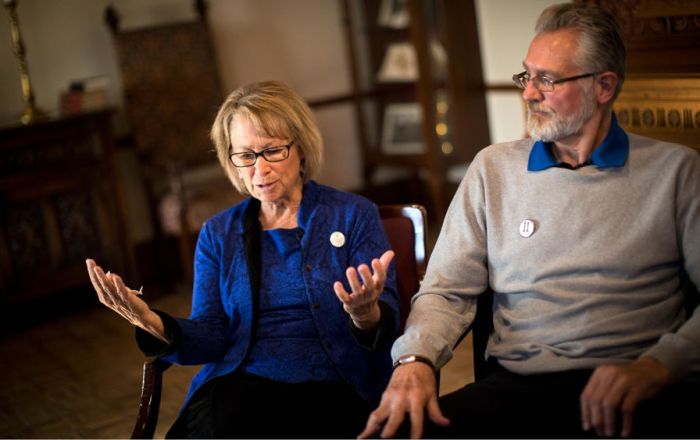
Jerry and Patty Wetterling, parents of Jason Wetterling, who was kidnapped, sexually assaulted, and killed by an Annandale man in 1989. (Star Tribune via AP / Renee Jones Schneider)

Madeleine Baran’s stunning investigative podcast grapples with our so-called “justice” system.

If Childish Gambino’s song “This is America” and Boots Riley’s film Sorry to Bother You perfectly distill the absurd comedy and violent hell of the United States circa 2018, then Madeleine Baran’s In the Dark does the same in podcast form. The audio-documentary series dropped the haunting final episode of its second season earlier this month, and, like Donald Glover’s and Riley’s works, Baran’s opus lays bare the nexus of racial anxiety, guns, criminal “justice,” and capitalism in our nation.

In the Dark is produced by APM Reports and hosted by lead reporter Baran, who helms an investigative team of a half dozen journalists who work on a single story for a year. Season 1investigated the 1989 abduction of 11-year-old Jacob Wetterling in rural Minnesota. Wetterling’s fate went unsolved for almost 27 years, during which he became the poster child for dangerous misconceptions about child kidnappings. But unlike the purveyors of many true-crime series, Baran and her team do not hype hysteria. Rather, they reveal how those in positions of power—like the local sheriff, politicians, and huckster John Walsh of America’s Most Wanted—were incompetent and exploitative of the Wetterlings. (Danny Heinrich, an early but largely unpursued suspect, confessed in 2016 as part of plea deal over child-pornography charges.)

Read More


Black farmers were deliberately sold ‘fake seeds’ in scheme to steal their land: report

Black farmers were deliberately sold ‘fake seeds’ in scheme to steal their land: report

Black farmers in the Mid-South region surrounding Memphis used science to uncover a multi-million scheme to put them out of business and steal their farmland, WMC News reported Tuesday.

At the Mid-South Farm and Gin Show show in March of 2017, African-American farmers believe that Stine Seed Company purposefully sold them fake seeds.

Thomas Burrell, president of the Black Farmers and Agriculturalists Association, explained how black farmers were receiving one-tenth of the yield as their white neighbors.

“Mother nature doesn’t discriminate,” Burrell said. “It doesn’t rain on white farms but not black farms. Insects don’t [only] attack black farmers’ land…why is it then that white farmers are buying Stine seed and their yield is 60, 70, 80, and 100 bushels of soybeans and black farmers who are using the exact same equipment with the exact same land, all of a sudden, your seeds are coming up 5, 6, and 7 bushels?”

The results were so stark, resulting in millions of dollars in losses, the farmers took their seeds for scientific testing by experts at Mississippi State University.

The tests revealed the black farmers had not been given the quality “certified” Stine seeds for which they had paid.

Burrell suggested a land grab was the ultimate motivation of the perpetrators.

“All we have to do is look at here: 80 years ago you had a million black farmers, today you have less than 5,000. These individuals didn’t buy 16 million acres of land, just to let is lay idle. The sons and daughters, the heirs of black farmers want to farm, just like the sons and daughters of white farmers.”

“So we have to acknowledge that racism is the motivation here,” Burrell concluded.

The farmers have filed a class-action lawsuit in United States District Court for the Western Division in Memphis.

A state legislator is also seeking an investigation into the scheme.

Tennessee Rep. G.A. Hardaway (D-Memphis) vowed state government would investigate “issues which have negatively impacted our black farmers.”

“We will explore the avenues — whether its civil, whether it’s criminal — dealing with fraud,” Rep. Hardaway vowed.

One farmer victimized, David Hall, explained why he had paid extra for high quality seeds.

“We bought nearly $90,000 worth of seed” Hall explained. “It’s been known to produce high yield, so you expect it, when you pay the money for it, to produce the high yields.”

The farmers “were effectively duped,” Burrell told WREG-TV. “It’s a double whammy for these farmers, it accelerates their demise and effectively it puts them out of business.”

“No matter much rain Mother Nature gives you, if the germination is zero the seed is impotent,” Burrell reminded.

Watch:

https://cdn2.trb.tv/iframe.html?ec=l1bHRwZjE6KOmV4BrvZctDofERl116ez&pbid=ffbcf8e010eb4c238d3dda4eb935d806&pcode=J5b3E62qXs0__5N6rt4w1q4FbPSD

Scott Pruitt Wasn’t Corrupt Enough for Trumpistan

If you’re going to act like a local warlord, you’ve got to go big. Petty corruption is harder to excuse than bold piratical plundering.

Source: Scott Pruitt Wasn’t Corrupt Enough for Trumpistan

Amazon continues to profit from the sale of white-supremacist propaganda

July 6 at 6:00 AM  

The Washington Post

“Hate movements really rely on symbolism to carry their ideologies and signal their belief systems to other members of their tribe,” said Carrie Sloan, research director for the Action Center on Race & the Economy. “It’s so easy to go to Amazon and get a backpack to signal that your kid is somehow connected to neo-Nazi and white-nationalist ideology.”

Shoppers can purchase Amazon.com merchandise displaying symbols of white supremacy, such as a swastika necklace, a baby onesie with a burning cross, and a child’s backpack featuring a neo-Nazi meme, all in contradiction of the retail giant’s policy against selling products that promote hatred, according to a new report from two watchdog groups.

Amazon’s policy says that “prohibited listings” on its website include “products that promote or glorify hatred, violence, racial, sexual or religious intolerance or promote organizations with such views.” But the report, to be released Friday by the Action Center on Race & the Economy and the Partnership for Working Families, argues that Amazon is failing to adhere to its own policy by allowing the sale of dozens of products in its online store as well as its publishing and music platforms that facilitate the spread of racist ideology.

“It’s clear that Amazon is bringing in money by propping up these hate organizations and allowing them to spread these messages in a moment of rising white nationalism and violence,” said Mariah Montgomery, campaign director for the Partnership for Working Families. The Action Center on Race & the Economy and the Partnership for Working Families are national nonprofit organizations that say they are focused on advancing racial and economic justice.

Continue reading