Remembering Octavia Butler on her Birthday φ The Ubuntu Biography Project

Today is a special day. Wishing the giant spirit of OCTAVIA BUTLER a very happy birthday

Today, a woman of untold brilliance, insight, and vision was born, a woman whose literature changed not only my perspective, but my life.

Octavia Butler was born on this day in 1947 (to February 24, 2006), She was an celebrated American Science Fiction author, who excelled in a genre with few African-American women. She won both the Hugo and Nebula awards. In 1995, she became the first science fiction writer to receive the MacArthur Foundation Genius Grant.Octavia Estelle Butler was born and raised in Pasadena, California. Her father Laurice, died when she was a baby, and Butler was raised by her grandmother and her mother (Octavia M. Butler), who worked as a maid in order to support the family. She grew up in a struggling, racially mixed neighborhood. According to the Norton Anthology of African American Literature, Butler was "an introspective, only child in a strict Baptist household" and "was drawn early to science fiction magazines such as “Amazing”, “Fantasy”, “Science Fiction”, and “Galaxy” and soon began reading all the science fiction classics. Nicknamed “Junie,” Octavia Butler was paralytically shy and a daydreamer, and was later diagnosed as being dyslexic. She began writing at the age of ten "to escape loneliness and boredom"; and when she was twelve, she began her lifelong interest in science fiction.  After earning her associate's degree from Pasadena City College in 1968, she enrolled at California State University in Los Angeles. She eventually left CalState and took writing classes through a UCLA extension. She would later credit two writing workshops for giving her "the most valuable help I received with my writing”.  She participated in The Open Door Workshop of the Screenwriters' Guild of America, West, a program designed to mentor Latino and African American writers. Through Open Door, she met the noted science fiction writer Harlan Ellison in 1969.  She also had high praise for her time in The Clarion Science Fiction Writers Workshop, where she first met Samuel R. Delany.  She remained, throughout her career, a self-identified science fiction fan, an insider who rose from within the ranks of the field. For some writers, science fiction serves as means to delve into fantasy. But for Butler, it largely served as a vehicle to address issues facing humanity. It was this passionate interest in the human experience that imbued her work with a certain depth and complexity. In the mid-1980s, Butler began to receive critical recognition for her work. Butler won the Nebula Award for Best Novel, “Parable of the Talents” in 1999, the Hugo and Locus Awards for Best Novelette, “Bloodchild” in 1985 and the Hugo Award for Best Short Story for “Speech Sounds” in 1984.  In 1995, Butler received a "genius" grant from the MacArthur Foundation, which allowed her to buy a house for her mother and herself.  She has been inducted into the Science Fiction Hall of Fame.  In 1976, Butler published her first novel, “Patternmaster.” This book was the first in a series of works about a group of people with telepathic powers called Patternists. Other Patternist titles include “Mind of My Mind” in 1977 and “Clay's Ark” in 1984. In the late 1980s, Butler published her Xenogenesis trilogy—“Dawn” in 1987, “Adulthood Rites” in 1988 and “Imago” in 1989. This series of books explores issues of genetics and race.  To insure their mutual survival, humans reproduce with aliens known as the Oankali. Butler received much praise for this trilogy. She went on to write the Parable series, which includes the novels “Parable of the Sower” in 1993, and “Parable of the Talents” in 1999. In 1999, Butler abandoned her native California to move north to Seattle, Washington. She was a perfectionist with her work and spent several years grappling with writer's block. Her efforts were hampered by her ill health and the medications she took. After starting and discarding numerous projects, Butler wrote her last novel “Fledgling” in 2005. In an interview by Randall Kenan, Octavia E. Butler discusses how her life experiences as a child shaped most of her thinking. As a writer, Butler was able to use her writing as a vehicle to critique history under the lenses of feminism. In the interview, she discusses the research that had to be done in order to write her bestselling novel, “Kindred.” Most of it is based on visiting libraries as well as historic landmarks with respect to what she is investigating. Butler admits that she writes science fiction because she does not want her work to be label or used as a marketing tool. She wants the readers to be genuinely interested in her work and the story she provides, but at the same time she fears that people will not read her work because of the “science fiction” label that they have. The nearly reclusive Octavia Butler died unexpectedly in February of 2006 at her home in Seattle after falling and sustaining a head injury. With her death, the literary world lost one of its great storytellers. She is remembered, as Gregory Hampton wrote in Callaloo, as writer of "stories that blurred the lines of distinction between reality and fantasy." And through her work, "she revealed universal truths."   Much has been written recently about Octavia E. Butler’s sexual orientation Many obituaries recognized her as “both a Black and Lesbian science-fiction writer” All references seem to link to an unsourced Wikipedia post.  She has been described by some close friends as bisexual, as asexual, and as heterosexual. She apparently never discussed any lesbianism publicly.  There is even a discussion with Octavia Butler and fellow Black sci-fi author Samuel Delaney on the MIT website where he briefly talks about being a gay man. It would seem natural that Octavia Butler might have used the opportunity to acknowledge that she was a lesbian, but she did not mention it in that discussion.  Dr. Ron Buckmire, a math professor at Occidental College, very near where Miss Butler lived until her move to Seattle, writes in his blog his reflections on her passing. He says that he knew her casually and does remark that she was a lesbian. Whatever her orientation, she was a gifted and inspiring writer whose work impacted and inspired the lives of many. The Octavia E. Butler Memorial Scholarship was established in Butler's memory in 2006 by the Carl Brandon Society. Its goal is to provide an annual scholarship to enable writers of color to attend one of the Clarion writing workshops where Butler got her start. The first scholarships were awarded in 2007. In April 2014, it was announced that two new stories by Octavia E Butler had been discovered among her papers at the Huntington Library in San Marino, California, and that the stories are set for release this summer. We remember Octavia E. Butler on this day in celebration of the 67th anniversary of her birth, and in appreciation for her brilliant writing, her unique and pioneering spirit, and for her many contributions to our community. Copyright © MMXIV Stephen A. Maglott.  I’m not fond of lawyers, but I have one anyway.  She insist that I inform you that permission to share this biography or any portion thereof, on an online service or blog other than Facebook, must be granted in writing by yours truly (Stephen Maglott).  Please feel free however, to share this post with others on Facebook. * If you enjoy these biographical tributes to same-gender loving/Trans men and women of African descent, please “like” the Ubuntu Biography Project page!  And then go back and select “Get Notifications”.  (https://www.facebook.com/UbuntuBiographyProject) Thank you.

Octavia Butler φ In the spirit of remembrance, talk about your favorite work by Butler. φ


Octavia Butler was born on this day in 1947 (to February 24, 2006), She was an celebrated American Science Fiction author, who excelled in a genre with few African-American women. She won both the Hugo and Nebula awards. In 1995, she became the first science fiction writer to receive the MacArthur Foundation Genius Grant.

Octavia Estelle Butler was born and raised in Pasadena, California. Her father Laurice, died when she was a baby, and Butler was raised by her grandmother and her mother (Octavia M. Butler), who worked as a maid in order to support the family. She grew up in a struggling, racially mixed neighborhood. According to the Norton Anthology of African American Literature, Butler was “an introspective, only child in a strict Baptist household” and “was drawn early to science fiction magazines such as “Amazing”, “Fantasy”, “Science Fiction”, and “Galaxy” and soon began reading all the science fiction classics.

Nicknamed “Junie,” Octavia Butler was paralytically shy and a daydreamer, and was later diagnosed as being dyslexic. She began writing at the age of ten “to escape loneliness and boredom”; and when she was twelve, she began her lifelong interest in science fiction.

After earning her associate’s degree from Pasadena City College in 1968, she enrolled at California State University in Los Angeles. She eventually left CalState and took writing classes through a UCLA extension. She would later credit two writing workshops for giving her “the most valuable help I received with my writing”. She participated in The Open Door Workshop of the Screenwriters’ Guild of America, West, a program designed to mentor Latino and African American writers. Through Open Door, she met the noted science fiction writer Harlan Ellison in 1969. She also had high praise for her time in The Clarion Science Fiction Writers Workshop, where she first met Samuel R. Delany. She remained, throughout her career, a self-identified science fiction fan, an insider who rose from within the ranks of the field.

For some writers, science fiction serves as means to delve into fantasy. But for Butler, it largely served as a vehicle to address issues facing humanity. It was this passionate interest in the human experience that imbued her work with a certain depth and complexity. In the mid-1980s, Butler began to receive critical recognition for her work.

Butler won the Nebula Award for Best Novel, “Parable of the Talents” in 1999, the Hugo and Locus Awards for Best Novelette, “Bloodchild” in 1985 and the Hugo Award for Best Short Story for “Speech Sounds” in 1984. In 1995, Butler received a “genius” grant from the MacArthur Foundation, which allowed her to buy a house for her mother and herself. She has been inducted into the Science Fiction Hall of Fame.

In 1976, Butler published her first novel, “Patternmaster.” This book was the first in a series of works about a group of people with telepathic powers called Patternists. Other Patternist titles include “Mind of My Mind” in 1977 and “Clay’s Ark” in 1984.

In the late 1980s, Butler published her Xenogenesis trilogy—“Dawn” in 1987, “Adulthood Rites” in 1988 and “Imago” in 1989. This series of books explores issues of genetics and race. To insure their mutual survival, humans reproduce with aliens known as the Oankali. Butler received much praise for this trilogy. She went on to write the Parable series, which includes the novels “Parable of the Sower” in 1993, and “Parable of the Talents” in 1999.

In 1999, Butler abandoned her native California to move north to Seattle, Washington. She was a perfectionist with her work and spent several years grappling with writer’s block. Her efforts were hampered by her ill health and the medications she took. After starting and discarding numerous projects, Butler wrote her last novel “Fledgling” in 2005.

In an interview by Randall Kenan, Octavia E. Butler discusses how her life experiences as a child shaped most of her thinking. As a writer, Butler was able to use her writing as a vehicle to critique history under the lenses of feminism. In the interview, she discusses the research that had to be done in order to write her bestselling novel, “Kindred.” Most of it is based on visiting libraries as well as historic landmarks with respect to what she is investigating. Butler admits that she writes science fiction because she does not want her work to be label or used as a marketing tool. She wants the readers to be genuinely interested in her work and the story she provides, but at the same time she fears that people will not read her work because of the “science fiction” label that they have.

The nearly reclusive Octavia Butler died unexpectedly in February of 2006 at her home in Seattle after falling and sustaining a head injury. With her death, the literary world lost one of its great storytellers. She is remembered, as Gregory Hampton wrote in Callaloo, as writer of “stories that blurred the lines of distinction between reality and fantasy.” And through her work, “she revealed universal truths.”

Much has been written recently about Octavia E. Butler’s sexual orientation Many obituaries recognized her as “both a Black and Lesbian science-fiction writer” All references seem to link to an unsourced Wikipedia post. She has been described by some close friends as bisexual, as asexual, and as heterosexual. She apparently never discussed any lesbianism publicly. There is even a discussion with Octavia Butler and fellow Black sci-fi author Samuel Delaney on the MIT website where he briefly talks about being a gay man. It would seem natural that Octavia Butler might have used the opportunity to acknowledge that she was a lesbian, but she did not mention it in that discussion. Dr. Ron Buckmire, a math professor at Occidental College, very near where Miss Butler lived until her move to Seattle, writes in his blog his reflections on her passing. He says that he knew her casually and does remark that she was a lesbian. Whatever her orientation, she was a gifted and inspiring writer whose work impacted and inspired the lives of many.

The Octavia E. Butler Memorial Scholarship was established in Butler’s memory in 2006 by the Carl Brandon Society. Its goal is to provide an annual scholarship to enable writers of color to attend one of the Clarion writing workshops where Butler got her start. The first scholarships were awarded in 2007.

In April 2014, it was announced that two new stories by Octavia E Butler had been discovered among her papers at the Huntington Library in San Marino, California, and that the stories are set for release this summer.

We remember Octavia E. Butler on this day in celebration of the 67th anniversary of her birth, and in appreciation for her brilliant writing, her unique and pioneering spirit, and for her many contributions to our community.

Copyright © MMXIV Stephen A. Maglott. I’m not fond of lawyers, but I have one anyway. She insist that I inform you that permission to share this biography or any portion thereof, on an online service or blog other than Facebook, must be granted in writing by yours truly (Stephen Maglott). Please feel free however, to share this post with others on Facebook.

* If you enjoy these biographical tributes to same-gender loving/Trans men and women of African descent, please “like” the Ubuntu Biography Project page! And then go back and select “Get Notifications”. (https://www.facebook.com/UbuntuBiographyProject) Thank you


Marissa Alexander Facing 60 Years in Prison for Firing a Warning Shot in Self Defense | The Nation

Marissa Alexander Now Faces 60 Years in Prison for Firing a Warning Shot in Self Defense | The Nation.

Florida State Attorney Angela Corey will seek to triple Marissa Alexander’s original prison sentence from twenty to sixty years, effectively a life sentence for the 33-year-old woman, when her case is retried this July, The Florida Times-Union reports.

Alexander was convicted on three charges of aggravated assault in 2012 for firing warning shots in the direction of Rico Gray, her estranged husband, and his two children. No one was hurt. Alexander’s attorneys argued that she had the right to self-defense after Gray physically assaulted and threatned to kill her the day of the shooting. In a deposition, Gray confessed to a history of abusing women, including Alexander.

In September of 2013 a District Appeals court threw out the conviction on grounds that Circuit Judge James Daniel erroneously placed the burden on Alexander to prove she acted in self-defense, when she only had to meet a “reasonable doubt concerning self-defense.”

Judge Daniel originally slapped Alexander with three twenty-year prison sentences, but ordered that they be served concurrently. If Alexander is convicted a second time in July, State Attorney Angela Corey will seek consecutive sentences, adding up to sixty years in prison.

Florida’s 10-20-Life law imposes a mandatory minimum of twenty years in prison for anyone who fires a gun while committing a felony. Angela Corey’s prosecution team says it is following a court ruling that multiple convictions for related charges under 10-20-Life should carry consecutive sentences.

The advocacy group Free Marissa Now released a statement calling Corey’s move a “stunning abuse of power.” Members of the group say Corey is pressing for a longer sentence to thwart attention from accusations of prosecutorial misconduct, as well as recent failures in high-profile trials. Corey failed to secure murder convictions for George Zimmerman and Michael Dunn, two men who fatally shot black teenagers.

“Remember that when Marissa Alexander fired her warning shot to save her own life, she caused no injuries. Now she’s facing the very real possibility of spending the rest of her life in prison for that act of self-defense,” said advocate Sumayya Fire in the statement. “That should send a chill down the back of every person in this country who believes that women who are attacked have the right to defend themselves.”

From Prostitute to Professor: The 7 Lessons of Maya Angelou’s Messy Life φ Yolanda Young

From Prostitute to Professor: The 7 Lessons of Maya Angelou’s Messy Life

Yolanda Young

Yolanda Young Become a fan

Yolanda Young is the author of On Our Way To Beautiful founder of http://www.onbeingablacklawyer.com.

Posted: 06/12/2014
MAYA ANGELOU

The death of Dr. Maya Angelou provided us the opportunity to once again delight in her memoirs, which chronicle the eclectic, bohemian first half of her life. Yet, we know from her writings that such praise was often withheld as she pursued her dreams of being a dancer and poet while raising a young child as a single mother. How many times must she have been urged to settle down and give up her artistic and cultural pursuits, which time and time again left her broke and broken? While we now refer to Angelou as a renaissance woman, until she published I Know Why The Caged Bird Sings in her 40s, her life resembled what is referred to in ghetto parlance as a hot mess.

This messiness is what we all fear. It is why rather than pursue our dreams, we settle into the lives expected of us. Cubicles and cul-de-sacs become the things of our imagination. Only happiness and satisfaction studies suggest they are not enough. A GALLUP Poll last year found that only 30 percent of U.S. workers are passionate about their work. The majority (52 percent) are unhappy with their jobs and put little energy into their work while another 18 percent actually hate their jobs and actively work to undermine coworkers. We sacrifice our dreams only to find ourselves restless, bored and frustrated in midlife having realized what Angelou told us all along; “making a living is not the same thing as making a life.” Worse still, we recognize the irony in discovering after layoffs, financial setbacks and divorce that the “mess” is unavoidable.

These unmet expectations and realization that youthful aspirations have been abandoned are suspected as the cause of feelings of discouragement and depression among those in midlife. The British think tank NatCen Social Research found that studies show that people between 35 and 55 suffer a dip in well-being. A separate study that analyzed data from “nationally representative” surveys in Australia, Britain and Germany found that the bell curve in well-being dips to its lowest point around the ages of 40 to 42.

Even those who choose to pursue unconventional dreams don’t escape these feelings, especially if such pursuits have come at the expense of nearly everything else. I abandoned life as a lawyer in favor of one as a writer, activist and entrepreneur. Now having entered midlife without any of our culture’s success markers — husband, children, two-car garage — I have had to answer, both to myself and to others, the question of whether the path I’ve chosen was a wise one. Reflecting on Angelou’s has helped me find the answers.

1. Be uniquely you.

Angelou described herself in I Know Why the Caged Bird Sings as “a too-big Negro girl, with nappy black hair, broad feet and a space between her teeth that would hold a number-two pencil.” She knew such a girl would’ve perished trying to conform to mainstream conventions. “If you’re always trying to be normal, you will never know how amazing you can be.” Instead of fretting over not being a swan, Angelou reinvented herself as a rare bird. As many biographers have noted, she won’t be remembered for her poems or plays, but for her memoirs and for being Maya Angelou. The key to discerning one’s authenticity is quite simple: “Listen to yourself and in that quietude you might hear the voice of God.”

2. When it comes to failure, be courageous.

Angelou was a marvelous failure. Her most noteworthy stage performance, playing the seamstress in the two-woman play Mary Todd Lincoln, earned her a Tony nomination but closed on opening night. The rolling stone never stuck to one thing for long. She moved from coast to coast, continent to continent, sometimes making poor childcare decisions, one of which resulted in her son’s brief abduction. She didn’t have a stable home or steady job until she was in her 50s, an age at which many are preparing for retirement. She divorced several times but would would never confirm the exact number, “for fear of sounding frivolous.” Aware of all her failings, Angelou was brave enough to look at herself. “We have to confront ourselves. Do we like what we see in the mirror? And, according to our light, according to our understanding, according to our courage, we will have to say yea or nay — and rise!”

3. Know who your friends are.

One would be hard-pressed to identify a significant black figure Angelou didn’t know. She danced with Amiri Baraka. Billie Holiday visited her home and explained the meaning of Strange Fruit to her young son. While a calypso dancer she worked with Alvin Ailey. James Baldwin gave her the introductions that would lead to the publication of her first memoir. These were people she deeply cared for, but in anEssence interview, she had this to say of friendship.

There’s a marked difference between acquaintances and friends. Most people really don’t become friends. They become deep and serious acquaintances. But in a friendship you get to know the spirit of another person, and your values coincide. Friends may disagree, but not about serious matters. A friend will stand for you when you are no longer able… Years ago one of the slick White women’s magazines asked if they could photograph me with my closest friends for an issue they were doing on friends. The editor wanted me to bring Oprah. I have 30 years on Oprah. She calls me her friend, her mother, all that. I am very close to her in a motherly way. So I told [the magazine], ‘I have three dear friends — Dolly McPherson, Jessica ‘Decca’ Mitford and M.J. Hewitt — they are sisters to me.’

4. Believe you can do anything.

For Angelou, inexperience was never a reason not to take on an interesting job. Angelou’s only criterion was seemingly that a new occupation share little to no similarities with her previous one. At sixteen, she became San Francisco’s first African-American streetcar conductor and later passed herself off as an experienced Creole chef. She held jobs dancing in a nightclub, stripping paint from old cars, and singing Calypso. She knew nothing about being a journalist when she accepted a position as an editor for The Arab Observer,” an English-language magazine. She said of the experience,

I stayed at the Arab Observer for over a year and gradually my ignorance receded. I learned from Abdul Hassan how to write an opinionated article with such subtlety that the reader would think the opinion his own…I received a raise from Dr. Nagati, the respect of my fellow workers and a few compliments from strangers…

She made her television debut as Kunte Kinte’s grandmother in the acclaimed television adaptation of Alex Haley’s Roots. And in the one-time high school dropout who never attended college became the Reynolds professor of American studies at Wake Forest University in North Carolina.

5. Forgive others and yourself.

In addition to enduring the injustices that came along with being poor, black and female in the South, Angelou was also raped as a child and beaten as a young woman. In a May 9th interview at her home she told Armstrong Williams, “I’ve learned that forgiving is one of the greatest gifts that I can give myself…And as soon as I do I feel lighter, brighter and better.”

In Gather Together in My Name, Angelou shares one of her lowest periods when she served as a pimp for two lesbian prostitutes and sometimes worked as a prostitute herself. In one interview, she said of the experience.

If you happen to fall into that sort of experience, what you have to do is forgive yourself. If you’re in the very gutter, see where you are and admit it. As soon as you admit it, you can be like the prodigal son, the prodigal daughter. Get up and go home — wherever home is. Get up and go to a safe place, someplace where your spirit is not kicked and brutalized and your body not misused and abused. Get up. But you can’t get up unless you see where you are and admit it.

6. Persevere.

In A Song Flung Up to Heaven, Angelou tells of her midlife crisis which was accompanied by great sorrow. Returning to the States after the end of a romance in Africa, Angelou became a Civil Rights activist only to be witness to the Movement’s greatest tragedies. She was working with Malcolm X to establish his foundation when he was assassinated New York City. Three years later she was working as the northern coordinator for Dr. Martin Luther King Jr. when he was gunned down in Memphis on Angelou’s 40th birthday. For a time, Angelou withdrew from society unable to deal with the tragedy, but eventually she harnessed her grief and regrets to write her seminal work, I Know Why The Caged Bird Sings. From then on, she would rise at dawn and set out for the motel room where she would write. Her only companions were a Bible, a dictionary, a thesaurus, a stack of legal pads, and a bottle of sherry. Having written her way out of the worst time in her life, she credited it with her survival. “All my work is meant to say, ‘You may encounter many defeats, but you must not be defeated…Nothing will work unless you do.”

7. Change.

Angelou was a master of reinvention. She didn’t settle on a name until after her first marriage, claiming her childhood nickname and a twist on her first husband’s last name. For Angelou, change was essential. Perhaps more so when one decides nothing can be done at all. “If you don’t like something, change it. If you can’t change it, change your attitude.”


Yolanda Young Headshot

Follow @yolandayoungesq

Follow Yolanda Young on Twitter: www.twitter.com/yolandayoungesq


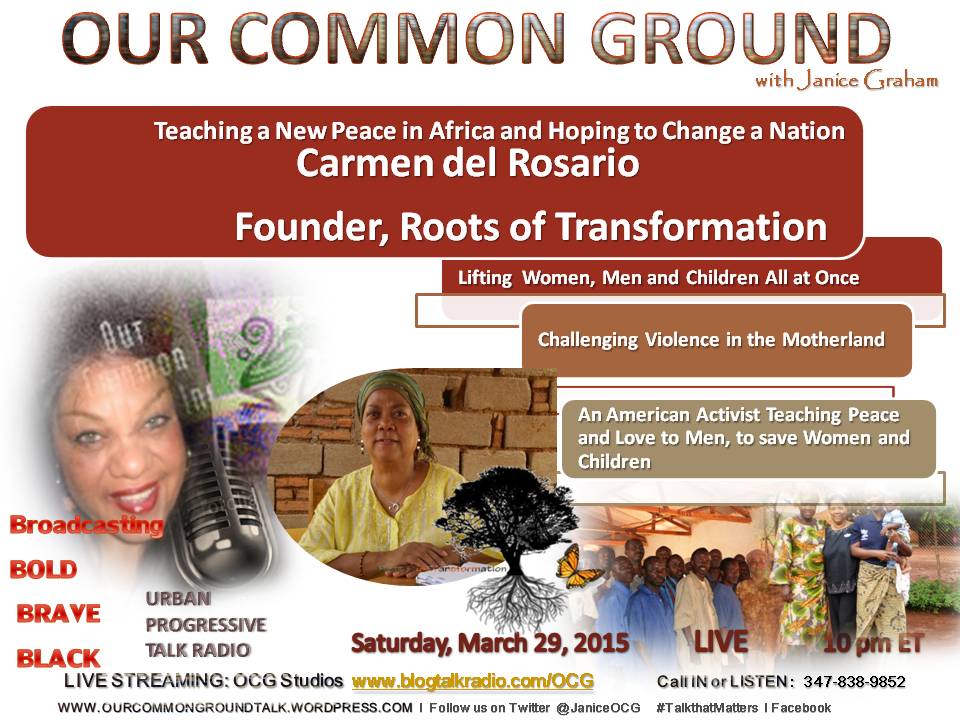
Teaching Peace in Violence-Torn Regions of Africa φ Carmen del Rosario, Anti-violence Educator and Activist φ LIVE 10 pm ET 3-29-14

OUR COMMON GROUND with Janice Graham

Teaching a New Peace in Africa and Hoping to Change a Nation

Guest:   Anti-Violence EducatorActivist Carmen del Rosario
Founder, Roots of Transformation


03-29 Carmen

Saturday, March 29, 2014 10 pm ET

LISTEN LIVE and Join the OPEN Chat

Web location:  http://www.blogtalkradio.com/OCG
Call In – Listen Line: 347-838-9852

“When I dare to be powerful– to use my strength in service of my vision, then it becomes less and less important whether I am afraid” – Audre Lorde

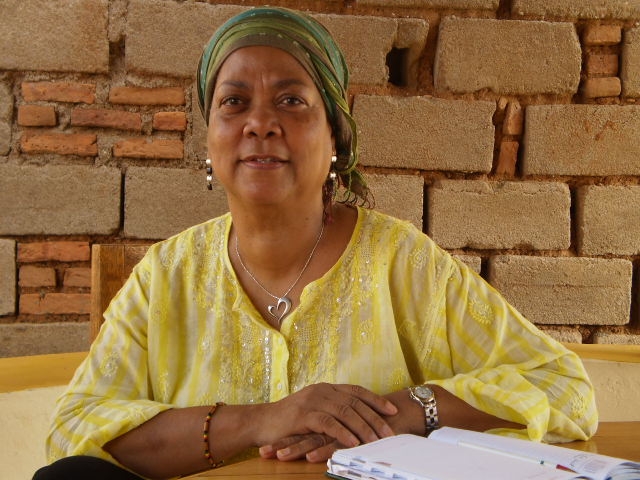
OLYMPUS DIGITAL CAMERAAbout Carmen del Rosario

Carmen is a highly driven and motivated, partnership, and programme management professional with over 20 years of professional experience working in the field of violence against women and children with government and development organizations, community networks and institutions in the US, El Salvador, Rwanda, Burundi, Dominican Republic, Tanzania, Congo (RDC) and Liberia

Ms. Carmen Del Rosario served as the Director of the Boston Public Health Commission’s Domestic Violence Program for 10 years. Del Rosario was a pioneer in developing strategies to engage boys and men in positive ways to prevent violence and to promote healthy relationships. In the year 2000, under her leadership, de Domestic Violence Program received funding from the CDC to develop , implement and evaluate a five years demonstration project working with men as fathers.

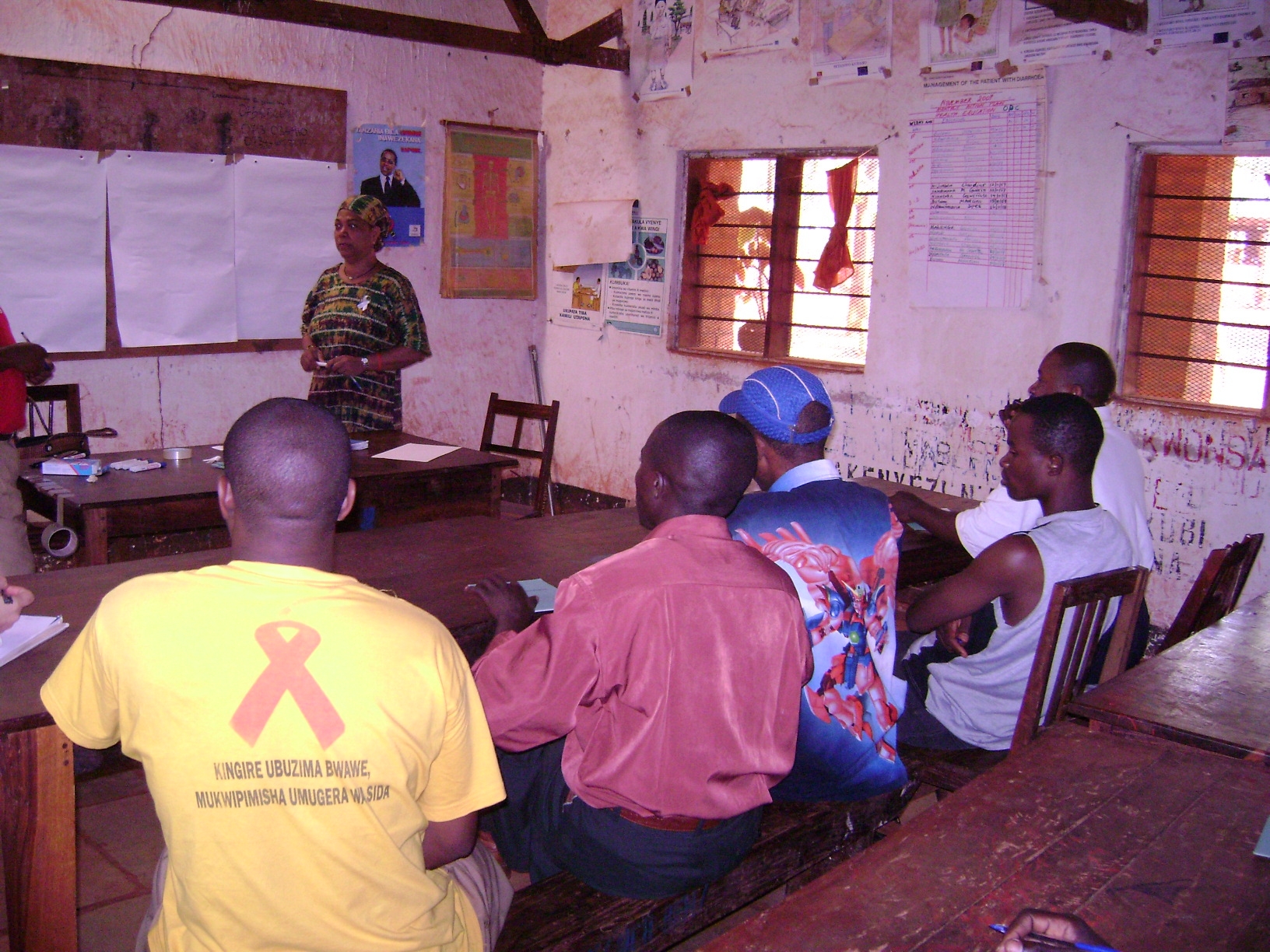
Over the past eight years Carmen has been working in East Africa, (Tanzania) Central Africa (Eastern Congo) and West Africa (Liberia), developing, coordinating and implementing programs to respond to survivors of Gender Based Violence (GBV), Women’s Empowerment Program as well as prevention initiatives with men from different background; these include, refugees’ men, religious leaders, traditional leaders, the police, and the UN peacekeepers. Carmen has developed intervention and prevention programs providing technical support to capacity development of the implementing partners in partnership with government, UNHCR, WFP, UNICEF and INGO.

ABOUT ROOTS of TRANSFORMATION

Roots of Transformation, is a non-government grassroots organization working toward the prevention of VAWC by catalyzing changes in communities and by supporting organizational sustainability. The organization works to prevent violence by addressing its roots causes, such as traditional gender roles, and the imbalance of power between women and men.

 Mission

DSC00577Roots of Transformation is committed to equipping people with the knowledge, wisdom and tools needed to make decisions that will positively impact their futures, the future of their family and their nation.

BROADCASTING BOLD BRAVE BLACK

OUR COMMON GROUND with Janice Graham

“Speaking Truth to Power and Ourselves”

email: OCGinfo@ourcommonground.com

Call In – Listen Line: 347-838-9852

“Speaking Truth to Power and Ourselves” 

email: OCGinfo@ourcommonground.com

LISTEN LIVE and Join the OPEN Chat

Call In – Listen Line: 347-838-9852

Community Forum

Twitter: @JaniceOCG #TalkthatMatters

Web   –  OCG Blog  –  OCG Pinterest   – Visit our OUR COMMON GROUND Tumblr Page

Facebook

“Speaking Truth to Power and Our selves” 

email: OCGinfo@ourcommonground.com

LISTEN LIVE and Join the OPEN Chathttp://www.blogtalkradio.com/OCG
Call In – Listen Line: 347-838-9852

Marissa Alexander seeks “Stand Your Ground” immunity,… | www.wokv.com

Marissa Alexander seeks “Stand Your Ground” immunity, sentencing changes


Marissa Alexander
Action News
Marissa Alexander

By Stephanie Brown

Jacksonville, FL —

We first told you earlier this week that Marissa Alexander’s attorney intended seek another “Stand Your Ground” immunity hearing ahead of her trial- and we’ve now obtained the documents backing that up.

More than 1200 pages were filed today in support of five separate motions. One would seek a pre-trial immunity hearing under “Stand Your Ground”. Two deal with the sentence Alexander could face if convicted. Two more deal with interactions between Alexander and Rico Gray.

Alexander was initially convicted of shooting a gun in the presence of Gray and two children and was sentenced to 20 years in prison. That conviction was overturned because of how the jury instructions were phrased. Alexander claims she fired a warning shot, fearing that Gray meant to harm her.

Stand Your Ground

Alexander sought SYG immunity ahead of her initial trial, but was denied. The motion now filed argues that neither the initial denial or the appeals court decision not to “reweigh” the case prevent Alexander from seeking this immunity again.

“This Court is able on remand to consider anew legal issues decided as part of the original proceeding, and the use of that discretion is especially vital where failure to do so would result in manifest injustice,” the motion reads.

The attorney, Bruce Zimet, says there has been “critical” new evidence since the initial SYG hearing and that the initial hearing itself included evidentiary problems. Zimet says the ruling in the SYG hearing was made largely on the testimony of Gray’s two sons, and he says one has since recanted and the other admitted to lying about a “prior altercation” between Gray and another woman, which Zimet believes woduld have established a pattern of Gray as abusive toward women.  He additionally argues that expert testimony on Alexander’s state of mind when she pulled the trigger was not previously introduced.

Zimet further says the initial SYG hearing was argued under the wrong statute.  He says the section used includes more stringent rules that require someone to have been attacked before returning with force of their own.

“By contrast, § 776.012—which applies to an individual in her home, as is the case here—eliminates any duty to retreat and allows deadly force if a person reasonably believes that such force is necessary to prevent imminent death, great bodily harm, or a forcible felony,” the motion says.

10-20-Life

A second motion claims sentencing Alexander to a mandatory minimum 20 years in prison is cruel and unusual punishment because it is “grossly disproportionate” to any offense Alexander is accused of committing.

Zimet argues the Florida legislature, who established 10-20-Life, never intended to have it applied to “battered women attempting to defend themselves”. In fact, Zimet cites current efforts at the state level to specifically exempt “warning shots” from such consequences, as proof that the statute was improperly applied.

While Zimet argues that Alexander should not face conviction at all, he says if she is found guilty, the sentence is out of proportion. He says most other states have a mandatory minimum nowhere near what Florida law outlines.

Consecutive vs. concurrent sentencing

The State Attorney’s Office tells WOKV that Florida statute requires Alexander to serve concurrent sentences if convicted, meaning she would face a minimum 60 years in prison for the total three counts of aggravated assault with a deadly weapon.

This motion is condition on the ruling over 10-20-Life. Zimet says if the court does not rule mandatory minimum sentencing should not apply here, than it should rule sentences should at least not run consecutive- a total sentence Zimet argues would be unconstitutional in two ways.

First, Zimet argues the State is not allowed to pursue a steeper sentence on appeal unless there is new evidence introduced to warrant it. Zimet says the State did not object to concurrent sentences on the initial trial, so consecutive sentencing now would be an unconstitutional increase.

Second, the motion states the 60 year sentence in itself would be unconstitutional.

“A sentence of such enormous length is grossly disproportionate to any offense Alexander may have committed by firing a single, upward warning shot to protect herself against an enraged husband with a history of abuse who only minutes before had violently assaulted her,” the motion says.

Rico Gray, Sr. prior actions

The fourth motion filed is notice of Zimet’s intent to introduce past actions by Gray as part of Alexander’s affirmative defense that she feared for her life.

“At Alexander’s first trial, the jury heard a he-said/she-said about the events of August 1, 2010,” the motion says.

There was as discrepancy between those sides on whether the argument was verbal or physical, who the aggressor was, if there was an imminent threat, whether Alexander could leave the scene and more.

“What the jury did not hear—and what Alexander is now entitled to introduce—is specific evidence of Gray’s prior similar attacks on women, his repeated lies to law enforcement to avoid prosecution, and his implicit and explicit threats of violence against and coercion of witnesses, including his own children, to falsely accuse his female victims of attacking him,” the motion says.

Zimet says there is evidence Gray attacked Alexander as well as other women, which makes it hard to believe he is a victim. While Alexander introduced evidence of prior violent acts against her by Gray in the initial trial, Zimet says they plan to offer further evidence of violent acts by Gray against other women as well, and repeated attempts to obstruct justice- including a threat to kill Alexander and cover it up.

Subsequent “incident” with Rico Gray

While out on bail for the initial charges, which happened in August 2010, Alexander communicated on several occasions with Gray. In December 2010, Alexander was charged with Domestic Battery stemming from a fight with Gray. Gray claims that he refused to let Alexander spend the night after she dropped off their daughter, and she became angry and punched him, leaving marks on his face. Alexander claims Gray was the one who was angry and violent because she refused to spend the night, but police did not notice any physical marks on her.

In the first trial, the defense sought to preclude any evidence of this incident, but was denied. Zimet has filed a new motion asking the court to reconsider that motion to preclude.

Zimet says the fact that Alexander had contact with Gray cannot rebut her claim to self-defense. He says the charge deals with Alexander’s state of mind and fear of harm the moment she fired the gun, so only evidence dealing with that moment should be presented to a jury.

“The December 30 incident is not probative of Alexander’s state of mind nearly five months earlier, before she and Gray went to marital counseling, before Gray’s profuse apologies and proclamations of love, and before Alexander learned that her daughter Rihanna’s insurance was set to expire at the end of 2010 unless Alexander obtained Gray’s signature on Rihanna’s birth certificate,” the motion says.

Zimet further says the incident is “excessively prejudicial”, which hampers the interest of justice.

The State’s response

The State Attorney’s Office has issued a statement reading, in part, that they are reviewing these most recent motions.

“The State Attorney’s Office is committed to seeking justice for our two child victims and their father,” the statement says.

It further reads that they will make a response to these motions at the appropriate time.

Alexander’s retrial has been scheduled for July.


Marissa Alexander seeks “Stand Your Ground” immunity,… | www.wokv.com.

Lupita Nyong’o >>Essence Magazine Black Women In Hollywood Breakthrough Performance Award Acceptance Speech

Lupita Nyong’o >>Essence Magazine Black Women In Hollywood Breakthrough Performance Award

Lupita Nyong’o won the Essence Magazine Black Women In Hollywood Breakthrough Performance Award. In a beautiful speech at the ceremony, she said: “What is fundamentally beautiful is compassion for yourself and for those around you. That kind of beauty enflames the heart and enchants the soul…” At 30 years old, Nyong’o credits other #Black / #African women, including her mother and Oprah Winfrey , for inspiring her to believe that anything is possible., and thanks them for breaking barriers in their lives and empowering the next generation to do the same.

Read the Essence Magazine Articlehttp://www.essence.com/2014/02/27/lup…

Black History Note – Betsey Stockton: Missionary and Educator

Betsey Stockton: Missionary and Educator

By

Karen A. Johnson,

Associate Professor of Ethnic Studies & Education at the University of Utah

English: Betsey Stockton was born in slavery c...English: Betsey Stockton was born in slavery c. 1798 in New Jersey. She traveled to Lahaina, Hawaii with Rev. C. S. Stewart in 1823 and worked as a teacher. She returned in 1825, and taught in Philadephia, Canada, and then Princeton, where she died in October 1865. (Photo credit: Wikipedia)

Prior to the overthrow of the Hawaiian monarchy in 1890s by foreign businessmen who were “unofficially supported by the United States military,” Catholic Presbyterian, Mormon, and other Protestant missionaries were “especially prominent in their religious zeal to convert and save the souls,” of the indigenous Hawaiians (Au 78; Jackson xix). During the early 1820s, a number of young female Christians took up the torch and embarked on missionary work overseas. Indeed, their desire to do the Lord’s work in remote regions of the world has its roots in the gospel of Matthew: 12 v. 50, which states: “For whosoever shall do the will of my father which is in Heaven, the same is my brother, and sister, and mother” (Zwiep 40). During this time, it was not uncommon for 19th century Black women missionaries and evangelists to travel in the U.S. and its territories to do ministry work. As Marcia Riggs explains, 19th century Black women evangelists and missionaries were “like biblical prophets … who brought faith out of the … sanctuary to the marketplace of human affairs where history was in process” (Riggs xii).

Betsey Stockton, a former enslaved person in the U.S., was one of the earliest Black women missionaries to travel to the Sandwich Islands (later Hawaiian Islands) in the early 1820s. No doubt Stockton felt a special calling to be part of history as God’s prophetic witness in an era when women Black women were still enslaved, considered second-class citizens due to their race and gender status; and generally denied the opportunity to become Protestant ministers (Johnson 7; Collier-Thomas).

Betsey was born in 1798 in Princeton, New Jersey into the slaveholding family of Robert Stockton. Robert later gave Betsey to his daughter, Elizabeth and son-in-law, Reverend Ashbel Green. Green, who was president of the College of New Jersey (later Princeton College), taught Betsey reading, writing, arithmetic, geography, and theology. He gave her “books and encouraged her to use the family library” (Johnson 7; Takara 14). In 1815, Green gave Betsey her manumission papers and the next year, she was accepted into the First Presbyterian Church in Princeton, New Jersey.

Betsey became a devout Christian and was very much immersed in the Presbyterian doctrines. In 1820, the American Board of Commissioners for Foreign Missionaries granted her permission to travel with the second mission to the Sandwich Islands. Two years later, Betsey sailed to Honolulu, Hawaii with the Reverend Charles Stewart and his wife “on the Thames from New Haven, Connecticut” (Takara 14). Three days into her voyage, Betsey wrote the following in her diary on November 23, 1822:

“Saturday morning at daybreak shipped a sea. The water rushed into the cabin. I saw it with very little fear and felt inclined to say, ‘The Lord reigneth [sic], let us all rejoice.” … At 10 o’clock, I went on deck. The scene that presented itself was to me the most sublime I’d ever witnessed” (“Betsey Stockton’s Journal”).

Stockton arrived in Honolulu on April 27, 1823 and a month later, she traveled to Lahaina, Maui. In the 1825 issue of the Hawaiian Missionary Herald, it reports that “a colored woman connected with Mr. Stewart’s family … makes herself highly useful to the mission” in Maui (qtd in Nordyke, 243). From 1823 to 1825, Betsey cared for sick infants, secured clothes for the needy, and established a school on Maui for Native Hawaiian children. It should also be noted that while engaging in missionary work on the islands, Stockton continued to work as a domestic servant for the Stewarts.

While Stockton lived in Hawaii during the early 19th century, she was accorded the respect and trust of the local Hawaiians and fellow missionaries and her “advice and opinions were sought after in many matters” (Takara 15). After residing in Hawaii for over two years, Betsey Stockton relocated to Cooperstown, New York, with the Stewarts. In subsequent years, she taught indigenous Canadian Indian students on Grape Island and “led a movement to form the First Presbyterian Church of Colour in Princeton, New Jersey, in 1848” (“Betsey Stockton’s Journal”; Ravage 158). In addition, between the period of 1848 to 1865, Stockton moved to Philadelphia to teach Black children.

Betsey Stockton made pioneering endeavors as a missionary in Hawaii, but her legacy is not well known. Still, Stockton’s school “set a new direction for education in the Islands … [It] served as a model for the Hilo Boarding School,” and may have influence Samuel C. Armstrong, the founder of Hampton Institute, who also worked as a missionary in Hawaii during this period. After a full and productive life of service for the Lord, Betsey Stockton passed away in October of 1865 in Princeton, New Jersey (Takara 15).

Works Cited

Au, Wayne. “The Price of Paradise.” Rethinking our Classrooms: Teaching for Equity and Justice II. Ed. Bill Bigelow. Milwaukee, WI: Rethinking Schools LTD. Vol. 12 Issue 4 (Summer 1998).

“Betsey Stockton’s Journal, November 20, 1822 to July 4, 1823.” African American Religion: AHistorical Interpretation with Representative Documents. Ed. David W. Wills and Albert J. Raboteau. Chicago: University of Chicago Press, (2006). Web. January 5, 2014.

Collier-Thomas, Bettye. Daughters of Thunder: Black Women Preachers and their Sermons, 1850-1970. San Francisco, CA: Jossey-Bass, 1998.

Jackson, Miles M. “Introduction.” They Followed the Trade Winds: African Americans in Hawaii.Ed. Miles M. Jackson. Honolulu, HI: University of Hawaii Press (2004).

Johnson, Karen A. “Undaunted Courage and Faith: The Lives of Three Black Women in the West and Hawaii in the Early 19th Century.” The Journal of African American History. Vol. 91, No. 1, (Winter 2006): 4-22.

Nordyke, Eleanor C. “Blacks in Hawaii: A Demographic and Historical Perspective.” The Hawaiian Journal of History. Vol. 22 (1998).

Ravage, John W. Black Pioneers: Images of the Black Experience on the North American Frontier.Salt Lake City, UT: University of Utah Press.

Riggs, Marcia. Can I Get A Witness?: Prophetic Religious Voices of African American Women: An Anthology. Maryknoll, New York: Orbis Books (1997).

Takara, Kathryn W. “The African Diaspora in Nineteenth Century Hawaii.” They Followed the Trade Winds. Ed. Miles M. Jackson. Honolulu, HI: University of Hawaii Press (2004).

Zwiep, Mary. “Sending the Children Home: A Dilemma for Early Missionaries.” The Hawaiian Journal of History. Vol. 24 (1990).

From:  POLITE ON SOCIETY

Editors Note: This guest post is part of the Blog Carnival of Blogging While Brown for Black History Month 2014. -M.P.

Google+

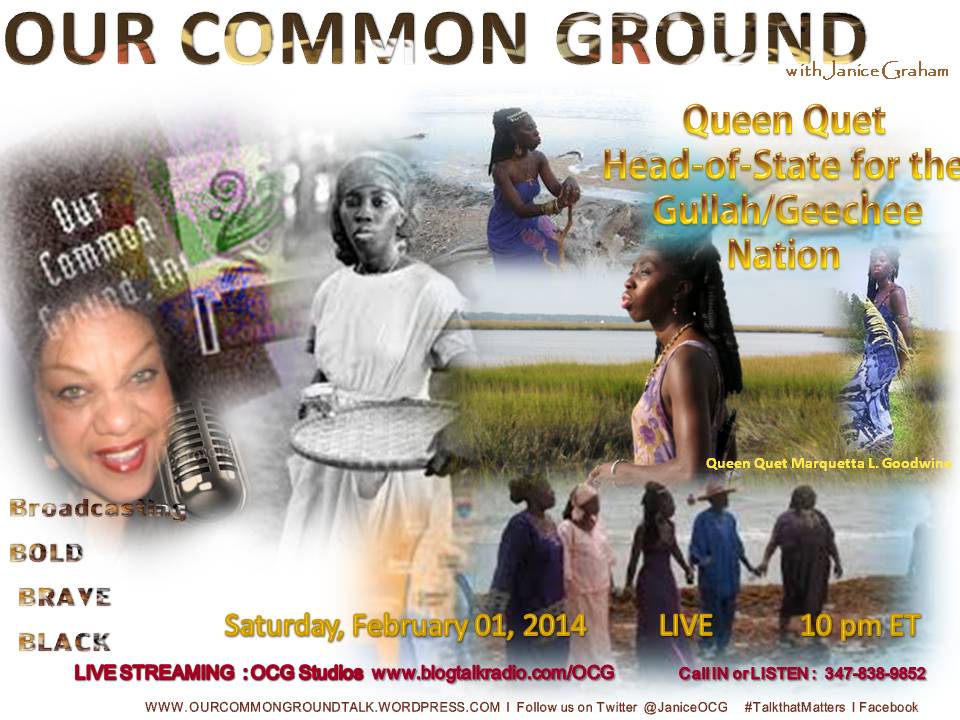
OCG This Week: The Gullah Geechee Nation with Queen Quet Marquetta L. Goodwine Head-of-State for the Gullah/Geechee Nation

           OUR COMMON GROUND with Janice Graham 
                    2014 Black History Month 

                        02-1-14 Quet2

The Gullah Geechee Nation
OUR GUEST: Queen Quet Marquetta L. Goodwine 
Head-of-State for the Gullah/Geechee Nation

LISTEN LIVE

Saturday, February 1, 2014
10 pm ET  LIVE

ABOUT the GULLAH/GEECHEE NATION
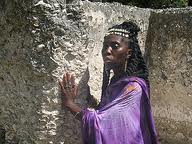
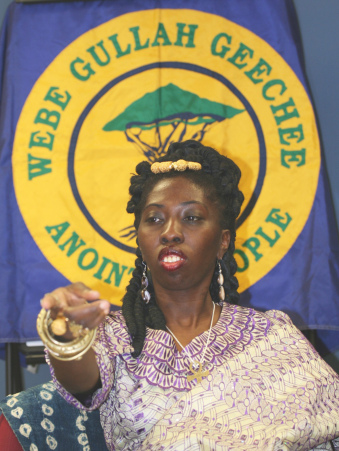
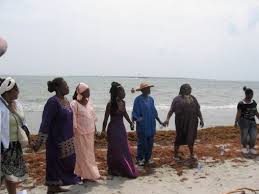
queenquet10queenquet12queenquet5The Gullah/Geechee Nation exist from Jacksonville, NC to Jacksonville, FL. It encompasses all of the Sea Islands and thirty to thirty-five miles inland to the St. John’s River. On these islands, people from numerous African ethnic groups linked with indigenous Americans and created the unique Gullah language and traditions from which later came “Geechee.” The Gullah/Geechee people have been considered “a nation within a nation” from the time of chattel enslavement in the United States until they officially became an internationally recognized nation on July 2, 2000. At the time of their declaration as a nation, they confirmed the election of their first “head pun de boddee”-head of state and official spokesperson and queen mother. They elected Queen Quet, Chieftess and Head-of-State for the Gullah/Geechee Gullah Nation.
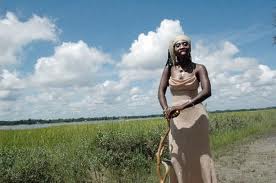
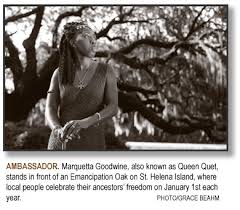
ABOUT QUEEN QUET MARQUETTA L. GOODWINE

queenquet9Queen Quet Marquetta L. Goodwine is a published author, computer scientist, lecturer, mathematician, historian, columnist, preservationist, environmental justice advocate, environmentalist, film consultant, and “The Art-ivist.” She is the founder of the premiere advocacy organization for the continuation of Gullah/Geechee culture, the Gullah/Geechee Sea Island Coalition. Queen Quet has not only provided “histo-musical presentations” throughout the world, but was also the first Gullah/Geechee person to speak on behalf of her people before the United Nations in Genevé, Switzerland.

Queen Quet was one of the first of seven inductees to the Gullah/Geechee Nation Hall of Fame. She received the “Anointed Spirit Award” for her leadership and for being a visionary. In 2008, she was recorded at UNESCO Headquarters in Paris, France at a United Nations Conference in order to have the human rights story of the Gullah/Geechee people archived for the United Nations. In 2009, she was invited by the Office of the High Commissioner of the United Nations to come and present before the newly founded “Minority Forum” as a representative of the Gullah/Geechee Nation and the International Human Rights Association for American Minorities (IHRAAM) which is an NGO in consultative status with the United Nations. Queen Quet is a directorate member for IHRAAM and for the International Commission on Human Rights. She represented these bodies and the Gullah/Geechee Nation at the “United Nations Forum on Minority Rights.”

Due to Queen Quet advancing the idea of keeping the Gullah/Geechee culture alive, the Gullah/Geechee Sea Island Coalition under the leadership of Queen Quet, worked with Congressman James Clyburn to insure that the United States Congress would work to assist the Gullah/Geechees. Queen Quet then acted as the community leader to work with the United States National Park Service to conduct several meetings throughout the Gullah/Geechee Nation for the “Special Resource Study of Lowcountry Gullah Culture.” Due to the fact that Gullah/Geechees worked to become recognized as one people, Queen Quet wanted to insure that the future congressional act would reflect this in its name and form. As a result in 2006 the “Gullah/Geechee Cultural Heritage Act” was passed by the United States Congress and signed into law by the president.

Queen Quet is vetted with the United States White House as an Expert Commissioner in the Department of the Interior. She is also the Chair of the Gullah/Geechee Cultural Heritage Corridor General Management Plan which is being completed by a commission created by the act for there to be a “Gullah/Geechee National Heritage Corridor.” Queen Quet is also a member of the “National Park Relevancy Committee” and proudly continues to work to protect the environment and to insure that diverse groups of people engage in the outdoors and the policies governing them. Queen Quet has engaged in several White House conferences on this issue.

queenquet7The Mission of the Gullah Geechee Nation 

To preserve, protect, and promote our history, culture, language, and homeland and to institute and demand official recognition of the governance (minority) rights necessary to accomplish our mission to take care of our community through collective efforts which will provide a healthy environment, care for the well beings of each person, and economic empowerment.


2014 season   BROADCASTING BOLD BRAVE BLACK 

OUR COMMON GROUND with Janice Graham

“Speaking Truth to Power and Ourselves”

email: OCGinfo@ourcommonground.com

LISTEN LIVE and Join the OPEN Chat:
Call In – Listen Line: 347-838-9852

Community Forum
Twitter: @JaniceOCG #TalkthatMatters
Web

Pinterest  
Visit our Tumblr Page 
Facebook 
“Speaking Truth to Power and Ourselves” 

email: OCGinfo@ourcommonground.com

LISTEN LIVE and Join the OPEN Chat 
Call In – Listen Line: 347-838-9852

The 5 Things Black Women Must Do in 2014 to Live Happier, Healthier, Healed Lives

 The 5 Things Black Women Must Do in 2014 to Live Happier, Healthier, Healed Lives

Posted: 12/27/2013
The funny thing about stereotypes is that they often have some measure of truth to them. As black women in America, no group has been more stereotyped, or misunderstood, or more devalued than us. As we begin the countdown on the year that was 2013, it is time for us as black women to look toward our future in the New Year that is 2014.

As someone who has traveled the country for the last two years, talking and engaging almost exclusively with black women in corporate America, in universities, in our sororities, in industry, in our organizations, in the media and in our churches — I think it is time that we, as black women, faced some challenging truths about ourselves. What I’m about to say will be hard. And it may offend some of you. But that is okay, because the truth always hurts us before it heals us. Years before I wrote my award-winning book Black Woman Redefined, I founded an organization: I Am My Sister’s Keeper.

This organization, was dedicated to helping college-educated professional black women to better navigate their careers, their health and wellness, their spirit, their finances and their relationships. The organization took off and grew much greater than I ever expected, and was nationally recognized by media outlets like CNN and The Washington Post as the go-to organization for Black women’s personal development and wellness for over six years. The organization was the catalyst for the book Black Woman Redefined: Dispelling Myths and Discovering Fulfillment in the Age of Michelle Obama.

One of the things that I have discovered about living life as a black woman in America, and by talking to and engaging with literally tens of thousands of black women throughout the United States, is that we have some very negative self-destructive patterns that we need to own, face and be courageous enough to fix if we want to have happy, healthy and healed lives. It is my goal in this column to challenge us as a sisterhood of women to take the necessary steps, to heal ourselves, both individually and collectively. Before we get into the steps that I believe are necessary for us to truly get to the places that we desire in our lives as black women, I ask you to keep an open mind, try not to get defensive, and share the steps in your sororities, clubs, and workplaces so that other black women can benefit. Sometimes it is as simple as people NOT knowing better so that they can do better.

The steps that I have outlined below, are based on qualitative and quantitative research, focus groups, coaching and speaking at large women’s conferences, HBCUs and interactive workshops I have conducted throughout the country over the past several years:

1. We must deal with our unresolved pain, wounds and baggage that often result in angry eruptions, broken relationships, failed relationships and unrealized dreams. This is a huge stumbling block for us in our interpersonal relationships. We carry lots of stuff, and lots of people on our backs and in our spirits. It results in us being weary, tired and frustrated.

2. We must stop doing emotional violence and damage to other black women. Other black women are not the enemy. Other black women are struggling and fighting the same battles that we fight every day, no matter their station in life, no matter what you think they may possess in terms of wealth, status or lifestyle. We have to stop “hating” on other sisters. It is just wreaking havoc on our emotional wellness and sisterhood. “We are all we have,” as First Lady Michelle Obama once said. Let’s start acting like it!

3. We must love ourselves enough to take care of our physical bodies and learn to eat healthier, sleep better, exercise more, tend to our feet (for diabetics) and wean ourselves off of generations of destructive emotional eating (comfort foods) that has literally millions of black women in America stuck in a pattern of diabetes, hypertension, obesity, depression and heart disease.

4. We must learn to teach people how to treat us with value, respect, love, honor, dignity and peace by showing them that we live by a WOMAN CODE that honors the very same values in our own lives and in how we treat other people.

5. We must commit to engaging in healthy, functional, committed and loving relationships with the men in our lives. Where those relationships are unhealthy, abusive or destructive to our soul’s landscape; we must be willing to put an end to those relationships immediately. We have got to stop making excuses for other people’s abusive treatment of us and toward us. It is NOT acceptable, sisters. We have got to put an end to the pain we feel because our fathers left us or were absent. Or the pain that we feel because the men we love betrayed us, cheated on us, raped or beat us. We have to believe that there are still good, loving, healthy and functional men regardless of their race, who will see our value, our worth, our beauty and our possibilities. And when they find us, we must commit not to run away, push them away or punish them for what our fathers, brothers or uncles did to us.

The truth is, there is no magic checklist for getting any of us the life that we desire. But there are critical life steps that we can take starting right now, and right here to helping us as black women to heal. And sisters, we need to heal.

Far too many of us are walking around with a smile on our face, with beautiful clothing, with our hair perfectly coiffed and with expensive handbags and shoes to make us feel valuable. When deeply inside, we are simmering pots waiting to erupt. We look so good on the outside. But some of us are badly broken on the inside. And we are killing other black women with our venom.

And for those who have been courageous enough to do the work on themselves, it is time for us to be our sister’s keeper. I am not asking you to burden your life with another woman’s pain, I am not asking you to save another woman’s life, what I am asking you to do, is to be kind to other black women. Reach out. Care. Show some empathy. Be a mentor. Be a friend. When other black women try to help you do not treat them as the enemy. When they are there for you say thank you. When they have stuck with you in the trenches and storms of life honor them. When they have your back, don’t stab them in theirs. When they bless you with their gifts for free, support your causes, organizations, and the like or help you and your family in desperate times of need, don’t later discard them because you believe that you no longer need them. It is just immoral. It violates the WOMAN CODE.

Sisters, this will be the last column that I will ever write on the issue of us as black women. I’ve grown tired and weary. I love us, but the world is bigger, more global, and sisterhood is about all women coming together to lift, heal, inspire and change the world. We need to do the work on us so that we can fully participate in that global sisterhood and all the benefits of it.

I have, like many others before me, devoted the last decade of my life to helping the rest of the world try to see us as the beautiful, fabulous, fierce, loyal, kind, nurturing, intelligent, committed and loving women that we are. But in the last year, in particular, I’ve experienced first hand, and heard far too many stories from good black women, from all walks of life, about other black women who have cursed them, cut them off, betrayed them, manipulated them, stolen from them, slept with their men, slandered them, ruined them, fired them and literally broken their hearts with treachery for the smallest of offenses, or for no offense at all.

We love to do what I call “The Go Off.” It is what we do when anyone dares challenge us, correct us, upsets us, or in some cases, tries to love us. Sisters, you have no right despite whatever kind of pain you may be in, to heap abuse on another black woman. The most disturbing part of this “go off” mentality, is that we feel entitled to do it most of all against one another. We don’t do it to the men in our lives who mistreat us and abuse us. We would never do it to the “other” people in our lives or at our workplaces. But we will do it to the sister in church, the sister who has taken us into her home, the sister who has been with us through hell, the sister who has lent us money, the sister who bathed us when we were too sick to bathe ourselves, or cared for us when we were sick. Sisters, it’s time to heal (see my 2012/2013 series for essence.com: “Sisters Heal,” it will bless you).

In the final analysis, each of us must determine her own journey for herself. Each of us must do the work that is required, for us to rise above the pain that was unfairly inflicted upon us as children, as young girls and women, and now as grown middle-aged or aging women. It is never too late to fix yourself, if you are willing to do the work. It is never too late to apologize, to make amends for the wrongs that we do and to forgive those who have wronged us. Sisters, it’s time for us to stop pointing the finger at everyone else and take a long hard look in the mirror at the woman was looking back. If your life is not what you imagined it would be, or if you are unhappy. The change has to start within. You can never skip doing the work. It will destroy your destiny.

If you want 2014 to be different than 2013, then the work has to start now. Your life will only become what you want it to be, when you find the courage to love yourself. And when you learn to love yourself, I promise you that you will learn to love, respect and honor other black women.

Sophia A. Nelson

Award Winning Author; Corporate/Personal Development Coach, Cultural & Political Columnist for The Daily Beast, NBC’s theGRIO, Essence Magazine, & USATODA

RATCHET ME THIS: HOW DO WE RIDE FOR PLEASURE IN A PIMP CULTURE?

REAL COLORED GIRLS

DEC 22 2013

RATCHET ME THIS: HOW DO WE RIDE FOR PLEASURE IN A PIMP CULTURE?

Audre Lorde, bell hooks, Angela Davis, Toni Cade Bambara, Alice Walker, Beverly Guy-Sheftall, Ida B. Wells-Barnett, Barbara Christian, June Jordan, Michele Wallace, Harriet Tubman, Patricia Hill Collins, Sojourner Truth, M. Jacqui Alexander, Zora Neale Hurston, Sonia Sanchez, Toni Morrison, et. al.


irst things first: we are not talking to Jamilah-come-lately. If you ain’t been boycottin’ R. Kelly since Aaliyah was 14, if you even needed to see the piss tapes to persuade you further, if Kevin Powell’s BK Nation petition was your entry into this conversation, you ain’t got the answers.

Second: if you’re trying to engage in an analysis of Black women’s sexuality, without acknowledging the role of pimp culture in your framing, you ain’t been doin’ the education.

‘Pimp culture’ is the umbrella under which we map the interlocking systems of oppression that create the material conditions under which Black women experience bodily and psychic harm. Vestiges of the gator-wearing, fur cape-lined pimp show up in our private and public spaces and we feel the brunt of his solid gold cane in our experiences of mass culture apparatuses. Pimp culture employs white supremacy, misogyny, racism, homophobia and the dogma of rugged individualism to physically and psychically undermine our sense of self, diminishing our capacity for self-determination.

Pimp culture is in line with other terms used in anti-violence discourse – sexual violence, culture of violence, rape culture. Yet, in the Black feminist tradition, we use the term to center the unique experiences of Black women and signal the specific forms of knowledge that we bring in understanding the depths of physical violence and psychic trauma on individual and societal levels.

By Jess Pinkham _DSC9539.NEFCollectively, these forces show up as, for example, the vicious maligning of nine-year old Oscar nominee Quvenzhané Wallis who was “jokingly” called a cunt by a major news media outlet. The sexualized verbal battery of a Black girl child, on the public stage, in her moment of glory, was an act of psychic aggression meant to humiliate Black girls and women, while underscoring that in pimp culture we are primed to be sexually exploited even in our most innocent moments. The language used was an attempt by pimp culture to turn a Black girl child out as a sexual spectacle, reminding those of us who are grown that we don’t own the mechanisms of our representation, nor do we have the allegiance of anyone in power who will ride for us.

Many of the comments on our first blog, “The Problem with BeyHive Bottom Bitch Feminism,” along with dialogues in the Twitterverse, support the idea that we should celebrate the presentation of sexual pleasure by Black women, especially when it’s done inside of marriage. In an effort to subvert the politics of respectability, some Black feminist hash-taggers have relied on strategic amnesia that discounts the reality of the material conditions of our sexual lives. To wit:

Whenever we consider Black women on stage, we also consider the auction block. When we think of public displays of Black female sexuality, Saartje Baartman isn’t far from our minds. When Black women voluntarily show “the actual inside[s] of [our] vagina” to an audience of strangers and peeping Toms, the torture of Anarcha Wescott takes center stage. Sexual violence is not a joke. We breathe these histories alongside our freedoms, which interrupt any fantasies of an ahistoric sexuality and make us suspicious and critical like a mutha.

Real Colored Girls are serving notice: game recognize game, and we are not here for corporate entities to consume our bodies, shit them out, repackage and sell them back to us as avatars for the music industrial complex. RCG are committed to defining healthy, loving, kinky, freaky, juicy, queer, bi and hetero sexualities for Black women. We are most concerned with publicly taking care of Black women’s sexuality by addressing historical and present trauma and arguing for the creation of a cultural environment in which it is safe for us to express ourselves sensually and sexually.

A cadre of Black feminists and Black women sympathizers (those who don’t proclaim to be feminist but ride for Black women) are calling for a “pleasure principle” that creates space in pop culture for Black women to express empowered sexualities. Any set of propositions that seeks to determine the fundamental basis for our sexual expression must consider the structural conditions under which said propositions are engineered. Pop cultural texts are produced inside of this context, and failing to acknowledge that in your analysis limits the work of dismantling the structures of pimp culture. Twerk it out.

Real Colored Girls encourages the communities of folk engaged in recent discussions about this work to move beyond Bey and consider what this moment has triggered around the presentation of Black female sexualities. Beyonce seems to have mastered the impossible, given the realities for most Black women in the U.S. – taking charge of her cultural production. Close reads of her recent and past work from writers Emily J. Lordi and Daphne Brooks invite us to consider the complex challenges for Black women artists. Even though Beyoncé is suspiciously sexy and joyfully raunchy, it would take a contortionist to situate her performances as a safe & empowered representation of Black women’s sexualities. Beyonce is a product of the hip hop generation – she woke up like that. In contracting with pop culture to distribute feminism, have we diluted the struggle of our Black feminist foremothers? For RCG, this is about the political economy of culture – how global corporate structures are not the context for transformative revolutionary action, and we shouldn’t look to them for our politics.

Our dream is for a revolution for Black women and our sexualities. As Mother bell exhorts, living out this dream requires us to do,

…the critical project of openly interrogating and exploring representations of black female sexuality as they appear everywhere, especially in popular culture.

Real Colored Girls are willing to ride for our radical politic, while acknowledging our privileges as artists and academics. We promote an oppositional consciousness that imagines radical spaces for sexual expression – physical, virtual and spiritual – which is risky and not without sacrifice. We call upon the lives and recorded texts of womanists and Black feminists as scripture and theory in the flesh.

roll-callAudre Lorde, bell hooks, Angela Davis, Toni Cade Bambara, Alice Walker, Beverly Guy-Sheftall, Ida B. Wells-Barnett, Barbara Christian, June Jordan, Michele Wallace, Harriet Tubman, Patricia Hill Collins, Sojourner Truth, M. Jacqui Alexander, Zora Neale Hurston, Sonia Sanchez, Toni Morrison, et. al.

bell hooks cautions that Black women,

…haven’t as a group really carved out different ways to live our lives.

This is an amazing opportunity to do this work. In the spirit of loving Black women, we invite interventions that construct a post-capitalist imagination in which to dream ourselves whole.

#RealColoredGirls

#PimpCulture

Photo Credits: Bridge to Freedom FoundationTrey Anthony

REAL COLORED GIRLS