Celebrating the ‘complete’ Martin Luther King Jr.; unfinished work and all l Dr. Blair L.M. Kelley

Celebrating the ‘complete’ Martin Luther King Jr.; unfinished work and all

by Blair L. M. Kelley

Blair L. M. Kelley is an associate professor at North Carolina State University. Follow her on Twitter at @ProfBLMKelley

My 9-year old daughter came home this week raving about her class and their discussion of Martin Luther King, Jr.

She declared that she loved learning about his life and that she was thankful to him because without King, no change would have been possible in America on the question of race. I am a historian of African-American history specializing in social movements, so I quickly moved to correct her. Of course change would have happened, even if King had never lived! I described to her other leaders. I reminded her that movements don’t function because of just one great man. I told her that King was not a perfect person, and that even he had come short of meeting all his goals. In the end, I even resorted to reminding her that I wrote a book on a movement that took place 35 years before King was even born.

Clearly my daughter didn’t care. She insisted that her school would not be integrated, and that her whole world would not have been the same without King’s leadership.

After thinking about it for a while, I realized that most people feel the same way about King that my daughter does. King has become the single greatest icon of the civil rights movement—his words are studied, his great marches are remembered, his name marks our boulevards; his shadow, now literally cast in stone, looms large on our national consciousness. He has become the benchmark for great leadership, so much so that nearly every leader that has emerged after him is compared to him, and found wanting.

As an icon, King is often thought of as flawless, so that we rarely reflect on his failures as a movement leader. Our collective memory of King only touches on the high points. The images we remember are the moments of his greatest triumphs as a leader: the 1955-56 Montgomery Bus Boycott, the 1963 March on Washington, the Birmingham Campaign that same year, and the 1965 march from Selma to Montgomery. Each of these efforts resulted in positive change, clear victories in the courts or in the halls of Congress.

We tend not to remember the moments when King faltered or searched for the right direction. We don’t recall the indecision about what to do next after the success of the Montgomery Bus Boycott; the challenge of the 1966 Chicago Freedom Movement campaign, or his unfulfilled Poor People’s Campaign — cut short by his tragic assassination in 1968. These moments are forgotten when King is not remembered in his broader context.

Why Mitt Romney Is Unfit to Be President l Obery M. Hendricks, Jr., Ph.D. Author,”The Universe Bends Toward Justice”


Obery M. Hendricks, Jr., Ph.D.

Author of The Universe Bends Toward Justice: the Bible, the Church and the Body Politic (Orbis, 2010)

Why Mitt Romney Is Unfit to Be President
Posted: 11/06/2012 10:12 am

Today is Election Day. In just a few hours we should know who will lead our nation for the next four years. So let me get right to the point: Mitt Romney is unfit to be president.

No qualifiers. Simply unfit.

Why? It’s not just because he has proven to be the biggest flip-flopper and the most dishonest major party presidential candidate in our lifetimes — and perhaps even in our parents’ lifetimes. It is something much more dangerous. Mitt Romney is unfit because he is a devout and bloodless financial technocrat and a dyed-in-the-wool economic elitist. That is to say that he embodies in one tortured soul 1) the social myopia and practiced insensitivity to human suffering that is typical of the dedicated corporate financial technocrat, even when he himself has caused the suffering; and 2) he also embodies the social Darwinist condescension of upper-class economic elitists toward those on the lower rungs of the economic ladder. If Romney was simply one or the other (and had not been discredited as a shameless political liar) he might be a viable Oval Office occupant, for we’ve seen varying degrees of these characteristics there before. But Mitt Romney is something different. He embodies both technocratic and economic elitist sensibilities to an Olympian degree. That is a pairing with very dangerous implications for most Americans. Here is why.

Financial technocrats see the world through data. They make their decisions based on the numbers. Social issues are important to them only as they impact the bottom line. In their bloodless analyses there is no room for concern for the effects of their actions on the health and welfare of workers and their communities, for to them workers are merely pawns, faceless ciphers in their game of profit margins and corporate numbers. In fact, the most dedicated financial technocrats are fully blind to the needs and struggles of ordinary people. They don’t see folks who are elderly or sick or disabled or in need of assistance to feed their families. What technocrats see are financial liabilities, “entitlements” that must be paid — and cut out altogether whenever possible.

Mitt Romney is such a financial technocrat. For decades he crunched numbers and analyzed data in pursuit of maximum profitability for himself and his rarified clients and, like the typical technocrat that he is, counted workers as faceless ciphers. According to Romney’s Bain Capital colleagues, he never spoke to non-executive employees in the businesses he bought, sold and sometimes drove into bankruptcy; apparently, he never showed a whit of interest in whether his firm’s actions would benefit workers or devastate them. As Bart Gellman put it in TIME magazine, Romney was “matter of fact about business decisions that closed factories, crushed unions, outsourced services and threw employees of his companies out of work.”

The depth of Mitt’s technocratic mindset is reflected in his callously punitive budget proposal. It ends healthcare for 10 million Americans now covered by Obama’s Affordable Care Act, turns Medicaid into a voucher system that would burden already beleaguered seniors with thousands of dollars in additional out-of-pocket expenses, transforms Medicare into a block grant that would strip healthcare access from up to 28 million currently insured Americans, and removes more than 200,000 children from Head Start and 2 million mothers and children from programs that ensure them access to healthy food. (Conspicuously absent is the gutting of programs and entitlements that benefit America’s richest corporations and individuals.)

Yet Romney the technocrat does not see faces in the suffering his budget proposal would cause. He only sees numbers. That is why he can so easily reduce to an unproductive, faceless mass and a cold, hard number — 47 percent — the many Americans who rely on government aid: sick Americans, U.S. military veterans, elderly Americans, poor American children, proud American parents whose breadwinning has been reduced to unemployment checks. And what do technocrats do with unproductive assets? They discard them. That is what Romney’s policies promise to do: discard the programs and services that struggling Americans need most.

As for Romney’s upper class elitism, it is well attested. New Yorker magazine’s Nicholas Lemann put it this way: “Romney is a product of a series of interconnected, tightly enclosed worlds, with their own rules.” And from a former Romney aide: “[Mitt] is patrician. He just is. He has lived a charmed life … It is a big challenge that he has, connecting to folks who haven’t swum in the same rarified waters that he has.” David Brooks, a moderately conservative columnist at the New York Times, offers a more pointed assessment of Romney’s elitism. Of Mitt’s infamous “47 percent” rant he writes, “[I]t’s what self-satisfied millionaires say to each other.” He concludes that it “suggests that Romney does not know much about the culture of America.” Romney’s much derided attempt to make a $10,000 bet with Texas Gov. Rick Perry during a televised Republican primary election debate before a nation in which millions are struggling to make ends meet shows how little understanding and regard he has for the plight of ordinary Americans.

Romney’s 47 percent rant and his other derisive comments about the less well-off are reflective of real elitist contempt for ordinary Americans, for if those ugly indictments did not represent his true sentiments he could not have uttered them, even in error. Indeed, Romney holds the masses of the American people in such low regard that he has intentionally, repeatedly and shamelessly mislead and lied to them about any number of issues, refusing even to explain the true workings of his controversial — some have said ‘far-fetched’ — economic plans and their true consequences.

Thus the implications of the unfortunate coupling of elitist and technocratic sensibilities in Mitt Romney are as clear as day: from the first a Romney White House would not only have a built-in bias toward the richest Americans; conversely, as a matter of course it would doubly discount the interests of all those outside that fortunate few. Both tendencies are already evident in virtually every policy Romney has proposed. As for poor people, it’s almost as if Mitt sees them as a different species. Listening to his infamous pronouncement that “I’m not concerned about the poor; we have a safety net for them,” one would have thought he was speaking of nuisance pets, not human beings.

That is why Mitt Romney is unfit to be president: because his elitist policies and derisive statements demonstrate that he does not value the interests of all Americans in equal measure. A Romney presidency could well be the worst thing to happen to American workers in many years.

Obery M. Hendricks, Jr., Ph.D. is the author of ‘The Universe Bends Toward Justice: Radical Reflections on the Bible, the Church and the Body Politic’ (Orbis, 2011).

Follow Obery M. Hendricks, Jr., Ph.D. on Twitter: www.twitter.com/@UniverseBends

On Moral Preachment Vs. Political Realities

See on Scoop.itOUR COMMON GROUND Guest Profiles

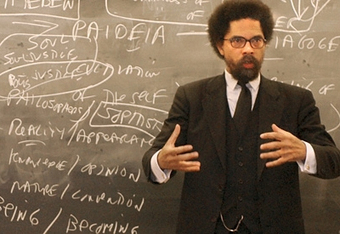
The Learned Professor West in his Element A Response To Dr. Cornel West Anybody who was looking for evidence that history repeats itself need only read my critiques of Dr. Cornel West since the fir…

OUR COMMON GROUND Omnibus‘s insight:

OUR COMMON GROUND Voice, Playthell Benjamin’s "Commentaries On the Times"


As a fellow Democratic Socialist we share the same basic vision and hopes for America.  But from time to time I am forced to part company and criticize his views on a particular question.  In the past we disagreed on his assessment of the character of Dr. WEB Dubois, and the viability of Ralph Nader’s bid for theu presidency and its implications for African American political strategy.  And now I passionately disagree with his assessment of President Obama’s political strategy and policies.  It is this question that I wish to address in the present commentary.

See on commentariesonthetimes.wordpress.com

Remembering the Real Martin Luther King l TruthDig

Remembering the Real Martin Luther King

Posted on Jan 20, 2013

King statue
Kelly Branan

This piece was first published April 3, 2008. It is being reposted in remembrance of Dr. King in advance of Martin Luther King Jr. Day.

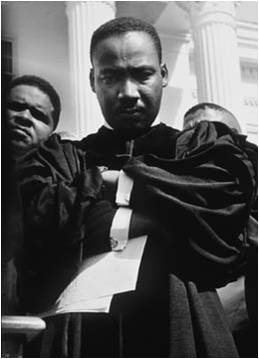
Forty years after his death, Martin Luther King Jr., one of the great prophets of American democracy, has been reduced to little more than a lifeless statue. Yet his courageous call for peace and criticism of his government at a time of war must not be lost to history.

Toward the end of his life, King turned his attention to poverty and the war in Vietnam. After giving the speech below, in which he called America “the greatest purveyor of violence in the world today,” King was dropped from Gallup’s annual list of the most admired Americans and was ridiculed by The New York Times, among too many others. Soon after, he was murdered.

King said that America “can never be saved so long as it destroys the deepest hopes of men the world over.” Those words were echoed years later by the Rev. Jeremiah Wright, a man who served his nation in uniform, who devoted his life to the welfare of his community, but was dismissed as a kook and a racist and a hater of his country for challenging its moral impenetrability.

America, apparently, does not take well to criticism. Thus it seems an appropriate time to let King, not the statue but the patriot, say his piece.

—Peter Z. Scheer


Beyond Vietnam – A Time to Break Silence

By the Rev. Martin Luther King Jr.
Text from AmericanRhetoric.com

Mr. Chairman, ladies and gentlemen, I need not pause to say how very delighted I am to be here tonight, and how very delighted I am to see you expressing your concern about the issues that will be discussed tonight by turning out in such large numbers. I also want to say that I consider it a great honor to share this program with Dr. Bennett, Dr. Commager, and Rabbi Heschel, some of the distinguished leaders and personalities of our nation. And of course it’s always good to come back to Riverside Church. Over the last eight years, I have had the privilege of preaching here almost every year in that period, and it is always a rich and rewarding experience to come to this great church and this great pulpit. I come to this magnificent house of worship tonight because my conscience leaves me no other choice. I join you in this meeting because I am in deepest agreement with the aims and work of the organization which has brought us together: Clergy and Laymen Concerned about Vietnam. The recent statements of your executive committee are the sentiments of my own heart, and I found myself in full accord when I read its opening lines: “A time comes when silence is betrayal.” And that time has come for us in relation to Vietnam.

The truth of these words is beyond doubt, but the mission to which they call us is a most difficult one. Even when pressed by the demands of inner truth, men do not easily assume the task of opposing their government’s policy, especially in time of war. Nor does the human spirit move without great difficulty against all the apathy of conformist thought within one’s own bosom and in the surrounding world. Moreover, when the issues at hand seem as perplexed as they often do in the case of this dreadful conflict, we are always on the verge of being mesmerized by uncertainty; but we must move on.

And some of us who have already begun to break the silence of the night have found that the calling to speak is often a vocation of agony, but we must speak. We must speak with all the humility that is appropriate to our limited vision, but we must speak. And we must rejoice as well, for surely this is the first time in our nation’s history that a significant number of its religious leaders have chosen to move beyond the prophesying of smooth patriotism to the high grounds of a firm dissent based upon the mandates of conscience and the reading of history. Perhaps a new spirit is rising among us. If it is, let us trace its movements and pray that our own inner being may be sensitive to its guidance, for we are deeply in need of a new way beyond the darkness that seems so close around us.

Over the past two years, as I have moved to break the betrayal of my own silences and to speak from the burnings of my own heart, as I have called for radical departures from the destruction of Vietnam, many persons have questioned me about the wisdom of my path. At the heart of their concerns this query has often loomed large and loud: “Why are you speaking about the war, Dr. King?” “Why are you joining the voices of dissent?” “Peace and civil rights don’t mix,” they say. “Aren’t you hurting the cause of your people,” they ask? And when I hear them, though I often understand the source of their concern, I am nevertheless greatly saddened, for such questions mean that the inquirers have not really known me, my commitment or my calling. Indeed, their questions suggest that they do not know the world in which they live.

In the light of such tragic misunderstanding, I deem it of signal importance to try to state clearly, and I trust concisely, why I believe that the path from Dexter Avenue Baptist Church—the church in Montgomery, Alabama, where I began my pastorate—leads clearly to this sanctuary tonight.

I come to this platform tonight to make a passionate plea to my beloved nation. This speech is not addressed to Hanoi or to the National Liberation Front. It is not addressed to China or to Russia. Nor is it an attempt to overlook the ambiguity of the total situation and the need for a collective solution to the tragedy of Vietnam. Neither is it an attempt to make North Vietnam or the National Liberation Front paragons of virtue, nor to overlook the role they must play in the successful resolution of the problem. While they both may have justifiable reasons to be suspicious of the good faith of the United States, life and history give eloquent testimony to the fact that conflicts are never resolved without trustful give and take on both sides.

Tonight, however, I wish not to speak with Hanoi and the National Liberation Front, but rather to my fellowed [sic] Americans, who, with me, bear the greatest responsibility in ending a conflict that has exacted a heavy price on both continents.

Since I am a preacher by trade, I suppose it is not surprising that I have seven major reasons for bringing Vietnam into the field of my moral vision. There is at the outset a very obvious and almost facile connection between the war in Vietnam and the struggle I, and others, have been waging in America. A few years ago there was a shining moment in that struggle. It seemed as if there was a real promise of hope for the poor—both black and white—through the poverty program. There were experiments, hopes, new beginnings. Then came the buildup in Vietnam, and I watched this program broken and eviscerated, as if it were some idle political plaything of a society gone mad on war, and I knew that America would never invest the necessary funds or energies in rehabilitation of its poor so long as adventures like Vietnam continued to draw men and skills and money like some demonic destructive suction tube. So, I was increasingly compelled to see the war as an enemy of the poor and to attack it as such.

TruthDig  1           NEXT PAGE >>>

King in my Life l Personal Reflection of a Freedom Fighter l National King Day 2013

King in my life

This slideshow requires JavaScript.

king 3

When I was young I was confused about the King’s approach of non-violence. I believed that it accomplished very little but to “split the wood”. As I approach my more years, I began to really look at the question of “What are we after?” And in those thoughts I was able to grasp what King meant and the lessons learned. I am grateful to have struggled to that place. So tomorrow, if some young person asks me what did King hope to accomplish, I can reply that he hoped to accomplish a seismic shift in the way America sees and understands itself. He hoped to achieve a more courageous and visionary people within our community. He hoped to illuminate the untruth by saying the lies, and pointing to the truth.

Non-violence is not the absence of fight, it is a fight against wrong with rage and repeal, while walking on the path to a justice against the deeds. Leaving the perpetrators, instead of injured, to suffer in the shadow of their wrong doing .

Joining people of HOPE and Justice on January 21st in celebrating one of the world’s foremost human rights leaders, who stopped the world for a minute. Celebrate the real King.

Janice Graham, OUR COMMON GROUND Media and Communications

“EYES ON THE PRIZE” l A Special Presentation of American Experience PBS

EYES ON THE PRIZE

America’s Civil Rights Movement 1954-1985

Series Description

Dr. Martin Luther King, Jr. is welcomed with a kiss by his wife Coretta Scott King after leaving court in Montgomery, Alabama, March 22, 1956.
A teenager and adult protest against school integration in Montgomery, Alabama in 1963.Produced by Blackside, Eyes on the Prize tells the definitive story of the civil rights era from the point of view of the ordinary men and women whose extraordinary actions launched a movement that changed the fabric of American life, and embodied a struggle whose reverberations continue to be felt today. Winner of numerous Emmy Awards, a George Foster Peabody Award, an International Documentary Award, and a Television Critics Association Award, Eyes on the Prize is the most critically acclaimed documentary on civil rights in America.

Eyes on the Prize recounts the fight to end decades of discrimination and segregation. It is the story of the people — young and old, male and female, northern and southern — who, compelled by a meeting of conscience and circumstance, worked to eradicate a world where whites and blacks could not go to the same school, ride the same bus, vote in the same election, or participate equally in society. It was a world in which peaceful demonstrators were met with resistance and brutality — in short, a reality that is now nearly incomprehensible to many young Americans.

Through contemporary interviews and historical footageEyes on the Prize traces the civil rights movement from the Montgomery bus boycott to the Voting Rights Act; from early acts of individual courage through the flowering of a mass movement and its eventual split into factions. Julian Bond, political leader and civil rights activist, narrates.

The driving force behind Eyes on the Prize and Blackside, Henry Hampton (1940-1998) won numerous awards for this landmark series including the duPont-Columbia Gold Baton, the Peabody Award, and Academy Award nominations. He set out to share his vision of what he called “the remarkable human drama that was the Civil Rights Movement” through the Eyes on the Prize documentary and a book of the same title by Juan Williams. In recent years, a number of key figures who appear in the films (including the Reverend Ralph Abernathy, a leader of the Montgomery bus boycott; Coretta Scott King, wife of slain civil rights leader Martin Luther King, and an activist in her own right; Kwame Ture, also known as Stokely Carmichael, leader of theStudent Nonviolent Coordinating Committee; and George Wallace, the 1960s Alabama governor who resisted integration) have died, making this record of their testimony all the more valuable.

Programs in the series:

Awakenings (1954-1956)
Individual acts of courage inspire black Southerners to fight for their rights: Mose Wright testifies against the white men who murdered young Emmett Till, and Rosa Parks refuses to give up her bus seat to a white man in Montgomery, Alabama.

Fighting Back (1957-1962)
States’ rights loyalists and federal authorities collide in the 1957 battle to integrate Little Rock’s Central High School, and again in James Meredith’s 1962 challenge to segregation at the University of Mississippi. Both times, a Southern governor squares off with a U.S. president, violence erupts — and integration is carried out.

Ain’t Scared of Your Jails (1960-1961)
Black college students take a leadership role in the civil rights movement as lunch counter sit-ins spread across the South. “Freedom Riders” also try to desegregate interstate buses, but they are brutally attacked as they travel.

No Easy Walk (1961-1963)
The civil rights movement discovers the power of mass demonstrations as the Rev. Martin Luther King, Jr. emerges as its most visible leader. Some demonstrations succeed; others fail. But the triumphant March on Washington, D.C., under King’s leadership, shows a mounting national support for civil rights. President John F. Kennedy proposes the Civil Rights Act.

Mississippi: Is This America? (1963-1964)
Mississippi’s grass-roots civil rights movement becomes an American concern when college students travel south to help register black voters and three activists are murdered. The Mississippi Freedom Democratic Party challenges the regular Mississippi delegation at the Democratic Convention in Atlantic City.

Bridge to Freedom (1965)
A decade of lessons is applied in the climactic and bloody march from Selma to Montgomery, Alabama. A major victory is won when the federal Voting Rights Bill passes, but civil rights leaders know they have new challenges ahead.

The Time Has Come (1964-66)
After a decade-long cry for justice, a new sound is heard in the civil rights movement: the insistent call for power. Malcolm X takes an eloquent nationalism to urban streets as a younger generation of black leaders listens. In the South, Stokely Carmichael and the Student Nonviolent Coordinating Committee (SNCC) move from “Freedom Now!” to “Black Power!” as the fabric of the traditional movement changes.

Two Societies (1965-68)
Martin Luther King, Jr. and the Southern Christian Leadership Conference (SCLC) come north to help Chicago’s civil rights leaders in their nonviolent struggle against segregated housing. Their efforts pit them against Chicago’s powerful mayor, Richard Daley. When a series of marches through all-white neighborhoods draws violence, King and Daley negotiate with mixed results. In Detroit, a police raid in a black neighborhood sparks an urban uprising that lasts five days, leaving 43 people dead. The Kerner Commission finds that America is becoming “two societies, one black, one white, separate and unequal.” President Lyndon Johnson, who appointed the commission, ignores the report.

Power! (1966-68)
The call for Black Power takes various forms across communities in black America. In Cleveland, Carl Stokes wins election as the first black mayor of a major American city. The Black Panther Party, armed with law books, breakfast programs, and guns, is born in Oakland. Substandard teaching practices prompt parents to gain educational control of a Brooklyn school district but then lead them to a showdown with New York City’s teachers’ union.

The Promised Land (1967-68)
Martin Luther King stakes out new ground for himself and the rapidly fragmenting civil rights movement. One year before his death, he publicly opposes the war in Vietnam. His Southern Christian Leadership Conference (SCLC) embarks on an ambitious Poor People’s Campaign. In the midst of political organizing, King detours to support striking sanitation workers in Memphis, where he is assassinated. King’s death and the failure of his final campaign mark the end of a major stream of the movement.

Ain’t Gonna Shuffle No More (1964-72)
A call to pride and a renewed push for unity galvanize black America. World heavyweight champion Cassius Clay challenges America to accept him as Muhammad Ali, a minister of Islam who refuses to fight in Vietnam. Students at Howard University in Washington, D.C., fight to bring the growing black consciousness movement and their African heritage inside the walls of this prominent black institution. Black elected officials and community activists organize theNational Black Political Convention in Gary, Indiana, in an attempt to create a unified black response to growing repression against the movement.

A Nation of Law? (1968-71)
Black activism is increasingly met with a sometimes violent and unethical response from local and federal law enforcement agencies. In Chicago, two Black Panther Party leaders are killed in a pre-dawn raid by police acting on information supplied by an FBI informant. In the wake of President Nixon’s call to “law and order,” stepped-up arrests push the already poor conditions at New York’s Attica State Prison to the limit. A five-day inmate takeover calling the public’s attention to the conditions leaves 43 men dead: four killed by inmates, 39 by police.

The Keys to the Kingdom (1974-80)
In the 1970s, antidiscrimination legal rights gained in past decades by the civil rights movement are put to the test. In Boston, some whites violently resist a federal court school desegregationorder. Atlanta’s first black mayor, Maynard Jackson, proves that affirmative action can work, but the Bakke Supreme Court case challenges that policy.

Back to the Movement (1979-mid 80s)
Power and powerlessness. Miami’s black community — pummeled by urban renewal, a lack of jobs, and police harassment — explodes in rioting. But in Chicago, an unprecedentedgrassroots movement triumphs. Frustrated by decades of unfulfilled promises made by the city’s Democratic political machine, reformers install Harold Washington as Chicago’s first black mayor.


More at PBS.org

On Voter Suppression: Supreme Court rejects 30 year GOP effort at Voter Intimidation

On Voter Suppression: Supreme Court rejects 30 year GOP effort at Voter Intimidation

January 14, 2013

By 

The Republican effort to end a 30 year old court order which attempts to prevent intimidation of minority voters  was unsuccessful. The Supreme Court has rejected their appeal without comment from the Justices.

Image: Think Progress

Image: Think Progress


The AP reports, “The order stems from a lawsuit filed by Democrats in New Jersey in 1981 that objected to a “ballot security” program the RNC ran in minority neighborhoods. Republicans said the order hampers efforts to combat voter fraud, but U.S. District Judge Dickinson Debevoise said voter intimidation remains a threat and preventing it outweighs the potential danger of fraud. The court action is unrelated to legal challenges to Republican-inspired voter identification laws in the 2012 campaign.”

This is a big win against voter suppression. The ballot security program posted armed officers in the task force, from the ranks of off-duty county deputy sheriffs and local police, placing them at the polls with foreboding signs, who prominently displayed revolvers, two-way radios, and BSTF armbands. BSTF patrols challenged and questioned voters at the polls.

This sounds similar to True the Vote, sans the armbands. With partisan efforts to secure the polls and question mostly minority voters while claiming it’s only an effort to combat voter fraud, seems disingenuous — especially when True the Vote is a Tea Party concept which only identifies Democrats in voter fraud.

In short: GOP, you’re not the police of me!

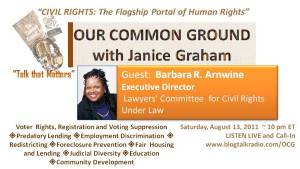
Thanks to Barbara Arnwine, National Director, The Lawyers’ Committee for Civil Rights Under Law for passing this piece over to us.  Barbara is an OUR COMMON GROUND Voice, along with other members of the LCCRUL staff.

Arwine


CHILD SEXUAL ABUSE & TRAUMA IN THE AFRICAN-AMERICAN COMMUNITY l BALT March 22-23, 2013


ROYAL CIRCLE FOUNDATION

PRESENTS IN ASSOCIATION WITH

BLACK PSYCHIATRISTS OF AMERICA, THE OFFICE OF MINORITY AND NATIONAL AFFAIRS

(AMERICAN PSYCHIATRIC ASSSOCIATION)

&

THE BALTIMORE BLACK MENTAL HEALTH ALLIANCE

 A National Conference

CHILD SEXUAL ABUSE & TRAUMA

IN THE AFRICAN-AMERICAN COMMUNITY

(The Shame, The Blame & The Solutions)

MARCH 22-23, 2013

Hilton Baltimore

401 West Pratt Street – Baltimore, MD 21201

(Limited Number of Hotel Rooms Still Available Thru 02/20/13)

For Discounted Hotel Rooms  

 Call:  1-800-HILTONS

GROUP: Royal Circle Foundation Child Abuse Conference

**********

Conference “Early Bird” Registration Now Open!

CALL FOR PAPERS ANNOUNCEMENT, ADVERTISING & EXHIBITORS APPLICATIONS AVAILABLE

(Clink Links Below For Details)

******** 

March 22, 2013 

FRIDAY EVENING RECEPTION & SPECIAL MOVIE SCREENING

“WOLF”

wolf.jpg

A Family Struggles with Child Sex Abuse in the Black Church

FOLLOWING THE MOVIE SCREENING WILL BE A DISCUSSION WITH DIRECTOR & FILMMAKER

Prof. Ya’Ke Smith

yake.jpg
PROFESSOR YA’KE SMITH

PRESS RELEASE

CHILD SEXUAL ABUSE & TRAUMA CONFERENCE ANNOUNCEMENT

REGISTER FOR THIS CONFERENCE HERE

SPONSORSHIP OPPORTUNITIES

PROGRAM ADVERTISEMENT BOOKING FORM

CONFERENCE EXHIBITORS/VENDORS AGREEMENT

***** 

SAVE THE DATE

August 20 – 22, 2013

The Royal Circle Foundation

Presents

AN INTERNATIONAL CONFERENCE

THE HEALTH & MENTAL HEALTH EFFECTS OF HUMAN TRAFFICKING


6_1782_Carpet-weaver14.jpg
Phoro Courtseyof: US Department of State

CHILD SEXUAL ABUSE & TRAUMA IN THE AFRICAN-AMERICAN COMMUNITY

See on Scoop.itOUR COMMON GROUND News Board •● ☥●• The Third Eye Parenthesis

ROYAL CIRCLE FOUNDATION

PRESENTS IN ASSOCIATION WITH

BLACK PSYCHIATRISTS OF AMERICA, THE OFFICE OF MINORITY AND NATIONAL AFFAIRS

(AMERICAN PSYCHIATRIC ASSSOCIATION)

&

THE BALTIMORE BLACK MENTAL HEALTH ALLIANCE

A National Conference

CHILD SEXUAL ABUSE & TRAUMA

IN THE AFRICAN-AMERICAN COMMUNITY

(The Shame, The Blame & The Solutions)

MARCH 22-23, 2013

Hilton Baltimore

OUR COMMON GROUND Omnibus‘s insight:

For students, activists, scholars, parents, teachers and victims.

The Shame, The Blame & The Solutions

See on www.royal-circle.org