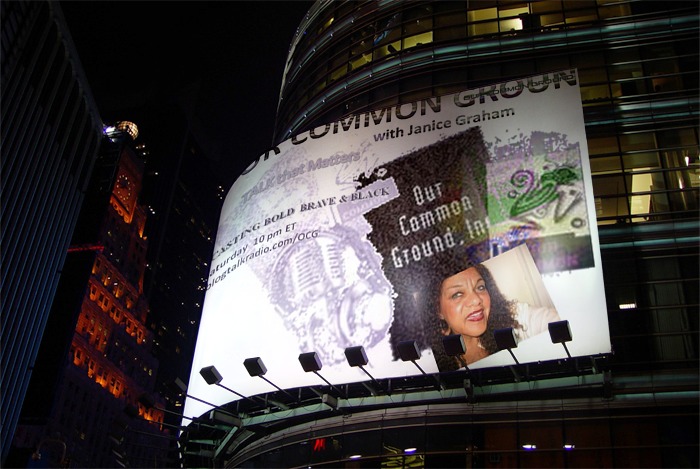
OUR COMMON GROUND 2013 Season Begins February 2, 2013


2013 Season


OUR COMMON GROUND BEGINS THE 2013 BROADCAST SEASON’

SATURDAY, February 2, 2013   10 pm ET


SPEAKING TRUTH

 The 2013 SEASON

SATURDAY   February 2, 2013    10 pm ET


PhotoFunia-a349


saturdays

We hope that you will join us as we kick off our 2013 Season of LIVE Broadcast. This season, we focus on poverty, hunger, homelessness, prison and prisoners and mental health in Black America. Advancing our VOICE and our WILL. Building solutions in the context of respect for our people’s HISTORY and HOPE. Constructing the path for new law, new public policy and reparations in an on-going dialogue transforming our thinking and our living. It’s what we do on OUR COMMON GROUND.


OUR COMMON GROUND premiering the 2013 Season of LIVE Broadcasts February 2, 2013 – 10 pm ET

Live and Call-In

Broadcasting BRAVE BOLD and BLACK

Celebrating its 28th Year of Broadcast Excellence

Continuing the Legacy of bringing to our audiences the best of informed analysis, discourse, ideas, solutions to the pressing issues of Struggle of Black People.

OCG Meeting House Studios

“Where Friends come to Meet with Comrades”

Agyei Tyehimba- Empowerment Coach's avatarMY TRUE SENSE

stamp collage

America has a conflicted relationship with committed Black leaders or social icons. She typically views them as threatening, arranges her financial, political and law enforcement agencies to neutralize or kill them, and then portrays them as “patriotic Americans” long after their demise.

This occurs because these conservative forces view Black liberators as “safe” and unable to stir up trouble once dead.

Therefore it is not uncommon to find the very people this country once defined as enemies of the state with their likenesses on U.S. postage stamps after their death.

This distinguished list includes Harriet Tubman, Frederick Douglass, Sojourner Truth, Ida B. Wells, W.E.B. DuBois, Paul Robeson, Ella Baker, James Baldwin, Medgar Evers, Fannie Lou Hamer, Malcolm X, and Dr. King.

Some will say this results from grassroots pressure to recognize Black historical figures. There is obvious truth to this.

Yet this delayed recognition of Black path-makers speaks to America’s…

View original post 1,333 more words

2013 Academy Award Nominations: “And the Winner is … The CIA” l Centre for Research on Globalization

2013 Academy Award Nominations: “And the Winner is … The CIA”

The Oscars: Extraordinary and glaring contradictions

Global Research, January 13, 2013
oscar

This year’s Academy Award nominations were announced Thursday morning during a media event at the Samuel Goldwyn Theater in Beverly Hills, California.

The award ceremony itself will take place February 24 at the Dolby Theater in Hollywood.

In 2012 the American film industry presented an extraordinary contradiction, between those showing an interest in social life and history, on the one hand, and those eagerly endorsing the “dark side” of imperialist policy, on the other. In their own inimitably muddle-headed fashion, the Oscar nominations reflect this divide.

With twelve, Steven Spielberg’s Lincoln received the largest number of nominations, including those for best picture, actor (Daniel Day-Lewis), supporting actor (Tommy Lee Jones), supporting actress (Sally Field), director (Spielberg), adapted screenplay (Tony Kushner), cinematography (Janusz Kaminski), costume design (Joanna Johnston), editing (Michael Kahn) and original score (John Williams).

This film about a social revolution, one of the most immense struggles for social progress of the 19th century, shared in the awards nomination bounty with Zero Dark ThirtyKathryn Bigelow’s quasi-fascistic glorification of the role played by the CIA in the so-called “war on terror,” which was tapped for five awards; Django Unchained, Quentin Tarantino’s foul and racialist fantasy about the antebellum period, also nominated in five categories; and Argo, another tribute to the CIA, directed by Ben Affleck, this one concerning the Iran hostage crisis of 1979-80, which was named for seven possible awards.

Opposed groupings and factions within the film industry may back the different works, but it doesn’t take any stretch of the imagination to suppose that a fairly representative figure in contemporary Hollywood might well favor both Lincoln and, say, Bigelow’s deplorable film. The degree of bewilderment, willful or otherwise, about both artistic and political matters is that great.

The nominations overall demonstrated an effort to cover every possible base.

Life of Pi, a murky, semi-religious ode to the little things in life, which also preaches ethnic and religious tolerance, won eleven nominations, second most to Lincoln. One of David O. Russell’s weaker films, Silver Linings Playbook, about a semi-dysfunctional working class couple in Philadelphia, one of this year’s official “tributes to the human spirit,” was nominated in eight categories. An obligatory big-budget action picture, Skyfall the latest James Bond, was nominated for five awards. A sentimental (and musical) depiction of poverty and oppression in 19th century France, Les Miserables, carried off eight nominations.

Beasts of the Southern Wild

Also receiving recognition, somewhat surprisingly, were the independent Beasts of the Southern Wild, a poetical consideration of post-Katrina Louisiana (four nominations), and Austrian filmmaker Michael Haneke’s Amour, about an elderly couple confronting disease and the approach of death (five nominations). The interesting Searching for Sugar Man was nominated in the best documentary feature category.

Searching for Sugar Man

The Academy Awards process is always a peculiar one. The combination of confusion, liberal good intentions, semi-philistinism, self-congratulation and political blindness is a particular expression, refracted through the peculiarities of the entertainment business, of the thinking and feeling of sections of the better-paid professional middle classes in America. This is not the best crowd, and it is not the worst.

To the extent that such people, including of course Spielberg himself, remain in thrall to the Democratic Party and Barack Obama, they are both politically and artistically limited. The subordination to the Democrats speaks to and ensures their distance from the concerns and needs of the overwhelming majority of the working population. Insulated from the economic hardships facing tens of millions and all too ignorant of history and the social process, prominent figures in the film world tend to accept the view self-servingly advanced by the media that the mass of the American people is backward and conservative. To a shameful extent they cower before the right-wing media, terrified of being attacked as “un-American” and unpatriotic.

This is bound up with the ongoing consequences of the anti-communist purges of the 1950s, which still haunt Hollywood. The most “radical” and “controversial” work today remains firmly within the framework of an acceptance of the present social and economic order.

Events will help clarify the best elements in filmmaking. One can even imagine a day when considerable numbers in Hollywood may be able to distinguish between a work that celebrates the cause of human liberation and one that identifies with its bitterest and most murderous enemies.

__________________________________________________________________________________________________________________________

ANNEX

The Complete List of Nominations

Here is the complete nominations lists:

Best Motion Picture

Argo
Amour
Beasts of the Southern Wild
Django Unchained
Les Misérables
Life of Pi
Lincoln
Silver Linings Playbook
Zero Dark Thirty 

Achievement in Directing

Ang Lee, Life of Pi
Benh Zeitlin, 
Beasts of the Southern Wild
David O. Russell, Silver Linings Playbook
Michael Haneke, 
Amour
Steven Spielberg, Lincoln

Performance by an Actor in a Leading Role

Bradley Cooper, Silver Linings Playbook
Daniel Day-Lewis, Lincoln
Denzel Washington, Flight
Hugh Jackman, Les Misérables
Joaquin Phoenix, The Master

Performance by an Actress in a Leading Role

Emmanuelle Riva, Amour
Jennifer Lawrence, Silver Linings Playbook
Jessica Chastain, Zero Dark Thirty
Naomi Watts, 
The Impossible
Quvenzhané Wallis, Beasts of the Southern Wild

Performance by an Actor in a Supporting Role

Alan Arkin, Argo
Christoph Waltz, Django Unchained
Phillip Seymour Hoffman, The Master
Robert De Niro, Silver Linings Playbook
Tommy Lee Jones, Lincoln

Performance by an Actress in a Supporting Role

Amy Adams, The Master
Anne Hathaway, Les Miserables
Helen Hunt, The Sessions
Jacki Weaver, Silver Linings Playbook
Sally Field, Lincoln

Best Animated Feature Film

Brave
Frankenweenie
ParaNorman
The Pirates! Band of Misfits
Wreck-It Ralph

Original Screenplay

Amour, Michael Haneke
Django Unchained, Quentin Tarantino
Flight, John Gatins
Moonrise Kingdom, Wes Anderson and Roman Coppola
Zero Dark Thirty, Mark Boal

Adapted Screenplay

Argo, Chris Terrio
Beasts of the Southern Wild, Lucy Alibar and Benh Zeitlin
Life of Pi, David Magee
Lincoln, Tony Kushner
Silver Linings Playbook, David O. Russell

Best Foreign-Language Film

A Royal Affair (Denmark)
Amour
 (Austria)
No (Chile)
War Witch (Canada)
Kontiki (Norway)

Original Score

Anna Karenina, Dario Marianelli
Argo, Alexandre Desplat
Life of Pi, Mychael Danna
Lincoln, John Williams
Skyfall, Thomas Newman

Original Song

“Before My Time,” J. Ralph; Chasing Ice
“Everybody Needs a Best Friend,” Walter Murphy and Seth McFarlane; Ted
“Pi’s Lullaby,” Mychael Danna and Bombay Jayashri; Life of Pi
“Skyfall,” Adele Adkins and Paul Epworth; Skyfall
“Suddenly,” Claude-Michel Schönberg, Herbert Kretzmer and Alain Boulil; Les Misérables 

Achievement in Production Direction

Anna Karenina
The Hobbit: An Unexpected Journey
Les Misérables
Life of Pi
Lincoln

Achievement in Cinematography

Anna Karenina, Seamus McGarvey
Django Unchained, Robert Richardson
Life of Pi, Claudio Miranda
Lincoln, Janusz Kaminski
Skyfall, Roger Deakins

Achievement in Costume Design

Anna Karenina, Jacqueline Durran
Les Misérables, Paco Delgado
Lincoln, Joanna Johnston
Mirror Mirror, Eiko Ishioka
Snow White and the Huntsman, Colleen Atwood

Best Documentary Feature

5 Broken Cameras
The Gatekeepers
How to Survive a Plague
The Invisible War
Searching for a Sugar Man

Best Documentary Short Subject

Inocente
Kings Point
Mondays at Racine
Open Heart
Redemption

Achievement in Film Editing

Argo
Life of Pi
Lincoln
Silver Linings Playbook
Zero Dark Thirty

Achievement in Makeup & Hairstyling

Hitchcock
The Hobbit: An Unexpected Journey
Les Misérables

Best Animated Short Film

Adam and Dog
Fresh Guacamole
Head Over Heels
Maggie Simpson in “The Longest Daycare”
Paperman

Best Live-Action Short Film

Asad
Buzkashi Boys
Curfew
Death of a Shadow
Henry

Achievement in Sound Editing

Argo
Django Unchained
Life of Pi
Skyfall
Zero Dark Thirty

Achievement in Sound Mixing

Argo
Les Misérables
Life of Pi
Lincoln
Skyfall

Achievement in Visual Effects

The Hobbit: An Unexpected Journey
Life of Pi
Marvel’s The Avengers
Prometheus
Snow White and the Huntsman


From Global Research Center for Research on Globalization

Centre for Research on Globalization (CRG)
PO Box 55019
11 Notre-Dame Ouest,
MONTREAL, Qc, H2Y 4A7
CANADA

GLOBAL RESEARCH RADIO

Michael Welch, Radio Producer, Winnipeg, Manitoba

The Global Research News Hour hosted by Michael Welch airs on CKUW 95.9FM in Winnipeg, Manitoba, Thursdays at 10am CDT. and on Canadian community radio networks.

The weekly programme is available for download on the Global Research website.

Consult Past GR Radio Programmes

Davey D's avatarDavey D's Hip Hop Corner

Share/Save/Bookmark
Historic 1967 Speech to National Association of Radio Announcers


MLK-brown-leanThis weekend we’ll be celebrating Dr Martin Luther King‘s birthday and in doing so we should all be mindful of the power of his words. We should be mindful of King’s words as we continue to dialogue about what sort of responsibility those who speak to the public have especially via broadcast medium especially with respect to Black Radio..We thought we’d take a walk down memory lane and listen to what King had to say about the role BLACK RADIO played in furthering the Civil Rights struggle..It was a speech given in August of 1967 in Atlanta, Ga to NATRA (National Association of TV and Radio Announcers )

In this rare speech which can be heard in its entirety by clicking the link above..King talks about how Black radio has been a transformative tool. He notes that Black radio is…

View original post 1,238 more words

Left of Black – Season 3, Episode 15

See on Scoop.itOUR COMMON GROUND Informed Truth and Resistance

Mark Anthony Neal is joined by independent documentary filmmaker Byron Hurt to talk about his new film, Soul Food Junkies.

OUR COMMON GROUND Omnibus‘s insight:

Left of Black inteview with Byron Hurt on "Soul Food Junkie"

See on www.youtube.com

Chris Hedges: The Myth of Human Progress – Truthdig

See on Scoop.itOUR COMMON GROUND Informed Truth and Resistance

The mounting distortions of climate change and the rapid depletion of natural resources have done little to blunt the self-destructive notion of ceaseless expansion. The road we are on points toward human extinction.

OUR COMMON GROUND Omnibus‘s insight:

“Requiem for a Species: Why We Resist the Truth About Climate Change” describes a dark relief that comes from accepting that “catastrophic climate change is virtually certain.” This obliteration of “false hopes,” he says, requires an intellectual knowledge and an emotional knowledge. The first is attainable. The second, because it means that those we love, including our children, are almost certainly doomed to insecurity, misery and suffering within a few decades,

See on www.truthdig.com

The Case of Dr. Jahi Issa l RACE, HIGHER EDUCATION AND HBCUs -Update

09-01-12 Issa

Revision of October 26, 2012 publication
See Updates below

RACE, HIGHER EDUCATION AND HBCUs

 Dr. Jahi Issa, until March 2012, worked as an Assistant Professor of History & Africana Studies at Delaware State University (DSU) in Dover. When a group of students assembled in protest of DSU President Dr. Harry Williams after the state auditor criticized the university’s business practices and for the decreasing percentage of black students at the historically black university, police arrested Issa and escorted him away until he dropped to the ground and requested an ambulance. After being seen at the hospital and later released, DSU police charged him with disorderly conduct, resisting arrest, offensive touching of a law enforcement officer, and inciting a riot.

Issa was born and reared in St. Louis, Mo. and was awarded his PhD in history from Howard University. His forthcoming monograph examines the Universal Negro Improvement Association in Louisiana and its contribution to African nationalism. He is currently banned from the DSU campus and is facing a prosecution that could put him behind bars for
more than two years. The incident has fueled concerns that Professor Issa’s arrest and the pending charges represent an act of repression and retaliation for his outspokenness and the EEOC and other complaints he has filed while he was on the faculty at DSU, and not because of any actual crimes he committed. The situation is depressing and he is in need of support in this difficult time.

We ask, what is the crime ?  Is there no freedom of speech for a progressive Black educator in this HBC ? We remember the on-slaught of firings in HBCUs in the 1960s as many began to publish the early works of student involvement in the infancy of the Black Power movement.  Among them, Dr. Nathan Hare who was fired from Howard University.


Listen to the OUR COMMON GROUND

interview with Dr. Jahi Issa

09-01-12 Issa

YouTube video of the Rally and his arrest

“How Black Colleges are Turning White” in the Black Agenda Report
http://www.blackagendareport.com/content/ethnic-cleansing-historica…


Dr. Issa’s Legal Defend Fund. Consider donating and circulating the site address.  http://www.hbcuinstitute.org/

His response to the White House Advisor on HBCUs in the Chronicle ofHigher Education

  http://www.chronicle.com/article/No-Need-to-Overhaul-Americas/129565/

Visit HBCU Institute to lean More and to support Dr. Issa
www.hbcuinstitute.org

Commentary on the Case of Dr. Jahi Issa


At the heart of this bizarre response to Dr. Issa’s attendance to the student rally is an essay which he wrote and was published at Black Agenda Report.

How Black Colleges Are Turning White – The Ethnic Cleansing Of African Americans in the Age of Obama

“How Black Colleges are Turning White” in the Black Agenda Report
http://www.blackagendareport.com/content/ethnic-cleansing-historica…

How Black Colleges Are Turning White and Keeping Their Historically Black Colleges and Universities Status: The Ethnic Cleansing Of African Americans in the Age of Obama (Part 1 of 3 )
By Jahi Issa, Ph.D.

For more than 100 years, HBCU’s have served as a model for educating a plethora of African American leadership around the country. Although the mission statements of most HBCUs do not state this fact, HBCUs grew out of the social disorder and aftermath of the American Civil War—a period which constitutionally brought millions of formerly enslaved Africans into citizenry in the United States. Similar to colleges and universities that were created for groups such as Catholics, Jews and for immigrant groups, HBCUs were created in reaction to de facto marginalization created by a European American hostile society. Because of the efforts of the Civil Right Movement, HBCU’s were finally recognized as important institutions and were giving special status for Federal funding. However, over the past few decades, HBCUs have been targeted as being too “Black” and many states are progressively trying to eliminate African Americans from these institutions that have served as a buffer zone for the Black middle class. Some HBCUs have and are going through hostile takeovers in order to turn them into White education facilities and thereby permanently eliminating the African American middle class.

African American Perform Better at HBCUs
Although over the years many have argued that HBCUs are redundant and irrelevant in today’s “post racial world,” the fact remains that these intuitions of higher learning, according to the National Science Foundation, graduate more than 33% of all African Americans earning Bachelor’s and doctoral degrees, almost double that compared to African Americans attending predominately White schools . Furthermore, according to the Washington Post, the “post racial” world that many hoped for with the election of President Barack Obama may just be an illusion. Relying on a recent report from the Pew Research Center’s Social & Demographic Trends, the Washington Post noted that the typical White household in 2009 had 20 times more wealth ($113,149) than the typical Black household ($5,677). Moreover, another report that was conducted by Brandeis University in May of 2010 and concluded that African American will never reach wealth parity with that of White Americans. Both reports note that African Americans with college degrees stand a better chance at edging out a decent life in the United States than those without degrees.

According to a 1977 study that was conducted under the leadership of Dr. Mary Francis Berry, in her capacity as the former Secretary of Education in the Carter Administration, primary reasons why HBCUs tended to be better equipped to prepare students for real world experience was because they offered:

  • “credible models for aspiring Blacks…
  • “psycho-socially congenial settings in which blacks can develop”
  • “insurance against a potentially declining interest in the education of black folk”

Furthermore, the report posits that the ultimate purpose of the HBCU is to “represent the formal structures which nurture and stress racial ideology, pride and worth for Blacks. Consequently, they are what every racial and ethnic group is entitled to have—a political, social and intellectual haven.” The report mentioned above was recently vindicated in a study that was published in January of 2011. Three economists concluded that African Americans who attend HBCUs tend to perform better in the work force than African Americans who attend predominately White universities and colleges.

The 1965 Higher Education Act and Title III: Federal Funding For African-Americans in Higher Education
One cannot discuss today’s relevancy of HBCU’s without mentioning the Higher Education Act of 1965. The Higher Education Act was signed into law by President Lyndon B. Johnson as part of his Great Society program that sought “to strengthen the educational resources of our colleges and universities and to provide financial assistance for students in postsecondary and higher education.” Before the law was signed by President Johnson, the Chairman of the House Committee on Education, an African-American Harlem Congressman named Adam Clayton Powell made an amendment that defined HBCUs as “…any historically black college or university that was established prior to 1964, whose principal mission was, and is, the education of black Americans.” The amendments also legalized the federal funding of HBCUs through the Higher Education Act of 1965 Title III program. Title III is the federal governing body which sets the standard for providing funding for HBCUs. Over the years Title III had provided billions of dollars to support African-American undergraduate, graduate programs, increasing African American participation in math and science, real estate acquisitions and strengthen HBCU’ endowments to name a few. In all, Title III has helped African American universities to not only increase their numbers in accredited degree programs across the country; it has also allowed many HBCUs to have a tremendous economic impact in the communities that they serve.

Economic Impact of HBCUs and the Origins of a New Era Rifted in Corruption
In 2005 the National Center for Education Statistics (NCES), an office within the U.S. Department of Education, published a report that documented the economic impact of HBCUs. Primarily, this study was introduced by President George W. Bush and continued by President Barack Obama administration which sought to include the participation of private sector (corporations) into the governing bodies of HBCUs. The study found that more than 100 HBCUs had in 2001 an economic impact of almost 11 billion dollars in the communities that they served. For instance, schools such as Howard University total economic impact in the Washington D.C. metropolitan area was more than 600 million dollars. For smaller schools such as Delaware State University, their total economic impact was more than 150 million dollars. It must be noted that the economic impacts also made a national impression. Again, according to the National Science Foundation, HBCUs bestowed nearly 25% of all bachelor degrees earned by African Americans in 2001. In the areas of agriculture, biology, mathematics and the physical sciences, HBCUs accounted for more than 40 percent of all bachelor degrees earned by African-Americans. With this stated, it is easy to see why corporations would want a piece of the pie. Furthermore, if one is to evaluate the current lack of transparency on Wall Street, it is easy to see that Wall Street’s collaboration with today’s HBCUs could represent the end of African American higher education as we know it.

The Second Corporate takeover Black Higher Education

Although President Barack Obama HBCU Executive Order 13532 “encourages private investment in HBCUs,” however, research proves that corporate partnerships is not new to HBCUs, nor are their historic input solely motivated by financial gains. Not long after the end of reconstruction, Northern White capitalists sought extreme ways in which they could control the ebb and flow of African American education. This was done to curtail the rapid development of African American educational institutions immediately after the Civil War. For instance, from 1865-1880 federal agents documented that there were thousands of African American schools operating throughout the South independent of White control. When northern White benevolent groups finally reach the South with mythical-preconceived notions that they were coming to “civilize” former wretched enslaved Africans, they were astonished to see that Africans Americans had already had established their own schools systems fully equipped with African American teachers. These schools’ full missions were self-determination and political control over the regions of the South in which they were the majority.

The high level of African American political education created a problem for the nation after the Compromise of 1877. Since African Americans were no longer allowed to exercise political autonomy in the South, strategies were devised on the federal level to control the nature of their education. The federal government along with the corporate conglomerates in the North believed that the only way that they could ensure the continual flow of cheap labor in the South was to train African Americans in a way that they would not advocate for political control of their communities. Furthermore, there was another important issue at play—that was African American competition with Whites for high skilled jobs. The solution was a new type of training for Southern African Americans was called industrial education. This type of schooling served the purpose of supervising and training African American to be subservient to White interest. Schools such as Hampton, Tuskegee and Delaware State were devised as the alternative to the African American independent schools that advocated self-determination after the Civil War. The corporate-handpicked spokesman for this new type of schooling was none other than Booker T. Washington. One must remember that Washington’s entrance exam into Hampton University was sweeping the floor. The ultimate goal of Hampton was to control the emerging Black leadership of the Jim Crow South, and train African Americans in the corporate labor needs of the new South. The financial backing of Hampton University and what would later be Tuskegee was provided by White Northern corporations and philanthropy. This corporate-industrial style form of education continued to dominate Southern higher educational institutions long after the death of Booker T. Washington in 1915.

The White House Initiative on HBCUs Encourages Corporate Collaboration? 
The current encroachment of private corporate input into the affairs of African American higher education could and will be disastrous. It would mean that African Americans will be forced back into the Jim Crow Era. A deliberate attempt to curtail educational advancements that was gained by the Civil Rights and Black Power era seems to be the main motivation. The White House Advisor on HBCUs, John Wilson, Jr., stated in April of 2010 HBCUs “must not be seen as plaintiffs in the struggle for civil rights….” Dr. Wilson, a graduate of Morehouse College, tends to forget that it was struggle for Civil Rights that literally allows him to serve President Barack Obama. The White House Initiative on HBCUs came into existence because of the “plaintiff” of the past. Furthermore, Mr. Wilson’s statement implies that African American should abandon their pursuit for full rights and self-interest. Taking a lead from Dr. Wilson’s statements, A Wall Street Journal editor named Jason L. Liley wrote an editorial stating that HBCU’s were a dismal failure and that “Mr. Obama ought to use the federal government’s leverage” to bring these schools under Wall Street’s control. He went further by stating that HBCUs should all become private and model themselves after the University of Phoenix. One month after Liley’s editorial, a conservative from the Wall Street funded American Enterprise Institute also imputed on Wall Street’s quest to control Black education. He ended his article in the Chronicle of Higher Education by stating that HBCUs “should accordingly be encouraged to enroll more non-black students.” The author mentioned nothing about White universities increasing African American enrollment. He also stated that “some HBCUs, notably two in West Virginia (Bluefield State and West Virginia State University), are in fact no longer predominantly black” but are still receiving special (HBCU) federal funding. Five months after the Chronicle of Higher Education essay appeared, the White House Advisor on HBCUs, John Wilson, Jr. was invited as the keynote speaker to the Thurgood Marshall College Fund. The title of his speech “Historically Black Colleges and Universities and the Albatross of Undignified Publicity” conveyed that HBCU are historically cursed when it comes to publicity in White dominated media outlets. Moreover, the central thesis of his speech, although impressively constructed, was that HBCUs should jump on the corporate bandwagon by accepting funds from good corporate Samaritans such as Bill Gates and Warren Buffett.

Black Colleges Turning White or White Cultural Hegemony: The Signs of the Future 
Although the Higher Education Act of 1965 clearly states that an HBCU is a school “whose principal mission was, and is, the education of black Americans,” economist and scholar at American Enterprise Institute, Richard Vedder, reminds us that there is a trend being shaped were as HBCUs who formally had an African American majority student and faculty body, and now have White majority populations, still receive federal funding geared for African Americans. These two schools are Bluefield State College and West Virginia State University. According to a May 19, 2000 CNN report, White enrollment at HBCUs is on the rise. Other schools such as Kentucky State University, Elizabeth City State University and Delaware State University are only a few schools that have a growing White and non-African American student and faculty population. Furthermore, according to an August 17, 2011 Wall Street Journal article called “Recruiters at Black Colleges Break From Tradition,” HBCUs such as Tennessee State University, Delaware State University and Paul Quinn College are cited as no longer focusing exclusively on recruiting African Americans. The author of the article points out that Tennessee State University’s Black enrollment has reduced to around 70 %, while Paul Quinn College Black enrollment has been predicted to fall from 94% to 85% for the Fall 2011 academic year.

Many have asked the question if White enrollment at HBCUs represent a decrease in African American enrollment at the same schools. The year that CNN published its story, Bluefield College African American faculty had dwindled to less than one percent from previous decades. The African American student enrollment had also decreased to less than ten percent. Nonetheless, research shows that when African American faculty at HBCUs is a majority, African American students tend to enroll at a higher percentage and they tend to be more productive in the work place once they graduate. There seems to be a direct correlation between African American student enrollment and that of its faculty. In other words, if the African American faculty enrollment at HBCU’s is low, African American students tend not to attend HBCU’s. When this occurs, is an HBCU still a HBCU? In other words, can you have a HBCU without Black students and faculty? This is exactly the issue that American Enterprise Institute scholar Richard Vedder was raising in his essay in the Chronicle of Higher Learning. Why are HBCUs that are no longer Black in students or faculty population receiving federal monies geared toward African Americans? The federal government seems to believe that this trend represents the future for HBCUs.

Jahi Issa, Ph.D Assistant Professor of History and Africana Studies at Delaware State University and Former Northeastern North Carolina Grass Root Coordinator for President Barack Obama’s 2008 Presidential Campaign. 

Dr. Issa’s Legal Defend Fund. Consider donating and circulating the site address.  http://www.hbcuinstitute.org/

“How Black Colleges are Turning White” in the Black Agenda Report

http://www.blackagendareport.com/content/ethnic-cleansing-historica…

His response to the White House Advisor on HBCUs in the Chronicle ofHigher Education    http://www.chronicle.com/article/No-Need-to-Overhaul-Americas/129565/

Learn more about  the and how you can support Dr. Issa

HBCU Institute
www.hbcuinstitute.org


UPDATE:  

The Petition for Justice for Dr. Issa

OP-ED on BlackStar News

Rally to Support Dr. Issa on January 15, 2013. Commentary and participant comments begin around 2:52 in the video.

Relevant to this case

Protest to force investigate Lynchings in DE

2012 whites in Delaware Lynching Black Men Louisiana-styled Cover-ups in Delaware


Busted: 91 Doctors, Nurses, Medical Professionals Charged In $430M Medicare Fraud

Busted: 91 Doctors, Nurses, Medical Professionals Charged In $430M Medicare Fraud

Added by Maria Lloyd on October 5, 2012.Tags:


Ninety-one Doctors, Nurses, and Medical Professionals Are Charged By The Justice Department For A $430 Million-Dollar Medicare Scam- The Largest Ever

Dr. Robert Kolbusz of Chicago (left) and Dr. Joseph Megwa of Dallas (right), were among those facing serious charges for medicare fraud

The U.S. Justice Department and the Department of Health and Human Services discovered alleged false billing schemes involving $230 million in home health services, over $100 million in mental services, and $49 million from ambulance transportation. Ninety-one people, including: doctors, nurses, and other medical professionals, have been charged with committing over $430 million in Medicare fraud in seven U.S. cities. The scheme is the largest of its kind, according to Attorney General Eric Holder. The announcement marks the latest case in a concerted crackdown against Medicare fraud by an inter-agency Medicare fraud strike force.

The charges the suspects face range from healthcare fraud and conspiracy to wire fraud, kickback violations, identity theft and money laundering. In a news conference, Holder said that the case reveals an alarming trend of criminal attempts to steal billions of taxpayer dollars for personal profit.  ”Today’s enforcement actions reveal an alarming and unacceptable trend of individuals attempting to exploit federal health care programs to steal billions in taxpayer dollars for personal gain,” Holder said. Assistant Attorney Lanny A. Breuer agreed, adding: “Today’s coordinated actions represent one of the largest Medicare fraud takedowns in Department of Justice history.” Breuer continued : “We have made it one of the Department’s missions to hold accountable those who abuse the Medicare program for personal profit.”

Medicare Fraud Strike Force operations targeted health care workers in seven cities – Brooklyn, Baton Rouge, Chicago, Dallas, Houston, Los Angeles, and Miami. According to Holder, Dr. Joseph Megwa, was writing 33,000 prescriptions for some 2,000 patients between 2006 and 2011. Dr. Megwa, who practices in Dallas, allegedly signed off these documents without reviewing them, causing $103.3million in false billings. According to the Dallas Morning News, the 58-year-old’s alleged defrauding was the costliest. The doctor, who works at Raphem Medical Practice in Arlington, was indicted on conspiracy and health-fraud. The Justice Department alleges that Megwa helped patients in their homes as he travelled abroad. Two nurses, Ferguson Ikhile, and Ebolose Eghobor, were indicted along with the doctor. The three remain in federal custody.

Similarly, dermatologist Dr. Robert Kolbusz of Chicago, was charged with falsely diagnosing his patients and billing Medicare for treatments that were not given, according to the Chicago Tribune reported. Seven individuals in Houston were charged for giving kickbacks of cigarettes, coupons, and food to Medicare recipients who would in turn just watch TV or play games instead of receiving the services that were billed to Medicare. The fraud allegedly led to $158 million in fraudulent billing.

In Miami, 33 suspects were arrested and charged with fraud of more than $200 million, according to NBC Miami.  Breuer said that owners and operators at one Miami psychiatric hospital gave cash kickbacks to owners of assisted living facilities in order to obtain more patients. They then billed the social insurance plan more than $67million, often for services that were never offered, or patients they never actually had. Breuer added that these 33 medical professionals then billed Medicare for the cash they used as kickbacks for their false patients. Little else is known about those charged in the city.

Holder condemned the fraud as one that “siphons precious taxpayer resources, drives up heath care costs, and jeopardizes the strength of the Medicare program.” He added: “They also victimize the most vulnerable members of society, including elderly, disabled, and impoverished Americans.” The strike force was created under the healthcare reform law as a means of curbing waste, fraud and abuse within the $590 billion Medicare program that provides healthcare benefits to approximately 50 million elderly and disabled beneficiaries.

In February of 2011, 111 medical practitioners were charged in a $225million Medicare fraud, which was the largest of its kind at that time.

How Did the Gates of Hell Open in Vietnam?

How Did the Gates of Hell Open in Vietnam?

Posted on Jan 17, 2013

Ron Cogswell (CC BY 2.0)

By Jonathan Schell, TomDispatch

This piece originally appeared at TomDispatch. Read Tom Engelhardt’s introduction here.

For half a century we have been arguing about “the Vietnam War.” Is it possible that we didn’t know what we were talking about? After all that has been written (some 30,000 books and counting), it scarcely seems possible, but such, it turns out, has literally been the case.

Now, in Kill Anything that MovesNick Turse has for the first time put together a comprehensive picture, written with mastery and dignity, of what American forces actually were doing in Vietnam. The findings disclose an almost unspeakable truth.  Meticulously piecing together newly released classified information, court-martial records, Pentagon reports, and firsthand interviews in Vietnam and the United States, as well as contemporaneous press accounts and secondary literature, Turse discovers that episodes of devastation, murder, massacre, rape, and torture once considered isolated atrocities were in fact the norm, adding up to a continuous stream of atrocity, unfolding, year after year, throughout that country.

It has been Turse’s great achievement to see that, thanks to the special character of the war, its prime reality—an accurate overall picture of what physically was occurring on the ground—had never been assembled; that with imagination and years of dogged work this could be done; and that even a half-century after the beginning of the war it still should be done. Turse acknowledges that, even now, not enough is known to present this picture in statistical terms. To be sure, he offers plenty of numbers—for instance the mind-boggling estimates that during the war there were some two million civilians killed and some five million wounded, that the United States flew 3.4 million aircraft sorties, and that it expended 30 billion pounds of munitions, releasing the equivalent in explosive force of 640 Hiroshima bombs.

Yet it would not have been enough to simply accumulate anecdotal evidence of abuses. Therefore, while providing an abundance of firsthand accounts, he has supplemented this approach. Like a fabric, a social reality—a town, a university, a revolution, a war—has a pattern and a texture.  No fact is an island. Each one is rich in implications, which, so to speak, reach out toward the wider area of the surrounding facts. When some of these other facts are confirmed, they begin to reveal the pattern and texture in question.

Turse repeatedly invites us to ask what sort of larger picture each story implies. For example, he writes:

“If one man and his tiny team could claim more KIAs [killed in action] than an entire battalion without raising red flags among superiors; if a brigade commander could up the body count by picking off civilians from his helicopter with impunity; if a top general could institutionalize atrocities through the profligate use of heavy firepower in areas packed with civilians—then what could be expected down the line, especially among heavily armed young infantrymen operating in the field for weeks, angry, tired, and scared, often unable to locate the enemy and yet relentlessly pressed for kills?”

Like a tightening net, the web of stories and reports drawn from myriad sources coalesces into a convincing, inescapable portrait of this war—a portrait that, as an American, you do not wish to see; that, having seen, you wish you could forget, but that you should not forget; and that the facts force you to see and remember and take into account when you ask yourself what the United States has done and been in the last half century, and what it still is doing and still is.

Scorched Earth in I Corps

My angle of vision on these matters is a highly particular one. In early August 1967, I arrived in I Corps, the northernmost district of American military operations in what was then South Vietnam.  I was there to report for the New Yorker on the “air war.” The phrase was a misnomer.  The Vietnamese foe, of course, had no assets in the air in the South, and so there was no “war” of that description.

There was only the unilateral bombardment of the land and people by the fantastic array of aircraft assembled by the United States in Vietnam.  These ranged from the B-52, which laid down a pattern of destruction a mile long and several football fields wide; to fighter bombers capable of dropping, along with much else, 500-pound bombs and canisters of napalm; to the reconfigured DC-3 equipped with a cannon capable of firing 100 rounds per second; to the ubiquitous fleets of helicopters, large and small, that crowded the skies. All this was abetted by continuous artillery fire into “free-fire” zones and naval bombardment from ships just off the coast.

By the time I arrived, the destruction of the villages in the region and the removal of their people to squalid refugee camps was approaching completion. (However, they often returned to their blasted villages, now subject to indiscriminate artillery fire.) Only a few pockets of villages survived. I witnessed the destruction of many of these in Quang Ngai and Quang Tinh provinces from the back seat of small Cessnas called Forward Air Control planes.

As we floated overhead day after day, I would watch long lines of houses burst into flames one after another as troops moved through the area of operation.  In the meantime, the Forward Air Controllers were calling in air strikes as requested by radio from troops on the ground. In past operations, the villagers had been herded out of the area into the camps.  But this time, no evacuation had been ordered, and the population was being subjected to the full fury of a ground and air assault. A rural society was being torn to pieces before my eyes.

The broad results of American actions in I Corps were thus visible and measurable from the air. No scorched earth policy had been announced but scorched earth had been the result.  Still, a huge piece was missing from the puzzle.  I was not able to witness most of the significant operations on the ground firsthand. I sought to interview some soldiers but they would not talk, though one did hint at dark deeds.  “You wouldn’t believe it so I’m not going to tell you,” he said to me. “No one’s ever going to find out about some things, and after this war is over, and we’ve all gone home, no one is ever going to know.”

In other words, like so many reporters in Vietnam, I saw mainly one aspect of one corner of the war.  What I had seen was ghastly, but it was not enough to serve as a basis for generalizations about the conduct of the war as a whole. Just a few years later, in 1969, thanks to the determined efforts of a courageous soldier, Ron Ridenhour, and the persistence of a reporter, Seymour Hersh, one piece of the hidden truth about ground operations in I Corp came to light.

1         NEXT PAGE >>>

Extraordinary Scholar and Author, Dr. Tony Martin Now an Ancestor l February 21, 1942 ~ January 17, 2013

Dr. Tony Martin Now an Ancestor


Professor Tony Martin dies at 70

Trinicenter.com Reporters
January 17, 2013


Professor Martin has written, compiled or edited 14 books including Caribbean History: From Pre-Colonial Origins to the Present (2012) published by Pearson Education; Amy Ashwood Garvey: Pan-Africanist, Feminist and Mrs. Marcus Garvey No. 1, Or, A Tale of Two Amies (2007), Literary Garveyism: Garvey, Black Arts and the Harlem Renaissance (1983), and the classic study of the Garvey Movement, Race First: the Ideological and Organizational Struggles of Marcus Garvey and the Universal Negro Improvement Association (1976).
Dr. Tony Martin, former Professor Emeritus at Wellesley College, has passed over tonight, January 17th 2013 in Trinidad & Tobago at West Shore Medical Hospital. Trinidadian-born Dr. Martin taught at the University of Michigan-Flint, the Cipriani Labour College (Trinidad), and St. Mary’s College (Trinidad). He has been a visiting professor at the University of Minnesota, Brandeis University, Brown University, and The Colorado College and also spent a year as an honorary research fellow at the University of the West Indies, Trinidad.

His work on Marcus Garvey was featured on the curricula of many African studies programmes around the world and he was a well-known lecturer in many countries.

Share your views here…


Dr. Tony Martin is Emeritus Professor of Africana Studies at Wellesley College, Massachusetts, where he taught from 1973 to 2007. Now an Ancestor

Dr. Tony Martin is Emeritus Professor of Africana Studies at Wellesley College, Massachusetts, where he taught  from 1973 to 2007. Prior to coming to Wellesley, he taught at the University of Michigan-Flint, the Cipriani Labour College (Trinidad), and St. Mary’s College (Trinidad). He has been a visiting professor at the University of Minnesota, Brandeis University, Brown University, and The Colorado College. He also spent a year as an honorary research fellow at the University of the West Indies, Trinidad.

Professor Martin has authored, compiled or edited 14 books. His most recent isCaribbean History: From Pre-Colonial Origins to the Present (2012) published by Pearson Education. Earlier works include  Amy Ashwood Garvey: Pan-Africanist, Feminist and Mrs. Marcus Garvey No. 1, Or, A Tale of Two Amies (2007), Literary Garveyism: Garvey, Black Arts and the Harlem Renaissance (1983), and the classic study of the Garvey Movement, Race First: the Ideological and Organizational Struggles of Marcus Garvey and the Universal Negro Improvement Association (1976).

Martin qualified as a barrister-at-law at the Honourable Society of Gray’s Inn (London) in 1965, did a B.Sc. honours degree in economics at the University of Hull (England), and the M.A. and Ph.D. in history at Michigan State University.

Martin’s articles and reviews have appeared in such journals as the Journal of Negro History; Journal of African American History; American Historical Review; African Studies Review; Washington Post Book World; Journal of Caribbean History; Journal of American History; Black Books Bulletin; Jamaica Journal; Comparative Studies of South Asia, Africa and the Middle East; and many others.

His writings can be found in several reference works and encyclopedias, including the UNESCO General History of the Caribbean; the Oxford Dictionary of National BiographyAmerican National Biography; the Encyclopedia of African American Business History; International Encyclopedia of the Social Sciences; and Encyclopedia of the Harlem Renaissance. He has received numerous academic and community awards, including a grant from the American Philosophical Society. He has reviewed articles and programs for scholarly journals, the National Endowment for the Humanities, and the Austrian Science Fund. His biographical listings can be found in Who’s Who in America; Who’s Who in the World; Who’s Who Among America’s Teachers; Personalities Caribbean; Who’s Who Among African Americans; and elsewhere. He has been a reviewer and consultant for publishers and has served as an expert witness for Congressional hearings.

Martin is well known as a lecturer in many countries. He has spoken to university and general audiences all over the United States, Canada, the Caribbean, and England, as well as in Africa, Australia, Bermuda, and South America. In 1990 he delivered the annual DuBois/Padmore/Nkrumah Pan-African lectures in Ghana. In 2004 he was one of the principal speakers at the First Conference of Intellectuals of Africa and the Diaspora, which was sponsored by the African Union in Senegal.

Learn more about Dr. Tony Martin at his Official Website

Dr. Martin became an OUR COMMON GROUND Voice in 1989. His voice is deep and important. We are proud of his association and support of our programming. We expect that he will be an ancestral guide to our mission.