What Does Black Lives Matter Want?

What Does Black Lives Matter Want?

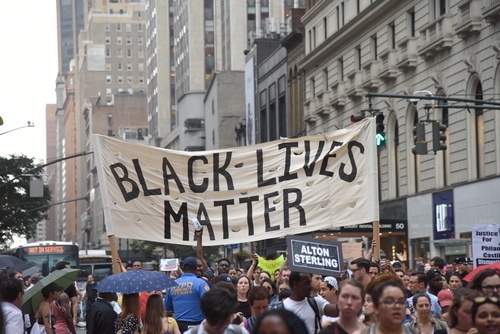
On August 1 the Movement for Black Lives (M4BL), a coalition of over sixty organizations, rolled out  “A Vision for Black Lives: Policy Demands for Black Power, Freedom & Justice,” an ambitious document described by the press as the first signs of what young black activists “really want.” It lays out six demands aimed at ending all forms of violence and injustice endured by black people; redirecting resources from prisons and the military to education, health, and safety; creating a just, democratically controlled economy; and securing black political power within a genuinely inclusive democracy. Backing the demands are forty separate proposals and thirty-four policy briefs, replete with data, context, and legislative recommendations.

But the document quickly came under attack for its statement on Palestine, which calls Israel an apartheid state and characterizes the ongoing war in Gaza and the West Bank as genocide. Dozens of publications and media outlets devoted extensive coverage to the controversy around this single aspect of the platform, including The Guardian, the Washington Post, The Times of Israel, Haaretz, and the St. Louis Post-Dispatch. Of course, M4BL is not the first to argue that Israeli policies meet the UN definitions of apartheid. (The 1965 International Convention for the Elimination of All Forms of Racial Discrimination and the 1975 International Convention on the Suppression and Punishment of the Crime of Apartheid define it as “inhuman acts committed for the purpose of establishing and maintaining domination by one racial group of persons over any other racial group of persons and systematically oppressing them.”) Nor is M4BL the first group to use the term “genocide” to describe the plight of Palestinians under occupation and settlement. The renowned Israeli historian Ilan Pappe, for example, wrote of the war on Gaza in 2014 as “incremental genocide.” That Israel’s actions in Gaza correspond with the UN definition of genocide to “destroy, in whole or in part, a national, ethnical, racial or religious group” by causing “serious bodily or mental harm” to group members is a legitimate argument to make.

The few mainstream reporters and pundits who considered the full M4BL document either reduced it to a laundry list of demands or positioned it as an alternative to the platform of the Democratic Party—or else focused on their own benighted astonishment that the movement has an agenda beyond curbing police violence. But anyone following Black Lives Matter from its inception in the killingtrayvonsaftermath of the George Zimmerman verdict should not be surprised by the document’s broad scope. Black Lives Matter founders Alicia Garza, Patrisse Cullors, and Opal Tometi are veteran organizers with a distinguished record of fighting for economic justice, immigrant rights, gender equity, and ending mass incarceration. “A Vision for Black Lives” was not a response to the U.S. presidential election, nor to unfounded criticisms of the movement as “rudderless” or merely a hashtag. It was the product of a year of collective discussion, research, collaboration, and intense debate, beginning with the Movement for Black Lives Convening in Cleveland last July, which initially brought together thirty different organizations. It was the product of some of the country’s greatest minds representing organizations such as the Black Youth Project 100, Million Hoodies, Black Alliance for Just Immigration, Dream Defenders, the Organization for Black Struggle, and Southerners on New Ground (SONG). As Marbre Stahly-Butts, a leader of the M4BL policy table explained, “We formed working groups, facilitated multiple convenings, drew on a range of expertise, and sought guidance from grassroots organizations, organizers and elders. As of today, well over sixty organizations and hundreds of people have contributed to the platform.”
The result is actually more than a platform. It is a remarkable blueprint for social transformation that ought to be read and discussed by everyone. The demands are not intended as Band-Aids to patch up the existing system but achievable goals that will produce deep structural changes and improve the lives of all Americans and much of the world. Thenjiwe McHarris, an eminent human rights activist and a principle coordinator of the M4BL policy table, put it best: “We hope that what has been created carries forward the legacy of our elders and our ancestors while imagining a world and a country profoundly different than what currently exists. For us and for those that will come after us.” The document was not drafted with the expectation that it will become the basis of a mass movement, or that it will replace the Democratic Party’s platform. Rather it is a vision statement for long-term, transformative organizing. Indeed, “A Vision for Black Lives” is less a political platform than a plan for ending structural racism, saving the planet, and transforming the entire nation—not just black lives.

If heeded, the call to “end the war on Black people” would not only reduce our vulnerability to poverty, prison, and premature death but also generate what I would call a peace dividend of billions of dollars. Demilitarizing the police, abolishing bail, decriminalizing drugs and sex work, and ending the criminalization of youth, transfolk, and gender-nonconforming people would dramatically diminish jail and prison populations, reduce police budgets, and make us safer. “A Vision for Black Lives” explicitly calls for divesting from prisons, policing, a failed war on drugs, fossil fuels, fiscal and trade policies that benefit the rich and deepen inequality, and a military budget in which two-thirds of the Pentagon’s spending goes to private contractors. The savings are to be invested in education, universal healthcare, housing, living wage jobs, “community-based drug and mental health treatment,” restorative justice, food justice, and green energy.

But the point is not simply to reinvest the peace dividend into existing social and economic structures. It is to change those structures—which is why “A Vision for Black Lives” emphasizes community control, self-determination, and “collective ownership” of certain economic institutions. It calls for community control over police and schools, participatory budgeting, the right to organize, financial and institutional support for cooperatives, and “fair development” policies based on human needs and community participation rather than market principles. Democratizing the institutions that have governed black communities for decades without accountability will go a long way toward securing a more permanent peace since it will finally end a relationship based on subjugation, subordination, and surveillance. And by insisting that such institutions be more attentive to the needs of the most marginalized and vulnerable—working people and the poor, the homeless, the formerly incarcerated, the disabled, women, and the LGBTQ community—“A Vision for Black Lives” enriches our practice of democracy.

For example, “A Vision for Black Lives” advocates not only closing tax loopholes for the rich but revising a regressive tax policy in which the poorest 20 percent of the population pays on average twice as much in taxes as the richest 1 percent. M4BL supports a massive jobs program for black workers, but the organization’s proposal includes a living wage, protection and support for unions and worker centers, and anti-discrimination clauses that protect queer and trans employees, the disabled, and the formerly incarcerated. Unlike the Democratic Party, M4BL does not subscribe to the breadwinner model of jobs as the sole source of income. It instead supports a universal basic income (UBI) that “would meet basic human needs,” eliminate poverty, and ensure “economic security for all.” This is not a new idea; some kind of guaranteed annual income has been fundamental to other industrializing nations with strong social safety nets and vibrant economies, and the National Welfare Rights Organization proposed similar legislation nearly a half century ago. The American revolutionary Thomas Paine argued in the eighteenth century for the right of citizens to draw a basic income from the levying of property tax, as Elizabeth Anderson recently reminded. Ironically, the idea of a basic income or “negative income tax” also won support from neoliberal economists Milton Friedman and Friedrich Hayek—although for very different reasons. Because eligibility does not require means testing, a UBI would effectively reduce the size of government by eliminating the bureaucratic machine of social workers and investigators who police the dispensation of entitlements such as food stamps and welfare. And by divesting from an unwieldy and unjust prison-industrial complex, there would be more than enough revenue to create good-paying jobs and provide a basic income for all.

Reducing the military is not just about resources; it is about ending war, at home and abroad. “A Vision for Black Lives” includes a devastating critique of U.S. foreign policy, including the escalation of the war on terror in Africa, machinations in Haiti, the recent coup in Honduras, ongoing support for Israel’s occupation of Palestine, and the role of war and free-trade policies in fueling the global refugee crisis. M4BL’s critique of U.S. militarism is driven by Love—not the uncritical love of flag and nation we saw exhibited at both major party conventions, but a love of global humanity. “The movement for Black lives,” one policy brief explains, “must be tied to liberation movements around the world. The Black community is a global diaspora and our political demands must reflect this global reality. As it stands funds and resources needed to realize domestic demands are currently used for wars and violence destroying communities abroad.”

Finally, a peace dividend can fund M4BL’s most controversial demand: reparations. For M4BL, reparations would take the form of massive investment in black communities harmed by past and present policies of exploitation, theft, and disinvestment; free and open access to lifetime education and student debt forgiveness; and mandated changes in the school curriculum that acknowledge the impact of slavery, colonialism, and Jim Crow in producing wealth and racial inequality. The latter is essential, since perhaps the greatest obstacle to reparations is the common narrative that American wealth is the product of individual hard work and initiative, while poverty results from misfortune, culture, bad behavior, or inadequate education. We have for too long had ample evidence that this is a lie. From generations of unfree, unpaid labor, from taxing black communities to subsidize separate but unequal institutions, from land dispossession and federal housing policies and corporate practices that conspire to keep housing values in black and brown communities significantly lower, resulting in massive loss of potential wealth—the evidence is overwhelming and incontrovertible. Structural racism is to blame for generations of inequality. Restoring some of that wealth in the form of education, housing, infrastructure, and jobs with living wages would not only begin to repair the relationship between black residents and the rest of the country, but also strengthen the economy as a whole.

To see how “A Vision for Black Lives” is also a vision for the country as a whole requires imagination. But it also requires seeing black people as fully human, as producers of wealth, sources of intellect, and as victims of crimes—whether the theft of our bodies, our labor, our children, our income, our security, or our psychological well-being. If we had the capacity to see structural racism and its consequences not as a black problem but as an American problem we have faced since colonial times, we may finally begin to hear what the Black Lives Matter movement has been saying all along: when all black lives are valued and the structures and practices that do harm to black communities are eliminated, we will change our country and possibly the world.

This article previously appeared in the Boston Review.

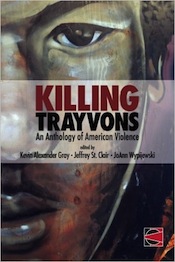
Robin D. G. Kelley, who teaches at UCLA, is the author of the remarkable biography Thelonious Monk: The Life and Times of an American Original (2009) and most recently Africa Speaks, America Answers: Modern Jazz in Revolutionary Times (2012). He is a contributor to Killing Trayvons: an Anthology of American Violence.

More articles by:

Source: What Does Black Lives Matter Want?

For Colored Girls Like Korryn Gaines And the Black Men Who Hate Us


For Colored Girls Like Korryn Gaines And The Black Men Who Hate Us

What is it to be a black woman in America. For the burden of both racism and misogyny to lay at our feet.

Korryn Gaines was no fool. In her short 23 years she was all too familiar with the carnage of black bodies. This familiarity with state sanctioned executions empowered her to raise unafraid black children. With her thick Baltimore accent she instructed her five-year-old son to record the Baltimore County police who’d pulled her over for not having registered tags on her car. That day, she was ready to die. Her life was spared, but she wouldn’t be so fortunate again.

Her Instagram shows a warrior woman who believed in her right to legally bear arms. She was uninterested in cow-towing to the very system that kills even its most “perfect” victims. Instead of “hands up, don’t shoot!” shethought “#StopKillingUs is some begging ass shit” was more appropriate. Baby girl had no desire to be pleasant or respectable.

So when Baltimore County police showed up to her apartment to serve a warrant for her arrest over misdemeanor traffic violation charges, she knew it could very well be the day she took her last breath. In her last moments she took to Instagram to record her cute, chubby cheeked five-year-old son, her asking the questions, him predicting the outcome.

“Who’s outside?”
“The police.”
“What are they trying to do?”
“They trying to kill us.”

What happened next doesn’t matter much because the result is the same. It’s always the same. Korryn is dead. The police will lie. The media will corroborate the police’s lies. The public will blame her for her death. There will be no justice. Officials will call for peace. Family members are left to raise her children. And shortly we will have all moved on to grieve the next victim of police violence. The narrative is so familiar it shows up in our dreams. The tears feel the same as the ones we wiped the last time we mourned a black person who we did not know. Only this time those tears will only be cried by black women. All black lives are not mourned equally.

Because Korryn dared to be a vocal black woman — one who may or may not have been legally armed — there is no outcry for her except from other black women. There will be no outraged celebrities. Protesters won’t flood the streets in cities across the nation. Public officials will not demand accountability for the officers who killed her. Presidential candidates will not condemn the police department for their failure to de-escalate considering a child was present. President Obama will not tell the nation Korryn could’ve been his daughter. News and cable networks won’t profit off her death by hosting Town Hall meetings. Black men will not grieve her as they have the long list of black men killed similarly. In fact, black men will adopt the language of our oppressors to blame her for her own murder.

Black men couldn’t wait to vocalize their hatred for black women. “It’s looking mighty justifiable right now” and “Korryn Gaines deserved to die” and “Basically asked for it” and “She decided to be reckless with her son and her own life” and “Korryn Gaines was an ignorant, loud mouth little girl.” Those are just a few. Tucking in their hatred is hard to do, even when two black children are left without a mother.

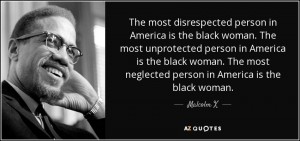
Black men's hero, Malcolm X, telling the painful truth about black women.

Black men’s hero, Malcolm X, telling the painful truth about black women.

These are the same black men who automatically don’t trust police accounts in killings where the victim is a black man, but are quick to believe Korryn was pointing a gun at the police when they entered her home. Despite her documented recordings of run-ins with the Baltimore County police, black men aren’t thinking maybe this woman was targeted. Black men are not playing detective to figure out the truth in this strange story the police tell of using the landlord’s key to enter her home. Black men are not rallying for an end to a system that sends a SWAT team to someone’s home over non-violent traffic violations. Black men are not calling foul, because even if she was armed, white suspects with guns are apprehended alive all the time. Black men are not questioning how she could hold her phone to record, hold her son and allegedly hold a shotgun in her hand all at the same time. Black men aren’t sympathetic to her developmental disability due to lead poisoning, which could’ve affected her reasoning the day she was murdered. Nope. Black men are saying she deserved to die because she was a crazy fool and a shitty mother for daring to be free.

Ain’t that peculiar?

Black men must remove the word revolutionary from their vocabulary. One minute it’s “fuck the police” and the next it’s Korryn was reckless. Black men love the iconic photo of their hero Malcolm X looking out the window of his home, shotgun in hand to protect his family, but Korryn possibly having a gun means she deserved death. They cheer on Nat Turner but who does Korryn think she is to protect her family. Black men either don’t know what revolutionary really means or think the word is reserved for them solely.

Remove it from your tongues.

It’s not just about Korryn. It’s about black womenfolk being de mules of the worldat the hands of black men. Folks called Sandra Bland sassy. Said had she not talked back she would’ve lived. No one showed up for the Rekia Boyd rally in NYC. When we talk to black men about the dangers of street harassment we are met with death and rape threats. Statistics show violence against black women is mostly at the hands of black men, but we’re shouted over for bringing that up. Then when we tell black men that we, too, are killed by police, we are told now is not the time to be divisive. You will get to us after we take care of our “kings.”

But you see, that doesn’t work for me. My liberation is not going to come after. I’m not suffering through black men’s harmful misogynoir while black women’s freedom becomes a ‘maybe we’ll get to it in the next lifetime’ non-priority. I’m not adding a “not all black men” caveat to my truths in order to coddle hurt feelings. My life is literally on the line. And my freedom can’t wait.

Either cis black men are going to center black women so we can all get free together, or my freedom fighting will be reserved for black women and black queer folks. Do what you want with that. But my freedom can’t wait. I won’t wait for you to see my humanity while I fight for yours.

While you’re denying our humanity, remember this: Putting off black women’s liberation for tomorrow is a dangerous game. Because ain’t a single liberation movement survived without us.

To Korryn and Sandra and all the black women who refuse to bow, refuse to shutup, we got you. Rest easy knowing black women said your name and refused to let them forget.

Source: For Colored Girls Like Korryn Gaines And the Black Men Who Hate Us

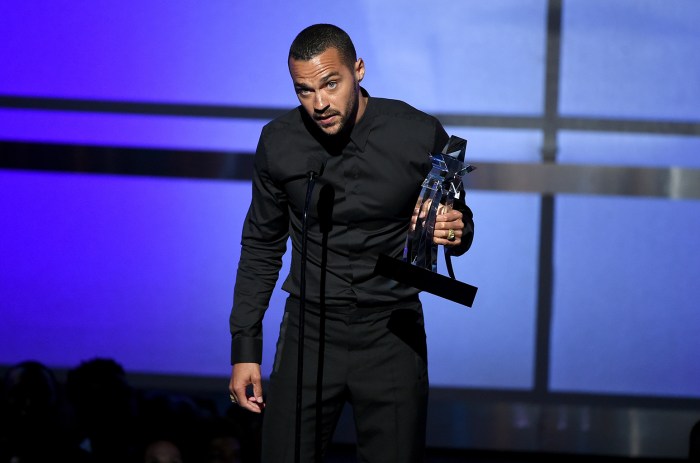
Jesse Williams’ BET Awards 2016 Speech: Watch | Billboard


“Just because we’re magic doesn’t mean we’re not real. Thank you.”

Watch the full speech below:


“Let’s get a couple of things straight. The burden of the brutalized is not to comfort the bystander — that’s not our job so let’s stop with all that. If you have a critique for our resistance then you’d better have an established record, a critique of our oppression.“If you have no interest in equal rights for black people then do not make suggestions to those who do: sit down.“We’ve been floating this country on credit for centuries, and we’re done watching and waiting while this invention called whiteness uses and abuses us, burying black people out of sight and out of mind while extracting our culture, our dollars, our entertainment like oil — black gold! — ghettoizing and demeaning our creations and stealing them, gentrifying our genius and then trying us on like costumes before discarding our bodies like rinds of strange fruit.“Just because we’re magic doesn’t mean we’re not real. Thank you.”

  • Jesse Williams

Jesse Williams accepts the Humanitarian Award onstage during the 2016 BET Awards at the Microsoft Theater on June 26, 2016 in Los Angeles.
KEVIN WINTER/BET/GETTY IMAGES FOR BET

It’s safe to say that 34-year-old Grey’s Anatomy star Jesse Williams stole the BET Awards on Sunday night with a wildly inspirational, confrontational speech that is bound to become a cornerstone of the Black Lives Matter movement. Later in the show, Samuel L. Jackson said he hadn’t heard a speech like it since the 1960s.

Williams has appeared in multiple films, but he was honored with BET’s Humanitarian Award for his activism. In October 2014, he joined protests in Ferguson, Missouri to protest the shooting of Michael Brown. He was also an actor and executive producer of Stay Woke, a documentary about the movement that premiered in May. He has written extensively on Black Lives Matter and met with President Obama earlier this year to discuss his humanitarian work.

Watch All the Prince Tributes at the 2016 BET Awards

BET CEO Debra Lee presented his award “for his continued efforts and steadfast commitment to furthering social change.”

He began by thanking BET and all involved in the video that preceded his appearance, his wife and his parents “for teaching me to focus on comprehension over career, they made sure I learned what the schools are afraid to teach us.

“This award is not for me,” he continued. “This is for the real organizers all over the country, the activist, the civil rights attorneys, the struggling parents, the families, the teachers, the students that are realizing that a system built to divide and impoverish and destroy us cannot stand if we do. It’s kinda basic mathematics: the more we learn about who we are and how we got here the more we will mobilize.

“This award is also for the black women in particular who have spent their lives nurturing everyone before themselves — we can and will do better for you.

Beyonce, Kendrick Lamar Open the 2016 BET Awards

“Now, what we’ve been doing is looking at the data and we know that police somehow manage to de-escalate, disarm and not kill white people every day. So what’s going to happen is we’re going to have equal rights and justice in our own country or we will restructure their function and ours. [Standing ovation.]

“I got more, y’all. Yesterday would have been young Tamir Rice’s 14th birthday so I don’t want to hear any more about how far we’ve come when paid public servants can pull a drive-by on a 12-year-old playing alone in a park in broad daylight, killing him on television, and then going home to make a sandwich.

“Tell Rekia Boyd how it’s so much better to live in 2012 than 1612 or 1712. Tell that to Eric Garner, Sandra Bland.

“The thing is though, all of us here are getting money, that alone isn’t going to stop this. Dedicating our lives to getting money just to give it right back to put someone’s brand on our body — when we spent centuries praying with brands on our bodies, and now we pray to get paid for brands on our bodies?

BET Awards Week: See All the Photos

“There has been no war that we have not fought and died on the front lines of. There is no job we haven’t done, there is no tax they haven’t levied against us, and we have paid all of them.

“But freedom is always conditional here. ‘You’re free!’ they keeping telling us. ‘But she would be alive if she hadn’t acted so… free.’ Now, freedom is always coming in the hereafter, but the hereafter is a hustle: We want it now.

“Let’s get a couple of things straight. The burden of the brutalized is not to comfort the bystander — that’s not our job so let’s stop with all that. If you have a critique for our resistance then you’d better have an established record, a critique of our oppression.

“If you have no interest in equal rights for black people then do not make suggestions to those who do: sit down.

“We’ve been floating this country on credit for centuries, and we’re done watching and waiting while this invention called whiteness uses and abuses us, burying black people out of sight and out of mind while extracting our culture, our dollars, our entertainment like oil — black gold! — ghettoizing and demeaning our creations and stealing them, gentrifying our genius and then trying us on like costumes before discarding our bodies like rinds of strange fruit.

“Just because we’re magic doesn’t mean we’re not real. Thank you.”

Watch the full speech  from the link below:

Source: Jesse Williams’ BET Awards 2016 Speech: Watch | Billboard

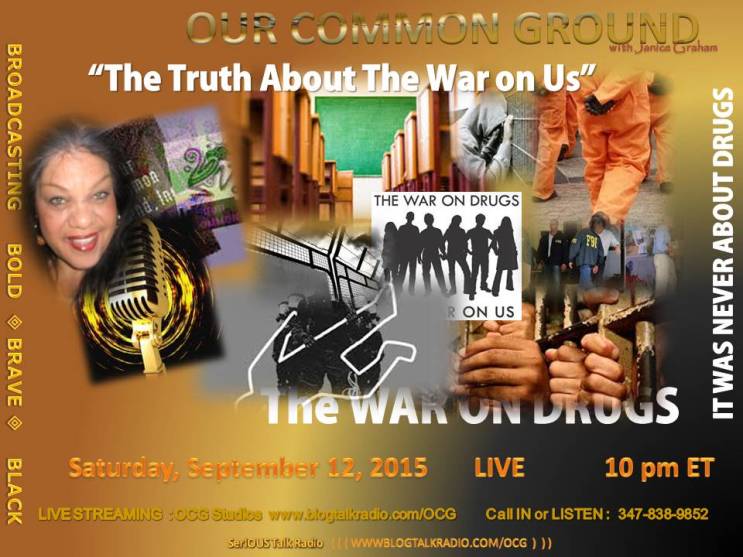
This Week on OUR COMMON GROUND φ “40 Years, $1 Trillion, 45 Million Arrests Later: “The Truth About the War Against Us” φ LIVE

OUR COMMON GROUND with Janice Graham

“The Truth About the War Against Us”
09-12-15 War on Drugs4
40 Years, $1 Trillion, 45 Million Arrests – the war still rages against our community. IT WAS NEVER ABOUT DRUGS

 Saturday, September 12, 2015

10 pm EDT
LISTEN LIVE and Join the OPEN Chat

LISTEN LIVE HERE

Learn more and join us on Facebook
Call In – Listen Line: 347-838-9852

This week on OUR COMMON GROUND, we review and examine the truth about the policies and intent of the “War on Drugs”. We need to talk about the money making behind the politics; how the drug war can be considered slow Nazi policy on the poor and the racial profiling used. We look at these destructive and failed policy and manipulation in its historical context and destructive outcomes. We will present audio clips for our discussion which will assist us in understanding just how much the “War on Drugs” was really never about drugs.

For sheer government absurdity, the War on Drugs is hard to beat. After three decades of increasingly punitive policies, illicit drugs are more easily available, drug potencies are greater, drug killings are more common, and drug barons are richer than ever. The War on Drugs costs Washington more than the Commerce, Interior, and State departments combined – and it’s the one budget item whose growth is never questioned. A strangled court system, exploding prisons, and wasted lives push the cost beyond measure. What began as a flourish of campaign rhetoric in 1968 has grown into a monster. And while nobody claims that the War on Drugs is a success, nobody suggests an alternative. Because to do so, as Surgeon General Joycelyn Elders learned, is political suicide.

As a community we need to understand how Drug War fever has been escalated; who has benefited along the way; and how the mounting price in dollars, lives, and liberties has been willfully ignored. Where are the policy maker offices where each new stage was planned and executed? What happened in the streets where policies have produced bloody warfare. This is a tale of the nation run amok – in a way the American people are not yet ready to confront. Are you?

You are invited to bring your thoughts about the pressing issues facing our community. Come listen and learn. SHARE please.

OUR COMMON GROUND where friends come to confer with allies.

Listen & Call In Line: 347-838-9852
Saturday, September 12, 2015 10 pm ET
Join the LIVE Broadcast Here

 http://bit.ly/1KIQv2q

            BROADCASTING   BOLD BRAVE & BLACK

Web     Facebook     Community Forum   Pinterest    Visit our Tumblr Page

Twitter: @JaniceOCG #TalkthatMatters

“Speaking Truth to Power and OURselves” 

email: OCGinfo@ourcommonground.com

Call In – Listen Line: 347-838-9852


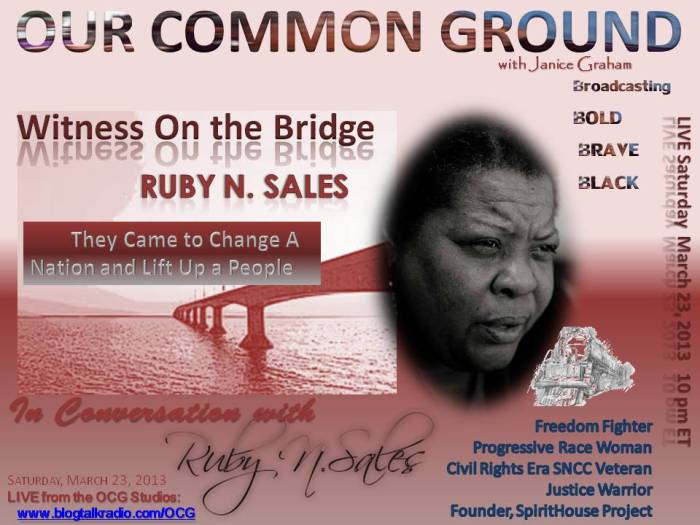
“The Flames of Liberation: Rebellion and Resistance” ll September 5, 2015 with Ruby N. Sales

Activist and Organizer, Ruby N. Sales

  “The Flames of Liberation: Rebellion and Resistance”

Saturday, September 5, 2015    Φ     LIVE  10 pm EDT

 “Transforming Truth to Power, One Broadcast At a Time” 

           OUR COMMON GROUND  Session II 2015 SEASON 

     33rd BROADCAST SEASON 

                               We open our 2nd Session of the 2015 Season continuing to examine the depth of structural and institutionalized racism, the impact of white supremacy and the concept of #BlackLivesMatter as a clarion call and the its promise as a movement.  As always we ask, “What is your End Game?”                      We invite you to join us and be part of the response to THE STATE OF EMERGENCY.


Guest Moderator, Ruby N. Sales, Founder & Director, The Spirit House Project


To help us kick off this session we have asked Rev. Ruby N. Sales to join us a co-moderator on the critical questions and issues that challenge, trembling like a swelling tsunami beneath the ocean. A seasoned veteran of the civil and human rights campaigns of our time and a fierce and clear visionary of Black Power, we believe that she is most appropriate to help us press out an authentic narrative on these issues.

Institutionalized Racism is the concept and practice of white supremacy. It is the practice of discrimination and oppression based on skin color, physical characteristics, continent of origin and culture. It has its origins as a justification for slavery and the conquest of the Americas. From the beginning, slavery in the United States was tied to the development and growth of capitalism. Founded on the sale and ownership of human beings on the basis of their physical characteristics and color, its purpose was the exploitation of unpaid labor for super profits. As chattels, Africans were hunted like animals, transported to the “New World,” and then sold on the auction block like beasts of burden. In like manner Native American Indians were exterminated on a massive scale.

Moral and intellectual rationales were invented and continue to justify this kidnapping, sale, enslavement and genocide against human beings. As an ideology, racism provided the moral and intellectual underpinnings of slavery, the westward expansion of colonialism and the seizure of half of Mexico. Thus the purpose of this doctrine was, and still is, to put forward ideas and theories founded on the myth that Black people and other people of color are inherently inferior.

Almost 130 years after the Emancipation Proclamation, the legacy of slavery remains. It is embedded in and influences every aspect of social, economic and political life. Institutionalized racism is the combined economic, political, social, cultural, legal, ideological and other structures that exist to maintain the system of inequality. #RaceMatters

Institutionalized racism has economic, social, political, ideological and cultural forms, and denies equality, justice and dignity to all people of color.  There are new problems because of the systemic nature of crisis. Our discussions should examine what adjustments must be made in these new efforts to eradicate our place in this society. We rebel and resist the effort to force us into the margins, to make us invisible and to remove us to prison for profit camps.

Our discussions must explore and examine how to elevate our voices in the fight against police brutality, housing discrimination, immigrant rights, and the dismantlement of public education to mention a few issues. At OUR COMMON GROUND provide “a place for our unfiltered voices”.  With the brightest, most loyal and insightful Black activists, community organizers and servants, scholars, researchers, journalists and social scientists we raise, clarify and illuminate the racist dimension of these issues, show how their roots lie in the system of capitalism and its new stage of crisis, and come up with concrete ideas to launch new initiatives and support existing ones.

As a set of institutions, racism is infused in the very foundations of our society and is inseparable from the economic foundations of U.S. capitalist society. The “new domestic military policing” is implemented to intimidate and destroy racially homogenous communities and put into place a ‘superexploitation’ of racial oppression that ensures our silence and to fill prisons serves to create and make real the essence of white supremacy.  We are living in an increasingly surreal special system of oppression and racism perpetrated by a narrative dictated outside of our community. None of this is new; the struggle to liberate ourselves has been before us since our time on these shores. One of our most effective weapons is to ensure that we work from an authentic narrative and that its formulation comes from our Truth. OUR COMMON GROUND for more than 33 years has focused its broadcast mission on ensuring that the Black Truth illuminates and informs our struggle.  #BlackTruthMatters #BlackVoiceMatters

   BROADCASTING   

   BOLD      BRAVE       BLACK 

           OUR COMMON GROUND with Janice Graham

                                 “Speaking Truth to Power and Ourselves” 

                                email: OCGinfo@ourcommonground.com

           LISTEN LIVE and Join the OPEN Chat:  http://www.blogtalkradio.com/OCG

                             Call In – Listen Line: 347-838-9852

Community Forum ll   Twitter: @JaniceOCG  #TalkthatMatters   ll    Pinterest   ll  Visit our Tumblr Page   Facebook

Activist Ruby Sales on Liberation and God’s Will

03-09 RubySales2


Dear Sisters and Brothers,

I want to respond to a question that was posed: where we go from here when far too many Black people are in the theological and Christological grip of white right wing Christians. Chip Berlet, author and political, analyst calls this group the theocrats. He tells us, “Theocrats support a form of government where the actions of leaders are seen as sanctioned by God-where the leaders claim that they are carrying out God’s will.” This is a very dangerous claim that gives divine meaning and sanction to their actions no matter how racist, sexist, militaristic or homophobic. Moreover, this brand of Christofacism is designed to shut down critique by creating one legitimate Christian voice. Without a doubt for theocrats, the legitimate Christian voice is white, and more than likely a heterosexual male.

Berlet goes on to tell us that theocrats promote a brand of Christianity that proclaims, “People are basically sinful and must be restrained by harsh punitive laws. Social problems are caused by satanic conspiracies aided and abetted by liberals, homosexuals, feminists and secular humanists. These forces must be exposed and neutralized. “They see themselves in a holy war against the forces of evil and conspirators who are determined to destroy the divine destiny of the white American Empire. However, they do not see all white men as standard bearers for the Empire. Nor do they mean people of color when they use the term American Empire.
As we move forward in this reflection, it is critical that we make a distinction between Empire Christianity and Liberation Christianity. Empire Christianity beats in the veins and hearts of theocrats and their Reconstructionist allies. It is essential to realize that conservatism stands in direct opposition to the mission of Jesus which is a radical call to “turn the society upside down” and create a just society.

Liberation Christianity begins with the assertion that God is on the side of the oppressed rather than the side of the Empire. This is the good news of the radical Jew Jesus who challenged the Roman Empire. Jesus made clear the radical nature of his mission: (1) to bring sight to the blind, i.e. to bring a new consciousness that freed his community and others from the false consciousness of identifying with the goals of the Roman Empire; (2) to feed the hungry, i.e. a systemic redistribution of resources that is not charity, but systemic economic justice; and (3) to set the prisoners free, i.e., a recognition that the Empire uses law and order as tools of oppression and domination.

This message of liberation galvanized the Southern Freedom Movement in the United States, South African liberation movement, and liberation movements around the world. It is a dynamic message that changes the status quo and rearranges our relationship with God and others. It is a justice message of non violence. It is a message that reminds us that we are not entrapped by history. We have the collective power to free ourselves from the bonds of a tyrannical state. It reminds us that we have the power to make a new history and a new world. The view of our collective power challenges the notion that history begins and ends with the Empire.
For the Tea Party members and their allies God is the keeper of the status quo. Theirs is a cynical status quo view of God that allows them to be “on the wrong side of history and issues” without taking moral responsibility for their actions. Their God talk also obscures the nature of their radical wrongs by hiding behind liberation and freedom sounding language that they stole from the Southern Freedom Movement and other popular struggles for justice.

The Empire religion espoused by the Tea Party and their white Christian conservative allies and their misled colored allies is headed by a white supremacist patriarchal upper class God who stood on the side of enslavement and the genocide of native peoples throughout the globe, including North and South America. Their God issued a direct order to destroy the Iraqi people and their culture. In their eyes, Iraq is a pagan Babylonian culture that worships a false God. They root their religion in an over and against paradigm that tears down the world and relationships, gobble up resources and relationship. Although they claim to stand for law and order, they operate from a theology of chaos where God summons them that to tears down the world rather than build it up.
Like their forefathers, right wing and conservative militaristic, white supremacist, and homophobic Christians believe that God is on their side and gives them the theological authority to build an oppressive white supremacist patriarchal world. They misuse scripture to justify this, and they hide their intentions behind self-centered and pious God talk that under girds and propels exclusion and domination whether it is about the inferiority of women, black people or lesbians and gays.

Nor is their Jesus the Jesus who wept over the oppression and suffering of his people. Nor is there Jesus the Jesus who came from a colonized community where the Roman Empire used violent measures to stifle unrest and resistance. Or the Jesus who was executed by the Roman Empire for proclaiming that God and not the Empire owns the world or the people in it. This Jesus who acted in history for those people whom the Empire minimized moved generations of enslaved Black people to assert, in the face of an Empire that said they were property without any civil or spiritual rights, “I have a right to the tree of life.”
What Black Christian conservatives must understand is that the God of the Empire can never be our God. Nor can their Jesus be our Jesus. Nor can their Empire Theology or Christology be ours. The Empire Jesus is their emissary and the messenger of war and oppression. For them, Jesus is not as the Black old folk understood, a poor little shepherd boy, outcast and belonging to a people whose backs were “up against the wall.”
The next step is to unveil the lies of White Christian Conservatives so that Black folk understand that these lesbian and gay hating folk come out the same tradition of the people who broke and battered Emmett Till’s fourteen-year-old body and threw it into the Tallahatchie River. Their teachings birthed and fermented the hatred that poisoned the minds and spirits of the killers of Samuel Younge and Jonathan Daniels. Their God can never be our God. Nor can their theology or Christology be ours. They are inheritors of a Biblical tradition that believed that Black oppression was ordained by God because of a curse where God proclaims, “Canaan shall be the lowest of slaves to his brothers.”

We must unveil their hypocrisy and slight of theological hands by remembering that these right wing conservatives barred Martin Luther King, Jr. and other southern freedom workers from the doors of white churches even as they proclaimed their connection with God. They stand today in the doorways of Christian academies and universities like Bob Jones University. In these spaces Christian conservatives still see Blacks as inferior and the bearers of a theological taint that places us on the lowest rung of humanity.

Our job is to have these conversations that help Black Christian conservatives remember so that we as a community do not fall prey to demagoguery. For those of us who remember, we are called upon to stir within Black Christian conservatives the reminder we serve a God that brought us out of the tyranny of enslavement and southern apartheid. This same God enabled Black southern sharecroppers and their allies during the Southern Freedom Movement to bring down southern apartheid, one of the most powerful governments in history, without firing a shot.
There is a great spiritual and social danger of not remembering this God and what God has been with us and for us. When we forget we allow other people to reconstruct God in their own image and to make us believe that their God of hate and injustice is our God. When we bow down to their God, we bow down at the altar of the Empire and men who believe that they are God and the overseers of creation.
Finally, it is important to remember that our ancestors, these magnificent and ordinary people had a vision of God that broke with the enslavers’ view of God. Their view of God moved them to a theology of agape that enabled them to say in the midst of enslavement: “I love everybody, I love everybody, and you can’t make me hate you in my heart; you can’t make me hate you in my heart.”

© All rights reserved. The SpiritHouseProject

Follow Ruby Sales on Facebook

Visit the SpiritHouse Project Website

Marissa Alexander Facing 60 Years in Prison for Firing a Warning Shot in Self Defense | The Nation

Marissa Alexander Now Faces 60 Years in Prison for Firing a Warning Shot in Self Defense | The Nation.

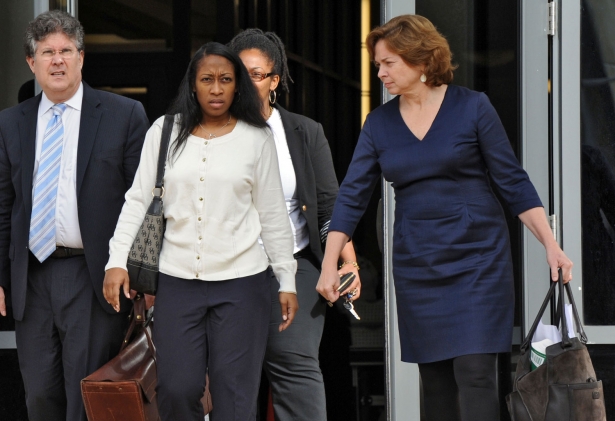
Florida State Attorney Angela Corey will seek to triple Marissa Alexander’s original prison sentence from twenty to sixty years, effectively a life sentence for the 33-year-old woman, when her case is retried this July, The Florida Times-Union reports.

Alexander was convicted on three charges of aggravated assault in 2012 for firing warning shots in the direction of Rico Gray, her estranged husband, and his two children. No one was hurt. Alexander’s attorneys argued that she had the right to self-defense after Gray physically assaulted and threatned to kill her the day of the shooting. In a deposition, Gray confessed to a history of abusing women, including Alexander.

In September of 2013 a District Appeals court threw out the conviction on grounds that Circuit Judge James Daniel erroneously placed the burden on Alexander to prove she acted in self-defense, when she only had to meet a “reasonable doubt concerning self-defense.”

Judge Daniel originally slapped Alexander with three twenty-year prison sentences, but ordered that they be served concurrently. If Alexander is convicted a second time in July, State Attorney Angela Corey will seek consecutive sentences, adding up to sixty years in prison.

Florida’s 10-20-Life law imposes a mandatory minimum of twenty years in prison for anyone who fires a gun while committing a felony. Angela Corey’s prosecution team says it is following a court ruling that multiple convictions for related charges under 10-20-Life should carry consecutive sentences.

The advocacy group Free Marissa Now released a statement calling Corey’s move a “stunning abuse of power.” Members of the group say Corey is pressing for a longer sentence to thwart attention from accusations of prosecutorial misconduct, as well as recent failures in high-profile trials. Corey failed to secure murder convictions for George Zimmerman and Michael Dunn, two men who fatally shot black teenagers.

“Remember that when Marissa Alexander fired her warning shot to save her own life, she caused no injuries. Now she’s facing the very real possibility of spending the rest of her life in prison for that act of self-defense,” said advocate Sumayya Fire in the statement. “That should send a chill down the back of every person in this country who believes that women who are attacked have the right to defend themselves.”

Dr. Tommy J. Curry φ Concepts of Racism and Black Men φ PBS Conference October 26, 2013 Tommy Curry


curryvoices


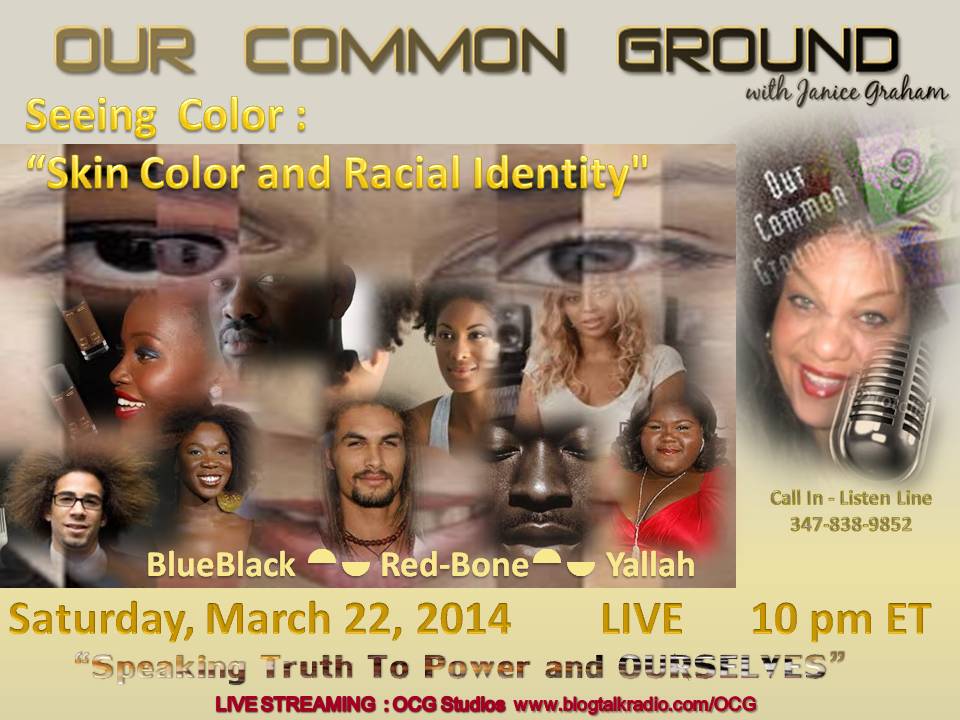
BlueBlack – Red-Bone – Yallah : Colorism and the Black Community” >> March 22, 2014 >>> LIVE 10 pm ET

BlueBlack – Red-Bone – Yallah : Colorism and the Black Community”

OUR COMMON GROUND with Janice Graham
March 22, 2014 LIVE 10 pm ET

03-22-14 Colorism

LISTEN LIVE HERE

“If you’re black, stay back; if you’re brown, stick around; if you’re yellow, you’re mellow; if you’re white, you’re all right.”

In sum, colorism refers to discrimination based on skin color. Colorism disadvantages dark-skinned people, while privileging those with lighter skin. Research has linked colorism to smaller incomes, lower marriage rates, longer prison terms and fewer job prospects for darker-skinned people. What’s more, colorism has existed for centuries both in and outside of black America. That makes it a persistent form of discrimination that should be fought with the same urgency that racism is.

Starts LIVE in One Hour . . . Join us, with updates on Marissa Alexander’s persecution and my favorite Colored Governor, Bobby Jindahl’s “Greatest Country in the world” fantasy.


BROADCASTING BOLD BRAVE BLACK

OUR COMMON GROUND with Janice Graham

“Speaking Truth to Power and Ourselves”

email: OCGinfo@ourcommonground.com

LISTEN LIVE and Join the OPEN Chat: http://www.blogtalkradio.com/OCG
Call In – Listen Line: 347-838-9852

Community Forum:
http://www.ourcommonground-talk.ning.com/

Twitter: @JaniceOCG #TalkthatMatters

Web: http://www.ourcommonground.com/

OCG Blog: http://www.ourcommongroundtalk.wordpress.com/

Pinterest : http://www.pinterest.com/ocgmedia/boards/

Visit our Tumblr Page: http://ourcommonground.tumblr.com/

Facebook: https://www.facebook.com/OCGTALKRADIO

“Speaking Truth to Power and Our selves”

email: OCGinfo@ourcommonground.com

LISTEN LIVE and Join the OPEN Chat: http://www.blogtalkradio.com/OCG
Call In – Listen Line: 347-838-9852

POSTS

Marissa Alexander seeks “Stand Your Ground” immunity,… | www.wokv.com

Marissa Alexander seeks “Stand Your Ground” immunity, sentencing changes


Marissa Alexander
Action News
Marissa Alexander

By Stephanie Brown

Jacksonville, FL —

We first told you earlier this week that Marissa Alexander’s attorney intended seek another “Stand Your Ground” immunity hearing ahead of her trial- and we’ve now obtained the documents backing that up.

More than 1200 pages were filed today in support of five separate motions. One would seek a pre-trial immunity hearing under “Stand Your Ground”. Two deal with the sentence Alexander could face if convicted. Two more deal with interactions between Alexander and Rico Gray.

Alexander was initially convicted of shooting a gun in the presence of Gray and two children and was sentenced to 20 years in prison. That conviction was overturned because of how the jury instructions were phrased. Alexander claims she fired a warning shot, fearing that Gray meant to harm her.

Stand Your Ground

Alexander sought SYG immunity ahead of her initial trial, but was denied. The motion now filed argues that neither the initial denial or the appeals court decision not to “reweigh” the case prevent Alexander from seeking this immunity again.

“This Court is able on remand to consider anew legal issues decided as part of the original proceeding, and the use of that discretion is especially vital where failure to do so would result in manifest injustice,” the motion reads.

The attorney, Bruce Zimet, says there has been “critical” new evidence since the initial SYG hearing and that the initial hearing itself included evidentiary problems. Zimet says the ruling in the SYG hearing was made largely on the testimony of Gray’s two sons, and he says one has since recanted and the other admitted to lying about a “prior altercation” between Gray and another woman, which Zimet believes woduld have established a pattern of Gray as abusive toward women.  He additionally argues that expert testimony on Alexander’s state of mind when she pulled the trigger was not previously introduced.

Zimet further says the initial SYG hearing was argued under the wrong statute.  He says the section used includes more stringent rules that require someone to have been attacked before returning with force of their own.

“By contrast, § 776.012—which applies to an individual in her home, as is the case here—eliminates any duty to retreat and allows deadly force if a person reasonably believes that such force is necessary to prevent imminent death, great bodily harm, or a forcible felony,” the motion says.

10-20-Life

A second motion claims sentencing Alexander to a mandatory minimum 20 years in prison is cruel and unusual punishment because it is “grossly disproportionate” to any offense Alexander is accused of committing.

Zimet argues the Florida legislature, who established 10-20-Life, never intended to have it applied to “battered women attempting to defend themselves”. In fact, Zimet cites current efforts at the state level to specifically exempt “warning shots” from such consequences, as proof that the statute was improperly applied.

While Zimet argues that Alexander should not face conviction at all, he says if she is found guilty, the sentence is out of proportion. He says most other states have a mandatory minimum nowhere near what Florida law outlines.

Consecutive vs. concurrent sentencing

The State Attorney’s Office tells WOKV that Florida statute requires Alexander to serve concurrent sentences if convicted, meaning she would face a minimum 60 years in prison for the total three counts of aggravated assault with a deadly weapon.

This motion is condition on the ruling over 10-20-Life. Zimet says if the court does not rule mandatory minimum sentencing should not apply here, than it should rule sentences should at least not run consecutive- a total sentence Zimet argues would be unconstitutional in two ways.

First, Zimet argues the State is not allowed to pursue a steeper sentence on appeal unless there is new evidence introduced to warrant it. Zimet says the State did not object to concurrent sentences on the initial trial, so consecutive sentencing now would be an unconstitutional increase.

Second, the motion states the 60 year sentence in itself would be unconstitutional.

“A sentence of such enormous length is grossly disproportionate to any offense Alexander may have committed by firing a single, upward warning shot to protect herself against an enraged husband with a history of abuse who only minutes before had violently assaulted her,” the motion says.

Rico Gray, Sr. prior actions

The fourth motion filed is notice of Zimet’s intent to introduce past actions by Gray as part of Alexander’s affirmative defense that she feared for her life.

“At Alexander’s first trial, the jury heard a he-said/she-said about the events of August 1, 2010,” the motion says.

There was as discrepancy between those sides on whether the argument was verbal or physical, who the aggressor was, if there was an imminent threat, whether Alexander could leave the scene and more.

“What the jury did not hear—and what Alexander is now entitled to introduce—is specific evidence of Gray’s prior similar attacks on women, his repeated lies to law enforcement to avoid prosecution, and his implicit and explicit threats of violence against and coercion of witnesses, including his own children, to falsely accuse his female victims of attacking him,” the motion says.

Zimet says there is evidence Gray attacked Alexander as well as other women, which makes it hard to believe he is a victim. While Alexander introduced evidence of prior violent acts against her by Gray in the initial trial, Zimet says they plan to offer further evidence of violent acts by Gray against other women as well, and repeated attempts to obstruct justice- including a threat to kill Alexander and cover it up.

Subsequent “incident” with Rico Gray

While out on bail for the initial charges, which happened in August 2010, Alexander communicated on several occasions with Gray. In December 2010, Alexander was charged with Domestic Battery stemming from a fight with Gray. Gray claims that he refused to let Alexander spend the night after she dropped off their daughter, and she became angry and punched him, leaving marks on his face. Alexander claims Gray was the one who was angry and violent because she refused to spend the night, but police did not notice any physical marks on her.

In the first trial, the defense sought to preclude any evidence of this incident, but was denied. Zimet has filed a new motion asking the court to reconsider that motion to preclude.

Zimet says the fact that Alexander had contact with Gray cannot rebut her claim to self-defense. He says the charge deals with Alexander’s state of mind and fear of harm the moment she fired the gun, so only evidence dealing with that moment should be presented to a jury.

“The December 30 incident is not probative of Alexander’s state of mind nearly five months earlier, before she and Gray went to marital counseling, before Gray’s profuse apologies and proclamations of love, and before Alexander learned that her daughter Rihanna’s insurance was set to expire at the end of 2010 unless Alexander obtained Gray’s signature on Rihanna’s birth certificate,” the motion says.

Zimet further says the incident is “excessively prejudicial”, which hampers the interest of justice.

The State’s response

The State Attorney’s Office has issued a statement reading, in part, that they are reviewing these most recent motions.

“The State Attorney’s Office is committed to seeking justice for our two child victims and their father,” the statement says.

It further reads that they will make a response to these motions at the appropriate time.

Alexander’s retrial has been scheduled for July.


Marissa Alexander seeks “Stand Your Ground” immunity,… | www.wokv.com.