Angela Davis Talks Black Liberation, History and the Contemporary Vision – News & Views – EBONY

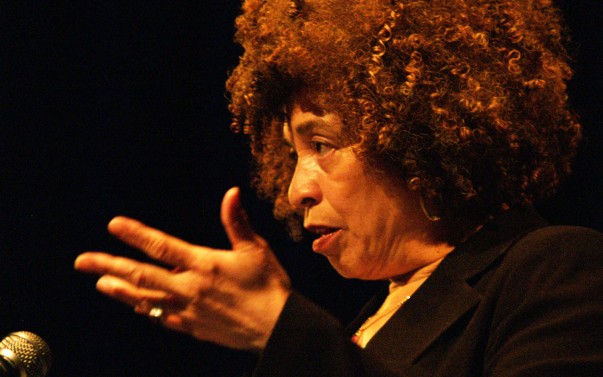
Angela Davis Talks Black Liberation, History and the Contemporary Vision[INTERVIEW] The iconic freedom struggle leader speaks with EBONY.com about Black human rights activism stretching back decades and her recently released book observing global movementsBY SHERYL HUGGINS SALOMON, FEBRUARY 17, 2016COMMENTSAngela Davis speaking at Myer Horowitz Theatre of the University of Alberta. Nick Wiebe/Wikimedia CommonsFifty years after the founding of the Black Panther Party for Self Defense, the agenda and style of the legendary Black revolutionary organization remains relevant in today’s public discourse. An end to “police brutality and the murder of Black people,” central to the Black Lives Matter movement, was laid out in the Black Panthers’ 10-Point Platform five decades ago. Both acclaim and condemnation erupted when their iconic black berets made an appearance recently in Beyoncé’s half-time show performance during the Super Bowl.It’s telling that America is still grappling with many of the same racial inequities and injustices that it did 50 years ago – and that Black pride remains a controversial topic. Not so to renowned scholar, activist and feminist icon and close associate of the Black Panthers Angela Y. Davis.“If one looks at the 10-point program of the Black Panther Party, one sees that the very same issues that were raised in the aftermath of slavery are at the center of a program that was formulated in 1966,” said Davis, now a professor emeritus at University of California, Santa Cruz. “In 2008 when Barack Obama was elected, those issues had not been sufficiently addressed, certainly not yet solved, so therefore the election of one person to political office was not going to automatically reverse a history of a racist inspired economic oppression, which isn’t to say that it wasn’t important that we elected Barack Obama, but those struggles continue.”While in Spain last week advocating for the release of imprisoned Basque separatist politician Arnaldo Otegi, Davis took a few moments with EBONY.com to discuss contemporary issues like Black Lives Matter, the 2016 U.S. presidential election, and details from her latest book, Freedom is a Constant Struggle: Ferguson, Palestine, and the Foundations of a Movement (Haymarket Books, 2016), edited by human rights activist Frank Barat.“I’ve been involved in the Palestine Solidarity movement for a very long time,” explained Davis. “When the Ferguson uprising happened a year and a half ago activists on the ground in occupied Palestine were the first to tweet support and advice to protesters in Ferguson. Out of that has come a very interesting, a very rich development of connections across the ocean. A delegation from Palestine visited Ferguson. Black Lives Matter and Ferguson activists, [as well as members of] Dream Defenders, Black Youth Project 100 made a trip to Palestine over about a year ago to express their solidarity.”  Related Articles CONNECTING PALESTINE AND POLICE VIOLENCE SIDRA SMITH ON ANGELA DAVIS DOC DIRECTOR TALKS ANGELA DAVIS DOCUMENTARYMore highlights of what Davis said are in the Q&A below.EBONY.COM: What’s the message of your new book?Angela Davis: I am particularly interested in [having] activists associated with the Black freedom movement to realize that our struggles never would have achieved this universality that they have achieved without solidarity that has come from Africa, Asia, Latin America, Europe and Australia. Our struggles are global, therefore, it is important for us to incorporate this global vision into our on the ground battles against police crimes and the prison industrial complex. Since I was very young I have been involved in organizations— the Communist Party, the Black Panther Party— that have had this global perspective.EBONY.COM: As you note in your book, events in Ferguson after the police shooting of Michael Brown exposed the militarization of police forces. Where is this push toward militarization headed and how can it be stopped?Davis: If one looks at the history of policing, especially over the last 15 years in the aftermath of 9/11, one can see the emphasis on the shifting of resources from the military to the police. This actually has a much longer history if one looks at the way in which the Vietnam War resulted in an impact on local police. The S.W.A.T. squads emerged as a result of using techniques and technology that were used by the Green Berets in the Vietnam War. The Los Angeles Police Department was the first to use such tactics against the Black Panther Party. We have also seen the emergence of privatized policing corporations. In the book, I refer to G4S (Group 4 Security), which is a private security corporation that has spread policing and prisons all over the world. It’s important not only to look at the ways in which these moments of inflicting terror have been taken up by police departments, but it’s also essential to look at the economic dimension by such processes. G4S, of course, is the thir

Source: Angela Davis Talks Black Liberation, History and the Contemporary Vision – News & Views – EBONY

Angela Davis on Not Endorsing Any Presidential Candidate: “I Think We Need a New Party” | Democracy Now!

In a Women’s History Month special, we speak with author, activist and scholar Angela Davis. For more than four decades, Davis has been one of most influential activists and intellectuals in the United States. An icon of the 1970s black liberation movement, Davis’ work around issues of gender, race, class and prisons has influenced critical thought and social movements across several generations. She is a leading advocate for prison abolition, a position informed by her own experience as a fugitive on the FBI’s top 10 most wanted list more than 40 years ago. Davis talks about the “fascist appeal” of Donald Trump and explains why she is not officially endorsing any candidate in this election. “I believe in independent politics,” she says. “I still think that we need a new party, a party that is grounded in labor, a party that can speak to all of the issues around racism, sexism, homophobia, transphobia, what is happening in the world. We don’t yet have that party.”

Source: Angela Davis on Not Endorsing Any Presidential Candidate: “I Think We Need a New Party” | Democracy Now!

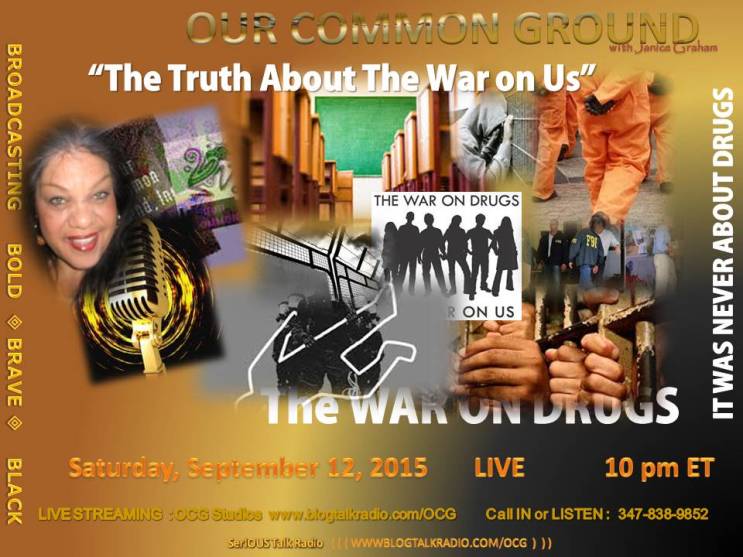
This Week on OUR COMMON GROUND φ “40 Years, $1 Trillion, 45 Million Arrests Later: “The Truth About the War Against Us” φ LIVE

OUR COMMON GROUND with Janice Graham

“The Truth About the War Against Us”
09-12-15 War on Drugs4
40 Years, $1 Trillion, 45 Million Arrests – the war still rages against our community. IT WAS NEVER ABOUT DRUGS

 Saturday, September 12, 2015

10 pm EDT
LISTEN LIVE and Join the OPEN Chat

LISTEN LIVE HERE

Learn more and join us on Facebook
Call In – Listen Line: 347-838-9852

This week on OUR COMMON GROUND, we review and examine the truth about the policies and intent of the “War on Drugs”. We need to talk about the money making behind the politics; how the drug war can be considered slow Nazi policy on the poor and the racial profiling used. We look at these destructive and failed policy and manipulation in its historical context and destructive outcomes. We will present audio clips for our discussion which will assist us in understanding just how much the “War on Drugs” was really never about drugs.

For sheer government absurdity, the War on Drugs is hard to beat. After three decades of increasingly punitive policies, illicit drugs are more easily available, drug potencies are greater, drug killings are more common, and drug barons are richer than ever. The War on Drugs costs Washington more than the Commerce, Interior, and State departments combined – and it’s the one budget item whose growth is never questioned. A strangled court system, exploding prisons, and wasted lives push the cost beyond measure. What began as a flourish of campaign rhetoric in 1968 has grown into a monster. And while nobody claims that the War on Drugs is a success, nobody suggests an alternative. Because to do so, as Surgeon General Joycelyn Elders learned, is political suicide.

As a community we need to understand how Drug War fever has been escalated; who has benefited along the way; and how the mounting price in dollars, lives, and liberties has been willfully ignored. Where are the policy maker offices where each new stage was planned and executed? What happened in the streets where policies have produced bloody warfare. This is a tale of the nation run amok – in a way the American people are not yet ready to confront. Are you?

You are invited to bring your thoughts about the pressing issues facing our community. Come listen and learn. SHARE please.

OUR COMMON GROUND where friends come to confer with allies.

Listen & Call In Line: 347-838-9852
Saturday, September 12, 2015 10 pm ET
Join the LIVE Broadcast Here

 http://bit.ly/1KIQv2q

            BROADCASTING   BOLD BRAVE & BLACK

Web     Facebook     Community Forum   Pinterest    Visit our Tumblr Page

Twitter: @JaniceOCG #TalkthatMatters

“Speaking Truth to Power and OURselves” 

email: OCGinfo@ourcommonground.com

Call In – Listen Line: 347-838-9852


“The Flames of Liberation: Rebellion and Resistance” ll September 5, 2015 with Ruby N. Sales

Activist and Organizer, Ruby N. Sales

  “The Flames of Liberation: Rebellion and Resistance”

Saturday, September 5, 2015    Φ     LIVE  10 pm EDT

 “Transforming Truth to Power, One Broadcast At a Time” 

           OUR COMMON GROUND  Session II 2015 SEASON 

     33rd BROADCAST SEASON 

                               We open our 2nd Session of the 2015 Season continuing to examine the depth of structural and institutionalized racism, the impact of white supremacy and the concept of #BlackLivesMatter as a clarion call and the its promise as a movement.  As always we ask, “What is your End Game?”                      We invite you to join us and be part of the response to THE STATE OF EMERGENCY.


Guest Moderator, Ruby N. Sales, Founder & Director, The Spirit House Project


To help us kick off this session we have asked Rev. Ruby N. Sales to join us a co-moderator on the critical questions and issues that challenge, trembling like a swelling tsunami beneath the ocean. A seasoned veteran of the civil and human rights campaigns of our time and a fierce and clear visionary of Black Power, we believe that she is most appropriate to help us press out an authentic narrative on these issues.

Institutionalized Racism is the concept and practice of white supremacy. It is the practice of discrimination and oppression based on skin color, physical characteristics, continent of origin and culture. It has its origins as a justification for slavery and the conquest of the Americas. From the beginning, slavery in the United States was tied to the development and growth of capitalism. Founded on the sale and ownership of human beings on the basis of their physical characteristics and color, its purpose was the exploitation of unpaid labor for super profits. As chattels, Africans were hunted like animals, transported to the “New World,” and then sold on the auction block like beasts of burden. In like manner Native American Indians were exterminated on a massive scale.

Moral and intellectual rationales were invented and continue to justify this kidnapping, sale, enslavement and genocide against human beings. As an ideology, racism provided the moral and intellectual underpinnings of slavery, the westward expansion of colonialism and the seizure of half of Mexico. Thus the purpose of this doctrine was, and still is, to put forward ideas and theories founded on the myth that Black people and other people of color are inherently inferior.

Almost 130 years after the Emancipation Proclamation, the legacy of slavery remains. It is embedded in and influences every aspect of social, economic and political life. Institutionalized racism is the combined economic, political, social, cultural, legal, ideological and other structures that exist to maintain the system of inequality. #RaceMatters

Institutionalized racism has economic, social, political, ideological and cultural forms, and denies equality, justice and dignity to all people of color.  There are new problems because of the systemic nature of crisis. Our discussions should examine what adjustments must be made in these new efforts to eradicate our place in this society. We rebel and resist the effort to force us into the margins, to make us invisible and to remove us to prison for profit camps.

Our discussions must explore and examine how to elevate our voices in the fight against police brutality, housing discrimination, immigrant rights, and the dismantlement of public education to mention a few issues. At OUR COMMON GROUND provide “a place for our unfiltered voices”.  With the brightest, most loyal and insightful Black activists, community organizers and servants, scholars, researchers, journalists and social scientists we raise, clarify and illuminate the racist dimension of these issues, show how their roots lie in the system of capitalism and its new stage of crisis, and come up with concrete ideas to launch new initiatives and support existing ones.

As a set of institutions, racism is infused in the very foundations of our society and is inseparable from the economic foundations of U.S. capitalist society. The “new domestic military policing” is implemented to intimidate and destroy racially homogenous communities and put into place a ‘superexploitation’ of racial oppression that ensures our silence and to fill prisons serves to create and make real the essence of white supremacy.  We are living in an increasingly surreal special system of oppression and racism perpetrated by a narrative dictated outside of our community. None of this is new; the struggle to liberate ourselves has been before us since our time on these shores. One of our most effective weapons is to ensure that we work from an authentic narrative and that its formulation comes from our Truth. OUR COMMON GROUND for more than 33 years has focused its broadcast mission on ensuring that the Black Truth illuminates and informs our struggle.  #BlackTruthMatters #BlackVoiceMatters

   BROADCASTING   

   BOLD      BRAVE       BLACK 

           OUR COMMON GROUND with Janice Graham

                                 “Speaking Truth to Power and Ourselves” 

                                email: OCGinfo@ourcommonground.com

           LISTEN LIVE and Join the OPEN Chat:  http://www.blogtalkradio.com/OCG

                             Call In – Listen Line: 347-838-9852

Community Forum ll   Twitter: @JaniceOCG  #TalkthatMatters   ll    Pinterest   ll  Visit our Tumblr Page   Facebook

Reparations: A Global Struggle after a Global Crime φ Institute for the Black World 21st Century

Reparations: A global struggle after a global crime  φ

By Ashahed M. Muhammad -Assistant Editor- The Final CallFreedom cannot be compromised Nation of Islam minister tells a Chicago gathering focused on justice for the descendants of survivors, victims of trans-Atlantic slave trade

reparations_fourm_04-29-2014a.jpg 

Photos: Haroon Rajaee and Tim 6X

CHICAGO (FinalCall.com) – The Honorable Minister Louis Farrakhan told a group of political leaders, researchers and activists that true commitment and a firm unwavering demand for real justice is required, if the call for reparations is ever to be taken seriously by the governments of the earth.“Nothing is more important than the liberation of our people,” Minister Farrakhan told those gathered at the Emil Jones Convocation Center on the campus of Chicago State University April 19. “If you really want freedom, you cannot compromise with slave makers, slave masters and the collaborators,” he said.

Although he had not been feeling his best, the Minister wanted to be with the “thinkers, warriors and soldiers” in the fight for the reparations and the liberation of oppressed people all over the world.

“We have a responsibility to our ancestors,” said Minister Farrakhan during remarks lasting about 30 minutes. “What kind of generation will we be to have ancestors that have gone through what our ancestors have gone through and we’re sitting here today talking about the revitalization of a movement that should never have had to be revitalized?” he asked.

reparations_fourm_04-29-2014_1.jpg 

Minister Farrakhan spoke on the subject of “Revitalizing the Reparations Movement” on the campus of Chicago State University April 19.

The meticulous research and documentation of scholars lays the base for movements to build upon and propels movements forward, noted Min. Farrakhan. “You cannot proceed for justice on assumptions. You can proceed for justice on actual facts.”“When they speak—we act! It is not about applause, it is about acting now because the talk has been done and we talk too damn much and we do too little towards our own liberation!” said the Minister.

Revitalization suggests some have lost the spirit of reparatory justice, but, this it is not a quick and easy journey, it is a lifelong struggle until justice is achieved, he noted. Part of the problem is the weak approach of those sometimes sent to speak for the oppressed but who really desire favor with an enemy who only makes promises to deceive and never honors agreements, Min. Farrakhan added.

“When you talk to power, you can’t go to power just with a cry for justice; you’ve got to have power backing your cry! You should never think that the enemy is going to give you the justice that you seek. We’ve been crying at his feet for too damn long! We’ve got to have the power to force justice!”

Cowards will always need revitalization and slaves always want to be accepted by their former slave masters, he added. White governments know the truth about what they did during the slave trade and continue to reject the call for reparations from their former slaves, he said.

“What is our response? To go back and beg some more? That’s what got you in the shape you are in! You’re litigating your damn self into poverty and want! It’s not litigation it is revolution that is needed!” the Minister thundered.

Only men and women who aren’t afraid to die for reparatory justice and who are not seeking the friendship of their former slave masters will remain steadfast, he said.

Calling European governments “criminals,” the Minister said he realizes strong talk scares those who aren’t courageous and fully committed. But, he continued, the time has arrived for direct talk about the Black condition and what is required to change it.

“The situation is radical and it needs a radical solution,” said the Minister. “I’m not leaving the Earth as a squirming punk! I speak for the dead who have no voice today!  I speak for the living who are voiceless! I speak for the unborn generations who need a voice! That’s the kind of men and women that will make reparatory justice real.”

reparations_fourm_04-29-2014b.jpg

New life for the reparations movement?

Observers and activists agreed that the reparations movement in the United States has continuously hovered between lifeless and moribund for the last decade. Many key movement leaders, such as Hannibal Afrik, Imari Obadele and recently Chokwe Lumumba, have died. There have been real questions as to whether the reparations movement is even viable, or, simply an anachronism that has aged along with its leaders.

But in early March, the heads of the Caribbean Community and Common Market (CARICOM) met in St. Vincent and the Grenadines and heavily discussed reparations for a global crime against humanity—the African slave trade.

The governments of Britain, France and the Netherlands are primarily being targeted to pay compensation to Blacks throughout the African Diaspora hurt and destroyed by what is commonly called the trans-Atlantic slave trade.

reparations_fourm_04-29-2014c.jpg

Dr. Ralph Gonsalves, prime minister of Saint Vincent and the Grenadines, has been at the forefront of the CARICOM effort. He was scheduled to be the day’s keynote speaker but was unable to make it. In his stead was Rhonda King, Saint Vincent and the Grenadines ambassador to the United Nations, and Professor Hilary Beckles, who serves as chair of the CARICOM Reparations Commission. Mr. Beckles, pro vice chancellor of the Cave Hill Campus of the University of the West Indies, wrote the book “Britain’s Black Debt: Reparations for Caribbean Slavery and Native Genocide.”The trading of enslaved Africans lies at the foundation of the wealth inequality that exists not only in the United States but worldwide. The Western world was built through the work done, and profits generated by Blacks scattered across the globe and deposited wherever free labor was required by Europeans.

Calling reparatory justice “the greatest political movement of the 21st century,” Prof. Beckles explained reparations from responsible governments is more than just economics and finances—though both are important. It is a matter of pride, dignity, and self-respect for the victims of the slave trade to seek reparatory justice for the harm done, he said.

caricom_reparations_04-29-2014.jpg

He went over a 10-point plan covering all aspects of what is needed for reparatory justice—ranging from formal apology, to curbing an “explosion of chronic diseases,” such as hypertension and diabetes, which grips Blacks in the Caribbean and the U.S., to debt cancellation.There has been some tacit and direct admission of wrongdoing by European nations in recent years: The British agreed to issue a “statement of regret” and award $21.5 million to surviving Kenyans detained and tortured during the Mau Mau rebellion decades ago. In 2007 to mark the 200th anniversary of the British prohibition of slavery, then-British Prime Minister Tony Blair “expressed regret” for suffering caused by Britain’s role in the slave trade. The Haitian revolution of January 1, 1804 effectively ended slavery in that territory, but the equivalent of economic sanctions was used against Haiti as a penalty for her successful efforts at throwing off the chains of slavery and colonialism. Following the January 2010 earthquake, then French President Nicolas Sarkozy reportedly acknowledged the “wounds of colonization,” and quickly approved a financial aid package said to include millions in budgetary support for the Haitian government.

Activists say a mere “statement of regret” will not be sufficient for the horrific trafficking and enslavement of Black human beings around the world.

“It is a global struggle for a global crime,” said Prof. Beckles. “They must be held accountable for it. Our plan is to call for that justice.”

If they do not respond to the request for justice, these Western European nations will be taken to the International Court at the Hague, said activists.

“Slavery is over, but we are now in the jet stream of the consequences,” said Prof. Beckles.

During brief comments, Rev. Dr. Jeremiah A. Wright, pastor emeritus of Trinity United Church of Christ, said although it is a term widely used in activist and academic circles, he feels it is inaccurate to refer to a trans-Atlantic slave trade because “the Atlantic Ocean never enslaved anyone.” The slave trade was a European endeavor, he said.

Dr. Conrad Worrill, a stalwart in the reparations movement, said no matter what happens, Africans in America and abroad must continue to fight for reparations.

IBW_logo.jpg

“There is no statute of limitations on crimes against humanity,” said Dr. Worrill, of the Center for Inner City Studies, who helped organize the Chicago State forum alongside Dr. Ron Daniels of the Institute for the Black World 21st Century. Dr. Worrill was also among those who traveled to Durban, South Africa for the World Conference Against Racism in 2001. He witnessed Israel and the United States walk out of the conference when the question of reparations was brought up. While returning to the U.S. to discuss what took place in South Africa, the World Trade Center attack Sept. 11, refocused attention and changed the global landscape activists found. While many continued to fight to keep reparations in public view, the movement struggled to attract the masses of the people, especially young people. Despite the challenges, said Dr. Worrill, those who truly want justice cannot be weak in their call for justice.“A strong people will never give up fighting for justice and repair from those who damaged you,” he said.

Rep. John Conyers, Jr., who first introduced HR-40, the Reparation’s Study Bill, in 1989, vowed to continue to pursue the legislation no matter how long it takes. He first introduced the bill in the 101st Congress of the United States. It is now the 113th Congress.

“This is one of the most important pieces of legislations I have ever produced,” Rep. Conyers told the audience.

A global struggle, a global crime

Don Rojas, communications director for the Institute of the Black World, said President Obama has recently talked about income and wealth disparity. That discussion represents an “intellectual paradigm shift,” said Mr. Rojas, who also served as press secretary for the late Grenada Prime Minister Maurice Bishop. The revolutionary was removed from power and executed in a mercenary coup orchestrated by political rivals and Western nations before a U.S. invasion of the small country in 1983.

The reparations movement is “the great moral imperative of our time” and those who line up against it, or perhaps think it is a misguided waste of effort, are “ignorant of the moral power of an idea whose time has come,” argued Mr. Rojas.

Dr. Iva E. Carruthers, general secretary of the Samuel DeWitt Proctor Conference, Inc., an ecumenical group that represents a cross section of progressive Black faith leaders across the country, called the April 19 gathering a “sacred assembly.” The Proctor Conference also helped organize the Chicago State program.

“When you call a sacred assembly, you have to take the risk of hearing from the prophets, and when prophets speak, it may not be comfortable,” said Dr. Carruthers. “I think we were in the hands of master prophets in the form of Minister Louis Farrakhan and Reverend Dr. Jeremiah Wright and I think we’re in the hands of a master teacher in the form of Dr. Beckles. And if we listen to our prophets and our teachers—if we would just be still enough to feel the power of God and the righteous authority upon which we stand to speak truth, to stand on truth and to organize ourselves at any cost with those who share the vision—then this day will be fulfilled.”

Dr. Kelly Harris, director of Chicago State University’s African-American Studies Dept., enjoyed the perspectives offered by Min. Farrakhan and Prof. Beckles.

“Minister Farrakhan really gave us the charge tonight and Professor Beckles was excellent,” said  Dr. Harris. “I think Minister Farrakhan did what he always does, he made sure that we stood up and had steel in our back and that’s what we need.”

Dr. Ron Daniels called the mission of the gathering a success as the goal was to “give a spark and deliver a jolt” to the U.S.-based reparations movement. Since there’s power in the fact that Caribbean nations unanimously agreed to the 10-point program, there is now added power, he said.

reparations_fourm_hmlf_04-29-2014.jpg 

(Top left) Min. Farrakhan and Rep. John Conyers, Jr. (D-MI). In all photos clockwise, Min. Farrakhan greets students from Chicago State University as the college’s president Wayne Watson looks on.

According to Dr. Daniels, the Institute of the Black World is creating a reparations resource center on its website and will continue to help educate the public on reparations. Asked about the next generation of leaders for the movement, Dr. Daniels said that remains to be seen, but agreed “there’s a need for new blood.”“We have to see who emerges,” said Dr. Daniels. “Like anything else you have a wave, the people who are involved in it, they tire, they thin, they pass on. The question is will there be someone to pass the torch on to? So I think we need to be focusing on increasingly going at young people; teaching them, giving them history, giving them the background so they can pick up the torch and become the new wave because we need some new troops, but we also need to change the mentality. We need to be able to use some economic sanctions and other modalities to let people know we’re not playing.”

“We have to go to the universities and get them. It is there where—especially young Black men—see the contradictions, they see the differences. If there’s not massive change … even with the education they’re seeing, that’s not a ticket to a lifestyle that they’ve been promised,” said Kamm Howard of the National Coalition of Blacks For Reparations in America, or N’COBRA.

“I think once we build the connections on the university campuses with our young brothers and sisters who can also speak the language of the streets—because a lot of them are coming from the streets and that’s their ticket out—then we can begin to build a movement among the youth. We’re seeing the young people are interested … they’re asking what they can do because they’re looking for some guidance.”

Minister Farrakhan “put it in plain English” that this is a revolutionary struggle that must be fought if the current generation cares about the sacrifices of their ancestors, Mr. Howard continued. “We have to be able to stand before our ancestors and say ‘I fought for this life that you made sure that I have.’ But are we deserving of this life? And if we say we are deserving of it then we must fight to ensure that our future generations have a better life than we had.”

 

BlueBlack – Red-Bone – Yallah : Colorism and the Black Community” >> March 22, 2014 >>> LIVE 10 pm ET

BlueBlack – Red-Bone – Yallah : Colorism and the Black Community”

OUR COMMON GROUND with Janice Graham
March 22, 2014 LIVE 10 pm ET

03-22-14 Colorism

LISTEN LIVE HERE

“If you’re black, stay back; if you’re brown, stick around; if you’re yellow, you’re mellow; if you’re white, you’re all right.”

In sum, colorism refers to discrimination based on skin color. Colorism disadvantages dark-skinned people, while privileging those with lighter skin. Research has linked colorism to smaller incomes, lower marriage rates, longer prison terms and fewer job prospects for darker-skinned people. What’s more, colorism has existed for centuries both in and outside of black America. That makes it a persistent form of discrimination that should be fought with the same urgency that racism is.

Starts LIVE in One Hour . . . Join us, with updates on Marissa Alexander’s persecution and my favorite Colored Governor, Bobby Jindahl’s “Greatest Country in the world” fantasy.


BROADCASTING BOLD BRAVE BLACK

OUR COMMON GROUND with Janice Graham

“Speaking Truth to Power and Ourselves”

email: OCGinfo@ourcommonground.com

LISTEN LIVE and Join the OPEN Chat: http://www.blogtalkradio.com/OCG
Call In – Listen Line: 347-838-9852

Community Forum:
http://www.ourcommonground-talk.ning.com/

Twitter: @JaniceOCG #TalkthatMatters

Web: http://www.ourcommonground.com/

OCG Blog: http://www.ourcommongroundtalk.wordpress.com/

Pinterest : http://www.pinterest.com/ocgmedia/boards/

Visit our Tumblr Page: http://ourcommonground.tumblr.com/

Facebook: https://www.facebook.com/OCGTALKRADIO

“Speaking Truth to Power and Our selves”

email: OCGinfo@ourcommonground.com

LISTEN LIVE and Join the OPEN Chat: http://www.blogtalkradio.com/OCG
Call In – Listen Line: 347-838-9852

POSTS

A New Case for African American Reparations: A Simple Three-Part Plan

 A New Case for African American Reparations: A Simple Three-Part Plan

 12/03/2013 

Follow   Black Voices News


2013-11-26-slaveswhobuiltthewhitehouse.jpg

Photo courtesy of “I Was A Slave”

The idea of reparations is not new. Yet, in today’s presumed colorblind and post-racial society, many white Americans are convinced that the enduring legacy of racial inequities facing the black community are best remedied by individual responsibility and personal accountability; that is, if African Americans would simply work harder by “pulling themselves up by their bootstraps” and stop pulling the so-called “race card,” they might actually get ahead and finally lay claim to the ever-elusive “American Dream.” In other words, from a white person’s point of view, reparations for the 346 years of chattel slavery and near-slavery like conditions of Jim Crow racism involves a call for black Americans “to do for themselves.” Black folk need to get their moral house in order.

Most whites profess individual responsibility as a means to success or failure. By ignoring the paradox that the failure of black Americans is attributed to individual responsibility, white Americans (and bright Americans) neglect to acknowledge the crippling effects of centuries-old white racism and contemporary forms of institutional prejudice anddiscrimination. Additionally, this shared, group-based understanding — implying that whites work hard while blacks apparently do not — is seriously misguided and has significant consequences for African Americans. Given the historical context of racial oppression and current white-controlled industries, white notions of merit-based success ensures that black Americans linger in a perpetual state of marginalization keenly visible across a broad spectrum of institutions like healthcare, education, housing, employment, politics, and other major domains of society.

Like white Americans, black Americans want the necessary resources to allow their children good health and achievement in life. Superior education, access to decent employment and quality health care are key among other requisites identified by a variety of sociological, epidemiological, public health, educational and social science research as important factors that influence the overall health and well-being of a society, its communities and its individuals. It is time for the nation to take responsibility for the current state of affairs for scores of black Americans living on the fringes of obsolescence. A simple three-part plan calling for group recompense will address the central racial disparities that remain trenchant within the black community and American life. With this, the US will finally offer a tangible solution to challenge the systemic conditions of deprivation known all too well by the black community.

First, we must concede that formal education is key to some semblance of full participation in US society. The problem with education, in part, stems from how schooling is unequally funded, often punishing poor white, black and brown children for their inherited circumstances in life. The most nefarious of abuses to blacks occurs in public education as they are divested of the opportunity to be educated on their terms in ways that foster success, which begins with healthy racial identity development and positive affirmation that blackness matters. When American schools began the slow and violent process of desegregation after 1954, African American students were expected to close black schools and attend historically white schools. It was hoped that by placing black students next to white students, school achievement would effortlessly improve. Instead, jobs for thousands of black teachers and administrators throughout the south were eliminated, and black students were placed into an unequal structure where they encountered a predominately white, middle-class, female teaching profession racially-primed to view blacks through a deficit lens for generations to come. This white racial frame of black inferiority lends itself to present-day microaggressions toward black students (especially black males), who are severely mistreated, misunderstood and overly pathologized in public education. This not only hinders the possibility of equal education, but it exposes the fallacy of integration. These historically white institutions were never formally prepared or adequately resourced to meet the needs of black students, and the intermingling of blacks and whites occupying the same space in no way assured equality. Currently, blacks attend under-funded urban schools in considerable numbers (ironically re-segregated from whites). Most of these urban schools are nothing more than holding pens more akin for prison preparation rather than substantive schooling for collegiate preparation. Education for African Americans and their progeny should be equally funded and staffed to those of the best public schools in the nation, and students should have the benefit of free public education through their collegiate years.

Secondly, African Americans should receive free necessary health care in all areas of life. As evidence-based research documents, protracted exposure to chronic psychological stress is shown to be physiologically and mentally corrosive for health and well-being. More importantly, exposure to race-based discrimination at the institutional and interpersonal level of society, coupled with grinding inequalities in housing, jobs, education and income parity, keeps the body’s stress response in a constant state of arousal. Disease does not exist in a vacuum. The historical domination and complete disenfranchisement of black Americans in a so-called integrated and free society gives rise to a perfect storm for disease formation deep within the cells and biological pathways of the body. Because black Americans report higher levels of racial discrimination in a number of supposedly fair and impartial institutions, they are more vulnerable to pre-mature disease in the form of high blood pressure, obesity, diabetes, certain cancers, cardiovascular disease and other serioushealth-related consequences.

Like black children exposed to the whiteness of public education, black Americans have, likewise, been exposed to a two-tiered racist healthcare system. Not too long ago, “Black disease” was considered inherent to being black rather than the cause of dehumanizing forces of systemic white racism. As health care providers pledge an oath to treat all patients equitably and with integrity, how is it possible that health disparities remain a major concern for communities of color? To lesson the burden of disease for African Americans, they should be given federally-sponsored health care and unencumbered access to high quality health care delivery services. This would allow black Americans to gain substantial ground toward group uplift with the elimination of race-based health disparities.

And finally, African Americans need to be economically empowered with the resources necessary to provide a meaningful existence and future. Black Americans, as a group, have long been denied access to wealth and wealth-generating opportunities. Between 1619 and 1865 alone, black people were robbed of millions of dollars in wages for over 222 million hours of forced labor. After 246 years of chattel slavery along with another 100 years of Jim Crow, white racism has taken a toll on black folk of all stripes — young, old, rich, poor and everything in between. To this day, blacks have considerably less personal wealth than even poor white Americans and other Americans of color. The debt owed to African Americans is severely underestimated and long overdue. Therefore, all blacks should be exempt from federal taxes for a minimum of 346 years or until the poorest black American has equal parity with the poorest white American in terms of employment, income, wealth accumulation, and improved educational and health-related outcomes.

It is well known that white people have a strong aversion to the idea of a “free ride.” Yet, white America has an extensive and bloody history of taking what it wants with no thought or concern for the lives of Native Americans, black folk and other Americans of color. White supremacy is alive and robustly active still in North America. If the practice of segregation was bad, the illusion of integration has been misery. African Americans are literally dying from the stresses of an unrelenting and uncaring white power structure. This three-part plan will allow black Americans the time to heal their communities and regain some sense of control and destiny in their lives.

 Follow Darron T. Smith, Ph.D. on Twitter: www.twitter.com/DrDarronSmith
FOLLOW BLACK VOICES

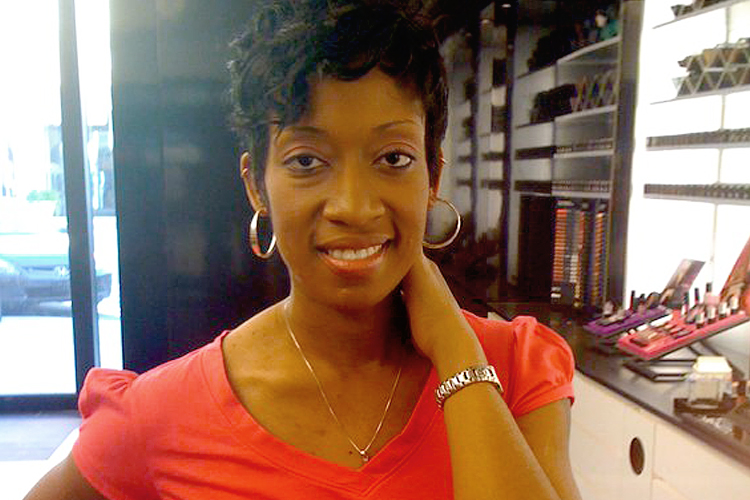
Marissa Alexander Released Home on House Arrest

Fla. Woman Sentenced to 20 Yrs. for Firing Warning Shot—RELEASED

Marissa Alexander Freed While Awaiting Trial

by Associated Press

Click on the photo to view additional Photos.

Marissa Alexander before going to prison (left), and during her prison term (right). (Courtesy Photo)

 AFRO Black History Archives

Check out related stories, research genealogies, or peruse all that our archives have to offer.

Click Here to get started! 

JACKSONVILLE, Fla. (AP) — The Florida woman awaiting a new trial in a controversial “stand your ground” case is free on bond.

First Coast News (http://fcnews.tv/18q19sa) reports that Marissa Alexander was released from jail Wednesday. According to the Duval County Clerk of Court, she must remain under house arrest and electronic monitoring while awaiting trial.

In 2012, Alexander was sentenced to a mandatory 20-year prison sentence for firing what she insisted was a warning shot during a fight with her husband. She tried to invoke Florida’s “stand your ground” law but the judge threw out her self-defense claim, noting that she could have run out of the house to escape her husband but instead got the gun and went back inside

An appeals court ruled in September that the judge in the case gave improper jury instructions, and a new trial has been set for next year.

Alexander’s supporters, including the NAACP and advocates for victims of domestic violence, have compared the case to the trial of George Zimmerman, who recently was acquitted in the fatal shooting of Trayvon Martin. Both cases have brought into question the state’s “stand your ground” law, which generally allows people to use deadly force if they feel threatened.

Alexander, who had never been arrested before, has said she fired a bullet at a wall in 2010 to scare off her husband when she felt he was threatening her. No one was hurt, but the judge in the case said he was bound by state law to sentence her to 20 years in prison after she was convicted of aggravated assault with a deadly weapon.

Alexander had rejected a plea deal that would have resulted in a three-year prison sentence and chose to go to trial. A jury deliberated 12 minutes before convicting her.

Alexander was also charged with domestic battery four months after the shooting in another assault on her husband. She pleaded no contest and was sentenced to time served.

State Attorney Angela Corey, who oversaw the prosecution of George Zimmerman in the shooting death of Trayvon Martin, has stood by the handling of Alexander’s case. Corey said she believes that Alexander aimed the gun at the man and his two sons, and that the bullet she fired could have ricocheted and hit any of them.

Click for related articles:

“Woman Sentenced to 20 Years for Firing Warning Shot Receives New Trial”

“Blacks Who Stand Their Ground Often Imprisoned”

“Unbelievable: Fla. ‘Stand Your Ground’ Defense Rejected for Mother Only Firing “Warning Shot””

“Stand Your Ground Law Bites Blacks in the Butt”

Woman Sentenced For Firing Alleged ‘Warning Shot’ At Her Husband Gets Released

11/28/13 03:21 PM ET EST AP

woman warning shot released

JACKSONVILLE, Fla. (AP) — The Jacksonville woman awaiting a new trial in a controversial “stand your ground” case is free on bond.

First Coast News (http://fcnews.tv/18q19sa) reports that Marissa Alexander was released from jail Wednesday. According to the Duval County Clerk of Court, she must remain under house arrest while awaiting trial.

In 2012, Alexander was sentenced to a mandatory 20-year prison sentence for firing what she insisted was a warning shot during a fight with her husband. She tried to invoke Florida’s “stand your ground” law, but the judge threw out her self-defense claim.

An appeals court ruled in September that the judge in the case gave improper jury instructions.

Alexander says she fired a bullet at a wall in 2010 to scare off her husband when she felt he was threatening her.


Herman Wallace : Political Prisoner, now Ancestor

“Herman Wallace, whose four-decades in solitary confinement in Louisiana State Penitentiary at Angola made him among the most prominent symbols in the debate over race and prisons in Louisiana, has died. He was 71.”

Herman Wallace, member of the Angola Three, dies at 71

BY ANDREW VANACORE

From The Advocate

avanacore@theadvocate.com

October 04, 2013

Herman Wallace, whose four-decades in solitary confinement in Louisiana State Penitentiary at Angola made him among the most prominent symbols in the debate over race and prisons in Louisiana, has died. He was 71.

Nick Trenticosta, one member of a legal team that had finally earned Wallace a release from prison and a new trial just this week after decades of appeals, confirmed that Wallace succumbed to liver cancer at a friend’s home in Uptown New Orleans on Friday morning.

Since the 1970s, when Wallace was convicted of killing a guard while serving time for armed robbery, he has formed part of a trio known as the Angola Three, all of them former Black Panthers who maintained that they were wrongly convicted.

Albert Woodfox, who was given a life sentence along with Wallace in the stabbing death of a young guard named Brent Miller in 1972, remains incarcerated. Robert King, another Black Panther from New Orleans who was convicted of a separate murder inside Angola and also placed in solitary confinement, won his release in 2001 after 29 years.

Although a judge on Tuesday ordered Wallace’s release from Elayn Hunt Correctional Center, where he had been undergoing treatment for cancer, the fight to clear his name was not over. A West Feliciana Parish grand jury re-indicted Wallace on the original murder charge Thursday, and a younger brother of the slain guard said in an interview this week that Wallace never should have been released, even in such a grave condition.


Women’s lives don’t matter: The lesson of Marissa Alexander

TUESDAY, OCT 1, 2013

Women’s lives don’t matter: The lesson of Marissa Alexander

Laws fail to effectively stop violent men or protect us — that’s why we have to stand up for ourselves

BY 

Women's lives don't matter: The lesson of Marissa AlexanderMarissa Alexander (Credit: AP/Lincoln B. Alexander)

I am passionate about domestic violence, because I am a childhood survivor of domestic violence. I know all too well the ways in which men like my father, many of whom are themselves subjugated on the basis of race and class, use home spaces to assert dominance and control that they are not able to wield in the larger world.

I know intimately the terror of being under surveillance in one’s own home, of the prerogative that many men assert to control the comings and goings of their partners and children, often through the threat of violence and force. I have seen how difficult it is to stand your ground, when society is structured to give men economic and political control over private, domestic space. I know what the journey to survivor status looked like for my mother, and the way that my father’s violence demoralized him and ruined our relationship.

I think of the women survivors of gun violence that I personally know (and of the gun violence that snuffed out my father’s life at the age of 33, as he ironically tried to prevent another woman and her children from becoming the victims of domestic violence at the hands of another man).

I think of two high school classmates, a white girl named Mary Dee and a black girl named Jackie, both killed by fatal gunshots in murder-suicide scenarios involving their partners. I think of a class of first-year, college-age African-American women (18 and 19 year olds) that I taught several years ago, in which fully one-quarter of them admitted to having been in violent relationships in high school.

I think about all the stories that are almost too terrifying to remember and much too personal to confess.

Last week, a judge ordered a new trial for Marissa Alexander, a 33-year-old African-American woman from Florida currently serving a mandatory 20-year sentence for firing a warning shot into the wall to scare off her violent and abusive husband.

The new trial order comes just in time for our annual October commemoration of Domestic Violence Awareness Month, and it calls attention to startling new statistics released from the Violence Policy Center. In 2011, 1,707 women were murdered by men in single victim, single offender incidents. In 94 percent of these cases, these women were murdered by men they knew, and in 51 percent of the cases, they were murdered by guns. Sixty-one percent of these victims were wives or intimate acquaintances of their killers. This means that intimate partner relationships constitute one of the most significant contexts through which women experience violence within our culture.

The disproportionate amounts of violence toward black women, who are 2.5 times more likely to be killed by an intimate partner than their white female counterparts, were significant enough to warrant their own section of the report. In 2011, 470 black women were killed in single victim/single offender homicides. In cases where the relationship could be determined, 94 percent of black women knew their killers.

That number is entirely consistent across racial categories, because most violent crime is intraracial. On the one hand, that fact would seem to highlight the erroneous nature of designations like “black-on-black” crime, an incendiary term use to pathologize black people, while failing to acknowledge that among white people most crime is “white-on-white” crime.

Beyond the racially problematic dimensions of these kinds of demographic designations, there is the problem of gender. Black women are never the subject of either community or national discussions about “black-on-black” crime, which is largely focused on stopping the epidemic of homicidal violence among young black men. The invisibilization of black women from discourses about victims of violence makes it hard to actually see black women as victims.

In Marissa Alexander’s case, she inadvertently encountered her husband, a man against whom she had a restraining order, when she went to their home to retrieve her clothes unaware that he would be there. When he showed up, she felt threatened, went to her car to retrieve her gun, and then fired a shot into the wall in order to scare him away. Perhaps, this is why the judge also ruled that Alexander cannot use a “stand your ground” defense in her own trial.

The failure of the law to protect Marissa Alexander from her husband, who has admitted under oath to treating her violently, placed her in a difficult set of circumstances. There is no reason that she should be serving 20 years in prison for defending herself against a violent attacker. Yet, she was sentenced through a combination of overzealous prosecuting, by the same Florida district attorney, Angela Corey, who had to be convinced through national protests and marches to prosecute Trayvon Martin’s killer, and extremely punitive mandatory minimum sentencing laws that require some crimes in which a gun is used to carry a 20-year sentence.

Yet again, Angela Corey, and the Florida justice system in general, seem to have a hard time distinguishing victims from perpetrators.

In an ironic twist, Shellie Zimmerman, wife of acquitted killer George Zimmerman, has also had trouble finding any protection on the basis of Florida’s domestic violence laws.  In early September, Shellie Zimmerman called 911 to report that George Zimmerman was brandishing a gun at her and her father, as she attempted to remove her belongings from their home after filing for divorce. Mrs. Zimmerman never saw the actual weapon, but instead observed her husband using threatening body language, while gesturing toward his waistband. She concluded that he had a gun, and since he is legally entitled to carry his gun after being acquitted of Trayvon Martin’s murder, that seems like a credible conclusion on her part. To date, no charges have been filed against George Zimmerman, even though this is not his first run-in with the law on charges of domestic violence.

Fifty-one percent of female homicide victims are killed with guns. In a world where women’s lives matter, robust gun control would be non-negotiable. But in a world where women’s lives don’t matter, Marissa Alexander doesn’t have any ground on which to stand, nor a fighting chance at freedom.

Lest folks convince themselves that these kinds of occurrences are anomalous, I would encourage you to spend some time this month talking to the women you know about the violence they have experienced at the hands of men in their own lives.

Marissa Alexander stood up for herself. She did not retreat. She refused any longer to take her husband’s shit. Unaided by laws that can effectively stop violent men in their tracks, all women survivors reach a point where they refuse to take it anymore. Even as we work to transform our culture of misogynistic violence into a world safe for women to inhabit, we must stand with and for those women who are standing up for themselves.

Brittney CooperBrittney Cooper is a contributing writer at Salon. Follow her on Twitter at@professorcrunk.

LISTEN LIVE TO OUR LIVE INTERVIEW WITH Ms. Alexander hours following her sentencing.

5-12 aCTION aLERT