North Carolina’s shocking history of sterilization

North Carolina’s shocking history of sterilization

Forced sterilization was the law in 32 U.S. states, and actually inspired the Nazis. We’re just learning the truth

North Carolina's shocking history of sterilization(Credit: Provided by Willis Lynch)
Adapted from “For the Public Good” from The New New South

People generally have two reactions when they hear about American eugenics programs for the first time: the first is shock, and the second is distancing. How could those people have done that to them?

Most have heard of the program in Nazi Germany, in which more than 400,000 people considered unworthy of life — those with hereditary illnesses, but also the dissident, the idle, the homosexual, and the weak — were targeted for forced sterilization beginning in the 1930s. Few realize that the some of the inspiration for Germany’s eugenics program, and even the language for the Nuremberg racial hygiene laws, which among other restrictions banned sexual intercourse between Jewish and non-Jewish Germans, came from eugenicists who had been practicing for years in the United States. Some 60,000 American citizens were sterilized, often under coercion or without consent.

Returning from my first visit with Willis Lynch, I met my in-laws, in town from Northern Virginia, for dinner in Durham, N.C. Lynch was sterilized at age 14 on the recommendation of North Carolina’s Eugenics Board, which determined that he was unfit to father children. When I told them about all he had been through, they were outraged. They had never heard of forced sterilizations taking place in the United States, but blamed their ignorance on where they grew up. “I’m from the North,” said my mother-in-law, who had assumed that Lynch, now 80, is black (he is white). “We didn’t have things like that there.”

I went home and looked it up. Pennsylvania, her home state, never passed a eugenics law, but managed to sterilize 270 people anyway, and also to perform the first known eugenics-motivated castration, in 1889. The first state to enact a eugenics-based sterilization law was Indiana, in 1907; it was followed two years later by Washington and California. Eventually 32 states would pass such legislation. Internationally, the list of countries with a history of forced sterilization includes Canada, Czechoslovakia and the Czech Republic, Denmark, Japan, Iceland, India, Finland, Estonia, China, Peru, Russia, Sweden, Switzerland, and Uzbekistan.

Though North Carolina did not sterilize the greatest number of people (that distinction belongs to California, where 20,000 were sterilized), the state’s Eugenics Board was notorious for its aggressiveness. While many states confined their sterilization programs to institutions, North Carolina allowed social workers to make recommendations based on observations of “unwholesome” home environments or poor school performance. The state’s program was also one of the longest lasting, increasing its number of sterilizations while others were winding down. Between 1929 and 1974, more than 7,600 North Carolinians were sterilized. Like Willis Lynch, many of the victims were children, and consent was provided by relatives or guardians who feared the loss of welfare benefits or other consequences if they refused.

Over more than a decade, sterilization victims waited for North Carolina to make things right. Lynch, for his part, testified at state hearings, gave interviews to newspapers and magazines, and talked regularly by phone with other victims. For years, not much materialized: an apology from Democratic Gov. Mike Easley, expressions of regret and sympathy from his successor, Beverly Perdue, also a Democrat.

Then in 2012, something remarkable happened: A Perdue-appointed task force that had been listening to testimonies from Lynch and others like him for almost two years recommended a package of compensation for the victims of eugenics, and the state’s Republican-led and oft-divided House of Representatives supported the measure in a bipartisan effort. The plan included equal monetary payments to victims, access to mental health resources, and a program of public recognition and education that would ensure that no one would ever forget what happened to them. It began to look like North Carolina would be the first in the nation to address the legacy of eugenics, and victims imagined what they might do with the restitution: pay bills, fix up their homes, visit distant relatives.

The members of the task force were united in their recommendation, but the journey to a proposal that satisfied the victims had not been easy. They’d listened to many hours of painful testimony from sterilized men and women and their families, and had reviewed thousands of pages of supporting documents: medical records, reports from the Eugenics Board, propaganda in favor of eugenics-based sterilization. They’d looked at the faulty science behind eugenics, as well as North Carolina’s unequal targeting of poor, vulnerable, and minority citizens. They’d considered actuarial data to estimate the number of living victims, and calculated the potential total cost of compensation. Though they acknowledged that no amount of money can pay for the harm done by compulsory sterilization, they did, in fact, put a number on the line: $50,000 for each living victim, $50 million total.

But some wondered: Can you put a price on reproductive ability? And is it appropriate, in a time of austerity, to make such large monetary payments, especially when it won’t right the wrongs? Should today’s taxpayers be responsible for something that happened decades ago? Though the effort to include the task force’s recommendations in the House budget had been bipartisan, the measure faced more dissent from the G.O.P.-controlled Senate: The state can’t afford to pay for something that won’t fix any problems, and it was a long time ago, anyway. It wasn’t us.

It is human nature to distance oneself from what now seems cruel, violent, reprehensible. We tell ourselves that we would not have done that, that our country is better than that now. But that same distance — I am not like that, I am better — is what motivated the first eugenicists and their followers.

Like Willis Lynch, Francis Galton was born into a family of seven children, though more than 90 years earlier and thousands of miles away. The circumstances of his early childhood in England were quite different: His father was a wealthy banker, his mother the daughter of physician Erasmus Darwin, making Francis Galton a cousin to the father of the theory of evolution. The Galton family also included a number of prominent gunsmiths, iron mongers, athletes, and Quakers.

Under the tutelage of a doting older sister, Galton showed exceptional intellectual promise even before he was school-aged. He knew his capital letters by 12 months, could read at 2-and-a-half, and could sign his own name by 3. The day before he turned 5, Galton boasted in a letter to his sister: “I am four years old and can read any English book. I can say all the Latin Substantives and Adjectives and active verbs besides 52 lines of Latin poetry. I can cast up any sum in addition and multiply by 2, 3, 4, 5, 6, 7, 8, 10. I can also say the pence table. I read French a little and I know the Clock.” When he finally entered school, he was surprised and disappointed that his classmates did not share his enthusiasm or facility for reciting the “Iliad” or Walter Scott’s “Marmion.” He was sent to a French boarding school at age 8, and at 16, left secondary school to study medicine (a pursuit he later abandoned).

As an adult, Galton had a varied and peripatetic career. He traveled to Africa for anthropological work, discovered the anticyclone, created the first weather map, pioneered the first system of fingerprinting, and developed a “Beauty-map” of the British Isles that compared the relative attractiveness of women. (London had the most beautiful women, according to his research, Aberdeen the ugliest.) He is best known, however, as the father of modern eugenics, an area of study partially inspired by cousin Charles Darwin’s work. Less than a month after the publication of “On the Origin of Species,” Galton wrote, in an admiring letter to his cousin: “I have laid it down in the full enjoyment of a feeling that one rarely experiences after boyish days, of having been initiated into an entirely new province of knowledge, which, nevertheless, connects itself with other things in a thousand ways.” Galton was interested in the potential implications of Darwin’s work on heredity and evolution: Could these principles be used, through selective breeding, to enhance the human gene pool? Likely influenced by the achievements of his own illustrious family, Galton believed that talent and ability are transferred genetically rather than by environment. To Galton’s mind, his particular aptitude for geography, language, and the sciences came not so much from his education and privilege as from his eminent forebears.

Improving human societies through selective breeding was not a new idea, even in the 1800s. In ancient Greece, deformed babies were killed at birth, unwanted ones abandoned to the elements. Spartan elders inspected every newborn for potential contribution to the state — weak babies were dropped into a chasm — and the strongest men and women were encouraged to procreate (including outside of marriage). In the “Republic,” Plato argued that “the best of either sex should be united with the best as often as possible, and the inferior with the inferior as seldom as possible.” The goal was the collective good. If only the strongest and smartest reproduced, then their offspring would, over time, benefit everyone through their industry, bravery, creativity, and strength.

But the term eugenics was not coined until 1883, when Galton published his fifth book, “Inquiries into Human Faculty and Development.” In it, he combined the Greek word eu, meaning good, with the suffix -genes, meaning born, and defined eugenics as “the study of all agencies under human control which can improve or impair the racial quality of future generations.” He identified both positive eugenics (encouraging the breeding of the best) as well as negative eugenics (discouraging and even preventing the unfit from procreation), though he found the former more practical and socially palatable. Arguing that religion and custom had always strongly influenced breeding and marriage, Galton proposed that eugenics, with its ultimate goal of improving human societies, could be introduced to the general public as a new and compelling religion.

With his amateur background in anthropology, Galton classified humans along a line of “Mediocrity,” or average talents. Those above average, especially the most talented, should be encouraged to procreate within their classes, early and often. Those below average, especially the lowest-ranking, should be encouraged to abstain or, at the very least, refrain from tainting the bloodlines of their superiors. He had only a few vague suggestions about how this could be accomplished: intelligent and well-born women should be encouraged to marry at 21 or 22, promising couples provided with inexpensive housing, social inferiors encouraged to regard celibacy as noble self-sacrifice, and habitual criminals segregated, monitored, and denied the opportunity to produce offspring. “What nature does blindly, slowly, and ruthlessly, man may do providently, quickly, and kindly,” he asserted. His vision was Utopian; the English race, after a few generations, would be “less foolish, less excitable, and politically more provident.” Men of special ability, like himself and his cousin, would be less rare, and would be able to contribute more than their fair share to the general population.

Galton soon realized a problem with positive eugenics: Eminence generally appeared later in life, often after the opportunity to marry and produce children. To address this problem, he established London’s Anthropometric Laboratory, the world’s first mental testing center, which sought not only to provide individuals with information about their own abilities, but also to serve as a collection of data for Galton and other scientists. These early tests, offered for three pence each to subjects ranging in age from 5 to 80, were unlike the written test Willis Lynch would take, years later, though their goal was the same: determination of ability or potential. Galton’s tests involved a variety of largely physical measurements: grip strength, head size, tactile sensitivity, breathing capacity, and visual and auditory acuity. His Anthropometric Laboratory collected data on more than 9,000 people, and although there is little evidence that they found much use in the information cards they received, his studies of the data eventually produced the statistical concepts of standard deviation and percentile ranking.

Negative eugenics — preventing those deemed unfit from reproducing — was considerably more challenging, at least as envisioned by Galton. It was not reasonable to expect most people to live a celibate life simply for the betterment of the gene pool, and monitoring ex-cons and other undesirables  was equally daunting. Though the British Eugenics Education Society, founded in 1907, campaigned for sterilization and marriage restrictions for mentally ill citizens, negative eugenics remained mostly the subject of political debate in Britain, and legislation enforcing sterilization of the unfit was never passed. Galton died in 1911 without seeing his “new religion” realized. Despite the genetic promise of his intellectual gifts, he also died childless.

**

The American eugenics movement is often characterized as a progressive folly for its faith in science and its big-government intrusiveness, but the truth is somewhat more complicated. The American Eugenics Society counted among its members some of the country’s most influential Progressive Era businesspeople, philanthropists, and activists, including J.P. Morgan Jr., Mary Duke Biddle, and Margaret Sanger, but the group of scientists and eugenicists who founded it also included well-known racists and anti-Semites. Early outreach efforts often included a mix of public health education and racist, anti-immigration messages.

The Fitter Families for Future Firesides competitions, sponsored by the Eugenics Society starting in 1924, provided one way of reaching out to rural white Americans. Held in state fairs across the country, the contests originated as Better Babies competitions and exhibitions that were meant to educate the public about infant health and mortality. Fitter Families contests, with the goals of collecting data on hereditary traits and spreading the message of eugenics to a wider population, invited entire families to submit to screenings for health, character, and intelligence. Those scoring highest received awards and medals bearing the inscription, “Yea, I have a goodly heritage” and had their photographs taken for the local papers. Following an examination, a family might listen to a Galtonesque lecture on the importance of mating the best with the best; browse an exhibit about comparative literacy rates of foreign, African-American, and native-born white Americans; or read about the social costs of incarcerating the mentally deficient.

At the 1926 Sesqui-Centennial International Exposition in Philadelphia, a poster equipped with flashing lights informed fairgoers that “every 48 seconds someone is born in America who will never grow up beyond the mental age of 8” and that “crime costs America $100,000 every second.” The poster also claimed that  “few normal persons go to jail.” The message received by the “Fittest Families?” You are carrying the burden of the least fit, who should not be having so many children. In one way or another, you will pay for the children of undesirable parents: to feed and clothe them when their parents cannot, to care for them in institutions, and later, to imprison them.

Outside of state fairs and exhibitions, this fear of social dependency had already primed the culture for an embrace of negative eugenics. Large-scale asylums for the homeless and mentally ill, built in the late 19th and early 20th centuries, raised fears that increasing numbers of handicapped citizens were a drain on public resources. The country’s first major immigration law, the Immigration Act of 1882, specifically prohibited entry by any “lunatic, idiot, or any person unable to take care of himself or herself without becoming a public charge.” American eugenicists believed, as Galton did, that people could be bred, like livestock, for desirable traits. Those with undesirable traits, which included everything from alcoholism to criminal recidivism to poverty, could be sterilized.

Indiana passed the first law allowing eugenics-based sterilization in 1907. Thirty-one other states would follow. After constitutional challenges, many employed language and structure from the Model Eugenical Sterilization Law written by Harry Laughlin, one of the founders of the American Eugenics Society. (Laughlin’s law later became the model for Nazi Germany’s Law for the Prevention of Hereditarily Diseased Offspring, and he would receive an honorary degree from the University of Heidelberg for his support of “the science of racial cleansing.”)

Laughlin proposed a position of state eugenicist, whose function was “to protect the state against the procreation of persons socially inadequate from degenerate or defective physical, physiological or psychological inheritance.” He defined a socially inadequate person as one who, in comparison with “normal” persons, fails to maintain himself as a useful member of the state, and he set out the socially inadequate classes: the feeble-minded, the insane, the criminalistic, the epileptic, the inebriate, the diseased, the blind, the deaf, the deformed, the crippled, and the dependent (including “orphans, ne’er-do-wells, the homeless, tramps and paupers”). Twenty years later, Virginia’s Sterilization Act, patterned after Laughlin’s, was found constitutional by the U.S. Supreme Court in the Buck v. Bell case, in which Chief Justice Oliver Wendell Holmes famously wrote, about the family of 19-year-old Carrie Buck, “three generations of imbeciles are enough.”

North Carolina’s first sterilization law was recorded in 1919, but sterilizations did not begin until 1929, after the passage of Buck v. Bell, when one vasectomy, one castration, and one ovariectomy were performed (the state’s law was unusual in allowing castrations for “therapeutic treatment”). In 1933, the law was declared unconstitutional by the state’s Supreme Court on the basis of a deficient appeals process, and a second law was passed that year, ostensibly providing for due process for the individuals recommended for surgery. Sterilizations could be petitioned by the superintendent of public welfare, the heads of prisons or other institutions housing potential patients, or their next of kin or legal guardians. Despite the ability of individuals to appeal such recommendations, the statute was broad, allowing the Eugenics Board to overrule objections and authorize sterilizations in the best interest of the individual, for the public good, or if the individual was suspected to produce children with “a tendency to serious physical, mental or nervous disease or deficiency.”

By July 1935, the state had sterilized 223 men and women, most of them residents of state-run institutions. Though it would take another decade for public opinion to begin turning away from eugenics, “Eugenical Sterilization in North Carolina,” a report published by the state that year, envisioned a public that still needed convincing. The report argued, among other things, that sterilization was protection that benefitted both society and the sterilized individual:

There is no discovery vitally affecting the life, happiness and well being of the human race in the last quarter of a century about which intelligent people know so little, as modern sterilization. The operation is simple, it removes no organ or tissue of the body. It has no effect on the patient except to prevent parenthood. Under conservative laws, sanely and diplomatically administered, as they have been in California, these discoveries developed by the medical profession now offer to these classes the greatest relief possible and the greatest protection to the defenseless child of the future. It offers one, humane, practical protection against threatened race degeneracy.

Adapted from “For the Public Good” by Belle Boggs. Copyright 2013 The New New South. All rights reserved.


Belle Boggs is the author of the story collection “Mattaponi Queen,” which won the Bakeless Prize and the Library of Virginia Award.

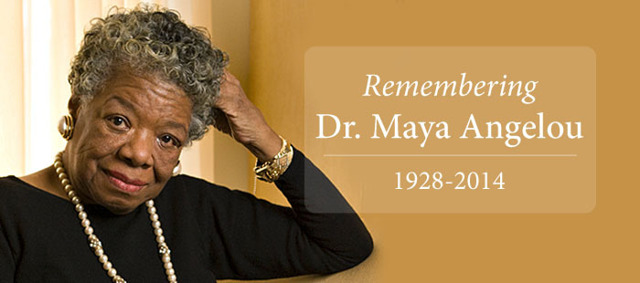
“Into a daybreak that’s wondrously clear . . . I RISE” φ Victory Service Honoring the Life of Dr. Maya Angelou

20030306F_christman9332

“Out of the huts of history’s shameφ
I rise
Up from a past that’s rooted in pain
I rise
I’m a black ocean, leaping and wide,
Welling and swelling I bear in the tide.
Leaving behind nights of terror and fear
I rise
Into a daybreak that’s wondrously clear
I rise
Bringing the gifts that my ancestors gave,
I am the dream and the hope of the slave.
I rise
I rise
I rise”


Watch the full Service Here

The Lies We Tell Black Boys and the Truth They Deserve to Hear φ CHRISTOPHER “FLOOD THE DRUMMER®” NORRIS

The Lies We Tell Black Boys and the Truth They Deserve to Hear

black boys-AfroDad-flickr

We need to stop teaching our black boys how to survive in a world not designed for them, and instead show them how to design a world that will allow them to thrive as individuals.

I never realized how hard it was to get people to view black men and boys as assets until I asked them to actually do it. In countless conversation I’ve had with peers about black male achievement—from philanthropy to politics, to the environment and education—the question has always been: “how do we help black boys achieve?” and not: “how do we leverage the value and agency of black men and boys who are already achieving to inspire others and transform the spaces they live, work and play?”

In my opinion, the reason the latter doesn’t gets asked as often as it should is because most people believe that black men and boys are problems that need to be solved; a disease that needs to be cured. Decision and media makers pretend the answer is as easy as getting the “thugs” to pull up their pants and not tattoo their faces.

Well-intentioned teachers and mentors often express that if black boys wear suits, ties, and carry books instead of bullets, that the probability of being accepted by, and achieving in, the “real world” will increase dramatically. Parents of black boys—just wanting them to come home in one piece—indoctrinate them religiously with the “do’s and don’ts of being black in public.”

And all the while, during of all these lectures, the black boys who we want to grow into proud black men are slowly but surely feeling humanity slip right out of their finger tips. With a skewed perception of their self-worth, chances are those black boys grow into insecure black men who feel the need to measure their accomplishments and assets to their white-counterparts, ultimately seeking validation outside their race before accepting what makes them unique.

What we should be telling black boys, and more importantly, what they deserve to hear is that the “real-world” is f*cked up and is filled with sick people who will hate them regardless of whether or not they are wearing a hoodie or a Brooks Brothers suit. They need to hear that the problem is the world and not them; that they exist to improve the world, not succumb to its bullsh*t. Black boys deserve to know that their elders will fight for their right to walk or run down a street of their choosing—regardless of their clothing—without the fear of being intimidated by a police officer who doesn’t view them as a human being.

We need to stop teaching our black boys how to survive in a world not designed for them, and instead show them how to design a world that will allow them to thrive as individuals. We need stop preaching respectability politics and tell our black boys what they deserve to hear, which is the sky is not the limit, it’s the starting point.

CLICK HERE to pledge to see the good in black men and share their stories so that others may do the same. 

– See more at: http://goodmenproject.com/featured-content/the-lies-we-tell-black-boys-and-the-truth-they-deserve-to-hear-cnorris/#sthash.XZqFn3xn.1C2M93Pi.dpuf


Thanks for reading. Until next time, I’m Flood the Drummer® & I’m Drumming for JUSTICE!™ DOWNLOAD NOW: The Black His-Story Book: A Collection of Narratives from Black Male Mentors, presented in part by GoodMenProject.com.  – See more at: http://goodmenproject.com/featured-content/the-lies-we-tell-black-boys-and-the-truth-they-deserve-to-hear-cnorris/#sthash.XZqFn3xn.1C2M93Pi.dpuf

Segregation Now … – The Atlantic

Segregation Now …

Sixty years after Brown v. Board of Education, the schools in Tuscaloosa, Alabama, show how separate and unequal education is coming back.


APRIL 16, 2014

Nikole Hannah-Jones/ProPublica

Photographs by Maisie Crow


Enough James Dent could watch Central High School’s homecoming parade from the porch of his faded-white bungalow, it had been years since he’d bothered. But last fall, Dent’s oldest granddaughter, D’Leisha, was vying for homecoming queen, and he knew she’d be poking up through the sunroof of her mother’s car, hand cupped in a beauty-pageant wave, looking for him.

So, at about 4:30 in the afternoon on October 18, Dent, age 64, made his way off the porch and to the curb along Martin Luther King Jr. Boulevard in the West End of Tuscaloosa, Alabama. Soon he could hear the first rumblings of the band.

There was a time, little more than a decade ago, when the Central High School homecoming parade brought out the city. The parade started in the former state capital’s lively downtown and seemed to go on for miles. The horns of one of the state’s largest marching bands, some 150 members strong, would bounce off the antebellum mansions along the streets. Revelers—young and old, black and white, old money and no money—crowded the sidewalks to watch the elaborate floats and cheer a football team feared across the region.

Central was not just a renowned local high school. It was one of the South’s signature integration success stories. In 1979, a federal judge had ordered the merger of the city’s two largely segregated high schools into one. The move was clumsy and unpopular, but its consequences were profound. Within a few years, Central emerged as a powerhouse that snatched up National Merit Scholarships and math-competition victories just as readily as it won trophies in football, track, golf. James Dent’s daughter Melissa graduated from Central in 1988, during its heyday, and went on to become the first in her family to graduate from college.

But on that sunlit day last October, as Dent searched for Melissa’s daughter in the procession coming into view, he saw little to remind him of that era. More caravan than parade, Central’s homecoming pageant consisted of a wobbly group of about 30 band members, some marching children from the nearby elementary schools, and a dozen or so cars with handwritten signs attached to their sides. The route began in the predominantly black West End and ended a few blocks later, just short of the railroad tracks that divide that community from the rest of the city.

The reason for the decline of Central’s homecoming parade is no secret. In 2000, another federal judge released Tuscaloosa City Schools from the court-ordered desegregation mandate that had governed it for a single generation. Central had successfully achieved integration, the district had argued—it could be trusted to manage that success going forward.

Freed from court oversight, Tuscaloosa’s schools have seemed to move backwards in time. The citywide integrated high school is gone, replaced by three smaller schools. Central retains the name of the old powerhouse, but nothing more. A struggling school serving the city’s poorest part of town, it is 99 percent black. D’Leisha, an honors student since middle school, has only marginal college prospects. Predominantly white neighborhoods adjacent to Central have been gerrymandered into the attendance zones of other, whiter schools.

New Prinicipal

via Segregation Now … – The Atlantic.

Pessimistic Themes in West’s Necrophobic Aesthetic by Dr. Tommy J. Curry

curryvoicesPessimistic Themes in West’s Necrophobic Aesthetic

: Moving Beyond Subjects ofPerfection to Understand the New Slave as a Paradigm of Anti-Black Violence.(Forthcoming The Pluralist)

by  Dr. Tommy J. Curry

This intersectional allusion to the bourgeois Black woman, her indemnification against all critique, has long been the unquestionable norm operating within the political assertions of Black feminism and the allegedly conceptual pluralization had in claiming intersectionality as a method. Carole Boyce Davies describes this tendency as condification; “a project perhaps, a behavioral process which marks the rise of a certain neo-colonial elite in the U.S. imperial context, operating for the benefit of the dominant state and its rulers” (14). Davies argues that “Condification marks the limit …but can also be seen as the ultimate manifestation of a domestic black and/or feminist bourgeois discourse” (14), and presents a concrete crisis for Black feminist calls for social, economic, and political equality, since there is no accountability to the buttressing up of empire and inequality in their march towards capitalist freedom. Davies is not alone in this analysis of Black feminism; Elaine Brown has gone as far as to say: “feminism,” assuming this word, which I don’t assume (let’s just call it that for now, women’s liberation, the liberation of all human beings), is part of my agenda. If you take their analysis, as strict analysis, you can end up having a woman like Condoleezza Rice. So they are incorrect in their ideological commitment. Condoleezza Rice would be the ultimate Black feminist icon. So they’re wrong” (3). Power within the system is justified as gender progress, and rationalized as the necessary trajectory of political progress. There are no criteria for liberation, only the accumulation of representatives that are Black and female who command the recognition of systems previously blind to their existence. The now common practice of lifting the immaterial subject, the ideal abstraction of the (Black) feminist self, represented by the mere utterance of race, class, and gender, destroys our ability to truly understand the suffering of Black people. The Black man, the Black woman, and the Black child who survive in the bare conditions of wretchedness nurtured by anti-Blackness—the poverty, death, and violence of racial oppression—are never seen. They are spoken about as factors, but never considered to be the primary subjects motivating study. Intersectionality, its synonymy with the ideal bourgeois Black woman, is an errant axiom that denies Black study for the elevation of one (powerful, Black, female) identity taken to be the finality of all Black morality.”

Introduction

The release of Kanye West‘s Yeezus  was indelibly marked by the provocation of his song entitled the ―  New Slave ,‖ which introduced a  pessimistic terminology deployed against the paradoxical condition that Black freedom from enslavement only recaptured Black people psychically in the neo-liberal entanglements of poverty, servitude, and corporatism. His analysis,not unlike currently en vogue theories of Afro-pessimism, or Critical Race Theory‘s  (racial)realist lens maintains that despite all the rhetoric and symbols of progress to the contrary, Black people are simply not free in America. West‘s  performance of ―New Slave,‖on Saturday NightLive was only amplified by the  Not For Sale  insignia projected behind him.
 As a symbol ofindependence, disengagement; a resistance against commodification, West announced hisconfrontational posture towards the industry; a posture which ignited the Hip-Hop communityand academia alike over this artistic radicalism. However, such a provocation, despite itsrhetorical flare and allure, was immediately cast as disingenuous and inauthentic. Kanye West isa Black man torn at moments by his brilliance and at times by his banality. His work is not beinganalyzed in Hip-Hop Studies and philosophical aesthetics because it is not worthwhile;
 — his analysis of anti-Black death, corporatism, and neo-liberal aspiration is enough to warrant morethan one serious study of his art. West is not studied because he lacks sufficient correctness orexhibits minimalist thoughts about the world around him, rather West is not studied because his body, his Black male body, lacks the symbolic currency to motivate reverence for his thinking.The New Slave implicates all arenas of knowledge and political production hailing from theacademy, and while his life and public proclamations are at tension with some of his work, itnonetheless necessities serious study, rather than sophistry and condemnation. This article is anattempt to draw out some of the themes concerning anti-
Black racism in West‘s ―New Slave and the double meaning this work has given that it was co-
authored with Che ―Rhymefest Smith.
It is my view that West‘s work establishes the continuity of enslavement beyond the artificial political and social changes that are attributed to racial progress and social equality.

READ AND DOWNLOAD THE FULL AND  FINAL PAPER 


ABOUT Dr. Tommy J. Curry

Professor of Philosophy, Texas A&M University

Tommy J. Curry’s work spans across the various fields of philosophy, jurisprudence, Africana Studies, and Gender Studies. Though trained in American and Continental philosophical traditions, Curry’s primary research interests are in Critical Race Theory and Africana Philosophy. In Critical Race Theory, Curry looks at the work of Derrick Bell and his theory of racial realism as an antidote to the proliferating discourses of racial idealism that continue to uncritically embrace liberalism through the appropriation of European thinkers as the basis of racial reconciliation in the United States. In Africana philosophy, Curry’s work turns an eye towards the conceptual genealogy (intellectual history) of African American thought from 1800 to the present, with particular attention towards the scholars of the American Negro Academy and the Negro Society for Historical Research.

In Biomedical ethics, Curry is primarily interested government regulation, the ethical limits of government intervention in the practice of medicine, and democratic potentialities that arise from collaborative doctor-patient diagnoses and regenerative medicine like stem cells. Currently his research focuses on the linking the conceptualization of ethics found in the Belmont Report to Civil Rights and social justice paradigms.

Subscribe to The Nationalist and read more of Dr. Tommy J. Curry

Follow him on Twitter


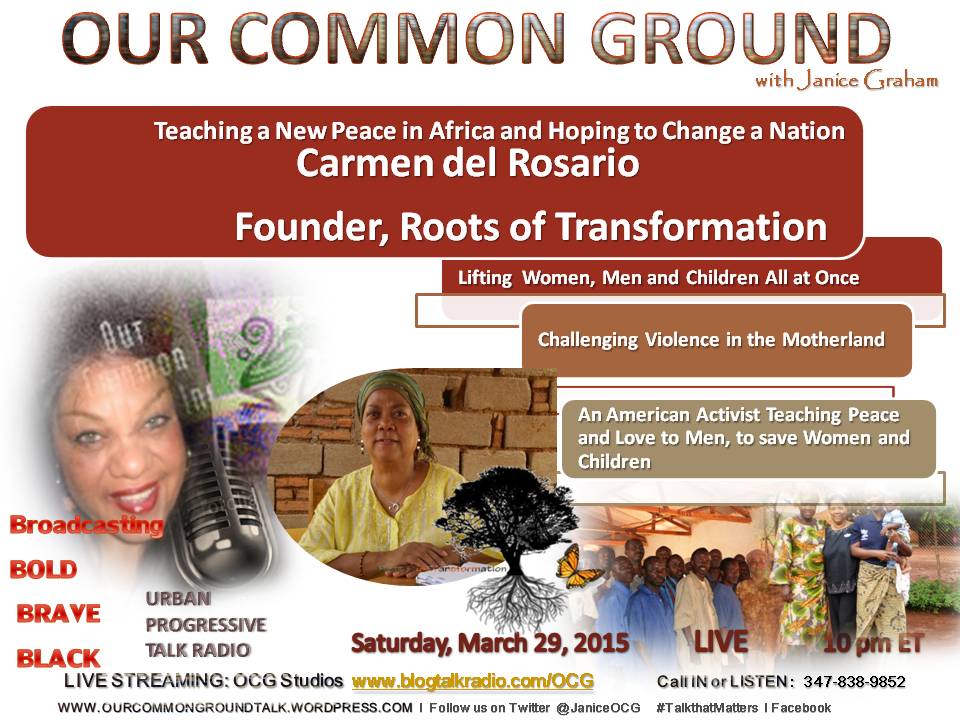
Teaching Peace in Violence-Torn Regions of Africa φ Carmen del Rosario, Anti-violence Educator and Activist φ LIVE 10 pm ET 3-29-14

OUR COMMON GROUND with Janice Graham

Teaching a New Peace in Africa and Hoping to Change a Nation

Guest:   Anti-Violence EducatorActivist Carmen del Rosario
Founder, Roots of Transformation


03-29 Carmen

Saturday, March 29, 2014 10 pm ET

LISTEN LIVE and Join the OPEN Chat

Web location:  http://www.blogtalkradio.com/OCG
Call In – Listen Line: 347-838-9852

“When I dare to be powerful– to use my strength in service of my vision, then it becomes less and less important whether I am afraid” – Audre Lorde

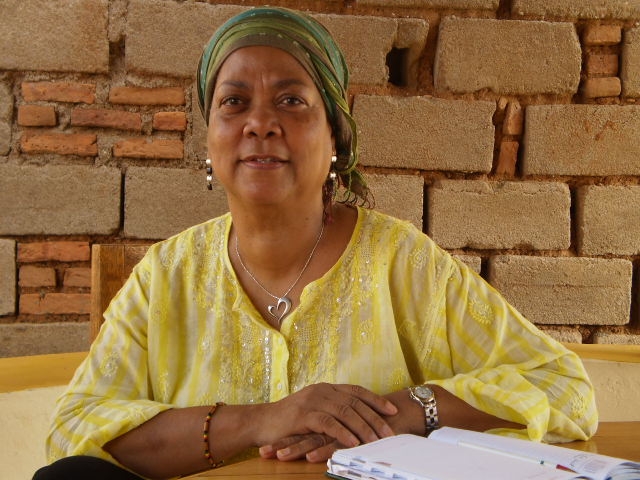
OLYMPUS DIGITAL CAMERAAbout Carmen del Rosario

Carmen is a highly driven and motivated, partnership, and programme management professional with over 20 years of professional experience working in the field of violence against women and children with government and development organizations, community networks and institutions in the US, El Salvador, Rwanda, Burundi, Dominican Republic, Tanzania, Congo (RDC) and Liberia

Ms. Carmen Del Rosario served as the Director of the Boston Public Health Commission’s Domestic Violence Program for 10 years. Del Rosario was a pioneer in developing strategies to engage boys and men in positive ways to prevent violence and to promote healthy relationships. In the year 2000, under her leadership, de Domestic Violence Program received funding from the CDC to develop , implement and evaluate a five years demonstration project working with men as fathers.

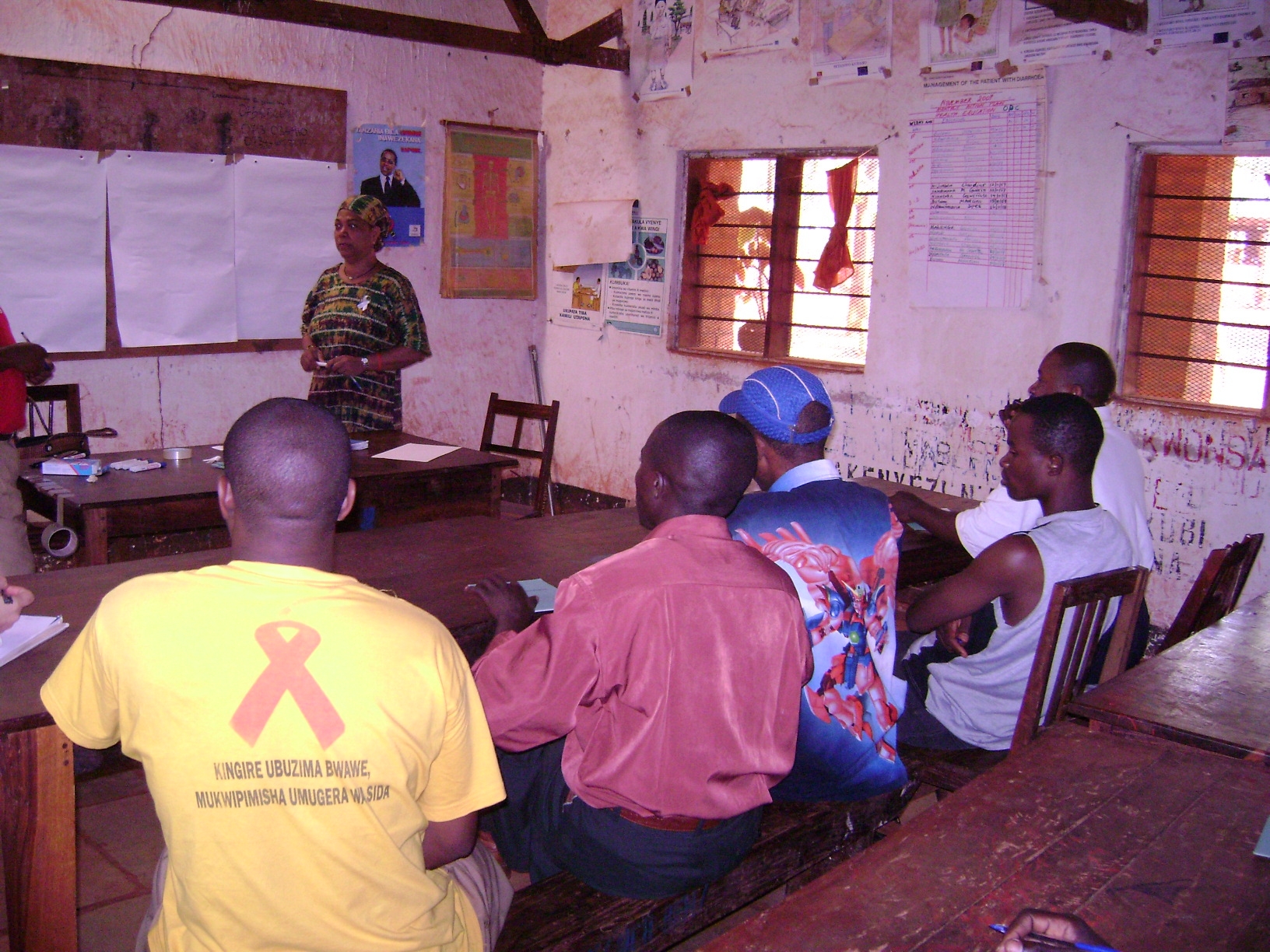
Over the past eight years Carmen has been working in East Africa, (Tanzania) Central Africa (Eastern Congo) and West Africa (Liberia), developing, coordinating and implementing programs to respond to survivors of Gender Based Violence (GBV), Women’s Empowerment Program as well as prevention initiatives with men from different background; these include, refugees’ men, religious leaders, traditional leaders, the police, and the UN peacekeepers. Carmen has developed intervention and prevention programs providing technical support to capacity development of the implementing partners in partnership with government, UNHCR, WFP, UNICEF and INGO.

ABOUT ROOTS of TRANSFORMATION

Roots of Transformation, is a non-government grassroots organization working toward the prevention of VAWC by catalyzing changes in communities and by supporting organizational sustainability. The organization works to prevent violence by addressing its roots causes, such as traditional gender roles, and the imbalance of power between women and men.

 Mission

DSC00577Roots of Transformation is committed to equipping people with the knowledge, wisdom and tools needed to make decisions that will positively impact their futures, the future of their family and their nation.

BROADCASTING BOLD BRAVE BLACK

OUR COMMON GROUND with Janice Graham

“Speaking Truth to Power and Ourselves”

email: OCGinfo@ourcommonground.com

Call In – Listen Line: 347-838-9852

“Speaking Truth to Power and Ourselves” 

email: OCGinfo@ourcommonground.com

LISTEN LIVE and Join the OPEN Chat

Call In – Listen Line: 347-838-9852

Community Forum

Twitter: @JaniceOCG #TalkthatMatters

Web   –  OCG Blog  –  OCG Pinterest   – Visit our OUR COMMON GROUND Tumblr Page

Facebook

“Speaking Truth to Power and Our selves” 

email: OCGinfo@ourcommonground.com

LISTEN LIVE and Join the OPEN Chathttp://www.blogtalkradio.com/OCG
Call In – Listen Line: 347-838-9852

5 Reasons Why The Black Community Is Still Enslaved To White People >>Urban Intellectuals

5 Reasons Why The Black Community Is Still Enslaved To White People

by  | Jan 17, 2014 | Opinions |

5 Reasons Why The Black Community Is Still Enslaved To White People


You might not want to hear this, but it is time for the black community to have a dose of cold reality. We are in a position today where we don’t control our own destiny and are effectively still slaves to white people. Hopefully, this article we can open the dialog and minds to get out of this situation before it is too late.

This opinion isn’t about bashing white people or telling you to hate them. It is about pointing out our behaviors and things we are allowing to continue to happen to us 150 years after the Emancipation Proclamation. We have lawyers, politicians, doctors, PhDs, business owners and so called intelligent people in the black community. We have many material things in our lives and “freedoms”, but in many ways are in a worse position than we were 100 years ago. Isn’t it time to recognize and admit it is time to do something different as a community?

slavery photo

With that said, let’s dive into the reasons we still haven’t gotten from under the thumb of our captors and still have a long uphill battle to fight. Despite some of us having the markings of success, we still have a long way to go as a people.

The White Educational System And View Of The World Dominates The Black Community

Because the black community doesn’t control their educational system, our children will forever see the world through the perspective of white eyes. This is what is meant when people say one has black skin, but white eyes. The individual looks like a member of the black community, but thinks like a member of the white community. Meaning, they see everything as sacred that comes from the white community and negates thoughts, sciences, businesses and everything else that comes from their own people.

During the indoctrination years, I mean formal education, the black community is being conditioned to love, honor and respect white history, people and where they come from on the planet. Blacks know everything about white people, but only take one month, February, to learn anything about the black community. And if you are awakened, then you know these are controlled lessons that only emphasis what you are learning the other 11 months of the year.

Black People Are Infatuated By White Culture & Europe

This is a by product of the reason above, the educational system. Why wouldn’t you love, honor and respect white or Western culture when you have been formally indoctrinated into the system? It only makes sense. It becomes what you are familiar with and identify with at the same time.

On the other hand, if you are all in on Western culture, then you must be ignoring your own culture, history and people. Sure, you don’t mean for this to be the outcome, but it is nevertheless unless you are blessed enough to have someone in your life to help the scales fall from your eyes.

However, most in the black community are not so fortunate. We end up living a life dreaming of visiting Europe to see and experience the history we endear growing up first hand. The black community is infatuate with white culture, people and Europe.

Nothing Is Validated In The Black Community Until It Is Approved By Whites

Building on the education and the infatuation the black community has with white people, you know nothing is given the stamp of approval until someone white gives it the thumbs up. It hurts my heart to say this in public, but it is true and you know it.

breaking the chainsValidation comes to businesses, athletes, students, children, our intelligence, medicine, inventions, political policies, and everything else the black community can dream up when someone from the white community says it is good. This is a hangover from slavery as discussed by Dr. Na’im Akbar in his epic book “Breaking the Chains of Psychological Slavery”. We need white validation.

Blacks Embrace White Jesus And Their Religion

I know I’m going to lose a few of you from the this point forward. However, I don’t care. This is very important. Dr. John Henrik Clarke talks about if you take a man’s identity out of his God, then he will always see himself as inferior because he will identify the other with the deity, blessed people and not himself. This is exactly what happen to the black community and we bought it hook line and sinker.

For hundreds of thousands of years, we have controlled our visions of God, the Universe and our spirituality. Post slavery, we do not control this image and continue to struggle from turning over this basic human right.

Blacks Spend All Their Money With Whites Continuing To Make Them Rich At The Expense Of Themselves

It makes me sick that we are economically foolish enough to spend our $1 trillion dollars in annual spending power almost exclusively with white businesses. We have no concept of how important it is to spread our money around our community a few times before allowing it to leave. In fact, we are the only community in the country that does this and because of our Mis-Education, Carter G. Woodson’s book reference. What is worst is we don’t even understand the error in this practice, nor care to learn.  At this rate, we will definitely forever be slaves to white people.

Obviously, the black community is no longer in physical chains, but to the awakened mind it is clear the psychological chains still exist. We turn over all power and assets back to the white community without resistance and need to make a serious change in our behavior and beliefs.

What Are Your Thoughts and What Reasons Are Missing From the List Above?

OCG Freedom Note >> Thinking About Black History Month 2014

Runoko Rashidi

“Our history and culture is our immune system.”
–Marimba Ani

Copy (2) of bl_hist_logoThinking About Black History Month 2014

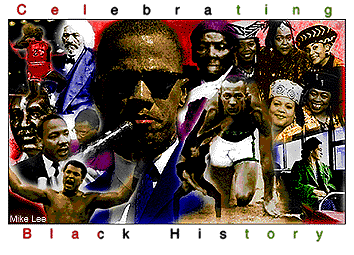
According to whether or not the year leaps or not, February 28th marks the end of what should always be a national celebration of the achievements and contributions made by African-Americans in America – National Black History Month. Despite slavery, government imposed oppressive conditions under which they were made and the lack of routine appropriate vehicles of credit and recordkeeping for tremendous accomplishments, and efforts of denial, it is clear that African-Americans have lifted America in extraordinary ways. In education, politics, science and arts, literature and philosophy there is no absence of an abundance of achievement by our people.  Every American or foreign visitor has experienced our footprint and infusion of cultural richness in the short and painful time of our existence in this nation.

The extraordinary people, inventions, music, dance, art and thoughts of our people recorded or passed along orally are treasures that we all share. Black History Month has become a tradition.  I was a young girl when it was still Black History Week and the only public acknowledgement was within segregated schools and communities, and Black publications. Growing up Black in the South the facts and episodes of our history, the people, their images and their oration was made sacred by my parents, grandparents and people in our community. People like Ida B. Wells, Thurgood Marshall, Jackie Robinson and W.E.B. DuBois were honored and familiar visitors at our breakfast and dinner table. My Mother spoke of the women and for such a long time, I really thought that they were her friends who lived elsewhere.  My Father spoke bleeding his expression with the words of dead men, Carver, Garvey and Douglas recalling their words as though they had relayed them directly to him. Telling the tales of a Harlem in Renaissance, of a budding Malcolm and the lives women crooners named Billie, Sarah who sang with  the Duke, and laughed with Dizzy and Louie. My Dad danced the Savoy and lounged the Paradise and boldly breathed the air of Black progress and pain.  The books, the authors, required and yearned for, bought, shared and placed on shelves for prosperity.  The speeches learned and kept close to the heart.  The people, and the events that they recalled was  testimony validating and affirming the character of the lives of Black folks. Enumerating Black worth in America and checking the validity of the equation.  An account so carefully recorded- a burden so deftly carried. Black people waiting for the Pittsburgh Courier and the Ebony magazine for assurance that they were real.

03-1 2black history So many years later, I not only seek our history to bind my life, but see into it as I navigate forward. This is what we do during this month of February. We raise it up, make it a sacred light illuminating the pathways of our future. It makes us real in the universe, assured that we will always have a special brand of hope which is ours and ours alone. All through the year, we must spend our time putting our lives, the echo of who we are into the record, sorting it and ordering it to build the bridges that will take us safely across.

Thanks for joining with us at OUR COMMON GROUND, or supporting our efforts at OUR COMMON GROUND to honor the ritual to lift up the journal of the Black experience in America. #HistoryMatters

Janice Graham

OUR COMMON GROUND Media & Communications

TruthWorks Network Radio


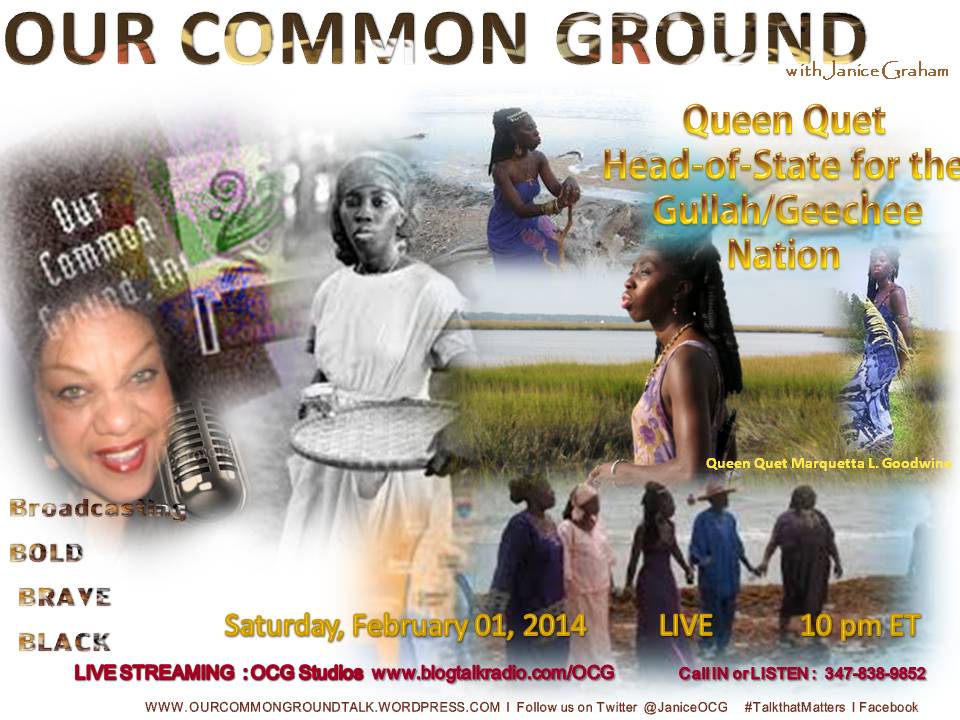
OCG This Week: The Gullah Geechee Nation with Queen Quet Marquetta L. Goodwine Head-of-State for the Gullah/Geechee Nation

           OUR COMMON GROUND with Janice Graham 
                    2014 Black History Month 

                        02-1-14 Quet2

The Gullah Geechee Nation
OUR GUEST: Queen Quet Marquetta L. Goodwine 
Head-of-State for the Gullah/Geechee Nation

LISTEN LIVE

Saturday, February 1, 2014
10 pm ET  LIVE

ABOUT the GULLAH/GEECHEE NATION
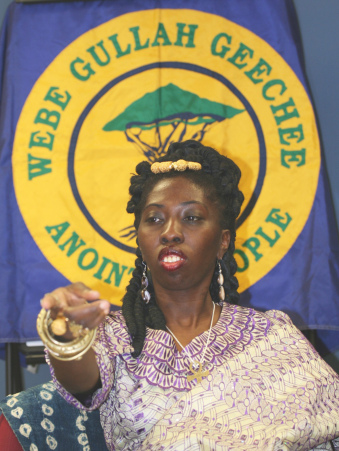
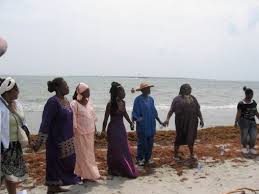
queenquet10queenquet12queenquet5The Gullah/Geechee Nation exist from Jacksonville, NC to Jacksonville, FL. It encompasses all of the Sea Islands and thirty to thirty-five miles inland to the St. John’s River. On these islands, people from numerous African ethnic groups linked with indigenous Americans and created the unique Gullah language and traditions from which later came “Geechee.” The Gullah/Geechee people have been considered “a nation within a nation” from the time of chattel enslavement in the United States until they officially became an internationally recognized nation on July 2, 2000. At the time of their declaration as a nation, they confirmed the election of their first “head pun de boddee”-head of state and official spokesperson and queen mother. They elected Queen Quet, Chieftess and Head-of-State for the Gullah/Geechee Gullah Nation.
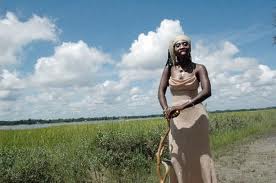
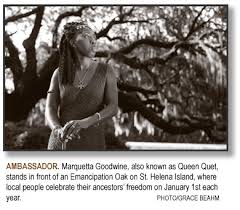
ABOUT QUEEN QUET MARQUETTA L. GOODWINE

queenquet9Queen Quet Marquetta L. Goodwine is a published author, computer scientist, lecturer, mathematician, historian, columnist, preservationist, environmental justice advocate, environmentalist, film consultant, and “The Art-ivist.” She is the founder of the premiere advocacy organization for the continuation of Gullah/Geechee culture, the Gullah/Geechee Sea Island Coalition. Queen Quet has not only provided “histo-musical presentations” throughout the world, but was also the first Gullah/Geechee person to speak on behalf of her people before the United Nations in Genevé, Switzerland.

Queen Quet was one of the first of seven inductees to the Gullah/Geechee Nation Hall of Fame. She received the “Anointed Spirit Award” for her leadership and for being a visionary. In 2008, she was recorded at UNESCO Headquarters in Paris, France at a United Nations Conference in order to have the human rights story of the Gullah/Geechee people archived for the United Nations. In 2009, she was invited by the Office of the High Commissioner of the United Nations to come and present before the newly founded “Minority Forum” as a representative of the Gullah/Geechee Nation and the International Human Rights Association for American Minorities (IHRAAM) which is an NGO in consultative status with the United Nations. Queen Quet is a directorate member for IHRAAM and for the International Commission on Human Rights. She represented these bodies and the Gullah/Geechee Nation at the “United Nations Forum on Minority Rights.”

Due to Queen Quet advancing the idea of keeping the Gullah/Geechee culture alive, the Gullah/Geechee Sea Island Coalition under the leadership of Queen Quet, worked with Congressman James Clyburn to insure that the United States Congress would work to assist the Gullah/Geechees. Queen Quet then acted as the community leader to work with the United States National Park Service to conduct several meetings throughout the Gullah/Geechee Nation for the “Special Resource Study of Lowcountry Gullah Culture.” Due to the fact that Gullah/Geechees worked to become recognized as one people, Queen Quet wanted to insure that the future congressional act would reflect this in its name and form. As a result in 2006 the “Gullah/Geechee Cultural Heritage Act” was passed by the United States Congress and signed into law by the president.

Queen Quet is vetted with the United States White House as an Expert Commissioner in the Department of the Interior. She is also the Chair of the Gullah/Geechee Cultural Heritage Corridor General Management Plan which is being completed by a commission created by the act for there to be a “Gullah/Geechee National Heritage Corridor.” Queen Quet is also a member of the “National Park Relevancy Committee” and proudly continues to work to protect the environment and to insure that diverse groups of people engage in the outdoors and the policies governing them. Queen Quet has engaged in several White House conferences on this issue.

queenquet7The Mission of the Gullah Geechee Nation 

To preserve, protect, and promote our history, culture, language, and homeland and to institute and demand official recognition of the governance (minority) rights necessary to accomplish our mission to take care of our community through collective efforts which will provide a healthy environment, care for the well beings of each person, and economic empowerment.


2014 season   BROADCASTING BOLD BRAVE BLACK 

OUR COMMON GROUND with Janice Graham

“Speaking Truth to Power and Ourselves”

email: OCGinfo@ourcommonground.com

LISTEN LIVE and Join the OPEN Chat:
Call In – Listen Line: 347-838-9852

Community Forum
Twitter: @JaniceOCG #TalkthatMatters
Web

Pinterest  
Visit our Tumblr Page 
Facebook 
“Speaking Truth to Power and Ourselves” 

email: OCGinfo@ourcommonground.com

LISTEN LIVE and Join the OPEN Chat 
Call In – Listen Line: 347-838-9852

OUR COMMON GROUND Kwanzaa 2013 -14

KWANZAA

Kwanzaa (kwahn-ZAH) is an annual cultural observance, which is recognized by Black people from December 26 thru January 1, each year:

  • Kwanzaa is non-political.
  • Kwanzaa is non-religious.
  • Kwanzaa is not related to Christmas.*

* Annual Kwanzaa observances begin on December 26th, each year] 

2013 Kwanzaa banner

This year’s OUR COMMON GROUND KWANZAA message comes from our Brother, Friend and Comrade,OUR COMMON GROUND Voice, Dr. Ron Daniels.

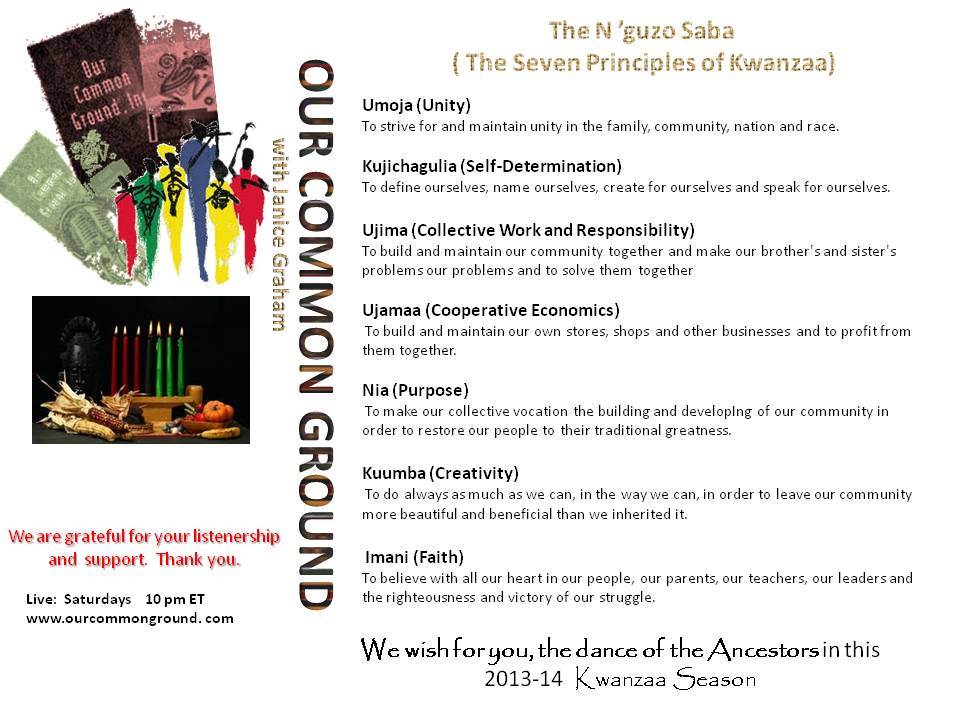
The Nguzo Saba contains the core concepts and values of Kawaida and the foundation for Kwanzaa.  In a recent article, First Call for State of the Black World Conference III, I suggested that a spiritual and cultural revival is essential to combat and overcome the devastating State of Emergency afflicting the “dark ghettos” in Black America.  As we begin the celebration of Kwanzaa, it might be useful to restate the N’guzo Saba and discuss its relevance to healing our families and communities in a time of crisis.  So, I offer these reflections.

Dr. Ron Daniels, Founder and Director, IBW 21

Ron Daniels

The first Principle in the Nguzo Saba is Umoja/Unity. That Africans in America should be unified or act in concert to confront the State of Emergency should be self evident.  However, achieving Black unity can be challenging and illusive. In the name of pursuing the interests of Black people, what we have in the Black community is a myriad of leaders and organizations that all too often compete rather than cooperate with each other.  Moreover, various leaders and organizations have different ideologies and strategies for achieving full freedom/liberation. There is also a “class divide” between the more affluent sisters and brothers who have benefited from the “movement” and moved up in the world and the dispossessed left behind in abandoned and devastated “dark ghettos,” the “hood.”  Overcoming disunity  requires a conscious effort to create “united front” structures which bring people together despite their differences in philosophy and approach.  Dr. Karenga has advocated “operational unity” as a concept to enable leaders and organizations with differing philosophies and approaches to work together.  Operational unity means focusing on issues and areas where there is agreement among organizations and leaders rather than disagreement.  Dr. Karenga calls this “unity without uniformity.” With so many problems/issues affecting the Black community, the goal of operational unity is to have leaders and organizations collaborate/act collectively around specific issues, projects and initiatives they agree on.

Unity in the Black community requires bridging the class divide.  Brothers and sisters who have seized on a pathway to the middle and upper class paved by the blood and sacrifice of heroes and sheroes of the Black freedom struggle have an obligation to spiritually and/or physically return to “Tobacco Road,” the urban inner-city neighborhoods of this country, to give back, to reinvest their time, talent and resources to reconstruct/revive the “dark ghettos” from which they escaped.

 The second Principle is Kujichagulia/Self-Determination.  There has been much talk about a “post-racial society” in the aftermath of the election of Barack Obama as America’s first African American president. And, there have always been some within the race who wanted to escape the “burden” of their Blackness.  The State of Emergency in Black America clearly suggests that “race still matters” as a determinant of one’s life chances in this country. Dr. Karenga has said that to chart a course toward full freedom, a theory/ideology of liberation must provide an “identity, purpose and direction.” I believe that if we are to permanently rise above the crises plaguing our families and communities, we must name and claim our identity, proudly embrace ourselves and be resolutely committed to being “of the race and for the race.”  As descendants from the African motherland, “we are an African people.” And, part of our mission in life should be to unapologetically work for the advancement of people of African descent in the U.S. and the Pan African world.  This does not mean disrespecting, disregarding or disdaining other racial/ethnic groups; it simply means “charity begins at home and spreads abroad,” and “love thy neighbor as thyself.”  We cannot, must not abandon the race, especially our sisters and brothers in the “hood,” in an ill conceived effort to become absorbed in a “colorblind” or “post racial society.”  We have a right to define who we are and determine our own destiny as people!

 The third Principle is Ujima/Collective Work and Responsibility.  As noted earlier, the Doctrine of Kawaida as conceived by Dr. Karenga is grounded in the traditional worldview and way of life of African people. As such it emphasizes “we, us and our” in terms of the values that are important to building and sustaining wholesome families and communities.  This is diametrically opposed to the “me, myself and I” values of “individualism” and “competition” stressed as central to the “cherished” American/western way of life.  The concept of the “collective” is frowned upon in America as “socialist” or communist.” And yet, the idea of extended families working together for a common purpose within communities with a sense of mutual obligation and responsibility is deeply ingrained in African societies – and our own experience as Africans in America, particularly in the South.  We certainly will not permit class or status to divide us if we see ourselves as one people committed to promoting the common good of the race. This is a clear example of the need to retain the values/principles of our forebears as opposed to adopting a value orientation which has proven to be destructive to Black families and communities.

 The fourth Principle is Ujamaa/Cooperative Economics.  This principle is closely linked to Ujima in that it encourages people of African descent to share resources and engage in joint efforts to build and sustain an economic foundation for our families and communities. Cooperatives, credit unions, investment clubs and community development corporations are examples of economic structures based on pooling and sharing resources for the common good.  Ujamaa does not preclude for-profit corporations or individual entrepreneurship. But, the value/principle of Ujamaa dictates that entrepreneurs and businesses explore ways of collaborating/cooperating, exchanging ideas and pooling resources where appropriate to enhance the collective economic empowerment of the Black community. This is what Dr. Claud Anderson has promoted through the concept of Powernomics and George Fraser through Power Networking.  In the spirit of Booker T. Washington, Marcus Garvey, W.E.B. Du Bois and the Honorable Elijah Muhammad, it is imperative that people of African descent persistently work to build an economic infrastructure to undergird our social and political institutions.

 The fifth Principle is Nia/Purpose. When we survey the incredible fratricide/carnage occurring in Black communities, largely committed by young Black males, one has the feeling that it may be because many of our young people lack a sense of purpose and meaning in their lives.  And, this may be related to a lack of collective purpose in the Black community as a whole. Gone are the days of the civil rights/human rights and Black Power movements when there was a pervasive spirit of purpose in the air. There was a dynamic movement and a feeling that Black people were on the move! In the face of a daunting State of Emergency, we urgently need to restore a sense of purpose in Black America. And, that purpose should be a commitment to reclaim and rebuild our communities, a fervent determination that America’s desolate dark ghettos will become new communities that are bright beacons of hope and possibility. The collective conviction/purpose and the struggle required to rebuild our communities will be contagious; it will capture the hearts and minds of our youth/young people by restoring a sense of mission to their lives as part of a people fighting to liberate themselves from an oppressive value system and society.

The Sixth Principle is Kuumba/Creativity.  People of African descent gave the world its first multi-genius in the person of Imhotep, the Egyptian physician, architect and engineer who mastered the science of building in stone that led to the erection of the pyramids as one of the greatest wonders of the world! One might say that creativity is in our DNA.  Africans from the Caribbean took old barrels and transformed them into “steel drums” that produce amazing music.  Those of us who came up on the “rough side of the mountain” in America (most of us) bear witness to the fact that our mothers and fathers were masters of “making something out of nothing.”  They had to in order to survive.  Overcoming the State of Emergency to rebuild our families and communities is a formidable undertaking.  It will not be easy, but we should act with the absolute confidence that we possess the creativity, the knowledge, skill and will to meet the challenge.

 The Seventh and final Principle is Imani/Faith.  Given the obstacles our forebears faced, they had to have an abiding faith that survival was possible, that beyond the brutality, hardships, suffering and sacrifice of the moment, “joy would come in the morning,” that someday, a generation that sprang from their loins – sons, daughters, grandchildren, great grandchildren, great, great grandchildren … would be able to proclaim “free at last.” For millions it was the belief that “we’ve come this far by faith, leaning on the Lord.” For others it was a spiritual force deep down inside that could be tapped to carry forth for another day and another day … the faith that a better day was coming for the sons and daughters of Africa in America. In this current crisis, we too must have faith, a belief that enables us to scale heights, not normally possible, because we believe and act on our beliefs. Similar to the Principle of Kuumba/Creativity, we must have faith that there are no odds too great for a people to overcome if we act with Umoja/Unity, Kujichagulia/Self-Determination, Ujima/Collective Work and Responsibility, Ujamaa/Cooperative Economics, Nia/Purpose, Kuumba/Creativity, and Imani/Faith.  “Deep in my heart, I do believe, we shall overcome some day!”

– See more at: http://ibw21.org/vantage-point/the-nguzo-saba-and-kwanzaa-in-a-time-of-crisis/#sthash.gap6irva.dpuf

2014-3Kwanzaa