
After seeing the name of the “Universal Negro Improvement Association” pop up on “Boardwalk Empire,” Speakeasy emailed HBO to ask for a comment about why their writers associated a real-life black leader’s group with murder, drugs and other kinds of wrongdoing.
September 29, 2013, 10:00 AMIs ‘Boardwalk Empire’ Trampling the Legacy of Marcus Garvey?
By Ishmael Reed
“Boardwalk Empire” made a reference to the black leader Marcus Garvey on a recent episode. But it wasn’t a tribute that Garveyites would have appreciated.
“Black Moses, The Story of Marcus Garvey and theUniversal Negro Improvement Association” by E. David Cronon received an endorsement from the celebrated black historian, John Hope Franklin, who wrote the introduction. The book recounts the career of Garvey, a Jamaican immigrant, who launched one of the largest mass movements of blacks before the Civil Rights movement. The book tracks the Jamaican from his beginnings as a journalist to his conviction for mail fraud. Though the case against him was fragile, Garvey doomed his case by acting as his own lawyer.
In the beginning of its new season, “Boardwalk Empire,” introduced a character named Valentin Narcisse (played by actor Jeffrey Wright), a dapper smooth talking character who speaks with an Caribbean accent. This character uses a white woman to blackmail Chalky White whose henchman killed the woman’s husband after he pretends to be outraged at finding the black henchman with his wife. Turns out that this was a set up and that this was how the husband and wife got their freak on. In order for Narcisse to keep quiet, Nucky Thompson decides that White has to give Narcisse ten percent of his club’s profits. Returning to New York from New Jersey, Narcisse has the woman killed. Back in Harlem, he is seen negotiating with white gangsters for part of Harlem’s heroin trade. The walls of his office are decorated with the photos of distinguished black men, but this character despite his eloquence and his fancy dress is a hoodlum. We see a banner hanging behind Narcisse that reads “Universal Negro Improvement Association”–which was the real-life name of the real-life black nationalist and self-help organization founded by Garvey. The inclusion of the Universal Negro Improvement Association in a show about crime and violence shocked even me, a person who has written, obsessively, about the depiction of blacks by the media, part of a hundred year old complaint.
After seeing the name of the “Universal Negro Improvement Association” pop up on “Boardwalk Empire,” Speakeasy emailed HBO to ask for a comment about why their writers associated a real-life black leader’s group with murder, drugs and other kinds of wrongdoing.
Here’s something that Garvey, who campaigned for black empowerment, surely would have noted: the writing staff on “Boardwalk Empire” isn’t a very diverse bunch. Garvey himself might have raised an eyebrow at the fact that virtually none of the people involved with the writing of the series, which plans to explore Garvey’s legacy in future shows, have any black roots (according to HBO, David Matthews, the executive story editor on the show, is biracial).
An HBO spokeswoman said via email “there are no writers of Caribbean heritage on the show but they do an extensive amount of research. Yes, you were correct in noticing the name of the organization and Marcus Garvey’s name comes up in future episodes – this is not a coincidence. ”
One of the most controversial figures in American history, Garvey was criticized by both the NAACP and the Communist Party, who, on other occasions, said nasty things about each other. His model for his self help enterprises was, Booker T.Washington, who, for those in power, was the president of the Black Nation; his being invited by Theodore Roosevelt to dine at the White House caused a scandal.
Garvey’s newspaper, The Negro World, established in January,1918, was called by poet Claude McKay, “ The best edited colored weekly in New York. Emphasizingblack pride, the newspaper published stories about slave rebellions,American and Haitian, and the histories of African Empires,all meant to make blacks feel proud of their racial heritage.
The Negro World,which was published weekly until 1933 was also used by Garvey to criticize his enemies sometimes in such a vitrolic manner that he invited lawsuits.Taking his lead from Washington, who established Tuskeegee College, that blacks operated their own businesses, he rejected capital from whites and used his “magnetic” personality to raise money from the grass roots. At the height of his influence, Garvey was able to draw 25,000 blacks to hear their leader make a speech in Madison Square Garden as part of a convention, which was accompanied by parades and much pageantry.
Already under surveillance by the Government, the flamboyant Garvey got into difficulty when he began a steam ship company”that would link the colored peoples of the world in commercial and industrial intercourse.” His enemies used the business dealings associated with the purchase of steam ships for which he sold stock, to get him done in with the charge of mail fraud.He was sent to an Atlanta prison and served a term there until he was awarded clemency by president Calvin Coolidge. He was deported to Jamaica, Garvey’s ideas influenced not only American blacks likeMinister Elijah Muhammad, and Malcolm X, but foreign leaders like Kwame Nkrumah, the first president of Ghana.
An HBO spokeswoman told us “Nowhere in the story line are we implying Marcus Garvey was involved in gambling or drugs. Valentin Narcisse is a fictional character who is based on someone who was.”
HBO pointed us to an interview in GQ in which Wright said “Dr. Narcisse is kind of a funhouse mirror distortion of an historical figure named Casper Holstein who was, during the early 1920s in Harlem, the king of the numbers game.” He goes on to say “at that time, there was something of a great debate within African-American society, among the great thinkers of the past: W.E.B. Du Bois, Booker T. Washington, Marcus Garvey, and within the Harlem Renaissance about what was the way forward. Within that debate were some pretty vicious personal attacks over complexion, politics, between urbane and rural—a lot of those dynamics are fleshed out within the relationship between Dr. Narcisse and Chalky.”
“Boardwalk Empire” creator Terry Winter said this via email: “Our fictional Valentin Narcisse is associated with Marcus Garvey’s organization, but this is not to imply in any way that Garvey himself was involved in the same types of illegal activities. Without giving away any future story developments, I can say that the Narcisse character was inspired in part by Casper Holstein, a West Indian immigrant who was head of the Harlem numbers racket as well as a philanthropist and political activist. After Garvey was sentenced to prison and the UNIA collapsed, Holstein purchased the building in which the organization was headquartered. As the season progresses, we also focus on J. Edgar Hoover‘s fixation with putting Garvey in jail.”
But except for his buying the mortgage for a building once used by Garvey’s organization, Holstein was not a part of the UNIA. Moreover, there is no evidence that Holstein was involved in the murder of a white woman. Also, connecting him with the heroin trade is bizarre because he died in 1944. Heroin was introduced into Harlem in the 1950s; before that it was used by white males, mostly.
Holstein’s connection with Garvey’s old building came about when Garvey’s movement already had collapsed. Holstein donated a large portion of his fortune towards charitable purposes such as building dormitories at historically black colleges, as well as financing many artists, writers, and poets during the Harlem Renaissance. He also helped establish a Baptist school in Liberia, and create hurricane relief fund for his native Virgin Islands. He had nothing to do with heroin.
Garvey is an official National Hero of Jamaica. It is a disgrace that HBO connects his UNIA in any form with murder and heroin dealing. In my view, it’s an example of what happens when the writing staffs of Hollywood and television are decades behind in terms of diversity. There are plenty of black historians who could serve as consultants in case they continue to exploit the Garvey story.
George Bernard Shaw had it right. If you don’t tell your stories others will tell them for you and they will “degrade” and “vulgarize” you.
Ishmael Reed’s new play, “ The Final Version” will premiere at the Nuyorican Poet’s Cafe on Dec.12. His online magazine Konch is at konchmagazine.localon.com
Category Archives: Black and Race Blogs


A Black Boy is Dead

Histories of gender and slavery focus overwhelming on women, as if gender and women are coextensive and men have no gender. This observation points to a problem with the conceptualization of sex and gender across academic disciplines. For if there is a structural neglect of manhood in studies of gender, and if womanhood is misunderstood to be synonymous with gender itself, then this approach signifies an extension rather than an analysis of gender ideology, which traditionally inscribes women as being gendered and men as being generic and beyond gender.
Greg Thomas—The Sexual Demon of Colonial Power—2007
Introduction:
Last week, Black America’s heart was broken and their hopes and expectations of fairness, justice, and equality shattered. The murderer of a young Black boy was freed. George Zimmerman gets to live his life an acquitted killer, and Trayvon Martin, his family, and other Black men and boys will forever be impacted by the reality that any confrontation with white men and/or women can mean death. Black men and boys remain invisible to conversations about gendered violence and death. Their existence and suffering is replaced by negation, or replaced with only the problematization of any scholarship that seeks to address their peculiar racial existence as being marginalizing to the their Black female counterpart. In short, any work seeking to speak to, and for Black male oppression is attacked for not being sufficiently feminist, and as such, worthy of dismissal and censor.
Being Black and Male is not a Privilege—It’s a Death Sentence
Within minutes of the verdict, Black feminists from across the web began posting and comparing the life of Trayvon Martin to that of Black women killed or incarcerated within the last year. On facebook, Black feminist postings about Rekia Boyd, Marissa Alexander, and Aiyanna Stanley-Jones, were on statuses and shared prolifically. Reiterating Jamila Aisha Brown’s piece, “If Trayvon Martin had been a woman…” these feminist posters/bloggers saw themselves making a point about the difference in the attention Black men’s and boy’s deaths receive next to these Black women’s lives. However, when one actually reads Ms. Brown’s piece one can only be amazed by how causality and history are vacated for ideology. Brown’s piece is written as a response to a Marc Lamont Hill’s interview where he was asked “How would things be different if Trayvon was a young Black girl? Hill responded “[Zimmerman] would have been convicted, because we have this history of seeing Black male bodies as dangerous and threatening and always worthy of lethal force.” Hill makes an observation many Black men and women across the country actually agree with, namely that Black men and boys are by and large the victims of state sponsored murder and violence and white vigilantism. This is not to deny Black women as victims, but to acknowledge the dangers of being Black and male in the United States. A point recently supported by Melissa Harris Perry’s admission that America is so dangerous for Black men that she wishes her sons away, a burden only alleviated somewhat by “the relief I [she] felt at my [her] 20-week ultrasound when they told me [her] it was a girl.”
Unfortunately, the sentiments that express fear, anger, and hopelessness are lost on Brown and many of her readers. Despite the outrage of the Black community, the powerlessness endured by the parents of young Black men and boys, and the fear of death Black men/boys suffer, Brown seems to conclude these emotions are simply inconsequential to the larger identity politics needing to be advanced. For Ms. Brown, any and all experiences of violence against Black women are examples that they could in fact have been Trayvon Martin. She begins her argument with a brief point that Black women have been lynched, a fact that has not gone unnoticed by historians or even anti-lynchers back in the 19th century given the cataloguing of Black women’s and girl’s names and alleged offenses in both Ida B.Wells-Barnett’s Red Record (1895) and John Edward Bruce’s A Blood Red Record (1901). In Brown’s view, however, these women’s lives have been erased and go to prove that if “Trayvon Martin were a young Black woman, we would not even know her name.”

On the face of it, this seems silly. All violence is not the same, so to suggest that Black women who have been focused on less regarding lynching, or police-state-sponsored violence means that an unarmed teenage girl who was shot by a white man on the claim of self-defense would not been known to Black America is non-sequitar. Ida B. Wells-Barnett was clear that lynching was justified against the manhood of the race and used as a weapon to discourage Black economic independence. Contrary to the popular account of Well’s anti-lynching activism as revelatory, Ida B. Wells-Barnett understood the unique vulnerability of Black men, because at one time she supported the lynching of Black men as justifiable. As she confesses in Crusade for Justice “…I had accepted the idea meant to be conveyed—that although lynching was irregular and contrary to law and order, unreasoning anger over the terrible crime of rape led to the lynching; that perhaps the brute deserved death anyhow and the mob was justified in taking his life.” After the death of her friend Thomas Moss, she began to understand that lynching was a punishment driven by the desire to murder Black men. When the white lynch mob declared to Ida B. Wells-Barnett that her “sex would not save her,” if she returned to Memphis, it reaffirmed the masculine ontology at the bottom of lynching. It was Wells-Barnett’s debasement to the status of Black maleness that threatened her life and erased her sex. Despite the historical evidence that give ample support for the view that anti-Black death (lynching, police state violence, and public executions) are directed primarily at Black men, Black feminists cannot conceptualize a reality in which Black maleness is a gendered vulnerability that warrants being the center of any account of American racism.
Brown claims that the deaths of Rekia Boyd, Deanna Cook, Aiyana Stanley Jones, and Tarika Wilson, despite being protested, taken up by the NAACP in their respective cites, and warranting lawsuits, are ignored because of “Black male privilege,” or the idea that “the victimization of young women is subsumed into a general well of black pain that is largely defined by the struggles of African-American men.” Are they not ignored by the asymmetrical power relationship between impoverished Black communities and the police state, or the general apathy for Black life? By asserting the existence of “a Black male privilege” that somehow remains unaffected by the exponential deaths, imprisonment, unemployment, and poverty of Black men and Black boys—conditions that deserve particular attention, these authors make acknowledging Black male privilege axiomatic, and indisputable. In short, these feminists claim that regardless of the death historically associated with being a Black man, these Black men enjoy the political privilege of being male, and of being recognized even in death over Black women, some of whom are still living and breathing. Rather than being a serious analysis of how Black men concretely have privilege (education, wealth, mortality, health), this contention is about the ideological politics of academic recognition confined to blogs more than an empirical study offering insight into the tragedies that actually impact the Black community. In the death of Trayvon Martin, Black male privilege attempts to demonize a community that has lost Black fathers, sons, and husbands alongside mothers, daughters and wives for not holding a particular brand of feminist politics. These Black feminists pretend that despite the tragedy of losing a 17 year old Black boy, a child, they are ultimately the arbiters of what his life should mean for the Black community, or what his life would mean if the Black community was not blinded by the ignorance of their hetero-patriarchal pathology.
While the Black left, and Black independent news outlets have concerned themselves with the death of Black men and women, as well as Black boys and girls, Black feminists have not made the death of Black women killed by state violence, police brutality, racial profiling, or anti-Blackness their central agenda, unless of course those women were killed or brutalized at the hands of Black men, which makes their suffering fit nicely with their predetermined (Duluth) account of domestic violence. Voxunion presented evidence of Black men and women dying hourly, Redding News Review covered the death of Rekia Boyd, and Aiyana Stanley Jones, as well as the arrest of Marissa Alexander; I constantly commented on these deaths as topics of conversation on my own radio segment, and Black Agenda Report has reported the deaths of Black women and children alongside their Black male counterparts. But given the gender ideology in the university, these Black feminists feel more than comfortable using the death of these women and children to point out why the death of Trayvon Martin should not be valued as much as it is because he is a Black boy.
Black Males are Victims of Racism and Sexism
It’s sickening that these individuals are now claiming they get to decide how Martin’s death should be valued, but say nothing against the specific white supremacists and institutions that devalued Black life in the first place. The central question posed by Piers Morgan in asking what would happen “If Trayvon Martin was a Black girl,” is whether or not a white vigilante could have claimed he feared for his life and used self-defense as a justification for killing her. Many commentators simply think Zimmerman would have been arrested for killing a Black woman, and the opposing feminist commentaries have offered no reason for this not to be the case. So, in an attempt to “one-up” Black male death, these commentaries pose endless hypotheticals that ask the audience to imagine the Black female victim being raped and sexually assaulted rather than simply being murdered in cold blood. Mind you, these hypotheticals are being embraced as fact, something that would necessarily happen to the Black female victim, despite Rachel Jeantel telling the American audience that she actually told Trayvon Martin that Zimmerman could have been a rapist. This sexualized aspect of racist violence is completely ignored when talking about Black men and boys.Eric Glover and Terrence Rankin were murdered to fulfill the necrophilia fetish of three white teens, and as expected not one “feminist” analysis on the particular gendered vulnerability of these Black men. But this fear, the fear a young boy may have of being raped, is ignored, because as Greg Thomas explains, “for feminism, gender means for females only,” and as such, only females can fear, be assaulted by, be victims of, rape.
Why are these Black feminists not attacking the comparison between white men’s, women’s, and children’s lives next to the death of these Black women? Why are the deaths of Black men and boys the only comparable examples? Why are they not attacking their figureheads like Beverly Guy Sheftall for publically announcing the agendas of Black feminism in popular venues like the Root, but excluding Black death? Why are these Black feminists not writing about these women in their journals and blogs as analyses of anti-Black death and suffering rather than the reaction to the death of a Black boy? Why is it when a Black community mourns, the feminist response is to divest the meaning the symbolism a Black male life has taken on—a life embraced by Black men, women, and children alike, a life taken from Black families across the world, and a life that continues to represent the fear of growing up a Black boy who wonders if he shall live to become a man? Does this fear of death not warrant political organization around Black male issues and erasures?
In this case, Black Feminism isn’t any better than the white supremacist who denies the political possibilities held by Black manhood. Black manhood is not a pathology; a sickness to be cured by either death or by feminism. Angela Davis is clear in Women, Race &Class that Black men didn’t have male privilege during slavery, because it endangered the slave system, nor did they have it during the civil rights movement despite Michelle Wallace’s contention given the myth of the Black male rapist. Feminists are using this tragic incident to bring further attention to their political agendas. J.N. Salter’s article, “Am I A Race Traitor? Trayvon Martin, Gender Talk and Invisible Black Women” argues that Black women are expected to put their race before their gender and ignore the issues that black women have within our communities,” but this is not an issue for the black community, this is an issue for the Black feminist community who demands that the deaths of the Black women and girls they have handpicked garner the same attention recently afforded to Trayvon Martin. Haydia Pendleton was killed in January, and her death, the death of a 15 year old Black girl sparked, national attention, so much so that the First Lady Michelle Obama attended her funeral, but this did not create the attention to Black women’s death by Black feminists that Trayvon Martin’s death did. Salter argues that “Black women are expected to put their race before their gender, to choose between their dual identities (“black” or “woman”) at the expense of their full humanity,” but this is untrue since many Black women from Ida B. Wells-Barnett to mothers like Sybrina Fulton have resolved this issue. This is a Black feminist issue that pretends being Black and being a woman should not be criticized, despite the fact that the identity politics lurking behind their idea of womanhood is about their political alliances with, and the benefits they receive from their relationships with white women. Our focus should not be on whether the Black person was/is a woman or a man it should be on protecting our communities from violence. It just so happens that in this case, the case of white vigilantism, Black men and boys deserve much of our attention.
A Conclusion
Of the 300+ Black people killed in 2012 by extra-legal violence, how many names do we know? Every year,hundreds of Blacks are killed by police, most of them men, we don’t know who all of them are, and they don’t all get marches; some names are never uttered. Black children, little boys and girls, are killed and no one cries, mourns, or marches for them. A white vigilante kills an unarmed teen and suddenly the fear and sorrow felt by the death of a young Black boy is transformed into “the only death Black people care about.” Whereas Black feminism has no problem turning the pain and torture of a community—its families—into a metric measuring Black death and rationing this dehumanizing spectacle into the “meaningful” deaths of Black women, and then everyone else; the Black community, the dead Black men, “we,” as their voices should. Ideology (political, moral, or otherwise) is not the barometer of truth.
The indifference to the death of Black men and women from the near silence of this Black feminist academic cadre on issues like state violence, anti-Black death, and murder for their preferred discourses of recognition, be it phrased as: intersectionality, love, or education, is self-inflicted. Stop talking to white women and white people for academic recognition and write about the (Black) deaths of the people you claim should be at the center of consciousness. These posts that continue to react to the importance the Black community has attached to Trayvon Martin’s death, instead of suggesting any analysis of the conditions that gave rise to it, demonstrates the negating drive of Black feminist identity politics against Black men/boys, rather than concrete analysis of Black people’s vulnerability to sexual violence and murder—and how that acknowledgement helps the Black community. These posts show that vitiating Black masculinity is academically profitable, not that the death of a Black boy is tragic.
~ This post was written by guest blogger Dr. Tommy J. Curry, Associate Professor of Philosophy,Affiliated Professor of Africana Studies, Texas A&M University and his wife, Mrs. Gwynetta Curry.

Recovery Work: Black Women and Emotional Health

Wednesday, September 4, 2013
Recovery Work: Black Women and Emotional Health
Posted by “For Harriet”

by Liz A.
I had a recent encounter with her, you know, that sister who is needy as hell. I was hoping she didn’t see me and with a quick right turn down the other hallway, I would be able to dodge her. But just my luck, before I could attempt my matrix type move, she spotted me.
DAMN.
Me: Hey sis…
Her: Hey girl, I’ve been calling you. Did you get my texts? My voice messages?
Me: Yes girl, I got them. I just have been extremely busy and haven’t had the opportunity to respond to them yet.
Yes, I am aware that she has been calling me. And yes, I did receive all of her texts and voice messages. But as an acquaintance, her incessant calling and texting made me uncomfortable. And after much thought I made a conscious decision not to return her calls and to distance myself from her. My decision to distance myself was not out of malice or ill will but as an act of self-care. Especially after unsuccessful attempts to playfully hint to her, using gestures such as “ girl, stop calling me a million times a day” or “sis, you don’t have to call me, I will call you,” that she needed to calm down with the contact. It was also intended to serve as a non-verbal cue, with the hope that, for someone who admittedly had difficulty with preserving friendships, she would take the time to recognize and examine her relationship patterns.
I mean what else could I have done? We weren’t close enough for me to tell her straight out that she didn’t have any friends because she was needy. And that her incessant contact was suffocating and entrapping and that contrary to her belief that it communicated her interest in pursuing a friendship, it actually displayed itself as neurotic and obsessive behavior that made people distance themselves from her. No, I couldn’t tell her this but I did hope someone who cared about her would; that way, it wouldn’t hurt so much.
Because as a woman in recovery, who herself was confronted about being needy, knowing that the person cared about me, helped to absorb some of the impact of that painful truth.
My need arose from the death of my mother when I was fourteen. After being abandoned by our relatives, my brothers and I were left to raise ourselves. During this phase of my journey, I was emotionally neglected, deprived of affection and suffered from issues of abandonment and rejection. In a desperate attempt to seek out love, as an only girl with limited female guidance, I sought out women under the guise of mentorship for nurture, affection and mothering, often forcing my emotional needs onto them. This resulted in several toxic and unhealthy relationships with women.
Overtime, I learned that my need came from a place of deep pain and wounded-ness. And according to my truth telling therapist, “as long as I come from that place of wounded-ness, I would never be in a healthy relationship.” So out of an act of ‘radical self love’ and out of a desire to be as whole as possible, I made a commitment to do the necessary work in order to heal, which involved taking ownership of my emotional health.
Just like that sister must do…
And when she does, she will realize that it’s deeper than her inability to develop friendships and that her neediness is but the language of her wounded-ness.
Reposted from “For Harriet”
For Harriet is an online community for women of African ancestry. We encourage women, through storytelling and journalism, to engage in candid, revelatory dialogue about the beauty and complexity of Black womanhood.Learn more.
Liz A. is a woman on a journey of becoming. She is a “warrior poet”, an avid journal-ler and an independent writer. Liz identifies as a Womanist with Black Feminist tendencies and is currently a social worker in training. So far, Liz has written for the Feminist Wire and is a columnist for the ForHarriet blog. Liz is currently working on her untitled memoir.
white out – from Gone agape.

Gone Agape.
white out.
http://goneagape.tumblr.com/post/55996194687/white-out
I haven’t had much to say about the trial of Trayvon Martin (yes he was the one on trial) because like many of you— this shit was emotionally destructive. What you may not know is me and Trayvon are from the same neighborhood. Literally. That I went to the elementary school and middle school that fed into Rachel Jeantel’s highschool of the same name. My brother went to Rachel’s high school, as did most of my friends growing up.
Had I not suffered from extreme anxiety that arose anytime I made a mistake, I would have gone to the same high school as Trayvon. The day I was to audition for their vocal program, I didn’t bring background music and after being chastised by the white woman organizing the auditions, I decided not to audition at all and lied to my mom about my rejection. I regret that.
So when I say this shit hits home, I mean it. It hit 197th Terrace in Miami Gardens, Florida. This hit home and it sucks. Because I know very well what comes out of North Dade and what died with Trayvon that night was a whole hell of a lot of potential and no conviction of George Zimmerman will allow us to see what Trayvon could have been.
But as much as this entire fiasco is about racism— it’s also about privilege. Privilege white people refuse to acknowledge and Black people can’t seem to communicate enough. No doubt that the privilege with roots in racism played a role in the trial… but, it’s not enough to say, things would be different if the races were reversed. People never want to deal in the what ifs… and no one seems to want to touch racism with a 10 foot pole. Though the acts are no doubt racist at the root, I rather be effective than right- so I need to acknowledge these things in a way people can digest.
White privilege is being able to live your life as a white man for all intents and purposes and become Hispanic when denying you are racist. That same privilege allows you to not know the difference between race and ethnicity. Privilege involves always getting the benefit of the doubt… because you are trusted.
No matter how ridiculous it might sound that you disobey an order by an emergency professional, and shoot someone to death for nothing really. Privilege is like that. Privilege is about the right to be an individual. That no matter how heinous crimes are that white people are accused of, no one looked at George Zimmerman and thought of Dahmer, or Bundy, or Gacy. No one diagnosed his anger issues, his insecurity, or overzealous nature as something indicative of a propensity to commit violence again. But when you’re Black, you are everyone else. Because, violent and mischievous Black teenagers exist, it was okay for Zimmerman to assume Trayvon was one. And because we don’t ever exist as individuals, then Trayvon becomes at fault for his own murder. Black children can’t make mistakes, white adults can.
Whenever there is an instance of one account versus another, the account of a White person is always more true. It’s the reason that I pull out my whitest voice possible when making any customer service transaction over the phone. When you’re white, you are you— when you’re Black you’re all of us, and all of us, are bad Black thugs. I don’t even like the premise that Trayvon could have gone to college and been a “good nigga.” Don’t show me a picture of another teenager with baggy pants and then with a graduation cap 10 years later… because, Trayvon wasn’t wronged because he could have been a college graduate and traded in his hoodie for a bowtie. Trayvon was wronged because he was here. We are wronged not just because we aren’t afforded individuality, we are wronged because someone believes they can determine the value, or lack thereof, of Black lives.
Privilege is when there is outrage about a white terrorist who makes the cover of Rolling Stone after killing white people in a horrific display of inhumanity. But awkward white boys with backpacks across the world will continue boarding planes, going hiking, being publicly intoxicated, and playing violent video games without so much as a nod in their direction. They will go to school without being tracked, and they will drive cars freely without being stopped. Privilege on privilege is when people are outraged he made the cover and not at the article that promises to tell us how a “popular, promising student was failed by his family, fell into radical Islam, and became a monster.”
No one is troubled by the suggestion that the Boston Marathon bomber was failed by his family and became a monster and Trayvon was supported by his family and born one. Privilege is telling Black people these things are not related in a world where everything is. Privilege is failing to understand the very real physical and psychological damage privilege and racial microaggressions cause. Since I have gotten a new car, I’ve been pulled over three times- more than in almost 10 years of driving. Privilege is when seeing the police is a sign of relief and not one of anxiety.
This discussion about racism will never be valuable if the subject matter and those discussing it are always the oppressed. It will never be valuable if we keep saying people who do racist shit are not racist because they are nice people. The cop who stopped me for “rolling through a stop sign” was a fucking racist. Why? Because he wanted to know where I was going, how long I owned my car, and asked to see my license and registration even though by his own admission, “everyone who comes to that sign always does the same thing.” And maybe he volunteers at his church or takes care of his sick mother and I’m supposed to believe he can’t be racist because he’s a nice person. Well, like people we love are addicts, or thieves or liars— we can love racists. And while we pity him, it is me who has PTSD from being followed in the dark, humiliated, scared, and even as a civil rights attorney well aware that I was stopped for DWB in a nice car, I had to be non threatening and apologetic for a stop that I know was complete bullshit because I wanted to make it out alive.
And anyone whose privilege won’t allow them to recognize that fact, I suggest they ask Trayvon Martin how the decision to defend or be offended is so often a life or death one. I have no doubt Zimmerman spent his life relishing in microaggressions that were dismissed as non racist, and of people being too sensitive or obsessed with being politically correct. But the reality is, many microaggressions make for one big ass MACROaggression and a whole helluva lot of Trayvons. The running theme is, they are not like us, they are dangerous and they are all the same. So long as I have a Black friend, I can’t possibly have ever caused harm to another Black person. And if engaged in a fist fight with a black person, I must use a gun because the pure brute strength of the Black African makes any object in the universe a weapon. We can be armed with fresh air so it’s best to suffocate us all if given the chance.
And suffocate us they do, bit by bit. While we march for Trayvon and pack theaters to watch Fruitvale, I encourage everyone to call out these microaggressions and deconstruct the myth of Black inhumanity. We are human when we are born, not because we go to college, or because we wear bow ties. We are worthy because we are here.
http://goneagape.tumblr.com/post/55996194687/white-out
About

gone agape is a blog that is centered around understanding the world with love as a compass. to go agape is to BE love. agape (uh-gop-ay) is the most divine, unconditional, self-sacrificing, active, volitional and thoughtful love.
to go apape is also to be open, and to find freedom in being honest about who you are. we may not always like what we find, but we must love it. and sometimes that means repairing the most broken parts of us. every post is a chance to challenge everything we have been taught, and unlearn when necessary. you don’t always have to agree, but you do have to be open to the process.
Agape Always.
The Veil Between Obama and Black America – Ta-Nehisi Coates
The Veil Between Obama and Black America
By: Ta-Nehisi Coates
| August 30, 2013


President Barack Obama (Mark Wilson/Getty Images)
In a hard-hitting piece at The Atlantic, Ta-Nehisi Coates looks at President Obama’s relationship with the black community in terms of his remarks on the 50th anniversary of the March on Washington. He compares Obama’s speech to “The Conservation of Races” by W.E.B. Du Bois, a speech that Du Bois is said to have come to look back on with embarrassment.
Much like Du Bois more than a century ago, Obama positioned himself as an airer of laundry, and speaker of bold, necessary truths:
And then, if we’re honest with ourselves, we’ll admit that during the course of 50 years, there were times when some of us claiming to push for change lost our way. The anguish of assassinations set off self-defeating riots. Legitimate grievances against police brutality tipped into excuse-making for criminal behavior. Racial politics could cut both ways, as the transformative message of unity and brotherhood was drowned out by the language of recrimination. And what had once been a call for equality of opportunity, the chance for all Americans to work hard and get ahead was too often framed as a mere desire for government support — as if we had no agency in our own liberation, as if poverty was an excuse for not raising your child, and the bigotry of others was reason to give up on yourself.
It goes without saying that the president is using a tank to bravely plow through an army of strawmen. George Will could not have done better. I have met a lot of trifling human beings who happened to be black, and from them, I have heard a lot of trifling excuses for not parenting. I have never met one who cited racism as an excuse for not parenting or for giving on oneself. I doubt that Barack Obama has either …
Indeed, if we are — as the president asks us to be — honest with ourselves, we will see that we have elected a president who claims to oppose racial profiling one minute, and then flirts with inaugurating the country’s greatest racial profiler the next. If we are honest with ourselves we will see that we have a president who can condemn the riots as “self-defeating,” but can’t see his way clear to enforce the fair housing law that came out of them. If we are honest with ourselves we will see a president who believes in particular black morality, but eschews particular black policy.
It is heartbreaking to see this. But it is also clarifying.
Read Ta-Nehisi Coates’ entire piece at The Atlantic.

TA-NEHISI COATES is a senior editor at The Atlantic, where he writes about culture, politics, and social issues. He is the author of the memoir The Beautiful Struggle. MORE
Obama Offered “The Tranquilizing Drug of Gradualism” – Dr. Wilmer Leon
In His March on Washington Speech, Obama Offered “The Tranquilizing Drug of Gradualism”
Dr. Wilmer Leon
By Dr. Wilmer J. Leon, III

“We have also come to this hallowed spot to remind America of the fierce urgency of Now. This is no time to engage in the luxury of cooling off or to take the tranquilizing drug of gradualism. Now is the time to make real the promises of democracy.” Rev. Dr. Martin Luther King, Jr. August 28, 1963
During the 50th anniversary of the March on Washington for Jobs and Freedom there was a lot of discussion about the “then” vs. “now”. Has the “Dream” been realized? Are we in a post-racial America? How did the 50th anniversary March compare to the first?
The answer to the first question is an emphatic “NO”. As I have written and lectured on a number of occasions, to refer to Dr. King’s message as a dream misses the point of the speech. Over the years Dr. King’s revolutionary message has been hijacked, compromised and relegated to being that of just a dreamer, not the lucid and radical ideas of a man seeking solutions to how a people can overcome oppression and racism. To cast King in the light of a dreamer allows people to be convinced that substantive change resulting from clear vision and direct action is not necessary.
Are we in a post-racial America? No, and that’s a ridiculous question. I havewritten to this point as well. America cannot be close to being post racial when a candidate for president has to run a deracialized campaign in order to make the masses comfortable with the obvious aesthetic. This is not a post-racial America when the unemployment rate in the African American community is more than double the national average and the wealth accumulation of the average European American family is 20 times that of the average African American family.
How did the 50th anniversary March compare to the first? Comparisons are natural due to the fact that the two marches were convened to address many of the same issues. The fact that 50 years later, speakers still addressed issues such as unemployment, jobs, civil liberties, education, health care, support for social programs and protection against police brutality made for easy yet unfortunate comparisons. It is understandable that people will try to make qualitative and quantitative assessments between similar events.
While there might be some obvious and natural similarities between the two marches they are also quite different. Their political contexts are very different.
Leading up to the 1963 March, civil rights organizations such as CORE, SNCC, SCLC and the NAACP were engaged in non-v*****t direct action. There was a three pronged strategy to bring pressure upon the executive branch and other branches of government to recognize and protect the civil rights of Negros of the day. This pressure was being applied in the streets (sit-ins, boycotts, and marches), the courts (Brown v. Board of Education, etc.) and the legislature (civil rights laws, voting, and public accommodations). It was the struggle of a people to be included into the social, economic and legal mainstream of America.
Due to the constant pressure that the Civil Rights Movement brought to bear upon the government which culminated with the 63’ March, President Kennedy reluctantly came to support what would become the 1964 Civil Rights Act. Torn between the moral reality of the Movement and practical Southern electoral politics, Kennedy in June of 63’gave a nationally televised address where he stated, “A great change is at hand, and our task, our obligation, is to make that revolution, that change, peaceful and constructive for all.” He then asked Congress to enact a civil rights bill that would remove race from consideration “in American life or law.”
After Kennedy’s assassination, President Johnson would support and sign the 1964 Civil Rights Act, along with the 1965 Voting Rights Act, and the Fair Housing Act. In seizing the initiative, Johnson stated, “…rarely in any time does an issue lay bare the secret heart of America itself. The issue of equal rights for American Negroes is such an issue. And should we defeat every enemy, should we double our wealth and conquer the stars, and still be unequal to this issue, then we will have failed as a people and as a nation… Wednesday I will send to Congress a law designed to eliminate illegal barriers to the right to vote.”
It is important to understand what both Kennedy and Johnson said and did to bring about substantive change in American society. Today, due to complacency and the fallacy that those who dare criticize the president should turn in their “Black Card”, there has been virtually no pressure on the current administration to work with the Congressional Black Caucus to propose and fight for targeted legislation that addresses the interests of the African American community.
As a result of orchestrated efforts by of some in the extremist wing of the Republican Party and the complacency of the Black electorate after the election of President Obama, many of the civil rights gained from the movement and culminating in the 1963 March (affirmative action, voting rights, and protections against police brutality) have been eviscerated. The focus of the struggle has shifted away from inclusion into mainstream America to futile efforts to hang onto the gains that were hard fought and won in the 1960’s.
The 2013 March on Washington was a wonderful commemoration and tribute to the past, but it failed to articulate a legislative agenda and plan to pressure the Obama administration and Congress to address disparities in mass incarceration, home foreclosure, unemployment or education.
In 1963 President Kennedy stayed in the White House, choosing to watch the March on television. He was afraid that the March would turn into a riot. In 2013 President Obama was the keynote speaker. Many see this as progress.
During his speech President Obama applauded the struggles and successes of the past and with soaring rhetoric talked about the promise of tomorrow. He did not propose any substantive legislative initiatives to address the suffering of today and ask those in attendance to go back to their homes and hamlets and work with him to defeat legislative gridlock.
He offered the “tranquilizing drug of gradualism”.
Dr. Wilmer Leon, an OUR COMMON GROUND Voice, is the Producer/ Host of the Sirisu/XM Satellite radio channel 110 call-in talk radio program “Inside the Issues with Wilmer Leon” Go to www.wilmerleon.com or email:wjl3us@yahoo.com. www.twitter.com/drwleon and Dr. Leon’s Prescription at Facebook.com
© 2013 InfoWave Communications, LLC

Oprah Winfrey’s Butlers – Lee Daniels and Tyler Perry
Oprah Winfrey’s Butlers – Lee Daniels and Tyler Perry

I have a knot in my heart. It was in my throat, it moved along. Eventually, I am sure it will suffocate me if I don’t get this out. Black women, listen, we’ve got to stand up. We need to be mad as hell and not take it anymore.
Please indulge me because I am, admittedly, angry. And, before anyone starts rolling their eyes, I am not an angry black woman (whatever the fuck that is). I put compassion and understanding at the center of all things. Having survived sexual abuse as a child. And, rape as an adult, I have a right to be angry. But, no, I have decided that compassion is essential if I am to walk amongst humans. Because human beings do some foul shit.
The first person I encountered outside of the theater, as I went in to see ‘The Butler’, was a young black woman with a dishrag in her hand. She waited, patiently, for the men to exit the toilets so she could clean the bathroom. People like this woman and the butler have not been on black folk’s agenda for decades. So, why now? Is it simply a good story, provides a good arc and has potential for an Oscar run?
I watched Oprah’s talk show, continuously, for many years. Struggling after film school, I watched one of her home makeover shows. On the show, a lamp was apart of the makeover. She said something along the lines of “If you can’t afford this lamp, you are not doing something right.” The lamp was $20. I couldn’t afford it. And, I was one of those black people who had done everything right. I also thought about my family, in rural North Carolina, that lived in a trailer. At 23, I went to find my father’s family. They knew nothing about me (this is a story for another day). Anyway, fearless, I wanted to know this side of my family.
One cousin lived in a trailer. Children were everywhere. I mean, everywhere. And, the women were, what is considered, dark, overweight and opinionated. At 4pm, all of the women and children gathered around the television. I wondered what was going on. I asked what was coming on. “Oprah”, my cousin said. She then gave me a side eye and asked, “You got any children?” I knew a ‘no’ was going to bring harsh judgment. But, I gripped the couch and, barely, uttered the word, “No.” Oprah’s show began, thank goodness. No one in that room, in full support of and offering unconditional love to Oprah, could afford that lamp.
We cannot underestimate her influence on American culture. We cannot yet determine how her presence has impacted the landscape. Unlike my mother’s generation, I grew up hearing conversations about child molestation, abuse against women, all of the things that remained in the shadows for centuries. Oprah brought all of that to the center of the conversation. She made it visible. In this regard, she is a heroine of the highest order. To speak, in spite of the shame that sexual violation rains upon you, is serious. And, she did it before the world. And, she did it in triumph.
I watched Oprah’s performance in ‘The Butler’ and I thought about her ‘lamp’ statement. I wondered if the character she portrayed could have afforded that lamp. Would that lamp have been a priority for her character? And, yes, probably. The film is an homage to the middle class. It honors hard work, discipline, loyalty to family, black men who put family before “running the streets”. Unfortunately, we are never inside of the Butler’s head. We don’t experience what he thinks or feels about the unique situation he is in. This is a script issue. The writer didn’t see the world through his eyes.
I am not anti-‘The Butler’. I do not feel that ‘The Butler’ is the male version of the ‘The Help’. I do think Lee Daniels is thoughtful about his work. I do think he has an agenda. What that is, I don’t know. I think the Butler’s story is a moving one. Do I think Lee pulled it off in this film, no. I think it is Lee’s best film to date. So far, he has directed ‘Precious’ and ‘Shadow Boxer’. You can determine if this being his “best film” is significant in light of his track record.
I am, however, anti-Precious. The film was exaggerated horror and poverty pornography. Like Sapphire, I knew the population that she worked with. I, too, worked with girls in group homes. Girls that have survived unthinkable horrors. And, let me tell you, like Oprah, they are some of the most creative, complex and extraordinary girls on the planet. I have known girls that got their heads bashed into the sidewalk by their mother and could dress up in a fierceness that would shame a Parisian runway. Trauma does not equal despair, fatigue or isolation. Depression is not the only result.
In the interest of full disclosure, I was in consideration to write the screenplay for ‘Push’. Ultimately, Lee made his choice. And, it would have been a much different movie had I penned it. But, I went to see it with an open mind and heart, hoping the best for Lee Daniels. Because, in my eyes, black representation trumps all. It is not about me, it is about the images that, ultimately, wind up on the screen. And, to me, Precious was beyond disappointing. But, you see, it received “the stamp” from Sundance, etc. A stamp that was misplaced because white liberals wouldn’t know an “authentic” black narrative if it hit them in the face. It is easier to accept the idea that black people are depraved, grotesque and horrifying than to understand our nuance. But, Lee Daniels got what he wanted- a platform for his demons.
Where am I going with this? Here. And, perhaps you can help me. For the life of me, I cannot understand why Ms. Winfrey supports black filmmakers whose work denigrates black women. Yes, I am referring to Tyler Perry and Lee Daniels. Help me to understand this. Madea?! Madea. Really?!
Now, mind you, I have had to make sense of Madea for myself. Clearly, black people are underrepresented in cinema. Elderly black women, especially. Church going women as well. I get it. There is an emotional connection to the “idea” of Madea that black people may be responding to. Unfortunately, it is hyperbolic and exaggerated. Kind of like Precious, but, the opposite. I’ve watched Tyler Perry’s stage shows on youtube. Only because I needed to understand what people were watching. Okay, I get it. Where in American culture, are you going to hear someone crooning Vandross or Phil Perry? There is an emotional connection, a validation of experience in Tyler Perry’s work that folks can’t get elsewhere.
And, I believe in freedom of expression. So, here’s mine. We have to expect better. We have to do better. We have to stop making a joke out of black women. We have to stop looking at black women as the shrew. Which is what Oprah was in the butler. Oprah was in a Tennessee Williams play while everyone else was in the movie ‘The Butler’. Oprah appears to be angling so hard for an Oscar that she cut off from the rest of the cast and did her own thing. The moments where she showed serious chops were when she was in step with the cast.
Oprah was in a film where the two lead black women were foul (although Yaya DaCosta was a beautiful representation of a black woman from that period). Lee, ultimately, maligned Yaya’s character. He built up this amazing black woman only to undercut all that he had done in one, ridiculous, moment. The two women then go on to detest one another. The black men in the film, however, take care of each other.
Honestly, the best thing about ‘The Butler’, well, other than Forest Whitaker’s sublime performance, was the camaraderie of the black men. That was a thing of beauty. And, it was good to see a relationship between a black man and a black woman that unfolded over time. But, honestly, for most of the film, I wondered why the butler was with such a, glaringly, haunted woman. It made no sense. Oprah’s character could have been sister to the mother in Precious. Did Oprah and Mo’nique share the same acting coach? Oprah has gifts that are unique to her that were not called upon. Oprah’s charm, wit and intellect are her light. Blinded by trinkets like ‘The Oscar’, we got regurgitated Mo’nique.
Why is Oprah supporting these “filmmakers” who have shown very little respect for black women? Is the dream of ‘the Oscar’ and the cash flow all that important? Perhaps it is. As Oprah stated, she still has dreams. One of them, it seems, is to get an Oscar. And, let me tell you, these black folks are going to get that Oscar if it kills them. Even if they have to pay for it. That’s cool, that’s the marketplace. But, in the midst of the journey, can we show some love to black women? Oprah knows our story. Oprah is aware of the particular pains that black women experience. Is it fair to burden her with “proper representation”? No, I am not asking for that. I love drama. I love haunted characters. I believe in exalted drama. It is possible to work with people who write the hell out of the black experience with sensitivity and depth. Find them! Ms. Winfrey, have a black woman write the Henrietta Lacks story because NO ONE, NO ONE, will write her life like a black woman writer. A black woman who understands what it is to be violated in the most intimate regions of our being.
Recently, a friend sent a video interview to me. In the interview, Oprah asks Tyler Perry (of all people), “Why is it, that you think, Hollywood doesn’t see a consistent space for roles for black women?” The real question is, why don’t you two see a consistent space for talented black women writers and filmmakers? That’s the question. Why aren’t you all employing and lifting us up?! Black women will flock to the theaters if Oprah began to create portraits of black women that sing us true. The way to make this happen is to hire black women to tell our fucking stories. And, if you don’t know where to find us ask Lee Daniels, he knows.
As we prepare for the 50th anniversary of the ‘March on Washington’ let us all remember, ain’t nobody cared about the butler or the woman cleaning the toilets -for generations. The Black 1% has to learn to lift up all black folks -not just the ones whose stories have the potential to garner an Oscar or a bright new shiny lamp.
Follow Tanya Steele on Twitter at @digtanya. Or on facebook at https://www.facebook.com/SteeleInk. Or visit digtanya.com.
Article Appears in Shadow and Act
American Racist Magic – Son of Baldwin

The literary, sociopolitical, sexual, pop-cultural blog. Live from Bedford-Stuyvesant
American Racist Magic
Dear America,
Why was it that, in most of the reporting for the story regarding Chris Lane’s horrific murder, you first showed photos that all three murderers were black?

Then, you showed photos of just two of the three murderers, both of whom were black?

And then, after days of reporting, you finally showed a picture of all three murderers, one of whom was white:

But most of your reporting is STILL focusing on the two black boys instead of the white boy who, through American Racist Magic, was the only one not charged with murder even though he drove the getaway car (while one of the black boys was a passenger in the car and didn’t pull the trigger)?
Also, why haven’t you yet apologized to the black boy you misidentified in the first photo?
Read Son of Baldwin and subscribe
King’s “Dream” vs. Obama’s Realpolitik – Dr. Wilmer Leon
King’s “Dream” vs. Obama’s Realpolitik
| August 20, 2013
Dr. Wilmer J. Leon, III
– “Even when pressed by the demands of inner truth, men do not easily assume the task of opposing their government’s policy, especially in time of war. Nor does the human spirit move without great difficulty against all the apathy of conformist thought within one’s own bosom and in the surrounding world. Moreover, when the issues at hand seem as perplexing as they often do in the case of this dreadful conflict, we are always on the verge of being mesmerized by uncertainty. But we must move on.” Rev. Dr. Martin Luther King, Jr. April 4, 1967
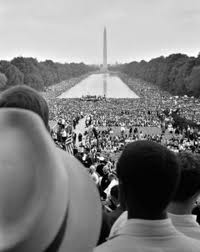
As America commemorates the 50th anniversary of the historic March on Washington for Jobs and Freedom I am compelled to ask the following question, would Dr. King be invited to speak at upcoming events to commemorate the March?
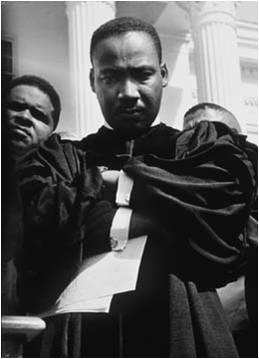 If you get past the marketed “Dream” reference in the “I Have a Dream” speech you will understand that it was an indictment of America. If you read “Beyond Vietnam: A Time to Break Silence” or Dr. King’s last book Where Do We Go From Here, Chaos or Community?; you can rest assured that today Dr. King would be in opposition to America’s backing of the assignation of Muammar Gaddafi, drone attacks, indefinite detention at Guantanamo, NSA wiretapping, mass incarceration, and the Obama administration’s failure to speak forcefully about poverty in America. From that premise one can only conclude that if Dr. King were alive today, those within the African American community who are engaged in stifling honest, fact-based, critical analysis of the administration’s policies would not allow Dr. King on the dais. Reason being, Dr. King committed his life to a morally based sense of justice and humanity not actions taken from a sense of political expediency or realpolitik.
On August 28, 1963 Dr. King stated, “Five score years ago, a great American, in whose symbolic shadow we stand today, signed the Emancipation Proclamation…One hundred years later, the colored American lives on a lonely island of poverty in the midst of a vast ocean of material prosperity.” Today according to the Bureau of Labor Statistics, the national unemployment rate stands at 7.6% and 15% in the African American community. Today, “in the midst of a vast ocean of material prosperity,” according to Bread For the World, “14.5 percent of U.S. households—nearly 49 million Americans, including 16.2 million children—struggle to put food on the table” and “more than one in five children is at risk of hunger. Among African-Americans and Latinos, nearly one in three children is at risk of hunger.”
President Obama has claimed to be a champion of the middle class but rarely speaks to the plight of the poor in America. Dr. King would not stand idly by and allow this to go unchallenged. As America spends billions of dollars on its drone program, children continue to go hungry. In his 1967 speech Beyond Vietnam: A Time to Break Silence Dr. King stated, “A few years ago…It seemed as if there was a real promise of hope for the poor, both black and white, through the poverty program…Then came the buildup in Vietnam, and I watched this program broken and eviscerated as if it were some idle political plaything on a society gone mad on war. And I knew that America would never invest the necessary funds or energies in rehabilitation of its poor so long as adventures like Vietnam continued to draw men and skills and money like some demonic, destructive suction tube.” If you replace Vietnam with Afghanistan and the War on Terror I believe Dr. King would be engaged in the same analysis and saying the same things today.
Dr. King said that the people of Vietnam must see, “Americans as strange liberators…they languish under our bombs and consider us, not their fellow Vietnamese, the real enemy…What do the peasants think as we ally ourselves with the landlords and as we refuse to put any action into our many words concerning land reform? What do they think as we test out our latest weapons on them…?” Today, Dr. King would be asking the same questions about America’s actions in Libya, Afghanistan, Pakistan, Egypt, and the continued US support for the Zionist government in Israel as it continues to build settlements on Palestinian land in violation of international law.
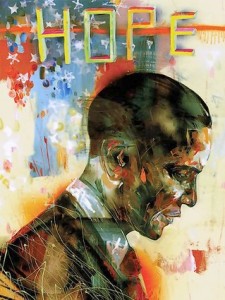 Let’s be very clear, I have used actions of the Obama administration to highlight many of the contradictions that we face and to demonstrate how the man we now revere, the icon that will be lauded at the 50th anniversary of the March on Washington would not be invited to speak in today’s political context. That’s the symptom of a greater problem.
To gain great insight into the real problem you have to examine the work of Edward Bernays and the rise of the propaganda industry in the 1920’s. “[The] American business community was also very impressed with the propaganda effort (created by Bernays). They had a problem at that time. The country was becoming formally more democratic. A lot more people were able to vote and that sort of thing. The country was becoming wealthier and more people could participate and a lot of new immigrants were coming in, and so on. So what do you do? It’s going to be harder to run things as a private club. Therefore, obviously, you have to control what people think. There had been public relation specialists but there was never a public relations industry.” History as a Weapon – Noam Chomsky – 1997.
The business community as Chomsky discussed or the corptocracy in today’s parlance uses propaganda to co-opt the American political landscape and has contributed to the decline of the American political left. The politics and policies of the Obama administration are examples of that decline, not responsible for it. th
At the 50th anniversary of the March on Washington pay very close attention to what is said and even closer attention to what is not (August 27, 2013 is the 50th commemoration of the passing of W.E.B. DuBois).
Understanding the moral basis of Dr. King’s analysis, he would be standing today for the very things he stood for then. He would be critical of the current administration, and as such, great efforts would be made to shut him out of the national debate since many in the African American community see honest, fact based, criticism of Obama administration policy as antithetical to the interests of the African American community. The prophet is never welcome in his own village.
Dr. King’s “Dream” was significant because of its juxtaposition against the reality of the Negros nightmare but Bernaysian propaganda keeps the focus on the “Dream”.
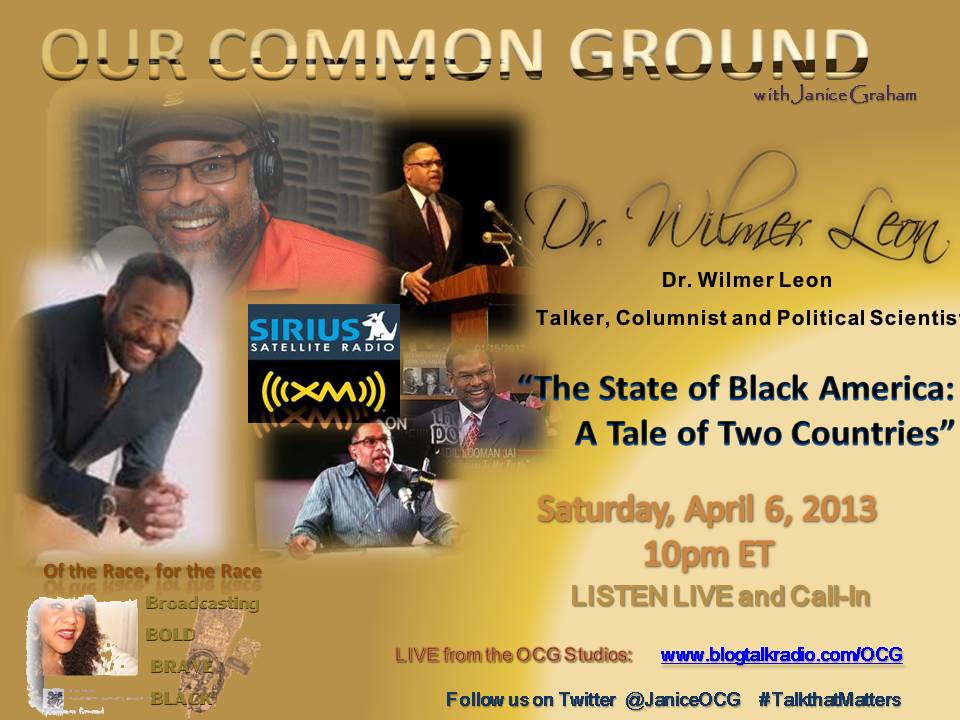 Dr. Wilmer Leon is the Producer/ Host of the Sirisu/XM Satellite radio channel 110 call-in talk radio program “Inside the Issues with Leon” Go to www.wilmerleon.com or email:wjl3us@yahoo.com. www.twitter.com/drwleon and Dr. Leon’s Prescription at Facebook.com He is an OUR COMMON GROUND Voice, joining us as Guest and Co-Host.
© 2013 InfoWave Communications, LLC
– See more at: http://www.wilmerleon.com/
“I Fear I May Have Integrated My People Into a Burning House” – Martin Luther King Jr.
“I Fear I May Have Integrated My People Into a Burning House” – Martin Luther King Jr.

Harry Belafonte speaks on last conversation between him and MLK.
http://www.scu.edu/ethics/architects-of-peace/Belafonte/essay.html
Midway through the Civil Rights movement, Dr. Martin Luther King Jr. realized that the struggle for integration would ultimately become a struggle for economic rights. I remember the last time we were together, at my home, shortly before he was murdered. He seemed quite agitated and preoccupied, and I asked him what the problem was. “I’ve come upon something that disturbs me deeply,” he said. “We have fought hard and long for integration, as I believe we should have, and I know that we will win. But I’ve come to believe we’re integrating into a burning house.”
That statement took me aback. It was the last thing I would have expected to hear, considering the nature of our struggle, and I asked him what he meant. “I’m afraid that America may be losing what moral vision she may have had,” he answered. “And I’m afraid that even as we integrate, we are walking into a place that does not understand that this nation needs to be deeply concerned with the plight of the poor and disenfranchised. Until we commit ourselves to ensuring that the underclass is given justice and opportunity, we will continue to perpetuate the anger and violence that tears at the soul of this nation.”
“I fear, I am integrating my people into a burning house.”
~ Rev. Dr. Martin Luther King, Jr
Dr. King said the above statement to Harry Belafonte in a conversation they had before his death. Belafonte startled at the statement said to him “What should we do?” Dr. King told him that we “Become the firemen, Let us not stand by and let the house burn.”
On the flip side of that, you have a speech by Malcolm X. It was entitled “The House Negro and the Field Negro.” He spoke about how the House Negro loved the Master more than he loved himself. And that if the Masters house caught on fire, the House Negro would try to put the fire out. On the other hand you have the Field Negro. The Field Negro hated the master and despised his very existence. If the Master’s house were to catch on fire, the Field Negro would pray for a strong wind to come along.
Here you have two black thoughts that are on opposite sides of the spectrum. The feelings are as true today as they were when both these statements were proclaimed in the mid 60’s.
What are your thoughts on this?
How can one fight for something they don’t believe in?
or
Why would someone fight for something they believe will ultimately destroy the people they are supposedly fighting for?