It is clear that a military operation has been unleashed against this American citizen. It is a popular protocol of war to hunt down friendly witnesses of war atrocities.

Agyei Tyehimba- Empowerment Coach's avatarMY TRUE SENSE

Dorner

If you are unfamiliar with Christopher Dorner, you are either under the influence of a powerful narcotic, or you live in a cave with no access to television, computer or internet service. In any event, both the corporate propaganda machine (the mainstream media) and corporate security (law enforcement) have every interest in defining this man and his meaning for you.

What we know is that the 33 year-old former LAPD officer and former member of the Navy Reserve recently killed a police officer, the daughter of a former police officer and her fiance . We also know that this armed and dangerous man” has “declared war” on law enforcement officers, and even their family members.

Therefore Mr. Dorner is presented to us as a desperate madman on the run who will inevitably meet a most violent end at the hands of the law enforcement agents chasing him across the “Big…

View original post 608 more words

The American Case Against a Black Middle Class l TA-NEHISI COATES l The Atlantic

The American Case Against a Black Middle Class

 JAN 22 2013 

I went on a Twitter rant yesterday because I’d finished Isabel Wilkerson’s phenomenal The Warmth Of Other Suns. The book is a narrative history of the Great Migration through the eyes of actual migrants. Several points stick out for me.

1) The Great Migration was not an influx of illiterate, bedraggled, lazy have-nots. Wilkerson marshalls a wealth of social science data showing that the migrants were generally better educated than their Northern brethren, more likely to stay married, and more likely to stay employed. In fact, in some cases, black migrants were better educated than their Northern white neighbors.
2) In this sense, the migrants to Northern cities resembled immigrant classes to whom black people in these same cities are often unfavorably compared to. There’s a quote in Wilkerson’s book which I can’t find where a supervisor basically says that blacks are the favored workers because they will work hard at the worst jobs for relatively little money. You would have thought the guy was talking about Hispanic farm-hands today.
3) The black migrants were not immigrants. They were citizens of this country who did not enjoy its full protection. Unlike other immigrant classes, blacks were never able to cash in on their hard work and middle-class values. For all of their work-ethic, education-valuing, and long-term marriages, they received the worst wages in the worst jobs, were limited to the worst housing, and stuffed in the worst schools.
4) What becomes clear by the end of Wilkerson’s book is that America’s response to the Great Migration was to enact a one-sided social contract. America says to its citizens, “Play by the rules, and you will enjoy the right to compete.” The black migrants did play by the rules, but they did not enjoy the right to compete. Black people have been repeatedly been victimized by the half-assed social contract. It goes back, at least, to Reconstruction.
5) The half-assed social contract continues to this very day with policies under the present administration, like the bail-out of banks that left the homeowners whom the banks conned underwater. The results of the housing crisis for black people have been devastating. The response is to hector these people about playing video games and watching too much television. Or to tell them they’ve have “an achievement gap.” It is sickening, dishonest, and morally repugnant.
6) America does not really want a black middle class. Some of the most bracing portions of Wilkerson’s book involve the vicious attacks on black ambition. When a black family in Chicago saves up enough to move out of the crowded slums into Cicero, the neighborhood riots. The father had saved for years for a piano for his kids. The people of Cicero tossed the piano out the window, looted his home, torched his apartment and then torched his building. In the South, when black people attempted to leave to earn better wages, they were often forcibly detained, and thus kept in slavery as late as the 1950s.
On a policy level, there is a persistent strain wherein efforts to aid The People are engineered in such a way wherein they help black people a lot less. It is utterly painful to read about the New Deal being left in the hands of Southern governments which were hostile to black people, and then to today see a significant chunk of health care, again, left in the hands of Southern governments which are hostile to black people.  At this point, such efforts no longer require open bigotry. They are simply built into the system.
7) “That the Negro American has survived at all, is extraordinary.” That is from the Moynihan report, which neo-liberals are fond of touting, while ignoring the report’s lengthy policy recommendations.
8) Get the book. Read it now. Today is too late.

 – Ta-Nehisi Coates is a senior editor at The Atlantic, where he writes about culture, politics, and social issues for TheAtlantic.com and the magazine. He is the author of the memoir The Beautiful StruggleMore


THE OTHER FACE OF GUN VIOLENCE: KEEPING GUNS FROM HIGH-RISK INDIVIDUALS l Jamye Wooten, Kinetics LIVE

Suicide-Gun-Violence

THE OTHER FACE OF GUN VIOLENCE: KEEPING GUNS FROM HIGH-RISK INDIVIDUALS

By Jamye Wooten | NEWS & VIEWS

 “The staggering toll of gun violence—which claims 31,000 U.S. lives each year—is an urgent public health issue that demands an effective evidence-based policy response.”– The Case for Gun Policy Reform in America

There’s a world of difference between truth and facts. Facts can obscure the truth.”– Maya Angelou

There has been a lot of attention given to gun violence, since the day Adam Lanza armed himself with hundreds of bullets and took the lives of 20 children and six adults at Sandy Hook Elementary in Newtown, Connecticut. This tragic story has gotten the attention of corporate media, the nation, and even a President who hails from one of the deadliest cities in the country. “We won’t be able to stop every violent act, but if there is even one thing that we can do to prevent any of these events, we have a deep obligation, all of us, to try,” stated President Obama.

English: New York Mayor, Michael R. Bloomberg.New York Mayor, Michael R. Bloomberg.

New York City Mayor Michael Bloomberg, co-founder of Mayors Against Illegal Guns, also joined the chorus launching  Demand a Plan, a celebrity backed PSA campaign to reform gun laws.

Mayor Bloomberg has been supportive of the controversial, “Stop and Frisk” program of the NYPD that has resulted in over 4 million stops and street interrogations of mostly Black and Latinos in New York City since 2002. According to New York Civil Liberties Union (NYCLU) guns are found in less than 0.2 percent of stops, prompting concerns over racial profiling.

Gun Policy Summit

The staggering toll of gun violence—which claims 31,000 U.S. lives each year—is an urgent public health issue that demands an effective evidence-based policy response.

The staggering toll of gun violence—which claims 31,000 U.S. lives each year—is an urgent public health issue that demands an effective evidence-based policy response.

Last month, I attended a two-day Gun Policy Summit hosted by Mayor Bloomberg and the John Hopkins University School for Public Health. I was interested in hearing what sort of gun policy recommendations would be proposed and their potential impact on the Black community.

According to the research there are over 31,000 incidents of gun violence each year in the United States, but while homicides often make the headlines, there is a less known fact when dealing with issues of gun violence.

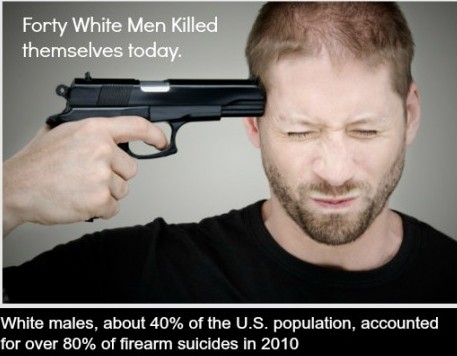
Out of the 31,000 lives lost due to gun violence, every year 19,000 or almost 2 out of every 3 are suicides. White males accounted for over 80% of gun related suicides in 2010. And according to the American Foundation for Suicide Prevention, yearly medical costs associated with suicide, is nearly $100 million and 90% of people who die by suicide have a diagnosable and treatable psychiatric disorder at the time of their death.

Every night we watch Black men on the nightly news who have been involved in gun violence. Gun violence in urban America is a serious issue and Black youth are disproportionately victims of it. When addressing the high rates of homicide in the African-American community, Dr. Linda Frisman told the audience at John Hopkins “that being African-American and Hispanic are really proxies for social and economic disadvantage.” This is something that most Blacks understand. Addressing gun violence in urban America will not be solved with more police and school resource officers as President Obama has recommended or by adding additional security cameras to our schools that stream live to patrol cars and police precincts. If we are serious about reducing gun violence, we must address the social and economic disparities in communities of color. Strong economically secure communities that provide family sustaining wages, affordable housing, culturally relevant and enriching education that equips children with skills to succeed in the 21st century, and love will make schools and neighborhoods safe for our children. Successful faith and community-based programs should be rewarded with additional funds with less money being poured into Police departments that normally respond punitively when dealing with our children.

Another forty white men have killed themselves tonight

I begin to think, what if each night the local nightly news began by stating, “Another forty white men have killed themselves tonight?”

There are studies for every social pathology in the Black community, and policy responses crafted by “experts,” that are often punitive and never seem to be systemic. But for some reason, you can’t find much research on white males and why they are killing themselves at an alarming rate, or why there is a fascination with weapons. What if we began to take the same data and create policy around it? What would it look like? Would it stigmatize white males? Would we have to dispatch mental health professionals to workplaces every time they were laid off? Would we need to send the Bureau of Alcohol, Tobacco, Firearms and Explosives (ATF) to their homes to search and remove their guns? How safe would White women and children feel when their husbands and fathers were laid off? Would white men be considered a High-Risk group for firearm ownership? Or would there be a stop and frisk policy implemented for White men over the age of 50?

In October of 2012, leading experts from the Johns Hopkins Bloomberg School of Public Health produced a report entitled, “The Case for Gun Policy Reform in America.” Many of the policy recommendations from the expert reports concentrated on Firearms Prohibitions for High-Risk Persons. Though suicide is the leading cause of death by firearms, with White males accounting for over 80%, they were not mentioned in the high risk category.

Well, who are the High Risk groups that should be prohibited from owning firearms? Under the section entitled, Why Firearms Prohibitions for High-Risk Persons Should be Broadened the categories include Criminals, Substance Abusers (Illegal Substances) and Youth Under Age 21.

Criminal Prohibitions

We believe the evidence above justifies an extension of firearm prohibitions for persons with a history of criminal behavior to include persons convicted of all misdemeanor crimes of violence, as well as individuals who have committed felony crimes as a juvenile.”

Substance Abusers

The number of drug abusers prohibited from possessing firearms might be increased significantly by revamping these regulations to, for example, expand the period following a drug conviction for which a person is prohibited from possessing firearms.”

Youth Under Age 21

Restrictions on youths’ ability to purchase and possess firearms should be broadened. Although federal law and most state law allows youth 18 to 20 years of age to legally possess a handgun, youth of these ages have some of the highest rates of homicide offending.”

These policy recommendations are about narrowing access to who can legally own a firearm, by identifying the most high-risk persons. The criminal prohibitions and substance abusers recommendations would narrow the number of Black people who have access to guns. Not because Blacks use illegal substances at higher rates than Whites. According to the NAACP, “5 times as many Whites are using drugs as Blacks, yet the Black population, especially men are sent to prison for drug offenses at 10 times the rate of Whites.”  The NAACP Criminal Justice Fact Sheets states that “in 2002, despite that fact that more than 2/3 of crack cocaine users in the U.S. are white or Hispanic, blacks constituted more than 80% of people sentences under federal crack cocaine laws.”

It is also important to remember, as Dr. Matthew Miller pointed out, the vast majority guns that kill are handguns and legally owned.

United Nations Conference on the Arms Trade Treaty

Internationally the United Nations appears to be pursuing the same policies. In March of this year they will convene the United Nations Conference on the Arms Trade Treaty (ATT). The conference is designed to tighten import, export and transfer of conventional arms. The UN states that ATT “will not aim to ban any weapon.” And why would they? White men control the most deadly arsenals of weapons of mass destruction in the world. Instead, the conference wants to make sure weapons don’t fall “into the hands of terrorists, drug traffickers, and criminal cartels.”

Drug traffickers and Criminal cartels? I think you already know who the target groups are. This sounds very familiar to the language in the Hopkins report. Identify high-risk populations, mostly communities of color and limit their access to acquiring weapons while leaving out the highest risk group, White men. No group has manufactured, proliferated or used more weapons of mass destruction than White males, yet they conveniently label communities of color as “terrorists” or “high risk.”

They will beat their swords into plowshares and their spears into pruning hooks. Nation will not take up sword against nation, nor will they train for war anymore. – Isaiah 2:4

I pray for the day when we will beat our swords into plowshares and study war no more. But until then, we must make an honest effort to make sound gun policy. We must make sure that the War-on-Guns does not unfairly target people of color in the same way the War-on-Drugs have devastated our community.

READ MORE on Kinetics LIVE

When liberals ignore injustice

TUESDAY, FEB 5, 2013

When liberals ignore injustice

Why isn’t there more outrage about the president’s unilateral targeted assassination program on the left?

BY 


When liberals ignore injustice
(Credit: AP/Susan Walsh)

Last year Brown University’s Michael Tesler released a fascinating study showing that Americans inclined to racially blinkered views wound up opposing policies they would otherwise support, once they learned those policies were endorsed by President Obama. Their prejudice extended to the breed of the president’s dog, Bo: They were much more likely to say they liked Portuguese water dogs when told Ted Kennedy owned one than when they learned Obama did.

But Tesler found that the Obama effect worked the opposite way, too: African-Americans and white liberals who supported Obama became more likely to support policies once they learned the president did.

More than once I’ve worried that might carry over to bad policies that Obama has flirted with embracing, that liberals have traditionally opposed: raising the age for Medicare and Social Security or cutting those programs’ benefits. Or hawkish national security policies that liberals shrieked about when carried out by President Bush, from rendition to warrantless spying. Or even worse, policies that Bush stopped short of, like targeted assassination of U.S. citizens loyal to al-Qaida (or “affiliates”) who were (broadly) deemed (likely) to threaten the U.S. with (possible) violence (some day).

Those ugly parentheses are made necessary by Michael Isikoff’s exclusive report on the Obama administration “white paper” that justifies its unprecedented claim to the power to assassinate U.S. citizens without due process on foreign soil. The New York Times and the ACLU had sued to get the administration to release the Office of Legal Counsel’s opinion in the case of the targeted assassination of Anwar al-Awlaki by drone strike in Yemen last year. The administration fought that effort, but Isikoff was leaked a summary, “Lawfulness of a Lethal Operation Directed Against a US Citizen Who is a Senior Operational Leader of Al-Qa’ida or An Associated Force.” It lays out a legal rationale far beyond anything the administration has claimed before.

Specifically, where Attorney General Eric Holder insisted such attacks would only be used to deter “imminent threat of violent attack,” similar to the rights police officers have to kill a suspect in a hostage situation or impending terror attack, the white paper clarifies what that means – or rather obfuscates – in chilling language:

The condition that an operational leader present an ‘imminent’ threat of violent attack against the United States does not require the United States to have clear evidence that a specific attack on U.S. persons and interests will take place in the immediate future.

So: the president doesn’t need “clear evidence” of a “specific attack” planned for “the immediate future.” How about little or no evidence of some vaguely debated attack at some point some day?

And while joining up with al-Qaida might be evidence that an American means his or her country grave harm, what about hooking up with “associated force”? The memo doesn’t define it. And it doesn’t restrict the power to make these judgments to the commander in chief either; it’s enough that an “informed, high-level official” deem the suspect an “operational leader” who presents the danger of an unspecified “imminent threat” – some day.

As Glenn Greenwald notes, the paper itself makes clear it’s establishing a kind of ceiling, not a floor – it allows that targeted assassination may also be allowed under conditions not outlined in the paper. “This paper does not attempt to determine the minimum requirements necessary to render such an operation lawful,” it states; rather, “it concludes only that the stated conditions would be sufficient to make lawful a lethal operation.” And it reflects a continuation of the Bush-Cheney doctrine of “global battlefield,” justifying such operations anywhere al-Qaida may be operating.

Opponents of Obama’s targeted assassination program have tried to galvanize some public outrage by pointing not to the killing of the senior al-Awlaki, who went public many times with his fealty to al-Qaida and his desire to see the U.S. attacked, but of his 16-year-old son, Abduhrahman, who was killed in a separate targeted strike two weeks later. We don’t know anything about the evidence against the younger al-Awlaki, and liberals who care about the rights of the accused, especially the minor accused, should be expected to care maybe a little bit more about the 16-year-old. Except many don’t. Most famously, when former Obama press secretary Robert Gibbs was confronted by a reporter who questioned “an American citizen that is being targeted without due process, without trial … And, he’s underage. He’s a minor,” he replied:

I would suggest that you should have a far more responsible father if they are truly concerned about the well being of their children. I don’t think becoming an al Qaeda jihadist terrorist is the best way to go about doing your business.

It’s hard to imagine Obama supporters defending the punishment of a 16-year-old because he “should have a more responsible father” – let alone capital punishment.

After the killing of Trayvon Martin, I got in ugly Twitter battles with tin-eared leftists who trashed Obama for defending Martin when he had presided over the killing of the younger al-Awlaki. They ignored the very real relief many African-Americans felt that the president spoke up for Martin with the poignant comment, “If I had a son, he’d look like Trayvon.” Today on Twitter, some Obama supporters are accusing the president’s critics – without evidence — of caring more about al-Awlaki than Trayvon Martin. Ugh. It’s even been suggested that raising questions about the president’s targeted assassination policy is a form of “white privilege.” Goldie Taylor, someone I respect, clarified her Tweet to say that “selective outrage” over the Isikoff story reflects “white privilege.” But plenty of people questioning targeted assassination also protested George Zimmerman’s killing of the unarmed Martin.

Weirdly, today would be Trayvon Martin’s 18thbirthday. I think people who care about justice have hearts and minds big enough to be concerned about all forms of injustice, and potential injustice. Late last year I admitted I looked away from some of the more disturbing national security policies of the Obama administration before the election because I knew President Romney would almost certainly pursue worse ones. But in the president’s last term, I think it’s incumbent on people who care about civil liberties to care about these policies. It would be a shame if Obama’s popularity made people who once cared about such issues care less.

Finally, it should be noted that the OLC “white paper” was leaked to Isikoff, not formally released. I’m not going to be dishonest and say I’d like the policies it describes any more had it been voluntarily disclosed, but at least it would be a gesture toward transparency by the administration. We also don’t know if this is indeed the rationale the president used to justify killing the al-Awlakis; there’s evidence that it is not, and that the specific legal case was outlined in another still secret memo. The worst thing about this policy is that it’s been pursued with zero checks, balances, accountability or transparency. That, at least, should change in the months to come.

Joan Walsh 

Joan Walsh is Salon’s editor at large and the author of “What’s the Matter with White People: Why We Long for a Golden Age That Never Was.”

theGrio’s 100: OUR COMMON GROUND Voice, Nina Turner

theGrio’s 100: Nina Turner, taking on voter suppression in Ohio

Senator Nina Turner (OhioSenate.gov)Senator Nina Turner (OhioSenate.gov)

Who is Nina Turner? 

The Ohio state senator emerged as one of the loudest voices in the country against controversial voting laws advanced by Republicans in her state, which was one of the most important battlegrounds in the 2012 campaign. Turner, 45, represents the Cleveland area, where she  grew up and and later served as a city councilman.

Why is she on theGrio’s 100? 

Ohio was one of the biggest flash points in the various controversies over voting laws and restrictions during the campaign. And Turner was a constant voice, insisting on making sure that it was as easy as possible for people both in Cleveland and throughout the state to vote. She made numerous appearances on MSNBC and other cable news outlets, as well as making her concerns known locally.

“Public officials at all levels have a moral obligation to make it easier to vote, but some of Ohio’s leaders have ignored this responsibility,” she said last year in the midst of the voting controversies.

Ohio state senator Nina Turner wears T-shirt: ‘GOP: Get out of my panties’

Her actions had impact. In the end, public attention and legal decisions forced Ohio Secretary of State Jon Husted, a Republican, to abandon many controversial ideas that could have depressed the Obama vote in the Buckeye State, which the president won.

What’s next for Turner? 

Turner could eventually consider a run for the U.S. House or Senate or as Cleveland mayor. But more immediately, she is likely to continue playing a role in elections in 2014 and 2016 in battling Republicans on voting laws.

In 2014, Democrats want to win back the statehouse in Ohio, and Turner could help rally the party’s base to ensure reelection. And in 2016, Ohio is very likely to remain in the spotlight as a battleground state.

Related Posts

theGrio’s 100: OUR COMMON GROUND Voice, Barbara Arnwine

theGrio’s 100: Barbara Arnwine, keeping civil rights front and center

Laywers' Committee for Civil Rights Under Law Executive Director Barbara Arnwine (2nd R) speaks during a news conference to voice opposition to state photo identification voter laws with the Rev. Jesse Jackson (C) and members of Congress at the U.S. Capitol July 13, 2011 in Washington, DC. In what the the committee calls 'vote supression legislation,' eight states require photo identification for people to vote and 22 others are considering similar legislation. (Photo by Chip Somodevilla/Getty Images)Laywers’ Committee for Civil Rights Under Law Executive Director Barbara Arnwine (2nd R) speaks during a news conference to voice opposition to state photo identification voter laws with the Rev. Jesse Jackson (C) and members of Congress at the U.S. Capitol July 13, 2011 in Washington, DC. In what the the committee calls ‘vote supression legislation,’ eight states require photo identification for people to vote and 22 others are considering similar legislation. (Photo by Chip Somodevilla/Getty Images)
Arnwine is president and executive director of theLawyers Committee on Civil Rights Under Law,which works on issues like racial profiling and voter protection.

Why is she on theGrio’s 100? 

Arnwine and her group were instrumental in battling controversial voting laws, such as ones requiring photo identification to vote, that were passed by Republican legislatures in 2011 and 2012. The committee joined lawsuits against many of the laws, helping lead to many of them being struck down by courts. The group also created a “Map of Shame” depicting which states had the most controversial voting laws and a hotline for people to report voting or registration problems in the months before Election Day.

“Voter suppression legislation that has been debated and passed across the nation since the 2010 mid-terms threatens to heighten voter confusion this November,” Arnwine said in the midst of the campaign.

The effort by Arnwine and others was successful, as Obama campaign aides said the voter laws had little impact on the 2012 election results.

What ‘s next for Arnwine? 

The battle over voter laws is likely to continue. While courts put aside many of the laws in 2012, Republican-led legislatures and governors are likely to propose them again in the future. And the 2014 and 2016 campaigns are not far away.

Arwine

LISTEN TO OUR COMMON GROUND with Barbara Arnwine HERE

Related Posts

Do Black Intellectuals Need to Talk About Race? l Room for Debate @ NYT

Room for Debate Home

UPDATED FEBRUARY 4, 2013 8:33 PM

Do Black Intellectuals Need to Talk About Race?

Black Intellectuals Have Sold Their Souls

Eddie S. Glaude Jr.

Eddie S. Glaude Jr. is the William S. Tod Professor of Religion and African-American Studies in the department of religion at Princeton University and the chairman of the Center for African-American Studies.

FEBRUARY 4, 2013

 Black academics don’t have a “special obligation” to speak to broader social and political issues. What we have witnessed over the last few decades is the increasing professionalization of this particular class of persons – where the object of their scholarly interests range across a number of subjects that aren’t reducible to questions of race. These individuals stand alongside those who work explicitly on racial matters, but their work doesn’t necessarily reach beyond the confines of a specialized academic community. The political significance of their ideas has been weakened or worse, banished to the shadows, and we’re left, as my grandmother would say, “bumping our gums.”


Too many have given up the work of thinking carefully about black America. We have become cheerleaders for President Obama or self-serving pundits.

However, the role of the black intellectual raises a different question. I do believe that intellectuals generally ought to aspire to be the moral conscience of their societies: that what we write, say and do should reflect intelligent efforts to provide a critical account of who we take ourselves to be as a nation. Black intellectuals take up this task in the context of black communities and the ever-shifting regime of race that undermines democratic possibility in this country. (And remember that the folks who do this kind of labor do not have to work in universities or colleges.)

That’s what they ought to do. Instead, today we are experiencing a “new nadir.” Too many black intellectuals have given up the hard work of thinking carefully in public about the crisis facing black America. We have either become cheerleaders for President Obama or self-serving pundits. Our celebration of his singular achievement and our crazed desire for access have made many of us “born-again patriots.”

All too often what stands in for the black intellectual these days are folks who can spin a phrase and offer a soundbite. The idea of the intellectual who reads widely and deeply and who critically engages the complexity of our times has been supplanted by the fast-talking “black Ph.D. pundit” who strives to be on CNN, Fox or MSNBC. This same pundit has found new career opportunities within universities and colleges by thinking about black people in ways that conform to the current liberal consensus about racial matters.

The combination turns out to be a deadly one. I am reminded of what the sociologist C. Wright Mills wrote in 1948: “The two together, for the liberal ideology, as now used by intellectuals, acts as a device whereby he can take advantage of the new career chances but retain the illusion that his soul remains his own.” Put another way, too many black intellectuals have sold their souls “for a mess of pottage,” while the misery in black America deepens. And there is a tragic story to tell about how we arrived at this point.

Even given this state of affairs, I remain hopeful. Those of us committed to the work of thinking carefully in public with others must model the value of seriousness amid the white noise of our current media landscape. This involves using various social networks to push critical conversations and thinking among our fellows; it entails recommitting ourselves to build reading and writing communities that cultivate the habits of public intellectual work; it means bringing our skills to bear on the problems of our day through interpretations that single out our failings and point the way forward to what needs to be done to, as James Baldwin wrote, “achieve our country.”

Room for Debate NYT


Do Black Intellectuals Need to Talk About Race?

DEBATERS

Eddie S. Glaude Jr.

Black Intellectuals Have Sold Their Souls

EDDIE S. GLAUDE JR., RELIGION, PRINCETON

Too many have given up the work of thinking carefully about black America. We have become cheerleaders for President Obama or self-serving pundits.

Melissa Harris-Perry

The Few, the Famous

MELISSA HARRIS-PERRY, POLITICAL SCIENCE, TULANE

Most of the work of academics goes unnoticed. A few of us gain public attention, but most often we are just the best-looking, most articulate thought synthesizers of our age.

Carl Hart

Keep to Your Expertise

CARL HART, PSYCHOLOGY, COLUMBIA

Not every black academic is an expert on race. Qualified intellectuals of any race should raise their voices about social and racial issues.

Stephon Alexander

A Responsibility to the Next Generation

STEPHON ALEXANDER, PHYSICS AND ASTRONOMY, DARTMOUTH

As a tenured faculty member, I feel an obligation to recruit and mentor black and other minority group members, as well as to shape institutional support.

Khalil Muhammad

Many Voices’ Many Agendas

KHALIL MUHAMMAD, SCHOMBURG CENTER, NEW YORK PUBLIC LIBRARY

The incarceration and sustained poverty of black and brown young men are a product, in part, of the off-campus activities of conservative black intellectuals.

INTRODUCTION

W.E.B. Du Bois, the sociologist and civil rights activist, in 1949.Associated PressW.E.B. Du Bois, a leading black intellectual of an earlier generation.
Two decades ago, The Atlantic Monthly chronicledthe rise of black academics, including Cornel West, Henry Louis Gates Jr. and Patricia Williams, who had vigorously taken on the role of public intellectuals, stirring debate on issues of importance to African-Americans. Today, more African-Americans hold more positions at colleges, not always involving subjects that have particular relevance to black people.

Do these academics still have a special obligation to address the nation’s social and racial issues? Are there particular challenges or opportunities faced by intellectuals who talk to the public about social issues?

Josef Sorett, an assistant professor of religion and African-American studies at Columbia University, organized this discussion.

READ THE DISCUSSION »

“The Vicissitudes of OUR Struggle to Matter – Black History , Victories and Pain” l Soul AFIRE with Dr. Matthew V. Johnson

SOUL AFIRE with Dr. Matthew V. Johnson

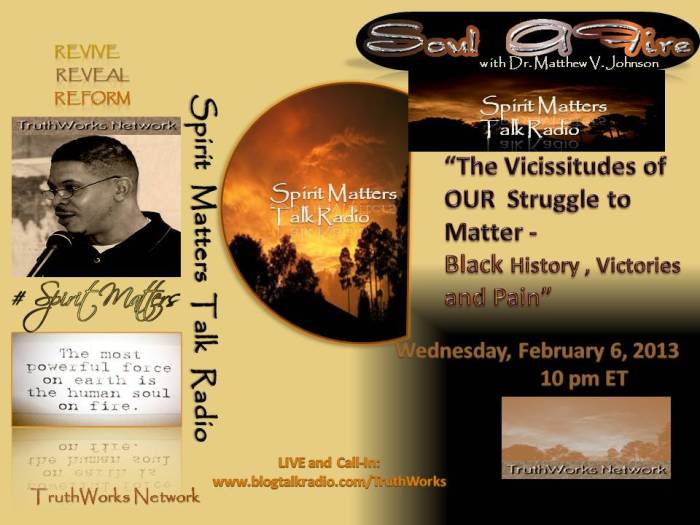
“The Vicissitudes of OUR Struggle to Matter – Black History , Victories and Pain”

February 6, 2013 10 pm ET
“Spirit Matters Talk Radio”


02-06 Vicissitudes

From Matters of Religion to Matters of Politics
…Spirit Matters…

#Spirit Matters

Listen Live: http://www.blogtalkradio.com/truthworks
Call In Line: 914-338-1610

This Week from the Spirit Matters Journal of Dr. Matthew V. Johnson

“Just a general observation on American society. This comment seems to me justified in the way the society, culture and the mass media treats issues concerning whites and blacks, as well as whites and blacks deferentially in matters that concern them both. What follows is a phenomenological observation not a normative affirmation.

Black people’s whole struggle seems to be the vicissitudes of their efforts to matter. While the entire presumption of White society is that they have ultimate significance while all other’s significance is a derivative of their place in how white people see themselves. It must be nice to live in a cultural universe where one matters so much. Of course this is a question of the entanglements of pathological narcissism, the different levels of causality and the existential entrance point in the received framework.”

ABOUT SOUL AFIRE
A new and urgent broadcast experience . . .

Soul Afire is a live talk radio program hosted by Dr. Matthew V. Johnson, Sr. The call-in program Inspires and Incites the personal spirit to come alive and reach for the fire within. Whether your life moves in the nests of tumbleweed against desert dryness or flows quietly in the sanctuary of lush foliage of a tropical riverbed, you live by the realm a claimed or neglected human spirit. Soul Afire is about the human Spirit and how it navigates Blackness. The program will feature Dr. Johnson’s weekly commentary, “Spirit Matters”.

ABOUT REVEREND DR. MATTHEW V. JOHNSON


Johnson14Matthew V. Johnson, Sr., is a graduate of Morehouse College and earned his Masters and Ph.D. degrees in Philosophical Theology from the University of Chicago. He has done post-graduate studies in Psychoanalysis and is a member in training at the Institute of Contemporary Psychotherapy and Psychoanalysis. In the ministry for thirty years, Dr. Johnson is the Pastor of Church of the Good Shepherd-Baptist located in Atlanta, GA.

Soul AFIRE

http://ww.soulafire.wordpress.com/
Like us on FB: SoulAFire
Twitter: @ASoulAFire #SpiritMatters
Email: soulafire@truthworksnetwork.com

TruthWorks Network

flaming new twnlogo 7-12

Facebook: http://www.facebook.com/TruthWorks

On the Web
http://www.truthworks.wordpress.com/
http://www.truthworks.ning.com/

THIS IS AN INTERNET-BASED BROADCAST ! LISTEN FROM ANYWHERE on YOUR SMART DEVICE or Computer

Join our active participants in our open chatroom.
http://www.blogtalkradio.com/\Truthworks

Call In Line: 914-338-1610
TruthWorks Studios:
http://www.blogtalkradio.com/TruthWorks

7 Electoral Scenarios Most Likely to Trigger Armed Rebellion

 7 Electoral Scenarios Most Likely to Trigger Armed Rebellion

Or, you know, a total cable news freakout.

By 

| Tue Oct. 30, 2012 2:03 AM PDT
Obama vs Romney

On November 6, the fate of the free world will be decided by a handful of voters in Iowa, Virginia, Ohio, and Colorado, many of whom will have made up their minds at the last minute after a frantic bout of Googling (“Mitt Romney” + “Gangnam style”). If all goes as planned, the losing candidate will call to graciously congratulate the winning candidate sometime before the East Coast has gone to bed, the losing party will begrudgingly accept the result, and the transfer of power will continue in peace, as it has without exception every four years since 1860.

Probably. But there’s another possible outcome: Instead of a smooth transition, the nation could be thrown into a constitutional crisis, or at the very least, a few more weeks of waiting. Here’s a look at what could happen, in no particular order of probability:

Unpopularly elected: President Obama wins the Electoral College by the narrowest of margins—but loses the popular vote to Mitt Romney. That could trigger a coordinated challenge to the legitimacy of the election. As CBS News’ Scott Conroy notes, “In the days before the 2000 election, George W. Bush’s campaign reportedly prepared talking points to dispute the democratic fairness of what was then seen as a more likely outcome—that Al Gore would win the Electoral College while losing the popular vote.” (When the opposite scenario unfolded, Gore pushed wary Democrats to accept the outcome.) The New York Times‘ Nate Silver projects that there is a 5.2 percent chance of Obama winning the Electoral College while losing the popular vote—and a 2 percent chance of the reverse.

Romney-Biden: Barack Obama wins the popular vote on November 6, winning every state John Kerry did in 2004, plus Iowa and Virginia, getting him every state he needs to clinch the election. But there’s a catch: Romney pulls off an upset in Maine’s second congressional district, the state’s most conservative (Todd Palin campaigned there in 2008). Maine is one of two states to split its electoral votes, and the victory would put Romney and Obama in a 269-269 Electoral College tie.

Or: Obama loses every swing state but Ohio.

Or: Obama wins Virginia, Colorado, Nevada, and New Hampshire. But he loses two blue states—Wisconsin and Iowa—along with Florida and Ohio.

Or: Obama peels off one congressional district in Nebraska (Omaha), wins Ohio and Virginia, but loses Wisconsin, Iowa, New Hampshire, Nevada, Florida, and Colorado.

The presidential tie then goes to the Republican House of Representatives. (Silver’s model gives this an 0.3 percent chance of happening.) Each state delegation gets one vote. Romney wins easily.

But it’s not that simple. In the event of an Electoral College tie, the Constitution stipulates that the vice president be chosen by the Senate—which is in Democratic hands until at least January. Even if a few Democrats peel off (we’re looking at you, Joe Manchin), a 50-50 tie would be settled by the vice president. Voting for yourself to be second-in-command to your ideological opposite? Sounds like the ultimate Biden move.

President Boehner: Thanks to a combination of lame-duck congressmen and turncoats, the House ends up in a 25–25 tie, making Speaker of the House John Boehner (R-Ohio) president. He immediately breaks into tears.

Nader 2.0: Democrats fall flat on November 6. Romney wins the big three—Florida, Virginia, and Ohio—plus Iowa, and Obama falls below the 50 percent mark in Colorado and Nevada. But aided by disaffected Ron Paul supporters who feel they’ve been pushed around by the GOP one too many times (and a marijuana referendum in Colorado), Libertarian Gary Johnson has one of the best performances in his party’s short history, taking in 4 percent of the vote in both states. It’s enough—barely—to put Obama over the top.

Recount! With visions of hanging chads still fresh in everyone’s heads, the presidency once more comes down to one or two pivotal states. On November 7, it’s still too close to call. Likely candidates include Iowa, whose GOP caucus last January was marred by vote-counting troubles, or—perish the thought—Florida. In Colorado and Ohio, a recount is automatically triggered if the difference between the two candidates is half of 1 percent or smaller. In Virginia, a recount can be requested if the margin between the two candidates is less than 1 percent of the non-write-in vote. Minnesota Sen. Al Franken wasn’t seated until July of 2009, after an eight-month legal battle and recount process.

Going rogue: In September, the Associated Press reported that at least three Republican electors were considering not voting for Mitt Romney in the Electoral College should he win their state in November. (A fourth resigned his position in protest.) In a close race, those three votes—which would likely go to Ron Paul—could make all the difference. They could also lead to messy legal action, since Nevada, home to one of the potentially wayward electors, requires electors to abide by the popular vote result.

November surprise: Biblical prophesy guru and Michele Bachmann confidante Jan Markell has warned that this election would have “apocalyptic” consequences. And she was right. As the nation awaits the returns on election night, President Obama reveals that he is really one of the therion, a seven-headed, 10-horned sea beast prophesied in the Book of Revelation. The world immediately plunges into war, ending, after many years of violent upheaval, with the therion being thrown into the Lake of Fire. Interestingly, the Constitution makes no provisions for this kind of scenario, although presumably it will end with Virgil Goode seizing power.

The GOP’s Plan to Rig the Electoral College, Explained

How the GOP could win by losing.

By 

| Thu Jan. 31, 2013

Ever since the 47 percent dashed Mitt Romney’s White House dreams, GOPers have been trying to figure out what went wrong, and how to stop it from happening again. Texas Republican Sen. Ted Cruz suggests that Republicans stop reading the New York Times. Sen. Marco Rubio (R-Fl.) is seizing the opportunity to reform his party’s stance on immigration. But other GOPers are pitching a solution that will sound familiar to anyone who witnessed the 2010 GOP gerrymandering effort or the ensuing voter fraud wars: If you can’t win, change the rules—in this case, the rules of the Electoral College. Here’s what you need to know.

They’re changing the rules of the Electoral College? What’s the Electoral College? You don’t personally elect the president of the United States, the Electoral College does. Each state has a number of electoral votes equal to the state’s number of US senators and representatives—Montana has 3, New York has 29, Texas has 38, and giant California has 55. Washington, DC, is the only nonstate with electoral votes; it gets three. There are 538 electoral votes total, and you need 270 to win. When a presidential candidate wins the popular vote in a state, he or she gets all of that state’s electoral votes—except in Maine and Nebraska. (More on that later.) This last bit, called the winner-take-all rule, is what Republicans have been trying to change.

Okay, but how does the plan work? The GOP doesn’t have one “master plan” to rig the electoral college. Instead, lawmakers are considering a couple of different versions of a plan that would tie electoral votes to congressional districts. Ready to geek out? Okay. The plan would award one electoral vote to the winner of the popular vote in each congressional district. That would leave two leftover electoral votes, representing the state’s two senators, up for grabs. In Virginia’s plan, the two bonus votes would have been given to the candidate who won the most districts (that proposal was killed on Tuesday); in other versions of the proposal, two bonus votes would go to the winner of the statewide popular vote.

The only problem? Congressional districts aren’t created equal. In 2010, the GOP went on a massive gerrymandering spree that allowed Republicans to keep their House majority in 2012 even though more Americans voted for Democrats. Tying electoral votes to these gerrymandered districts would give the GOP a huge advantage in states that are expected to go blue on the presidential level. This could discount the votes of those Americans who live in urban areas, particularly minority groups. (Blogger Paul Bibeau found that the Virginia plan would make a Democrat vote worth 3/5 of a Republican one.)

This would give Republican presidential candidates a bunch more electoral votes without forcing them to win over any new voters. Six states—Florida, Michigan, Ohio, Virginia, Pennsylvania and Wisconsin—have considered the idea, but it’s so controversial that the proposals have lost steam in all but the last two states. “The people supporting this were hoping to do it without anyone noticing, and they thought it was too complicated for people to understand,” Ian Millhiser, a senior constitutional policy analyst at the Center for American Progress, notes.

Do any states already do this? Maine and Nebraska already have a system where electoral votes are allocated by congressional district. The winner of each state gets two electoral votes, but the rest are split up by congressional district. In the 2008 election, Barack Obama whisked an electoral vote away from John McCain in Nebraska, irking Republicans (in 2012, Romney won all five of Nebraska’s electoral votes).

If Maine and Nebraska already do it, what’s the problem? Sometimes, a presidential candidate wins the nationwide popular vote but loses the Electoral College. This has happened three times, most recently in 2000. Awarding electoral votes by congressional districts would make this much more likely to happen. That’s because it would allow for a candidate to win the majority of the electoral votes in a state without winning the popular vote in that state. A candidate could lose Pennsylvania overall, for example, by 200,000 votes, but still take 12 of its 20 electoral votes by winning 12 of its congressional districts. As Akhil Reed Amar, a constitutional law professor at Yale University, has explained, it’s currently impossible for a candidate to win the popular vote and lose the electoral vote in Maine or Nebraska because those states have such a small number of electoral votes to begin with. But larger states could give the candidate with fewer actual votes the majority of their electoral votes—an obviously undemocratic outcome.

Republicans are also not trying to apply their reform ideas in all states; they just want to change the rules in states where a rule change might help them. “A lot of states that have been consistently blue that are fully controlled red ought to be [looked] at,” Reince Priebus, the chairman of the Republican National Committee, told the Milwaukee Journal Sentinel on January 13. But there’s no reason for Republicans to try this in Texas, for example, because the state is expected to go red, and the GOP wants to win all of its electoral votes.

So is this happening in my state? Florida, Michigan, Ohio, Pennsylvania, Virginia and Wisconsin are all states that have voted for Obama twice but have Republican governors and Republican-controlled state legislatures. But according to Millhiser, the GOP is less inclined to target swing states, like Ohio, Florida, and Virginia, that could go red in 2016. In those cases, a change could end up hurting Republicans instead of helping them. Here are states where the GOP plan has run into trouble:

  • Virginia: bill that would have implemented the Electoral College changes wasdefeated 11-4 on Tuesday, despite GOP state Sen. Charles W. Carrico Sr.’s last-ditch offer to award electoral votes in proportion to the popular vote, instead of by congressional district.
  • Michigan: GOP state Rep. Pete Lund planned to reintroduce a bill that would change how electoral votes are awarded, but Republican Gov. Rick Snyder has since toldBloomberg he is “very skeptical of the idea” and this isn’t the “appropriate time to look at it.”
  • Ohio: Ohio lawmakers haven’t proposed legislation, according to the Cleveland Plain Dealer, but Ohio Secretary of State Jon Husted brought up the idea of tying electoral votes to congressional districts in a public appearance last year. This week, Husted and a number of Republican leaders came out and said they would not be pursuing the plan.
  • Florida: Florida lawmakers haven’t proposed legislation, and Florida House Speaker Will Weatherford essentially knocked the idea out in the first round by likening it tocheating at football.


These are states where the plan hasn’t been shut down:

  • Pennsylvania:  Electoral vote by congressional district was recently reintroduced in the Pennsylvania House, and Pennsylvania representatives backed the idea in a December 2012 memorandum. Republican Gov. Tom Corbett and Republican State Senate Majority Leader Dominic Pileggi attempted to push a similar bill through in 2011, and now Pileggi is also reportedly supporting a different version that would allocate electoral votes based on the popular vote (instead of by congressional district).
  • Wisconsin: Last week Wisconson Gov. Scott Walker called proportional allocation “an interesting idea,” but added that he hasn’t “committed one way or the other.” On Monday, he said he had “real concern” about the plan, but has yet to actively take a position.

Molly Ball at The Atlantic also reports that a DC-based strategist and a former Ohio Republican secretary of state are raising money to spread the electoral-votes-by-district plan to every state, not just the ones that give Republicans an obvious advantage. The strategist, Jordan Gehrke, told Ball that “[t]he point of this is not to help or hurt Republicans. Competitive elections are a good thing.” Gehrke’s strategy hasn’t been popular with progressives:

What’s the justification for this plan? The GOP says some voters, especially in rural areas, aren’t having their voices heard. “I think if you want to continue to get people to be involved and turn out to vote for their candidate in the more rural areas, you’re going to have to even the playing field in order to have involvement,” Sen. Bill Carrico, who introduced the Virginia bill, told the Roanoke Times. And two Pennsylvania GOP representatives argued in a December 2012 memorandum that “the Congressional District Method will increase voter turnout and encourage candidates to campaign in all states rather than just those that are competitive.”

If the plan had been around in 2012, would it have changed the outcome of the election? Maybe. As Richard L. Hasen, a voting rights expert, notes in Slate, if that had been the case, “The Obama and Romney campaigns would have campaigned very differently in these states if they were under a district system, targeting not voters across the state, but voters in the key districts needed to win.” However, according ttheHuffington Post, if every state had used the new Electoral College plan and candidates had campaigned exactly like they did, Romney would have won by at least 11 electoral votes. And even if electoral votes were awarded by congressional district in the six key states that have been targeted, Romney would have won an additional 64 electoral votes, giving him enough to win the election.

Ian Millhiser, Center for American Progress Action Fund, and David Wasserman, Cook Political Report

Has this been tried before? “This is one of those terrible ideas that losers bring up every now and again when they’re distraught they’ve lost an election,” Millhiser says. “Democrats aren’t angels.” In fact, Democrats proposed a similar ballot initiative in Colorado in 2004. If it had passed, it would have given then-presidential candidate John Kerry an edge over George W. Bush. GOPers opposed the initiative, and Republican political strategist Katy Atkinson led a group effort against the initiative called “Coloradoans Against a Really Stupid Idea.

States splitting their electoral votes between multiple candidates was fairly commonduring America’s first few decades. By the end of the 19th century, however, tying electoral votes to districts had fallen out of favor as parties found that the winner-takes-all system was a more effective way to throw support behind a candidate. It’s not unconstitutional for states to use a district system—the Supreme Court allowed Michigan to do so in 1892—but as Lyle Denniston at the National Constitution Center notes, members of a political party could potentially sue if they feel a system “undermines their right to collectively make a political choice.” But as Amar explains, in the 21st century, a system where a candidate can lose the statewide popular vote and still win the majority of its electoral votes is something “completely new under the sun.”