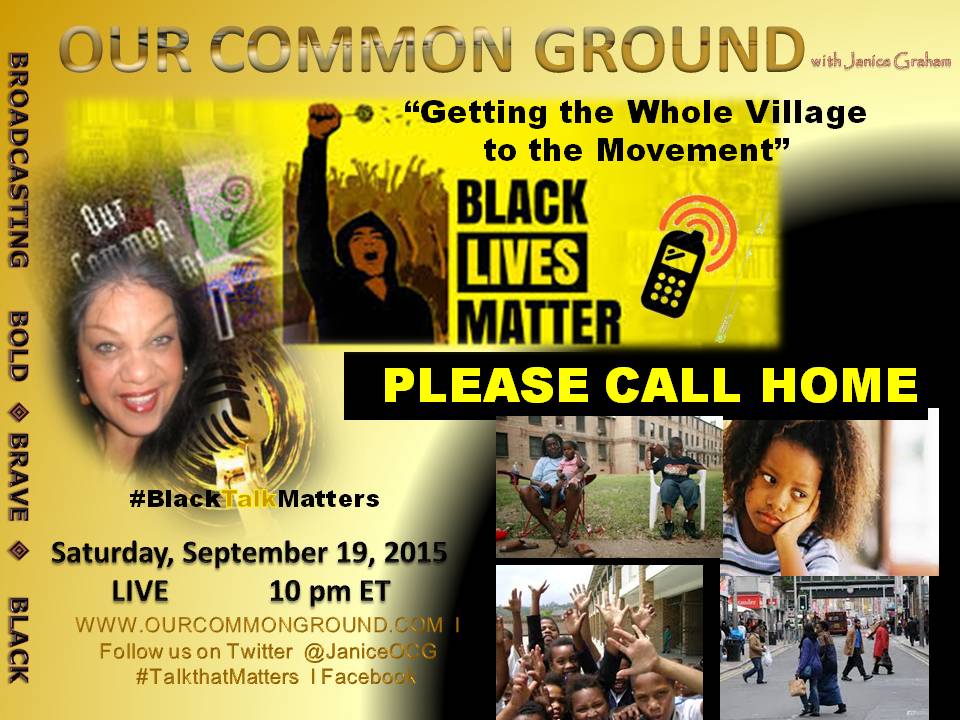
This Week on OUR COMMON GROUND ll “Getting the Whole Village to the Movement: #BlackLivesMatter, Please Call Home”

“Getting the Whole Village to the Movement: #BlackLivesMatter, Please Call Home”
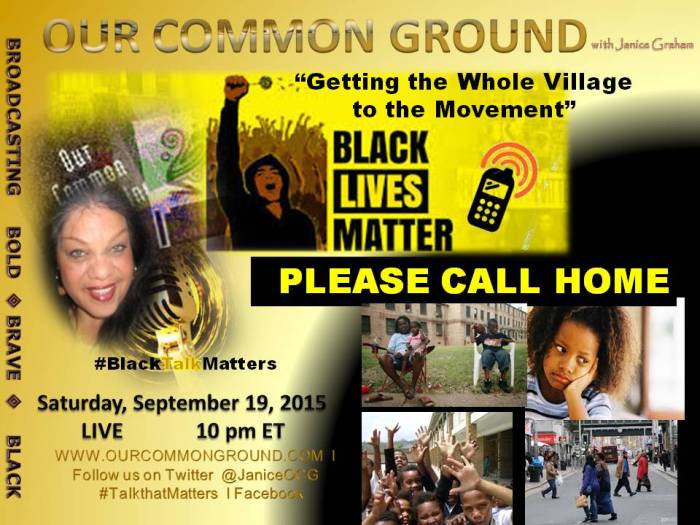
09-19-15 BLM FBSaturday, September 19, 2015 10 pm EDT

LISTEN LIVE and Join the OPEN Chat: http://bit.ly/1KqBNqr
Call In – Listen Line: 347-838-9852

The cry of #Black Lives Matter rings throughout the nation. It stands in the wake of a new movement and awakens our national consciousness to the persistent system of white supremacy and structural racism that penetrates each of our institutions. By placing violence against black bodies at the center of the movement, BLM has demanded dignity and respect for those who are often disregarded as disposal.

The Black Lives Matter movement was born out of the pain and injustice of Trayvon Martin’s death in 2012 and gathered momentum in the wake of the killings of Michael Brown, Eric Garner, Freddie Gray, Walter Scott, Tamir Rice and far too many others. The significance of this emergence was not so much the movement as it was the cry of our people declaring that “Black Lives Matter”. A cry for a need for a new liberation uprising for Black people in America. #BlackLivesMatter as a slogan met the need of Black people to declare its pain, loudly and precisely. Moving that slogan as the undergird of a movement is the hard part. Figuring how we ignite political and social transformation — not just marches, Twitter feeds and shouting matches on- and offline is the real challenge.

More teaching, training and strategic action is needed. More poor people, experienced organizers and on-the ground development is required to create a movement. Too often, meetings and community conversations are held in order to delay progress and to give the illusion of progress, all while the community remains broken. The Black Lives Matter Movement has the potential to turn this very moment into a movement, but must expand in depth and breadth to accomplish the task of justice and reconciliation. #BlackLivesMatter has to be the talk on the “block” across America.

There is no doubt that the “#BlackLivesMatter” movement is a critical opportunity to engage community interest groups in conversations about race and privilege. The movement issued a call to action for people everywhere to recognize the reality of institutionalized racism. But to whom is it engaged?

We must get as excited about policy shaping as we do about protesting. Systemic terrorism needs also requires Black redemption; and that work is little, slow and fueled political bickering on the left, long meetings and little relationship building. Who is teaching the history that brings us to the street proclaiming #BlackLivesMatter ? A slogan is cry for a need for a new liberation for Black people in America, but within the village, is there a depth of understanding beyond the pain – understanding of the Empire which presses us? “#BlackLivesMatter” as a slogan meets only a small need. Moving that slogan as the undergird of a movement igniting political and social transformation — not just marches, Twitter feeds and shouting matches on- and offline.

But here is the rub. No movement can be sustained or make significant change if it falls to co-opting by the same systems which rule the Empire that designs, control and maintains the structures of institutionalized racism and system of white supremacy. It cannot be vulnerable to take-down and huge vacuums of community disengagement. If #BlackLivesMatters is to be a true moment, the whole community is required to build the walls and fortify a strategy that moves forward on objectives targeting goals for all Black people.

The whole village must understand where and when they enter. If not, it is merely another group attempting to advance a narrow agenda, important, but narrow just the same. How do we infuse the slogan with a movement?


You are invited to bring your thoughts about the pressing issues facing our community. Come listen and learn. SHARE please.

OUR COMMON GROUND where friends come to confer with allies.

Listen & Call In Line: 347-838-9852
Saturday, September 19, 2015 10 pm ET
Join us Here: http://bit.ly/1KqBNqr

BROADCASTING BOLD BRAVE & BLACK
Web  Φ  Community Forum Φ Facebook
Twitter: @JaniceOCG #TalkthatMatters
Pinterest   Φ Visit our Tumblr Page:

“Speaking Truth to Power and OURselves”
email: OCGinfo@ourcommonground.com

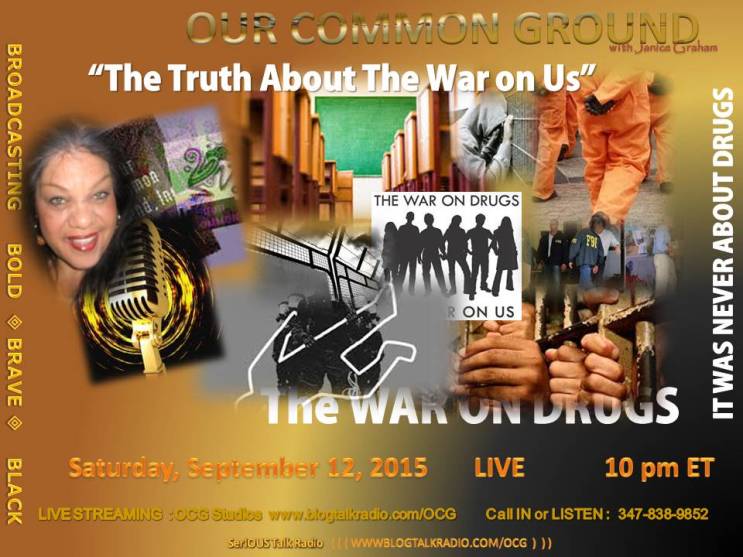
This Week on OUR COMMON GROUND φ “40 Years, $1 Trillion, 45 Million Arrests Later: “The Truth About the War Against Us” φ LIVE

OUR COMMON GROUND with Janice Graham

“The Truth About the War Against Us”
09-12-15 War on Drugs4
40 Years, $1 Trillion, 45 Million Arrests – the war still rages against our community. IT WAS NEVER ABOUT DRUGS

 Saturday, September 12, 2015

10 pm EDT
LISTEN LIVE and Join the OPEN Chat

LISTEN LIVE HERE

Learn more and join us on Facebook
Call In – Listen Line: 347-838-9852

This week on OUR COMMON GROUND, we review and examine the truth about the policies and intent of the “War on Drugs”. We need to talk about the money making behind the politics; how the drug war can be considered slow Nazi policy on the poor and the racial profiling used. We look at these destructive and failed policy and manipulation in its historical context and destructive outcomes. We will present audio clips for our discussion which will assist us in understanding just how much the “War on Drugs” was really never about drugs.

For sheer government absurdity, the War on Drugs is hard to beat. After three decades of increasingly punitive policies, illicit drugs are more easily available, drug potencies are greater, drug killings are more common, and drug barons are richer than ever. The War on Drugs costs Washington more than the Commerce, Interior, and State departments combined – and it’s the one budget item whose growth is never questioned. A strangled court system, exploding prisons, and wasted lives push the cost beyond measure. What began as a flourish of campaign rhetoric in 1968 has grown into a monster. And while nobody claims that the War on Drugs is a success, nobody suggests an alternative. Because to do so, as Surgeon General Joycelyn Elders learned, is political suicide.

As a community we need to understand how Drug War fever has been escalated; who has benefited along the way; and how the mounting price in dollars, lives, and liberties has been willfully ignored. Where are the policy maker offices where each new stage was planned and executed? What happened in the streets where policies have produced bloody warfare. This is a tale of the nation run amok – in a way the American people are not yet ready to confront. Are you?

You are invited to bring your thoughts about the pressing issues facing our community. Come listen and learn. SHARE please.

OUR COMMON GROUND where friends come to confer with allies.

Listen & Call In Line: 347-838-9852
Saturday, September 12, 2015 10 pm ET
Join the LIVE Broadcast Here

 http://bit.ly/1KIQv2q

            BROADCASTING   BOLD BRAVE & BLACK

Web     Facebook     Community Forum   Pinterest    Visit our Tumblr Page

Twitter: @JaniceOCG #TalkthatMatters

“Speaking Truth to Power and OURselves” 

email: OCGinfo@ourcommonground.com
Call In – Listen Line: 347-838-9852


“The Flames of Liberation: Rebellion and Resistance” ll September 5, 2015 with Ruby N. Sales

Activist and Organizer, Ruby N. Sales

  “The Flames of Liberation: Rebellion and Resistance”

Saturday, September 5, 2015    Φ     LIVE  10 pm EDT

 “Transforming Truth to Power, One Broadcast At a Time” 

           OUR COMMON GROUND  Session II 2015 SEASON 

     33rd BROADCAST SEASON 

                               We open our 2nd Session of the 2015 Season continuing to examine the depth of structural and institutionalized racism, the impact of white supremacy and the concept of #BlackLivesMatter as a clarion call and the its promise as a movement.  As always we ask, “What is your End Game?”                      We invite you to join us and be part of the response to THE STATE OF EMERGENCY.


Guest Moderator, Ruby N. Sales, Founder & Director, The Spirit House Project


To help us kick off this session we have asked Rev. Ruby N. Sales to join us a co-moderator on the critical questions and issues that challenge, trembling like a swelling tsunami beneath the ocean. A seasoned veteran of the civil and human rights campaigns of our time and a fierce and clear visionary of Black Power, we believe that she is most appropriate to help us press out an authentic narrative on these issues.

Institutionalized Racism is the concept and practice of white supremacy. It is the practice of discrimination and oppression based on skin color, physical characteristics, continent of origin and culture. It has its origins as a justification for slavery and the conquest of the Americas. From the beginning, slavery in the United States was tied to the development and growth of capitalism. Founded on the sale and ownership of human beings on the basis of their physical characteristics and color, its purpose was the exploitation of unpaid labor for super profits. As chattels, Africans were hunted like animals, transported to the “New World,” and then sold on the auction block like beasts of burden. In like manner Native American Indians were exterminated on a massive scale.

Moral and intellectual rationales were invented and continue to justify this kidnapping, sale, enslavement and genocide against human beings. As an ideology, racism provided the moral and intellectual underpinnings of slavery, the westward expansion of colonialism and the seizure of half of Mexico. Thus the purpose of this doctrine was, and still is, to put forward ideas and theories founded on the myth that Black people and other people of color are inherently inferior.

Almost 130 years after the Emancipation Proclamation, the legacy of slavery remains. It is embedded in and influences every aspect of social, economic and political life. Institutionalized racism is the combined economic, political, social, cultural, legal, ideological and other structures that exist to maintain the system of inequality. #RaceMatters

Institutionalized racism has economic, social, political, ideological and cultural forms, and denies equality, justice and dignity to all people of color.  There are new problems because of the systemic nature of crisis. Our discussions should examine what adjustments must be made in these new efforts to eradicate our place in this society. We rebel and resist the effort to force us into the margins, to make us invisible and to remove us to prison for profit camps.

Our discussions must explore and examine how to elevate our voices in the fight against police brutality, housing discrimination, immigrant rights, and the dismantlement of public education to mention a few issues. At OUR COMMON GROUND provide “a place for our unfiltered voices”.  With the brightest, most loyal and insightful Black activists, community organizers and servants, scholars, researchers, journalists and social scientists we raise, clarify and illuminate the racist dimension of these issues, show how their roots lie in the system of capitalism and its new stage of crisis, and come up with concrete ideas to launch new initiatives and support existing ones.

As a set of institutions, racism is infused in the very foundations of our society and is inseparable from the economic foundations of U.S. capitalist society. The “new domestic military policing” is implemented to intimidate and destroy racially homogenous communities and put into place a ‘superexploitation’ of racial oppression that ensures our silence and to fill prisons serves to create and make real the essence of white supremacy.  We are living in an increasingly surreal special system of oppression and racism perpetrated by a narrative dictated outside of our community. None of this is new; the struggle to liberate ourselves has been before us since our time on these shores. One of our most effective weapons is to ensure that we work from an authentic narrative and that its formulation comes from our Truth. OUR COMMON GROUND for more than 33 years has focused its broadcast mission on ensuring that the Black Truth illuminates and informs our struggle.  #BlackTruthMatters #BlackVoiceMatters

   BROADCASTING   

   BOLD      BRAVE       BLACK 

           OUR COMMON GROUND with Janice Graham

                                 “Speaking Truth to Power and Ourselves” 

                                email: OCGinfo@ourcommonground.com

           LISTEN LIVE and Join the OPEN Chat:  http://www.blogtalkradio.com/OCG

                             Call In – Listen Line: 347-838-9852

Community Forum ll   Twitter: @JaniceOCG  #TalkthatMatters   ll    Pinterest   ll  Visit our Tumblr Page   Facebook

“Uprising: Resistance and Rebellion” ll OUR COMMON GROUND with Ajamu Baraka and Efia Nwangaza

OUR COMMON GROUND   with Janice Graham

       “Uprising: Resistance and Rebellion”

05-02-15 Resistance and Rebellion

               Depraved INDIFFERENCE – Beyond Baltimore
  Learn More
Saturday, May 2, 2015 LIVE 10 pm ET
Guests: Ajamu Baraka and Efia Nwangaza
Call In – Listen Line: 347-838-9852
Join us LIVE http://bit.ly/1KCu4aR

Tonight we look back at this week’s uprising in Baltimore MD and explore where we go from here. How do we prepare a generation of people for a new, more militarized war on Black people? How do we get our people to see, “we are the Gaza?” Looking at the Freddie Gray murder charges and the overall fracture and failure of the Amerikkan judicial and government systems.

ABOUT OUR GUESTS

Ajamu Baraka,Human Rights Leader and Contributor, Black Agenda Report

Ajamu Baraka is a human rights defender whose experience spans three decades of domestic and international education and activism, Ajamu Baraka is a veteran grassroots organizer whose roots are in the Black Liberation Movement and anti-apartheid and Central American solidarity struggles.
Baraka is an internationally recognized leader of the emerging human rights movement in the U.S. and has been at the forefront of efforts to apply the international human rights framework to social justice advocacy in the U.S. for more than 25 years. As such, he has provided human rights trainings for grassroots activists across the country, briefings on human rights to the U.S. Congress, and appeared before and provided statements to various United Nations agencies, including the UN Human Rights Commission (precursor to the current UN Human Rights Council).

As a co-convener with Jaribu Hill of the Mississippi Worker Center for Human Rights, Baraka played an instrumental role in developing the series of bi-annual Southern Human Rights Organizers’ conferences (SHROC) that began in 1996. These gatherings represented some of the first post-Cold War human rights training opportunities for grassroots activists in the country.

He writes for the Black Agenda Report and is Editor of “A Voice from the Margins” http://www.ajamubaraka.com/

Efia Nwanga, Human Rights Attorney and Liberation Broadcaster, WMXP Greenville South Carolina

Sister Nwangaza, current director of the Malcolm X Center for Self Determination, is a former Student Non-Violent Coordinating Committee (SNCC) organizer. The Malcolm X Center for Self Determination (http://wmxp955.webs.com/aboutus.htm ), is a volunteer grassroots, community based, volunteer staffed, owned and operated human rights action center, since 1991. It serves as a non-profit, public space for developing, testing, training and implementation of approaches to popular education, strategic planning, problem solving, and communications skill enhancement, with wide ranging performing and organizing skill development, using human rights frameworks and mechanisms for self-determination, community and self-advocacy. WMXP-LP 95.5 FM – The Voice of the People, http://wmxp955.webs.com/, is a community based, volunteer programmed, listener and local business supported non-commercial educational radio station. It’s mission is to give voice to the voiceless with local music, local talk, local news, local people doing local programming.

She clerked in the SNCC national office, worked the Julian Bond Special Election Campaign, and was a member of the Atlanta Project which drafted the Black Power, Anti-Vietnam War, and Pro-Palestinian Human Rights position papers popularized by SNCC,http://www.crmvet.org/vet/nwangaza.htm . At the behest of Malcolm X, SNCC worked and moved the 1960s U.S. Civil Rights movement to founding today’s U.S. Human Rights Movement. SNCC’s modern day call for Black Power/Self Determination united, elevated and invigorated resistance movements here and around the world. For fifty years of work as a human rights activist, her early career as a staff attorney for the Greenville Legal Services Program, and her contributions to numerous civic and human rights organizations . Nwangaza is an affiliate member of the Pacifica Radio Board of Directors as a representative of WMXP.

         BROADCASTING BOLD BRAVE & BLACK

Facebook

Community Forum

Twitter: @JaniceOCG #TalkthatMatters

OCG Blog

Pinterest

Visit our Tumblr Page

email: OCGinfo@ourcommonground.com

LISTEN LIVE and Join the OPEN Chat: http://www.blogtalkradio.com/OCG
Call In – Listen Line: 347-838-9852

‘Police are Heroes’: The Cultural Mythologies that Enable Police Brutality Against Black and Brown Americans φ Chauncey Devega

‘Police are Heroes’: The Cultural Mythologies that Enable Police Brutality Against Black and Brown Americans φ

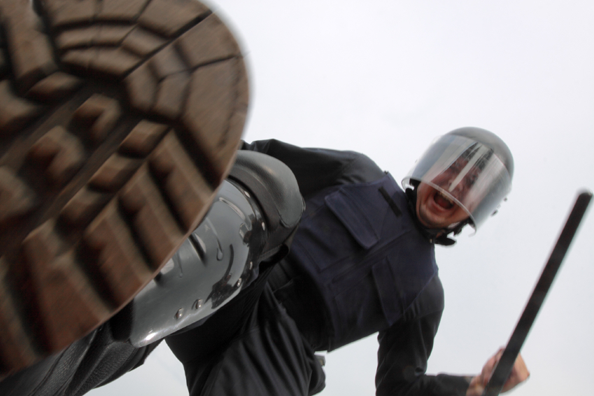
The deaths of NYPD officers Rafael Ramos and Wenjian Liu, gunned down by a mentally unstable man who later committed suicide, have been accompanied by public rituals of mourning. Unfortunately, many public figures are also villifying those who demand accountabilty for police brutality.
In a sign of how debased American cultural values have become (especially on the Right), a plea for human dignity, civil rights and an end to police brutality against people of color can be twisted and warped into some type of provocation to violence against the police. The millions of Americans who want police to act in a professional and responsible manner by not abusing those they are ostensibly “sworn to protect” are not endorsing premeditated violence against police. Rather, those Americans of conscience who are standing up against police brutality believe that the dignity and safety of all people are paramount virtues.
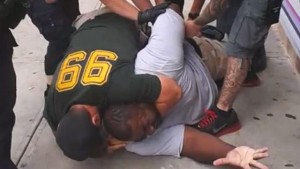
While it may be a challenging truth for some, as I wrote here, the lives of Rafael Ramos and Wenjian Liu are no more valuable or sacred than the lives of Eric Garner, Tamir Rice, Michael Brown, John Crawford, or any other human being. Human rights are universal. The lives of police are no more valuable or special than those of any other citizen. Failing to embrace this fact leads to a type of creeping fascism or authoritarianism by legitimizing police thuggery and abuse of the public.
While the public rituals that accompany the loss of a police officer are by definition designed to hide and obfuscate complex realities through the use of powerful symbols and rhetoric, the basic truth remains that police as a social institution and group are not victims. Rather, in the United States the police are a protected class of people. They are the day-to-day face of the State—and its power to visit violence upon the American people. Police are enforcers of the law; in many ways they are positioned above and outside it.
The examples of this Orwellian abuse of power are many.

The Supreme Court recently ruled in Hein v. North Carolina that even when a police officer stops a person without proper cause such an act is not a violation of the Constitution’s protections against unreasonable search and seizure.
And in those rare instances when police are faced with indictments by the courts for their illegal, hostile and heinous acts against the American people they are rarely, if ever, indicted.
Police departments also do not report the actual numbers of people they kill in the United States each year. Victims of police violence are “disappeared” by a bureaucratic trick where “justified” killings by police officers are thrown down the memory hole.
The criminal justice system monitors itself. There can be no true accountability. This is not an accident or aberration of the system. No, it is the carceral and punishing State working exactly as designed and intended by American elites.
The United States was founded as a white (and male) supremacist society. Centuries later, the country remains organized around the maintenance and protection of white privilege. These hierarchies of race deem that the ability and power of the police to violate the basic human and Constitutional rights of a given person of color in the United States are outsized and exaggerated.
Here, police abuse against non-whites (and the poor, more generally) within the context of a racist criminal justice system (what Michelle Alexander has called the New Jim Crow) is the norm, a quotidian reality that hides behind cold statistics that detail how black teens are 21 times more likely to be killed by the police than their white peers, or how a black person’s life is taken at least once every 28 hours by a law enforcement officer.
The panoply of ways black and brown people have been killed by the police, and the explanations offered for their deaths, could form the basis of an absurdist or dark satire. Black people have been killed by cops for sleeping in cars, because wallets, key chains and cell phones look like guns when held by African Americans; for holding toys, committing the Jim Crow-era crime of “bumptious walking,” playing in the park, dressing up like a favorite anime character, or selling loose cigarettes outside a corner bodega.
Except for pathological white racists, and those other white folks who share such sentiments and feelings even while they mask their bigotry with the claim that they don’t “see” race, there is no humor to be found in this necropolis of black people, many of them unarmed, who have been killed by the police in this bloody 2014 or in the decades and centuries that preceded it.
Because the police are a protected class, an artifice of myths has been erected around them, myths that take the form of unstated assumptions that are circulated throughout American culture and are rarely questioned or critically interrogated. This cultural and rhetorical shield takes many forms; it is a narrative and type of conventional wisdom that Americans learn in childhood, is recited by politicians and religious leaders, and endlessly reinforced by the mass media.
Police violence is justified and explained away by the following tropes.
Police work is a dangerous job. While being a police officer may involve some level of risk, it is largely mitigated by training and equipment. On the macro level, in the United Statespolice work is not included in the top 10 most dangerous professions. Sanitation workers, truck drivers, forestry workers, and professional fisherman are far more likely to be killed or injured on the job than police.
While the mass media and police unions are invested in projecting an image of police work as highly dangerous, thrilling, and adrenaline-filled, the number-one cause of death for police officers are vehicular accidents.
Police have a difficult job that involves making split-second decisions. As research on implicit bias, racism and police use of force has demonstrated, cops are much more likely to make “split-second decisions” to kill black men. Yet, somehow the perils and fears that loom over police and their decision-making processes are suspended and lessened when they interact with white people.
Cliven Bundy and his armed group of marauders did not face a “split-second” decision by the police to shoot them. White men walking around neighborhoods with guns displayed in plain sight are not preemptively killed by the police. White men who have actually shot at firefighters and police are somehow miraculously taken into custody unharmed and alive. White teenagers who bring arsenals of guns and knives to their high schools are arrested and given bail.
Police selectively make split-second decisions about who to shoot and kill in America. Blackness is a trigger for violence; whiteness and white skin privilege are signals to deescalate.
Police are heroes. Heroism involves a selfless act by a person who is not trained for such duty, or who cannot be reasonably expected to act in such a manner. Police have chosen their profession. They are trained and equipped for the task. Police officers are also well compensated both on the job and in retirement. They also benefit and receive support from a huge and powerful social apparatus that is designed to protect them from the consequences of their actions.
A given police officer may have a moment of bravery or courage. By themselves, neither of those deeds rises to the level of heroism.
The police who killed Eric Garner, Tamir Rice, Michael Brown, and who participate in a system that harasses and targets people of color for unjust punishment and harassment are most certainly not heroes in the best and most authentic sense of the word.
Instead of holding police (and others who are empowered by the state to kill) to a higher standard, America’s civil religion deifies police and simultaneously lowers their bar of accountability to one far below that of the average person—in all, what is a perverse paradox.
The blind worship of the police exists in the same flat and empty right-wing political imagination as litmus tests for patriotism that consist of questioning if a given politician wears an American flag pen on his lapel.
Such rituals socialize the American people into the twin habits of banal and unreflective thinking which legitimizes a narrowing of the public discourse. Basic questions about justice are made verboten; they are not to be mentioned or discussed in polite company.
Rafael Ramos and Wenjian Liu are dead. Eric Garner, and many other unarmed black and brown people are also dead—killed by the police under highly questionable circumstances. Demands that police treat all Americans with respect, and in accordance with their human rights, is not a zero sum game.
Police lives matter because they are human beings. The lives of the victims of police brutality and violence matter because they too are human beings. This simple calculus makes for a safer and more just society for all people.

devega2WHO IS CHAUNCEY DEVEGA?

I am the editor and founder of We Are Respectable Negroes, as well as the host of the podcast known as “The Chauncey DeVega Show”.

I am also a race man in progress, Black pragmatist, ghetto nerd, cultural critic and essayist. I have been a guest on the BBC, Ring of Fire Radio, Ed Schultz, Make it Plain, Joshua Holland’s Alternet Radio Hour, the Thom Hartmann radio show, the Burt Cohen show, and Our Common Ground.  My writing has been featured by Salon, Alternet, The New York Daily News, and the Daily Kos.  My work has also been referenced by MSNBC, as well as online magazines and publications such as The Atlantic, Slate, The Week, The New Republic, Buzzfeed, The Daily Beast, The Washington Times, The Nation, and The Chronicle of Higher Education.

Judge me by my enemies. Fox News, Rush Limbaugh, Sean Hannity, Juan Williams, Herman Cain, Alex Jones, World Net Daily, Twitchy, the Free Republic, NewsBusters, the Media Research Council, Project 21, and Weasel Zippers have made it known that they do not like me very much

#SupportKelliMurray: Stop the Bullying of the Baltimore Co. FOP Lodge | LBS Baltimore

#SupportKelliMurray: Stop the Bullying of the Baltimore Co. FOP Lodge | LBS Baltimore.

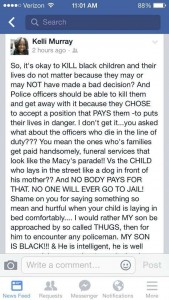
Kelli Murray is currently an employee of the Baltimore County Government who works as a dispatcher. She is a wife and mother.  After the non-indictment of Daniel Pantaleo in New York City (the officer who killed Eric Garner), she posted a Facebook status that expressed her fear of her children interacting with law enforcement.  This is a fear that has been expressed by many people in light of the increased coverage of issues of police brutality.  She went out of her way to express that she appreciates the job that good police officers do, but that in light of the current events her fears persist.  This was the text of her actual post:


“UPDATE: 12/29: Since this article has been published, Kelli has been continued to be bullied online and in the media. She will likely have to move and find new employment. Kelli is a wife and mother of six who needs support. Please click here to donate to her family and support them during this time.  Kelli has also released a video public statement about her comments (at the bottom of this article).

Unfortunately most people who are talking about racism in the mainstream political discourse are not sufficiently literate in the dynamics of racism to properly apply it to the events that have dominated the mainstream news media.  Racism is about the power that white dominated and controlled institutions have over the livelihood of Black people and other people of color.  In the context of police brutality what we are seeing is racism as it exist in our society.

Racism does not exist in a form that requires ill intent of a white person against Black people.  We are not seeing evil white people conspiring to kill young Black people.  What we are seeing is police officers operationalizing their feelings of Black criminality and worthlessness that our society has been saturated with.  They are acting on impulses that all of us are socialized to have.  Black criminality and worthlessness are notions that have been with us since America’s inception.  From the 3/5’s compromise, to the system of Jim Crow, American civil society has been structured on popular narratives that justify our dehumanization.  It’s latest iteration has been embodied in the war on drugs that has decimated Black communities.”


“Instead of society admitting that there is a deep seeded problem of racism in our country beyond the rudimentary discourse of unfair treatment, our conversation about police brutality has been muddled.  Admitting that law enforcement (like all of the major institutions of society) is an institutions that perpetuates institutional racism doesn’t mean that you are anti-cop.  All it means is that you acknowledge that the criminalization of Black people has caused law enforcement officials to engage in behaviors that dehumanized Black people.  And if you are serious about effectively serving the people that you are designated to protect then you would take the time to take seriously the ways that internalized racism effects how you interact with Black people.”

Michael Brown, Abner Louima, and the Anguish of Police Brutality

NOVEMBER 26, 2014

Enough Is Enough

BY 

Michael Brown, Abner Louima, and the Anguish of Police Brutality.

I have seen police brutality up close. Both in Haiti, where I was born during a ruthless dictatorship, and in New York, where I migrated to a working-class, predominantly African-American and Caribbean neighborhood in Brooklyn at the age of twelve. In the Haiti of the nineteen-seventies and early eighties, the violence was overtly political. Government detractors were dragged out of their homes, imprisoned, beaten, or killed. Sometimes, their bodies were left out in the streets, in the hot sun, for hours or days, to intimidate neighbors.

In New York, the violence seemed a bit more subtle, though no less pervasive. When I started riding New York City Transit buses between my family’s apartment and the high school I attended, three miles away, I noticed that a muffled radio message from an annoyed bus driver—about someone talking too loud, or not having the right fare—was all it took to make the police rush in, drag a young black man off the bus, and beat him into submission on the sidewalk. There were no cell-phone cameras back then to record such abuse, and most of us were too terrified to cry “Shame!” or demand a badge number.

Besides, many of us had fled our countries to escape this kind of military or police aggression, so we knew how deadly a confrontation with an armed and uniformed authoritarian figure could be. Still, every now and then a fellow traveller would summon his or her courage and, dodging the swaying baton, or screaming from a distance, would yell some variation of, “Stop it! This is a child! A Child!”

Of course, not all of the police’s victims were children. Abner Louima, a family friend, was thirty years old when he was mistaken for someone who’d punched a police officer outside a Brooklyn nightclub, on August 9, 1997. He was arrested, beaten with fists, as well as with police radios, flashlights, and night sticks, then was sexually assaulted with the wooden handle of a toilet plunger or a broom inside a precinct bathroom. After Abner, there was Amadou Diallo, a Guinean immigrant, who, on February 4, 1999, was hit by nineteen of the forty-one bullets aimed at him as he retrieved his wallet from his pocket. Then there was Patrick Dorismond, who died on March 16, 2000, while trying to convince undercover cops that he was not a drug dealer. Then there was Sean Bell, whose car was shot at fifty times on November 25, 2006, the day of his wedding.

These are only a few cases—a few that made the news. I have no doubt that there were many others, ones involving women, too, though few got much attention, except for that of the sixty-six-year-old Eleanor Bumpurs, who, thirteen years before Abner’s assault, was killed with a twelve-gauge police shot gun inside her own apartment.

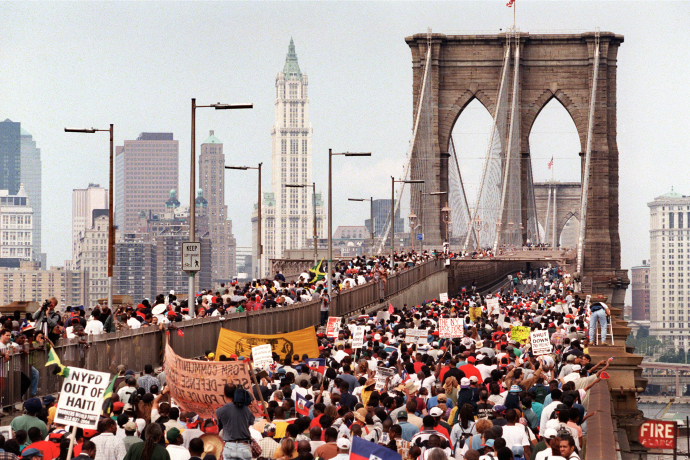
We marched for all of them in the Louima/Diallo decade, seven thousand of us across the Brooklyn Bridge one time. We carried signs and chanted “No Justice, No Peace!” and “Whose streets? Our Streets!” even while fearing that this would never be true. The streets belonged to the people with the uniforms and the guns. The streets at that time also belonged to Mayor Rudolph Giuliani, who believed then, and still seems to believe now, that police brutality is unworthy of public scrutiny so long as black people keep “killing each other.” The streets were never ours to begin with, because on these same streets our sons and brothers, fathers and uncles were, and still are, prey.

My father, a Brooklyn cab driver, used to half joke that the only reason the police didn’t beat him up was because he was too skinny and too old, and not worth the effort. Every now and then, when he was randomly stopped by a police officer and deigned to ask why, he would be given, rather than a beating, a handful of unwarranted traffic citations that would wipe out a few weeks’ hard-earned wages. Today, one might generously refer to such acts as micro-aggressions. That is, until they turn major, until they turn deadly. Until a man who is believed to be selling loose cigarettes has the life strangled out of him in a police chokehold. Until yet another unarmed brown or black body finds itself in the familiar path of yet another police officer’s gun.

The other night, while watching the St. Louis County Prosecutor Robert McCulloch declare that there would be no indictment against Officer Darren Wilson for the killing of Michael Brown, I kept thinking of Abner Louima, whose assault took place on another August 9th, when Brown was just eighteen months old.

Abner and I have known each other for years. Yet I have always steered clear, in my conversations with him, of what happened all those years ago. Yesterday, though, I decided to call him, just to hear his thoughts about Michael Brown and Ferguson, Missouri. If anyone could understand all those broken hearts, all the rage, all the desperation, the yearning for justice that we are seeing in Ferguson and all over the country, I thought, he would.

Abner Louima, unlike Michael Brown, survived. He went on with his life, moved to South Florida, started a business, has done charity work. He has a daughter and two sons. One son eighteen years old, the same age Michael Brown was when he died. His other son is fifteen.

I asked him what he thought of the grand jury’s decision. The question seemed to wear on him. It was one, I could tell, that he was tired of answering. “Like everyone else, I’m very disappointed,” he said, his voice sinking with every word. “It’s not a good signal to send to a system that’s already not working.”

How does he feel each time he hears that yet another black man was killed or nearly killed by the police? “It touches me very deeply each time,” he said. “It forces me to ask myself why so little has changed in all these years since this happened to me. It reminds me again and again that our lives mean nothing.” His case, Abner reminded me, was the last one he could think of, in New York or elsewhere, in which the police officers who had assaulted or killed a black man actually went to jail. In his case, justice was served in part because of the public pressure, and because there were federal prosecutors involved, including the current nominee for Attorney General, Loretta Lynch.

What message does Louima have for Brown’s family, whose son died on what could have been the anniversary of his own death? “My heart aches so much for them,” he said. “I know how difficult this must be for them. Like them, I encourage peaceful protest. Too many lives are being lost, so we can’t just close our eyes and hope it goes away. We must keep raising our voices until we find justice for those who lost their lives, and until these things stop happening.” We both wonder: Will these things ever stop happening?

In 2007, on the tenth anniversary of his assault, Abner Louima wrote an opinion piece for the Daily News reflecting on what had happened to him. “It’s time we all said, “Enough is enough,” he wrote. He still believes that—now more than ever.

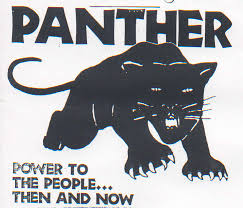
How Far the US Government Went to Subvert the Black Panther Party φ The Atlanta Star

 atlanta star banner

How Far the US Government Went to Subvert the Black Panther Party

The Atlanta Star

atlanta star banner

Boston Police Awards 3 Officers involved in High-Profile Brutality cases infused with race l The Blackstonian

Boston Police Awards 3 Officers involved in High-Profile Brutality cases infused with race

By   /   January 9, 2013  /

  © 2013 Blackstonian. // Black Boston 411 24/7

Boston Police Awards

BLACKSTONIAN EXCLUSIVE:
Boston Police Awards 3 Officers involved in High-Profile Brutality cases infused with race

The Boston Police department in its latest routine round of awarding officers for “outstanding performance” of their duties during the past year has named among its many recipients 3 officers in particular who were involved in some of the departments most highly publicized and controversial cases, all of which include elements of race and police brutality and use of excessive and/or deadly force.

These officers are: Brian R. Dunford, Michael T. McManus, Christopher R. Carr

These awards send a message of disregard and disrespect to the Black Community. Remember the outrage after the tragedy of DJ Henry when Officer Aaron Hess was awarded Officer of the Year by the Pleasantville Police Dept??? Here in Boston, these 3 separate cases are all hot buttons and the BPD is well aware of the message that these awards send to a community in constant struggle with its Police Department. Shame on the BPD, you dont have to be a detective to know this is not a good look.

Editor’s Note: We contacted BPD top brass and the official position of the BPD is that they stand by each of these officers and have their own reasoning and logic by which these officers are all worthy and deserving of these awards. The BPD noted that in the cases in question that these officers were all exonerated after an investigation by both internal affairs and Suffolk County DA Dan Conley. The BPD also stated that in the case of at least one of the officers they were disciplined for filing a false report and that no further punishment was needed and since then there have been no further incidents. The position of the Blackstonian which we expressed to the BPD is that the fact that these Officers were exonerated is only indicative of the problem, bearing in mind that 99% of officers are exonerated which is part of our contention that internal affairs and the Suffolk County DA are incapable of conducting fair investigations.

Note: 2 of the officers named below, Dunford and Carr were also part of a 2004 lawsuit against the City of Boston because they felt they were discriminated against because of their “Caucasian race”.
see it here: http://www.clearinghouse.net/chDocs/public/EE-MA-0020-0002.pdf

Now, on to the awards…

Officer Brian R. Dunford is awarded “The Department Medal of Honor” among other officers for their response to a call on October 16, 2011.
Officer Brian Dunford also happens to be the same officer who was involved with the vicious 3/23/08 beating of Boston Firefighter Wayne Abron. At the time Abron was villianized, but later (9/21/09) he was acquitted of all charges against him and is currently engaged in a lawsuit against the City of Boston and the BPD.
This is what Wayne Abron looked like after his encounter with Department Medal of Honor recipient Dunford.
Wayne Abron

see the results of a basic google search for BPD Officer Brian Dunford – click here

Dunford Award

click image for larger version

**************************************************************************************************

Officer Michael T. McManus is awarded The Mayor’s Medal of Excellence among other officers for general performance of duty and achieving a cumulative count of over 250 arrests in B-2. In addition to this actual award McManus was also in a separate ceremony appointed to one of the most coveted and high profile assignments within the BPD. McManus was appointed by Commissioner Ed Davis to the BPD Fugitive Squad which we are told includes the much wanted perks of: unlimited overtime, make your own hours and a personal take home vehicle.

Office Michael T. McManus also happen to be the same Officer involved in 2 separate incidents which were some of the city’s most controversial cases. McManus only joined the force in 2007 and has made quite an impression.

A. The death of David Woodman – on June 18, 2008 David Woodman was being arrested in the Fenway after a Boston Celtics Championship. He died 11 days later and his family was subsequently paid a 3 million dollar out of court settlement by the City of Boston.
Woodman Family
http://www.masslive.com/news/index.ssf/2010/11/investigation_of_boston_police.html

B. The beating of 17 yr old boy at RCC – On October 22, 2010 a 17 yr old teenage black boy was apprehended by members of the BPD and DYS. The event was captured on video and went viral on youtube and became highly publicized. McManus was one of the officers in the video involved in the beating of this young man. A year later Suffolk County DA Dan Conley declared no wrong doing.

McManus Award

click image for larger version

**************************************************************************************************

Officer Christopher R. Carr along with another officer, is awarded The Schroeder Brothers Memorial Medal; The Department Medal of Honor. It should be noted that the Schroeder Brothers Memorial Medal is the highest medal given by the BPD from the Boston Police Relief Association Memorial Award.

Also please note that this award is different from the others because in this case, which to the Blackstonian is the most despicable award, is for the specific incident in question. Unlike the other awardees who were awarded for other instances and not the particular one which was notorious and in question, this specific honor the very highest medal given by the BPD is specifically for the very incident that our community is so traumatized from.

Officer Christopher Carr is the same officer involved in the Sept. 7, 2011 police chase from Roxbury to Rockland, MA which ended in the death of Mark McMullen. For those who have been following the Blackstonian you know that we have organized around this very issue. We have sat with the family and this case is VERY MUCH in question.

Mark McMullen

The Blackstonian seriously questions how an officer can be awarded for a high speed chase 30 min out of the city, when BPD policy forbids chases out of city limits, except in the case where a suspect is fleeing a serious, violent felony and people are in imminent danger. this was not even remotely close to such a case.

Please read the narrative supplied by the BPD describing the incident for which this award is given.

Officer Carr Award

click image for larger version


**************************************************************************************************


About the Blackstonian

A word used to symbolize the spirit and culture of Black Bostonians. We created the Blackstonian newspaper as a community service to the Black, Latino, Cape Verdean and other Peoples of Color in Boston and the surrounding area.

Who We Are

We represent Black Boston, centrally Roxbury, Dorchester, Mattapan but really all through the other burroughs and suburbs to wherever Black people are found in our extended midst. Our definition of Black is very inclusive, in Boston we have a lot of Brothers and Sisters from all over the Globe…Puerto Rico, Dominican Republic, Haiti, Jamaica, Cape Verde, Africa, Trinidad, wherever…. in our eyes you are all Black People and we are family here in Boston aka The Bean.

Blackstonian Team

Jamarhl Crawford
Publisher