
 This is longer than a 140-character Tweet, but I respectfully ask that all who participated in exchanges over a statement I made on Twitter on February 4, 2021 concerning #PureReparations, that aroused a firestorm of responses, please read this from start to finish.
Background
This is longer than a 140-character Tweet, but I respectfully ask that all who participated in exchanges over a statement I made on Twitter on February 4, 2021, concerning #PureReparations, that aroused a firestorm of responses, please read this from start to finish. Some of the responses to my statement were serious, thoughtful, and critical, but others were so hostile. I am convinced many of them were written by people who only had, at best, second- or third-hand knowledge of the content of my message.
Let me be clear, I remain steadfast that African American reparations in the United States should be designated specifically for black Americans who are descendants of persons enslaved in the United States. It is a position that I have maintained for upwards of 20 years, first articulated with the eligibility criteria I presented in an article published with Dania Frank in 2003 in the American Economic Review.
The criteria expressed at the time were twofold: 1. An American citizen would have to demonstrate they have at least one ancestor enslaved in the United States. 2. An American citizen would have to demonstrate that for at least ten years before the adoption of a reparations program they self-classified as black, negro, or African American. The first criterion is a lineage standard; the second is an identity standard. Both standards must be met to merit receipt of reparations payments.
Lineage Criteria
In our recent book, From Here to Equality (FHTE), Kirsten Mullen and I modify the identity standard to lengthen the time to at least twelve years (two Senatorial terms) and to include the adoption of a study commission for reparations as one of two events that would trigger the time count on self-classification.
The core objective always has been to include all persons, and their descendants, who have been subjected to the cumulative, intergenerational effects of slavery, legal segregation and white terrorist violence, and post-Civil Rights Era mass incarceration, police executions of unarmed blacks, and ongoing discrimination in the justice claim. This is the community whose ancestors were denied the promised 40 acres as restitution for the years of bondage and as a material springboard for entry into full citizenship in the United States.
Kirsten and I argue further, in FHTE, the best economic indicator of the combined effects of these atrocities is the racial wealth gap. We propose that elimination of the gap yields the baseline value for a reparations plan—demanding a federal government expenditure of $10 to $12 trillion. It is a key aspect of our project to generate a research-based standard for determining the size of the bill that is due. We do not identify an upper bound for the bill.
We also insist that priority be given to mobilization of the funds in the form of direct payments to eligible recipients, whether cash transfers, trust accounts, other types of endowments, or some combination thereof.
Necessary Exclusions
The two eligibility criteria necessarily exclude many Americans. The lineage standard will exclude all blacks in the United States who migrated to the United States and became citizens after the end of the Civil War. Their descendants also will not be eligible, in the absence of a parent’s or grandparent’s intermarriage with black Americans having ancestry anchored in US slavery. Counting among blacks excluded would be the relatively small group that migrated to the United States during the Jim Crow years (estimated to be, according to a Smithsonian study, to the right of the decimal point). Also excluded is a much larger group of black immigrants (now approaching ten percent of the nation’s black population) who arrived after 1964, especially coming in large numbers from the 1980s onward.
The identity standard excludes all persons who self-identified as non-black, inclusive of all white Americans, at a point where there was no apparent financial benefit from classifying oneself as black.
Meeting the lineage standard necessitates serious genealogical research. As a result, in FHTE, Kirsten Mullen and I recommend the federal government establish an agency with genealogists with expertise in African American ancestry to provide free services to all persons seeking to establish their reparations claim. Despite that recommendation, we continue to get substantial push back from those who say many black Americans with ancestors enslaved in the US will hit a wall in getting past the 1870 Census to identify their particular ancestors who were held in bondage before 1865. Therefore, I have been giving more thought to modifications in the criterion that would make it easier for all black American descendants of U.S. slavery to be assured of inclusion.
Balloon Reasoning
One possibility that seemed reasonable is the one I advanced that stirred the pot to a boil—include black immigrants who came during the Jim Crow years on the eligibility list. Let me emphasize, I advanced this to prompt discussion. I even referred to this in a later post as a “trial balloon,” which left me open to the somewhat humorous charges that the balloon popped or, quite the opposite, the balloon was made of lead.
Here is the thinking that I pursued: Allowing pre-1950s black immigrants onto the reparations roll eases genealogical proof required of black American descendants of U.S. slavery to establish their lineage claim. You necessarily have a tradeoff between letting a small number of otherwise excluded black folk in the door versus keeping the strong genealogical standard that will demand going past the 1870 “wall.” Under the former case, with the relaxed lineage standard, a person would have to demonstrate, say, that they have at least two black ancestors who were citizens of the USA before 1950 or 1960.
Then, eligibility would be much easier to establish for all black American descendants of U.S. slavery at the “price” of including a small number of black immigrants who arrived during legal segregation. Let a few in who do not meet the original lineage standard to ensure that all make it in who meet the original lineage standard.
No Mission Creep
I reject the “slippery slope” argument that has it that making this exception opens the gates for every other group to piggyback onto the reparations’ claim. Conditions can be drawn so precisely that no additional groups will become eligible.
Nevertheless, I do take seriously, the following critical response to my “trial balloon”: The limitation of African American reparations to black American descendants of US slavery is a matter of principle that should not be compromised. America’s history of racial injustice has targeted this community so consistently and with such ferocity that we should brook no modification in the criteria, even it remains more difficult for each individual to establish eligibility for the merited compensation.
In fact, I take it so seriously, in a later message, I indicate that I would not advance as an option the proposal any longer, and I will stand committed solely to the original criterion. Unlike what is suggested in a number of messages on Twitter, I never proposed that recent black immigrants should be eligible for reparations from the U.S. government. Nor do I anticipate reneging on that position. . . ”
Additional Considerations
Source: Reflections On Recent Controversy And The Case For #PureReparations | Actify Press

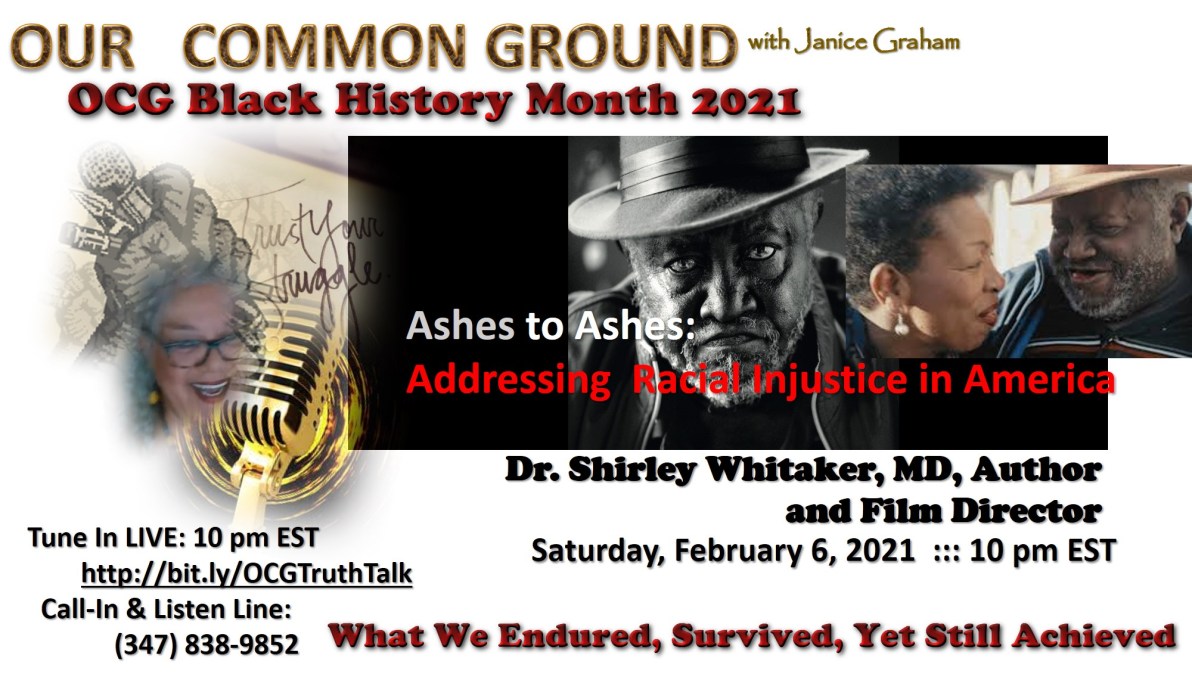
 Dr. Whitaker is the seventh child of Eddie and Charlie Mae Jackson from Waycross, Georgia. Dr. Whitaker attended Clark Atlanta University completing a BS degree with honors in Biology. She attended Yale University School of Medicine-Department of Public Health and obtained her medical degree form Emory University School of Medicine, the only female African American in her class. A kidney specialist by trade, an artist trained under Leonard Baskin, and a healer by passion, her Ashes to Ashes project was developed to provide hope for a better American future, one in which races of varying color and heritage can understand the importance of each other’s American history, empathize with each other’s sacrifices and tragedies, realize the legacy of impacts from suffered injustices and accept that healing is a process as much a cure, and recognize and lay to rest the 4,000 victims of vigilante justice perpetrated against a predominantly black population for simply desiring the most basic of American rights of obtaining an education, ownership of land, fair competition in commerce, the uniquely American right of voting for our governing institutions and for an equal stake in the American experience. She is currently working on the second phase of A2A: The Noose: Tread of Hate and Resilience. This will center on American history through the lens of lynching and will include an International Speak My Name Day to speak the names of the lynched.
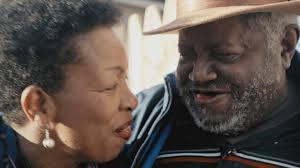 Mr. Rembert grew up in rural Georgia, in a farm laborer’s house and later in the small town of Cuthbert. Raised by his great-aunt, Rembert worked with her in the cotton fields during much of his childhood, and received little formal education. As a teenager he got involved in the 1960s Civil Rights Movement. Jailed for fleeing for his life in a stolen car, nearly lynched and then cut down to serve as an example to others, Rembert was sentenced to 27 years in the Georgia Penal System. Despite the cruel prison circumstances, Rembert learned to read and write and managed to meet and write letters to his would-be wife Patsy as well as to congressmen, with the hope of gaining early release. He also learned the craft of hand-tooling leather from a fellow-prisoner. After seven years, most of which was spent on chain gangs, Rembert was released from prison, but it wasn’t until 1997, at the age of 51, that he began to work more seriously with leather as his artistic medium, creating tooled and dyed canvases that tell the stories of his life. His paintings have been exhibited at galleries across the country—including the Yale University Art Gallery, the Adelson Galleries New York, and the Hudson River Museum—and have been profiled in The New York Times and elsewhere. Rembert is the recipient of a 2017 USA Fellowship, and in 2015 was an honoree of Bryan Stevenson’s Equal Justice Initiative. Rembert’s full-color memoir, Chasing Me to My Grave: An Artist’s Memoir of the Jim Crow South, is forthcoming from Bloomsbury in 2021.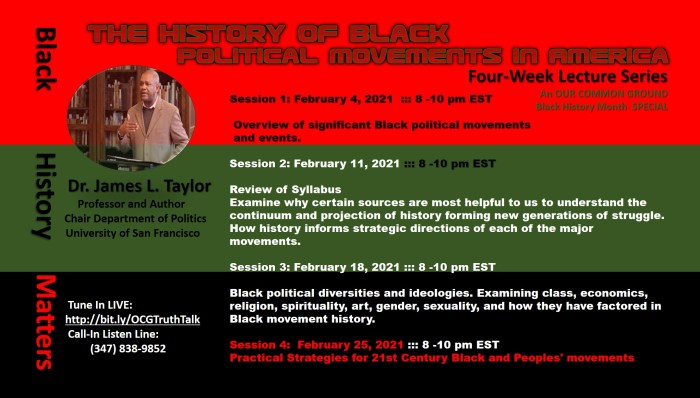

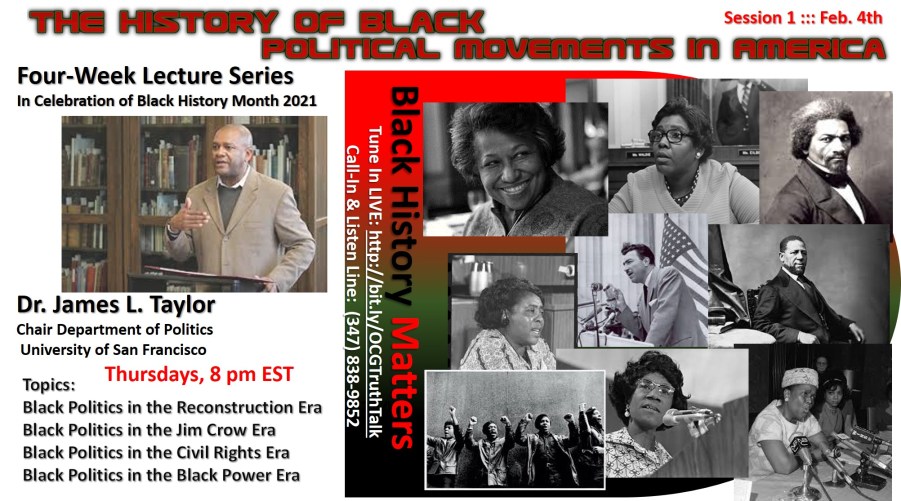
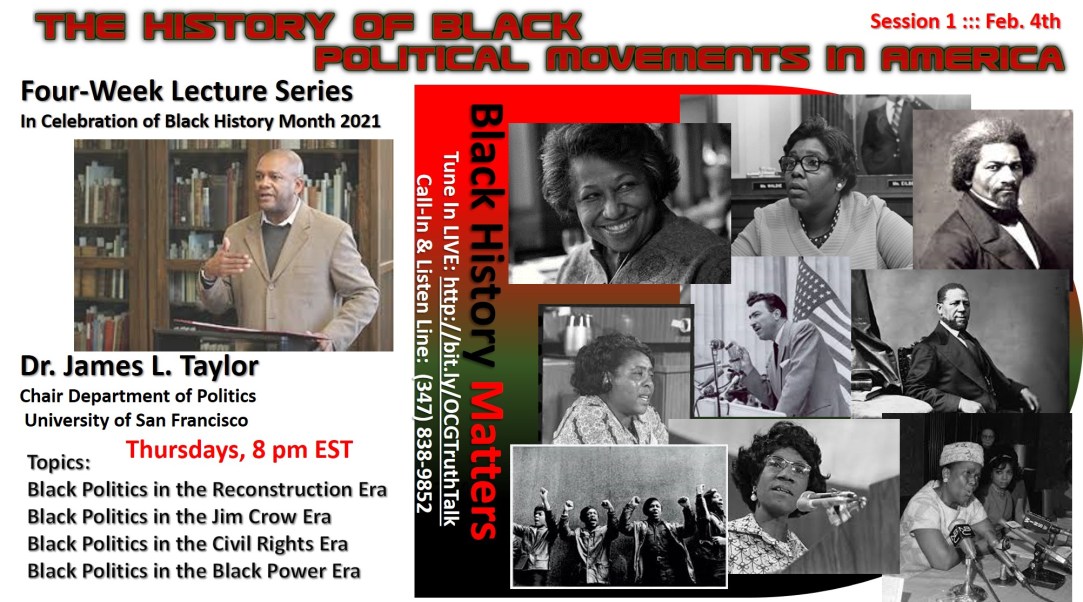
 Professor James Lance Taylor is the Chair of the Department of Politics at the University of San Francisco and is from Glen Cove, Long Island. He is the author of the book “Black Nationalism in the United States: From Malcolm X to Barack Obama”, which earned 2012 “Outstanding Academic Title” – Choice: Current Reviews for Academic Libraries. (Ranked top 2 percent of 25,000 books submitted and top 8 percent of 7,300 actually accepted for review by the American Library Association). Rated “Best of the Best.” The hardback version sold out in the U.S. and the paperback version was published in 2014.














 OCG
OCG 