“ON BEING WHITE AND OTHER LIES” James Baldwin, Essence Magazine 1984

ON BEING “WHITE” • AND OTHER LIES James Baldwin (1924-1987)

baldwinJames Baldwin was the greatest expert on white consciousness in the twentieth century United States. Born in what he described as the “southern community” of Harlem, Baldwin published six novels, including his brilliant treatment of fathers, sons, and religion in Go Tell It on the Mountain (1953), and Giovanni’s Room (1956), a work concentrating on white, gay characters. Baldwin’s early essays, collected in Notes of a Native Son (1955), Nobody Knows My Name (1961), and The Fire Next Time (1963), are works of remarkable range, lucidity, and compassion. But his scandalously underappreciated essays, generously sampled in The Price of the Ticket (1985), push Baldwin’s arguments regarding race and the meaning of America, racism, homophobia, and the “male prison,” and whiteness and the immigrant experience to unprecedented levels of insight. “On Being ‘White’ and Other Lies,” published originally in the popular African-American magazine Essence in 1984, is a dramatic reminder that “becoming American” meant learning to be white in a new way for European immigrants.

“ON BEING WHITE  AND OTHER LIES”  James Baldwin, Essence Magazine 1984

The crisis of leadership in the white community is remarkable—and terrifying—because there is, in fact, no white community. This may seem an enormous statement—and it is. I’m willing to be challenged. I’m also willing to attempt to spell it out. My frame of reference is, of course, America, or that portion of the North American continent that calls itself America. And this means I am speaking, essentially, of the European vision of the world—or more precisely; perhaps, the European vision of the universe. It is a vision as remarkable for what it pretends to include as for what it remorselessly diminishes, demolishes or leaves totally out of account.

There is, for example—at least, in principle—an Irish community: here, there, anywhere, or, more precisely, Belfast, Dublin and Boston. There is a German community: both sides of Berlin, Bavaria and Yorkville. There is an Italian community: Rome, Naples, the Bank of the Holy Ghost and Mulberry Street. And there is a Jewish community, stretching from Jerusalem to California to New York. There are English communities. There are French communities. There are Swiss consortiums. There are Poles: in Warsaw (where they would like us to be friends) and in Chicago (where because they are white we are enemies). There are, for that matter, Indian restaurants and Turkish baths. There is the underworld—the poor (to say nothing of those who intend to become rich) are always with us—but this does not describe a community It bears terrifying witness to what happened to everyone who got here, and paid the price of the ticket. The price was to become “white.”

No one was white before he/she came to America. It took generations, and a vast amount of coercion, before this became a white country. It is probable that it is the Jewish community or more accurately, perhaps, its remnants—that in America has paid the highest and most extraordinary price for becoming white. For the Jews came here from countries where they were not white, and they came here, in part, because they were not white; and incontestably in the eyes of the Black American (and not only in those eyes) American Jews have opted to become white, and this is how they operate. It was ironical to hear, for example, former Israeli prime minister Menachem Begin declare some time ago that “the Jewish people bow only to God” while knowing that the state of Israel is sustained by a blank check from Washington.

Without further pursuing the implication of this mutual act of faith, one is nevertheless aware that the Black presence, here, can scarcely hope—at least, not yet—to halt the slaughter in South Africa. And there is a reason for that. America became white—the people who, as they claim, “settled” the country became white—because of the necessity of denying the Black presence, and justifying the Black subjugation.

No community can be based on such a principle—or, in other words, no community can be established on so genocidal a lie. White men—from Norway, for example, where they were Norwegians—became white: by slaughtering the cattle, poisoning the wells, torching the houses, massacring Native Americans, raping Black women. This moral erosion has made it quite impossible for those who think of themselves as white in this country to have any moral authority at all—privately, or publicly. The multitudinous bulk of them sit, stunned, before their TV sets, swallowing garbage that they know to be garbage, and—in a profound and unconscious effort to justify this torpor that disguises a profound and bitter panic pay a vast amount of attention to athletics: even though they know that the football player (the Son of the Republic, their sons!) is merely another aspect of the money-making scheme. They are either relieved or embittered by the presence of the Black boy on the team. I do not know if they remember how long and hard they fought to keep him off it.

I know that they do not dare have any notion of the price Black people (mothers and fathers) paid and pay. They do not want to know the meaning, or face the shame, of what they compelled—out of what they took as the necessity of being white—Joe Louis or Jackie Robinson or Cassius Clay (aka Muhammad Ali) to pay I know that they, themselves, would not have liked to pay it. There has never been a labor movement in this country, the proof being the absence of a Black presence in the so-called father-to-son unions. There are, perhaps, some niggers in the window; but Blacks have no power in the labor unions. Just so does the white community, as a means of keeping itself white, elect, as they imagine, their political (!) representatives. No nation in the world, including England, is represented by so stunning a pantheon of the relentlessly mediocre.

I will not name names I will leave that to you. But this cowardice, this necessity of justifying a totally false identity and of justifying what must be called a genocidal history, has placed everyone now living into the hands of the most ignorant and powerful people the world has ever seen: And how did they get that way? By deciding that they were white. By opting for safety instead of life. By persuading themselves that a Black child’s life meant nothing compared with a white child’s life. By abandoning their children to 180 BLACK ON WHITE the things white men could buy By informing their children that Black women, Black men and Black children had no human integrity that those who call themselves white were bound to respect. And in this debasement and definition of Black people, they debased and defamed themselves. And have brought humanity to the edge of oblivion: because they think they are white. Because they think they are white, they do not dare confront the ravage and the lie of their history. Because they think they are white, they cannot allow themselves to be tormented by the suspicion that all men are brothers.

Because they think they are white, they are looking for, or bombing into existence, stable populations, cheerful natives and cheap labor. Because they think they are white, they believe, as even no child believes, in the dream of safety Because they think they are white, however vociferous they may be and however multitudinous, they are as speechless as Lot’s wife— looking backward, changed into a pillar of salt. However-1 White being, absolutely, a moral choice (for there are no white people), the crisis of leadership for those of us whose identity has been forged, or branded, as Black is nothing new. We—who were not Black before we got here either, who were defined as Black by the slave trade—have paid for the crisis of leadership in the white community for a very long time, and have resoundingly, even when we face the worst about ourselves, survived, and triumphed over it. If we had not survived and triumphed, there would not be a Black American alive. And the fact that we are still here—even in suffering, darkness, danger, endlessly defined by those who do not dare define, or even confront, themselves is the key to the crisis in white leadership.

The past informs us of various kinds of people—criminals, adventurers and saints, to say nothing, of course, of popes—but it is the Black condition, and only that, which informs us concerning white people. It is a terrible paradox, but those who believed that they could control and define Black people divested themselves of the power to control and define themselves.

497f84c1-4ea4-47ab-9098-654817c93231.jpg

OUR COMMON GROUND with Janice Graham

BROADCASTING BOLD BRAVE & BLACK

Each Saturday  LIVE& Call-In

 10 pm ET

Join us on FACEBOOK and Learn More about us.
OCG on Facebook
Enjoy our archive of all OCG past broadcasts.

OCG on the Web: https://ourcommongroundtalk.wordpress.com/
Community Forum: http://www.ourcommonground-talk.ning.com/
Follow us on Twitter: @JaniceOCG #TalkthatMatters

Presidential Election 2016: An American Tragedy – The New Yorker

OUR COMMON GROUND Returns LIVE
“Rebooting for a New Era of Struggle”
CoHosting, Dr. James L. Taylor
USF and UC Berkeley Black Studies Department Chair, Professor; Author, “Black Nationalism in the United States: From Malcolm X to Barack Obama”

Learn More About this Broadcast:
November 12, 2016 LIVE ::10 pm EST::
Join Us LIVE :: http://bit.ly/Blackreboot

Presidential Election 2016: An American Tragedy – The New Yorker

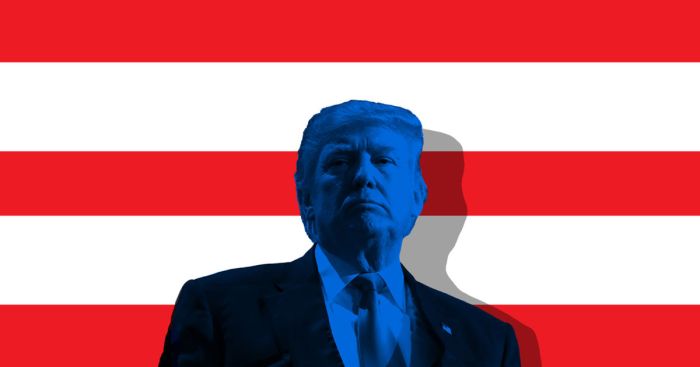
The electorate has, in its plurality, decided to live in Trump’s world.SOURCE PHOTOGRAPH BY JOE RAEDLE / GETTY

The election of Donald Trump to the Presidency is nothing less than a tragedy for the American republic, a tragedy for the Constitution, and a triumph for the forces, at home and abroad, of nativism, authoritarianism, misogyny, and racism. Trump’s shocking victory, his ascension to the Presidency, is a sickening event in the history of the United States and liberal democracy. On January 20, 2017, we will bid farewell to the first African-American President—a man of integrity, dignity, and generous spirit—and witness the inauguration of a con who did little to spurn endorsement by forces of xenophobia and white supremacy. It is impossible to react to this moment with anything less than revulsion and profound anxiety.

Source: Presidential Election 2016: An American Tragedy – The New Yorker

Spiritual blackout in America: Election 2016 – The Boston Globe :: Dr. Cornel West

The neofascist catastrophe called Donald Trump and the neoliberal disaster named Hillary Clinton are predictable symbols of our spiritual blackout.

THE MOST FRIGHTENING feature of the civic melancholia in present-day America is the relative collapse of integrity, honesty, and decency — an undeniable spiritual blackout of grand proportions. The sad spectacle of the presidential election is no surprise. Rather, the neofascist catastrophe called Donald Trump and the neoliberal disaster named Hillary Clinton are predictable symbols of our spiritual blackout. Trump dislodged an inert conservative establishment by unleashing an ugly contempt for liberal elites and vulnerable citizens of color — and the mainstream media followed every performance (even his tweets!) for financial gain. Clinton laid bare a dishonest liberal establishment that was unfair to Bernie Sanders and obsessed with winning at any cost — and the mainstream media selectively weighed in for pecuniary ends.
For more: http://bit.ly/2f8BpG3

Source: Spiritual blackout in America: Election 2016 – The Boston Globe

Black Nationalism and Liberation | Boston Review


Nation of Islam counter-demonstration at NAACP rally in Harlem, 1961 / Photograph: NAACP collection, Library of Congress

In a world where Donald Trump’s presidential nomination speech has been endorsed by a former leader of the Ku Klux Klan—yet Black Lives Matter activists are accused of reverse racism for asking to not be murdered by police—what constitutes hate speech has become increasingly convoluted. In the aftermath of police killings in Dallas and Baton Rouge, gunmen Micah Johnson and Gavin Long were immediately linked by media outlets to black nationalist groups such as the Nation of Islam (NOI), New Black Panther Party, Black Riders Liberation Party, and Washitaw Nation, despite their professions to have been acting alone. Not only did these depictions draw misleading lines to organizations that do not prescribe such acts of violence, they also overshadowed both mens’ backgrounds in cultures of military violence (Johnson joined the Army Reserves immediately after high school and Long was a former Marine sergeant).

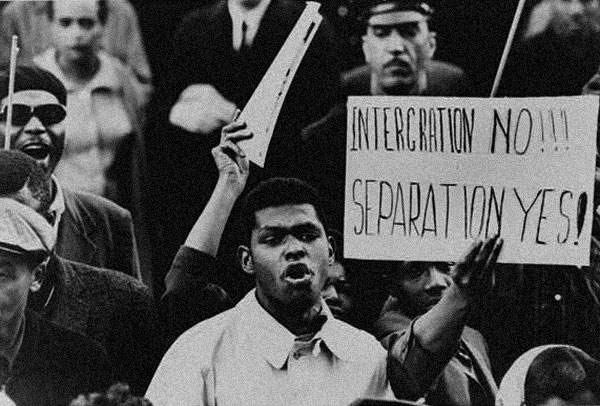
In a desperate attempt to drive home a link to black nationalism and direct attention away from these other troubling vectors, some news outlets began referring to Johnson as “Micah X” (NOI members use “X” to replace their “slave names”). In fact his middle name was simply Xavier. Even progressive groups, such as the Southern Poverty Law Center, play a legitimating role by identifying black nationalist groups as “black separatist hate groups,” leaving little room for meaningful distinctions between white supremacy and black nationalism. While groups such as the Nation of Islam have historically advocated for the separation of black communities, to assert that this position is simply the obverse of white supremacy—that is, black supremacy—overlooks the nuance of black nationalism. More importantly, it fails to account for the dramatically different relationships to power that black nationalist and white supremacist groups possess. White nationalism reinscribes and exalts the privileges of whiteness. Black nationalists council separation as an anti-racist practice and a method of empowerment in the absence of alternative avenues of power. To many black nationalists, this is the difference between life and death: the black community must either do for itself or perish.

The conflation of black and white nationalism is not new. In 1963 the New York Herald Tribune satirized what it perceived as the ironic similarities between white supremacists and black nationalists in a story entitled “Integrated Segregation.” Things “seem a trifle confused on the racial front these days. The segregationists are getting integrated and the integrationists are getting segregated,” the Tribune remarked. The article imagined a scene in which staunch segregationist George Wallace was explaining why racial segregation benefitted black Americans when “a Black Muslim popped up from behind, tapped him on the back and agreed with him.” Soon, the article predicted, the Congress for Racial Equality would “start picketing the N.A.A.C.P., while the Black Muslims set up an all-Negro chapter of the Ku Klux Klan.”

To many black nationalists, separation from whites is the difference between life and death: the black community must either do for itself or perish.

Understanding black nationalism as simply the mirror image of white supremacy, rather than an anti-racist practice, has deep roots in American political discourse. And in our current moment of colorblind “post-racialism,” when race-specific remedies such as affirmative action or reparations are derided as reverse racism—and even modest demands from Black Lives Matter for criminal justice reform are decried as anti-white—black nationalism has been once again mischaracterized using a host of long-stale tropes. We would be better served, not by simply dismissing black nationalism as the underbelly of white supremacy, but by understanding it as a tradition that is both liberative and anti-racist; one that does not mirror white supremacy, but repudiates it.

section separator

W. D. Fard, the founder of the Nation of Islam, arrived in Detroit in 1930 and told black Detroiters that they “were not Americans but Asiatics.” This was part of a holistic alternative creation story that rejected the racist underpinnings of white American nationalism. Many of Fard’s followers were former followers of Marcus Garvey, left without an organization after the decline of his Universal Negro Improvement Association (UNIA) in the late 1920s due to financial mismanagement and government infiltration. Garvey and the UNIA epitomized the goals of black nationalism, launching the most ambitious and successful Pan-Africanist vision in history. At its height, the UNIA had over 700 branches in 38 states, and its newspaper, Negro World, circulated throughout the African diaspora. Millions of black people were moved by Garvey’s message of racial pride embodied through the UNIA motto “One God! One Aim! One Destiny!” The NOI borrowed many of its black nationalist tenets from the UNIA, combining them with religious symbols, practices, and theologies drawn from the plethora of new northern, black, urban religious and racial-pride movements spawned by the Great Migration. This blending spoke to the diverse backgrounds of many early NOI members: in 1951 nineteen out of twenty-eight Muslims interviewed reported having previously been members in other movements such as black Masonry, the Israelite Movement, God’s Government on the Earth (dedicated to Liberian emigration), the Peace Movement of Ethiopia, Repatriation Movement to Liberia, and the Black Jews.

As historian Robin D. G. Kelley notes, many of these movements were influenced by a Black Zionist tradition that drew upon the narrative of the book of Exodus to imagine liberation and deliverance for black people around the world. These freedom dreams not only provided what he calls a “narrative of slavery, emancipation, and renewal,” but also a “language to critique America’s racist state since the biblical Israel represented a new beginning.” Beyond providing a framework for denouncing American racism, black nationalists addressed the racist power structures that governed their communities by creating jobs, businesses, schools, and places of worship. Racial separation was not simply about black communities’ physical relationship to white people; it was about changing the structures of power that governed those relationships through self-determination, community control, and new relationships to self and one another.

By 1959 the Nation of Islam was a burgeoning movement well known within urban black communities in the North but still largely unknown to white America. That summer, as Malcolm X traveled to Africa as a guest of Egypt’s president, Gamal Abdel Nasser, Mike Wallace (later of 60 Minutes fame) and black journalist Louis Lomax presented the NOI to white audiences for the first time. In their sensationalist documentary, The Hate That Hate Produced, NOI was compared to the American Nazi Party and the Ku Klux Klan. Members of the Nation were referred to as “black racists” and “black supremacists.” Its cautionary message to a largely white audience was that white racism would inevitably produce its black variant. As Malcolm X later recalled in his Autobiography, the show was meant to shock viewers, like when “Orson Welles frightened America with a radio program describing . . . an invasion by ‘men from Mars.’”

The Hate That Hate Produced was critical in launching the Nation of Islam into the public eye. But it also offered white viewers a language for understanding black nationalism that both intensified and allayed their fears. While racism was a plague that undermined American democracy, it was not a distinctly white characteristic. As Charlie Keil, a young white civil rights organizer at Yale during the early 1960s explained to me recently: “The Hate that Hate Produced allowed [whites] to sort of categorize the Muslims—the Nation of Islam—and treat them a certain way. . . . [It was] some way of saying that this was not an autonomous self-starting movement, but a reaction, an overreaction to a history of oppression.”

Throughout the 1960s black nationalists were castigated as “supremacists” who promoted the very racism and racial segregation that liberals were fighting against. This was stoked by white nationalists who saw calls for black racial separation as consistent with their belief in the benefits of racial segregation. As George Lincoln Rockwell, head of the American Nazi Party, told Alex Haley in a 1966 interview: “Malcolm X said the same thing I’m saying.”

Rockwell was not the only one confused about the difference between racial segregationand racial separation. In a highly-publicized Los Angeles trial in 1962 after police killed an unarmed member of the Los Angeles NOI mosque, the Los Angeles Times reported the “unusual problem in seating of spectators . . . when women members of the sect refused to accept seats alongside white persons.” The court eventually overturned this seating arrangement, and the press described this as “desegregation.” Los Angeles NAACP president Christopher Taylor joined the chorus of the aggrieved by arguing that he would be against any type of segregation, regardless of who initiated it. This decontextualized, colorblind insistence that any race demanding separation was calling for racial segregation was central to mischaracterizations of black nationalism during this period.

Malcolm X set about clarifying the Nation of Islam’s advocacy for racial separatism through dozens of debates with prominent civil rights figures on college campuses across the country in the early 1960s. He debated James Farmer at Cornell, Bayard Rustin at Howard, Louis Lomax at Yale, and the NAACP’s Walter Carrington at Harvard. Almost every debate was themed around the question: “Integration or Separation?” As Malcolm explained at Wesleyan University: “We are just as much against segregation as the most staunch integrationist.” But he added that black people did not “want to be free any more; they want integration. . . . They have confused their method with their objective.” In other words, black nationalists were not opposed to racial integration as an outcome of freedom struggles, or even as an organizing strategy, but they saw it as deeply flawed as the movement’s principal objective. More importantly, they pointed out the racist presumption of integration, which took for granted that white society and its values were more desirable. As Malcolm once sardonically asked, Who is the white man to be equal to?

More than simply critiquing integration, the Nation of Islam emphasized the importance of community control, an idea that flourished in upcoming years with the emergence of the Black Power movement. As Malcolm explained: “segregation means to regulate or control. . . . A segregated community is that forced upon inferiors by superiors. A separate community is done voluntarily by two equals.” Recognizing the pervasiveness of racial segregation, nationalists sought control over the businesses, healthcare, education, housing, and policing in their communities. Indeed, the Kerner Commission’s grim 1968 assessment that the nation was “moving toward two societies, one black, one white—separate and unequal” was something understood within black communities for decades. Amidst this backdrop, nationalists called for greater autonomy. The distinction between segregation and separation was not a semantic pivot. It was a deeper analysis of power, and an assertion of self-determination.

Over sixty years since the Supreme Court struck down the constitutionality of “separate but equal” in Brown v. Board, it would seem that calls for racial separatism are a relic of the past. But that might be too hopeful. A 2014 UCLA study revealed higher levels of school segregation in many regions than in 1968, the year the Supreme Court decreed a more proactive approach to desegregation. Schools with less than 1 percent white students are now being referred to as “apartheid schools.” And while the South is no longer governed by Jim Crow laws, cities outside the South such as Chicago and Baltimore continue to be described by demographers as “hypersegregated.”

The denial of race is a fixture of racism. Black nationalists have often exposed the “colorblind,” coded racism of liberals.

Black critiques of school integration during the 1950s and 1960s were often decried. In the words of scholar Andrew Delbanco, novelist and anthropologist Zora Neale Hurston “consigned herself to oblivion” when she responded to the Brown v. Board decision by saying that she could “see no tragedy in being too dark to be invited to a white school affair.” After James Meredith enrolled as the first black student in the University of Mississippi’s history, Malcolm X told a courtroom that anytime a man “needs [an] escort of 15,000 troops to go to a college where he will be among people whose viciousness toward him is so deadly that he needs the Army there to protect him . . . that Negro is foolish if he thinks that he is going to get an education.” Education, not integration, should be the goal, both Hurston and Malcolm agreed. As Malcolm explained, “token integration” was pointless as long as there were “a couple million Negroes in Mississippi who haven’t been allowed to go to the Kindergarten in a decent school.”

Meanwhile, integration today is often illustrated through the exceptional accomplishments of a handful of black elites, most notably President Barack Obama, rather than evidenced by a substantial redistribution of wealth or educational and housing opportunities. As Keeanga-Yamahtta Taylor demonstrates, the role of “black faces in high places” is often to obscure the common conditions facing many African Americans. Instead, black elected officials serve as interlocutors speaking to—and on behalf of—black communities. Taylor writes poignantly of the 2015 Baltimore uprising after the death of Freddie Gray: “When a Black mayor, governing a largely Black city, aids in the mobilization of a military unit led by a Black woman to suppress a Black rebellion, we are in a new period of the Black freedom struggle.” But this new period has unfortunately produced all-too-familiar outcomes for poor and working-class black people.

section separator

The long history of black nationalist leaders having official meetings with white supremacist leaders is another narrative often mobilized as proof of the essential symmetry of the two movements. In 1922 Marcus Garvey met with the Imperial Wizard of the Klan, Edward Clarke, earning him swift denunciation by the NAACP. In 1961 Malcolm X and other NOI officials secretly met with the KKK in Atlanta to negotiate a non-aggression pact surrounding the NOI’s purchase of southern farmland. The following year American Nazi leader George Lincoln Rockwell even appeared as an invited guest at the NOI’s Saviour’s Day convention in Chicago. When police in Monroe, Louisiana, illegally targeted and raided the city’s mosque with tear gas, rifles, and riot sticks, the Nation of Islam secured an interracial defense team: local black attorney James Sharpe, Jr., and Imperial Wizard of the National Knights of the Klan, James Venable. As Venable explained when taking the case, “I hate to say it but a colored man doesn’t have a chance in a courtroom in the South.”

The decision by black nationalists to meet or coordinate with white supremacists was often driven by a combination of pragmatism and a deep cynicism about the authenticity of liberals. In the case of the UNIA, Garvey negotiated an agreement with Clarke to sell stock in black businesses such as newspapers, factories, and his Black Star shipping line, which ambitiously hoped to link a global black economy in Africa, the Caribbean, and the Americas before failing due to poor business management. And although Malcolm X would later denounce the Nation of Islam’s détente with the Klan, the organization’s motivation for doing so was plainly and only to secure the right to farm in the South without danger of violent reprisal. And in the case against eight members of the NOI in Monroe, Venable successfully won an appeal for several of those convicted.

Black nationalists were also not uncritical of the white supremacists with whom they interacted, a fact often downplayed or forgotten. After his meeting with the Klan, Garvey told a crowd: “Mr. Clark [sic] did not tell me anything new; he told me what I discovered seven years ago. He told me the thing that caused me to have organized the Universal Negro Improvement Association four and a half years ago.” When Rockwell, wearing full Nazi regalia, donated twenty dollars to a collection plate at Saviour’s Day, there was a smattering of reluctant applause. Malcolm X belittled him by adding: “You got the biggest hand you ever got.” Equally, black nationalists used white supremacists to draw attention to the hypocrisy of liberals. Following his 1922 meeting, Garvey claimed that Klan members were “better friends to my race, for telling us who they are, and what they mean.” Malcolm used a similar device in his folk metaphor of the liberal “fox” and the conservative “wolf.” When comparing John F. Kennedy to George Wallace, Malcolm said: “Neither one loves you. The only difference is that the fox will eat you with a smile instead of a scowl.” He even penned a 1964 editorial entitled “Why I Am for Goldwater” in which he drew upon the same fox/wolf metaphor and cynically suggested that with Goldwater, “black people at least know what they are dealing with.”

Critics on the left who see these as misguided political strategies have marginalized black nationalists by painting them as racial conservatives, and thereby emptied black nationalists’ critiques of their incisiveness. For example, Paul Gilroy accuses Garvey of “black fascism” and C. L. R. James even compared him to Hitler. Others have taken Malcolm’s cynical support for Goldwater at face value, rather than understanding his rhetorical move to draw parallels between openly racist politicians and ostensibly liberal ones whose policies nonetheless gut the black community.

Black nationalist groups such as the UNIA and the NOI have rightly been critiqued for their deep patriarchy, homophobia, and tendency to reproduce the other trappings of empire. As historian Michelle Ann Stephens notes of Garvey, his “vision of the sovereign state figured in the black male sovereign; the desire for home at a more affective level figured in the woman of color.” Likewise, anti-Semitic comments by Nation of Islam leaders such as Louis Farrakhan have certainly buttressed comparisons between white and black nationalists. Most recently, Farrakhan stoked this fire by praising Donald Trump’s refusal to take money from Jewish donors.

But although charismatic leaders are often the voices we hear most prominently, for many rank-and-file members of the Nation of Islam and other black nationalist groups, the lived experience of racial pride, religious rebirth, and doing for oneself is a redemptive, affirming, and even lifesaving practice. Many members joined the NOI after feeling alienated in integrated, more middle-class organizations such as the NAACP. As Lindsey X told an interviewer, what the NAACP “wanted never seemed real to me. I think Negroes should create jobs for themselves rather than going begging for them.” Malcolm X’s autobiography is only the best-known narrative of religious and political redemption. In a long-running feature in the NOI’s newspaper, Muhammad Speaks, entitled “What Islam Has Done For Me,” members offered their conversion narratives and testified to the transformative practice of Islam. Robert 24X of Paterson, New Jersey, contributed: “I was a young drug addict who had spent too much time in the hells of Harlem’s East Side . . . [before] everything came into focus for me. . . . I stopped smoking, using profanity, and eating improper foods. And I’ve passed my biggest acid test—no more needles in the arm.”

Instead of positioning black nationalism as a reactionary, conservative ideology that simply apes the violence and hate of white supremacy, we might learn from its lessons today. If asked about the xenophobia and dangerous comments of conservative firebrand Donald Trump in our current election, Malcolm X might well have pivoted us back to Hillary Clinton’s questionable record on race, one which Black Lives Matter activists have pointed out includes racist dog whistles such as her comments about “super-predators” lacking empathy, her steadfast support for the devastating 1994 Crime Bill, and campaign money taken from private prison corporations. And beyond the hollow political discourse of election cycles, we must avoid the pitfalls of incessant claims of post-racialism that insist that to see race is to participate in racism. As we have witnessed with the familiar “All Lives Matter” rejoinder to “Black Lives Matter,” we are living in a time when people’s humanity is so denigrated that the mere valuation of life is taken by some whites to be a zero-sum game. The denial of race is a central fixture in the perpetuation of racism, and black nationalists have routinely called attention to the importance of racial pride while exposing the coded racism of liberals. Rather than draw facile lines between black nationalism and white supremacy, we are better served by understanding black nationalism as an anti-racist political tradition seeking to envision black American freedom and citizenship in a nation that has rarely devoted much effort toward either end.

Source: Black Nationalism and Liberation | Boston Review

Black Girls, Domestic Violence, and the Limits of Self-Defense | Black Agenda Report


Black Girls, Domestic Violence, and the Limits of Self-Defense

by Lindsey E. Jones

Recent scholarship in the history of black women and the carceral state illustrates the extent to which systems of criminal justice and law enforcement have both historically failed to protect black female victims of domestic violence and criminalized black women who rise up in their own defense.

Black Girls, Domestic Violence, and the Limits of Self-Defense

by Lindsey E. Jones

This article previously appeared in the blog of the African American Intellectual History Society.

Legal systems in this country explicitly and implicitly render black women defenseless against intra- and interracial violence.”

The case of Bresha Meadows, an African American teenage girl in Ohio, is a sad commentary on the failure of the state to protect victims of domestic violence. After a lifetime of watching him physically and psychologically abuse her mother—and of being subjected to threats and verbal abuse, along with her siblings—Bresha allegedly shot her father to death while he slept on July 28, 2016. While her mother’s family and her attorney consider her actions to have been in self-defense, the county prosecutor has charged Bresha with aggravated murder. It remains to be seen whether she will be tried as a juvenile or as an adult. At stake is the possibility that Bresha, who marked her fifteenth birthday in juvenile hall just weeks after her arrest, could spend the rest of her life in prison if convicted as an adult.

While the case is making its way through the courts and the families of Brandi Meadows (Bresha’s mother) and Jonathan Meadows (Bresha’s deceased father) share conflicting stories with news media about the latter’s personality and propensity toward violence, as well as their conflicting opinions about premeditation versus self-defense, it is important to note that this case is neither isolated nor entirely new. Recent scholarship in the history of black women and the carceral state illustrates the extent to which systems of criminal justice and law enforcement have both historically failed to protect black female victims of domestic violence and criminalized black women who rise up in their own defense.

“Survivors of intimate partner violence dramatically overrepresented among incarcerated black women.”

Historian Kali Gross, in providing historical context to the case of Marissa Alexander, argues that the state’s willingness to condemn this woman for defending herself against an abusive husband points back through centuries of American history to “the legacies of an exclusionary politics of protection whereby black women were not entitled to the law’s protection, though they could not escape its punishment.” Gross traces the ways in which “racialized, gendered notions of protection” have, from the seventeenth century on, shaped legal systems in this country that explicitly and implicitly render black women defenseless against intra- and interracial violence. She argues that this exclusionary politics of protection fuels the current mass incarceration crisis, with survivors of intimate partner violence dramatically overrepresented among incarcerated black women.1

Bresha Meadows’s case exemplifies Gross’s concept of the exclusionary politics of protection. This past May, Bresha ran away from home to the home of an aunt, Martina Latessa. Latessa, a police officer working in a domestic violence unit in Cleveland, was forced to return Bresha to her father, who had reported the girl as having been kidnapped by her aunt. Latessa reported her brother-in-law to Family Services, which resulted in an agent interviewing Brandi Meadows about the allegations of abuse—as Jonathan Meadows sat beside her. Neither law enforcement nor the state bureaucracy could protect Brandi Meadows and her children from this abuse, which she and her family assert intensified after this incident. As a result of the state’s failure to end the cycle of trauma in her family, Bresha Meadows took matters into her own hands—and was charged with aggravated murder, for which she could potentially spend the rest of her life in prison.

Gross’s essay compellingly reveals the intersections of race, gender, and class in black women’s hyper-vulnerability to domestic violence; state failure to prevent or put a stop to said violence; and the too-common outcome of black women being incarcerated for offenses resulting from attempting to defend themselves against domestic violence. However, as the case of Bresha Meadows illustrates, there is another vector of identity that often doesn’t appear in our historical analyses of black females and the carceral state: that is, age.2

“For black women in the Jim Crow South—as in antebellum times—domestic violence was constitutive of domestic labor.”

Where race, gender, and class have worked together to create the conditions discussed above, the erasure of age difference has historically created disadvantages for black girl victims of domestic violence. One prominent example recently provided by historian LaShawn Harris is that of Virginia Christian. Often referred to as the first woman to be executed by the Commonwealth of Virginia, Christian was in reality a seventeen-year-old girl when she was killed by electric chair in 1912—a fact that her advocates hoped would persuade the state to show her mercy.3

Virginia Christian belonged to a working-class black family in Hampton, Virginia, and needed to work in order to contribute to her household, including her disabled mother. From the age of thirteen, she served as a laundress for a middle-class white family named Belote in Hampton. During a dispute about missing jewelry that turned physical, Virginia killed the matriarch of the family—a crime she confessed to committing in self-defense. Harris argues that “Christian’s act of self-defense delineated working-class African American women’s impetuous ways of protecting their bodies and their often last attempts to seek and secure long-awaited personal justice—especially when legal protection seemed beyond their reach.” While there is no archival evidence that Ida Belote had laid hands upon Virginia Christian prior to this altercation, there is plenty of evidence to demonstrate that for black women in the Jim Crow South—as in antebellum times—domestic violence was constitutive of domestic labor, the racially prescribed set of occupations for black women and girls.4

Christian’s response was most immediately triggered by Belote’s accusations of theft and subsequent physical assault on March 18, 1912, but it is conceivable that she was also responding to other physical and psychological traumas accumulated over three years of working in the Belote household.

The analogy from Virginia Christian in 1912 to Bresha Meadows in 2016 is imperfect, but these cases both illustrate the extent to which the state has failed to consider age in evaluating black girls’ actions in self-defense from domestic violence. Sadly, over a century later, Bresha’s advocates find themselves making very similar demands of a system that hasn’t changed enough since Virginia’s trial, and employing very similar tactics in their pursuit of mercy for this abused adolescent girl.

“In the minds of whites, the accused, regardless of her age, was a deviant and vulgar black murderess that had to be punished for her crime.”

In the case of Virginia Christian, the Commonwealth of Virginia ignored evidence that Christian committed the crime at sixteen years of age in order to prevent her minority status from impeding its plan to execute her. Harris argues that, “in the minds of whites, the accused, regardless of her age, was a deviant and vulgar black murderess that had to be punished for her crime; essentially, Christians’ race trumped her gender and age. By denying Christian of her adolescent status, the State of Virginia sought to punish her to the full extent of the law.”5

Black and white Americans wrote letters and circulated petitions pleading with the Commonwealth to consider Christian’s youth as a factor in her crime and her punishment and to commute her sentence from execution to life in prison. In the end, neither Christian’s appeal to self-defense, nor her advocates’ appeal to adolescence, could spare her from the lethal retribution of the state.

In a throwback to the campaign to spare Virginia Christian’s life in 1912, advocates of Bresha Meadows are writing letters and circulating petitions in the hope that local prosecutors take into account her age and her status as a survivor of domestic violence as they proceed with charges against her. Because of the Supreme Court’s 2005 decision in Roper v. Simmons that it is unconstitutional to execute a person for a crime committed under eighteen years of age, the death penalty is not on the table for Bresha. However, because prosecutors could decide to try her in adult court, it is a real possibility that she could be sentenced to life in prison.

A century after Virginia Christian’s advocates passionately and strategically petitioned the Commonwealth of Virginia for life imprisonment, Bresha’s advocates argue that no adolescent should spend life in prison—especially not a girl pushed toward drastic action by a lifetime of trauma and abuse. There is thankfully still time for the prosecutors of Trumbull County to give real weight to Bresha Meadows’ traumatic life history, and to the fact that it spans fifteen short years, as they decide what action to pursue.

Lindsey E. Jones is a PhD Candidate in History of Education at the University of Virginia’s Curry School of Education and a 2016-2018 Pre-doctoral Fellow at the Carter G. Woodson Institute for African-American and African Studies at the University of Virginia. Her dissertation project, “‘Not a Place of Punishment’: the Virginia Industrial School for Colored Girls, 1915-1940,” historicizes the education and incarceration of black girls by examining Virginia’s only reformatory for delinquent African American girls. Follow her on Twitter @noumenal_woman.

NOTES:

1. Kali N. Gross, “African American Women, Mass Incarceration, and the Politics of Protection,” Journal of American History 102, no.1 (2015), 25–33.

2. For a contemporary examination of black girls, interpersonal violence, and the carceral state, see Jody Miller, Getting Played: African American Girls, Urban Inequality, and Gendered Violence (New York: NYU Press, 2008).

3. Lashawn Harris, “The ‘Commonwealth of Virginia vs. Virginia Christian’: Southern Black Women, Crime & Punishment in Progressive Era Virginia,” Journal of Social History 47, no.4 (2014), 922–42.

4. See, for instance: Tera W. Hunter, To ’Joy My Freedom: Southern Black Women’s Lives and Labors after the Civil War (Cambridge, Mass.: Harvard University Press, 1997); Thavolia Glymph, Out of the House of Bondage: The Transformation of the Plantation Household (Cambridge: Cambridge University Press, 2003); Sarah Haley, “‘Like I Was a Man’: Chain Gangs, Gender, and the Domestic Carceral Sphere in Jim Crow Georgia,” Signs 39 (Autumn 2013).

5. Harris cites “a 1910 Virginia statue prohibiting death to ‘any child under seventeen years of age who is charged with any felony, and never having been heretofore convicted in any court of a misdemeanor’” (931).

Source: Black Girls, Domestic Violence, and the Limits of Self-Defense | Black Agenda Report

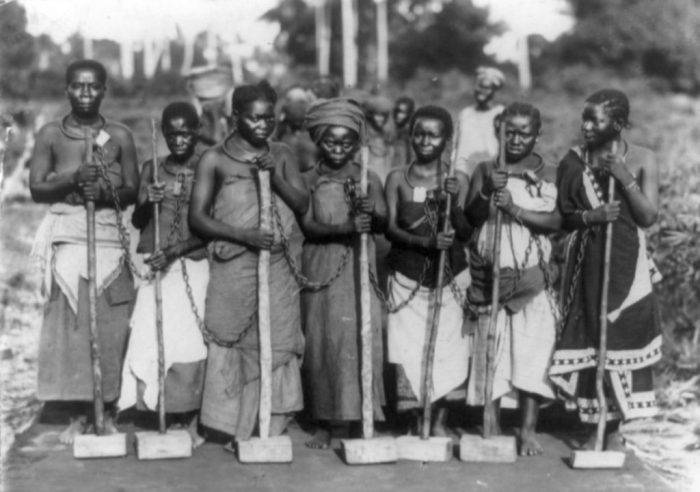
How Prison Labor is the New American Slavery and Most of Us Unknowingly Support it

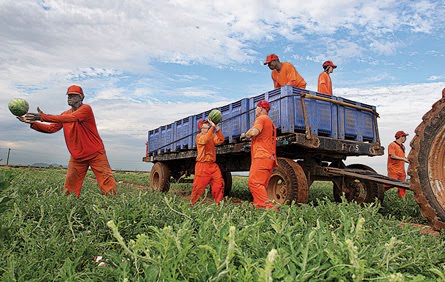
American slavery was technically abolished in 1865, but a loophole in the 13th Amendment has allowed it to continue “as a punishment for crimes” well into the 21st century. Not surprisingly, corporations have lobbied for a broader and broader definition of “crime” in the last 150 years. As a result, there are more (mostly dark-skinned) people performing mandatory, essentially unpaid, hard labor in America today than there were in 1830.

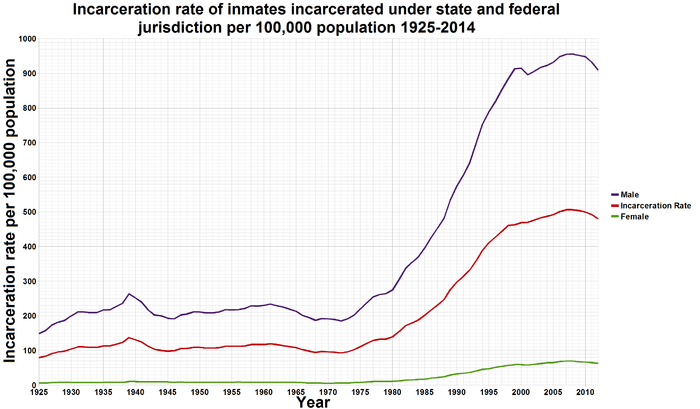
With 5 percent of the world’s population and 25 percent of the world’s prison population, the United States hasthe largest incarcerated population in the world. No other society in history has imprisoned more of its own citizens. There are half a million more prisoners in the U.S. than in China, which has five times our population. Approximately 1 in 100 adults in America were incarcerated in 2014.  Out of an adult population of 245 millionthat year, there were 2.4 million people in prison, jail or some form of detention center.

The vast majority – 86 percent – of prisoners have been locked up for non-violent, victimless crimes, many of them drug-related.

Big Business is making big bucks off of prison labor:

While prison labor helps produce goods and services for almost every big business in America, here are a few examples from anarticle that highlights the epidemic:

Whole Foods – You ever wonder how Whole Foods can afford to keep their prices so low (sarcasm)? Whole Foods’ coffee, chocolate and bananas might be “fair trade,” but the corporation has been offsetting the “high wages” paid to third-world producers with not-so-fair-wages here in America.

The corporation, famous for it’s animal welfare rating system, apparently was not as concerned about the welfare of the human “animals” working for them in Colorado prisons until April of this year.

You know that $12-a-pound tilapia you thought you were buying from “sustainable, American family farms?” It was raised by prisoners in Colorado, who were paid as little as 74 cents a day. And that fancy goat cheese? The goats were raised and milked by prisoners too.

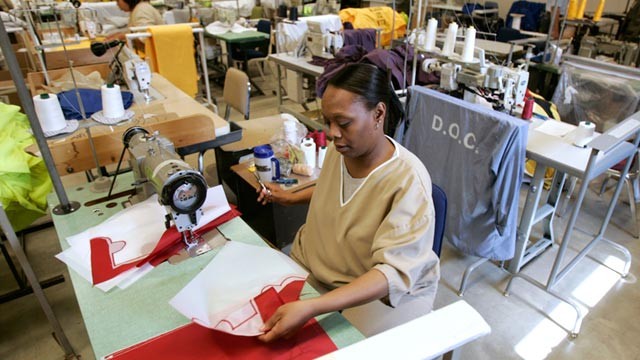
McDonald’s – The world’s most successful fast food franchise purchases a plethora of goods manufactured in prisons, including plastic cutlery, containers, and uniforms. The inmates who sew McDonald’s uniformsmake even less money by the hour than the people who wear them.

Wal-Mart – Although their company policy clearly states that “forced or prison labor will not be tolerated by Wal-Mart,” basically every item in their store has been supplied by third-party prison labor factories. Wal-Martpurchases its produce from prison farms, where laborers are often subjected to long hours in the blazing heat without adequate food or water.

Victoria’s Secret – Female inmates in South Carolina sew undergarments and casual-wear for the pricey lingerie company. In the late 1990’s, two prisoners were placed in solitary confinement for telling journalists that they were hired to replace “Made in Honduras” garment tags with “Made in USA” tags.

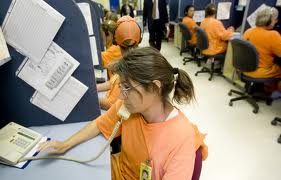
AT&T – In 1993, the massive phone company laid off thousands of telephone operators—all union members—in order to increase their profits. Even though AT&T’s company policy regarding prison labor reads eerily like Wal-Mart’s, they have consistently used inmates to work in their call centers since ’93, barely paying them $2 a day.

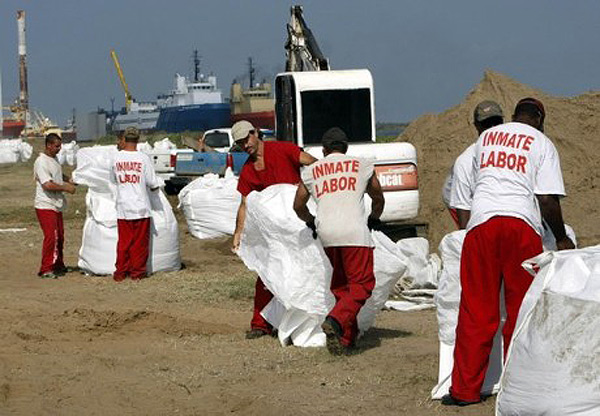
BP (British Petroleum) – When BP spilled 4.2 million barrels of oil into the Gulf coast, the company sent a workforce of almost exclusively African-American inmates to clean up the toxic spill while community members, many of whom were out-of-work fisherman, struggled to make ends meet. BP’s decision to use prisoners instead of hiring displaced workers outraged the Gulf community, but the oil company did nothing to reconcile the situation.

The full list of companies implicated in exploiting prison labor includes:

Bank of America
Bayer
Cargill
Caterpillar
Chevron
Chrysler
Costco
John Deere
Eli Lilly and Company
Exxon Mobil
GlaxoSmithKline
Johnson and Johnson
K-Mart
Koch Industries
McDonald’s
Merck
Microsoft
Motorola
Nintendo
Pfizer
Procter & Gamble
Pepsi
ConAgra Foods
Shell
Starbucks
UPS
Verizon
WalMart
Wendy’s

While not all prisoners are “forced” to work, most “opt” to because life would be even more miserable if they didn’t, as they have to purchase pretty much everything above the barest necessities (and sometimes those too) with their hard-earned pennies. Some of them have legal fines to pay off and families to support on the outside. Often they come out more indebted than when they went in.

Prison farms” aka “modern plantations”
In places like Texas, however, prison work is mandatory and unpaid – the literal definition of slave labor.

According the Texas Department of Criminal Justice, prisoners start their day with a 3:30 a.m. wake-up call and are served breakfast at 4:30 a.m. All prisoners who are physically able are required to report to their work assignments by 6 a.m.

“Offenders are not paid for their work, but they can earn privileges as a result of good work habits,” the website says.


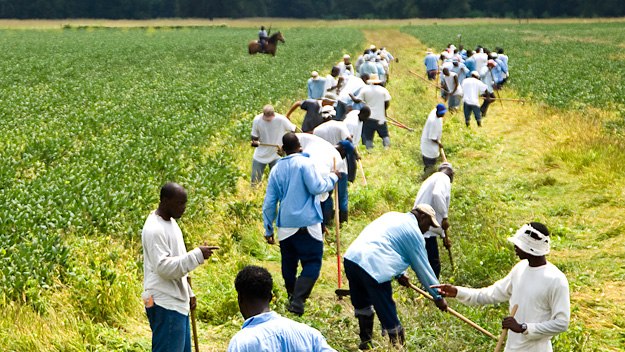
Most prisoners work in prison support jobs, like cooking, cleaning, laundry, and maintenance, but about 2,500 of them work in the Texas prison system’s own “agribusiness department,” where they factory-farm 10,000 beef cattle, 20,000 pigs and a quarter million egg-laying hens. The prisoners also produce 74 million pounds of livestock feed per year, 300,000 cases of canned vegetables, and enough cotton to clothe themselves (and presumably others). They also work at meat packaging plants, where they process 14 million pounds of beef and 10 million pounds of pork per year.

While one of the department’s stated goals is to reduce operational costs by having prisoners produce their own food, the prison system admittedly earns revenue from “sales of surplus agricultural production.”

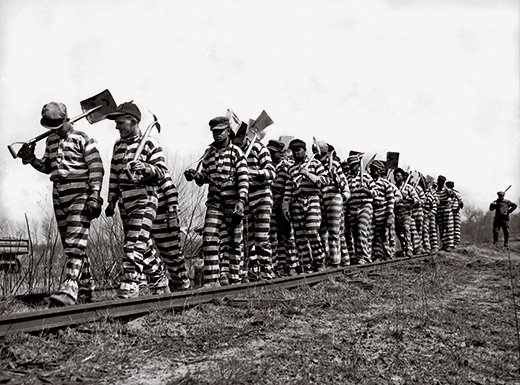
Prisoners who refuse to work – again, unpaid – are placed in solitary confinement. When asked if Texas prisons still employ “chain gangs” in the FAQ section, the department responds:

“No, Texas does not use chain gangs. However, offenders working outside the perimeter fence are supervised by armed correctional officers on horseback.”

Similar “prison farms” exist in Arizona, Alabama, Alaska, Arkansas, California, Colorado, Florida, Georgia, Hawaii, Louisiana, Mississippi, Ohio and other states, where prisoners are forced to work in agriculture, logging, quarrying and mining. Wikipedia says while the agricultural goods produced on prison farms is generally used to feed prisoners and other wards of the state (orphanages and asylums) they are also sold for profit.

In addition to being forced to labor directly for the profit of the government, inmates may be “farmed out” to private enterprises, through the practice of convict leasing, to work on private agricultural lands or related industries (fishing, lumbering, etc.). The party purchasing their labor from the government generally does so at a steep discount from the cost of free labor.

Source: How Prison Labor is the New American Slavery and Most of Us Unknowingly Support it

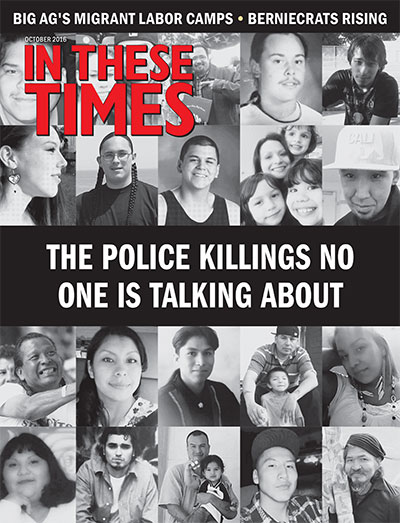
If You Thought Obama Was Giving Less Military Gear to Local Police Departments, You Were Wrong :: In These Times

If You Thought Obama Was Giving Less Military Gear to Local Police Departments, You Were Wrong

Despite President Obama’s much-touted 2015 executive order, an In These Timesinvestigation reveals evidence that police departments are still receiving as much military hardware from the Pentagon as ever.


WHEN PROTESTORS TOOK TO THE STREETS OF FERGUSON, MO., IN 2014 in response to the police killing of 18-year-old Michael Brown, they also turned the nation’s attention to a related issue: the growing militarization of local law enforcement. Images of suburban police threatening demonstrators with armored vehicles and assault rifles prompted changes to the controversial 1033 program, through which the Department of Defense (DOD) transfers surplus military equipment to police departments nationwide.

President Obama’s May 2015 announcement that he would freeze giveaways of certain gear drew outrage from law enforcement groups such as the National Association of Police Organizations (NAPO), which later charged that the banned equipment was “essential in protecting communities against violent criminals and terrorists.” After shooters targeted and killed uniformed police officers in Dallas and Baton Rouge in July, NAPO and other groups doubled down on criticisms that the administration was putting officers’ lives at risk. On July 21, Reuters reported that, following a meeting with police groups, Obama had agreed to revisit the ban.

But an In These Times investigation provides evidence that, in practice, the president’s much-ballyhooed reforms to the 1033 program have done little to stem the flow of battlefield gear to cops.

In fact, the total value of equipment distributed through the program actually increased in the year following the ban, according to figures provided to In These Times by Michelle McCaskill, media relations chief for the DOD’s Defense Logistics Agency (DLA), which oversees the shipments.

So far in fiscal year 2016, (Oct. 1, 2015 – September 13), the DLA has transferred $494 million worth of gear to local police departments, In These Times learned from McCaskill.

That far exceeds the $418 million of equipment sent to police in FY 2015 (Oct. 1, 2014 – Sept. 30, 2015). According to an analysis published in May by the transparency organization Open the Books, 2015 was already a peak year for such shipments within the past decade, exceeded only by 2014’s $787 million. Since 2006, more than $2.2 billion of hardware has found its way into the hands of police, according to the report.

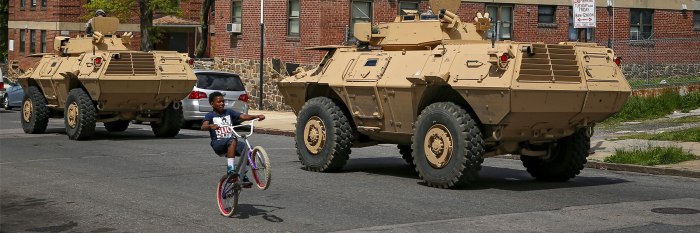
Many police accountability advocates warned from the outset that last year’s reforms were too limited in scope. Of seven items on the list of prohibited equipment, only one had actually been given to police departments in recent years, noted a May 2015 article in the Guardian. While the Obama administration placed additional requirements on the transfer of certain aircraft, armored vehicles and riot gear considered especially intimidating to civilians, hundreds of pieces of such equipment are still finding their way into the hands of local police. So far this year, for example, cops have acquired more than 80 mine-resistant ambush protected vehicles (MRAPs)—15-ton vehicles that were originally designed to withstand roadside bombs in war zones.

A SECOND LIFE FOR LETHAL WEAPONRY

The 1033 program, which refers to a section of the 1997 National Defense Authorization Act that created it, is a popular way for cash-strapped local law enforcement agencies to get gear on the cheap. Police departments typically are responsible only for the costs of shipping and maintaining the equipment.

Advocates also say the 1033 program allows underutilized Pentagon inventory to find a second life. “Since the American taxpayers have paid for this equipment already, does it not make more sense to share this equipment with local law enforcement agencies, as opposed to asking for the taxpayers to buy the same equipment twice?” asks Jim Franklin, executive director of the Minnesota Sheriffs’ Association, in an email to In These Times.

ACLU Minnesota legal director Teresa Nelson says that she is sensitive to the needs of law enforcement. “Nobody wants the police to be unsafe,” she says. “At the same time … when you have police in armored vehicles that look like tanks, you really change the dynamic between the police and the communities they serve.”

In January 2015, Obama responded to growing criticism of the program in the wake of Ferguson by issuing Executive Order 13688, which created a federal interagency group to investigate police militarization and come up with recommendations. As a result of this investigation, police were prohibited from receiving certain equipment, including bayonets, tracked armored vehicles, firearms and ammunition of .50‐caliber or higher, grenade launchers, camouflage uniforms and weaponized aircraft.

Critics said the reforms were superficial. Last year, an NPR analysis of 10 years of DLA data showed that of all the aircraft given to local police through the 1033 program, none were weaponized. The investigation further revealed that nearly 87 percent of the hundreds of armored vehicles being used at the time by local police ran on wheels, not tracks. Peter Kraska, a professor at Eastern Kentucky University’s School of Social Justice Studies and one of the leading researchers of police militarization, told the Guardian that the new rules were nothing more than a “publicity stunt.”

The ongoing transfer of armored vehicles, such as MRAPs, epitomizes these criticisms. Since the vehicles run on wheels, they aren’t on the new list of banned transfers. Nevertheless, their heft and design for use in warfare illustrates what critics see as the increasingly blurry line between police and military.

According to the DLA, police departments have received 708 MRAPs through the 1033 program since 2011, when the drawdown of troops in Iraq and Afghanistan first created a large reserve of unused equipment. At press time, 84 police departments had received the armored vehicles this year. More than 100 others have been approved and are awaiting delivery, according to DLA records obtained by In These Times through a Freedom of Information Act request.

As part of the Obama administration’s reforms, law enforcement agencies receiving “controlled” items, such as MRAPs, must demonstrate that they plan to train officers on proper use. But training materials used by various California police departments, obtained by the website MuckRock in June, show that instructional time for MRAPs ranges from 20 hours to as little as 15 minutes.

COMING TO A TOWN NEAR YOU?

Previously, only large urban police departments would have had the resources to justify acquiring the armored vehicles, which can cost upwards of $1 million. In 2014, Bill Johnson, executive director of NAPO, told USA Today that the 1033 program allows smaller police forces to play catch-up: “It’s their turn to get some of this equipment.”

That may explain why the 1033 program is particularly popular in states with significant rural populations such as Minnesota, where 74 of 87 county sheriffs have received surplus military equipment since 2005—mostly assault rifles and armored vehicles.

Jason Dingman, sheriff of sparsely populated Stevens County, Minn., told In These Times that an MRAP arrived this summer with only 56 miles on it. Virtually brand-new, the armored vehicle will just need a paint job and a fresh battery before being ready for use by West Central SWAT—a multi-agency task force that carries out tactical operations along the South Dakota border, but is called to the scene just six to eight times per year. “If we’re just executing a search warrant then we won’t bring [the MRAP] out,” Dingman says.
“But if the bad guy starts shooting at us then it’s a different situation and we can call out the MRAP to give our officers more protection.”

The DLA’s data show that police agencies receiving MRAPs in 2016 included those serving such tiny municipalities as Fallon, Nev. (pop. 8,458), and Westwego, La. (pop. 8,542). Even the police force in rural Pigeon Forge, Tenn. (pop. 6,171), found the need for an MRAP—perhaps to more effectively repel potential terrorist attacks on Dollywood, the town’s Dolly Parton-themed amusement park.

While police contend that equipment such as MRAPs are used defensively, renewed concerns arise whenever protests are met with a show of force. Following the police killing of Alton Sterling in Baton Rouge in July, a local reporter videotaped an armored vehicle pushing up against a crowd of protestors.

John Lindsay-Poland, who has researched the topic for the anti-militarism group American Friends Service Committee, thinks that the 1033 program fosters a “warrior mentality” that can further corrode police-community relations. “If we do not want our police to be at war in our communities,” he tellsIn These Times, “then we shouldn’t equip them with war-fighting equipment.”

Investigative stories like this are only possibly because of the support of readers like you. If you want to see more hard-hitting journalism, make a tax-deductible donation to support In These Times.


From the November 2016 Issue

SETH KERSHNER is a writer and researcher whose work has appeared in outlets such as Rethinking Schools, Sojourners, and Boulder Weekly. He is the co-author (with Scott Harding) of Counter-Recruitment and the Campaign to Demilitarize Public Schools (Palgrave Macmillan, 2015).

Source: If You Thought Obama Was Giving Less Military Gear to Local Police Departments, You Were Wrong

The Radical Democracy of the Movement for Black Lives :: Peniel Joseph

The Radical Democracy Of The Movement For Black Lives

“Black Lives Matter has cast a strobe-light on contemporary myths of racial progress, arguing correctly that the criminal justice system represents a gateway to a panoramic system of racial and class and gender and sexuality oppression.”

The Black Lives Matter policy agenda represents one of the most important agenda setting documents collectively produced by black activists in a generation. The proposals, authored by over fifty different civil rights organizations, offers a panoramic narrative, diagnosis, and political alternatives to the intricacies of structural racism, state-sanctioned violence, and the institutional exploitation of black bodies across the nation.

A Vision For Black Lives” builds on, expands, and goes beyond policy agendas promoted by a range of civil rights and Black Power era groups, including the Black Panthers, Nation of Islam, NAACP, SNCC (the Student Non-Violent Coordinating Committee), CORE, Malcolm X’s Organization of Afro-American Unity, and Martin Luther King Jr’s SCLC. In its poignant urging of the United States to “end the war on black people,” the document is reminiscent of the “Gary Agenda,” the historic 1972 document that emanated from the National Black Political Convention in Gary, Indiana.

Gary Mayor Richard Hatcher speaks at the National Black Political Conference in Gary, Ind. (AP/Charles Kelly)

That meeting of over 8,000 black delegates from across black America’s political and ideological spectrum proved to be a watershed event, albeit one that was hamstrung by an inability to translate grassroots insurgency into tangible political power, accountability, and resources.  Gary, like the Black Power Conferences from the late 1960s and the African Liberation Day and Sixth Pan-African Congress of the 1970s, sought to modernize the black convention movements that could be traced back to the Reconstruction era, where black activists organized for political power in slavery’s aftermath.

By the early 20th century efforts like the “Niagara Movement” faltered due to a lack of resources and political infighting. For a time, Marcus Garvey’s Universal Negro Improvement Association cast a shadow large enough to encompass the complexity of black life, uniting economic strivers with revolutionary activists in developing a black agenda broad enough to attract millions of black people across several continents.

Garvey’s decline fractured aspects of black political life, but not dreams for a cohesive vision, plan, and strategy for black liberation, a cause taken up during the Depression and Second World War by a variety of groups including the Southern Negro Youth Congress, National Negro Labor Congress, The Nation of Islam, the Civil Rights Congress, and the Council of African Affairs. The NAACP’s membership reached almost a half-million by 1946, the closest it would ever come to mass membership in scale. Black political leaders pushed an agenda to the left of the New Deal creating space for the global popularity of Paul Robeson, the political resurrection of W.E.B. Du Bois, and the insider status of Mary McLeod Bethune and Ralph Bunche.


Organizers like Ella Baker in New York City and Septima Clarke in South Carolina, worked the lower frequencies of black life, working at the margins of the black quotidian: the ordinary black folk from New York to South Carolina whose dreams remained disarmingly pragmatic ones focused preserving hope and dignity.

The Black Lives Matter Movement is rooted in this wider Black Freedom Struggle, one whose two dominant branches are reflected in the Civil Rights and Black Power era. BLM activists’ successful adoption of non-violence is rooted in the civil rights era even as their unapologetic focus on structural racism, community control, and political self-determination reflects the Black Power era’s radical politics. Surprisingly, so does the movement’s focus on intersectionality. Popularly remembered as deeply masculinist, unapologetically sexist, and homophobic, the Black Power era proved to be more complicated than such simple generalizations indicate. Despite the movement’s many political and ideological blinders, black women, queer activists, and others on the margins of African American life consciously shaped an expansive Black Power politics.


The Third World Women’s Alliance articulated a vision of radical black feminism, socialism, and Black Power militancy that made it a visionary example of cutting edge social justice movements. The Combahee River Collective gave voice to radical black lesbian feminists whose politics went to the far left of the more mainstream National Black Feminist Organization. In many ways both of these organizations reflected the black radical feminist politics revealed in Toni Cade Bambara’s groundbreaking 1970 anthology, The Black Woman, an intellectual and political intervention that ushered in Black Women’s Studies and helped give attention to the works of Audre Lorde, Barbara Smith, Gloria Hull, and many others.

BLM activists have taken some of the best aspects of these two generations of the Black Radical Tradition and linked it with more recent efforts to promote reparations (especially by grassroots a organization like N’COBRA, although reparations go back to the formerly enslaved activist Callie House as the historian Mary Frances Berry teaches us); divestment from domestic and global racial exploitation which Jesse Jackson, especially in 1984, promoted as a hallmark of his presidential campaign; the pursuit of independent black political power that had been advocated in the post Gary era by a series of organizations including the National Black United Front, the National Black Independent Political Party, and the Black Radical Congress; the movement for economic justice that has been promoted by a spectrum of grassroots labor, community, church, and secular activists, including black nationalists in communities such as St. Petersburg, Florida, who famously booed candidate Obama in 2008 by chanting and holding signs, “What About the Black Community Obama?”

Black Lives Matter has cast a strobe-light on contemporary myths of racial progress, arguing correctly that the criminal justice system represents a gateway to a panoramic system of racial and class and gender and sexuality oppression. This intervention, while important, is incomplete without an acknowledgment of the way in which the rise of mass incarceration is connected to systems of racial segregation, voting rights denial, state-sanctioned violence and exploitation of black bodies, all while criminalizing and decimating the very communities that remain largely under assault even in the Age of Obama.

The Age of Ferguson, Baltimore, Milwaukee, Black Lives Matter has shattered conventional civil rights narratives, ones that begin with Rosa Parks, continue with King’s Dream, and sought to end with Barack Obama’s election. This version of history as a bedtime story, complete with heroic individual blacks, stalwart white allies, and the thanks of a grateful nation has only one glaring problem.

It’s a lie.

The Civil Rights era heroic period experienced pervasive anti-black violence that only increased during the Black Power era and its aftermath. What is now universally acknowledged as a moral and political good—complete with a multiracial cast of characters—was demonized in word and deed by the larger society, a denigration that became inscribed in a series of intricate anti-black legal, legislative, and policy challenges that have utterly decimated some of the gains of the era, especially for the black poor.

“A Movement For Black Lives” is essential precisely because it helps to expose what is at the root of our national amnesia regarding slavery and anti-black racism-white supremacy and its relationship to conceptions of citizenship, the rule of law, democracy, and justice. In its passionate repudiation of the political status quo and elevating the lives of the black community’s most vulnerable residents—the poor, young, elderly, trans, LGBT, mentally ill, incarcerated, ex-offenders—the BLM has produced a watershed document that once again illustrates why the black freedom struggle has always been on the cutting edge of movements for radical democracy: we have no choice.


Peniel Joseph is the Barbara Jordan Chair in Ethics and Political Values and director of the Center for the Study of Race and Democracy at the LBJ School of Public Affairs and Professor of History at The University of Texas. He is the award-winning author of several books, including Waiting ‘Til the Midnight Hour: A Narrative History of Black Power in America, Dark Days, Bright Nights: From Black Power to Barack Obama, and Stokely: A Life. Follow him on Twitter @PenielJoseph.

Source: The Radical Democracy of the Movement for Black Lives