Respectability politics are making black Americans sick — Quartz

Pull up your pants. Straighten your hair. Stop using the n-word.

blackamericans1
Black Americans have long been told that there is a “right” way to act in order to secure racial equality and individual promotion in the United States. Often, these recommendations are made by other black Americans attempting to mute certain cultural aesthetics in order to make white Americans feel comfortable in their presence. I recently attended a lecture where a middle-aged black American man explained that he yearned for the days when black men “had grace.” He posted a picture of black men circa 1940 in Tuskegee, Alabama, standing in a cotton field wearing pressed white shirts and suspenders.
As journalist Aurin Squire explains, black respectability presumes that “systematic oppression can be overcome if we’re clean, mild, moderate, and economically successful.” Yet in a time when black men are nine times more likely to be shot and killed by the police and people still protest those who point out police brutality, policing the appearance of black Americans is, at best, beside the point.
But the issue isn’t just that respectability is irrelevant. New evidence suggests that the beliefs that inform respectability politics are bad for black Americans’ health.

According to the Journal of Behavioral Medicine, attributing success to personal characteristics instead of biased structural systems may negatively impact black Americans’ health. Nao Hagiwara and her colleagues at Virginia Commonwealth University explored whether the “just world” belief—the belief that the world is a just place where people get what they deserve—would influence the relationship between perceived discrimination and health consequences for 130 black adults.
The psychologists found that participants who both strongly believed that the world was a just place and reported experiencing high levels of discrimination were more likely than other blacks to suffer from chronic illnesses and increased blood pressure. Why? Because respectability politics tells black Americans that what is happening to them in this country is our fault. In other words, we’re to blame for the 9.5% unemployment rate among black Americans, the police who fatally shoot unarmed black men, and the teachers who expect less academic success from black students. If we just pulled our pants up a little higher and turned our music down, the systematic discrimination that informs nearly every sector of American life would disappear. If the world is just, then the injustice we experience in it is on us.
This thought is literally making people sick.
Health care and mental health practitioners should work to educate themselves on the current status of racial issues in the United States. And they should encourage their black patients to reframe how they look at their experiences. An understanding of individual accountability must be supplemented with a more contextual assessment of negative events. This reframing could alleviate the stress that’s associated with the belief that our behavior determines all of our experiences–even in a deeply racist and unjust society.
By seriously considering the social systems and racist encounters experienced by black Americans, health practitioners may help their patients better assess their experiences and select tailored methods for health improvement. Those charged with caring for black lives should be among the first acknowledge that they matter.
You can follow Veronica Womack on Twitter at @vwomackphd. This piece was originally published in New America’s digital magazine, The New America Weekly. We welcome your comments at ideas@qz.com.

Source: Respectability politics are making black Americans sick — Quartz

Against Fortress Liberalism | Jacobin

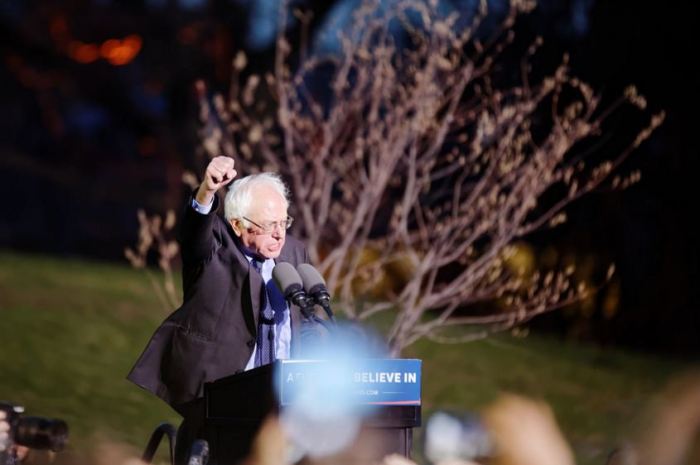
Against Fortress LiberalismFor forty years, liberals have accepted defeat and called it “incremental progress.” Bernie Sanders offers a different way forward.by Matt KarpBernie Sanders in the South Bronx on March 31, 2016. Michael Vadon / Flickr628Our next issue, “Between the Risings,” is out this month. To celebrate its release, international subscriptions are $25 off.The primary campaign between Hillary Clinton and Bernie Sanders has produced the most direct ideological battle the Democratic Party has seen in a generation. It’s not just the policy differences that separate Sanders’s blunt social-democratic platform from Clinton’s neoliberal grab bag. The two candidates embody clashing theories of politics — alternative visions of how to achieve progressive goals within the American political system.The Bernie Sanders model of change has all the subtlety of an index finger raised high above a debate podium. Lay out a bold, unapologetic vision of reform that speaks directly to people’s basic needs. Connect that vision to existing popular struggles, while mobilizing a broad and passionate coalition to support it (#NotMeUs). Ride this wave of democratic energy to overwhelm right-wing opposition and enact major structural reforms.The Hillary Clinton model of change, on the other hand, begins not with policy or people but with a politician. Choose an experienced, practical leader who explicitly rejects unrealistic goals. Rally around that leader’s personal qualifications, while defending past achievements and stressing the value of party loyalty (#ImWithHer). Draw on the leader’s expertise to grind away at Congress and accumulate incremental victories that add up to significant reform.For most of the Left, Clinton-style “incrementalism” is just a code word to disguise what is effectively a right-wing retrenchment. Nevertheless many self-identified progressives have backed Clinton’s “theory of politics” as the most realistic path to achieve Sanders’s objectives.“As a temperamentally moderate figure,” the liberal Boston Globe argued, Clinton is best positioned to “take concrete steps to get relevant legislation enacted.”Other editorial boards, corporate legal bloggers, and billionaires in the back seats of limousines have likewise endorsed the Clinton model as the only serious form of politics in a polarized republic. But they struggle to identify a major progressive victory that Clinton-style incrementalism has won in the past half-century.Clinton’s eight-year term in the Senate produced bills to regulate video game violence and flag burning, both of which died in committee.Bill Clinton’s eight-year term in the White House gave us the Earned Income Tax Credit and a small children’s health insurance program — but also NAFTA, the 1994 crime bill, welfare reform, the Defense of Marriage Act, financial deregulation, and a grand bargain to gut Social Security that was only thwarted by a timely sex scandal.The pragmatic, piecemeal, and irreproachably moderate achievements of Jimmy Carter are still more dispiriting. Even judged by the charitable standards of American liberalism, the forty-year balance sheet of “incremental progress” is decidedly negative.Beltway pundits scoff at Sanders’s model of change, meanwhile, as if the Vermont senator thinks he can defeat a Republican Congress by getting a few hundred protestors to yell slogans outside Capitol Hill.They naturally fail to mention that as a matter of historical record, the Sanders model happened to produce Social Security, the National Labor Relations Act, the Voting Rights Act, Medicare, and Medicaid.The simple truth is that virtually every significant and lasting progressive achievement of the past hundred years was achieved not by patient, responsible gradualism, but through brief flurries of bold action. The Second New Deal in 1935–36 and Civil Rights and the Great Society in 1964–65 are the outstanding examples, but the more ambiguous victories of the Obama era fit the pattern, too.These reforms came in a larger political environment characterized by intense popular mobilization — the more intense the mobilization, the more meaningful the reform. And each of them was overseen by an unapologetically liberal president who hawked a sweeping agenda and rode it all the way to a landslide victory against a weakened right-wing opposition.All three bursts of reform, of course, were shaped by the need to deal with opponents in Congress — including conservative Democrats — who imposed their own conditions. And even the New Deal and the Great Society, of course, were profoundly compromised in ways that no one on the Left is likely to forget.Nevertheless these were real victories. None of them was won in the name of moderation, incrementalism, or the sober-minded rejection of ambitious goals.At the 1936 Democratic convention, Franklin Roosevelt famously called for a “rendezvous with destiny,” not a rendezvous with tax credits for small businesses. Roosevelt took it as hi

Source: Against Fortress Liberalism | Jacobin

Angela Davis Talks Black Liberation, History and the Contemporary Vision – News & Views – EBONY

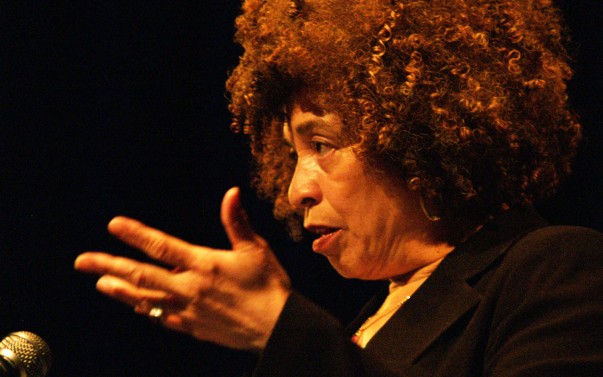
Angela Davis Talks Black Liberation, History and the Contemporary Vision[INTERVIEW] The iconic freedom struggle leader speaks with EBONY.com about Black human rights activism stretching back decades and her recently released book observing global movementsBY SHERYL HUGGINS SALOMON, FEBRUARY 17, 2016COMMENTSAngela Davis speaking at Myer Horowitz Theatre of the University of Alberta. Nick Wiebe/Wikimedia CommonsFifty years after the founding of the Black Panther Party for Self Defense, the agenda and style of the legendary Black revolutionary organization remains relevant in today’s public discourse. An end to “police brutality and the murder of Black people,” central to the Black Lives Matter movement, was laid out in the Black Panthers’ 10-Point Platform five decades ago. Both acclaim and condemnation erupted when their iconic black berets made an appearance recently in Beyoncé’s half-time show performance during the Super Bowl.It’s telling that America is still grappling with many of the same racial inequities and injustices that it did 50 years ago – and that Black pride remains a controversial topic. Not so to renowned scholar, activist and feminist icon and close associate of the Black Panthers Angela Y. Davis.“If one looks at the 10-point program of the Black Panther Party, one sees that the very same issues that were raised in the aftermath of slavery are at the center of a program that was formulated in 1966,” said Davis, now a professor emeritus at University of California, Santa Cruz. “In 2008 when Barack Obama was elected, those issues had not been sufficiently addressed, certainly not yet solved, so therefore the election of one person to political office was not going to automatically reverse a history of a racist inspired economic oppression, which isn’t to say that it wasn’t important that we elected Barack Obama, but those struggles continue.”While in Spain last week advocating for the release of imprisoned Basque separatist politician Arnaldo Otegi, Davis took a few moments with EBONY.com to discuss contemporary issues like Black Lives Matter, the 2016 U.S. presidential election, and details from her latest book, Freedom is a Constant Struggle: Ferguson, Palestine, and the Foundations of a Movement (Haymarket Books, 2016), edited by human rights activist Frank Barat.“I’ve been involved in the Palestine Solidarity movement for a very long time,” explained Davis. “When the Ferguson uprising happened a year and a half ago activists on the ground in occupied Palestine were the first to tweet support and advice to protesters in Ferguson. Out of that has come a very interesting, a very rich development of connections across the ocean. A delegation from Palestine visited Ferguson. Black Lives Matter and Ferguson activists, [as well as members of] Dream Defenders, Black Youth Project 100 made a trip to Palestine over about a year ago to express their solidarity.”  Related Articles CONNECTING PALESTINE AND POLICE VIOLENCE SIDRA SMITH ON ANGELA DAVIS DOC DIRECTOR TALKS ANGELA DAVIS DOCUMENTARYMore highlights of what Davis said are in the Q&A below.EBONY.COM: What’s the message of your new book?Angela Davis: I am particularly interested in [having] activists associated with the Black freedom movement to realize that our struggles never would have achieved this universality that they have achieved without solidarity that has come from Africa, Asia, Latin America, Europe and Australia. Our struggles are global, therefore, it is important for us to incorporate this global vision into our on the ground battles against police crimes and the prison industrial complex. Since I was very young I have been involved in organizations— the Communist Party, the Black Panther Party— that have had this global perspective.EBONY.COM: As you note in your book, events in Ferguson after the police shooting of Michael Brown exposed the militarization of police forces. Where is this push toward militarization headed and how can it be stopped?Davis: If one looks at the history of policing, especially over the last 15 years in the aftermath of 9/11, one can see the emphasis on the shifting of resources from the military to the police. This actually has a much longer history if one looks at the way in which the Vietnam War resulted in an impact on local police. The S.W.A.T. squads emerged as a result of using techniques and technology that were used by the Green Berets in the Vietnam War. The Los Angeles Police Department was the first to use such tactics against the Black Panther Party. We have also seen the emergence of privatized policing corporations. In the book, I refer to G4S (Group 4 Security), which is a private security corporation that has spread policing and prisons all over the world. It’s important not only to look at the ways in which these moments of inflicting terror have been taken up by police departments, but it’s also essential to look at the economic dimension by such processes. G4S, of course, is the thir

Source: Angela Davis Talks Black Liberation, History and the Contemporary Vision – News & Views – EBONY

Angela Davis on Not Endorsing Any Presidential Candidate: “I Think We Need a New Party” | Democracy Now!

In a Women’s History Month special, we speak with author, activist and scholar Angela Davis. For more than four decades, Davis has been one of most influential activists and intellectuals in the United States. An icon of the 1970s black liberation movement, Davis’ work around issues of gender, race, class and prisons has influenced critical thought and social movements across several generations. She is a leading advocate for prison abolition, a position informed by her own experience as a fugitive on the FBI’s top 10 most wanted list more than 40 years ago. Davis talks about the “fascist appeal” of Donald Trump and explains why she is not officially endorsing any candidate in this election. “I believe in independent politics,” she says. “I still think that we need a new party, a party that is grounded in labor, a party that can speak to all of the issues around racism, sexism, homophobia, transphobia, what is happening in the world. We don’t yet have that party.”

Source: Angela Davis on Not Endorsing Any Presidential Candidate: “I Think We Need a New Party” | Democracy Now!

Prosecutors as the Most Powerful Actor in the Criminal Justice System φ Race, Racism and the Law


The racial disparities in our criminal justice system are extraordinary and well-documented. In 1995, nearly one in three African American men between the ages of twenty and twenty-nine were under the supervision of the criminal justice system–either in jail, prison, on probation, or on parole. Today, one in every ten black Angela J Davismales in his thirties is in prison or jail on any given day. Over 60% of all prisoners in 2010 were Black or Latino. The disparities exist at every step of the criminal process, from arrest through sentencing.

Much has been written about why the American criminal justice system is so fraught with racial disparity. Some point to discriminatory *823 decision-making by criminal justice officials at each step of the process while others suggest that disproportionate offending is the cause. In fact, there are many complex reasons for this unfortunate phenomenon. Criminal justice officials–including police officers, prosecutors, judges, and corrections officials–make discretionary decisions that often have a racial impact. In addition, the socioeconomic causes of crime disproportionately affect people of color. The impact of the War on Drugs cannot be overstated, and there are undoubtedly many other factors that have contributed to the startling statistics and overwhelming evidence of racial disparity. Not surprisingly, as the causes of the racial disparities in our criminal justice system stem from many sources, so must the solutions.
* * *

Prosecutors are the most powerful officials in the criminal justice system. They make the decisions that control the system, and they exercise almost boundless discretion in making those decisions.  Many argue that police officers are the most important officials in their role as the gatekeepers who bring individuals into the system. There is no doubt that police officers exercise broad discretion in deciding whether to stop and/or arrest individuals for criminal behavior. However, police officers only have the power to bring individuals to the courthouse door. It is the prosecutors whose decisions keep them there and firmly entrench them in the system–decisions that have life-changing consequences.

The most important prosecutorial decisions are the charging and plea bargaining decisions. Prosecutors control and almost predetermine the outcome of criminal cases through these two critical decisions. They decide whether to charge an individual with a crime and what the charge or charges should be, and they enjoy vast discretion in making this decision. Even if a prosecutor believes she can prove a defendant’s guilt beyond a reasonable doubt, she is not required to charge that individual. If she does decide to charge, she often has discretion to charge either a misdemeanor or felony. For example, if an individual is arrested with a large quantity of cocaine, the police officer might recommend that the person be charged with Possession with Intent to Distribute Cocaine–a felony that carries a mandatory minimum sentence. The prosecutor has a number of choices. She may decide to charge the person with the felony, but she also has the discretion to charge him with simple possession–a misdemeanor that may result in a probationary sentence with fewer collateral consequences. The prosecutor may also choose not to charge the person at *833 all. The charging decision is totally within the discretion of the prosecutor.

Prosecutors enjoy the same discretion in the plea-bargaining process. They are not required to offer the defendant a plea to a lesser offense, but if they do, they decide what that offer will be. Certainly a defendant may agree to plead guilty to a lesser offense if the prosecutor dismisses all other offenses, but the decision is up to the prosecutor. And with the existence of so many offenses that carry mandatory minimum sentences, the plea bargaining power has become even more important. Since going to trial always carries the risk of conviction, the only way a defendant can be assured that he will not be convicted of an offense carrying a mandatory minimum sentence is to plead guilty to a lesser offense. Ninety-five percent of all criminal cases are resolved by way of a plea. Prosecutors’ control of the charging and plea-bargaining decisions almost permits them to predetermine the outcome of most criminal cases.

Charging and plea-bargaining decisions have a tremendous impact on racial disparities in the criminal justice system. If a prosecutor charges an African American with a crime but chooses not to charge his similarly situated white counterpart, or chooses to charge the white counterpart with a less serious offense, she will create an unwarranted disparity. But the problem is a complex one. A prosecutor is rarely presented with two cases–one white defendant, one black–with exactly the same circumstances (same prior record, same facts, etc.) where she consciously chooses to treat the black defendant more harshly. She may unconsciously empathize with a white defendant and give him preferable treatment, or she may offer a white defendant better treatment for legitimate reasons that produce a racial impact.

Consider the case of a white defendant who is arrested for selling cocaine in his dorm room. The arresting officer recommends that he *834 be charged with distribution of cocaine–a felony offense with a five year mandatory minimum sentence. The defendant’s parents hire an attorney who tells the prosecutor that the defendant is suffering from a debilitating drug addiction and was selling drugs only to support his own addiction. The attorney indicates that the defendant has been accepted to a six-month program at a residential drug treatment facility. He also informs the prosecutor that the defendant is an honor student who planned to apply to law school, that he has never been arrested in his life, and that a felony conviction would ruin his career and his life. A prosecutor might legitimately offer such a defendant a plea to a misdemeanor offense, or even dismiss the case all together. One could see how a prosecutor might empathize with such a defendant, subconsciously seeing himself and perhaps remembering his own “youthful indiscretions.”

That same prosecutor might handle the case of a similarly situated black defendant quite differently. Consider the black defendant arrested for selling cocaine on the street corner in his neighborhood. The arresting office recommends the same charge–distribution of cocaine. This defendant is poor and represented by an overworked public defender. The public defender discovers that his client is addicted to cocaine and was selling the drug only to support his habit. The family cannot afford to pay for residential treatment and there are no free programs available. The defendant does not have a prior criminal record but is a high school dropout with no employment prospects. The public defender asks the prosecutor to consider dismissing the case, and the prosecutor declines.

The prosecutor’s decisions in these cases would produce a racial disparity, but were her decisions unfair or unjustified? Shouldn’t a prosecutor pursue an outcome that results in an alternative to incarceration, thereby saving scarce government resources, especially if she does not believe that the defendant poses a danger to the community? Is it the prosecutor’s fault that the black defendant could not afford to pay for a drug program and was neither employed nor in school? Yet the black defendant did not appear to be any more deserving of a prison term than the white defendant. The prosecutor may have had an unconscious bias towards the white defendant and against the black defendant, but how could that be proven? And even if it were true, would it matter, considering all the other factors?

If prosecutors charge African American and Latino defendants with crimes while neglecting to charge their similarly situated white counterparts, they may be engaging in race-based selective prosecution. *835 Race-based selective prosecution violates the Constitution, but proving it is difficult. As with racial profiling, the victim of selective prosecution must prove that the prosecutor intended to discriminate against him because of his race. The Court practically closed the door on all claims of race-based selective prosecution when it decided United States v. Armstrong. In Armstrong, the Court held that in order to get discovery to prove selective prosecution, the defendant must show that similarly situated whites could have been charged, but were not –an impossible showing for almost anyone.

The Supreme Court has consistently required proof of intentional discrimination in criminal cases, and the amount and type of proof necessary have made successful challenges extremely difficult, if not impossible. In McCleskey v. Kemp, Mr. McCleskey presented a sophisticated study of how the death penalty was implemented in the state of Georgia. The study, conducted by Professors David Baldus, Charles Pulaski, and George Woodworth (known as “the Baldus Study”) produced startling racial disparities in the implementation of the death penalty and concluded that black defendants who kill whites were more likely to receive a death sentence. The Court accepted the validity of the study and its findings, but nonetheless declined to reverse Mr. McCleskey’s death sentence. Because the study did not prove that the prosecutors in Mr. McCleskey’s case intended to discriminate against him because of his race, the Court rejected his claim.

The difficulty of proving intentional discrimination does not pose the most difficult challenge, since intentional discrimination is rarely the cause of racial disparity in today’s criminal justice system. Most racial disparities are caused and/or exacerbated by prosecutors’ race-neutral decisions which may be influenced by unconscious racism. *836 These race neutral decisions, even though unintentional, may have a racial impact.

Whether or not prosecutors intentionally or unconsciously discriminate against defendants of color in the charging and plea-bargaining processes, their decisions–even the race-neutral ones–may cause or exacerbate racial disparities. Their tremendous power and discretion is often exercised in ways that produce unintended and undesirable consequences. However, that same power and discretion can be used to remedy the problem. The next section will examine one possible solution.

* * *

Racial disparity in the criminal justice system is a complex problem with many disparate causes. Its elimination will require change within and outside of the criminal justice system. The socio-economic causes of crime may never be totally eliminated. However, individuals in the criminal justice system can have an impact on the problem. Prosecutors are particularly suited to help eliminate racial disparities because of their power and discretion.

Prosecutors must not only be willing to replicate the Prosecution and Racial Justice Program, they must be willing to change their practices and policies in ways that will have a real impact. Sometimes these changes will involve abandoning traditional methods of decision-making to achieve fairness. For example, even though considering *851 a defendant’s prior record as a factor in the decision to charge is appropriate, if the existence of prior records is the main reason why otherwise similarly situated black defendants are being charged while whites are not, prosecutors should consider abandoning that factor. Public safety must remain the priority, but there are many defendants arrested for nonviolent offenses with criminal records of nonviolent offenses. Even if prosecutors focused on nonviolent offenses alone and abandoned or reduced reliance on traditional charging considerations in those cases, they could make a difference.

The Prosecution and Racial Justice Program is not a panacea, but it is one remedy that can make a difference. However, it can only work with the participation of chief prosecutors who are willing to make racial justice a priority. The prosecutors who have worked with PRJ have demonstrated that commitment. They took a chance that produced positive results in their offices and serve as examples for other prosecutors who seek to fulfill their duty to assure a fair and effective criminal justice system.


Angela J. Davis is a Professor of Law at American University Washington College of Law and the former director of the Public Defender Service for the District of Columbia.

Support Race, Racism And The Law

How the Republican Hold on the South Could Collapse ∇ Newsweek

How the Republican Hold on the South Could Collapse

By Pema Levy / July 8, 2014 11:41 AM EDT   

7_11_FE0203_DixieBlue_01

As minorities head to the South, the Republican grip on politics is under threat. Pictured, Obama supporters celebrate his election in 2008. Mario Tama/Getty
AA
Filed Under: U.S., The South, Democrats, Republicans

Henry L. Marsh III wanted to see President Barack Obama’s second inauguration in person because, at 79, he figured he might not live to see another black president elected. So the Virginia civil rights lawyer spent January 21, 2013, in Washington, D.C., witnessing a part of history he had dedicated his life to making possible.

His presence at Obama’s inauguration, however, set off one of the dirtiest political maneuvers in recent history.

Marsh is a Democrat in the Virginia Senate, a chamber that until last month was divided evenly along party lines, with 20 Democrats and 20 Republicans. But with Marsh 100 miles away in Washington, Republicans briefly enjoyed a 20-19 majority, if only for a few hours. In a power grab so brazen it caught even the GOP governor by surprise, Senate Republicans passed a bill redrawing the state Senate map to give them a permanent majority.

By the time Marsh returned, his colleagues had passed a redistricting bill that would have vastly undercut the political power of black Virginians. The new map crowded black voters into minority-heavy districts so that up to eight more districts would turn red, a strategy political scientists call “pack and crack,” leaving Republicans with a 27-13 majority in Virginia for years to come. As if to pour salt on the wound, this all happened on Martin Luther King Jr. Day. The plan never made it out of the Republican-controlled legislature. Two and a half weeks after the Senate passed the new map, the Republican speaker in Virginia’s lower chamber, after much reflection and prayer, angered his own party by killing the map with a procedural move.

Get top stories emailed to you each day.

“Count that as a new low for hyper-partisanship, dirty tricks and the unaccountable arrogance of power,” declared The Washington Post, echoing the widespread shock at the sly incident that made a mockery of democracy.

That attempt may seem extraordinary up close, but take a step back to look at the changing demographics of Virginia and the South more broadly and this power play starts to make sense. Two months before, Obama had won the state for a second time. For the first time since 1964, Virginia was on its way from red to blue.

Virginia’s Republicans were seeing decades of political control melting away before their eyes. “They tried to seize power that they didn’t deserve,” Marsh said. “They got caught with their hand in the cookie jar.”
SOUTHERN EXPOSURE

To understand why the Republican Party has come to dominate the South—and why that strength may now be waning—you have to go back to the Civil War. Abraham Lincoln and Northern abolitionists ran the Republican Party in the 1860s, while the Democrats drew much of their strength from the slave states. After Reconstruction, when the Southern states were left to their own devices, the Democratic Party ruled with an iron fist—and Jim Crow. Their reign lasted nearly a century.

The GOP in Dixie, political scientist V.O. Key Jr. observed in 1949, more closely resembled a cult or a conspiracy than a political party. In 1950, of the 127 members of Congress from the former Confederate states, just two were Republican.

But the Democrats’ stranglehold on the South was already loosening. Perhaps no one embodied, or facilitated, the South’s transformation from the Democrats’ Solid South to the regional anchor of today’s Republican Party as much as Strom Thurmond.

7_11_FE0203_DixieBlue_02After Democratic President Harry Truman embraced civil rights ahead of his re-election bid in 1948, Southern Democrats broke from the party in protest. They wanted to send a message to Democrats in Washington: Either civil rights go, or the South goes.

A group of Southern lawmakers formed the “Dixiecrats,” who were devoted to states’ rights, and nominated Thurmond, the former Democratic segregationist governor of South Carolina, for president. On a hot day in Birmingham, Alabama, Thurmond made his first speech to Southern deserters as their presumptive nominee.

“There’s not enough troops in the Army to force the Southern people to break down segregation and admit the nigra race into our theaters, into our swimming pools, into our homes and into our churches,” Thurmond told them. That November, he won over a million votes and carried four states in the Deep South.

Thurmond and his fellow Dixiecrats weren’t kidding around. Two months after President Lyndon Johnson signed the Civil Rights Act in July 1964, Thurmond, by then a U.S. senator, switched parties from Democrat to Republican. That November, five Southern states followed his lead and voted for Barry Goldwater, the Republicans’ ultra-conservative presidential nominee. In 1964, more Southern whites voted Republican than Democrat for the first time. They never went back.

FELLOW AMERICANS, DON’T LET OUR IGNORANCE DESTROY US  Φ The Wattree Chronicle

Hillary’s Nightmare? A Democratic Party That Realizes Its Soul Lies With Elizabeth Warren

2016

NOVEMBER 10, 2013

THE NEW REPUBLIC

Hillary’s Nightmare? A Democratic Party That Realizes Its Soul Lies With Elizabeth Warren

BY NOAM SCHEIBER @noamscheiber

 We’re three years from the next presidential election, and Hillary Clinton is, once again, the inevitable Democratic nominee. Congressional Republicans have spent months investigating her like she already resides in the White House. The New York Times has its own dedicated Clinton correspondent, whose job it is to chronicle everything from Hillary’s summer accommodations (“CLINTONS FIND A NEW PLACE TO VACATION IN THE HAMPTONS”) to her distinct style of buckraking (“IN CLINTON FUNDRAISING, EXPECT A FULL EMBRACE”). There is a feature-length Hillary biopic in the works, and a well-funded super PAC—“Ready for Hillary”—bent on easing her way into the race. And then there is Clinton herself, who sounds increasingly candidential. Since leaving the State Department, Clinton has already delivered meaty, headline-grabbing orations on voting rights and Syria.

Yet for all the astrophysical force of these developments, anyone who lived through 2008 knows that inevitable candidates have a way of becoming distinctly evitable. With the Clintons’ penchant for melodrama and their checkered cast of hangers-on—one shudders to consider the embarrassments that will attend the Terry McAuliffe administration in Virginia—Clinton-era nostalgia is always a news cycle away from curdling into Clinton fatigue. Sometimes, all it takes is a single issue and a fresh face to bring the bad memories flooding back.

The last time Clinton ran, of course, the issue was Iraq and the gleaming new mug was Barack Obama’s. This time the debate will be about the power of America’s wealthiest. And, far more than with foreign policy, which most Democrats agreed on by 2008, this disagreement will cut to the very core of the party: what it stands for and who it represents.

Christopher Gregory/The New York Times/Redux
Elizabeth Warren

On one side is a majority of Democratic voters, who are angrier, more disaffected, and altogether more populist than they’ve been in years. They are more attuned to income inequality than before the Obama presidency and more supportive of Social Security and Medicare.1 They’ve grown fonder of regulation and more skeptical of big business.2 A recent Pew poll showed that voters under 30—who skew overwhelmingly Democratic—view socialism more favorably than capitalism. Above all, Democrats areincreasingly hostile to Wall Street and believe the government should rein it in.

(WATCH: The ten best Elizabeth Warren viral videos out there)

But as central as this debate is to the identity of the party, Democrats won’t openly litigate it until they’re forced to ponder life after Obama. Partly out of deference to the president, partly out of a preoccupation with governing, and partly because there is no immediate political need, parties rarely conduct their internal soul-searching when they control the White House. It’s only when the president finally contemplates retirement that the feuding breaks out with real violence. Think of the Republican Party after George W. Bush. Or, you know, Yugoslavia.

 Judging from recent events, the populists are likely to win. In September, New York City Public Advocate Bill de Blasio, running on a platform of taming inequality, routed his Democratic mayoral rival, Christine Quinn, known for her ties to Michael Bloomberg’s finance-friendly administration. The following week, Larry Summers, Obama’s first choice to succeed Ben Bernanke as Federal Reserve chairman, withdrew his name from consideration after months in which Senate Democrats signaled their annoyance with his previous support for deregulation. Not 48 hours later, Bill Daley, the former Obama chief of staff and JP Morgan executive, ended his primary campaign for governor of Illinois after internal polls showed him trailing his populist opponent.

All of this is deeply problematic for Hillary Clinton. As a student of public opinion, she clearly understands the direction her party is headed. As the head of an enterprise known as Clinton Inc. that requires vast sums of capital to function, she also realizes there are limits to how much she can alienate the lords of finance. For that matter, it’s not even clear Clinton would want to. “Many of her best friends, her intellectual brain trust [on economics], all come out of that world,” says a longtime Democratic operative who worked on Bill Clinton’s 1992 campaign and then for Hillary in the White House. “She doesn’t have a problem on the fighting-for-working-class-folks side”—protecting Medicare and Social Security—“but it will be hard, really wrenching for her to be that populist on [finance] issues.”

Which brings us to the probable face of the insurgency. In addition to being strongly identified with the party’s populist wing, any candidate who challenged Clinton would need several key assets. The candidate would almost certainly have to be a woman, given Democrats’ desire to make history again. She would have to amass huge piles of money with relatively little effort. Above all, she would have to awaken in Democratic voters an almost evangelical passion. As it happens, there is precisely such a person. Her name is Elizabeth Warren.

A Harvard law professor and best-selling author who led the congressional task force overseeing the bank bailout, Warren was already a liberal icon before she set foot in the Senate last January. Her public floggings of Treasury Secretary Tim Geithner helped make her a fixture on MSNBC, “The Daily Show,” and The Huffington Post.

(READ: Elizabeth Warren, Hillary Clinton, and Female Votes)

As a result, Warren’s 2012 victory in Massachusetts set off a minor cottage industry of speculation about whether she would be a senator in the mold of other celebrities, like Hillary Clinton and Al Franken, who made collegiality and discretion the hallmarks of their early years in office—or whether she would follow the model of the body’s noisier gadflies, like former South Carolina Senator Jim DeMint and his spiritual successor, Ted Cruz of Texas.

The short answer is: None of the above. Warren has always said she had no interest in holding her tongue and blending into the senatorial wallpaper. But neither has she been a Cruz-like self-promoter, horning in on issues that hold out the greatest chance at media glory. (It’s one reason she’s well liked, which isn’t the case with Cruz.) Warren was understated during the Syria debate. She loyally supported Majority Leader Harry Reid during the recent government shutdown.

Curiously, this posture has had the effect of putting other Democrats in a chronic state of mild unease. From the perspective of a fellow senator, both the Clinton approach and the Cruz approach offer the advantage of predictability. Practitioners of the first will always sublimate their ambitions to the greater good of the caucus. Adherents of the second can be relied on to seize every last target of opportunity. In both cases, the senator’s colleagues can adjust accordingly. With Warren, on the other hand, they never entirely know when she may unload.

University of Texas School of Law
In 1986, Warren was a law professor at the University of Texas focused on bankruptcy issues.

During her Senate orientation in January, Warren, who serves on the banking committee, paid a courtesy call to the committee’s moderate chairman, Tim Johnson of South Dakota. “She was incredibly respectful, deferential,” says a committee aide who was in the room. “She really demonstrated to a lot of us that she would follow the model of . . . people like Franken, Barack Obama, Hillary.”

The following month, during her very first banking committee hearing, Warren again waited patiently for her turn to speak—then promptly set off a national furor. “Tell me a little bit about the last few times you’ve taken the biggest financial institutions on Wall Street all the way to a trial,” she asked a table full of bank regulators. The question, though eminently reasonable, violated an unstated rule of committee protocol, in which members of Congress are allowed to rant and rave at length but generally abstain from humiliating appointees, especially from their own party.

 An awkward pause ensued, at which point Warren flared her eyes and thrust her head forward, as if to say, “Yes, this is really happening.” Until that instant, the regulators believed the world worked one way; suddenly, it was working another. One winced hemorrhoidally as he searched for a place to fix his gaze. The head of an agency called the Office of the Comptroller of the Currency (OCC) appeared to whimper before allowing that the threat of trial was unnecessary for keeping the banks in check—about as counterfactual a notion as the industry has ever produced. A third regulator chimed in affirmatively. For a few minutes, Warren looked like the only sane person in a mental ward. A video of the exchange has been viewed online more than a million times.

Alas, Warren’s colleagues have not always welcomed these clarifying moments. “The chairman is more of an introspective kind of guy, it’s not his style personally,” says the banking committee staffer, who stresses that he didn’t discuss it with Johnson. “It felt more like a Chuck Schumer move,” he continued, referencing the voluble New York senator. Warren’s fellow liberals on the committee might be more philosophically inclined toward such tactics, but even they seem to find them irksome. A handful of aides to these senators were willing to comment on their own bosses’ work, but ducked my follow-ups about Warren. “To the degree that [Sherrod] Brown and [Jeff] Merkley had this space to themselves, she’s taken a chunk of that,” says a former banking committee staffer, who notes that Brown may well become chairman if Democrats retain their majority next year. “They’re in agreement on a lot of stuff,” adds the former staffer. “But if he does become chair . . . I’m not sure how that dynamic is going to work. Is she going to be looking like she’s upstaging him?”

For its part, the Obama administration appears to regard Warren with its own special wariness. Take the successful campaign to block the would-be nomination of Larry Summers to be Federal Reserve chairman. Brown and Merkley played critical roles in halting Summers’s momentum and rounding up “no” votes among fellow Democrats. But Warren’s contribution is hard to overstate. “Elizabeth did something only she could do,” says a source close to the Fed chairman selection process, “which was engage with the administration on the subject and make clear that, if they insisted on moving ahead, the whole weight of her capacity could be brought to bear.” This “was a different order of magnitude,” says the source, alluding to Warren’s outsized fund-raising heft— $42 million raised for her Senate race, half of it online—and her media magnetism. A Warren aide doesn’t dispute this, saying only that “she passed along her concerns to the White House.”

Warren isn’t just better at picking her spots than Cruz, she is disciplined about following through. After the February hearing, Warren asked the OCC in writing whether it had analyzed the cost of settling complaints against banks without ever requiring admissions of guilt (which would expose banks to investor lawsuits). When the OCC said it had not, she wrote the Securities and Exchange Commission (SEC), the Department of Justice, and the Federal Reserve asking the same question. A few weeks later, Mary Jo White, the newly installed SEC chairwoman, sent Warren a letter saying she was “actively reviewing” the issue. A week after that, White announced that she was making a change: Some companies would now have to fess up as a condition for settling. In September, the SEC forced JP Morgan to admit that it violated securities laws as a condition for a $200 million settlement. Though Warren is far from the only Wall Street critic to have highlighted this issue, the line from her questioning to the change is exceedingly direct.

(VIDEO: Elizabeth Warren calling out Wall Street from the Senate )

Even at her most Cruz-like, it’s almost always possible to discern Warren’s goals. This summer, Senate Democrats negotiated a compromise with their Republican counterparts to lower student interest rates, which had recently doubled. Warren thought the deal was shameful: She objects in principle to making money from student loans, and in any case the bill holds down rates for only a few years. She denounced the “so-called ‘compromise’ ” in e-mails to her extensive list of supporters and channeled her outrage during closed-door Senate meetings—“more loudly than anyone else,” recalls Chris Murphy, her colleague from Connecticut. “We can’t go out and tell ourselves we’ve done good if we haven’t,” Warren told me later, during a brief interview in her office.

The cause was always a bit hopeless, and the bill passed overwhelmingly. But a Warren staffer says the aim was to draw attention to the outrage of profiting from students and to impose a political cost on those who went along with this practice so as to tilt future debates. When the Senate revisits the issue in a few years, as is likely, it’s hard to believe the calculus will not have changed. A Democratic aide whose boss supported the compromise told me the Warren team’s logic was “one hundred percent” right.

The gripe that Warren is maniacally image-obsessed has dogged her for almost as long as she’s been in Washington. During her days running oversight on the bank bailout, Treasury aides became convinced that Warren’s questions served little purpose other than to raise her profile, and that they had the effect of inciting a populist mob against policies that were unavoidable. They observed that a voice mail message for Warren instructed callers to press one if they were calling about a media appearance and press 2 for other messages. In 2010, Obama appointed Warren to be a special Treasury adviser in charge of setting up the newly formed Consumer Financial Protection Bureau. Warren was particular about the title she received, wanting it to reflect her work on behalf of the middle class. Treasury officials joked that if she were “Ambassador to the Middle Class,” it would make them “Ambassadors to the Plutocrats.”

There is no doubt that Warren takes a special interest in her public profile. According to a former aide, one of Warren’s greatest frustrations after arriving at the consumer agency was that the White House insisted on vetting all her media appearances. During her Senate campaign, Warren traveled with at least three staffers: Her body man and press secretary, as is the case for most candidates, but also a digital director, whose job it was to capture Warren’s choicest words on video, then upload the clips to YouTube and circulate them via social media. “She’s engaged in videos, e-mails, everything,” says an aide. “She plays an integral role in the content we send out.”

Still, the story of Warren’s rise to prominence is much more complicated than one of unbridled narcissism. Warren has been preoccupied with the plight of the middle class since her childhood, when her father suffered a heart attack and her mother took a job in the catalog department of Sears to keep four kids clothed and fed. “I watched Obama get completely obsessed by health care reform . . . and realized it was all about his mother on her death bed,” says a longtime Warren friend. “For her, it was her father.” As a law professor in the 1980s, Warren conducted research demonstrating that most of the people who filed for bankruptcy weren’t deadbeats, contrary to the popular perception, but hardworking, often middle-class households who’d endured staggering economic hardship.

Ever since, Warren’s mindset has been utterly brass tacks. When I asked about her views toward Geithner, one progressive activist who has worked closely with Warren told me it can be tempting to try to understand how people in power might be acting in good faith, even if they’re wrong. “Elizabeth is neither sentimental nor vindictive,” the activist said. “She’s not that interested in why people carry water for Wall Street or what they think of her.” She spends her time trying to beat her adversaries, the activist explained, or at least hold them accountable. As Warren told The Huffington Postduring the fight over financial reform: “My first choice is a strong consumer agency. My second choice is no agency at all and plenty of blood and teeth left on the floor.”

The proper interpretation of Warren’s prodigious p.r. efforts, then, isn’t that she’s especially taken with the idea of media stardom. It’s that she is relentlessly, perhaps ruthlessly, maybe even a bit messianically, focused on advancing her policy agenda. Everything else is merely instrumental.

Christopher Gregory/The New York Times/Redux
Warren and Clinton haven’t always been as chummy as this picture suggests.

This is what the banking industry and its Republican allies (as well as internal opponents like Geithner) didn’t fully appreciate when they effectively killed Warren’s hopes of permanently heading the consumer agency in 2011. Anyone who knows Warren will tell you she had no particular ambition to be a senator. She decided that the Senate would suffice as a way to agitate for her issues only when Obama stiffed her for the CFPB job—an enormous disappointment after she spent months lining up support among banks. “It’s poetic justice. At end of the day, if the banking community hadn’t been so apoplectic, everyone could have decided it’s this little tiny agency, who really cares?” says Anita Dunn, Obama’s White House communications director in 2009. “Instead, she ends up as a senior senator from Massachusetts on the banking committee, blocking Larry at the Fed.”

It’s hard to look at the Democratic Party these days and not feel as if all the energy is behind Warren. Before she was even elected, her fund-raising e-mails would net the party more cash than any Democrat’s besides Obama or Hillary Clinton. According to the Times, Warren’s recent speech at the annual League of Conservation Voters banquet drew the largest crowd in 15 years. Or consider a website called Upworthy, which packages online videos with clever headlines and encourages users to share them. Obama barely registers on the site; Warren’s videos go viral. An appearance on cable this summer—“CNBC HOST DECIDES TO TEACH SENATOR WARREN HOW REGULATION WORKS. PROBABLY SHOULDN’T HAVE DONE THAT”—was viewed more than a million times. A Warren floor speech during the recent stalemate in Congress—“A SENATOR BLUNTLY SAYS WHAT WE’RE ALL THINKING ABOUT THE OBNOXIOUS GOVERNMENT SHUTDOWN”—tallied more than two million views.

The poll numbers also suggest the Democratic Party is becoming Elizabeth Warren’s party. Gallup finds that the percentage of Democrats with “very negative” views of the banking industry increased more than fivefold since 2007, while the percentage who have positive views fell from 51 to 31. Between 2001 and 2011, the percentage of Democrats who were dissatisfied with the “size and influence of major corporations” rose from 51 to a remarkable 79.3

Of course, any prediction of a populist revolt against the party’s top brass must grapple with the tendency of such predictions to be wrong. From the Howard Dean campaign in 2004 to the Occupy Movement in 2011, the last decade in Democratic politics has been rife with heady declarations of grassroots rebellion, only to see the insiders assert control each time. Even the one insurgency that did succeed, the Obama campaign, was quickly absorbed into the party establishment, from which Obama was never so far removed in the first place.

But three developments suggest this time really could be different. The first is that, even at the elite level, the party has changed far more over the last few years than is widely understood. Chris Murphy, the Connecticut senator, estimates that not too long ago, congressional Democrats were split roughly evenly between Wall Street supporters and Wall Street skeptics. Today, he puts the skeptics’ strength at more like two-thirds. Warren told me she attributes this to the disillusionment surrounding Dodd-Frank, which ushered in a range of new regulations but left the details to regulators, who promptly caved.

There is also the fact that, unlike other liberal challenges, this one has broad national reach. The pollster Celinda Lake has found that support for “tougher rules” for Wall Street obliterates party lines, increasing in the last two years from more than 70 percent to more than 80. In South Dakota, a state Mitt Romney carried by 18 points, arecent poll showed Democrat Rick Weiland, an obscure ex-aide to Tom Daschle, a mere six points behind the state’s former Republican governor for a soon-to-be-vacant Senate seat. The animating principle of Weiland’s campaign is that government per se isn’t the problem; the problem is a government taken over by “big-money interests.” The same poll showed voters agreeing with this statement by a 68-to-26 margin.

And then there’s the way Hillary Clinton’s weaknesses so perfectly align with the passions of the moment. “There’s very much a wait-and-see approach to Hillary among progressives,” says Adam Green, co-founder of the Progressive Change Campaign Committee. “I think it’s mutually exclusive to be a real hero for reform and accountability and to have a [fund-raising] strategy that relies on Wall Street.” A financial reform activist is more blunt: “Unless there is some major public break by Hillary Clinton with this disreputable crowd, then everybody will have to think long and hard before they support her as president. We do not need yet another administration packed full of Wall Street–friendly politicians.”

When I recently asked a top Clinton campaign operative from 2008 if there’s any Democrat who Hillary should fear in 2016, he immediately named the Massachusetts senator. The typical Democratic insurgent, he explained, captivates the latte-liberal demographic but has trouble making additional gains. This is where Howard Dean ran aground in 2004 and where Bill Bradley stumbled in 2000. “I don’t think there’s anyone out there who can break out of just that left coalition like Warren could,” says the operative, who hopes to work for Hillary again. “She’s got a real message tailored to the middle-class and working-class people.”

Warren would also benefit from the resentments of party elders. Because the Clintons have always placed a premium on loyalty, there is a generation of donors, fund-raisers, and activists who supported other candidates in 1992, or who were simply late to support the Clintons, and were largely frozen out as a result. “If you weren’t on the Clinton train after ’92, then from ’92 almost to 2004, you weren’t on the team,” recalls one prominent Democratic donor. “You never quite made it to the major leagues.” Many of these exiles banded together to support John Kerry in 2004. And the Kerry fund-raising team, in turn, formed the nucleus of Obama’s operation four years later. “People have enormous admiration for what Hillary did as secretary of state, enormous gratitude for the important role she played,” says the donor, who was a major Obama backer. “But in Obamaworld, there is not deep loyalty to Hillary Clinton.”

Increasingly, Democratic donors are looking for more than just a person to support; they’re looking for a candidate who represents something larger than their own ambition. With Obama, it was all about hope and change. With Warren, it would be about a distinct worldview. But as different as their sources of appeal are, both allow donors to feel as if they’re part of a larger crusade. By contrast, the long-standing knock on the Clintons in these circles (unfair in many ways) is that they primarily represent the cause of themselves. “Warren has core convictions that would allow her to answer the question, ‘Why are you running?’ and not spend a lot of money on focus groups,” says Dunn.

On top of everything else, Warren would have some real mechanical advantages. New Hampshire, the first primary state, is fertile ground for a Warren-esque message—not many rich people, not many poor—and 80 percent of its residents live in the Boston media market. As much as any Massachusetts voter, they have watched her ads and heard her sound bites. And it’s hardly their only connection to Massachusetts politics. One traditional way Democrats have organized New Hampshire is to send in party hands from its southern neighbor. Officials from the North Shore of Massachusetts focus on the seacoast of New Hampshire; Worcester goes to Concord; greater Boston goes to Manchester. In 2004, this is how Kerry cased out New Hampshire en route to his primary victory there. In 2008, Hillary hired his deputy state director from Massachusetts, Roger Lau, to execute the same winning strategy. Lau, as it happens, is currently Warren’s state director.

 If Warren were to challenge Clinton, the contours of the campaign would be fairly obvious. Outside New Hampshire, Warren would thrive in caucus states, where Obama organized his way to victory in 2008. Clinton, on the other hand, would probably embrace a two-pronged strategy. First, she would move left on as many issues as possible. Since leaving the State Department, she has already staked out liberal ground on gay rights and voting rights, and she recently used the word “progressive” so many times in a single speech it was tempting to describe her condition as “severe.”

Gary Cameron/Reuters
Some pre-hearing chatter with Federal Reserve Board Governor Daniel Tarullo.

Phase two would be to attack ruthlessly, casting Warren as an untested novice with little expertise outside financial issues. Unlike Obama, who at least had Iraq and a tour on the Foreign Relations Committee to neutralize charges of naïveté, Warren would be exceedingly vulnerable. One Democratic donor who is active on Israel policy and considers himself a liberal Zionist had long admired Warren when he finally spoke with her in 2011. He came away from the conversation thinking “she would have to be careful on her Middle East politics.” The donor doesn’t recall Warren saying anything he would disagree with substantively, but the phrasing seemed inartful. “You don’t want people to have an excuse to go after you,” says the donor. Clinton’s infamous “3 a.m.” ads would write themselves.

And those are only the aboveground assaults. As in 2008, Greater Hillaryland, if not the Clinton campaign itself, would quietly work to disqualify Warren as a crazed, countercultural liberal. A former Obama campaign aide recalls Clintonites planting stories in foreign newspapers, then watching them enter the domestic bloodstream through outlets like The Drudge Report. This appears to be how Obama’s dubious connection to former Weatherman terrorist Bill Ayers first gained widespread attention. “They were the kings of bank-shot press attention,” says the aide. “They were pitching stories domestic outlets would not cover . . . because the information they were peddling was so toxic.”

A Clinton-Warren matchup would have all sorts of consequences, none of them especially heartwarming. The most immediate is that Warren would probably lose. Though Warren has been boning up on a variety of policy areas in periodic dinners with experts—she told me there are several issues beyond Wall Street “we need to have frank conversations” about without naming specifics—she remains a work in progress as a politician. She is still pedestrian in front of a crowd despite her strengths as a questioner and debater, and her Senate campaign last year was bumpier than it should have been. At this stage in their careers, Clinton is simply easier to visualize as president. “Does Elizabeth Warren . . . cross some kind of experience threshold, a presidential threshold? I don’t think she crosses it yet,” says Joe Trippi, Howard Dean’s 2004 campaign manager. Then again, Trippi adds, “Neither did Obama till the campaign.” Sometimes you can’t overthink it.

The first time Elizabeth Warren met Hillary Clinton was in 1998, when the then–first lady requested a briefing on an industry-backed bankruptcy bill. Warren was impressed by Clinton’s smarts and steel, and credited her when Bill Clinton vetoed the bill in 2000. But the following year Hillary Clinton was a senator and she reversed her position. Warren’s reaction was scathing. “Her husband was a lame duck at the time he vetoed the bill; he could afford to forgo future campaign contributions,” Warren wrote in The Two-Income Trap. “As New York’s newest senator, however, it seems that Hillary Clinton could not afford such a principled position.” Warren never forgot the betrayal, invoking it as recently as her 2012 campaign.

Most of the pundits, operatives, and donors who populate the presidential-campaign industry assume Warren will not run for president in 2016 if Clinton does. They believe taking her on would be a suicide mission at best—harmless to Clinton but career-ending for the challenger. When I asked Swanee Hunt, an influential donor to both Warren and Clinton, about the possibility of Warren running, she told me: “I know three other women [besides Hillary] who would be very credible primary candidates. But none of them is going to challenge Hillary. . . . These women are not stupid.” If Clinton took a pass, on the other hand, many believe Warren would be difficult to beat, and the pressure to run could be irresistible.

This type of analysis is almost always correct: It assumes that a politician will maximize her chances of getting elected president. But it fundamentally misunderstands Warren. While her ambitions are considerable, they have always been focused on advancing her economic agenda. Everything from her public denunciations of Clinton to her lobbying to lead the CFBP to her eventual Senate run was motivated by a zealous attachment to the cause that has preoccupied her since childhood, not necessarily an interest in holding office. In October of 2010, Eliot Spitzer, the former New York governor, was launching a show on CNN and was thrilled to land Warren as his inaugural guest. But Spitzer planned to open the broadcast calling for Geithner’s head and worried that his monologue might violate some delicate protocol. Geithner was officially Warren’s boss at Treasury, after all. He held a key vote over whether she would run the consumer agency. But when Spitzer offered to skip the diatribe, Warren didn’t even pause to mull it over. “No, it’s fine with me,” she told him flatly.

All of which is to say, if Hillary Clinton runs and retains her ties to Wall Street, Warren will be more likely to join the race, not less. Warren is shrewd enough to understand that the future of the Democratic Party is at stake in 2016. At 64, she knows that if Hillary wins and populates yet another administration with heirs to Robert Rubin, it will be at least eight years before there’s another chance to reclaim the party. “She has an immense—I can’t put it in words—a sense of destiny,” says a former aide. “If Hillary or the man on the moon is not representing her stuff, and her people don’t have a seat at table, she’ll do what she can to make sure it’s represented.”

Warren refused to tell me what would happen if the likely 2016 nominee is wrong on her issues. “You’ve asked me about the politics. All I can do is take you back to the principle part of this,” she said. “I know what I am in Washington to do: I’m here to fight for hardworking families.”4

These words may be soothingly diplomatic, but her methods usually are not—and that should be terrifying for Hillary. An opponent who doesn’t heed political incentives is like a militant who doesn’t fear death. “Yeah, Hillary is running. And she’ll probably win,” says the former aide. “But Elizabeth doesn’t care about winning. She doesn’t care whose turn it is.”

Noam Scheiber is a senior editor at The New Republic.

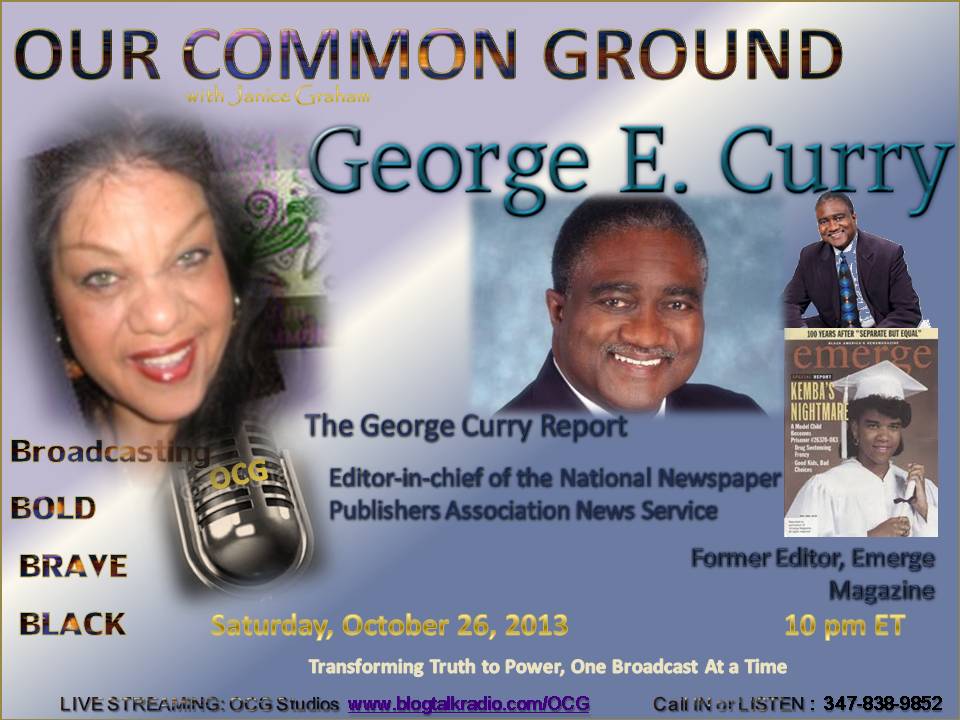
OUR COMMON GROUND “In Conversation with George Curry”

OUR COMMON GROUND with Janice Graham

“Transforming Truth to Power, One Broadcast At a Time”

“In Conversation with George Curry”

October 26, 2013 
10 pm ET                                     LIVE and Call -IN

10-26-13 Curry

About our Guest George Curry

George E. Curry is the editor-in-chief of the National Newspaper Publishers Association News Service. The former editor-in-chief of Emerge magazine, Curry also writes a weekly syndicated column for NNPA, a federation of more than 200 African American newspapers.

Curry, who served as editor-in-chief of the NNPA News Service from 2001 until 2007, returned to lead the news service for a second time on April 2, 2012. His work at the NNPA has ranged from being inside the Supreme Court to hear oral arguments in the University of Michigan affirmative action cases to traveling to Doha, Qatar, to report on America’s war with Iraq.
As editor-in-chief of Emerge, Curry led the magazine to win more than 40 national journalism awards. He is most proud of his four-year campaign to win the release of Kemba Smith, a 22-year-old woman who was given a mandatory sentence of 24 1/2 years in prison for her minor role in a drug ring. In May 1996, Emerge published a cover story titled “Kemba’s Nightmare.” President Clinton pardoned Smith in December 2000, marking the end of her nightmare.

Curry is the author of Jake Gaither: America’s Most Famous Black Coach and editor of The Affirmative Action Debate and The Best of Emerge Magazine. He was editor of the National Urban League’s 2006 State of Black America report.

His work in journalism has taken him to Egypt, England, France, Italy, China, Germany, Malaysia, Thailand, Cuba, Brazil, Ghana, Senegal, Nigeria, the Ivory Coast, Mexico, Canada, and Austria. In August 2012, he was part of the official US delegation and a presenter at the US-Brazil seminar on educational equity in Brasilia, Brazil.
George Curry is a member of the National Speakers Association and the International Federation for Professional Speakers. His speeches have been televised on C-SPAN and reprinted in Vital Speeches of the Day magazine. In his presentations, he addresses such topics as diversity, current events, education, and the media.

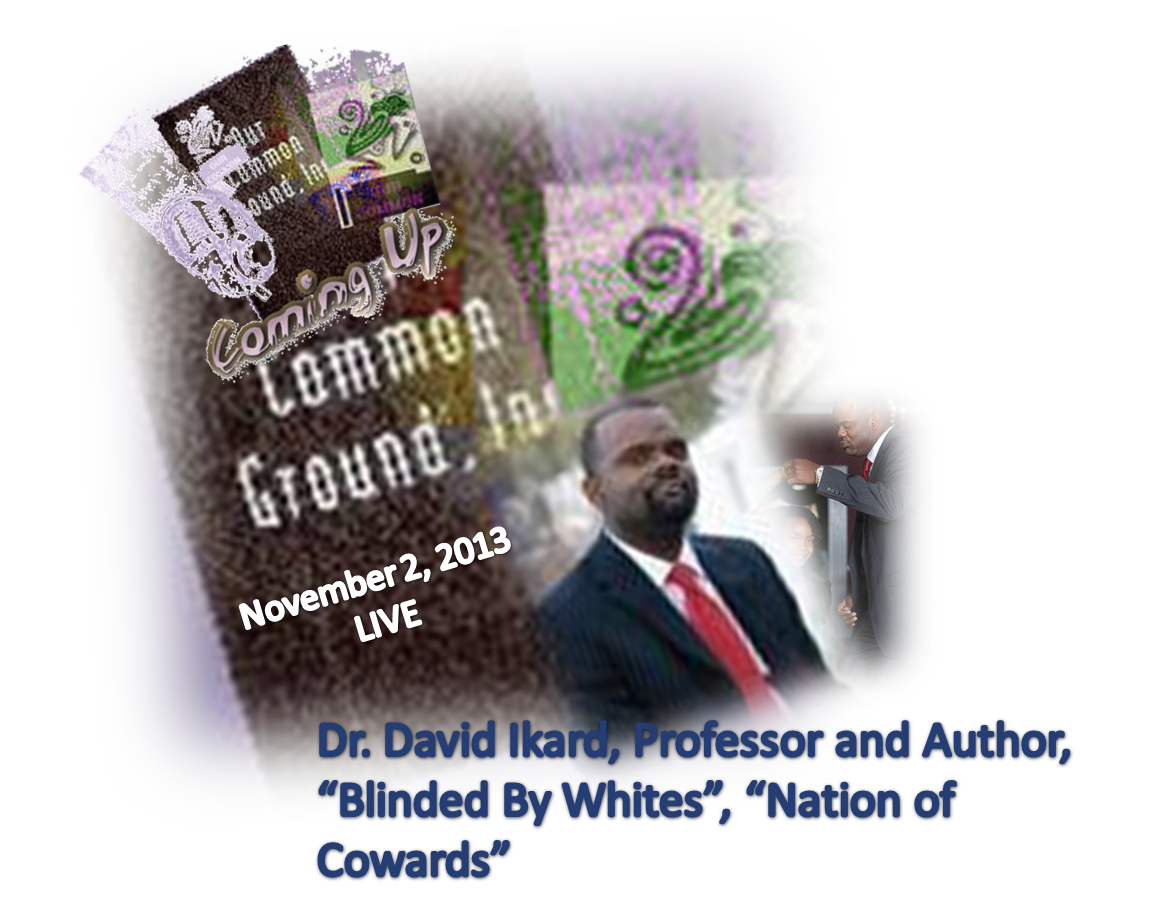
Ikard comingBROADCASTING 
BOLD BRAVE BLACK

OUR COMMON GROUND with Janice Graham

“Speaking Truth to Power and Ourselves” 

email: OCGinfo@ourcommonground.com

LISTEN LIVE and Join the OPEN Chat: http://www.blogtalkradio.com/OCG
Community Forum:http://www.ourcommonground-talk.ning.com/
Twitter: @JaniceOCG #TalkthatMatters
Web: http://www.ourcommonground.com/
OCG Blog: http://www.ourcommongroundtalk.wordpress.com/
Pinterest : http://www.pinterest.com/ocgmedia/boards/
Visit our Tumblr Page: http://ourcommonground.tumblr.com/
Facebook: https://www.facebook.com/OCGTALKRADIO

Chris Hedges “Death of the Liberal Class”

Chris Hedges, whose book “Death of the Liberal Class” (Perseus) came out the day of this presentation, is also the best-selling author of “War is a Force That Gives Us Meaning.” Hedges, whose column is published Mondays on Truthdig, spent nearly two decades as a foreign correspondent in Central America, the Middle East, Africa and the Balkans. He has reported from more than 50 countries and has worked for The Christian Science Monitor, National Public Radio, The Dallas Morning News and The New York Times, for which he was a foreign correspondent for 15 years. Produced by The Sanctuary for Independent Media in Troy NY, this event was co-sponsored by Bethlehem Neighbors for Peace.


Chris Hedges, whose column is published Mondays on Truthdig, has written twelve books, including the New York Times best seller “Days of Destruction, Days of Revolt” (2012), which he co-authored with the cartoonist Joe Sacco. Some of his other books include “Death of the Liberal Class” (2010), “Empire of Illusion: The End of Literacy and the Triumph of Spectacle” (2009), “I Don’t Believe in Atheists” (2008) and the best selling “American Fascists: The Christian Right and the War on America” (2008). His book “War Is a Force That Gives Us Meaning” (2003) was a finalist for the National Book Critics Circle Award for Nonfiction. In 2011, Nation Books published a collection of Hedges’ Truthdig columns called “The World As It Is: Dispatches on the Myth of Human Progress.”

Hedges previously spent nearly two decades as a foreign correspondent in Central America, the Middle East, Africa and the Balkans. He has reported from more than 50 countries and has worked for The Christian Science Monitor, National Public Radio, The Dallas Morning News and The New York Times, for which he was a foreign correspondent for 15 years.

Hedges was part of the team of reporters at The New York Times awarded a Pulitzer Prize in 2002 for the paper’s coverage of global terrorism. He also received the Amnesty International Global Award for Human Rights Journalism in 2002. The Los Angeles Press Club honored Hedges’ original columns in Truthdig by naming the author the Online Journalist of the Year in 2009 and again in 2011. The LAPC also granted him the Best Online Column award in 2010 for his Truthdig essay “One Day We’ll All Be Terrorists”.
Hedges is a senior fellow at The Nation Institute in New York City. He has taught at Columbia University, New York University, Princeton University and The University of Toronto. He currently teaches prisoners at a maximum-security prison in New Jersey.

Hedges began his career reporting on the Falkland War from Argentina for National Public Radio. He went on to cover the war in El Salvador and Nicaragua for five years, first for The Christian Science Monitor and National Public Radio and later The Dallas Morning News. Following six years in Latin America, he took time off to study Arabic and then went to Jerusalem and later Cairo. He spent seven years in the Middle East, most of them as the bureau chief there for The New York Times. He left the Middle East in 1995 for Sarajevo to cover the war in Bosnia and later reported the war in Kosovo. Afterward, he joined the Times’ investigative team and was based in Paris to cover al-Qaida. He left the Times after being issued a formal reprimand for denouncing the Bush administration’s invasion of Iraq.

Hedges holds a B.A. in English literature from Colgate University and a Master of Divinity degree from Harvard University. He was awarded an honorary doctorate from Starr King School for the Ministry in Berkeley, Calif. Hedges speaks Arabic, French and Spanish and studied classics, including ancient Greek and Latin, at Harvard. In addition to writing a weekly original column for Truthdig, he has written for Harper’s Magazine, Le Monde, The New Statesman, The New York Review of Books, Adbusters, Granta, Foreign Affairs and other publications. He lives in Princeton, New Jersey and is married to the Canadian actress Eunice Wong with whom he has two children. He also has two children from a previous marriage.