The Oscars, Quvenzhané & The C-Word

The Oscars, Quvenzhané & The C-Word

  on Feb 26, 2013

By Tracy Clayton

UPTOWN_quvenzhane_wallis_beasts_of_the_southern_wild


I watched every piece of the Oscars Sunday night, from pre-shows to the very end, which means that I was in front of my television for roughly 23 hours.  My viewing experience began in anger and fury, and it ended the very same way.  And thanks to some despicable behavior from the internet, that anger and fury is persisting hours after the show has ended.

It began when I heard Ryan Seacrest say that “they” (meaning, I assume, he and his E! red carpet cohorts) had decided to call Quvenzhané Wallis, the 9-year-old dynamo nominated for her role in Beasts of the Southern Wild, “Little Q” instead of her actual name.  Here’s a quick breakdown of the problems with this:

1.  That isn’t her name.
2.  To my knowledge, neither Quvenzhané nor her family OK’d this nickname.
3.  That nickname wasn’t given to her out of love or adoration; it was given out of discomfort and a need to control what they deemed as “other” in society.

Naming and names are important because they are entwined in our identities and the ownership of us and our bodies.  We name things that belong to us.  We name our children.  We name our pets.  We name our cars and our plants and our stuffed animals and even our hair.  The act of naming and/or re-naming something is absolutely about power and control, and this is something that slave owners knew very well–a standard practice in “seasoning” and “breaking” a slave was assigning them Anglo-Saxon names.  This established that those men and women were, without a doubt, property of their purchasers, and completely severed them from the identities they knew.  Further, the names that were assigned to enslaved black men and women were often diminutive versions of common names–Billy instead of William; Donnie instead of Donald.  These were verbal reminders that you were not a whole man or a whole woman, that you were not fully human.  And when that wasn’t enough, they were stripped of those names and called “boy” or “gal,” because acknowledging a person’s self-approved name is to acknowledge the humanity in someone.

This is still the function of naming, and precisely why the insistence on not learning how to prounounce Quvenzhané’s name is so problematic and outright offensive.

The erasure of Quvenzhané’s name is an attempt, consciously or unconsciously, to step around and contain her blackness.  Yes, sometimes black people have names that are difficult to pronounce.  There aren’t many people of European descent named Shaniqua or Jamal.  Names are as big a cultural marker as brown skin and kinky hair, and there has long been routine backlash against both of those things (see: perms, skin bleaching creams, etc.).   This insistence on not using Quvenzhané’s name is an extension of that “why aren’t you white?” backlash.

Calling Quvenzhané “Little Q” is a lazy way to keep from having to deal with the discomfort that race causes.  It is easier to be colorblind, to simply turn a blind eye to the differences that have torn this nation apart for centuries than it is to wade through those choppy waters.  And Quvenzhané’s very existence is enough to make the societal majority uncomfortable.  She is talented, successful, beautiful, happy, loved, and adored–all things that many people don’t figure that little black girls with “black” names could, or should, be.  Their answer?  Let’s make her more palatable.  If she insists on not fitting the mold of the ghetto hoodrat associated with women with “urban” names, let’s take her own urban name away from her.

Refusing to learn how to pronounce Quvenzhané’s name says, pointedly, you are not worth the effort.  The problem is not that she has an unpronounceable name, because she doesn’t.  The problem is that white Hollywood, from Ryan Seacrest to the AP reporter who decided to call her “Annie” rather than her real name, doesn’t deem her as important as, say, Renee Zellwegger, or Zach Galifinakis, or Arnold Schwarzenegger, all of whom have names that are difficult to pronounce–but they manage.  The message sent is this:  you, young, black, female child, are not worth the time and energy it will take me to learn to spell and pronounce your name. You will be who and what I want you to be; you be be who and what makes me more comfortable.  I will allow you to exist and acknowledge that existence, but only on my terms.

CONTINUE

– See more at: http://uptownmagazine.com/2013/02/the-oscars-quvenzhane-the-c-word/#sthash.VMIh9xPr.dpuf

More Black Men in Jail Than in College? Wrong l Ivory A. Toldson, Ph.D

More Black Men in Jail Than in College? Wrong

Show Me the Numbers: A 13-year-old report using questionable data gave rise to an enduring myth.

Students at a Morehouse College commencement (Getty); prisoners at the Avon Park Correctional Facility (Getty)

(The Root) — What does the line “There are more black men in jail than in college” have in common with the Jheri curl? Answer: They were invented by white men (Jheri Redding and Vincent Schiraldi, respectively) and adopted enthusiastically by black people, and they left a nasty stain on the shoulders of millions of black men.

It’s been more than 20 years since the Jheri curl faded away into infamy, and I’m proud to say that even in the 1980s, I never sported a curl. Unfortunately, I can’t say the same about the line “There are more black men in jail than in college.”

About six years ago I wrote, “In 2000, the Justice Policy Institute (JPI) found evidence that more black men are in prison than in college,” in my first “Breaking Barriers” (pdf) report. At the time, I did not question the veracity of this statement. The statement fit well among other stats that I used to establish the need for more solution-focused research on black male achievement.

I was in good company. The same year, at a 2007 NAACP forum, then-presidential candidate Barack Obama said, “We have more work to do when more young black men languish in prison than attend colleges and universities across America.”

However, just as a Jheri curl would be wrong no matter how you dressed it up today, the line “There are more black men in jail than in college” is wrong no matter how you contextualize, qualify or articulate it.

Today there are approximately 600,000 more black men in college than in jail, and the best research evidence suggests that the line was never true to begin with. In this two-part entry in Show Me the Numbers, the Journal of Negro Education’s monthly series for The Root, I examine the dubious origins, widespread use and harmful effects of what is arguably the most frequently quoted statistic about black men in the United States.

Continue Reading

Gabrielle Douglas: ‘Woman of the Year’ l The Final Call

Gabrielle Douglas: ‘Woman of the Year’

BY DR. RIDGELY ABDUL MU’MIN MUHAMMAD -GUEST COLUMNIST

FINAL CALL on-line| LAST UPDATED: DEC 10, 2012 


gabrielle_douglas_essence2012.jpg

Gold medalist Gabrielle Douglas appears on the December 2012 cover of Essence magazine crowned as “Woman of the Year.” The more we learn of her struggles, the more we must appreciate her as a strong Black woman as well as a great athlete. Now we must ask the question, “How many other great young Black people are out there that we will never know, because they were not as mentally and spiritually prepared as Gabrielle?” They may have great potential but they never made it through the agonizing reality of being Black in a world dominated by “White Supremacy.”


The Honorable Minister Louis Farrakhan writes in A Torchlight for America: “There seems to be a practice of identifying young, brilliant black children, particularlyBlack boys, and casting in their minds suggestions that stagnate their development and kill their upward movement.” Gabrielle Douglas gave an interview after the Olympics to Vanity Fair magazine. In this interview she stated that she felt isolated and was made the butt of “racist jokes” while training in Virginia before moving to Iowa to be coached by her mentor Liang Chow. She felt bullied by the other White girls in the program to the point that she was afraid to show off more of her skill. Gabrielle had been training as a gymnast since she was six years old. Starting in 2004, when she was eight, Gabrielle mostly trained at Excalibur Gymnastics in Virginia Beach, a well-regarded program that has produced 10 members of the U.S. national team since 1995. Her mother soon began working nights so she could home-school Gabrielle, in large part because a gymnast’s daily training regimen makes going to regular school impossible.

Through all of the physical and emotional stress of such intensive training, Gabrielle still blossomed until 2009. Gabrielle said that some of her fellow White gymnasts had made fun of her appearance but when an Excalibur staff member suggested to her that she might want to get a “nose job,” that was a severe blow to her self-esteem. But Gabrielle did not quit. She became determined to train at Chow’s gym, in West Des Moines, Iowa. “I’ve got to get a coach I can believe in, and who believes in me,” she told her mother. Gabrielle said that her mother told her to “suck it up,” to which Gabrielle asked, “If this was happening to you, how well would you suck it up?” Her mother was then moved to make it possible for Gabrielle to move to Iowa to train under Chow.

What would have happened to Gabrielle if she were not so persistent and her mother were not so caring? Do you remember the story of Malcolm X when he was in the eighth grade and the white teacher told him that he should forget about becoming a lawyer and instead think about learning carpentry? Malcolm eventually dropped out of school to pursue a life of crime. In a previous article “Exposing the Aim and Purpose of America’s Educational System,” we shared the statistic that 1 out of every 6 Black children was suspended from high school in the 2009-2010 school year compared to 1 out of 20 for white children. There is a direct relationship between being suspended and eventually dropping out of school and eventually ending up in jail.

Why should Gabrielle have to “suck up” a deliberate psychological blow to her head? Why does society have to suffer the consequences of having to deal with a destroyed ego? What if these incidents are not isolated, but a planned method of control? Is there, as Minister Farrakhan stated, “a system in place to keep a plantation running, for the benefit of the rich and powerful?” Minister Farrakhan also describes the purpose of “true education”: to cultivate “the person—mind, body, and spirit—by bringing us closer to fulfilling our purpose for being, which is to reflect Allah (God).” If her mother had not pulled Gabrielle out of the public school system and home schooled her, and then sent her away to be trained by an Asian coach, would we now be enjoying the athletic feats and captivating smile and personality of Gabrielle Douglas?

Minister Farrakhan has walked the streets of Chicago with the Fruit of Islam (FOI) trying to repair the broken souls of our young Black men who have formed “gangs” to express their manhood in a culture that has failed to acknowledge their humanity. Their frustrations are turned on each other while the dominant society is training professional killers to gun them down when the order is given. What if this form of psychological destruction, followed by physical annihilation, is not an anomaly but the American way? Jeff Schmidt in his book Disciplined Minds makes the point that this type of psychological warfare is not waged solely against Blacks, as manifested in their almost 50 percent high-school dropout rate; rather, it is a planned method of selection that moves all the way up to the Ph.D level and cuts across all racial lines. The selection process is based not on academic skills or even race, but on a willingness to give over the core of one’s being to serve “the status quo,” the rich and powerful. The aspiring professional, no matter what the field, must demonstrate a willingness to be a “professional” slave without making waves.

Dr. Schmidt, who holds a Ph.D in physics, demonstrates how the “ideology of the status quo is built into the curriculum.” The curriculum establishes the goals, values, priorities and attitude of its students to ensure future employers that the graduate is willing and able to set aside his or her values and do whatever is necessary to “get ahead.” If he changes employers, the graduate is flexible enough to change values to fit in to the new workplace at the drop of a hat. Sounds like a well-adjusted prostitute to me.

The streets of America are red with the blood of our young Black boys and girls who could have been another Gabrielle Douglas. Our prisons are full of untapped talent that just did not know that they were victims of a well-thought-out scheme. We must teach our young Black boys and girls that, as Minister Farrakhan says, “We are at war!” and that each person or institution that they may meet could have a “land mine” ready to detonate in their minds to destroy their self-esteem and their future. We must institutionalize some form of survival training to protect the minds of our children.

(Dr. Ridgely A. Mu’min Muhammad, Ph.D is an Agricultural Economist, and member of the Nation of Islam Research Group. Visit them online at www.noirg.org, join the conversation on FaceBook.com/NOIResearch and Twitter @ NOIResearch)

CHILD SEXUAL ABUSE & TRAUMA IN THE AFRICAN-AMERICAN COMMUNITY l BALT March 22-23, 2013


ROYAL CIRCLE FOUNDATION

PRESENTS IN ASSOCIATION WITH

BLACK PSYCHIATRISTS OF AMERICA, THE OFFICE OF MINORITY AND NATIONAL AFFAIRS

(AMERICAN PSYCHIATRIC ASSSOCIATION)

&

THE BALTIMORE BLACK MENTAL HEALTH ALLIANCE

 A National Conference

CHILD SEXUAL ABUSE & TRAUMA

IN THE AFRICAN-AMERICAN COMMUNITY

(The Shame, The Blame & The Solutions)

MARCH 22-23, 2013

Hilton Baltimore

401 West Pratt Street – Baltimore, MD 21201

(Limited Number of Hotel Rooms Still Available Thru 02/20/13)

For Discounted Hotel Rooms  

 Call:  1-800-HILTONS

GROUP: Royal Circle Foundation Child Abuse Conference

**********

Conference “Early Bird” Registration Now Open!

CALL FOR PAPERS ANNOUNCEMENT, ADVERTISING & EXHIBITORS APPLICATIONS AVAILABLE

(Clink Links Below For Details)

******** 

March 22, 2013 

FRIDAY EVENING RECEPTION & SPECIAL MOVIE SCREENING

“WOLF”

wolf.jpg

A Family Struggles with Child Sex Abuse in the Black Church

FOLLOWING THE MOVIE SCREENING WILL BE A DISCUSSION WITH DIRECTOR & FILMMAKER

Prof. Ya’Ke Smith

yake.jpg
PROFESSOR YA’KE SMITH

PRESS RELEASE

CHILD SEXUAL ABUSE & TRAUMA CONFERENCE ANNOUNCEMENT

REGISTER FOR THIS CONFERENCE HERE

SPONSORSHIP OPPORTUNITIES

PROGRAM ADVERTISEMENT BOOKING FORM

CONFERENCE EXHIBITORS/VENDORS AGREEMENT

***** 

SAVE THE DATE

August 20 – 22, 2013

The Royal Circle Foundation

Presents

AN INTERNATIONAL CONFERENCE

THE HEALTH & MENTAL HEALTH EFFECTS OF HUMAN TRAFFICKING


6_1782_Carpet-weaver14.jpg
Phoro Courtseyof: US Department of State

CHILD SEXUAL ABUSE & TRAUMA IN THE AFRICAN-AMERICAN COMMUNITY

See on Scoop.itOUR COMMON GROUND News Board •● ☥●• The Third Eye Parenthesis

ROYAL CIRCLE FOUNDATION

PRESENTS IN ASSOCIATION WITH

BLACK PSYCHIATRISTS OF AMERICA, THE OFFICE OF MINORITY AND NATIONAL AFFAIRS

(AMERICAN PSYCHIATRIC ASSSOCIATION)

&

THE BALTIMORE BLACK MENTAL HEALTH ALLIANCE

A National Conference

CHILD SEXUAL ABUSE & TRAUMA

IN THE AFRICAN-AMERICAN COMMUNITY

(The Shame, The Blame & The Solutions)

MARCH 22-23, 2013

Hilton Baltimore

OUR COMMON GROUND Omnibus‘s insight:

For students, activists, scholars, parents, teachers and victims.

The Shame, The Blame & The Solutions

See on www.royal-circle.org

Two Narratives the Black Community Needs to Give Up in the New Year

cropped-funeral_.jpg
Two Narratives the Black Community Needs to Give Up in the New Year
Posted: 01/03/2013 11:56 am

by 

Writer & Educator

2013 is here, and it’s time folks.

It’s time to leave behind the tired stories and unhealthy narratives that hurt our communities.

It’s time to re-commit our focus to the brilliance, beauty and resilience we possess, so that these things can grow exponentially and overshadow the death, gloom and despair that the media and many of us have focused on.

This is not about delusion. It is not about pretending that problems do not exist. This is about re-adjusting our gaze. It’s about getting as motivated about the things people are doing to help our communities as we are when a celebrity says something racist, or when a white film maker produces a film that distorts or minimizes our historical experiences. This is about getting excited and celebrating what we have going for ourselves as a community.

This is about finding a new lens on life.

So in honor of the new year, I’d like to offer you (and me) an opportunity to abandon two narratives in particular that have done a grave disservice to black communities. They are the “Ain’t No Good Black Men” and the ” Black People are Deficient in Every Damn Thing” narratives. Leaving them behind may not be easy, but by questioning these narratives and our commitment to them, we may come to some fairly surprising conclusions.

There are No “Good” Black Men:

There is an entire industry that has been created around the idea of there not being any “good black men.” Everyone from media moguls to R&B singers rely on it in order to sell products to emotionally starved black heterosexual women and black gay men.

In consuming their products, black heterosexual women in particular are either lulled into a sense of fantasy or beaten into psychological submission because of a perceived inability to express an “authentic” male defined womanhood. This narrative is not only present in black heterosexual middle class women’s lives, but in black gay male culture, where ideas of the lack of “good masculine” men echo very similar themes.

“Good,” in the context of “good black men” often means a number of things: how much money he makes, how “hard” his gender expression appears and his ability to perform sexually are among them.

Good in this context is not about black men’s inherent value as human beings. No, good in this context is about external realities. It is about our ability to produce income, and perform a rigid idea of masculinitythat we are learning is not only unhealthy for us, but unhealthy for black women and the black community at large.

Good in this context is not defined by ones’ ability to care for children. Good is not defined by one’s ability to care for home, or to express emotionality. Those traits are dismissed and belittled, both by black men and their potential suitors. This narrative has created incalculable chaos in our relations in the black community. That’s why it’s time to let it go.

It’s time to recognize a few things:

Black men’s inability to acquiesce to rigid of ideals of masculinity is not a commentary, nor a reflection of our worth. Our “goodness” is not defined through our ability to produce income. Our goodness is not measured by our desire to be monogamous. Our goodness is not about our ability to be heterosexual. Our goodness is not reflected in our car. Our goodness is inherent, as children of the universe. Yes, It may be marred, by the psychological conditioning of our communities that make it hard for us to effectively deal with our emotional trauma. It may be subdued by the rage that we have been taught is our only acceptable emotional option. But it is not gone. This is not to suggest that black men do not have ongoing spiritual, psychological and emotional work to do. This is to state that our worth, and further more, the worth of all human beings (which is often conveyed through “goodness”) is not contigent upon performing, doing, behaving in a certain way. Our value, like the value of all people is immanent. And no other narrative from this day forward should ever be acceptable.

2012 Narrative: Ain’t no good black men.

Its 2013 replacement: Good black men are everywhere, waiting for someone to see and celebrate the good they posses and already are.

Black People are Deficient In Every Damn Thing:

This one really doesn’t need much explaining. Turn on the news, switch to your Facebook feed, or browse your twitter timeline. It wont’ be long before you will come across articles, videos, memes and essays that rave on about how #%$% up black people are. They will tell you a statistic about how white people are better. They will tell you about what black people don’t do right. They will not tell you about the issues that white people have that are never pathologized because, well, they are white.

They will instead tell you about how we as black people are wrong. Wrong. Wrong.

But lack is not synonymous with black and black is not a metaphor for wrong. Still many believe this, and because they do you will not hear about the innovative ways in which black people are taking back our communities. They will not tell you about the black men and women honoring and celebrating their children’s gender and sexual diversity They will not tell you about the barbershops working to address health issues, or the churches challenging homophobia. There will be no stats that show how many black people are taking up vegetarianism to address dietary concerns. No stats that tell how many of us are not imprisoned. In the “black people are deficient in everything” narrative, none of that information is necessary, nor is it exciting. What is exciting is our death and demise. Our imbalanced focus on these things erases and minimizes the skills and talents we have.

This narrative has also severely hurt our sense of self worth. It is time to let it go.

2012 Narrative: Black people are deficient in every damn thing.

Its 2013 replacement: Black people are an abundant embodiment of brilliance, crafting new ways of being and thriving from our boundless creative legacy.

2012 is at an end. At its end we have choices to make. Will we continue to commit ourselves to unhealthy narratives that deny and dismiss the power and inherent brilliance of our community? Are we going to be honest with ourselves about how deeply internalized forces have impacted our perceptions of each other and work to change them? Can we simply take a moment as a collective to celebrate what we have learned and what we are doing? Yes we can. And we don’t have to sacrifice acknowledging the pain. We don’t have to sacrifice acknowledging the injustice. We can hold both, in balance, and move forward with a full and more cohesive vision of who we are for 2013 and beyond.

Follow Yolo Akili on Twitter: www.twitter.com/YoloAkili

 GET UPDATES FROM YOLO AKILI

Yolo Akili

Writer & Educator

SHARE THIS STORY 

DEPRESSION: One Black Man’s Story

DEPRESSION:
One Black Man’s Story

WRITER MYCHAL DENZEL SMITH IS ONE OF THOUSANDS OF BROTHERS TO EXPERIENCE THE PAIN OF DEPRESSION…AND ONE OF THE ONES BRAVE ENOUGH TO SHARE HIS STORY

Mychal Denzel Smith
ByMYCHAL DENZEL SMITHWriter
DEPRESSION:<br /><br /><br />
One Black Man's Story

It’s hard to answer the question “what’s wrong” when nothings right.

When my grades started dropping senior year of high school, I didn’t think much of it. School had never held much interest to me and I had always done just enough to “get by” anyway, so not being able to focus in Physics or AP Government wasn’t a big deal to me. And I never had many true friends, just a bunch of associates who came in out and of my life, so the fact that I closed myself off from them didn’t register as a warning sign. The sleeping in late, the not eating, the constant worrying about things that hadn’t happened…I thought I was just being my normal, neurotic self.    

But staring in the mirror, wondering how much blood there would be if I bashed my head against it, wasn’t normal. Sitting at the dinner table thinking about taking the knife I’m using to cut my steak to slit my wrists, wasn’t normal. Something was missing.

I had thought about suicide before, but never in any real way. It was always a “what if?” Now, it had become a “maybe I should…” I learned firsthand what the true meaning of the word “depression” was.

Something was missing, but I had no idea what.

I “got over” it though. I moved past it. I never spoke a word of it to anyone. I was “better.”

Two years later, I wasn’t just “better”, I thought I was completely “cured.” I spent the summer in Atlanta working a well-paying internship, going to concerts every week, meeting some of my heroes, just enjoying life.

Then I bought the Gnarls Barkley album, St. Elsewhere. I was taken aback. I realized I wasn’t too far removed from the space Cee-Lo was singing from. The isolation, the helplessness, the feeling of being trapped inside your own mind and it being locked from the outside and there is no one around to pick the key up from under the welcome mat to let you out…these feelings were all too familiar. I never spoke a word of it to anyone. No matter. Cee-Lo was doing that for me.

There’s a song toward the middle of the album called “Just a Thought” that is a hauntingly accurate description of what goes through a person’s mind while suffering from severe depression. Each verse ends with the phrase “…and I tried, everything but suicide, but it crossed my mind.” I could only nod silently in agreement as he belted out the most secret of my thoughts for the whole world to hear.

MORE in this series of stories

RELATED TAGS

MORE on Depression in the Black Community

More

Historically Black Colleges and Universities Rankings

Methodology: Historically Black Colleges and Universities Rankings

In total, there were 80 HBCUs eligible to be ranked.

September 11, 2012

For the sixth consecutive year, U.S. News & World Report has produced a ranking of the undergraduate education athistorically black colleges and universities (HBCU). These colleges were compared only with one another for these rankings.

How did we choose the schools to be part of the survey? In order to be on the list, a school currently must be listed as part of the U.S. Department of Education’s Historically Black Colleges and Universities registry.

The Higher Education Act of 1965 defines an HBCU as “any historically black college or university that was established prior to 1964, whose principal mission was, and is, the education of black Americans, and that is accredited by a nationally recognized accrediting agency or association determined by the Secretary [of Education] to be a reliable authority as to the quality of training offered or is, according to such an agency or association, making reasonable progress toward accreditation.”

To qualify for the U.S. News ranking, an HBCU also must be an undergraduate baccalaureate-granting institution that enrolls primarily first-year, first-time students and must have been a school that was currently part of the 2013 Best Colleges rankings. In almost all cases, if an HBCU was listed as Unranked in the 2013 Best Colleges rankings, it was also listed as being Unranked in the HBCU rankings (see more details below). In total, there were 80 HBCUs eligible to be ranked, and 8 of those were Unranked.

The data that were used in the HCBU rankings—except the peer survey results, which used a separate HBCU peer assessment survey—were the same as those published and used in the 2013 edition of the Best Colleges rankings.

The U.S. News rankings system rests on two pillars: It relies on quantitative measures that education experts have proposed as reliable indicators of academic quality, and it’s based on our nonpartisan view of what matters in education. The indicators we use to capture academic quality fall into six categories: assessment by administrators at peer institutions, retention of students, faculty resources, student selectivity, financial resources, and alumni giving.

The indicators include input measures that reflect a school’s student body, its faculty, and its financial resources, along with outcome measures—such as graduation rates and freshman retention rates—that signal how well the institution does its job of educating students.

The HBCU rankings are based on the same statistical methodology and weights used in the Best Colleges 2013 rankings for the schools in the Regional Universities andRegional Colleges ranking categories. Following are detailed descriptions of the statistical indicators and the weights that were used to measure academic quality among the HBCUs that were ranked:

Peer assessment (weighting: 25 percent): The U.S. Newsranking formula gives greatest weight to the opinions of those in a position to judge a school’s undergraduate academic excellence. The peer assessment survey allows the top HBCU academics we consult to account for intangibles such as faculty dedication to teaching. Each individual is asked to rate peer schools’ academic programs on a scale from 1 (marginal) to 5 (distinguished). Those who don’t know enough about a school to evaluate it fairly are asked to mark “don’t know.”

In spring and summer of 2012, U.S. News conducted an exclusive peer survey among only the president, provost, and admission dean at each HBCU. Each HBCU received three surveys. The recipients were asked to rate all HBCUs for their undergraduate academic quality, considering each school’s scholarship record, curriculum, and quality of faculty and graduates at schools with which they were familiar.

2   3  >

http://www.usnews.com/education/articles/2012/09/11/methodology-historically-black-colleges-and-universities-rankings-2

The Original Deadbeat Dad

The Original Deadbeat Dad

Written by: James B. Peterson

U.S. Supreme Court Justice John Catron is one of several prominent Americans who fathered children with slave women. His son, James P. Thomas was born to a 36-year-old Tennessee slave named Sally. Thomas escaped slavery, with no help from Catron, who in his entire life gave Thomas only 25 cents.

“Unless their mothers were raped by their masters/fathers; in that case they would be dogged by the existential tensions of their own miscegenated identities; their sui generis experience with fatherlessness would have been inextricably linked to their condition as human chattel“   — James Braxton Peterson “Racial Redux” (NewBlackMan & Huffington Post)

 Bill Andrews’ edited, Frederick Douglass Reader begins with a chronology of Douglass’ life.  The first entry reads as follows: “Frederick Augustus Washington Bailey born in February . . . , in Talbot County on the Eastern Shore of Maryland, the son of Harriet Bailey, a slave, and an unknown white man” (Andrews, xi).  Although scholars and historians have been somewhat reluctant to underscore the fact, Douglass was clearly haunted by his peculiar experience with fatherlessness – so much so that as Henry Louis Gates points out, one of his final “missions” in life was to meet with a physician who may have been able to provide him with some information regarding his actual birthdate.  One of the signal achievements of Douglass’ classic 1845 “slave” narrative, was the poignant manner in which he articulated the natal alienation that American slavery produced in its victims.  Not knowing one’s birthdate, being alienated from one’s mother, and not knowing one’s father all colluded to produce in enslaved Black Americans a diminished sense of their own humanity.  When we factor in additional practices of the “Peculiar Institution:” forced separation of families, rape, rampant brutality, and uncompensated, forced labor, the legacy of the institution and its potential to impact the present become readily apparent.


In the epigraph above I am wrestling with the unchecked irony and impact of certain public comments made by politicians.  In this case, then presidential primary candidate Michelle Bachman, fresh off the talking points memo of the moment, suggested that Black families (especially Black children) were somehow better off during slavery because back then . . . (wait for it), Black families were more intact than they are in the Obama era. *Sigh* Although I can imagine that at this point many people can simply tune out these kinds of ignorant comments, for me they reflect just about everything that is wrong with the body politic.  Political figures – and I use this term very loosely – exploit history in order to bend the present back on itself.  And this comment obscures an even deeper hypocrisy.  It is rooted in the Right’s self-professed exclusive claim to traditional family values.  In this scenario, right-wing politicians espouse traditional, western, nuclear ideas about family and pass these off as the sine non qua for all human interactions.  Never mind their own families; never mind their own behavior, biases, infidelities, and most of all – never mind history.


A couple of years ago, I made my first appearance on the Bill O’Reilly Show (Fox News).  It was on the occasion of an extremely violent murder of several school-aged children on school grounds.  These murders were horrific and the circumstances surrounding them were mystified by gang lore and the media’s requisite inability to understand the nuances of inner city life.  Mr. O’Reilly opened the segment by citing the (oft-cited) statistics on Black fatherlessness – some 70% of African American children are born to single mothers.  I remember wondering what that had to do with this particular segment, but for O’Reilly and those who follow the Right’s talking points, Black fatherlessness is the fundamental “problem” with Black people and (simultaneously) the prevailing rationale for all crime in America.  I certainly do not want to underestimate the importance of Black fatherlessness here.  Parents have important roles to play in the development of children’s lives.  Having two parents is a blessing (not necessarily a necessity) and the key to children becoming ‘upstanding’ citizens has more to do with any adults — parents, mothers, fathers, uncles, teachers, etc. — taking a sincere sustained interest in them and their successful maturation into adulthood.  That said, Black fatherlessness has been used as a political tool to enhance the public appetite for narratives of Black pathology.  And this is always done in a historical vacuum, as if there are no structural (or historical) precedents to these situations; as if there are no biases about the construction of family in the first place.

When we take just a cursory look blackward into the history of African Americans, there are too many narratives of white pathology: systematic rape, legislated oppression, and yes – Black fatherlessness.  Slave masters separated Black families, but they also raped Black women and sold their own children – or worse, enslaved them.  Let’s just call this white-Black fatherlessness.  This was not solely the purview of Presidents and Senators, it was a normative practice amongst white male slave owners for over two centuries.  I don’t offer this tidbit of history to justify Black Black fatherlessness, I only make the point to unveil some of the historical ironies inherent in the ways in which Black-Black fatherlessness seems to exist in some socio-political space devoid of the institutions, structures, and yes, HISTORY that predates it and may in some strange way originates it.

James B. Peterson

James Braxton Peterson (Duke ’93, UPENN 2003) is the Director of Africana Studies and Associate Professor of English at Lehigh University. He has been Associate Professor of English at Bucknell University, a visiting lecturer and preceptor in African American Studies at Princeton University and the Media Coordinator for the Harvard University Hip Hop Archive.

More articles by  »

Related Articles

Sally’s Plan — How One Slave Mother Helped Free All Her Children

The Wall Between My Father & Me

The Lessons of Fatherhood

Gifted Students Have ‘Special Needs,’ Too – Chester E. Finn Jr. – The Atlantic

2 DEC 22 2012, 9:00 AM ET 3

It’s not elitist to pour more resources into educating our brightest kids. In fact, the future of the country may depend on it.

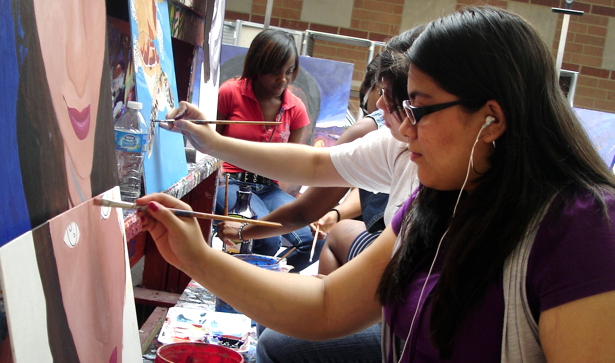
A high school senior paints a portrait at the School for Talented and Gifted in Dallas. (Reuters)

Are our national education-reform priorities cheating America’s intellectually ablest girls and boys? Yes — and the consequence is a human capital catastrophe for the United States. It’s not as dramatic or abrupt as the fiscal cliff. But if we fail to pay attention, one day we’ll be very sorry.

In a recent New York Times column, I explained how America could benefit from more schools and classes geared toward motivated, high-potential students. Here, I want to look more deeply at why such initiatives are unfashionable, even taboo, among today’s education reformers.

We’d like to believe that every teacher can do right by every child in each classroom. But let’s be serious: how many of our 3 million-plus teachers are up to this challenge? The typical class is profoundly diverse in ability, motivation, and prior attainment. In most cases, instructors — under added pressure from state and federal accountability regimes — end up focusing on pupils below the “proficient” line, at the expense of their high achievers.

You don’t have to search hard for evidence that teachers and school systems are neglecting them. Take, for instance, our longstanding failure to get more than a few percent of U.S. students scoring at or above the National Assessment’s “advanced” level — in any subject or grade level. Study the data showing how far our students’ scores lag behind those of many competitor countries. Consider the ongoing need of high-tech employers to import highly educated personnel from abroad.

Then look at the unmet demand for “gifted and talented” schools and classrooms (and teachers suited to them). For many years, Washington’s only sign of interest in this portion of the K-12 universe was the Jacob K. Javits Gifted and Talented Students Education Program. Since 2004, however, Congress has steadily decreased funding for the program; last year, that contribution dropped to $0. And despite plenty of evidence that America is failing to nurture its gifted students, the problem fails to awaken much interest from education leaders and philanthropists. Why is this so?

Consider these possible explanations.

via Gifted Students Have ‘Special Needs,’ Too – Chester E. Finn Jr. – The Atlantic.