Deaths of children that don’t make news l OUR COMMON GROUND Voice, Dr. Vijay Prashad

Vijay Prashad: Deaths of children that don’t make news

By VIJAY PRASHAD

Monday, December 17, 2012
(Published in print: Tuesday, December 18, 2012

NORTHAMPTON — No community easily suffers the death of children. Accidents, violent crimes and illness: the cause is immaterial.

No death of a child is for a reason. All such deaths are senseless.

In his emotional address shortly after news came of the massacre in Newtown, Conn., President Obama pointed to the frequency of such mass crimes and nudged the country to widen our field of vision: “Whether it is an elementary school in Newtown, or a shopping mall in Oregon, or a temple in Wisconsin, or a movie theater in Aurora, or a street corner in Chicago — these neighborhoods are our neighborhoods, and these children are our children.”

The contrary nudge came in his last destination, the “street corner in Chicago.”

When a singular mass killing occurs in mainly affluent suburbs, it shocks the nation — and rightly so. But it might be a shock to some to know that this year alone 117 children died from handgun violence in Chicago. These deaths do not get discussed, let alone memorialized in the national conversation of tragedy.

There are at least two reasons for this. First, these deaths do not happen in a spectacular fashion. They take place in ones and twos, often in the lonely hours of the night when bullets depart from their targets and settle in the soft tissue of children asleep in their homes, or in the afternoon as they play on the sidewalk.

Take the case of April 12. One-year-old Jayliah Allen was shot while she slept in her bed, the bullet entering the window. Seven-year-old Derrick Robeteau was shot in the leg while playing outside his grandfather’s home and a 7-year-old girl was shot as she stood outside her home. Three children hit by handguns in one day, but in an unspectacular form.

Second, old racist habits linger. These are African-American and Latino kids, whose neighborhoods are considered dangerous. Which is why when Jayliah and Derrick were killed no one called their neighborhoods bucolic or thought that this violence was senseless. There is a hardness that has entered our consciousness, allowing us to avoid the sealed fates of these kids.

No memorials exist as well for the 178 children killed by U.S. drone strikes in the borderlands of Pakistan and Afghanistan. Noor Aziz, 8, Talha, 8, Najibullah, 13, Adnan, 16, Hizbullah, 10, Wilayat Khan, 11, Asadullah, 9, Sohail, 7: these are some of the names of children killed by the drones. News reports frequently say “three militants killed,” and then a few days later, in the Pakistani press, one hears that amongst the dead were children with no association with the militants. Unlike the street shootings in Chicago, there have been mass killings by drones, which have received only minimal attention. On Oct. 30, 2006, a U.S. drone struck a school in Bajaur, Pakistan, killing 83 people. The New York Times story ran Nov. 10 with the headline, “American Strike in January Missed Al-Qaeda’s No. 2 By a Few Hours.”

Read Article Here

05-14-11 Prashad

Corporal Punishments Hidden Costs l SALIM MUWAKKIL l In These Times

On the Matt McGill Morning Show this morning, during a discussion of the horrific events in Newtown, Conn., we veered into a conversation about the effects of corporal punishment on the rates of interpersonal violence in the Black community. One caller even urged President Obama to mandate corporal punishment as way to stem violence. I can’t think of a worse suggestion, but this spare-the-rod sentiment is amazingly widespread in the black community. Here is a slightly altered piece I wrote a few years ago, noting the negative consequences of corporal punishment. Please check it out and post your reactions.”

WVON Radio Chicago

In These Times
SEPTEMBER 8, 2006
Corporal Punishments Hidden Costs

Corporal punishment of children linked to later interpersonal violence.

BY SALIM MUWAKKIL

If the civil rights community began a movement to discourage corporal punishment among African Americans, I believe it would do more to stem the tide of interpersonal violence than any other strategy.
An errant bullet hit the eye of a 12-year-old Chicago girl on August 27 but she survived. Earlier this year, stray bullets killed two girls in separate incidents in the city’s Englewood neighborhood and triggered a flurry of activity designed to address the chronic violence hammering Chicago’s inner-city neighborhoods.
In black communities across the United States, concerned people are gathering with increasing urgency, seeking solutions to rising rates of violence.
Let me add one suggestion that is not likely to be raised at any of these gatherings: Stop spanking your children.
If the civil rights community began a movement to discourage corporal punishment among African-Americans, I believe it would do more to stem the tide of interpersonal violence than any other strategy.
Experts are increasingly fingering corporal punishment–the infliction of physical pain on the body of a child for purposes of punishment or controlling behavior–as the culprit in a wide variety of social dysfunctions. A host of relevant professional organizations, including the American Academy of Pediatrics, the American Psychological Association and the National Association of Social Workers have published position papers opposing or strongly discouraging corporal punishment of children.
International research on the deleterious effects of physical punishment is so compelling that the United Nations has initiated a global program to eliminate it. Not only is corporal punishment of children a violation of human rights, the United Nations argued in a 2005 UNESCO publication, that according to a preponderance of research, it is also “counterproductive, relatively ineffective, dangerous and harmful.”
In 1979, Sweden became the first country in the world to ban all corporal punishment of children. Twelve more European countries have followed: Denmark, Norway, Finland, Austria, Cyprus, Italy, Croatia, Latvia, Germany, Bulgaria, Ukraine and Iceland. Leaders in these countries concluded that the costs of corporal punishment were too high for a society that called itself civilized.
Despite this wide consensus on the ills of corporal punishment, there is scant sentiment for an anti-spanking movement among African Americans. But that may be changing. Growing numbers of experts who focus on the black community, are also raising questions about the high costs of using physical violence to punish children. Dr. Alvin Poussaint, a professor of psychiatry at Harvard Medical School who has written extensively on African-American issues, has long opposed the use of corporal punishment.
His major argument is simple: “the use of corporal punishment teaches children that violence is the way to solve problems.” Poussaint, who was an adviser to the popular program “The Cosby Show,” says corporal punishment also has other harmful effects on the social life of the black community.
At a recent forum on young black men, sponsored by the Washington Post and the Kaiser Family Foundation, Poussaint fingered corporal punishment as a factor in the disproportionate expulsions of black children from pre-school programs, especially males. He said his research has found that even preschool black males harbor a lot of anger.
“There’s an overuse of beating kids,” he said, breaking a major taboo among black leadership by raising this issue. “So that you have 80 percent of black parents believing you should beat them–beat the devil out of them. And research shows the more you beat them, the angrier they get.”
High levels of violent crime in black communities certainly reflect that anger. According to figures from the Department of Justice’s Bureau of Justice Statistics, African Americans were more likely than other Americans to be both victims and perpetrators of violent crime.
In 2000, blacks were six times more likely than whites to be victims of murder. They also were seven times more likely to be perpetrators. In fact, for the last half-century blacks were homicide victims at least five times more than whites were. Sometimes that rate reached more than ten times the white rate.
Among the major reasons cited for this disparity are poverty, segregation, media violence and the self-hatred inculcated by a white supremacist culture. Some argue the problem is simply one of bad behavior, abetted by black communities that deemphasize personal responsibility and cultural standards.
There is a bit of truth in those explanations, but Poussaint’s anti-spanking reasoning also makes sense. What doesn’t make sense is that black leaders have yet to make the connection between high rates of corporal punishment and high rates of interpersonal violence.
One reason for this reticence is the influence of the church. All spanking advocates need to do is cite a biblical justification not to spare the rod and for far too many, the case is closed. Also, many African-American parents argue they must discipline their children harshly to prepare them better for the racist treatment they’re sure to receive in the Untied States.
But Poussaint said his research found that 80 to 90 percent of black prison inmates were severely punished or neglected as children. It doesn’t work.
There’s also the sheer injustice of imposing an act of physical violence on someone smaller and weaker: As we’ve learned from U.S. foreign policy, that a characteristic of tyranny and seldom leads to positive outcomes.

A Massacre in Newtown, CT l Commentary

December 14, 2012

THE NEWTOWN SHOOTING: KINDERGARTENERS AND COURAGE

Posted by 
sandy-hook-kids.jpg

[Updated]
“I heard something like someone was kicking on a door,” a little boy, a student at Sandy Hook Elementary School, near Newtown, Connecticut, told a reporter for NBC. He said that bullets were “whizzing by” him in the hallway, but “a teacher pulled me into her room” before one hit him. “The gym teachers told us to go in the corner and we huddled,” another said. “We were in the gym and I heard really loud bangs,’’ a third boy, a nine-year-old, told the Times. “And we heard yelling, and we heard gunshots. We heard lots of gunshots…. We had to go into the closet in the gym. Then someone came and told us to run down the hallway.” The children ran, some with their eyes closed, and made it out.


By then, twenty of the children who had arrived at school that morning were dead, along with six grownups—that is a preliminary count—and the shooter, a twenty-year-old man named Adam Lanza, whose mother was among the adult victims. (Earlier reports had named his older brother, Ryan.) “The majority of those who died today were children, beautiful little kids between the ages of five and ten years old,” President Obama said in a press conference. And then he began to cry.

This is one of the worst school shootings in the history of a country that has had plenty of them. The images from Newtown are hard to shake: the children comforting each other, the parents for whom comfort now must feel useless; the seventeen-year-old who lived near enough to hear the shots and came running, looking for his nine-year-old sister. A teacher leading a line of students, many of them crying but each, with the orderliness of the very young, with hands on the shoulder of the child ahead. Other children had been told to find a buddy before making a break for it, and did. They were brave. The contrast here is not only between the civility of the children and the cruelty of the shooter, but between what was asked of them at this moment and how little the public and elected officials ask of themselves when it comes to doing something about gun violence. (One of the first questions was not just what kind of gun Lanza had but how many.) How do we find ourselves asking kindergarteners to be more courageous in the face of a gunman than politicians are in the face of the gun lobby?

Here is the difference guns make: A man comes to kill his mother. He shoots her and goes to the school where she works and, on his way down the hall, turns his weapon on some of her colleagues. He finds a room filled with kindergarteners; she is their teacher, they are all about five years old. He pulls the trigger and keeps shooting until the children are dead, too. Then he shoots himself.

In what sort of state of rage and nothingness do you have to be to take even one of those steps? Adam Lanza moved from one to another for reasons we will be sorting out for a long time, maybe forever. His mother is dead, and by the time the shooting stopped, so was he. The impulse and the guilt appear to be his alone. But a gun, with the momentum of shot after shot, the continuity of a round of bullets, gives such crimes more force. (As I noted in a post on the Jovan Belcher case, ninety-two per cent of domestic-violence murder-suicides involve guns.) Guns extend the reach of violence, and, with our national silence on senseless gun laws, so do we. Guns make it easier for a killer. They make it impossibly hard for parents who arrive, dazed and pleading, at the firehouse in Connecticut where the surviving schoolchildren were taken, and don’t find the one they were looking for there.

Photograph by Shannon Hicks/Newton Bee/AP.

See our full coverage of the Newtown shooting.

Read more: http://www.newyorker.com/online/blogs/closeread/2012/12/the-newtown-shooting-kindergarteners-and-courage.html#ixzz2F8dmAVPB


December 14, 2012

AMERICA’S SHAME: WORDS AND TEARS AREN’T ENOUGH

Posted by 
Newtown-shooting-Americas-gun-shame.jpg

Having flown into Manchester from J.F.K. on Friday morning, I was driving through my home town of Leeds listening to the radio. “We’re getting reports of another mass shooting at a school in the United States,” the announcer on BBC Radio 4 said, “this one at an elementary school in Connecticut.” By the time I reached my destination, a holiday charity event at Leeds Irish Center, the big television screen above the bar, which is usually dedicated to sports, was showing live pictures and footage from Newtown: buildings and vehicles cordoned off with yellow plastic tape, burly police officers sporting submachine guns, teary parents leading away some of the young survivors.

At that stage, the number of the victims and the name of the shooter hadn’t been established, but it was clear that something terrible had transpired. A few of the revellers near the bar were avidly watching the story develop. Others glanced at it occasionally, shaking their heads. Most people were ignoring the screen, talking to their friends, and drinking their beer—an attitude that wasn’t as heartless as it might seem. From three thousand five hundred miles away, the narrative emerging from Newtown seemed all too familiar. A lone nut arms himself like Rambo, drives to a locale packed with innocents, and savagely takes out his resentments on the world. In July, the location was a movie theatre in Aurora, Colorado. A few weeks later, it was a Sikh temple near Milwaukee. Now it was an elementary school in leafy Connecticut. Just another American horror movie.

For me, of course, it was something much closer to home. My holiday spirit having dissipated, I called my wife in Brooklyn and talked about what we should tell our two young daughters, both of whom attend local schools. Then I drove back to my mother’s house and turned on the BBC News channel, which was covering the shooting as if it had taken place in Glasgow or Grimsby. Other countries, the U.K. included, have experienced school massacres of this nature. In March, 1996, a former Scout troop leader called Thomas Hamilton entered a primary school in Dunblane, Scotland, and shot to death sixteen pupils before killing himself. But nowhere have mass shootings been as prevalent as the United States, and nowhere has the policy reaction been so pathetic.

As the coverage continued, the true scale of what had taken place—including the apparent execution of an entire kindergarten class—became clear. But did it really make much of a difference to the underlying narrative? At various points in recent years, the American gun plague has struck down college students, high-school students, department-store shoppers, moviegoers, and religious worshippers. Unstopped, it was sure at some point to claim the lives of kindergarten and grade-school students.

Deprived of much truly revealing footage from the scene, the BBC dug up some eyewitnesses, local residents, psychologists, criminologists, and an academic from Yeshiva University whom it billed as an expert on school massacres. (In what other country can you make a professional specialty of the mass shootings of children?) The presenters dutifully brought up many of the pertinent questions about gun control and school security, not that they, or anybody else here, was really expecting to get any persuasive answers. After watching so many of these terrible events from afar, a lot of Britons and other foreigners, including many who greatly admire the United States, have given up even trying to figure out why it doesn’t do more to prevent them.

In fact, things have gone in the other direction. The U.S.’s addiction to gun violence and its capacity to generate these acts of astonishing selfishness, cruelty, and nihilism is sometimes seen as an immutable national trait—something as American as baseball and fast food. From this perspective, producing crazed shooters like Adam Lanza is just one of those things that American does better than any other nation, the criminal equivalent of churning out New York comedians and Silicon Valley billionaires.

This thinking is wrong, of course. All societies have deeply troubled and alienated young men, some of whom end up violently lashing out at the world. But in most other advanced countries, such as the United Kingdom, which banned handguns after what happened at Dunblane, these misfits don’t have easy access to guns and the gun culture that glorifies them. During recent years, politicians of both parties, President Obama included, have been far too reticent about spelling out this elemental truth. In the immediate aftermath of the massacre at the cinema in Aurora, President Obama refused even to talk about the gun laws, preferring to keep the focus on the victims.

On Friday, it looked for a time as if the White House was going to give another pitiful response, especially when Obama’s press secretary Jay Carney, at his regular morning briefing, said that this wasn’t the day for a discussion of gun control. President Obama recognized the magnitude of the occasion and grasped that something more was needed. In his emotional statement, which the BBC ran live and then showed repeatedly, Obama artfully expressed the nation’s grief and horror and also called for “meaningful action to prevent more tragedies like this, regardless of the politics.”

They were only words, of course—words and tears. If we really want to persuade people overseas, people such as ones I grew up with, that what happened today was an aberration—a desecration of American values rather than a twisted display of them—more, much more, will be needed: a willingness to face down the N.R.A. and introduce proper gun control. Until such a display of national resolve materializes, the massacres will occur at intermittent intervals, the toll of needless deaths will climb, and our overseas friends will continue to shake their heads, saying, “It’s America, you know. That sort of thing happens there.”

Photograph by Jessica Hill/AP.

See our full coverage of the Newtown shooting.

Read more: http://www.newyorker.com/online/blogs/johncassidy/2012/12/after-the-newtown-shooting-americas-gun-shame.html#ixzz2F8dzUoJb

Take Police Officers Off the School Discipline Beat – NYTimes.com

OPINION

Schoolhouse to Courthouse

By DONNA LIEBERMAN

Published: December 8, 2012

Take Police Officers Off the School Discipline Beat - NYTimes.com

KENNETH screwed up. The 11th grader made a crude joke about the police officers in his Bronx high school — and an officer overheard.


Sam Kalda

“What did you say?” the officer demanded. “Say it again and I’m going to punch you in the [expletive] mouth.”

“You can’t [expletive] touch me,” said Kenneth, who has Asperger syndrome.

And so it began …

The officer pulled out his nightstick, with one hand, grabbed Kenneth (whose name I’ve changed) by the throat with the other, and pushed him against the wall. Then he pinned the boy’s arms behind his back and pulled him, by the neck of his hoodie, down the fourth-floor hallway.

The officer, who said Kenneth pushed him, arrested Kenneth and drove him to the local precinct, where officers took his photo and his fingerprints, and detained him overnight in a locked cell.

Kenneth says he was not permitted to call his mother — or a lawyer — until much later in the day and it wasn’t until the next morning, when he was taken to court and charged with resisting arrest, that he was read his rights. On the advice of court-appointed counsel, Kenneth pleaded guilty to disorderly conduct and emerged from the incident with an arrest record.

The story is disturbing, but not unusual.

Kenneth’s was one of 882 arrests in New York City public schools during the 2011-12 school year. (The police issued another 1,666 summonses for illegal conduct.) The incidents involved ranged from resisting arrest to possessing marijuana to drawing graffiti. Serious felony arrests were rare.

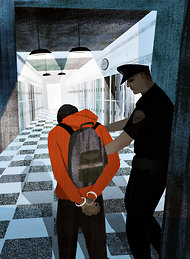
Public outcry over the arrest of 5-year-old Dennis Rivera in 2008 helped lead to a policy change: the New York City Police Department now primarily uses Velcro handcuffs on elementary school children. But the new, soft cuffs don’t address what my organization, the New York Civil Liberties Union, and others say is a high incidence of excessive police force, unlawful arrest and routine civil rights violations in New York City public schools.

via Take Police Officers Off the School Discipline Beat – NYTimes.com.

“Ending the School-to-Prison Pipeline” Written Testimony l The Lawyers’ Committee for Civil Rights Under Law

lawyerscomm

“Ending the School-to-Prison Pipeline” Written Testimony

DECEMBER 10, 2012  |  LAWYERS’ COMMITTEE FOR CIVIL RIGHTS UNDER LAW  |  LINK TO ARTICLE

Summary. Too many of our most vulnerable youth find themselves caught in the School-to-Prison Pipeline, which has transformed our schools into pathways to incarceration instead of places of learning. Juvenile delinquency can lead to long-term barriers to many life opportunities, such as access to public housing, military service, student financial aid, and professional licenses. Moreover, exclusionary student discipline policies perpetuate the cycle of incarceration within communities of color.

In order to combat the School-to-Prison Pipeline and ensure equal educational opportunities for all children, the Lawyers’ Committee advocates that federal education reform do the following: (1) permit the use of ESEA Title I funds to implement school-wide positive behavior supports; (2) prohibit ESEA funding for exclusionary discipline measures; and (3) improve accountability by mandating inclusion of school discipline data in ESEA state Report Cards.

Read the full written testimony.

2012 NAM Women Immigrants Fellowship Stories – New America Media

NAM Home | 2012 NAM Women Immigrants Fellowship Stories

Reporting on the intersection of immigration and gender

New America Media’s 2012 Women Immigrants Fellowship Program is funded by a grant from Atlantic Philanthropies. NAM’s immigration coverage and collaborative reporting projects are also made possible by grants from the Evelyn & Walter Haas, Jr. Fund, Ford Foundation, The Overbrook Foundation, Rockefeller Brothers Fund and by the support of individual donors.

via 2012 NAM Women Immigrants Fellowship Stories – New America Media.

Necole Bitchie.com: Jada Pinkett Smith: ‘Willow’s Beauty Isn’t Measured By The Length Of Her Hair’

Jada Pinkett Smith was getting her fierce kitty on as she arrived at LAX airport yesterday evening with her daughter Willow and son Jaden in tow.  The trio were on their way to Hawaii where they will be spending the Thanksgiving holidays, while living it up on the beach.

Meanwhile, Jada must have come to her wits’ end when it comes to dealing with all of the criticism surrounding her daughter’s hair.  Today, she posted a letter on her facebook, explaining exactly why she allows Willow to express herself through her clothes and hair while alluding to posting even more thoughts on the topic in the days to come.  She wrote:

via Necole Bitchie.com: Jada Pinkett Smith: ‘Willow’s Beauty Isn’t Measured By The Length Of Her Hair’.

Low Income Mothers Could Face Penalties For Giving Birth While On Welfare | Loop21

Low Income Mothers Could Face Penalties For Giving Birth While On Welfare

MAURICE GARLAND 3 weeks ago

Pennsylvania bill would slash assistance, unless women proved they were raped.

Life may just get a little tougher for “welfare moms.”

A Pennsylvania bill proposed on October 17 would allow the state to cut back government assistance from low income mothers who have more children while currently on welfare.

The bill was brought forth by lawmakers Rose Marie Swanger (R), Tom Caltagirone (D), Mark Gillen (R), Keith Gillespie (R), Adam Harris (R), and Mike Tobash (R).

via Low Income Mothers Could Face Penalties For Giving Birth While On Welfare | Loop21.

Welfare is Not a Dirty Word » Counterpunch: Tells the Facts, Names the Names

Attention America

Welfare is Not a Dirty Word

by ADAM PARSONS

It was compelling to read the November issue of In These Times titled ‘The Welfare State of America‘. Over the other side of the pond, the idea of a welfare state is hardly a controversial topic for most (‘most’) Europeans, especially in those countries like the UK that have long heralded the state pension, the National Health Service and, until not so long ago, free university education. But this has never been the case in America, where talk of the welfare state is often viewed as socialism or even closet Marxism – however ludicrous that might seem to the general public in Western Europe. Not even Prime Minister David Cameron, for all his plans to dismantle the NHS and privatize education in the UK, could declare his outright opposition to the post-war ideal of universal welfare provision.

How refreshing then to see the bold headline of In These Times that speaks a great deal of common sense and practical realism about expanding the welfare state in America. In an editorial titled ‘For the Welfare of All‘ by Frances Fox Piven, the American professor and well-known defendant of universal welfare, she upholds the proposal of Peter Frase and Bhaskar Sunkara in their headline article to inaugurate an anti-austerity campaign that focuses on the expansion of government social welfare programs.

Welfare is Not a Dirty Word » Counterpunch: Tells the Facts, Names the Names.