I’ve noticed many people policing the reactions of (primarily) POC to the George Zimmerman verdict under the guise of “don’t offend the allies”. This is problematic on several levels.
I want to start out by saying that I, personally, don’t agree with the idea of an “ally” that we, as a society, have seem to construct. You shouldn’t get special recognition or acknowledgement for meeting the basic minimum requirements of being a decent human being by treating people who are different from you with equality and respect; that should be a given. Another thing I’ve noticed is that people are more concerned with being the best ally than they are with the concerns/oppression of the marginalized group(s) that they’re allying with. When the focus becomes about you and your feelings instead of the people facing discrimination, you’re being a really shitty ally.
I am a straight, cisgender woman. It would be the height of heterosexual and cissexual privilege (not to mention just damn rude) for me to start talking about how homophobia and transphobia hurts my feelings. I am not now, nor have I ever been, directly impacted by homophobia and/or transphobia. I have never been denied access to a job or housing solely due to my sexual orientation or gender expression. I can be denied access to these things based on my race and/or gender, but I also have legal recourse available to me to rectify the situation if that were to occur. LGBTQ people do not have the same recourse. 29 states have no laws protecting LGBTQ and gender non-conforming people fromemployment or housing discrimination. 52% of LGBTQ people live in these states. My job is to support LGBTQ groups/organizations/individuals advocating for equality and to call out homophobic and cissexist behavior when I see it. It is not my place to enter LGBTQ spaces and make the conversation about me and my feelings.
The first rule of being a good ally is that it’s not about you. Your feelings are irrelevant. If you insist on framing the conversation around your feelings and how you’re being excluded, then you were never a real ally in the first place. Marginalized groups are not required to invite non-marginalized people into their safe spaces. If you are invited, it is a privilege and should be treated as such. You should not take center stage, nor should you attempt to speak for members of the group. Once again, these issues don’t directly impact you.
I’m not trying to come across as the perfect ally to other marginalized groups. Do I screw up sometimes? Yes. We ALL do. @FeministGriot had said that being an ally is a process, and I couldn’t agree more. No matter how hard you try and how sincere you are, you’re going to screw up eventually and it’s not the end of the world. Now, this isn’t to minimize or excuse any transgression made in the past or in the future; it’s merely to say that we’re human and no one is perfect. What is important is your reaction and your behavior moving forward. If someone from a marginalized group calls you out on your privilege, one of the worst things you can do is to get defensive. What you need to do is sit back, listen, and reflect on what you did and how that came across. It doesn’t matter what your intent was, what matters is how it was perceived and received. Don’t forget: the road to Hell is paved with good intentions. Sometimes the best thing an ally can do is just sit back so that marginalized people can lead.
EPA Victims Ask: Who Will Protect Us From Our Protectors?
09/17/2013 – 17:19
from OUR COMMON GROUND Voice, Dr. Marsha Coleman
by BAR editor and columnist Dr. Marsha Coleman-Adebayo
The public need protection from the Environmental Protection Agency, a “rogue” department of government that ruthlessly suppresses the truth about its actual activities. “The EPA’s Office of General Counsel, Office of Civil Rights and the Office of the Administrator have all been complicit in crimes against the people and environment they are charged with protecting.”
EPA Victims Ask: Who Will Protect Us From Our Protectors?
by BAR editor and columnist Dr. Marsha Coleman-Adebayo
“It is imperative to those with the power for the whistleblower to be destroyed.”
The EPA is in the news again. Not for taking credit for a substantive decline in the neurotoxic levels of lead in the brains of young African-American children or imposing major pesticide rules against chemical companies that are poisoning our food and water but for its vicious and malicious retaliation against a courageous EPA employee who blew the whistle on Agency lies and corruption with its purposeful misleading of the public on health risk of dust at the World Trade Center cleanup after 9/11.
The EPA’s dismal record of discrimination and intolerance gives the Agency the odious distinction of having had its retaliatory and intimidating policies cited in the first whistleblower protective legislation of the 21st century when Congress and the Executive in 2002 took the first tentative steps toward reigning in this rogue agency that has come to symbolize institutionalized governmental coercion and systematic fear tactics applied by criminal elements within the upper ranks of government against lower level, conscientious workers.
The EPA is an Agency that has historically neglected economically-disadvantaged communities and allowed poor children to disproportionately suffer from asthma and other chronic upper-respiratory diseases, sometimes leading to death. The bulk of these children are Black, Hispanic and others who have nowhere else to go, but remain in toxic dumping grounds throughout the United States. The present controversy represents just the latest example of an Agency still out of control. Because sunlight is a disinfectant, Democratic and Republican presidents have dared not select an administrator from outside the EPA’s cloaked walls. The last three EPA Administrators have been insiders who have learned the ropes from the very same culprits the No FEAR Act sought to restrain.
“She sounded the alarm about the health risks for them and residents near the WTC buildings, resulting in her being thrown into the abyss of EPA retaliation.”
The latest target of their corruption is Dr. Cate Jenkins, a senior chemist who ran into the same “green” stonewall that all EPA employees hit when they make the decision to warn the public about environmental dangers the Agency has a hidden agenda about. Dr. Jenkins raised concerns about the health risks and dangers to the 911 emergency first responders after the terrorist attack on the World Trade Center in New York City.
Former New Jersey Governor and EPA administrator Christine Whitman said the air quality immediately following the 911 explosions was “safe to breathe,” leaving firefighters, police and citizens comforted by her statement but actually exposed to life and quality of life threatening toxins. Dr. Jenkins, a seasoned scientist with an impressive resume, professionally disagreed with the “official” line of the EPA and other political leaders. Concerned for the lives of the responders, she sounded the alarm about the health risks for them and residents near the WTC buildings, resulting in her being thrown into the abyss of EPA retaliation.
According to Public Employees for Environmental Responsibility (PEER), Dr. Jenkins “received a proposed removal more than a year after a federal civil service court ordered her returned to work…EPA re-filed the same charges from 2010 which had been thrown out for violations of her constitutional due process rights.”Further, she had “publicly charged that due to falsified EPA standards, First Responders waded into dust so corrosive that it caused chemical burns deep within their respiratory systems. After raising the issue to the EPA Inspector General, Congress and the FBI, Dr. Jenkins was isolated, harassed and ultimately removed from her position on December 30, 2010 by EPA, based upon an un-witnessed and contested claim that the soft-spoken, petite childhood polio survivor threatened her 6-foot male supervisor.” While the EPA allegations seem laughable, Dr. Jenkin’s EPA career has been destroyed. She follows hundreds of other EPA employees of conscience who have raised “green flags” about EPA corruption continuing unabated.
“First Responders waded into dust so corrosive that it caused chemical burns deep within their respiratory systems.”
Susan Morris, an Assistant Director in the Office of Civil Rights, blew the whistle on the violations of civil rights, dishonesty, and misuse of federal resources that were ignored by the Administrators, the EPA Inspector General and the legal office. After a lengthy investigation, the Office of Special Counsel (OSC), the agency responsible for these violations, found that EPA had retaliated against Morris for whistle blowing and said she should be reinstated with full benefits. Instead, in line with their continued abuse and retaliation of employees, administrator Lisa Jackson ignored the OSC, forcing Ms. Morris to file a complaint that will be heard by a jury in Federal District Court.
In discussing Dr. Jenkin’s situation with Ms. Morris, she said, “I am not surprised by anything that EPA does to its employees. I worked at four major Departments and industry for over 30 years and never encountered a more despicable environment in which to work. I understand the woman, another lawyer, that they just put in the Acting position was detailed over 30 times and is now in charge of civil rights. They don’t want civil rights to work in the EPA because it would mean they would have to be timely in processing complaints from employees and poorer communities that are being polluted by industry. It’s a disgrace.” The case of Dr. Jenkins, Morris continued, “just adds to the fear of discrimination and retaliation that permeates the agency with over 1,000 attorneys supporting the corruption.”
On May 4, 2012, the MSPB (the Merit Systems Protection Board), responsible for protecting employees from agency management abuses unanimously rejected EPA’s claims against Dr. Jenkins and ordered the rogue agency to “fully restore” her back to her position and provide back pay with interest, just as OSC did with respect to Susan Morris. It should be noted that the MSPB routinely finds in favor of federal agencies and rarely in favor of federal employees. In this instance, the evidence was clearly so overwhelming that the MSPB was unable to rubber stamp the illegal behavior of the Agency. Ignoring the MSPB decision, the EPA placed Dr. Jenkins on paid administrative leave for over one year (at taxpayers’ expense) and re-filed termination charges against her on August 27, 2013—the same exact charges as those previously dismissed.
“They don’t want civil rights to work in the EPA because it would mean they would have to be timely in processing complaints from employees and poorer communities that are being polluted by industry.”
Is this an isolated case? By no means. The Washington Post recently reported that John C. Beale, a subordinate of EPA Administrator Gina McCarthy, (in her previous position as head of the Air and Radiation office) has pleaded guilty to defrauding the EPA of $900,000. However, the same rules do not apply to all offenders. Mr. Beale obviously belonged to what many refer to as the EPA’s “good ole boy club” having basked in the perks of special privilege afforded the high and mighty. Once his crime was discovered he did not face the same level of acrimony suffered by Dr. Cate Jenkins or Susan Morris. In Beale’s case, he was allowed to quietly retire from his position until he was criminally charged. The length to which the Agency will go to provide cover and protection to one of its “own” would shame any government that values fairness andjustice.
For an agency whose stated mission is “to protect human health and the environment,” it is more than a little embarrassing when one of their scientists outs the Agency’s willfully dishonest and misleading statements. Questioning the moral, legal and socially responsible ethics of what would in any reasonable context be seen as criminal misconduct cannot be allowed. It is imperative to those with the power for the whistleblower to be destroyed.
Dr. Jenkins’ is just the latest in the succession of cases that the EPA chooses to ignore direct instructions from its judicial overseers. This flagrant and arrogant disregard for the law comes as no surprise to those familiar with EPA whistleblowers. Despite public outcry and congressional inquiries, the same attorneys in the EPA Office of General Counsel, including David Guerrero and Nancy Dunham, routinely have their names affixed to agency adverse removal actions.
According to the Centers for Disease Control (CDC), as many as 65,000 people have been ill as a result of exposure to the 9/11 dust. This was exactly what Dr. Jenkins was trying to avoid. A Mount Sinai Medical Center study announced the grim statistics that 9/11 first responders are now experiencing a 15% higher cancer rate than their cohorts who were not exposed to the toxic air.
EPA allowed these people to be exposed when it was unnecessary and could have been averted through using proper protective recovery gear. As of August 2013, approximately 1,140 emergency responders and people who lived or worked near ground zero have been certified by the National Institute for Occupational Safety and Health to have a WTC-related cancer and these numbers are expected to rise. The question is how many more will die?
Where is the accountability for those who were in a position to know what Dr. Cate Jenkins knew and made up feel-good announcements that condemned all of these people to suffering and death? The EPA’s Office of General Counsel, Office of Civil Rights and the Office of the Administrator have all been complicit in crimes against the people and environment they are charged with protecting. The corruption at EPA is found at every level. Lisa Jackson, the former EPA Administrator who leveraged her EPA gig into the position of Vice President for Environmental Affairs at Apple (a business that she used to regulate) is under Congressional scrutiny for using the alias, ‘Richard Windsor’ to skirt Congressional oversight and to avoid having to release information to the public mandated under the Freedom of Information Act (FOIA.) A Congressional hearing was held last week to continue the investigation into this matter.
“9/11 first responders are now experiencing a 15% higher cancer rate than their cohorts who were not exposed to the toxic air.”
In Coleman-Adebayo v. Carol Browner, in which I prevailed in federal court, a jury of my peers established that EPA as an agency tolerated racism, sexism and a hostile work environment. However, as in the case of Dr. Jenkins, even after I won and the first civil rights and whistleblower protection law of the 21st century, No FEAR, was ratified the agency continued its ham-fisted retaliation until I was fired.
The legal attack team that is prosecuting the cases against Dr. Jenkins and Susan Morris are the same lawyers who have been relentless against me. People who trusted the assurances of the Agency tasked to protect human health and the environment are suffering by the tens of thousands and dying.
Who is going to protect us from the ones who systematically destroy the whistleblowers who are trying to protect us?
It is essential that we continue to fight for the survival of this planet that is placed in peril when we choose corporate collusion over sustainable environmental protection. For more information about corruption at the EPA please see: www.occupyEPA.com.
Dr. Marsha Coleman-Adebayo is the author of No FEAR: A Whistleblowers Triumph over Corruption and Retaliation at the EPA is available through amazon.com. Dr. Coleman-Adebayo worked at the EPA for 18 years and blew the whistle on a US multinational corporation that endangered vanadium mine workers in South Africa. Marsha’s successful lawsuit lead to the introduction and passage of the first civil rights and whistleblower law of the 21st century: the Notification of Federal Employees Anti-discrimination and Retaliation Act of 2002 (No FEAR Act). She is Director of Transparency and Accountability for the Green Shadow Cabinet.
Marissa Alexander was sentenced to 20 years in prison for firing what she termed a warning shot at her abusive husband, and not allowed to use the stand your ground defense.
Members of the Florida Cabinet said Tuesday it’s too soon to consider a pardon for Marissa Alexander, a Jacksonville woman who was sentenced to 20 years in prison after firing a shot into a wall during a domestic dispute.
But an appeals court will decide whether Alexander should have been able to use a “stand your ground” defense to fight the charge.
Alexander, a 32-year-old mother of three, was sentenced last year under Florida’s “10-20-Life” mandatory-minimum law. (She was prosecuted by State Attorney Angela Corey, whom Gov. Rick Scott picked to prosecute the Gorge Zimmerman case. Corey offered Alexander a three-year prison sentence in a plea bargain, which Alexander turned down. The prosecution’s version of events is posted here.)
Alexander argued that the “stand your ground” self-defense law should apply, but a judge ruled against her because she ran to the garage for her gun and returned with it instead of escaping. A jury later found her guilty — in 12 minutes — of aggravated assault with a deadly weapon.
According to filings at the 1st District of Appeal in Tallahassee, Alexander’s attorneys contend that the trial court erred in denying Alexander’s pretrial motion for immunity based on “stand your ground.” They wrote that due to the history of domestic violence in the relationship with her husband, Rico Gray, Alexander had reason to fear bodily harm and had no duty to retreat.
They also argued that the trial court’s instruction to the jury “erroneously shifted the burden of proof, requiring that Alexander prove beyond a reasonable doubt that she was in danger of imminent harm in order to invoke self-defense,” according to the motion filed last November.
Alexander’s case drew enormous attention when she was sentenced in May 2012. It returned to the spotlight last month, when a Sanford jury acquitted George Zimmerman of second-degree murder in the death of Trayvon Martin.
Zimmerman did not use a “stand your ground” defense, but the case has sparked widespread debate about the law. Approved in 2005, the law says a person who is not doing anything illegal and gets attacked “has no duty to retreat and has the right to stand his or her ground and meet force with force, including deadly force if he or she reasonably believes it is necessary to do so to prevent death or great bodily harm to himself or herself.”
Alexander’s case also has become part of a sit-in at the state Capitol, where a group called the Dream Defenders has occupied Gov. Rick Scott’s waiting area, demanding a special legislative session on the “stand your ground” law. Tuesday marked the third week of the sit-in.
Members of the Dream Defenders have followed Alexander’s case, and their political director, Ciara Taylor of Jacksonville, was in court when Alexander was sentenced.
One good thing to come out of the verdict, Taylor said Tuesday, is the need to explore cases like Alexander’s — “cases involving the black-and-white … disparity within using ‘stand your ground.’ ” She also said it’s important “to talk about domestic violence against women in this country.”
On Monday, state Sen. Dwight Bullard, D-Miami, wrote to Scott and the Cabinet, asking them to pardon Alexander when they next sit as the clemency board. Bullard noted that Alexander had reason to fear because her husband had battered her in the past.
Scott and Cabinet members could take up Bullard’s call for a pardon for Alexander on Sept. 25, when the clemency board meets. But on Tuesday, they were noncommittal. A spokeswoman for Attorney General Pam Bondi said that because Bondi’s office is representing the prosecution in Alexander’s criminal appeal, “it would not be appropriate to discuss clemency-related matters until the court has made a determination regarding the disposition of the criminal appeal.”
The appeal is also based on what Alexander’s attorneys argue are two additional errors by the trial court: denying her the right to consult her attorney during the single overnight recess of her two-day trial, and giving the standard jury instruction on the use of force.
“The instruction given effectively negated Alexander’s sole defense — that is, self-defense — by erroneously stating that an injury to the victim was a prerequisite to successfully invoking self-defense,” the motion said.
“She had every right to be afraid and every right to defend herself,” said Rita Smith, executive director of the National Coalition Against Domestic Violence. “It is often the case that when a battered woman fights back and protects herself, the full force of the law comes down on her.”
I had a recent encounter with her, you know, that sister who is needy as hell. I was hoping she didn’t see me and with a quick right turn down the other hallway, I would be able to dodge her. But just my luck, before I could attempt my matrix type move, she spotted me.
DAMN.
Me: Hey sis…
Her: Hey girl, I’ve been calling you. Did you get my texts? My voice messages?
Me: Yes girl, I got them. I just have been extremely busy and haven’t had the opportunity to respond to them yet.
Yes, I am aware that she has been calling me. And yes, I did receive all of her texts and voice messages. But as an acquaintance, her incessant calling and texting made me uncomfortable. And after much thought I made a conscious decision not to return her calls and to distance myself from her. My decision to distance myself was not out of malice or ill will but as an act of self-care. Especially after unsuccessful attempts to playfully hint to her, using gestures such as “ girl, stop calling me a million times a day” or “sis, you don’t have to call me, I will call you,” that she needed to calm down with the contact. It was also intended to serve as a non-verbal cue, with the hope that, for someone who admittedly had difficulty with preserving friendships, she would take the time to recognize and examine her relationship patterns.
I mean what else could I have done? We weren’t close enough for me to tell her straight out that she didn’t have any friends because she was needy. And that her incessant contact was suffocating and entrapping and that contrary to her belief that it communicated her interest in pursuing a friendship, it actually displayed itself as neurotic and obsessive behavior that made people distance themselves from her. No, I couldn’t tell her this but I did hope someone who cared about her would; that way, it wouldn’t hurt so much.
Because as a woman in recovery, who herself was confronted about being needy, knowing that the person cared about me, helped to absorb some of the impact of that painful truth.
My need arose from the death of my mother when I was fourteen. After being abandoned by our relatives, my brothers and I were left to raise ourselves. During this phase of my journey, I was emotionally neglected, deprived of affection and suffered from issues of abandonment and rejection. In a desperate attempt to seek out love, as an only girl with limited female guidance, I sought out women under the guise of mentorship for nurture, affection and mothering, often forcing my emotional needs onto them. This resulted in several toxic and unhealthy relationships with women.
Overtime, I learned that my need came from a place of deep pain and wounded-ness. And according to my truth telling therapist, “as long as I come from that place of wounded-ness, I would never be in a healthy relationship.” So out of an act of ‘radical self love’ and out of a desire to be as whole as possible, I made a commitment to do the necessary work in order to heal, which involved taking ownership of my emotional health.
Just like that sister must do…
And when she does, she will realize that it’s deeper than her inability to develop friendships and that her neediness is but the language of her wounded-ness.
For Harriet is an online community for women of African ancestry. We encourage women, through storytelling and journalism, to engage in candid, revelatory dialogue about the beauty and complexity of Black womanhood.Learn more.
Liz A. is a woman on a journey of becoming. She is a “warrior poet”, an avid journal-ler and an independent writer. Liz identifies as a Womanist with Black Feminist tendencies and is currently a social worker in training. So far, Liz has written for the Feminist Wire and is a columnist for the ForHarriet blog. Liz is currently working on her untitled memoir.
According to the U.S. Department of Defense, Private LaVena Lynn Johnson killed herself on July 19, 2005, eight days before her twentieth birthday. Exactly how did she end her life? She punched herself in the face hard enough to blacken her eyes, break her nose, and knock her front teeth loose. She douched with an acid solution after mutilating her genital area. She poured a combustible liquid on herself and set it afire. She then shot herself in the head. Despite this massive self-inflicted trauma, she somehow managed to drag her then fully clothed body into the tent of a KBR contractor, leaving a trail of blood along the way and set the tent ablaze in a failed attempt to cover up her crimes against herself.
If this story sounds plausible to you, you may have missed your calling as an officer in the U.S. Army, because Army officers, speaking with a straight face, would have you believe that such a thing is not only possible, but actually happened.
In reality, LaVena Johnson was raped, beaten, and murdered by someone on a military base in Balad, Iraq, and the Army doesn’t want you to know about it. Army officers most especially didn’t want her parents to know about it, so they concocted the suicide story, informing them that their daughter had shot herself in the head in her barracks.
When LaVena’s body was returned to her parents, however, her father, Dr. John Johnson, immediately noticed that her nose was broken and her lip was torn. He was surprised to discover that her gloves were glued to her hands (as it turns out, to hide burns). As a former military man himself, he also recognized that the exit wound from the bullet could not possibly have come from the weapon the military claimed LaVena used to kill herself. He knew then that the Army was lying to him, that his daughter had been murdered. He made these discoveries three years ago. Today, the Army is still lying to him, and to us.
LaVena Johnson enlisted in the U.S. Army after graduating from a Missouri high school because she believed it was right to serve her country. She loved America, was very patriotic, and she thought joining the military was the best way to express that patriotism. Although her mother had assumed that her daughter, a violinist and honor student, would go straight to college, LaVena had made other plans. After her death, her company commander described her as having been “clearly happy” during her time in the Service. She enjoyed her job, took pride in it, and cared about the U.S. Army.
Unfortunately, the Army did not care about her. In fact, the disdain and contempt in which the Army held — and continues to hold — her seems to have no bounds. Her father stated last year in an interview given for a Missouri television station that the U.S. Army “turned on her” after her murder. I differ with Dr. Johnson on onlyone point: the U.S. Army never did give a damn about his daughter.
After filing a FOIA request for release of a CD-ROM contained in LaVena’s file but withheld from the family for over two years, and under added pressure from a congressman, the Army finally gave the Johnsonsthe CD. On it they found horrific photographs from the autopsy thatclearly showed the extent of their daughter’s injuries. It proved that the original black and white photos of LaVena’s body originally sent to them had been doctored. Also on the disk were damning sketches of the crime scene that gave her parents further information contradicting the Army’s statements.
In a heart-wrenching interview conducted last month with LaVena’s parents, her mother, Linda Johnson, describes the members of the military responsible for this cover-up as “lying demons.”
One wonders whether LaVena would have enlisted in the Army if she had known that Veterans Administration statistics show that one third of the women who serve in the military are victims of sexual assault by a fellow soldier. Or if she had known about an emerging pattern of “suicides” of women soldiers who were also victims of sexual assault.
“The Army remains committed to thoroughly investigate and take appropriate action in all unrestricted reports of sexual assault,” and the Department of Defense “continues its commitment to eradicate sexual assault in the military services.”
Military leaders have no real interest in stopping sexual assaults. If they did, LaVena Johnson’s rape and murder would be included in their statistics. But they would rather not admit that these crimes occur if theydon’t have to. So, if the victim is dead, all the better. Just report that death as a suicide.
LaVena Johnson was awarded a posthumous promotion to Private First Class, a bone thrown to her family, no doubt. But her spirit cries out for justice. Please call your representatives in Congress and demand action on her case. The telephone number for the U.S. Capitol switchboard is 202/224-3121. Please help her parents to obtain a proper investigation of their daughter’s death. The major media have ignored LaVena’s story, and without a vociferous public demand for action the government will continue to stonewall.
LaVena Johnson was raped and murdered. Do not let the military sweep this under the rug.
August 4, 2008
Elizabeth Higgs [send her mail] is a wife and mother living in Covington, Louisiana.
We are a collective of black men dedicated to challenging the ideas of black masculinity and manhood through the written word. Through our work, we explore the ugliest parts of ourselves and our community, in the hope that we can illuminate the beauty that we know exists as well. We challenge each other daily to create and be more than what this racist, patriarchal society has raised us to be. But simply wanting it will not do. It requires tons of hard work, and much of that work includes listening to our sisters, black women, who tend to bear the brunt of our messiness. Unfortunately, in this regard, we have been woefully absent.
When the hashtag #Blackpowerisforblackmen, created by Ebony.comeditor Jamilah Lemeiux, took over Twitter, it was a clear sign that we haven’t been doing enough. Thousands of our sisters (and brothers) tweeted for hours about the imbalance in our community. We, black men, tend to pride ourselves on our anti-white racial supremacy activism but often fail to reach out and consider the pain and trauma faced by the women in our lives. Our culture actively denigrates the very existence of black women. We take their love, support, nourishment, and spiritual presence for granted. As a whole, black men have not reciprocated our love and support in a way that affirms the humanity and dignity of black womanhood in the face of white supremacy, patriarchy, heterosexism, homophobia, transphobia, misogyny, sexual violence, and physical and verbal abuse.
#Blackpowerisforblackmen became the call, and as black men dedicated to fighting alongside our sisters, we have taken up the responsibility of answering. As individuals, we recognize where we have fallen short, and as a community we make a promise to participate in deep self-reflection and correction.
This ain’t just an apology; it’s a commitment.
___________________________________
Dear @BougieBlackGurl, You tweeted the following: “I am supposed to give a cookie to the BM who are involved in their children’s lives while Single BW carry the blame #blackpowerisforblackmen”
When my daughters were babies—they are now 10 and 14—I used to relish the attention that I received when I was with them in public. The expectations held out for Black fathers have often been so low, that Black men who even show a small amount of attention to their children are lauded; I can’t say that I didn’t enjoy being thought of as special.Yet being at daycare, or volunteering at school, I was also able to witness the women—often single mothers—who don’t parent for the prestige of it, but because it’s what they are supposed to do. Save Mother’s Day and the Hip-Hop Awards Show shout-out (often uttered after rhetorically bashing a “baby-mama”), there is very little attention to those women who put in the work, because if they don’t, nobody else will. And of course if they don’t, these women are blamed for failing, not only their children or their family, but the “Race” itself.And this is one of the ways that male privilege functions—that which is ordinary and mundane is deemed as exceptional when done by men. When these everyday activities are done by women, they are demeaned and devalued—and all we have to do is look at what we pay folks who work in so called “women’s professions” or the fact that we so devalue parenting that we think that those women who are raising children on their own, and perhaps on Federal or State assistance, should be required to work outside of the home, because apparently parenting is not really work.
Dear Monifa Bandele (@monifabandele), You tweeted the following: “#blackpowerisforblackmen when trying to discuss gender privilege is black male bashing.”
Tomi Ungerer: black Power / White Power Poster
I had one of those moments like the old folks do in church where all I could do was sway and say to myself “well ain’t that the truth.” It’s most disheartening because a quick glance at our past or present shows us just how dedicated black women have been to addressing the black men in this country. But when sisters speak up and ask us to consider the ways in which we have contributed to their oppression, we consider it an affront to our fragile sense of community and an attack on our manhood.
Undoubtedly, there were the brothers reacting with the predictable “not me!” responses. But those individual “not me’s!” aren’t enough to drown out the massive indifference to black women’s suffering at the hands of black men. We defend to the hilt the culture we’ve created around a toxic vision of masculinity, but can’t muster up a tenth of that energy to get into the streets and demand our sisters stop being raped, and then we pretend we don’t know what privilege is.
I heard one brother flat out say sexism isn’t the problem in our community. If ever there was a moment we could use a drop squad, that was it. We can pretend away the sexism and misogyny we inflict upon black women. We mirror the worst of the defense of racism when we do and enact untold damage to the bodies and psyches of the women who have loved us most. We can stand back and pretend, as black men, we’re the only ones under attack, as we’ve done, or we can acknowledge our culpability in oppressing black women and dedicate ourselves to striving for better. The choice should be clear.
Dear @YoloAkili, “#BlackPowerisForBlackMen Becuz I can’t think of ONE national march that black men organized becuz a black woman was raped or killed.”
I must have reread your tweet a hundred times today. I understood fully, maybe for the first time, that black men who profess a love for black women can’t have it both ways. The truth is too true and the stakes are too high. We can’t, as I did, call Kendrick’s verse one of the dopest lyrical performances of the year when the song is bubbling with spectacular disses of black women and black femininity, then wonder why we never organized around the killing or rape of a black woman.
Photograph by: Darnell Moore (NYC March for Trayvon Martin 2013)
We can’t watch and participate in the national obliteration and shaming of Rachel Jeantel and wonder why we never organized around the killing or rape of a black woman. We can’t lie, cheat on, or manipulate black women while convincing black women it’s so hard for us then wonder why we never organized around the killing or rape of a black woman. We can’t literally and figuratively kill and rape black woman for fun, for free, for checks, for claps from our niggas, and wonder why we never organize around the killing or rape of black woman.
No art, no person, no relationship, no sexual fantasy that kills and rapes black women is going to stop black women from being killed, hurt, and raped. If our consumption and creation doesn’t affirm, accept, and explore the complicated lives of black women, we can’t be bout that life. No exceptions. Never. Shameful that after all this life, and education, and art creation, your tweet made me know that we really ain’t been bout shit. We really been encouraging black women’s death while leaning on black women for survival. Sorry ain’t enough.
Dear @PrestonMitchum, ”@PrestonMitchum: #blackpowerisforblackmen because as sad as it already was, what if Trayvon were a woman?”
What if Trayvon were a woman? After reading your tweet, I contemplated that question for hours. I thought about everything I read about Trayvon Martin. I thought about all the conversations I had about Trayvon Martin. I tried to remember similar conversations about female-identified individuals. They really didn’t exist. And when they did, they were framed in the context of blaming the victim for something “she” should have done to prevent the horrendous actions perpetrated against her. If Trayvon were a woman, the story would have been told though the lens of a male because our society always allows men to speak for women, believing this act gives women a voice. We have yet to truly move past ideas of coverture and do the work to train our sons, husbands, brothers, and male friends to view women not as property but as equal partners.
The silencing of women is so deafening that even in life and death we want to dictate the terms of how a women can give life or how we would tell her story in death. I don’t profess to understand the myriad ways my male-privilege continually operates to suppress and oppress women but I can celebrate all women and I can do the work to love women as Rainer Maria Rilke teaches. — “Love is the commitment to be the witness to someone else’s joy in life, not to be that joy.”
Dear @Blade_Varzity, ”#blackpowerisforblackmen Can someone explain exactly how BM are stopping BW from addressing ANY of these issues they’re tweeting about?”
Blade, I have come to realize that sometimes we as people,who exist on the scale of oppression (I am a Black man of immigrant parentage from a ghetto in Brooklyn who spent 1/3 of his life in prison), are so easily blinded by our own marginalized place on that scale that we are unable to see how we contribute to the oppression of others. I say this not as an indictment on you in any way, but as an expression of understanding and realization of the shrewd nature of the hierarchy of oppression and our subconscious infatuation with our own oppression.
As Black men in a patriarchal, white supremacist world it’s so easy not to realize our own male privilege because in comparison to white male (and female) privilege, we think our whatever-privilege is minuscule. But, however minuscule, it DOES exist, particularly in the eyes of Black women, and especially when we, black men, don’t acknowledge our role in their oppression as Black Women.
Like I said Blade, this is not an accusation just an observation. Peace, bruh.
Dear Yolo Akili Robinson (@YoloAkili), You tweeted the following: “#BlackPowerisForBlackMen becuz even in the Black LGBT community MALE voices (cis/trans) r still privileged over all women&genderqueer folks.”
Damn, bro! Your words hit me hard—in the best way possible.
I am a gay black man who has been skilled at calling out white racism and heterosexism as weapons that have stifled my own senses of freedom. I even try to do the type of self-work necessary to understand my complicity in sexism and the part I play in maintaining the patriarchy, but I know that I can do and be better.
I can do better at not only calling out sexism, misogyny, transphobia, rape culture, and so much else, but I can be a better brother to my cis and trans sisters (regardless of their sexual identities) by not taking up too much space (when I know that some spaces are often made available to me precisely because I am a black gay cis man). That is the work, my work, for sure.
We black gay men have models of the “better,” however. My brother Kai M. Green (@Kai_MG) reminded me that some of our black gay male elders (who, too, benefited from the unearned privilege of maleness) worked hard to think and practice feminism. Kai tweeted: “#blackpowerisforblackmen bcuz we 4get Joseph Beam and Marlon Riggs were Blk feminists 2. Feminism isn’t just for cis women–>we ALL need it!” Yes, feminism is for all of us. I am in community with women I can learn with/from, remain accountable to, and engage transformative personal and social justice work alongside. I want my sisters and critically conscious brothers, as my brother Kiese once wrote, “to knock my hustle” when need be. I will do the same for you and others. That is the only way I can grow. The only way that we can be better. The only way that I/we might truly show up as allies in the struggle to end patriarchy, the power-driven reign of “the man” (and not just the one imagined as white, but also the one who stares us black men back in the face when we look in the mirror).
Dear Raequel Solomon (@systris2h), ”cause tyler perry and steve harvey are deemed worthy of telling US how we should be living? #blackpowerisforblackmen”
Your tweet is complicated and my feelings towards both Tyler Perry and Steve Harvey are as complicated. I’m assuming the “US” that you are referring to is black women; but even if that isn’t the case, the black community at large is still deeply affected by these two men and the public platforms they occupy. I don’t know who is deeming Perry and Harvey as “worthy” and again, I’m assuming because of the hashtag that accompanied your tweet you may have meant black men are. But I’m completely convinced what is responsible for this “christening” of Harvey and Perry’s black sagaciousness is not a population, but an institution and a doctrine.
Black living is messy and difficult and is more trial and error than anything else. Anything or body that says otherwise is standing on the side of black powerlessness as opposed to black power. What is also crucial in my conceptualizing this tweet is the context that black media has carved into this moment of post-racial hopscotch and difference’s reduction. The sheer number of black faces and spaces in American media is slim to none and the ability to choose with a convicted agency is placed in jeopardy as a result. But a choice is nonetheless being made.
It would be misguided and misinformed to approach this tweet without sensitivity to gender’s role in producing it. Yes, Steve Harvey and Tyler Perry are black men and, yes, black men have participated in the patriarchal tradition of speaking for and over black women, but issues of hegemony and capitalist seduction aside, the consumers of products made by these two men make a choice to support their products and never should we, as black people, attack the people choosing or producing the product, but instead the product itself. Bottom line is this – the interrogation of the function and usefulness of the tangible products that make up a black social reality is a fundamental method to form and maintain black power in this profit-driven, privately influenced market we know as America.
You tweeted, “#blackpowerisforBlackmen because Frederick Douglass, Booker T. Washington and Denmark Vesey would never end up in a sex tape spoof.” You also tweeted, “Uncle Rush and Co. didn’t just pick a nameless black woman. They picked our ‘Black Moses.’ The gun wielding guide to freedom.”
You made me revisit Audre Lorde’s call for women to make use of the erotic as a source of power, a source of power that because of patriarchy, misogyny, and white supremacy has been deemed solely pornographic. There is power in the erotic—it is a site of reproduction, a site of intimacy (intimate relationships with lovers, intimate relationships with kin, intimate relationships with violence, loss and death), and a site of struggle. The erotic terrain is a site of embodied knowledge. That Black men like Uncle Rush and Co. feel it is funny to make a sex tape starring Harriet Tubman is violent and sick. They went back and sexually violated a historical figure and then disappeared the evidence (the video), but the deed was done and those ghosts will continue to haunt us like so many other “nameless Black women,”–-we must speak up. The struggle that Black women have had and continue to endure in order to gain access to their erotic power is real.
Although Audre Lorde’s call was to women, it is clear that men, Black men especially, need to interrogate the erotic as well (Thank you Alexis Pauline Gumbs for this lesson). The erotic for Black men has been distorted by a violent type of pornography perpetuated by Black men as well as others—it is the notion that Black manhood is only fully realized when men through domination take control of their houses, their women, and their stuff. The erotic as a source of knowledge cannot be fully reached until we, Black men, let go of our ideas about reclamation of some ideal manhood that was taken from us. We must let go of manhood as ownership. We spend so much time trying to reclaim some sense of humanity through manhood that we don’t see how we become the oppressors in our quests to reclaim.
If we could only realize that everything we need, we have. But then that is scary, because what is it that Black men have that we don’t want to face? Lorde stated that the erotic “lies in a deeply female and spiritual plane.” Hortense Spillers says, “It is the heritage of the mother that the African-American male must regain as an aspect of his own personhood–the power of the ‘yes’ to the ‘female’ within.”
For Black men to really be able to interrogate the erotic, we must face the real truth of our vulnerability, too. Because though we will not see a sex tape spoof of Booker T. Washington, we know that historically and in the present day, Black men’s bodies also archive dis-(re)membering sexual traumas. We too were made to bend over and open up, taking in whatever the master decided to feed us that night. But if we cannot face that in ourselves and in our bodies because we only see it as emasculation, then we lose our erotic power. We lose the power to unite with Black women. We lose the power to ultimately unite with our full selves. We lose the power to analyze the ways in which we become oppressors because we are no longer able to see Black male privilege–we only see white racism and white men. We reach for that white power not realizing we have access to something much greater, much more generative, right here in our own bodies as Black men.
Black men need to do as Hortense Spillers says and interrogate that being that we are encouraged to despise, the being that we fear will destroy our manhood, that Black woman that lies deep in us—this strength is also this vulnerability.
We are not enemies, Black men and women. Black men need to recognize that critique is love. Love asks us to grow. We need to grow.
I want you to trust me.
I understand that the love of a Black woman is a privilege often times devalued, but I value you and your love. I value the love of Harriet Tubman. I value the love of my mother—Black love, tough love, deep love, mama love, granny and auntie love, lover love, sweet potato pie love, I’m tired from working all day love, get the holy ghost and pass out love, get school clothes for baby while you still wear that same ol’ raggedy dress and make it look good love, stay up all night and watch over me when I’m sick love, I’m tired of yo’ triflin’ ass I’m leavin’ love, I’m hurt love, I’m exhausted but I’m still gonna make you dinner love, You locked up so I’mma hold it down for you love, gansta love, Black professional don’t have time to cook but let’s share a glass of wine love, I will carry your stash love, I will go down on your behalf love, I will testify in court love, young love, hot love, you getting on my nerves love, love love, Black women’s love is God love.
I will do my part to reflect that love. I will hold you when I am strong and when I am weak. I stand with you. And I vow to you that no quest for freedom of mine will begin with the devaluation of your body, spirit or intellect. I vow to listen to you. I vow to stay open to being checked, but I will not wait on you to check me. I will work to check myself too, because I understand that feminism isn’t just about your liberation, it’s about OUR liberation. If my manhood becomes a placeholder for my humanity, we are doomed. But I want to live, love.
Several members of the Brothers Writing to Live Collective
Brothers Writing to Live is a group of black cis and trans-men who hail from spaces across the United States. We come from myriad neighborhoods, diverse familial backgrounds, and different life worlds. We are different, indeed. And, yet, in so many ways we are the same. We are black male identified writers whose notions of blackness, manhood, and writing are as assorted as our multifaceted lives. Whether we have come from the red clay roads of Mississippi or the cement paved streets of New York City, through our writings we have mapped out similarities regarding the ways that racism, gender restrictions, capitalism, heteropatriarchy, ableism, economic disenfranchisement, heteronormativity, criminal (in)justice systems, and so much else has shaped the men that we have become and yet to be. This campaign has united the following black male writers:
Kiese Laymon, Writer & Professor at Vassar College
Mychal Denzel Smith, Writer, Mental Health Advocate, & Cultural Critic
Kai M. Green, Writer, Filmmaker, & Ph.D Candidate at USC
Marlon Peterson., Writer & Youth & Community Advocate
Mark Anthony Neal, Writer, Cultural Critic, & Professor at Duke University
Hashim Pipkin, Writer, Cultural Critic, Ph.D. Candidate at Vanderbilt University
Wade Davis, II, Writer, LGBTQ Advocate, & Former NFL Player
“I look forward to a time when Black women will have the freedom to wear what they want to wear, speak how they want to speak and still be taken seriously.”
— Duchess Harris
by Duchess Harris
(OUR COMMON GROUND Voice)
I have taught Women’s Gender and Sexuality Studies since 1994, and one recurring comment from white students is that I don’t “look” like a feminist. I find it amusing. I pretend to be confused and politely ask, “What does a feminist look like?” Their response is usually, “Less feminine.”
This is a teachable moment.
When I was an undergraduate at the University of Pennsylvania between 1987 and 1991, I was mentored by Professor Evelyn Brooks Higginbotham. She was finishing her groundbreaking book “Righteous Discontent,” in which she argues that the politics of respectability enabled Black women to counter racist images and structures. She stated that this aesthetic of respectability should not be misconstrued as mindless mimicry of white behavior or a “front” without substance or content. Instead, the politics of respectability assumed a fluid and shifting continuum of African American resistance.
Fast forward to 2013. The reality is that when you think of a college professor, you probably do not see the image of my face. My insistence on professional dress (i.e., skirts, heels and ironed shirts) is not a subscription to patriarchy; I want to be recognized and respected. Informality, for a Black woman, can be professionally harmful.
There are currently 176,485 tenured full professors at the nation’s public and private research universities – 72 percent white men, 17 percent white women, 8 percent men of color (Black, Hispanic and Native American combined) and 2 percent women of color – combined.
In a racist society, white people hold the power of the “gaze,” and people of color are subject to interpretation.
I wear what I wear because I take myself seriously and I expect you to, also. I don’t have the privilege to “dress down.” When white women do this, they are read as earthy, edgy and intellectual. When Black women dress down, we are read as “The Help.”
I share this because my white female students feel entitled to judge my cisgender, herteronormative, feminine aesthetic; not understanding that many Blacks are proud that I don’t wear a uniform. I find that the Black service people at Macalester are glad to see a dressed up Black woman on the faculty.
Once again there is a historical context for this. In “Living In, Living Out,” Elizabeth Clark-Lewis narrates the personal experiences of 81 Black women who worked for wealthy white families. These women describe how they encountered – but never accepted – the master-servant relationship, and they recount their struggles to change their status from “live in” servants to daily paid workers who “lived out.” One of their biggest acts of resistance was to do the cleaning in their own clothes, not a uniform, and leave.
I am writing this essay in the midst of the George Zimmerman trial. I have been traumatized by the treatment of Rachel Jeantel, a friend of Trayvon Martin. The best analysis I have read of why many people could not hear her was because of what they saw.
Regina N. Bradley writes, “Jeantel’s … inability to conform to expected cultural and aural scripts of Black womanhood within the confines of the courtroom – the epitome of a hyper-respectable space – destabilizes not only racial paradigms of Black (southern) respectability but Americanized expectations of Black women’s scripts of respectability.”
I was not ashamed by her inability to conform; I was disappointed that in 2013 she isn’t read as “respectable.” I look forward to a time when Black women will have the freedom to wear what they want to wear, speak how they want to speak and still be taken seriously.
But until then I will dress up for Rachel and all the other Black women who do not have the privilege of being heard.
Duchess Harris, J.D., Ph.D., is a professor of American Studies at Macalester College. Read a selection of her published works at works.bepress.com/duchess_harris/.
The prosecution needed to represent Rachel Jeantel as much as they represented Trayvon Martin because her assumed unintelligence and subsequent worthlessness were inadvertently assigned to him. Aware of this, prosecution attorney Bernie de la Rionda attempted, but failed, to insist upon her credibility in his closing statements. Before queering a Dr. King quote by saying that she “should not be judged by the color of her personality but by the content of her testimony,” he told the jury that she was “a little unsophisticated” and “uneducated.”
By insulting her to gain credibility, he complied with the idea that she was insignificant and by default, so was Martin’s life. Such inherently assumed superiority over Jeantel from the prosecution’s closing statement, the defense’s humiliating tactics and venomous commentary from cyber voyeurs was deeply remnant of a passage from Toni Morrison’s The Bluest Eye in which Morrison stated:
All of us—all who knew her—felt so wholesome after we cleaned ourselves on her. We were so beautiful when we stood astride her ugliness. Her simplicity decorated us; her guilt sanctified us, her pain made us glow with health, her awkwardness made us think we had a sense of humor. Her inarticulateness made us believe we were eloquent. Her poverty kept us generous. Even her waking dreams we used—to silence our own nightmares. And she let us, and thereby deserved our contempt. We honed our egos on her, padded our characters with her frailty, and yawned in the fantasy of our strength.
Afraid to embrace those realities, many dwelled on their critiques of Jeantel’s dialect. Here, too, there was a deep politic that neither the talented-tenth, code-switching middle class Black folks who claimed to be ashamed by her nor those who maintained the racist ideology that she was merely another ignorant, fat black woman, could bear to acknowledge. James Baldwin’s 1979 essay, “If Black English Isn’t A Language, Then Tell Me, What is?” best presented this truth where he states,
…language is also a political instrument, means, and proof of power. It is the most vivid and crucial key to identify: It reveals the private identity, and connects one with, or divorces one from, the larger, public, or communal identity.
He further explains,
Language, also, far more dubiously, is meant to define the other–and, in this case, the other is refusing to be defined by a language that has never been able to recognize [them]. People evolve a language in order to describe and thus control their circumstances, or in order not to be submerged by a reality that they cannot articulate.
Just as many have never considered that Trayvon Martin, who we know for a fact was followed by George Zimmerman, was standing his own ground, many who shared Juror B-37’s condescending viewpoint and “felt bad” for Rachel who was “using phrases [they] never heard before” have not considered themselves ignorant for not understanding her. Those same individuals may never challenge the absurdity of having deemed themselves the standard of comparison; nor will they realize that they misnamed her “uneducated” in order to hide from the paralyzing fear of a heavy-set, dark skinned teenager unwilling to bow to their assumed superiority.
Rachel Jeantel cannot be reduced to just a witness in a popular trial because what she endured in court and from the media were private acts made public: the mocking and silencing of black women and girl’s stories as well as the devaluing of their traumas. In response to critics, Jeantel shared with Piers Morgan that “[My critics] should be appreciating [me]. You should learn from this situation. If it happened to you or your family, would you step up or would you just say ‘oh, it ain’t my business’?” To my mind, she has remained brilliant and strong in spite of the overwhelming grief of losing a friend and then being publicly labeled as ignorant–as a national embarrassment–because she, like James Baldwin, knows that “it is [never] the black child’s language that is in question, it is not [their] language that is despised: It is [their] experience.”
______________________________________
Lauren G. Parker is an undergraduate, intended Creative Writing major at George Mason University. Currently, she is co-coaching Richmond, Virginia’s internationally competing youth slam poetry team.
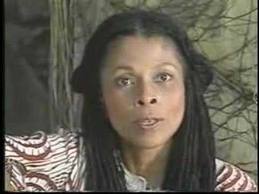
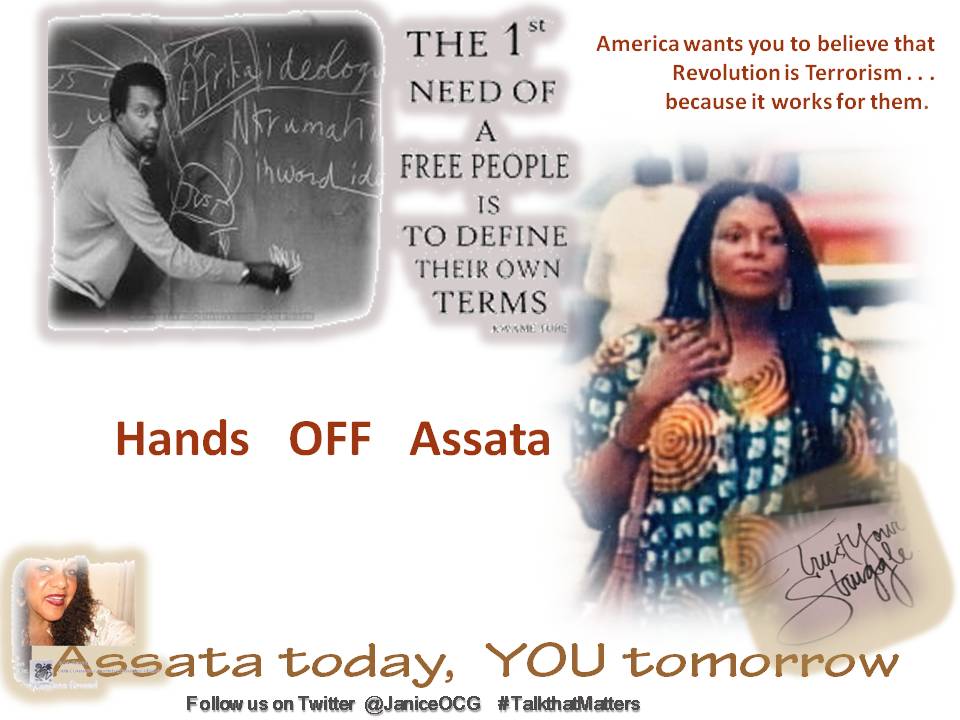
This week the FBI sent out a symbolic warning. That warning, though heavily veiled behind a sacrificial lamb, said “Do not resist the government. Know your place or be prepared to die.” Sounds a bit harsh, right? But, I’m not the only person who feels the FBI’s actions in regards to Assata Shakur come at an interesting time, and are far more about the bigger picture than this passionate woman and a New Jersey state trooper.
Assata Shakur became the first woman added to the FBI’s most wanted terror listthis week. And in announcing her as one of the top ten most wanted “terrorists”, the agency also said they would be increasing the reward for her capture to $2 million.
Formerly known as Joanne Chesimard (the name that the FBI—with no pretenses of respect–still refers to her as), Shakur was found guilty of killing a New Jersey law enforcement officer in 1973. She was shot twice that night by the police (once while both hands were above her head and once in the back). But it was she who was sentenced to life in prison. Maintaining her innocence, she escaped prison and sought refuge in Cuba where she has been ever since.
To the mainstream media and anyone who uses it as their sole source of information, this may seem like an open and shut case. But, if you know anything about the Black Power era, read about COINTELPRO, or if you’ve heard names like Fred Hampton, Leonard Peltier, or the “MOVE 9”, you know the police (including the FBI) acting on behalf of the U.S. government has a history of covert, unethical, illegal, and racist practices. And if you are hip to today’s War on Terror and its sweeping generalizations of what makes a terrorist, the renewed interest in Assata Shakur should be troubling.
Assata Shakur was, and remains, a revolutionary. She was an active member of the Black Panther Party and the Black Liberation Army. In a nation founded on the backs of Africans, she stood up with her colleagues against a system deeply rooted in the system of oppression. In Assata’s own words, it was this challenge to the most powerful nation in the U.S. that led the FBI to target the Black Panther Party in the first place.
By 1969 the Black Panther Party had become the number one organization targeted by the FBI’s COINTELPRO program. because the Black Panther Party demanded the total liberation of black people, J. Edgar Hoover called it “greatest threat to the internal security of the country” and vowed to destroy it and its leaders and activists.
The Black Panther Party– which did such “terrorizing” things as feeding schoolchildren (creating what we now have as the school-lunch program), providing medical clinics, offering drug-alcohol education and treatment, and clothing distribution—is, in modern terms, a terrorist group. Alone, these things may have been acceptable. But paired with their “pro-Black” stance and their unabashed disdain for the system designed to keep them quiet, they were (and remain) a threat to the status quo.
The naming of Assata Shakur to the terror list is less about her and more about who she is and what she stands for. Like all true revolutionaries, she spoke up, either unafraid or overcoming fear to stand for truth and rights. And from her current home in Cuba, she continues to speak up today.
Shakur herself put it best in a 1998 letter to the Pope:
I understand that the New Jersey State Police have written to you and asked you to intervene and to help facilitate my extradition back to the United States. I believe that their request is unprecedented in history. Since they have refused to make their letter to you public, although they have not hesitated to publicize their request, I am completely uninformed as to the accusations they are making against me. Why, I wonder, do I warrant such attention? What do I represent that is such a threat?
I grew up and became a political activist, participating in student struggles, the anti-war movement, and, most of all, in the movement for the liberation of African Americans in the United States. I later joined the Black Panther Party, an organization that was targeted by the COINTELPRO program, a program that was set up by the Federal Bureau of Investigation to eliminate all political opposition to the U.S. government’s policies, to destroy the Black Liberation Movement in the United States, to discredit activists and to eliminate potential leaders.
Under the COINTELPRO program, many political activists were harassed, imprisoned, murdered or otherwise neutralized. As a result of being targeted by COINTELPRO, I, like many other young people, was faced with the threat of prison, underground, exile or death. The FBI, with the help of local police agencies, systematically fed false accusations and fake news articles to the press accusing me and other activists of crimes we did not commit. Although in my case the charges were eventually dropped or I was eventually acquitted, the national and local police agencies created a situation where, based on their false accusations against me, any police officer could shoot me on sight. It was not until the Freedom of Information Act was passed in the mid-’70s that we began to see the scope of the United States government’s persecution of political activists.
At this point, I think that it is important to make one thing very clear. I have advocated and I still advocate revolutionary changes in the structure and in the principles that govern the United States. I advocate self-determination for my people and for all oppressed inside the United States. I advocate an end to capitalist exploitation, the abolition of racist policies, the eradication of sexism, and the elimination of political repression. If that is a crime, then I am totally guilty.
To make a long story short, I was captured in New Jersey in 1973, after being shot with both arms held in the air, and then shot again from the back. I was left on the ground to die and when I did not, I was taken to a local hospital where I was threatened, beaten and tortured. In 1977 I was convicted in a trial that can only be described as a legal lynching.
In 1979 I was able to escape with the aid of some of my fellow comrades. I saw this as a necessary step, not only because I was innocent of the charges against me, but because I knew that in the racist legal system in the United States I would receive no justice. I was also afraid that I would be murdered in prison. I later arrived in Cuba where I am currently living in exile as a political refugee.
I believe that some people spell God with one “O” while others spell it with two. What we call God is unimportant, as long as we do God’s work. There are those who want to see God’s wrath fall on the oppressed and not on the oppressors. I believe that the time has ended when slavery, colonialism, and oppression can be carried out in the name of religion. It was in the dungeons of prison that I felt the presence of God up close, and it has been my belief in God, and in the goodness of human beings that has helped me to survive. I am not ashamed of having been in prison, and I am certainly not ashamed of having been a political prisoner. I believe that Jesus was a political prisoner who was executed because he fought against the evils of the Roman Empire, because he fought against the greed of the money changers in the temple, because he fought against the sins and injustices of his time. As a true child of God, Jesus spoke up for the poor, for the meek, for the sick, and the oppressed. The early Christians were thrown into lions’ dens. I will try and follow the example of so many who have stood up in the face of overwhelming oppression.
So what can the FBI achieve by capturing Shakur or even merely putting her on the list? It’s my opinion that they care less about Shakur herself and more about squashing current opposition to their power. They want to shut her up, but they also want you to know that if you vocally and physically resist their power, you too could be labeled a terrorist, hunted, and– for all intents and purposes—killed for your actions. They want the people of this country, and specifically the people who would dream of bucking the system, to submit and comply. And this passionate, determined woman has become their lamb.
Group Files Petition in Support of Assata Shakur, Asks Obama to Investigate
Why, after so many years, would the FBI decide to place a 65-year old activist on it’s most wanted terrorists list? People are asking this question about Assata Shakur, a former Black Panther who has been able to evade authorities for the last 40 years. Her conviction for allegedly killing a police officer and wounding another has long been called into question and she has garnered a tremendous amount of public support, particularly within the black community.
A group has filed a petition on behalf of Shakur, asking that President Barack Obama form a panel to do an unbiased investigation. The group says that, despite the scant evidence that Shakur actually shot anyone, the authorities insist on pursuing her.
This week, the Newark, New Jersey FBI office named Shakur to the “Most Wanted Terrorists” List, despite the fact that she hasn’t harmed anyone in over 40 years. The group also announced a $2 million dollar reward for her capture, drawing the attention of bounty hunters around the world.
“She’s been living in political assylum in Cuba, unable to return to the United States for fear of being killed or imprisoned. We must strike a blow for justice by fighting this ongoing campaign to smear her name and unfairly imprison her,” the petition states.
In their letter to the president, the group is asking President Obama to do the following:
1. Launch a federal and state investigation to determine the validity of Ms. Shakur’s initial conviction and prison sentence
2. Rescind Ms. Shakur’s status as a “terrorist.”
3. Terminate any bounty or “reward” for assisting in her capture.
4. Exonerate Ms. Shakur of ALL criminal charges and the need to serve the remainder of her (unjust) prison sentence.Assata Olugbala Shakur escaped prison in 1979 and has been living in Cuba since 1984, where she was given political asylum. She is the step-aunt to the late rapper Tupac Shakur. She wrote an open letter to the pope in 1998 after the state of New Jersey requested the Pope’s held in getting her extradicted. To date, she continues to teach and engage in activism.
Assata: Exile since 1979 On May 2 1973, Black Panther activist Assata Olugbala Shakur (fsn) Joanne Deborah Chesimard, was pulled over by the New Jersey State Police, shot twice and then charged with murder of a police officer. Assata spent six and a half years in prison under brutal circumstances before escaping out of the maximum security wing of the Clinton Correctional Facility for Women in New Jersey in 1979 and moving to Cuba.
Assata: In her own words My name is Assata (“she who struggles”) Olugbala ( “for the people” ) Shakur (“the thankful one”), and I am a 20th century escaped slave. Because of government persecution, I was left with no other choice than to flee from the political repression, racism and violence that dominate the US government’s policy towards people of color. I am an ex political prisoner, and I have been living in exile in Cuba since 1984. I have been a political activist most of my life, and although the U.S. government has done everything in its power to criminalize me, I am not a criminal, nor have I ever been one. In the 1960s, I participated in various struggles: the black liberation movement, the student rights movement, and the movement to end the war in Vietnam. I joined the Black Panther Party. By 1969 the Black Panther Party had become the number one organization targeted by the FBI’s COINTELPRO program. because the Black Panther Party demanded the total liberation of black people, J. Edgar Hoover called it “greatest threat to the internal security of the country” and vowed to destroy it and its leaders and activists.
The New York City Chapter of the National Lawyers Guild (NLG-NYC) denounces the renewed attacks on Assata Shakur (s/n Joanne Chesimard) by the Federal Bureau of Investigation and law enforcement authorities in the State of New Jersey. The FBI has designated the 65-year old former Black Panther Party member a “terrorist” and increased the bounty for her capture to $2 million.
Assata Shakur is a former member of the Black Panther Party in New York City. That organization, which advocated community control and self-determination in the Black community, was the chief target of the FBI’s infamous counterintelligence program known as “COINTELPRO”. According to documents released in the 1970’s, COINTELPRO’s stated goal was to “expose, misdirect, destroy and neutralize” Black political organizations and their leadership. The illegal and unconstitutional program resulted in the police murder of scores of BPP members, including Fred Hampton and Mark Clark in Chicago, and the frame-ups and wrongful convictions of many others, such as Geronimo Pratt and Dhoruba Bin Wahad, both of whom spent two decades in prison before their frame-ups were exposed. Many former Panthers remain in prison today.
Labelled by law enforcement as a leader of the Black Liberation Army (BLA), by 1973 Assata was listed as a suspect in virtually dozens of acts where a Black woman was thought to have been involved. After her May 2, 1973 arrest, she was tried repeatedly for armed robberies and assaults, and each time was either acquitted or the charges were dismissed.
Her May 2, 1973 arrest and conviction were the product of a New Jersey State Police “stop” for an alleged traffic infraction. Police opened fire, killing Panther leader Zayd Malik Shakur. As trial evidence showed, Assata raised her hands but was shot once in the front and again in the back. She was left to die on the road. Another Panther in the car, Sundiata Acoli, was wounded, was able to escape, but was captured a few days later. Assata was charged with felony murder on Trooper Forrester, who also died in the shootout. She was convicted by an all-white jury and sentenced to life. She escaped custody in 1979 and thereafter went to Cuba. In the 1980’s that government, after concluding that Assata faced political persecution in the United States, granted her full asylum in accordance with international law.
The determining factor in labeling Assata Shakur a “terrorist” was the FBI’s assertion that she continues to espouse radical, revolutionary and “anti-U.S.” ideology. This candid observation by the FBI is in accordance with its continuing COINTELPRO operation. According to a 1969 FBI document, one of COINTELPRO’s goals was to insure that “the Negro youth and moderate must be made to understand that if they succumb to revolutionary teaching, they will be dead revolutionaries.” The FBI’s action is an attack on Assata Shakur. But it is also an attack on all those who believe in and advocate for fundamental change in the social order in the United States. Advocating for freedom, human rights and self-determination and against racist police attacks is not terrorism. It is a fundamental right guaranteed by the First Amendment and international law.
We call on the U.S. government and State of New Jersey to rescind its bounty on Assata Shakur. We further demand that all efforts to secure her extradition cease and that her political asylum be respected. We further urge that Sundiata Acoli (s/n Clark Squire), who is over 70 years old and who has been incarcerated for over 40 years, be released to parole supervision.
The National Lawyers Guild is the oldest and largest public interest/human rights bar organization in the United States. Its headquarters are in New York and it has members in every state.
“Like most poor people in the United States, I have no voice. The Black press and the progressive media, as well as Black civil rights organizations, have historically played an essential role in the struggle for social justice. We should continue and expand that tradition. We should create media outlets that help to educate our people and our children, and not annihilate their minds. I am only one woman. I own no TV stations or radio stations or newspapers. But I believe that people need to be educated as to what is going on and to understand the connection between the news media and the instruments of repression in America. All I have are my voice, my spirit and the will to tell the truth. But I sincerely ask those of you in the Black media, those of you in the progressive media and those of you who believe in truth and freedom to publish my story.’
“WITNESSES FROM THE BRIDGE” “They came to Change a Nation and Lift Up A People” The Women of the Black Power Movement
about RUBY N. SALES
FREEDOM and JUSTICE WARRIOR
Ruby Nell Sales is a highly-trained, experienced, and deeply-committed social activist, scholar, administrator, manager, public theologian, and educator in the areas of Civil, Gender, and other Human Rights. She is an excellent public speaker, with a proven track record in conflict resolution and consensus building. Ms. Sales has preached around the country on race, class, gender, and reconciliation, and she has done ground-breaking work on community and nonviolence formation. Ms. Sales also serves as a national convener of the Every Church A Peace Church Movement.
Along with other SNCC workers, Sales joined young people from Fort Deposit, Alabama who organized a demonstration to protest the actions of the local White grocery-store owners who cheated their parents. The group was arrested and held in jail and then suddenly released. Jonathan Daniels, a White seminarian and freedom worker from Episcopal Divinity School in Cambridge, Massachusetts was assassinated as he pulled Sales out of the line of fire when they attempted to enter Cash Grocery Store to buy sodas for other freedom workers who were released from jail. Tom Coleman also shot and deeply wounded Father Richard Morrisroe, a priest from Chicago. Despite threats of violence, Sales was determined to attend the trial of Daniels’ murderer, Tom Coleman, and to testify on behalf of her slain colleague.
As a social activist, Sales has served on many committees to further the work of reconciliation, education, and awareness. She has served on the Steering Committee for International Women’s Day, Washington, D.C.; the James Porter Colloquium Committee, Howard University, Washington, D.C.; the Coordinating Committee, People’s Coalition, Washington, D.C.; the President’s Committee On Race, University of Maryland; and the Coalition on Violence Against Women, Amnesty International, Washington, D.C. She was a founding member of Sage Magazine: A Scholarly Journal on Black Women. Sales received a Certificate of Gratitude for her work on Eyes on the Prize. Additionally, she was featured in Broken Ground: A Film on Race Relations in the South, by Broken Ground Productions. From 1991-1994, Sales founded and directed the national nonprofit organization Women of All Colors, dedicated to improving the overall quality of life for women, their families, and the communities in which they live. Women of All Colors organized a week-long SisterSpeak that brought more than 80 Black women together to set a national agenda.
In 2000, Dan Rather spotlighted Sales on his “American Dream” Segment. In 1999, Selma, Alabama gave Sales the key to the city to honor her contributions there. In 2007, Sales moved to Columbus, Georgia, where she organized: a southern summit on racism; a national write-in campaign to save Albany State from being merged into a White college; a grassroots and media campaign to shed light on the death of seventeen year old, Billye Jo Johnson, who allegedly killed himself on a dark road in Lucedale, Mississippi when a deputy stopped him for speeding; Long Train Running Towards Justice, which celebrated the work of Black teachers during segregation and explored the ways that the Black school culture has been destroyed by White officials under the guise of desegregation; and a meeting with students at Savannah State to assist them in organizing and mobilizing a move by officials to merge Savannah State with a White college.
In 2009, the History Makers named her a History Maker for her contributions to civic affairs. The Veterans of Hope Project selected her to be a part of its video series. Her video “Standing Against the Wind” has been shown at colleges around the nation.
Sales serves as the founder and director of the SpiritHouse Project. SpiritHouse Project is a national organization that uses the arts, research, education, action, and spirituality to bring diverse peoples together to work for racial, economic, and social justice, as well as for spiritual maturity.
about SPIRITHOUSE Project
SpiritHouse Project houses The Jonathan Daniels and Samuel Young Institute for Racial Justice, which (1) supports and prepares a new generation of peace and justice workers who want to discern a call to social justice and nonviolence; (2) strengthens their courage, hope, resolve, and reason to do this work; (3) prepares them to play leading roles in public policy debates about issues such as poverty, prison industrial complex, militarism, the shrinking budget for human needs, voting rights, privacy and judicial issues, and neo-conservatism; and (4) helps grassroots communities meet their urgent need for trained and committed volunteers or staff. Throughout her career, Sales has mentored young people and provided support and venues for an intergenerational community of developing and seasoned social justice performing and creative artists. Sales has a deep commitment to providing the education, practical experiences, and frame of references to contest racism and add their voices to a public conversation on the many streams of oppression that emerge from it.
SpiritHouse also houses SisterAll Programs that bring Black women together in assemblies, classrooms, and performance spaces to renew our historical roles as a community of activists, spiritual guides, and leaders who stand and work on the front lines for racial, economic, and human rights using the tools of nonviolence and participatory democracy. SisterAll One was a community-building project that called together black female scholars, activists, artists, students, workers, practitioners, and lay and ordained spiritual leaders between the ages of 18 and 35, alongside older Black women who have been long distance runners for justice.
Ruby Sales’ Spirit House Project interns will share what they have learned in their work tracking the different points of connection within the Prison Industrial Complex and Criminal Justice Reform.
Spirit House is located at 1884 Ponce De Leon Avenue NE #1, Atlanta, GA 30307
Join us in the conversation with one of our most powerful, prolific and important figures in contemporary Black History.


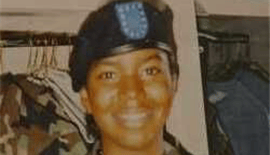
 LaVena Johnson enlisted in the U.S. Army after graduating from a Missouri high school because she believed it was right to serve her country. She loved America, was very patriotic, and she thought joining the military was the best way to express that patriotism. Although her mother had assumed that her daughter, a violinist and honor student, would go straight to college, LaVena had made other plans. After her death, her company commander described her as having been “clearly happy” during her time in the Service. She enjoyed her job, took pride in it, and cared about the U.S. Army.

 When the hashtag #Blackpowerisforblackmen, created by







 Lauren G. Parker is an undergraduate, intended Creative Writing major at George Mason University. Currently, she is co-coaching Richmond, Virginia’s internationally competing youth slam poetry team.