GOVERNMENT SHUTDOWN: WHY OBAMA SHOULDN’T NEGOTIATE WITH REPUBLICAN HOSTAGE-TAKERS

GOVERNMENT SHUTDOWN: WHY OBAMA SHOULDN’T NEGOTIATE WITH REPUBLICAN HOSTAGE-TAKERS

BY DR WILMER J. Leon

OCTOBER 09,2013

President Obama must stand firm 

[The View From Washington]

 The Obama Administration Let Republicans Control Narrative

Since the Republican led House of Representatives shut down the government, polls show a continued shift in public sentiment away from Republicans and in favor of the President.

According to the latest Washington Post-ABC News poll  Americans disapproval of the way Congressional Republicans are “handling negotiations over the federal budget” has jumped to 70% with a mere 24% approving of Congressional Republicans.

The disapproval rate of President Obama’s performance on the budget negotiations has narrowed, 51% to 45%. That’s a small improvement from the previous week’s 50% to 41% disapproval ratio.

The issue is not with the poll numbers.  If you are a member of the administration the numbers are trending in the right direction.

Their concern should be with the construct of the narrative by the corporate media. Programs such as Meet the Press, Face the Nation, and This Week are following the narrative articulated by Speaker Boehner and other Republicans: “Why won’t President Obama negotiate?”

Savannah Guthrie from Meet the Press asked Treasury Secretary Jack Lew, “Is the president ready to watch this country go into default rather than negotiate with Republicans?”

Later she tells Representative Fudge (D-OH), “As this goes on and on, the president’s stance is, ‘I won’t negotiate.’ And even if there’s a host of reasons why that is a responsible position, as a bumper sticker, it’s not the greatest, is it?”  Supporters of the administration’s position are allowing themselves to be brought into a debate based upon a false premise. The nature of Guthrie’s questions presumes that the Republican’s position has merit.

It does not.

George Stephanopoulos from This Week opened his round-table discussion by allowing his guest Paul Gigot to say, the President is playing with fire by failing to negotiate; as though the Republicans position is intellectually honest. Gigot went on to recount how many continuing resolutions (CR’s) have been negotiated by previous presidents; as though that history is relevant to the current circumstance.

It is not.

This time Republicans are holding the country hostage to reargue established law; the Affordable Care Act. Even Senator John McCain (R-AZ) has said, “We fought as hard as we could in a fair and honest manner and we lost…”

The hosts of these news programs and others may consider themselves to be unbiased journalists by allowing the Republican spokespeople and pundits to go unchallenged but they are really doing the public a great disservice.  Facts matter. The truth is important and should always be paramount.

The shutdown of the government is being led by a small band of elected officials who are more focused on their narrow political ideology than operating in the best interest of the American people.  According to The New York Times, “Shortly after President Obama started his second term, a loose-knit coalition of conservative activists led by former Attorney General Edwin Meese III gathered in the capital to plot strategy.”

The result was the “blueprint to defunding Obamacare.” According to the Times “It articulated a take-no-prisoners legislative strategy that had long percolated in conservative circles: that Republicans could derail the health care overhaul if conservative lawmakers were willing to push fellow Republicans — including their cautious leaders — into cutting off financing for the entire federal government.

This of course comes on the heels of the infamous January 20, 2009 dinner where according to Robert Draper’s book, “Do Not Ask What Good We Do: Inside the U.S. House of Representatives” Republican leadership “met and plotted to sabotage, undermine and destroy America’s Economy.” The senior GOP members plotted to bring Congress to a standstill regardless how much it would hurt the American Economy by pledging to obstruct and block President Obama on all legislation.

Contrary to how John Boehner, Eric Cantor, et al, try to position the current shutdown we are exactly where they wanted us to be. It is not a noble gesture that the Republicans are championing on behalf of “the American people”.  This is, according to the Times, “the outgrowth of a long-running effort to undo the law, the Affordable Care Act, since its passage in 2010 — waged by a galaxy of conservative groups (such as the Koch Brothers) with more money, organized tactics and interconnections than is commonly known.”

It is also the Republican Party playing to a bigoted ideologically driven element of their party, the White Southern Republican base.  According to The Nation “Many factors play into the shutdown, but a leading cause is the fact that the Republican Party is whiter, more Southern and more conservative than ever before.”  As a result of the 2012 census and restricting, “while the country continues to grow more racially diverse, the average Republican district continues to get even whiter.”

Contrary to Boehner’s mantra, Republicans are not listening to “the American people,” they are playing to the narrow structural base of the Republican party.

For mainstream American journalists to allow Republican representatives to justify their “negotiating” position as though it is valid perpetuates the lie.  For Democrats to participate in television and radio programs where the questions they are being asked are based upon faulty premises and they trying to answer the questions without highlighting their flaws is a formula for disaster.

It is also interesting how journalists, Democratic strategists, and Democratic members of Congress have adopted the Republican created pejorative term “ObamaCare.”  When you allow your enemy to define your position you’ve already lost the argument.

Not once have I heard Representative Fudge (D-OH) or other’s say, “no, it’s not ObamaCare; it’s the Affordable Care Act. (ACA)” Polls have shown many Americans oppose “ObamaCare” but support the ACA, demonstrating how effective Republican marketing has been and how the administration has failed to explain its flagship legislation.  He who defines reality controls others perception of reality.

Even though the polls are showing Americans disapprove of the way congressional Republicans are “handling negotiations over the federal budget” I believe the administration has lost control of the narrative, again. They can’t seem to construct a consistent and cohesive message. The ACA is not a takeover of health-care; it’s a change to health insurance which provides greater access to care for the previously uninsured.

In terms of corporate “mainstream” media, the administration has failed to get program hosts to focus on why Republicans are opposed to expanding healthcare to more Americans and are willing to shut down the government in order to prevent it.  Also, why should the President negotiate issues (ACA) that are unrelated to a clean CR?

By failing to force the narrative to address these issues, as the day’s pass and the country again get’s closer to the fiscal cliff, the winds of public sentiment may shift; forcing the administration to concede defeat when the battle, if properly fought, was already won.

Dr. Wilmer Leon, an OUR COMMON GROUND Voice is the Producer/ Host of the Sirius/XM Satellite radio channel 110 call-in talk radio program “Inside the Issues with Wilmer Leon” Go to  www.wilmerleon.com or email: wjl3us@yahoo.com.  www.twitter.com/drwleon and Dr. Leon’s Prescription at Facebook.com  © 2013 InfoWave Communications, LLC 
 04-06 Wiler2 Leon

– See more at: http://www.blackstarnews.com/us-politics/us-politics/government-shutdown-why-obama-shouldnt-negotiate-with-republican-hostage#sthash.x77CNbJM.dpuf

Building A Poor People’s Survival Movement In A Time of Economic Crisis

Saturday, September 21, 2013

Building A Poor People’s Survival Movement In A Time of Economic Crisis

Download Podcast
With the US Congress slashing food assistance programs by tens of billions of dollars, food security is a serious issue for everyone in the United States but especially poor and working class communities. The urban Black community could be especially hit hard and while a few non-governmental programs exist in a few communities, the need for a larger Poor People’s Survival Movement can not be stressed enough.
www.StatCounter.com/myspace/ - Free myspace Profile Counter

Obama Offered “The Tranquilizing Drug of Gradualism” – Dr. Wilmer Leon

 In His March on Washington Speech, Obama Offered “The Tranquilizing Drug of Gradualism”

Dr. Wilmer Leon

 By Dr. Wilmer J. Leon, III

weopwepospwp

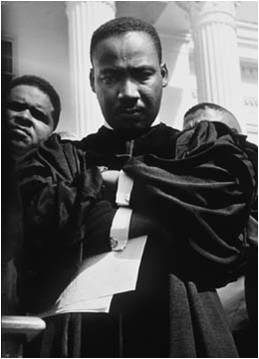
“We have also come to this hallowed spot to remind America of the fierce urgency of Now. This is no time to engage in the luxury of cooling off or to take the tranquilizing drug of gradualism. Now is the time to make real the promises of democracy.” Rev. Dr. Martin Luther King, Jr. August 28, 1963

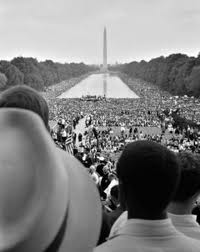
During the 50th anniversary of the March on Washington for Jobs and Freedom there was a lot of discussion about the “then” vs. “now”.  Has the “Dream” been realized?  Are we in a post-racial America? How did the 50th anniversary March compare to the first?

The answer to the first question is an emphatic “NO”. As I have written and lectured on a number of occasions, to refer to Dr. King’s message as a dream misses the point of the speech. Over the years Dr. King’s revolutionary message has been hijacked, compromised and relegated to being that of just a dreamer, not the lucid and radical ideas of a man seeking solutions to how a people can overcome oppression and racism. To cast King in the light of a dreamer allows people to be convinced that substantive change resulting from clear vision and direct action is not necessary.

Are we in a post-racial America? No, and that’s a ridiculous question.  I havewritten to this point as well. America cannot be close to being post racial when a candidate for president has to run a deracialized campaign in order to make the masses comfortable with the obvious aesthetic. This is not a post-racial America when the unemployment rate in the African American community is more than double the national average and the wealth accumulation of the average European American family is 20 times that of the average African American family.

How did the 50th anniversary March compare to the first? Comparisons are natural due to the fact that the two marches were convened to address many of the same issues. The fact that 50 years later, speakers still addressed issues such as unemployment, jobs, civil liberties, education, health care, support for social programs and protection against police brutality made for easy yet unfortunate comparisons. It is understandable that people will try to make qualitative and quantitative assessments between similar events.

While there might be some obvious and natural similarities between the two marches they are also quite different. Their political contexts are very different.

Leading up to the 1963 March, civil rights organizations such as CORE, SNCC, SCLC and the NAACP were engaged in non-v*****t direct action.  There was a three pronged strategy to bring pressure upon the executive branch and other branches of government to recognize and protect the civil rights of Negros of the day.  This pressure was being applied in the streets (sit-ins, boycotts, and marches), the courts (Brown v. Board of Education, etc.) and the legislature (civil rights laws, voting, and public accommodations). It was the struggle of a people to be included into the social, economic and legal mainstream of America.

Due to the constant pressure that the Civil Rights Movement brought to bear upon the government which culminated with the 63’ March, President Kennedy reluctantly came to support what would become the 1964 Civil Rights Act. Torn between the moral reality of the Movement and practical Southern electoral politics, Kennedy in June of 63’gave a nationally televised address where he stated, “A great change is at hand, and our task, our obligation, is to make that revolution, that change, peaceful and constructive for all.” He then asked Congress to enact a civil rights bill that would remove race from consideration “in American life or law.”

After Kennedy’s assassination, President Johnson would support and sign the 1964 Civil Rights Act, along with the 1965 Voting Rights Act, and the Fair Housing Act. In seizing the initiative, Johnson stated, “…rarely in any time does an issue lay bare the secret heart of America itself. The issue of equal rights for American Negroes is such an issue. And should we defeat every enemy, should we double our wealth and conquer the stars, and still be unequal to this issue, then we will have failed as a people and as a nation… Wednesday I will send to Congress a law designed to eliminate illegal barriers to the right to vote.”

It is important to understand what both Kennedy and Johnson said and did to bring about substantive change in American society. Today, due to complacency and the fallacy that those who dare criticize the president should turn in their “Black Card”, there has been virtually no pressure on the current administration to work with the Congressional Black Caucus to propose and fight for targeted legislation that addresses the interests of the African American community.

As a result of orchestrated efforts by of some in the extremist wing of the Republican Party and the complacency of the Black electorate after the election of President Obama, many of the civil rights gained from the movement and culminating in the 1963 March (affirmative action, voting rights, and protections against police brutality) have been eviscerated.  The focus of the struggle has shifted away from inclusion into mainstream America to futile efforts to hang onto the gains that were hard fought and won in the 1960’s.

The 2013 March on Washington was a wonderful commemoration and tribute to the past, but it failed to articulate a legislative agenda and plan to pressure the Obama administration and Congress to address disparities in mass incarceration, home foreclosure, unemployment or education.

In 1963 President Kennedy stayed in the White House, choosing to watch the March on television. He was afraid that the March would turn into a riot. In 2013 President Obama was the keynote speaker. Many see this as progress.

During his speech President Obama applauded the struggles and successes of the past and with soaring rhetoric talked about the promise of tomorrow. He did not propose any substantive legislative initiatives to address the suffering of today and ask those in attendance to go back to their homes and hamlets and work with him to defeat legislative gridlock.

He offered the “tranquilizing drug of gradualism”.

Dr. Wilmer Leon, an OUR COMMON GROUND Voice, is the Producer/ Host of the Sirisu/XM Satellite radio channel 110 call-in talk radio program “Inside the Issues with Wilmer Leon” Go to www.wilmerleon.com or email:wjl3us@yahoo.comwww.twitter.com/drwleon and Dr. Leon’s Prescription at Facebook.com

© 2013 InfoWave Communications, LLC

04-06 Wiler Leon

King’s “Dream” vs. Obama’s Realpolitik – Dr. Wilmer Leon

crera2

King’s “Dream” vs. Obama’s Realpolitik

 | August 20, 2013

Dr. Wilmer J. Leon, III

– “Even when pressed by the demands of inner truth, men do not easily assume the task of opposing their government’s policy, especially in time of war. Nor does the human spirit move without great difficulty against all the apathy of conformist thought within one’s own bosom and in the surrounding world. Moreover, when the issues at hand seem as perplexing as they often do in the case of this dreadful conflict, we are always on the verge of being mesmerized by uncertainty. But we must move on.” Rev. Dr. Martin Luther King, Jr. April 4, 1967

As America commemorates the 50th anniversary of the historic March on Washington for Jobs and Freedom I am compelled to ask the following question, would Dr. King be invited to speak at upcoming events to commemorate the March?

king 3If you get past the marketed “Dream” reference in the “I Have a Dream” speech you will understand that it was an indictment of America.  If you read “Beyond Vietnam: A Time to Break Silence” or Dr. King’s last book Where Do We Go From Here, Chaos or Community?; you can rest assured that today Dr. King would be in opposition to America’s backing of the assignation of Muammar Gaddafi, drone attacks, indefinite detention at Guantanamo, NSA wiretapping, mass incarceration, and the Obama administration’s failure to speak forcefully about poverty in America. From that premise one can only conclude that if Dr. King were alive today, those within the African American community who are engaged in stifling honest, fact-based, critical analysis of the administration’s policies would not allow Dr. King on the dais.  Reason being, Dr. King committed his life to a morally based sense of justice and humanity not actions taken from a sense of political expediency or realpolitik.

On August 28, 1963 Dr. King stated, “Five score years ago, a great American, in whose symbolic shadow we stand today, signed the Emancipation Proclamation…One hundred years later, the colored American lives on a lonely island of poverty in the midst of a vast ocean of material prosperity.”  Today according to the Bureau of Labor Statistics, the national unemployment rate stands at 7.6% and 15% in the African American community.  Today, “in the midst of a vast ocean of material prosperity,” according to Bread For the World, “14.5 percent of U.S. households—nearly 49 million Americans, including 16.2 million children—struggle to put food on the table” and “more than one in five children is at risk of hunger. Among African-Americans and Latinos, nearly one in three children is at risk of hunger.”

President Obama has claimed to be a champion of the middle class but rarely speaks to the plight of the poor in America.  Dr. King would not stand idly by and allow this to go unchallenged.  As America spends billions of dollars on its drone program, children continue to go hungry.  In his 1967 speech Beyond Vietnam: A Time to Break Silence Dr. King stated, “A few years ago…It seemed as if there was a real promise of hope for the poor, both black and white, through the poverty program…Then came the buildup in Vietnam, and I watched this program broken and eviscerated as if it were some idle political plaything on a society gone mad on war. And I knew that America would never invest the necessary funds or energies in rehabilitation of its poor so long as adventures like Vietnam continued to draw men and skills and money like some demonic, destructive suction tube.”  If you replace Vietnam with Afghanistan and the War on Terror I believe Dr. King would be engaged in the same analysis and saying the same things today.

Dr. King said that the people of Vietnam must see, “Americans as strange liberators…they languish under our bombs and consider us, not their fellow Vietnamese, the real enemy…What do the peasants think as we ally ourselves with the landlords and as we refuse to put any action into our many words concerning land reform? What do they think as we test out our latest weapons on them…?”  Today, Dr. King would be asking the same questions about America’s actions in Libya, Afghanistan, Pakistan, Egypt, and the continued US support for the Zionist government in Israel as it continues to build settlements on Palestinian land in violation of international law.

ObamaLet’s be very clear, I have used actions of the Obama administration to highlight many of the contradictions that we face and to demonstrate how the man we now revere, the icon that will be lauded at the 50th anniversary of the March on Washington would not be invited to speak in today’s political context. That’s the symptom of a greater problem.

To gain great insight into the real problem you have to examine the work of Edward Bernays and the rise of the propaganda industry in the 1920’s. “[The] American business community was also very impressed with the propaganda effort (created by Bernays). They had a problem at that time. The country was becoming formally more democratic. A lot more people were able to vote and that sort of thing. The country was becoming wealthier and more people could participate and a lot of new immigrants were coming in, and so on.  So what do you do? It’s going to be harder to run things as a private club. Therefore, obviously, you have to control what people think. There had been public relation specialists but there was never a public relations industry.” History as a Weapon – Noam Chomsky – 1997.

The business community as Chomsky discussed or the corptocracy in today’s parlance uses propaganda to co-opt the American political landscape and has contributed to the decline of the American political left.  The politics and policies of the Obama administration are examples of that decline, not responsible for it. th

At the 50th anniversary of the March on Washington pay very close attention to what is said and even closer attention to what is not (August 27, 2013 is the 50th commemoration of the passing of W.E.B. DuBois).

Understanding the moral basis of Dr. King’s analysis, he would be standing today for the very things he stood for then.  He would be critical of the current administration, and as such, great efforts would be made to shut him out of the national debate since many in the African American community see honest, fact based, criticism of Obama administration policy as antithetical to the interests of the African American community.  The prophet is never welcome in his own village.

Dr. King’s “Dream” was significant because of its juxtaposition against the reality of the Negros nightmare but Bernaysian propaganda keeps the focus on the “Dream”.

04-06 Wiler2 LeonDr. Wilmer Leon is the Producer/ Host of the Sirisu/XM Satellite radio channel 110 call-in talk radio program “Inside the Issues with Leon” Go to www.wilmerleon.com or email:wjl3us@yahoo.comwww.twitter.com/drwleon and Dr. Leon’s Prescription at Facebook.com  He is an OUR COMMON GROUND Voice, joining us as Guest and Co-Host.

© 2013 InfoWave Communications, LLC

– See more at: http://www.wilmerleon.com/

“Talking about White Privilege Is Not Profound, Its Just for Profit” Dr. Tommy J. Curry

THE NATIONALIST

“Talking about White Privilege Is Not Profound, Its Just for Profit”

By: Dr. Tommy J. Curry

tcurry1

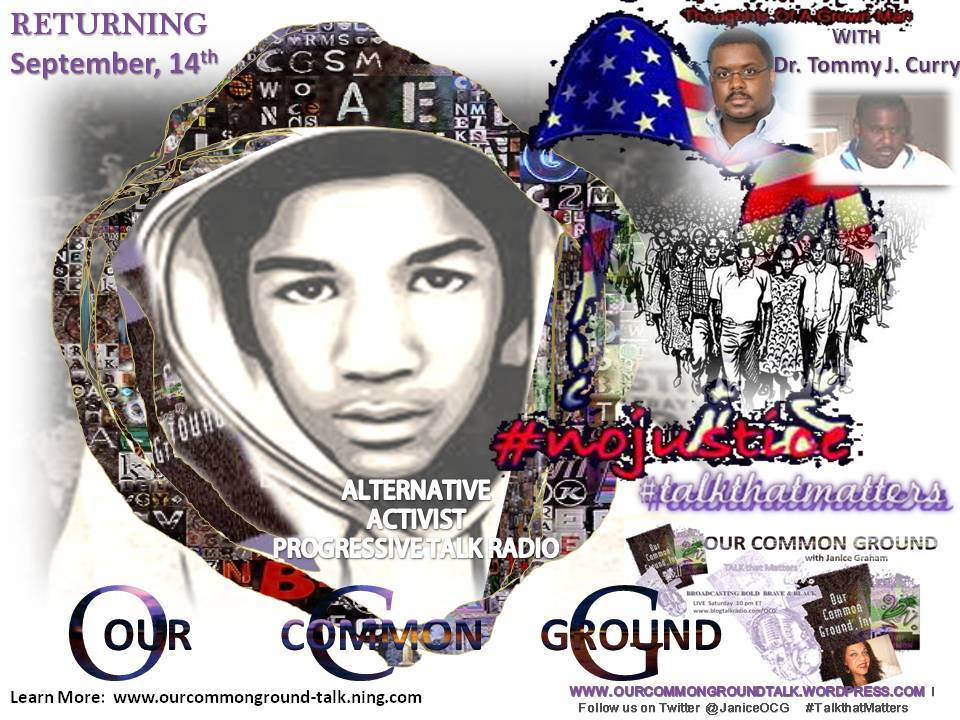
Dr. Tommy J. Curry Coming to OCG September 14, 2013

There is a growing economy for discussions about white privilege in this country that are employing Black and brown intellectuals and whites who profess anti-racism, to be the missionaries that save white souls. white privilege, or the idea that white individuals are born with unearned benefits and advantages, over others has been making its way through out the public media as well as the classroom. On the face of it, this seems like a radical conversation. Black, brown and some white people calling out white liberals and conservatives for their racism, and starting “real” conversations about race that air on MsNBC,CNN and even the Huffington Post. But conversations about white privilege are not really conversations about race, and certainly not about racism—its a business—WHERE BLACKS MARKET THEMSELVES AS RACIAL THERAPISTS.

See the first discussions of white privilege like W.E.B. DuBois’s Black Reconstruction (1935) or George Lipsitz’s The Possessive Investment in whiteness, or even Cheryl Harris’s “whiteness as property,” came from the radical Black intellectual tradition (race-crits, Black nationalists, Pan-Africanists) that did not believe that whites would simply donate their power and act against their global racial interests to be good people IN THE EYES OF BLACKS, people they owned and still imprison.  DuBois, and Lipsitz understood there is an antipathy and power in being against Blacks. Like George Jackson said, regarding the ILLUSION many Black academics have in romanticizing their ability to solve racism, “the white race, the economic elites of America, are not going to let themselves be educated out of existence. But today, you sound radical, progressive and insightful by MARKETING YOURSELF as therapist for whites, and know nothing about the actual conditions, structures, and ills that concretely effect the lives of Blacks. You can even talk about white privilege and not even know the names of the Black thinkers, the literature, the context, or the history the term comes from, and get acclaim for only citing white celebrities like Peggy McIntosh or Tim Wise.

It’s not genius to say in an oppressive society there are benefits being in the superior class instead of the inferior class. That’s true in any hierarchy, being on the top is better than being on the bottom, but the speaker of white privilege gets to pretend that America is not oppressive, they love America, they just want whites to surrender their privilege so we can be equal. See the revolutionary doesn’t have white friends: the government killed MLK, Assata is called a terrorist, Derrick Bell is erased from a field he started, because they spoke about the actual racial and economic tyranny of corporations, governments, the military and the white public,  but the for profit revolutionary wants to be commodified by whites…that Black friend that feels like they cured the racist white, while that same white person gets to point to these very relationships as proof they are healed and show to other whites they are the “white ally.”

Conversations about white privilege are simply moral appeals to the conscience of whites who have shown themselves to be committed to racism and social inequity IN THE IDLE HOPE THAT THEY change their mind. The implication of talking about privilege suffers from a childlike naiveity, it suggests that simply exposing racism and the privilege of whiteness to the white mind motivates whites to no longer act in their own self interest. See like the liberal utopia born out of integration, there is an unjustifiable assumption that telling whites about their social position means they are willing to surrender their power to appease a pop culture account of oppression. Think about the dishonesty of this approach. Black people, oppressed people, know there is a fundamental difference between being oppressed/Black and not oppressed, a citizen, white. We call for “national conversations on race,” where these public intellectuals get credit for starting conversations that amount to little more than allowing white America the opportunity to deny the actual realities Black America suffer from. And regardless of the outcome they come out LOOKING LIKE PROPHETS. This issue is white supremacy, and anti-Black death…trying discussing that…and see if your oppressor recognizes you then.

I remember at a recent APA I sat next to a feminist of color trying to get her white male student who couldn’t get a job in the white figures he studied and wrote a book on, and never studied race, racism, or Black philosophy, a job. This professor felt comfortable telling him if you start talking about white privilege, where she claimed the field was going, he could land a race job easily.  Think about this. So all the Black, Brown, and Indigenous scholars who study the raw histories of oppression and resistance lose out because they don’t want to give white liberals and conservatives a guilt trip. This is a powerful example of how as an academic discussion white privilege distracts the oppressed, and empowers the oppressor class to be employed in discussing systems they have no real interest in dismantling.

“The Nationalist”

Returning 9-14-13

Papantonio: Tea Baggers Dismantle Obamacare (VIDEO) – Ring Of Fire Radio: Robert Kennedy Jr, Mike Papantonio and Sam Seder

Papantonio: Tea Baggers Dismantle Obamacare (VIDEO)

Posted on August 1, 2013 by Gary Bentley •

The Tea Party made repealing the Affordable Care Act the cornerstone of the 2010 midterm elections, and it helped catapult them onto the national stage.  And in the last three years, they haven’t budged one inch in their efforts to destroy healthcare reform, even though it’s providing coverage to people who would otherwise have to go without healthcare. Ring of Fire host Mike Papantonio discusses the continued assault on the Affordable Care Act with India DeClair, host of the I Declair Show.  India is a prime example of just how powerful citizens’ media can be if we become active, take a stand, and are willing to help offer solutions to problems instead of simply complaining.

via Papantonio: Tea Baggers Dismantle Obamacare (VIDEO) – Ring Of Fire Radio: Robert Kennedy Jr, Mike Papantonio and Sam Seder.

“Mr. President, It’s Not What You Say, but What You Do” Dr. Wilmer Leon

OUR COMMON GROUND Voice

Dr. Wilmer Leon: Mr. President, It’s Not What You Say, but What You Do

ioisoiw

by Dr. Wilmer J. Leon, III

“How shall integrity face oppression? What should honesty do in the face of deception? What does decency do in the face of insult? How shall virtue meet brute force….”  The Ordeal of Mansant – W.E.B. DuBois

Last week President Obama addressed the Zimmerman verdict and the ugly reality of racial profiling.  He spoke through the White House press corps to the American people.  He spoke forcefully and with surprising candor and empathy. He was measured in his tone and verbiage; clearly understanding that just one wrong word or improper inflection would ignite a firestorm of reaction.

For the sake of this piece I will not take issue with anything the president said.  I agree with most of what was presented. In his 2,156 words the president spoke volumes of truth.  He said what needed to be said and it needed to be said by him.  This was the perfect example of a president using the power of the bully pulpit to its fullest.  He placed into context, informed, and educated the country about a very sensitive reality that far too many don’t understand and/or have chosen to ignore.

The president was correct to state, “You know… Trayvon Martin could have been me 35 years ago…I think it’s important to recognize that the African American community is looking at this issue through a set of experiences and a history that doesn’t go away.”  He went on to say, “There are very few African American men in this country who haven’t had the experience of being followed when they were shopping in a department store. That includes me. There are very few African American men who haven’t had the experience of walking across the street and hearing the locks click on the doors of cars. That happens to me — at least before I was a Senator. There are very few African Americans who haven’t had the experience of getting on an elevator and a woman clutching her purse nervously and holding her breath until she had a chance to get off. That happens often.”

What made the president’s remarks so powerful was the fact that he told America that the history of racial profiling is his history; the experience is real because it’s his experience.  The community’s outrage, anger, and frustration are based in a context and reality that is shared byhim and cannot be ignored.

The president went on to say,”The African American community is also knowledgeable that there is a history of racial disparities in the application of our criminal laws — everything from the death penalty to enforcement of our drug laws.  And that ends up having an impact in terms of how people interpret the case.”

The president could not be more correct.  That history not only impacts how the African American community has viewed the Zimmerman verdict, it impacts our everyday lives.  It is not only a prism through which one interprets reality; it is reality!  There has been “a history of racial disparities in the application of our criminal laws”.  An example of this recent history can be found in New York City police commissioner Ray Kelly’s “stop-and-frisk” laws.

According to the New York Civil Liberties Union (NYCLU), New York Police Department (NYPD) officers have stopped more than 4 million New Yorkers since the Department began collecting data on the program in 2004.  The latest stop-and-frisk report shows that the NYPD stopped and interrogated New Yorkers 152,311 times between July 1 and Sept. 30, 2011. About 88 percent of those encounters did not result in arrests or tickets. Nearly 85 percent of those stopped were Black or Latino.

So, earlier last week while the country was grappling with the Zimmerman verdict and the president was preparing his remarks, he contradicted himself by endorsing Commissioner Kelly “as a worthy candidate” to succeed Janet Napolitano as head of the Department of Homeland Security.  The President stated on Univision – that “Kelly has obviously done an extraordinary job in New York,” and that the police commissioner is “one of the best there is” — an “outstanding leader in New York.”  The president went on to say, “Mr. Kelly might be very happy where he is. But if he’s not I’d want to know about it. ‘Cause, you know, obviously he’d be very well qualified for the job.”

We all understand; it’s not what you say it’s what you do.  Actions speak louder than words.

NY neighborhoods with the highest number of stop/frisk interrogations included Inwood/Washington Heights, Central Brooklyn, Far Rockaway, Eastern Queens and the North Shore of Staten Island – all low-income neighborhoods of color. Whites, who represent 33 percent of the city’s population, accounted for less than 9 percent of people stopped. During the third quarter of 2011: All five precincts with the fewest stop-and-frisk encounters were concentrated below 59th Street in Manhattan and are majority white.

I suggest that a police department that was on pace to stop and interrogate a record number of totally innocent New Yorkers is operating outside of the moral and constitutional ideals that it was created to protect. When you have a department that during the first three quarters of 2011 stopped totally innocent New Yorkers 451,000 times – the overwhelming majority of whom were Black or Latino you as a citizenry have a problem. If Ray Kelly were empowered to implement NY style stop-and-frisk policies nationwide coupled with the use of drones and NSA style wiretapping and the PRISM program, America would have a serious problem than it has today.

The president spoke very powerfully and eloquently about the history of and problems with racial profiling in America. I listened very carefully to what he said and then compared it to what he is supporting. “How shall integrity face oppression? What should honesty do in the face of deception…?”  The actions speak louder than the words.

Dr. Wilmer Leon is the Producer/ Host of the Sirisu/XM Satellite radio channel 110 call-in talk radio program “Inside the Issues with Leon” Go to www.wilmerleon.com or email:wjl3us@yahoo.comwww.twitter.com/drwleon and Dr. Leon’s Prescription at Facebook.com

© 2013 InfoWave Communications, LLC

Detroit and America’s Racial “Exceptionalism” | Black Agenda Report

 Detroit and America’s Racial “Exceptionalism” | Black Agenda Report.

A Black Agenda Radio commentary by executive editor Glen ford

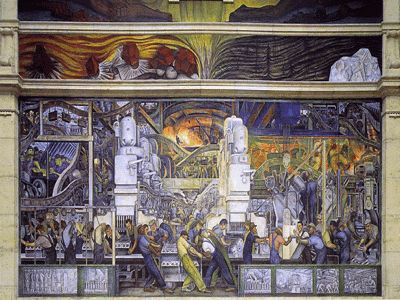
The picture is of Diego Rivera’s mural Detroit Industry, 1932-33, Detroit Institute of Arts.

Corporate solutions can justifiably be substituted for democracy, when it comes to Blacks.”

The great American dissolution of electoral democracy is playing out in Detroit, where last Monday the state-appointed Emergency Financial Manager explained to a crowd at Wayne State University how he would compassionately go about the business of breaking their city into buyable and sellable parts. The people and their elected representatives would have no say in the ultimate result.

The corporate media, and white folks in general, view the process as an inevitability – a kind of crude justice – not because they have rejected the principle of self-government, but because Detroit is overwhelmingly Black, and Blacks have always been the exception to the American rule. In fact, all of the Black population centers of Michigan have been divested of the right to govern themselves.

There has been no national outpouring of solidarity with Michigan’s Blacks over the loss of their citizenship rights, which can only mean that there exists an effective white consensus that African Americans are not fully deserving of those rights. Uncontrolled concentrations of Blacks are seen as pathological, by definition.

The same race-based exception was made to public education, for Blacks. In New Jersey and localities across the country, public schools in largely Black areas have for decades been under state control, denying Black parents any effective voice in their children’s education. By and large, white suburbanites supported the state in making Blacks an exception to the general American rule on local control over education. It is a right Blacks are not thought to be qualified to exercise.

Blacks were an exception to the Constitution.”

The same racial exception to the rule led to massive privatization of inner city education, through wholesale imposition of charter schools and private school vouchers. When education secretary Arne Duncan declared that Hurricane Katrina was the best thing that ever happened to public schools in New Orleans because it allowed most of the city’s schools to be converted to charters, there was no national condemnation of his remarks – since it is accepted that Blacks cannot run their own school systems. They are the great exceptions to the American rule. Corporate solutions can justifiably be substituted for democracy, when it comes to Blacks.

The problems of drugs and crime were framed as Black phenomena, requiring a more flexible interpretation of civil liberties and the creation of a vast police state. Just as the Founding Fathers actually intended, Blacks were an exception to the Constitution.

Blacks, and their alleged “pathologies,” were considered the nexus of poverty and social disintegration in America. Therefore, the social safety net was kept at the absolute minimum.

And now, all these exceptions that have been made for Blacks, are to become models for America as a whole, in the age of austerity, corporatized education, undemocratic governance, and the National Security State. In places like Detroit and New Orleans, America has been busily creating the pilot programs for the rule of the rich, by systematically undermining social democracy for Blacks.

The great exception, is becoming the rule.

For Black Agenda Radio, I’m Glen Ford. On the web, go to BlackAgendaReport.com.

BAR executive editor Glen Ford can be contacted at Glen.Ford@BlackAgendaReport.com.


Michael Baisden and the Assault on Black Radio: A Question of Leadership l Bob Law, former Vice President of Programming at New York’s WWRL radio

Michael Baisden and the Assault on Black Radio: A Question of Leadership

  By Bob Law
May 17, 2013
 
radioB

We are witnessing the very serious decline of Black radio in general and Black owned radio in particular.  This is happening at a time when Blacks can ill afford to be without voice in the marketplace of ideas.

It is important to take into account the factors that have made Black radio so vulnerable. Two Major contributing factors to the demise of Black owned radio are the 1990 Bill Clinton telecommunications ACT, and the bias inherent in the radio ratings system, a system whose incorrect information has consistently deprived Black radio of a fair share of advertising revenue, leading to the financial demise of a number of Black owned radio stations throughout the nation.With the hateful indifference to Blacks that dominates so much of what is considered mainstream media, Blacks must have access to social, political, esthetic and cultural expressions that are born of the Black experience in the world.

It is the Federal Communications Commission, however, where these destructive factors find their greatest support. One of the reasons that these and other unfair business practices persist is that the mega corporations, when taking advantage of Black stations that find themselves forced into irreversible decline, are assured that the FCC will grant them the stations broadcast license, in spite of what often appears to be unethical and perhaps even illegal behavior.

The mega media corporations in their rampage to consolidate and dominate all media markets have been able to strip the FCC of all rules and guidelines, making it impossible for members of the general public and independent station owners to have legal standing when appealing to the FCC to protect the air waves from mega corporate take overs.

Recently, Federal Communications Commissioner Mignon Clyburn standing on her own, blocked the commission from literally sneaking through additional rules changes that would have allowed further media ownership by Rupert Murdoch without giving the public ample time to review and comment. We applaud commissioner Clyburn’s integrity.

It is Congress however, that has oversight over the FCC, and it is Congress that must restructure the Commission, and since it is the Black community that has so much at stake, on Dec. 6, 2012 in our capacity as representatives of a putative class of African American citizens, Bob Law, Betty Dobson, Michael North and New York City Councilman Charles Barron appealed to the Congressional Black Caucus to place the FCC on the congressional agenda for 2013. We went directly to the then chair of the caucus, Emanuel Cleaver, with an open letter to the CBC office in Washington D.C. and as instructed by his Chief of staff, an email of the same letter to his district office in Kansas City.

Our efforts to engage the CBC were freely dismissed. We also emailed the letter to the New York congressional delegation, Charles Rangel, Yvette Clark, and Gregory Meeks, all of whom ignored us. The letter was hand delivered to Congresswoman Barbra Jackson Lee, of Houston Texas. To date the CBC has ignored this request coming from respected members of the Black community.

On the occasion of Martin Luther King’s birthday, Marcia L. Fudge, the new chairwoman of the Congressional Black Caucus, announced that in the spirit of Dr. King, the CBC must commit itself to the fight for the rights of all people. This interpretation of Martin King comes at a very strange time.

When you consider that Blacks have the highest unemployment rate of all ethnic groups, the highest debt, the lowest median family income, the most dysfunctional schools, the highest incarceration rate, a street violence that is of epidemic proportions prompting a growing number of African Americans to even urge the president to address the needs of Blacks head on.

At this time, when their own constituents need them the most, the CBC ignores a direct appeal from Blacks, and according to chairwoman Fudge chooses instead to chase the broad ambiguous notion of securing everyone’s “version” of the American dream. As though the needs and concerns of Blacks do not qualify as a legitimate version of the American dream.

Were it not for the courage and commitment of Maxine Waters, the CBC would have no relevance at all. Nonetheless, the CBC overall raises significant questions for African Americans. At this point, can we really afford leadership, both elected and appointed, that is so befret of the skills and vision needed to move Black people forward?

It was Frantz Fanon, in his classic study “The Wretched Of The Earth” who pointed out that a deserving people, a people conscious of its dignity, is a people that understands and insist that the government and the political parties are to serve the interest of the people. Fanon says that ultimately, a government or a party gets the people it deserves, and sooner or later, a people gets the government leadership they deserve.

The overall condition of Black Americans remains bleak as long as we tolerate totally inadequate leadership. It is time to replace those leaders and elected officials who offer no vision or strategy to actually move Blacks forward. As long as we leave these politicians in place, we may be getting what we deserve!

Bob Law served as the Vice President of programming at New York’s WWRL radio for 3 years. Prior to that, he was the host of NIGHT TALK, the nation’s first nationally broadcast daily Black call-in show on the National Black Network for two decades. He is currently chairman of the board of the Black Spectrum Theatre in Queens, New York, and has begun a new career in filmmaking. His first film Saying it Loud, a documentary about the power and significance of Black radio, is being well received by audiences around the country.


On Boston & Violence: An Intimate Relationship l Esther Armah

Esther Armah

NYC Radio Host, Playwright, Author

 On Boston & Violence: An Intimate Relationship

 04/16/2013

 Boston. Remote in hand, I channel surf, pausing from one horror to another. I’ve just heard the president’s message of unity, swift justice for the perpetrators, and recognition that on this day we are all Americans — not members of different parties, but of one nation.

National horrors like Boston, or Newtown, bring us together in our grief, unite us in our condemnation, stun us, and momentarily silence us because we agree on the brutality. We draw on a collective comfort. When the violence is the kind that is collectively mourned, no focus will rest on the shortness of the women’s running shorts. No one will say because the women voluntarily went to Boston and ran in the marathon they were asking to be blown up. Here’s the thing. We have a contradictory and intimate relationship with violence.

There is the type of violence we mourn and are horrified by, there’s also the type we sanction, sanitize, justify — in life, love, work, sports. We separate that violence according to who the victims are and who perpetrates it in specific ways. We unite in our mourning for the victims of some violence, but we tend to be divided, hostile and accusatory in the face of others. For most of us, violence is relative. Who gets to be the victim? Who is accused of being the perpetrator?

Violence occupies an emotional space; it is at once familiar and horrifying and sanguine. It is individual and institutional. We don’t respond to sexual violence the way we do with the violence of Boston or Newtown, for example. We are not all Americans when a woman or girl is raped or sexually assaulted; we are good girls and bad ones. We will not collectively mourn the shock to her body, the distress, the trauma, and its potential legacy. We will engage in insisting on knowing her potential role in that violence, we will defend the individual perpetrator of that violence, and we will be divided. But the act of violence in Boston produces different responses. We won’t question any of the women’s rights to be in that public space dressed in shorts or in any way suggest that their clothing or presence might arguably be interpreted as an invitation for an act of domestic terrorism. We will agree the perpetrator deserves to face consequences, the full weight of the law. We will not defend the perpetrators right of free and peaceful assembly, we will agree that his freedom should be curtailed.

We will defend the 1st Amendment right of a newspaper when it spews emotional violence masquerading as comedy about an Oscar-nominated brown girl reducing her to a “cunt” — a body part as The Onion did with Quvenzhane Wallis. We will not collectively condemn this emotional violence but engage in 140-character defenses of the 1st Amendment and mockingly Tweet to the constituency of the outraged to pipe down and chill — it’s only comedy. We will, in no way, defend the violence that occurred in Boston, however.

We will mourn the black bodies who came from far and wide to take part in a marathon that goes back to 1897 — provincial and global — as part of an institutional space to be celebrated, respected and revered. The humanity of the black marathon runner will be counted, not disregarded. In this moment, those black bodies morph into our national identity; they are momentarily American bodies with shared goals, ambitions, and dreams. Yet, we are never all American when a black man falls victim to the institutional violence of the state; we are prosecutors, interrogators of his behavior, questioning him, his actions, his words, his intentions, defending the institution. We are divided. We are accusatory. We are hostile. We are defensive when the state enacts violence upon black bodies.

Our horror post-Newtown or Boston is tangible; we can taste it, feel it, and relate to it. Our dismissal of the violence suffered by children on the streets of the south side of Chicago and other urban (and mostly black, brown, and working poor) neighborhoods across the country is equally tangible. We are not allAmerican when it comes to the violence of poverty. We measure, judge, label individuals and communities marked by the violence of economic disenfranchisement. We do not collectively raise our voices against the institutions that contribute to maintaining poverty and inequity in our country.

Our relationship with violence is exactly that, a relationship. We are married to our version of violent events; we are divorced from certain folk’s experiences of violent events. We negotiate what we believe, whom we believe, of whom we are skeptical and who is a liar. We have wakes and obits and sadness in 140 characters on Twitter or FB threads. We may be outraged that this piece would even be written, dismissing it as inappropriate. You maybe right. The real tragedy? So am I.

Our relationship with violence needs ’emotional justice’ — the untangling of a societal and generational inheritance of untreated trauma, this space where we are handed the job of teasing out which violence is which and navigating institutions, systems, individuals and society accordingly. This is our world. What are we willing to do to change our relationship with violence?

Esther Armah

NYC Radio Host, Playwright, Author

Follow Esther Armah on Twitter: www.twitter.com/estherarmah