Black Lives Matter Profiles: Remembering the Joyful Spirit of Malcolm Ferguson φ The Atlanta Star

atlanta star banner

Black Lives Matter Profiles: Remembering the Joyful Spirit of Malcolm Ferguson, Killed After Filing a Lawsuit Against the NYPD

 
This profile is part of an ongoing series of narratives focused on men and women who have been killed by the police. It is an attempt to counteract media bias, which often vilifies these men, women, boys and girls. These stories have been captured through the voices of the victims’ family members. I have been fortunate to meet the families through my activism in the Black Lives Matter movement and through work in various organizations.

Even before Michael Brown was gunned down in Ferguson, Missouri, the name Ferguson was analogous to police violence and murder. On March 1, 2000, the unarmed Malcolm Ferguson was gunned down blocks from his home in the Bronx.

“Malcolm was my biggest baby,” laughs Malcolm’s mother, Juanita Young, who is a parent to four other children.

Malcolm was born on Oct. 31, 1976, in the Bronx. “He was a loving, happy-go-lucky little boy,” Young explains. He trusted his loved ones, and Young giggles as she tells of a time Malcolm was convinced by his brother that he was Superman. He then attempted to fly out the window. Young recalls when Malcolm discovered Santa Claus was his mother, and instead of crying, he laughed and was happy all the same. He loved his mother.

“He was always worried about me because I’m legally blind. He was very close to his sisters and brothers because his father died when they were young,” Young says.

Malcolm was Young’s second to oldest son—her oldest, James, was 11 months older than Malcolm. Malcolm and his brother developed a strong relationship, but it was Malcolm who took on the leading role of big brother and acted like a father to his three younger siblings when their own father was not around. He went to great lengths to take care of his mother as well.

Like many boys, Malcolm loved to play basketball and liked to ride his bike, exploring different areas of the Bronx, all while protecting his family.

“We would tease him because he didn’t go with lots of girls. He would say that if anyone would do anything to his sister, he would be so defensive. So, he didn’t want to just go with any girl,” says Young.

Artist Kate Deciccio Painting of Malcolm's mother Juanita Young.

With a kind-hearted and devoted character, Malcolm grew up with lots of friends and felt pressure from his peers to have more name-brand things. Like many of his peers, he decided to sell drugs for some extra money. He ended up being arrested and serving eight months in prison for drug-related offenses when he was 17 years old. It was in prison where Malcolm finished his high school degree.

Malcolm was so negatively affected by his time incarcerated that he vowed never to return to prison. “He would lay at the corner of my bed and tell me the different horror stories and said, ‘I don’t [ever], ever want to go through that again,’” Young recalls.

Malcolm, then only a teenager, and Young spoke every day while he was incarcerated. Young had a miscarriage while Malcolm was locked up, and she remembers how guilty Malcolm felt. He felt, as the protector, that had he been home, perhaps the baby would have been born. Malcolm did everything in his power to ensure the safety, security and well-being of his beloved family—of his cherished mother.

“There is so much now that I do that I wouldn’t have to do if he were alive. If I would go to the laundry, he would go. He would ask me, ‘Ma, wait until I come back.’ Because of my blindness, he really protected me. There were so many times I had been beat up or whatever, and Malcolm felt the need to protect me,” Young explains.

One time, Young was standing outside of her building when someone asked her for directions, and as Young began to search through her purse, Malcolm was at the window, banging, urging the passerby to ask someone else, out of a fear that she could be robbed. He would leave no opportunity for anyone to take advantage of his mother.

It was not just Young and her other children Malcolm sought to protect. “Malcolm wanted to be a paralegal to help people after what he witnessed in prison. He felt he wanted to help people who were incarcerated,” Young says.

Upon leaving prison, Malcolm took an honest job at a car wash, so that he could make money as he pursued a career as a paralegal. His mother was content and knew that his brief stint in illegal pursuits was done.

“It was better than him asking me for quarters,” Young jokes, “I used to go to Atlantic City with my friends. He always would say, ‘Mom, do you have quarters around here?’ ”

Like many formerly convicted people, Malcolm was constantly harassed and profiled by the police after his time in prison. The young, 6-foot-1 Black man was continually harassed by the NYPD in the Bronx despite no involvement with crime or any illegal activity.

“Every time the cops arrested him, the judge would let him go because he wasn’t doing anything. The judge wouldn’t even buy it,” Young says.

One time, the police arrested Malcolm and instead of properly placing the handcuffs around his wrists, the police aggressively placed them over his thumb. His thumb was so injured that Malcolm had to be taken to emergency services. In response to the violent act, Malcolm decided to take legal action against the NYPD for his injuries in police care. He was still involved in the lawsuit when he was killed. After the lawsuit began, the police harassment increased.

“He still kept coming home and telling me the cops were bothering him. He couldn’t go nowhere without the cops stopping him,” Young explains.

When 23-year-old Amadou Diallo was shot and killed by the NYPD in the Bronx in February 1999 (also unarmed), Malcolm was angered and disturbed, like many in New York. He joined in the massive rallies in 2000 when Diallo’s killers were acquitted.

“He saw how the cops treated him and his friends. He knew what happened to Amadou was not right,” explains Young.

That day, Young was alerted by a friend to turn on the TV and was subsequently told that Malcolm would not be coming home.

“I saw [the police] dragging [Malcolm] on the ground arresting him [for peacefully protesting],” Young says.

Then the police started to come after Young. They began pressing seemingly ridiculous charges against her (one such charge was walking a dog without a leash). Young insists that the police would do anything to get her away from her apartment.

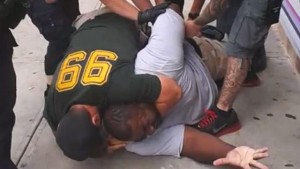
On March 1, 2000, about a year after Diallo’s death, just several days after the acquittal, Young was approached in her home by a police officer who told her that Malcolm, her loving son, her protector, was found dead in the hallway of her building. (Young would later find out that Malcolm had been killed, shot in the head, in the streets.) The shock sent Young into respiratory arrest, and she ended up having to go to the emergency room that same night.
Young claims that the police had been threatening Malcolm because of the legal action he was taking against the NYPD for their brutal arrests. Malcolm was unarmed and was not involved in any illegal activity. He did not attack a police officer, nor did he try and resist arrest, as he was doing nothing wrong to warrant arrest. Malcolm, presumably on his way home from work, was approached by Officer Louis Rivera, a plainclothes officer, and then shot in the street. Witnesses attest to this story, although the police claim Malcolm was shot in an apartment building while selling drugs, and then was shot in a struggle between himself and Officer Rivera. There were no drugs found on Malcolm.

Malcolm is remembered as a brother to James, Saran, Buddy and D’Nai. He was an adoring son to his mother, who has worked nonstop since 2000 on his behalf to fight for greater police accountability and to end violence rooted in racism at the hands of the police. Malcolm himself had hoped to work with the legal system to advocate for those most brutalized by the system. Instead, his life was cut tragically short.

The police officer who murdered Malcolm still is a police officer. Young continues to fight on Malcolm’s behalf.

“I think about what he would be like today. What joy he would have brought me,” Young says.

Tess Raser, originally from Chicago, is a teacher in Brooklyn and an active member of the growing Black Lives Matter movement. She works with various groups, including We the People and the Stop Mass Incarceration Network.

#SupportKelliMurray: Stop the Bullying of the Baltimore Co. FOP Lodge | LBS Baltimore

#SupportKelliMurray: Stop the Bullying of the Baltimore Co. FOP Lodge | LBS Baltimore.

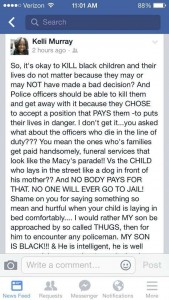
Kelli Murray is currently an employee of the Baltimore County Government who works as a dispatcher. She is a wife and mother.  After the non-indictment of Daniel Pantaleo in New York City (the officer who killed Eric Garner), she posted a Facebook status that expressed her fear of her children interacting with law enforcement.  This is a fear that has been expressed by many people in light of the increased coverage of issues of police brutality.  She went out of her way to express that she appreciates the job that good police officers do, but that in light of the current events her fears persist.  This was the text of her actual post:


“UPDATE: 12/29: Since this article has been published, Kelli has been continued to be bullied online and in the media. She will likely have to move and find new employment. Kelli is a wife and mother of six who needs support. Please click here to donate to her family and support them during this time.  Kelli has also released a video public statement about her comments (at the bottom of this article).

Unfortunately most people who are talking about racism in the mainstream political discourse are not sufficiently literate in the dynamics of racism to properly apply it to the events that have dominated the mainstream news media.  Racism is about the power that white dominated and controlled institutions have over the livelihood of Black people and other people of color.  In the context of police brutality what we are seeing is racism as it exist in our society.

Racism does not exist in a form that requires ill intent of a white person against Black people.  We are not seeing evil white people conspiring to kill young Black people.  What we are seeing is police officers operationalizing their feelings of Black criminality and worthlessness that our society has been saturated with.  They are acting on impulses that all of us are socialized to have.  Black criminality and worthlessness are notions that have been with us since America’s inception.  From the 3/5’s compromise, to the system of Jim Crow, American civil society has been structured on popular narratives that justify our dehumanization.  It’s latest iteration has been embodied in the war on drugs that has decimated Black communities.”


“Instead of society admitting that there is a deep seeded problem of racism in our country beyond the rudimentary discourse of unfair treatment, our conversation about police brutality has been muddled.  Admitting that law enforcement (like all of the major institutions of society) is an institutions that perpetuates institutional racism doesn’t mean that you are anti-cop.  All it means is that you acknowledge that the criminalization of Black people has caused law enforcement officials to engage in behaviors that dehumanized Black people.  And if you are serious about effectively serving the people that you are designated to protect then you would take the time to take seriously the ways that internalized racism effects how you interact with Black people.”

Michael Vick Is On The Verge Of Pulling Off A Financial Victory No One Could Have Predicted | Celebrity Net Worth

Michael Vick Is On The Verge Of Pulling Off A Financial Victory No One Could Have Predicted | Celebrity Net Worth.

Michael Vick Is On The Verge Of Pulling Off A Financial Victory No One Could Have Predicted

Random Celebrity ArticleBy  on December 19, 2014

In the early to mid-2000s, Michael Vick was one of the top quarterbacks in the NFL. His running style of football was unheard of at the time. he ran for nearly 4,000 yards in six seasons, and led the Atlanta Falcons to the playoffs twice, winning a game each year. He signed a huge contract and started to live large. Very large.

As we all know, in July 2008 Vick found himself locked up at Leavenworth prison after being convicted of some horrendous crimes against animals. Not only was he locked up, he was also forced to file for bankruptcy protection thanks to the roughly $18 million he owed to a variety of creditors. With no more NFL money coming in, Michael was earning just 12 cents an hour mopping floors at Leavenworth. FYI, paying off $18 million on a salary of 12 cents per hour will take 60 thousand years.

Vick ended up serving 548 days in jail for taking part in an illegal dogfighting ring. He even returned to the NFL, as a member of the Eagles, in 2010. He actually won Comeback Player of the Year that same season. But perhaps most shocking of all, Vick is on the verge of paying off the entire $18 million owed to his creditors. This is especially incredible because Michael easily could have simply walked away from the debt. He instead chose to honor his (literal) obligations.

Since returning to the NFL in 2010, Vick has earned $49 million over five years. But before he signed that first comeback contract, Michael had a very distinct choice to make. He could file for Chapter 7 bankruptcy protection and walk away from all his debts, or file for Chapter 11 and honor every penny. Michael chose Chapter 11.

Let’s repeat that. Michael had the option to file for Chapter 7, in which case the majority of his $18 million debt would have been completely forgiven. But he instead went out of his way to keep those debts active.

How did that risky decision turn out? To date, Michael has paid off more than $15 million, roughly 85%, of the $17.8 million he owes! And there is still a real estate asset that will be sold in the coming months which is expected to bring down the debt down even further. The sale of that asset might even be enough money to pay off his entire remaining balance.

Of course, Vick has had his doubters over the years. Most notably his former team. In March 2009, Vick agreed to pay back The Falcons $6.5 million in salary. Doubting they’d ever see anything from him, in 2011 the team sold its liability at a big discount to Fortress Capital, an investment firm co-founded by Wesley Edens, the owner of the Milwaukee Bucks. Vick ended up paying off every cent of the debt he owed.

In order to pay off his creditors, Vick has been living on a $300,000 a year budget. More than 50% of what he’s made since mounting his comeback has gone to taxes and legal fees. Anything leftover is being put into savings.

While Vick will return to his normal lifestyle in the new year, he says he won’t spend money like he used to. He realizes he doesn’t need to buy things like boats, but as a self-proclaimed car guy, he’ll still buy cars. Let’s just hope he gets a good deal on them.

So at what point do we forgive Michael Vick? Or has that already happened?


Michael Brown, Abner Louima, and the Anguish of Police Brutality

NOVEMBER 26, 2014

Enough Is Enough

BY 

Michael Brown, Abner Louima, and the Anguish of Police Brutality.

I have seen police brutality up close. Both in Haiti, where I was born during a ruthless dictatorship, and in New York, where I migrated to a working-class, predominantly African-American and Caribbean neighborhood in Brooklyn at the age of twelve. In the Haiti of the nineteen-seventies and early eighties, the violence was overtly political. Government detractors were dragged out of their homes, imprisoned, beaten, or killed. Sometimes, their bodies were left out in the streets, in the hot sun, for hours or days, to intimidate neighbors.

In New York, the violence seemed a bit more subtle, though no less pervasive. When I started riding New York City Transit buses between my family’s apartment and the high school I attended, three miles away, I noticed that a muffled radio message from an annoyed bus driver—about someone talking too loud, or not having the right fare—was all it took to make the police rush in, drag a young black man off the bus, and beat him into submission on the sidewalk. There were no cell-phone cameras back then to record such abuse, and most of us were too terrified to cry “Shame!” or demand a badge number.

Besides, many of us had fled our countries to escape this kind of military or police aggression, so we knew how deadly a confrontation with an armed and uniformed authoritarian figure could be. Still, every now and then a fellow traveller would summon his or her courage and, dodging the swaying baton, or screaming from a distance, would yell some variation of, “Stop it! This is a child! A Child!”

Of course, not all of the police’s victims were children. Abner Louima, a family friend, was thirty years old when he was mistaken for someone who’d punched a police officer outside a Brooklyn nightclub, on August 9, 1997. He was arrested, beaten with fists, as well as with police radios, flashlights, and night sticks, then was sexually assaulted with the wooden handle of a toilet plunger or a broom inside a precinct bathroom. After Abner, there was Amadou Diallo, a Guinean immigrant, who, on February 4, 1999, was hit by nineteen of the forty-one bullets aimed at him as he retrieved his wallet from his pocket. Then there was Patrick Dorismond, who died on March 16, 2000, while trying to convince undercover cops that he was not a drug dealer. Then there was Sean Bell, whose car was shot at fifty times on November 25, 2006, the day of his wedding.

These are only a few cases—a few that made the news. I have no doubt that there were many others, ones involving women, too, though few got much attention, except for that of the sixty-six-year-old Eleanor Bumpurs, who, thirteen years before Abner’s assault, was killed with a twelve-gauge police shot gun inside her own apartment.

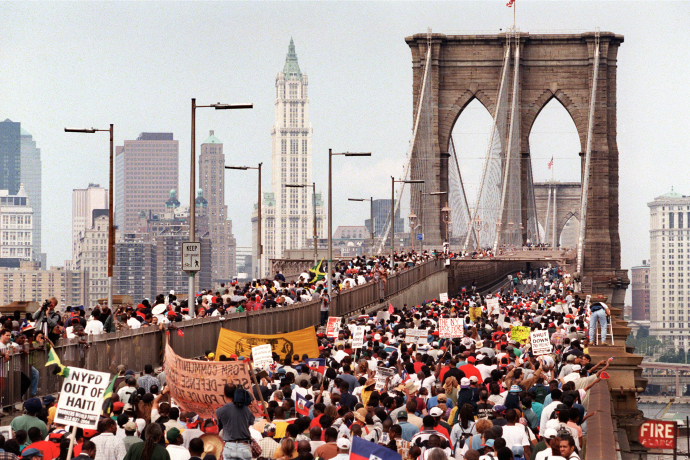
We marched for all of them in the Louima/Diallo decade, seven thousand of us across the Brooklyn Bridge one time. We carried signs and chanted “No Justice, No Peace!” and “Whose streets? Our Streets!” even while fearing that this would never be true. The streets belonged to the people with the uniforms and the guns. The streets at that time also belonged to Mayor Rudolph Giuliani, who believed then, and still seems to believe now, that police brutality is unworthy of public scrutiny so long as black people keep “killing each other.” The streets were never ours to begin with, because on these same streets our sons and brothers, fathers and uncles were, and still are, prey.

My father, a Brooklyn cab driver, used to half joke that the only reason the police didn’t beat him up was because he was too skinny and too old, and not worth the effort. Every now and then, when he was randomly stopped by a police officer and deigned to ask why, he would be given, rather than a beating, a handful of unwarranted traffic citations that would wipe out a few weeks’ hard-earned wages. Today, one might generously refer to such acts as micro-aggressions. That is, until they turn major, until they turn deadly. Until a man who is believed to be selling loose cigarettes has the life strangled out of him in a police chokehold. Until yet another unarmed brown or black body finds itself in the familiar path of yet another police officer’s gun.

The other night, while watching the St. Louis County Prosecutor Robert McCulloch declare that there would be no indictment against Officer Darren Wilson for the killing of Michael Brown, I kept thinking of Abner Louima, whose assault took place on another August 9th, when Brown was just eighteen months old.

Abner and I have known each other for years. Yet I have always steered clear, in my conversations with him, of what happened all those years ago. Yesterday, though, I decided to call him, just to hear his thoughts about Michael Brown and Ferguson, Missouri. If anyone could understand all those broken hearts, all the rage, all the desperation, the yearning for justice that we are seeing in Ferguson and all over the country, I thought, he would.

Abner Louima, unlike Michael Brown, survived. He went on with his life, moved to South Florida, started a business, has done charity work. He has a daughter and two sons. One son eighteen years old, the same age Michael Brown was when he died. His other son is fifteen.

I asked him what he thought of the grand jury’s decision. The question seemed to wear on him. It was one, I could tell, that he was tired of answering. “Like everyone else, I’m very disappointed,” he said, his voice sinking with every word. “It’s not a good signal to send to a system that’s already not working.”

How does he feel each time he hears that yet another black man was killed or nearly killed by the police? “It touches me very deeply each time,” he said. “It forces me to ask myself why so little has changed in all these years since this happened to me. It reminds me again and again that our lives mean nothing.” His case, Abner reminded me, was the last one he could think of, in New York or elsewhere, in which the police officers who had assaulted or killed a black man actually went to jail. In his case, justice was served in part because of the public pressure, and because there were federal prosecutors involved, including the current nominee for Attorney General, Loretta Lynch.

What message does Louima have for Brown’s family, whose son died on what could have been the anniversary of his own death? “My heart aches so much for them,” he said. “I know how difficult this must be for them. Like them, I encourage peaceful protest. Too many lives are being lost, so we can’t just close our eyes and hope it goes away. We must keep raising our voices until we find justice for those who lost their lives, and until these things stop happening.” We both wonder: Will these things ever stop happening?

In 2007, on the tenth anniversary of his assault, Abner Louima wrote an opinion piece for the Daily News reflecting on what had happened to him. “It’s time we all said, “Enough is enough,” he wrote. He still believes that—now more than ever.

North Carolina’s shocking history of sterilization

North Carolina’s shocking history of sterilization

Forced sterilization was the law in 32 U.S. states, and actually inspired the Nazis. We’re just learning the truth

North Carolina's shocking history of sterilization(Credit: Provided by Willis Lynch)
Adapted from “For the Public Good” from The New New South

People generally have two reactions when they hear about American eugenics programs for the first time: the first is shock, and the second is distancing. How could those people have done that to them?

Most have heard of the program in Nazi Germany, in which more than 400,000 people considered unworthy of life — those with hereditary illnesses, but also the dissident, the idle, the homosexual, and the weak — were targeted for forced sterilization beginning in the 1930s. Few realize that the some of the inspiration for Germany’s eugenics program, and even the language for the Nuremberg racial hygiene laws, which among other restrictions banned sexual intercourse between Jewish and non-Jewish Germans, came from eugenicists who had been practicing for years in the United States. Some 60,000 American citizens were sterilized, often under coercion or without consent.

Returning from my first visit with Willis Lynch, I met my in-laws, in town from Northern Virginia, for dinner in Durham, N.C. Lynch was sterilized at age 14 on the recommendation of North Carolina’s Eugenics Board, which determined that he was unfit to father children. When I told them about all he had been through, they were outraged. They had never heard of forced sterilizations taking place in the United States, but blamed their ignorance on where they grew up. “I’m from the North,” said my mother-in-law, who had assumed that Lynch, now 80, is black (he is white). “We didn’t have things like that there.”

I went home and looked it up. Pennsylvania, her home state, never passed a eugenics law, but managed to sterilize 270 people anyway, and also to perform the first known eugenics-motivated castration, in 1889. The first state to enact a eugenics-based sterilization law was Indiana, in 1907; it was followed two years later by Washington and California. Eventually 32 states would pass such legislation. Internationally, the list of countries with a history of forced sterilization includes Canada, Czechoslovakia and the Czech Republic, Denmark, Japan, Iceland, India, Finland, Estonia, China, Peru, Russia, Sweden, Switzerland, and Uzbekistan.

Though North Carolina did not sterilize the greatest number of people (that distinction belongs to California, where 20,000 were sterilized), the state’s Eugenics Board was notorious for its aggressiveness. While many states confined their sterilization programs to institutions, North Carolina allowed social workers to make recommendations based on observations of “unwholesome” home environments or poor school performance. The state’s program was also one of the longest lasting, increasing its number of sterilizations while others were winding down. Between 1929 and 1974, more than 7,600 North Carolinians were sterilized. Like Willis Lynch, many of the victims were children, and consent was provided by relatives or guardians who feared the loss of welfare benefits or other consequences if they refused.

Over more than a decade, sterilization victims waited for North Carolina to make things right. Lynch, for his part, testified at state hearings, gave interviews to newspapers and magazines, and talked regularly by phone with other victims. For years, not much materialized: an apology from Democratic Gov. Mike Easley, expressions of regret and sympathy from his successor, Beverly Perdue, also a Democrat.

Then in 2012, something remarkable happened: A Perdue-appointed task force that had been listening to testimonies from Lynch and others like him for almost two years recommended a package of compensation for the victims of eugenics, and the state’s Republican-led and oft-divided House of Representatives supported the measure in a bipartisan effort. The plan included equal monetary payments to victims, access to mental health resources, and a program of public recognition and education that would ensure that no one would ever forget what happened to them. It began to look like North Carolina would be the first in the nation to address the legacy of eugenics, and victims imagined what they might do with the restitution: pay bills, fix up their homes, visit distant relatives.

The members of the task force were united in their recommendation, but the journey to a proposal that satisfied the victims had not been easy. They’d listened to many hours of painful testimony from sterilized men and women and their families, and had reviewed thousands of pages of supporting documents: medical records, reports from the Eugenics Board, propaganda in favor of eugenics-based sterilization. They’d looked at the faulty science behind eugenics, as well as North Carolina’s unequal targeting of poor, vulnerable, and minority citizens. They’d considered actuarial data to estimate the number of living victims, and calculated the potential total cost of compensation. Though they acknowledged that no amount of money can pay for the harm done by compulsory sterilization, they did, in fact, put a number on the line: $50,000 for each living victim, $50 million total.

But some wondered: Can you put a price on reproductive ability? And is it appropriate, in a time of austerity, to make such large monetary payments, especially when it won’t right the wrongs? Should today’s taxpayers be responsible for something that happened decades ago? Though the effort to include the task force’s recommendations in the House budget had been bipartisan, the measure faced more dissent from the G.O.P.-controlled Senate: The state can’t afford to pay for something that won’t fix any problems, and it was a long time ago, anyway. It wasn’t us.

It is human nature to distance oneself from what now seems cruel, violent, reprehensible. We tell ourselves that we would not have done that, that our country is better than that now. But that same distance — I am not like that, I am better — is what motivated the first eugenicists and their followers.

Like Willis Lynch, Francis Galton was born into a family of seven children, though more than 90 years earlier and thousands of miles away. The circumstances of his early childhood in England were quite different: His father was a wealthy banker, his mother the daughter of physician Erasmus Darwin, making Francis Galton a cousin to the father of the theory of evolution. The Galton family also included a number of prominent gunsmiths, iron mongers, athletes, and Quakers.

Under the tutelage of a doting older sister, Galton showed exceptional intellectual promise even before he was school-aged. He knew his capital letters by 12 months, could read at 2-and-a-half, and could sign his own name by 3. The day before he turned 5, Galton boasted in a letter to his sister: “I am four years old and can read any English book. I can say all the Latin Substantives and Adjectives and active verbs besides 52 lines of Latin poetry. I can cast up any sum in addition and multiply by 2, 3, 4, 5, 6, 7, 8, 10. I can also say the pence table. I read French a little and I know the Clock.” When he finally entered school, he was surprised and disappointed that his classmates did not share his enthusiasm or facility for reciting the “Iliad” or Walter Scott’s “Marmion.” He was sent to a French boarding school at age 8, and at 16, left secondary school to study medicine (a pursuit he later abandoned).

As an adult, Galton had a varied and peripatetic career. He traveled to Africa for anthropological work, discovered the anticyclone, created the first weather map, pioneered the first system of fingerprinting, and developed a “Beauty-map” of the British Isles that compared the relative attractiveness of women. (London had the most beautiful women, according to his research, Aberdeen the ugliest.) He is best known, however, as the father of modern eugenics, an area of study partially inspired by cousin Charles Darwin’s work. Less than a month after the publication of “On the Origin of Species,” Galton wrote, in an admiring letter to his cousin: “I have laid it down in the full enjoyment of a feeling that one rarely experiences after boyish days, of having been initiated into an entirely new province of knowledge, which, nevertheless, connects itself with other things in a thousand ways.” Galton was interested in the potential implications of Darwin’s work on heredity and evolution: Could these principles be used, through selective breeding, to enhance the human gene pool? Likely influenced by the achievements of his own illustrious family, Galton believed that talent and ability are transferred genetically rather than by environment. To Galton’s mind, his particular aptitude for geography, language, and the sciences came not so much from his education and privilege as from his eminent forebears.

Improving human societies through selective breeding was not a new idea, even in the 1800s. In ancient Greece, deformed babies were killed at birth, unwanted ones abandoned to the elements. Spartan elders inspected every newborn for potential contribution to the state — weak babies were dropped into a chasm — and the strongest men and women were encouraged to procreate (including outside of marriage). In the “Republic,” Plato argued that “the best of either sex should be united with the best as often as possible, and the inferior with the inferior as seldom as possible.” The goal was the collective good. If only the strongest and smartest reproduced, then their offspring would, over time, benefit everyone through their industry, bravery, creativity, and strength.

But the term eugenics was not coined until 1883, when Galton published his fifth book, “Inquiries into Human Faculty and Development.” In it, he combined the Greek word eu, meaning good, with the suffix -genes, meaning born, and defined eugenics as “the study of all agencies under human control which can improve or impair the racial quality of future generations.” He identified both positive eugenics (encouraging the breeding of the best) as well as negative eugenics (discouraging and even preventing the unfit from procreation), though he found the former more practical and socially palatable. Arguing that religion and custom had always strongly influenced breeding and marriage, Galton proposed that eugenics, with its ultimate goal of improving human societies, could be introduced to the general public as a new and compelling religion.

With his amateur background in anthropology, Galton classified humans along a line of “Mediocrity,” or average talents. Those above average, especially the most talented, should be encouraged to procreate within their classes, early and often. Those below average, especially the lowest-ranking, should be encouraged to abstain or, at the very least, refrain from tainting the bloodlines of their superiors. He had only a few vague suggestions about how this could be accomplished: intelligent and well-born women should be encouraged to marry at 21 or 22, promising couples provided with inexpensive housing, social inferiors encouraged to regard celibacy as noble self-sacrifice, and habitual criminals segregated, monitored, and denied the opportunity to produce offspring. “What nature does blindly, slowly, and ruthlessly, man may do providently, quickly, and kindly,” he asserted. His vision was Utopian; the English race, after a few generations, would be “less foolish, less excitable, and politically more provident.” Men of special ability, like himself and his cousin, would be less rare, and would be able to contribute more than their fair share to the general population.

Galton soon realized a problem with positive eugenics: Eminence generally appeared later in life, often after the opportunity to marry and produce children. To address this problem, he established London’s Anthropometric Laboratory, the world’s first mental testing center, which sought not only to provide individuals with information about their own abilities, but also to serve as a collection of data for Galton and other scientists. These early tests, offered for three pence each to subjects ranging in age from 5 to 80, were unlike the written test Willis Lynch would take, years later, though their goal was the same: determination of ability or potential. Galton’s tests involved a variety of largely physical measurements: grip strength, head size, tactile sensitivity, breathing capacity, and visual and auditory acuity. His Anthropometric Laboratory collected data on more than 9,000 people, and although there is little evidence that they found much use in the information cards they received, his studies of the data eventually produced the statistical concepts of standard deviation and percentile ranking.

Negative eugenics — preventing those deemed unfit from reproducing — was considerably more challenging, at least as envisioned by Galton. It was not reasonable to expect most people to live a celibate life simply for the betterment of the gene pool, and monitoring ex-cons and other undesirables  was equally daunting. Though the British Eugenics Education Society, founded in 1907, campaigned for sterilization and marriage restrictions for mentally ill citizens, negative eugenics remained mostly the subject of political debate in Britain, and legislation enforcing sterilization of the unfit was never passed. Galton died in 1911 without seeing his “new religion” realized. Despite the genetic promise of his intellectual gifts, he also died childless.

**

The American eugenics movement is often characterized as a progressive folly for its faith in science and its big-government intrusiveness, but the truth is somewhat more complicated. The American Eugenics Society counted among its members some of the country’s most influential Progressive Era businesspeople, philanthropists, and activists, including J.P. Morgan Jr., Mary Duke Biddle, and Margaret Sanger, but the group of scientists and eugenicists who founded it also included well-known racists and anti-Semites. Early outreach efforts often included a mix of public health education and racist, anti-immigration messages.

The Fitter Families for Future Firesides competitions, sponsored by the Eugenics Society starting in 1924, provided one way of reaching out to rural white Americans. Held in state fairs across the country, the contests originated as Better Babies competitions and exhibitions that were meant to educate the public about infant health and mortality. Fitter Families contests, with the goals of collecting data on hereditary traits and spreading the message of eugenics to a wider population, invited entire families to submit to screenings for health, character, and intelligence. Those scoring highest received awards and medals bearing the inscription, “Yea, I have a goodly heritage” and had their photographs taken for the local papers. Following an examination, a family might listen to a Galtonesque lecture on the importance of mating the best with the best; browse an exhibit about comparative literacy rates of foreign, African-American, and native-born white Americans; or read about the social costs of incarcerating the mentally deficient.

At the 1926 Sesqui-Centennial International Exposition in Philadelphia, a poster equipped with flashing lights informed fairgoers that “every 48 seconds someone is born in America who will never grow up beyond the mental age of 8” and that “crime costs America $100,000 every second.” The poster also claimed that  “few normal persons go to jail.” The message received by the “Fittest Families?” You are carrying the burden of the least fit, who should not be having so many children. In one way or another, you will pay for the children of undesirable parents: to feed and clothe them when their parents cannot, to care for them in institutions, and later, to imprison them.

Outside of state fairs and exhibitions, this fear of social dependency had already primed the culture for an embrace of negative eugenics. Large-scale asylums for the homeless and mentally ill, built in the late 19th and early 20th centuries, raised fears that increasing numbers of handicapped citizens were a drain on public resources. The country’s first major immigration law, the Immigration Act of 1882, specifically prohibited entry by any “lunatic, idiot, or any person unable to take care of himself or herself without becoming a public charge.” American eugenicists believed, as Galton did, that people could be bred, like livestock, for desirable traits. Those with undesirable traits, which included everything from alcoholism to criminal recidivism to poverty, could be sterilized.

Indiana passed the first law allowing eugenics-based sterilization in 1907. Thirty-one other states would follow. After constitutional challenges, many employed language and structure from the Model Eugenical Sterilization Law written by Harry Laughlin, one of the founders of the American Eugenics Society. (Laughlin’s law later became the model for Nazi Germany’s Law for the Prevention of Hereditarily Diseased Offspring, and he would receive an honorary degree from the University of Heidelberg for his support of “the science of racial cleansing.”)

Laughlin proposed a position of state eugenicist, whose function was “to protect the state against the procreation of persons socially inadequate from degenerate or defective physical, physiological or psychological inheritance.” He defined a socially inadequate person as one who, in comparison with “normal” persons, fails to maintain himself as a useful member of the state, and he set out the socially inadequate classes: the feeble-minded, the insane, the criminalistic, the epileptic, the inebriate, the diseased, the blind, the deaf, the deformed, the crippled, and the dependent (including “orphans, ne’er-do-wells, the homeless, tramps and paupers”). Twenty years later, Virginia’s Sterilization Act, patterned after Laughlin’s, was found constitutional by the U.S. Supreme Court in the Buck v. Bell case, in which Chief Justice Oliver Wendell Holmes famously wrote, about the family of 19-year-old Carrie Buck, “three generations of imbeciles are enough.”

North Carolina’s first sterilization law was recorded in 1919, but sterilizations did not begin until 1929, after the passage of Buck v. Bell, when one vasectomy, one castration, and one ovariectomy were performed (the state’s law was unusual in allowing castrations for “therapeutic treatment”). In 1933, the law was declared unconstitutional by the state’s Supreme Court on the basis of a deficient appeals process, and a second law was passed that year, ostensibly providing for due process for the individuals recommended for surgery. Sterilizations could be petitioned by the superintendent of public welfare, the heads of prisons or other institutions housing potential patients, or their next of kin or legal guardians. Despite the ability of individuals to appeal such recommendations, the statute was broad, allowing the Eugenics Board to overrule objections and authorize sterilizations in the best interest of the individual, for the public good, or if the individual was suspected to produce children with “a tendency to serious physical, mental or nervous disease or deficiency.”

By July 1935, the state had sterilized 223 men and women, most of them residents of state-run institutions. Though it would take another decade for public opinion to begin turning away from eugenics, “Eugenical Sterilization in North Carolina,” a report published by the state that year, envisioned a public that still needed convincing. The report argued, among other things, that sterilization was protection that benefitted both society and the sterilized individual:

There is no discovery vitally affecting the life, happiness and well being of the human race in the last quarter of a century about which intelligent people know so little, as modern sterilization. The operation is simple, it removes no organ or tissue of the body. It has no effect on the patient except to prevent parenthood. Under conservative laws, sanely and diplomatically administered, as they have been in California, these discoveries developed by the medical profession now offer to these classes the greatest relief possible and the greatest protection to the defenseless child of the future. It offers one, humane, practical protection against threatened race degeneracy.

Adapted from “For the Public Good” by Belle Boggs. Copyright 2013 The New New South. All rights reserved.


Belle Boggs is the author of the story collection “Mattaponi Queen,” which won the Bakeless Prize and the Library of Virginia Award.

Marissa Alexander Facing 60 Years in Prison for Firing a Warning Shot in Self Defense | The Nation

Marissa Alexander Now Faces 60 Years in Prison for Firing a Warning Shot in Self Defense | The Nation.

Florida State Attorney Angela Corey will seek to triple Marissa Alexander’s original prison sentence from twenty to sixty years, effectively a life sentence for the 33-year-old woman, when her case is retried this July, The Florida Times-Union reports.

Alexander was convicted on three charges of aggravated assault in 2012 for firing warning shots in the direction of Rico Gray, her estranged husband, and his two children. No one was hurt. Alexander’s attorneys argued that she had the right to self-defense after Gray physically assaulted and threatned to kill her the day of the shooting. In a deposition, Gray confessed to a history of abusing women, including Alexander.

In September of 2013 a District Appeals court threw out the conviction on grounds that Circuit Judge James Daniel erroneously placed the burden on Alexander to prove she acted in self-defense, when she only had to meet a “reasonable doubt concerning self-defense.”

Judge Daniel originally slapped Alexander with three twenty-year prison sentences, but ordered that they be served concurrently. If Alexander is convicted a second time in July, State Attorney Angela Corey will seek consecutive sentences, adding up to sixty years in prison.

Florida’s 10-20-Life law imposes a mandatory minimum of twenty years in prison for anyone who fires a gun while committing a felony. Angela Corey’s prosecution team says it is following a court ruling that multiple convictions for related charges under 10-20-Life should carry consecutive sentences.

The advocacy group Free Marissa Now released a statement calling Corey’s move a “stunning abuse of power.” Members of the group say Corey is pressing for a longer sentence to thwart attention from accusations of prosecutorial misconduct, as well as recent failures in high-profile trials. Corey failed to secure murder convictions for George Zimmerman and Michael Dunn, two men who fatally shot black teenagers.

“Remember that when Marissa Alexander fired her warning shot to save her own life, she caused no injuries. Now she’s facing the very real possibility of spending the rest of her life in prison for that act of self-defense,” said advocate Sumayya Fire in the statement. “That should send a chill down the back of every person in this country who believes that women who are attacked have the right to defend themselves.”

“Spent: Looking for Change” A Movie ♠ Personal Financial Crisis – Americans with NO OPTIONS

“Spent: Looking for Change”


“Spent: Looking for Change” is a film about everyday Americans without the financial options most of us take for granted and the movement giving them renewed hope. To find out more and take action, visit http://spentmovie.com/.

Turning to pawn shops, check cashing services, and using payday loans to meet basic financial needs can be costly for many of us, with $89 billion a year going to fees and interest* for using these types of alternative financial services.

It’s time for change. New technology, new ideas and encouraging dialogue around this issue can help make managing money simple and more affordable.

American Express is presenting this documentary to help improve financial inclusion in the United States. Academy Award®-winning filmmaker Davis Guggenheim is the executive producer of the documentary which is narrated by Tyler Perry and directed by Derek Doneen.

* Source: CFSI, November 2013 Market Sizing Report

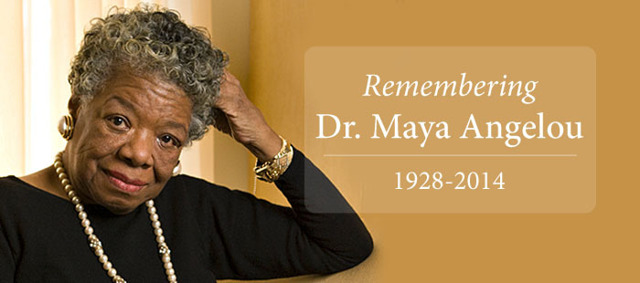
“Into a daybreak that’s wondrously clear . . . I RISE” φ Victory Service Honoring the Life of Dr. Maya Angelou

20030306F_christman9332

“Out of the huts of history’s shameφ
I rise
Up from a past that’s rooted in pain
I rise
I’m a black ocean, leaping and wide,
Welling and swelling I bear in the tide.
Leaving behind nights of terror and fear
I rise
Into a daybreak that’s wondrously clear
I rise
Bringing the gifts that my ancestors gave,
I am the dream and the hope of the slave.
I rise
I rise
I rise”


Watch the full Service Here

Farewell Brother Elombe φ The Pan-African Community Honors Elombe Brath

In Remembrance of Brother Elombe

Playthell Benjamin
Commentaries On the Times

Pleading the cause of African Peoples

Praise Song for a Tireless Pan-African Soldier φ

A more committed fighter for black liberation

Has yet to be born

And his mother is dead

Now that he has danced and joined the pantheon of honored ancestors

We shall never see his like again

For when the Gods fashioned Elombe Brath

They smashed the mold

I first met Elombe Brath at the Speaker’s Corner, which was at the intersection of 125th Street and Seventh Avenue in his beloved Harlem, 52 years ago. There was no state office building there at the time, and Congressman Adam Clayton Powell Jr. – for whom the building is named and whose statue now stands on that spot, – was alive and well and giving the southern redneck crackers hell…… in the halls of Congress. Where the State Office building now stands was Michaux’s book store – which displayed a sign over the entrance that announced: “The House of Proper Propaganda!”

There one could purchase every book on black history and radical political thought in print. It was a worthy annex to the Schomburg Collection, the largest collection of materials on the black world to be found anywhere. It was here that leaders of the newly liberated African nations and revolutionary movements fighting to rid Africa of all vestiges of European colonialism on the continent spoke to the people of Harlem.

Kwame Nkrumah, who led the first Ghana, sub-Saharan African nation to independence spoke there; Robert Mugabe spoke there just before he negotiated the independence of Zimbabwe at Whitehall in Britain, and the great Madiba, Nelson Mandela spoke there right after he was released from the prisons of the Apartheid South African government. Elombe was the Master of Ceremonies on that great day and he invited Duruba bin Wahad, an Afro-American revolutionary who had spent 27 years in the prisons of racist America, just as Mandela had done in South Africa, to speak.

This corner was also where home grown Pan-Africanist revolutionaries like Carlos Cook – who first tutored Elombe in Black Nationalism – “Pork Chop Davis,” Malcolm X, and Drs. Ben and John Hendrik Clarke held forth in grand orations that recounted the African past, envisioned the redemption of the motherland and called for a renaissance that would create a modern African culture capable of producing a mighty civilization that could defend African peoples against European domination everywhere. It was an incubator of revolutionary freedom dreams, a place where revolutionaries came for spiritual fortification and freedom highs.

It was here that a curious Vietnamese sailor – who visited New York on a French freighter and was chased uptown by white racist who told him his place was in Harlem – accidentally stumbled upon a rally where the great orator and Black Nationalist leader Marcus Garvey was holding forth. He was so inspired by what he witnessed on this corner that he went home and began organizing a nationalist movement in his country. When white folks heard of him again he had crushed the French army at Dien bien Phu, and was known to the world as Ho Chi Mien!

This is the corner where Elombe and I first met. I was up on a ladder, as was the custom at the time, running down an impassioned Marxist rap. Standing below me checking me out with a blasé stare was this sharp dude, a Harlem hep cat who looked to smooth to move. He held a stack of what seemed to be magazines under his arm, and he was accompanied by another dude fumbling with a camera who kind of favored him and I surmised that they must be related.

I thought I was really droppin science, the “Science of Society,” as I had been told by my political tutors – a very impressive group of older black radical leftist intellectual/activists that Queen Mother Moore had recently introduced me too. But when I came down from the ladder, the guy with the magazines said “Where you from Jack….that stuff you talkin went outta style in the forties here in Harlem. Revolutionary Pan-African Nationalism is what’s happenin now brother….you got to check out George Padmore Brother…Pan-Africanism or Communism!”

He introduced himself as Ronnie Brathwaite, and the other guy as his brother Cecil – they would later become Elombe and Kwame. Before I could recover from his cavalier dismissal of my speech, he dropped a copy of the magazine on me; which turned out to be a softback book of cartoons titled “Color Us Cullud.”

I took the book and when I got back to Philadelphia, where I was living at the time, I gave it a close reading and was thoroughly fascinated by its contents. To say that I had never seen cartoons of such power and irreverence is an understatement. I had seen scandalous cartoons before, such as the notorious “Tijuana Bibles,” which featured all of the most popular cartoons from the nation’s newspapers and animated shorts in the movie theaters that preceded the feature films, performing pornographic acts.

But these cartoons were irreverent in a different way: they were incendiary political statements. I can still remember some of those cartoons as if Elombe gave them to me yesterday, such was their power. In fact, one of his biggest fans was Malcolm X – even tho he took a little swipe at them too.

Although most people know Elombe as a tireless activist, compelling orator and walking archive of the African revolution who seemed to have the entire history of the modern African struggle against European colonialism neatly filed in his head, and could call it up in detail at will…the Griot of the African revolution. He was all that and more.

Yet Elombe was by training and sensibility an artist. He was the first person I ever met who viewed art as a potent weapon for liberation and knew how to wield it with the devastating effect of a Zulu warrior with an assegai. Since Elombe was a Black Nationalist he was naturally skeptical of, and even hostile to, the integrationist ideology that was the dominant trend in the mid-twentieth century.

He belonged to a tradition that had been the reigning ideology of black Americans in the mid-19th century, a time when secular black intellectuals like Dr. Martin Delaney and Robert Campbell as well as scholarly clergymen like Bishop Alexander Crummell and Edward Wilmont Blyden were all ardent nationalists and emigrationist that actually travelled to Africa on a mission of redemption. They were Pan-Africanists before the term was invented.

The great scholar on this subject, Professor Wilson Jeremiah Moses, tells us in his seminal book, “On the Wings of Ethiopia,” that Black Nationalist ideology was so pervasive during this period, when millions of Africans in America were regarded as livestock under southern laws crafted by slave masters, that it is virtually impossible to distinguish black Christianity from Black Nationalism.

This is the tradition that Marcus Garvey inherited and plugged into when he arrived in Harlem from Jamaica during the second decade of the 20th century, and explains why he was able to build a mass movement based on Black Nationalist ideology among the black minority in America and not in the West Indies where there was a black majority.

Elombe Brath belonged to this tradition and forged and ideology that was much like that of Kwame Nkrumah, who defined his philosophy of liberation as being part Garveyism and part Marxist. I think Dr. Clark pegged him just right when he said “Elombe is a good Garveyite and a middling Marxist.”

Hence Elombe’s political cartoons reflected his nationalist ideology and contempt for integrationist doctrine, just as Bishop Crummell expressed his contempt for integrationist in the 19th century by constantly referring to the great Abolitionist Frederick Douglass as “that mulatto showman!” For instance, among Elombe’s drawings was a cartoon of SNCC activist marching with a big banner that read “Masochism is our Stick Baby!”

His thinly veiled reference to Dr. King as “Reverend Eat A. Chicken Wing,” or his series of caricatured images of Sammy Davis Jr. under the headline “Sammy Davis Jr. is a Race Man…racing after white women, racing after white society, etc were poignant statements that raised the art of the political cartoon to a high level.. It is a testament to the power of these images and their biting witty scandalous captions that I remember them so graphically after half a century!

It was Elombe’s remarkable understanding of the power of art to inspire and fuel a movement for liberation that led him, in conjunction with his brother Kwame, to found the African Jazz Art Society in 1956 and recruit the great Jazz artists Max Roach and Abby Lincoln – the First Couple of what would soon become the Blacks Arts Movement in the 1960’s – to join them in their effort to create and promote a revolutionary black art. There are some highly influential art movements whose origins can be traced to a particular time and place.

For instance DaDa, – a European art of random choice born of a loss of faith in organized modern technological civilization in the aftermath of the barbarism of World War I – can be traced to the Café Voltaire in Geneva Switzerland. And the Bebop revolution, in which Charlie Parker, Dizzy Gillespie, Thelonious Monk, and Kenny “Klook” Clarke transformed modern western music, can be located in Minton’s Playhouse here in Harlem.

Thus the Black Arts Movement of the 1960’s, which changed the cultural consciousness of African Americans, began with the founding of the African Jazz Art Society in New York City. While others have emerged in popular lore as “The Father of the Black Arts Movement,” the real fathers of the movement are Elombe, Kwame and Max Roach. For the record, when these Brothers founded the African Jazz art Society, Leroi Jones, who would become Amiri Baraka over a decade later, was happily married to Hettie Cohen, living in Greenwich Village, and was a leading poet in the Beat literary movement.

By virtue of the fact that Elombe was an artist he saw the black struggle in visual terms, and he was well aware that black people everywhere were inundated with racist images designed to degrade us, to portray us as less attractive than the lighter races. If virtue itself was white, and God was a blue eyed white man with long flowing blond hair, then where does that leave those of us who are “of the deepest dye” – as the 18th century black scientist and designer of Washington DC Benjamin Banneker described himself in a letter to Thomas Jefferson, accompanied by a mathematical treatise, defending the intellect, indeed the humanity, of the African.

Elombe, like the great Afro-Brazilian scholar/activist Abdias do Naciemento, saw attacking the white standard of beauty as fundamental to the psychological liberation of black people who had suffered centuries of slavery and racial discrimination. Do Nascimento addressed the problem by organizing beauty contests for black women and mulatto women in Brazil, and The African Jazz Art Society, which combined jazz performances with exhibitions of visual art, added fashion shows by the Grandassa Models, stunning black women with Afro hair styles and Afrocentric clothing.

They would host shows with titles like “Naturally 63.” I remember when they came to Philadelphia to do a show and I thought I had stumbled into an African wonderland, where Black was unquestionably beautiful. It was a revelation to many people. Hence the slogan “black is beautiful,” natural hair styles and Afro-centric dress all started at the African Jazz Art Society, and spread across black America…and then the black world, like wildfire.

I know whereof I speak because I witnessed it! What is all the more remarkable is that Kwame and Elombe were teenagers when they first came up with some of these ideas. They began by promoting Jazz concerts in the Bronx and their first artist was the great Betty Carter – which is a demonstration of their exquisite artistic taste. And furthermore they did this without following the dictates of some well formulated theory, figuring it out as they went about. When they encountered obstacles they just improvised like the performances of the Jazz musicians they so admired.

Like Duke Ellington, who came to New York as an art student at Pratt Institute in Brooklyn but found his greater calling in music, Elombe would find a greater calling in revolutionary struggle. And just as Duke’s training as a visual artist greatly influenced the character of his music, Elombe’s essential artist’s soul affected his approach to politics. Both Duke and Elombe were brilliant autodidacts, self-taught men who made highly original contributions in their chosen field of endeavor.

In this sense Elombe belongs to a larger tradition of the broadly learned activist autodidact. The tradition of Frederick Douglas, CLR James, J. A. Rogers, Hubert Harrison, John Hendrik Clarke, Queen Mother Moore, James Boggs, Harold Cruse, James Baldwin, Malcolm X, et al. Although Elombe never got a college degree, I don’t know any academic that had a greater command of the facts regarding the African liberation movement, and its relationship to the world revolutionary movements of the 20th century.

I say this having taught African history and politics in the WEB Dubois Department of Black Studies at the University of Massachusetts, alongside Chreif Guelal, who was a central committee member of the Algerian National Liberation Front, that fought and won one of the greatest revolutions in the twentieth century, and had served as an aid de camp to Dr. Franz Fanon, one of the most profound black revolutionary thinkers of the 20th century.

The liberation of African peoples is an amazingly complex subject that requires knowledge of European, Asian, and Latin American history and political affairs. The program Elombe hosted for many years on WBAI, “Afrikalidescope,” was a vital forum for serious informed discussion of African issues that has no counterpart in American media.

As an activist we can only marvel at the scope of his interests and the source of his energy. He was a soldier in the struggle 24/7. It is as if he felt that the weight of the entire black world was on his shoulders. I remember being at a party once and Elombe disappeared. When I asked where he was, somebody said “He’s probably in the bathroom holding a meeting!”

It is nothing short of amazing that, working without any kind of foundation or philanthropic support, Elombe managed to carry on the work of providing support for leaders of African liberation movements exiled in the US. For half a century! Beginning in 1975 this work was conducted under the auspices of the Lumumba Coalition, an organization Elombe founded and named in honor of Patrice Lumumba, the assassinated leader of the independence movement in the Belgium Congo who became its first Prime Minister. Some of the African revolutionaries Elombe supported became important government officials after winning independence.

Thus he could have left the US and spent his later years as an honored guest in Africa, but he never abandoned our struggle. He visited Africa, basked in the abundant accolades, yet he always returned to the protracted struggle on the home front, much of it as a member of the December 12th Coalition, and remained a fighter until the end – a noble warrior carried out on his shield. Remarkably, commitment to the struggle for the advancement of the black working class seems to be encoded in the genes of this family.

In Barbados, the ancestral home of the Braithwaite family, Elombe’s cousin, Clenell Wickham, waged a long fight in behalf of black workers from his position as an Editor of the Herald, a local newspaper, during the era of British colonialism. Yet throughout his many years in the fight, Elombe maintained a job as a graphic artist at WABC television, where he was a strong union man and shop steward, going in to work on the graveyard shift after a day of movement activity.

He was there when Gil Nobel came to ABC to host Like It Is; he reached out to Gil and his contributions to the character of that show is beyond measure….and was responsible for much of its popularity among serious movement people. Elombe was responsible for virtually all of the coverage of African issues, after all before coming to ABC Gil was a newsman on black radio. He, like most of the black newsmen in major white media at the time, was hired as a result of the black urban rebellions when white reporters were afraid to go into black communities to cover the story.

Gil Noble had not spent his life dealing with African issues and radical Afro-American American movements like Elombe; hence Gil was mightily instructed by their association. The fact that both of them were Jazz lovers – Gil was a pretty good pianist – no doubt helped to cement their relationship.

Any remembrance of the life of Elombe must point out that, unlike all the so-called “revolutionaries” who claim they were too busy making the revolution to marry their baby’s mama and raise their kids, Elombe was a steadfast husband and father who along with his wife of many years, Helene Normsa Brath, a former Grandassa Model, raised seven sons in Harlem. His wife homeschooled some of them and they went on to college, none of them went to jail!

If this were his lone achievement in these trouble times, it would be worthy of sustained applause. My standards for heroes are rigorous; hence I have few of them. Elombe was at the top of my list, a hero worthy of our youths; the highest expression of manhood. A mighty tree has fallen in Harlem….and we are all poorer because of it. So I say to my departed comrade: Hail and farewell!

**********************

Playthell Benjamin

Harlem New York

May 27, 2014

**Photos of Elombe by: Kwame Brathwaite

Photo of Kwame by: Playthell Benjamin

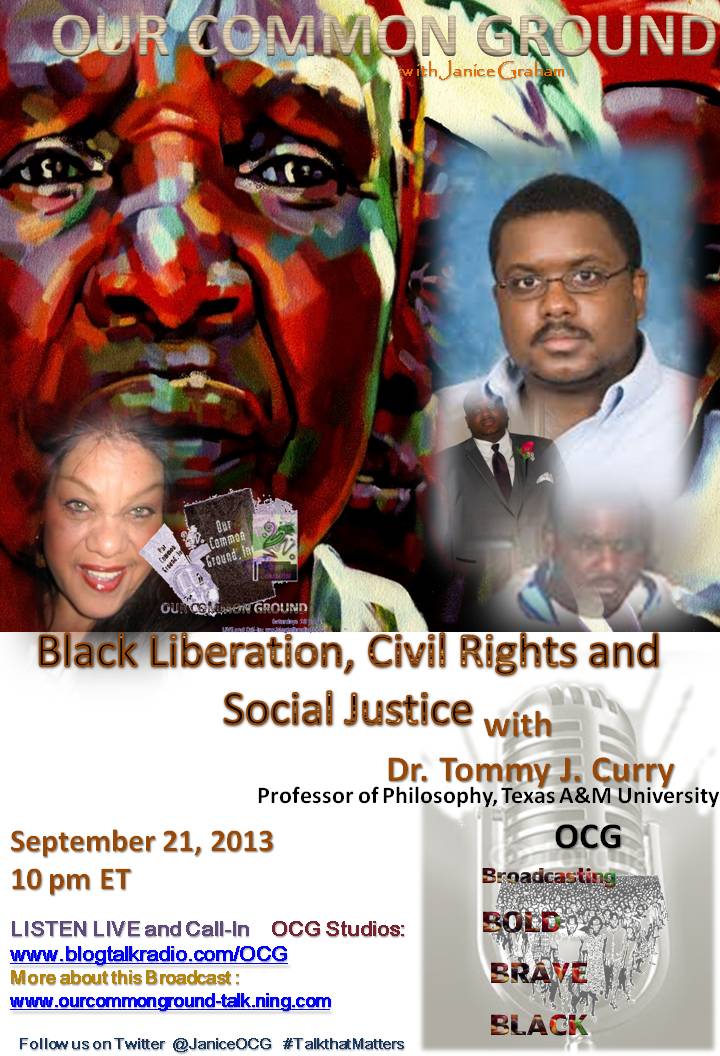
Talking about white Privilege is not Profound, its just for profit. φ Dr. Tommy J. Curry

curryvoicesTalking about white Privilege is not Profound, its just for profit.

By: Dr. Tommy J. Curry

There is a growing economy for discussions about white privilege in this country that are employing Black and brown intellectuals and whites who profess anti-racism, to be the missionaries that save white souls. white privilege, or the idea that white individuals are born with unearned benefits and advantages, over others has been making its way through out the public media as well as the classroom. On the face of it, this seems like a radical conversation. Black, brown and some white people calling out white liberals and conservatives for their racism, and starting “real” conversations about race that air on MsNBC,CNN and even the Huffington Post. But conversations about white privilege are not really conversations about race, and certainly not about racism—its a business—WHERE BLACKS MARKET THEMSELVES AS RACIAL THERAPISTS.

See the first discussions of white privilege like W.E.B. DuBois’s Black Reconstruction (1935) or George Lipsitz’s The Possessive Investment in whiteness, or even Cheryl Harris’s “whiteness as property,” came from the radical Black intellectual tradition (race-crits, Black nationalists, Pan-Africanists) that did not believe that whites would simply donate their power and act against their global racial interests to be good people IN THE EYES OF BLACKS, people they owned and still imprison. DuBois, and Lipsitz understood there is an antipathy and power in being against Blacks. Like George Jackson said, regarding the ILLUSION many Black academics have in romanticizing their ability to solve racism, “the white race, the economic elites of America, are not going to let themselves be educated out of existence. But today, you sound radical, progressive and insightful by MARKETING YOURSELF as a therapist for whites, and know nothing about the actual conditions, structures, and ills that concretely affect the lives of Blacks. You can even talk about white privilege and not even know the names of the Black thinkers, the literature, the context, or the history the term comes from, and get acclaim for only citing white celebrities like Peggy McIntosh or Tim Wise.

It’s not genius to say in an oppressive society there are benefits being in the superior class instead of the inferior class. That’s true in any hierarchy, being on the top is better than being on the bottom, but the speaker of white privilege gets to pretend that America is not oppressive, they love America, they just want whites to surrender their privilege so we can be equal. See the revolutionary doesn’t have white friends: the government killed MLK, Assata is called a terrorist, Derrick Bell is erased from a field he started, because they spoke about the actual racial and economic tyranny of corporations, governments, the military and the white public, but the for profit revolutionary wants to be commodified by whites…that Black friend that feels like they cured the racist white, while that same white person gets to point to these very relationships as proof they are healed and show to other whites they are the “white ally.”

Conversations about white privilege are simply moral appeals to the conscience of whites who have shown themselves to be committed to racism and social inequity IN THE IDLE HOPE THAT THEY change their mind. The implication of talking about privilege suffers from a childlike naiveity, it suggests that simply exposing racism and the privilege of whiteness to the white mind motivates whites to no longer act in their own self interest. See like the liberal utopia born out of integration, there is an unjustifiable assumption that telling whites about their social position means they are willing to surrender their power to appease a pop culture account of oppression. Think about the dishonesty of this approach. Black people, oppressed people, know there is a fundamental difference between being oppressed/Black and not oppressed, a citizen, white. We call for “national conversations on race,” where these public intellectuals get credit for starting conversations that amount to little more than allowing white America the opportunity to deny the actual realities Black America suffer from. And regardless of the outcome they come out LOOKING LIKE PROPHETS. This issue is white supremacy, and anti-Black death…trying discussing that…and see if your oppressor recognizes you then.

I remember at a recent APA I sat next to a feminist of color trying to get her white male student who couldn’t get a job in the white figures he studied and wrote a book on, and never studied race, racism, or Black philosophy, a job. This professor felt comfortable telling him if you start talking about white privilege, where she claimed the field was going, he could land a race job easily. Think about this. So all the Black, Brown, and Indigenous scholars who study the raw histories of oppression and resistance lose out because they don’t want to give white liberals and conservatives a guilt trip. This is a powerful example of how as an academic discussion white privilege distracts the oppressed, and empowers the oppressor class to be employed in discussing systems they have no real interest in dismantling.

Dr. Tommy J. Curry, The Nationist

9-14-13 Curry4