Has Civil Rights Activism Been Replaced by Endless Panels? Φ Crew of 42

Has Civil Rights Activism Been Replaced by Endless Panels?

Posted On 09 Apr 2014
  Ask yourself: Have you ever seen a photo of Dr. Martin Luther King, Jr. sitting on a panel? On the eve of the 50th anniversary of the signing of the Civil Rights Act we should ask ourselves: Has activism been replaced by “paneling” and hot air?

At every annual convention.  At every luncheon.  At every conference. There is the panel discussion as the centerpiece of the “agenda.”  And for the most part, these sessions repeat already known information and no calls to action.

Where the centerpiece of the American civil rights movement of the 1950s and 1960s was results based physical activities such as marches, boycotts and civil disobedience, the centerpiece now appears to be lots and lots of talking.

The activities of five decades ago yielded big results — like the Civil Rights Act — few of those big results and political victories can be seen today. And the problems, for the African American community in particular, are getting larger. 

Can panels create change and get results at a time when the wealth gap between black and white is the worst in 40 years and the dropout and incarceration rates remain at crisis levels?  Can marches get the same results they did in the 1960s as a more money and tech driven political landscape drives agendas?

Were it not for Rev. William Barber’s Moral Mondays there would be no consistent activism at all.  But even with those events one has to ask: Are the marches yielding tangible results?  It’s likely Dr. King didn’t have time for panels.  The actions Dr. King took got results and won victories.  Like the signing of the Civil Rights Act of 1964.

Lauren Victoria Burke is the creator of the blog Crewof42 and is the Managing Editor of Politic365.com. Ms. Burke has enjoyed employment with USAToday.com and ABC News and holds a B.A. in History from The American University. Contact: LBurke007@gmail.com. Twitter: @Crewof42

– See more at: http://www.crewof42.com/slide/has-civil-rights-activism-been-replaced-by-endless-panels/#sthash.onItQYKK.dpuf

Justice Sotomayor’s Powerful Defense of Equality

AP Photo/Steven Senne

Supreme Court Justice Sonia Sotomayor

 Yesterday, the Supreme Court upheld a provision of Michigan’s constitution that bans the state or any of its subdivisions from “grant[ing] preferential treatment to any individual or group on the basis of race, sex, color, ethnicity, or national origin in the operation of public employment, public education, or public contracting.” The Court was fractured; the six justices who voted to uphold the amendment did so for three independent reasons. Written by Justice Anthony Kennedy, the plurality decision—to which Chief Justice John Roberts and Associate Justice Samuel Alito signed on—was narrow: It upheld the amendment without disturbing any precedent. Far more interesting was Justice Sonia Sotomayor’s dissent, which makes a strong case for a robust interpretation of the equal-protection clause of the 14th Amendment and represents perhaps her most compelling work in her tenure on the Court so far.

The case for upholding Michigan’s amendment, which was adopted through the ballot-initiative process, seems compelling at first glance. Even if one agrees that affirmative-action programs are generally constitutional, it surely cannot be the case that the Constitution requires states or the federal government to adopt affirmative-action policies. Had Michigan never adopted affirmative-action policies or had the legislature repealed them, this would presumably not raise a serious constitutional question. So why wouldn’t the citizens of Michigan be able to make the same policy choice? “There is no authority in the Constitution of the United States or in this Court’s precedents,” Kennedy asserts in the plurality opinion, “for the Judiciary to set aside Michigan laws that commit this policy determination to the voters.”

In the most relevant precedent, the Court ruled in 1976 that a Washington constitutional amendment that banned the use of bussing to integrate schools violated the 14th Amendment because it “impose[d] substantial and unique burdens on racial minorities.” Joined by Justice Ruth Bader Ginsburg, Justice Sotomayor makes a powerful argument that this and related precedents require the Court to strike down the Michigan initiative.

The core of the Court’s “political-process” precedents, Sotomayor observes, is that minorities have access to the state’s democratic procedures. The Constitution “does not guarantee minority groups victory in the political process,” but it does “guarantee them meaningful and equal access to that process. It guarantees that the majority may not win by stacking the political process against minority groups permanently, forcing the minority alone to surmount unique obstacles in pursuit of its goals—here, educational diversity that cannot reasonably be accomplished through race-neutral measures.” Reallocating power in the way Michigan does here therefore raises serious equal-protection concerns.

Sotomayor’s dissent cites a landmark Kennedy opinion: Romer v. Evans, in which the Court struck down a Colorado initiative forbidding the recognition of sexual orientation as a protected category under existing civil-rights laws. Sotomayor observes that Romer “resonates with the principles undergirding the political-process doctrine.” The Court forbade Colorado from preventing a disadvantaged minority access to the state and local political processes, even though states are not constitutionally required to pass civil-rights laws.

When burdens are placed on minorities that affect access to the political process, the possibility of discrimination is particularly acute, allowing exclusionary politics to become self-perpetuating.

Sotomayor’s dissent also offers a useful defense of the political-process doctrine and its strong roots in the 14th Amendment. Starting with the famous fourth footnoteof Carolene Products in 1938, the Court has held that state actions that burden minorities should be subject to heightened judicial scrutiny. When burdens are placed on minorities that affect access to the political process, the possibility of discrimination is particularly acute, allowing exclusionary politics to become self-perpetuating.

It is instructive that in their concurrence Justices Antonin Scalia and Clarence Thomas mock the influence of Carolene Products: “We should not design our jurisprudence to conform to dictum in a footnote in a four-Justice opinion.” This is grimly ironic, given that Justice Scalia and Justice Thomas recently joined an opinion gutting the Voting Rights Act based on highly implausible bare assertions made by dicta in an opinion written by Chief Justice Roberts less than five years ago. With respect to Carolene Products, conversely, what matters is not merely the footnote in one opinion but the fact that it conforms to the 14th Amendment, and was elaborated on in many subsequent cases. Several of these precedents were the political-process rulings that were supposed to control the outcome in yesterday’s case. As both Scalia from the right and Sotomayor from the left argue, it’s hard to deny that these precedents have been silently overruled, even if the plurality says otherwise.

The consequences of Michigan’s constitutional amendment illustrate the ongoing relevance of the Court’s equal-protection precedents. As the dissenters point out, the percentage of African-American students getting degrees from the University of Michigan was the lowest since 1991 after the amendment passed. In addition, the percentage of racial minorities in freshman classes at Michigan’s flagship university has steadily declined—even as racial minorities comprise an increasing percentage of the state’s population. This does not in itself prove that the Court was wrong to uphold it, but it does show that the elimination of affirmative action is unwise, and at a minimum the Supreme Court should show deference to elected decision-makers who determine that it is necessary.

Hillary’s Nightmare? A Democratic Party That Realizes Its Soul Lies With Elizabeth Warren

2016

NOVEMBER 10, 2013

THE NEW REPUBLIC

Hillary’s Nightmare? A Democratic Party That Realizes Its Soul Lies With Elizabeth Warren

BY NOAM SCHEIBER @noamscheiber

 We’re three years from the next presidential election, and Hillary Clinton is, once again, the inevitable Democratic nominee. Congressional Republicans have spent months investigating her like she already resides in the White House. The New York Times has its own dedicated Clinton correspondent, whose job it is to chronicle everything from Hillary’s summer accommodations (“CLINTONS FIND A NEW PLACE TO VACATION IN THE HAMPTONS”) to her distinct style of buckraking (“IN CLINTON FUNDRAISING, EXPECT A FULL EMBRACE”). There is a feature-length Hillary biopic in the works, and a well-funded super PAC—“Ready for Hillary”—bent on easing her way into the race. And then there is Clinton herself, who sounds increasingly candidential. Since leaving the State Department, Clinton has already delivered meaty, headline-grabbing orations on voting rights and Syria.

Yet for all the astrophysical force of these developments, anyone who lived through 2008 knows that inevitable candidates have a way of becoming distinctly evitable. With the Clintons’ penchant for melodrama and their checkered cast of hangers-on—one shudders to consider the embarrassments that will attend the Terry McAuliffe administration in Virginia—Clinton-era nostalgia is always a news cycle away from curdling into Clinton fatigue. Sometimes, all it takes is a single issue and a fresh face to bring the bad memories flooding back.

The last time Clinton ran, of course, the issue was Iraq and the gleaming new mug was Barack Obama’s. This time the debate will be about the power of America’s wealthiest. And, far more than with foreign policy, which most Democrats agreed on by 2008, this disagreement will cut to the very core of the party: what it stands for and who it represents.

Christopher Gregory/The New York Times/Redux
Elizabeth Warren

On one side is a majority of Democratic voters, who are angrier, more disaffected, and altogether more populist than they’ve been in years. They are more attuned to income inequality than before the Obama presidency and more supportive of Social Security and Medicare.1 They’ve grown fonder of regulation and more skeptical of big business.2 A recent Pew poll showed that voters under 30—who skew overwhelmingly Democratic—view socialism more favorably than capitalism. Above all, Democrats areincreasingly hostile to Wall Street and believe the government should rein it in.

(WATCH: The ten best Elizabeth Warren viral videos out there)

But as central as this debate is to the identity of the party, Democrats won’t openly litigate it until they’re forced to ponder life after Obama. Partly out of deference to the president, partly out of a preoccupation with governing, and partly because there is no immediate political need, parties rarely conduct their internal soul-searching when they control the White House. It’s only when the president finally contemplates retirement that the feuding breaks out with real violence. Think of the Republican Party after George W. Bush. Or, you know, Yugoslavia.

 Judging from recent events, the populists are likely to win. In September, New York City Public Advocate Bill de Blasio, running on a platform of taming inequality, routed his Democratic mayoral rival, Christine Quinn, known for her ties to Michael Bloomberg’s finance-friendly administration. The following week, Larry Summers, Obama’s first choice to succeed Ben Bernanke as Federal Reserve chairman, withdrew his name from consideration after months in which Senate Democrats signaled their annoyance with his previous support for deregulation. Not 48 hours later, Bill Daley, the former Obama chief of staff and JP Morgan executive, ended his primary campaign for governor of Illinois after internal polls showed him trailing his populist opponent.

All of this is deeply problematic for Hillary Clinton. As a student of public opinion, she clearly understands the direction her party is headed. As the head of an enterprise known as Clinton Inc. that requires vast sums of capital to function, she also realizes there are limits to how much she can alienate the lords of finance. For that matter, it’s not even clear Clinton would want to. “Many of her best friends, her intellectual brain trust [on economics], all come out of that world,” says a longtime Democratic operative who worked on Bill Clinton’s 1992 campaign and then for Hillary in the White House. “She doesn’t have a problem on the fighting-for-working-class-folks side”—protecting Medicare and Social Security—“but it will be hard, really wrenching for her to be that populist on [finance] issues.”

Which brings us to the probable face of the insurgency. In addition to being strongly identified with the party’s populist wing, any candidate who challenged Clinton would need several key assets. The candidate would almost certainly have to be a woman, given Democrats’ desire to make history again. She would have to amass huge piles of money with relatively little effort. Above all, she would have to awaken in Democratic voters an almost evangelical passion. As it happens, there is precisely such a person. Her name is Elizabeth Warren.

A Harvard law professor and best-selling author who led the congressional task force overseeing the bank bailout, Warren was already a liberal icon before she set foot in the Senate last January. Her public floggings of Treasury Secretary Tim Geithner helped make her a fixture on MSNBC, “The Daily Show,” and The Huffington Post.

(READ: Elizabeth Warren, Hillary Clinton, and Female Votes)

As a result, Warren’s 2012 victory in Massachusetts set off a minor cottage industry of speculation about whether she would be a senator in the mold of other celebrities, like Hillary Clinton and Al Franken, who made collegiality and discretion the hallmarks of their early years in office—or whether she would follow the model of the body’s noisier gadflies, like former South Carolina Senator Jim DeMint and his spiritual successor, Ted Cruz of Texas.

The short answer is: None of the above. Warren has always said she had no interest in holding her tongue and blending into the senatorial wallpaper. But neither has she been a Cruz-like self-promoter, horning in on issues that hold out the greatest chance at media glory. (It’s one reason she’s well liked, which isn’t the case with Cruz.) Warren was understated during the Syria debate. She loyally supported Majority Leader Harry Reid during the recent government shutdown.

Curiously, this posture has had the effect of putting other Democrats in a chronic state of mild unease. From the perspective of a fellow senator, both the Clinton approach and the Cruz approach offer the advantage of predictability. Practitioners of the first will always sublimate their ambitions to the greater good of the caucus. Adherents of the second can be relied on to seize every last target of opportunity. In both cases, the senator’s colleagues can adjust accordingly. With Warren, on the other hand, they never entirely know when she may unload.

University of Texas School of Law
In 1986, Warren was a law professor at the University of Texas focused on bankruptcy issues.

During her Senate orientation in January, Warren, who serves on the banking committee, paid a courtesy call to the committee’s moderate chairman, Tim Johnson of South Dakota. “She was incredibly respectful, deferential,” says a committee aide who was in the room. “She really demonstrated to a lot of us that she would follow the model of . . . people like Franken, Barack Obama, Hillary.”

The following month, during her very first banking committee hearing, Warren again waited patiently for her turn to speak—then promptly set off a national furor. “Tell me a little bit about the last few times you’ve taken the biggest financial institutions on Wall Street all the way to a trial,” she asked a table full of bank regulators. The question, though eminently reasonable, violated an unstated rule of committee protocol, in which members of Congress are allowed to rant and rave at length but generally abstain from humiliating appointees, especially from their own party.

 An awkward pause ensued, at which point Warren flared her eyes and thrust her head forward, as if to say, “Yes, this is really happening.” Until that instant, the regulators believed the world worked one way; suddenly, it was working another. One winced hemorrhoidally as he searched for a place to fix his gaze. The head of an agency called the Office of the Comptroller of the Currency (OCC) appeared to whimper before allowing that the threat of trial was unnecessary for keeping the banks in check—about as counterfactual a notion as the industry has ever produced. A third regulator chimed in affirmatively. For a few minutes, Warren looked like the only sane person in a mental ward. A video of the exchange has been viewed online more than a million times.

Alas, Warren’s colleagues have not always welcomed these clarifying moments. “The chairman is more of an introspective kind of guy, it’s not his style personally,” says the banking committee staffer, who stresses that he didn’t discuss it with Johnson. “It felt more like a Chuck Schumer move,” he continued, referencing the voluble New York senator. Warren’s fellow liberals on the committee might be more philosophically inclined toward such tactics, but even they seem to find them irksome. A handful of aides to these senators were willing to comment on their own bosses’ work, but ducked my follow-ups about Warren. “To the degree that [Sherrod] Brown and [Jeff] Merkley had this space to themselves, she’s taken a chunk of that,” says a former banking committee staffer, who notes that Brown may well become chairman if Democrats retain their majority next year. “They’re in agreement on a lot of stuff,” adds the former staffer. “But if he does become chair . . . I’m not sure how that dynamic is going to work. Is she going to be looking like she’s upstaging him?”

For its part, the Obama administration appears to regard Warren with its own special wariness. Take the successful campaign to block the would-be nomination of Larry Summers to be Federal Reserve chairman. Brown and Merkley played critical roles in halting Summers’s momentum and rounding up “no” votes among fellow Democrats. But Warren’s contribution is hard to overstate. “Elizabeth did something only she could do,” says a source close to the Fed chairman selection process, “which was engage with the administration on the subject and make clear that, if they insisted on moving ahead, the whole weight of her capacity could be brought to bear.” This “was a different order of magnitude,” says the source, alluding to Warren’s outsized fund-raising heft— $42 million raised for her Senate race, half of it online—and her media magnetism. A Warren aide doesn’t dispute this, saying only that “she passed along her concerns to the White House.”

Warren isn’t just better at picking her spots than Cruz, she is disciplined about following through. After the February hearing, Warren asked the OCC in writing whether it had analyzed the cost of settling complaints against banks without ever requiring admissions of guilt (which would expose banks to investor lawsuits). When the OCC said it had not, she wrote the Securities and Exchange Commission (SEC), the Department of Justice, and the Federal Reserve asking the same question. A few weeks later, Mary Jo White, the newly installed SEC chairwoman, sent Warren a letter saying she was “actively reviewing” the issue. A week after that, White announced that she was making a change: Some companies would now have to fess up as a condition for settling. In September, the SEC forced JP Morgan to admit that it violated securities laws as a condition for a $200 million settlement. Though Warren is far from the only Wall Street critic to have highlighted this issue, the line from her questioning to the change is exceedingly direct.

(VIDEO: Elizabeth Warren calling out Wall Street from the Senate )

Even at her most Cruz-like, it’s almost always possible to discern Warren’s goals. This summer, Senate Democrats negotiated a compromise with their Republican counterparts to lower student interest rates, which had recently doubled. Warren thought the deal was shameful: She objects in principle to making money from student loans, and in any case the bill holds down rates for only a few years. She denounced the “so-called ‘compromise’ ” in e-mails to her extensive list of supporters and channeled her outrage during closed-door Senate meetings—“more loudly than anyone else,” recalls Chris Murphy, her colleague from Connecticut. “We can’t go out and tell ourselves we’ve done good if we haven’t,” Warren told me later, during a brief interview in her office.

The cause was always a bit hopeless, and the bill passed overwhelmingly. But a Warren staffer says the aim was to draw attention to the outrage of profiting from students and to impose a political cost on those who went along with this practice so as to tilt future debates. When the Senate revisits the issue in a few years, as is likely, it’s hard to believe the calculus will not have changed. A Democratic aide whose boss supported the compromise told me the Warren team’s logic was “one hundred percent” right.

The gripe that Warren is maniacally image-obsessed has dogged her for almost as long as she’s been in Washington. During her days running oversight on the bank bailout, Treasury aides became convinced that Warren’s questions served little purpose other than to raise her profile, and that they had the effect of inciting a populist mob against policies that were unavoidable. They observed that a voice mail message for Warren instructed callers to press one if they were calling about a media appearance and press 2 for other messages. In 2010, Obama appointed Warren to be a special Treasury adviser in charge of setting up the newly formed Consumer Financial Protection Bureau. Warren was particular about the title she received, wanting it to reflect her work on behalf of the middle class. Treasury officials joked that if she were “Ambassador to the Middle Class,” it would make them “Ambassadors to the Plutocrats.”

There is no doubt that Warren takes a special interest in her public profile. According to a former aide, one of Warren’s greatest frustrations after arriving at the consumer agency was that the White House insisted on vetting all her media appearances. During her Senate campaign, Warren traveled with at least three staffers: Her body man and press secretary, as is the case for most candidates, but also a digital director, whose job it was to capture Warren’s choicest words on video, then upload the clips to YouTube and circulate them via social media. “She’s engaged in videos, e-mails, everything,” says an aide. “She plays an integral role in the content we send out.”

Still, the story of Warren’s rise to prominence is much more complicated than one of unbridled narcissism. Warren has been preoccupied with the plight of the middle class since her childhood, when her father suffered a heart attack and her mother took a job in the catalog department of Sears to keep four kids clothed and fed. “I watched Obama get completely obsessed by health care reform . . . and realized it was all about his mother on her death bed,” says a longtime Warren friend. “For her, it was her father.” As a law professor in the 1980s, Warren conducted research demonstrating that most of the people who filed for bankruptcy weren’t deadbeats, contrary to the popular perception, but hardworking, often middle-class households who’d endured staggering economic hardship.

Ever since, Warren’s mindset has been utterly brass tacks. When I asked about her views toward Geithner, one progressive activist who has worked closely with Warren told me it can be tempting to try to understand how people in power might be acting in good faith, even if they’re wrong. “Elizabeth is neither sentimental nor vindictive,” the activist said. “She’s not that interested in why people carry water for Wall Street or what they think of her.” She spends her time trying to beat her adversaries, the activist explained, or at least hold them accountable. As Warren told The Huffington Postduring the fight over financial reform: “My first choice is a strong consumer agency. My second choice is no agency at all and plenty of blood and teeth left on the floor.”

The proper interpretation of Warren’s prodigious p.r. efforts, then, isn’t that she’s especially taken with the idea of media stardom. It’s that she is relentlessly, perhaps ruthlessly, maybe even a bit messianically, focused on advancing her policy agenda. Everything else is merely instrumental.

Christopher Gregory/The New York Times/Redux
Warren and Clinton haven’t always been as chummy as this picture suggests.

This is what the banking industry and its Republican allies (as well as internal opponents like Geithner) didn’t fully appreciate when they effectively killed Warren’s hopes of permanently heading the consumer agency in 2011. Anyone who knows Warren will tell you she had no particular ambition to be a senator. She decided that the Senate would suffice as a way to agitate for her issues only when Obama stiffed her for the CFPB job—an enormous disappointment after she spent months lining up support among banks. “It’s poetic justice. At end of the day, if the banking community hadn’t been so apoplectic, everyone could have decided it’s this little tiny agency, who really cares?” says Anita Dunn, Obama’s White House communications director in 2009. “Instead, she ends up as a senior senator from Massachusetts on the banking committee, blocking Larry at the Fed.”

It’s hard to look at the Democratic Party these days and not feel as if all the energy is behind Warren. Before she was even elected, her fund-raising e-mails would net the party more cash than any Democrat’s besides Obama or Hillary Clinton. According to the Times, Warren’s recent speech at the annual League of Conservation Voters banquet drew the largest crowd in 15 years. Or consider a website called Upworthy, which packages online videos with clever headlines and encourages users to share them. Obama barely registers on the site; Warren’s videos go viral. An appearance on cable this summer—“CNBC HOST DECIDES TO TEACH SENATOR WARREN HOW REGULATION WORKS. PROBABLY SHOULDN’T HAVE DONE THAT”—was viewed more than a million times. A Warren floor speech during the recent stalemate in Congress—“A SENATOR BLUNTLY SAYS WHAT WE’RE ALL THINKING ABOUT THE OBNOXIOUS GOVERNMENT SHUTDOWN”—tallied more than two million views.

The poll numbers also suggest the Democratic Party is becoming Elizabeth Warren’s party. Gallup finds that the percentage of Democrats with “very negative” views of the banking industry increased more than fivefold since 2007, while the percentage who have positive views fell from 51 to 31. Between 2001 and 2011, the percentage of Democrats who were dissatisfied with the “size and influence of major corporations” rose from 51 to a remarkable 79.3

Of course, any prediction of a populist revolt against the party’s top brass must grapple with the tendency of such predictions to be wrong. From the Howard Dean campaign in 2004 to the Occupy Movement in 2011, the last decade in Democratic politics has been rife with heady declarations of grassroots rebellion, only to see the insiders assert control each time. Even the one insurgency that did succeed, the Obama campaign, was quickly absorbed into the party establishment, from which Obama was never so far removed in the first place.

But three developments suggest this time really could be different. The first is that, even at the elite level, the party has changed far more over the last few years than is widely understood. Chris Murphy, the Connecticut senator, estimates that not too long ago, congressional Democrats were split roughly evenly between Wall Street supporters and Wall Street skeptics. Today, he puts the skeptics’ strength at more like two-thirds. Warren told me she attributes this to the disillusionment surrounding Dodd-Frank, which ushered in a range of new regulations but left the details to regulators, who promptly caved.

There is also the fact that, unlike other liberal challenges, this one has broad national reach. The pollster Celinda Lake has found that support for “tougher rules” for Wall Street obliterates party lines, increasing in the last two years from more than 70 percent to more than 80. In South Dakota, a state Mitt Romney carried by 18 points, arecent poll showed Democrat Rick Weiland, an obscure ex-aide to Tom Daschle, a mere six points behind the state’s former Republican governor for a soon-to-be-vacant Senate seat. The animating principle of Weiland’s campaign is that government per se isn’t the problem; the problem is a government taken over by “big-money interests.” The same poll showed voters agreeing with this statement by a 68-to-26 margin.

And then there’s the way Hillary Clinton’s weaknesses so perfectly align with the passions of the moment. “There’s very much a wait-and-see approach to Hillary among progressives,” says Adam Green, co-founder of the Progressive Change Campaign Committee. “I think it’s mutually exclusive to be a real hero for reform and accountability and to have a [fund-raising] strategy that relies on Wall Street.” A financial reform activist is more blunt: “Unless there is some major public break by Hillary Clinton with this disreputable crowd, then everybody will have to think long and hard before they support her as president. We do not need yet another administration packed full of Wall Street–friendly politicians.”

When I recently asked a top Clinton campaign operative from 2008 if there’s any Democrat who Hillary should fear in 2016, he immediately named the Massachusetts senator. The typical Democratic insurgent, he explained, captivates the latte-liberal demographic but has trouble making additional gains. This is where Howard Dean ran aground in 2004 and where Bill Bradley stumbled in 2000. “I don’t think there’s anyone out there who can break out of just that left coalition like Warren could,” says the operative, who hopes to work for Hillary again. “She’s got a real message tailored to the middle-class and working-class people.”

Warren would also benefit from the resentments of party elders. Because the Clintons have always placed a premium on loyalty, there is a generation of donors, fund-raisers, and activists who supported other candidates in 1992, or who were simply late to support the Clintons, and were largely frozen out as a result. “If you weren’t on the Clinton train after ’92, then from ’92 almost to 2004, you weren’t on the team,” recalls one prominent Democratic donor. “You never quite made it to the major leagues.” Many of these exiles banded together to support John Kerry in 2004. And the Kerry fund-raising team, in turn, formed the nucleus of Obama’s operation four years later. “People have enormous admiration for what Hillary did as secretary of state, enormous gratitude for the important role she played,” says the donor, who was a major Obama backer. “But in Obamaworld, there is not deep loyalty to Hillary Clinton.”

Increasingly, Democratic donors are looking for more than just a person to support; they’re looking for a candidate who represents something larger than their own ambition. With Obama, it was all about hope and change. With Warren, it would be about a distinct worldview. But as different as their sources of appeal are, both allow donors to feel as if they’re part of a larger crusade. By contrast, the long-standing knock on the Clintons in these circles (unfair in many ways) is that they primarily represent the cause of themselves. “Warren has core convictions that would allow her to answer the question, ‘Why are you running?’ and not spend a lot of money on focus groups,” says Dunn.

On top of everything else, Warren would have some real mechanical advantages. New Hampshire, the first primary state, is fertile ground for a Warren-esque message—not many rich people, not many poor—and 80 percent of its residents live in the Boston media market. As much as any Massachusetts voter, they have watched her ads and heard her sound bites. And it’s hardly their only connection to Massachusetts politics. One traditional way Democrats have organized New Hampshire is to send in party hands from its southern neighbor. Officials from the North Shore of Massachusetts focus on the seacoast of New Hampshire; Worcester goes to Concord; greater Boston goes to Manchester. In 2004, this is how Kerry cased out New Hampshire en route to his primary victory there. In 2008, Hillary hired his deputy state director from Massachusetts, Roger Lau, to execute the same winning strategy. Lau, as it happens, is currently Warren’s state director.

 If Warren were to challenge Clinton, the contours of the campaign would be fairly obvious. Outside New Hampshire, Warren would thrive in caucus states, where Obama organized his way to victory in 2008. Clinton, on the other hand, would probably embrace a two-pronged strategy. First, she would move left on as many issues as possible. Since leaving the State Department, she has already staked out liberal ground on gay rights and voting rights, and she recently used the word “progressive” so many times in a single speech it was tempting to describe her condition as “severe.”

Gary Cameron/Reuters
Some pre-hearing chatter with Federal Reserve Board Governor Daniel Tarullo.

Phase two would be to attack ruthlessly, casting Warren as an untested novice with little expertise outside financial issues. Unlike Obama, who at least had Iraq and a tour on the Foreign Relations Committee to neutralize charges of naïveté, Warren would be exceedingly vulnerable. One Democratic donor who is active on Israel policy and considers himself a liberal Zionist had long admired Warren when he finally spoke with her in 2011. He came away from the conversation thinking “she would have to be careful on her Middle East politics.” The donor doesn’t recall Warren saying anything he would disagree with substantively, but the phrasing seemed inartful. “You don’t want people to have an excuse to go after you,” says the donor. Clinton’s infamous “3 a.m.” ads would write themselves.

And those are only the aboveground assaults. As in 2008, Greater Hillaryland, if not the Clinton campaign itself, would quietly work to disqualify Warren as a crazed, countercultural liberal. A former Obama campaign aide recalls Clintonites planting stories in foreign newspapers, then watching them enter the domestic bloodstream through outlets like The Drudge Report. This appears to be how Obama’s dubious connection to former Weatherman terrorist Bill Ayers first gained widespread attention. “They were the kings of bank-shot press attention,” says the aide. “They were pitching stories domestic outlets would not cover . . . because the information they were peddling was so toxic.”

A Clinton-Warren matchup would have all sorts of consequences, none of them especially heartwarming. The most immediate is that Warren would probably lose. Though Warren has been boning up on a variety of policy areas in periodic dinners with experts—she told me there are several issues beyond Wall Street “we need to have frank conversations” about without naming specifics—she remains a work in progress as a politician. She is still pedestrian in front of a crowd despite her strengths as a questioner and debater, and her Senate campaign last year was bumpier than it should have been. At this stage in their careers, Clinton is simply easier to visualize as president. “Does Elizabeth Warren . . . cross some kind of experience threshold, a presidential threshold? I don’t think she crosses it yet,” says Joe Trippi, Howard Dean’s 2004 campaign manager. Then again, Trippi adds, “Neither did Obama till the campaign.” Sometimes you can’t overthink it.

The first time Elizabeth Warren met Hillary Clinton was in 1998, when the then–first lady requested a briefing on an industry-backed bankruptcy bill. Warren was impressed by Clinton’s smarts and steel, and credited her when Bill Clinton vetoed the bill in 2000. But the following year Hillary Clinton was a senator and she reversed her position. Warren’s reaction was scathing. “Her husband was a lame duck at the time he vetoed the bill; he could afford to forgo future campaign contributions,” Warren wrote in The Two-Income Trap. “As New York’s newest senator, however, it seems that Hillary Clinton could not afford such a principled position.” Warren never forgot the betrayal, invoking it as recently as her 2012 campaign.

Most of the pundits, operatives, and donors who populate the presidential-campaign industry assume Warren will not run for president in 2016 if Clinton does. They believe taking her on would be a suicide mission at best—harmless to Clinton but career-ending for the challenger. When I asked Swanee Hunt, an influential donor to both Warren and Clinton, about the possibility of Warren running, she told me: “I know three other women [besides Hillary] who would be very credible primary candidates. But none of them is going to challenge Hillary. . . . These women are not stupid.” If Clinton took a pass, on the other hand, many believe Warren would be difficult to beat, and the pressure to run could be irresistible.

This type of analysis is almost always correct: It assumes that a politician will maximize her chances of getting elected president. But it fundamentally misunderstands Warren. While her ambitions are considerable, they have always been focused on advancing her economic agenda. Everything from her public denunciations of Clinton to her lobbying to lead the CFBP to her eventual Senate run was motivated by a zealous attachment to the cause that has preoccupied her since childhood, not necessarily an interest in holding office. In October of 2010, Eliot Spitzer, the former New York governor, was launching a show on CNN and was thrilled to land Warren as his inaugural guest. But Spitzer planned to open the broadcast calling for Geithner’s head and worried that his monologue might violate some delicate protocol. Geithner was officially Warren’s boss at Treasury, after all. He held a key vote over whether she would run the consumer agency. But when Spitzer offered to skip the diatribe, Warren didn’t even pause to mull it over. “No, it’s fine with me,” she told him flatly.

All of which is to say, if Hillary Clinton runs and retains her ties to Wall Street, Warren will be more likely to join the race, not less. Warren is shrewd enough to understand that the future of the Democratic Party is at stake in 2016. At 64, she knows that if Hillary wins and populates yet another administration with heirs to Robert Rubin, it will be at least eight years before there’s another chance to reclaim the party. “She has an immense—I can’t put it in words—a sense of destiny,” says a former aide. “If Hillary or the man on the moon is not representing her stuff, and her people don’t have a seat at table, she’ll do what she can to make sure it’s represented.”

Warren refused to tell me what would happen if the likely 2016 nominee is wrong on her issues. “You’ve asked me about the politics. All I can do is take you back to the principle part of this,” she said. “I know what I am in Washington to do: I’m here to fight for hardworking families.”4

These words may be soothingly diplomatic, but her methods usually are not—and that should be terrifying for Hillary. An opponent who doesn’t heed political incentives is like a militant who doesn’t fear death. “Yeah, Hillary is running. And she’ll probably win,” says the former aide. “But Elizabeth doesn’t care about winning. She doesn’t care whose turn it is.”

Noam Scheiber is a senior editor at The New Republic.

Chauncey DeVega “Race, Sex and BDSM . . .”

TUE AUG 14, 2012

Race, Sex, and BDSM: On “Plantation Retreats” Where Black People Go to Serve Their White “Masters”

by   chaunceydevega       Follow

plantationretreat1

Those who have loved and dated across the color line have to negotiate the realities of race in our society, and by extension, its impact on their relationships. For many, this is done through explicit conversations. For others, these dialogues come implicitly, through gestures, and taken for granted shared assumptions.

But how many folks actually talk about how race impacts their own sexuality, attraction, physicality, or notions of the erotic?

We live in a society that is structured around many different hierarchies of power, authority, and difference. As Foucault brilliantly observed, Power is not sitting out there in the ether, an abstraction that we just talk about in philosophy classes. Power acts through and upon bodies. Certain people are racialized in American society for example. Their bodies are locations of power–and yes resistance. Likewise, certain types of bodies are marked as “normal,” while others are deemed “different” or “abnormal.”

The “popular” imagination holds many assumptions about particular types of bodies. The black male body is something to be policed, controlled, and feared. It is both envied and despised. The Asian female body is “erotic” and “submissive.” The black female body alternates between being fecund, always available, and out of control, while simultaneously being marked as “masculine,” asexual, and unattractive. Latinas are “hot” and “sexy.” White bodies of a certain type are taken as the baseline for what is considered “beautiful” or “normal.”

Ironically, the bodies of black and brown people which are considered beautiful or attractive by the white gaze are judged as such either by how “different” they are from white norms (the exotic or savage) or how close these racialized bodies–almost like impostors or stand-ins–are to the normalized white body.

The very language we use to discuss race, the physical, and the sexual, is a quotidian example of Power in action. But, how are matters complicated when a significant part of a given person’s sexuality, and sense of the erotic, is centered on playing with the dynamics of dominance and submission?

Consider the following passage from the Colorlines article “Playing with Race”:

Contrary to popular notions, BDSM is not about abuse. It’s consensual and trusting and people refer to it as “play” (as in “I want to play with you”). The point of BDSM is not sexual intercourse. In fact, when Williams recalls her first experience as a masochist seven years ago, she says she met her partner, a white man, at a bar and “fell in love at first sight.” They made their way back to his hotel. “For the first time I felt someone could see who I really was.” And that was someone who found it erotic to be a submissive to her partner.In recent years, Williams has added another element to her repertoire as a masochist. She’s begun to engage in what is called “race play” or “racial play”—that is getting aroused by intentionally using racial epithets like the word “nigger” or racist scenarios like a slave auction.

Race play is being enjoyed in the privacy of bedrooms and publicly at BDSM parties, and it’s far from just black and white. It also includes “playing out” Nazi interrogations of Jews or Latino-on-black racism, and the players can be of any racial background and paired up in a number of ways (including a black man calling his black girlfriend a “nigger bitch”).

White master seeking black slave, however, seems the more popular of the combinations.

I could not engage is such types of role-playing. My personal politics would not allow it; my libido would not respond.That is my choice. I do not deny others their pleasure.

raceplay3However, as someone interested in the relationship between race, politics, and racial ideologies, I am fascinated by how individuals negotiate white supremacy and Power.

Are people like Williams or Mollena more “evolved” and “progressive” than those of us who cannot decouple the realities and burdens of race from their bodies and psyches in the present? Alternatively, could this deep sense of both owning and living in a racialized body, be turned into a location for pleasure and catharsis:

Vi Johnson, the black matriarch of BDSM, has presented on race play at kinky conferences and she believes the appeal is different for each person. “When you’re being sexually stimulated, you’re not thinking that what’s stimulating you is a racist image, ” she says. “You’re just getting turned on.”So, for some, she says, race play is about playing with authority and for others, it might be humiliation.

Well-known sexuality and SM educator Midori, who is Japanese and German, often presents her theory that humiliation in BDSM is linked to self-esteem. Take the woman who likes it when her boyfriend calls her a “slut,” Midori says. Perhaps the woman internalized the idea that “good girls don’t,” but she enjoys her sexuality. Because the boyfriend sees her in all her complexity, Midori says, when he calls her a slut, “he is freeing her of the social expectations of having to be modest.”

That’s different than having some stranger (and jerk) calling you a slut. The stranger doesn’t see the full woman. It’s similar with race play, Midori says. By focusing, for example, on a black man’s body, while he’s bound as a slave, she’s bolstering his own perception of himself as strong and powerful…

Her workshop demonstrations have included full auction scenes mimicking those of the Old South. In them, she is the plantation mistress inspecting a black man for “purchase.” He’s in shackles and “I slap him on his face and push him down on the ground, make him lick my shoes,” she says, emphasizing that she only does the demonstration after the “psychological” talk.

In the interest of transparency, I am a sex positive person (at least according to the survey onyourmorals.org). In many ways, I am also a bit of a libertine and a hedonist who is comfortable in both exclusive and open relationships. I also have certain predilections and tastes that more “vanilla” folks could find “kinky” or “different.” Ultimately, I am just myself, and do not know how to pretend to be anyone else.I am also full of contradictions and complications as sexuality and the erotic are not neatly bounded constructs (for example, I do not like watching interracial porn where white men have aggressive sex with black women as chattel slavery looms too large in my mind; however, I have no problems watching black men have aggressive sex with white women). I have also dated many women from a range of racial backgrounds: I love women; I love variety.

I share those details not to titillate; rather, because while I am rendering a judgement of sorts, I would not want to sound “judgmental.” The difference is a subtle, but nonetheless, an important one.

One of the questions I will be asking Viola Johnson from the Carter Johnson Leather Librarywhen I interview her in the next few weeks (fingers crossed) is how do we separate more “healthy” types of race play from those encounters that are rooted in disdain for the Other and white supremacy. Are these just inter-personal contracts or do these types of sexual relationships gain power (and are made erotic) precisely because of how they signal to larger societal taboos?

If the website Fetlife is any indication, there is apparently a not insubstantial number ofpeople who engage in sexual roleplaying and BDSM using the motif of chattel slavery in the antebellum South. A cursory review of the member profiles suggests that many of these people are white supremacists. This is apparently not a deterrent to the black men and women who want to “serve” these white masters.

plantation2Here a white “slave owning” master offers some insight on race play and “plantation retreats”:

My major kink-interest is in chattel slave-ownership in today’s world but following the historical models of 8,000 years of historical slave-ownership tradition (from Greek-Roman through modern day)…along with everything that might relate to it (which sometimes can go pretty far into the realm of BDSM activities, depending on the partner). I’m very knowlegable in the field of historical slavery.Some of my other non-kink interests include history and philosophy, classic cars, music, science, singing and writing lyrics, architecture, comparative culture, language, reading and counseling..

I get a lot of questions about “Plantation Retreat”…so here are some basic facts:

My goal in creating and hosting Plantation Retreat is to provide a safe and welcoming, private place (and opportunity) for White Masters and plantation slaves/niggers to meet and explore their mutual fantasies. I get a lot of questions and answer many individual questions. To simplify things…here is some general basic information:

The gathering lasts for up to 2 weeks this year, with the main gathering around the 4th of July…folks can stay as long or as short a time as they want (some stay even longer). Masters can stay at the compound here or in a hotel if they want to (as can any personal slaves that they bring with them or any other slave that is ordered to do so).

Slaves arriving on their own stay here and are considered (and protected) as property of the plantation or my personal property.

Slaves sign up for a specific length of service. Slaves can specify what their limits are or that they will serve in any way the Master/guests desire. Sex is not required, but depends on individual choice (as do other activities). Most Masters desire to use slaves sexually in addition to normal domestic services. Some slaves are used only for hard labor. A slave’s assignments and duties are based on its experience and ability-level (some require whipping or punishment). Masters have their own king or queen bed (up to 5 available); slaves sleep where they are told to sleep (unless they are ordered into a Master’s bed and allowed to sleep there). Normally a slave sleeps at the foot of a Master’s bed, but some can be chained or caged elsewhere.

The minimum requirement for slaves is that they be obedient and respectful of all Masters and work to give the Masters and enjoyable time. This can be anything from preparing and serving drinks and meals, doing housework or yard work, to providing sexual relief on demand, to hard labor in the compound (depending on the slave’s previously-stated limitations). Slaves should expect Masters to be totally comfortable and free in using humiliating or degrading racist speech in referring to or speaking to mud-slaves. It’s not all punishment and misery for slaves…there is plenty of time for camaraderie and playful fun also. Some slaves even form a brotherly bond with the other slaves that serve with them. Masters also form lasting bonds and friendships based on their mutual interests and sharing slaves.

It’s just a small friendly gathering of White Masters at my house/compound….being served by mud-slaves as might have been in a modern version of slave-days. one might call it a situation of consensual non-consent/slavery. Slaves can set their limits and the time they will be in service as slaves in advance…. and also what they expect to learn and experience from the experience. The more that a slave lets me know about itself in advance, the better I can guide its growth from the experience.

Backstage racism mates with BDSM, the eroticization of the black body, and finds a place online through a variant of cyber-racism. Amazing. We do in fact live in interesting times.White supremacy is a mental illness. Western (and global) society is sick with it. All of us, across the color line, have been impacted by white supremacy and white racism. But who are we to judge how adults in a consensual relationship decide to work through its pain and ugliness?

As is per my tradition, here are some concluding questions.

Have any of you engaged in race play? For those of you in inter-racial relationships, how do you negotiate these bigger questions of race and the erotic? If our kinks and sexual predilections are in some way a function of life experience, trauma, early childhood experiences, etc. what happened in the life of a black person who is willing to play a slave for the pleasures of white racists?

WHO IS CHAUNCEY DEVEGA ?

Chauncey Devega is an OUR COMMON GROUND Voice . . . of himself, he offers

“I am the editor and founder of We Are Respectable Negroes.
I am also a race man in progress, Black pragmatist, ghetto nerd, cultural critic and essayist.
I have been a guest on the BBC, Ring of Fire Radio, Ed Schultz, Joshua Holland’s Alternet Radio Hour, the Thom Hartmann radio show, the Burt Cohen show, and Our Common Ground.My essays have been featured by Salon, Alternet, the New York Daily News, and the Daily Kos.

103 Comments / 103 New

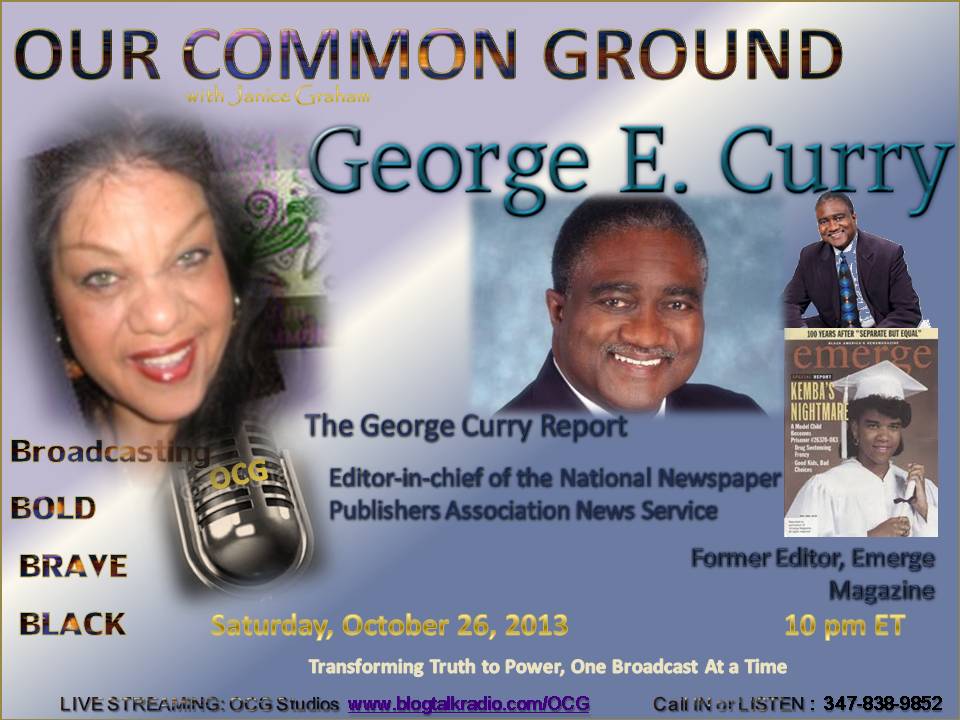
OUR COMMON GROUND “In Conversation with George Curry”

OUR COMMON GROUND with Janice Graham

“Transforming Truth to Power, One Broadcast At a Time”

“In Conversation with George Curry”

October 26, 2013 
10 pm ET                                     LIVE and Call -IN

10-26-13 Curry

About our Guest George Curry

George E. Curry is the editor-in-chief of the National Newspaper Publishers Association News Service. The former editor-in-chief of Emerge magazine, Curry also writes a weekly syndicated column for NNPA, a federation of more than 200 African American newspapers.

Curry, who served as editor-in-chief of the NNPA News Service from 2001 until 2007, returned to lead the news service for a second time on April 2, 2012. His work at the NNPA has ranged from being inside the Supreme Court to hear oral arguments in the University of Michigan affirmative action cases to traveling to Doha, Qatar, to report on America’s war with Iraq.
As editor-in-chief of Emerge, Curry led the magazine to win more than 40 national journalism awards. He is most proud of his four-year campaign to win the release of Kemba Smith, a 22-year-old woman who was given a mandatory sentence of 24 1/2 years in prison for her minor role in a drug ring. In May 1996, Emerge published a cover story titled “Kemba’s Nightmare.” President Clinton pardoned Smith in December 2000, marking the end of her nightmare.

Curry is the author of Jake Gaither: America’s Most Famous Black Coach and editor of The Affirmative Action Debate and The Best of Emerge Magazine. He was editor of the National Urban League’s 2006 State of Black America report.

His work in journalism has taken him to Egypt, England, France, Italy, China, Germany, Malaysia, Thailand, Cuba, Brazil, Ghana, Senegal, Nigeria, the Ivory Coast, Mexico, Canada, and Austria. In August 2012, he was part of the official US delegation and a presenter at the US-Brazil seminar on educational equity in Brasilia, Brazil.
George Curry is a member of the National Speakers Association and the International Federation for Professional Speakers. His speeches have been televised on C-SPAN and reprinted in Vital Speeches of the Day magazine. In his presentations, he addresses such topics as diversity, current events, education, and the media.

Ikard comingBROADCASTING 
BOLD BRAVE BLACK

OUR COMMON GROUND with Janice Graham

“Speaking Truth to Power and Ourselves” 

email: OCGinfo@ourcommonground.com

LISTEN LIVE and Join the OPEN Chat: http://www.blogtalkradio.com/OCG
Community Forum:http://www.ourcommonground-talk.ning.com/
Twitter: @JaniceOCG #TalkthatMatters
Web: http://www.ourcommonground.com/
OCG Blog: http://www.ourcommongroundtalk.wordpress.com/
Pinterest : http://www.pinterest.com/ocgmedia/boards/
Visit our Tumblr Page: http://ourcommonground.tumblr.com/
Facebook: https://www.facebook.com/OCGTALKRADIO

One student editor fired, another suspended following protests at Grambling State Univ.

One student editor fired, another suspended following protests at Grambling State Univ.

20 Oct 2013

By Tracie Powell

UPDATING

The online editor was fired and the opinions page editor is under a two-week suspension at Grambling State University’s student newspaper, The Gramblinite, following growing tensions there between students and administrators.

David Lankster Sr. said he’s been fired after tweeting statements from anonymous sources and photos of dilapidated facilities (here and here) using the newspaper’s Twitter account, and he accused the school’s Director of Public Relations and Communications, former journalist Will Sutton, of attempting to censor student journalists.

“I was behind it. I was the only one on the ground hearing from the students and players,” said Lankster, the former sports editor who has worked at the paper since 2009. “Sutton was trying to mute our voice because we were tweeting the real news, the truth about what was going on.”

allDigitocracy reached out to Sutton on Sunday; he referred questions to the newspaper’s adviser who did not immediately respond to emails.

Tensions that have been simmering for weeks came to a head last week when Grambling football players walked out of a meeting with college president Frank Pogue; and they refused to play in a scheduled game over the weekend, taking a forfeit. Students are upset about crumbling buildings and a lack of teachers among other things, they said. There’s even mold in a section of the newsroom, Lankster said. Doors to the area are kept locked and students are told not to enter the area, he added.

While Lankster was fired, his colleague Kimberly Monroe was informed she was being suspended for two weeks. Monroe, the editor of the newspaper’s opinion section, said she was asked by the newspaper’s adviser to remove parts of a column submitted by Grambling’s student government president, including the president’s email address that he asked students to use to report problems on campus.

Kimberly Monroe“I refused and then I left,” said Monroe, a graduate student who said she has worked at the paper for two years. Monroe said she later attended a student rally where she spoke with local and national media about crumbling buildings and the student-teacher ratio. The next day Monroe said the newspaper’s adviser, Wanda Peters, asked what role she played at the rally. Monroe responded that she was there as a concerned student. “That’s when (Peters) told me that she didn’t know what she would do with me, but something would have to be done,” Monroe said.

Monroe can be seen in this Associated Press photo and is identified as the organizer of the Oct. 17th rally. She told allDigitocracy that she did help gather students, but had no idea members of the football team would attend. Having players present at the gathering on Thursday turned it into a media event that she did not expect, Monroe said.

Monroe was notified by email on Friday afternoon that she would be suspended from her job at The Gramblinite due to “unprofessional behavior.” An excerpt from the letter below states:

As a member of The Gramblinite, you should not have become involved in a public rally, as you did yesterday.  I know Mass Communication was not your undergraduate major so you missed the classroom instruction regarding conflict of interest.  But the Code of Ethics that you must read and sign each semester as part of your Gramblinite application outlines certain behaviors that are expected of you. Item No. 4 of the Code reads:

“We report the news without regard for our own interests, mindful of the need to disclose potential conflicts. We avoid involvement in campus events, politics, demonstrations and social causes that would cause a conflict of interest, or the appearance of such conflict.”

The letter is copied to Dr. Edward Welch, interim chief of the school’s department of mass communication, Dr. Janet Guyden, dean of the college’s graduate school and Dr. Connie Walton, provost and vice president of academic affairs. Peters, the adviser, did not immediately respond to emails asking for comment on the disciplinary actions against the student journalists, but she did include in the letter that Monroe contributes “much to The Gramblinite and it would be a blow to lose your participation.”

Monroe said she does not agree with the suspension. ”I’m a student first,” Monroe said in a telephone interview, “a student who works for a student newspaper.” Monroe added that she did not sign a code of ethics at the start of the current semester.

Lankster, the online editor, said he began tweeting developments and student frustrations with administrators around Oct. 17. He does not recall how many tweets he posted, but said some of them have been deleted by school officials, but not before they had caught Sutton’s attention. Sutton, a former president of the National Association of Black Journalists, did not answer specific questions, but earlier he tweeted these admonishments to Grambling’s student journalists:

Women’s lives don’t matter: The lesson of Marissa Alexander

TUESDAY, OCT 1, 2013

Women’s lives don’t matter: The lesson of Marissa Alexander

Laws fail to effectively stop violent men or protect us — that’s why we have to stand up for ourselves

BY 

Women's lives don't matter: The lesson of Marissa AlexanderMarissa Alexander (Credit: AP/Lincoln B. Alexander)

I am passionate about domestic violence, because I am a childhood survivor of domestic violence. I know all too well the ways in which men like my father, many of whom are themselves subjugated on the basis of race and class, use home spaces to assert dominance and control that they are not able to wield in the larger world.

I know intimately the terror of being under surveillance in one’s own home, of the prerogative that many men assert to control the comings and goings of their partners and children, often through the threat of violence and force. I have seen how difficult it is to stand your ground, when society is structured to give men economic and political control over private, domestic space. I know what the journey to survivor status looked like for my mother, and the way that my father’s violence demoralized him and ruined our relationship.

I think of the women survivors of gun violence that I personally know (and of the gun violence that snuffed out my father’s life at the age of 33, as he ironically tried to prevent another woman and her children from becoming the victims of domestic violence at the hands of another man).

I think of two high school classmates, a white girl named Mary Dee and a black girl named Jackie, both killed by fatal gunshots in murder-suicide scenarios involving their partners. I think of a class of first-year, college-age African-American women (18 and 19 year olds) that I taught several years ago, in which fully one-quarter of them admitted to having been in violent relationships in high school.

I think about all the stories that are almost too terrifying to remember and much too personal to confess.

Last week, a judge ordered a new trial for Marissa Alexander, a 33-year-old African-American woman from Florida currently serving a mandatory 20-year sentence for firing a warning shot into the wall to scare off her violent and abusive husband.

The new trial order comes just in time for our annual October commemoration of Domestic Violence Awareness Month, and it calls attention to startling new statistics released from the Violence Policy Center. In 2011, 1,707 women were murdered by men in single victim, single offender incidents. In 94 percent of these cases, these women were murdered by men they knew, and in 51 percent of the cases, they were murdered by guns. Sixty-one percent of these victims were wives or intimate acquaintances of their killers. This means that intimate partner relationships constitute one of the most significant contexts through which women experience violence within our culture.

The disproportionate amounts of violence toward black women, who are 2.5 times more likely to be killed by an intimate partner than their white female counterparts, were significant enough to warrant their own section of the report. In 2011, 470 black women were killed in single victim/single offender homicides. In cases where the relationship could be determined, 94 percent of black women knew their killers.

That number is entirely consistent across racial categories, because most violent crime is intraracial. On the one hand, that fact would seem to highlight the erroneous nature of designations like “black-on-black” crime, an incendiary term use to pathologize black people, while failing to acknowledge that among white people most crime is “white-on-white” crime.

Beyond the racially problematic dimensions of these kinds of demographic designations, there is the problem of gender. Black women are never the subject of either community or national discussions about “black-on-black” crime, which is largely focused on stopping the epidemic of homicidal violence among young black men. The invisibilization of black women from discourses about victims of violence makes it hard to actually see black women as victims.

In Marissa Alexander’s case, she inadvertently encountered her husband, a man against whom she had a restraining order, when she went to their home to retrieve her clothes unaware that he would be there. When he showed up, she felt threatened, went to her car to retrieve her gun, and then fired a shot into the wall in order to scare him away. Perhaps, this is why the judge also ruled that Alexander cannot use a “stand your ground” defense in her own trial.

The failure of the law to protect Marissa Alexander from her husband, who has admitted under oath to treating her violently, placed her in a difficult set of circumstances. There is no reason that she should be serving 20 years in prison for defending herself against a violent attacker. Yet, she was sentenced through a combination of overzealous prosecuting, by the same Florida district attorney, Angela Corey, who had to be convinced through national protests and marches to prosecute Trayvon Martin’s killer, and extremely punitive mandatory minimum sentencing laws that require some crimes in which a gun is used to carry a 20-year sentence.

Yet again, Angela Corey, and the Florida justice system in general, seem to have a hard time distinguishing victims from perpetrators.

In an ironic twist, Shellie Zimmerman, wife of acquitted killer George Zimmerman, has also had trouble finding any protection on the basis of Florida’s domestic violence laws.  In early September, Shellie Zimmerman called 911 to report that George Zimmerman was brandishing a gun at her and her father, as she attempted to remove her belongings from their home after filing for divorce. Mrs. Zimmerman never saw the actual weapon, but instead observed her husband using threatening body language, while gesturing toward his waistband. She concluded that he had a gun, and since he is legally entitled to carry his gun after being acquitted of Trayvon Martin’s murder, that seems like a credible conclusion on her part. To date, no charges have been filed against George Zimmerman, even though this is not his first run-in with the law on charges of domestic violence.

Fifty-one percent of female homicide victims are killed with guns. In a world where women’s lives matter, robust gun control would be non-negotiable. But in a world where women’s lives don’t matter, Marissa Alexander doesn’t have any ground on which to stand, nor a fighting chance at freedom.

Lest folks convince themselves that these kinds of occurrences are anomalous, I would encourage you to spend some time this month talking to the women you know about the violence they have experienced at the hands of men in their own lives.

Marissa Alexander stood up for herself. She did not retreat. She refused any longer to take her husband’s shit. Unaided by laws that can effectively stop violent men in their tracks, all women survivors reach a point where they refuse to take it anymore. Even as we work to transform our culture of misogynistic violence into a world safe for women to inhabit, we must stand with and for those women who are standing up for themselves.

Brittney CooperBrittney Cooper is a contributing writer at Salon. Follow her on Twitter at@professorcrunk.

LISTEN LIVE TO OUR LIVE INTERVIEW WITH Ms. Alexander hours following her sentencing.

5-12 aCTION aLERT

Michelle Alexander: I can no longer just stay in my lane

Michelle Alexander: I can no longer just stay in my lane

September 3, 2013

by Michelle Alexander

For the past several years, I have spent virtually all my working hours writing about or speaking about the immorality, cruelty, racism and insanity of our nation’s latest caste system: mass incarceration. On this Facebook page I have written and posted about little else. But as I pause today to reflect on the meaning and significance of the 50th anniversary of the March on Washington, I realize that my focus has been too narrow.

Michelle Alexander graphic, webFive years after the March, Dr. King was speaking out against the Vietnam War, condemning America’s militarism and imperialism – famously stating that our nation was the “greatest purveyor of violence in the world.” He saw the connections between the wars we wage abroad and the utter indifference we have for poor people and people of color at home. He saw the necessity of openly critiquing an economic system that will fund war and will reward greed, hand over fist, but will not pay workers a living wage. Five years after the March on Washington, Dr. King was ignoring all those who told him to just stay in his lane, just stick to talking about civil rights.

Yet here I am decades later, staying in my lane. I have not been speaking publicly about the relationship between drones abroad and the War on Drugs at home. I have not been talking about the connections between the corrupt capitalism that bails out Wall Street bankers, moves jobs overseas and forecloses on homes with zeal, all while private prisons yield high returns and expand operations into a new market: caging immigrants. I have not been connecting the dots between the NSA spying on millions of Americans, the labeling of mosques as “terrorist organizations” and the spy programs of the 1960s and ‘70s – specifically the FBI and COINTELPRO programs that placed civil rights advocates under constant surveillance, infiltrated civil rights organizations and assassinated racial justice leaders.

I have been staying in my lane. But no more. In my view, the most important lesson we can learn from Dr. King is not what he said at the March on Washington, but what he said and did after. In the years that followed, he did not play politics to see what crumbs a fundamentally corrupt system might toss to the beggars of justice. Instead he connected the dots and committed himself to building a movement that would shake the foundations of our economic and social order, so that the dream he preached in 1963 might one day be a reality for all. He said that nothing less than “a radical restructuring of society” could possibly ensure justice and dignity for all. He was right.

I am still committed to building a movement to end mass incarceration, but I will not do it with blinders on. If all we do is end mass incarceration, this movement will not have gone nearly far enough. A new system of racial and social control will be born again, all because we did not do what King demanded we do: connect the dots between poverty, racism, militarism and materialism. I’m getting out of my lane. I hope you’re already out of yours.

This statement was posted by Michelle Alexander to her Facebook page on Aug. 28, 2013.

EPA Victims Ask: Who Will Protect Us From Our Protectors?

EPA Victims Ask: Who Will Protect Us From Our Protectors?

 09/17/2013 – 17:19

 from OUR COMMON GROUND Voice, Dr. Marsha Coleman


by BAR editor and columnist Dr. Marsha Coleman-Adebayo

The public need protection from the Environmental Protection Agency, a “rogue” department of government that ruthlessly suppresses the truth about its actual activities. “The EPA’s Office of General Counsel, Office of Civil Rights and the Office of the Administrator have all been complicit in crimes against the people and environment they are charged with protecting.”

EPA Victims Ask: Who Will Protect Us From Our Protectors?

by BAR editor and columnist Dr. Marsha Coleman-Adebayo

It is imperative to those with the power for the whistleblower to be destroyed.

The EPA is in the news again. Not for taking credit for a substantive decline in the neurotoxic levels of lead in the brains of young African-American children or imposing major pesticide rules against chemical companies that are poisoning our food and water but for its vicious and malicious retaliation against a courageous EPA employee who blew the whistle on Agency lies and corruption with its purposeful misleading of the public on health risk of dust at the World Trade Center cleanup after 9/11.

The EPA’s dismal record of discrimination and intolerance gives the Agency the odious distinction of having had its retaliatory and intimidating policies cited in the first whistleblower protective legislation of the 21st century when Congress and the Executive in 2002 took the first tentative steps toward reigning in this rogue agency that has come to symbolize institutionalized governmental coercion and systematic fear tactics applied by criminal elements within the upper ranks of government against lower level, conscientious workers.

The EPA is an Agency that has historically neglected economically-disadvantaged communities and allowed poor children to disproportionately suffer from asthma and other chronic upper-respiratory diseases, sometimes leading to death. The bulk of these children are Black, Hispanic and others who have nowhere else to go, but remain in toxic dumping grounds throughout the United States. The present controversy represents just the latest example of an Agency still out of control. Because sunlight is a disinfectant, Democratic and Republican presidents have dared not select an administrator from outside the EPA’s cloaked walls. The last three EPA Administrators have been insiders who have learned the ropes from the very same culprits the No FEAR Act sought to restrain.

She sounded the alarm about the health risks for them and residents near the WTC buildings, resulting in her being thrown into the abyss of EPA retaliation.”

The latest target of their corruption is Dr. Cate Jenkins, a senior chemist who ran into the same “green” stonewall that all EPA employees hit when they make the decision to warn the public about environmental dangers the Agency has a hidden agenda about. Dr. Jenkins raised concerns about the health risks and dangers to the 911 emergency first responders after the terrorist attack on the World Trade Center in New York City.

Former New Jersey Governor and EPA administrator Christine Whitman said the air quality immediately following the 911 explosions was “safe to breathe,” leaving firefighters, police and citizens comforted by her statement but actually exposed to life and quality of life threatening toxins. Dr. Jenkins, a seasoned scientist with an impressive resume, professionally disagreed with the “official” line of the EPA and other political leaders. Concerned for the lives of the responders, she sounded the alarm about the health risks for them and residents near the WTC buildings, resulting in her being thrown into the abyss of EPA retaliation.

According to Public Employees for Environmental Responsibility (PEER), Dr. Jenkins “received a proposed removal more than a year after a federal civil service court ordered her returned to work…EPA re-filed the same charges from 2010 which had been thrown out for violations of her constitutional due process rights.”Further, she had “publicly charged that due to falsified EPA standards, First Responders waded into dust so corrosive that it caused chemical burns deep within their respiratory systems. After raising the issue to the EPA Inspector General, Congress and the FBI, Dr. Jenkins was isolated, harassed and ultimately removed from her position on December 30, 2010 by EPA, based upon an un-witnessed and contested claim that the soft-spoken, petite childhood polio survivor threatened her 6-foot male supervisor.” While the EPA allegations seem laughable, Dr. Jenkin’s EPA career has been destroyed. She follows hundreds of other EPA employees of conscience who have raised “green flags” about EPA corruption continuing unabated.

First Responders waded into dust so corrosive that it caused chemical burns deep within their respiratory systems.”

Susan Morris, an Assistant Director in the Office of Civil Rights, blew the whistle on the violations of civil rights, dishonesty, and misuse of federal resources that were ignored by the Administrators, the EPA Inspector General and the legal office. After a lengthy investigation, the Office of Special Counsel (OSC), the agency responsible for these violations, found that EPA had retaliated against Morris for whistle blowing and said she should be reinstated with full benefits. Instead, in line with their continued abuse and retaliation of employees, administrator Lisa Jackson ignored the OSC, forcing Ms. Morris to file a complaint that will be heard by a jury in Federal District Court.

In discussing Dr. Jenkin’s situation with Ms. Morris, she said, “I am not surprised by anything that EPA does to its employees. I worked at four major Departments and industry for over 30 years and never encountered a more despicable environment in which to work. I understand the woman, another lawyer, that they just put in the Acting position was detailed over 30 times and is now in charge of civil rights. They don’t want civil rights to work in the EPA because it would mean they would have to be timely in processing complaints from employees and poorer communities that are being polluted by industry. It’s a disgrace.” The case of Dr. Jenkins, Morris continued, “just adds to the fear of discrimination and retaliation that permeates the agency with over 1,000 attorneys supporting the corruption.”

On May 4, 2012, the MSPB (the Merit Systems Protection Board), responsible for protecting employees from agency management abuses unanimously rejected EPA’s claims against Dr. Jenkins and ordered the rogue agency to “fully restore” her back to her position and provide back pay with interest, just as OSC did with respect to Susan Morris. It should be noted that the MSPB routinely finds in favor of federal agencies and rarely in favor of federal employees. In this instance, the evidence was clearly so overwhelming that the MSPB was unable to rubber stamp the illegal behavior of the Agency. Ignoring the MSPB decision, the EPA placed Dr. Jenkins on paid administrative leave for over one year (at taxpayers’ expense) and re-filed termination charges against her on August 27, 2013—the same exact charges as those previously dismissed.

They don’t want civil rights to work in the EPA because it would mean they would have to be timely in processing complaints from employees and poorer communities that are being polluted by industry.”

Is this an isolated case? By no means. The Washington Post recently reported that John C. Beale, a subordinate of EPA Administrator Gina McCarthy, (in her previous position as head of the Air and Radiation office) has pleaded guilty to defrauding the EPA of $900,000. However, the same rules do not apply to all offenders. Mr. Beale obviously belonged to what many refer to as the EPA’s “good ole boy club” having basked in the perks of special privilege afforded the high and mighty. Once his crime was discovered he did not face the same level of acrimony suffered by Dr. Cate Jenkins or Susan Morris. In Beale’s case, he was allowed to quietly retire from his position until he was criminally charged. The length to which the Agency will go to provide cover and protection to one of its “own” would shame any government that values fairness andjustice.

For an agency whose stated mission is “to protect human health and the environment,” it is more than a little embarrassing when one of their scientists outs the Agency’s willfully dishonest and misleading statements. Questioning the moral, legal and socially responsible ethics of what would in any reasonable context be seen as criminal misconduct cannot be allowed. It is imperative to those with the power for the whistleblower to be destroyed.

Dr. Jenkins’ is just the latest in the succession of cases that the EPA chooses to ignore direct instructions from its judicial overseers. This flagrant and arrogant disregard for the law comes as no surprise to those familiar with EPA whistleblowers. Despite public outcry and congressional inquiries, the same attorneys in the EPA Office of General Counsel, including David Guerrero and Nancy Dunham, routinely have their names affixed to agency adverse removal actions.

According to the Centers for Disease Control (CDC), as many as 65,000 people have been ill as a result of exposure to the 9/11 dust. This was exactly what Dr. Jenkins was trying to avoid. A Mount Sinai Medical Center study announced the grim statistics that 9/11 first responders are now experiencing a 15% higher cancer rate than their cohorts who were not exposed to the toxic air.

EPA allowed these people to be exposed when it was unnecessary and could have been averted through using proper protective recovery gear. As of August 2013, approximately 1,140 emergency responders and people who lived or worked near ground zero have been certified by the National Institute for Occupational Safety and Health to have a WTC-related cancer and these numbers are expected to rise. The question is how many more will die?

Where is the accountability for those who were in a position to know what Dr. Cate Jenkins knew and made up feel-good announcements that condemned all of these people to suffering and death? The EPA’s Office of General Counsel, Office of Civil Rights and the Office of the Administrator have all been complicit in crimes against the people and environment they are charged with protecting. The corruption at EPA is found at every level. Lisa Jackson, the former EPA Administrator who leveraged her EPA gig into the position of Vice President for Environmental Affairs at Apple (a business that she used to regulate) is under Congressional scrutiny for using the alias, ‘Richard Windsor’ to skirt Congressional oversight and to avoid having to release information to the public mandated under the Freedom of Information Act (FOIA.) A Congressional hearing was held last week to continue the investigation into this matter.

9/11 first responders are now experiencing a 15% higher cancer rate than their cohorts who were not exposed to the toxic air.”

In Coleman-Adebayo v. Carol Browner, in which I prevailed in federal court, a jury of my peers established that EPA as an agency tolerated racism, sexism and a hostile work environment. However, as in the case of Dr. Jenkins, even after I won and the first civil rights and whistleblower protection law of the 21st century, No FEAR, was ratified the agency continued its ham-fisted retaliation until I was fired.

The legal attack team that is prosecuting the cases against Dr. Jenkins and Susan Morris are the same lawyers who have been relentless against me. People who trusted the assurances of the Agency tasked to protect human health and the environment are suffering by the tens of thousands and dying.

Who is going to protect us from the ones who systematically destroy the whistleblowers who are trying to protect us?

It is essential that we continue to fight for the survival of this planet that is placed in peril when we choose corporate collusion over sustainable environmental protection. For more information about corruption at the EPA please see: www.occupyEPA.com.

Dr. Marsha Coleman-Adebayo is the author of No FEAR: A Whistleblowers Triumph over Corruption and Retaliation at the EPA is available through amazon.com. Dr. Coleman-Adebayo worked at the EPA for 18 years and blew the whistle on a US multinational corporation that endangered vanadium mine workers in South Africa. Marsha’s successful lawsuit lead to the introduction and passage of the first civil rights and whistleblower law of the 21st century: the Notification of Federal Employees Anti-discrimination and Retaliation Act of 2002 (No FEAR Act). She is Director of Transparency and Accountability for the Green Shadow Cabinet.

Reference documents:

Read the PEER protest to the new proposed removal

Click to access 9_11_13_Jenkins_Removal_PEER_Protest.pdf

View legal victory that restored Dr. Jenkins

View legal victory that restored Dr. Jenkins after her Monsanto Agent Orange dioxin study disclosures

Read an interview of Dr. Jenkins in the scientific journal Nature

ocg 10-8-11 MColeman 2

Detroit and America’s Racial “Exceptionalism” | Black Agenda Report

 Detroit and America’s Racial “Exceptionalism” | Black Agenda Report.

A Black Agenda Radio commentary by executive editor Glen ford

The picture is of Diego Rivera’s mural Detroit Industry, 1932-33, Detroit Institute of Arts.

Corporate solutions can justifiably be substituted for democracy, when it comes to Blacks.”

The great American dissolution of electoral democracy is playing out in Detroit, where last Monday the state-appointed Emergency Financial Manager explained to a crowd at Wayne State University how he would compassionately go about the business of breaking their city into buyable and sellable parts. The people and their elected representatives would have no say in the ultimate result.

The corporate media, and white folks in general, view the process as an inevitability – a kind of crude justice – not because they have rejected the principle of self-government, but because Detroit is overwhelmingly Black, and Blacks have always been the exception to the American rule. In fact, all of the Black population centers of Michigan have been divested of the right to govern themselves.

There has been no national outpouring of solidarity with Michigan’s Blacks over the loss of their citizenship rights, which can only mean that there exists an effective white consensus that African Americans are not fully deserving of those rights. Uncontrolled concentrations of Blacks are seen as pathological, by definition.

The same race-based exception was made to public education, for Blacks. In New Jersey and localities across the country, public schools in largely Black areas have for decades been under state control, denying Black parents any effective voice in their children’s education. By and large, white suburbanites supported the state in making Blacks an exception to the general American rule on local control over education. It is a right Blacks are not thought to be qualified to exercise.

Blacks were an exception to the Constitution.”

The same racial exception to the rule led to massive privatization of inner city education, through wholesale imposition of charter schools and private school vouchers. When education secretary Arne Duncan declared that Hurricane Katrina was the best thing that ever happened to public schools in New Orleans because it allowed most of the city’s schools to be converted to charters, there was no national condemnation of his remarks – since it is accepted that Blacks cannot run their own school systems. They are the great exceptions to the American rule. Corporate solutions can justifiably be substituted for democracy, when it comes to Blacks.

The problems of drugs and crime were framed as Black phenomena, requiring a more flexible interpretation of civil liberties and the creation of a vast police state. Just as the Founding Fathers actually intended, Blacks were an exception to the Constitution.

Blacks, and their alleged “pathologies,” were considered the nexus of poverty and social disintegration in America. Therefore, the social safety net was kept at the absolute minimum.

And now, all these exceptions that have been made for Blacks, are to become models for America as a whole, in the age of austerity, corporatized education, undemocratic governance, and the National Security State. In places like Detroit and New Orleans, America has been busily creating the pilot programs for the rule of the rich, by systematically undermining social democracy for Blacks.

The great exception, is becoming the rule.

For Black Agenda Radio, I’m Glen Ford. On the web, go to BlackAgendaReport.com.

BAR executive editor Glen Ford can be contacted at Glen.Ford@BlackAgendaReport.com.