The Lies We Tell Black Boys and the Truth They Deserve to Hear φ CHRISTOPHER “FLOOD THE DRUMMER®” NORRIS

The Lies We Tell Black Boys and the Truth They Deserve to Hear

black boys-AfroDad-flickr

We need to stop teaching our black boys how to survive in a world not designed for them, and instead show them how to design a world that will allow them to thrive as individuals.

I never realized how hard it was to get people to view black men and boys as assets until I asked them to actually do it. In countless conversation I’ve had with peers about black male achievement—from philanthropy to politics, to the environment and education—the question has always been: “how do we help black boys achieve?” and not: “how do we leverage the value and agency of black men and boys who are already achieving to inspire others and transform the spaces they live, work and play?”

In my opinion, the reason the latter doesn’t gets asked as often as it should is because most people believe that black men and boys are problems that need to be solved; a disease that needs to be cured. Decision and media makers pretend the answer is as easy as getting the “thugs” to pull up their pants and not tattoo their faces.

Well-intentioned teachers and mentors often express that if black boys wear suits, ties, and carry books instead of bullets, that the probability of being accepted by, and achieving in, the “real world” will increase dramatically. Parents of black boys—just wanting them to come home in one piece—indoctrinate them religiously with the “do’s and don’ts of being black in public.”

And all the while, during of all these lectures, the black boys who we want to grow into proud black men are slowly but surely feeling humanity slip right out of their finger tips. With a skewed perception of their self-worth, chances are those black boys grow into insecure black men who feel the need to measure their accomplishments and assets to their white-counterparts, ultimately seeking validation outside their race before accepting what makes them unique.

What we should be telling black boys, and more importantly, what they deserve to hear is that the “real-world” is f*cked up and is filled with sick people who will hate them regardless of whether or not they are wearing a hoodie or a Brooks Brothers suit. They need to hear that the problem is the world and not them; that they exist to improve the world, not succumb to its bullsh*t. Black boys deserve to know that their elders will fight for their right to walk or run down a street of their choosing—regardless of their clothing—without the fear of being intimidated by a police officer who doesn’t view them as a human being.

We need to stop teaching our black boys how to survive in a world not designed for them, and instead show them how to design a world that will allow them to thrive as individuals. We need stop preaching respectability politics and tell our black boys what they deserve to hear, which is the sky is not the limit, it’s the starting point.

CLICK HERE to pledge to see the good in black men and share their stories so that others may do the same. 

– See more at: http://goodmenproject.com/featured-content/the-lies-we-tell-black-boys-and-the-truth-they-deserve-to-hear-cnorris/#sthash.XZqFn3xn.1C2M93Pi.dpuf


Thanks for reading. Until next time, I’m Flood the Drummer® & I’m Drumming for JUSTICE!™ DOWNLOAD NOW: The Black His-Story Book: A Collection of Narratives from Black Male Mentors, presented in part by GoodMenProject.com.  – See more at: http://goodmenproject.com/featured-content/the-lies-we-tell-black-boys-and-the-truth-they-deserve-to-hear-cnorris/#sthash.XZqFn3xn.1C2M93Pi.dpuf

5 Reasons Why The Black Community Is Still Enslaved To White People >>Urban Intellectuals

5 Reasons Why The Black Community Is Still Enslaved To White People

by  | Jan 17, 2014 | Opinions |

5 Reasons Why The Black Community Is Still Enslaved To White People


You might not want to hear this, but it is time for the black community to have a dose of cold reality. We are in a position today where we don’t control our own destiny and are effectively still slaves to white people. Hopefully, this article we can open the dialog and minds to get out of this situation before it is too late.

This opinion isn’t about bashing white people or telling you to hate them. It is about pointing out our behaviors and things we are allowing to continue to happen to us 150 years after the Emancipation Proclamation. We have lawyers, politicians, doctors, PhDs, business owners and so called intelligent people in the black community. We have many material things in our lives and “freedoms”, but in many ways are in a worse position than we were 100 years ago. Isn’t it time to recognize and admit it is time to do something different as a community?

slavery photo

With that said, let’s dive into the reasons we still haven’t gotten from under the thumb of our captors and still have a long uphill battle to fight. Despite some of us having the markings of success, we still have a long way to go as a people.

The White Educational System And View Of The World Dominates The Black Community

Because the black community doesn’t control their educational system, our children will forever see the world through the perspective of white eyes. This is what is meant when people say one has black skin, but white eyes. The individual looks like a member of the black community, but thinks like a member of the white community. Meaning, they see everything as sacred that comes from the white community and negates thoughts, sciences, businesses and everything else that comes from their own people.

During the indoctrination years, I mean formal education, the black community is being conditioned to love, honor and respect white history, people and where they come from on the planet. Blacks know everything about white people, but only take one month, February, to learn anything about the black community. And if you are awakened, then you know these are controlled lessons that only emphasis what you are learning the other 11 months of the year.

Black People Are Infatuated By White Culture & Europe

This is a by product of the reason above, the educational system. Why wouldn’t you love, honor and respect white or Western culture when you have been formally indoctrinated into the system? It only makes sense. It becomes what you are familiar with and identify with at the same time.

On the other hand, if you are all in on Western culture, then you must be ignoring your own culture, history and people. Sure, you don’t mean for this to be the outcome, but it is nevertheless unless you are blessed enough to have someone in your life to help the scales fall from your eyes.

However, most in the black community are not so fortunate. We end up living a life dreaming of visiting Europe to see and experience the history we endear growing up first hand. The black community is infatuate with white culture, people and Europe.

Nothing Is Validated In The Black Community Until It Is Approved By Whites

Building on the education and the infatuation the black community has with white people, you know nothing is given the stamp of approval until someone white gives it the thumbs up. It hurts my heart to say this in public, but it is true and you know it.

breaking the chainsValidation comes to businesses, athletes, students, children, our intelligence, medicine, inventions, political policies, and everything else the black community can dream up when someone from the white community says it is good. This is a hangover from slavery as discussed by Dr. Na’im Akbar in his epic book “Breaking the Chains of Psychological Slavery”. We need white validation.

Blacks Embrace White Jesus And Their Religion

I know I’m going to lose a few of you from the this point forward. However, I don’t care. This is very important. Dr. John Henrik Clarke talks about if you take a man’s identity out of his God, then he will always see himself as inferior because he will identify the other with the deity, blessed people and not himself. This is exactly what happen to the black community and we bought it hook line and sinker.

For hundreds of thousands of years, we have controlled our visions of God, the Universe and our spirituality. Post slavery, we do not control this image and continue to struggle from turning over this basic human right.

Blacks Spend All Their Money With Whites Continuing To Make Them Rich At The Expense Of Themselves

It makes me sick that we are economically foolish enough to spend our $1 trillion dollars in annual spending power almost exclusively with white businesses. We have no concept of how important it is to spread our money around our community a few times before allowing it to leave. In fact, we are the only community in the country that does this and because of our Mis-Education, Carter G. Woodson’s book reference. What is worst is we don’t even understand the error in this practice, nor care to learn.  At this rate, we will definitely forever be slaves to white people.

Obviously, the black community is no longer in physical chains, but to the awakened mind it is clear the psychological chains still exist. We turn over all power and assets back to the white community without resistance and need to make a serious change in our behavior and beliefs.

What Are Your Thoughts and What Reasons Are Missing From the List Above?

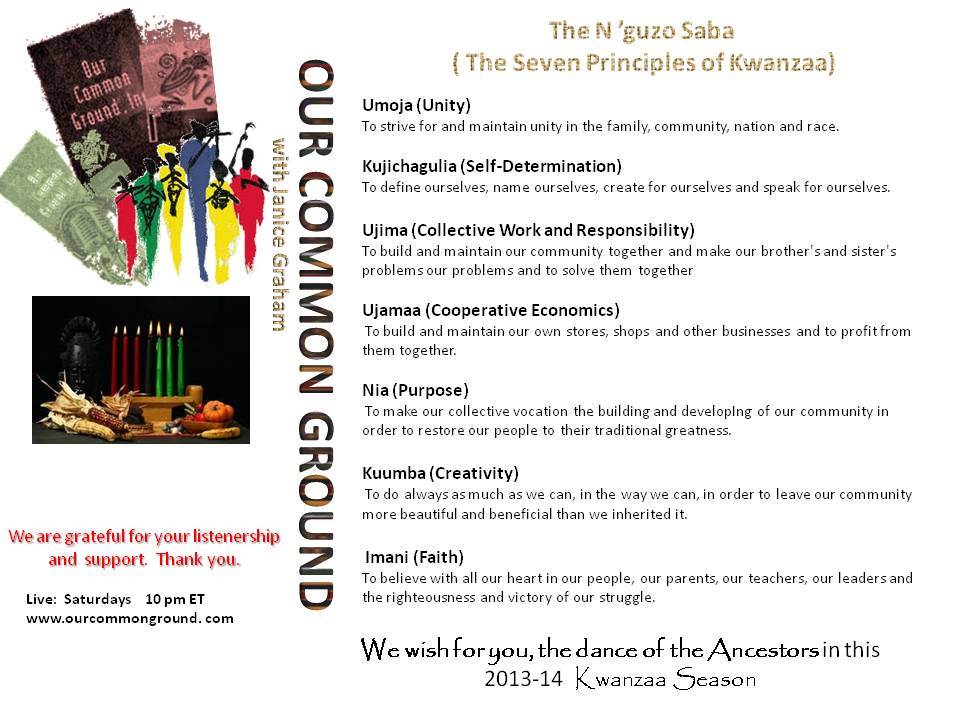
OUR COMMON GROUND Kwanzaa 2013 -14

KWANZAA

Kwanzaa (kwahn-ZAH) is an annual cultural observance, which is recognized by Black people from December 26 thru January 1, each year:

  • Kwanzaa is non-political.
  • Kwanzaa is non-religious.
  • Kwanzaa is not related to Christmas.*

* Annual Kwanzaa observances begin on December 26th, each year] 

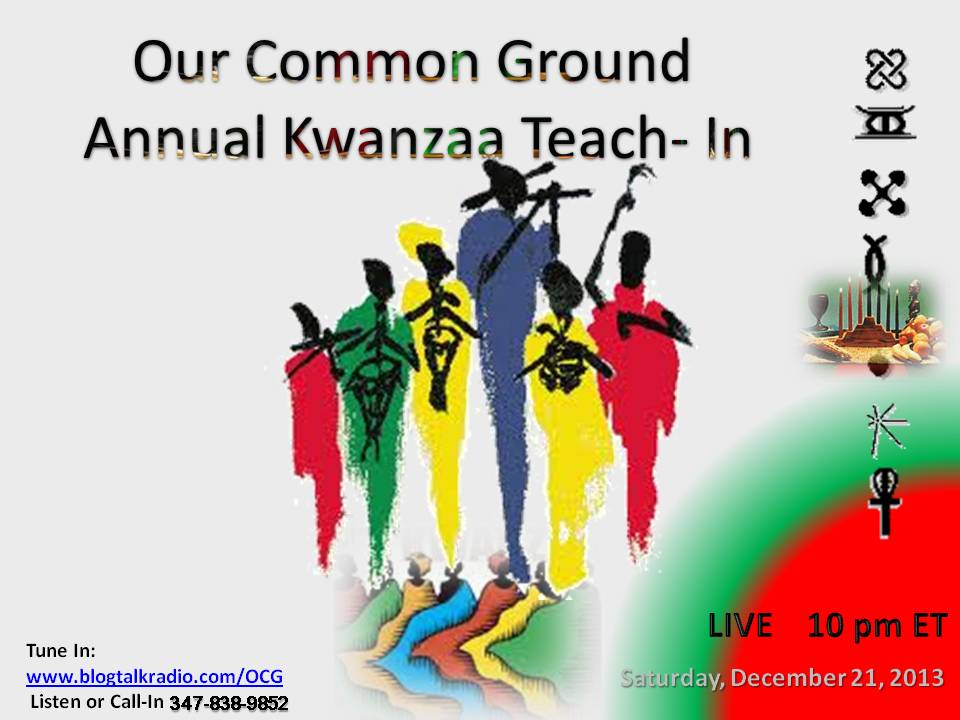
2013 Kwanzaa banner

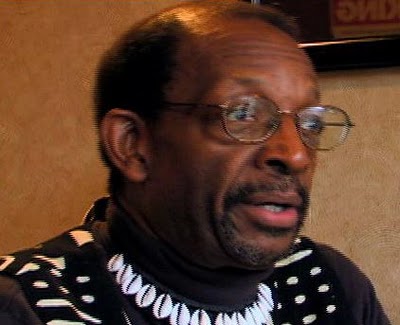
This year’s OUR COMMON GROUND KWANZAA message comes from our Brother, Friend and Comrade,OUR COMMON GROUND Voice, Dr. Ron Daniels.

The Nguzo Saba contains the core concepts and values of Kawaida and the foundation for Kwanzaa.  In a recent article, First Call for State of the Black World Conference III, I suggested that a spiritual and cultural revival is essential to combat and overcome the devastating State of Emergency afflicting the “dark ghettos” in Black America.  As we begin the celebration of Kwanzaa, it might be useful to restate the N’guzo Saba and discuss its relevance to healing our families and communities in a time of crisis.  So, I offer these reflections.

Dr. Ron Daniels, Founder and Director, IBW 21

Ron Daniels

The first Principle in the Nguzo Saba is Umoja/Unity. That Africans in America should be unified or act in concert to confront the State of Emergency should be self evident.  However, achieving Black unity can be challenging and illusive. In the name of pursuing the interests of Black people, what we have in the Black community is a myriad of leaders and organizations that all too often compete rather than cooperate with each other.  Moreover, various leaders and organizations have different ideologies and strategies for achieving full freedom/liberation. There is also a “class divide” between the more affluent sisters and brothers who have benefited from the “movement” and moved up in the world and the dispossessed left behind in abandoned and devastated “dark ghettos,” the “hood.”  Overcoming disunity  requires a conscious effort to create “united front” structures which bring people together despite their differences in philosophy and approach.  Dr. Karenga has advocated “operational unity” as a concept to enable leaders and organizations with differing philosophies and approaches to work together.  Operational unity means focusing on issues and areas where there is agreement among organizations and leaders rather than disagreement.  Dr. Karenga calls this “unity without uniformity.” With so many problems/issues affecting the Black community, the goal of operational unity is to have leaders and organizations collaborate/act collectively around specific issues, projects and initiatives they agree on.

Unity in the Black community requires bridging the class divide.  Brothers and sisters who have seized on a pathway to the middle and upper class paved by the blood and sacrifice of heroes and sheroes of the Black freedom struggle have an obligation to spiritually and/or physically return to “Tobacco Road,” the urban inner-city neighborhoods of this country, to give back, to reinvest their time, talent and resources to reconstruct/revive the “dark ghettos” from which they escaped.

 The second Principle is Kujichagulia/Self-Determination.  There has been much talk about a “post-racial society” in the aftermath of the election of Barack Obama as America’s first African American president. And, there have always been some within the race who wanted to escape the “burden” of their Blackness.  The State of Emergency in Black America clearly suggests that “race still matters” as a determinant of one’s life chances in this country. Dr. Karenga has said that to chart a course toward full freedom, a theory/ideology of liberation must provide an “identity, purpose and direction.” I believe that if we are to permanently rise above the crises plaguing our families and communities, we must name and claim our identity, proudly embrace ourselves and be resolutely committed to being “of the race and for the race.”  As descendants from the African motherland, “we are an African people.” And, part of our mission in life should be to unapologetically work for the advancement of people of African descent in the U.S. and the Pan African world.  This does not mean disrespecting, disregarding or disdaining other racial/ethnic groups; it simply means “charity begins at home and spreads abroad,” and “love thy neighbor as thyself.”  We cannot, must not abandon the race, especially our sisters and brothers in the “hood,” in an ill conceived effort to become absorbed in a “colorblind” or “post racial society.”  We have a right to define who we are and determine our own destiny as people!

 The third Principle is Ujima/Collective Work and Responsibility.  As noted earlier, the Doctrine of Kawaida as conceived by Dr. Karenga is grounded in the traditional worldview and way of life of African people. As such it emphasizes “we, us and our” in terms of the values that are important to building and sustaining wholesome families and communities.  This is diametrically opposed to the “me, myself and I” values of “individualism” and “competition” stressed as central to the “cherished” American/western way of life.  The concept of the “collective” is frowned upon in America as “socialist” or communist.” And yet, the idea of extended families working together for a common purpose within communities with a sense of mutual obligation and responsibility is deeply ingrained in African societies – and our own experience as Africans in America, particularly in the South.  We certainly will not permit class or status to divide us if we see ourselves as one people committed to promoting the common good of the race. This is a clear example of the need to retain the values/principles of our forebears as opposed to adopting a value orientation which has proven to be destructive to Black families and communities.

 The fourth Principle is Ujamaa/Cooperative Economics.  This principle is closely linked to Ujima in that it encourages people of African descent to share resources and engage in joint efforts to build and sustain an economic foundation for our families and communities. Cooperatives, credit unions, investment clubs and community development corporations are examples of economic structures based on pooling and sharing resources for the common good.  Ujamaa does not preclude for-profit corporations or individual entrepreneurship. But, the value/principle of Ujamaa dictates that entrepreneurs and businesses explore ways of collaborating/cooperating, exchanging ideas and pooling resources where appropriate to enhance the collective economic empowerment of the Black community. This is what Dr. Claud Anderson has promoted through the concept of Powernomics and George Fraser through Power Networking.  In the spirit of Booker T. Washington, Marcus Garvey, W.E.B. Du Bois and the Honorable Elijah Muhammad, it is imperative that people of African descent persistently work to build an economic infrastructure to undergird our social and political institutions.

 The fifth Principle is Nia/Purpose. When we survey the incredible fratricide/carnage occurring in Black communities, largely committed by young Black males, one has the feeling that it may be because many of our young people lack a sense of purpose and meaning in their lives.  And, this may be related to a lack of collective purpose in the Black community as a whole. Gone are the days of the civil rights/human rights and Black Power movements when there was a pervasive spirit of purpose in the air. There was a dynamic movement and a feeling that Black people were on the move! In the face of a daunting State of Emergency, we urgently need to restore a sense of purpose in Black America. And, that purpose should be a commitment to reclaim and rebuild our communities, a fervent determination that America’s desolate dark ghettos will become new communities that are bright beacons of hope and possibility. The collective conviction/purpose and the struggle required to rebuild our communities will be contagious; it will capture the hearts and minds of our youth/young people by restoring a sense of mission to their lives as part of a people fighting to liberate themselves from an oppressive value system and society.

The Sixth Principle is Kuumba/Creativity.  People of African descent gave the world its first multi-genius in the person of Imhotep, the Egyptian physician, architect and engineer who mastered the science of building in stone that led to the erection of the pyramids as one of the greatest wonders of the world! One might say that creativity is in our DNA.  Africans from the Caribbean took old barrels and transformed them into “steel drums” that produce amazing music.  Those of us who came up on the “rough side of the mountain” in America (most of us) bear witness to the fact that our mothers and fathers were masters of “making something out of nothing.”  They had to in order to survive.  Overcoming the State of Emergency to rebuild our families and communities is a formidable undertaking.  It will not be easy, but we should act with the absolute confidence that we possess the creativity, the knowledge, skill and will to meet the challenge.

 The Seventh and final Principle is Imani/Faith.  Given the obstacles our forebears faced, they had to have an abiding faith that survival was possible, that beyond the brutality, hardships, suffering and sacrifice of the moment, “joy would come in the morning,” that someday, a generation that sprang from their loins – sons, daughters, grandchildren, great grandchildren, great, great grandchildren … would be able to proclaim “free at last.” For millions it was the belief that “we’ve come this far by faith, leaning on the Lord.” For others it was a spiritual force deep down inside that could be tapped to carry forth for another day and another day … the faith that a better day was coming for the sons and daughters of Africa in America. In this current crisis, we too must have faith, a belief that enables us to scale heights, not normally possible, because we believe and act on our beliefs. Similar to the Principle of Kuumba/Creativity, we must have faith that there are no odds too great for a people to overcome if we act with Umoja/Unity, Kujichagulia/Self-Determination, Ujima/Collective Work and Responsibility, Ujamaa/Cooperative Economics, Nia/Purpose, Kuumba/Creativity, and Imani/Faith.  “Deep in my heart, I do believe, we shall overcome some day!”

– See more at: http://ibw21.org/vantage-point/the-nguzo-saba-and-kwanzaa-in-a-time-of-crisis/#sthash.gap6irva.dpuf

2014-3Kwanzaa

The 5 Things Black Women Must Do in 2014 to Live Happier, Healthier, Healed Lives

 The 5 Things Black Women Must Do in 2014 to Live Happier, Healthier, Healed Lives

Posted: 12/27/2013
The funny thing about stereotypes is that they often have some measure of truth to them. As black women in America, no group has been more stereotyped, or misunderstood, or more devalued than us. As we begin the countdown on the year that was 2013, it is time for us as black women to look toward our future in the New Year that is 2014.

As someone who has traveled the country for the last two years, talking and engaging almost exclusively with black women in corporate America, in universities, in our sororities, in industry, in our organizations, in the media and in our churches — I think it is time that we, as black women, faced some challenging truths about ourselves. What I’m about to say will be hard. And it may offend some of you. But that is okay, because the truth always hurts us before it heals us. Years before I wrote my award-winning book Black Woman Redefined, I founded an organization: I Am My Sister’s Keeper.

This organization, was dedicated to helping college-educated professional black women to better navigate their careers, their health and wellness, their spirit, their finances and their relationships. The organization took off and grew much greater than I ever expected, and was nationally recognized by media outlets like CNN and The Washington Post as the go-to organization for Black women’s personal development and wellness for over six years. The organization was the catalyst for the book Black Woman Redefined: Dispelling Myths and Discovering Fulfillment in the Age of Michelle Obama.

One of the things that I have discovered about living life as a black woman in America, and by talking to and engaging with literally tens of thousands of black women throughout the United States, is that we have some very negative self-destructive patterns that we need to own, face and be courageous enough to fix if we want to have happy, healthy and healed lives. It is my goal in this column to challenge us as a sisterhood of women to take the necessary steps, to heal ourselves, both individually and collectively. Before we get into the steps that I believe are necessary for us to truly get to the places that we desire in our lives as black women, I ask you to keep an open mind, try not to get defensive, and share the steps in your sororities, clubs, and workplaces so that other black women can benefit. Sometimes it is as simple as people NOT knowing better so that they can do better.

The steps that I have outlined below, are based on qualitative and quantitative research, focus groups, coaching and speaking at large women’s conferences, HBCUs and interactive workshops I have conducted throughout the country over the past several years:

1. We must deal with our unresolved pain, wounds and baggage that often result in angry eruptions, broken relationships, failed relationships and unrealized dreams. This is a huge stumbling block for us in our interpersonal relationships. We carry lots of stuff, and lots of people on our backs and in our spirits. It results in us being weary, tired and frustrated.

2. We must stop doing emotional violence and damage to other black women. Other black women are not the enemy. Other black women are struggling and fighting the same battles that we fight every day, no matter their station in life, no matter what you think they may possess in terms of wealth, status or lifestyle. We have to stop “hating” on other sisters. It is just wreaking havoc on our emotional wellness and sisterhood. “We are all we have,” as First Lady Michelle Obama once said. Let’s start acting like it!

3. We must love ourselves enough to take care of our physical bodies and learn to eat healthier, sleep better, exercise more, tend to our feet (for diabetics) and wean ourselves off of generations of destructive emotional eating (comfort foods) that has literally millions of black women in America stuck in a pattern of diabetes, hypertension, obesity, depression and heart disease.

4. We must learn to teach people how to treat us with value, respect, love, honor, dignity and peace by showing them that we live by a WOMAN CODE that honors the very same values in our own lives and in how we treat other people.

5. We must commit to engaging in healthy, functional, committed and loving relationships with the men in our lives. Where those relationships are unhealthy, abusive or destructive to our soul’s landscape; we must be willing to put an end to those relationships immediately. We have got to stop making excuses for other people’s abusive treatment of us and toward us. It is NOT acceptable, sisters. We have got to put an end to the pain we feel because our fathers left us or were absent. Or the pain that we feel because the men we love betrayed us, cheated on us, raped or beat us. We have to believe that there are still good, loving, healthy and functional men regardless of their race, who will see our value, our worth, our beauty and our possibilities. And when they find us, we must commit not to run away, push them away or punish them for what our fathers, brothers or uncles did to us.

The truth is, there is no magic checklist for getting any of us the life that we desire. But there are critical life steps that we can take starting right now, and right here to helping us as black women to heal. And sisters, we need to heal.

Far too many of us are walking around with a smile on our face, with beautiful clothing, with our hair perfectly coiffed and with expensive handbags and shoes to make us feel valuable. When deeply inside, we are simmering pots waiting to erupt. We look so good on the outside. But some of us are badly broken on the inside. And we are killing other black women with our venom.

And for those who have been courageous enough to do the work on themselves, it is time for us to be our sister’s keeper. I am not asking you to burden your life with another woman’s pain, I am not asking you to save another woman’s life, what I am asking you to do, is to be kind to other black women. Reach out. Care. Show some empathy. Be a mentor. Be a friend. When other black women try to help you do not treat them as the enemy. When they are there for you say thank you. When they have stuck with you in the trenches and storms of life honor them. When they have your back, don’t stab them in theirs. When they bless you with their gifts for free, support your causes, organizations, and the like or help you and your family in desperate times of need, don’t later discard them because you believe that you no longer need them. It is just immoral. It violates the WOMAN CODE.

Sisters, this will be the last column that I will ever write on the issue of us as black women. I’ve grown tired and weary. I love us, but the world is bigger, more global, and sisterhood is about all women coming together to lift, heal, inspire and change the world. We need to do the work on us so that we can fully participate in that global sisterhood and all the benefits of it.

I have, like many others before me, devoted the last decade of my life to helping the rest of the world try to see us as the beautiful, fabulous, fierce, loyal, kind, nurturing, intelligent, committed and loving women that we are. But in the last year, in particular, I’ve experienced first hand, and heard far too many stories from good black women, from all walks of life, about other black women who have cursed them, cut them off, betrayed them, manipulated them, stolen from them, slept with their men, slandered them, ruined them, fired them and literally broken their hearts with treachery for the smallest of offenses, or for no offense at all.

We love to do what I call “The Go Off.” It is what we do when anyone dares challenge us, correct us, upsets us, or in some cases, tries to love us. Sisters, you have no right despite whatever kind of pain you may be in, to heap abuse on another black woman. The most disturbing part of this “go off” mentality, is that we feel entitled to do it most of all against one another. We don’t do it to the men in our lives who mistreat us and abuse us. We would never do it to the “other” people in our lives or at our workplaces. But we will do it to the sister in church, the sister who has taken us into her home, the sister who has been with us through hell, the sister who has lent us money, the sister who bathed us when we were too sick to bathe ourselves, or cared for us when we were sick. Sisters, it’s time to heal (see my 2012/2013 series for essence.com: “Sisters Heal,” it will bless you).

In the final analysis, each of us must determine her own journey for herself. Each of us must do the work that is required, for us to rise above the pain that was unfairly inflicted upon us as children, as young girls and women, and now as grown middle-aged or aging women. It is never too late to fix yourself, if you are willing to do the work. It is never too late to apologize, to make amends for the wrongs that we do and to forgive those who have wronged us. Sisters, it’s time for us to stop pointing the finger at everyone else and take a long hard look in the mirror at the woman was looking back. If your life is not what you imagined it would be, or if you are unhappy. The change has to start within. You can never skip doing the work. It will destroy your destiny.

If you want 2014 to be different than 2013, then the work has to start now. Your life will only become what you want it to be, when you find the courage to love yourself. And when you learn to love yourself, I promise you that you will learn to love, respect and honor other black women.

Sophia A. Nelson

Award Winning Author; Corporate/Personal Development Coach, Cultural & Political Columnist for The Daily Beast, NBC’s theGRIO, Essence Magazine, & USATODA

RATCHET ME THIS: HOW DO WE RIDE FOR PLEASURE IN A PIMP CULTURE?

REAL COLORED GIRLS

DEC 22 2013

RATCHET ME THIS: HOW DO WE RIDE FOR PLEASURE IN A PIMP CULTURE?

Audre Lorde, bell hooks, Angela Davis, Toni Cade Bambara, Alice Walker, Beverly Guy-Sheftall, Ida B. Wells-Barnett, Barbara Christian, June Jordan, Michele Wallace, Harriet Tubman, Patricia Hill Collins, Sojourner Truth, M. Jacqui Alexander, Zora Neale Hurston, Sonia Sanchez, Toni Morrison, et. al.


irst things first: we are not talking to Jamilah-come-lately. If you ain’t been boycottin’ R. Kelly since Aaliyah was 14, if you even needed to see the piss tapes to persuade you further, if Kevin Powell’s BK Nation petition was your entry into this conversation, you ain’t got the answers.

Second: if you’re trying to engage in an analysis of Black women’s sexuality, without acknowledging the role of pimp culture in your framing, you ain’t been doin’ the education.

‘Pimp culture’ is the umbrella under which we map the interlocking systems of oppression that create the material conditions under which Black women experience bodily and psychic harm. Vestiges of the gator-wearing, fur cape-lined pimp show up in our private and public spaces and we feel the brunt of his solid gold cane in our experiences of mass culture apparatuses. Pimp culture employs white supremacy, misogyny, racism, homophobia and the dogma of rugged individualism to physically and psychically undermine our sense of self, diminishing our capacity for self-determination.

Pimp culture is in line with other terms used in anti-violence discourse – sexual violence, culture of violence, rape culture. Yet, in the Black feminist tradition, we use the term to center the unique experiences of Black women and signal the specific forms of knowledge that we bring in understanding the depths of physical violence and psychic trauma on individual and societal levels.

By Jess Pinkham _DSC9539.NEFCollectively, these forces show up as, for example, the vicious maligning of nine-year old Oscar nominee Quvenzhané Wallis who was “jokingly” called a cunt by a major news media outlet. The sexualized verbal battery of a Black girl child, on the public stage, in her moment of glory, was an act of psychic aggression meant to humiliate Black girls and women, while underscoring that in pimp culture we are primed to be sexually exploited even in our most innocent moments. The language used was an attempt by pimp culture to turn a Black girl child out as a sexual spectacle, reminding those of us who are grown that we don’t own the mechanisms of our representation, nor do we have the allegiance of anyone in power who will ride for us.

Many of the comments on our first blog, “The Problem with BeyHive Bottom Bitch Feminism,” along with dialogues in the Twitterverse, support the idea that we should celebrate the presentation of sexual pleasure by Black women, especially when it’s done inside of marriage. In an effort to subvert the politics of respectability, some Black feminist hash-taggers have relied on strategic amnesia that discounts the reality of the material conditions of our sexual lives. To wit:

Whenever we consider Black women on stage, we also consider the auction block. When we think of public displays of Black female sexuality, Saartje Baartman isn’t far from our minds. When Black women voluntarily show “the actual inside[s] of [our] vagina” to an audience of strangers and peeping Toms, the torture of Anarcha Wescott takes center stage. Sexual violence is not a joke. We breathe these histories alongside our freedoms, which interrupt any fantasies of an ahistoric sexuality and make us suspicious and critical like a mutha.

Real Colored Girls are serving notice: game recognize game, and we are not here for corporate entities to consume our bodies, shit them out, repackage and sell them back to us as avatars for the music industrial complex. RCG are committed to defining healthy, loving, kinky, freaky, juicy, queer, bi and hetero sexualities for Black women. We are most concerned with publicly taking care of Black women’s sexuality by addressing historical and present trauma and arguing for the creation of a cultural environment in which it is safe for us to express ourselves sensually and sexually.

A cadre of Black feminists and Black women sympathizers (those who don’t proclaim to be feminist but ride for Black women) are calling for a “pleasure principle” that creates space in pop culture for Black women to express empowered sexualities. Any set of propositions that seeks to determine the fundamental basis for our sexual expression must consider the structural conditions under which said propositions are engineered. Pop cultural texts are produced inside of this context, and failing to acknowledge that in your analysis limits the work of dismantling the structures of pimp culture. Twerk it out.

Real Colored Girls encourages the communities of folk engaged in recent discussions about this work to move beyond Bey and consider what this moment has triggered around the presentation of Black female sexualities. Beyonce seems to have mastered the impossible, given the realities for most Black women in the U.S. – taking charge of her cultural production. Close reads of her recent and past work from writers Emily J. Lordi and Daphne Brooks invite us to consider the complex challenges for Black women artists. Even though Beyoncé is suspiciously sexy and joyfully raunchy, it would take a contortionist to situate her performances as a safe & empowered representation of Black women’s sexualities. Beyonce is a product of the hip hop generation – she woke up like that. In contracting with pop culture to distribute feminism, have we diluted the struggle of our Black feminist foremothers? For RCG, this is about the political economy of culture – how global corporate structures are not the context for transformative revolutionary action, and we shouldn’t look to them for our politics.

Our dream is for a revolution for Black women and our sexualities. As Mother bell exhorts, living out this dream requires us to do,

…the critical project of openly interrogating and exploring representations of black female sexuality as they appear everywhere, especially in popular culture.

Real Colored Girls are willing to ride for our radical politic, while acknowledging our privileges as artists and academics. We promote an oppositional consciousness that imagines radical spaces for sexual expression – physical, virtual and spiritual – which is risky and not without sacrifice. We call upon the lives and recorded texts of womanists and Black feminists as scripture and theory in the flesh.

roll-callAudre Lorde, bell hooks, Angela Davis, Toni Cade Bambara, Alice Walker, Beverly Guy-Sheftall, Ida B. Wells-Barnett, Barbara Christian, June Jordan, Michele Wallace, Harriet Tubman, Patricia Hill Collins, Sojourner Truth, M. Jacqui Alexander, Zora Neale Hurston, Sonia Sanchez, Toni Morrison, et. al.

bell hooks cautions that Black women,

…haven’t as a group really carved out different ways to live our lives.

This is an amazing opportunity to do this work. In the spirit of loving Black women, we invite interventions that construct a post-capitalist imagination in which to dream ourselves whole.

#RealColoredGirls

#PimpCulture

Photo Credits: Bridge to Freedom FoundationTrey Anthony

REAL COLORED GIRLS


When Bad Things Happen to Beautiful Minds

Sister of the Yam

POLITICS. HIP HOP. AND THE OCCASIONAL LOVE POEM.

When Bad Things Happen to Beautiful Minds

 kanye-west-808s-heartbreak-kaws-1[1]

For lack of a better reference, the moment felt like Lauryn Hill circa 2000: Kanye West spitting his characteristically impulsive but nod-worthy truths–my favorite that night was his deft critique of “rap beef” –riddled by the painfully familiar feeling that what we were also witnessing was a beautiful mind unraveling.

Some who watched the Kanye West-Jimmy Kimmel interview this past Thursday, who had been keeping close watch of the many other interviewstweetspaparazzi attacks, and fashion statements that brought Kanye to Kimmel’s desk that night, and who were perhaps also nostalgic for the pre-kilt, pre-Kim, College Dropout Kanye that used to croon about family dinners and the graveshift of dead-end jobs, observed in Kanye a dangerously heightened mix of mania and megalomania; heard a wired, rambling incoherence; and chronicled those twenty plus minutes as exhibit Z that Kanye West is indeed battling some sort of mental health crises.

Others picked up on a mouth racing to keep up with a mind in constant overdrive; they tuned into Kanye’s fearless, biting critique; and cheered along the self-proclaimed Genius-Underdog sparring with the lovable Everyman type that always seems to win these kinds of debates.

Both interpretations of that night–that Kanye was emitting his last fumes before meltdown or that he is deep beyond reproach–are freighted with their own particular dangers. On one hand, we risk participating in a rich tradition of silencing and managing rightfully angry people of color who dare to speak up by calling them crazy. On the other hand, fawning hero-worship can doom us to pulling up a chair and whipping out the popcorn to shit shows that could very well be prevented; Michael Jackson and Whitney Houston hang heavy in my mind as the parables for how fatal that kind of spectatorship can truly be.

Positioning oneself in the gray is often indicia of cowardice, but here I am in this whack limboland of hedge and no answers: neither hypotheses fully work for me.


That night I saw a man who was wounded. Who never expected his naked struggle for legitimacy would become fodder for late-night mockery or that it would hurt that much–that he, as an adult man with serious indictments against an industry that made and now mangles him, would be infantalized into a whiny, ranting child. I saw a man deeply frustrated by an industry that has smugly siloed bright black and brown men into the white noise of hip-hop so that it can exoticize, imitate, appropriate, and snub them safely from afar. I saw a man who was lonely and misunderstood, who had had been stripped of his support system and now floats about unmoored. I saw a man who thought his creativity and hard word would somehow immunize him from the garden variety isms that topple heroes and unmentionables alike. I saw a man who, like many talented men of color, whether they hide out in Ivy League institutions or behind mics, has never been held accountable for the gaps in his logic and the tangles in his heart strings–for the materialism, misogyny and violence that hobbles his otherwise brave and sophisticated wisdom about race and class in this country. (But that goes for Common, Nas, Tupac and Kendrick Lamar too). I saw a man who wears his vanity like a XXL T-shirt as armor for the much smaller, more vulnerable man underneath. I saw a man who is so transfixed by needing affirmation from White America, so obsessed with his worthiness and seriousness as an artist, an intellectual and a man that he can’t quite calibrate, stake out terms for himself, laugh at the jokes that will surely come, or brave the insults that will never end. And I saw a man who can’t help but still be, many albums and awards later, the creative boy in the back of classrooms, saving up for Gucci loafers, standing up against gangster bullies and inventing those self-survival myths and mechanisms that get you out but never quite set you free.


Black America is mad at Kanye because he didn’t properly learn the lesson that every person of color must learn to remain sane in an insanely racist world–how not to offer your neck to the guillotine. Quite frankly, we’re confused: did Kanye think his art, his name, his stuff, his women-as-props would exempt him from blackness? Did he think his laying out of dreams, the unbridled honesty and that faux Little Engine That Could confidence could be the brave preemptive moves that would keep him safe? Further, we’re exhausted by his lack of groundedness . Kanye cannot seem to locate himself in a long history of great people doing great things while hearing as many–if not more and more serious–no’s than he. Lack of perspective is a male privilege and also the white privilege Kanye will never have and should never fight for.

Terrifyingly, Kanye’s sins for White America are much simpler: he dared to call himself great without their permission. For that, he is an asshole.  For that, he is dangerous. For that, he is crazy.

ink-blot-colored-small[1]

Deciding what Kanye is–”crazy”, genius, or troubled–is important because this is, of course, much bigger than Kanye. He stands next to Lauryn Hill, Dave Chapelle, and others with beautiful minds and broken spirits. I do not think it is coincidence that all three–Kanye, Lauryn, Dave and we can even throw Michael Jackson in–have been accused of “craziness” at the height of critiquing the ugliness and the isms of the industries and audiences that have propelled them to fame. I think we should understand that “crazy” is the Atomic Bomb of the English language, that it’s a no-return obliteration of personhood and credibility. And we should also remember that ”crazy” has been a way of managing female sexual desirequeer eroticism and political ideology; yesterday’s history is today’s wet paint. As Dave once said, “the worst thing to call somebody is crazy. It’s dismissive. ‘I don’t understand this person. So they’re crazy.’ That’s bullshit.”

I believe in considering Dave’s follow up to that thought: “These people are not crazy. They’re strong people. Maybe their environment is a little sick.”drwdx-pw5_ru-deyv-shapell-aktery-dave-chappelle[1]

And that–the sick environment–is the one thing that never, ever gets enough play: if, as we speculate, all these beautiful, beautiful minds are breaking, undoing themselves, unfurling like tightly wound string, we owe it to ourselves to at least ask if something drives them to it. Certainly, mental illness is complex and at times turns on with no external switch, but we have testimony from artists we respect and admire, that something is rotten in Hollywood.

As Lauryn said after her hiatus from music, “When artists experience danger and crises…everyone easily accepts that there was something either dysfunctional or defective with the artist, rather than look at, and fully examine, the system and its means and its policies of exploiting/’doing business’.”

Over the course of a short decade, so many celebrities have fallen apart before my eyes: shaving their heads, ripping apart cameras, tearing off clothes, eating themselves into bloated existence or not eating themselves into invisible non-existence, drinking and drugging fast lives and slow deaths, basically begging us to listen in the most literal, primal languages possible, and we still keep diagnosing symptoms instead of curing the disease and the whole thing seems wild to me.

If mental illness is a dialectic between the person and the space,  then its source is not wholly the artist nor Hollywood, but I know that what Kanye and so many others deserve is the clean slate and the fighting chance Kanye kept quoting Richard Pryor to talk about.

LaurynHill[1]

If this past Thursday was only an open-aired breakdown of mental health, then we need better language. Because though we complain mental health in this country and for black folks in particular isn’t talked about, that’s not entirely true: we talk about it all the time; we just talk about it poorly. If finding oneself on the edge deserves a life-sentence of being called “crazy,” of being dismissed, written off, and laughed at, of not being heard, then no wonder the shame and the silence. Particularly for artists, whose whole careers and identities are based on being experienced, interpreted, listened to and gazed upon: mattering.  Truth is, there are those who are dying from, but more curiously living with, mental illness in our midst; they are flying our planes, shaking our hands, watching our kids, loving us, and staring back at us from mirrors. And some of the great mindswe most admire produced art, theories, and inventions despite and because of battles with mental illness. Furthermore, achieving mental health is often a lifetime of strenuously and intentionally maintaining the balance; there is not one discrete day you are sick and one discrete day you are well. Given the enormity, pervasiveness, and constantly looming threat of mental illness, we have to figure out a way for people to matter even if they have not sought or successfully phased out of treatment. We can’t just keep calling people “crazy” as the lever we pull to extradite them into irrelevance. The balance is hard but important: how to hear folks when they need help, how to hear folks even if they need help, how to empower them to seek help, how to be the help they seek, and how to know when we can’t be.

If this Thursday was also about something bad happening to a beautiful mind and that something bad is, as Lauryn puts it, “a machine that overlook[s] the need to to take care of the people who produce the sounds that have a lot to do with the health and well-being of society,” then we still need transformation.  We not only need to imagine and create a celebrity culture that does not drive the talented, the strong, and the brave into hiding but we also need to collectively figure out how to survive that heartless, breathless machine in the meantime. For Kanye, the machine is the fashion and the music industries, but for any one of us, it could be the university or the office or the political regime. If we become as angry as we deserve to be, then the isms we fight will rob us of our life joy. We have to somehow figure out how to resist and dissent without allowing that enterprise to swallow us whole and turn us stale and I have faith we can win this war without quotable tweets or serving as the one-person congregation of the Church of our own self-proclaimed Godliness. Kanye once said that he, like Dave Chapelle, has to laugh to keep from crying and I suggest that he works harder on that laugh–not for the Kimmels but for Kanye.

My Black President. Easy like sunshine/Own it like Summer

Easy like sunshine/Own it like Summer

(STAY LOW/ KEEP FIRING)

December 6, 2013
I hold you like I held Malcolm before he went away. Before Robben and Mecca laid claim to brilliant, roaring bonfires and hushed them to quiet embers. I remember you as the man who said “it is an ideal for which I am prepared to die”, as the man who led Umkhonto weSizwe (mama le papa), as the man who said we must arm ourselves to take back our land and dignity, as the Black Pimpernel, the boxer, the lawyer, the one who survived on Madikizela’s devotion – when you were all fight and fire and flame – this is how I love you.Lala kahle, qhawe elihle Rolihlahla Mandela.

Because of you, Luthuli, Tambo, Hani, Sisulu, Biko, Mahlangu, Mashinini, Kathrada, Sobukwe and countless, countless others we are able to rightly walk free in this land of our ancestors.

I didn’t think I would cry because the deification of your memory had fatigued me. But this morning, a little past midnight, I slowly collapsed into myself as I looked around me: I thought of my address, my parents’ tax brackets, my education, my flight to Cape Town in a few hours, my ability to choose the direction of my life and all the opportunities I have. Without you, without your brave peers, without my parents who fought too, without our people, without the tears and without the lifetimes and lifetimes of blood – I would surely be cleaning the house of some white family or teaching a Bantu Education syllabus to brown-skinned babies who would be forced to internalise the message that they were born to be servants. Without all of you, we would be born and die in the chains of servitude to evil, despicable people; prisoners in the only place we’ve ever known as home.

I cried when I thought of how you wore that Boks jersey and walked onto the rugby pitch in 1995. I cried when I thought of all the shuffling and shmiling you had to do to set them at ease after all they did was murder us, steal from us, rape us and plunder our resources for 300 years. I cried because you had to dance. I cried because you had to be the Magic Negro. I cried because CNN called FW de Klerk first this morning as if he hadn’t upheld the very system which equated us to animals. I cried because you did so much and yet for the majority, South Africa is still what it is. I cried because I have an amazingly privileged life. I cried because I so badly believed in a rainbow that does not exist. I cried because I choose to believe that being president was hard and you tried your best to make the best decisions. I cried because I don’t know how to process a world where you, as a man and an ideal, have to be spoken of in memoriam…

It’s all so overwhelmingly complex. I should be in Houghton giving flowers to your memory and singing struggle songs with my kin but I’m writing this from a pretty hotel room in Cape Town, overlooking Table Mountain. This city makes me feel like I am the only one in mourning, there are hardly any brown people here. As we drove in this morning, Brenda Fassie’s tribute to you played and all the heaviness rose and fell and settled once more as I turned to my left and saw the terribly named Castle of Good Hope. History hurts.

Everything hurts but you lived and you loved and you tried.

Thank you for your life. Thank you for your spirit. Thank you for showing what it means to truly serve the people. Siyabonga, Dalibhunga. Rest In Power, eternally.

My Black President.
Easy like sunshine/Own it like Summer

For inquiries & general sweetness:
– @kingxnova
– novathevogue(at)gmail(dot)com
 “I belong deeply to myself.” – Warsan Shire(And I’m a lot a bit of a bada$$)

For inquiries & general sweetness:
– @kingxnova
– novathevogue(at)gmail(dot)com

I write for http://rookiemag.com

© Lebohang Masango

Recovery Work: Black Women and Emotional Health

Wednesday, September 4, 2013

Recovery Work: Black Women and Emotional Health

by Liz A.

I had a recent encounter with her, you know, that sister who is needy as hell. I was hoping she didn’t see me and with a quick right turn down the other hallway, I would be able to dodge her. But just my luck, before I could attempt my matrix type move, she spotted me.
DAMN.

Me: Hey sis…
Her: Hey girl, I’ve been calling you. Did you get my texts? My voice messages?
Me: Yes girl, I got them. I just have been extremely busy and haven’t had the opportunity to respond to them yet.

Yes, I am aware that she has been calling me. And yes, I did receive all of her texts and voice messages. But as an acquaintance, her incessant calling and texting made me uncomfortable. And after much thought I made a conscious decision not to return her calls and to distance myself from her. My decision to distance myself was not out of malice or ill will but as an act of self-care. Especially after unsuccessful attempts to playfully hint to her, using gestures such as “ girl, stop calling me a million times a day” or “sis, you don’t have to call me, I will call you,” that she needed to calm down with the contact. It was also intended to serve as a non-verbal cue, with the hope that, for someone who admittedly had difficulty with preserving friendships, she would take the time to recognize and examine her relationship patterns.

I mean what else could I have done? We weren’t close enough for me to tell her straight out that she didn’t have any friends because she was needy. And that her incessant contact was suffocating and entrapping and that contrary to her belief that it communicated her interest in pursuing a friendship, it actually displayed itself as neurotic and obsessive behavior that made people distance themselves from her. No, I couldn’t tell her this but I did hope someone who cared about her would; that way, it wouldn’t hurt so much.

Because as a woman in recovery, who herself was confronted about being needy, knowing that the person cared about me, helped to absorb some of the impact of that painful truth.

My need arose from the death of my mother when I was fourteen. After being abandoned by our relatives, my brothers and I were left to raise ourselves. During this phase of my journey, I was emotionally neglected, deprived of affection and suffered from issues of abandonment and rejection. In a desperate attempt to seek out love, as an only girl with limited female guidance, I sought out women under the guise of mentorship for nurture, affection and mothering, often forcing my emotional needs onto them. This resulted in several toxic and unhealthy relationships with women.

Overtime, I learned that my need came from a place of deep pain and wounded-ness. And according to my truth telling therapist, “as long as I come from that place of wounded-ness, I would never be in a healthy relationship.” So out of an act of ‘radical self love’ and out of a desire to be as whole as possible, I made a commitment to do the necessary work in order to heal, which involved taking ownership of my emotional health.

Just like that sister must do…

And when she does, she will realize that it’s deeper than her inability to develop friendships and that her neediness is but the language of her wounded-ness.


Reposted from “For Harriet” 

For Harriet is an online community for women of African ancestry. We encourage women, through storytelling and journalism, to engage in candid, revelatory dialogue about the beauty and complexity of Black womanhood.Learn more.

Liz A. is a woman on a journey of becoming. She is a “warrior poet”, an avid journal-ler and an independent writer. Liz identifies as a Womanist with Black Feminist tendencies and is currently a social worker in training. So far, Liz has written for the Feminist Wire and is a columnist for the ForHarriet blog. Liz is currently working on her untitled memoir.

The “Unsophisticated” Mirror of Rachel Jeantel thefeministwire

The Feminist Wire

The “Unsophisticated” Mirror of Rachel Jeantel

July 22, 2013

By 

By Lauren G. Parker

The prosecution needed to represent Rachel Jeantel as much as they represented Trayvon Martin because her assumed unintelligence and subsequent worthlessness were inadvertently assigned to him. Aware of this, prosecution attorney Bernie de la Rionda attempted, but failed, to insist upon her credibility in his closing statements. Before queering a Dr. King quote by saying that she “should not be judged by the color of her personality but by the content of her testimony,” he told the jury that she was “a little unsophisticated” and “uneducated.”Rachel_Jeantel_rtr_img

By insulting her to gain credibility, he complied with the idea that she was insignificant and by default, so was Martin’s life. Such inherently assumed superiority over Jeantel from the prosecution’s closing statement, the defense’s humiliating tactics and venomous commentary from cyber voyeurs was deeply remnant of a passage from Toni Morrison’s The Bluest Eye in which Morrison stated:

 All of us—all who knew her—felt so wholesome after we cleaned ourselves on her. We were so beautiful when we stood astride her ugliness. Her simplicity decorated us; her guilt sanctified us, her pain made us glow with health, her awkwardness made us think we had a sense of humor. Her inarticulateness made us believe we were eloquent. Her poverty kept us generous. Even her waking dreams we used—to silence our own nightmares. And she let us, and thereby deserved our contempt. We honed our egos on her, padded our characters with her frailty, and yawned in the fantasy of our strength.

Afraid to embrace those realities, many dwelled on their critiques of Jeantel’s dialect. Here, too, there was a deep politic that neither the talented-tenth, code-switching middle class Black folks who claimed to be ashamed by her nor those who maintained the racist ideology that she was merely another ignorant, fat black woman, could bear to acknowledge. James Baldwin’s 1979 essay, “If Black English Isn’t A Language, Then Tell Me, What is?” best presented this truth where he states,

…language is also a political instrument, means, and proof of power. It is the most vivid and crucial key to identify: It reveals the private identity, and connects one with, or divorces one from, the larger, public, or communal identity.

He further explains,

Language, also, far more dubiously, is meant to define the other–and, in this case, the other is refusing to be defined by a language that has never been able to recognize [them]. People evolve a language in order to describe and thus control their circumstances, or in order not to be submerged by a reality that they cannot articulate.

Just as many have never considered that Trayvon Martin, who we know for a fact was followed by George Zimmerman, was standing his own ground, many who shared Juror B-37’s condescending viewpoint and “felt bad” for Rachel who was “using phrases [they] never heard before” have not considered themselves ignorant for not understanding her. Those same individuals may never challenge the absurdity of having deemed themselves the standard of comparison; nor will they realize that they misnamed her “uneducated” in order to hide from the paralyzing fear of a heavy-set, dark skinned teenager unwilling to bow to their assumed superiority.

Rachel Jeantel cannot be reduced to just a witness in a popular trial because what she endured in court and from the media were private acts made public: the mocking and silencing of black women and girl’s stories as well as the devaluing of their traumas. In response to critics, Jeantel shared with Piers Morgan that  “[My critics] should be appreciating [me]. You should learn from this situation. If it happened to you or your family, would you step up or would you just say ‘oh, it ain’t my business’?” To my mind, she has remained brilliant and strong in spite of the overwhelming grief of losing a friend and then being publicly labeled as ignorant–as a national embarrassment–because she, like James Baldwin, knows that  “it is [never] the black child’s language that is in question, it is not [their] language that is despised: It is [their] experience.”

______________________________________

L_G_Parker-The_'Unsophisticated'_Mirror_of_Rachel_Jeantel-lgpLauren G. Parker is an undergraduate, intended Creative Writing major at George Mason University. Currently, she is co-coaching Richmond, Virginia’s internationally competing youth slam poetry team.


A Black Feminist Comment on The Sisterhood, The Black Church, Ratchetness and Geist l The Feminist Wire

A Black Feminist Comment on The Sisterhood, The Black Church, Ratchetness and Geist

January 28, 2013

By 

Unknown-1There’s been much talk about TLC’s new show The Sisterhood, a reality show about the lives and struggles of Ivy Couch, Domonique Scott, Christina Murray, DeLana Rutherford, and Tara Lewis, five pastor’s wives in the Atlanta area.  While some critics are threatening to boycott the show, and others are framing it as evidence of black [male] preachers loosing their way (which I guess is synonymous with the Black Church loosing its way, but that’s another issue), millions of others, myself included, a former “first lady” and black feminist scholar of religion, race and media, are flocking faithfully to the television screen on Tuesday nights with popcorn and bottled water in hand.

And let me be clear: like many, I’m “sick and tired of being sick and tired” of the operative mediation of the global racist and sexist imagination through black women’s corporeal realities.  I’m tired of mass mediated notions of “black womanhood” being both the adjective and the noun that modifies and constricts space, time and meanings. I’m tired of black women consistently serving as—through both overdetermination and consent—televisual artifacts for establishing white, black and other “normalcy.”  And yes, I’m sick and tired of black women functioning as cultural mediums for soothing primal fears, representational tropes for suckling the collective fascination with black female sexuality, and work horses for demonstrating a mastery of unscrupulousness and otherness.  I’m tired.

SisterhoodAnd yet, I’m also admittedly drawn in to this show and others like it, week after week.  Like so many others before them, Ivy, Domonique, Christina, DeLana, Tara and many other reality TV women, inspire all kinds of repulsions, attractions and anxieties.  However, they also satiate [some of] our ratchet taste buds.  Can we have a moment of honesty?  The Sisterhood is a hit show.  And this isn’t because no one’s watching it.

So what’s the draw?  The Sisterhood creates a conflict between public politics, private realities and personal taste.  However, this war between the emperors’ coat of high culture and the everydayness of his nakedness is nothing new.  This ongoing juxtaposition highlights the ever increasing tensions between the “cultured” and the “ratchet;” the former drawing attention to so-called taste, tact, refinement, civilization and genius, and the latter calling attention to the so-called vulgar.  While the former is purported to arise out of the Geist – the intellectual inclinations – of our times, the latter is purported to spring forth from the worst of black culture.  However, what better communicates the spirit of the time than the ratchet?  And no, I don’t mean the ways that ratchet gets deployed to project a collage of derogatory meanings onto black women’s bodies.  I’m referring to the ways that ratchetness often undergirds the ricocheting of raw emotions and missiles of unfiltered truths.

The-SisterhoodTo uncritically bash The Sisterhood is to toe the expected party line.  To demonize the show is not only an attempt to maintain a position of moral superiority, but an assay to construct and limit meaning for the audience—an audience that may in fact connect with the human qualities of the ratchetness therein.  And trust me, I get the critiques regarding black female representations in media.  This needs to be called out everyday all day—but not while asphyxiating black women’s complex identities with mythological notions of black women’s heroic genius.  In short, binary oppositions don’t work.  They set up “us” versus “them” politics, which are both totalizing and reductive.  I think a better suggestion might be to think about the heroic qualities of black women’s genius, that is if you buy this argument, as at times being a bit ratchet. Identities and tastes shift in shades of grey, not monochrome.  That said, we don’t need another schemata.  And we damn sure don’t need another exceptionalist social fiction to cancel out our complex subjectivities, which can neither be packaged nor wholesaled, by the way.

images-3The Sisterhood isn’t “hurting the church image…[or] giving God a bad name.” Religious people have already done that.  Neither is it “abominable and offensive to the Christian/African American communities.”  I can think of a few other things, all ending with “isms” or “phobia,” to fit that bill.  And finally, it’s not evidence of black [male] preachers or the historical Black Church loosing its way–I haven’t even mentioned how the eve/gender politics here are troubling at best.  And to be sure, I’m not saying wether the Black Church or the black [male] preacher has lost their way or not.  That’s an entirely different conversation.  For starters, I think I’d first need to know what the “way” once was or imagined to be.  And truly, The Sisterhood isn’t even a representation of the Black Church.  As far as I can see, there are only two wives from historical black churches (hold this thought) on the series–whose church would likely define themselves in such a way, Ivy and Domonique.

The Sisterhood is evidence of our obsession with brown women’s lives and our pornotropic desire to lift their curtains and see everything.  In addition, it’s evidence of the fluidity between religion and culture, and the myriad ways that each cross-pollinates the other, thus broadening, limiting and confusing all kinds of meanings.  An example of this is the construction of the “first lady” concept for the show, a Black Church conception structured in both politics of respectability and patriarchal dominance, aimed at constructing alternative identities–distinct from the hypersexual/sexual savage trope–for black women, particularly during the early twentieth century.  As with the FLOTUS, it’s a title of respect for wives in religious contexts that are often theo-socially hostile to women in general.  With regard to black women, there’s a long history here apropos race, gender, sex, sexuality, respectability and wifehood.  However, I’ll save the politics of race, ladyhood and wifedom for another day.

images(Side note: background, I’d be interested to see how the “first lady” title operates for Christina, a Dominican woman married to a black new wave evangelical pastor, and DeLana, a white southern woman who, akin to her co-pastor husband, seems to fancy all things “plantation” (27:56 mark) and soft Christian rock.  I’d be even more interested in seeing how this works for Tara, a black body builder married to a Jewish Christian former pastor, both of whom appear to be working with a different set of gender politics.  But this, again, is another story.)

images-1

Ultimately, The Sisterhood is evidence of not only our obsession with brown women’s lives, the constant interpolation of religion in culture and vice versa and the static nature of meanings in our society, but our very own and ever expanding frailties, contradictions and complexities as human beings.  These women represent the thorny nature of our inner selves, particularly when situated in hostile, novel, and/or uncomfortable environments.  Sure.  Ivy, Domonique, Christina, DeLana, and Tara aren’t really sisterly (or are they?) and they argue like the women in the Basketball Wives and Real Housewives franchise.  But wouldn’t you if pimping your story on reality television somehow became a necessity, or if you found yourself in the midst of a group of others who were geographically, theologically, racially, economically, politically, contextually, and socially different than you?  Would you not have differences of opinions and take up, forcefully at that, different positonalities?  Seriously.  Are we above drama and contradictions?  Have we never been pushed to the edge to the point where we want to or choose to take it there?  Are our lives without mistakes, conflict, struggles, pain, stresses and moments of dehumanization?  Show me a person devoid of these realities and I’ll show you a straight up liar.  Yes.  That simple.

UnknownThe bottom line for me is this: these women are human.  They are women with problems from autonomous churches that differ, at minimum, theologically.  And like it or not, for Christians and others, theology shapes how people understand themselves in the world. Yes, it shapes both Tara’s unyielding “prayerbush” (s/o to Birgitta Johnson) at the 37:18 mark of the 4th episode and Domonique’s ongoing quest to live out and within her own truth.

Consciously or not, theology re-appropriates politics and ways of seeing by constructing a veil that recolours reality with simultaneous taken for granted notions of truth, hope, transcendence, capitalism, injustice and intolerance.  Moreover, the “first lady” position often serves as a protective shield against disagreement.  That is, Ivy, Domonique, Christina, DeLana, and Tara are likely used to participating in discourses where their politics and ways of seeing go unchallenged, especially within their congregations.

images-2But what happens when removed from that context?  Basically, shit goes awry—just as it would with any other group of strangers with different theo-political-socio-cultural-historical backgrounds and value systems.  My favorite on the show is Domonique. Not simply because she keeps it all the way real and clearly isn’t afraid to get it poppin with her co-stars, but because her struggle between the politics of respectability, the structures of dominance that frame her sexual past, and her quest for financial independence and selfhood are real.

Wherever we land in terms of this show being good or bad or something in between, it’s pretty significant to see a reality TV show centered on people of faith who are flawed with real issues.  Perhaps we might interpret The Sisterhood  not as an “abomination,” but as an imperfect, yet useful intervention–for the Black Church, black popular culture and black folk living in various communities.  These ladies disrupt the monolithic image of the puritanical (and irrational) religious person on one hand, and the exemplary religious heroic genius on the other.  These tropes are death-dealing.  No one can live them…or live up to them.  Let’s face it, we are messy inter-subjective beings with troubles, longings, complications, and inconsistencies–just like Ivy, Domonique, Christina, DeLana, and Tara.

And this is why we watch—and yes, with popcorn and bottled water in tow.  Because, unlike the black [male] mega church prosperity gospel preacher constantly being shoved down our throats (pun intended) as the symbol of black churches U.S.A, these folks—these women, are trying to make it and make sense of their messy lives—just like us.  And hey, like so many others in academe, the Black Church and without, they want to do it on TV.  That said, perhaps we’ve all lost our way.

 Dr. Tamura Lomax is an OUR COMMON GROUND Voice. She was guest in our “Black Women in the Prism” series

11-13 Lomax