Martin Luther King Jr: New documentary on FBI surveillance – BBC News

Martin Luther King Jr: New documentary on FBI surveillanceMartin Luther King Jr: New documentary on FBI surveillance

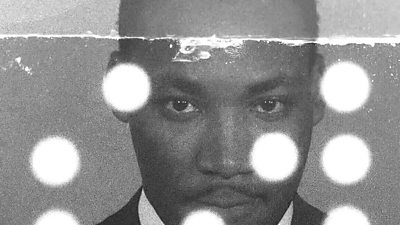
CloseShortly after Dr. Martin Luther King Jr led the march on Washington in 1963, FBI agents were ordered to start following the famed civil rights leader.The extent of the surveillance shocked documentary maker Sam Pollard so much he decided to start digging. He managed to uncover FBI documents, sourced secret White House phone calls, and found long-forgotten footage of King at the peak of his career. With interviews from King’s contemporaries Clarence Jones and Andrew Young and former FBI agents, MLK/FBI paints a picture which, as Pollard tells the BBC’s Alex Stanger, mirrors today’s reality.

Watch preview here:  https://www.bbc.com/news/av-embeds/55620286/vpid/p093xfl2“>

Source: Martin Luther King Jr: New documentary on FBI surveillance – BBC News

Life After Lynching in “Ashes to Ashes” | The New Yorker

Life After Lynching in “Ashes to Ashes”

In “Ashes to Ashes,” the artist Winfred Rembert and the activist and physician Shirley Jackson Whitaker reckon with the living legacy of racist violence in America.

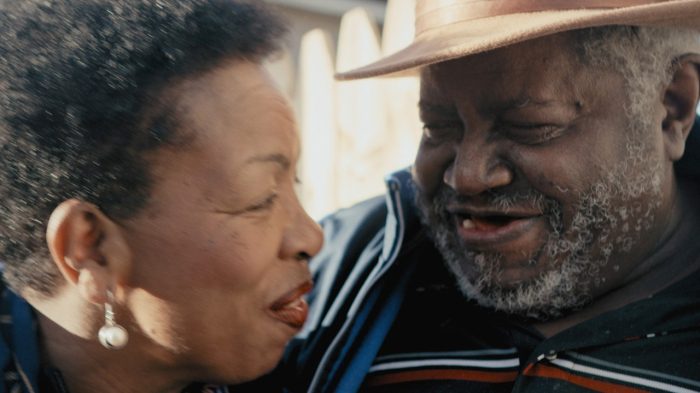
Sometimes the artist Winfred Rembert can’t sleep at night. His wife, Patsy, says that it has to do with his work. “Whenever he do one of those pictures, he gets sick,” she explains. “He has to double up on that medicine in order to get some rest.” Rembert first draws his scenes, full of faces and patterns, on paper, then carves the images onto a sheet of tanned leather by hand, texturing the surface with tools that look almost surgical, before filling in the etchings with vivid dyes. His paintings depict scenes of Black life in the Jim Crow South, and making them means dredging up painful memories from his youth, when he worked in cotton fields and on a prison-labor chain gang. Some artworks are healing or serve as sources of hope, Rembert says, in the documentary “Ashes to Ashes”—but not his.

When he was nineteen years old, living in Georgia and participating in the civil-rights movement, Rembert, now seventy-five, was lynched by a mob of white men. They shoved him into the trunk of a car, stripped him, hung him upside down, stabbed him, and made it clear that they intended to castrate him. The attack was brutal and dehumanizing—“There I am, bleeding like a pig, hanging up in a tree, ready to be slaughtered,” Rembert recalls. The attackers were moments from hanging him. They stopped, Rembert says, only because one man said they had “better things” to do. Rembert survived, but the scars have stayed with him.

“Ashes to Ashes” follows Rembert’s discussions with the physician Shirley Jackson Whitaker, a friend who also grew up in Georgia, about trauma and about how wounds of the spirit are connected to physical health. In the film, Whitaker is on a mission, organizing a homegoing ceremony to honor the thousands of Black people who have been killed by lynching in the United States, whose families often did not get even the solace of a burial. “Sometimes they would lynch people—they’d put them in the water with weights, so the family would never see them again,” she says. “Sometimes they would take the bodies and cut them up and sell the pieces. Sometimes they would take the body after they lynch it and burn it up. So the families would not have anything.” Those examples, she points out, are just the instances that were reported. Whitaker organized a funeral service, held in May of 2017 in Springfield, Massachusetts, to honor and remember the unburied. The ceremony included a reading of names, with members of a local theatre group performing monologues drawn from Whitaker’s historical research.

Whitaker has a physician’s reverence for history. She says that, when patients come to see her, they may need to have difficult conversations about what has happened in that patient’s life. Those conversations can’t be ignored or elided, no matter how uncomfortable they may be. “Sometimes, patients come and they tell you horror stories. But I can’t discard it, because I need it in order to help that patient live,” she says. Without that information, she says, the patient will never get toward a cure. It’s a striking parallel to the words she delivered at the homegoing ceremony: “Some bad things happened in this country, where Americans tortured other Americans. . . . So we’re looking back in history,” she says, to a church full of mourners. “This patient”—and, here, the patient is something more collective than an individual in her exam room—“can only live and get stronger if we’re willing to look back.”

Taylor Rees, who directed the film, told me that working with Rembert and Whitaker has expanded her thinking about what it means to heal from racial and political violence. “That healing process might never look like a complete recovery from an injury, but it’s the courage to face an injury,” she told me. “Looking at that thing that has caused harm is sometimes the hardest part.” The attack that Rembert describes is so vicious, his attackers so lacking in human decency, that the temptation is, if not to look away, then to dissociate, to ascribe the actions to a distant place and time. But neither Rembert nor the brutality he lived through are relics of history. “The person who endured this is alive. This isn’t generations ago,” Rees said. The truth of that statement could hardly be clearer. We spoke just days after a mob had breached the Capitol building, many of its members wearing white-supremacist insignias and at least one waving a Confederate flag. On the National Mall, some of the group erected a scaffold and noose.

Source: Life After Lynching in “Ashes to Ashes” | The New Yorker

Whiteness Is the Greatest Racial Fraud | Boston Review

Whiteness Is the Greatest Racial Fraud

The Krugs and Dolezals dominate the headlines, but they are distractions from the fraud that imperils us all: believing oneself to be white.

LUVELL ANDERSON

Image: Boston Review

What is racial fraud and how is it possible? The answer would be clear enough, perhaps, if race were a biological reality. But the consensus seems to be that race is a social construction, a product of human ingenuity. So why can’t you choose to be any race you want?

Rachel Dolezal, the former president of the Spokane NAACP who identifies as Black despite being born to white parents, clearly believes we are free to choose our racial identity. Her case would seem to expose the limits of thinking of race as a social construction. If races are social rather than biological, some commentators on Dolezal suggest, we are free to make of them what we will; there are no rules. Yet responses to Dolezal tell a different tale. A 2015 Rasmussen survey of 1,000 likely U.S. voters found that 63 percent believed Dolezal was being deceitful in claiming to be Black: she was engaged in a kind of racial fraud.

The subtlest version of racial fraud—the fraud of whiteness itself—is the one we should be most concerned about, for it is by far the most destructive to our polity.

Is it incoherent to believe both that race is a social construct and that racial fraud is possible? In other words, does endorsing the notion of racial fraud require believing races are biological, after all? Literary scholar Walter Benn Michaels makes this sort of argument in his 1994 essay “The No-Drop Rule,” and versions of that idea endure. Michaels’s claim basically amounts to this: in order for a charge of racial fraud to have any normative power—that is, the kind of authority we generally grant to statements about what we should and should not do—it must rely on the claim that race is an essential, biological part of who we are.

But Michaels is wrong: normative significance does not ride on racial essences. In his 2008 essay “Race, Multiculturalism and Democracy,” philosopher Robert Gooding-Williams explains the error. Following Adrian Piper, Gooding-Williams claims that racial classification is the result of being subjected to a practice that counts one as a member of a particular race. Michaels wrongly assumed that for social constructionists, one’s racial identity is determined solely by visual features. But, at least in the United States, racial identification draws on both visual and cognitive criteria: facial characteristics, hair texture, skin color, ancestry. That is why, Gooding-Williams writes, “someone who would not be classified as black on the basis of visual criteria could still be black because Americans’ conventional (though not universal) adherence to the one-drop rule cognitively identifies her as black.” In saying that Dolezal committed racial fraud, you do not have to believe that race is biological. You simply have to think that the practice of racial classification cognitively identifies her as white. In other words, social construction can be ruled-governed without appealing to biological essence.

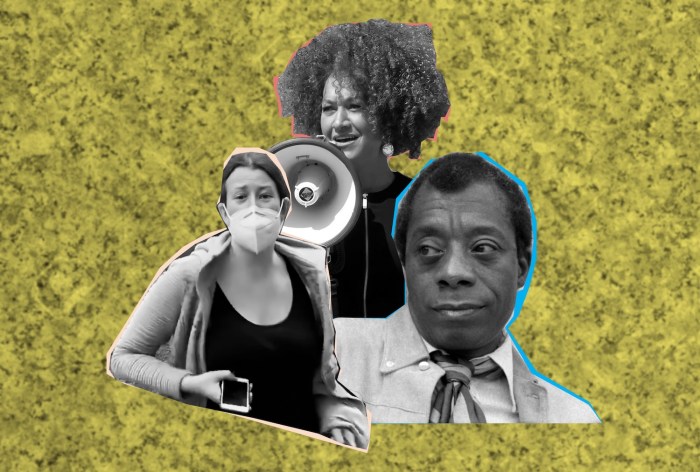
What does this tell us about debates over racial fraud today? While people like Dolezal, former George Washington University professor Jessica Krug, graduate student CV Vitolo-Haddad, and activist Satchuel Cole dominate the headlines, there are more subtle forms of this phenomenon to which we should pay attention. The most obvious versions are often easiest to denounce, perhaps because they are more easily detected or recognized. But I think the subtlest version—the fraud of whiteness itself—is the one we should be most concerned about, for it is by far the most destructive to our polity. To understand its stakes, we must see how it differs from two other, more familiar types of racial fraud.

section separator

Perhaps the most familiar type of racial fraud amounts to identity theft. A classic example occurs in the 1986 movie Soul Man, in which the character Mark Watson (played by C. Thomas Howell), a white Californian, poses as a Black man in order to get a scholarship from Harvard Law School. To pull it off, Watson takes tanning pills, perms his hair, learns a few cultural references, essentially donning blackface for the sake of personal gain. He attempts to defraud Harvard and others by misrepresenting himself, the white son of a wealthy psychiatrist, as a Black man.

Racial fraud as identity theft seems to be quite clearly what is happening in cases like that of Krug as well. Krug outed herself as a white woman last fall after having claimed various Black identities over the years. She deceived others by misrepresenting herself as something she isn’t, appropriating the identities of North Africans, African Americans, and finally Bronx-based Afro-Latinx. Krug’s posing took place all while building her career as a scholar working on the history of Africa and the African diaspora. Perhaps she believed doing so would boost her credibility as a scholar.

However, personal gain is only one basis for engaging in this kind of identity theft. Another basis is fetishization. Sometimes a person’s admiration for a group of people can result in a kind of conflation where that person no longer recognizes a distinction between themselves and the group. Arguably, this is what may have happened with Dolezal. Before her true parentage was revealed, part of her identification included claiming a Black man as her father, claiming her adopted Black brothers as her sons, wearing hairstyles typically associated with Black women, and tanning her skin to make it darker. Dolezal continues to identify as Black even after being exposed. This suggests a different motivation from that of the personal gain of things like money or social status.

It is the need to protect the ultimate fraud of whiteness that imperils not only the vulnerable other, but everyone.

Perhaps a clearer instance of fetishization is the case of German model Martina Big. Once a blonde-haired, white-skinned German woman, she has since transitioned into a brown-skinned, black-haired “Black” woman. On her website, she says she changed her ethnicity in 2017 to Black and has changed her legal name to Malaika Kubwa. She also notes that she very much likes her “new African look” and will complete the transformation by changing her facial features to “African” and enlarging her buttocks. Big—along with her husband, Michael Eurwen, who has also been injecting Melanotan to darken his skin—expressed plans to move to Kenya to “be with her ‘people’ and learn how to raise a family in the African way.”

Why should we be concerned with racial identity theft? Engaging in racial fraud for personal gain is wrong because it typically cheats members of marginalized groups out of resources intended to redress historic injustices. Racial fraud motivated by fetishization, however, is more complicated. Dolezal, for instance, was certainly wrong for the lies she told in presenting herself as Black. Big, on the other hand, does not appear to have engaged in such behavior. Her actions appear more pathological than diabolical. Big is also an extreme case. Less extreme cases may provoke more debate about what exactly is at issue. Perhaps the mildest form of these cases falls into a second type of fraud—a certain kind of appropriation.

In her book White Negroes (2019), Lauren Michele Jackson thinks through the stakes of cultural appropriation. She makes clear that the “act of cultural transport is not in itself an ethical dilemma. Appropriation can often be a means of social and political repair.” What matters, in her view, is the combination of cultural appropriation with power: white people profiting from the cultural productions of Black people, all the while denying credit to the originators—resulting in the erasure of Black contributions to society. And as Jackson notes, these kinds of appropriations exacerbate and prolong our society’s inequalities.


Instances of these kinds of erasure are quite widespread. In music, Elvis Presley is a vivid illustration; Jackson alerts us to instances of erasure in the culinary world, too. Hattie B’s Hot Chicken, a white-owned restaurant based in Nashville, has become the embodiment of this distinctively Nashville cuisine. But as it turns out, Black-owned restaurants—Prince’s Hot Chicken Shack and Bolton’s Spicy Chicken and Fish—are responsible for its creation and existence. When the mainstream culinary outlets got wind of it, Prince’s and Bolton’s were all but erased from the picture. What makes both of these cases instances of racial fraud is the consuming of the cultural productions of the group coupled with the erasure of that group’s contribution. Apportioning credit to the Elvises and Hattie B’s of the world rests on a fraud, a fraud perpetrated by the erasure of someone else.

section separator

Beyond these two types of racial fraud, however, there is a third type—less often discussed, but perhaps most consequential—that has to do with one’s relationship to one’s own history. By “history” I don’t mean exclusively, or even primarily, a person’s particular history, but more so corporate or social history: the kind of thing a person is a part of with others in virtue of being identified in a particular way. There are narratives that provide a unified sense of the various happenings to a group of people who evolve over time. But the sense of history I have in mind is slightly different. It is the notion of history found in James Baldwin’s essay “Unnameable Objects, Unspeakable Crimes” (1965):

History, as nearly no one seems to know, is not merely something to be read. And it does not refer merely, or even principally, to the past. On the contrary, the great force of history comes from the fact that we carry it within us, are unconsciously controlled by it in many ways, and history is literally present in all that we do. It could scarcely be otherwise, since it is to history that we owe our frames of reference, our identities, and our aspirations.

The presence of this history in our present, its impact on our frames of reference and identity, is crucial to the third type of racial fraud.

There are at least two versions of this type. The first is exemplified by the incident last year in New York City’s Central Park when Amy Cooper, a white woman, called the police on Christian Cooper, an African American man (no relation, despite the common last name), after he asked her to leash her dog. Amy became more and more irate in response to Christian’s insistence that she leash her dog. She became so upset that she called the police and claimed Christian threatened her, making sure to emphasize that he was “an African American man.” Amy signaled the urgency of the situation in her voice, sounding agitated and fearful.

What preexisting ideas and practices did Amy have available to her to make her think her indignation over being told to leash her dog was a violation worthy of police intervention and to lead her to emphasize the perpetrator was an “African American male”? It is the latter thing that is most revealing. Amy’s inclination to point out Christian’s African American maleness drew—consciously or not—on an understanding of the world as one in which African Americans stand in a particular kind of relationship to white people. Christian was out of line, out of place, in calling Amy’s attention to the park’s rules and insisting she follow them. Given the kind of person she is, as well as the kind of person he is, this was especially egregious.

The basis of white identity is a “lie of their history,” a lie used to justify dominating others.

This understanding of the world presumes a natural relationship of ruler to ruled, reminiscent of the one Aristotle describes in his Politics. To be sure, Amy Cooper and many others would likely deny believing anything like this, but her reflex to act this way hints at something present practically, almost like muscle memory. I think that Amy’s actions can possibly be linked to what Baldwin might say is her belief in being white. In “On Being ‘White’ and Other Lies” (1984), Baldwin details the fraud of those who “believe they are white.” In a powerful passage, Baldwin registers a catalog of the effects of white racial fraud:

Because they think they are white, they do not dare confront the ravage and the lie of their history. Because they think they are white, they cannot allow themselves to be tormented by the suspicion that all men are brothers. Because they think they are white, they are looking for, or bombing into existence, stable populations, cheerful natives and cheap labor. Because they think they are white, they believe, as even no child believes, in the dream of safety. Because they think they are white, however vociferous they may be and however multitudinous, they are as speechless as Lot’s wife—looking backward, changed into a pillar of salt.

Baldwin points out that the “price of the ticket” for Europeans immigrating to the North American continent was to become “white.” What this meant, in essence, was leaving behind their history as English or Spanish or German to forge something different. But this newly forged whiteness was so monstrous that it became necessary to misrepresent it as something else—something grander, superior, innocent.

This kind of racial fraud differs from the others in that those perpetrating it do not attempt to pass themselves off as a member of another race or attempt to pass off as their own the cultural traits or mannerisms of another group. Instead, perpetrators of this fraud commit to something so disturbing that it becomes necessary to hide it even from themselves. The basis of their identity is a “lie of their history,” a lie used to justify dominating others. A stark example of this phenomenon is arguably present in our current political context. The election of figures like Donald Trump reflects, at least in part, the desperation of some to hold onto whiteness. It is as Baldwin noted: “Just so does the white community, as a means of keeping itself white, elect, as they imagine, their political (!) representatives. No nation in the world, including England, is represented by so stunning a pantheon of the relentlessly mediocre.”

A second manifestation of this type of fraud is highlighted in Frantz Fanon’s Black Skins, White Masks (1952). Fanon considers the case of an Antillean who spends time in the French metropole getting educated and then returns to his homeland with a new outlook, one that has him looking down on his fellow Antilleans with disgust:

All colonized people—in other words, people in whom an inferiority complex has taken root, whose local cultural originality has been committed to the grave—position themselves in relation to the civilizing language: i.e., the metropolitan culture. The more the colonized has assimilated the cultural values of the metropolis, the more he will have escaped the bush. The more he rejects his blackness and the bush, the whiter he will become.

The fraud in this instance is in the colonized believing the deceptive history of the colonizer. The colonized Antillean who goes to France for a “civilized” education and believes the terrible lies told about him and his descendants has failed to confront his history honestly and has identified himself with a fraudulent identity. Once again, the basis of this racial identity is a lie, and to behave on the basis of that lie is to perpetrate a fraud.

section separator

The pervasiveness of the third type of racial fraud is a grave problem. Addressing it is much more difficult because it is less detectable, even by its perpetrators. It is not just dyed-in-the-wool racists, confident in their superior racial stock, who are racially fraudulent. The good white liberal is also guilty of this kind of fraud. That is, good white liberals also believe they are white. Amy Cooper’s political contributions to Barack Obama, Pete Buttigieg, and John Kerry suggest she identifies politically as a liberal.

While the Krugs, Dolezals, and Vitolo-Haddads attract all of the media attention, the focus on figuring out what motivates their behavior provides a neat scapegoat on which to load all of our anxieties, fears, misgivings, and disdain. Doing this allows us to avoid confronting turbulent histories that become repressed and, in turn, produce fraudulent identities that become the basis for destructive behavior.

Perhaps the fire James Baldwin foresaw in 1963 will be set by those who have had so much practice setting things ablaze.

Our present is full of such instances of destruction, as is our past. Rosewood, a small Black town in northern Florida, was burned out of existence in 1923 all in the service of protecting whiteness. As the story goes, a white woman, Fannie Taylor, was sexually assaulted, allegedly by a Black man. Sarah Carrier, a Black woman employed as a domestic worker by Taylor, remembered things differently. Carrier and her granddaughter were in the back of the house that day, preparing to wash clothes, when they saw a white man—an engineer who worked on the railroad and rumored paramour of Taylor—enter the house. Taylor and her lover apparently got into a heated argument that became physical. Carrier and her granddaughter both heard the altercation and saw him subsequently run from the house. Taylor then made her way into the street, screaming that she had been attacked by a Black man. What ensued was a rampage that resulted in the burning of the town and the lynching of several residents. (Estimates of how many were killed vary, with an official death toll of 8 but claims of up to 200.)

The massacre at Rosewood was made possible by the belief of so many that they were white. The need to protect “the purity of the white woman” from the advances of the ravenous Black man was a pretense used to lynch countless numbers of people. The belief in an identity boasting purity and superiority instigated murderous behavior that has created and sustained various inequalities in our land till this day. As we saw last week, when hundreds of white Trump supporters staged a violent insurrection at the U.S. Capitol, it is the need to protect this fraud at all costs—the ultimate fraud of whiteness—that imperils not only the vulnerable other, but everyone. What happens when reality comes crashing down and the fraudsters realize the scam cannot be maintained? In 1963 Baldwin spoke of the fire to come if America did not heed the warning of the oppressed and turn from its wicked ways. Perhaps the fire Baldwin foresaw will instead be set by those who have had so much practice setting things ablaze.

Source: Whiteness Is the Greatest Racial Fraud | Boston Review

What should we do with plantations? – The Boston Globe

Black Lives Matter signs have popped up nearly everywhere. In June this slogan, or judiciously crafted approximations of it, began flooding my email inbox in the form of company statements that fell into a gray area between corporate responsibility, virtue signaling, and free advertising. During a 4th of July road trip to Vermont after I turned onto the wrong highway and found myself lost in New Hampshire, I saw the slogan painted in massive letters on the front of an aging barn. I thought then that a barn in a white, rural area took the prize for the most unexpected placement of a rallying cry for the fight against anti-Black racism, police brutality, and the lack of funding for social services. But the strangest place I have yet encountered the political mantra is the home page of a lavish Southern plantation house museum.

Berkeley Plantation, a National Historic Landmark that bills itself as “Virginia’s Most Historic Plantation,” is situated along the James River in Virginia, a colony and then state that enchained thousands of African Americans to produce lucrative tobacco crops before feeding, in the early 19th century, a massive forced migration of nearly one million Black people into the formerly Indigenous cotton lands of the Old Southwest. Berkeley Plantation’s home page features the romanticized lexicon and imagery that tourists anticipate and scholars of plantation tourism have long catalogued and criticized: genteel white owners, ornate architecture, splendid gardens, fine antiques, and decorous housewares. At Berkeley, the wealthy former residents who are extolled include Virginia Governor Benjamin Harrison and two of his descendants who became president, William Henry Harrison and Benjamin Harrison. The idealized domestic setting is enlivened, the home page text promises, by “enthusiastic guides in period costume.” Visitors here, the website suggests, will step into an Old South fantasy that obscures how slavery in its myriad grotesque realities shaped the site economically, socially, politically, and culturally. But in this moment of public foment, the Berkeley Plantation website now fronts a bold banner across the top of the screen proclaiming: “Berkeley Plantation believes that Black Lives Matter.”

I was stunned to see this claim appearing above photographs of grounds once maintained by enslaved people and formal parlors with slaveholder portraits hanging on walls. It struck me as the most supreme irony, and even as a cruel joke, that an estate built on the chewed-up and spat-out lives of Black people was now purporting to cherish Black existence. Given that we live in a time when not saying something of this sort exposes businesses and cultural institutions to the scrutiny of public opinion, this plantation was disingenuous at best and opportunistic at worst, I thought.

Then I clicked on the banner and discovered a direct statement indicating the harm done to Black and Native people on those grounds. The statement opens with an affirmation, “We believe that Black Americans, Indigenous People and their descendants deserve justice,” and continues with an admission of responsibility as well as an aspirational action plan. “We recognize that enslaved people were present at Berkeley plantation,” the statement reads. “We are working with researchers and historians to uncover all aspects of this site’s past and there is much work and responsibility ahead to make this site a place for healing and awareness.” I was persuaded that Berkeley Plantation’s current operators care about this past and its legacy.

Nevertheless, they are stewarding a racist landmark among an entire class of public memorials — plantation homes and landscapes — with a grandeur and impact equal to or greater than the Confederate statues currently being toppled or secreted away in our summer of national reckoning with anti-democratic symbols. As Patricia J. Williams stated in a September 2019 piece in The Nation on plantation weddings: These iconic homes and landscapes are “monuments to slavery.” The relevant question is not whether any site staff believes in their hearts that Black life is valuable — but rather, what caretakers of plantation sites and visitors to these historic places will do differently as a result of this belief.

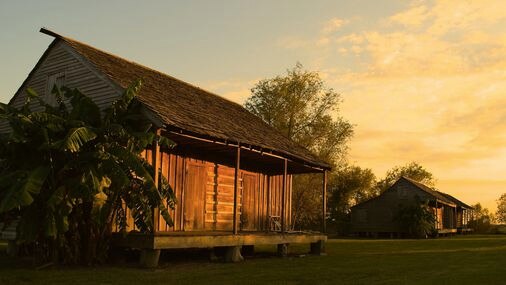
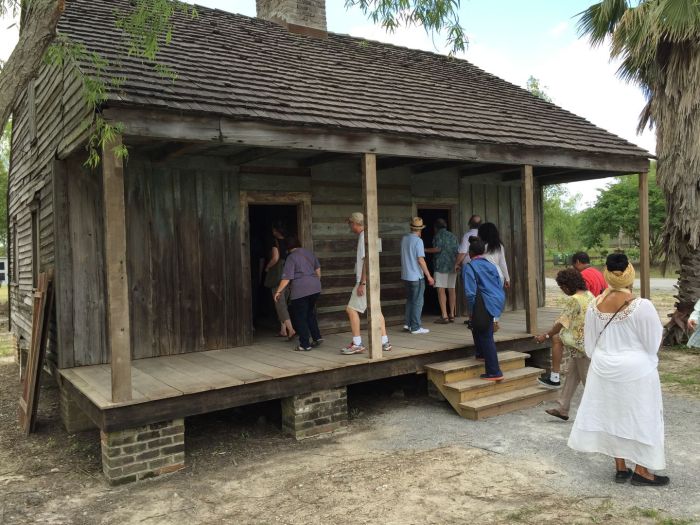
Visitors took a close look at a slave cabin at Whitney Plantation.
Visitors took a close look at a slave cabin at Whitney Plantation.DOUG WARREN FOR THE BOSTON GLOBE

NUMEROUS STUDIES OF plantation tourism, such as Jennifer Eichstedt and Stephen Small’s classic 2002 sociological study, “Representations of Slavery,” have found that plantation sites (especially those that are privately owned) tend toward Eurocentric portrayals of the past that participate in a process of “symbolic annihilation” in which Black presence is ignored or marginalized. Geographers E. Arnold Modlin, Derek Alderman, and Glenn Gentry argued in the journal Tourist Studies that even when plantation museums incorporate African Americans into tour narratives, they often do so in a distant manner that reduces Black experience to a cold recitation of population numbers, ages, and work tasks, rather than elevating Black residents to the level of white owners through stories that induce empathetic responses in visitors. The National Science Foundation has funded a team of geographers and historians headed by David Butler to conduct the most systematic study to date of a famous cluster of cotton estates known as the River Road Plantations spanning the Mississippi-Louisiana border. The team members are finding, as detailed in the Journal of Heritage Tourism, that even at sites that have made an effort to interpret enslaved people’s presence, features of the built environment, such as the location and size of the front-facing “big house” in comparison to “slave quarters” in the rear of a property, emphasize elite white experiences to the detriment of others.

Tourists who enter these landscapes often carry romanticized notions of the Old South that find affirmation in the spatial arrangement of the plantation that aggrandizes white mastery. I have found in my own research on ghost tourism in South Carolina, Louisiana, and Georgia, recounted in my book “Tales from the Haunted South,” that a handful of privately run plantation sites and walking tours market Black suffering in the form of horrific tales of sexual abuse and murder trivialized as ghost stories. It is heartbreaking and noteworthy, as well, that plantations can be heritage sites for white supremacists. Dylann Roof, who killed nine people participating in Bible study at Charleston’s Mother Emanuel AME Church in 2015, visited South Carolina plantation sites in the months leading up to his racially motivated attack.

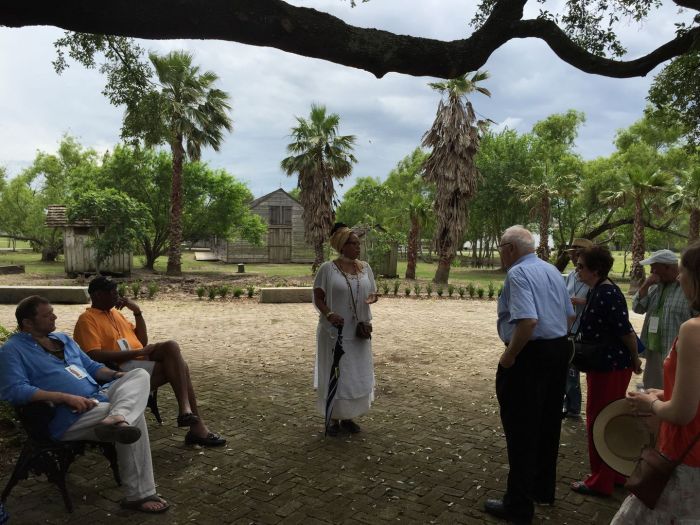
Whitney Plantation tour guide Mikhala Iversen answered questions from visitors.
Whitney Plantation tour guide Mikhala Iversen answered questions from visitors.DOUG WARREN FOR THE BOSTON GLOBE

Plantation tourism has changed slowly but substantially over the last decade, particularly with the 2014 opening of the innovative, privately owned Whitney Plantation in Louisiana that consciously centers African and African American experiences and with the 2015 opening of the McLeod Plantation in South Carolina, which is operated by Charleston County and interprets Black experiences before and after the Civil War. These sites are models for how the plantation museum experience has been reimagined, and yet, they have remained in the minority of Southern estate museums. The gradual shift at Whitney and McLeod has provoked resistance from white visitors who have expressed resentment at tours that address racial subjugation. Most plantation sites dependent on tourism dollars and public funding have tended not to risk the discomfort of their majority white visitors by highlighting Black experience and the trauma of slavery. In this fraught context, the Berkeley Plantation statement that openly engages contemporary racial politics seems rather courageous.

As public debate continues about commemorations to the Confederacy in the built environment, we should ask what is to be done with the hundreds of monuments to a pre-Civil War culture of racialized power that proliferate across the Southern landscape — and indeed, the Northern terrain — in the form of the plantation and country estate. How do we turn these homages to slavery into stages for meaningful dialogue? Not, I would suggest, by pretending they do not exist or taking aim with the wrecking ball.

The latter approach seems to have been adopted this July in South Carolina on the former Oaks Plantation of 18th-century ricing patriarch Arthur Middleton, where, according to The Post and Courier, a late 19th-century plantation revival home built on the original grounds was recently demolished by the corporate owner under the cover of night. Instead, we should push ourselves as visitors and stewards of these sites to reinvent them as spaces of facilitated conversation at the nexus of multiple social histories, as places of homecoming and meaning-making for descendants of the enslaved, and as sites where managers and tour guides of color have equal employment and advancement opportunities as well as shared authority to research and incorporate fresh interpretations. This vision might include any number of concrete actions. Among them could be a reversal of how visitors enter and experience physical places. Rather than entering a mansion first, tourists might be welcomed into the comparatively humble quarters to learn about the unfree population who built the wealth of others but also sustained their own lives and families.

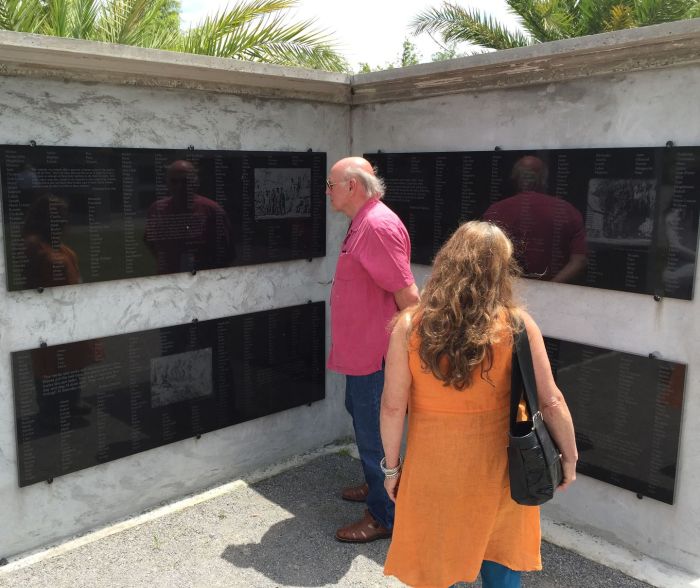
Jim Smith and Paula Barry of Conway, Mass., examined names of Louisiana slaves recorded on the 18 monument walls in the Allées Gwendolyn Midlo Hall at Whitney Plantation.
Jim Smith and Paula Barry of Conway, Mass., examined names of Louisiana slaves recorded on the 18 monument walls in the Allées Gwendolyn Midlo Hall at Whitney Plantation.DOUG WARREN FOR THE BOSTON GLOBE

Visitors might be invited to walk fields and survey outbuildings where many enslaved people spent the bulk of their time, to traverse any remaining wooded areas where enslaved people secretly met to practice their faith or temporarily escape corporal punishment, to tarry in work yards and kitchens where unfree workers practiced the range of skills necessary for supplying the white household. This approach would reveal not only the human strivings of Black and Indigenous people, but also the intricate, intimate, and violent relations that entwined the worlds of enslaved and enslaver.

With greater attention to plantation grounds, tour guides might even bring visitors into active, productive engagement. Volunteers could tend reproduction gardens of the type some enslaved people kept and, as the historian Peter Wood has often urged, “plant gourds!” The fruits of such gardens might be donated for the benefit of local community food security, connecting physical sites and histories of slavery (including the scourge of hunger that was often part of that trauma) to present-day social issues. Sites might attract diverse visitors with planned conversations, book clubs, poetry readings, and overnight stays — along the lines of Joseph McGill’s Slave Dwelling Project — that openly link past histories with current racial, economic, and political challenges. While such approaches may disabuse tourists of romantic notions about life in the United States prior to the formal end of racial slavery, they yield other and deeper satisfactions: earnest historical investigation, hands-on learning, social connection, and civic contribution. This dramatic summer of mass protest may represent an unprecedented opening for plantation sites to find receptive audiences for this tough work of collaborative reinvention, and indeed, some are already doing so.

FOR EXAMPLE, PUBLIC visits to the Royall House and Slave Quarters, an 18th century estate in Medford, Mass. (home to Governor John Winthrop as well as Isaac Royall, whose fortune built on slave labor and commercial trade helped to establish Harvard Law School), begin in the quarters. Board Co-President Penny Outlaw continually interweaves the activities of Blacks with those of white residents even as the tour moves into and through the main house. Recently, the house museum hosted a poetry reading with Malcolm Tariq, prize-winning author of “Heed the Hollow,” and featured an Instagram Live event with activist and performer Alok Vaid-Menon. Kyera Singleton, the first African American woman to lead the site as executive director, planned these virtual events. Singleton told me about her museum’s special charge in these times: “I cannot stress enough that the Royall House and Slave Quarters is a museum that seeks not only to get the history of slavery right, but also to function as a site of memory. It is a place that memorializes the lives of enslaved people. We do that quite simply by centering their lives, their experiences with violence, and their resistance. I believe one of our strengths is the ability to help people reckon with our current political moment by being honest about slavery and the legacies of enslavement today.”

The Broadway actor Robert Hartwell also had reinvention in mind when he purchased an antebellum house in Great Barrington, Mass., originally built for the Russell family that owned a local cotton manufacture. Hartwell said on Instagram: “I wish I could’ve told my ancestors when they were breaking their backs in 1820 to build this house that 200 years later a free gay Black man was going to own it and fill it with love and find a way to say their name.” Given that Massachusetts began taking steps to abolish slavery in the 1780s in response to Revolutionary-era ideals and legal suits brought by enslaved people, Hartwell’s home was probably not built by unfree workers. Nevertheless, New England mills routinely procured cotton grown and harvested by enslaved people in the South. Northern entrepreneurs shipped textiles woven from that cotton across the Atlantic Ocean to European markets and back down South to cheaply clothe the very people whose stolen labor had produced the lucrative raw material. Hartwell’s personal association of his house with that entangled history reminds us just how close the cultural memory of slavery is for many African Americans.

Black Lives Matter protests, however imperfect, have ignited widespread recognition that symbols we have long accepted as features of local landscapes wear down our potential to weave a new national fabric even as they archive physical evidence of our troubled racial history. Retiring, reimagining, and repurposing misplaced symbols that glorify racial oppression have the potential to open psychic and civic space for the descendants of enslaved people to finally call this nation home.

Tiya Miles is a professor of history at Harvard and the author of five books. Her latest, “All That She Carried: The Journey of Ashley’s Sack, A Black Family Keepsake,” is forthcoming from Random House in 2021.

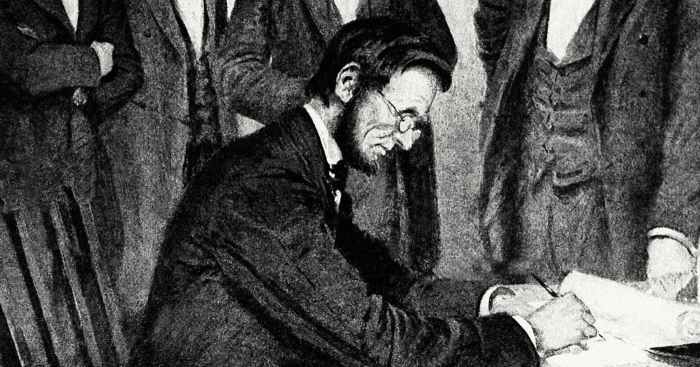
On Jan 01, 1863: Enslavement Only Partially Banned by Emancipation Proclamation

Slavery did not become illegal until the Thirteenth Amendment was officially ratified on December 6, 1865 (though even then, the provision allowed for legal enslavement “as punishment for crime”). Many Southern states refused to ratify the Thirteenth Amendment even after the Civil War ended. Delaware and Kentucky rejected ratification and slavery persisted in those states for several more years before the practice ceased. Mississippi did not officially ratify the amendment until 1995 – 130 years after it was adopted.”

Source: On Jan 01, 1863: Enslavement Only Partially Banned by Emancipation Proclamation

America doesn’t want unity. It wants absolution without restitution ::: Renee Graham :: The Boston Globe

America doesn’t want unity. It wants absolution without restitution

Renee Graham, Boston Globe

Throughout his campaign, and especially during his first speech as president-elect, Joe Biden stressed the need for unity. “Our nation is shaped by the constant battle between our better angels and our darkest impulses,” he said. “It is time for our better angels to prevail.”

Abraham Lincoln first summoned “the better angels of our nature” in his inaugural speech in 1861. A month later, the Civil War began; we’ve been waiting ever since for these rumored apparitions of our nation’s inherent goodness to prevail.

America has never wanted unity. It prefers absolution over restitution.

When this nation’s leaders speak of unity, that often means, “We need to move on,” even though unchecked trauma leaching from one generation to another prohibits any such thing. For many of us, especially Black and brown people, unity is a five-letter word for “Shut up and get over it.” That is how this nation regards calls for repair of systemic disenfranchisement.

Before accord, there must be an accounting — otherwise, it’s like leaving a tick’s head embedded beneath the skin. The problem is less visible, but the host body remains sick and unsound.

In his speech, Biden seemed to speak very specifically about the horrors imposed these past four years. (And they aren’t over.) Of course, what we witnessed during the Trump years was an amplification of the racism and other hatreds that plagued this country long before a failed businessman became a failed president.

“Every day we hear about how society is splitting apart — a polarized Congress, a fragmented media market, a persistent schism among Americans over social issues. But really, how bad are the divisions?” Bob Cohn (now president of The Economist), wrote in The Atlantic. His conclusion: “Pretty bad.”

That was seven years ago. Trump did not create the divisions; he exploited the hell out of them.

About 10 million more people voted for Trump in the 2020 election than in 2016. Again, most of them are white. This I believe: They want to be feared, not understood, and their only definition of unity is aligning against anyone who doesn’t think like them. They’re willing to tear this nation apart with baseless, anti-democracy conspiracies to slake one man’s flimsy ego and their own relevance in an increasingly multiracial, multicultural nation.

Fox News is even chiding Democrats for lobbing “angry rhetoric at those who have worked with and for, and even those who simply support, Trump.” For the president’s propaganda network, achieving unity is a burden to be borne only by those who oppose the president. I don’t hear many Trump supporters reckoning with why they still support the worst president in modern American history.

And that’s par for this country. During a 2017 Harvard conference on universities and slavery, writer Ta-Nehisi Coates said, “I don’t know how you conduct research that says your very existence is rooted in a great crime, and you just say, at best, ‘Sorry,’ and walk away.

For its entire existence, America has mostly walked away. From nearly 250 years of Black people in bondage to the genocidal “Trail of Tears” that forced thousands of Indigenous people from their lands in the 1800s; from the 1921 Tulsa Race Massacre during which white people killed hundreds and destroyed that Oklahoma city’s “Black Wall Street” to every barbarity the current administration concocted to punish those who sought only a better life, this nation continually opts for historical amnesia over atonement.

As the Rev. Bernice King, daughter of Martin Luther King Jr., tweeted, “We can’t skip justice and get to peace.” Nor can we get there without equality.

Scars of this catastrophic presidency will lie alongside festering wounds long untended. There’s no shortcut to unity, a challenge in a nation that would rather be comfortable than truthful. This unfinished democracy will never be whole until all of its practitioners abandon the collective silence that cloaks their complicity. To move toward unity, white supremacy must first be demolished. America has shown no serious inclination to do that, and more than 72 million Trump voters serve as damning proof.

For the sake of this country, I wish Biden every success. I hope he understands that unity is not self-achieving. The most arduous labor must be done by those who have inflicted or benefited from the pain of so many others. Until then, do not ask me to forgive all this nation is too eager to forget.


Renée Graham can be reached at renee.graham@globe.com. Follow her on Twitter @reneeygraham.

Source: America doesn’t want unity. It wants absolution without restitution – The Boston Globe

Births of a Nation, Redux | Boston Review

Births of a Nation, Redux

Births of a Nation, Redux

Surveying Trumpland with Cedric Robinson

ROBIN D. G. KELLEY

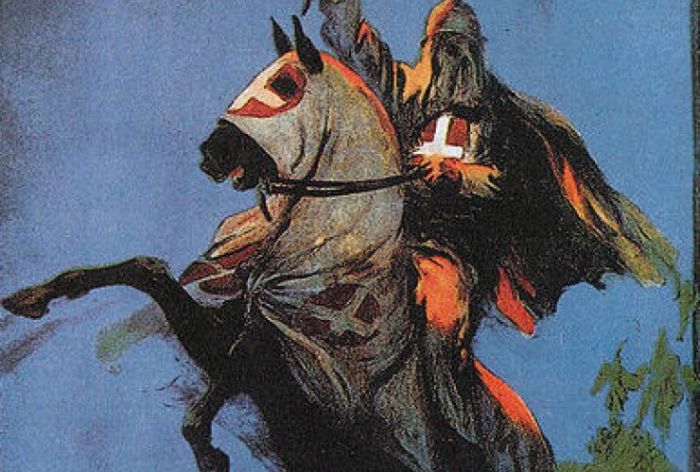
Image: A poster for Birth of a Nation (1915)

November 5, 2020

I wrote the following essay, “Births of a Nation: Surveying Trumpland with Cedric Robinson,” in the wake of Trump’s 2016 victory, but it could have been written today—two days into a still unsettled presidential election; two days of witnessing frenzied, nail-biting, soul-searching Democrats wondering what happened to the blue wave and why 68 million people actually voted for Trump; two days of threats from the White House that they will fight in the courts and in the streets before giving up power. And today Cedric Robinson, pioneering scholar of what he called the “Black Radical Tradition,” would have celebrated his eightieth birthday.

Today Cedric Robinson would have celebrated his eightieth birthday. What Robinson identified as “the rewhitening of America” a century ago is what we’re seeing play out today.

The lessons I took from Cedric in the aftermath of Trump’s election still stand: our problem is not polling, or the failure of Democrats to mobilize the Black and Latinx vote (they came out, often at great risk to their health and safety), or a botched effort to reach working-class whites with a strong, colorblind class-based agenda. What Robinson identified as “the rewhitening of America” a century ago is what we’re seeing play out today.

But before reviving the tired race-versus-class debate, pay attention: Robinson was making an argument about racial regimes as expressions of class power and how racism undergirds class oppression. As I quoted Robinson before: “White patrimony deceived some of the majority of Americans, patriotism and nationalism others, but the more fugitive reality was the theft they themselves endured and the voracious expropriation of others they facilitated. The scrap which was their reward was the installation of Black inferiority into their shared national culture. It was a paltry dividend, but it still serves.” (The emphasis is mine.)

What we’ve seen is the consolidation of a racial regime based—as are all racial regimes—on “fictions” “masquerading as memory and the immutable.” Trump is saving white suburban women from Black rapists and drug dealers who want to take their Section 8 vouchers out to gated communities. He’s protecting our borders from “illegals” who have no claims whatsoever to this white man’s country. He’s shielding the nation from wicked critical race theorists and Howard Zinn with “patriotic education.” He responds to the assault on white supremacist mythologies by defending Confederate monuments. He dispatches federal military forces to crush antiracist protests and declares Kyle Rittenhouse a patriot for killing two unarmed Black Lives Matter protesters. And he dusts off the tried and true strategy of labeling all challengers to the regime “communists and socialists.” (When Biden brags “I beat the socialists!” and “I am the Democratic Party,” he plays right into the regime’s fictions—he is the neoliberal moderate taking back the country from rioters, fascists, and socialists.)

We keep telling ourselves that Trump was elected as a backlash to a Black president, but really he was elected as a backlash to a Black movement. President Obama presided during the killing of Mike Brown, Tamir Rice, Tanisha Anderson, Philando Castile, Alton Sterling, Freddie Gray, Sandra Bland—ad infinitum. It was the mass rebellion against the lawlessness of the state—in Ferguson, in Baltimore, in Chicago, in Dallas, in Baton Rouge, in New York, in Los Angeles, and elsewhere—that prompted Trumpian backlash.

We keep telling ourselves that Trump was elected as a backlash to a Black president, but really he was elected as a backlash to a Black movement. Fear and racism feed off of insecurity.

The massive vote for Trump and his fascist law-and-order rhetoric should also be seen as a backlash to a movement. Some of us believed Black Spring rebellion in the wake of the murders of George Floyd, Breonna Taylor, and Ahmad Arbery signaled a national reckoning around racial justice. But rather than reverse the rewhitening of America, our struggles catalyzed and concretized the racial regime’s explicit embrace of white power. Once again, an unstable ruling class drapes itself in white sheets, puts on its badge and brings out its guns. Fear and racism feed off of insecurity. And in the face of a global pandemic, joblessness, precarity, and an economy on the verge of collapse, this paltry dividend still serves.

If we’d paid attention, we wouldn’t have expected a Biden landslide or a blue wave ripping the Senate from Kentucky’s Mitch McConnell grip. It is not a coincidence that Louisville is on fire over the murder of Breonna Taylor and countless others who died at the hands of police in McConnell’s state. Kentucky has always been a battleground. California is too, and we’re not necessarily winning. Voters just defeated affirmative action, rent control, and the labor rights of gig workers. And despite some important victories, California delivered a lot of votes to Trump. We need to face the fact that our entire country, and the world, is a battleground. Trump and McConnell have succeeded in packing the Supreme Court with reactionaries. Trump’s backers still run the Senate. Gun-toting men and women in red hats stand outside vote-tabulating centers, threatening to do whatever is needed to secure a Trump victory. They yell “stop the count.”

Even with a Biden victory, the failure of the blue wave will be attributed in part to a certain kind of identity politics—Black and Latinx voter turnout less than what was expected—or to the militancy of antiracist protests, or to left-leaning candidates who scared off white moderates by pushing for single-payer healthcare and a Green New Deal. We should not see these as problems for legitimate Democrats. We’ve been witnessing authentic small-d democracy in action. In the streets we’ve seen a movement embrace Black, Brown, and Indigenous people, queer feminism, and a horizontal leadership model that emphasizes deliberative, participatory democracy.

We have an electoral college, battleground states, and voter suppression because the U.S. political order was built on anti-democracy.

This is the democracy Cedric Robinson insisted we embrace. He reminded us that the U.S. political order was built on anti-democracy, a theory of so-called enlightened governance that excludes the popular classes. This is why we have an electoral college, why we have battleground states, and why voter suppression was built into our country’s DNA. As I wrote three years ago, “today’s organized protests in the streets and other places of public assembly portend the rise of a police state in the United States. For the past five years, the insurgencies of the Movement for Black Lives and its dozens of allied organizations have warned the country that unless we end racist state-sanctioned violence and the mass caging of black and brown people, we are headed for a fascist state.”

We’re already here. And there is no guarantee that a Biden-Harris White House will succeed in completely reversing this trend. Nor should we expect presidents and their cabinets to do this work. That would put us back where we started—with tacit acceptance of the principles of anti-democracy.

Cedric’s words from exactly twenty years ago still haunt: “For the moment . . . an unelected government has seized illegal powers. That must be opposed with every democratic weapon in our arsenal.”

Happy Birthday, Dr. Robinson.


March 6, 2017


Cedric Robinson was fond of quoting his friend and colleague Otis Madison: “The purpose of racism is to control the behavior of white people, not Black people. For Blacks, guns and tanks are sufficient.” Robinson used the quote as an epigraph for a chapter in Forgeries of Memory and Meaning (2007), titled, “In the Year 1915: D. W. Griffith and the Rewhitening of America.” When people ask what I think Robinson would have said about the election of Donald Trump, I point to these texts as evidence that he had already given us a framework to make sense of this moment and its antecedents.

Robinson’s work—especially his lesser-known essays on democracy, identity, fascism, film, and racial regimes—has a great deal to teach us about Trumpism’s foundations, about democracy’s endemic crises, about the racial formation of the white working class, and about the significance of resistance in determining the future.

Source: Births of a Nation, Redux | Boston Review

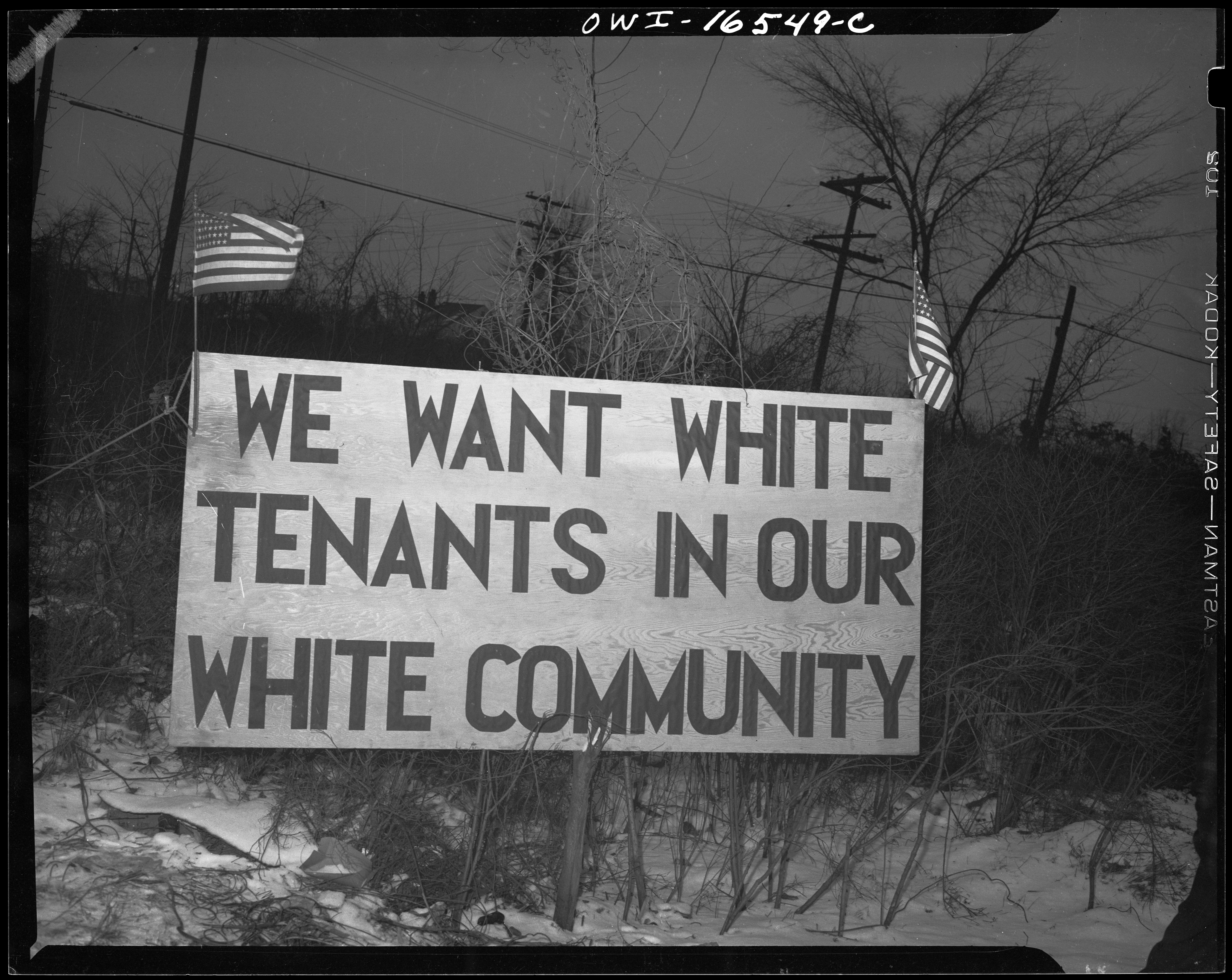
Tearing Down Black America | Boston Review

Tearing Down Black America

Policing is not the only kind of state violence. In the mid-twentieth century, city governments, backed by federal money, demolished hundreds of Black neighborhoods in the name of urban renewal.

BRENT CEBUL

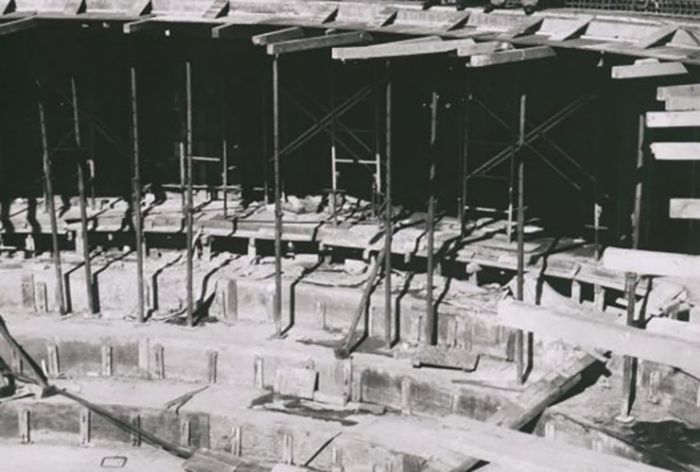
Lincoln Center under construction, after the demoltion of the historically black neighborhood of San Juan Hill. Image: NYPL

When James Baldwin visited San Francisco in 1963 to film a documentary about U.S. racism, he encountered neighborhoods in turmoil: the city was seizing properties through eminent domain, razing them, and turning them over to private developers. Part of a massive, federal urban renewal program, nearly 5,000 families—no fewer than 20,000 residents, the majority of them people of color—were being displaced from rental homes, private property, and businesses in the Western Addition neighborhoods. Baldwin spoke to a Black teenager who had just lost his home and watched as his neighborhood was destroyed. He told Baldwin: “I’ve got no country. I’ve got no flag.” Soon after, Baldwin would say: “I couldn’t say you do. I don’t have any evidence to prove that he does.”

At the very moment when the civil rights movement secured voting rights and the desegregation of public and private spaces, the federal government unleashed a program that enabled local officials to simply clear out entire Black neighborhoods.

That young man was one of millions of Americans, disproportionately of color, who lost homes and communities through the federal urban renewal program. In discussing its human costs—colossal in scope and yet profoundly intimate—Baldwin helped popularize a phrase common in Black neighborhoods: urban renewal meant “Negro removal.” To steal people’s homes, Baldwin understood, was to shred the meaning of their citizenship by destroying their communities. And “the federal government,” he said, “is an accomplice to this fact.”

The 1921 Tulsa massacre and redlining have pierced the popular consciousness in recent years as ways that, through murder and markets, Black communities were destroyed. Curiously, urban renewal has so far remained on the margins of these discussions. Yet that program, in operation between 1949 and 1974, constituted one of the most sweeping and systematic instances of the modern destruction of Black property, neighborhoods, culture, community, businesses, and homes. At its peak in the mid-1960s, urban renewal displaced a minimum of 50,000 families annually—a 1964 House of Representatives report estimated the figure at more like 66,000.

At the very moment when the civil rights movement secured voting rights and the desegregation of public and private spaces, the federal government unleashed a program that enabled local officials to simply clear out entire Black neighborhoods. Federal subsidies went to more than 400 cities, suburbs, and towns, supported more than 1,200 projects, and displaced a minimum of 300,000 families—perhaps some 1.2 million Americans. While Black Americans were just 13 percent of the total population in 1960, they comprised at least 55 percent of those displaced. And, while we tend to remember urban renewal as a big-city program, pursued by titans such as Robert Moses in New York, the vast majority of projects were carried out in cities of 50,000 residents or fewer. These were small cities such as Greenville, North Carolina, where 207 families of color and 11 white families were displaced; Tupelo, Mississippi, where 217 families of color and 31 white families were displaced; and Demopolis, Alabama, where 55 families of color and 7 white families were displaced. Urban Renewal was spread as widely as today’s marches for social justice.

Today, as racially disparate rates of eviction, police violence, and capital flight raise urgent questions about the right to live in safe, thriving communities, a more complete reckoning with urban renewal’s record of destruction is necessary. Fortunately, because urban renewal was federally funded, Washington collected data about how projects unfolded; these records also allow us to reconstruct the many costs of urban renewal. Thanks to a recent comprehensive digital mapping project which I helped spearhead at the University of Richmond’s Digital Scholarship Lab, it’s now possible for the first time to visualize how hundreds of urban renewal projects displaced tens of thousands of Americans. While private–public practices such as redlining help explain the staggering racial wealth gap, the history of urban renewal, though no less materially devastating, involved kinds of theft that are more difficult to quantify—thefts that amount to the destruction of entire lifeworlds. And, the political and economic forces that made urban renewal seem like a good idea at the time continue to shape the precarity of neighborhoods of color today. Like redlining, profit— in this case, returns derived from boosting property taxes— continues to define the state’s interest in destabilizing Black neighborhoods.

section separator

The political and economic forces that made urban renewal seem like a good idea at the time continue to shape the precarity of neighborhoods of color today.

As the United States emerged from World War II, many cities faced a housing crunch. Whites policed the racial boundaries of their neighborhoods, often violently. And so as greater numbers of African Americans migrated north in search of manufacturing jobs and to escape the South’s more formal system of Jim Crow, Black neighborhoods quickly became overcrowded. Residents were often subjected to exorbitant rents in derelict housing owned by slumlords. Families and friends boarded together. Others sublet rooms to meet extortionate rents. Segregated neighborhoods in northern cities became so crowded that many schools operated in two shifts—half of the students went in the morning, the other half in the afternoon. “Blight” was the term policymakers used to describe the worsening conditions structured by these national practices of urban segregation.

Meanwhile, city budgets teetered on the edge of fiscal cliffs, from which they had only just clawed their way back up. The economic exuberance of the 1920s had produced an urban and suburban “land boom,” as the Wall Street Journal put it—the overheated, last gasp of a period “of great and extended prosperity.” Cities fueled this speculation by taking on staggering levels of debt to support the infrastructure that made private property profitable. Net annual additions to municipal debt between 1923 and 1931 averaged over $845 million (or more than $13.5 billion in 2020 dollars), or enough, as one contemporary analyst accurately predicted, “to keep municipal finance in a turmoil for two decades or more.”

When the bottom fell out of the stock market, the consequences quickly ricocheted through urban land markets and city budgets. Property values plummeted, and tax delinquency skyrocketed. In the Great Depression, some 1,200 local or county governments defaulted or went bankrupt.

The New Deal helped stabilize the situation. Later, defense conversion and contracting in World War II injected desperately needed capital into cities. But cities still held considerable debt, and the New Deal’s public works agenda was not without its own considerable costs—while federally subsidized labor constructed many bridges, libraries, schools, and sewage plants, these public assets had also become new line items on municipal budgets. Moreover, as the Depression shuttered factories and the Great Migration brought new residents, officials worried that property tax revenues would never rise to meet these new burdens.

As early as the late 1930s, New Dealers were increasingly concerned that city budgets were fiscal time bombs that threatened to explode the entire progressive project. And they saw that local governments were already using New Deal works programs to remedy the situation. As Mabel Walker, an urban analyst, noted in 1938, in New York City, federally subsidized works projects had begun “siphoning off [the] slum population,” constructing affordable housing “in cheaper areas,” and might even facilitate the delivery of cleared land to “higher income groups” and “business and industry.” The result, she wrote, was “in effect a gigantic subsidy or bonus handed out to property holders in these slum areas” who could never have assembled enough private capital to reset urban land markets themselves. By 1938 Mayor Fiorello LaGuardia estimated the city had torn down or gutted nearly 9,000 buildings. In Philadelphia federal support for clearance subsidized the demolition of 8,328 structures, releasing land with an estimated value of $11.5 million.

Federal leaders struck on the idea of using urban renewal to harness this haphazard redevelopment of cities and turn it into a more coherent, national program of planning, redevelopment, and housing. They also recognized that the federal government’s budget overwhelmingly depended on capital generated in cities in the form of confiscatory, progressive corporate and personal income tax rates. As one of urban renewal’s federal designers put it, short of “a nation-wide overhauling of our traditional arrangements for taxation and public expenditures,” “it seems only fair that the federal government should aid the local governments to the extent necessary to cover their urgently needed outlays.” Federally subsidized slum clearance and redevelopment could put cities back on the path to fiscal independence—and the federal government wouldn’t have to share much of its precious income tax revenue.

Local government officials and their private sector partners were much less interested in creating public housing than they were in commercial redevelopment.

World War II delayed the initiative, but the Housing Act of 1949 set aside significant financing to enable cities to build public housing and to demolish neglected, overcrowded neighborhoods, and antiquated or abandoned industrial properties. As in a number of New Deal programs, the subsidies would be offered in the form of bonded debt, which, after cities delivered a matching share, the federal government would retire. The goal with such a convoluted system of finance was to get capital moving through private financial institutions and to plausibly deemphasize the role of the national government. These were local programs.

This growing mishmash of priorities was a hallmark of midcentury liberalism, which forged cross-cutting relationships with many different interest groups. Some policymakers, for instance, worked closely with real estate interests and business groups and their allies in city halls. Together they hungered for the potential bonanza of private redevelopment and city property tax yields. Others were aligned with progressive public housing advocates or worked closely to cultivate the support of African American community leaders. When he signed the 1949 bill, a signature piece of his Fair Deal agenda, President Harry S. Truman heralded a new front in the war for civil rights: securing a decent home for all Americans. Early on, Black clergy and civil rights activists were among the initiatives’ most hopeful supporters.

Congress soon confronted the reality that few local governments were pursuing the program. Local government officials and their private sector partners were much less interested in creating public housing than they were in commercial redevelopment. But the act’s regulations mandated that housing projects were to be prioritized.

Rather than amend the legislation to offer greater incentives for housing, a revised version of the legislation, the Housing Act of 1954, created the federal Urban Renewal Administration, ceding to the interests of commercial lobbyists and mayors. The act loosened housing mandates and so unleashed a goldmine of federally financed business-oriented clearance and development.

Many of the developments that resulted are among their city’s most iconic. New York City’s Lincoln Square, anchored by Lincoln Center, displaced at least 4,000 families, many of whom were recent arrivals from Puerto Rico. (One imagines some of those residents had been displaced from Puerto Rico, too, where the federal government funded renewal projects in some 30 municipalities, displacing at least 10,000 families.) Pedro Quinones protested displacement by joining a movement called Save Our Homes. As he correctly understood, the program “has come to New York to ‘clean up’ minority groups.” But “we are living there very happily, Puerto Ricans, Negroes, Japanese-Americans and other minorities. . . . We don’t want these communities broken up, but the city wants to have what are called ‘better class people’ there.”

Other projects underwrote the emergence of the “meds and eds” economy that fuel so many cities today. The University of Chicago displaced more than 4,000 families in a series of projects. Clearance and construction of Oklahoma City’s University Medical Center displaced at least 700, disproportionately African American families. And Detroit’s massive Medical Center displaced around 2,000 families, again disproportionately of color. That campus now anchors the city’s fashionable Midtown neighborhood. The University of Pennsylvania spurred projects that displaced more than 700 African American families and a thriving Black business district. That community, called Black Bottom, had been owned or occupied by African Americans since at least the Civil War. Many of its men were Union Army veterans.

“We are living there very happily, Puerto Ricans, Negroes, Japanese-Americans and other minorities. We don’t want these communities broken up, but the city wants ‘better class people’ there.”

Just counting families displaced, however, misses important dimensions of what made this so devastating. While they may not have been thriving in the terms that counted on municipal balance sheets, and while many residents were in dire economic straits, the informal, unplanned mix of public and private, business and culture often amounted to thriving communities. In New York, for instance, more than 600 businesses sat within the Lincoln Square project footprint, businesses that defined the commercial and cultural life of the neighborhood: diners and luncheonettes, candy stores and beauty parlors, a “Chinese goods” store, photography studios, a detective agency, and a funeral parlor.

For displaced businesses, federal law authorized a $2,500 reimbursement for “moving and fixtures” (the ceiling was ultimately abolished, but payments were still at local officials’ discretion). But business owners protested that the figure was a pittance compared to the costs associated with moving, reopening, and lost revenue in the meantime. Small businesses operated on vanishingly slim margins. One pharmacist estimated the cost of relocating and reopening was more like $20,000. Many displaced businesses simply closed down. These dynamics played out in small cities such as Rome, Georgia, too. Callie Martin had owned and operated Let’s Eat Café in the city’s cleared Black neighborhood. After packing up, moving, and reopening, she was barely scraping by. “I was able to give work to two people,” she told the local paper in 1971. “But now I’m just working by myself and not really making ends meet.” Renewal “really caused me to lose a decent living.” Hubert Holland, who lost his barber shop was clearer: “The way I see it, they destroyed the Negro businesses, what little they had.” Two years after clearance, just four of Rome’s 16 displaced Black businesses had reopened. As of 1963, some 39,399 businesses were reported to have been displaced through urban renewal alone (the federal highway program displaced thousands more). Urban renewal would run for another 11 years.

The vast majority of families displaced were renters: a 1968 study found that two thirds of all “relocatees” and three quarters of non-white families displaced were renters. While their landlords—slumlords in many cases—would be compensated for the loss of their property (and some quite handsomely), very often the families that actually lived in these buildings were not. Instead, federal statutes entitled these citizens to “relocation assistance”—vague guidelines that local authorities assist displaced families with finding temporary housing. The legislation “authorized” local governments to offer up to $300 in relocation grants to displaced families. That figure was raised to $500 in 1964, the first year that relocation funds and rental assistance were included elderly individuals. But in many cities, “relocation assistance” simply amounted to flyers with lists of local real estate brokers.

Because of baked-in local discretion, thousands and thousands of those who were displaced never received any financial assistance. Cities made little attempt to keep track of those who were displaced because if they didn’t know where people went, they couldn’t compensate them; as a result, displacement records constitute one of the archival silences of urban renewal. In one Cleveland neighborhood, 717 families’ homes were razed to clear land for industrial redevelopment. Of them, 224 moved to “unknown” locations (they were likely living with friends and family); 57 moved into other forms of “substandard” housing; and 301 still lived, as the city’s Black paper reported, “in the midst of abandoned housing.” Across a number of Cleveland’s renewal programs, officials admitted not knowing what had become of another 1,194 families.

section separator

Thousands of those who were displaced never received financial assistance. Cities made little attempt to keep track of those who were displaced because if they didn’t know where people went, they couldn’t compensate them.

The transfer of wealth, capital, and land from these communities to large business interests and developers only scratches the surface of the damage done by urban renewal. Ties of kinship and community were shattered. The loss of a sense of “rootedness” was devastating. Grady Abrams, who was displaced from the Five Points neighborhood in Augusta, Georgia, recalled the traumatic experience of his lost community. “It is one thing to leave your home, your neighborhood on your own, to be forced out is a different manner.” He testified to the lasting trauma: “It was, to me, the closest thing to death I can think of. In fact, my neighbors and I lost relationships forever. There is nothing of the past now in Five Points that I can show my grandchildren and great grandchildren that was part of my past. Nothing at all.”

All of these issues were known to federal administrators. As one 1965 report found, thanks to urban renewal, “Nonwhites have been forced into already crowded housing facilities, thereby spreading blight, aggravating ghettoes, and generally defeating the social purpose of urban renewal.” Displaced citizens, another report found, “are faced with having to reconstruct their lives. . . . They must terminate relationships and break routines that—especially for the elderly—have been equated with life itself.” These were connections to tradition, community, and history that the built environment makes manifest—the millions of memories and attachments we make to each other through spaces like street corners and schools, bars and barber shops.

As we try to reconstruct these histories, so far we only have comprehensive family displacement data for the years 1950–66. These figures dramatically undercount families of color because in many places Latin and Caribbean communities were counted as white, as in the Lincoln Center project and a number of clearance projects in California. Moreover, the government only counted families for displacement purposes, because they were the primary displacees entitled to the paltry and frequently underdelivered relocation assistance grants. Non-elderly single people and nonconforming households—by which officials meant gay and lesbian families and those in which unmarried women and men cohabitated—were not entitled to relocation assistance. They literally didn’t count.

Rather than solve urban decay, urban renewal often exacerbated the problems. Many projects took years to complete. In the state of New York, it took an average of 8 years to develop a project; in New York City the average was 13 years. Those who stuck around their old neighborhoods often lived among boarded-up and vacated buildings or vacant lots. Not surprisingly, crime, which often hadn’t been much of a problem before, frequently took hold. Once optimistic Black residents—who had hoped to take their relocation checks out to the suburbs or use them to secure new homes in their old neighborhoods—couldn’t wait to get out. As one Black property-owner in Cleveland put it, “I’d move tonight if the city will buy my property. I’m ready to get out.” But in Cleveland, as in other cities, the local urban renewal office often intentionally delayed purchasing properties. In the mid-1960s, the federal Civil Rights Commission found that city officials allowed targeted properties to fall into further disrepair in order to secure a lower purchasing price ahead of demolition.

As historian Arnold Hirsch found in his landmark study of midcentury Chicago, clearing out African Americans was often the entire point: as the Chancellor of the University of Chicago put it, the program would act as “an effective screening tool” and as a way of “cutting down the number of Negroes” in the neighborhood surrounding the elite institution. That said, communities of color, immigrants, and the elderly were not alone in shouldering the costs of urban renewal. Many working-class white communities were devastated as well. While white families had more options for neighborhoods where they could move, and greater access to traditional mortgages, the loss of community and history reverberated across the color line.

“It is one thing to leave your neighborhood on your own, to be forced out is a different manner. It was, to me, the closest thing to death I can think of. There is nothing of the past now that I can show my grandchildren.”

In Boston, the majority of families displaced to build the city’s new West End and brutalist Government Center complex—nearly 70 percent—were white. Though even that figure suggests that nonwhite Bostonians were disproportionately displaced: as of 1960, they were still less than 10 percent of the city’s population. Still, the sheer number of white families displaced in Boston, more than 7,000, is staggering. And, as in Black neighborhoods, class played an important role in leading officials to choose certain communities—those with fewer resources and less political clout suffered greater losses. In Brooklyn, for instance, white, middle-class gentrifiers successfully blocked or modified key aspects of Robert Moses’s redevelopment plans for Brooklyn Heights and neighborhoods farther south. In the process, they also taught city planners about the potential value to be gained through preservation and gentrification. From these clashes emerged new, subtler and more recognizably modern forms of urban renewal: code enforcement, historical zoning, targeted policing.

In total, at least 550 square miles of U.S. cities were razed through urban renewal. The scale of displacement in big cities was staggering. Washington, D.C.’s Southwest projects displaced more than 4,000 families. The Lubbock, Texas, Coronado project forced out nearly 1,300 families and, federal data shows, managed not to touch a single white family. The country’s single largest project in terms of dislocation was Cincinnati’s Kenyon-Barr, which displaced at least 4,953 families—4,824 of which were African American. However, the intimacy of clearance in small city renewal projects was no less devastating. Communities that had lived and worked beside each other were ripped apart. Tiny Danville, Kentucky—population 9,010 in 1960—cleared out its lone Black residential and commercial district, displacing businesses and at least 48 families of color. When violence erupted in smaller cities in Georgia—Augusta in 1970 and Rome in 1971—a younger generation of African Americans in these communities signaled that discriminatory policing and displacement continued to define their second-class citizenship.

Throughout, local and federal officials kept their eyes on the bottom line: property values and property tax revenues. As the commissioner of the federal Urban Renewal Administration testified before Congress, the leading rationale for the program had “always been to sustain and increase the capacity of cities to meet rising needs for essential public facilities and services”; “private enterprise could not do it alone”; and “the impact of urban renewal upon taxable values is particularly important.” Local officials enthusiastically ratified these commitments. In Chicago, Mayor Richard Daley expected the city’s tax harvest on renewed land to rise from $2.3 million to $4.8 million. The massive Southwest, Washington, D.C., renewal project—estimated to displace some 2,500 black families—was expected to produce nearly $5 million in tax revenue annually against less than $600,000 prior to clearance. Even Tiny Calexico, California, population 7,900 in 1960, situated on the California–Mexico border, predicted a nearly fourfold uptick in property tax yields on its renewed land, from $4,400 to $16,400.

Many projects failed, leaving cities under pressure to boost property values through aggressive policing tactics. In the wake of Michael Brown’s killing, the DOJ found that Ferguson’s harsh policing of Black residents was the result of a systemic effort to raise revenue.

Yet, for many cities, these forecasts were dead wrong. Many projects failed to materialize, often removing otherwise “productive” properties from the tax rolls. The result has been even greater pressure on municipal governments to boost property values and tax yields, goals they have often pursued through greater borrowing and aggressive policing tactics. In the wake of Michael Brown’s killing by Ferguson, Missouri, police, the U.S. Department of Justice found that the city’s harsh policing of its Black residents was the result of a systemic effort to raise revenue. The recent allegations that Breonna Taylor’s murder by Louisville police was tied to a special police squad—“Place Based Investigations”—makes the linkage between policing, municipal revenue creation, and redevelopment even clearer. According to attorneys for Taylor’s family, the warrants associated with narcotics investigations were meant to address one of the “primary roadblocks” to a multimillion-dollar redevelopment initiative. As the attorneys put it, “When the layers are peeled back, the origin of Breonna’s home being raided by police starts with a political need to clear out a street for a large real estate development project and finishes with a newly formed, rogue police unit violating all levels of policy, protocol and policing standards.”

The young man James Baldwin spoke with in San Francisco understood that the fullest expressions of identity and citizenship rest on the most intimate foundations—the spaces of home and community through which our lives take on meaning, a neighborhood to which we might return, memories created and that come rushing back. Returning to such spaces enables us to rediscover our roots, collapsing, for a moment, the distance between past and present. Urban renewal robbed generations of these formative spaces—and much more besides.

As today’s movements for social justice grapple with state-sanctioned violence on communities of color, we must also be alert to the fact that policing is but one branch of the local state. While the audacity and scale of urban renewal was exceptional, the structural conditions and fiscal-political logics that created it are still with us. Indeed, today’s austerity and municipal debt only increases urban budgetary pressures, which helps explain why cities led by Black mayors and councils are as likely as any other to pursue aggressive displacement and redevelopment schemes. These powerful dynamics also help explain why city officials resist calls for defunding the police: they guard present property values and are one among a number of tools for producing the property values of the future. Focusing on policing alone, then, misses this broader picture—of urban real estate, the fiscal bases of city governance, and capitalism. Producing flourishing Black communities today means addressing all of these forces at once.

 

Source: Tearing Down Black America | Boston Review

Tulsa digs for mass graves from 1921 race massacre – The Washington Post

Archaeologists and forensic scientists watch as excavation begins at Tulsa's Oaklawn Cemetery, where there could be a mass grave from the 1921 race massacre. (Photo by Nick Oxford for The Washington Post)
Archaeologists and forensic scientists watch as excavation begins at Tulsa’s Oaklawn Cemetery, where there could be a mass grave from the 1921 race massacre. (Nick Oxford for The Washington Post)
July 13, 2020 at 8:28 p.m. EDT

TULSA — Nearly a century after a brutal race massacre left as many as 300 black people dead, this city began to dig Monday for suspected mass graves from the violence.


A team of scientists, archaeologists and forensic anthropologists watched as a backhoe moved dirt from an 8-by-10-foot hole at the city-owned Oaklawn Cemetery, where ground-penetrating radar last year detected anomalies consistent with mass graves.

Several descendants of massacre survivors bore witness to the moment outside the graveyard’s wrought-iron fence, standing in a light rain after the work was briefly delayed by booming thunder and lightning.

J. Kavin Ross, whose great-grandfather owned a business that was destroyed in the massacre, said he had waited a long time for this day.

“I’ve waited for this day for over two decades to find out the truth of Tulsa’s public secrets,” said Ross, a photojournalist and teacher in Tulsa who spent years of his own time interviewing survivors of the massacre. “A lot of people knew about it but wouldn’t tell about it.”

Tulsa Mayor G.T. Bynum (R), who ordered the investigation reopened after a Washington Post story detailed the unresolved questions surrounding the violence, told reporters that he once thought it was incredible that there could be mass graves in Tulsa.

Tulsa Mayor G.T. Bynum talks Monday about the search for mass graves at Oaklawn Cemetery in Tulsa. (Photo by Nick Oxford for The Washington Post)
Tulsa Mayor G.T. Bynum talks Monday about the search for mass graves at Oaklawn Cemetery in Tulsa. (Nick Oxford for The Washington Post)

“You hear about mass graves in authoritarian regimes,” he said. “You don’t hear about them in the United States and definitely shouldn’t be hearing about them in Tulsa.”

The excavation was delayed for three months by the coronavirus pandemic.

It comes weeks after President Trump appeared in Tulsa at a campaign rally that drew more than 6,000 people to an indoor arena, where few wore masks. Tulsa Health Department Executive Director Bruce Dart said last week that a spike in new coronavirus cases in Tulsa may be linked to Trump’s rally and the protests it generated.

But Bynum decided not to postpone the work at Oaklawn a second time. He called the investigation personal for him. “I don’t want my kids growing up in a city where we might be walking around on mass graves, and we haven’t done everything we could to find them and identify the victims,” he said.

Although the scientists said their radar findings are promising, the only way to determine precisely what lies beneath the ground is to dig. The excavation will take up to two weeks.

In the trench, archeologists found pottery pieces, glass items, metal bowl, an oven door and buttons dating back to 1920s.

Phoebe Stubblefield, a forensic anthropologist from the University of Florida, said she’s hopeful that any bones found will be preserved well enough to “allow us to extract DNA from remains” that could help identify the victims and connect them to descendants.

She said she would be looking for intact bones. She will also be looking for any signs of violence or trauma, or charred remains.

The backhoe is moving slowly so as not to crush any bones that may be in the trench. Stubblefield said she expects the backhoe to dig 4 to 5 feet before hitting any potential remains.

Archaeologists examine a hole dug during a test excavation at Oaklawn Cemetery in Tulsa on Monday. (Photo by Nick Oxford for The Washington Post)
Archaeologists examine a hole dug during a test excavation at Oaklawn Cemetery in Tulsa on Monday. (Nick Oxford for The Washington Post)

The rest of the excavation will be done by hand. If the city finds unmarked human remains at the site, the state medical examiner’s office will begin an investigation to determine how the person died.

“The cause of death determination would be an important step to the investigation as remains will be close to 100 years old and a Spanish Influenza outbreak occurred in Tulsa in 1919 prior to the Race Massacre in 1921,” city officials said in a statement.

The city is expected to issue daily updates on the excavation.

The work comes nearly seven months after a team of forensic anthropologists and archaeologists, led by the Oklahoma Archaeological Survey at the University of Oklahoma, announced that they had found “possible common graves” at two sites in Tulsa.

They identified the sites as the Canes, located on a bluff along the Arkansas River near Highway 75, and the Sexton area of Oaklawn Cemetery, which is a few blocks from Greenwood, the black community that was destroyed during one of the worst episodes of racial violence in U.S. history.

The aftermath of the 1921 Tulsa Race Massacre. (Library of Congress/AFP/Getty Images)

The massacre began May 31, 1921, after a black teenager, who was working as a shoe shiner in downtown Tulsa, was accused of assaulting a white woman in an elevator. A white mob marched on Greenwood, one of the most affluent black communities in the country.

Historians believe that as many as 300 black people were killed, and 40 square blocks of what was known as Black Wall Street were destroyed by fire. The destruction included more than 1,250 homes, churches, schools, businesses, a hospital and library.

Survivors reported seeing bodies tossed into the muddy Arkansas River or loaded onto trucks or trains, making it difficult to account for the dead.

For decades afterward, people in Tulsa avoided discussing what had happened. No one was ever arrested for the violence. But Bynum has said it is time to find out whether there are mass graves, especially as the city prepares to mark the 100th anniversary of the massacre.

“There was a concerted coverup by city leaders and business leaders” to hide what happened, he said. “Anytime a terrible event occurs, there are two inclinations. One is to find out what happened and why. The other inclination is to cover it up. Unfortunately, the leaders in Tulsa in 1921 chose that second option. You had generations who never heard about the massacre because the conspiracy of silence was strong.”


Read more Retropolis:

DeNeen L. Brown, who has been an award-winning staff writer in The Washington Post Metro, Magazine and Style sections, has also worked as the Canada bureau chief for The Washington Post. As a foreign correspondent, she wrote dispatches from Greenland, Haiti, Nunavut and an icebreaker in the Northwest Passage. Follow

White Backlash Is Nothing New – The Atlantic

A group of black marchers protesting school-board policies is met by white counterprotesters during a double demonstration in Memphis on August 31, 1963.
A group of black marchers protesting school-board policies is met by white counterprotesters during a double demonstration in Memphis on August 31, 1963.BILL HUDSON / AP

The word backlash gained popularity in the summer of 1963, when, after dallying on the issue for the first two years of his presidency, President John F. Kennedy proposed significant civil-rights legislation. In response, the word, which had primarily denoted the recoil of a fishing line, was repurposed, usually as “white backlash,” to refer to opposition to the increased pace of African American civil-rights activism or the Kennedy (and, after his assassination in November 1963, the Lyndon B. Johnson) administration’s legislative proposals and executive actions, or both.

In 1966, a commentator, speaking of “the grand new word, backlash,” claimed without much exaggeration that “just about everything that happened could be (and was) attributed to some form of backlash.” The word came to stand for a topsy-turvy rebellion in which white people with relative societal power perceived themselves as victimized by what they described as overly aggressive African Americans demanding equal rights. Backlash, as the New York Times columnist Tom Wicker wrote, “is nothing more nor less than white resentment of Negroes.”

Moving beyond an opposition to civil rights, the word backlash—less frequently qualified as “white”—quickly became a synonym for a new and growing conservative force, signifying a virulent counterreaction to all manner of social movements and cultural transformations that became central to American politics. Over time, observers noted manifestations of this reaction in a “Southern backlash,” a “male backlash,” a “heterosexual backlash,” a “property tax backlash” and a “backlash against environmentalists.” Just a month after the passage of the Civil Rights Act, a journalist described the United States as being in the midst of “a multitude of backlashes.” But as one commentator pointed out, “The word which gave rise to all sorts of other ‘lashes’ was coined in reference to white opposition to Negro gains.”

During Reconstruction, opponents of the black-freedom struggle deployed preemptive, apocalyptic, slippery-slope arguments that have remained enduring features of backlash politics up to the present. They treated federal support for African American civil rights, economic and social equality—however delayed, reluctant, underfunded, and incomplete it may have been—as a cataclysmic overreaction and framed it as a far more dangerous threat to liberty than the injustice it was designed to address. In 1867, not even two years after ratification of the Thirteenth Amendment, the Brooklyn Daily Eagle decried the placement of political power “in the hands of a property-less and ignorant class of the population,” and pronounced that “the pending Reconstruction scheme must be abandoned.”

Since then, such framing has done more than merely shape the politics of reaction in the United States; it has also constrained putatively supportive political leaders, who live in fear of setting off backlashes. Responding to a moderate plan to enfranchise only free blacks in Louisiana in 1864, the Union general Nathaniel P. Banks, worrying about a negative response from the state’s whites, who were being defeated in the Civil War, said, “Revolutions which are not controlled and held within reasonable limits produce counter-revolution.” That obeisance to a defeated group in 1864 was an extreme version of a general pattern that has remained a hallmark of backlashes ever since: solicitousness to white fears.

For many white backlashers in the 1960s, the era of what the historian C. Vann Woodward called the “second Reconstruction,” the first Reconstruction remained a negative model. They viewed its reform as overly fast-paced, and felt that it foregrounded black civil rights at the cost of white people’s peace of mind. They associated civil-rights activism with what popular historians and commentators of the day called the “excesses” of Reconstruction, by which they meant a combination of “militant” African American demands for basic equality with overweening, aggressive, and hasty federal action in support of interracial democracy. Thurman Sensing of the Southern States Industrial Council, a conservative business group, described the civil-rights movement in 1966 as an effort to force “the Reconstruction of American customs,” showing the degree to which the post–Civil War campaign for racial equality remained a central metaphor for white backlashers. The journalist in December 1963 who noted the political power of those opposed to “Negro pressure for equal opportunity and the Federal Government’s pace on the Civil Rights front,” could just as easily have been describing the origins of the counterrevolution of the 1870s.

What is particularly noteworthy is that the white backlash in this case was in place before the passage of the Civil Rights Act in July 1964. The pattern is this: American reactionary politics is nearly always preemptive, predicting catastrophe and highlighting potential slippery slopes. “White backlash,” after all, got its name in 1963, just months after African Americans in Birmingham risked attacks from police dogs and high-pressure fire hoses in order to demand justice, and immediately after Kennedy mooted the idea of substantive legislation—both events taking place well before the Civil Rights Act became law. What one reporter called “white panic” was driven by fears of “favoritism” and “special privileges” for African Americans—that white “workers would be forced out of their jobs to make way for Negroes,” as one article put it that year, when Jim Crow still prevailed. “Many of my people think the Negroes want to take over the country,” a midwestern Republican politician said in a Wall Street Journal article published on April 10 of the following year, still months before the Act’s passage. “They think there are things in the bill that just aren’t there, like forced sales of housing to Negroes and stuff like that.” White backlashers imagined coercion where it did not exist. They embraced a lexicon and posture of victimization that hearkened back to the era of Reconstruction and anticipated the deceiving, self-pitying MAGA discourse that drives reactionary politics in Donald Trump’s America.

Residents of Levittown, Penn., are shown during a rally to protest plans by William Myers, a black man, to move into a home in the all-white community of 60,000 persons, Aug. 17, 1957.  (Bill Ingraham / AP)
Residents of Levittown, Pennsylvania, are shown during a rally on August 17, 1957, to protest plans by William Myers, a black man, to move into a home in the all-white community of 60,000 people.  (Bill Ingraham / AP)

Since reconstruction, many backlash campaigns have imposed a politics of white fragility and frustration onto racial-equality struggles. Reporting on the “hate vote” in The Saturday Evening Post, in October 1964, one month before the presidential election, Ben H. Bagdikian highlighted the “churning, emotional conflict within each voter,” by which he meant white people. He noted that the backlashers “are not against a better life for the Negro, but they are strongly against this being achieved at the cost of white tranquility.” The elevation of “tranquility” over equal justice for all was a hallmark of backlash discourse, which ranked white feelings over black rights.

Backlashers understood civil rights as zero-sum, and therefore treated campaigns for African American equality as an inexcusable undermining of what they saw as deserved white privileges and prerogatives. A New York Times poll revealed, in condensed form, the emotional landscape of the white backlash: “Northern white urbanites have no sympathy for the Negro’s plight, and believe the Civil Rights movement has gone too far, while a considerable percentage believes Negroes ‘don’t appreciate what we’re doing for them.’” The extension of sympathy, such as being in favor of a “better life for the Negro,” was, then, conditional on personal convenience and easily withdrawn. “In general, the persons interviewed were mildly in favor of a better break for Negroes—as long as it wouldn’t affect them personally,” the reporter Dave Allbaugh observed in 1963.

White backlashers did not just wallow in their fear, anger, and resentment. In broadcasting these feelings widely, they shaped the limits of acceptable reform. Recommending a “go-slow course,” they could extend sympathy or not, and sought to determine when equal rights crossed the line into “special privileges.” A reporter noted “the apprehension of suburbanites and others in white neighborhoods that their residential areas will face an influx of Negroes.” In this worldview, whites presented themselves as victims, the crimes perpetrated against them by campaigns for equality were anxiety, inconvenience, and fear. Long before the passage of the Civil Rights Act, a politician told the Post’s Roberts in October 1963, “For the first time, I’m getting mail from white people saying, ‘Wait a minute, we’ve got rights too.’” The “too” was especially telling because at that time a large number of African Americans still lacked federal protection for basic civil and voting rights.

The reporting on the backlash foregrounded white fears and anxieties in a way that coverage of African Americans rarely did. Jerry Landauer’s April 1964 report for the Wall Street Journal highlighted white people’s “emotion-laden struggle,” appropriating even the word struggle to describe the psychological challenges for white Americans of adjusting to the possibility of racial equality. Landauer noted “the intense resentment of large blocs of whites in the North,” which was amplified by the likelihood that the Civil Rights Act might actually become law (which it did in July). “To them, the bill has become a symbol of fear—fear of losing jobs to Negroes; fear that neighborhood schools will be flooded by Negro kids ‘bussed in’ from across town; fear that homeowners will be forced to sell, if they wish to sell at all, to Negro newcomers.” These were fears of the consequences of African American equality, framed as unfair victimization.

Throughout what we might call the “backlash era,” African Americans offered a clear-eyed analysis and robust critique of backlashes and white defenses of them, taking them to be, as the ex-baseball star and longtime activist Jackie Robinson put it in a 1966 New York Amsterdam News article, “a great big fat alibi for bigotry.” Whereas many white observers in the early 1960s highlighted the novelty of white backlash, Martin Luther King Jr. more accurately called it “a new name for an old phenomenon” that “had always existed underneath and sometimes on the surface of American life.”  Langston Hughes wrote a poem, “The Backlash Blues,” which Nina Simone later set to music and recorded.

Members of the Arkansas-based white-pride organization White Revolution protest on May 21, 2005. (David S. Holloway / Getty)

Perhaps Lorraine Hansberry most directly put her finger on the issue in a June 1964 talk titled “The Black Revolution and the White Backlash,” which she gave at the Town Hall in New York City. She spoke during an event organized by the Association of Artists for Freedom, a group of African American artists and intellectuals, about two weeks before the passage of the Civil Rights Act. Pointing to the long history of the black-liberation struggle, Hansberry said, “The charge of impatience is simply unbearable.” Her request to the “white liberal to stop being a liberal and to become a radical” was largely a call for those liberals to recognize that the true victims of racism were not resentful white Americans but African Americans demanding equality.

But, as Johnson was also well aware, the forces of backlash were far from defeated. “I think we just delivered the South to the Republican Party for a long time to come,” LBJ told Bill Moyers, his press aide, shortly after he signed the Civil Rights Act. With the hindsight that history offers, we can see that Goldwater’s campaign was less a sign of the backlash’s vanquishing than a harbinger of modern conservatism. In 1966, the influential columnists Rowland Evans and Robert Novak called white backlash “a permanent feature of the political scene,” where it has remained ever since.

Using the same phrase that General Banks had employed a century earlier, but to different purposes, a columnist wrote that the proper way to understand white backlash was as “a counter-revolution against the black man.” Counterrevolution is a phrase that Americans rarely use to describe our politics. But it is not unfair or inaccurate to apply this label to white backlash, whose explicit goal was to slow or halt the civil-rights revolution.

The backlashers lost a number of key political battles in the 1960s, the decade in which they got their name. From Reconstruction to the New Deal, they had been vanquished before, and they’ve been defeated more recently, too, in a variety of areas—LBGTQ rights, for example. But both before and since, the preemptive politics of grievance and anti-egalitarianism they championed, whereby the psychology of privilege takes center stage while the needs of the oppressed are forced to wait in the wings, has left a deforming and reactionary imprint on our political culture. It has done so not just by emboldening reactionaries but by making the fear of setting off backlashes a standard element of the political conversation.

Neo-Nazis, members of the alt-right, and white supremacists take part in a “Unite the Right” rally in Charlottesville, Virginia, in 2017.* (Zach D Roberts / NurPhoto via Getty)

Consider, as examples, when last year the economist Larry Summers tweeted about the dangers of a wealth tax “boomerang,” and David Brooks warned about the “ugly backlash” that would likely follow an impeachment trial. Or, in a similar vein, when the columnist Ross Douthat wrote that if the Democrats adopt the Green New Deal, it “will empower climate-change skeptics, weaken the hand of would-be compromisers in the GOP” and “possibly help Donald Trump win re-election.” In this way, backlash politics has become a constraint on modern liberalism.

The backlashers have been out in force at recent anti-social-distancing protests, which have been dominated by white people proclaiming that public-health measures to prevent the spread of COVID-19 are robbing them of their birthright of liberty. Making the connection to prior backlashes explicit, some protesters have waved Confederate flags and held signs that read give me liberty or give me death. While in some ways laughable, given their complaints about being unable to get a haircut or having to “get two iced teas in the drive thru,” some of the protesters also incite fear, with their ostentatious weapon-wielding and threats of violence, to say nothing of their willingness to potentially infect others with the coronavirus. Drawing upon the template of the backlashes of earlier historic moments, these protesters, too, combine the paranoia and insecurity that have long warped our political culture with acclamations of freedom for some at the expense of freedom for all. As during Reconstruction and the civil-rights era, we face once again the danger that a politics of freedom and equality may be eclipsed by the psychology of white resentment.


* A photo caption in this article previously misstated the date the photo was taken. It is from the 2017 “Unite the Right” rally in Charlottesville, Virginia.

Lawrence B. Glickman is a history professor at Cornell University. He is the author, most recently, of Free Enterprise: An American History.

Source: White Backlash Is Nothing New – The Atlantic