How Fannie Lou Hamer Created a Tool To Fight Voter Suppression Today

By Marc Elias

May 25, 2021

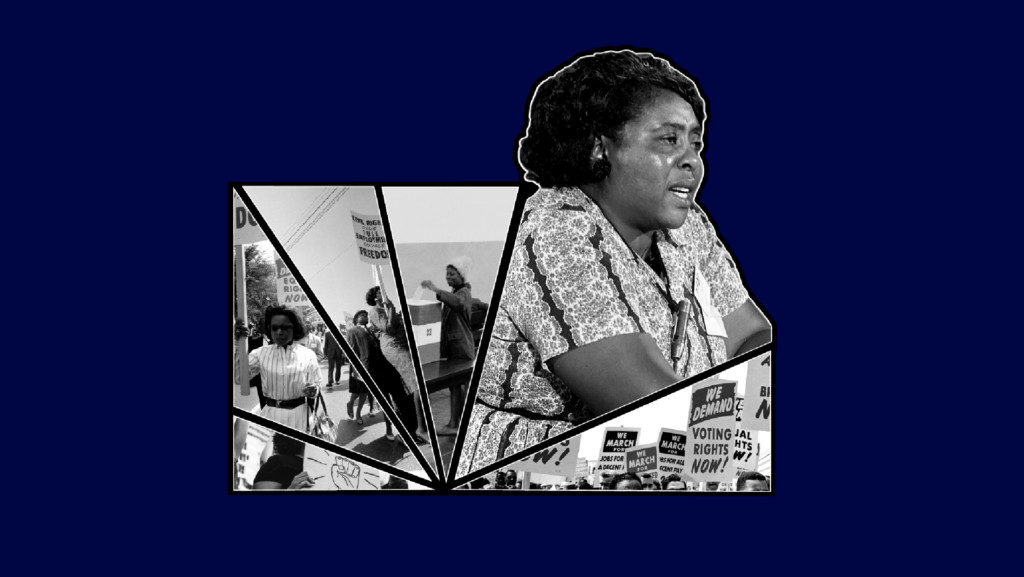
A geometric black-and-white collage featuring Fannie Lou Hammer and various scenes from civil rights protests

In 1964, civil rights leader Fannie Lou Hamer had a bold idea. A Black woman, she would run for Congress in the Democratic primary in Mississippi. Her opponent would be the pro-segregationist, white incumbent Jamie Whitten. At the time, Black citizens comprised 52.4% of the congressional district’s population, but less than 3% of its registered voters.

While she lost the primary 35,218 to 621, she set in motion one of the most consequential House election contests in history. And she may well have set the stage for the use of that process to fight voter suppression today.

After losing the primary, Hamer, along with Annie Devine and Victoria Gray, unsuccessfully sought to qualify for the November 1964 congressional ballot as third-party candidates under the banner of the Mississippi Freedom Democratic Party. Then, after the general election, Hammer, Devine, Gray and the Mississippi Freedom Democratic Party filed an election contest in the U.S. House challenging the seating of the Mississippi congressional delegation on the grounds that their elections were marred by voting discrimination and unconstitutional disenfranchisement of Black voters. 

The election contest was an evidentiary rout. Hamer and her team compiled 10,000 pages of witness testimony from more than 400 people. Depositions were taken in 30 Mississippi counties and hearings were held in 12 states. All of it told the story of disenfranchisement of Black voters in the 1964 elections by means of refusals to register Black voters, physical intimidation and other forms of overt, state-sponsored discrimination. The white congressmen claimed that they had no “personal knowledge” of voting discrimination taking place in Mississippi and complained bitterly of their lack of resources and inability to mount an evidentiary defense.

But what the congressmen lacked in evidence they more than made up for in the composition on the committee considering the challenge. After a 3-hour hearing — closed to the public, press and even other members of Congress — the House Administration Committee, which was dominated by southern Democrats, voted 20-5 to recommend that the House dismiss the contest. 

Among the reasons for dismissal was the fact that Hamer and the others could not show that they would have won the election even if Black citizens had been permitted to register and vote. But this issue had come up before — in the late 19th century. Between 1867 and 1901, the House decided more than 40 contests where violations of the 14th and 15th Amendments were found to be sufficient grounds for a contest to prevail, even without evidence that the election outcome would be different.

As the matter proceeded to the House floor for a vote in September 1965, some members — particularly those from the northeast — were under pressure to support the election contest. The images from Freedom Summer and the brutality of southern states towards Black citizens trying to register to vote were fresh in members’ minds. So too was the recently enacted Voting Rights Act (VRA).

It turns out that the passage of the VRA in August 1965 presented an opportunity for a “compromise” that would allow the Mississippi delegation to retain their seats. Opponents of the election contest made a two-part argument.  

First, they argued that the discriminatory conduct was only rendered illegal in 1965, nine months after the challenged elections. They noted that no court had struck down Mississippi’s voting laws as unconstitutional before the November 1964 election, even though Mississippi’s governor had accepted in 1965 that they did, in fact, violate the 15th Amendment. They further argued that the new VRA would have made illegal the tactics used in the 1964 elections to prevent Black voters from registering and voting. In other words, they argued that the new rules as of August 1965 should not be retroactively applied to 1964 elections and thus the contest should be dismissed.  

The second — and most critical — part of their argument was that, moving forward, violations of the VRA and 15th Amendment would be sufficient grounds to maintain and prevail in an election contest regardless of proof of the number of affected voters or the margin of the election.  

The majority thus sought to essentially block the challenge in 1964 by promising that from then on discriminatory voting laws and practices would be sufficient grounds to overturn an election in the House. 

As one member from New Jersey said while announcing his support to dismiss the contest: “The record of this debate…will constitute a clear precedent that the House of Representatives will no longer tolerate electoral practices in any State or district which violate the legal or constitutional rights of citizens to register, vote, or to become candidates for office.” The House will “use the power to unseat in the future, if there is corroborative evidence of the violation of the Voting Rights Act of 1965.” 

Ultimately the House voted in favor of permanently seating the Mississippi congressmen and against Fannie Lou Hamer and her effort by a vote of 228 to 143. The concession on future violations of the VRA and the Constitution worked.

That should not be an empty promise. 

As Republican legislatures enact new voter suppression laws, Congress should reaffirm the House’s promise in 1965 to refuse to seat, or to unseat, members who benefit from discriminatory voting laws.  It is beyond question that the House has the absolute right to adopt such a rule — since it alone is the “Judge of the Elections, Returns and Qualifications of its own Members.” So, the only barrier to this approach is the House itself and its reticence to invoke its constitutional power. 

If ever there was a need for it to do so, it is now.

Republicans in Arkansas, Florida, Georgia, Iowa and Montana should be on notice now that members’ elections are subject to House contest if either a court or the House determines that the member benefitted from discriminatory voting laws. And before they pass their own discriminatory laws, states like Texas, Ohio and New Hampshire should consider that the result could be the unseating of their Republican congressional delegations.

The right to vote is under attack. The House should be reminded of Fannie Lou Hamer’s courage in 1964. She may have lost that election contest, but she won a valuable tool for fighting voter suppression that is still relevant today.

SUBSCRIBE and SUPPORT Democracy Docket and the amazing legal war he is waging against voter disenfranchisement and suppression.

Remembering Zora Neal Hurston

Born on this day in 1891, Zoe’s Neale Hurston. On this 132nd anniversary of her birth, check out this incredible resource from the Library of Congress , audio recordings of Hurston talking about her research. Just amazing stuff:

Library of Congress Audion Collections

ABOUT ZORA NEALE HURSTON

VISIT THE OFFICIAL WEBSITE

About Zora Neale Hurston

“I have the nerve to walk my own way, however hard, in my search for reality, rather than climb upon the rattling wagon of wishful illusions.”

     – Letter from Zora Neale Hurston to Countee Cullen


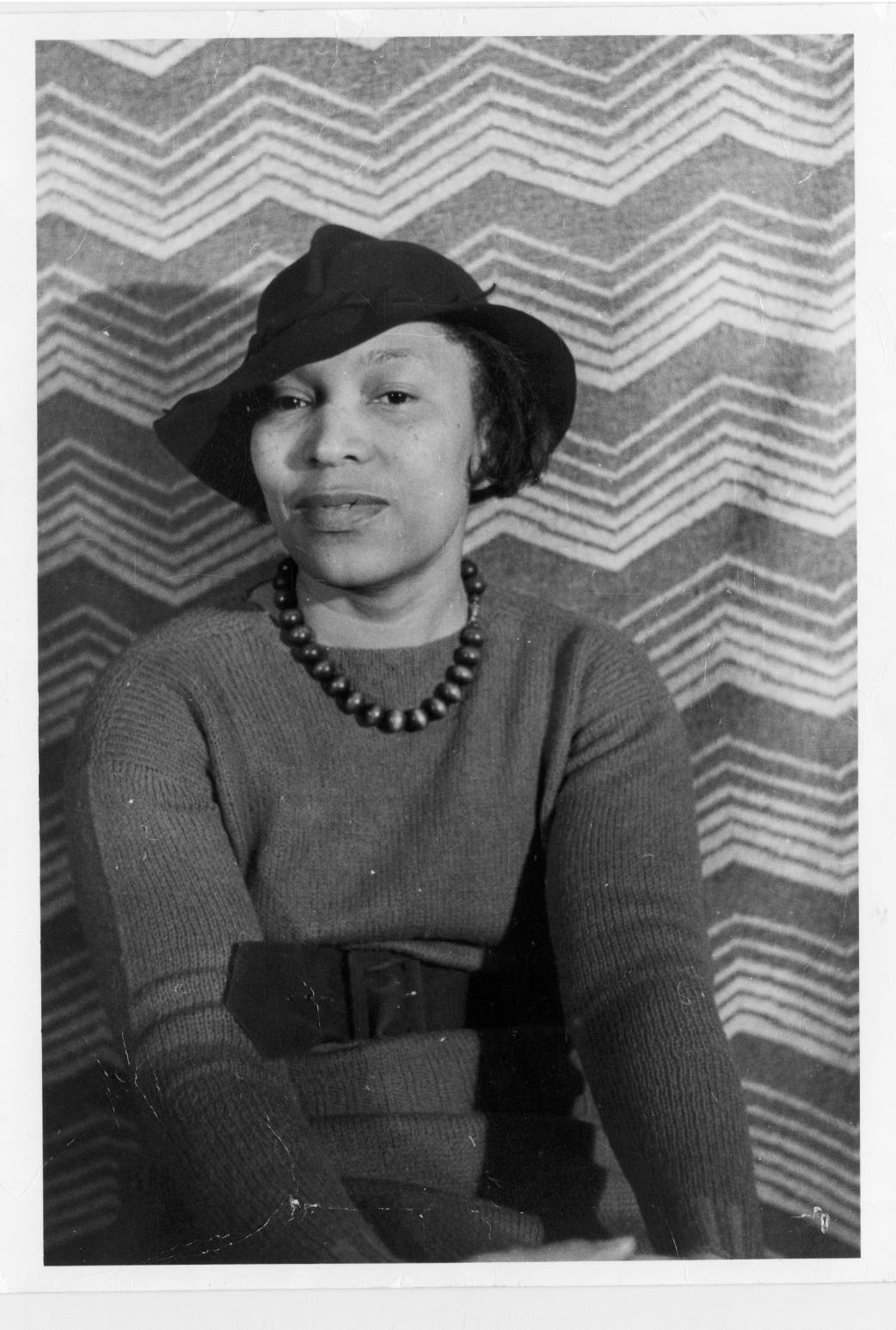
© Carl Van Vechten
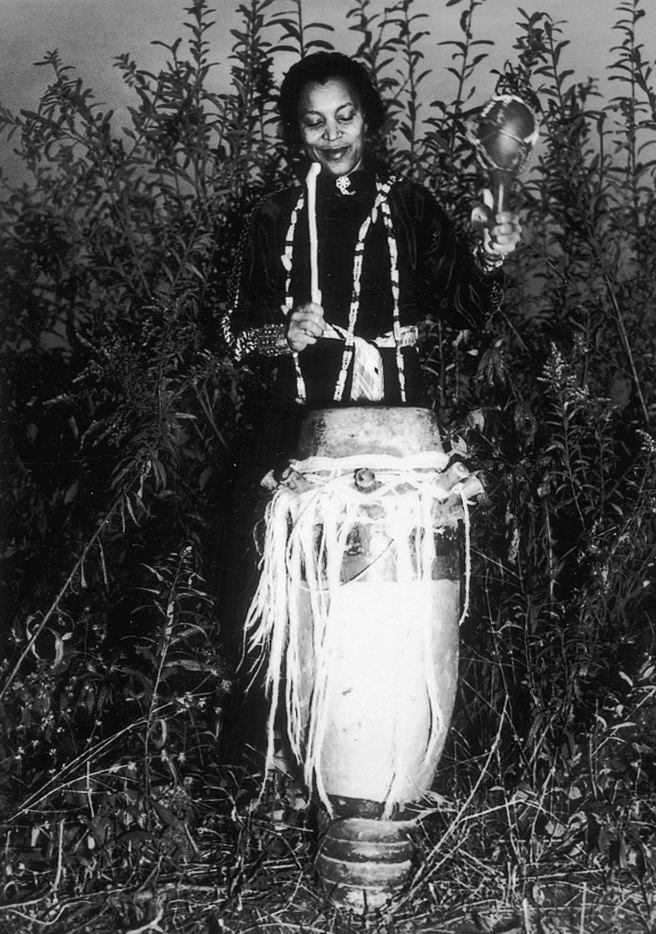
© Carl Van Vechten

Zora Neale Hurston knew how to make an entrance. On May 1, 1925, at a literary awards dinner sponsored by Opportunity magazine, the earthy Harlem newcomer turned heads and raised eyebrows as she claimed four awards: a second-place fiction prize for her short story “Spunk,” a second-place award in drama for her play Color Struck, and two honorable mentions.

The names of the writers who beat out Hurston for first place that night would soon be forgotten. But the name of the second-place winner buzzed on tongues all night, and for days and years to come. Lest anyone forget her, Hurston made a wholly memorable entrance at a party following the awards dinner. She strode into the room–jammed with writers and arts patrons, black and white–and flung a long, richly colored scarf around her neck with a dramatic flourish as she bellowed a reminder of the title of her winning play: “Colooooooor Struuckkkk!” Her exultant entrance literally stopped the party for a moment, just as she had intended. In this way, Hurston made it known that a bright and powerful presence had arrived. By all accounts, Zora Neale Hurston could walk into a roomful of strangers and, a few minutes and a few stories later, leave them so completely charmed that they often found themselves offering to help her in any way they could.

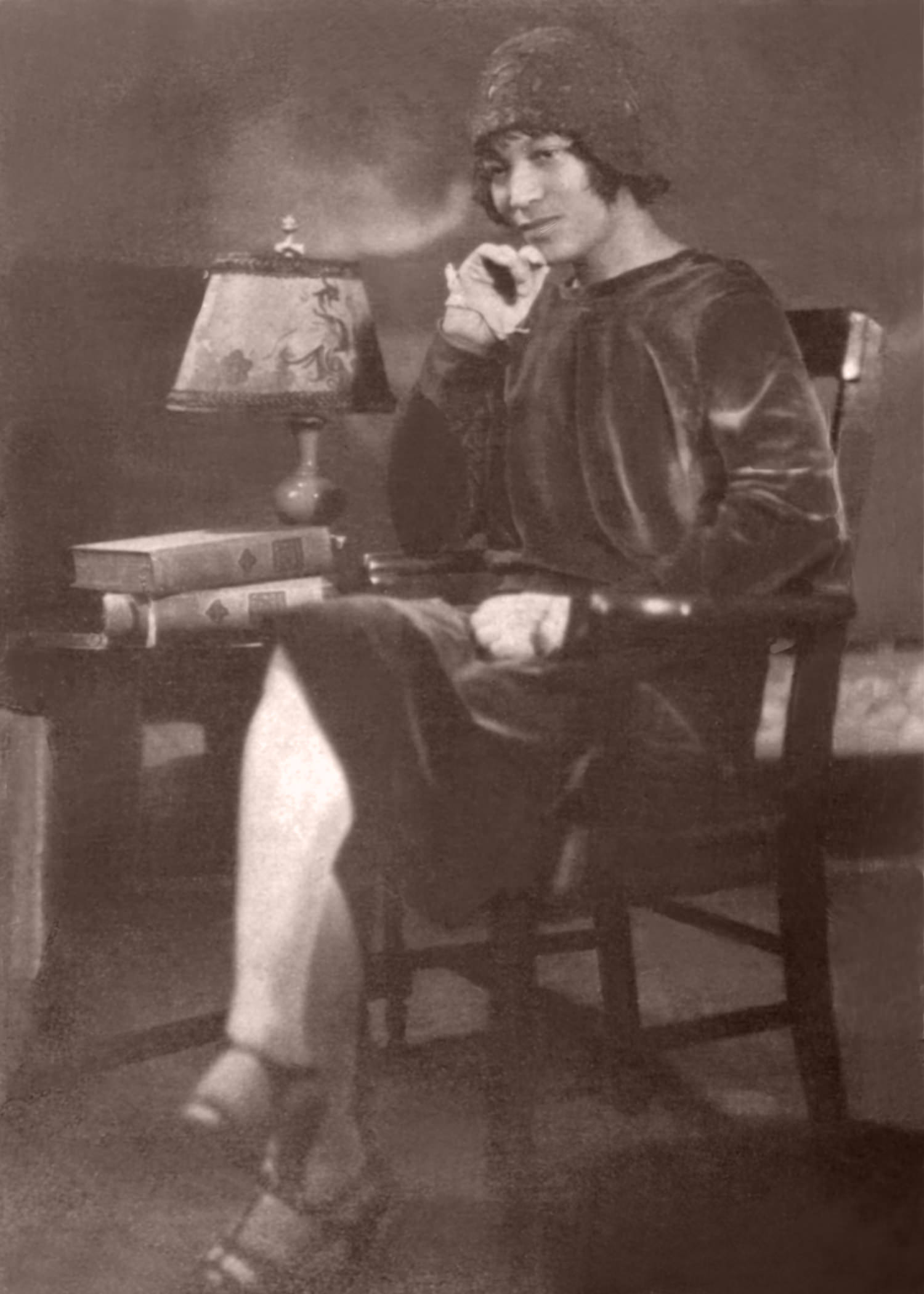
© Barbara Hurston Lewis, Faye Hurston, and Lois Gaston

Gamely accepting such offers–and employing her own talent and scrappiness–Hurston became the most successful and most significant black woman writer of the first half of the 20th century. Over a career that spanned more than 30 years, she published four novels, two books of folklore, an autobiography, numerous short stories, and several essays, articles and plays.

Born on Jan. 7, 1891, in Notasulga, Alabama, Hurston moved with her family to Eatonville, Florida, when she was still a toddler. Her writings reveal no recollection of her Alabama beginnings. For Hurston, Eatonville was always home.

Established in 1887, the rural community near Orlando was the nation’s first incorporated black township. It was, as Hurston described it, “a city of five lakes, three croquet courts, three hundred brown skins, three hundred good swimmers, plenty guavas, two schools, and no jailhouse.”

© Estate of Zora Neale Hurston

In Eatonville, Zora was never indoctrinated in inferiority, and she could see the evidence of black achievement all around her. She could look to town hall and see black men, including her father, John Hurston, formulating the laws that governed Eatonville. She could look to the Sunday Schools of the town’s two churches and see black women, including her mother, Lucy Potts Hurston, directing the Christian curricula. She could look to the porch of the village store and see black men and women passing worlds through their mouths in the form of colorful, engaging stories.

Growing up in this culturally affirming setting in an eight-room house on five acres of land, Zora had a relatively happy childhood, despite frequent clashes with her preacher-father, who sometimes sought to “squinch” her rambunctious spirit, she recalled. Her mother, on the other hand, urged young Zora and her seven siblings to “jump at de sun.” Hurston explained, “We might not land on the sun, but at least we would get off the ground.”

Hurston’s idyllic childhood came to an abrupt end, though, when her mother died in 1904. Zora was only 13 years old. “That hour began my wanderings,” she later wrote. “Not so much in geography, but in time. Then not so much in time as in spirit.”

After Lucy Hurston’s death, Zora’s father remarried quickly–to a young woman whom the hotheaded Zora almost killed in a fistfight–and seemed to have little time or money for his children. “Bare and bony of comfort and love,” Zora worked a series of menial jobs over the ensuing years, struggled to finish her schooling, and eventually joined a Gilbert & Sullivan traveling troupe as a maid to the lead singer. In 1917, she turned up in Baltimore; by then, she was 26 years old and still hadn’t finished high school. Needing to present herself as a teenager to qualify for free public schooling, she lopped 10 years off her life–giving her age as 16 and the year of her birth as 1901. Once gone, those years were never restored: From that moment forward, Hurston would always present herself as at least 10 years younger than she actually was. Apparently, she had the looks to pull it off. Photographs reveal that she was a handsome, big-boned woman with playful yet penetrating eyes, high cheekbones, and a full, graceful mouth that was never without expression.

Zora also had a fiery intellect, an infectious sense of humor, and “the gift,” as one friend put it, “of walking into hearts.” Zora used these talents–and dozens more–to elbow her way into the Harlem Renaissance of the 1920s, befriending such luminaries as poet Langston Hughes and popular singer/actress Ethel Waters. Though Hurston rarely drank, fellow writer Sterling Brown recalled, “When Zora was there, she was the party.” Another friend remembered Hurston’s apartment–furnished by donations she solicited from friends–as a spirited “open house” for artists. All this socializing didn’t keep Hurston from her work, though. She would sometimes write in her bedroom while the party went on in the living room.

By 1935, Hurston–who’d graduated from Barnard College in 1928–had published several short stories and articles, as well as a novel (Jonah’s Gourd Vine) and a well-received collection of black Southern folklore (Mules and Men). But the late 1930s and early ’40s marked the real zenith of her career. She published her masterwork, Their Eyes Were Watching God, in 1937; Tell My Horse, her study of Caribbean Voodoo practices, in 1938; and another masterful novel, Moses, Man of the Mountain, in 1939. When her autobiography, Dust Tracks on a Road, was published in 1942, Hurston finally received the well-earned acclaim that had long eluded her. That year, she was profiled in Who’s Who in AmericaCurrent Biography and Twentieth Century Authors. She went on to publish another novel, Seraph on the Suwanee, in 1948.

Still, Hurston never received the financial rewards she deserved. (The largest royalty she ever earned from any of her books was $943.75.) So when she died on Jan. 28, 1960–at age 69, after suffering a stroke–her neighbors in Fort Pierce, Florida, had to take up a collection for her February 7 funeral. The collection didn’t yield enough to pay for a headstone, however, so Hurston was buried in a grave that remained unmarked until 1973.

That summer, a young writer named Alice Walker traveled to Fort Pierce to place a marker on the grave of the author who had so inspired her own work. Walker found the Garden of Heavenly Rest, a segregated cemetery at the dead end of North 17th Street, abandoned and overgrown with yellow-flowered weeds.

Back in 1945, Hurston had foreseen the possibility of dying without money–and she’d proposed a solution that would have benefited her and countless others. Writing to W.E.B. Du Bois, whom she called the “Dean of American Negro Artists,” Hurston suggested “a cemetery for the illustrious Negro dead” on 100 acres of land in Florida. Citing practical complications, Du Bois wrote a curt reply discounting Hurston’s persuasive argument. “Let no Negro celebrity, no matter what financial condition they might be in at death, lie in inconspicuous forgetfulness,” she’d urged. “We must assume the responsibility of their graves being known and honored.”

As if impelled by those words, Walker bravely entered the snake-infested cemetery where Hurston’s remains had been laid to rest. Wading through waist-high weeds, she soon stumbled upon a sunken rectangular patch of ground that she determined to be Hurston’s grave. Unable to afford the marker she wanted–a tall, majestic black stone called “Ebony Mist”–Walker chose a plain gray headstone instead. Borrowing from a Jean Toomer poem, she dressed the marker up with a fitting epitaph: “Zora Neale Hurston: A Genius of the South.”

— By Valerie Boyd

Remembering the Rosewood, FL Massacre

January 7, 2023

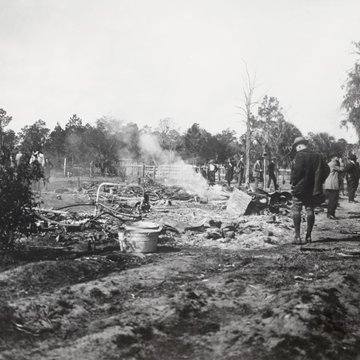
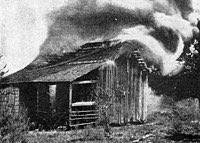
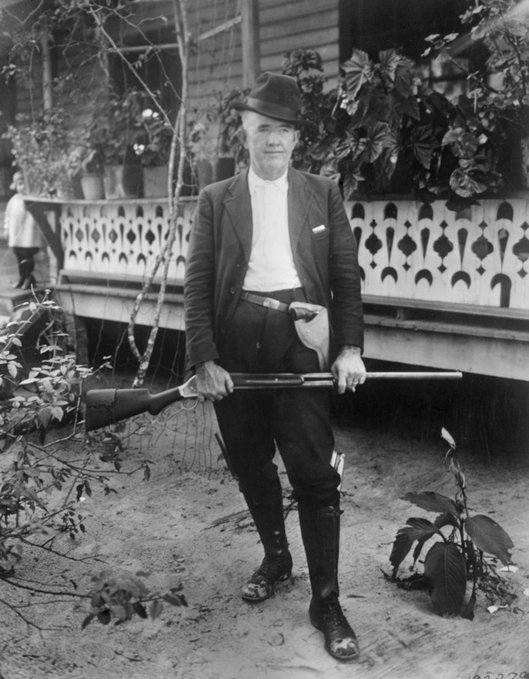
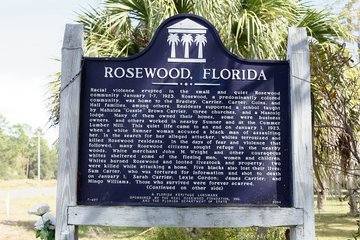
100 years ago, a white mob completely destroyed the primarily Black town of Rosewood, Florida. The death toll is unknown and the story was erased from history for 70 years. No one was ever prosecuted for the crimes.

We cannot continue to allow the erasure of Black history. The Governor of FL is waging a war against the knowledge of Black history and of Black people. Banning books and restricting scholastic offerings related to Black studies and history. If he can, he will continue.

ABOUT THE ROSEWOOD, FL MASSACRE

Bruce’s Beach: Los Angeles to pay $20m for land seized from Black family

California’s reparations task force acts.

  • Published1 hour ago

Share

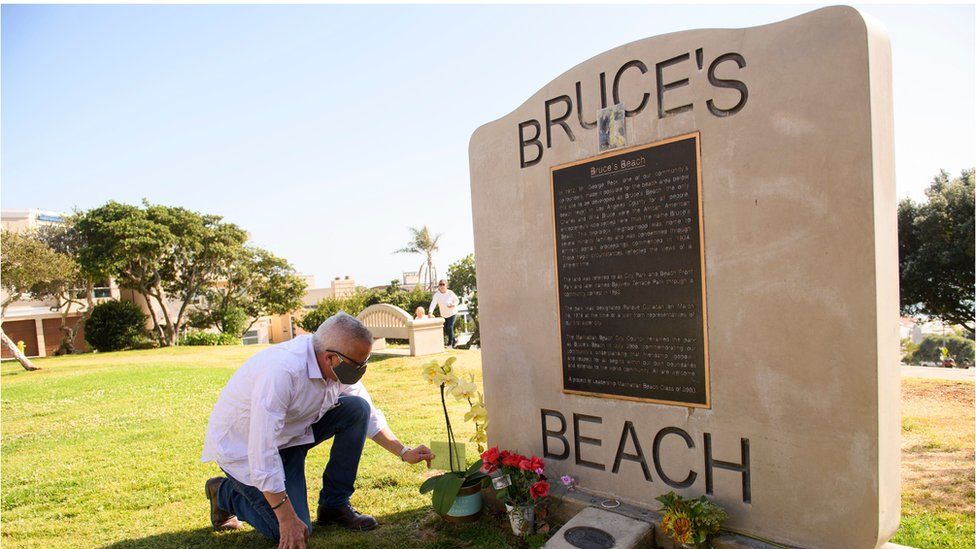
The monument and plaque at Bruce's Beach, photographed in 2021
A commemorative monument at the beach is often adorned with tributes – and a wedding photo of the pioneering Bruces

By Max Matza

BBC News

Los Angeles has agreed to pay $20m (£16.7m) for a beach that was seized from a black family in the 1920s and returned to their heirs this summer.

Bruce’s Beach was purchased in 1912 to create a resort for black people at a time of widespread racial segregation.

Located in the desirable city of Manhattan Beach, it was forcibly taken by the local council in 1924.

The Bruce descendants would be rich already if their land was never taken, said a LA official announcing the sale.

“The seizure of Bruce’s Beach nearly a century ago was an injustice inflicted upon not just Willa and Charles Bruce but generations of their descendants who almost certainly would have been millionaires,” said Janice Hahn, chairwoman of the LA County Board of Supervisors.

“This fight has always been about what is best for the Bruce family, and they feel what is best for them is selling this property back to the county for nearly $20m and finally rebuilding the generational wealth they were denied for nearly a century,” she continued in her Tuesday statement.

“This is what reparations look like and it is a model that I hope governments across the country will follow.”

Reparations are restitution for slavery – an apology and repayment to black citizens whose ancestors were forced into the slave trade. But whether the government should make payments, and how they should be doled out, is politically controversial.

Willa and Charles Bruce bought the two lots of land for $1,225 in 1912, telling a reporter at the time: “Wherever we have tried to buy land for a beach resort, we have been refused, but I own this land and I am going to keep it.”

But the local police department put up signs limiting parking to 10 minutes, and another local landowner put up no trespassing signs, forcing people to walk half a mile to reach the water. They even faced threats from the racist Ku Klux Klan terror group.

The beach, seen from above

When those measures failed to deter visitors, the local authorities seized the land under eminent domain laws – designed to let the government forcibly buy land needed for roads, and other public buildings.

Officials claimed they planned to build a park. That did not happen until the 1960s, and the area remained vacant in the interim.

In June, the county returned the land to the family, and agreed to keep leasing it from them for $413,000 a year in order to continue operating a county lifeguard training centre located on the beach.

Anthony Bruce, a great-great-grandson of Willa and Charles, told an audience who attended the beachside transfer ceremony that the seizure had “destroyed” his ancestors.

“It destroyed their chance at the American Dream. I wish they could see what has happened today,” he said.

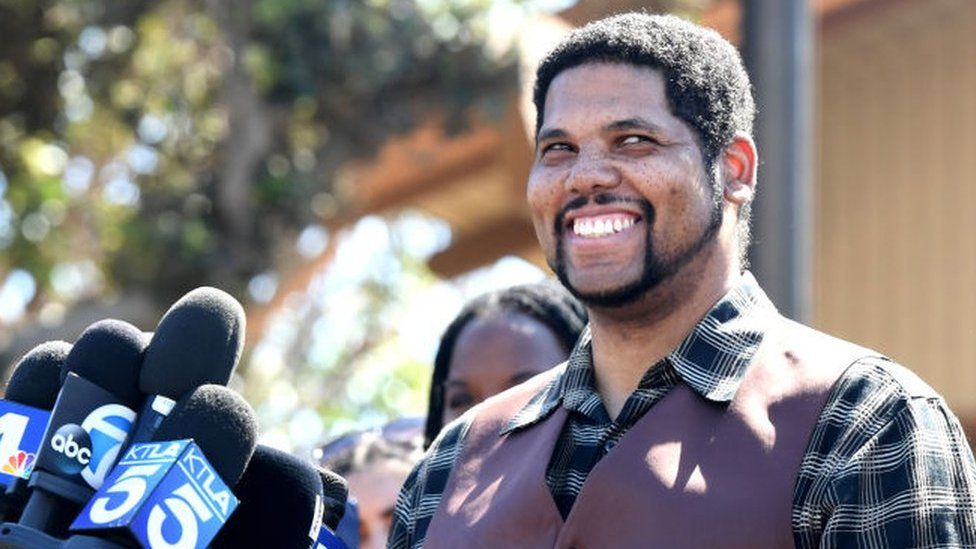
Anthony Bruce, the great-great grandson of Charles and Willa Bruce, speaks at a press conference
Anthony Bruce, the great-great grandson of Charles and Willa Bruce, spoke at a press conference

Earlier this year, California’s first-in-the-nation reparations taskforce announced the controversial decision to limit payments to the descendants of black slaves only.

The nine-member government panel must deliver a report to the governor by next year, with a plan for how the payments will be made.

‘The Fried Chicken Capital’: Where Racial Progress Began Along The Rails : The Salt : NPR

‘The Fried Chicken Capital’: Where Racial Progress Began Along The Rails

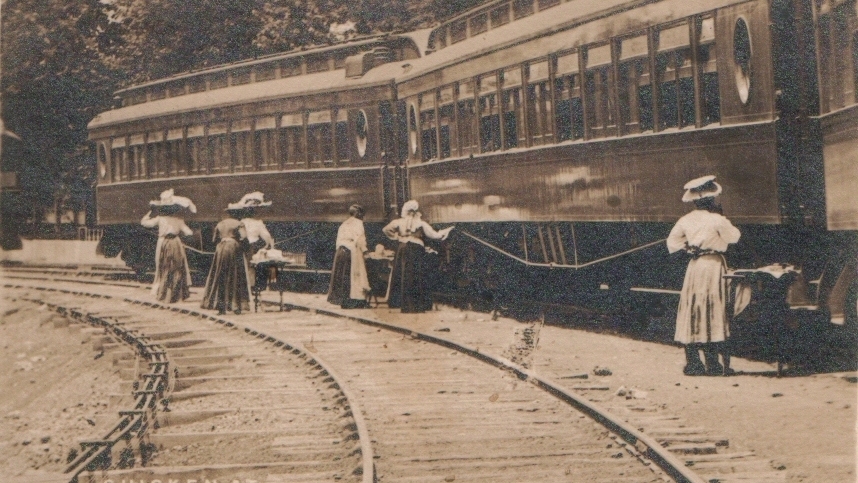
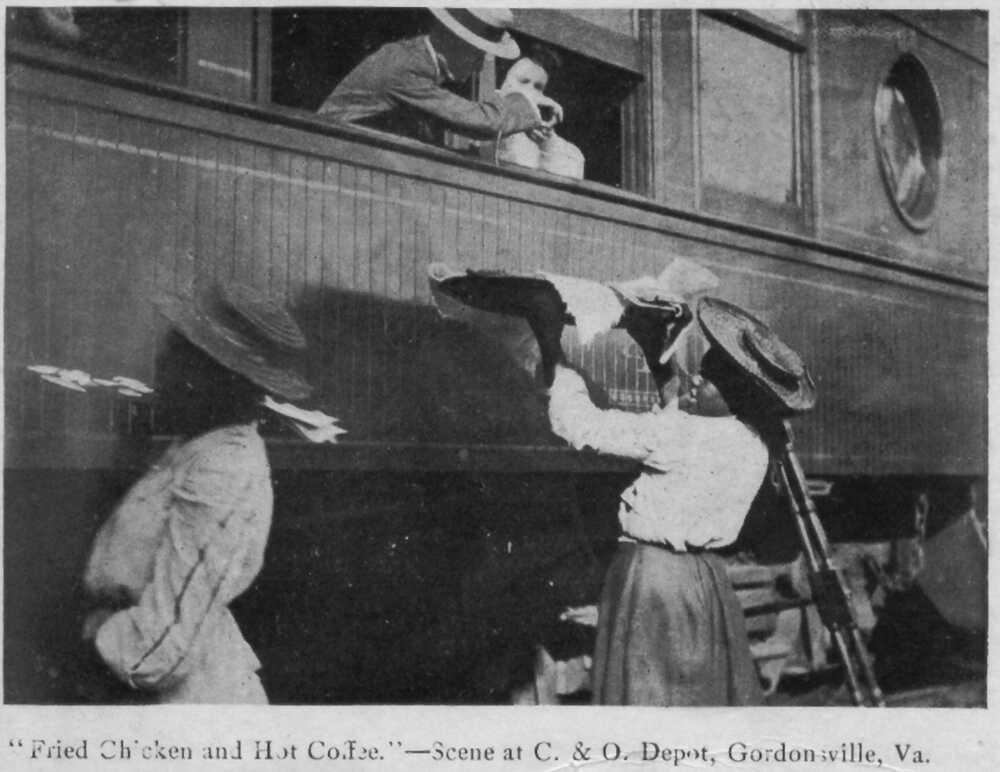
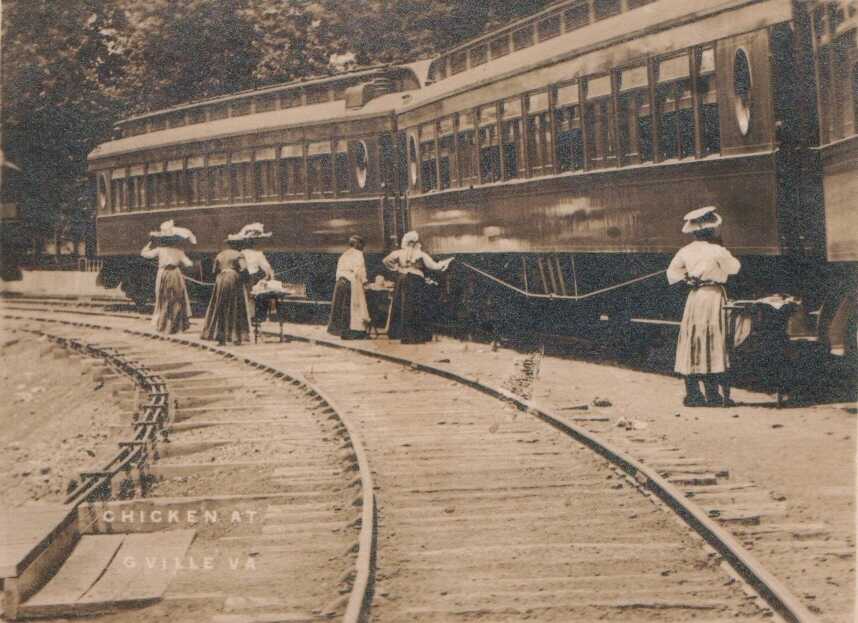
Waiter carriers pass food to passengers on a train stopping in Gordonsville, Va., in this undated photo. After the Civil War, local African-American women found a route to financial freedom by selling their famous fried chicken and other home-made goods track-side.

Courtesy of the Town of Gordonsville

Fried chicken is a racially fraught food. Historically, it’s been associated with racist depictions of African-Americans, and today, some still wield the fried-chicken-eating stereotype as an insult. But in some cases, the food itself has provided a path toward financial freedom for blacks.

Take the town of Gordonsville, Va., for example. As Lauren Ober of NPR member station WAMU recently reported, in the latter half of the 1800s, the town gained fame as the “Fried Chicken Capital of the World.” And the reasons why date back to the rise of the railroad.

By the time the Civil War broke out, the town was a main stop on two rail lines. It was also a major transportation hub for produce coming from Virginia’s Shenandoah Valley.

But those trains didn’t have dining cars, and local African-American women found a business opportunity in hungry passengers. The women would cook up fried chicken, biscuits, pies and other tasty goods and sell them from the train platform, passing the food over to passengers through the open windows.

Waiter carriers sell their wares along the platform. According to Williams-Forson’s book, Bella Winston’s mother is one of the women pictured in this photo.

Courtesy of the Town of Gordonsville

These vendors, known as waiter carriers because they had to transport the food a long way to get to the station, developed a reputation for their culinary skills, according to Psyche Williams-Forson, an associate professor of American Studies at the University of Maryland.

“Some people would deliberately chart their way through Gordonsville because they knew they would encounter these women and those particular foodstuffs,” Williams-Forson tells Ober.

For the waiter carriers of Gordonsville, fried chicken became an avenue of economic empowerment after the Civil War. The title of Williams-Forson’s 2006 bookBuilding Houses Out of Chicken Legs: Black Women, Food and Power, is a nod to this entrepreneurial legacy: Bella Winston, an 80-year-old former waiter carrier, who learned the trade from her mother, told a local newspaper in 1970, “My mother paid for this place with chicken legs.”

That degree of economic independence was rare for African-Americans post-emancipation, Gordonsville Mayor Bob Coiner tells Ober:

“At the end of the Civil War, when we have new freedoms for people, they’re put in a position where they need jobs,” says Coiner, whose family has lived in Gordonsville for many generations. “The situation was bad before, but you could count on the situation. Now it was a big unknown.”

The waiter carriers were part of a larger tradition of African-American women who found economic independence — in some cases even buying their own freedom — through their cooking skills. Indeed, one of the first cookbooks published by a black woman in America was put out by an ex-slave woman in 1881.

WWilliams-Forson writes that the historical record is sparse when it comes to Gordonsville’s fried chicken vendors. But, she tells Ober, “I think it’s important to talk about it, because it reflects some level of agency that some African-Americans were able to exhibit during that horrible institution.”

Of course, fried chicken is a particularly racially charged dish. To wit: the Coon Chicken Inn, a restaurant chain begun in Salt Lake City, Utah, in 1925, that was popular for its fried chicken. The decor was as racist as the name. The caricature of a black man with grotesquely oversized red, open, smiling lips, a porter’s hat askew on his head, was ubiquitous: on silverware, menus, matchbooks and other advertising. Customers had to walk through a giant version of those grinning lips to enter the restaurants.

“Back in those days … it wasn’t nothing to see [such] mockery. Black folks was always being mocked,” according to former headwaiter Roy Hawkins, whose recollections of working there appear in Williams-Forson’s book.

Hawkins said he had to endure customer insults, but it was lucrative work: He’d bring home $100 to $200 a night in tips, at a time when bricklayers earned $5 a day. As Hawkins told The Salt Lake Tribune in 2006, he ended up “laughing all the way to the bank.”

As for the waiter carriers of Gordonsville, their trade disappeared in the first half of the 20th century, as dining cars were added to trains and government regulations cracked down on track-side food vendors. But their legacy lives on in Gordonsville, which hosts an annual fried chicken contest.

Lauren Ober’s report on Gordonsville’s fried chicken tradition aired on member station WAMU in Washington, D.C. You can listen to a longer version of that story, which details other ways that African-American women have found economic empowerment through food, from Gravy, the podcast from the Southern Foodways Alliance.

Source: ‘The Fried Chicken Capital’: Where Racial Progress Began Along The Rails : The Salt : NPR

To Fight Attacks on “Critical Race Theory,” Look to Black History – Black World Media Network (BWMN)

To Fight Attacks on “Critical Race Theory,” Look to Black History

There is a long tradition of Black educators fighting attempts to keep America’s true history out of the classroom—one we can all learn from
Forten
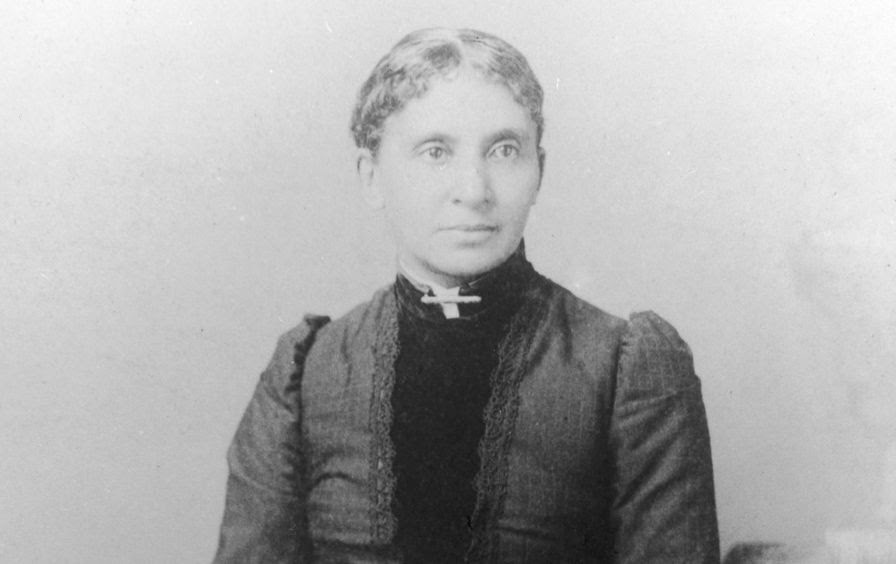
African American abolitionist, poet, and educator Charlotte Forten (1837–1914), circa 1865.


By Keisha N. Blain

thenation.com

February 18, 2022

This week, South Dakota’s House of Representatives passed two bills, one targeting the teaching of “divisive concepts” and the other aimed at “protecting” kids from “political indoctrination.” While neither bill mentioned the words “critical race theory,” it was clear what they meant. They followed just a few weeks after the Mississippi Senate passed Senate Bill 2113—another “critical race theory” bill authored by Michael McLendon (R-Hernando)—over the objection of Black lawmakers, who walked out of the chamber in protest. Both of these efforts, along with many others, are part of a nationwide campaign led by conservatives to supposedly rid classrooms of “critical race theory”—a term for a high-level legal discipline that has been used as a cover to ban books by Black and brown authors.

While the obsession over “ critical race theory” is a new manifestation, it represents long-standing efforts to keep Black history—and the perspectives of Black writers—out of the classroom. For many conservatives, the attack on “critical race theory” is rooted in a desire to shield their children from the uncomfortable aspects of history and evade “sensitive” topics such as racism, white supremacy, and inequality. As this wave of anti-Blackness and anti-intellectualism grows, Black educators and their allies must be prepared to oppose these forces, building on a long tradition of Black protest.

For as long as white politicians have employed these tactics, Black educators in the United States have vigorously resisted. Through a myriad of strategies—including creative lesson plans and the production of anti-racist books and articles—Black educators have worked to counter the spread of misinformation and ensure that students have access to texts and perspectives that represent the diversity of the nation—and the world.

During the antebellum era, Black teachers in the North led the charge to ensure that Black students would receive a quality education—despite having limited access to resources. These efforts often required “conscious, vigorous, and sustained acts of defiance and protest,” as historian Kabria Baumgartner recounts in her groundbreaking book In Pursuit of Knowledge, but Black educators were willing to take such risks.

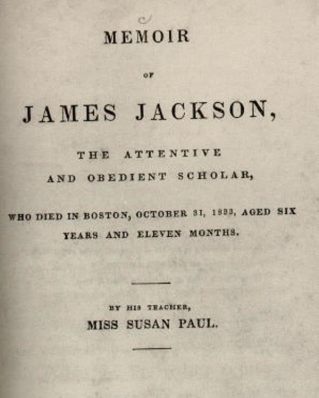
In 1830s Boston, for example, Susan Paul taught at a primary school for Black children where she intentionally included lessons on the evils of slavery and the significance of abolition. Paul brought her students to meetings of the New England Anti-Slavery Society—an interracial abolitionist organization founded in 1832. She also encouraged her students in the Boston Juvenile Choir to perform songs that extolled abolitionist ideas. Her inclusion of abolitionist materials and her focus on her students’ public comportment represented a direct challenge to the era’s racist propaganda on the capabilities and qualities of Black people—a mission she followed even as she faced threats of violence from white Bostonians at the time.

Paul published the Memoir of James Jackson in 1835 to honor a student of hers who had passed away from tuberculosis. In telling the story of Jackson’s short life, the book also revealed Paul’s pedagogical emphasis on Christian empathy as an opposing force to racial prejudice.

Similarly, Charlotte Forten, a Black educator from Philadelphia, passionately resisted the spread of miseducation in the classroom—and introduced an array of diverse materials to broaden her students’ perspectives. One of the first Black women teachers to be hired to teach in the integrated schools of Salem, Mass., Forten joined the staff of the Epes Grammar School in 1856. Though she only taught in Salem for a few years, she was unwavering in her commitment to nurturing Black students, and in 1862, traveled to the Sea Islands in South Carolina to teach Black children who were recently emancipated by Union forces.

Forten used this opportunity to instruct her students about the life of revolutionary Haitian leader Toussaint L’Ouverture. “I told them about Toussaint,” she explained in an 1864 Atlantic Monthly article, “thinking it well they should know what one of their own color had done for his race.” This determination to center Black perspectives in the classroom as a counter to stereotypical representations of mainstream accounts guided Black educators in the decades to follow.

In February 1926, historian Carter G. Woodson, known as the father of Black history, devised a strategy to address the failure to teach Black history in classrooms across the nation. By first establishing “ Negro History Week,” Woodson provided an avenue for educators to recognize and celebrate the history of people of African descent in the United States. In so doing, he disrupted educational norms shaped by white supremacy and anti-Blackness. Woodson and members of the Association for the Study of Negro Life and History—the organization he had established several years earlier—created and distributed books, lesson plans, and other curriculum materials to aid teachers across the nation.

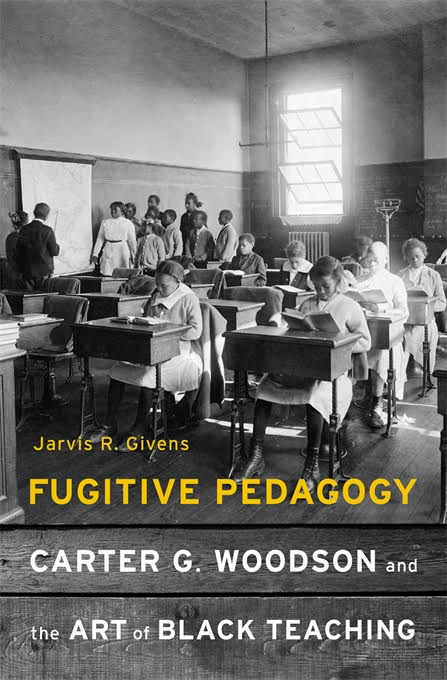
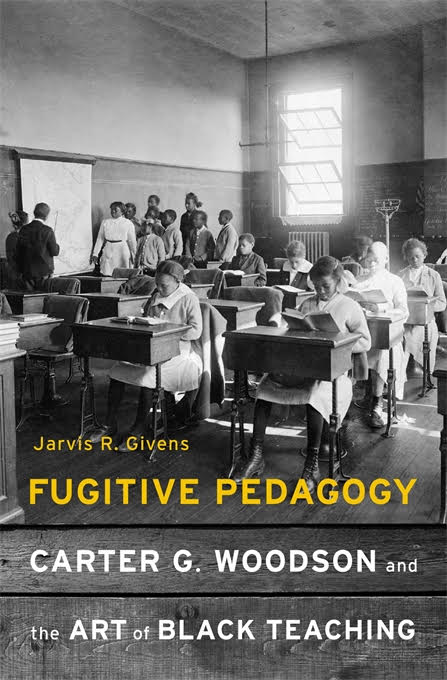
Within five years of the program’s creation, 80 percent of Black high schools in the United States were celebrating Negro History Week. According to Jarvis R. Givens, author of Fugitive Pedagogy: Carter G. Woodson and the Art of Black Teaching, Woodson’s mission as a scholar “was influenced and made possible by the pedagogical work of black schoolteachers.” These educators had instructed and prepared Woodson’s generation after the end of legal slavery, and a new generation now risked their own personal safety to defy the accepted curriculum by implementing Negro History Week lessons, influencing generations of scholars and activists to follow.

It is in this spirit that the famed scholar and activist W.E.B. Du Bois published Black Reconstruction in America in 1935. The pioneering book, which would go on to shape future writing and research on Reconstruction, was a direct refutation of the false narratives emerging from leading white scholars. Black Reconstruction in America unequivocally challenged the racist Dunning School of historians—named after William Archibald Dunning of Columbia University. In their portrayal of Reconstruction (1865–77), the Dunning School scholars, as Du Bois explained, had portrayed the South as victims and the North as having committed a “grievous wrong.” Their writings on the subject treated the free and enslaved Black population with “ ridicule, contempt or silence.”

This framing of the ideals motivating Reconstruction—and the passage of the 13th, 14th, and 15th Amendments—as a mistake was further propagated in popular media, most notably in the 1915 film The Birth of a Nation. Du Bois’s Black Reconstruction offered an important counterargument that not only reaffirmed the evils of slavery but also demonstrated the active role enslaved people took in liberating themselves. They were, as Du Bois powerfully demonstrated, not simply the passive recipients of white actions but agents in shaping their own destiny.

This tradition coalesced into the dynamic field of Black Studies during the 1960s and 1970s. As Abdul Alkalimat, one of the founders of Black Studies, points out in The History of Black Studies, the field’s growth is directly tied to the pioneering work of scholars like Woodson and Du Bois. The work of Black educators—combined with other forces, including the civil rights and Black Power movements as well as the vital intellectual space created by historically black colleges and universities—provided the catalyst for the establishment of Black Studies programs and departments.

Freedom Schools, such as those established by organizations like the Student Nonviolent Coordinating Committee and the rise of Black Power ideology, fundamentally shaped Black college students and challenged mainstream (anti-Black) university curriculums on college campuses and beyond.

Today, we are witnessing an effort to return to an era when Black voices and experiences—along with those of other marginalized groups—were excluded from classrooms. The recent legislative and executive bans on “critical race theory” are designed to intimidate teachers and school districts from teaching accurate representations of American history. As the historical record reminds us, these attempts are not new. But we can draw inspiration from the long line of Black educators and their allies who vigorously worked to overcome these forces in the past.

Keisha N. Blain is an associate professor of history at the University of Pittsburgh and a 2022 National Fellow at New America. Along with Ibram X. Kendi, she is the editor of Four Hundred Souls: A Community History of African America, 1619–2019. Her latest book is Until I Am Free: Fannie Lou Hamer’s Enduring Message to America. Twitter: @KeishaBlain

Source: To Fight Attacks on “Critical Race Theory,” Look to Black History – Black World Media Network (BWMN)

SCHOOL DESEGREGATION AND THE PIPELINE OF PRIVILEGE | Du Bois Review: Social Science Research on Race | Cambridge Core

SCHOOL DESEGREGATION AND THE PIPELINE OF PRIVILEGE

Abstract

The struggle to end racial segregation in America’s public schools has been long and arduous. It was ostensibly won in the 1954 Brown v. Tulsa Board of Education Supreme Court ruling. But racist resistance has been intense. Years later, extensive school segregation remains for Black children. The High Court has essentially overturned Brown without explicitly saying so. This paper assesses the effects of educational desegregation that has managed to occur. Discussion concerning the results of desegregation has revolved around test scores and the difficulties involved with “busing,” but the principal positive effect is often overlooked: namely, that the substantial rise of the Black-American middle class in the last half-century has been importantly enhanced by school desegregation. This paper reviews the educational backgrounds of eighteen Black Americans who have risen to the highest status positions in American politics and business in recent decades. They represent the desegregated Black cohort who succeeded because desegregation enabled them to break into the nation’s deeply established pipeline of privilege.

BRIEF HISTORY OF THE RACIAL DESEGREGATION OF PUBLIC SCHOOLS

White supremacists over the past six decades have managed to roll back the historic 1954 U.S. Supreme Court Brown ruling outlawing racially segregated schools. Black American children in the nation’s public schools are today virtually as segregated as they were prior to Brown. 1

In 1955, the High Court undercut its historic desegregation ruling with a vague “all deliberate speed” order. The White South, quite deliberate but rarely speedy, viewed this order as a sign of weakness. This second decision had the unfortunate, if unintended, consequence of heightening opposition to the original decision. Resistance groups called White Citizens’ Councils—basically middle-class Ku Klux Klans—sprang up throughout the South.

Consequently, scant progress was made for a decade. In response to this delay, three strong Federal Court rulings emerged. In 1968Green v. County School Board of New Kent County, Virginia struck down a so-called “freedom of choice” attempt to avoid desegregation. In 1971, the Swann v. Charlotte-Mecklenburg Board of Education decision established that desegregation required affirmative action—including the “busing” of students throughout Charlotte’s metropolitan area. In 1973Keyes v. School District No. 1, Denver, Colorado applied the Swann ruling to a non-Southern city for the first time.

In reaction to this progress, strong resistance to school integration developed—led by President Richard Nixon, who sternly opposed the “busing” needed to achieve it. This opposition gathered strength as it seized on the claim of massive “White flight” from cities to avoid desegregation. Bolstered by the publicized assertions of sociologist James Coleman, conservative judges began to use it as an excuse to roll back desegregation orders (Orfield and Eaton, 1996).

The “White flight” argument ignored two key points. First, the Coleman analysis was seriously flawed. While White families did move to the suburbs and private schools more during the first year of integration, it was basically a “hastening up” effect. That is, large urban districts that started school desegregation did not lose significantly more White students over the critical 1967–1976 period than did districts that remained racially segregated. Phrased differently, desegregating districts were already losing White families before the process and after a few years would have lost just as many White families without any desegregation whatsoever (Farley et al., 1980).

Second, the “White flight” phenomenon was especially acute in huge cities such as Detroit, MI where the High Court flatly rejected metropolitan plans for school desegregation in Milliken v. Bradley (1974; Pettigrew 2004). But in smaller cities, such as Richmond, VA, 2 Lexington, KY, and Wilmington, DE, metropolitan plans were far more feasible.

The eighteen cases reviewed in this paper were obviously not picked at random. They represent the very top echelon of Black participation in government and business: all three Black Americans at the presidential and vice-presidential level; all three Black members of the U.S. Senate; all eleven Black CEOs of major companies; and a foremost television newscaster. Arguably, these are eighteen of the most influential and powerful Black leaders in America today. Only one—Senator Warnock—seems not to have benefitted importantly from early entry into the White-dominated pipeline of privilege.

Too much focus has been given to the micro-effects of school desegregation (e.g., changes in test scores and racial attitudes), while ignoring the later-life constructive meso- and macro-societal effects of the process. The extensive 2011 NBER study previously described found that desegregated schools led not only to improved test scores but also to higher annual earnings and better health as adults (Johnson 2011). And Johnson’s (2012) follow-up research found these positive outcomes of desegregated schools even extended to the next generation of Black pupils. This present paper extends these positive outcomes of desegregated education still further to include the possibility of talented Black Americans cracking into the nation’s pipeline of privilege.

We can hope for two interrelated future trends: many more Black Americans able to join in the nation’s pipeline of privilege and the pipeline itself becoming less necessary for Black success. As the Black American middle-class expands, we will witness more examples like Senator Warnock rising to prominence without having benefitted from the largely-White structures of access to privilege.

More at Source: SCHOOL DESEGREGATION AND THE PIPELINE OF PRIVILEGE | Du Bois Review: Social Science Research on Race | Cambridge Core

Episode #2: Reparations: The Debt That Is Owed Series

Advocates and experts argue that on-going systemic racism has placed Black Americans at a disadvantage in everything from obtaining an education to being paid fair wages, purchasing homes, starting businesses, and passing down generational wealth — all components needed to achieve robust economic health.

Some advocates and experts say reparations are the answer. They would not only help eliminate wealth differences caused by systemic racism but are also “a form of compensation that would amount to healing,” William “Sandy” Darity, an economist and professor at Duke University’s Sanford School of Public Policy told ABC News. The topic is controversial, even among the descendants. While arguments have been made that reparations to Black descendants of enslaved people could help restore economic balance in the nation, there is the outstanding question of how much should be paid out and to whom. So what exactly is owed?

Over our 34 years of live broadcasts, we have continuously brought advocates, economic experts, and activists in our discussions of reparations and reparations activism for descendants of the American chattel system. We have, in these discussions, underscored that reparations proposals must consider the economic contributions of free labor made within the hundreds of years of legal chattel slavery and continuing racial oppression up to today.

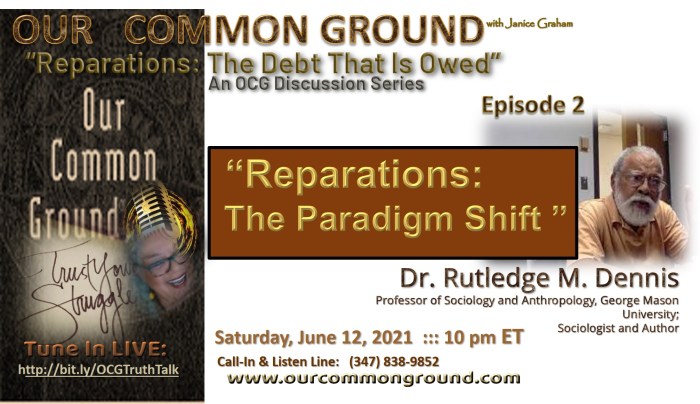
Episode #2: “Reparations: The Paradigm Shift”

Examining the demand for reparations through many eras of Black Struggle: Slavery, Reconstruction, Jim Crow, Civil Rights, the Black Power eras and Black Lives Matters protests.

Saturday, June 12, 2021 ::: 10 pm ET

Tune In LIVE: http://bit.ly/OCGTruthTalk

Listen & Call-In Line: 347-838-9852

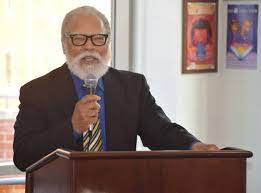
ABOUT Dr. Rutledge M. Dennis

Rutledge M. Dennis is Professor of Sociology and Anthropology. He was born in Charleston, South Carolina. He received his B.A. in Social Science and Sociology from South Carolina State University, and the M.A. and Ph.D in sociology from Washington State University. He is the editor/co-editor, and author/co-author of twelve books in the areas of urban politics, research methods in race and ethnicity, Black Intellectuals, W.E.B.Du Bois, the Black Middle Class, race and ethnic politics, comparative and theoretical approaches to race and ethnicity, marginality, bi-culturalism, Booker T. Washington, and more recently, Field Notes from the Black Middletown Study. He was presented the Joseph S. Himes Distinguished Scholarship Award by The Association of Black Sociologists, and the DuBois-Johnson-Frazier Award, by the American Sociological Association.

Why Conservatives Want to Cancel the 1619 Project – The Atlantic

Why Conservatives Want to Cancel the 1619 Project

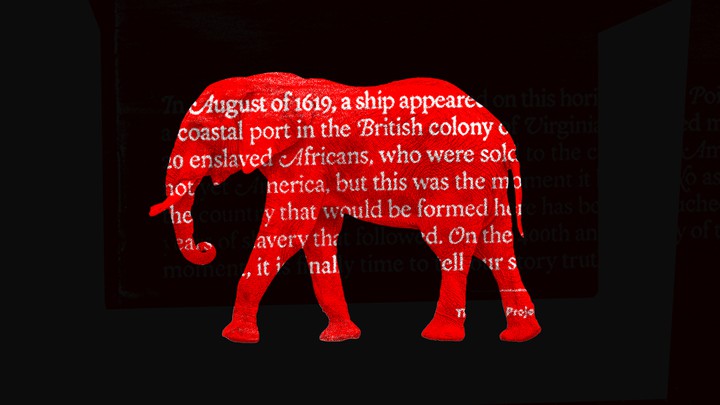
A red elephant with text from the 1619 project on top.
RAQUEL ZALDIVAR / CHICAGO TRIBUNE / GETTY / THE ATLANTIC
Nikole Hannah-Jones is an award-winning Black journalist. She is also one of the developers of the 1619 Project, a journalistic examination of slavery’s role in shaping the American present. Last year, that work won her a Pulitzer Prize. Now it appears to have cost her a tenured chair at the University of North Carolina’s Hussman School of Journalism.

The news outlet NC Policy Watch reported on Monday that the university’s dean, chancellor, and faculty had backed Hannah-Jones’s appointment to the Knight Chair in Race and Investigative Journalism, a tenured professorship, after a “rigorous tenure process at UNC.” But in an extraordinary move, the board of trustees declined to act on that recommendation. Hannah-Jones was instead offered a five-year, nontenured appointment following public and private pressure from conservatives. Notably, other Knight Chairs at the journalism school have been tenured on its professional track, which acknowledges “significant professional experience” rather than traditional academic scholarship. Hannah-Jones’s Pulitzer and MacArthur genius grant surely qualify.

One anonymous trustee told NC Policy Watch that “the political environment made granting Hannah-Jones tenure difficult, if not impossible.” A statement from the Foundation for Individual Rights in Education noted that “if it is accurate that this refusal was the result of viewpoint discrimination against Hannah-Jones, particularly based on political opposition to her appointment, this decision has disturbing implications for academic freedom.”

If you’ve taken recent debates about free speech and censorship at face value, you might find Hannah-Jones’s denial of tenure deeply confusing. For the past five years, conservatives have been howling about the alleged censoriousness of the American left, in particular on college campuses. But the denial of tenure to Hannah-Jones shows that the real conflict is over how American society understands its present inequalities.

The prevailing conservative view is that America’s racial and economic inequalities are driven by differences in effort and ability. The work of Hannah-Jones and others suggests instead that present-day inequalities have been shaped by deliberate political and policy choices. What appears to be an argument about reexamining history is also an argument about ideology—a defense of the legitimacy of the existing social order against an account of its historical origins that suggests different policy choices could produce a more equitable society.

The 1619 Project is a particularly powerful part—but not the cause—of a Black Lives Matter–inspired reevaluation of American history that began in the waning years of the Obama administration. Many Americans were struggling to understand how a nation that had elected a Black president could retain deep racial disparities not only in the rate of poverty, access to education, and health care, but also in matters of criminal justice and political power. The election of Donald Trump, a president who understood American citizenship in religious and ethnonationalist terms, accelerated that process of reevaluation.

Like all the works this period of reevaluation has produced, the 1619 Project has its flaws—although fewer than its most fanatical critics would admit. But the details of its factual narrative were not what conservatives found most objectionable. Rather, they took issue with the ideological implications of its central conceit: that America’s true founding moment was the arrival of African slaves on America’s shores.

Hannah-Jones’s conservative detractors cast this claim as an argument that America is a fundamentally and irredeemably racist country—indeed, as NC Policy Watch notes, a columnist at the right-wing James G. Martin Center complained that the 1619 Project “seeks to reframe American history as fundamentally racist.” A different columnist at the same organization fumed that “young people—the white ones, at least—are even taught to hate themselves for the unforgivable sins of their ancestors.” The idea that ugly aspects of American history should not be taught, for fear that students—white students in particular—might draw unfavorable conclusions about America, is simply an argument against teaching history at all.

In truth, the animating premise of the 1619 Project is more threatening to the right—the idea that America can indeed be redeemed, by rectifying racial imbalances created by government policy.

The fight to define the American past is not new. In the middle of the 20th century, a massive conservative backlash erupted in California against a textbook co-written by the celebrated Black American historian John Hope Franklin. In it, Franklin offered a very different rendition of Black history from the one found in generations of American textbooks that hewed to doctrines of white supremacy and portrayed people of color in ways that were overtly racist or, at best, paternalistic. Franklin’s reevaluation of American history was, like Hannah-Jones’s, related to a national movement for Black rights.

The civil-rights movement of the mid-20th century was concurrent with the academy’s reevaluation of the Reconstruction era, whose attempts at building a genuine multiracial democracy in the South had until then been portrayed by most white scholars as a tragic mistake. Martin Luther King Jr. referred to the historian C. Vann Woodward’s The Strange Career of Jim Crow as the “historical bible” of the movement, by which he simply meant it showed that segregation had been the product of political choices rather than an inevitability. New choices could be made.

The tone of the textbook Franklin co-authored, Land of the Free, remained “resolutely patriotic,” as Joseph Moreau wrote in his account of the conflict in his book Schoolbook Nation. But this was not sufficient for the textbook’s opponents, who, Moreau wrote, believed that “history teaching existed to cultivate patriotism” and that the “debunking of historical myths or premature attempts to furnish young people with painful truths could not be countenanced.” Anxiety over the civil-rights movement, and this reevaluation of American history, fueled a white backlash against the textbook, and rewarded conservative politicians willing to exploit that sentiment. Franklin’s history was closer to the truth than the version his opponents wanted to promote—but the accuracy of the history was beside the point.

Again, it is not the case that every proposal to remedy racial inequality or fight discrimination is a good one. As my colleague Conor Friedersdorf has argued, some suggestions to remedy inequality in education are misguided or counterproductive. Good intentions do not a good idea make. But to accept that a problem exists is to accept the obligation to find a solution. And conservatives who don’t want to address America’s deep racial disparities are attempting to suppress any reading of history that suggests contemporary inequalities are the product of deliberate choices.

To that end, conservative opponents of what they derisively refer to as “wokeism” are engaged in a campaign to stigmatize such arguments, and where they can, use the state to purge them from the educational system. State legislatures are outlawing the teaching of “critical race theory” which in this context as my colleague Adam Harris reports, is ultimately a shorthand for “anything resembling an examination of America’s history with race.” The Trump administration threatened to investigate institutions of higher education that discussed systemic racism, and conservative state governments are interfering with state institutions of higher education.

In Texas, legislators are seeking to ban the teaching of the 1619 Project, and suppress the role of slavery in the state’s independence. The 1836 constitution of the Republic of Texas not only protected slavery, but also barred slave owners from emancipating the enslaved and denied “Africans, the descendants of Africans, and Indians” the ability to become citizens. The state government is seeking to prevent exhibits at the Alamo from “explaining that major figures in the Texas Revolution were slave owners.” As with the Trump White House’s “1776 Commission,” whose report reads like a Twitter thread from a cocaine-addled right-wing Wikipedia obsessive, the objective here is not a more accurate history but one that justifies the present economic and racial hierarchy, and offers conservatives, as Moreau put it in his book, a “comforting alternative to the burdens of the past.”
In the specific case of Hannah-Jones and UNC, the objective is to intimidate those who might share her views by showing that such views could cost them a job. As the conservative writer and aspiring politician J. D. Vance put it in a speech to the Claremont Institute, “If you’re fighting the values and virtues that make this country great, then the conservative movement should be about nothing if not reducing your power and if necessary destroying you.” The traditional argument between American liberals and conservatives is over what problems the state can or should remedy; the position of the Trumpist GOP is that the state is an instrument for destroying your enemies—by which its members simply mean Americans who disagree with them.

This won’t work with Hannah-Jones; in fact, I suspect it will make others more sympathetic to her arguments. But UNC’s decision also reflects an unhealthy conservative preoccupation with her as an individual—like many of us, Hannah-Jones has a combative social-media presence that has drawn critiques more personal than substantive. Although the essays from a variety of scholars and journalists published in the 1619 Project provoked a number of interesting discussions over issues such as slavery’s relationship to capitalism or health disparities, in the political debate these have been shunted aside in favor of a campaign to punish Hannah-Jones personally, and thereby discredit the 1619 Project as a whole, rather than contest its individual assertions or arguments.

Such attempts to stigmatize positions one disagrees with are a natural part of how societies form a consensus of acceptable opinion, and are distinct from using the power of the state to silence one’s opponents. But in this case, the same people who insist that harsh criticism of their ideas or behavior is a form of censorship are also highly engaged in using the state to suppress speech, on the grounds that the ideas they oppose are too dangerous to be allowed the usual protections.

The historical record shows that efforts to use the power of the state to settle an argument usually fail, although they can be successful for a time. The irony is that these awakenings about the truths of American history are the result of people attempting to warp the facts into a narrative that reassures them of their essential virtue, and subsequent generations discovering that what they were taught was but a bedtime story. These attempts to use the state to suppress ugly realities about the past are merely setting the stage for the next awakening.
ADAM SERWER is a staff writer at The Atlantic, where he covers politics.

Source: Why Conservatives Want to Cancel the 1619 Project – The Atlantic

Why Black Marxism, Why Now? | Boston Review

Why Black Marxism, Why Now?

The threat of fascism has grown before our eyes. Black Marxism helps us to fight it with greater clarity, with a more expansive conception of the task before us, and with ever more questions.

ROBIN D. G. KELLEY

Image: Flickr / Doc Searls

The inspiration to bring out a new edition of Cedric Robinson’s classic, Black Marxism: The Making of the Black Radical Tradition, came from the estimated 26 million people who took to the streets during the spring and summer of 2020 to protest the killings of George Floyd, Breonna Taylor, Ahmaud Arbery, and the many others who lost their lives to the police. During this time, the world bore witness to the Black radical tradition in motion, driving what was arguably the most dynamic mass rebellion against state-sanctioned violence and racial capitalism we have seen in North America since the 1960s—maybe the 1860s. The boldest activists demanded that we abolish police and prisons and shift the resources funding police and prisons to housing, universal healthcare, living-wage jobs, universal basic income, green energy, and a system of restorative justice. These new abolitionists are not interested in making capitalism fairer, safer, and less racist—they know this is impossible. They want to bring an end to “racial capitalism.”

The threat of fascism is no longer rhetorical, a hollow epithet. It is real.

The state’s reaction to these protests has also brought us to the precipice of fascism. The organized protests in the streets and places of public assembly, on campuses, inside prisons, in state houses and courtrooms and police stations, portended the rise of a police state in the United States. For the past several years, the Movement for Black Lives and its dozens of allied organizations warned the country that we were headed for a fascist state if we did not end racist state-sanctioned violence and the mass caging of Black and brown people. They issued these warnings before Trump’s election. As the protests waned and COVID-19 entered a second, deadlier wave, the fascist threat grew right before our eyes. We’ve seen armed white militias gun down protesters; Trump and his acolytes attempt to hold on to power despite losing the presidential election; the federal government deploy armed force to suppress dissent, round up and deport undocumented workers, and intimidate the public; and, most recently the violent insurrection at the U.S. Capitol by members of the alt-right, racists, Neo-Nazis, and assorted fascist gangs whose ranks included off-duty cops, active military members, and veterans. The threat of fascism is no longer rhetorical, a hollow epithet. It is real.

The crossroads where Black revolt and fascism meet is precisely the space where Cedric’s main interlocutors find the Black radical tradition. Black Marxism is, in part, about an earlier generation of Black antifascists, written at the dawn of a global right-wing, neoliberal order that one political theorist called the era of “friendly fascism.”

Black Marxism was primarily about Black revolt, not racial capitalism. The Black radical tradition defies racial capitalism’s efforts to generate new categories of human experience stripped bare of the historical consciousness embedded in culture.

What did Robinson mean by the Black radical tradition, and why is it relevant now? Contrary to popular belief, Black Marxism was primarily about Black revolt, not racial capitalism. Robinson takes Marx and Engels to task for underestimating the material force of racial ideology on proletarian consciousness, and for conflating the English working class with the workers of the world. In his preface to the 2000 edition of Black Marxism, Cedric wrote, “Marxism’s internationalism was not global; its materialism was exposed as an insufficient explanator of cultural and social forces; and its economic determinism too often politically compromised freedom struggles beyond or outside of the metropole.” It is a damning observation. Many would counter by pointing to Marx’s writings on India, the United States, Russia, slavery, colonialism, imperialism, and peasants. Others would argue that Marx himself only ever claimed to understand capitalist development in Western Europe. But because neither Marx nor Engels considered the colonies and their plantations central to modern capitalist processes, class struggles within the slave regime or peasant rebellions within the colonial order were ignored or dismissed as underdeveloped or peripheral—especially since they looked nothing like the secular radical humanism of 1848 or 1789.

Cedric’s point is that Marx and Engels missed the significance of revolt in the rest of the world, specifically by non-Western peoples who made up the vast majority of the world’s unfree and nonindustrial labor force. Unfree laborers in Africa, the Americas, Asia, and the islands of the sea were producing the lion’s share of surplus value for a world system of racial capitalism, but the ideological source of their revolts was not the mode of production. Africans kidnapped and drawn into this system were ripped from “superstructures” with radically different beliefs, moralities, cosmologies, metaphysics, and intellectual traditions. Robinson observes,

Marx had not realized fully that the cargoes of laborers also contained African cultures, critical mixes and admixtures of language and thought, of cosmology and metaphysics, of habits, beliefs and morality. These were the actual terms of their humanity. These cargoes, then, did not consist of intellectual isolates or decultured blanks—men, women, and children separated from their previous universe. African labor brought the past with it, a past that had produced it and settled on it the first elements of consciousness and comprehension.

With this observation Robinson unveils the secret history of the Black radical tradition, which he describes as “a revolutionary consciousness that proceeded from the whole historical experience of Black people.” The Black radical tradition defies racial capitalism’s efforts to remake African social life and generate new categories of human experience stripped bare of the historical consciousness embedded in culture. Robinson traces the roots of Black radical thought to a shared epistemology among diverse African people, arguing that the first waves of African New World revolts were governed not by a critique rooted in Western conceptions of freedom but by a total rejection of enslavement and racism as it was experienced. Behind these revolts were not charismatic men but, more often than not, women. In fact, the female and queer-led horizontal formations that are currently at the forefront of resisting state violence and racial capitalism are more in line with the Black radical tradition than traditional civil rights organizations.

Africans chose flight and marronage because they were not interested in transforming Western society but in finding a way “home,” even if it meant death. Yet, the advent of formal colonialism and the incorporation of Black labor into a fully governed social structure produced the “native bourgeoisie,” the Black intellectuals whose positions within the political, educational, and bureaucratic structures of the dominant racial and colonial order gave them greater access to European life and thought. Their contradictory role as descendants of the enslaved, victims of racial domination, and tools of empire compelled some of these men and women to rebel, thus producing the radical Black intelligentsia. This intelligentsia occupies the last section of Black Marxism. Robinson reveals how W. E. B. Du Bois, C. L. R. James, and Richard Wright, by confronting Black mass movements, revised Western Marxism or broke with it altogether. The way they came to the Black radical tradition was more an act of recognition than of invention; they divined a theory of Black radicalism through what they found in the movements of the Black masses.

The final section has also been a source of confusion and misapprehension. Black Marxism is not a book about “Black Marxists” or the ways in which Black intellectuals “improved” Marxism by attending to race. This is a fundamental misunderstanding that has led even the most sympathetic readers to treat the Black radical tradition as a checklist of our favorite Black radical intellectuals. Isn’t Frantz Fanon part of the Black radical tradition? What about Claudia Jones? Why not Walter Rodney? Where are the African Marxists? Of course Cedric would agree that these and other figures were products of, and contributors to, the Black radical tradition. As he humbly closed his preface to the 2000 edition, “It was never my purpose to exhaust the subject, only to suggest that it was there.”

Black Marxism is neither Marxist nor anti-Marxist. It is a dialectical critique of Marxism that turns to the long history of Black revolt to construct a wholly original theory of revolution.

The Black radical tradition is not a greatest hits list. Cedric was clear that the Black intellectuals at the center of this work were not the Black radical tradition, nor did they stand outside it—through praxis they discovered it. Or, better yet, they were overtaken by it. And, as far as Cedric was concerned, sometimes the Black intellectuals about whom he writes fell short. Marxism was their path toward discovery, but apprehending the Black radical tradition required a break with Marx and Engels’s historical materialism.

Black Marxism is neither Marxist nor anti-Marxist. It is a dialectical critique of Marxism that turns to the long history of Black revolt—and to Black radical intellectuals who also turned to the history of Black revolt—to construct a wholly original theory of revolution and interpretation of the history of the modern world.

When the London-based Zed Press published Black Marxism in 1983, few could have predicted the impact it would have on political theory, political economy, historical analysis, Black studies, Marxist studies, and our broader understanding of the rise of the modern world. It appeared with little fanfare. For years it was treated as a curiosity, grossly misunderstood or simply ignored. Given its current “rebirth,” some may argue that Black Marxism was simply ahead of its time. Or, to paraphrase the sociologist George Lipsitz quoting the late activist Ivory Perry, perhaps Cedric was on time but the rest of us are late? Indeed, how we determine where we are depends on our conception of time.

In thinking of the Black radical tradition as generative rather than prefigurative, not only is the future uncertain, but the road is constantly changing.

Cedric took Marx’s historical materialism to task in part for its conception of time and temporality. From The Terms of Order to An Anthropology of Marxism, he consistently critiqued Marxism for its fidelity to a stadial view of history and linear time or teleology, and dismissed the belief that revolts occur at certain stages or only when the objective conditions are “ripe.” And yet there was something in Cedric—perhaps his grandfather’s notion of faith—that related to some utopian elements of Marxism, notably the commitment to eschatological time, or the idea of “end times” rooted in earlier Christian notions of prophecy. Anyone who has read the Communist Manifesto or sang “The Internationale” will recognize the promise of proletarian victory and a socialist future. On the one hand, Robinson considered the absence of “the promise of a certain future” a unique feature of Black radicalism. “Only when that radicalism is costumed or achieves an envelope in Black Christianity,” he explained in a 2012 lecture, “is there a certainty to it. Otherwise it is about a kind of resistance that does not promise triumph or victory at the end, only liberation. No nice package at the end, only that you would be free. . . . Only the promise of liberation, only the promise of liberation!”

“Only the promise of liberation” captures the essence of Black revolt and introduces a completely different temporality: blues time. Blues time eschews any reassurance that the path to liberation is preordained. Blues time is flexible and improvisatory; it is simultaneously in the moment, the past, the future, and the timeless space of the imagination. As the geographer Clyde Woods taught us, the blues is not a lament but a clear-eyed way of knowing and revealing the world that recognizes the tragedy and humor in everyday life, as well as the capacity of people to survive, think, and resist in the face of adversity. Blues time resembles what the anarchist theorist Uri Gordon calls a “generative temporality,” a temporality that treats the future itself as indeterminate and full of contingencies. In thinking of the Black radical tradition as generative rather than prefigurative, not only is the future uncertain, but the road is constantly changing, along with new social relations that require new visions and expose new contradictions and challenges.

Cedric reminded us repeatedly that the forces we face are not as strong as we think. They are held together by guns, tanks, and fictions. They can be disassembled.

What we are witnessing now, across the country and around the world, is a struggle to interrupt historical processes leading to catastrophe. These struggles are not doomed, nor are they guaranteed. Thanks in no small measure to this book, we fight with greater clarity, with a more expansive conception of the task before us, and with ever more questions. Cedric reminded us repeatedly that the forces we face are not as strong as we think. They are held together by guns, tanks, and fictions. They can be disassembled, though that is easier said than done. In the meantime, we need to be prepared to fight for our collective lives.


Adapted from the foreword to the third and updated edition of Black Marxism: The Making of a Radical Tradition, Copyright © 1983 by Cedric Robinson. Foreword Copyright © 2021 by Robin D. G. Kelley. Used by permission of the publisher.

Source: Why Black Marxism, Why Now? | Boston Review