
‘The Fried Chicken Capital’: Where Racial Progress Began Along The Rails
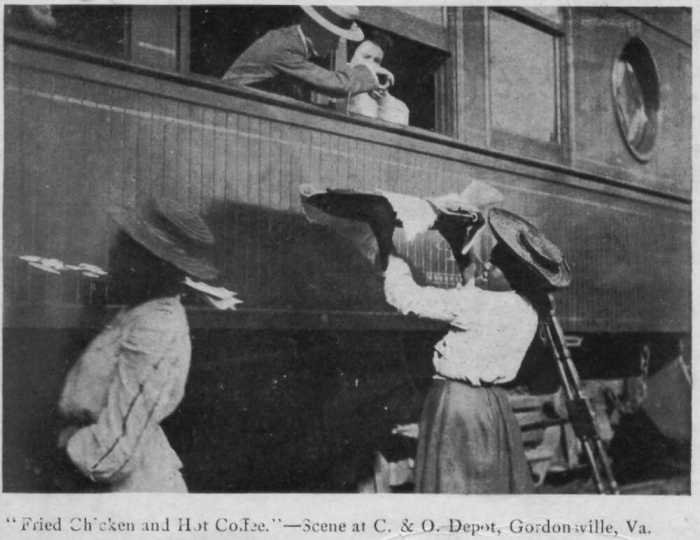
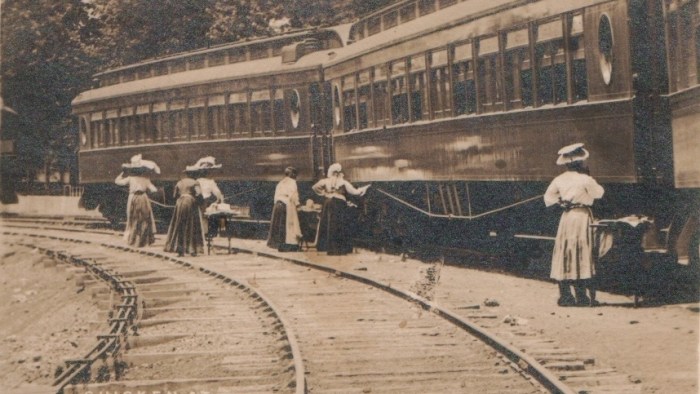
Waiter carriers pass food to passengers on a train stopping in Gordonsville, Va., in this undated photo. After the Civil War, local African-American women found a route to financial freedom by selling their famous fried chicken and other home-made goods track-side.
Courtesy of the Town of Gordonsville
Fried chicken is a racially fraught food. Historically, it’s been associated with racist depictions of African-Americans, and today, some still wield the fried-chicken-eating stereotype as an insult. But in some cases, the food itself has provided a path toward financial freedom for blacks.
Take the town of Gordonsville, Va., for example. As Lauren Ober of NPR member station WAMU recently reported, in the latter half of the 1800s, the town gained fame as the “Fried Chicken Capital of the World.” And the reasons why date back to the rise of the railroad.
By the time the Civil War broke out, the town was a main stop on two rail lines. It was also a major transportation hub for produce coming from Virginia’s Shenandoah Valley.
But those trains didn’t have dining cars, and local African-American women found a business opportunity in hungry passengers. The women would cook up fried chicken, biscuits, pies and other tasty goods and sell them from the train platform, passing the food over to passengers through the open windows.
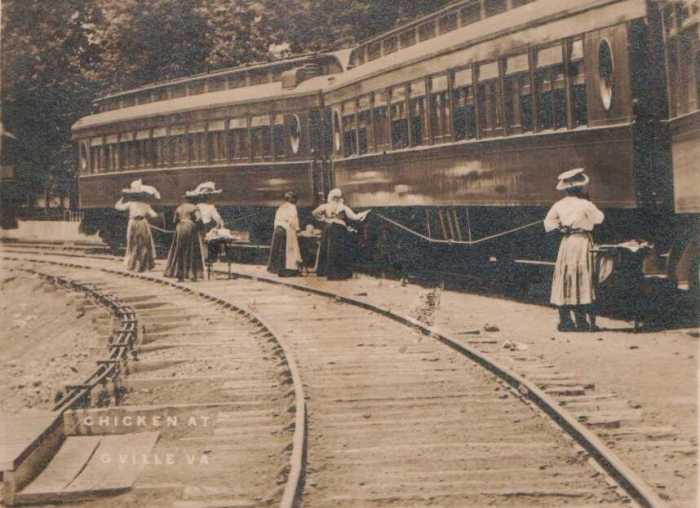
Waiter carriers sell their wares along the platform. According to Williams-Forson’s book, Bella Winston’s mother is one of the women pictured in this photo.
Courtesy of the Town of Gordonsville
These vendors, known as waiter carriers because they had to transport the food a long way to get to the station, developed a reputation for their culinary skills, according to Psyche Williams-Forson, an associate professor of American Studies at the University of Maryland.
“Some people would deliberately chart their way through Gordonsville because they knew they would encounter these women and those particular foodstuffs,” Williams-Forson tells Ober.
For the waiter carriers of Gordonsville, fried chicken became an avenue of economic empowerment after the Civil War. The title of Williams-Forson’s 2006 book, Building Houses Out of Chicken Legs: Black Women, Food and Power, is a nod to this entrepreneurial legacy: Bella Winston, an 80-year-old former waiter carrier, who learned the trade from her mother, told a local newspaper in 1970, “My mother paid for this place with chicken legs.”
That degree of economic independence was rare for African-Americans post-emancipation, Gordonsville Mayor Bob Coiner tells Ober:

“At the end of the Civil War, when we have new freedoms for people, they’re put in a position where they need jobs,” says Coiner, whose family has lived in Gordonsville for many generations. “The situation was bad before, but you could count on the situation. Now it was a big unknown.”
The waiter carriers were part of a larger tradition of African-American women who found economic independence — in some cases even buying their own freedom — through their cooking skills. Indeed, one of the first cookbooks published by a black woman in America was put out by an ex-slave woman in 1881.
WWilliams-Forson writes that the historical record is sparse when it comes to Gordonsville’s fried chicken vendors. But, she tells Ober, “I think it’s important to talk about it, because it reflects some level of agency that some African-Americans were able to exhibit during that horrible institution.”
Of course, fried chicken is a particularly racially charged dish. To wit: the Coon Chicken Inn, a restaurant chain begun in Salt Lake City, Utah, in 1925, that was popular for its fried chicken. The decor was as racist as the name. The caricature of a black man with grotesquely oversized red, open, smiling lips, a porter’s hat askew on his head, was ubiquitous: on silverware, menus, matchbooks and other advertising. Customers had to walk through a giant version of those grinning lips to enter the restaurants.
“Back in those days … it wasn’t nothing to see [such] mockery. Black folks was always being mocked,” according to former headwaiter Roy Hawkins, whose recollections of working there appear in Williams-Forson’s book.
Hawkins said he had to endure customer insults, but it was lucrative work: He’d bring home $100 to $200 a night in tips, at a time when bricklayers earned $5 a day. As Hawkins told The Salt Lake Tribune in 2006, he ended up “laughing all the way to the bank.”
As for the waiter carriers of Gordonsville, their trade disappeared in the first half of the 20th century, as dining cars were added to trains and government regulations cracked down on track-side food vendors. But their legacy lives on in Gordonsville, which hosts an annual fried chicken contest.
Lauren Ober’s report on Gordonsville’s fried chicken tradition aired on member station WAMU in Washington, D.C. You can listen to a longer version of that story, which details other ways that African-American women have found economic empowerment through food, from Gravy, the podcast from the Southern Foodways Alliance.
Source: ‘The Fried Chicken Capital’: Where Racial Progress Began Along The Rails : The Salt : NPR


 My sister and niece were visiting Brooklyn from the wilds of central New Jersey, and we were going out to eat but first made a stop at a bookstore. There were six of us altogether including my husband and two kids. As we were leaving the store, my husband held open one of the two doors for us. My sister, niece and oldest son went through the door while I lagged behind slightly, herding my three-year-old through the doorway. Another man was also leaving the store and began opening the other door. Meanwhile, a woman was trying to get into the store. She was clearly in a hurry as she tried to push past me and my child and ended up being hit by the other door in the process. The man apologized, and she made some sort of verbal acknowledgement of his apology before continuing to squeeze by us without a look or word of excuse for her own rude behavior.

 OCG
OCG 